Search Results: "Martin"

12 March 2009

Martin Michlmayr: Debian support for QNAP TS-119 and TS-219 Turbo NAS coming

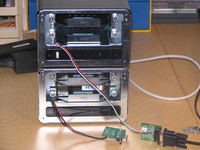
TS-219 on top of TS-209 I received a sample of QNAP's new TS-219 Turbo NAS today. The TS-119 and TS-219 devices are an upgrade to QNAP's TS-109 and TS-209 devices and were announced earlier this month at CeBIT. The new TS-219 uses the same robust case as the TS-209 but offers much more performance: The numbers I've seen about the Kirkwood CPU suggest that the TS-219 will indeed give a very significant performance boost. So far, the TS-219 looks very nice. My only complaint is that QNAP didn't export the second Ethernet port the Kirkwood chip offers, but I suspect this is because they wanted to stay as close to the original design of the TS-209 as possible. In any case, the TS-219 is a nice machine and I look forward to porting Debian to it. As a first step, this means getting the mainline kernel to run on the device and adding a kernel for Kirkwood to the archive (the latter is needed for a number of other devices based on Kirkwood anyway). Hopefully, the remaining porting work and integration into the Debian installer should be fairly straightforward given that the TS-209 is already supported in Debian. I'm sure I'll find out as I dig into the details... I'll give periodic updates of my progress. In the meantime, I've created an image gallery of the TS-219.

9 March 2009

Martin F. Krafft: Import to Switzerland: being charged for services you never asked for

When you order good into Switzerland, they will pass the customs office, where VAT and possibly import duties are levied. The customs office does not charge any duties if the total amount to be paid is less than 5 CHF Practically, given 7.6% VAT, this means that you can import 5 CHF / 0.076 = 65.79 CHF for free . As soon as you exceed this amount, it gets complicated. All of a sudden, the carrier charges you for the customs declaration it does in your name. What really blows my mind is that the fee to pay to the carrier (more on that later) actually plays into the whole equation. Let s assume you order goods for 100 CHF, which is well above the free import limit. You also paid 10 CHF for shipping. The carrier charges you 20 CHF to do the customs presentation for you. There, they determine that import duties are 5 CHF, and you end up paying: (100 + 10 + 20 + 5) * 107.6% = 145.26. That s fun, isn t it? I continue to be amazed by all the ways in which the government sucks money from your pockets. What s similarly baffling is how some carries deal with this. The Swiss Post (and their ally TNT) makes you pay taxes, duties, and fees on delivery, and their charges are the lowest when compared to the other carriers. With this approach, you have the option to refuse the package, if you re willing to deal with the vendor to get your money back. DHL is the only other carries I know who does things like the Swiss Post. However, due to their extraordinary crap performance and service, I could never recommend them to anyone. The three letters of DHL, a German company, apparently stand for das heisst langsam this means slow . None of the other carriers give you the option to accept the duties and their services. For instance, GLS delivers your parcel, and some weeks later you get an invoice, asking for the taxes and duties, and charging a fee of 45 CHF for their service, which you ve never really asked for and which you could not refuse. UPS, FedEx, and DPD fall into the same category, but their charges are lower. The one and only time I had used GLS to have something shipped to me, I called them up to complain about their invoice, and replied with an invoice of my own, in which I charged the same amount for opening and reading your letter and giving your call-centre employee the chance to talk to me directly . They got the message and dropped the invoice. The next step should be to play them off against each other: create some pencil art, write an invoice for half a million, and pay UPS to deliver the package to GLS headquarters. Attach a miniature audio transmitter to the invoice for added fun. NP: Goldie: Timeless

8 March 2009

Martin Michlmayr: D-Link DNS-323 and Conceptronic CH3SNAS support integrated in installer

I finally had a chance today to test the patches Matt Palmer created to add D-Link DNS-323 support to the Debian installer. I tested the patches on a Conceptronic CH3SNAS which, from a hardware perspective, is a D-Link DNS-323 (rev B1). I noticed that the firmware image specifies a number for the vendor, so we have to generate different installer images for the D-Link DNS-323 and Conceptronic CH3SNAS. That was easy enough to do and I was able to install Debian without any problems. The next steps are to write an installation guide and other documentation, and to improve the kernel (the power LED is blinking and cannot be changed, and fan control is missing).

7 March 2009

Martin Meredith: Cheese Nibbles and Podcasts

So, fanatical readers of my blog (are there any?) may remember a long time back that I got bored and wrote a little script that amused me. While testing something out yesterday, I needed to find a domain that I wasn t using in production so I could test on it. I stumbled across Cheese Nibbles which had a lovely We ll be back with something cool soon message on it. So, I did my tests, and they worked. Everything s good. I d actually forgotten what was on Cheese Nibbles in the first place, so I started rooting round in the code. I found the old site, and I decided to resurrect it. I posted in a couple of IRC channels, to see if other people found the site amusing, and got the following back in response
<Daviey> neat
<Daviey> Mez: rss feed needed
<Mez> Daviey: *chuckles*
<Mez> but then it d be twitter
<Daviey> sure, but a shared account :)
<Daviey> Or.. make it twitter when changed
So, well, thanks to Dave Walker s suggestion, I did a quick google, and within 6 minutes, had it working. You can find the twitter feed at http://twitter.com/cheesenibbles Also, over the last couple of weeks I ve been working with Zeth from my local LUG (and the tech, who shall remain anonymous, like The Stig ) on a podcast, which we are, for now calling The Podcast (imaginative I know). I was interviewed in the first podcast (which Zeth did alone, and I (apparently) provided the comedy element for) and presented with Zeth for the second one. Also, as the second one was recorded during the Ubuntu Global Bug Jam, of which I was running one of the venues, I actually allowed myself to be interviewed for it aswell. The podcast is very rough around the edges at the moment, and well, we haven t got a website, or an RSS feed yet, but you can find the show notes here, and download the podcast episode in either MP3 Format, or OGG Format All comments/thoughts/suggestions welcome!

6 March 2009

Martin F. Krafft: Case Logic cases ruin your CDs

While I have most of my albums encoded as Ogg Vorbis files, the music from my college days (and before) is still only on disc, either in a big box in storage, or in one of a couple Case Logic CD wallets I used back then to lug my tunes around the globe. I ve long been meaning to encode those and shove the boxes and cases into storage, but in more than a year, that hasn t happened. A few weeks ago, my adorable girlfriend offered the necessary encouragement, suspecting that I might enjoy going through old music again. Right she was: it s great fun. I didn t think I was ever going to listen to Drum and Bass again, and now I am quite enjoying the music I listened to in high school. Unfortunately, while encoding all those discs, there s a pattern emerging: the discs from the box are all processed without any problems; the discs from the wallets yield many read errors. Inspecting the physical media, the cause seem to be scratches in the plastic deep enough to damage the reflective layer. When CDs came out, they were touted to be rigid and sturdy. The material quality has noticeably decreased in the years, as the producers kept cutting their costs. Discs of the past 15 years aren t good enough anymore to be stored in the Case Logic way. I wish I had known 15 years ago. NP: LTJ Bukem: Logical Progression

Martin F. Krafft: Hands off my focus!

If I open a link from within one of my terminals, it causes Firefox to load that link in a new tab, which it activates (puts on top). Unfortunately, the browser window also steals the focus. This is driving me nuts at times. I want the new tab in the foreground, but I don t want the browser to steal the window focus. Firefox would not be Firefox if it didn t have an obscure, under-documented feature that almost achieves what I want, but comes with negative side-effects. As I learnt over at UbuntuForums, I can enable browser.tabs.loadDivertedInBackground, and the browser stays unfocused. The negative side-effect is that new tabs are loaded in the background. I cannot decide whether that s more or less annoying than the focus thievery. Rock, hard place, rock, hard place could someone please offer a way out? How can I make firefox load links in foreground tabs, but to keep its greedy little fingers off my focus? The rest of this post is personal. In cooperation with my therapist, I ve stopped wondering about Firefox design choices, and my life quality took a boost from that. Every other day, however, I find myself plotting ways to get rid of the Firefox crap, only to conclude that none of the alternatives provide the functionality I want/need, which are provided by some of the Firefox plugins: AdBlock+, CustomizeGoogle, Firebug, NoScript, TreeStyleTabs, and, of course, Vimperator. And there are others too. That s like being forced to drive a GM truck because the stereo you like doesn t work in any other car. I better go and swallow some more pills. Update: I ve filed a bug with the Mozilla bug tracker: Mozilla bug #481844

5 March 2009

Martin F. Krafft: Don't get fooled by the cost-average effect

I have a bit of money invested in stocks and funds, passively managed by my bank. I ve made a bit with risky speculations, and I ve lost about the same amount with the markets dive of the last 18 months. Net benefit: zero cash, a bit of experience. Time to move on I am not an interesting customer, so I was all the more surprised to get a call from an employee of the bank the other day. He identified himself as Crisis Manager or something similarly ridiculous, mentioned at least 20 times that he was a regular employee and wouldn t receive provisions, and he also kept assuring me that he s doing himself what he s suggesting to me: leveraging the cost-average effect. I turned him down, probably a bit too briskily. Let s investigate why. Banks are good at devising ingenious tricks to fool people; it s their business after all. One of those tricks is the so-called cost-average effect. It s awesome, they say, because it is the first product that adapts to the ever-changing market: when prices are up, it buys smaller numbers of shares, and in low times, it stocks up on them by buying larger quantities, automatically. Fancy, no? It isn t, because the entire idea is to get your signature on a contract that obliges you to pay a fixed sum each month, with which shares are then bought. Obviously, when prices are up, numbers you get for your money are low, and vice versa. Observe how well the banks manage to turn that basic rule into a selling point. They are good at that. In fact, that s probably all they re good at. Obviously , inflation is also factored in, so the monthly fixed sum actually increases by a projected 5% each year, which they call inflation protection . While this strategy investing fixed-sum installments rather than lump sums certainly has its benefits, and can level out the risk of throwing a large sum of money at the market, it is commonly considered a suboptimal strategy, especially when employed over longer spans of time. For more information, I refer you to the frequently cited article Nobody gains from dollar cost averaging analytical, numerical and empirical results , published in the 1992/1993 issue of the Financial Services Review journal. So why would the bank approach me with this offer ? Let s go hypothetical and check out Ashley s investment practices: Ashley bought a fund five years ago at 100 per share, and it s now down to 80 . The loss is thus 20%, a -4% factor (20% / 5 years) that affects the overall performance of the portfolio. Ashley doesn t really care much about the percentages. After all, the only thing that counts is the worth of the shares when sold right now. Everything else is history and only influences the size of the tears one weeps in times like this, which is a psychological malfunction, not a function of the financial markets crisis. The bank, however, does not like negative performance values. Positive percentages yield happy (blinded?) customers, who get much more enthusiastic (greedy?) to put more money into the giant machine that makes the banks tick which is still in the process of blowing up into their faces. But negative performance values cause investors to become conservative and leery. They d rather hold on to their hard-earned cash for fear of losing more. That s the flip-side of aforementioned psychological malfunction, and this is the core of the reason why some of the big investors get bigger even in times like this they do not succomb to the feeling . The banks, however, need cash, and loads of it, and while the state is busy printing notes, they take every chance to get more. Private clients are wonderful prey, as they are less informed about the system than investors. So, to get cash from the clients, the banks have to circumvent the psychological malfunction. They cannot boost the market value share, but there are two values that factor into a percentage, and the cost-average effect, sold as the best thing since sliced bread, is nothing but a way to affect the other number: the sale price, the divisor. If the fund stays below the original sale price (100 ), each time Ashley pumps more cash into the machinery each month, this divisor decreases, effectively decreasing the percentage value. In the long run, this yields happier customers, who are willing to put more money in, especially if the performance turns positive. The baseline is now lower, so a return to previous heights would correspond to larger performance values than ever before. Obviously, a positive market causes the baseline to grow, but the cost-average deals continues to pay off for the banks. Since Ashley put that signature on the contract, the bank has a guaranteed cash flow for the contract s duration, while Ashley wonders why the percentage remains dampened. Cost-average means decreasing the percentage, in good as well as in bad times. Just now, the bank doesn t have to work so hard to get even more money from you. It gets worse: usually, those contracts are embedded in some sort of life insurance deals with grand promises in 40 years to come, and over all that time, it ll be quite clear who wins and who loses. Scary, huh? I was going to end with the advice to stay away from the cost-average effect, but I think I can just as well make it more general: if you don t understand a deal, don t sign it. If you abide by that rule, you would stay away from cost-average effect deals all by yourself. Maybe my little writeup has helped, nonetheless. NP: DJ Ti sto: Live at Innercity

Eddy Petri&#537;or: Glest: how upstream can be a real dick

At some point in the past, when I was still thinking that Glest can be packaged in a sane way, I had a conversation with upstream developer martinho on the Glest forum (they call it board) about them integrating a patch in order to support big endian machines.

After some messages on their board, it was clear that they don't want to integrate any patches and started to throw out random fake arguments against the integration of my patch and other patches.

When he figured out that I replied and debunked all of his fake arguments, he went on and actually removed my posts from the forum. It was so weird since I have never seen that kind of behaviour before and some of his posts and other people's posts were replies to my posts and things didn't made any sense after the deletion.

At that moment I have managed to save one small bit of the conversation via Google's cache, but now I have finally decided to make it public.


Note: Back then, I kept this post private in the hope that I was maybe too involved in the conversation at that moment to make a rational decision about it, and hoped things would get better in time. They didn't. Meanwhile they migrated to another forum software and they said they lost most/all(?) of the previous content from the old forum.


Here is the conversation bit I managed to save.
Original text is in italic font. Regular font is for my current comments for clearing up the context of the discussion. The text retains the BB syntax and [quote]-d text is martinho's own words.


[quote="martinho"]thebohemian, eddyd,

I think you guys are missing the point, this is not the place for any [/quote]

Congrats, you are avoiding to answer the points I have raised.

[quote]
- The Glest project is made by a bunch of friends for fun, we ask for nothing, we answer to no one. So I beg you not co complain, because it is out of order.
[/quote]

In that case I don't see the point of the "development" forum. care to explain?
And, from my PoV, these are your users you're arrogantly dismissing.


The following was a reply to my request to add big endian support through a patch I provided at that time. The patch wasn't complete to actually make glest work on BE machines, but it didn't broke little endian support at all. He was trying to argue that there were no valid big endian machines on which the game would run. Integrating the patch would have made my life a lot easier in continuing the work on the patch.

[quote]
- Our target plarforms are PCs running Windows (I'm responsible for this) or Linux (matze is the boss here). We don't care if Glest doesn't run in a big endian dishwasher with Solaris.
[/quote]

Linux on PowerPC is a viable platform. So is Mac OS X on PowerPC.


I made the mistake of saying that some parts of the code where not that clean and could be improved. More on that below.

[quote]
- One of the keys of Glest success is how extremely clean our code is. Bringing random people in would break this, and we are not going to do it. [/quote]

So you are the only keepers of true knowledge of clean code? Hahahaha!

There were at least 3 patches that provided this through word/double-word swapping. I don't see how embedding the patch can affect the unity of the code.

BTW, you are aware you can "carve" people into coding in your style before accepting in, aren't you?


I suggested using int8, uint8, int16, uint16 in order to make sure that the parameters are of the expected fixed size since plain char, int, long, long long have different sizes depending on the architecture. The usage of int and int16 was inconsistent and I also suggested using always the numbered variants.

I said the approach that was then taken in code was not portable and that was the reason for the proposed change.

[quote]
- Glest has been coded with portability in mind, some of your comments about portability are really naive (compilers don't care if you declare function parameters with fixed byte length, they just use whatever is the fastest int in the platform). Fixed length data types are used when needed,
[/quote]

What? When did I say anything about that? I said the code uses inconsistently "int" and "int16" and should use the later always because the code assumes the sizes on i386, which are not always applicable - see long on amd64.


If you mean that I can't enforce the width of the parameter, then you should know better, those types are defined in a platform dependent way to be platform independent. Yes, there are cases where [b]on the stack[/b] the size of the passed data is bigger (they might be padded), but that is transparent to the functions and, in spite of that, the functions will see the proper values for the parameters.

Also, the packing behaviour is compiler and architecture dependent, and some compilers produce the weirdest packing (if you are allowed access to such docs, look for Green Hills compilers' for V850 and you'll be stunned).


Please, don't make a fool of yourself by trying to discredit me, just not to loose face.

Later he just removed my posts not to loose face.


As a sane programmer, I made my patch to do the swapping only on big endian platforms, and the code was enabled in through the precompiler, so there was no performance hit on the little endian arches.

Of course, any more-than-newbie programmer would agree that having two data sets for a single game is stupid and is better to do the swapping in the application itself to avoid space wastage and maintaing an alternate big endian data set.

[quote]
no more, no less. About endianness, we don't care. If we wanted to fix the problem anyway, the right way is to do the byte swap in the data, this is how it is done in commercial games, since it is more efficient.
[/quote]

You just proved how much bullshit you can deliver in one phrase just for the sake of winning an argument. All portable games and all applications that have data files prefer to do swapping on the spot just because swapping the data on the disk (or providing BE and LE data) is plain stupid and inefficient from a disk and bandwidth PoV.

For Glest, swapping the data after reading from disk is not even affecting performance in a manner that could be significant or noticed, not even for a processor running at 500MHz, since that would be done only on load, once, and just for the bits of data which are relevant; these are mostly headers, since the actual data, in most cases, is just a long byte vector. This translates in not more than 3 or 4 instructions in assembler (an init, an exchange, an increment and/or a loop instruction), and that would happen before starting a game, which is dead time anyway and wouldn't be noticed unless the data would be huge (order of hundreds of MB or GB) and the whole data set would need swapping.

Even if the data itself (not headers) represents data which needs to be swapped, that is still irrelevant in terms of speed.


BTW, the reason that in commercial games it might be done like that is because there the games are distributed in a package per platform anyway and having two data sets is not an issue since they are using the same amount of CDs/DVDs, but doing the same for a game like Glest would mean doubling the storage used and it would increase the complexity for a release, not to count the confusion of the users.

I still doubt commercial games do this, but I might be wrong.

4 March 2009

Martin F. Krafft: Searching Tangerine Dream's Barbakane

Dear recording industry: I hate almost all of you. One of my all-time favourite albums, Poland: The Warsaw Concert by Tangerine Dream, has been castrated, probably to save cost by squeezing a double LP onto a single CD. Today, Wikipedia turned my world upside down. Screw you, money-greedy recording industry. Please fuck off and leave music to those who care. This includes smaller labels who know what they are doing. I now must have the full-length track. Unfortunately, it s seemingly impossible to come by. I searched the Web, even dreaded sites like Ebay, but after an hour I gave up without success. There s a seller on Amazon, but s/he consistently gets negative feedback, so that s a bit risky for the price asked. Thus, dear world, please save me: does anyone have the full-length third track of that album, titled Barbakane , in a high-quality digital recording and would let me have it? I will pose with the album and today s newspaper to prove legal ownership. Heck, go ahead and make a ridiculous request, such as standing on my head. I m desperate. NP: Tangerine Dream: Phaedra

25 February 2009

Russ Allbery: Expectation and obligation

Some necessary background: George R.R. Martin is a science fiction and fantasy author who's been writing (and editing) in the field for quite a while. In 1996, he started a new epic fantasy series entitled The Song of Ice and Fire, a hugely complex and sprawling series telling the story of an entire medieval world, with four volumes published and something on the order of 19 viewpoint characters to date. The fourth and last book to date in the series was published in 2005. It contained only half the viewpoints expected (and in my opinion and that of at least some other readers, the least interesting half). There was an afterword saying basically that the book was cut somewhat artificially in half for length reasons (it was 753 hardcover pages for what was there), the next book would have the other viewpoints, and it was basically done. Three years and some later, and after a few other optimistic updates, it's not yet done. Some of Martin's fans are increasingly getting antsy and sometimes abusive about this. This has increasingly been getting to Martin, and he's responded in various ways in his personal blog, most recently February 19th. See also John Scalzi and Charlie Stross reacting to his post. Now, I'm not one of the people who is rabid about this series. I'm a little disappointed that I haven't gotten to read the next bits with the characters I really like in the series, and I didn't much care for A Feast for Crows because of how the book was split. But I have a thousand other books I want to read (literally I've read less than half the books I own) and if I don't get to see more of the series, oh well. I am, however, very interested in the fan reaction to this delay and Martin's reaction to that, because it has started reminding me of similar things in my own life. Some of the fans are just batshit insane, which is one of the things that happens to a best-selling author; I feel for Martin there but there isn't much anyone can really do about that. But among the sane people, there are a bunch who say something like "I understand why the constant nagging doesn't help, but on the other hand, when you start a big story with unresolved plots, you have an obligation to your readers to finish it." I call bullshit on that. This same effect happens in the free software world. If you write some program, you're perceived to have an obligation to support it, fix it, release new versions, and so forth. I've also had this happen in other volunteer contexts, such as Usenet. Often that obligation is based on some comments that one makes about future plans, things that will go into the next release, e-mail messages where you say that you'll look at something, and so forth. It's not entirely groundless, and it's not groundless with Martin either. However. As any software developer knows, time estimates for tasks are horribly difficult and almost always too short. This is clearly what happened to Martin, and bitching about the time estimates doesn't help at all. Some problems turn out to be so much harder than you expect that time estimates fail entirely. With creative work (including some programming) it's particularly hard to know how much work is remaining. You may know roughly how much you have left to write, but you don't know how hard each chunk will be until you start it, and sometimes until you finish it. With some projects, the only thing you can do is say "sorry, my estimates were completely off and I don't know how to estimate this" and then stop promising dates. Which Martin has already done. He was "wrong" in some sense for setting bad expectations, but estimation is insanely hard and the world usually doesn't let you get away with just refusing to estimate anything. So much for time. What about whether Martin has an obligation to write the next book at all? The equivalent question in the free software world is whether one can just walk away from a project, or away from a volunteer position, leaving a bunch of stuff undone that some people who were using the software were counting on having finished. It's a bit easier to deal with in free software, since usually just promises are at stake, whereas with Martin he's sold a commercial product and people get weird about money. There is a reasonable expectation that a series of this type will have a conclusion (although I'll point out that the SFF world is filled with unfinished series). Maybe you wouldn't have bought any of the series if you had known that it wouldn't end, so now you're out $100 for the hardcovers that you feel like you bought on false pretenses. Let's examine that. First, I have a serious problem with people who use the economic transaction as leverage in this sort of argument. This is a really piddly amount of money for each individual person, generally less than I get paid for one hour of work. Writing a new novel is way, way more than one hour of work. Martin's fans are demanding that he do work that's worth many orders of magnitude more than they're conceivably out monetarily. (And the reactions are individual reactions of anger; the level of upsetness of each individual shouldn't change based on the total size of the fan base.) Furthermore, their economic transaction was with the publisher, and they had no control and no say over how Martin got paid. From multiple different directions, they're not his employer, have no contractual control over how he spends his time, and have no legitimate economic basis for asserting any such control. They can make a decision to not buy his future work because they're disappointed, and that's it. Second, it is absolutely mandatory to give other people room to be wrong or change their mind. Human beings cannot keep every promise that they make. We fail at things that we fully intend to do, particularly around estimates, and particularly around one's dedication to decade-long major life projects. People are wrong about marriages and children, which involve far more serious consequences than a fiction series. I think it's a good reality check here to note that his fans are placing way more restrictions on what he can do with his life than would be legal for any employer. Third, when someone doesn't meet your expectations, the response should be proportional and rational. This is the one that really gets to me. Choosing not to read the next book in the series because it's been too long is entirely reasonable. Trying to make Martin feel like crap is not. I would go further: nothing that an artist could promise to their general public could warrant intentionally making them feel like crap for failing to do it. That level of emotional consequence should be reserved for things like marriage, parenting, or life-long friendship, not disappointment that you didn't get to hear the end of a story you were enjoying. I speak from personal experience here: this type of punishment by guilt is a nasty, nasty business. It burns people out faster than any other possible reaction, it makes it much less likely that Martin will continue the series at all, and it's probably poisoning his feelings about the entire world. It's burning down the bridge you're standing on. It always hurts and never helps. People already create feelings of obligation around things they've promised, implicitly or explicitly, to do, and generate plenty of their own guilt. That guilt is one of the major obstacles that one has to overcome to be productive; if you don't believe me, read any good productivity book, such as Allen's Getting Things Done, and notice how much it talks about getting past guilt. Intentionally going out of your way to contact someone you do not know personally and pile on more guilt is vicious, cruel, and tactically counterproductive. Trust me, Martin didn't fail to notice that he missed his own deadlines. I think Martin's post and the subsequent discussion is a great opportunity for all of us who create or use creative and technical works to think about how we apply the Golden Rule. There's a natural tendency to hold people tightly to promises that we'll get something that we want. There's a natural tendency for all of us to make those promises, since people are grateful for them, and then pile guilt on ourselves for not meeting them. All of the emotion wrapped up in both sides of that tension of expectation and obligation can be exhausting and poisonous. It makes relationships brittle because we don't let people renegotiate. We don't let people say they were wrong. We don't let people change their minds. And we don't let ourselves change our minds. Here's my promise: the next time someone doesn't meet an expectation I had, I will remember this discussion, give them space to be wrong, and not pile on more guilt. Like all promises, I'll try to keep it, but I might not be able to.

21 February 2009

Uwe Hermann: Debian Lenny 5.0 released

Debian Lenny banner Yes, just when you thought the spamming of Planet Debian with "Lenny released" blog posts had finally stopped, here comes another one :-) Let me join the crowd by saying a great "thank you!" to all the people who made this release possible, especially so the release team who organized everything, as well as the thousands of contributors (in one form or another) who helped shape the new release! Personally, I'm eager to try out the new Linux 2.6.28 kernel package in unstable now (which have been uploaded today or so, but haven't yet reached my mirror), since they contain mainline wireless drivers for my One A110 netbook, among many other things. Also, in the next few days I'll probably re-install my NSLU2 ARM box using the latest Lenny installer, following the HOWTOs by Martin Michlmayr (I'll probably write about the experience later). This re-install is long overdue, as I'm currently running the box from an 1GB thumb drive, which works ok, but I'm slowly running out of space. So I'll re-install on a 4 GB (or bigger) thumb drive.

16 February 2009

Martin-&#201;ric Racine: Roadmap to a better FreeDesktop: ridding us of the Firefox filth

Lately, I've been pondering how to solve one annoying aspect of the FreeDesktop, namely how to eject the piece of bloat called Firefox from the picture and get myself a fast web browser that I can rely on and that yet offers a similar UI experience based upon native GTK2 widgets rather than XUL components. Just to investigate possible options, I tested Epiphany, Galeon and Konqueror. My conclusions were than a Gecko-based Epiphany or Gaelon is incredibly fast and that Konqueror offers a similarily efficient experience albeit using QT, rather than GTK2 widgets. Why is Firefox so bloody bloated then, if it uses the same Gecko engine as Epiphany and Galeon? The only possible conclusion I could come up with is that its crappy XUL implementation, rather than leverage existing native GTK2 or QT widgets, tries to reinvent the wheel with its own UI toolkit running as a gigantic RAM blackhole. One option that I wanted to investigate but found too deficient was a Webkit-based port of Epiphany. Unfortunately, at its current stage, the GTK2 port of Webkit simply isn't mature enough to consider, although the fact that Webkit has been succesfully ported to a number of platforms and constitutes the basis for Safari on Mac OS suggests that the potential is significant. That only leaves one single aspect on which Firefox wins hands-down: its UI concept; it just works well, whereas Epiphany simply has a UI concept that is utterly inadequate, because it is too crude, lacking basic necessities such as a session saving feature that also works when purposely unloading the application, rather than only as a crash recovery measure. Simply put, Epiphany's premise that a browser should never be closed and thus ought to always remain open in the background of a desktop session is utterly flawed; it doesn't work like that in real life and Firefox acknowledges this, while Epiphany stubbornly doesn't because someone wreaked Havoc in our desktop paradigm. Anyhow, to me the solution is clear: regardless of which rendering engine it uses, Epiphany's UI concept needs to become more like Firefox, before it can truly gain acceptance as the default browser among Linux distributions.

14 February 2009

Christian Perrier: The Lenny day?

Suspense..... Will we release Lenny today? :-) Whatever happens, I like the way these last two weeks were handled. The clear communication from the release team made it clear to everybody what the deadlines were. That helped a lot in cooking up good Release Notes and the great Release Annoucencement, as well as their translations. Of course, one can regret that all had to happen in the very last weeks (the RN could have been prepared earlier but nobody was in that mood except certainly Martin Borgert who is trying to shake up the tree for months...). Again, great work, everybody and I wish the best to the folks who will burn their week-end up to polish the last bits of that release.

12 February 2009

Martin-&#201;ric Racine: Here's hoping for the best...

Life sometimes has extreme ways of waking people up and making them realize what matters for them. I'm going through such a phase right now in my romantic life. I won't discuss what happened here, but suffice it to say that I haven't felt so depressed in a long, long, long, long time. The good news is that life has proven to me once again how having good friends who truly care for me makes a whole world of difference. The big slap in the face that life gave me over these last few days was a harsh lesson, but I think that it was worth it. Of course, it helps that people like Gilles, Jaana, Henni, Pia, Linda, Arno and Sailesh beleived in me enough to support me through this rough spot in my life. Although their advices were vastly different, they all pointed in a very positive direction and gave me the strenght to carry on. I also must thank my beloved Anastassija; what she did was cruel beyond beleif and yet, if her few SMS from the last 24 hours are any indication, there's still hope after the storm. I'll be seeing her tonight again, after a few days of separation and I prepared her a truly romantic evening. It ain't much, but I hope that it truly succeeds in bringing the point accross that Love is stronger than everything and that even the unforgivable can be forgiven, over time, if everyone involved has enough faith in each other's future as a couple. Tonight, I truly could use the prayers of a million voices to support me and Anastassija in this difficult time. Life slapped me hard and I got the message... I think... and whatever happens after tonight, I need to know that I gave it my best shot and that, whatever her and I decide, Life can only take a turn for the better from now on.

5 February 2009

Martin F. Krafft: Replacing my home fileserver

My home file server, Asterisk PBX, firewall and general router is apparently dying. I am looking forward to replacing it, because it s old and eats too much power anyway. Now I just need to figure out what to put in its place. Basically I need a low-power machine that ll be always on, with at least two LAN ports (three would be better, but I can also connect the cable modem with USB), and a means to connect at least two harddrives with at least 1Tb capacity. I d rather use SATA for the drives than USB, but I would be willing to investigate eSATA and external drives too. However, I want to have direct access to the drives and not be forced to use some sort of proprietary RAID. At the moment, I am investigating the Thecus N3200PRO, which has quite a reasonable hardware selection. The device has a low-power AMD Geode processor, but for some reason I have it stuck in my head that the ARM would be a better choice. Does anyone have experience with this device? Or maybe someone would like to make a different suggestion? Mail me! I d prefer a device that I can get working without too much learning or frickling. The less I have to learn/know about and touch hardware, the better. It would help if the machine booted off the harddisk, for then I could install Linux elsewhere and move the disks. Alternatively, network booting and a serial console would work, although I hear that USB makes that unnecessarily painful. I d like to avoid flashing ROMs or other black magic just to get it working. NP: AC/DC: Powerage Update: The folks at EXSYS kindly replied and filled me in with some information regarding the N3200PRO. Thanks! First of all, Thecus officially claims that it is not possible to install Linux on the device (although the device is running Linux, according to the hardware list). Second, the machine boots off a Flash-ROM, which makes the installation more difficult than I d like it, and apparently also one-way: once the Thecus firmware has been overwritten, there seems to be no way to get it back. I am looking elsewhere now, because even though the hardware is exactly what I want, I won t give money to a company who impose shackles on their customers and force them to use software that may not be up-to-date, and which is probably castrated I d be surprised if the N3200PRO spoke IPv6, for instance. Nevertheless, I ve asked about installing Debian in the Thecus User Group forum and I also dropped a message to Thecus itself. I ll keep this post up-to-date, so come back for more.

31 January 2009

Dirk Eddelbuettel: State-of-the-art in parallel computing with R: New paper

A few weeks ago, we finished a paper that surveys the current state of parallel computing with R. The paper was lead by Markus Schmidberger and written while he was visiting the Fred Hutchinson Cancer Research Center in Seattle. The co-authors are Martin Morgan, myself, Hao Yu, Luke Tierney and Ulrich Mansmann. The paper is now available as a technical report from LMU Munich via open access, and also from my papers page.

29 January 2009

Martin Michlmayr: SmallNetBuilder article about Debian on QNAP TS-209

Jim Buzbee published an article in SmallNetBuilder a few days before Christmas about installing Debian on the QNAP TS-209. I find the article very well written and balanced, and it makes a good introduction for folks who are interested in installing Debian on NAS devices.

28 January 2009

Martin Michlmayr: Pictures of QNAP TS-409U and Conceptronic CH3SNAS

I took some pictures the other day of NAS devices I'm currently working on. They are now available in the QNAP TS-409U and Conceptronic CH3SNAS (aka D-Link DNS-323) image galleries.

Obey Arthur Liu: Debian Summer of Code 08 : Where are they now (part 2/3)

Here s for the second installment of my review of this past year s Summer of Code at Debian. See the previous part here: Debian Summer of Code 08 : Where are they now (part 1/3). I apologize for being so late at getting this second part out but I have been very busy. Still, I ll get the last part out before FOSDEM. Those of you who ever had to write a Java compiler (ok, Java subset, but the OOP part was here ) in brainfucking Ada will understand what I went through working on two of my most loathed languages. Debian NAS, improve support of Debian on NAS devices Presentation There is a large range of inexpensive Network storage devices available on the market. For some of them, such as Linksys NSLU-2 and Thecus N2100, we have added support, but there is many many more devices we could support. For this summer we look forward at supporting multiple Marvell Orion based devices (as outlined in Martin Michlmayr s talk Running Debian on Inexpensive Network Storage Devices), such as Revogear Kuro Box Pro, Buffalo Linkstation, QNAP TS-109+, If you don t have old computers lying around to turn into NAS servers, you need to sleep at night without the soothing sound of computer fans or if you actually pay your own electricity bill, you might want to have a look at standalone NAS devices. They re cheap and can be made vastly more capable by slapping a Debian on it. If you ever heard of DD-WRT, you know the spirit. The project was mentored by Riku Voipio, with help from Martin Michlmayr. The project proposal (sorry, Google cache) was introduced by Martin, who did a presentation about it the previous year at FOSDEM. Student Per Andersson was a 24 year old student working towards a MSc in computer science at Chalmers University of Technology in Sweden. He had been looking for ways to join Debian but with school still being priority one, he didn t find time to dive in. Result This project was successful. The Kurobox Pro is now supported and several useful tools were packaged to make life easier with these NAS devices. Martin Michlmayer is still working on Debian NAS related stuff. Per was happy to be invited to the Emdebian work session in Extremadura and has been active within debian, maintaining the packages he created during the Summer of Code. Cran2deb, generate Debian packages from R packages Presentation GNU R has become the preeminent platform for computing with data . The CRAN archives contain over 1300 source packages of very high-quality, and BioConductor has again almost as many focuses on bioinformatics. We want more of these in Debian, and going beyond the 50+ packages we currently have suggests more scripting and automation. R is a pretty big among statisticians and all of them they wasted no time writing their own package to work on particular research subject. It s a lot like Perl with CPAN or LaTeX with CTAN. It s always a pain to discovery that a particular R package is not wihtin Debian and having to resort to unmanaged installation of said packages. The project was mentored by Dirk Eddelbuetel. The project proposal (which is nowhere to be found but seemed to be good) was introduced by Dirk, along with another proposal he did for R. Student Charles Blundell is a research student at.. hum.. didn t do my homework about that. Anyway, you can find him around R related projects. Result This project was successful. Cran2deb is happilly turning more than 1400 of the ~1500 CRAN R packages, all with correct dependencies. The work has since been moved to R-Forge. It s working, we re almost there. We just need it to be polished and we ll get a whole bunch of new packages into Debian. Charles pinged me about the status of Cran2Deb after the previous post. He admits that he hasn t done much about cran2deb recently because of his new position as a research student but hopes to commit again to it soon. I do encourage him to get these R packages into Debian. I had to manually install some packages myself when I had to use R for school because they weren t into Debian and it s not pretty. Mergemaster, interactively merge changes in configuration files Presentation FreeBSD has a shellscript called mergemaster which is used to interactively merge changes in configuration files, based on 3-way diffs. Debian s approach to configuration file differences is much more primitive: either keep the original file, or blow it away (including all local changes) and use the Debian-provided file. It would be nice to get a system such as mergemaster into Debian. Important is to remember that Debian contains two often-used configuration file management systems: ucf, and conffiles; porting mergemaster in such a way that it will be used in both cases would be great. The handling of configuration files during upgrades has always been a little.. brutal, with the user being asked at gunpoint to make a good decision, lest the upgrade won t continue or configuration files get borked (ever tried automerging nagios configuration files?). Having a less stressful upgrade experience is a good thing since the point of Debian is to make package management a stressless thing. The project was mentored by, hum, Manoj Srivastava. I have no idea who came up at first with the proposal. UPDATE: Wouter Verhelst mailed to say that he made the original proposal. Student Max Wiehle was a physics student at the University of Heidelberg. He did a Summer of Code stint (Archive.org copy..) as a student for Beagle Project in 2006 which, I suppose, was successful. He s been active in the past with Gnome and desktop related projects. Result This project was somewhat successful. He posted an update one month into the program with repositories with code to test. Last commit to the mergecf branch of project was September 19th but it was never merged in. According to Steve McIntyre, it s dead, Jim. I couldn t find any further public involvement of Max within Debian. PAS NSS Debian Installer, improve support of PAM and NSS at install-time Presentation It would be very important for the Debian allowing the user to configure additional PAM and NSS modules (eg. LDAP, NIS) during the installation process inside the Debian Installer. To do this, we have to provide tools and helpers to modify /etc/nsswitch.conf and /etc/pam.d/common-*, as well as changing the maintainer scripts for the packages libpam-* and libnss-* to apply the required changes at install time using debconf and these helpers. To be honest, I will probably never use this. I don t do that many coordinated installs in the same place to warrant doing funny authentication with PAM and NSS, and if I did, I would probably use a more elaborate tool to personalize the install, like FAI. On the other hand, I can see the appeal of being done with authentication mechanisms before the first boot. The project was mentored by Fabio Tranchitella. The proposal came from the student. Student Juan Luis Belmonte was a computer science student. He worked in a couple of companies in the area of Sarragossa. He is now founding debug_mode=ON. Result This was quite a disappointement after seemingly good work. Although Juan was satisfied with the project, the PAM package maintainer (Steve Vorlon Langasek) was not. He was never asked about this project (but didn t intervene timely either when the accepted projects were announced though). In his words, it was the wrong solution to the problem . You can find his lenghty rationale on the wontfix bug report that resulted from the project. It really was a problem of communication with the Debian developpers since Juan could certainly have done the right work if pointed to it. Juan didn t ask thoroughly for existing work and Steve didn t publicize his (enough). That s all for now. The information is quite fragmented I admit. Most of it was pulled from Google, mailing lists, commit logs, blogs, whatever. If some projects are lacking in information here, it s because I couldn t find it readily (which is an issue in itself!). In my next post, I ll try to give a student point of view of the Summer of Code in general, and more specifically, at Debian. It will be post 2.5/3 since it s getting a little longer than I planned. Release early, release often, as the say.
If you re a student or a mentor mentioned above, feel free to fill any of the blanks in my report. It s much appreciated. You re not a student or mentor mentioned above and have an opinion on how to improve the next Debian Summer of Code ? Feel free to comment.

Martin Meredith: A compelling read

Now, It s probably obvious to anyone reading this blog what my thoughts on Open Source and Licencing are, so I won t go into that. However, I ve recently found a new author, who I m liking a LOT. His name is Cory Doctorow, and after reading some of his short stories, I thought I d look into his longer stuff. As I ve mentioned before, I m a fan of feedbooks.com - and, as an author who s releasing his works under a Creative Commons licence, his stuff is also there. I started reading one of his books called Little Brother (http://www.feedbooks.com/book/2466). I read the intro, and I was hooked. It s kind of hard to explain what I mean, so I d suggest if you re interested, goto the link above, and click on the PDF link, then read pages 4 through 12 (the introduction/foreword to the book) and you ll see what I mean. I ll probably review the book once I ve finished it (curled up in bed with my trusty eeePC), but from what I ve read, and that intro, Cory Doctorow is fast becoming one of my favourite authors. You can find more about Cory Doctorow, and his works at http://craphound.com/

Next.

Previous.