Search Results: "will"

17 January 2014

Chris Lamb: Review: Captain Phillips (2013)

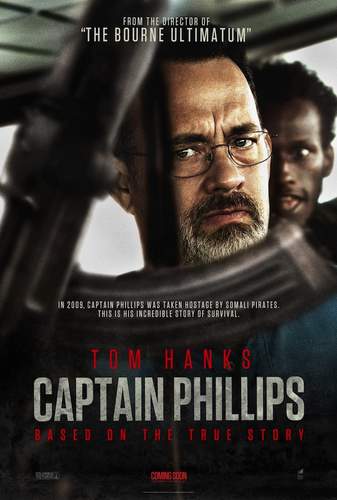
https://chris-lamb.co.uk/wp-content/2014/phillips_b.jpg Somalia's chief exports appear to be morally-ambiguous Salon articles about piracy and sophomoric evidence against libertarianism. However, it is the former topic that Captain Phillips concerns itself with, inspired by the hijacking of the Maersk Alabama container ship in 2009. What is truth? In the end, Captain Phillips does not rise above Pontius Pilate in providing an answer, but it certainly tries using more refined instruments than irony or leaden sarcasm. This motif pervades the film. Obviously, it is based on a "true story" and brings aboard all that well-travelled baggage, but it also permeates the plot in a much deeper sense. For example, Phillips and the US Navy lie almost compulsively to the pirates, whilst the pirates only really lie once where they put Phillips in greater danger. Notice further that Phillips only starts to tell the truth when he thinks all hope is lost. These telling observations become even more fascinating when you realise that they must be based on the testimony of the, well, liars. Clearly, deception is a weapon to be monopolised and there are few limits on what good guys can or should lie about if they believe they can save lives.
https://chris-lamb.co.uk/wp-content/2014/phillips_c.jpg

Even Phillip's nickname ("Irish") is a falsehood he straight-up admits he is an American citizen.

Lastly, there is an utterly disarming epilogue where Phillips is being treated for shock by clinical efficient medical staff. Not only will it scuttle any "blanket around the shoulders" clich but is probably a highly accurate portrayal of what actually happens post-trauma. This echoes the kind of truth Werner Herzog often aims for in his filmmaking as well his guilt-inducing duality between uncomfortable lingering and compulsive viewing. Another angle worthy of discussion: can a film based on real-world events even be "spoilered"? Hearing headlines on the before you read the newspaper hardly robs you of a literary journey... Captain Phillips does have some quotidian problems. Firstly, the only tool for ratcheting up tension is for the Somalians to launch verbal broadsides at the Americans, with each compromise somehow escalating the situation further. This technique is genuinely effective but well before the climatic rescue scene where it is really needed it has been subject to the most extreme diminishing returns. (I cannot be the first to notice the "Africans festooned with guns shouting incomphensively" trope I hope it is based on a Babel-esque mechanism of disorientation and miscommunication rather than anything, frankly, unsavoury.)
https://chris-lamb.co.uk/wp-content/2014/phillips_a.jpg

The racist idea that Africans prefer a AK-47 rotated about the Z-axis is socially constructed.

Secondly, the US Navy acts like a teacher with an Ofsted inspector observing quietly from the corner of the classroom; far too well-behaved it suspends belief, with no post-kill gloating or even the tiniest of post-arrest congratulations. Whilst nobody wants to see the Navy overreact badly to other military branches getting all the glory, nobody wants to see a suspiciously bland recruitment vehicle either. Paradoxically, this hermetic treatment made me unduly fascinated by them, as if they were part of some military "uncanny valley". Two quick observations:
https://chris-lamb.co.uk/wp-content/2014/phillips_d.jpg

The drone footage: I'd love to read (or write) an essay about how Call of Duty might have influenced cinema.

Finally, despite the title, the film is actually about two captains; the skillful liar Phillips and ... well, that's the real problem. Whilst Captain Muse is certainly no caricatured Hook, we are offered little depth beyond a "You're not just a fisherman" faux-revelation that leads nowhere. I was left inventing reasons for his akrasia so that he made any sense whatsoever. One could charitably argue that the film attempts to stay objective on Muse, but the inability for the film to take any obvious ethical stance actually seems to confuse and then compromise the narrative. What deeper truth is actually being revealed? Is this film or documentary? Worse still, the moral vacuum is invariably filled by the viewer's existing political outlook: are Somali pirates victims of circumstance who are forced into (alas, regrettable) swashbuckling adventures to pacify plank-threatening warlords? Or are they violent and dangerous criminals who habour an irrational resentment against the West, flimsily represented by material goods in shipping containers? Your improvised answer to this Rorschach test will always sit more haphazardly in the film than any pre-constructed treatment ever could. 6/10

16 January 2014

Daniel Pocock: Get ready to try Debian SIP

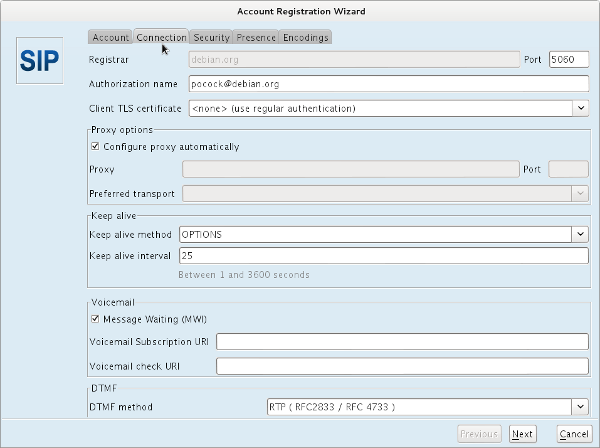
Before going on to talk about SIP, there is one really important thing that must be emphasized: XMPP/Jabber is also in the roadmap. Some of the infrastructure that has already been deployed (the new RTC passwords in ud-ldap, the TURN server and the RADIUS server) is good for both SIP and XMPP use cases. All to be revealed on Sunday As mentioned in my recent blog about the Debian.org NAPTR record, more details will be coming in my talk at mini-DebConf Paris this weekend. Today I'm just going to describe some things to install for those who want a head start. Jitsi Jitsi has been around for many years (originally as SIP Communicator) and it is probably the most advanced desktop softphone in the free software world. Jitsi packages are in jessie and sid - why not install them now. If you don't want to pull in dependencies from jessie on your wheezy system, you can also download from upstream and run it standalone. WebRTC browsers I've prepared a JSCommunicator implementation based on the jscommunicator-web-phone package. To use it, you need the latest version of Iceweasel/Firefox or Chromium. As HTML5 WebRTC / RTCPeerConnection is an evolving standard, using a recent browser is essential. Jitsi configuration for sip:debian.org It is not open for users just yet, but this is how you will configure it when it is available. More details to come...
AttachmentSize
step-4-setup-connection-scaled.png59.66 KB

Andrew Pollock: [life] And now for something completely different...

After 8 years, February 6 will be my last day with Google. The hardest pill to swallow with the end of my marriage was the reduction in my time with Zoe. It was one thing to lose my wife, but to lose 50% of my daughter as well has been, and will continue to be, a struggle for me. 2014 is the last year before Zoe starts in Prep (Queensland's school grade before "one"). This is my last opportunity to be able to have a big chunk of time with her before she gets swallowed up by the school system. It's ridiculous to be sticking her in full-time long day care if I have an alternative. And I do have an alternative. I'm in the fortunate financial position of not having a mortgage, or any debt to speak of, and a modest amount of savings. I shall be Daddy Day Care. It had always been my career goal in life to be a stay at home Dad. I'd wanted to have another child and be the one to stay at home and look after the kids, and allow Sarah to resume her career. Obviously none of that worked out, but there's no reason why I can't be a stay at home Dad for at least this year. Zoe's at a wonderful age now. We can have a lot of fun together this year. She's going to be in a 5 day a fortnight Kindergarten program (Monday, Tuesday and every other Wednesday) between 8:20am to 2:30pm, so I'm planning on using one of those days for Debian contributions, one of those days for exploring some of the crazy startup ideas I have rattling around in my head, and every second Wednesday to keep the home tidy. It's going to be a fun, different year for Zoe and I, and I'm so looking forward to it. I'm planning on doing lots of activities from Play at Home Mom, doing lots of baking and we'll be doing Science Friday's. If anyone knows where I can get a toddler-sized lab coat, drop me a line. I'm hoping I can make time to write up our activities for posterity as well.

15 January 2014

Daniel Pocock: NAPTR record for Debian.org

The debian.org domain got a new NAPTR record this week.
$ dig -t naptr debian.org
;; QUESTION SECTION:
;debian.org.			IN	NAPTR
;; ANSWER SECTION:
debian.org.		3600	IN	NAPTR	10 0 "s" "SIPS+D2T" "" _sips._tcp.debian.org.
If you would like to find out more, please come to the mini DebConf in Paris this weekend where the debian.org federated SIP deployment will be discussed, along with some of the benefits it brings for both human and automated communication. There are also many other great talks on the schedule and it looks like it will be a fun weekend. Some details have also been published on the Debian wiki recently.

Jon Dowland: Whitley Bay Ice Rink

Recently, North Tyneside Council circulated the beginnings of a regional development plan. This consisted of a detailed map of the borough, complete with various areas marked out as sites for potential housing development. Included amongst the sites for potential development was Whitley Bay Ice Rink and the surrounding leisure facilities: a football pitch, a cricket pitch, and more. Whitley Bay Ice Rink has been a fixture in the cultural history of the region and it would be a terrible shame if it were to close. Many people seemed to agree: a petition calling for the site to be excluded from the plan received over 7,000 signatures. Residents were also able to write comments on the plan itself. The specific paragraph for the Ice Rink had attracted over 100 comments when I looked at it on the last day that comments were open. I hurredly put together one of my own:
Whitley Bay Ice Rink is about to celebrate it s 60th birthday as both a key part of the history and culture of the borough and a unique leisure facility in the wider area. Sadly the Rink has seemed, historically, to be somewhat neglected, rather like the other large cultural landmark in the region - Whitley Bay s Spanish City and Dome. I argue you should no sooner consider closing or redeveloping the Rink site than the Dome itself. Rather, both should be cherished and invested in, particularly if (as rumoured) the current owners are keen to retire or pass it on. In recognising the need to increase the amount of housing in the area, one should consider what facilities will be available to the new residents within the region. Removing facilities to provide housing is slaying the golden goose. Whitley Bay Ice Rink is one of the few rinks left in the country and the nearest permanent ice rink within 30 miles. Ice skating has become a fond and lasting memory for many of the adults who have grown up in the region, many of whom enjoy or look forward to their own children experiencing it. I look forward to taking my niece and nephew there, when they are old enough, as well as my own future children. It is a traditional spot for School trips; the sports teams operating from the rink have a proud history and fearsome reputation. It s an attraction for the large numbers of University students that travel to the two nearest Universities. The borough is blighted with rotting seaside hotels which (following the recent development of the Idols site) should be converted into attractive flat or maisonette housing as a priority.

Bits from Debian: Call for Proposals for the MiniDebConf 2014 Barcelona

Debian Women will hold a MiniDebConf in Barcelona on March 15-16, 2014. Everyone is invited to both talks and social events, but the speakers will all be people who identify themselves as female. This is not a conference about women in Free Software, or women in Debian, rather a usual Debian Mini-DebConf where all the speakers are women. Debian Women invites submissions of proposals for papers, presentations, discussion sessions and tutorials for the event. Submissions are not limited to traditional talks: you could propose a performance, an art installation, a debate or anything else. All talks are welcome, whether newbie or very advanced level. Please, forward this call to potential speakers and help us make this event a great success! Please send your proposals to proposals@bcn2014.mini.debconf.org. Don't forget to include in your message: your name or nick the title of the event, description, language, and any other information that might be useful. Please submit your proposal(s) as soon as possible. For more information, visit the website of the event: http://bcn2014.mini.debconf.org We hope to see you in Barcelona!

Sylvestre Ledru: Some thoughts concerning LLVM & Clang and their evolutions: Release of LLVM & Clang 3.4

We just released LLVM & Clang 3.4 (already available in Debian Jessie and Ubuntu Trusty). The clang new release introduces some more warning and error detections. The point of the blog post is not to detail the changes (LLVM / Clang) but more to take a step back on the LLVM and Clang toolchains, usages and dissemination. For the last couple years, I have been presenting our work on the Debian side to make Clang part of the Debian infrastructure. I add the chance to speak at many events (Debconf 12 & 13, FOSDEM 2013, Linux Plumbers 2013, Distro recipes, etc). I even had Linus Torvalds attending to one of these talks (and proposing new approach). I had many feedback from the Debian/Ubuntu communities but also from other communities.
More and more projects are using Clang as part of their workflows, in term of development, production and QA. For example, some of them are running continuous integration using clang instead of gcc, others are running scan-build (Wireshark or LLVM itself) or Address Sanitizer (asan) (Firefox for example), etc.
More and more actors are moving from gcc to clang for their developments (Sony with their PS4, Chrome under Mac OS X, Apple, the Linux Kernel with the LLVMLinux project, FreeBSD, etc).
I stopped counting the number of times when people answered me "Yeh, I am now using Clang" when I said I am involved upstream. In parallel, more and more projects are using LLVM as a backend or computing engine and, in the meantime, getting more and more attraction (not because they are based on LLVM but just because they are great projects). For example, Mesa (llvmpipe), Julia, Rust, Emscripten or Native Client (NaCL) are excellent examples of this. The two last are excellent proofs that LLVM based technologies have an impact which goes further than geek-tools and will be used on a daily basis by millions of users. I also saw an interesting and growing number of new projects using libclang and libTooling. My feeling is that the lack of plugin capabilities in gcc for a long time and, now, its current complexity limited the innovation in term of compilation capabilities, analysis and fun tools. The features and the quality of this library are enabling new developments and I am sure we will see more and more excellent tools based on this library during 2014.
For example, the LLVM toolchain ships Clang modernize and clang format and some cool projects like include-what-you-use, DXR, OCLint or creduce are emerging. Thanks to this great competition, gcc is also improving (ASAN, JIT, better warnings, etc), remaining still relevant as before. No doubt that 2014 will be a great year for compilers.

Wouter Verhelst: Buildbot

I'd set up buildbot at a customer last monday. Since that resulted in me understanding the thing, I also set up an instance for nbd. The need for this had become apparent after the last upload to unstable failed on a disconcertingly large number of architectures. Apart from the fact that it uses python (and wants me to write python in its config file, grrr), it's a fairly nice system; pretty lightweight (it runs on barbershop, which is a QNAP TS419U, for crying out loud), yet still flexible enough that I don't have to jump through hoops to do normal things which the developer hadn't thought about. I also just noticed that if you push multiple commits to a git repository at once (put otherwise, if buildbots notices multiple new revisions when it checks), it will make sure that all revisions get built at least once. Of course it would have been nice if it would pick the fastest machines to do the "older" revisions rather than "whoever happens to be first", but that doesn't really matter all that much. Meanwhile, the bug that makes building 3.6 impossible on some architectures has been fixed. It turned out to be an LFS-issue, which is specific to 32-bit machines; and as my own machine runs amd64, well...

14 January 2014

Stefano Zacchiroli: forthcoming talks

Over the next few weeks I'll be on the road, attending a few Free Software events and giving talks. In particular: See you "there"?

13 January 2014

Daniel Pocock: PostFinance, where is my money?

Update: my money has been returned by PostFinance very soon after this blog appeared There's no better way to get the year off to a good start than finding money has gone missing from your bank account. Where I live in Switzerland, it is mandatory for everybody to make a monthly payment for health insurance (as it is mandatory, it is basically a tax, like the monthly council tax in England). Just like British council tax, the premiums go up each year and every person in the country has to log into their bank's web site and change their standing order. A few days after doing just that, I went back in to the web site to make another payment and noticed that the first health insurance payment for 2014 had been duplicated on two consecutive days, the 30th and 31st of December: I immediately sent them an email to alert them to the fault and ask for the duplicate transaction to be corrected. Normally, when a company makes a mistake, it would be fixed within a couple of days and certainly never reach my blog. Instead of getting a helpful reply, I was astonished to receive this:
There has been a misunderstanding when you have set up your standing order.
You selected "First execution" December 30, 2013 and then "monthly execution" 31. The system has followed your instruction and it results a double execution December 30 and 31.
Unfortunately, we are not able to return you the amount.
Great, apparently it is all my own fault. I thought "monthly" would mean one payment in each one month but apparently not everybody uses the same definition of monthly. (Actually, banks do have systems such as the 360 day calendar but that is another story). So let's look at these faulty instructions I supposedly gave. I immediately went back to the standing order page to take a screenshot. I even compared the page in English (my default language, which they are kind enough to let me use) and French (one of the four official languages of the Swiss Confederation) and I found they say much the same thing: Note: exact amounts and account numbers concealed The form is relatively clear: I authorised a monthly payment (Periodicite: mensuel) with the first (Premiere) payment on 30.12.2013 and then, or so I believed (and still do) a following payment (ensuite) on the 31st of each month, with the last payment at the end of November, for 12 payments in total. Simple, right? Where it says ensuite le 31, I sincerely believe that means the second payment is on 31 January, but Postfinance seem to be arguing that I meant the 31 December: just one day, rather than one month, after the first payment. Delaying tactics I replied to their email, telling them explicitly that I had authorized a monthly payment only and demanding the immediate return of the duplicate payment. When I got their next reply, I didn't know what to think:
We are pleased to do the necessary to revoke the transfer to SWICA. This will take at least two weeks.
On the one hand, it appears they are now starting to accept they may have made a blunder. But two more weeks? This was already 10 days after the money went missing. Do they even know what is wrong with their system? It doesn't give me confidence. I wrote back again and insisted that this is their error and that an immediate correction is required. Pass the buck, take three Today, another reply came back. After almost 14 days, I've now got three fob-off excuse mails and none of my money returned:
We did the request at SWICA to send back the money on your account on the 8th January 2014. The decision will be taken by them if they agree to send back this amount.
Unfortunately, we cannot do more except waiting their answer. You can call them and explain them the situation. With your call, maybe the reimbursement could be faster.
Why is it in the hands of the health insurance company? It is not their fault that Postfinance has a problem processing standing orders. Why do I have to waste my time chasing people, will I get compensation for that? Am I the only victim? With many people configuring their new health insurance payments at this time of the year, I can imagine that there may be other victims of this fault too. Are they all being fobbed off with these excuses? Some may not even realize if they don't check their account closely. What next? Sure, maybe I can just cancel the next health insurance payment: but why should I have that inconvenience? What exactly was I supposed to put on that form to not make this mistake they suggest I made? If I cancel the next payment like they suggest and then set up the payment again from March, how can I be sure the same duplication won't happen again? Using customers as unpaid QA testers Many leading financial organisations have experienced teams of developers, QA testers, and comprehensive regime of simulation/testing with paid participants to ensure their systems are reliable and as friendly and accurate as possible. Here, it feels like PostFinance has skipped all that, deploying a form that is ambiguous at best and they are using real customers like me to test the system and report the bugs. Normally organisations pay me for doing that very same task as part of my job as a software engineer. Not only have Postfinance taken almost 200 CHF of my money, but they have wasted my time with their strategy of fobbing me off and at the same time they are probably sending my feedback to their developers instead of paying a QA tester to check their systems. You be the judge What is your opinion?
  • Daniel can't use a web form, it is definitely Daniel's mistake, nobody else would make a mistake like that
  • The Postfinance form is ambiguous and so it is probably their fault and they should give back the money, it is likely these are cut and paste emails they send to all the customers who are duped by the form
  • Postfinance is completely wrong. Monthly means one payment each month.

11 January 2014

Steve Kemp: Some productive work

Having decided to take a fortnight off, between looking for a new job, I assumed I'd spend a while coding. Happily my wife, who is a (medical) doctor, has been home recently so we've got to spend time together instead. I'm currently pondering projects which will be small enough to be complete in a week, but large enough to be useful. Thus far I've just reimplemented RSS -> chat which I liked a lot at Bytemark. I have my own chat-server setup, which doesn't have any users but myself. Instead it has a bunch of rooms setup, and different rooms get different messages. I've now created a new "RSS" room, and a bunch of RSS feeds get announced there when new posts appear. It's a useful thing if you like following feeds, and happen to have a chat-room setup. I use Prosody as my chat-server, and I use my http2xmpp code to implement a simple HTTP-POST to XMPP broadcast mechanism. The new script is included as examples/rss-announcer and just polls RSS feeds - URLs which haven't been broadcast previously are posted to the HTTP-server, and thus get injected into the chatroom. A little convoluted, but simple to understand. This time round I'm using Redis to keep track of which URLs have been seen already. Beyond that I've been doing a bit of work for friends, and have recently setup an nginx server which will handle 3000+ simultaneous connections. Not too bad, but I'm sure we can make it do better - another server running on BigV which is nice to see :) I'll be handling a few Squeeze -> Wheezy upgrades in the next week too, setting up backups, and doing some other related "consultation". If I thought there was a big enough market locally I might consider doing that full-time, but I suspect that relying upon random work wouldn't work long-term.

Debian Sysadmin Team: Peter Palfrader: The Debian DNS universe

Abstract I recently moved our primary nameserver from orff.debian.org, which is an aging blade in Greece, to a VM on one of our ganeti clusters. In the process, I rediscovered a lot about our DNS infrastructure. In this post, I will describe the many sources of information and how they all come together.

Introduction The Domain Name System is the hierarchical database and query protocol that is in use on the Internet today to map hostnames to IP addresses, to map the reverse thereof, to lookup relevant servers for certain services such as mail, and a gazillion other things. Management and authority in the DNS is split into different zones, subtrees of the global tree of domain names. Debian currently has a bit over a score of zones. The two most prominents clearly are debian.org and debian.net. The rest is made up of debian domains in various other top level domains and reverse zones, which are utilized in IP address to hostname mappings.

Types and sources of information The data we put into DNS comes from a wide range of different systems:
  • Classical zonefiles maintained in git. This represents the core of our domain data. It maps services like blends.debian.org to static.debian.org or specifies the servers responsible for accepting mail to @debian.org addresses. It also is where all the ftp.CC.debian.org entries are kept and maintained together with the mirror team.
  • Information about debian.org hosts, such as master, is maintained in Debian's userdir LDAP, queryable using LDAP1.
    • This includes first and foremost the host's IP addresses (v4 and v6).
    • Additionally, we store the server responsible for receiving a host's mail in LDAP (mXRecord LDAP attribute, DNS MX record type).
    • LDAP also has some specs on computers, which we put into each host's HINFO record, mainly because we can and we are old-school.
    • Last but not least, LDAP also has each host's public ssh key, which we extract into SSHFP records for DNS.
  • LDAP also has per-user information. Users of debian infrastructure can attach limited DNS elements as dnsZoneEntry attributes to their user2.
  • The auto-dns system (more on that below).
  • Our puppet also is a source of DNS information. Currently it generates only the TLSA records that enable clients to securely authenticate certificates used for mail and HTTPS, similar to how SSHFP works for authenticating ssh host keys.

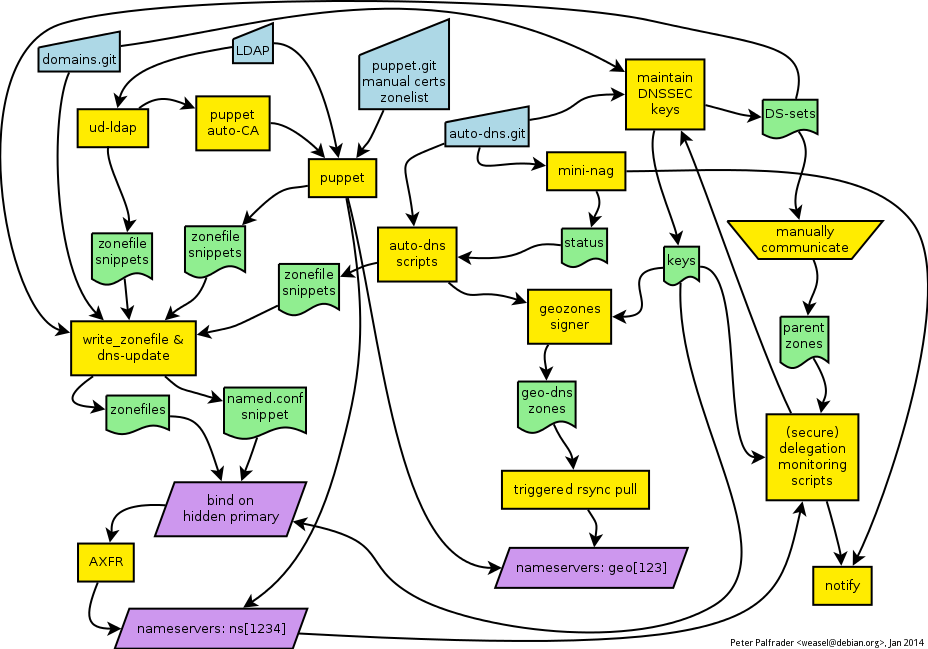
Debian's auto-dns and geo setup We try to provide the best service we can. As such, our goal is that, for instance, user access to www or bugs should always work. These services are, thus, provided by more than one machine on the Internet. However, HTTP did not specify a requirement for clients to re-try a different server if one of those in a set is unavailable. This means for us that when a host goes down, it needs to be removed from the corresponding DNS entry. Ideally, the world wouldn't have to wait for one of us to notice and react before they can have their service in a working manner. Our solution for this is our auto-dns setup. We maintain a list of hosts that are providing a service. We monitor them closely. Whenever a server goes away or comes back we automatically rebuild the zone that contains the element. This setup also lets us reboot servers cleanly since one of the things we monitor is "is there a shutdown running", we can, simply by issuing a shutdown -r 30 kernel-update, de-rotate the machine in question from DNS. Once the host is back it'll automatically get re-added to the round-robin zone entry. The auto-dns system produces two kinds of output:
  • In service-mode it generates a file with just the address records for a specific service. This snippet is then included in its zone using a standard bind $INCLUDE directive. Services that work like this include bugs and static (service definition for static).
  • In zone-mode, auto-dns produces zonefiles. For each service it produces a set of zonefiles, one for each out of a set of different geographic regions. These individual zonefiles are then transferred using rsync to our GEO-IP enabled nameservers. This enables us to give users a list of security mirrors closer to them and thus hopefully faster for them.

Tying it all together The Debian DNS Rube Goldberg Machine. Figure 1: The Debian DNS Rube Goldberg Machine. Once all the individual pieces of source information have been collected, the dns-update and write_zonefile scripts from our dns-helpers repository take over the job of building complete zonefiles and a bind configuration snippet. Bind then loads the zones and notifies its secondaries. For geozones, the zonefiles are already produced by auto-dns' build-zones and those are pulled from the geo nameservers via rsync over ssh, after an ssh trigger.

and also DNSSEC All of our zones are signed using DNSSEC. We have a script in dns-helpers that produces, for all zones, a set of rolling signing keys. For the normal zones, bind 9.9 takes care of signing them in-process before serving the zones to its secondaries. For our geo-zones we sign them in the classical dnssec-signzone way before shipping them. The secure delegation status (DS set in parent matches DNSKEY in child) is monitored by a set of nagios tests, from both [dsa-nagios] and dns-helpers. Of these, manage-dnssec-keys has a dual job: not only will it warn us if an expiring key is still in the DSset, it can also prevent it from getting expired by issuing timly updates of the keys metadata.

Relevant Git repositories -- Peter Palfrader

  1. ldapsearch -h db.debian.org -x -ZZ -b dc=debian,dc=org -LLL 'host=master'
  2. ldapsearch -h db.debian.org -x -ZZ -b dc=debian,dc=org -LLL 'dnsZoneEntry=*' dnsZoneEntry

Matthew Palmer: Keep your gems clean!

Ruby has a reputation for being slow. But there s slow, and then there s three seconds to show the help for a fairly command line program . That s not slow, that s ridiculous. The gem cleanup command is the solution. Rubygems has a nice feature whereby you can have multiple versions of a gem installed at once. That s neat, because it allows programs with different gem version requirements to co-exist on the system. Unfortunately, over time, you can end up with many versions of a gem installed, as upgrades pull in ever-newer versions of all your gems. Couple this accumulation of cruft with a need for Rubygems to look at every one of them on every startup, and you can see how you could very quickly end up with a three second startup time. By running gem cleanup, you ll have the opportunity to nuke all the out-of-date versions of your gems. It takes into account dependencies, so it will at least ask you before nuking a gem that another gem absolutely depends on (I d prefer a command-line switch to say, Don t even think about uninstalling something that another gem depends on! , but you can t have everything). If you ve got non-gem things on your system that rely on out-of-date gems (anything using bundler, for instance), those will assplode the next time you run them, but you can always re-run bundle install to get just the specific versions of gems back you need. The end result of my little spring cleaning? Down from three seconds to three quarters of a second. A 75% improvement. Win!

Wouter Verhelst: Computer education in Belgium

Today (well, technically yesterday by now), the Media were reporting of an open letter by '5 belgian university professors from the IT field' without calling them by name about how Belgian primary education should introduce programming into the curriculum, starting at age 5. Unsurprisingly, this did not go well with a majority of the Belgian populace. Arguments like "what should the school drop to make place for that, then" and "why would people ever need to learn programming" were rampant on some internet fora that I had a short look at. That being said, though, I think these five unnamed professors are correct. Understanding how a tool works is essential to proficient usage of said tool; and while it is possible to teach particular common and popular use cases of a given tool without providing enough background, doing so will only result in confusion when the computer "is acting up" an oxymoron if there ever was one. After all, a computer can't "act up"; it can only follow instructions. Whenever your seems to be "acting up", what's really happening is that someone (most likely, you) gave it the wrong instructions. Or, perhaps, someone evil on the Internet gave it the right instructions (for their goals, anyway) and infected your computer with a virus. But that's unlikely. Computer education currently mostly consists of "teaching software": rather than explaining how a computer does what it does, people are taught that if you click this button, the text will be bold, or if you click that button, the printer will start buzzing. That's all nice and dandy, until the actual computer people encounter when off the school bench and at work has this other piece of software, where all the buttons are in other places and look all "wrong". Because then they get all confused about the fact that things aren't where they're supposed to be. So, yes, it is my opinion that any computer education should help people understand how a computer does the things it does. And what better way to do that than to actually explain things to a computer, the way computer programmers do such things? Note that programming a computer doesn't have to be hard, and it can be something which kids can understand and will find fun to do. For instance, there's this scratch thing from MIT, which was made for teaching programming in such a context. Yes, adding programming to the primary school curriculum will require that some other things are dropped instead, and I could see that being a problem. However, in our modern world computers have become so pervasively important that we would be doing our kids a disservice not to explain them how to understand computers, as opposed to just learn how to use them...

Johannes Schauer: Why do I need superuser privileges when I just want to write to a regular file

I have written a number of scripts to create Debian foreign architecture (mostly armel and armhf) rootfs images for SD cards or NAND flashing. I started with putting Debian on my Openmoko gta01 and gta02 and continued with devices like the qi nanonote, a marvel kirkwood based device, the Always Innovating Touchbook (close to the Beagleboard), the Notion Ink Adam and most recently the Golden Delicious gta04. Once it has been manufactured, I will surely also get my hands dirty with the Neo900 whose creators are currently looking for potential donors/customers to increase the size of the first batch and get the price per unit further down. Creating a Debian rootfs disk image for all these devices basically follows the same steps:
  1. create an disk image file, partition it, format the partitions and mount the / partition into a directory
  2. use debootstrap or multistrap to extract a selection of armel or armhf packages into the directory
  3. copy over /usr/bin/qemu-arm-static for qemu user mode emulation
  4. chroot into the directory to execute package maintainer scripts with dpkg --configure -a
  5. copy the disk image onto the sd card
It was not long until I started wondering why I had to run all of the above steps with superuser privileges even though everything except the final step (which I will not cover here) was in principle nothing else than writing some magic bytes to files I had write access to (the disk image file) in some more or less fancy ways. So I tried using fakeroot+fakechroot and after some initial troubles I managed to build a foreign architecture rootfs without needing root priviliges for steps two, three and four. I wrote about my solution which still included some workarounds in another article here. These workarounds were soon not needed anymore as upstream fixed the outstanding issues. As a result I wrote the polystrap tool which combines multistrap, fakeroot, fakechroot and qemu user mode emulation. Recently I managed to integrate proot support in a separate branch of polystrap. Last year I got the LEGO ev3 robot for christmas and since it runs Linux I also wanted to put Debian on it by following the instructions given by the ev3dev project. Even though ev3dev calls itself a "distribution" it only deviates from pure Debian by its kernel, some configuration options and its initial package selection. Otherwise it's vanilla Debian. The project also supplies some multistrap based scripts which create the rootfs and then partition and populate an SD card. All of this is of course done as the superuser. While the creation of the file/directory structure of the foreign Debian armel rootfs can by now easily be done without superuser priviliges by running multistrap under fakeroot/fakechroot/proot, creating the SD card image still seems to be a bit more tricky. While it is no problem to write a partition table to a regular file, it turned out to be tricky to mount these partition because tools like kpartx and losetup require superuser permissions. Tools like mkfs.ext3 and fuse-ext2 which otherwise would be able to work on a regular file without superuser privileges do not seem to allow to specify the required offsets that the partitions have within the disk image. With fuseloop there exists a tool which allows to "loop-mount" parts of a file in userspace to a new file and thus allows tools like mkfs.ext3 and fuse-ext2 to work as they normally do. But fuseloop is not packaged for Debian yet and thus also not in the current Debian stable. An obvious workaround would be to create and fill each partition in a separate file and concatenate them together. But why do I have to write my data twice just because I do not want to become the superuser? Even worse: because parted refuses to write a partition table to a file which is too small to hold the specified partitions, one spends twice the disk space of the final image: the image with the partition table plus the image with the main partition's content. So lets summarize: a bootable foreign architecture SD card disk image is nothing else than a regular file representing the contents of the SD card as a block device. This disk image is created in my home directory and given enough free disk space there is nothing stopping me from writing any possible permutation of bits to that file. Obviously I'm interested in a permutation representing a valid partition table and file systems with sensible content. Why do I need superuser privileges to generate such a sensible permutation of bits? Gladly it seems that the (at least in my opinion) hardest part of faking chroot and executing foreign architecture package maintainer scripts is already possible without superuser privileges by using fakeroot and fakechroot or proot together with qemu user mode emulation. But then there is still the blocker of creating the disk image itself through some user mode loop mounting of a filesystem occupying a virtual "partition" in the disk image. Why has all this only become available so very recently and still requires a number of workarounds to fully work in userspace? There exists a surprising amount of scripts which wrap debootstrap/multistrap. Most of them require superuser privileges. Does everybody just accept that they have to put a sudo in front of every invocation and hope for the best? While this might be okay for well tested code like debootstrap and multistrap the countless wrapper scripts might accidentally (be it a bug in the code or a typo in the given command line arguments) write to your primary hard disk instead of your SD card. Such behavior can easily be mitigated by not executing any such script with superuser privileges in the first place. Operations like loop mounting affect the whole system. Why do I have to touch anything outside of my home directory (/dev/loop in this case) to populate a file in it with some meaningful bits? Virtualization is no option because every virtualization solution again requires root privileges. One might argue that a number of solutions just require some initial setup by root to then later be used by a regular user (for example /etc/fstab configuration or the schroot approach). But then again: why do I have to write anything outside of my home directory (even if it is only once) to be able to write something meaningful to a file in it? The latter approach also does not work if one cannot become root in the first place or is limited by a virtualized environment. Imagine you are trying to build a Debian rootfs on a machine where you just have a regular user account. Or a situation I was recently in: I had a virtual server which denied me operations like loop mounting. Given all these downsides, why is it still so common to just assume that one is able and willing to use sudo and be done with it in most cases? I really wonder why technologies like fakeroot and fakechroot have only been developed this late. Has this problem not been around since the earliest days of Linux/Unix? Am I missing something and rambling around for nothing? Is this idea a lost cause or something that is worth spending time and energy on to extend and fix the required tools?

9 January 2014

Gerfried Fuchs: Clawfinger

It's almost a month since I last blogged something, and one of my new year's resolution is to change that, a bit. Let's see how it goes. I've been listening a lot to this great band from Sweden recently again, put all their songs onto my mobile phone. It might sound weird because they have a rather aggressive style, both soundwise but also lyricswise, but it helps me to get things off my chest and stay relaxed in the rest of my life. The band I want to present to you was already twice mentioned in some other articles of my blog I noticed, but this is the proper post about them: I'm talking about Clawfinger. They came up in the nineties during the crossover phase and did blend in pretty well, but it's mostly their direct and political statements they carry in their lyrics that did let them stand out. One warning though: the direct language they use might be considered blunt and maybe even offensive by some. The message behind it though should rather get you thinking of your own doings if you consider it to be offensive. Here are the songs: Like always, enjoy! And maybe also think about it a bit. :)

/music permanent link Comments: 4 Flattr this

8 January 2014

Gunnar Wolf: [review] Packt's Instant Haml

Packt Publishing sent me Krzysztof Niki ski's Instant Haml to do a short blog review... Thing is, and those who read me know, I cannot write short reviews ;-) So lets see how this goes. Packt's Instant series First, as for the format this book follows and the series it fits in: They are very short books. I was the tech reviewer for their Instant Debian Build a Web Server , and when I opened it for the first time, I thought I had received only the first chapter. This series' motto is Short Fast Focused so, yes, the books are ~50 pages long, with ample margins and many big screenshots. I told the editors I was quite unsure about the value this kind of publications add, as they are very similar to online tutorials, but given they have so many books in this series (printed and electronic), there must be a market for them. They surely know their business better than me! There is one other detail regarding the publisher I'll stick in this section, although it is not specific to their Instant series: I do most of my reading in my Kindle. Packt seems to have chosen to specify a very small font for their texts. Besides the two books mentioned, I also have their Object Oriented JavaScript book. For all of the other books I read, I use the smallest font setting. Packt books in mobi format (what they present as Amazon format in their web site) are basically illegible without bumping up the font size through the roof. As I understand it, publishers should use industry-wide default sizes, and let the reader adjust their reading experience. Yes, books of technical nature (such as Packt's) often benefit from having more displayed information than what an ebook reader normally shows... But that's for me to decide! And no, this is not a Kindle-specific glitch: I also get a similar experience when opening it from Calibre. And as for the book... I am a long-time Haml convert/fan; I packaged its Ruby implementation for Debian (and should update it soon :-/ as new versions have appeared), the corresponding Emacs Lisp mode, and I use it for basically all of my static HTML sites and Ruby-based Web systems. Haml is a great templating language, meant to make dynamic HTML generation leaner and easier. It is a clean and elegant technology, and can clearly sell itself. And the project webpage has very good documentation, ranging from a short tutorial and a full API documentation for people to contribute to the project. The first part of this book, of course, covers the "why is Haml so great?" part, presenting the basic equivalences with HTML. In my opinion, the book could be structured a bit differently and would generate a stronger following. Why? Because, even given that Haml is greatly benefited from its Ruby integration and has many hooks to be tightly integrated in a Rails workflow, it can also be used by people who don't want to do Ruby. I have some static websites that are just a bunch of Haml files, compiled by a very simple Makefile and calling the haml command from the shell. I think there would be some value in presenting this invocation before learning how to call it from the Gems environment (i.e. bundle install). Using Haml as a standalone tool is only presented almost as an appendix ("Using HAML outside of Rails" section). Even more so if the author presents four different static-site solutions (probably more non-programmer-friendly than my trusty Makefile). Oh, and this little section uses the (old? obsolete?) uppercase HAML notation for the project's name instead of the now-standard Haml. Dirty screenshots About the screenshots presented in this first section (and I refer mainly to the scaffolding examples), they are meant to show how easy things are, but have an important stylistic mistake: Terminals with transparency might look cool (I hate using them, but then again I'm a very boring person when it comes to my computer habits ;-) ), but transparencies have no place in a book (be it printed or e-book), as the images appear very uncrisp. In the Kindle, they just seemed dirty Now that I'm browsing the PDF from my desktop, I see that the screenshot in "Step 1" has a photo of Earth from space behind the terminal, and even worse, in "Step 2" it is shown over a Web page detailing the installation! These elements are just distracting, and the text would be much cleaerer if it were presented typeset just as a regular code fragment. Opening many of those screenshots in the Kindle was plain useless. Editor integration It is perfectly clear from this text that the author strongly prefers Sublime Text, sometimes uses TextMate, and has just heard reports that Haml has some support in Vim, Rubymine, Emacs and Coda. Of course, devoting a full page (as it is for the first case) for each editor would be out of proportion for this size of book... I just felt the imbalance too big, specially given that most editors will sport approximately the same feature set. Text redundancy If the Instant series is about making short books, I would expect them to be loaded with easy to follow content (as they are), but free of repetition. I felt, however, a large chunk of step 1 of the "Quick start" chapter to be repeated with the the first section of the "Top 6 features" chapter. Yes, the second one adds some depth, but very little. Still, in the later parts of this "Top 6 features" chapter, a more thorough explanation could be used for the Filters, Multiline attributes/code/strings and helpers and extensions sections. It seems the author was on a hurry trying to get it finished, as it is barely explained Explaining a bit more deeply would surely benefit readers. Wrapping up Reading my review, I'm mostly talking about negative issues. IMO, the book is not excellent, but it is clearly not bad. Specially given it fits very well the format for which it was designed. There are many items that could be fixed, and I hope some of them can be fixed (i.e. the screenshots) before the book goes to print If I understand Packt's page correctly, it is currently only available as ebook, contrary to most of the Instant series' titles.

Pau Garcia i Quiles: FOSDEM Desktops DevRoom 2014: looking for volunteers for video recordings

Qt and KDE will be present at FOSDEM, the largest open-source event in Europe. One more year, we will be sharing the Desktops DevRoom with Gnome, Unity, Enlightenment, LXQt and Hawaii (a Qt Quick desktop environment). We recently published the schedule for the devroom, which will be also available in the printed booklet available at the front desk. fosdem-logo For the 2014 edition, the FOSDEM organization wants to achieve 100% recording of presentations. That means every presentation, in every room (devroom, lightning talk, main conference, etc) must be recorded. That s hundreds of talks. While the FOSDEM and devrooms organization teams comprise a lot of people, we are far too busy already with the organizative stuff and cannot spend time doing the actual recordings. Good thing is, you can help! Do you want to join the FOSDEM Video Team and receive the t-shirt? We are now looking for volunteer cameramen (and camerawomen, of course :-) ). FOSDEM will provide you with equipment and training, you only need to start recording, focus, make sure nobody gets between the camera and the speaker/stage, etc. You do NOT need to record the whole track, even one talk recording would help. More details on what will be required from you are available in this e-mail from Wouter. Please contact me (pgquiles at elpauer dot org) if you are interested in recording one or more presentations from the Desktops DevRoom.

6 January 2014

Russ Allbery: remctl 3.7

remctl is the middleware layer that we use everywhere at Stanford. It's a simple GSS-API-authenticated network service that supports running commands with ACLs. There are client bindings available for a wide variety of programming languages. This release fixes a couple of irritating bugs: the client library leaked memory when remctl_set_ccache was used (which was affecting mod_webkdc from WebAuth), and Net::Remctl::Backend didn't validate argument counts correctly when one of the arguments came from standard input (which affected krb5-sync). I also worked around a bug in RHEL 5's Module::Build, and added sanity checking to Net::Remctl and related classes to ensure that the object argument wasn't undef. Also new in this release are support in the remctld server for systemd startup notification and socket activation, and (via the -Z) flag) support for upstart's expect stop synchronization method. This is mostly a "clearing the decks" release in advance of more significant work. The next release will replace the server event loop with libevent, in preparation for further improvements in how the server can handle persistent worker children. You can get the latest release from the remctl distribution page.

Raphaël Hertzog: My Free Software Activities in December 2013

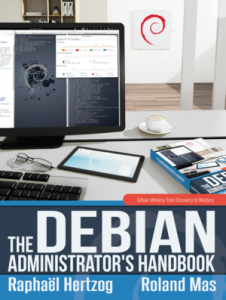
This is my monthly summary of my free software related activities. If you re among the people who made a donation to support my work (147.56 , thanks everybody!), then you can learn how I spent your money. Otherwise it s just an interesting status update on my various projects. The Debian Administrator s Handbook Cover of the Debian Administrator's Handbook (Wheezy edition)I spent a good chunk of December on the book. First finalizing the English version and getting it out (BTW, just for the launch, there s a 10% discount on the paperback that lasts only until January 9th!). Then working on updating the French translation. Eyrolles will publish a new edition of the French book based on this translation. Expect some further news about this during January! Debian France I contributed to many discussions within Debian France. Starting with a complaint that most events are organized in Paris, I proposed to map the location of Debian France members. We added new fields in the membership management page so that members can add their GPS coordinates and Fr d ric Decou made some experiments with Openstreetmap. Someone else (Kiriarat) volunteered to write the required glue code. A manual map is currently maintained on the website. Sample logo receivedIn the discussions about the setup of the Debian France shop, I suggested to update our logo with a nicer looking one. We got a few suggestions and after further discussions with Alexandre Delano and Sylvestre Ledru, we organized a small contest to entice designers to submit a logo proposal to us (the winner earns a set of Debian goodies). We got 46 proposals (see my favorite on the right)! The board is currently pre-selecting the logos and setting up the final vote for our members. The winner shall be announced at the end of the upcoming mini-debconf in Paris. I also continued the work to finalize new bylaws and new internal rules. They shall be adopted during the next general assembly which will happen during the mini-debconf. Misc Debian Work WordPress maintenance. I mentored Pablo Vasquez to do his first small contribution to the WordPress packaging. I really appreciate this but he s not yet ready to assume maintenance of a big package like WordPress on his own. I got multiple other offers of help and pinged them all while filing #733726 to coordinate the work on the new upstream version. But I got no reply :-( Handing over packages to new maintainers is hard Init system discussion. The technical committee has the hard task of picking the default init system that will replace the traditional System V init (see #727708). I followed this huge discussion closely and contributed a bit where I add something meaningful to say. Final decision is expected sometimes in January. FWIW, I share entirely Russ Allbery s point of view in those discussions. I have been running systemd on some of my computers for a few months already. Fixing lxc in stable. The lxc package in stable has a non-working debian template. I really dislike documenting that things are broken so instead of doing that in the Debian Administrator s Handbook, I opted to do something about it. I prepared a non maintainer upload for stable (see #680469 for the problem and #732358 for the stable update request). Misc stuff. I sponsored a tcpdf upload. I filed an enhancement request on Publican to have it keep processing instructions present in translations. I uploaded new versions of publican-librement and debian-handbook. I filed #732678 against git-buildpackage because it failed to properly call lintian when given the -A dpkg-buildpackage argument. Thanks See you next month for a new summary of my activities.
No comment Liked this article? Click here. My blog is Flattr-enabled.

Next.

Previous.