Search Results: "cas"

23 June 2010

Andrew McMillan: Using dnsmasq to add SRV records for CardDAV and CalDAV

I've been working on implementing CardDAV support into DAViCal at the moment, and the first problem I encountered when I went to try and use it from iCal, was that the configuration on iCal didn't seem to want to let me enter a URL to my addressbook. After I hauled out Wireshark and watched what was happening on the server it was clear that it was doing an SRV request to try and find the CardDAV server for the domain I had entered in. Unfortunately the DNS management front-end that I normally use doesn't support SRV records, so I was all ready to switch my whole DNS infrastructure around (one of those 'round tuit' tasks that's been on my todo list for somewhat more than a year) until I wondered if the magic that is dnsmasq would be able to help me out. It turns out that it can, and so after a little searching I'd managed to track down the magic syntax to do this:
srv-host=_caldav._tcp.home.mcmillan.net.nz.,davical.home.mcmillan.net.nz.,8008
srv-host=_carddav._tcp.home.mcmillan.net.nz.,davical.home.mcmillan.net.nz.,8008
Of course this is a special-case server for testing at home, and I run it on the funny port because it makes for less pollution when I sniff the traffic coming in. In the real world you'd want to add SRV records for caldavs and carddavs, to get SSL for these services, something like:
srv-host=_caldavs._tcp.home.mcmillan.net.nz.,davical.home.mcmillan.net.nz.,443
srv-host=_carddavs._tcp.home.mcmillan.net.nz.,davical.home.mcmillan.net.nz.,443
Once I'd done that, and put in a few more hours of debugging, DAViCal was working with iCal's CardDAV, at least for viewing / editing / deleting contacts - there's still some work to do yet on searching. I've now also got it working with Evolution's 'WebDAV contacts' plugin as well, after a tip from Milan Crha on the Evolution IRC channel. Heather gets home soon with the Apple phone I gave her when I upgraded to Android, so I'll hopefully be able to test against their new OS release and then get a new DAViCal release out next week. Maybe. Hopefully :-)

Christoph Berg: Cool Unix Features: nproc

Since coreutils 8.1 (in Squeeze, not Lenny), there is a command that simply prints out how many processors (cores, processing units) are available:
$ nproc
2
The use case is obvious:
$ make -j $(nproc)
On a side note, this is gnulib's nproc module wrapped into a C program. If you didn't know gnulib before (it had slipped my attention until recently), it is a library of portability functions and other useful things. Adding it to a project is simply done by calling gnulib-tool and tweaking a few lines in the automake/whatever build scripts. PS: do not use nproc unconditionally in debian/rules. Parse DEB_BUILD_OPTIONS for "parallel" instead.

21 June 2010

Stefano Zacchiroli: DD certification

A couple of months ago, Steve McIntyre introduced the notion of Developer Certification. In essence, if you are (or have been) a Debian Developer, you can ask for a certificate of that status of yours; that might be useful in case you need to "prove" it to anyone (more precisely: to anyone who would care about / believe in a certificate ...). Some people has asked me to provide such certificates and at the n-th iteration I took the chance to streamline a bit the process (yes, I'm lazy). In case you're interested, please check the DDCertificate wiki page and follow the instructions there.
While you are at it, join me in thanking Agnieszka Cicha-Cisek and Patryk Cisek, as they have prepared the LaTeX template. Some other people were interested in being certified, but missed the announcement, so I'm blogging about it mainly to spread the news. Paul Wise has already submitted a request for proper documentation of this possibility. We currently don't have a template for Debian Maintainers, but it should be straightforward to add: patches are welcome!

Colin Watson: GRUB 2 boot problems

(This is partly a repost of material I've posted to bug reports and to debian-release, put together with some more detail for a wider audience.) You could be forgiven for looking at the RC bug activity on grub2 over the last couple of days and thinking that it's all gone to hell in a handbasket with recent uploads. In fact, aside from an interesting case which turned out to be due to botched handling of the GRUB Legacy to GRUB 2 chainloading setup (which prompted me to fix three other RC bugs along the way), all the recent problems people have been having have been duplicates of one of these bugs which have existed essentially forever: When GRUB boots, its boot sector first loads its "core image", which is usually embedded in the gap between the boot sector and the first partition on the same disk as the boot sector. This core image then figures out where to find /boot/grub, and loads grub.cfg from it as well as more GRUB modules. The thing that tends to go wrong here is that the core image must be from the same version of GRUB as any modules it loads. /boot/grub/*.mod are updated only by grub-install, so this normally works OK. However, for various reasons (deliberate or accidental) some people install GRUB to multiple disks. In this case, grub-install might update /boot/grub/*.mod along with the core image on one disk, but your BIOS might actually be booting from a different disk. The effect of this will be that you'll have an old core image and new modules, which will probably blow up in any number of possible ways. Quite often, this problem lies dormant for a while because GRUB happens not to change in a way that causes incompatibility between the core image and modules, but then we get massive spikes of bug reports any time the interface does change. Since these bugs sometimes bite people upgrading from testing to unstable, they get interpreted as regressions from the version in testing even though that isn't strictly true (but it tends not to be very productive to argue this line; after all, people's computers suddenly don't boot!). Any problem that causes the core image to be installed to a disk other than the one actually being booted from, or not to be installed at all, will show up this way sooner or later. On 2010-06-10, there was a substantial upstream change to the handling of list iterators (to reduce core image size and make code clearer and faster) which introduced an incompatibility between old core images and newer modules. This caused a bunch of dormant problems to flare up again, and so there was a flood of reports of booting problems with 1.98+20100614-1 and newer, often described as "the unaligned pointer bug" due to how it happened to manifest this time round. In previous cases, GRUB reported undefined symbols on boot, but it's all essentially the same problem even though there are different symptoms. The confusing bit when handling bug reports is that not only are there different symptoms with the same cause, but there are also multiple causes for the same symptom! This takes a certain amount of untangling, especially when lots of people have thought "ooh, that bug looks a bit like mine" and jumped in with their own comments. Working through this was a worthwhile exercise, as it came up with an entirely new cause for a problem I thought was fairly well-understood (thanks to debugging assistance from Sedat Dilek). If you had set up GRUB 2 to be automatically chainloaded from GRUB Legacy (which happens automatically on upgrade from the latter to the former), never got round to running upgrade-from-grub-legacy once you confirmed it worked, and then later ran grub-install by hand for one reason or another, then the core image you installed by hand would never be updated and would eventually fall over the next time the core/modules interface changed. Fixing future cases of this was easy enough, but fixing existing cases involved figuring out how to detect whether an installed GRUB boot sector came from GRUB Legacy or GRUB 2, which isn't as easy as you might think. Fortunately, it turns out that there are a limited number of jump offsets that have ever been used in the second byte of the boot sector, and none of the GRUB 2 values clash with the only value ever used in GRUB Legacy; so, if you still have /boot/grub/stage2 et al on upgrade, we scan all disks for a GRUB 2 boot sector, and if we find one then we offer to complete the upgrade to GRUB 2. Unless anything new shows up, that just leaves the problems that were already understood. Today, I posted a patch to generate stable device names in device.map by default. If this is accepted, then we can do something or other to fix up device.map on upgrade, switch over to /dev/disk/by-id names in grub-pc/install_devices at the same time, and that should take care of the vast majority of this kind of upgrade bug. I think at that point it should be feasible to get a new version into testing, and we should be down from 18 RC bugs towards the end of last month to around 6. We can then start attacking things like the lack of support for mdadm 1.x metadata. Since my last blog entry on GRUB 2, improvements have included: The next upstream snapshot will bring several improvements to EFI video support, mainly thanks to Vladimir Serbinenko. I've been working on making grub-install actually work on UEFI systems as one of my goals for the next Ubuntu release, and I hope to get this landed in the not-too-distant future.

20 June 2010

Stefano Zacchiroli: debian meeting guidelines RFC

How to have a (Debian) summit without turning into a secret cabal It seems rather uncontroversial that sponsoring various kinds of Debian meetings (conferences, sprints, BSPs, etc.) is a good way to spend, actually invest, Debian money. Historically, that has not always saved the Debian community from muttering about "cabal-ish" meetings in very few specific occasions. (No, there is no cabal, in case you wonder.) I've always believed in the good faith of people and I don't think that we have ever had "secret meetings" on purpose. Nevertheless the question of how to have meetings in a community-compatible way is a sound one. Answering properly to such a question is something that it's harder than what it might seem at first sight (at least for me). In particular, organizers have to carefully balance the high efficiency that meetings offer (e.g.: communication bandwidth is higher than when working remotely, people have less distractions, more enthusiasm, more fun!, etc.) with the risk of cutting out the rest of the community which cannot attend the meeting, for whatever reason. Note also that since Debian is not a company, we cannot just require that everybody who is interested attend the meeting. As DPL, I'm starting to get quite some requests for meeting sponsorship, and that's just wonderful: it means that we have thrilling groups of people that are eager to get together and hack to improve Debian! Still, in doing so, we should all try to minimize the above risk; that's why I've started to apply the following Debian meeting guidelines, as a kind of prerequisite for sponsoring.
  1. Before the meeting: the meeting should be announced to the most relevant public mailing list(s); ideally, the tentative agenda of the meeting should be included in the announcement.
    That will enable people interested in the meeting topics to provide their inputs and more generally to know what is going on.
  2. During the meeting (preparation): expenses should be minimized, as a form of respect for all people that donate to Debian. Since we value their contributions, we do our best not to waste them. (TTBOMK, we've always done that, but making it explicit won't hurt.)
  3. After the meeting: meeting minutes should be sent to the most relevant public mailing list(s), usually to d-d-a for meetings that cover topics of general development interest.
    As an obvious consequence, minutes should be taken during the meeting; it is a bit of extra burden, but the risk of leaving the rest of the community in the dark is just not acceptable a community as wide and diverse as ours.
  4. In general, think about communication, e.g.: (micro)blog about the meeting, contact press/-publicity to prepare a news item about it, enable others to attend virtually on IRC or other media, etc.
For now, the above is just a brain dump.
Now, what do you think? Are the above reasonable demands? What else should we ask for?
Feel free to leave a comment or mail me about that.

Andrew Pollock: [life] First Father's Day

Father's Day in the US has always been a weird one for me. I've been pottering through the day oblivious, when a friend who is a father will tell me that they've been thinking of me especially today because of our loss. Then I'm reminded that Father's Day is in June and not September. I wonder what the deal is with that? It seems very few countries observe it on the first Sunday in September. Weird. Zoe hits the 7 week mark tomorrow, and I return to work. Boy is that going to be a shock to the system for all of us. The 7 weeks of paternity leave has been absolutely wonderful. Google's Paternity Leave benefit is now firmly my number one favourite employee benefit. Co-workers had complained that taking it all at birth was a bit of a waste, because all the baby does is sleep, but it's definitely been worthwhile taking it all now. Because we've been predominantly bottle feeding with pumped breast milk, I've been able to be very involved with the feeding, and I've been able to do a lot of the running around helping Sarah, so I wouldn't have done it any other way. It's also been great to watch Zoe grow and develop. She's interactive enough at this age, and it's just great to cuddle with her, or share a nap with her. On the sleeping front, things are a bit all over the place. She definitely gets fussy in the evenings, at around 5pm to 7pm. Often we have trouble getting her to go back to sleep after a feeding around this time. Sometimes the trouble can extend past the 10pm to midnight feeding. She sleeps magnificently during the day, and travels fairly well. She sleeps quite well in her car seat, and stays asleep in it when we're at a cafe or restaurant. We had our first overnight trip while Sarah's Mum was visiting. We went down to San Simeon to take her to Hearst Castle. It was fun having Zoe in a hotel room with us. Whenever she fussed during the night, we'd just grab her and bring her into bed with us. She spent quite a lot of time in our bed asleep on our chests. It was very sweet. It was like a little baby vacation. Zoe also had her first outing to the California Academy of Sciences, and we managed to spend about 5 hours there without any major meltdowns from anybody. It was absolutely fantastic having Sarah's Mum here for 4 weeks too. She's great to have around. She was a big help in cleaning up the back yard significantly, and generally helping out around the house. It was great having her take care of the 7am feeding when Sarah and I were both zonked out from overnight interruptions. It was also nice not to have to think so much about how dinner was going to materialise. My parents have decided they will come and visit in September, which is excellent, as they won't have to wait until February to meet Zoe. One of the other nice things about the Google Paternity Leave is that you keep accruing vacation time while you're on it, so I should have enough vacation time to take a couple of weeks off while they're here, as well as in February when we go back to Australia for Sarah's residential school at the University. The next big event will be Zoe's vaccinations at 8 weeks. Hopefully that will be as uneventful as possible.

17 June 2010

Thomas Koch: NoSQL summer at lake constance

Have you already started to try out these new storage/database things commonly referred to as NoSQL? (For you google-bot, I'm talking about CouchDB, Cassandra, HBase, Hadoop, Hypertable, MongoDB, Tokyo Cabinet, etc). Well, it's one thing to install and use them but another to understand all the computer science background about them.
Therefor many developers around the world thought to make this summer a NoSQL summer. Local meetings are held in many cities: London, Los Angeles, New York, Paris, lake constance ... :-)
If you like to meet for a beer and learn and discuss about some of the hottest stuff in computing, then come around! Please select the dates when you can join and the papers you'd like to discuss. You can subscribe to email announcements or ical and rss feeds at the lake constance nosql summer page.

16 June 2010

Petter Reinholdtsen: Calling tasksel like the installer, while still getting useful output

A few times I have had the need to simulate the way tasksel installs packages during the normal debian-installer run. Until now, I have ended up letting tasksel do the work, with the annoying problem of not getting any feedback at all when something fails (like a conffile question from dpkg or a download that fails), using code like this:
export DEBIAN_FRONTEND=noninteractive
tasksel --new-install
This would invoke tasksel, let its automatic task selection pick the tasks to install, and continue to install the requested tasks without any output what so ever. Recently I revisited this problem while working on the automatic package upgrade testing, because tasksel would some times hang without any useful feedback, and I want to see what is going on when it happen. Then it occured to me, I can parse the output from tasksel when asked to run in test mode, and use that aptitude command line printed by tasksel then to simulate the tasksel run. I ended up using code like this:
export DEBIAN_FRONTEND=noninteractive
cmd="$(in_target tasksel -t --new-install   sed 's/debconf-apt-progress -- //')"
$cmd
The content of $cmd is typically something like "aptitude -q --without-recommends -o APT::Install-Recommends=no -y install ~t^desktop$ ~t^gnome-desktop$ ~t^laptop$ ~pstandard ~prequired ~pimportant", which will install the gnome desktop task, the laptop task and all packages with priority standard , required and important, just like tasksel would have done it during installation. A better approach is probably to extend tasksel to be able to install packages without using debconf-apt-progress, for use cases like this.

Russell Coker: Carpal Tunnel Getting Better

Three months ago I wrote about getting Carpal Tunnel Syndrome [1]. A few weeks after that I visited the specialist again and had my wrist brace adjusted to make it a little less uncomfortable. The specialist also gave me some quick ultra-sound treatment and then said that if it didn t get better in a month or two then I should just get a referral to a surgeon! I didn t have a bad case, some people have their hand muscles atrophy. My hand strength was measured as 50Kg in my left hand (the one with CTS) and 52Kg in my right hand. The greater strength in my right hand is probably more due to the lack of left-handed tools and sporting equipment than any muscle atrophy. This is slightly better than the physical standards for the Victoria Police (just over 50Kg average for both hands) [2] and a lot better than the Australian Federal Police physical standards of 45Kg for the dominant hand and 40Kg for the non-dominant [3]. Really my hand strength should have been recorded as 490Newton and 510Newton respectively, medicine is the science of healing, in all aspects of science the Newton is the measure of force. Over the past few months my hand seems to have recovered a lot while wearing the wrist-brace 24*7. I ve just started going without the wrist-brace during the day and it seems to be OK. I m currently planning to wear the wrist brace at night for a year or two as it s the only way to ensure that my hand doesn t end up on a bad angle when I m asleep. At this stage it seems that I ve made as close to a full recovery from CPS as is possible!

15 June 2010

Craig Small: Australian Internet Censorship and Data Retention

Just going on how they treat matters regarding the internet, it seems that the current Australian government is trying to beat the previous government's poor record. Where the previous government seemed to think the internet a scary and unimportant thing that they didn't really understand and therefore ignored it, the current government seems to be trying to do something, but like a lot of other things they do, do something badly.

Internet Filtering
One of their bright ideas is to censor the internet, by putting some rather large filters right in the middle of all the ISPs. Supposedly this is going to protect the children, though other than some mad ranting by Senator Conroy he hasn't said which children or how.

The clearest information is that it will block Refused Content or RC rated information. The problem with this is there is no clear definition what this is. With no clear boundary you can get what is "scope creep". Bit by bit, each group with their own agenda will try to get whatever they don't like banned. Some will fail, but others will get their little set of demons onto the list.

From "children overboard" to the strange siezure of the wikileaks founder's passport when he returned to Australia, you can never trust the government fully. As the filter list will be a closed list, who is to say if it is right a particular webpage or website should be banned? Books or films that are banned are known, you can find out what they are and why. A proper discussion and review can then be undertaken. By contrast, you won't even know something is banned unless you try to visit it.

I've personally seen the "great firewall of china". What is filtered is often arbitary, though anything that is embarassing to the government is filtered. It slows a lot of sites down and makes others look strange. Do you really what to live in a country where the government decides what ideas should be seen? Or even a country that places like China can point to and say they are doing the same thing, so its all ok?

Data Retention
The next bright idea by the government is to make ISPs keep 10 years of internet browsing history of all their users. This would be like tapping everyone's phone, just in case you did something wrong in the next 10 years.

There hasn't been much detail about this proposal but let's assume for a moment that it keeps URLs. Now of course most people's internet addresses move around, so you will also need to keep some sort of log of which account used what address for the same time.

The URLs will tell the government which websites you have visited, but URLs also tell them which pages you visited. You can also often assume which pages you read and which you didn't because of the time between this viewed page and the next.

Search engine queries are also encoded into a url. Google searches usually have something at the end of the url which is what you were searching for. There is also a chain of visited pages, so someone looking at a log could see your search, you go to a site, perhaps you then visit a banking or paypal site (have you bought something now?)

Even if you think you have nothing to worry about what the government might do with this information, including future governments, this information has to sit somewhere. Data sitting around for 10 years has 10 years time of being stolen or copied. Perhaps some activists obtain this log and publish a list of names of people who visited a particular website.

There is current laws for lawful interception. This is where the police or another security agency goes to the court and says a particular person has done certain bad things and asks if they can intercept their internet traffic. It's the same rules if they want to tap your phone. Except for "fishing trips" where police just randomly look at information from anyone hoping to trip up on something, what is this system going to be used for?

What can you do?
If you're not happy about either, or both, of these new proposals, it is time to do something about it. Visit the website Open Internet Website for what you can do. One of the things is to
tell you mum about internet censorship which has a funny message from comedian Akmahl Saleh that also has an important side.

Most of important of all, don't let these proposals become law because of apathy!

<script defer="defer" src="http://static.zemanta.com/readside/loader.js" type="text/javascript"></script>

14 June 2010

Russell Coker: Should Passwords Expire?

It s widely regarded that passwords should be changed regularly. The Australian government declared last week the National Cyber Security Awareness Week [1] and has published a list of tips for online security which includes Get a stronger password and change it at least twice a year . Can a Password be Semi-Public? Generally I think of a password as being either secret or broken. If a password is known to someone other than the sysadmin and the user who is authorised to use the account in question then you have potentially already lost all your secret data. If a password is disclosed to an unauthorised person on one occasion then merely changing the password is not going to do any good unless the root cause is addressed, otherwise another anothorised person will probably get the password at some future time. Hitachi has published a good document covering many issues related to password management [2]. I think it does a reasonable job of making sysadmins aware of some of the issues but there are some things I disagree with. I think it should be used as a list of issues to consider rather than a list of answers. The Hitachi document lists a number of ways that passwords may be compromised and suggests changing them every 60 to 90 days to limit the use of stolen passwords. This seems to imply that a password is something that s value slowly degrades over time as it s increasingly exposed. I think that the right thing to do is to change a password if you suspect that it has been compromised. There s not much benefit in having a password if it s going to be known by unauthorised people for 89 days before being changed! Fundamentally a password is something that can have it s value rapidly drop to zero without warning. It doesn t wear out. Why are terms such as Three Months used for Maximum Password Ages? The Hitachi document gives some calculations on the probability of a brute-force attack succeeding against a random password with 90 days of attacking at a rate of 100 attempts per second [2]. I think that if a service is run by someone who wouldn t notice the load of 100 attempts per second then you have bigger security problems than the possibility of passwords being subject to brute-force attacks. Also it s not uncommon to have policies to lock accounts after as few as three failed login attempts. Rumor has it that in the early days of computing when the hashed password data was world readable someone calculated that more than 3 months of CPU time on a big computer would be needed to obtain a password by brute-force. But since then the power of individual CPUs has increased dramatically, computers have become cheap enough that anyone can easily gain legal access to dozens of systems and illegal access to a million systems, and it has become a design feature in every OS that hashed passwords are not readable by general users. So the limiting factor is to what degree the server restricts the frequency of password guesses. I don t think that specifying the minimum password length and maximum password age based on the fraction of the key space that could be subject to a brute-force attack makes sense. I don t think that any attempt to make an industry-wide standard for the frequency of password changes (as the government is trying to do) makes sense. Can there be a Delay between a Password being Compromised and being Used by an Attacker? Hypothetically speaking, if a password was likely to be compromised (EG by having the paper it was written on lost or stored insecurely) for some time before an attacker exploited it, then if the password was changed during that time period it could solve the problem. For example when a company moves office there is the possibility of notepaper with passwords to be lost. So if the sysadmin caused every user password to expire at the time of the move then a hostile party would be unable to gain access. Another possibility is the theft of backup tapes that contain the list of unencrypted passwords. If users change their passwords every three months then the theft of some four month old backup tapes will be less of a problem. Another possibility concerns the resale of old computers, phones, and other devices that may contain passwords. A reasonably intelligent user won t sell their old hardware as soon as the replacement device arrives, they will want to use the new device for some time to ensure that it works correctly. If passwords expire during this trial period with the new device then passwords stored in the old device won t have any value. The down-side to this idea is that people probably sell their old gear fairly quickly and making passwords expire every two weeks would not be accepted well by the users. It seems to me that having bulk password changes (all passwords for one user or for one company) based on circumstances that lead to potential insecurity would do more good than changing passwords at a fixed schedule. How are Passwords typically Compromised? Dinei Flor ncio and Cormac Herley of Microsoft Research and Baris Coskun of Brooklyn Polytechnic University wrote a paper titled Do Strong Web Passwords Accomplish Anything? [3] which discusses this issue. The first thing that they note is that nowadays passwords are most commonly compromised by phishing and keylogging. In those cases passwords are typically used shortly after they are stolen and the strength of a password never does any good. That paper suggests that banks should use stronger user-names rather than stronger passwords to combat the threat of bulk brute-force attacks. Can a Password Last Forever? If a password is entered in a secure manner, authenticated by a secure server, and all network links are encrypted or physically protected then there should never be a need to change it. Of course nothing is perfectly secure, so for some things with minimal short-term value or which can be used without anyone noticing there is a benefit in changing the password. But in the case of Internet banking if a hostile party gets your login details then you will probably know about it in a few days when the bank calls you about the unusual transactions from foreign countries long before a 90 day password change schedule would have done any good. Maybe one of the issues determining whether a password should be changed regularly is whether an attacker could use long-term read-only access to gain some benefit. Being able to read all the email someone received for a year could be a significant benefit if that person was a public figure, and there s usually no way for an ISP customer to know that someone else is downloading all their mail via POP or IMAP. Should a Password be the only Authentication Method? It is generally agreed that an authenitcation method should ideally involve something you have plus something you know. That means a password and a physical device such as a smart card, token with a changing sequential password, or a key such as a Yubikey [4]. If the physical device can t be cloned (through some combination of technical difficulty and physical access control) then it significantly improves security. When a physical device is used the purpose of the password is merely to stop someone who steals the physical device from being immediately exploit everything the password only has to be strong enough to keep the accounts secure until a new token can be issued. The combination of something you have and something you know is very strong. Having a physical token stored on the desk next to the PC that is used for logging in provides a significant benefit, then an attacker needs to break in to the house and can t sniff the password by compromising the PC remotely. Conclusion In all aspects of security you need to consider what threats you face. If an attacker is likely to launch an immediate noisy attack (such as transferring the maximum funds out of an Internet banking account) then changing the password regularly won t do any good. If a subtle long-term attack is expected then changing the password can do a lot of good but a physical token is the ideal if the account is valuable enough. But to put things in to perspective, it s technically possible to use a mobile phone camera at close range (or a SLR with a big lens at long range) to take a photo of keys that allow reproducing them. But this hasn t stopped people from carrying their house keys in an obvious manner that permits photography or leaving them on their desk at work. Also I ve never heard of anyone routinely changing the door locks in case a hostile party might have got a key although I m sure that such practices are common in highly secure locations. Few people even take their house keys off the key-ring when they have their car serviced! Related Posts Defense in Depth and Sudo when using sudo can increase security and when it can t.
Logging Shell Commands how to log what the sysadmin does and what benefits that provides you, it doesn t help if the sysadmin is hostile.
Logging in as Root should you login directly as root?

Gunnar Wolf: What Mexico feels like

I have been recently approached by several friends, from different countries. Mexico and the violence seems to be a frequent news topic all over the world. I live in Mexico City, as ~25% of the country's population does. This is not an easy city, of course, and I won't deny it has tons of problems of its own. However, Mexico City (and even more so the approximately of it that is politically located in Distrito Federal, the formal country capital) is very lucky in this regard. Still, in most of the country, the violence is mostly in the news, mostly a worrying perception that is every day more insistent. My parents live in Cuernavaca, Morelos, ~80Km south from us. Morelos has been known for decades for being the druglords' getaway and safe haven, so it remained a mostly peaceful state for most of this time. This has changed, and at some points during this year, militarization feels quite creepy... Fortunately, just for a couple of weeks, and then back to what seems like normal. The real problems in Morelos is the undeniable corruption of its successive governments, the lack of regard for the population, the inexistent urban planning... However, I know from several friends living in the North of the country (and all along the very long border - The most drug-related violent states nowadays are Chihuahua, Durango, Sinaloa, Tamaulipas and Nuevo Le n, with only two states in the South Michoac n and Guerrero) that violence is really felt by local population on the streets. Some friends say they have grown used to hearing shootings (Durango), others say that it is now usual that the cartels openly strangle the city's vial system with the express purpose of showing off their strength (Monterrey, Nuevo Le n, one of Mexico's most important cities and taken in the past as a token of industrialization and first-world-like life conditions... Just don't look towards the poor areas). About Chihuahua, I'd rather not even talk, as by all accounts (official even) it rivals Iraq in the lack of control the government has of its territory. Still, with all that as background... I am afraid of what I read today in the news. I know a single declaration is not enough to worry about (as said in El Quijote, una golondrina sola no hace verano , a single swallow does not mean it's summer), but those things always start small... Until they explode. La Jornada reports that The retired general Luis Garfias Maga a recommends suspending constitutional guarantees in the country to be able to properly fight violence. The last century we had a sad and long history of cases where the military took over civilian power and suspended the constitutional rights in basically every nation in Latin America Except for Mexico. Not one of those cases was overall successful. Not one of them went by without raging abuses, without terrible consequences. I don't see imminent we will go over to a military rule nor anything close to it, but the environment is getting each time closer to how it was like before said rights suspension. We should learn that it is just not the way, it leads nowhere. I am convinced, and will keep insisting on it at every ocassion, that the only possible way to fight violence is by reducing the social distance, and that should be achieved most importantly by reducing poverty, but also by making it harder to become incredibly rich. Mexico's percentage of poor people has grown over the last decades, but at the same time, the amount of wealth concentrated in very few hands has grown much faster. A society with terribly rich and terribly poor people leads to hatred, leads to desperation, leads to violence. A flatter society, even if the overall standard was to be somewhat lower, tends to a better equilibrium. And yes, I know the original problem with drugs is that Mexico is a great transit area for drugs to reach the USA (and I could also rant about drug legalization I won't, it's late and I must go to work), but the main fuel for young people to leave everything behind and take the risk of starting a life of open ilegality is the lack of future they face all life long. That leads many to risk their lives attempting to cross the border to the USA (Mexico "exports" 500,000 people every year), but also lures them to jobs where they will have easy money... In exchange for their lifes, ultimately. Anyway... Just to repeat and round off: The answer to this problem is not repression, is not policial or military strength. Our only way out is through social justice.

Biella Coleman: Baby Panda wants YOU to submit to DEBCONF


bad mood destroyer, originally uploaded by the biella.
People s the deadline is fast approaching. Don t worry though, the best ideas come under deadlines and your proposal need not be lengthy. So get those typing hands out and submit a proposal (a few sentences suffices) for a presentation!
The annual Debian conference is being held in NYC this year. First time
setting foot in the imperial empire. Are you doing something related to
free software that might be interesting to share, show off or talk about
at Debconf? I bet you are! We are looking for art installations,
performances, movie screenings, maybe you are wanting to host a
roundtable/panel discussion, coordinate a workshop (you dont have to
know the subject deeply to do this!). I know the deadline is soon, but don t let that scare you. The
submission requirement bar is very low, and we are flexible! here is the submission information: [1] ********************* Calling all potential contributors to DebConf10! One more week until
the final submission deadline! The DebConf team is excited to announce that we are now accepting
proposals for contributions to this year s Debian conference! We
invite you to submit proposals for how you would contribute until the
deadline: soon There are many ways you can contribute, you could present a technical
paper, host a panel discussion, put on a tutorial, do a performance,
an art installation, a debate, host a meeting (BoFS, or Birds of a
Feather Session), or other possibilities that you devise. This year we
are also accepting proposals for tracks=E2=80=94a thematic grouping around a
particular subject, and people to coordinate those tracks. If you are
looking for ideas of things that you could contribute, or have ideas
for things that you would like to see happen at DebConf, have a look
at the Contribution Brainstorm[0] page. DebConf talks will be broadcast live on the Internet where possible,
unless otherwise requested. Videos of the talks will be published on
the web along with the presentation slides and papers. =3D=3D Step 1. Submit Proposal =3D=3D Proposals should provide an overview of your proposed contribution,
similar to an abstract, and be no more than 600 words. Since
contributions can cover a range of issues, please describe what your
proposal covers, be it political (Free Software, law, advocacy,
access, etc.), technical (d-i, OpenPGP, etc.), social (Debian
structures and groups). It s okay to hit all three of these. Your
proposal should also include some information on why you re qualified
to present, or coordinate this topic. For example, you can include
links to posts you have made to Debian mailing lists or other material
that indicates your qualifications. Proposals and their abstracts will
be accepted until May 1st, 2010, 23h59 UTC. To submit your proposal, go to Penta[1] and register as an
attendee. Once you are registered, there is a Submit a proposal
link. You will see your proposal on the site. You can choose between
different presentation types. If you are unsure what type you should
use, please read our glossary of definitions[2]. If it s not there for
some reason, or you have questions, please contact us immediately at
mailto:talks@debconf.org. =3D=3D Step 2. Committee Review =3D=3D The review committee for this year will make its decision by May 1st,
2010. All correspondence will be done by email. =3D=3D Step 3. Paper Submission =3D=3D Like last year, we are asking for papers to be submitted along with
the presentations. A full paper is optional, however we strongly
encourage you to submit one if possible as we intend to provide
written information along with transcripts of the sessions for later
viewing. Having written papers in advance will allow us to get
translations done to help non-native-English speakers feel more
comfortable with the topics presented. Papers are due by July 1st,
2010, and should cover the topic in reasonable depth (3 pages A4 text,
plus pictures and diagrams). We will use LaTeX to typeset the
proceedings. Please submit your paper formatted in LaTeX. Should you
be unfamiliar with LaTeX earlier submission in plain text is also
fine. =3D=3D Step 4. Live Presentation =3D=3D Longer presentations may have a break in the middle and should include
workshop items that directly involve the participants. If using slides
or any other presentation, please consider that your audience will
consist of people who use free software, and your choice of
application to prepare and display the slides should reflect this if
at all possible. =3D=3D Fine Print Publication Rights =3D=3D DebConf requires non-exclusive publication rights to papers,
presentations, and any additional handouts or audio/visual materials
used in conjunction with the presentation. The authors have the
freedom to pick a DFSG-free license for the papers themselves and
retain all copyrights. The presentations will be recorded, and may be
broadcast over the Internet. Any copies of the presentation will be
made available =3D=3D Failure to Submit =3D=3D In the event that a deadline is missed we reserve the right to revoke
any offer to present. =3D=3D About DebConf =3D=3D The annual DebConf conference is a technical and social forum for
Debian developers, sponsors, affiliates, and friends. It allows
various groups within Debian a chance to come together, network, and
share their work. Until we see you in the big city,
DebConf Talks Team [1] introduction written by Micah Anderson

Gunnar Wolf: Planned obsolescence and propietary gear - Dear lazyweb, a sports tracking app for a N95 phone?

Grah. I got my current phone (a Nokia N95) back in January 2008. It was the first phone I ever paid for, and I don't expect that to change - The feature set I need from a phone is extremely basic, but I wanted to have a GPS unit on me, without needing to plan for it beforehand. As I recently blogged, I just got over the 5000Km mark (5269 as of last Friday), with almost daily usage since I registered. A couple of days ago (although please note I don't log in often to the web page, I just upload my , I was greeted by this gem:
IMPORTANT NEWS Thank you Nokia Sports Tracker beta users! After two and a half years of operation, the Nokia Sports Tracker beta service will close as of June 30, 2010. Thanks to all of you exercise enthusiasts who used the service and contributed valuable feedback to its improvement. We want you to stay active. You can keep tracking workouts through a new, non-Nokia service provided by Sports Tracking Technologies available for free in the Ovi Store. The new service is open for registrations at sports-tracker.com, and you'll even be able import your workout history from Nokia Sports Tracker until August 31, 2010.
In my case, instead of Thank you they could have just said Fuck off. They are directing me to a new application available in Nokia's Ovi store. Of course, this application is linked to a new 100% Flash-powered website. That would be a big turnoff for me, yes, although there are many ways around it (after all, I don't need the website functionality every day). However, I find the list of supported phones does not include the N95 (any version). This means, my two year old phone (which I bought as soon as the model arrived in Mexico) is obsolete now and they want me to (spend more money and) switch to a new one. Am I going to do that? Hell no! The N95 phone is quite good. The only gripes I have is with the (slow, buggy and memory leak and phone crash prone) Symbian S60 operating system. I will probably keep using the SportsTracker application, although I won't be able to link my tracks as easily as I do today. So... Dear lazyweb, do you know of any similar program? The feature set I use in Sports Tracker is:
  1. Have different activity profiles. I use Running and Cycling, and very ocassionaly Walking.
  2. Of course, GPS tracking, getting average and top speeds, altitude profile, etc.
  3. Aggregation into something website-friendly
  4. The ability to do my uploads post-factum (i.e. do not rely on a data plan, allow me to upload my excercising when I get home)
There are probably more things I'd want. But I am a geek, and I basically enjoy tracking myself, and sharing my tracks with $world. Thanks, dear lazyweb. I am confident you won't let me down.

John Goerzen: Camping with 2 Boys

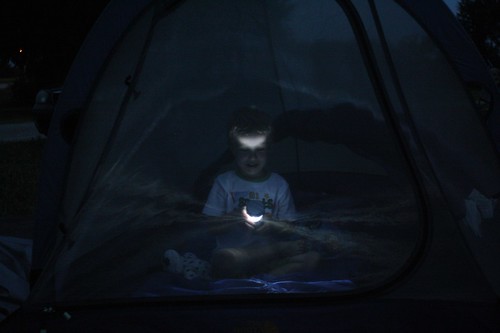
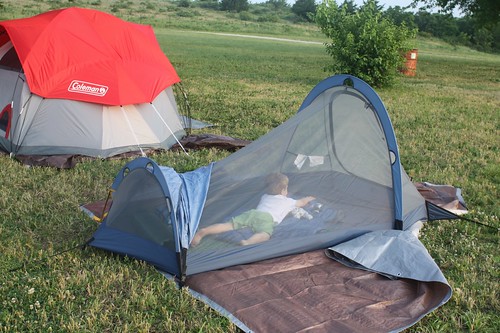
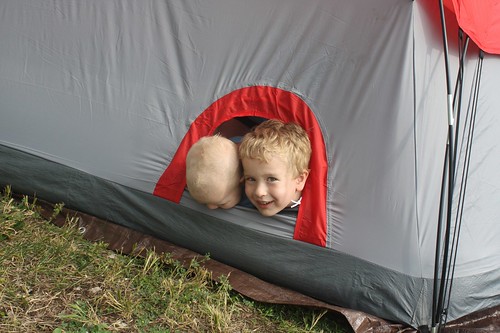
Friday I took the day off for us to go camping. Due to the birth of Oliver, our last time camping was in 2008. Back then, Terah had asked me what I wanted for father s day, and I suggested camping. Except when she was pregnant last year (and then Oliver was little), we have sort of had a standing plan to go camping twice a year: around father s day and my birthday. She says that s way more camping in a year than anyone needs. Anyhow, Jacob doesn t remember the last time we went camping; he was not quite 2 at the time. I explained that we would sleep in tents, and he d get one just his size. He laughed at that. Then I explained that he would get a bag to sleep in, and he thought that was hilarious. He kept talking about tents and even more so about sleeping bags until he actually got to be in one. It seems like each time we go camping, we wind up somewhere else. We ve camped at Kanoplis Lake and Marion Park and Lake in the past few years. But this time we went to Cedar Valley Reservoir near Garnett, KS. It was a nice place to be, with some wilderness camping areas far from any RV hookups (though right next to a gravel driveway where we could park). Almost as soon as we got out of the car, Jacob found a partially-burned stick left in a fire ring. So of course his hands were black pretty quick. He kept track of that stick the whole time we were there, and used it for everything he could think of. His favorite use, though, was at the lake to splash water: 2010-06-11 15.20.21.jpg The lake really was his favorite feature. He loved to throw rocks and sticks in it with me, to splash himself, and to stick his feet in. Oh, and to splash me. IMG_4057.JPG The pier was also a great thing for him he at first thought it was a boat, then really wanted to go. I made him hold my hand the whole time, and he liked walking on it. But he was frustrated that he couldn t reach the water. Somehow, Jacob acted as if he could sit in the hot sun for hours, just making small splashes with a stick. I, on the other hand, felt the 90-degree heat strongly, and eventually we found a shady spot to play in the lake. Oliver enjoyed crawling around on a blanket or on the grass. Though Terah put a stop to that after she noticed that he came across a pile of fish heads and was about to reach for one and put it in his mouth. We cooked over a campfire Friday night and Saturday morning. It took me a lot longer to start a fire than normal. Part of the problem was that there had been a lot of rain in the area, and it was humid, so there was little kindling to be found. Plenty of larger pieces of wood, so once the fire got going, it burned nicely. We cooked brats, brought along some homemade bread, had grilled foil-wrapped potatoes, and had stir-fry vegetables. Oliver got to eat with us too, of course: IMG_4022.JPG Terah is a big believer in smores, so after supper we made some smores Jacob predictably got sticky from the marshmallows and chocolate. Jacob started asking when I d set up the tent almost as soon as he found his stick. All afternoon he kept asking. Finally we got it set up, and of course he was so excited that he played inside it for an hour before he fell asleep. Terah had bought a $4 lantern at Walmart to give to him to use in his tent. I told him that there would be a surprise lantern in his tent for him to use. And he loved his lantern. It could turn on, off, and flash red. At one point he asked me, Dad, do you have a surprise lantern too? No, I will just use my flashlight. He looked a bit sad about that. For about 5 seconds. Then he turned on his lantern again. Here he is with it, still playing happily about 2 hours after his bedtime: IMG_4100.JPG And in the morning, of course he was still wanting that, but also wanted to play with his digital camera (a kid s version that also has a simple game or two on it). Without leaving the tent, of course. IMG_4105.JPG Oliver was getting hungry while we worked on breakfast, so I gave him some bread to munch on. IMG_4119.JPG We used our cast iron skillet to fry some bacon for breakfast. Then Terah made some pancakes in the skillet (with the bacon grease). Greasiest and best pancakes ever. After that, we had some fried and scrambled eggs. After that, we had more smores (I wasn t kidding about Terah being a big believer in them.) Jacob decided that he wanted to play in the other tent. He enjoyed playing with Terah, Oliver, and the air mattress (that Terah appreciated as much as I thought it took up too much space in the car). There s a little window on the back that can open to a screen or open completely. Jacob and Oliver enjoyed looking out of it while open. Or rather, Jacob enjoyed that, while Oliver enjoyed licking it. IMG_4161.JPG I had my Droid with me to keep an eye on the weather. The forecast for several days had called for a 20% chance of storms on Saturday. I checked Saturday morning at 7, and it still called for 20% chance of storms after 1PM. We decided we d pack up our tents after breakfast so we could stay as long as we liked or leave on short notice if we preferred. Clouds seemed to be building, though, so I checked the forecast again at maybe 9. Now it called for 60% chance of thunderstorms and heavy rain before 1PM. Guess I shouldn t have been surprised; it is Kansas after all. As I had the first tent about 90% put away, it started to rain. We rushed to get the rest of the stuff in the car, and by the time we did, it was raining heavily. We had planned to spend at least part of the afternoon there, but decided we d look for another place to stop on the way home. We stopped first at Garnett s North Lake, as the rain had let up for awhile. We spotted a fishing pier that Jacob wanted to walk on, but the bridge out to it was underwater, so we passed on that. While Terah fed Oliver in a shelter, Jacob and I played on some swings. Then we walked down to that lake. Jacob carefully came to an abrupt stop and looked both ways at each disused road between us and the lake, saying OK when it was clear to go. The rain picked up again, so we started heading towards home. It got quite heavy, with thunder and everything, which Jacob didn t care for at all. Both boys went to sleep, though. We stopped at Marion Reservoir on the way home. Jacob hadn t been able to play in the lake at Garnett (the place we stopped had a bank that was too steep) and so we played there. He waded into the water at the swimming area, and predictably enjoyed yes throwing rocks into the lake. When we got home, I set out the wet tent and tarps (it s not good to store that stuff wet) to dry there hadn t been rain at home yet. Camping s a lot of work, but it was a good family activity. I m looking forward to our next time, and hope we can choose a weekend a little less hot and damp.

13 June 2010

Gunnar Wolf: World Naked Bike Ride 2010 Mexico

For the second time (First time was in 2008; I didn't join in 2009 as I travelled to Nicaragua on that date), I took part of the World Naked Bike Ride. The WNBR is a global effort, where people in ~150 cities all over the world go cycling nude on the streets of our towns, with varied demands, including: I love my bike! One of the things I most like about WNBR is its diversity. Not everybody goes for the same reasons. As people who read me often will know, I took part because I believe (and act accordingly!) that the bicycle is the best, most efficient vehicle in by far most of the situations we face day to day, but we need to raise awareness in everybody that the bicycle is just one more vehicle: On one side, we have the right to safely ride on the streets, like any other vehicle. On the other side, we must be responsible, safe drivers, just as we want car drivers to be. Ok, and I will recognize it before anybody complains that I sound too idealistic: I took part of the WNBR because it is _tons_ of fun. This year, we were between 300 and 500 people (depending on whom you ask). Compared to 2008, I felt less tension, more integration, more respect within the group. Of course, it is only natural in the society I live in that most of the participants were men, but the proportion of women really tends to even out. Also, many more people joined fully or partially in the nude (as nudity is not required, it is just an invitation). There was a great display of creativity, people painted with all kinds of interesting phrases and designs, some really beautiful. Oh, one more point, important to me: This is one of the best ways to show that we bikers are not athletes or anything like that. We were people ranging from very thin to quite fat, from very young to quite old. And that is even more striking when we show our whole equipment. If we can all bike around... So can you! Some links, with obvious nudity warnings in case you are offended by looking at innocent butts and similar stuff: As for the sad, stupid note: 19 cyclists were placed under arrest in Morelia, Michoac n because of faltas a la moral (trasgressions against morality), an ill-defined and often abused concept. Also, by far, most of the comments I have read from people on the media, as well a most questions we had by reporters before or after the ride were either why are you going nude (because that's the only way I'll get your attention!) or But many people were not nude! (nudity is not a requirement but only an option.

12 June 2010

Matt Zimmerman: How to decide what to read (and what not to read)?

Like you, dear Internet readers, I have no shortage of reading material. I have ready access to more engaging, high quality, informative and relevant information than I can possibly digest. Every day, I have to choose what to read, and what to pass by. This seems like an important thing to do well, and I wonder if I do a good enough job of it. This is just one example of a larger breadth/depth problem, but I m finding the general problem difficult to stomach, so I m focusing on reading for the moment. These are my primary sources of reading material on a day-to-day basis: How do you decide what to read, and what not to read? How does your experience differ between your primary information sources? How have you tried to improve?

Russell Coker: Defense in Depth and Sudo

My blog post about logging in as root and whether sudo provides any benefit [1] got some interest on Redit. In the Reddit comments on my post [2] there are a lot of strange things. One interesting comment was to suggest that logging in as non-root provided defense in depth . The NSA is credited with inventing the term Defense in Depth as applied to the computer industry, they have a PDF that gives an overview of the concept [3]. It seems that Defense in Depth is all about having multiple different layers of security, firewalls, IDS/IPS, passwords, PKI, etc. Entering the same password twice (once to login and once to run sudo which seems to be a fairly typical configuration of sudo) hardly seems to count. Can using sudo provide Defense in Depth benefits? With a typical configuration the use of sudo provides no real protection. The user either enters their own password or the root password to gain full root access, in either case the attacker can exploit their session and get the password. A session exploit can be easily arranged by creating a shell function or alias that makes sudo run something else (such as using netcat to send the password out over the network). One way of making this sort of attack more difficult is to make root own the user home directory, files such as ~/.login that are used by the user shell, the ~/.ssh directory and the ~/.ssh/authorized_keys file. This way a hostile party can t change the configuration, so a successful attack has to involve a long running process that uses ptrace to intercept the shell and divert an attempt to run sudo. If the non-root user is prevented from using ptrace then things start to become a little more difficult for the attacker. In some quick tests I was able to capture about half the data through messing with /proc/X/fd/0 and /proc/X/fd/1 for a target process, but it seems that it would be difficult to get an entire password that way. To disable ptrace you could compile a kernel without ptrace support, use a SE Linux policy that prevents prevent ptrace access for the sessions in question, or make the user s shell SETGID. If the root account and the account used for su or sudo use different authentication methods, where the options include ssh authorized keys, password, and security token (maybe both password and token for the root account) then it does seem that it would provide some Defense in Depth benefits. sudo can be used to only permit executing certain commands. While this is a real security benefit it doesn t allow full sysadmin work, merely delegating some portions of operations to people who don t have full sysadmin rights. As someone needs to have full access to fix any problem that might occur on the machine someone needs to have access to run any command as root. So while sudo is great for providing limited administrative access to certain junior people, it s not going to stop an attack on a member of the sysadmin team. Conclusion In a typical sudo configuration the non-root account is configured in a default Unix manner (with the user having ownership of their home directory). The user who logs in to that account controls it s environment through .login and other scripts, so sudo doesn t gain anything. In a typical configuration ptrace is enabled so even if the critical environment files can t be modified by a hostile party they can get the same result through ptrace. Admittedly using a SETGID shell is not going to be difficult to implement after you have changed the ownership of the home directory. If you have a configuration where ptrace is not available and the non-root user can t modify their own profile files then it starts to become difficult for an attacker. If root authentication requires using a security token such that every login uses a different code and the code expires rapidly then it becomes even more difficult for an attacker. But for all configurations that are close to the default for every OS that I ve ever used none of these conditions hold. Also none of those conditions held for any of the systems I ve been employed to use which were configured to require su or sudo for root access. As it seems that most sudo configurations don t provide any extra security, and that auditing the actions of the sysadmin can be better done in other ways (such as the Bash 4.1 syslog feature) [4] it seems that for the vast majority of systems sudo doesn t provide a benefit. The fact that sudo could provide a benefit if configured in a way that is quite different to all the defaults and the ways that it is typically used is worth noting. I m not going to argue with anyone who wants to configure their systems in such a manner and who believes that they need to do so. But anyone who thinks that sudo is the only way to go because the Ubuntu default configuration does it really needs to investigate the issues. Remember that blind faith in the security choices of other people can be a security problem.

Russell Coker: Links June 2010

Seth Berkley gave an interesting TED talk about developing vaccines against the HIV and Influenza viruses [1]. The part I found most interesting was the description of how vaccines against viruses are currently developed using eggs and how they plan to use bacteria instead for faster and cheaper production. One of the problems with using eggs is that if the chickens catch the disease and die then you can t make a vaccine. Aigars Mahinovs wrote a really good review of Microsoft Azure and compared it to Amazon EC2 [2]. It didn t surprise me that Azure compared poorly to the competition. Johanna Blakley gave an insightful TED talk about IP lessons from the fashion industry [3]. She explained how an entire lack of IP protection other than trademark law was an essential part of the success of the fashion industry. She also compared the profits in various industries and showed that industries with little or no IP protection involve vastly larger amounts of money than industries with strong IP protection. Lisa D wrote an insightful post about whether Autism Spectrum Disorders (such as Asperger Syndrome) should be considered to be disabilities [4]. I don t entirely agree with her, but she makes some really good points. Sharmeen Obaid-Chinoy gave an interesting TED talk about the way the Taliban train young children to become suicide bombers [5]. Apparently the Taliban prey on large poor families, sometimes paying the parents for taking children away to school . At the Taliban schools the children are beaten, treated poorly, and taught theology by liars who will say whatever it takes to get a result. Then after being brain-washed they are sent out to die. Wired has an interesting article about Charles Komanoff s research into New York traffic problems [6]. He aims to track all the economic externalities of traffic patterns and determine incentives to encourage people to do things that impose less costs on the general economy. His suggestions include making all bus travel free as the externality of the time spent collecting fares is greater than the fare revenue. It s a really interesting article, his research methods should be implemented when analysing traffic in all large cities, and many of his solutions can be implemented right now without further analysis such as free buses and variable ticket pricing according to the time of day. William Li gave an interesting TED talk about starving cancer by preventing new blood vessels from growing to feed it [7]. Drugs to do this have been shown to increase the life expectancy of cancer patients by more than 100% on average. Also autopsies of people who died in car accidents show that half the women in their 40 s had breast cancer and half the men in their 50 s prostate cancer but those cancers didn t grow due to a natural lack of blood supply, so the aim here is to merely promote what naturally happens in terms of regulating cancers and preventing them from growing larger than 0.5mm^3. There are a number of foods that prevent blood vessels growing to cancers which includes dark chocolate! ;) Also drugs which prevent blood vessel growth also prevent obesity, I always thought that eating chocolate all the time prevented me from getting fat due to the central nervous system stimulants that kept me active Graham Hill gave an inspiring TED talk about becoming a weekday vegetarian [8]. Instead of making a commitment to being always vegetarian he s just mostly vegetarian (only eating meat on Sundays). He saves most of the environmental cost and doesn t feel guilty if he ever misses a day. It s an interesting concept. Cory Doctorow wrote an insightful article for the Guardian about the phrase Information Wants To Be Free [9]. He points out that really it s people who want to be free from the tyranny that is being imposed on us in the name of anti-piracy measures. He also points out that it s a useful straw-man for the MAFIAA to use when claiming that we are all pirates. The Atlantic has an interesting article about the way that Google is working to save journalistic news [10]. Adam Sadowsky gave an interesting TED talk about creating a Rube Goldberg machine for the OK Go video This Too Shall Pass [11]. At the end of the talk they include a 640*480 resolution copy of the music video. Brian Cox gave an interesting TED talk advocating increased government spending on scientific research [12]. Among other things he pointed out that the best research indicates that the amount of money the US government invested in the Apollo program was returned 14* to the US economy due to exports of new American products that were based on that research. It s surprising that any justification other than the return on investment for the Apollo program is needed! Moot gave an interesting TED talk about Anonymity [13]. I don t think that he made a good case for anonymity, he cited one person being identified and arrested for animal cruelty due to the efforts of 4chan people and also the campaign against the Cult of Scientology (which has not been very successful so far). Rory Sutherland gave an intriguing TED talk titled Sweat the Small Stuff [14]. He describes how small cheap changes can often provide greater benefits than huge expensive changes and advocates corporations having a Chief Detail Officer to take charge of identifying and implementing such changes. TED Hosted an interesting debate between pro and anti nuclear campaigners [15]. They agreed that global warming is a significant imminent problem but disagree on what methods should be implemented to solve it.

9 June 2010

Russell Coker: Mailing List Meta-Discussions

It seems that most mailing lists occasionally have meta-discussions about what is on-topic, the few that don t are the ones that have very strong moderation authoritarian moderators who jump on the first infraction and clearly specify the rules. I don t recall the list of acceptable topics for any mailing list including also discussions about what is on-topic . As this is the Internet I m sure that someone will immediately point out an example of such a list, but apart from the counter-example that someone will provide it seems obvious that for the majority of mailing lists a meta-discussion is not strictly on topic. Regardless of a meta-discussion not being on-topic I don t think there s anything wrong with such a discussion on occasion. But if a meta-discussion is to be based on the volume of off-topic messages it would be nice if the people who advocate such a position could try and encourage the discussion in a way that reduced the number of messages. Replying to lots of messages is not a good strategy if your position is that there are too many messages. If a meta-discussion is going to be about moving off-topic discussions to other forums that are more appropriate then it would be nice to have the meta-discussion move to another forum if possible. My previous post which advocates creating a separate mailing list for chatty messages was an attempt to move a discussion to a different forum [1]. Anyone who believes that such discussions don t belong on a list such as debian-private is free to commit their thoughts to some place that they consider more appropriate and provide the URL to any interested parties. I think that it s worth noting that the only comment on my previous post is one that describes how to filter mail to split the traffic from the debian-private list into different mailboxes. I had hoped that other people would write blog posts advocating their positions which would allow us to consider the merits of various ideas without the he-said-she-said element of mailing list discussions. Most mailing lists have a policy against profanity and some go further and ban personal abuse. Therefore it seems hypocritical to advocate a strict interpretation of the rules in regard to what is on-topic while also breaking the rules regarding profanity or personal abuse. I don t think it s asking a lot to suggest that the small minority of messages that someone writes on the topic of a list meta-discussion should obey the set of rules that they advocate I m not suggesting that someone should obey all the rules all the time, just when they are trying to enforce them. Also you can argue that a list policy against profanity doesn t preclude sending profane messages off-list, but if the off-list messages are for the purpose of promoting the list rules it still seems hypocritical to use profanity. It is a fair point that off-topic discussions and jokes can distract people from important issues and derail important discussions. It would be good if people who take such positions would implement them in terms of meta-discussions. If the purpose of a meta-discussion is to avoid distraction from important issues then it seems like a really good idea to try and avoid distraction in the meta-discussion thread. I wonder whether a meta-discussion can provide anything other than a source of lulz for all the people who don t care about the issue in question. The meta-discussions in the Debian project seem to always result in nothing changing, not even when the majority of people who comment agree that the current situation is not ideal. When an almost identical meta-discussion happens regularly it seems particularly pointless to start such a discussion for the purpose of reducing off-topic content. Revisiting an old discussion can do some good when circumstances change or when someone has some new insight. I know that it s difficult to avoid being sucked into such discussions, when I was diagnosed with AS [2] I decided to try and minimise my involvement in such discussions but I haven t been as successful at doing so as I had hoped.

Next.

Previous.