John Sullivan: Drupal UI win



Debian Women MiniDebConf, BCN 2014
I am going to Debian Women MiniDebConf, BCN 2014.
 Recently I've been pondering how to do service discovery.
Pretend you have a load balancer which accepts traffic and routes incoming requests to different back-ends. The loadbalancer might be pound, varnish, haproxy, nginx, or similar. The back-ends might be node applications, apache, or similar.
The typical configuration of the load-balancer will read:
# forward
# backends
backend web1    .host = "10.0.0.4";
backend web2    .host = "10.0.0.6";
backend web3    .host = "10.0.0.5";
#  afterword
I've seen this same setup in many situations, and while it can easily be imagined that there might be "random HTTP servers" on your (V)LAN which shouldn't receive connections it seems like a pain to keep updating the backends. Using UDP/multicast broadcasts it is trivial to announce "Hey I'm a HTTP-server with the name 'foo'", and it seems to me that this should allow seamless HTTP load-balancing. To be more explicit - this is normal:
Debian Women MiniDebConf, BCN 2014
I am going to Debian Women MiniDebConf, BCN 2014.
 A couple of weeks ago, Gunnar Wolf mentioned on IRC
that his CuBox-i4 had arrived. This resulted in
various jealous noises from me; having heard about this device making the
rounds at the Kernel Summit, I ordered one for myself back in December, as
part of the long-delayed HDification of our home entertainment system and
coinciding with the purchase of a new Samsung SmartTV. We've been running
an Intel Coppermine Celeron for a decade as a MythTV frontend and encoder
(hardware-assisted with a PVR-250), which is fine for SD video, but really
doesn't cut it for anything HD. So after finally getting a TV that would
showcase HD in all its glory, I figured it was time to upgrade from an
S-Video-out, barely-limping-along tower machine to something more modern
with HDMI out, eSATA, hardware video decoding, and whose biggest problem
is it's so small that it threatens to get lost in the wiring!
Since placing the order, I've been bemused to find that the SmartTV is
so smart that it has had a dramatic impact on how we consume media;
between that and our decision to not be a boiled frog in the face of DISH
Network's annual price increase, the MythTV frontend has become a much less
important part of our entertainment center, well before I ever got a chance
to lay hands on the intended replacement hardware. But that's a topic for
another day.
Anyway, the CuBox-i4 finally arrived in the mail on Friday, so of course I
immediately needed to start hacking on it! Like Gunnar, who wrote last
week about his own experience getting a "proper"
Debian install on the box, I'm not content with running a binary distribution
image prepared by some third party; I expect my hardware toys to run official
distro packages assembled using official distro tools and, if at all possible,
distributed on official distro images for a minimum of hassle.
Whereas Gunnar was willing to settle for using third-party binaries for the
bootloader and kernel, however, I'm not inclined to do any such thing. And
between my stint at Linaro a few years ago and the recent work on Ubuntu for
phones, I do have a little knowledge of Linux on ARM (probably just enough
to be dangerous), so I set to work trying to get the CuBox-i4 bootable with
stock Debian unstable.
Being such a cutting-edge piece of hardware, that does pose some challenges.
Support for the i.MX6 chip is in the process of being upstreamed to U-Boot,
but the support for the CuBox-i devices isn't there yet, nor is the support
for SPL on i.MX6 (which allows booting the variants of the CuBox-i with a
single U-Boot build, instead of requiring a different bootloader build for
each flavor). The CuBox-i U-Boot that SolidRun makes available (with source
at github) is based on U-Boot
2013.10-rc4, so more than a full release behind Debian unstable, and the
patches there don't apply to U-Boot 2014.01 without a bit of effort.
But if it's worth doing, it's worth doing right, so I've taken the time to
rebase the CuBox-i patches on top of 2014.01, publishing the results of the
rebase to my own github
repository and submitting
a bug to the Debian U-Boot maintainers
requesting its inclusion.
The next step is to get a Debian kernel that not only works, but fully
supports the hardware out of the box (a 3.13 generic arm kernel will boot on
the machine, but little things like ethernet and hdmi don't work yet). I've
created a page in the Debian
wiki for tracking the
status of this work.
 Zoe slept through the night for the first time in recent memory, and was up at
around 6am. It was lovely. I'm thinking the slightly lower temperature helped.
I'm definitely going to explore air conditioning for the bedrooms before next
Summer.
I'd picked up some egg cups on the weekend, so we did soft boiled eggs in the
Thermomix for breakfast. They turned out lovely this time, and Zoe seemed to
enjoy eating hers. She dressed herself while they were cooking. Her
Kindergarten t-shirts arrived yesterday, so now she looks like all the other
kids. It's very cute.
It rained on and off in the morning, and I was in two minds about whether to
chance it on the bike or not. As it happened we ended up messing around a bit
before leaving, so we drove, and it was a good call, because it started raining
again as we pulled out of the driveway.
Drop off was super smooth. Megan had been away yesterday, but was back today,
so Zoe was very happy to see her.
My financial advisor came out for a chat about investments mid-morning, and
then I got stuck into my US taxes. I will not miss having to do these tax
returns. The 2013 one is going to be particularly complicated by the fact we
sold our home and were only in the country for like 80 days.
I biked over to Kindergarten to pick up Zoe, as the weather had improved.
Surprisingly, she was awake, but her teacher said she'd just woken up from a
nap. We managed to clear out pretty quickly. I stopped at the health food shop
on the way home to get some peanut oil for the dinner I was making.
Due to a miscommunication, Zoe had missed her Saturday swim class. I explained
to the swim school the error, and they were kind enough to allow Zoe to have a
make up class anyway, so we went to that after Kindergarten.
Zoe wanted to do some more practice riding her bike. She's got a little 10 inch
bike with no training wheels and a gyrobike front wheel. We
haven't had a lot of success learning to ride to date, due to a combination of
her height and just time, so it was interesting that she decided today she
wanted to do some more practice.
She wanted to "ride" her bike from home to the park on the way to swim class,
but I managed to convince her to walk the bike to the park. It turns out even
walking the bike is a bit of a challenge for her, so I ended up carrying it
most of the way. It's heavy.
We got to the park, and had a bit of a run with the bike. I'm glad I decided to
take her knee pads and elbow pads, because she did stack it fairly decently,
but managed to survive mostly unscathed. To her credit, she even got back on
the bike again. She's a tough kid.
Once we made it to the playground, she lost all interest in the bike, and we
had about 15 minutes to kill before we needed to continue to the pool.
We walked/carried the bike from the park to the pool, and the make up class Zoe
ended up in was Megan's regular class, so the girls had a great time together.
After swim class, we walked back home. Zoe's Nana was coming over for dinner,
and I wanted to make a satay chicken dish. I'd bought some peanuts from the Peanut Wagon on Sunday, when I was in
Nanango for my uncle's 90th birthday party, and I wanted to try making peanut
butter from scratch in the Thermomix, and use that to make the satay sauce.
Long story short, dinner wasn't super great. I'd made a satay chicken in the
Thermomix previously, but I couldn't find the recipe I used last time. I used
this
recipe tonight, but didn't really follow it properly because I was trying
to cut corners due to the time. I tried cooking wild rice in the microwave and
it was a total flop. The satay chicken itself turned out okay, but it was a
shame about the rice. It was cool making my own peanut butter.
Zoe had a great time playing with her Nana, and after we dropped her off at the
train station went to bed without a peep.
-rw-r--r-- 1 nobody nogroup  69M Mar 11 01:25 0-003035.v264
-rw-r--r-- 1 nobody nogroup  69M Mar 11 02:25 0-013049.v264
-rw-r--r-- 1 nobody nogroup  69M Mar 11 03:26 0-023103.v264
-rw-r--r-- 1 nobody nogroup 5.9M Mar 11 03:31 0-033117.v264
-rw-r--r-- 1 nobody nogroup 1.5M Mar 11 03:40 0-034350.v264
-rw-r--r-- 1 nobody nogroup  17M Mar 11 04:02 0-035259.v264
-rw-r--r-- 1 nobody nogroup 306K Mar 11 04:10 0-041548.v264
-rw-r--r-- 1 nobody nogroup 4.9M Mar 11 04:23 0-042457.v264
There is a support forum, where I found the following files scattered in various posts. From what I can tell, they are the latest as of this writing. I can confirm they work with my IP391W-HD, which the system tells me is GM8126 hardware and came with firmware 1.2.8.3.
www.modern.ie offers free limited-time Windows VM's which will work to upload this firmware. Just make sure you use a bridged network in the VM; I'm guessing the firmware ActiveX control tells the camera to TFTP the data from it, which doesn't work via NAT. Somewhat worryingly, you can telnet to it and get a login prompt (TASTECH login). So it has a built-in backdoor you can't disable. There have been some efforts to hack the device. leecher@dose.0wnz.at did an excellent job reverse engineering the .pk2 format and writing tenvis_pack.c (no license, I'm generously assuming public domain). I used this to recreate the firmware above with a telnet daemon listening with a shell on port 2525 (no password, just telnet to it)
- 1.3.3.3.pk2 - firmware (b56f211a569fb03a37d13b706c660dcb)
- web.pk2 - a UI update that includes dropbox support. This is really for the model that has pan and tilt, so those buttons don't work. (0e42e42bd6f8034e87dcd443dcc3594d)
- V264ToAVIen.exe - converts the output to an AVI file that mplayer will play (with some complaints) (9c5a858aa454fed4a0186cf244c0d234)
It's interesting to poke around, but it seems like the whole thing is really driven by a binary called ipc8126
- 1.3.3.3-telnet.pk2 (19cf63ca8f0928af8ef5a9eb8326aae6)
/ # ipc8126 --help
*** TAS-Tech IPCAM/DVS
*** Version: 1.3.3.3
*** Release date: 2013-08-05 15:48:32
In general, I'd say hackability is quite low. Warning : any of the above might turn your camera into a paperweight. It worked for me, but that's all I can say...
 Each year the 7DRL competion gives me an opportunity to abandon developing a roguelike game part way through. This year I am going to strive mightily to actually complete a playable game though owing to family commitments I have already gotten off to a rocky start which does not bode well.
But enough negativity...
So this year 7DRL coincides with the first ever Procedural Death Jam. This is a similar type of thing except the genre is Procedural Death Labyrinth. Procedural Death Labyrinths are a subset of Roguelikes (or is it the other way round?) If you have taken advantage of the wonderful offer Valve has given to Debian developers, you can find a number of examples of Procedural Death Labyrinths on Steam.
The most important part of any software development project is of course choosing a cool name. My game is called "The Girl Who Played With The Dragons Nest" (Can you guess what I've been reading?) It is written in C++ with the Curses toolkit. It will of course be open source.
I intend to blog my progress here if you care to follow along.
I got up not as early as I'd have liked, and did the first 10km run I've done
for a while, with my new shoes and the orthotics in them. It was a bit cooler,
and despite not being particularly well hydrated, I lasted the distance, and
managed to complete it in under an hour. I'm a long way off my best time at the
moment, but I'm hoping as it cools down my running fitness will improve.
I ended up doing a bunch of startup-related stuff today, instead of Debian
stuff. It felt good to make some vaguely forward progress, even if it was just
business operations planning stuff.
I picked up Zoe from Kindergarten by bike. We'd both confirmed with her several
times since Friday as to which mode of transport she wanted to use to come
home, and she'd indicated the bike.
Zoe was asleep as usual, but woke up pretty easily. The Kindergarten has
indicated that they want everyone out of the centre by 2:30pm, which makes it a
bit of a challenge to rouse a deeply sleeping child and exit the centre in 10
minutes. I managed to sunscreen her while she was still horizontal, so that
sped things up, and it helped greatly that she didn't have a post-nap meltdown.
One of her class mates and her mother were hanging around waiting for her big
brother to finish school, and the bike
trailer tends to be a good conversation starter, so we chatted for a little
bit before leaving. It was nice to properly meet another parent, and I'm glad
to see Zoe's started learning some of her class mates names.
I had a kale, carrot and apple juice for lunch today, and as I hate wasting the
pulp out of the juicer, I'd previously found a nice
muffin recipe that I could use the kale and carrot pulp in. I'd previously
baked a batch of mini muffins for Zoe's lunches, and was pleased that she liked
them. We were getting a bit low, so I thought we'd bake another batch this
afternoon, so that's what we did after we got home.
Once they were in the oven, Zoe went off to watch TV and I made a start on
dinner.
Bedtime went nice and smoothly tonight.
 I've spent a while trying to make GPU switching work more reliably on Apple hardware, and got to the point where my Retina MBP now comes up with X running on Intel regardless of what the firmware wanted to do (test patches here. But in the process I'd introduced an additional GPU switch which added another layer of flicker to the boot process. I spent some time staring at driver code and poking registers trying to figure out how I could let i915 probe EDID from the panel without switching the display over and made no progress at all.
 As a followup for my previous blog post, I decided to port QAntenna to Qt 5. Here's my experience. As you might know, Qt 4 is now in bug-fixes-only maintenance mode. This means that only bug fixes are allowed to be pushed to Qt 4's repository, but no new features.
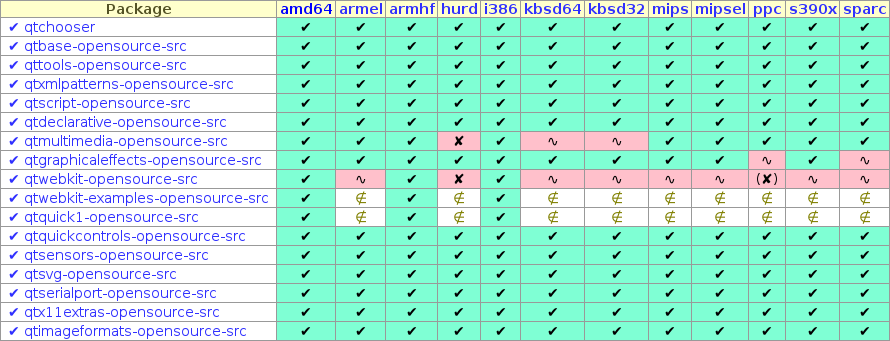
 |
| Note: qttools is FTBFS in armhf just because of some symbols changes, it will be fixed on the next upload. |
Q: How can you find Germans abroad?
A: You stand outside a bakery and wait until someone starts cussing.
 If you re the sort that cares about federation, the MediaGoblin project is for you!
lxc-unshare, which uses
Linux-specific clone(2) call to run a process with new PID, IPC and other
namespaces. However, this utility can t be used for running forking
daemons, as the container is destroyed when its PID 1 exits.
That s why I decided to add the support for process isolation to start-stop-daemon.
I was careful enough to introduce minimal changes to it to make sure they can
be merged back to the version as shipped with dpkg, and at the same time
be buildable separately from the rest of it. Speaking of building, by the way,
this version of start-stop-daemon uses mk-configure,
a light-weight autotools replacement, as its build system.
What I added, from a user s perspective, is a single --isolate option. When
run with this option, start-stop-daemon calls clone(2) just before configuring
the environment of a process it s going to run. The cloned process runs in
a new namespace, and immediately remounts /proc, /dev/shm and /dev/mqueue.
Then it forks, and a forked process executes the daemon. The parent process,
which is PID 1 in the new PID namespace, uses waitpid(2) to monitor its child
processes. As soon as its very first child exits, it talks via a pipe to the process
outside of the container, so that it knows the container has a forked daemon
and it needs to detach. In any case, the container s PID 1 does waitpid(2) in
a loop, checking the process list every time a child terminates. As soon as it s left
alone or a SIGTERM is received, it exits.
The code is published at Bitbucket.
 Or, "Why 2014 will NOT be the year of Linux in the desktop".
So, it happens that my mum (66 yo) has been a Debian user for over a year now. With highs and lows, she manages to do what she needs; sometimes I need to intervene.
Today I thought I could send her a quick email explaining how to download using BitTorrent, because of reasons. So, as I was writing, I realised that in many torrent sites, you only get a magnet link these days. No problem! Click on the magnet link, at it should work automagically.
Then I remembered: it works on my computer, because I've spent a couple of hours some time ago researching how to make FireFox work with magnet links, creating a custom script, etc. I hoped that by now this must have been solved, at least in Debian unstable.
Wrong again. I created a new user in my computer, launched IceWeasel/FireFox and boom: I get a dialog asking me to select a program, not from a list of desktop applications, taken from one of the gazillion sources where applications are defined, but just from any place on the file system! (At least, now you don't need to go tweaking with the hidden FireFox configuration editor).
I was very angry at the brainiac at Mozilla who thought it was a great idea to ignore the host system and do their own MIMEtype handling. And then, tried Chromium to see what would happen... And I get first a scary message telling me that it is going to use the super-obscure
xdg-open program to open my link, and that it could harm my computer! It was followed by another very helpful dialog telling me something like:
Unable to detect the URI-scheme of "magnet:?xt=urn:btih:diePh6iengei4quaep4shai8ahshahnae9 oolahtetheir2bohmu1eelaChui1ohdahruegh4wief6PusahDae4ho oshahjoogai7bae9shuvei9shufeX4boog8neichi3OoDee5ei9Uori c6aingairepon9gok8Mee7uRahphah4EucoopheiYin4xe4lahn0goh"Then the real fun started... I starting looking around to understand how this is supposed to work, I wanted to provide a patch! So, it turns out that if you add some values to GConf this should work. So, try to find where would that be. Read about GConf schemas, default and mandatory values, and their 10 possible locations. Find that Azureus provides an schema, use that to create one for Transmission. Then find that in fact, Transmission was providing defaults, which are not the same but work the same, and that they had an error there: yes, problem found! (#741069) No! It turns out that the Gnome desktop does not use that any more, and now they scan the
.desktop (who knows in which of the 100 directory tress where .destop files are present) files for MIME handlers, and the transmission-gtk.desktop file had that correctly. So why does it not work?
Well, it turns out that if I used gvfs-open instead of xdg-open, it did work! The thing is, I am running XFCE here, which is GTK based, but it is not Gnome: instead of gvfs-open, I was getting exo-open, which is it's brain-dead cousin, and can't do anything but files, email and web.
It is fecking 2014, and we still don't have a sensible, unified way to select preferred applications. We still have incompatible, duplicated, incomplete, competing implementations. We have FreeDesktop doing one thing to try and unify criteria, which is then ignored or mis-implemented up and down by some desktops and applications.
Some days I get really angry at the Free Software world.
PS: I guess I will tell mum to copy&paste the links from the browser to the torrent client, but not today. I have already lost 4 hours of sleep on this.
 Brief Glamor Hacks
Eric Anholt started writing Glamor a few years ago. The goal was to
provide credible 2D acceleration based solely on the OpenGL API, in
particular, to implement the X drawing primitives, both core and
Render extension, without any GPU-specific code. When he started,
the thinking was that fixed-function devices were still relevant, so
that original code didn t insist upon modern OpenGL features like
GLSL shaders. That made the code less efficient and hard to write.
Glamor used to be a side-project within the X world; seen as something
that really wasn t very useful; something that any credible 2D driver
would replace with custom highly-optimized GPU-specific code. Eric and
I both hoped that Glamor would turn into something credible and that
we d be able to eliminate all of the horror-show GPU-specific code in
every driver for drawing X text, rectangles and composited
images. That hadn t happened though, until now.
Fast forward to the last six months. Eric has spent a bunch of time
cleaning up Glamor internals, and in fact he s had it merged into the
core X server for version 1.16 which will be coming up this July.
Within the Glamor code base, he s been cleaning some internal
structures up and making life more tolerable for Glamor developers.
Using libepoxy
A big part of the cleanup was a transition all of the extension
function calls to use his other new project,
libepoxy, which provides a sane,
consistent and performant API to OpenGL extensions for Linux, Mac OS
and Windows. That library is awesome, and you should use it for
everything you do with OpenGL because not using it is like pounding
nails into your head. Or eating non-tasty pie.
Using VBOs in Glamor
One thing he recently cleaned up was how to deal with VBOs
during X operations. VBOs are absolutely essential to modern OpenGL
applications; they re really the only way to efficiently pass vertex
data from application to the GPU. And, every other mechanism is
deprecated by the ARB as not a part of the blessed core context .
Glamor provides a simple way of getting some VBO space, dumping data
into it, and then using it through two wrapping calls which you use
along with glVertexAttribPointer as follows:
pointer = glamor_get_vbo_space(screen, size, &offset);
glVertexAttribPointer(attribute_location, count, type,
              GL_FALSE, stride, offset);
memcpy(pointer, data, size);
glamor_put_vbo_space(screen);
1: fb-text.perf
2: glamor-text.perf
3: keith-text.perf
       1                 2                           3                 Operation
------------   -------------------------   -------------------------   -------------------------
   9300000.0      3160000.0 (     0.340)     18000000.0 (     1.935)   Char in 80-char line (6x13)
   8700000.0      2850000.0 (     0.328)     16500000.0 (     1.897)   Char in 70-char line (8x13)
   6560000.0      2380000.0 (     0.363)     11900000.0 (     1.814)   Char in 60-char line (9x15)
   2150000.0       700000.0 (     0.326)      7710000.0 (     3.586)   Char16 in 40-char line (k14)
    894000.0       283000.0 (     0.317)      4500000.0 (     5.034)   Char16 in 23-char line (k24)
   9170000.0      4400000.0 (     0.480)     17300000.0 (     1.887)   Char in 80-char line (TR 10)
   3080000.0      1090000.0 (     0.354)      7810000.0 (     2.536)   Char in 30-char line (TR 24)
   6690000.0      2640000.0 (     0.395)      5180000.0 (     0.774)   Char in 20/40/20 line (6x13, TR 10)
   1160000.0       351000.0 (     0.303)      2080000.0 (     1.793)   Char16 in 7/14/7 line (k14, k24)
   8310000.0      2880000.0 (     0.347)     15600000.0 (     1.877)   Char in 80-char image line (6x13)
   7510000.0      2550000.0 (     0.340)     12900000.0 (     1.718)   Char in 70-char image line (8x13)
   5650000.0      2090000.0 (     0.370)     11400000.0 (     2.018)   Char in 60-char image line (9x15)
   2000000.0       670000.0 (     0.335)      7780000.0 (     3.890)   Char16 in 40-char image line (k14)
    823000.0       270000.0 (     0.328)      4470000.0 (     5.431)   Char16 in 23-char image line (k24)
   8500000.0      3710000.0 (     0.436)      8250000.0 (     0.971)   Char in 80-char image line (TR 10)
   2620000.0       983000.0 (     0.375)      3650000.0 (     1.393)   Char in 30-char image line (TR 24)
 Makefile.am             2
 glamor.c                5
 glamor_core.c           8
 glamor_font.c         181 ++++++++++++++++++++
 glamor_font.h          50 +++++
 glamor_priv.h          26 ++
 glamor_text.c         472 +++++++++++++++++++++++++++++++++++++++++++++++++++++
 glamor_transform.c      2
 8 files changed, 741 insertions(+), 5 deletions(-)
uniform vec4 color;
void main()

       gl_FragColor = color;
 ;
Native code for point fragment shader 7 (SIMD8 dispatch):
   START B0
   FB write target 0
0x00000000: mov(8)          g113<1>F        g2<0,1,0>F                        align1 WE_normal 1Q  ;
0x00000010: mov(8)          g114<1>F        g2.1<0,1,0>F                      align1 WE_normal 1Q  ;
0x00000020: mov(8)          g115<1>F        g2.2<0,1,0>F                      align1 WE_normal 1Q  ;
0x00000030: mov(8)          g116<1>F        g2.3<0,1,0>F                      align1 WE_normal 1Q  ;
0x00000040: sendc(8)        null            g113<8,8,1>F
                render ( RT write, 0, 4, 12) mlen 4 rlen 0        align1 WE_normal 1Q EOT  ;
   END B0
 Makefile.am             1
 glamor.c                2
 glamor_polyops.c      116 ++++++++++++++++++++++++++++++++++++++++++++++++++--
 glamor_priv.h           8 +++
 glamor_transform.c    118 +++++++++++++++++++++++++++++++++++++++++++++++++++++
 glamor_transform.h     51 ++++++++++++++++++++++
 6 files changed, 292 insertions(+), 4 deletions(-)
$ ./Xephyr -glamor :1 -schedMax 2000 -screen 1024x768 -retro
git://people.freedesktop.org/~anholt/xserver glamor-server
git://people.freedesktop.org/~keithp/xserver glamor-server
convert -density 600 figure.pdf -channel alpha \
  -fx '((r == 1 && g == 1 && b == 1) ? 0 : 1)' figure.png
There are still some few points that look white but are probably not that white (due to antialiased rendering of the PDF file ?). There are many more things that can be done using the
-fx operator, this page was helpful to me !Edit: while the alpha channel seems to be on by default for PDF files, it is not necessarily the case for all images. If the above doesn't work, try adding -alpha Set before the -fx bit.
This week I received a logitech squeezebox radio, which is basically an expensive toy that allows you to listen to either "internet radio", or music streamed from your own PC via a portable device that accesses the network wirelessly.
The main goal of this purchase was to allow us to listen to media stored on a local computer in the bedroom, or living-room.
The hardware scans your network looking for a media server, so the first step is to install that:
Although I did start hacking a C & Lua alternative, it looks like there are enough implementations out there that I don't feel so strongly any more. I'm working in a different way to most people, rather than sort mails at delivery time I'm going to write a trivial daemon that will just watch ~/Maildir/.Incoming, and move mails out of there. That means that no errors will cause mail to be lost at SMTP/delivery time. I'm going to base my work on Email::Filter since it offers 90% of the primitives I want. The only missing thing is the ability to filter mails via external commands which has now been reported as a bug/omission.
Next.

