Search Results: "nate"

28 February 2007

David Welton: Ruby's Mysql interface

I just like open source too much to not be constantly bumping into things that I would love to improve or fix... I have way too much fun getting my hands dirty with something new. Today's adventure regards my need to stream large quantities of data from a ruby on rails installation, covered previously here: http://journal.dedasys.com/articles/2006/06/08/streaming-programmatically-generated-content-from-rails The current block is that ActiveRecord doesn't deal with a "stream" of results, but rather, fetches everything into one big, fat array and then deals with that. Luckily, I'm not the only person to have found this suboptimal: http://dev.rubyonrails.org/ticket/6921 However, as I comment there, to truly make things work, some low level coding is required. For mysql, since it doesn't seem to support cursors to the degree that something more standards-compliant like Postgresql does, the answer lies in the C library and language interfaces built on top of it: http://dev.mysql.com/doc/refman/5.0/en/mysql-use-result.html Unfortunately, Ruby's C API, or at least the versions that I downloaded, don't properly support fetching things one record at a time. It didn't take more than a few minutes to whip this up: http://dedasys.com/freesoftware/patches/mysql-ruby.patch (although there's a good possibility it could be improved...) However, according to this posting, the upstream maintainer may not be terribly responsive, and the project isn't really run as much of an open source project, with a public mailing list, bug tracker, version control, and so forth. Perhaps it's time to create that infrastructure?

Evan Prodromou: 9 Vent se CCXV

Lots of short, sharp items today that I want to get down.

LinuxQuestions.org supports OpenID First, I'm psyched to see that LinuxQuestions Wiki now supports OpenID. Jeremy gave the scoop in The LQ Wiki Now Supports OpenID. I was glad to see that LQ's on the OpenID path. It's a really strong community site, and I think it'll benefit greatly from opening up the authentication process. tags:

Wikia and OpenID Angela Beesley had some comments on my Journal/7 Vent se CCXV posting about wikiHow's support of OpenID. In that posting, I said that I thought companies with lots of wikis, like Wikia or wiki farms, might have a disincentive to participate in the OpenID network. Angela put me straight on the issue in a post on WikiAngela about OpenID. I'm glad to hear that Wikia is considering supporting the protocol. Then again, it's hard to believe that an Open Content, Open Source company is really going to go out of its way to avoid open standards and open login. tags:

DemoCampMontreal1 I had a good time last night at DemoCampMontreal1. I gave the first demo -- on, of course, the MediaWiki OpenID extension -- and I had some technical difficulties that didn't let me show off all the functionality. Which was kind of a bummer, but there were lots of questions about it from the audience, so that kind of made up my time. The room was packed, by the way -- pretty much anyone who's anyone in Montreal tech was there. I'm looking forward to DemoCampMontreal2 on 29 March! tags:

certifi.ca One of the best ways to establish credentials on the Web is to use a signed SSL certificate in your browser. It's fast, incredibly secure, and once you get it set up you can just forget it. They're also practically immune to phishing. Unfortunately, most people don't even know what browser certificates are, how they work, or what to do with them. Consequently, most Web sites don't support browser certificate authentication. Vicious cycle. But, one of the cool things about OpenID is that you can disconnect the authentication method from the Web site you're using. Most OpenID identity providers still use username/password combos for authentication, which is why critics have said that the standard is vulnerable to phishing attacks. I wanted to see if it were possible to set up an OpenID identity provider that used browser certificates as the only authentication system. So, in my copious free time, I've hacked up certifi.ca. It's based on the cool PHP OpenID Server that JanRain made, but I've ripped out all the password stuff, and now it runs on luscious certificatey goodness. I'm going to be enhancing the service in the near future, but I wanted to get feedback from folks interested in OpenID as soon as possible. I'm using it for my primary OpenID delegate, and it seems to be working great. Please give it a try and let me know what you think (admin@certifi.ca). tags:

DemoCampMontreal1 on Montreal Poutine There's an article on DemoCampMontreal1 on Midnight Poutine. That's me up on the stage, in the photo! tags:

Nepean Hotspurs Selects win On Saturday, a Muslim girl named "Azzy" Mansour, from Ontario playing in a soccer tournament in Laval was ejected from the tournament (by a Muslim referee, notably) for wearing a hijab -- reportedly because it was a safety hazard. (Montreal Gazette story, registration required.) Admirably, her entire team forfeited the tournament in protest. I'm not excited about Quebec's reactionary activity around Muslim, Sikh, and other religious community's different clothing rules. However, I understand that Quebecois -- and French people -- have a different idea of personal freedom than Americans. I try to be understanding and put myself in the Quebec headspace for this kind of stuff. Mostly, though: I admire the soccer team, the Nepean Hotspurs Selects, for standing up for their teammate and their friend. A lot of teams might have gone ahead and played without her, and it took some courage to drop out of a tournament they'd had high hopes for. They're sixth-grade girls, but they've learned something about integrity that most adults never learn. Kudos to them. tags:

Adam Rosi-Kessel: More Espresso Art

Via Jamie, an interview with an amazing espresso artist. As I’ve wondered before, it would be interesting to know if anyone has ever attempted to protect their copyright in espresso art. On further reflection, I think espresso art should meet the “fixed in a tangible medium” requirement, at least as much as ice sculptures which also tend to lose their form over time. I assume ice sculptures can be protected, although could not find an example in a quick search. I suspect the copyright office would accept a photograph as “identifying material” for the purposes of a registration deposit on a cup of espresso, as in the case of sculptural works. Be sure to check out the embedded video — it eliminates any concern that the espresso art photographs might have been digitally enhanced.

27 February 2007

Meike Reichle: Deutsche Post - when fact beats fiction

Sometimes it happens, that items that are handeled by the German Mail (Deutsche Post) get damaged by their technical installations. When this happens, the item is put into a transparent plastic bag, together with a letter excusing the accident and telling the recipient how to file a request for investigation. So far so good. Unfortunately the envelope that got ripped in that case included two pendants that fell out and got lost. I didn't expect this to be much of a problem, but when I tried to file my request at the mail office it turned out, that there is no form for that kind of incident. The regular form used for requests for investigation assumes that the whole shipment got lost. There is no way to indicate, that it is not an envelope that is missing but merely its content. Trying to exlpain that to the lady there also wasn't successful. Except for repeatedly telling me that I had no right to claim compensation when posting things via regular mail (I know!!) she wasn't of much help. In the end I filled out the form as good as possiblei, gave comments where necessary and the lady promised me I would at least get a confirmation from the service centre. So today, after waiting for more then two weeks I finally got a letter from the service centre. Guess what it said:
"Dear Mister(!) Reichle.
The investigation can not be carried out at the moment, since the information you provided is not complete. Please complete and correct the information according the missing item ..."
And now, guess how I got it. Ripped, in a transparent plastic bag.

25 February 2007

Christian Perrier: fr: 99.654%, cs: 93.438%, de: 82.990%, sv: 80.142%, vi: 77.568%

One step beyond. This is the madness that happens when uncoordinated uploads are done. This time, this has been an old dbmail upload that was rotting in NEW for two months and had been resurrected from there. So, my target is moving again, the very exact day where I intended to announce that French has reached 100%. We're now again in a call for translations for this package, just the same day I had gotten rid with debsecan, the former target mover. Today's uploads: tvtime, amavisd-new, openslp, smsclient (by its maintainer), gpsd, fdutils, apmd.

David Welton: Microsoft - an exercise in frustration

I've been investigating ways of testing out applications like Stuff to Do on Windows, and boy has it been frustrating. It's not a fun task in the first place, as I'd rather be coding than trying to deal with crappy incompatibilities between browsers and operating systems. I first looked into VMWare products, which look pretty good. The Workstation version has a free 30 day trial download, and the basic player is free of charge. Unfortunately the Ubuntu player packages appear to be seriously broken. Qemu also looks like a good possibility. I don't care if it's not blazing fast, just as long as reloading a page in IE doesn't take 5 minutes. I think I could make either one of those options work. However, the hairy, gorilla size problem is the microsoft operating system itself. I don't want to deal with Vista, because it's a hog, and emulating a hog is bound to be slow. So I'd like to get XP, and since I'd prefer people to respect the licenses of software I write, I think it's only fair to get a legitimate copy, even if my friends here in Italy will probably think I'm batty. Overlooking the fact that the basic retail price is $200, which is somewhere north of double what I think is reasonable, it seems as if you can't even download the damn thing and pay with a credit card. How antiquated is that? I want to be up and running now, not fiddle around with a CD that might arrive a week from now. The end result: massive amounts of frustrating and nothing to show for it. That I would have avoided if I just found a cracked version. I think for now I'll just put up some extra 'get firefox' banners on my sites:-/

24 February 2007

Benjamin Mako Hill: Fit For an Emperor

I found this box outside my apartment labeled, "The Emperor Clothes." Fortunately, the contents were exactly what I was expecting.    Surely clothing fit for an emperor. That is of course, if you are fit enough to appreciate them.

23 February 2007

Martin F. Krafft: The Inet

The folks of I, Cringely published some thoughts by a guy called David Harrison, who proposes to replace the ICANN-dominated DNS infrastructure with a new kind, which is backed by new technology and stricter rules from the start. I would really like to see the "Independent Network" ("Inet") be run by the open-source community. And I think we should get started soon. If there are people knowledgeable of whois databases and the DNS protocol, let's get in touch. If you're going to be at FOSDEM 2007, let's do it live!

Holger Levsen: debian-community.org

I wanted to write a much longer blogpost about debian-community.org before FOSDEM, where I'll have a opportunity to present the idea in some greater detail anyway. But as we are about to leave from the Debian-Edu gathering in Soissons, I guess my time will not allow it.

So I will not waste much time to describe here, what debian-community.org is about, you can read about most of the ideas on the webpage already anyway. I have quite some more ideas and concrete plans, which I will reveal in Brussels and after that on the site itself.

And for those, who cannot make it to FOSDEM (or just to my presentation, which is at the end of the schedule) the DebConf videoteam will also (try to) record the talks in the Debian room at FOSDEM - we'll see if that will work :-)

Besides being aware since some time that Debian has developers and users and (officially) nothing in between, there were two talks at LCA2007 which inspired me to start debian-community.org: the talk by Jono Bacon about the ubuntu community and the keynote from Kathy Sierra about passionate users. I suggest you watch both, they both are very insightful. If you are really low on time, I really suggest to find some. And if you can't, watch Kathy's :-)

But personally I think both are a must see. They changed my way of thinking about Debian, the OS, the project and the community. Thanks Kathy and Jono!

Oh, last but definitly not least: please join the #irc-channel, the list (both linked on the website) and get involved. Especially if you want to help to shape your local(ized) debian community!

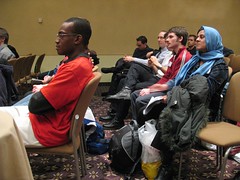
Simon Law: DemoCamp Montr al 1


Audience
Originally uploaded by sfllaw.
There's less than a week before Montr al's next little technology un-conference. DemoCamp Montreal 1 (Fran ais) follows in the footsteps of Toronto's DemoCamp, bringing neat demonstrations to the spotlight. What is DemoCamp? It's a mini-conference where you show up and get to see people present the cool things that they're doing. Be it some software they wrote, a robot they built, or even a live tutorial, there's always something interesting happening. And you need to know. All you have to do is show up. We'll be at the Societ des arts technologiques which has been cool enough to donate their space for us. Just show up on Tuesday 27 February 2007 at 18:30, after putting your name down on the registration list. Don't be shy, it's free! Demonstrations are short, sweet, and PowerPoint slides are forbidden. You get to actually see something happen, which is a much more exciting than your usual conference lecture. In addition, we'll hang out afterwards to shoot the breeze and discuss what we saw. I'll be there with my camera, helping my friends [info]gorbash_dragon and [info]peaceful_dragon run the show. Jonathan Kopanas, who went to Concordia, is coming up to introduce the presenters and Austin Hill is drumming up publicity. DemoCamp Montr al 1
Tuesday 27 February 2007
18:30 20:30
Societ des arts technologiques
1195 boul. St-Laurent
Free admission
( Sign up Upcoming.org Google Maps ) I'll see you there!

Simon Richter: Threads

Miriam, coroutines have the same problem as threads, futures and all the other interesting concepts out there: they are perceived as a magic bullet when they are merely one tool in the great toolbox. Whether a tool is appropriate depends on the job. Postgres, for example, handles each connection in a separate process, which adds a lot of complexity to their internal structures as all concurrent accesses need to be handled properly. However, SQL's transaction and isolation semantics make a single-threaded implementation almost as hard to implement, so the correct answer was to use threads. The biggest problem with threads is data consistency, and this is where almost all negative examples originate: some variable was not declared volatile, some lock not held long enough, some set of locks taken in the wrong order. A rule of thumb should be: if your threads need to interact, then you should not be using threads. If you have to compute something which will take longer, it is absolutely fine to start a new thread, but then you will have to protect the inter-thread communication appropriately. What is appropriate depends on the problem again; in most cases it will be message queues which allow the other thread to handly the request when it is in a safe state. Coroutines come in at a point where "you should not be using threads", by essentially allowing me to write a producer-consumer model as if it were threaded, and then letting the compiler build a nonthreaded version from that. In the C++ world, most algorithms can not be combined directly because they are written as a consumer/producer loop and cannot be suspended -- coroutines will make that possible.

Evan Prodromou: 3 Vent se CCXV

I was up late last night upgrading Wikitravel from MediaWiki 1.8.3 to the new 1.9.3. It took a long while, since the 404-handler caching extension that I built for MediaWiki a couple of years ago (which keeps Wikitravel running on a single, albeit quite big, server) is pretty invasive, and a lot of things had changed with the way users and stuff worked, so I had a lot of hacking to do. But it's stable now, even if some watchlist stuff is a little funky. Doing major upgrades is a real bear for me, but I'm happy when it's over. tags:

Home people Maj had her final oral exam in her French class tonight, which left me and Amita June home alone to fend for ourselves. We had a lot of fun. First, I had to do the day's dishes (lunch and breakfast) that were sitting in the sink. I brought the footstool around to the sink from our laundry room, and she stood on it and helped me with the dishes. After I'd finished washing a dish, she'd carefully fill it up with water, dump it out, then put the dish in the dishrack next to her. Pretty good for 18 months old. That went so well that I moved the stool over to the kitchen table where I cut tofu and vegetables for dinner. I gave her pieces of pepper, cabbage, and carrot while I was working, and she nibbled on them a bit and then practiced chopping them... with the handle of her mother's toothbrush, which she'd stolen out of the bathroom earlier in the day. After dinner, we had a bath, then we read some books, and then she went to sleep on my shoulder while I walked around her room and sang, like she's been doing for the last 2 months. It was another good night. tags:

Soft launch We launched two new Wikitravel versions overnight, too: Catalan Wikitravel and Finnish Wikitravel. Catalan recently, uh, catalyzed from a blog post by Carme Pla . Readers and the Catalan-speaking community rallied to our Catalan Wikitravel Expedition and got the project rolling. I got the site set up last night and they've started translating key help, style manual and policy guidelines already. Mean, Finnish had been simmering on the back burner for a while, so we got it launched at the same time. My friend and colleague Jani Patokallio is a Finn and a longtime and well-respected Wikitraveller; I'm glad he's taking leadership of the project. Finns have such disproportionate contributions to Free Software and Free Culture; I'm glad to have that Freedom Powerhouse Country all working together on Wikitravel now. And, y'know, I'm going to totally rack up a ton of HugAFinn points off of this. Actually, now that I think of it, I have no idea if "Carme Pla" is a real name or even a plausible personal name in Catalan. It sounds like it to me, though. tags:

coComment A couple of months ago Don Marti recommended that I check out coComment, and I made a mental note and then forgot to follow up. But I started using the system a few days ago, and now I wonder how I ever lived without it. coComment is a Firefox plugin that keeps track of when you post a comment on a blog or some other comment-handling system. It then keeps track of the conversation that happens after you comment. I have a lot of standing keyword searches on Technorati and Google Blog Search, and if people are talking about a subject I'm interested in, I'll usually jump in and talk about it. But sometimes I'll go back months later and see that people asked me questions and continued the conversation without me. So coComment is exactly the kind of cross-the-Internet aggregation service I need. tags:

Sage Speaking of keeping up with blogs, I've realized in the last week that I've outgrown Live Bookmarks for following RSS feeds. Rather than going with a Web-based RSS reader like Google Reader or Bloglines, I opted instead for the in-browser reader, Sage. It's simple, it does what I need it to do, and it supports OPML so I can move my subscriptions somewhere else if something better comes along. Good piece of software. My best candidate for something better coming along? Probably if I get my Netvibes home page customized well enough to handle my 50-60 feeds. And maybe when Netvibes gets smart and becomes and OpenID identity provider (or at least figures out a way that you can log into your ID when you start a browser session). tags:

21 February 2007

Julien Blache: pommed: nvidia testers sought

pommed has seen only little progress in the last weeks, mainly because I am busy with real life right now. I am trying to find some time to get things done on pommed, which includes adding support for the nvidia-based PowerBooks. If you own such a machine, please drop me a mail. I’ve got a mail from someone with such a machine a couple of weeks ago, unfortunately I lost that mail. If you read this, please resend :-) The next release should see some improvements in gpomme and some changes in the keyboard backlight behaviour, along with some fixes here and there.

Ingo Juergensmann: Wireless Bridge Linksys WET54G

Ok, for some time now, I've been using my old Samsung Vm8100KXDT Laptop to connect my wired network to my Linksys WRT54GS router, which resides on another floor.

Well, if you read my old Drupal blog, you may have noticed, that I complained several times about my Netgear WG311T PCI card, being not able to be run in my PowerPCs. That's the reason why my Laptop was acting as a wired/wireless bridge (or more exactly a router between both worlds).

Today I bought a Linksys WET54G wireless bridge to replace my Laptop for that purpose. My Laptop was just too noisy and too power consuming and - even worse - the harddisk began to die. It was giving loud klackklack noises from time to time, resulting in a loss of DMA and therefore needed a power cycle afterwards.

Anyway, the WET54G is a nice small box with one antenna and one ethernet port. It is advertised as being a operating system independent device - which is clearly not true. You'll need a Windows PC to configure the device and it's quite awful to configure.

Instead of accessing the WET54G bei http, the CD-Rom contains a small program that scans the ethernet for that device. Next problem will arise when you want to configure your WLAN/WiFi settings. It is pre-configured to use channel 6 and infrastructure mode. Unfortunately, you'll need to first configure infrastructure or ad-hoc mode before you proceed to configure your ESSID, channel and b/g/mixed mode settings. Even worse because you can't change the channel or the mode when you have chosen infrastructure mode.

So in order to change your channel, you'll need to configure it in ad-hoc mode first, then change your channel and mode first, safe your settings, let the device reboot and continue with configuring infrastructure mode again.
Really badly tested piece of software, Linksys!

But beside of this huge annoyance the WET54G works quite nice once setup properly. Alas, I can't recommend it to buy for the above reasons.

Update:
After configuring it the first time, there actually is a webinterface, where you can configure the device with your favorite free OS. However, it was not accessible the first time to me, although I configured a Laptop to use the described default network in the manual. The above mentioned problems of not being able to configure the channel in infrastructure mode still exists in the webinterface.

Martin F. Krafft: Why we have not yet released my Skycon presentation

On Sunday, I gave a talk at the 1st Skycon titled "Debian etch: does that itch scratch yet" (it's far less funny now than I thought it was when I came up with it). I think it was a well-received talk and from first feedback, it provided a doog overview of our situation with etch to those who don't follow the project very closely. I would especially like to thank Steve Langasek, Sam Hocevar, Frans Pop, Brian May, Anthony Towns, Theodore Ts'o, Thomas Viehmann. and the other folks of #debian-devel for their input during preparation. And a big shout to everyone who showed up to the talk itself, which included a bunch of the chaps who showed me a "craic" time during my five week stay in Limerick ("craic" is an Irish way to vent enthusiasm). As I've come to expect, my (not-so-)lovely IBM laptop hardlocked whenever I tried to switch on the external VGA port, be it via ACPI, /proc, or the BIOS, even after a reboot. I also could not get a Wifi association and did not have a USB key on me, so I started to get comfortable with the fact that I'd be doing the talk based off an older set of slides. Fortunately, just when I was about to start, I restored the ACPI registers to proper working order using a uswsusp suspend cycle (of all things; did you hear that, Matthew?), even though Cathal's USB stick and Dave's laptop came to my rescue. Thanks guys, even though I ended up using my own laptop, mostly because of Firefox's Autohide extension. The slides are online under the CC by-sa-nc 2.5 licence. The source is a reStructured Text document (and a bunch of images), which rst2s5 translated for use with the sweet S5 presentation system (S6? Haha). Last but not least, I would like to thank everyone at Skynet and especially Laura for organising this event. It was very fun and the selection of talks as well as the attendants ranked above the likes of such "important" events like LinuxTag. I hope there will be another Skycon next year! NP: Amorphis / Elegy Update: Thanks, h01ger for pointing out that Sun Java is not actually in main, but in non-free. Slides updated.

Lucas Nussbaum: State of software for Suspend to RAM/Disk ?

Dear readers, I am the mostly happy owner of a Dell Latitude D610 (the one with the ATI video card), running Debian Etch. I installed the hibernate package to try to get Suspend to RAM and to Disk to work, and Suspend to Disk worked out of the box. But Suspend to RAM didn’t work (garbled screen at resume). I never bothered to investigate this until today, when I discovered that acpi-support provides the same functionality, and works both for Suspend to RAM and to Disk ! I’m happier now, but I would like to understand, and the world of ACPI and Suspend to RAM/Disk is very difficult to grasp for newcomers. What is the story behind hibernate and acpi-support ? Why was this duplication of effort needed ? Also, it seems that gnome-power-manager and kpowersave provide the same functionality. Why can’t they just call the relevant acpi-support or hibernate scripts ? How do those different implementations compare (what are their main differences ?) ? Looking at the packages content, it seems that hibernate tries to be generic, while acpi-support gave up, and handles each and every laptop model differently. Correct ? Also, hibernate seems to be handling a few things better, like getting my network interface back up after hibernation. Finally, the last question: how do one debug Suspend issues, when it fails to work ? Is there a document somewhere explaining that ?

19 February 2007

Wouter Verhelst: FOSDEM booth: more volunteers needed

Yesterday, I sent out an email to the debian-events-eu mailinglist, to ask for more volunteers for the FOSDEM booth next weekend. The situation is a little less desperate now than it was yesterday, but I would still need about 5 extra people who would want to put in one our at the booth. Manning the booth at FOSDEM is not hard; you need to know a bit about Debian to be able to answer questions (which means that you don't even have to be a Debian Developer), and be sure to be at the booth for your designated hour. I fully expect you not to be there all alone, but you will have final responsibility for the stuff that's at the booth during your hour, and you are not to leave it, just in case everyone else does at some point, because of a rather interesting talk, or the keysigning, or some such. If there are interesting things which you definately don't want to miss, then just let me know the hours that would work for you; I'll consider them then when I put you on the schedule.

17 February 2007

Christian Perrier: fr: 99.980%, cs: 93.541%, de: 82.064%, sv: 79.796%, vi: 78.078%

atokx2 is OK now. twiki keeps us away from 100% Sad news with yet another uncoordinated upload of mysql-dfsg-5.0 which, as usual includes debconf templates changes. I yelled out loudly on debian-release about this. Today's uploads were php-json-ext, openldap2, laptop-net.

15 February 2007

Biella Coleman: I cite, you cite, I rant

Since there are few topics about academic etiquette than get me as excited as the norms of citations, I was quite fascinated by Joseph Reagle’s blog entry on the topic, a discussion that spanned a summary of Helen Nissenbaums’ work on the subject to his own wrangling with how he should recognize others who have independently reached similar conclusions as his own. Citations fascinate me because they are one of the few tangible inscriptions that reveal just how much of our work is indebted to others; it is stimergic (and if you don’t know what that is, read Joe’s entry as his moral wrangling over citations had to do with this term, his use of it and the discovery that someone else came up with it also). Despite the fact that all disciplines use them, we use them slightly distinctly. Lawyers use them in lawyerly-like ways: they cite the crap out of everything (it is kinda annoying but kinda helpful) and this makes total sense: they are covering their asses (lawyers know how to do this well), they are following the logic of their own practice as case law is quite citational, and well, law professors usually have one if not two research assistants, and this I am sure helps them in covering their citational bases. Another big difference in practices of citations is between a conventions that includes the name of the person you are citing in the body of the text and those that stuff all that data in a footnote. I can’t stand the later convention, not only because it is a pain in the neck to have to go back to the footnote JUST to see who the heck the author is citing but I think the credit should be right there, springing off the page so that the politics of collaborative recognition are, well, very evident (and I do understand that if you are citing a buttload of folks, that sometimes it is just better to do that in footnotes and sometimes with history they are citing way to may folks to really do it effectively in the body of the text). Joe raises some fundamentally thorny questions of who and how do we cite given that we may come up with an idea with the power of our own little brains, only to find out (gasp) that others, past and present and very unknown others, say something similar. On the whole, I tend to try to make clear, as Joe did in the example he provided, where I am totally taking the idea from someone to apply to another idea of mine and where I have an independently crafted idea and I am citing others so as to support my own position, which usually only strengthens my own argument. And what I find is that just because a cohort of folks may be working on similar topic (open souce, hackers), since we do so from our own perspectives and methods, most of the research will be original, though not as much as we tend to perform to our superiors. Also I sometimes find myself with an idea, which I consider as my own, but where I am so in need of a citation because it is an idea that seems at an intuitive level to be right on but it is hard to truly substantiate with the data I have (I am in that position right now and am desperate to find someone who says what I say and thus have a means to support what otherwise seems like a lofty idea…) And in fact, one thing that bothers me about citations is that we don’t seem to take seriously that the date of publication may not just tell us when something was published but help us gauge if something can become “dated.” What I mean is that when (and I guess if) I publish my book on hackers and Debian, it will not be a reflection not of some timeless aspects of hacking but firmly based out of the time period (roughly 10 years give or take 3 or 4) that I was either researching and writing about the topic. And while you can and should cite folks who wrote stuff in the past because that stuff still matters (a lot of what Steven Levy says for example still holds water) a lot changes. And yet I can’t stand how folks then cite someone as wrong when in fact all that went wrong is that time does what it does best: MOVE FORWARD and social phenomenon change along with the passing of new moons. This is not as likely to happen in the hard sciences but sure as heck happens with anything in the so-called human realm (which is why it bothers me that the social sciences and humanities model our citational and journal practices so similarly to the hard sciences, when it seems there are enough differences to warrant more differences than there are but that is a whole other topic). So now I try to note where my analysis diverges because the context so radically changed and really leave critique for those things I can safely and fairly disagree with on its own terms.
Finally, Nissenbaum’s article seems so interesting (I have not yet read it but now will) because it confronts how our practices of citations may or may not (or should) change in the face of a proliferation of access to work due to electronic media (she flags: wildcat publisher, grey literature, preprints). But I have found that, at least in anthropology journals, and especially in the anthropology of science, technology, and medicine, authors are mostly citing other anthropologists, as if a whole scholarship on a topic was non-existent, which seems more odd today when it has gotten easier to mine and find this stuff. They only cite “non-anthro others” when these folks are so standard, it would look horrible not to do so, but there is not a move to branch out, which I find a real shame and why I sometimes get really down on disciplinary journals (and why I am quite content to be joining an interdisciplinary department). And to be clear, I don’t fault individual authors, it seems that this is the unstated expectation and if that is what is going to get you in a journal, and that is what gets you tenure brownine-points, then you do as everyone else does. And that brings me to the final point which is the problem with standards in citational practices. So for example in the field of science studies, everyone must and usually does cite Bruno Latour. And as Chris Kelty reminded us, there is *very* good reason to. But I find what happens is that once a person is flagged and gets cited ad nauseum (which is mostly a decent but not full proof baramoter for judging good work), it become self-perpetuating reality/cycle because everyone else is doing it and it seems weird if you don’t (and I have sometimes seen some articles just awkwardly cite famous people in their discipline when it made little sense to do because, I think of this phenomenon). So all of a sudden, it becomes all Microsoft-Windows like: you cite, they cite, and it becomes “standard” who you cite and you can’t seem to escape the default. But alas, there is always an escape hatch, because one of the gems in academia is discovering that one theorist or book relate x to y and z topic that for some reason everyone else overlooked (because they were busy citing Latour,) to bathe some topic in a wholly new light and then a whole group of folks become unfashionable and the cycle begins, yet again…. The solution? If we only had a couple of research assistants like the lawyers, well maybe we could branch out a little and cover our bases a little..

David Welton: ActiveRecord nitpick - no constant iteration over select results

I need to iterate over a big set of data, and I want to do it without sucking the whole thing into memory. Unfortunately, as far as I can tell ActiveRecord does just that, which is a pity because it could probably be made to do something like this
Foo.find_and_loop(:all, :conditions => '....') do  res 
  do_something(res.foo, res.bar)
end
without too much trouble. You'd have to have some fancy interaction between AR and the connection adapters so as to run your loop at a low level, but it should be possible. All the databases that I looked at let you operate that way in their C API's. Doubtless, this is something "opinionated", and of use to a small percentage of rails users, so it's probably not worth submitting a bug report, but it's a minor annoyance all the same.

Next.

Previous.