Search Results: "ed"

13 August 2017

Lars Wirzenius: Retiring Obnam

This is a difficult announcement to write. The summary is if you use Obnam you should switch to another backup program in the coming months. The first commit to Obnam's current code base is this:
commit 7eaf5a44534ffa7f9c0b9a4e9ee98d312f2fcb14
Author: Lars Wirzenius <liw@iki.fi>
Date:   Wed Sep 6 18:35:52 2006 +0300
    Initial commit.
It's followed by over 5200 more commits until the latest one, which is from yesterday. The NEWS file contains 58 releases. There are 20761 lines of Python, 15384 words in the English language manual, with translations in German and French. The yarn test suite, which is a kind of a manual, is another 13382 words in English and pseudo-English. That's a fair bit of code and prose. Not all of it mine, I've had help from some wonderful people. But most of it mine. I wrote all of that because backups were fun. It was pleasing to use my own program to guarantee the safety of my own data. The technical challenges of implmenting the kind of backup program I wanted were interesting, and solving interesting problems is a big part of why I am a programmer. Obnam has a kind user base. It's not a large user base: the Debian "popularity contest" service estimates it at around 500. But it's a user base that is kind and has treated me well. I have tried to reciprocate. Unfortunately, I have not had fun while developing Obnam for some time now. This has changed. A few years ago, I lived in Manchester, UK, and commuted by train to work. It was a short train ride, about 15 minutes. At times I would sit on the floor with my laptop on my knees, writing code or the manual. Back then Obnam was a lot of fun. I was excited, and enthusiastic. In the past two years or so, I've not been able to feel that excitement again. My native language, Finnish, has an expression describing unpleasant tasks: something is as much fun as drinking tar. That describes Obnam in recent years for me. Obnam has not turned out well, from a maintainability point of view. It seems that every time I try to fix something, I break something else. Usuaully what breaks is speed or memory use: Obnam gets slower or starts using even more memory. For several years now I've been working on a new repository format for Obnam, code names GREEN ALBATROSS. It was meant to solve Obnam's problems as far as extensibility, performance, and resource use were concerned. It seems to have failed. I'm afraid I've had enough. I'm going to retire Obnam as a project and as a program, and move on to doing something else, so I can feel excitement and pleasure again. After some careful thought, I fear that the maintainability problems of Obnam can realistically only be solved by a complete rewrite from scratch, and I'm not up to doing that. If you use Obnam, you should migrate to some other backup solution. Don't worry, you have until the end of the year. I will be around and I intend to fix any serious bugs in Obnam; in particular, security flaws. But you should start looking for a replacement sooner rather than later. I will be asking Obnam to be removed from the Debian unstable and testing branches. The next Debian release (buster, Debian 10) won't include Obnam. The Obnam mailing lists are kindly hosted by Daniel Silverstone, and they will remain, but later this year I will change them to be moderated. The Obnam git repository will remain. The web site will remain, but I will add a note that Obnam is no longer maintained. Other Obnam online resources may disappear. If you would like to take over the Obnam project, and try to resolve the various issues, please contact me to discuss that. Thank you, and may you never need to restore.

Mike Gabriel: @DebConf17: Ad-hoc BoF: Debian for the Remote Desktop

On Thursday at DebConf17, all people interested in using this or that Remote Desktop solution on Debian (as a server, as a client, as both) came together for a BoF. Sharing about Usage Scenarios Quite some time we informally shared with one another what technologies and software we use for remote access to Debian machines and what the experiences are. The situation in Debian and on GNU/Linux in general is that many technical approaches exist, all of them have certain features and certain limitations. The composition of features and limitations finally lead the users to choosing one or another technology as his or her favourite solution. The Debian Remote Maintainers Team On the developers' side, Dominik George and I set up a packaging team for Remote Desktop related software in Debian. A packaging team that we invite everyone who is maintaining such software in the widest sense to join: https://qa.debian.org/developer.php?login=pkg-remote-team%40lists.alioth... 'DebianRemote' namespace on the Debian Wiki For users of Debian, the group agreed, we need an overview page (on wiki.debian.org) that provides an entry point for Debian on the Remote Desktop. An entry point that provides user information as well as developer information. A skeleton of this wiki page, I have just set up (thanks to Vagrant for taking some notes in Gobby during the BoF): https://wiki.debian.org/DebianRemote However, the page still contains loads of FIXMEs, so the actual work only now really starts. Fill the template with content (and also adapt the template, if needed). Everyone with experience and know-how about Remote Desktop on Debian systems is invited to share knowledge and improve this wiki namespace. (I will, at the earliest, start working on Arctica, X2Go and NX passages end of August, but I'll be also happy to find passages having been written down that I can review by then). Tracking Debian Remote Issues in Debian BTS At the BoF, also the following suggestions came up: The Remote Desktop experience on a GNU/Linux desktop or terminal server can be affected by all graphical applications available. Often it happens, that a change in this or that graphical application results in problems in remote sessions, but not so in local sessions. We agreed on filing and tagging such bugs accordingly. For new bugs, please file such bugs with the following BTS header at the top of your mail and always explain what remote desktop solution is being used when the bug appears:
Package: file
Version: 1:5.19-2
Severity: important
User: debian-edu@lists.debian.org
Usertags: debian-edu
Conclusion Overall, I was quite happy that the BoF has been attended by so many people and to see that there is quite "a lobby" in Debian. Let's dive into the work and make Debian 10 the first Debian, that mentions the Remote Desktop in its release notes. Let's, in fact, release Debian 10 as the first Debian with the official announcement as an operating system for the Remote Desktop (like the Fedora people did already for Fedora 20).

Enrico Zini: Consensually doing things together?

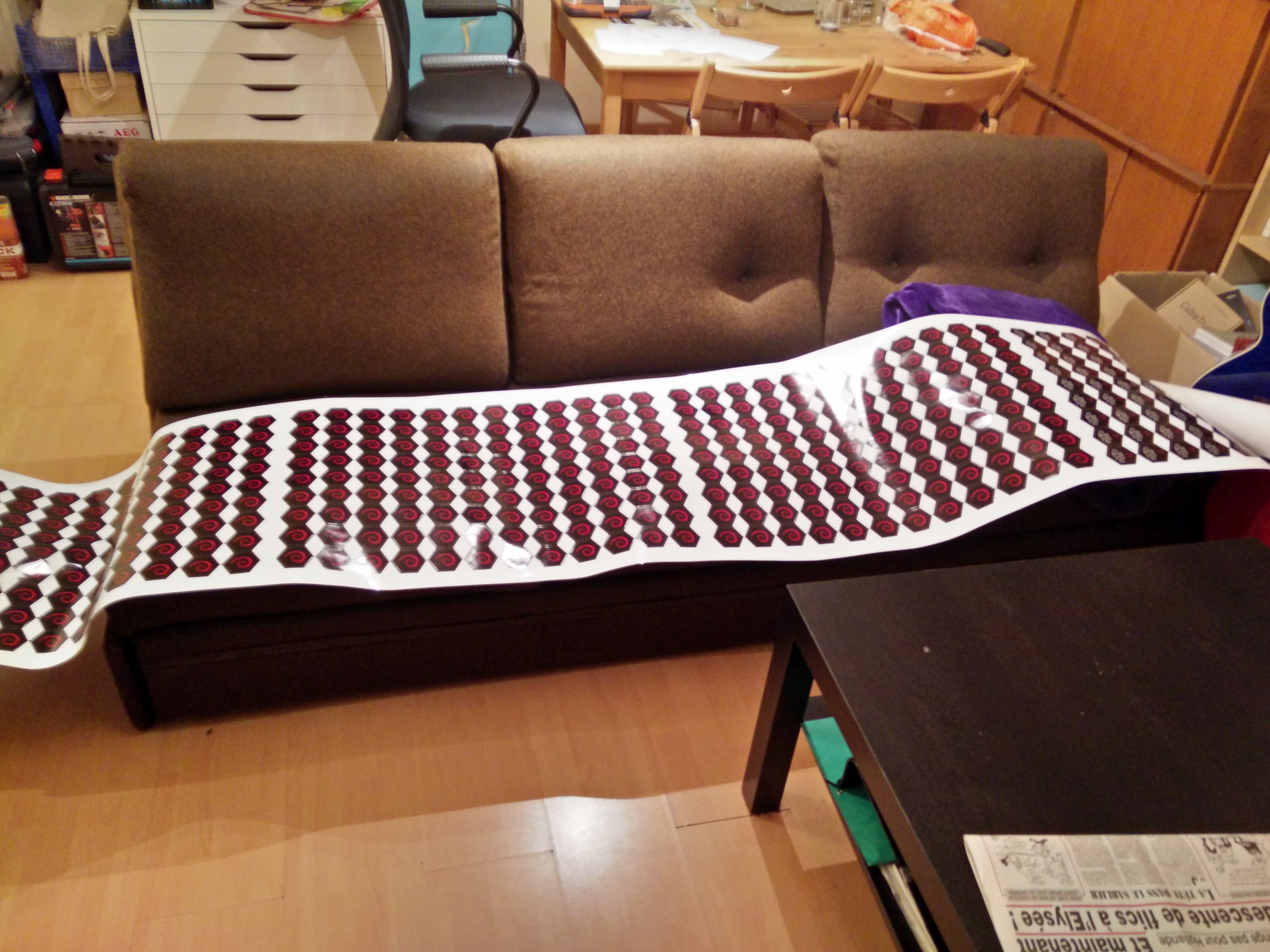
On 2017-08-06 I have a talk at DebConf17 in Montreal titled "Consensually doing things together?" (video). Here are the talk notes. Abstract At DebConf Heidelberg I talked about how Free Software has a lot to do about consensually doing things together. Is that always true, at least in Debian? I d like to explore what motivates one to start a project and what motivates one to keep maintaining it. What are the energy levels required to manage bits of Debian as the project keeps growing. How easy it is to say no. Whether we have roles in Debian that require irreplaceable heroes to keep them going. What could be done to make life easier for heroes, easy enough that mere mortals can help, or take their place. Unhappy is the community that needs heroes, and unhappy is the community that needs martyrs. I d like to try and make sure that now, or in the very near future, Debian is not such an unhappy community. Consensually doing things together I gave a talk in Heidelberg. Valhalla made stickers Debian France distributed many of them. There's one on my laptop. Which reminds me of what we ought to be doing. Of what we have a chance to do, if we play our cards right. I'm going to talk about relationships. Consensual relationships. Relationships in short. Nonconsensual relationships are usually called abuse. I like to see Debian as a relationship between multiple people. And I'd like it to be a consensual one. I'd like it not to be abuse. Consent From wikpedia:
In Canada "consent means the voluntary agreement of the complainant to engage in sexual activity" without abuse or exploitation of "trust, power or authority", coercion or threats.[7] Consent can also be revoked at any moment.[8] There are 3 pillars often included in the description of sexual consent, or "the way we let others know what we're up for, be it a good-night kiss or the moments leading up to sex." They are:
  • Knowing exactly what and how much I'm agreeing to
  • Expressing my intent to participate
  • Deciding freely and voluntarily to participate[20]
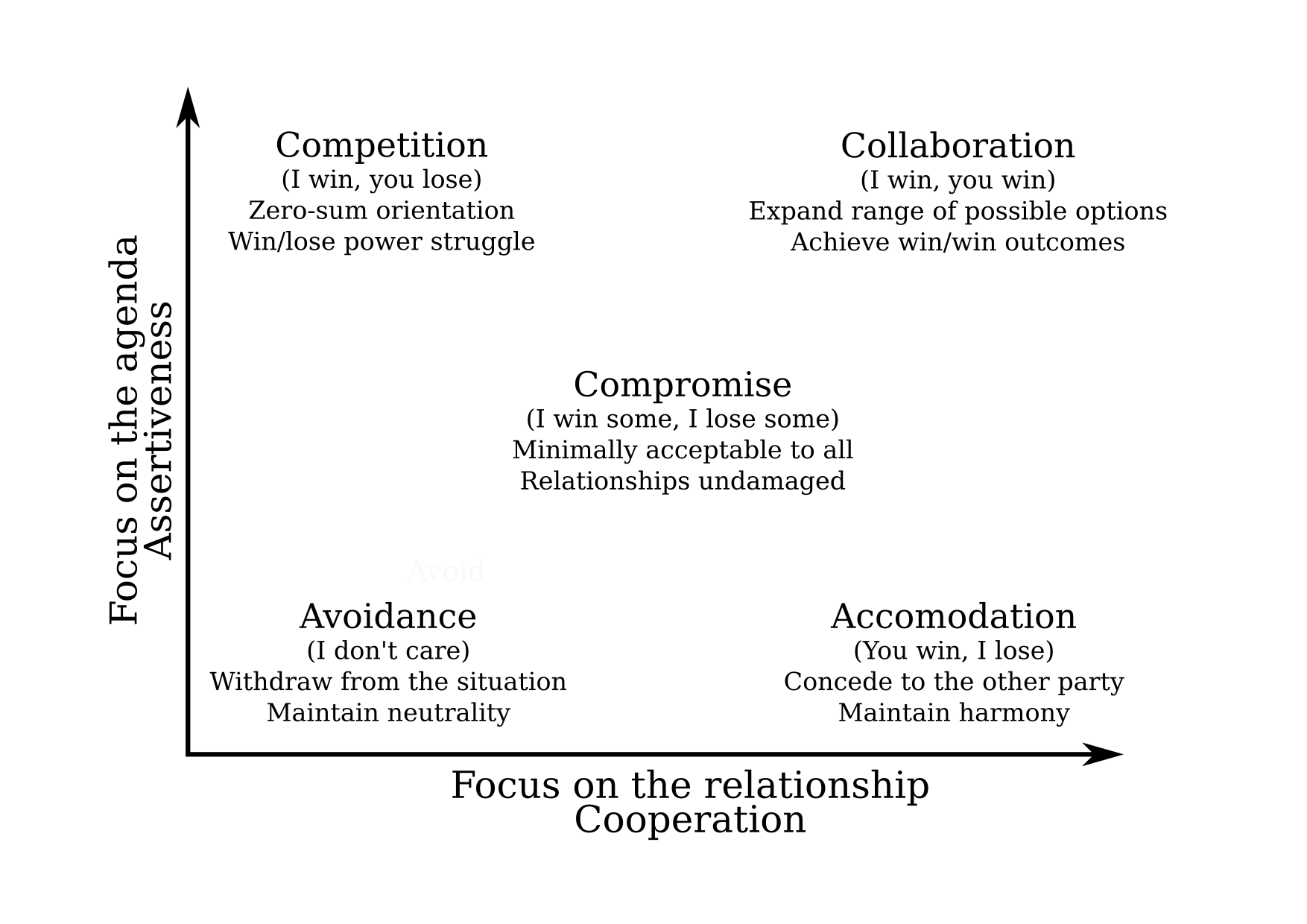
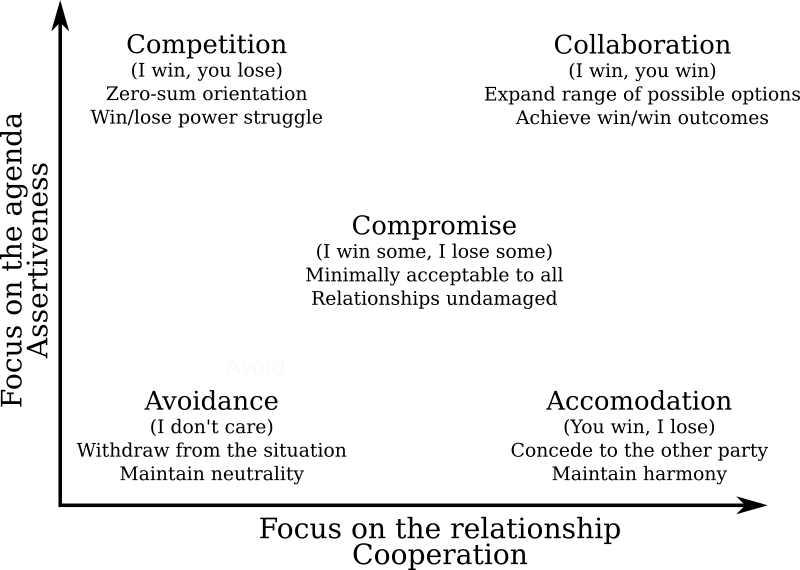
Saying "I've decided I won't do laundry anymore" when the other partner is tired, or busy doing things. Is different than saying "I've decided I won't do laundry anymore" when the other partner has a chance to say "why? tell me more" and take part in negotiation. Resources: Relationships Debian is the Universal Operating System. Debian is made and maintained by people. The long term health of debian is a consequence of the long term health of the relationship between Debian contributors. Debian doesn't need to be technically perfect, it needs to be socially healthy. Technical problems can be fixed by a healty community. graph showing relationship between avoidance, accomodation, compromise, competition, collaboration The Thomas-Kilmann Conflict Mode Instrument: source png. Motivations Quick poll: What are your motivations to be in a relationship? Which of those motivations are healthy/unhealthy? "Galadriel" (noun, by Francesca Ciceri): a task you have to do otherwise Sauron takes over Middle Earth See: http://blog.zouish.org/nonupdd/#/22/1 What motivates me to start a project or pick one up? What motivates me to keep maintaning a project? What motivates you? What's an example of a sustainable motivation? Is it really all consensual in Debian? Energy Energy that thing which is measured in spoons. The metaphore comes from people suffering with chronic health issues:
"Spoons" are a visual representation used as a unit of measure used to quantify how much energy a person has throughout a given day. Each activity requires a given number of spoons, which will only be replaced as the person "recharges" through rest. A person who runs out of spoons has no choice but to rest until their spoons are replenished.
For example, in Debian, I could spend: What is one person capable of doing? Have reasonable expectations, on others: Have reasonable expectations, on yourself: Debian is a shared responsibility When spoons are limited, what takes more energy tends not to get done As the project grows, project-wide tasks become harder Are they still humanly achievable? I don't want Debian to have positions that require hero-types to fill them Dictatorship of who has more spoons: Perfectionism You are in a relationship that is just perfect. All your friends look up to you. You give people relationship advice. You are safe in knowing that You Are Doing It Right. Then one day you have an argument in public. You don't just have to deal with the argument, but also with your reputation and self-perception shattering. One things I hate about Debian: consistent technical excellence. I don't want to be required to always be right. One of my favourite moments in the history of Debian is the openssl bug Debian doesn't need to be technically perfect, it needs to be socially healthy, technical problems can be fixed. I want to remove perfectionism from Debian: if we discover we've been wrong all the time in something important, it's not the end of Debian, it's the beginning of an improved Debian. Too good to be true There comes a point in most people's dating experience where one learns that when some things feel too good to be true, they might indeed be. There are people who cannot say no: There are people who cannot take a no: Note the diversity statement: it's not a problem to have one of those (and many other) tendencies, as long as one manages to keep interacting constructively with the rest of the community Also, it is important to be aware of these patterns, to be able to compensate for one's own tendencies. What happens when an avoidant person meets a narcissistic person, and they are both unaware of the risks? Resources: Note: there are problems with the way these resources are framed: Red flag / green flag http://pervocracy.blogspot.ca/2012/07/green-flags.html Ask for examples of red/green flags in Debian. Green flags: Red flags: Apologies / Dealing with issues I don't see the usefulness of apologies that are about accepting blame, or making a person stop complaining. I see apologies as opportunities to understand the problem I caused, help fix it, and possibly find ways of avoiding causing that problem again in the future. A Better Way to Say Sorry lists a 4 step process, which is basically what we do when in bug reports already: 1, Try to understand and reproduce the exact problem the person had. 2. Try to find the cause of the issue. 3. Try to find a solution for the issue. 4. Verify with the reporter that the solution does indeed fix the issue. This is just to say
My software ate
the files
that where in
your home directory and which
you were probably
needing
for work Forgive me
it was so quick to write
without tests
and it worked so well for me
(inspired by a 1934 poem by William Carlos Williams) Don't be afraid to fail Don't be afraid to fail or drop the ball. I think that anything that has a label attached of "if you don't do it, nobody will", shouldn't fall on anybody's shoulders and should be shared no matter what. Shared or dropped. Share the responsibility for a healthy relationship Don't expect that the more experienced mates will take care of everything. In a project with active people counted by the thousand, it's unlikely that harassment isn't happening. Is anyone writing anti-harassment? Do we have stats? Is having an email address and a CoC giving us a false sense of security?
When you get involved in a new community, such as Debian, find out early where, if that happens, you can find support, understanding, and help to make it stop. If you cannot find any, or if the only thing you can find is people who say "it never happens here", consider whether you really want to be in that community.
(from http://www.enricozini.org/blog/2016/debian/you-ll-thank-me-later/)
There are some nice people in the world. I mean nice people, the sort I couldn t describe myself as. People who are friends with everyone, who are somehow never involved in any argument, who seem content to spend their time drawing pictures of bumblebees on flowers that make everyone happy. Those people are great to have around. You want to hold onto them as much as you can. But people only have so much tolerance for jerkiness, and really nice people often have less tolerance than the rest of us. The trouble with not ejecting a jerk whether their shenanigans are deliberate or incidental is that you allow the average jerkiness of the community to rise slightly. The higher it goes, the more likely it is that those really nice people will come around less often, or stop coming around at all. That, in turn, makes the average jerkiness rise even more, which teaches the original jerk that their behavior is acceptable and makes your community more appealing to other jerks. Meanwhile, more people at the nice end of the scale are drifting away.
(from https://eev.ee/blog/2016/07/22/on-a-technicality/) Give people freedom If someone tries something in Debian, try to acknowledge and accept their work. You can give feedback on what they are doing, and try not to stand in their way, unless what they are doing is actually hurting you. In that case, try to collaborate, so that you all can get what you need. It's ok if you don't like everything that they are doing. I personally don't care if people tell me I'm good when I do something, I perceive it a bit like "good boy" or "good dog". I rather prefer if people show an interest, say "that looks useful" or "how does it work?" or "what do you need to deploy this?" Acknowledge that I've done something. I don't care if it's especially liked, give me the freedom to keep doing it. Don't give me rewards, give me space and dignity. Rather than feeding my ego, feed by freedom, and feed my possibility to create.

Mike Gabriel: @DebConf17: Work for Debian and FLOSS I got done during DebCamp and DebConf... and Beyond...

People I Met and will Remember Topics I have worked on Talks and BoFs Packages Uploaded to Debian unstable Packages Uploaded to Debian NEW I also looked into lightdm-webkit2-greeter, but upstream is in the middle of a transition from Gtk3 to Qt5, so this has been suspended for now. Packages Uploaded to oldstable-/stable-proposed-updates or -security Other Package related Stuff Thanks to Everyone Making This Event Possible A big thanks to everyone who made it possible for me to attend this event!!!

12 August 2017

Bits from Debian: DebConf17 closes in Montreal and DebConf18 dates announced

DebConf17 group photo - click to enlarge Today, Saturday 12 August 2017, the annual Debian Developers and Contributors Conference came to a close. With over 405 people attending from all over the world, and 169 events including 89 talks, 61 discussion sessions or BoFs, 6 workshops and 13 other activities, DebConf17 has been hailed as a success. Highlights included DebCamp with 117 participants, the Open Day,
where events of interest to a broader audience were offered, talks from invited speakers (Deb Nicholson, Matthew Garrett and Katheryn Sutter), the traditional Bits from the DPL, lightning talks and live demos and the announcement of next year's DebConf (DebConf18 in Hsinchu, Taiwan). The schedule has been updated every day, including 32 ad-hoc new activities, planned
by attendees during the whole conference. For those not able to attend, talks and sessions were recorded and live streamed, and videos are being made available at the Debian meetings archive website. Many sessions also facilitated remote participation via IRC or a collaborative pad. The DebConf17 website will remain active for archive purposes, and will continue to offer links to the presentations and videos of talks and events. Next year, DebConf18 will be held in Hsinchu, Taiwan, from 29 July 2018 until 5 August 2018. It will be the first DebConf held in Asia. For the days before DebConf the local organisers will again set up DebCamp (21 July - 27 July), a session for some intense work on improving the distribution, and organise the Open Day on 28 July 2018, aimed at the general public. DebConf is committed to a safe and welcome environment for all participants. See the DebConf Code of Conduct and the Debian Code of Conduct for more details on this. Debian thanks the commitment of numerous sponsors to support DebConf17, particularly our Platinum Sponsors Savoir-Faire Linux, Hewlett Packard Enterprise, and Google. About Savoir-faire Linux Savoir-faire Linux is a Montreal-based Free/Open-Source Software company with offices in Quebec City, Toronto, Paris and Lyon. It offers Linux and Free Software integration solutions in order to provide performance, flexibility and independence for its clients. The company actively contributes to many free software projects, and provides mirrors of Debian, Ubuntu, Linux and others. About Hewlett Packard Enterprise Hewlett Packard Enterprise (HPE) is one of the largest computer companies in the world, providing a wide range of products and services, such as servers, storage, networking, consulting and support, software, and financial services. HPE is also a development partner of Debian, and provides hardware for port development, Debian mirrors, and other Debian services. About Google Google is one of the largest technology companies in the world, providing a wide range of Internet-related services and products as online advertising technologies, search, cloud computing, software, and hardware. Google has been supporting Debian by sponsoring DebConf since more than ten years, at gold level since DebConf12, and at platinum level for this DebConf17.

Bastian Blank: Network caps in cloud environments

Providing working network is not easy. All the cloud providers seem to know how to do that most of the time. Providing enough troughput is not easy either. Here it get's interresting as the cloud providers tackle that problem with completely different results. There are essentially three large cloud providers. The oldest and mostly known cloud provider is Amazon Web Services (AWS). Behind that follow Microsoft with Azure and the Google Cloud Platform (GCP). Some public instances of OpenStack exist, but they simply don't count anyway. So we remain with three and they tackle this problem with widely different results. Now, what network troughput is necessary for real world systems anyway? An old friend gives the advice: 1Gbps per Core of uncongested troughput within the complete infrastructure is the minimum. A generalization of this rule estimates around 1bps per clock cycle and core, so a 2GHz core would need 2Gbps. Do you even get a high enough network cap at your selected cloud provider to fill any of these estimates? Our first provider, AWS, publishes a nice list of network caps for some of there instance types. The common theme in this list is: for two cores (all the *.large types) you get 500Mbps, for four cores (*.xlarge) you get 750Mbps and for eight cores (*.2xlarge) you get 1000Mbps. This is way below our estimate shown above and does not even raise linear with the number of cores. But all of this does not really matter anyway, as the performance of AWS is the worst of the three providers. Our second provider, Azure, seems to not publish any real information about network caps at all. From my own knowledge it is 50MBps (500Mbps) per core for at least the smaller instances. At least is scales linear with instance size, but is still way below our estimates. Our third provider, GCP, documents a simple rule for network caps: 2Gbps per core. This matches what we estimated. Now the most important question: does this estimate really work and can we actually fill it. The answer is not easy. A slightly synthetic test of a HTTP server with cached static content showed that it can easily reach 7Gbps on a 2GHz Intel Skylake core. So yes, it gives a good estimate on what network troughput is needed for real world applications. However we still could easily file pipe that is larger by a factor of three.

Steve Kemp: A day in the life of Steve

I used to think I was a programmer who did "sysadmin-stuff". Nowadays I interact with too many real programmers to believe that. Or rather I can code/program/develop, but I'm not often as good as I could be. These days I'm getting more consistent with writing tests, and I like it when things are thoroughly planned and developed. But too often if I'm busy, or distracted, I think to myself "Hrm .. compiles? Probably done. Oops. Bug, you say?" I was going to write about working with golang today. The go language is minimal and quite neat. I like the toolset: Instead I think today I'm going to write about something else. Since having a child a lot of my life is different. Routine becomes something that is essential, as is planning and scheduling. So an average week-day goes something like this: In short I'm responsible for Oiva from 6ish-8ish in the morning, then from 6PM-10PM (with a little break while he's put to bed.) There are some exceptions to this routine - for example I work from home on Monday/Friday afternoons, and Monday evenings he goes to his swimming classes. But most working-days are the same. Weekends are a bit different. There I tend to take him 6AM-8AM, then 1PM-10PM with a few breaks for tea, and bed. At the moment we're starting to reach the peak-party time of year, which means weekends often involve negotiation(s) about which parent is having a party, and which parent is either leaving early, or not going out at all. Today I have him all day, and it's awesome. He's just learned to say "Daddy" which makes any stress, angst or unpleasantness utterly worthwhile.

Sam Hartman: Debian: a Commons of Innovation

I recently returned from Debconf. This year at Debconf, Matthew Garrett gave a talk about the next twenty years in free software. In his talk he raised concerns that Debian might not be relevant in that ecosystem and talked about some of the trends that contribute to his concerns.
I was talking to Marga after the talk and she said that Debian used to be a lot more innovative than it is today.
My initial reaction was doubt; what she said didn't feel right to me. At the time I didn't have a good answer. Since then I've been pondering the issue, and I think I have a partial answer to both Marga and Matthew and so I'll share it here.
In the beginning Debian focused on a lot of technical innovations related to bringing an operating system together. We didn't understand how to approach builds and build dependencies in a uniform manner. Producing packages in a clean environment was hard. We didn't understand what we wanted out of packages in terms of a uniform approach to configuration handling and upgrades. To a large extent we've solved those problems.
However, as the community has grown, our interests are more diverse. Our users and free software (and the operating system we build together) are what bring us together: we still have a central focus. However, no one technical project captures us all. There's still significant technical innovation in the Debian ecosystem. That innovation happens in Debian teams, companies and organizations that interact with the Debian community. We saw several talks about such innovation this year. I found the talk about ostree and flatpak interesting, especially because it focused on people in the broader Debian ecosystem valuing Debian along with some of the same technologies that Matthew is worried will undermine our relevance.
Matthew talked about how Debian ends up being a man-in-the-middle. We're between users and developers. we're between distributions and upstreams. Users are frustrated because we hold back the latest version of software they want from getting to them. Developers are frustrated because we present our users with old versions of their software configured not as they would like, combined with different dependencies than they expect.
All these weaknesses are real.
However, I think Debian-in-the-middle is our greatest strength both on the technical and social front.
I value Debian because I get a relatively uniform interface to the software I use. I can take one approach to reporting bugs whether they are upstream or Debian specific. I expect the software to behave in uniform ways with regard to things covered by policy. I know that I'm not going to have to configure multiple different versions of core dependencies; for the most part system services are shared. When Debian has value it's because our users want those things we provide. Debian has also reviewed every source file in the software we ship to understand the license and license compatibility. As a free software supporter and as someone who consumes software in commercial context, that value alone is enormous.
The world has evolved and we're facing technologies that provide different models. They've been coming for years: Python, Ruby, Java, Perl and others have been putting together their own commons of software. They have all been working to provide virtualization to isolate one program (and its dependencies) from another. Containerization takes that to the next level. Sometimes that's what our users want.
We haven't figured out what the balances are, how we fit into this new world. However, I disagree with the claim that we aren't even discussing the problem. I think we're trying a lot of things off in our own little technical groups. We're just getting to the level of critical mass of understanding where we can take advantage of Debian's modern form of innovation.
Because here's the thing. Debian's innovation now is social, not technical. Just as we're in the middle technically, we're in the middle socially. Upstreams, developers, users, derivatives, and all the other members of our community work together. we're a place where we can share technology, explore solutions, and pull apart common elements. This is the first Debconf where it felt like we'd explored some of these trends enough to start understanding how they might fit together in a whole. Seven years ago, it felt like we were busy being convinced the Java folks were wrong-headed. A couple of years later, it felt like we were starting to understand our users' desires that let to models different than packaging, but we didn't have any thoughts. At least in my part of the hallway it sounded like people were starting to think about how they might fit parts together and what the tradeoffs would be.
Yes, Matthew's talk doubtless sparked some of that. I think he gave us a well deserved and important wake-up call. However, I was excited by the discussion prior to Thursday.
What I'm taking a way is that Debian is valuable when there's a role in the middle. Both socially and technically we should capitalize on situations where something between makes things better and get out of the way where it does not.

11 August 2017

Thorsten Glaser: [PSA] Fixing CVE-2017-12836 (Debian #871810) in GNU cvs

Considering I ve become the de-facto upstream of cvs(GNU) even if not yet formally the de-iure upstream maintainer, fixing this bug obviously falls to me not quite the way I had planned passing this evening after coming home from work and a decent and, worse, very filling meal at the local Croatian restaurant. But, so s life. The problem here is basically that CVS invokes ssh(1) (well, rsh originally ) but doesn t add the argument separator -- before the (user-provided) hostname, which when starting with a hyphen-minus will be interpreted by ssh as an argument. (Apparently the other VCSes also had additional vulnerabilities such as not properly escaping semicoloi or pipes from the shell or unescaping percent-escaped fun characters, but that doesn t affect us.) The obvious fix and the one I implemented first is to simply add the dashes. This will also be backported to Debian , ,old old stable-security. Then I looked at other VCSes out of which only one did this, but they all added extra paranoia hostname checks (some of them passing invalid hostnames, such as those with underscores in them). OK, I thought, then also let s add extra checks to CVS repository reference handling. This will end up in Debian sid and MirBSD, pending passing the regression tests of course hah, while writing this article I had to fixup because a test failed. Anyway, it s not strictly necessary AFAICT to fix the issue. Update, about 2 hours past midnight (the testsuite runs for several hours): of course, the sanity testsuite (which itself is rather insane ) also needs adjustments, plus a bonus fix (for something that got broken when the recent allow-root-regex patch was merged and got fixed in the same go to night). tl;dr: a fix will end up in Debian *stable-security and can be taken out of my mail to the bugreport; another few changes for robustness are being tested and then added to both MirBSD and Debian sid. The impact is likely small, as it s hard to get a user (if you find one, in the first place) to use a crafted CVSROOT string, which is easy to spot as well. Update, Monday: apparently someone took care of the DSA and DLA yesterday after ACCEPTing the uploads thanks, I was outside during the day.

Michal &#268;iha&#345;: Weblate 2.16

Weblate 2.16 has been released today while I'm at DebConf17. There are quite some performance improvements (and more of that is scheduled for 2.17), new file formats support and various other improvements. Full list of changes: If you are upgrading from older version, please follow our upgrading instructions. You can find more information about Weblate on https://weblate.org, the code is hosted on Github. If you are curious how it looks, you can try it out on demo server. You can login there with demo account using demo password or register your own user. Weblate is also being used on https://hosted.weblate.org/ as official translating service for phpMyAdmin, OsmAnd, Turris, FreedomBox, Weblate itself and many other projects. Should you be looking for hosting of translations for your project, I'm happy to host them for you or help with setting it up on your infrastructure. Further development of Weblate would not be possible without people providing donations, thanks to everybody who have helped so far! The roadmap for next release is just being prepared, you can influence this by expressing support for individual issues either by comments or by providing bounty for them.

Filed under: Debian English SUSE Weblate

Mike Gabriel: @DebConf 2017: Ayatana Indicators

On last Tuesday, I gave a 20 min talk about Ayatana Indicators at DebConf 17 in Montreal. Ayatana Indicators Talk The talk had video coverage, so big thanks to the DebConf video team for making it possible to send the below video link around to people in the world: http://meetings-archive.debian.net/pub/debian-meetings/2017/debconf17/ay... The document of notes shown in the video is available on Debian's Infinote (Gobby) server:
$ sudo apt-get install gobby
$ sudo gobby infinote://gobby.debian.org/debconf17/talk/ayatana-indicators 
The major outcome of this talk was getting to know Dimitri John Ledkov from the Foundation Team at Canonical Ltd. We agreed on investigating the following actions, targetting the Ubuntu 18.04 LTS release and later on Debian 10 (aka buster): Upstream Todos Debian/Ubuntu Todos Please get in Touch... As this is going to be quite an effort, esp. if we want to get this done until 18.04 LTS, let me say, that this blog post is a call for help. If you are attached to Ubuntu and have used desktops with indicator support until now, please get in touch with the Ayatana Indicators team upstream as well as downstream (Debian/Ubuntu). Contact: Looking forward to meeting you online or on person and possibly working together with you on this transition project.

Mike Gabriel: @DebConf17: Story Telling about Debian Edu in Northern Germany

Last Monday, I gave a 20min talk about our little FLOSS school project "IT-Zukunft Schule" at the Debian Conference 17 in Montreal. The talk had video coverage, so may want to peek in, if you couldn't manage to watch the life stream: http://meetings-archive.debian.net/pub/debian-meetings/2017/debconf17/su... I'd like to share some major outcomes (so far) of this talk.
  1. I realized how attached I am to "IT-Zukunft Schule" and how much it means to me that our kids grow up in a world of freedom and choice. Also and esp. when it comes to choosing your daily communication tools and computer working environment
  2. I met Foteini Tsiami and Alkis Georgopoulos from Greece. They work on LTSP and have deployed 1000+ schools in Greece with LTSP + Debian GNU/Linux + MATE Desktop Environment
  3. I met Vagrant Cascadian who is the maintainer of LTSP in Debian and also a major LTSP upstream contributor
  4. I received a lot of fine feedback that was very encouraging to go on with our local work in Schleswig-Holstein
If you have some more time for watching DebConf talks on video, I dearly recommend the talk given by Alkis and Foteini on their Greek FLOSS success story. If you don't have that much time, please skip through the video until you are at 26:15 and enjoy the map that shows how much Debian + LTSP has spread over all of Greece. http://meetings-archive.debian.net/pub/debian-meetings/2017/debconf17/lt... Unfortunately, the schools in Greece are so much smaller than schools in Germany. Most schools there have between 50 and 300 students. So at the Greek schools, it is possible to have a teacher machine being the server for one computer lab. This teacher / server machine provides the infrastructure for a room full of LTSP fat clients (no hard drive inside) and that's it. For German schools, unfortunately, we need a larger scale setup. German schools often have 800+ students and network services need to be spread over more than one server machine. So, the current approach with one server running LDAP, Kerberos etc. is quite appropriate, but also extendible, possibly on municipality level or on county level. We (from IT-Zukunft Schule) are quite positive that there will be opportunities for introducing FLOSS approaches more on the county level in Schleswig-Holstein in the near future. So stay tuned...

Lucas Nussbaum: systemd services, and queue management?

I ve been increasingly using systemd timers as a replacement for cron jobs. The fact that you get free logging is great, and also the fact that you don t have to care about multiple instances running simultaneously. However, sometimes I would be interested in more complex scenarios, such as: Is this doable with systemd? If not, how do people do that outside of systemd?

Dirk Eddelbuettel: #8: Customizing Spell Checks for R CMD check

Welcome to the eight post in the ramblingly random R rants series, or R4 for short. We took a short break over the last few weeks due to some conferencing followed by some vacationing and general chill. But we're back now, and this post gets us back to initial spirit of (hopefully) quick and useful posts. Perusing yesterday's batch of CRANberries posts, I noticed a peculiar new directory shown the in the diffstat output we use to compare two subsequent source tarballs. It was entitled .aspell/, in the top-level directory, and in two new packages by R Core member Kurt Hornik himself. The context is, of course, the not infrequently-expressed desire to customize the spell checking done on CRAN incoming packages, see e.g. this r-package-devel thread. And now we can as I verified with (the upcoming next release of) RcppArmadillo, along with a recent-enough (i.e. last few days) version of r-devel. Just copying what Kurt did, i.e. adding a file .aspell/defaults.R, and in it pointing to rds file (named as the package) containing a character vector with words added to the spell checker's universe is all it takes. For my package, see here for the peculiars. Or see here:
edd@bud:~/git/rcpparmadillo/.aspell(master)$ cat defaults.R 
Rd_files <- vignettes <- R_files <- description <-
    list(encoding = "UTF-8",
         language = "en",
         dictionaries = c("en_stats", "RcppArmadillo"))
edd@bud:~/git/rcpparmadillo/.aspell(master)$ r -p -e 'readRDS("RcppArmadillo.rds")'
[1] "MPL"            "Sanderson"      "Templated"
[4] "decompositions" "onwards"        "templated"
edd@bud:~/git/rcpparmadillo/.aspell(master)$     
And now R(-devel) CMD check --as-cran ... is silent about spelling. Yay! But take this with a grain of salt as this does not yet seem to be "announced" as e.g. yesterday's change in the CRAN Policy did not mention it. So things may well change -- but hey, it worked for me. And this all is about aspell, here is something topical about a spell to close the post:

This post by Dirk Eddelbuettel originated on his Thinking inside the box blog. Please report excessive re-aggregation in third-party for-profit settings.

10 August 2017

Kartik Mistry: DebConf17

So, I m here. It will take sometime to write about this, but this is to just reminder to myself that I exists on this blog too!

Don Armstrong: Debbugs: 22 Years of Bugs (Debconf 2017)

This is a talk which I presented on August 10th, 2017 at Debconf 17 in Montreal, Canada.

Fran ois Marier: pristine-tar and git-buildpackage Work-arounds

I recently ran into problems trying to package the latest version of my planetfilter tool. This is how I was able to temporarily work-around bugs in my tools and still produce a package that can be built reproducibly from source and that contains a verifiable upstream signature.

pristine-tar being is unable to reproduce a tarball After importing the latest upstream tarball using gbp import-orig, I tried to build the package but ran into this pristine-tar error:
$ gbp buildpackage
gbp:error: Pristine-tar couldn't checkout "planetfilter_0.7.4.orig.tar.gz": xdelta3: target window checksum mismatch: XD3_INVALID_INPUT
xdelta3: normally this indicates that the source file is incorrect
xdelta3: please verify the source file with sha1sum or equivalent
xdelta3 decode failed! at /usr/share/perl5/Pristine/Tar/DeltaTools.pm line 56.
pristine-tar: command failed: pristine-gz --no-verbose --no-debug --no-keep gengz /tmp/user/1000/pristine-tar.mgnaMjnwlk/wrapper /tmp/user/1000/pristine-tar.EV5aXIPWfn/planetfilter_0.7.4.orig.tar.gz.tmp
pristine-tar: failed to generate tarball
So I decided to throw away what I had, re-import the tarball and try again. This time, I got a different pristine-tar error:
$ gbp buildpackage
gbp:error: Pristine-tar couldn't checkout "planetfilter_0.7.4.orig.tar.gz": xdelta3: target window checksum mismatch: XD3_INVALID_INPUT
xdelta3: normally this indicates that the source file is incorrect
xdelta3: please verify the source file with sha1sum or equivalent
xdelta3 decode failed! at /usr/share/perl5/Pristine/Tar/DeltaTools.pm line 56.
pristine-tar: command failed: pristine-gz --no-verbose --no-debug --no-keep gengz /tmp/user/1000/pristine-tar.mgnaMjnwlk/wrapper /tmp/user/1000/pristine-tar.EV5aXIPWfn/planetfilter_0.7.4.orig.tar.gz.tmp
pristine-tar: failed to generate tarball
I filed bug 871938 for this. As a work-around, I simply symlinked the upstream tarball I already had and then built the package using the tarball directly instead of the upstream git branch:
ln -s ~/deve/remote/planetfilter/dist/planetfilter-0.7.4.tar.gz ../planetfilter_0.7.4.orig.tar.gz
gbp buildpackage --git-tarball-dir=..
Given that only the upstream and master branches are signed, the .delta file on the pristine-tar branch could be fixed at any time in the future by committing a new .delta file once pristine-tar gets fixed. This therefore seems like a reasonable work-around.

git-buildpackage doesn't import the upstream tarball signature The second problem I ran into was a missing upstream signature after building the package with git-buildpackage:
$ lintian -i planetfilter_0.7.4-1_amd64.changes
E: planetfilter changes: orig-tarball-missing-upstream-signature planetfilter_0.7.4.orig.tar.gz
N: 
N:    The packaging includes an upstream signing key but the corresponding
N:    .asc signature for one or more source tarballs are not included in your
N:    .changes file.
N:    
N:    Severity: important, Certainty: certain
N:    
N:    Check: changes-file, Type: changes
N: 
This problem (and the lintian error I suspect) is fairly new and hasn't been solved yet. So until gbp import-orig gets proper support for upstream signatures, my work-around was to copy the upstream signature in the export-dir output directory (which I set in ~/.gbp.conf) so that it can be picked up by the final stages of gbp buildpackage:
ln -s ~/deve/remote/planetfilter/dist/planetfilter-0.7.4.tar.gz.asc ../build-area/planetfilter_0.7.4.orig.tar.gz.asc
If there's a better way to do this, please feel free to leave a comment (authentication not required)!

John Goerzen: A new baby and deep smiles

IMG_2059 A month ago, we were waiting for our new baby; time seemed to stand still. Now she is here! Martha Goerzen was born recently, and she is doing well and growing! Laura and I have enjoyed moments of cuddling her, watching her stare at our faces, hearing her (hopefully) soft sounds as she falls asleep in our arms. It is also heart-warming to see Martha s older brothers take such an interest in her. Here is the first time Jacob got to hold her: IMG_1846 Oliver, who is a boy very much into sports, play involving police and firefighters, and such, has started adding aww and she s so cute! to his common vocabulary. He can be very insistent about interrupting me to hold her, too.

Thorsten Glaser: New mksh and jupp releases, mksh FAQ, jupprc for JOE 4.4; MuseScore

mksh R56 was released with experimental fixes for the history no longer persisted when HISTFILE near-full and interactive shell cannot wait on coprocess by PID issues (I hope they do not introduce any regressioins) and otherwise as a bugfix release. You might wish to know the $EDITOR selection mechanism in dot.mkshrc changed. Some more alias characters are allowed again, and POSIX character classes (for ASCII, and EBCDIC, only) appeared by popular vote. mksh now has a FAQ; enjoy. Do feel free to contribute (answers, too, of course). The jupp text editor has also received a new release; asides from being much smaller, and updated (mksh too, btw) to Unicode 10, and some segfault fixes, it features falling back to using /dev/tty if stdin or stdout is not a terminal (for use on GNU with find xargs jupp, since they don t have our xargs(1) -o option yet), a new command to exit nonzero (sometimes, utilities invoking the generic visual editor need this), and presentation mode . Presentation mode, crediting Natureshadow, is basically putting your slides as (UTF-8, with fancy stuff inside) plaintext files into one directory, with sorting names (so e.g. zero-padded slide numbers as filenames), presenting them with jupp * in a fullscreen xterm. You d hit F6 to switch to one-file view first, then present by using F8 to go forward (F7 to go backward), and, for demonstrations, F9 to pipe the entire slide through an external command (could be just sh ) offering the previous one as default. Simple yet powerful; I imagine Sven Guckes would love it, were he not such a vim user. The new release is offered as source tarball (as usual) and in distribution packages, but also, again, a Win32 version as PKZIP archive (right-click on setup.inf and hit I nstall to install it). Note that this comes with its own (thankfully local) version of the Cygwin32 library (compatible down to Windows 95, apparently), so if you have Cygwin installed yourself you re better off compiling it there and using your own version instead. I ve also released a new DOS version of 2.8 with no code patches but an updated jupprc; the binary (self-extracting LHarc archive) this time comes with all resource files, not just jupp s. Today, the jupprc drop-in file for JOE 3.7 got a matching update (and some fixes for bugs discovered during that) and I added a new one for JOE 4.4 (the former being in Debian wheezy, the latter in jessie, stretch and buster/sid). It s a bit rudimentary (the new shell window functionality is absent) but, mostly, gives the desired jupp feeling, more so than just using stock jstar would. CVS ability to commit to multiple branches of a file at the same time, therefore grouping the commit (by commitid at least, unsure if cvsps et al. can be persuaded to recognise it). If you don t know what cvs(GNU) is: it is a proper (although not distributed) version control system and the best for centralised tasks. (For decentral tasks, abusing git as pseudo-VCS has won by popularity vote; take this as a comparison.) If desired, I can make these new versions available in my WTF APT repository on request. (Debian buster/sid users: please change https to http there, the site is only available with TLSv1.0 as it doesn t require bank-level security.) I d welcome it very much if people using an OS which does not yet carry either to package it there. Message me when one more is added, too In unrelated news I uploaded MuseScore 2.1 to Debian unstable, mostly because the maintainers are busy (though I could comaintain it if needed, I d just need help with the C++ and CMake details). Bonus side effect is that I can now build 2.2~ test versions with patches of mine added I plan to produce to fix some issues (and submit upstream) (read more )

9 August 2017

Petter Reinholdtsen: Simpler recipe on how to make a simple $7 IMSI Catcher using Debian

On friday, I came across an interesting article in the Norwegian web based ICT news magazine digi.no on how to collect the IMSI numbers of nearby cell phones using the cheap DVB-T software defined radios. The article refered to instructions and a recipe by Keld Norman on Youtube on how to make a simple $7 IMSI Catcher, and I decided to test them out. The instructions said to use Ubuntu, install pip using apt (to bypass apt), use pip to install pybombs (to bypass both apt and pip), and the ask pybombs to fetch and build everything you need from scratch. I wanted to see if I could do the same on the most recent Debian packages, but this did not work because pybombs tried to build stuff that no longer build with the most recent openssl library or some other version skew problem. While trying to get this recipe working, I learned that the apt->pip->pybombs route was a long detour, and the only piece of software dependency missing in Debian was the gr-gsm package. I also found out that the lead upstream developer of gr-gsm (the name stand for GNU Radio GSM) project already had a set of Debian packages provided in an Ubuntu PPA repository. All I needed to do was to dget the Debian source package and built it. The IMSI collector is a python script listening for packages on the loopback network device and printing to the terminal some specific GSM packages with IMSI numbers in them. The code is fairly short and easy to understand. The reason this work is because gr-gsm include a tool to read GSM data from a software defined radio like a DVB-T USB stick and other software defined radios, decode them and inject them into a network device on your Linux machine (using the loopback device by default). This proved to work just fine, and I've been testing the collector for a few days now. The updated and simpler recipe is thus to
  1. start with a Debian machine running Stretch or newer,
  2. build and install the gr-gsm package available from http://ppa.launchpad.net/ptrkrysik/gr-gsm/ubuntu/pool/main/g/gr-gsm/,
  3. clone the git repostory from https://github.com/Oros42/IMSI-catcher,
  4. run grgsm_livemon and adjust the frequency until the terminal where it was started is filled with a stream of text (meaning you found a GSM station).
  5. go into the IMSI-catcher directory and run 'sudo python simple_IMSI-catcher.py' to extract the IMSI numbers.
To make it even easier in the future to get this sniffer up and running, I decided to package the gr-gsm project for Debian (WNPP #871055), and the package was uploaded into the NEW queue today. Luckily the gnuradio maintainer has promised to help me, as I do not know much about gnuradio stuff yet. I doubt this "IMSI cacher" is anywhere near as powerfull as commercial tools like The Spy Phone Portable IMSI / IMEI Catcher or the Harris Stingray, but I hope the existance of cheap alternatives can make more people realise how their whereabouts when carrying a cell phone is easily tracked. Seeing the data flow on the screen, realizing that I live close to a police station and knowing that the police is also wearing cell phones, I wonder how hard it would be for criminals to track the position of the police officers to discover when there are police near by, or for foreign military forces to track the location of the Norwegian military forces, or for anyone to track the location of government officials... It is worth noting that the data reported by the IMSI-catcher script mentioned above is only a fraction of the data broadcasted on the GSM network. It will only collect one frequency at the time, while a typical phone will be using several frequencies, and not all phones will be using the frequencies tracked by the grgsm_livemod program. Also, there is a lot of radio chatter being ignored by the simple_IMSI-catcher script, which would be collected by extending the parser code. I wonder if gr-gsm can be set up to listen to more than one frequency?

Next.

Previous.