Search Results: "will"

30 January 2014

Russell Coker: The Movie Experience

Phandroid has one of many articles about a man being detained for wearing Google Glass in a cinema [1]. The article states as a fact that it s probably not smart to bring a recording device into a movie theater which is totally bogus. I ve visited a government office where recording devices were prohibited, they provided a locker for me to store everything that could be used for electronic storage outside their main security zone, that s what you do when you ban recording devices. Any place that doesn t have such facilities really isn t banning recording. The Gadgeteer has the original story with more detail with an update showing that the Department of Homeland Security were responsible for detaining the victim [2]. There are lots of issues here with DHS continuing to do nothing good and more bad things than most people suspect and with the music and film industry organisations attacking innocent people. But one thing that seems to be ignored is that movies are a recreational activity, so it s an experience that they are selling not just a movie. Any organisation that wants to make money out of movies really should be trying to make movies fun. The movie experience has always involved queuing, paying a lot of money for tickets ($20 per seat seems common), buying expensive drinks/snacks, and having to waste time on anti-piracy adverts. Now they are adding the risk of assault, false-arrest, and harassment under color of law to the down-sides of watching a movie. Downloading a movie via Bittorrent takes between 20 minutes and a few hours (depending on size and internet connectivity). Sometimes it can be quicker to download a movie than to drive to a cinema and if you are organising a group to watch a movie it will definitely be easier to download it. When you watch a movie at home you can pause it for a toilet break and consume alcoholic drinks while watching (I miss the Dutch cinemas where an intermission and a bar were standard features). It s just a better experience to download a movie via Bittorrent. I ve previously written about the way that downloading movies is better than buying a DVD [3], now they are making the cinema a worse experience too. I sometimes wonder if groups like the MPAA are actually trying to make money from movies or whether they just want to oppress their audiences for fun or psychological research. I could imagine someone like the young Phillip Zimbardo working for the MPAA and doing experiments to determine how badly movie industry employees can treat their customers before the customers revolt. Anyone who watches a Jack Ryan movie (or any movie with a Marty-Stu/Gary-Stu character) obviously doesn t even want to experience the stress of an unhappy ending to a movie. It seems obvious that such people won t want the stress of potentially being assaulted in the cinema. In terms of economics it seems a bad idea to do anything about recording in the cinema. When I was 11 I was offered the opportunity to watch a movie that had been recorded by a video camera in the US before it was released in Australia, I wasn t interested because watching a low quality recording wouldn t be fun. It seems to me that if The Pirate Bay (the main site for Bittorrent downloads of movies) [4] was filled with awful camera recordings of movies then it would discourage people from using it. A quick search shows some camera recordings on The Pirate Bay, it seems that if you want to download a movie of reasonable quality then you have to read the Wikipedia page about Pirated Movie Release Types [5] to make sure that you get a good quality download. But if you buy a DVD in a store or visit a cinema then you are assured of image and sound quality. If the movie industry were smarter they would start uploading camera recordings of movies described as Blue-Ray rips to mess with Bittorrent users and put newbies off downloading movies.

29 January 2014

Daniel Pocock: Lumicall: giving you choice when you dial

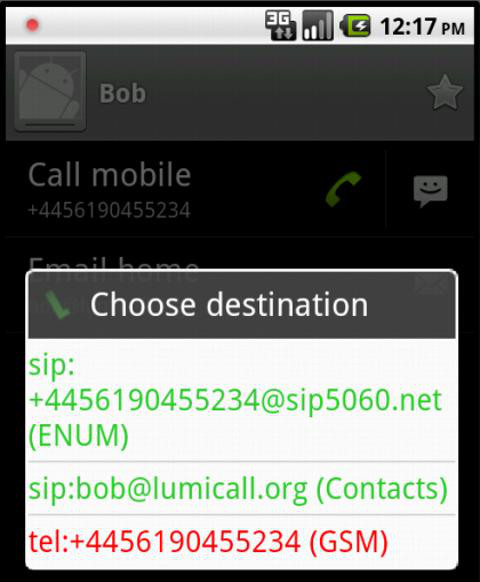
One of the distinguishing features of Lumicall, the free and open SIP/VoIP app for Android, is the unique dialing experience. In fact, even regular softphones for the desktop/laptop don't currently offer the same power when you want to make a call. In my previous blog, I looked at the ENUM technology that underpins part of this compelling new user experience. Here we can step back and look at the bigger picture. Choice is important, sneak preview of Sunday's talk at FOSDEM The fundamental reason for the dialing popup is to give the user choice. Choice is important. With that in mind, one of the key revelations that I will discuss during my talk about Lumicall this Sunday at FOSDEM is that I would like to give users the opportunity to use the Lumicall dialer with other VoIP apps, including Jitsi for Android and CSipSimple. To facilitate this, I hope to separate the dialing logic from the app and make it available as a standalone app or library module that can be used in any free communications software. Users expect convenience, Lumicall tries to deliver Have you noticed how many people will pick up their mobile phone to make a call even when they have a regular phone within reach? Have you found yourself calling your friends' mobile numbers even though you have their home and office numbers in your address book too? These mobile network calls are often at least ten times more expensive than landline calls and by definition they are infinitely more expensive than free calls made over the Internet. So why do people behave this way? The answer is simple: convenience. The caller does not want to make multiple efforts to dial, nor does he want to lose one or two minutes speaking to a secretary, colleague or spouse of the person he is trying to call. Dialing from the address book in his own mobile phone and calling the mobile number of the person he wants to speak with is the shortest path to success. It is efficient, it is compelling and it is what users expect. Free software products wanting to make an impact need to carefully align themselves with these user expectations and that is exactly what Lumicall tries to do. Choose your own adventure: dial the digits, use the address book or surf your call history Any of these everyday dialing practices triggers the Lumicall dialer. In this example, the user is trying to call Bob from the address book: While the user may have simply pressed the "call" button, Lumicall alerts them to several ways that they may proceed:

  • The first choice is a SIP address found in the ENUM directory, sip:+4456190455234@sip5060.net. Lumicall will take all the phone numbers associated with Bob in the address book and report any ENUM results associated with them. Here, just a single ENUM result is display.
  • The second choice is a SIP address constructed from Bob's email address. Lumicall found the email address in the address book entry and discovered that Bob's domain, lumicall.org, has a NAPTR record for SIP. Based on this discovery, Lumicall feels there is a good probability the email address is also a SIP address. If multiple email addresses are in the address book, they will all be checked for NAPTR.
  • (Not shown in the picture) if Lumicall has been configured to use a SIP-to-PSTN gateway account, it will display the option to call Bob's number through the gateway in blue
  • Finally, at the bottom of the list, Lumicall offers the option to call Bob's number in the normal manner, through the GSM network. This option is colour-coded in red to emphasize that it is usually the most expensive.
The tip of the iceberg This experience is a big improvement over the experience of the old rotary dial but it could also be taken even further. People don't always respond to their SIP address, especially if they live in a country where mobile data is not yet the norm. These are areas where Lumicall could be improved. For example, we could use SIP presence to make sure that Bob really is online before displaying the SIP option. This would reduce frustration and boost confidence in SIP. We could even go beyond that: Bob could use the SIP presence mechanism to advertise whether or not he is on a slow mobile data network or a fast network like 4G or wifi. You may choose to defer your call to Bob until he enters wifi coverage where the call quality is likely to be better and maybe video will be possible. This latter opportunity also has privacy implications: Bob may only choose to share that live insight into his network coverage with contacts he trusts. Try it at FOSDEM I will spend some time around the real-time lounge at FOSDEM and would be delighted to get feedback from users who are trying Lumicall, FreePhoneBox.net, JSCommunicator, DruCall or the new Debian SIP service.

Emanuele Rocca: Antifeatures and Antibugs

Software Engineering distinguishes between software features and software bugs. It is usually understood that features are positive, expected characteristics of a computer program. Features make users happy by allowing them to do something useful, interesting, or fun. Something good, anyways. Bugs are instead undesirable and annoying. You're sitting there at your computer writing a long email and the software crashes right before your email is sent. Bad stuff. Features are generally implemented by programmers on purpose, whereas bugs are purely unintentional. They are mistakes. You don't make a mistake on purpose. We might at this point be inclined to think that: i) what is good for users is done on purpose by software manufacturers; ii) what is bad for users was not meant to be. It happened by mistake. Here is a handy table to visualize this idea:
On purpose By mistake
Good Feature
Bad Bug
It seems to make a lot of sense. But you might have noticed that two cells of the table are empty. Right! In a great talk titled When Free Software isn't better, Benjamin Mako Hill mentions the concept of antifeatures, and how they relate to Free Software. Antifeatures are features that make the software do something users will hate. Something they will hate so much they would pay to have those features removed, if that's an option. Microsoft Windows 7 is used in the talk to provide some examples of software antifeatures: the Starter Edition does not allow users to change their background image. Also, it limits the amount of usable memory on the computer to 2GBs, regardless of how much memory the system actually has. Two antifeatures engineered to afflict users to the point that they will purchase a more expensive version of the software, if they have the means to do that. I have another nice example. The Spotify music streaming service plays advertisements between songs every now and then. To make sure users are annoyed as much as possible, Spotify automatically pauses an advertisement if it detects that the volume is being lowered. A poor Spotify user even tried to report the bug on The Spotify Community forum, only to find out that what she naively considered as a software error was "intentional behavior". A spectacular antifeature indeed. Whenever a piece of technology does something you most definitely do not want it to do, such as allowing the NSA to take complete control of your Apple iPhone, including turning on its microphone and camera against your will, that's an antifeature.
On purpose By mistake
Good Feature
Bad Antifeature Bug
Both bugs and antifeatures are bad for users. The difference between them is that antifeatures are engineered. Time and money are spent to make sure the goal is reached. A testing methodology is followed. "Are we really sure customers cannot change their wallpaper even if they try very very hard?" Engineering processes, of course, can fail. If the poor devils at Microsoft who implemented those harassments would have made a mistake that allows users to somehow change their wallpaper on Windows Starter... Well, I would call that a glorious antibug.
On purpose By mistake
Good Feature Antibug
Bad Antifeature Bug
There is no place for antifeatures in Free and Open Source Software. Free Software gives users control over what their software does. Imagine Mozilla adding a feature to Firefox that sets your speakers volume to 11 and starts playing a random song from the black metal artist Burzum every time you add a bookmark, unless you pay for Mozilla Firefox Premium Edition. The source code for Firefox is available under a free license. People who are not into Burzum's music would immediately remove this neat antifeature. I have spent many years of my life advocating Free and Open Source Software, perhaps using the wrong arguments. Mako's talk made me think about all this (thanks mate!). All these years I've been preaching about the technical superiority of Free Software, despite evidence of thousands of bugs and usability issues in the very programs I am using, and contributing to develop. Free Software is not better than Proprietary Software per se. Sometimes it is, sometimes it's not. But it gives you control, and freedom. When it annoys you, when it doesn't do what you expect and want, you can be sure it's not on purpose. And we can fix it together.

Petter Reinholdtsen: A fist full of non-anonymous Bitcoins

Bitcoin is a incredible use of peer to peer communication and encryption, allowing direct and immediate money transfer without any central control. It is sometimes claimed to be ideal for illegal activity, which I believe is quite a long way from the truth. At least I would not conduct illegal money transfers using a system where the details of every transaction are kept forever. This point is investigated in USENIX ;login: from December 2013, in the article "A Fistful of Bitcoins - Characterizing Payments Among Men with No Names" by Sarah Meiklejohn, Marjori Pomarole,Grant Jordan, Kirill Levchenko, Damon McCoy, Geoffrey M. Voelker, and Stefan Savage. They analyse the transaction log in the Bitcoin system, using it to find addresses belong to individuals and organisations and follow the flow of money from both Bitcoin theft and trades on Silk Road to where the money end up. This is how they wrap up their article:
"To demonstrate the usefulness of this type of analysis, we turned our attention to criminal activity. In the Bitcoin economy, criminal activity can appear in a number of forms, such as dealing drugs on Silk Road or simply stealing someone else s bitcoins. We followed the flow of bitcoins out of Silk Road (in particular, from one notorious address) and from a number of highly publicized thefts to see whether we could track the bitcoins to known services. Although some of the thieves attempted to use sophisticated mixing techniques (or possibly mix services) to obscure the flow of bitcoins, for the most part tracking the bitcoins was quite straightforward, and we ultimately saw large quantities of bitcoins flow to a variety of exchanges directly from the point of theft (or the withdrawal from Silk Road). As acknowledged above, following stolen bitcoins to the point at which they are deposited into an exchange does not in itself identify the thief; however, it does enable further de-anonymization in the case in which certain agencies can determine (through, for example, subpoena power) the real-world owner of the account into which the stolen bitcoins were deposited. Because such exchanges seem to serve as chokepoints into and out of the Bitcoin economy (i.e., there are few alternative ways to cash out), we conclude that using Bitcoin for money laundering or other illicit purposes does not (at least at present) seem to be particularly attractive."
These researches are not the first to analyse the Bitcoin transaction log. The 2011 paper "An Analysis of Anonymity in the Bitcoin System" by Fergal Reid and Martin Harrigan is summarized like this:
"Anonymity in Bitcoin, a peer-to-peer electronic currency system, is a complicated issue. Within the system, users are identified by public-keys only. An attacker wishing to de-anonymize its users will attempt to construct the one-to-many mapping between users and public-keys and associate information external to the system with the users. Bitcoin tries to prevent this attack by storing the mapping of a user to his or her public-keys on that user's node only and by allowing each user to generate as many public-keys as required. In this chapter we consider the topological structure of two networks derived from Bitcoin's public transaction history. We show that the two networks have a non-trivial topological structure, provide complementary views of the Bitcoin system and have implications for anonymity. We combine these structures with external information and techniques such as context discovery and flow analysis to investigate an alleged theft of Bitcoins, which, at the time of the theft, had a market value of approximately half a million U.S. dollars."
I hope these references can help kill the urban myth that Bitcoin is anonymous. It isn't really a good fit for illegal activites. Use cash if you need to stay anonymous, at least until regular DNA sampling of notes and coins become the norm. :) As usual, if you use Bitcoin and want to show your support of my activities, please send Bitcoin donations to my address 15oWEoG9dUPovwmUL9KWAnYRtNJEkP1u1b.

Alexander Wirt: everything comes to an end

I was a member of the credativ family for almost 10 years. It was a great and and demanding time where I did things I never imagined I would have to do them :). I started as an apprentice and finished as a technical lead. In the last summer one of my best friends - if not my best - and I developed the idea of me joining his company hs42 as their new Head of IT. The whole concept is interesting, most time I ll do home-office and for ~ 1 week in a month I ll join the company in Oldenburg. After a lot of thinking I accepted that offer. That means that I left credativ in December. Being an open source consultant is interesting on the one hand, but somewhat annoying on the other hand. You will always do new things, but often you are not in the position of designing, deciding or even running them. I was always something that is nowadays known as a devop - a long time before this was getting hip . Now I have the opportunity to design, develop and run my own systems. That also means a little bit windows, but opsi exists :). Running systems on your own is different from the usual consultant work. Being a consultant often means that you design and implement something and after it works you have to give your baby into the hands of someone else. Running them on your own also means you can do constant improvement to something, not only when its broken. The job should give me more time for open source and my family, which is a good thing. It is still a little bit odd to work from home, but being together with your family most of the time is a great thing - and I don t want to miss it. The new job also allows me to work as consultant on my own, so if you need a Debian, E-Mail, Linux or whatever guy that helps you in doing things - get in touch with me. The time at credativ was a great one and I look back with a smile to all the good things. If you need Open Source Support they are the people you should ask. I will stay connected with credativ in many ways.

Enrico Zini: correctness

On political correctness I am reading "Four ways to forgiveness" by Ursula Le Guin. This is how the book begins:
On the planet 0 there has not been a war for five thousand years, she read, and on Gethen there has never been a war. She stopped reading, to rest her eyes and because she was trying to train herself to read slowly, not gobble words down in chunks the way Tikuli gulped his food. There has never been a war : in her mind the words stood clear and bright, surrounded by and sinking into an infinite, dark, soft incredulity. What would that world be, a world without war? It would be the real world Peace was the true life, the life of working and learning and bringing up children to work and learn. War, which devoured work, learning, and children, was the denial of reality. But my people, she thought, know only how to deny. Born in the dark shadow of power misused, we set peace outside our world, a guiding and unattainable light. All we know to do is fight. Any peace one of us can make in our life is only a denial that the war is going on, a shadow of the shadow, a doubled unbelief.
That made me realise that several times I perceived political correctness as "only a denial that the war is going on". Last night I watched this video, which I felt was very relevant to this. Indeed, I have more respect for someone who listens to me and makes a good effort to understand what I said, then rudely disagrees, than for someone who is very politely ignoring everything I am trying to say. This is how I feel like this experience can be distilled into an actionable item:
Replying to an email is probably going to be useless, unless I am willing to make an effort to understand what the other person is trying to say, from their own point of view.

Russ Allbery: remctl 3.8

remctl is the middleware system that we use everywhere at Stanford. It's a very simple way to run commands, constrained by ACLs, over a GSS-API-authenticated with good encryption. This release doesn't have a lot of obvious user-visible changes. Rather, it's an internal refactoring and cleanup release that will make further changes easier. The major change is that the process event loop, which runs the command and sends its output back over the wire to the client, now uses libevent. This makes the code cleaner and fixes various problems previously caused by portability, such as the lack of proper handling of SIGCHLD forcing a short poll interval to see if the child had exited. While working on that, I also found and cleaned up several other minor issues: the maximum output per remctl token now matches the protocol maximum, rather than the arbitrary and strange choice of 65,000 octets, and I fixed a few minor memory leaks in the server and client that no one probably would have noticed. The server also now writes its PID file atomically. You can get the latest release from the remctl distribution page.

28 January 2014

Bits from Debian: Debian.org enabled for SIP federation and WebRTC, XMPP/Jabber to follow

Debian System Administrators working in conjunction with pkg-voip team member Daniel Pocock have set up a SIP proxy and TURN server for debian.org. Specifically, the SIP proxy provides a way for Debian Developers to use their Debian email ID as a SIP address for making calls to other project members and exchanging calls with any other domain that is enabled for SIP. The repro SIP proxy from reSIProcate has been chosen for this project. The TURN server provides a mechanism for users of SIP or XMPP (Jabber) to relay audio and video streams through a public IP address when necessary, eliminating many of the quality issues that arise when NAT devices block the media streams in one or both directions. The service allows the users to connect directly with the SIP device or softphone of their choosing, including many of those packaged in Debian such as Jitsi and Empathy or third party solutions like Lumicall or CSipSimple on Android. The SIP proxy also includes a WebRTC interface, allowing Debian Developers to immediately try WebRTC voice and video calls without installing or configuring any software of their own other than a web browser. A second stage of the project involves providing an XMPP (Jabber) server with similar capabilities for federated communications between debian.org users and other domains. Further details will be announced in the weeks ahead. It is a significant feature of the Debian Project philosophy that we can operate the entire project using free software, specifically, using software available in Debian packages running on our own infrastructure and without a dependency on third party cloud solutions.These new services for project members fulfill those expectations. It is particularly relevant for situations where real-time communication (voice or video) collaboration takes place with third parties such as applicants for Google Summer of Code, Outreach Program for Women, sponsors, media and other free software projects. Project specific details and a user guide are available now on the Debian Wiki at http://wiki.debian.org/UnifiedCommunications/DebianDevelopers

Andrea Colangelo: The (brand new) Debian 3D-Printing Team is hiring!

The 3D-printing technology has gained quite a big momentum in recent times. Its use is spreading widely even among hobbyists and many sources report daily several (sometimes weird) examples of its usage. The thing I like most, as a Free Software activist, is that several 3D-printing-related free and open source software are already available and quite good, and some printers are even released as free hardware. Unfortunately, Debian is quite lagged behind with regard to the availability of such software in our archive, especially compared to other distributions who already ship much of it. Hopefully this situation will change drastically thanks to the brand new Debian 3D-Printing team, whose purpose is to make Debian a rocking platform to do some serious 3D-printing. The team is bootstrapping right now, and we are looking for volunteers who are willing to help us. Packagers are greatly welcomed, but also triagers, users and passionate people with some experience in the field are extremely valuable. People willing to join the team can take a look at our (in-progress) wiki page and apply on the team page on Alioth. As with any good packaging team, a mailing list is available to share ideas, feel free to subscribe it, and feel free to join #debian-3dprinting on OFTC if you want to hang out with other team members.

Andrew Pollock: [life] Day 1, first day of Kindergarten

Yesterday was the first day of my new routine, except I haven't really established the new routine yet. I think that's going to take a few weeks. It was, however, the first day of Zoe's new routine, she started Kindergarten. "Kindergarten" is a bit of an ambiguous term, even within Australia, it seems. Back when I went to school, there was "pre-school", which was, as best I can determine, what "Kindergarten" is now, except a year later. It was optional, half a week, and the year preceding the start of primary ("elementary") school. I think every other state was already doing an extra year of school (which I think they called "Kindergarten", "Kinder", or something starting with "K") so Queensland blew up "pre-school", created "Prep" and now that's the first year of primary school. Zoe will start "Prep" next year. Then the Queensland education boffins realised that kids were missing out on the stuff that "pre-school" used to offer, so they reintroduced it in the form of "Kindergarten" (by Queensland standards). It's supposed to be play-based, and isn't really "long day care". Zoe does Monday, Tuesday and every other Wednesday, from 8:30am until 2:20pm. I'd only heard about C&K from a friend after moving back to Brisbane, so we were very fortunate to secure a place without having camped out on a waiting list from birth. We got very lucky, and ended up getting multiple offers, but we're pretty thrilled with the one that Zoe got into. It's a relatively new facility, right next to a state school and some bushland. They take the kids on excursions into the bushland, and up to the state school where there's some chickens. The Kindergarten facility itself is really lovely. Anyway, yesterday was Zoe's first day. I biked there yesterday morning (without Zoe) and it took me about 11 minutes. It took me more like 15 minutes to pick her up with the bike trailer. It's uphill on the way there, but not too much of a slog. It's been really great that Zoe's BFF from day care, Megan, also scored a place in the same Kindergarten, as I think this will help the transition for both girls greatly. I was able to stay for an extended period of time to help settle Zoe in, and I was able to leave without her being particularly distressed. I then biked home, running a few errands along the way. I then got stuck into a woodworking project (I'm trying to make a little wooden clothesline for Zoe). It turns out trying to cut a halved joint with a hand saw and chisel is a lot of work. I've managed to aggravate an old rotator cuff injury and the two pieces are a tad too tight, so I'm thinking I'll redo it and cut the joint out with an electric router instead. I probably spent at least a couple of hours faffing around with that. So I banged away with a hammer and chisel for a bit, got a haircut, had a late lunch and next thing I knew it was 2pm and time to head back on the bike to pick up Zoe. She was still asleep on her stretcher when I arrived to pick her up, which wasn't that surprising, since she tends to sleep later and longer at day care. I got a good opportunity to chat with her teacher about her first day and then gently woke her up with a kiss, and we headed home. I introduced Zoe to one of our new neighbours, and after a snack, we drove into Fortitude Valley where I had to pick up some mail from my post office box. When we got back home, I started on dinner while Zoe watched a little bit of TV. I spontaneously invited my cousin over to join us for dinner, and we walked down to the Hawthorne Garage for a babyccino after dinner. It was a good day. I realised that I'm going to have to be super regimented with my time on the days Zoe is in Kindergarten, because 2pm is going to roll around very quickly. "Scarcity brings clarity", as Sergey says...

27 January 2014

Steve Kemp: It is unfortunate that many companies need the same sysadmin jobs carried out

It is unfortunate that I've been exposed to several companies that all need the same kind of problems solving, again and again: A lot of these are solved problems, yet they seem to keep cropping up. I guess the fact I've done some of these things more than once means I'm the local-expert, so that's why I get asked. But still.. There was a time when I thought my Debian Administration site would help solve these kind of problems; that writing documentation would encourage people to do things properly. Certainly it has helped me, and some other people are greatful, but it didn't do enough to help. I'm not sure if the problem is that my documentation is a little ideosyncratic, isn't good enough, or isn't reaching the right kind of people. I suspect a combination of that and scale - You can't walk somebody though the idea of setting up a ten-node database-cluster, they need to suffer, they need to break things, they need to sweat on Christmas Day, at 5AM, as everything goes to hell. Then the next time they'll do it properly. I'd love to take the time to write out recipes in Salt, Ansible, Puppet, Chef, CFengine, Slaughter, whatever, and support them.
Remote. Automated. System management.
Throw in monitoring of metrics, security fixes, and reporting and there's probably a valuable service there. It probably can't happen though, for three main reasons: I did recently write some policies for setting up a two-node Master-Slave MySQL setup, with reporting, monitoring, and custom SMS-based alerts. I guess I'm wondering if I can be cheeky and sell the same work twice. ;)

Kees Cook: -fstack-protector-strong

There will be a new option in gcc 4.9 named -fstack-protector-strong , which offers an improved version of -fstack-protector without going all the way to -fstack-protector-all . The stack protector feature itself adds a known canary to the stack during function preamble, and checks it when the function returns. If it changed, there was a stack overflow, and the program aborts. This is fine, but figuring out when to include it is the reason behind the various options. Since traditionally stack overflows happen with string-based manipulations, the default (-fstack-protector), only includes the canary code when a function defines an 8 (--param=ssp-buffer-size=N, N=8 by default) or more byte local character array. This means just a few functions get the checking, but they re probably the most likely to need it, so it s an okay balance. Various distributions ended up lowering their default --param=ssp-buffer-size option down to 4, since there were still cases of functions that should have been protected but the conservative gcc upstream default of 8 wasn t covering them. However, even with the increased function coverage, there are rare cases when a stack overflow happens on other kinds of stack variables. To handle this more paranoid concern, -fstack-protector-all was defined to add the canary to all functions. This results in substantial use of stack space for saving the canary on deep stack users, and measurable (though surprisingly still relatively low) performance hit due to all the saving/checking. For a long time, Chrome OS used this, since we re paranoid. :) In the interest of gaining back some of the lost performance and not hitting our Chrome OS build images with such a giant stack-protector hammer, Han Shen from the Chrome OS compiler team created the new option -fstack-protector-strong, which enables the canary in many more conditions: This meant we were covering all the more paranoid conditions that might lead to a stack overflow. Chrome OS has been using this option instead of -fstack-protector-all for about 10 months now. As a quick demonstration of the options, you can see this example program under various conditions. It tries to show off an example of shoving serialized data into a non-character variable, like might happen in some network address manipulations or streaming data parsing. Since I m using memcpy here for clarity, the builds will need to turn off FORTIFY_SOURCE, which would also notice the overflow.
#include <stdio.h>
#include <stdlib.h>
#include <string.h>
struct no_chars  
    unsigned int len;
    unsigned int data;
 ;
int main(int argc, char * argv[])
 
    struct no_chars info =    ;
    if (argc < 3)  
        fprintf(stderr, "Usage: %s LENGTH DATA...\n", argv[0]);
        return 1;
     
    info.len = atoi(argv[1]);
    memcpy(&info.data, argv[2], info.len);
    return 0;
 
Built with everything disabled, this faults trying to return to an invalid VMA: Built with FORTIFY_SOURCE enabled, we see the expected catch of the overflow in memcpy: So, we ll leave FORTIFY_SOURCE disabled for our comparisons. With pre-4.9 gcc, we can see that -fstack-protector does not get triggered to protect this function: However, using -fstack-protector-all does trigger the protection, as expected: And finally, using the gcc snapshot of 4.9, here is -fstack-protector-strong doing its job: For Linux 3.14, I ve added support for -fstack-protector-strong via the new CONFIG_CC_STACKPROTECTOR_STRONG option. The old CONFIG_CC_STACKPROTECTOR will be available as CONFIG_CC_STACKPROTECTOR_REGULAR. When comparing the results on builds via size and objdump -d analysis, here s what I found with gcc 4.9: A normal x86_64 defconfig build, without stack protector had a kernel text size of 11430641 bytes with 36110 function bodies. Adding CONFIG_CC_STACKPROTECTOR_REGULAR increased the kernel text size to 11468490 (a +0.33% change), with 1015 of 36110 functions stack-protected (2.81%). Using CONFIG_CC_STACKPROTECTOR_STRONG increased the kernel text size to 11692790 (+2.24%), with 7401 of 36110 functions stack-protected (20.5%). And 20% is a far-cry from 100% if support for -fstack-protector-all was added back to the kernel. The next bit of work will be figuring out the best way to detect the version of gcc in use when doing Debian package builds, and using -fstack-protector-strong instead of -fstack-protector. For Ubuntu, it s much simpler because it ll just be the compiler default.

2014, Kees Cook. This work is licensed under a Creative Commons Attribution-ShareAlike 3.0 License.
Creative Commons License

Richard Hartmann: Public Consultation on the review of the EU copyright rules

You probably didn't know there's a Public Consultation on the review of the EU copyright rules under way as of right now. It states explicitly that "All stakeholders are welcome to contribute to this consultation." This means you. No matter where you live or what you do, this is your chance to potentially influence copyright reform. You have time until 2014-02-05. Don't wait that long, fill the survey out now. Else you will forget. And then lament the fact that legacy industries are upheld with artifical government-sanctioned monopolies. If you find the ~40 A4 pages of text scary, there's a handy guide as to what questions will interest you the most, but I suggest you fill it out on your own. Stop what you're doing, fill this out, and return. Thanks.

Jo Shields: Dear Debian Developers, lrn2gpg

For some strange reason, I ve been receiving a lot of GPG-signed mail from Debian Developers and Maintainers lately. In response to each of these mails, I need to send a GPG-encrypted reply. The rate at which I m able to send replies has been significantly hampered by the poor state in which many DD/DM s maintain their GPG keys. Here are a few common mistakes, so you can consider correcting them. Ensure you have a UID for the email address(es) you use When I send an encrypted mail, I need to be sure that the recipient is legit. This means any decent mail client should refuse to send an encrypted message to foo@bar.com unless that email address is known somehow to GPG. In many cases, someone with a valid key for foo@bar.com would send their signed mail from foobar@gmail.com without that being a valid UID. In some cases, foo@bar.com isn t even a valid email address anymore (i.e. the bar.com mail server says no such mailbox). You should have a UID for each address you use. Signatures are per-UID You may well have a valid UID for foo@debian.org, foo@bar.com, and foobar@gmail.com but the PGP trust model doesn t automatically trust every UID as much as its peers. Each individual UID needs to be trusted (i.e. signed/uploaded) by others. What if you added billg@microsoft.com as a UID should that automatically be trusted? Clearly not. Just because you have foo@debian.org doesn t mean it s trusted for encryption without some signatures. Make sure you actually have an encrypting subkey GPG sucks, and as a result, it reports Skipping unusable pubkey when the issue is a lack of valid encrypting subkeys. If you have revoked all encrypting subkeys, or allowed them to expire, then I cannot send you encrypted mail. Exact naming matters Bob Bobbertson <foo@bar.com> and B b B bb rts n <foo@bar.com> are different people. Check your mail client s From: setting, to ensure it matches your UID. If not, fix one of them. Check your webmail plugin isn t shit Some people use third party plugins to integrate GPG into their webmail client (e.g. Hotmail or GMail). Make sure this actually works. Don t use Enigmail Enigmail is a popular plugin to integrate GPG into Mozilla Thunderbird. It doesn t work, in most cases. Almost every single BADSIG in my inbox is due to Enigmail. Thunderbird will insert spurious line wraps and escape characters into your mail after signing, resulting in invalid signatures. It s mostly okay if you never quote mail, and restrict messages to about 70 characters. I know plenty of Debian Developers don t care about GPG other than for package signing but please, for the sanity of the rest of us, take an occasional moment to care a little. I should note that the worst offenders for keys which don t just work were Developers with 1024D keys the best behaved were Maintainers of all stripes.

26 January 2014

Niels Thykier: Release architecture meeting 2014-01-26

Today, we held an one-hour IRC-meeting to debate the status of the current architectures in sid. During that one hour, we brought up all 13 architectures. We made a decision on 9 of the architectures. The remaining 4 will be revisited within 2 months. As for the actual results, we will announce these on debian-devel-announce with our next bits mail. I suspect the announcement to happen within a couple of days. I am quite pleased that we managed to keep the meeting to one hour. Especially considering that it was planned less than a week ago. One of the things, that I believe helped us, was that we had summarised the status for each architecture prior to the meeting. In my view, the summary allowed us to finish at least half of the architectures within their allocated 5 minutes. In fact, we had 20 minutes for the last 2 architectures partly because amd64 + i386 combined took about a minute. A second thing that helped us stay on time was cutting debates short. Obviously, with less than 5 minutes per architecture, there was little time for debate and, I admit, that was by design. This meant that we had to defer 4 decisions for later. We are currently waiting for information, which we hope to have soon. More on that in the announcement later.
I would like to thank the attendees for contributing to a productive and short meeting. It was a pleasure and I hope we can repeat the success next time. :)

Neil Williams: Home server rack

The uses of this particular rack I ll cover in future entries this is about how I made the rack itself, with help from friends (Steve McIntyre & Andy Simpkins). A common theme is making allowances for using dev kit boards ready-to-rack ARM servers are not here yet. My aim was to have 4, possibly 6 ARM dev kit boards running services from home, so there was no need for a standard 42U rack, a 9U rack is enough. Hence:
Wall Mounted 9U 450mm deep 19 inch rack enclosure glass door To run various other services around the house (firewall, file server etc.), a microserver was also necessary:
HP 704941-421 ProLiant Micro Server (AMD Turion II Neo N54L 2.2GHz, 2GB RAM, 250GB HDD, 2 Core, 7th Generation) I chose to mount that on a bookcase beneath the wall mounted rack as it kept all the cables at the bottom of the rack itself. The microserver needed a second gigabit network card fitted to cope with being a firewall as well, if you do the same, ensure you find a suitable card with a low profile bracket. Some are described as being low profile but do not package the low profile bracket, only a low profile card and a full height bracket.
Intel EXPI9301CTBLK PRO1000 Network Card note the low profile bracket in the pack. The first of the dev kit requirements is the lack of boards which can be racked, so shelves are going to be needed, leading on to something to stop the boards wandering across the shelf when the cables are adjusted velcro pads in my case. Second requirement is that dev kit boards are notorious for not rebooting cleanly. Nothing to do with the image being run, the board just doesn t cut power or doesn t come back after cutting power. Sometimes this is down to early revisions of the board, sometimes the board pulls enough power through the USB serial converter to remain alive, whatever the cause, it won t reboot without user involvement. So a PDU becomes necessary remotely controllable. New units tend to be expensive and/or only suitable for larger racks, I managed to find an older 8 port APC unit, something like: (Don t be surprised if that becomes a dead link search for APC Smart Slot Master Switch Power Distribution Unit). Talking of power, I m looking to use SATA drives with these boards and the boards themselves come with a variety of wall wart plugs or USB cables, so a number of IEC sockets are needed not the usual plugs:
Power cable IEC C14 plug 13A socket 25 cm or, for devices which genuinely need 2A to boot (use the 1A for attached SATA or leave empty):

Black Universal 3.1A 15W 5V Dual USB Rapid Mains Charger Plug Check the power output rating of the USB plugs used to connect to the mains as well many are 1A or less. Keep the right plug for the right board.
Power is going to also be a problem if, like me, you want to run SATA drives off boards which support SATA. The lack of a standard case means that ATX power is awkward, so check out some cheap SATA enclosures to get a SATA connector with USB power. I am using these enclosures (prices seem to have risen since I obtained them):

Startech 2.5 inch eSATA USB External Hard Drive Enclosure for SATA HDD Along with these:
eSATA to SATA Serial External Shielded Cable 1m because the iMx53 boards have SATA connectors but the enclosure exports eSATA. Whilst this might seem awkward, the merit of having both eSATA and simple USB power on one enclosure is not to be under-estimated. (Avoid the stiffer black cables space will get tight inside the rack.) Naturally, a 2.5 inch SATA drive is going to be needed for each enclosure, I m using HDD but SSD is also an option. Also, consider simple 2 or 3 way fused adaptors so that the board and the SATA drive can be powered from a single PDU port, this makes rebooting much simpler if the board needs a power supply with integrated plug instead of over USB. Now to the networking (2 x 8 port was cheaper than 1 x 16):
Netgear GS108 8-port Gigabit Ethernet Unmanaged Switch Don t forget the cat5 cables too you ll want lots of short cables, 1m or shorter inside the rack and a few longer ones going to the microserver and wall socket. I used 8x1m. Naturally, on the floor below your rack you are going to put a UPS, so the PDU power then needs to be converted to draw from the UPS via IEC plugs instead of standard mains. I decided to use a 6 gang extension 1m cable with an IEC plug it was the only bit of wiring I had to do and even those are available ready-made if you want to do it that way. Depending on the board, you may need your own serial to USB converters, you ll certainly need some powered USB hubs. I m using a wall mounted 9U rack, so I also needed a masonry drill and 4 heavy duty masonry M8 bolts. The rack comes with a mounting plate which needs to be bolted to the wall but nothing else is included. This step is much easier with someone else to take the weight of the rack as it is guided into the brackets on the mounting plate the bracket may need a little persuasion to allow for the bolt heads to not get in the way during mounting. Once mounted, the holes in the back of the rack allow for plenty of room, it s just getting to that point. The rack has side panels which latch out easily, providing easy maintenance. The glass door can be easily reversed to open from the opposite side. However, the key in the glass door is largely useless. The expectation is that the units in the rack are attached at the front but the dev boards on shelves are not going to be protected by a key in the front door. The key therefore ends up being little more than a handle for the glass door. OK. If you ve got this far, it s a case of putting things together:
Economy Cage Nut Tool 19 inch racking for cagenut extraction Yes, you really do want one. Fine, do without the premium one, but the economy one will save you a lot of (physical) pain. At this stage, it becomes clear that the normal 19 inch server rack shelves don t leave a lot of room at the back of the rack for the cables and there are a lot of cables. Each board has power, USB serial connection and network. The SATA has power too. The PDU has a power lead and you ll need network switches too. The network switches need power and an uplink cable. I positioned the supports in the rack as far forward as possible and attached the shelves to give enough room for the PDU on the base of the rack, the network switches resting on top and the extension bar (with the heavier, stiffer cables) at the back. (I need to bring my shelves another 1 or 2 positions further forward as there is barely enough room for one cable between the shelf and the back of the rack and that makes moving boards around harder than it needs to be.) The PDU defaults to enabling all ports at startup, so connect to it over telnet and turn off the ports before connecting things and sorting out the network interface to what the rest of the lab needs. (I m using a 10. range and the PDU was originally set to use 192.168.1.) That s about it as far as the hardware setup is concerned. Just time to label up each board, note down which PDU port does which device, which serial to USB converter is on which device on the microserver and check the power my initial problem with one board was traced to the inability of the board to power SATA off the on-board USB port even when using the provided 2A power supply. That meant adding a standard mains adaptor to feed both the SATA power and the board power off the one PDU port there is little point powering off the board but not the SATA, or vice versa. I haven t totalled up the expenditure but the biggest expenses were the microserver and the wall mounted rack but don t underestimate how much it will cost to buy 6 IEC plugs, various USB serial converters and how much you may spend on peripheral items. There is quite a lot of room on the 2 shelves for more boards, what will limit the deployment in this rack is space for the cables, especially power. The shorter the power cables, the easier it will be to maintain the devices in the rack. It might be worth looking at a 12U rack, if only to give plenty of space for cables. Once I ve got the software working, I ll describe what this rack will be doing it s got something to do with Debian, ARM, Linux and tests but you ve probably already guessed that much

Matthias Klumpp: Next stop: FOSDEM 14

After years of missing this conference, I will finally make it to Brussels this time! I will even have some talks, one about Listaller (in the lightning-talks section) and one about AppStream and Listaller in the Distributions track. The lightning-talk will explain why distributing (some) applications independent from the distribution makes sense, and how Listaller does this. I will also very briefly talk about the concepts behind Listaller and which tools it offers for application developers to create & package cross-distro apps. The AppStream & Listaller talk will be much more detailed. It will cover the rationale for AppStream, what AppData is good for and how AppData files relate to AppStream. I will also reflect the AppData adoption in GNOME/Fedora and why GNOME-Software is the right way to go forward in developing software-centers. It will of course also include our future plans for AppStream. On the Listaller side, I will talk about how Listaller is connected to AppStream and PackageKit and why distributions should ship a way to install cross-distro packaged apps at all. I will explain module-definitions and why they are useful. An overview of the internals of Listaller and it s system integration is also included, as well as how it can be compared to competing installation solutions. If you are at FOSDEM and have questions about AppStream/PackageKit/Listaller/Tanglu/Debian/etc., please ask them! ;-) See you there! FOSDEM

25 January 2014

Russell Coker: Links January 2014

Fast Coexist has an interesting article about the art that Simon Beck creates by walking in snow [1]. If you are an artist you can create art in any way, even by walking in patterns in the snow. Russ Altman gave an interesting TED talk about using DNA testing before prescribing drugs [2]. I was surprised by the amount of variation in effects of codeine based on genetics, presumably many other drugs have a similar range. Helen Epstein wrote an interesting article about Dr. Sara Josephine Baker who revolutionised child care and saved the lives of a huge number of children [3]. Her tenacity is inspiring. Also it s interesting to note that the US Republican party was awful even before the Southern Strategy . The part about some doctors opposing child care because it s the will of God for children to die and keep them in employment is chilling. Jonathan Weiler wrote an insightful article about the problems with American journalism in defending the government [4]. He criticises the media for paying more attention to policing decorum than to content. Tobias Buckell wrote an interesting post about the so-called socialised health-care in the US [5]. He suggests that Ronald Reagan socialised health-care by preventing hospitals from dumping dying people on the street. I guess if doing nothing for people until they have a medical emergency counts as socialised health-care then the US has it. Kelvin Thomson MP made some insightful comments about climate change, the recent heat-wave in Australia, and renewable energy [6]. Iwan Baan gave an interesting TED talk about ways that people have built cheap homes in unexpected places [7], lots of good pictures. Racialicious has an interesting article by Arturo R. Garc a about research into the effects of concussion and the way the NFL in the US tried to prevent Dr. Bennet Omalu publicising the results of his research [8]. Stani (Jan Schmidt) wrote an interesting post about how they won a competition to design a commemerative Dutch 5 Euro coin [9]. The coin design is really good (a candidate for the geekiest coin ever), I want one! Seriously if anyone knows how to get one at a reasonable price (IE close to face value for circulated or not unreasonably expensive for uncirculated) then please let me know. When writing about Edward Snowden, Nathan says Imagine how great a country would be if if it were governed entirely by people who Dick Cheney would call Traitor [10]. That s so right, that might make the US a country I d be prepared to live in. Andrew Solomon gave an interesting TED talk Love No Matter What about raising different children [11]. Aditi Shankardass gave an interesting TED talk about using an ECG to analyse people diagnosed wit severe Autism and other developmental disorders [12]. Apparently some severe cases of Autism have a root cause that can be treated with anti-seizure medication. George Monbiot wrote an insightful article about the way that Bono and Bob Geldoff promote G8 government intervention in Africa and steal air-time that might be given to allow Africans to represent themselves in public debates [13]. Daniel Pocock wrote an informative article about racism in Australian politics and how it is bad for job-seekers and the economy (in addition to being horribly wrong) [14]. Aeon Magazine has an interesting article by Anne Buchanan about the difference between scientists and farmers [15]. She has some interesting points about the way that the lack of general knowledge impacts research, but misses the point that in most fields of study there is a huge problem of people not knowing about recent developments in their own field. I don t think it s a pipe dream to be well educated in humanities and science, but I guess that depends on the definition of well educated . Brian Cox gave an interesting TED talk titled Why We Need the Explorers about the benefits of scientific research [16]. Yupu Zhang, Abhishek Rajimwale, Andrea C. Arpaci-Dusseau, and Remzi H. Arpaci-Dusseau from the University of Wisconsin-Madison wrote an interesting paper about ZFS corruption in the face of disk and memory errors [17]. One thing to note is that turning off atime can reduce the probability of a memory error leading to corrupt data being written to disk, run zfs set atime=off tank to fix this. The comedian Solomon Georgio celebrated Martin Luther King day by tweeting I love you to racists [18]. It s an interesting approach and appears to have worked well.

24 January 2014

Erich Schubert: Definition of Data Science

Everything is "big data" now, and everything is "data science". Because these terms lack a proper, falsifiable definition.
A number of attempts to define them exist, but they usually only consist of a number of "nice to haves" strung together. For Big Data, it's the 3+ V's, and for Data Science, this diagram on Wikipedia is a typical example.
This is not surprising: effectively these term are all marketing, not scientific attempts at definiting a research domain.
Actually, my favorite definition is this, except that it should maybe read pink pony in the middle, instead of unicorn.
Data science has been called "the sexiest job" so often, this has recently led to an integer overflow.
The problem with these definitions is that they are open-ended. They name some examples (like "volume") but they essentially leave it open to call anything "big data" or "data science" that you would like to. This is, of course, a marketers dream buzzword. There is nothing saying that "picking my nose" is not big data science.

If we ever want to get to a usable definition and get rid of all the hype, we should consider a more precise definition; even when this means making it more exclusive (funnily enough, some people already called above open-ended definitions "elitist" ...).
Big data:
  • Must involve distributed computation on multiple servers
  • Must intermix computation and data management
  • Must advance over the state-of-the-art of relational databases, data warehousing and cloud computing in 2005
  • Must enable results that were unavailable with earlier approaches, or that would take substantially longer (runtime or latency)
  • Must be disruptively more data-driven
Data science:
  • Must incorporate domain knowledge (e.g. business, geology, etc.).
  • Must take computational aspects into account (scalability etc.).
  • Must involve scientific techniques such as hypothesis testing and result validation.
  • Results must be falsifiable.
  • Should involve more mathematics and statistics than earlier approaches.
  • Should involve more data management than earlier approaches (indexing, sketching&hashing etc.).
  • Should involve machine learning, AI or knowledge discovery algorithms.
  • Should involve visualization and rapid prototyping for software development.
  • Must satisfy at least one of these shoulds in a disruptive level.
But this is all far from a proper definition. Partially because these fields are so much in flux; but largely because they're just too ill-defined.
There is a lot of overlap, that we should try to flesh out. For example, data science is not just statistics. Because it is much more concerned with how data is organized and how the computations can be made efficiently. Yet often, statistics is much better at integrating domain knowledge. People coming from computation, on the other hand, usually care too little about the domain knowledge and falsifiability of their results - they're happy if they can compute anything.
Last but not least, nobody will be in favor of such a rigid definition and requirements. Because most likely, you will have to strip that "data scientist" label off your business card - and why bite the hand that feeds? Most of what I do certainly would not qualify as data science or big data anymore with an "elitist" definition. While this doesn't lessen my scientific results, it makes them less marketable.
Essentially, this is like a global "gentlemans agreement". Buzz these words while they last, then move on to the next similar "trending topic".

Maybe we should just leave these terms to the marketing folks, and let them bubble them till it bursts. Instead, we should just stick to the established and better defined terms...
Thank you.
Of course, sometimes you will have to play Buzzword Bingo. Nobody is going to stop you. But I will understand that you are doing "playing buzzword bingo", unless you get more precise.
Once you then have results that are so massively better, and really disrupted science, then you can still call it "data science" later on.
You have been seeing, I've been picking on the word "disruptive" a lot. As long as you are doing "business as usual", and focusing on off-the-shelf solution, it will not be disruptive. And it then won't be big data science, or a big data approach that yields major gains. It will be just "business as usual" with different labels, and return results as usual.
Let's face it. We don't just want big data or data science. What everybody is looking for is disruptive results, which will require a radical approach, not a slight modification involving slightly more computers of what you have been doing all along.

Julien Danjou: OpenStack Ceilometer Icehouse-2 milestone released

Yesterday, the second milestone of the Icehouse development branch of Ceilometer has been released and is now available for testing and download. This means the first half of the OpenStack Icehouse development has passed! New features For the Icehouse-1 milestone, we barely had enough time to implement 2 blueprints. We almost did a better job this time, but finally only 2 blueprints were implemented again. This is really far from what we planned initially. The infrastructure slowdown issues and the lower number of reviews is probably the root cause here. Anyway, Ceilometer now offers a REST API to accesses the stored event. The initial work to replace the /v2/meters endpoint with something more RESTy has started with the implementation of /v2/samples. Bug fixes Thirty-one bugs were fixed, though most of them might not interest you so I won't elaborate too much on that. Go read the list if you are curious. Toward Icehouse 3 We now have 29 blueprints targeting the Ceilometer's third Icehouse milestone, with some of them are already started and ready to merge. However, it's likely that we won't make all of them. As usual, the priority should indicate how confident we are that we want and need a feature. Still, it's likely the roadmap will be adjusted in the upcoming weeks. I'll try to make sure we'll get there without too much trouble for the 6th March 2013. Stay tuned!

Next.

Previous.