Matthew Garrett: Android apps, IMEIs and privacy
 There's been a sudden wave of people concerned about the Meitu selfie app's use of unique phone IDs. Here's what we know: the app will transmit your phone's IMEI (a unique per-phone identifier that can't be altered under normal circumstances) to servers in China. It's able to obtain this value because it asks for a permission called READ_PHONE_STATE, which (if granted) means that the app can obtain various bits of information about your phone including those unique IDs and whether you're currently on a call.
Why would anybody want these IDs? The simple answer is that app authors mostly make money by selling advertising, and advertisers like to know who's seeing their advertisements. The more app views they can tie to a single individual, the more they can track that user's response to different kinds of adverts and the more targeted (and, they hope, more profitable) the advertising towards that user. Using the same ID between multiple apps makes this easier, and so using a device-level ID rather than an app-level one is preferred. The IMEI is the most stable ID on Android devices, persisting even across factory resets.
The downside of using a device-level ID is, well, whoever has that data knows a lot about what you're running. That lets them tailor adverts to your tastes, but there are certainly circumstances where that could be embarrassing or even compromising. Using the IMEI for this is even worse, since it's also used for fundamental telephony functions - for instance, when a phone is reported stolen, its IMEI is added to a blacklist and networks will refuse to allow it to join. A sufficiently malicious person could potentially report your phone stolen and get it blocked by providing your IMEI. And phone networks are obviously able to track devices using them, so someone with enough access could figure out who you are from your app usage and then track you via your IMEI. But realistically, anyone with that level of access to the phone network could just identify you via other means. There's no reason to believe that this is part of a nefarious Chinese plot.
Is there anything you can do about this? On Android 6 and later, yes. Go to settings, hit apps, hit the gear menu in the top right, choose "App permissions" and scroll down to phone. Under there you'll see all apps that have permission to obtain this information, and you can turn them off. Doing so may cause some apps to crash or otherwise misbehave, whereas newer apps may simply ask for you to grant the permission again and refuse to do so if you don't.
Meitu isn't especially rare in this respect. Over 50% of the Android apps I have handy request your IMEI, although I haven't tracked what they all do with it. It's certainly something to be concerned about, but Meitu isn't especially rare here - there are big-name apps that do exactly the same thing. There's a legitimate question over whether Android should be making it so easy for apps to obtain this level of identifying information without more explicit informed consent from the user, but until Google do anything to make it more difficult, apps will continue making use of this information. Let's turn this into a conversation about user privacy online rather than blaming one specific example.

 The Omen
Another classic is

 Many bugs
 With the release of
 I wanted to write a more in-depth post about


 As the freeze of the next release is closing in, I have updated a bunch of packages around TeX: All of the
 The changes in the binaries are mostly cosmetic: one removal of a non-free (unclear-free) file, and several upstream patches got cherrypicked (dvips, tltexjp contact email, upmendex, dvipdfmx). I played around with including LuaTeX v1.0, but that breaks horribly with the current packages in TeX Live, so I refrained from it. The infrastructure package tex-common got a bugfix for updates from previous releases, and for the other packages there is the usual bunch of updates and new packages. Enjoy!
New packages
 Issue ticket
 Debian is very difficult, a puzzle. This surprising statement was what I got
last week when talking with a group of new IT students (and their teachers).
I would like to write down here what I was able to obtain from that
conversation.
From time to time, as part of my job at CICA, we open the doors of our
datacenter to IT students from all around Andalusia (our region) who want to
learn what we do here and how we do it.
All our infraestructure and servers are primarily built using FLOSS software
(we have some exceptions, like backbone routers and switches), and the most
important servers run Debian.
As part of the talk, when I am in such a meeting with a visiting group, I
usually ask about which technologies they use and learn in their studies.
The other day, they told me they use mostly Ubuntu and a bit of Fedora.
When I asked why not Debian, the answer was that it was very difficult to
install and manage. I tried to obtain some facts about this but I failed in
what seems to be a case of bad fame, a reputation problem which was extended
among the teachers and therefore among the students. I didn t detect any
branding biasing or the like. I just seems lack of knowledge, and bad
Debian reputation.
Using my DD powers and responsabilities, I kindly asked for feedback to
improve our installer or whatever they may find difficult, but a week later I
have received no email so far.
Then, what I obtain is nothing new:



 Like
 2 more weeks of my awesome Outreachy journey have passed, so it is time to make an update on my progress.
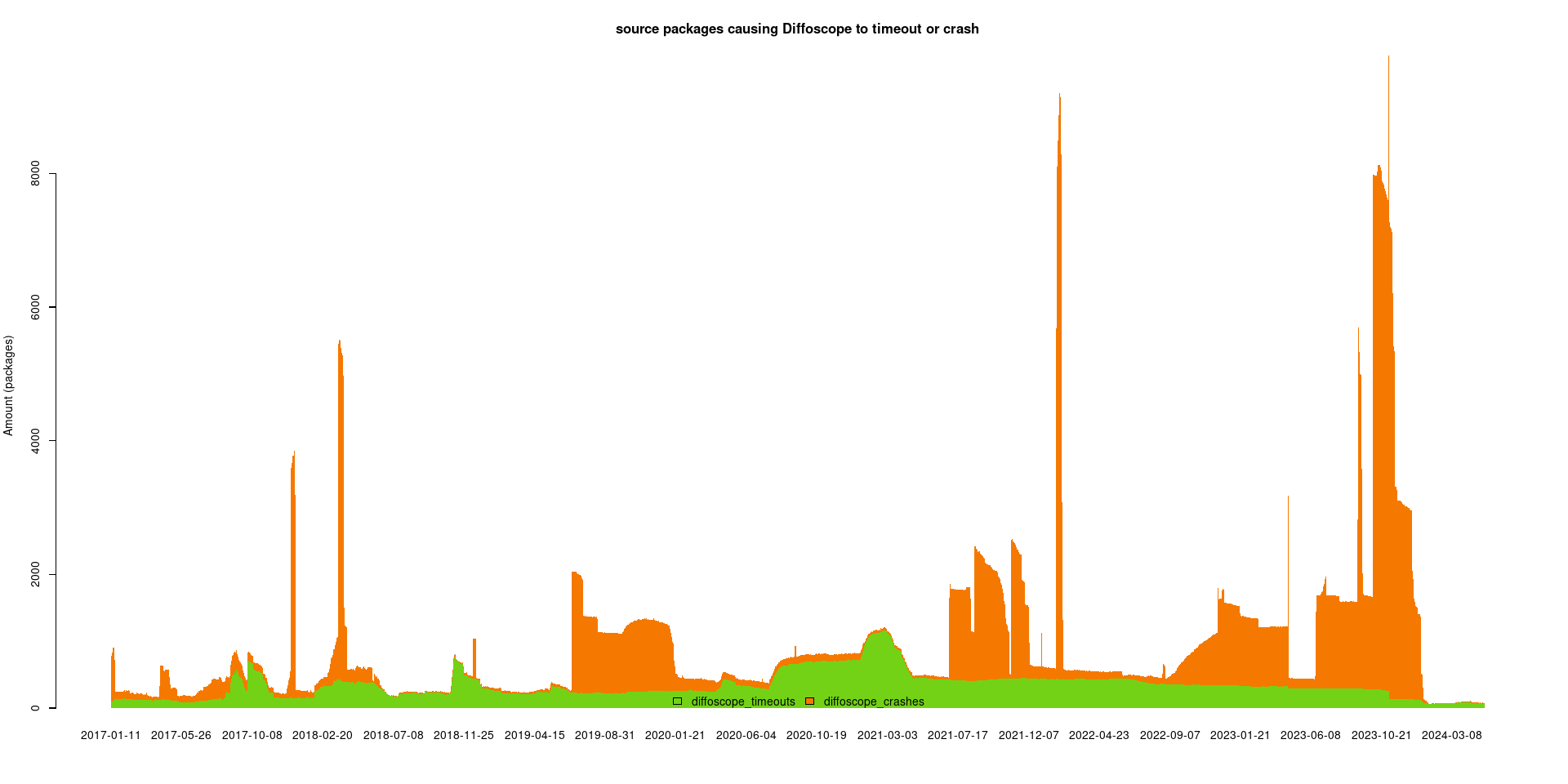
I continued my work on improving diffoscope by fixing bugs and completing wishlist items. These include:
 Many of you are big fans of