Search Results: "sto"

13 January 2013

Neil Williams: Status of klibc on AArch64

With significant assistance from Steve McIntyre and some judicious delving into the ARM Information Centre, I've now got the assembly portions of klibc sorted (but untested) for AArch64 (arm64).

Andy & I started by copying the old ARM support as a new directory and one of the final steps was to remove a whole bunch of legacy code from the days before Thumb and all the #ifdef lines which went with it. Some files disappeared entirely. setjmp.S was the largest amount of work as the load&store multiple support of ARMv7 has gone in ARMv8, so the stmia mnemonic had to be expanded to multiple stp calls but that makes it more explicit, so it's not a bad thing.

Steve & I borrowed from the glibc AArch64 code from upstream by Marcus Shawcroft, simplifying the glibc macros for klibc and also got clues about what extra registers needed handling compared to ARMv7.

I've now got to look at some traditional cross-compilation issues because the Linaro AArch64 toolchain doesn't install to typical Debian cross-building paths and the build now moves past the AArch64-specific assembly and fails later when the C code gets the wrong include path and ends up including /usr/include/i386-linux-gnu/asm/byteorder.h with predictable results.

If someone has an AArch64 toolchain already set up, feel free to clone my modified klibc tree and let me know if there are subsequent build errors. Of course, if you fancy testing a build in the Foundation Model for ARMv8, that would be good too! (Report issues via github.)

Whilst I'm sorting out the toolchain, I've also been updating perl-cross-debian (which has also seen some more upstream testing and improvement).

Russell Coker: Android Multitasking

My new Samsung Galaxy S3 has support for Multi Window Mode , here is a video which shows how to use this, Multi Window Mode starts at about 2:30 [1]. A common complaint about Android is the lack of multitasking, which is partly true and only slightly alleviated by Multi Window Mode. Running Multiple Programs Traditionally Android has multitasked with a similar ability to a Unix shell session, you can have applications running in the background and switch between them but you can t see multiple applications running at the same time (apart from seeing notification messages at the top of the screen). The new Multi Window Mode allows two or more applications to share a screen. But it only applies to a small number of applications which support it, on my phone that is applications shipped by Samsung and Google Chrome. Also I can t have multiple copies of Chrome open at the same time which means I can t do the things that I do on every PC that runs Chromium (the non-Google build of Chrome). I have not yet found a situation where Multi Window Mode has been useful to me, the applications I use for most tasks don t support it. So while Android being based on Linux does multitask really well in the technical computer-science definition it doesn t do so well in the user-centric definition. In practice Android multitasking is mostly about task switching and doing things like checking email in the background. Having multiple programs running at once is particularly difficult due to the Android model of applications sometimes terminating when they aren t visible. A common task is to view a message in a MUA and switch between that and another window (EG a web browser). K9 is my preferred MUA for Android which seems to have no option to switch back and still be viewing the same message as before the task switch so at least three actions need to be taken to get back to the same message after I resume K9. One major feature to make multitasking on Android more usable would be a way of rapidly switching between two applications and being certain that each one would be in the same state when the user switches back to it. Copy and Paste Another problem with Android multitasking is the difficulty in copying and pasting text. While copy/paste is not strictly required for multitasking it is a logical requirement when you have multiple applications running on behalf of a single user. For PCs everyone knows that you select text by holding down the SHIFT key while using the cursor control keys or by holding down the mouse button and swiping the mouse cursor over the text and you then use CTRL-C or the Edit menu to copy text. On Android it s a long press to select text which then gives you markers for the start and end, you drag those markers around and then select that you want to copy the text. This is at best a lot more inconvenient than using a high resolution input device like a mouse to select text. At worst it doesn t seem particularly reliable, K9 Mail for example won t let me copy text from a message for unknown reasons on a desktop OS such problems are vanishingly rare such that I can t think of an example of it happening. IO and Multitasking Multitasking for a user (as opposed to the multitasking needed to host dozens or hundreds of concurrent users) on Unix servers was very limited in the days of VT100 terminals and similar devices. Programs such as GNU Screen [2] allowed a text display to perform windowing functions that are similar to a modern GUI. But generally it seems that the ability for a user to run multiple programs at once is largely limited by their ability to see the output and to rapidly switch between programs or sessions. As a keyboard with ~100 keys and a text display with 80*25 characters is a major limitation it s obviously going to be a comparable (and often greater) limitation to have an on-screen keyboard that takes half the screen space, a single program taking all the screen, and a drop-down status bar that might be useful for multitasking. With Android 4.0 and above you can activate a task switcher by holding down the home button for two seconds [3]. There are also a variety of third party task switching programs on the Google Play store which all seem to start by holding down the home button. One problem with these options is that they require an extended press of the home button where the ideal is something that is as quick as ALT-TAB or a single mouse movement on a desktop system. One possible input action would be to switch between the most recent tasks with a palm swipe on the screen an operation that is quick and easy. Currently a palm swipe is used for a screen capture, but as there are four possible directions for swiping the screen one of them could be used for screen capture and another two for task switching. But this wouldn t do a lot of good without the ability to switch tasks without losing the context that either requires Android application changes or having the OS not tell an application that it was occluded. The iPaQ had interesting capabilities for input, it had a main button on the front that could be pushed in four directions (usually for cursor control) as well as being pushed in, four extra buttons on the front, and a button on the side [4]. I don t recall the methods that Familiar Linux on the iPaQ [5] used for task switching, but it was less of an issue as the iPaQ had less RAM, no Internet access and no telephony functions. I think that adding a bunch of extra buttons to an Android phone would make it a lot more useful. The iPaQ method of cursor control is one that could be considered (it could alleviate the copy/paste problems among other things). As an aside in two years of using Android phones I ve done less serious writing on Android than I did in my first two years of using Familiar on the iPaQ largely due to the lack of keys and a stylus on my Android phones. The screen size on Android phones is also a limit for multitasking. The earlier/cheaper phones that have small screens with resolutions such as 320*480 have very limited ability to display two programs at once. The 720*1280 display in the Galaxy S3 has a lot more potential in this regard and the Galaxy Note 2 and the HTC J Butterfly AKA Droid DNA have even more potential. In the future it seems that screen size limitations on phone multitasking will be a solved problem for everyone who can afford one of the high end phones which incidentally are much cheaper than the iPaQ was 10 years ago. Conclusion Checking email in the background etc is very useful on Android systems. But in terms of the user running two programs at once it seems very limited, and that situation seems likely to remain until the vendors adopt multi-window support. This could be difficult given that Google applied a lot of pressure to CyanogenMod to stop them from doing it [6]. Even when a system with a large display (particularly a tablet) runs a version of Android that supports multi-window mode that still won t entirely solve the problem. No matter how big your display is there are occasions when you need to use it all for a single application while still having the ability to rapidly switch to another application. User interface tweaks to allow rapid task switching without losing application context are necessary. Finally for the past two years that I ve been using Android devices I have been disappointed in the ways that they compare poorly to the iPaQ running Familiar I used 10 years ago. I once wrote a feature article for a magazine on an iPaQ while so far I haven t even written a blog post on an Android device. I think that some of the earlier Android devices might have been better in some ways, the trackball on the HTC Nexus One might have made it more suitable for writing long articles than more recent Android devices.

12 January 2013

Sylvestre Ledru: Some more cool stuff with LLVM/Clang

One of the drawback of C is the hard memory management. It is because of this aspect that Clang provides a way to detect, at runtime, memory errors. Called Address Sanitizer, it allows, while the program is running, to keep track of the memory and detect typical errors (out-of-bound accesses, use of a variable after a free, etc).
# With the following packages (version 3.2-1~exp3)
$ sudo apt-get install clang clang-3.2 compiler-rt -t experimental
Taking the simple following example, even if the errors are obvious, compilers will accept this code.
#include <stdlib.h>
int main()
char *x = (char*)malloc(10 * sizeof(char*));
free(x);
return x[5];
Built and run with:
$ clang -O1 -g -fsanitize=address -fno-omit-frame-pointer foo.c -o foo
$ ./foo &> memoryDebug.log
The previous command will generate a log file. Log which can be post processed with the asan_symbolize command.
$ asan_symbolize memoryDebug.log
which will give:
=================================================================
==21368== ERROR: AddressSanitizer: heap-use-after-free on address 0x7fb22e547f45 at pc 0x408c44 bp 0x7ffff60c10b0 sp 0x7ffff60c10a8
READ of size 1 at 0x7fb22e547f45 thread T0
    #0 0x408c43 in main /tmp/foo.c:5
    #1 0x7fb22d99f6ac in __libc_start_main /home/adconrad/eglibc-2.16/csu/libc-start.c:227
0x7fb22e547f45 is located 5 bytes inside of 80-byte region [0x7fb22e547f40,0x7fb22e547f90)
freed by thread T0 here:
    #0 0x408c90 in __interceptor_free ??:0
    #1 0x408c0a in main /tmp/foo.c:4
    #2 0x7fb22d99f6ac in __libc_start_main /home/adconrad/eglibc-2.16/csu/libc-start.c:227
previously allocated by thread T0 here:
    #0 0x408d50 in __interceptor_malloc ??:0
    #1 0x408bff in main /tmp/foo.c:3
    #2 0x7fb22d99f6ac in __libc_start_main /home/adconrad/eglibc-2.16/csu/libc-start.c:227
Shadow byte and word:
  0x1ff645ca8fe8: fd
  0x1ff645ca8fe8: fd fd fd fd fd fd fd fd
More shadow bytes:
  0x1ff645ca8fc8: fa fa fa fa fa fa fa fa
  0x1ff645ca8fd0: fa fa fa fa fa fa fa fa
  0x1ff645ca8fd8: fa fa fa fa fa fa fa fa
  0x1ff645ca8fe0: fa fa fa fa fa fa fa fa
=>0x1ff645ca8fe8: fd fd fd fd fd fd fd fd
  0x1ff645ca8ff0: fd fd fd fd fd fd fd fd
  0x1ff645ca8ff8: fa fa fa fa fa fa fa fa
  0x1ff645ca9000: fa fa fa fa fa fa fa fa
  0x1ff645ca9008: fa fa fa fa fa fa fa fa
Stats: 0M malloced (0M for red zones) by 1 calls
Stats: 0M realloced by 0 calls
Stats: 0M freed by 1 calls
Stats: 0M really freed by 0 calls
Stats: 0M (128 full pages) mmaped in 1 calls
  mmaps   by size class: 8:2047;
  mallocs by size class: 8:1;
  frees   by size class: 8:1;
  rfrees  by size class:
Stats: malloc large: 0 small slow: 1
==21368== ABORTING
The main advantage compare to valgrind is that asan is supposed to be way more faster. Threads can be also tricking to develop.
With the following example from stolen from upstream:
#include <pthread.h>
int Global;
void *Thread1(void *x)
Global = 42;
return x;
int main()
pthread_t t;
pthread_create(&t, NULL, Thread1, NULL);
Global = 43;
pthread_join(t, NULL);
return Global;
$ clang -fsanitize=thread -g -O1 foo2.c -fPIE -pie -o foo
$ ./foo
==================
WARNING: ThreadSanitizer: data race (pid=21416)
  Write of size 4 at 0x7f2f1a214a50 by thread 1:
    #0 Thread1 /tmp/foo2.c:4 (exe+0x00000000f850)
  Previous write of size 4 at 0x7f2f1a214a50 by main thread:
    #0 main /tmp/foo2.c:10 (exe+0x00000000f8a4)
  Thread 1 (tid=21417, running) created at:
    #0 pthread_create ??:0 (exe+0x00000001267e)
    #1 main /tmp/foo2.c:9 (exe+0x00000000f894)
==================
ThreadSanitizer: reported 1 warnings
Note that clang also provides scan-build, a static analyzer for memory issues. Not as powerful as the Address Sanitizer (it only works on a file), it provides some excellent reports. See the Wouter's blog post on this subject or the automatic report of scan-build on Scilab.

Russ Allbery: Review: Asimov's, April/May 2011

Review: Asimov's Science Fiction, April/May 2011
Editor: Sheila Williams
Issue: Volume 35, No. 4 & 5
ISSN: 1065-2698
Pages: 192
Williams's editorial this issue is about the tendency of SF to take a rose-colored view of the world, which on the surface seems odd given the tendency of recent SF towards dystopia. But she makes a good point that the portrayal of the past is rose-colored, linking that into the current steampunk trend. She doesn't take the argument quite as far as I'd like, but I'm glad to see editorials raising points like this. I'm inclined to think that a lot of the rose-colored frame of the past is because few of us want to read about real historic conditions at any length, even for edification, because the stench and discomfort isn't fun to read about. Silverberg's column is another discussion of programmatic plot generators, which mostly makes the point that plot ideas are the easy part of writing. James Gunn contributes an extended biography of Isaac Asimov that probably won't be new to long-time genre readers but may fill in some details (although it politely sticks to mostly flattering material). Spinrad's book review column is one of his better ones; it looks at two novels by China Mi ville and two by Ian McDonald and explores differences in world-building. Spinrad predictably makes the case in favor of science fiction with rules and against the New Weird, but the discussion along the way was worth reading. "The Day the Wires Came Down" by Alexander Jablokov: Speaking of steampunk, here's an example. There is even an airship, although the primary technological focus is suspended street cars. Jablokov postulates a city-wide transportation network of suspended carriages called telpher cars, along with a city built around the telpher cables: stores on roofs, windows displaying merchandise to passing cars, and even a history of heated competition and dirty tricks between competing telpher networks. The story is set, as the title would indicate, on the last day of the network. It's being shut down for cost, with some hints that progress is destroying something precious. There is a plot here, revolving around some mysteries of the history of the telpher network and the roles of several people in that history. But the story is primarily a celebration of old technology. It's a rail fan's story recast with a steampunk technology, featuring the same mix of fascination with mechanics and a sense that the intricate details are falling out of common knowledge (and perhaps usefulness). As a story, it's a bit slow-moving, but I enjoyed the elegiac tone. (7) "An Empty House with Many Doors" by Michael Swanwick: This is a very short story, more of an emotional profile, involving a man's reaction to the death of his wife. Oh, and parallel universes. It's sort of the inverse of Niven's classic "All the Myriad Ways." Similar to Niven's story, I found the idea vaguely interesting but the conclusion and emotional reaction unbelievable and alien. (5) "The Homecoming" by Mike Resnick: Resnick tends to yank on the heart-strings rather sharply in his stories, so I knew roughly what to expect when a father comes home to find his son is visiting. A son who, rather against his father's wishes, has been significantly altered to be able to live with aliens. Throw in a mother with serious dementia, and you can probably predict what Resnick does with this. Still, most of the story is a two-sided conversation, and I thought he succeeded in doing justice to both sides, even though one of them was destined to lose. (6) "North Shore Friday" by Nick Mamatas: Illegal Greek immigrants, a family-run system for getting them married off before the INS catch them, government psi probes and eavesdropping on thoughts, joint projects between computer and religion departments, secret government experiments, and even ghosts... this story is a complex mess, with numerous thoughts stuck into small boxes and scattered through the surface story. It's one of those stories where figuring out what's going on, and even how to read the story in a sensible way, is much of the fun. If you find that fun, that is; if not, it will probably be frustrating. I wished there was a bit more plot, but there's something delightful about how much stuff Mamatas packs into it. (6) "Clockworks" by William Preston: This is a prequel to Preston's earlier "Helping Them Take the Old Man Down". Like that story, it's primarily a pulp adventure, but layered with another level of analysis and thoughtfulness that tries to embed the pulp adventure in our understanding of human behavior and the nature of the world, although this one stays a bit more pulp than its predecessor. As with Preston's other story, we don't get directly in the head of the Old Man (here, just called the man, but identifiable from clues in both stories as Doc Savage); instead, the protagonist is a former villain named Simon Lukic who the man hopes to have fixed by operating on his brain. The undercurrent that lies beneath a more typical pulp adventure is the question of whether Lukic is actually healed. I think there was a bit too much daring-do and human perfection, but it's a perfectly servicable pulp story with some depth. (6) "The Fnoor Hen" by Rudy Rucker: If you've read any of Rucker's work before, you probably know what to expect: a mind-boggling blizzard of mathematically-inspired technobabble that turns into vaguely coherent surrealism. (You can probably tell that I'm not much of a fan, although the clear good humor in these stories makes it hard to dislike them too much.) There's a mutated chicken and some sort of alternate mathematical space and then something that seems like magic... I'd be lying if I said that I followed this story. If you like Rucker, this seems like the sort of thing that you'd like. (4) "Smoke City" by Christopher Barzak: At the start of this story, I thought it was going to be an emotional parable about immigration. The progatonist lives two lives: one in our world, and one in the Smoke City of industry, a world of hard labor, pollution, and little reward, with families in both. But nearly all of the story is set within Smoke City, and the parable turns out to be a caustic indictment of industry and its exploitation of labor. I kind of wish Barzak hadn't used rape as a metaphor, but when the captains of industry show up, I can't argue with how deeply and accurately the story shoves in the knife. There isn't much subtlety here, but it's still one of the better stories in this issue. (7) "A Response from EST17" by Tom Purdom: I'm very happy to see Purdom's writing appearing regularly. His stories are always quiet and matter-of-fact, and at first seem to miss emotional zest, but they almost always grow on me. He lets the reader fill in their own emotional reactions to events, and there's always a lot going on. This story is a first-contact story, except that the "humans" here are not human at all. They're automated probes sent by two separate human civilizations, with different programming and different governance algorithms, and they quickly start competing negotiations. The aliens they've discovered similarly have factions, who start talking to the different probes in an elaborate dance of gathering information without giving too much away. The twist is that this pattern has replayed itself many times in the past, and information itself can be a weapon. I enjoyed this one from start to finish. (7) "The One That Got Away" by Esther M. Friesner: Friesner is best known, at least to me, for humorous fantasy, and this story is advertised as such from early on. The first-person protagonist is a prostitute in a seaside town. She's bemused to finally be invited over by a sailor who's been eyeing her all evening, but that sailor has something else in mind than normal business. For much of this story, the fantasy element is unclear; when it finally comes, it was an amusing twist. (7) "The Flow and Dream" by Jack Skillingstead: This is a mildly interesting variation on the old SF story of hibernating humans (on a generation ship or elsewhere) waking up to a transformed world. Here, it's not a ship, it's a planet, and the hiberation was to wait for terraforming rather than for transit. The twist comes from an excessively literal computer and the fun of putting together the pieces. Sadly, the story trails off at the end without much new to say. (5) "Becalmed" by Kristine Kathryn Rusch: "Becalmed" takes place immediately before "Becoming One with the Ghosts" and explains the incident that created the situation explored in that story. The first-person protagonist of "Becalmed" is a linguist, an expert in learning alien languages so that the Fleet can understand the civilizations that it runs across. But something went horribly wrong at their last stop, something that she's largely suppressed, and now she's confined to quarters and possibly in deep trouble. As is the ship; they're in foldspace, and they have been for days. "Becalmed" is structed like a mystery, centered around recovering the protagonist's memories. It's also a bit of a legal procedural; the ship is trying to determine what to do with her and to what degree she's responsible. But the heart of the story is a linguistic and cultural puzzle. This is another great SF story from Rusch, whose name on a cover will make me eager to start reading a new magazine. I love both angles on the universe she's built, but I think I like the Fleet even better than the divers. The Fleet captures some of the magic of the original Star Trek, but with much more mature characters, more believable situations, and a more sensible and nuanced version of the Prime Directive. Rusch writes substantial, interesting plots that hold my interest. I'd love to see more like this. (8) Rating: 7 out of 10

11 January 2013

Patrick Matth i: What an ugly (PHP) work..

We still have got some more or less webapplications which are not compatible with PHP higher than version 5.2.x, which is the only blocker for the last Lenny servers to upgrade them to Squeeze.. I do not think that I am alone with this ****** topic :) So the new masterplan is to deploy those applications on seperated Wheezy servers, with PHP 5.2.x running as FastCGI, so that most parts of the system are security supported . First; I didn t documented my steps and I am not 100% done (something like 99%) but I have done the following to have it as clean as possible : PHP 5.2.x is just not able to detect the new multiarch paths, it fails at most dir options. Since patching the whole build system would be *too* much work I decided to hack around this (ln -s /usr/lib/x86 ./foo.so /usr/lib/), then some adjustions to the build dependencies, disablieng some modules, like SSL and libdb (incompatible versions), disabling merged patches and refresh the suhosin hardening patch; I get an working PHP 5.2.17 package on Wheezy.
But this is too easy!
I want packages which I could co-install with the PHP 5.4 packages from Wheezy, 5.2 should only used withing vHosts where I have enabled them.. So I rewrote the whole packaging (*burg* IMHO at all) to use php52 instead of php5 as packaging namespace and also everything is put into /opt as prefix. Much painfull work, but yeah it works.. :)
Some packages, like php52-dev or php-pear are broken, but those were not my goal of this action. If someone is interested in those packages please send me an email.
Since PHP 5.2 is not supported any longer (and that this is at all a big hack) I will not publish the source and binaries at all.

Julien Danjou: Overriding cl-json object encoding

CL-JSON provides an encoder for Lisp data structures and objects to JSON format. Unfortunately, in some case, its default encoding mechanism for CLOS objects isn't exactly doing the right thing. I'll show you how Common Lisp makes it easy to change that. Identifying the problem CL-JSON & CLOS CL-JSON mechanism encoding CLOS object is really neat. Let's see how it works for a simple case:
(defclass kitten ()
((tail :initarg :tail)))

(json:encode-json-to-string (make-instance 'kitten :tail 'black))

will produce:
 "tail":"black" 

Still using CL-JSON, we can also decode the JSON object to a CLOS object:
(slot-value
(json:with-decoder-simple-clos-semantics
(json:decode-json-from-string " \"tail\":\"black\" "))
:tail)

That code will return "black". Note that it's also possible to specify which class should be used when decoding objects, but that's beyond the purpose of this article. Postmodern Now, let's introduce Postmodern, a wonderful Common Lisp system providing access to the wonderful PostgreSQL database. It also provides a simple system to map rows in a database to CLOS classes, called DAO for Database access objects. With this, we can easily store our kitten into a table.
(defclass kitten ()
((tail :initarg :tail))
(:metaclass postmodern:dao-class))

If we try to encode this to JSON, it will produce the exact same result seen previously. The problem is what happens when one of our column has a NULL value. Postmodern encodes this using the :null symbol. So this code:
(defclass kitten ()
((tail :initarg :tail :col-type (or s-sql:db-null text)))
(:metaclass postmodern:dao-class))

(postmodern:deftable kitten
(postmodern:!dao-def))

(postmodern:connect-toplevel )

(postmodern:create-table 'kitten)

(json:encode-json-to-string
(postmodern:make-dao 'kitten))

will return:
" "tail":"null" "

Fail! The fact that the column is NULL is represented by the :null symbol. And CL-JSON encodes all symbols as string. This is not at all what we want here! Overriding encode-json CL-JSON provides and uses the encode-json method to encode all kind of object. It is defined as a generic function, and a lot of different methods are implemented to handle the different standard Common Lisp types. The one used for standard-object is defined liked that:
(defmethod encode-json ((o standard-object)
&optional (stream *json-output*))
"Write the JSON representation (Object) of the CLOS object O to
STREAM (or to *JSON-OUTPUT*)."
(with-object (stream)
(map-slots (stream-object-member-encoder stream) o)))

All we need to do here, is to create a new method for our kitten objects, that handles correctly the :null case.
(defclass kitten ()
((tail :initarg :tail :col-type (or s-sql:db-null text)))
(:metaclass postmodern:dao-class))

(export 'kitten)

;; Switch package just to define the new method
(in-package :json)
(defmethod encode-json ((o cl-user:kitten)
&optional (stream json:*json-output*))
"Write the JSON representation (Object) of the postmodern DAO CLOS object
O to STREAM (or to *JSON-OUTPUT*)."
(with-object (stream)
(map-slots (lambda (key value)
(as-object-member (key stream)
(encode-json (if (eq value :null) nil value) stream)))
o)))

;; Go back into our package
(in-package :cl-user)

(postmodern:deftable kitten
(postmodern:!dao-def))

(postmodern:connect-toplevel )

(postmodern:create-table 'kitten)

(json:encode-json-to-string
(postmodern:make-dao 'kitten))

With that new method, as soon as we encounter a :null symbol as a value for an object's slot, we replace it by nil. Now if we try to encode another kitten, we'll get:
 "tail":null 

which is far better for our JavaScript data consumers! In the end, I think that this kind of trick is feasible that easily because of the way CLOS provides its generic method implementation. The fact that methods don't belong to any class makes the extension of every program, library and class so much easier. Doing this in another language like Java would likely by impossible, and in Python it would unlikely be as clean as it is done in Common Lisp. The ability to teach any library about how it should handle your class just by defining a new method is really handy!

Julian Andres Klode: Recursive-descent in Python, using generators

Writing recursive descent parsers is easy, especially in Python (just like everything is easy in Python). But Python defines a low limit on the number of recursive calls that can be made, and recursive descent parsers are prone to exceed this limit. We should thus write our parser without real recursion. Fortunately, Python offers us a way out: Coroutines, introduced in Python 2.5 as per PEP 342. Using coroutines and a simple trampoline function, we can convert every mutually recursive set of functions into a set of coroutines that require constant stack space. Let s say our parser looks like this (tokens being an iterator over characters):
def parse(tokens):
    token = next(tokens)
    if token.isalnum():
        return token
    elif token == '(':
         result = parse(tokens)
         if next(tokens) != ')': raise ...
         return result
    else:
         raise ...
We now apply the following transformations:
return X => yield (X)
parse() => (yield parse()) That is, we yield the value we want to return, and we yield a generator whenever we want to call (using a yield expression). Our rewritten parser reads:
def parse(tokens):
    token = next(tokens)
    if token.isalnum():
        yield token
    elif token == '(':
         result = yield parse(tokens)
         if next(tokens) != ')': raise ...
         return result
    else:
         raise ...
We obviously cannot call that generator like the previous function. What we need to introduce is a trampoline. A trampoline is a function that manages that yielded generators, calls them, and passes their result upwards. It looks like this:
def trampoline(generator):
    """Execute the generator using trampolining. """
    queue = collections.deque()
    def schedule(coroutine, stack=(), value=None):
        def resume():
            if 0:
                global prev
                now = stack_len(stack)
                if now < prev:
                    print("Length", now)
                    prev = -1
                elif prev != -1:
                    prev = now
            result = coroutine.send(value)
            if isinstance(result, types.GeneratorType):     # Normal call
                schedule(result, (coroutine, stack))
            elif isinstance(result, Tail):                  # Tail call (if you want to)
                schedule(result.value, stack)
            elif stack:                                     # Return to parent
                schedule(stack[0], stack[1], result)
            else:                                           # Final Return
                return result
        queue.append(resume)
    schedule(generator)
    result = None
    while queue:
        func = queue.popleft()
        result = func()
    return result
This function is based on the code in PEP 342, the difference being that For a more generic version of that, you might want to re-add exception passing, but the exceptions will then have long tracebacks, so I m not sure how well they will work if you have deep recursion. Now, the advantage of that is that our parser now requires constant stack space, because the actual real stack is stored in the heap using tuples which are used like singly-linked lists in scheme here. So, the only recursion limit is available memory. A disadvantage of that transformation is that the code will run slightly slower for small inputs that could be handled using a normally recursive parser.
Filed under: Python

9 January 2013

Vincent Fourmond: Lots of hard drive accesses with MacOS

Sorry, a post about MacOS again, but this is a problem my boss has been faced with, and judging by what google searches gave us as clues to go on, I thought it would be useful for others to know about this.So here it is: for a couple of weeks, my boss's Mac had been slowing down very painfully, to the point that he was just sitting in front of it waiting for web pages to show up or applications to start... We tried a whole bunch of things, such as disabling spotlight, dropbox, and even the time machine, but nothing worked. Finally, he had a look at Disk Utility that said that the disk was gone beyond repair. Fortunately, a new colleague suggested to restore from the Time Machine, holding Command-R during startup. It took ages (over a slow network), but now the machine is up again, without any slowing down.

Petter Reinholdtsen: Lets make hardware dongles easier to use in Debian

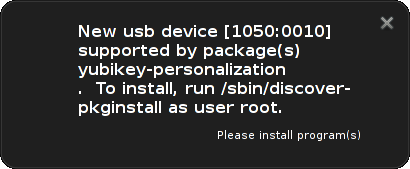
One thing that annoys me with Debian and Linux distributions in general, is that there is a great package management system with the ability to automatically install software packages by downloading them from the distribution mirrors, but no way to get it to automatically install the packages I need to use the hardware I plug into my machine. Even if the package to use it is easily available from the Linux distribution. When I plug in a LEGO Mindstorms NXT, it could suggest to automatically install the python-nxt, nbc and t2n packages I need to talk to it. When I plug in a Yubikey, it could propose the yubikey-personalization package. The information required to do this is available, but no-one have pulled all the pieces together. Some years ago, I proposed to use the discover subsystem to implement this. The idea is fairly simple: I am not sure what the best way to implement this is, but my initial idea was to use dbus events to discover new hardware, the discover database to find packages and PackageKit to install packages. Yesterday, I found time to try to implement this idea, and the draft package is now checked into the Debian Edu subversion repository. In the process, I updated the discover-data package to map the USB ids of LEGO Mindstorms and Yubikey devices to the relevant packages in Debian, and uploaded a new version 2.2013.01.09 to unstable. I also discovered that the current discover package in Debian no longer discovered any USB devices, because /proc/bus/usb/devices is no longer present. I ported it to use libusb as a fall back option to get it working. The fixed package version 2.1.2-6 is now in experimental (didn't upload it to unstable because of the freeze). With this prototype in place, I can insert my Yubikey, and get this desktop notification to show up (only once, the first time it is inserted):

For this prototype to be really useful, some way to automatically install the proposed packages by pressing the "Please install program(s)" button should to be implemented. If this idea seem useful to you, and you want to help make it happen, please help me update the discover-data database with mappings from hardware to Debian packages. Check if 'discover-pkginstall -l' list the package you would like to have installed when a given hardware device is inserted into your computer, and report bugs using reportbug if it isn't. Or, if you know of a better way to provide such mapping, please let me know. This prototype need more work, and there are several questions that should be considered before it is ready for production use. Is dbus the correct way to detect new hardware? At the moment I look for HAL dbus events on the system bus, because that is the events I could see on my Debian Squeeze KDE desktop. Are there better events to use? How should the user be notified? Is the desktop notification mechanism the best option, or should the background daemon raise a popup instead? How should packages be installed? When should they not be installed? If you want to help getting such feature implemented in Debian, please send me an email. :)

Russ Allbery: postfaq 1.17

I promise that the software releases will decrease in velocity soon! Work is starting up again and will involve longer projects, so I won't be able to keep releasing something daily. I'm still finishing up some fallout from my personal revision control migrations. postfaq is my script for posting Usenet FAQs, inspired by the venerable auto-faq. This release adds support for generating the Last-Modified subheader from the modification timestamp of the FAQ file. Previously, information for that subheader was only taken from an embedded RCS/CVS Id string. It also adds a new -d command-line option that changes the default directory for storing status files. You can get the latest version from the postfaq distribution page.

Daniel Kahn Gillmor: universally accessible storage for the wary user

A friend wrote me a simple question today. My response turned out to be longer than i expected, but i hope it's useful (and maybe other people will have better suggestions) so i thought i'd share it here too: Angela Starita wrote:
I'd like to save my work in a location where I can access it from any computer. I'm wary of using the mechanisms provided by Google and Apple. Can you suggest another service?
Here's my reply: I think you're right to be wary of the big cloud providers, who have a tendency to inspect your data to profile you, to participate in arbitrary surveillance regimes, and to try to sell your eyeballs to advertisers. Caveat: You have to trust the client machine too But it's also worth remembering that the network service provider is not the only source of risk. If you really mean "accessing your data from any computer", that means the computer you're using to access the data can do whatever it wants with it. That is, you need to trust both the operator of these "cloud" services, *and* the administrator/operating system of the client computer you're using to access your data. For example, if you log into any "secure" account from a terminal in a web caf , that leaves you vulnerable to the admins of the web caf (and, in the rather-common case of sloppily-administered web terminals, vulnerable to the previous user(s) of the terminal as well). Option 0: Portable physical storage One way to have your data so that you can access it from "any computer" is to not rely on the network at all, but rather to carry a high-capacity MicroSD card (and USB adapter) around with you (you'll probably want to format the card with a widely-understood filesystem like FAT32 instead of NTFS or HFS+ or ext4, which are only understood by some of the major operating systems, but not all). Here is some example hardware: Almost every computer these days has either a microSD slot or a USB port, while some computers are not connected to the network. This also means that you don't have to rely on someone else to manage servers that keep your data available all the time. Note that going the microSD route doesn't remove the caveat about needing to trust the client workstation you're using, and it has another consideration: You'd be responsible for your own backup in the case of hardware failure. You're responsible for your own backup in the case of online storage too, of course -- but the better online companies are probably better equipped than most of us to deal with hardware failure. OTOH, they're also susceptible to some data loss scenarios that we aren't as individual humans (e.g. the company might go bankrupt, or get bought by a competitor who wants to terminate the service, or have a malicious employee who decides to take revenge). Backup of a MicroSD card isn't particularly hard, though: just get a USB stick that's the same size, and regularly duplicate the contents of the MicroSD card to the USB stick. One last consideration is storage size -- MicroSD cards are currently limited to 32GB or 64GB. If you have significantly more data than that, this approach might not be possible, or you might need to switch to a USB hard disk, which would limit your ability to use the data on computers that don't have a USB port (such as some smartphones). Option 1: Proprietary service providers If you don't think this portable physical storage option is the right choice for you, here are a couple proprietary service providers who offer some flavor of "cloud" storage while claiming to not look at the contents of your data: I'm not particularly happy with either of those, though, in part because the local client software they want you to run is proprietary, so there's no way to verify that they are actually unable to access the contents of your data. But i'd be a lot happier with either wuala or spideroak than i would be with google drive, dropbox, or iCloud. Option 2: What i really want I'm much more excited about the network-accessible, free-software, privacy-sensitive network-based storage tool known as git-annex assistant. The project is spearheaded by Joey Hess, who is one of the most skilled and thoughtful software developers i know of. "assistant" (and git-annex, from which it derives) has the advantage of being pretty agnostic about the backend service (many plugins for many different cloud providers) and allows you to encrypt your data locally before sending it to the remote provider. This also means you can put your encrypted data in more than one provider, so that if one of the providers fails for some reason, you can be relatively sure that you have another copy available. But "assistant" won't be ready for Windows or Android for several months (builds are available for Linux and Mac OS X now), so i don't know if it meets the criterion for "accessible from any computer". And, of course, even with the encryption capabilities, the old caveat about needing to trust the local client machine still applies.

8 January 2013

Russell Coker: The Death of the Netbook

The Age has an interesting article about how Apple supposedly killed the Netbook [1]. It s one of many articles with a similar spin on the news that the last two companies making Netbooks are going to cease production. The main point of these articles is that Apple decided that Netbooks were crap and killed the market for them by producing tablets and light laptops that squeeze them out of the market. Is the Macbook Air a Netbook? According to the Wikipedia page the Macbook Air [2] weighs 1080g for the 11 version and 1340g for the 13 version. According to Wikipedia the EeePC 701 (the first EeePC) weighs 922g and the last EeePC weighs 1460g [3]. The last EeePC produced is heavier than ANY Macbook Air while the first (and lightest) EeePC is only 158g lighter than the 11 Macbook Air. The 11 Macbook Air is 300*192*17mm (979cm^3) in size while the EeePC 701 is 225*165*35mm (1299cm^3) and the biggest EeePC was 266*191*38mm (1931cm^3). So the 11 Macbook Air is 13% wider than the widest EeePC but takes less volume than any EeePC. The 13 Macbook Air is 325*227*17mm (1254cm^3) which is still less volume than any EeePC. The Wikipedia page about Netbooks defines them as being small, lightweight, legacy-free (in terms of hardware not software) and cheap [4]. The Macbook Air clearly meets all the criteria apart from price. The Apple US web site offers the version of the 11 Macbook Air with 64G of storage for $999 with free shipping, for comparison the EeePC 701 was on sale in stores for $500 in 2008. The CPI adjusted price for the EeePC 701 would be at least $550 in today s money. The Macbook is a bit less than twice as expensive as the EeePC was, but that s more of an issue of Apple being expensive a few years ago companies like HP were also selling Netbooks that were more expensive than the EeePC. Unless having an awful keyboard is a criteria for being a Netbook I think that the Macbook Air meets the criteria. As an aside, a relative recently asked me for advice on a device that is like a Macbook Air but cheaper. Does anyone know of a good option? Is Netbook Production Ceasing? Officeworks currently sells an ASUS Notebook that has a 11.6 display and weighs 1.3kg for $398, it s got a metal body that looks a bit like a Macbook Air (which is the latest fashion and is good for heat dissipation). That s not advertised as a Netbook or a Eee product but it s cheap, lighter than the heaviest EeePC, and not much bigger than an EeePC. It seems that the general prices of laptops other than Apple products (which have always had higher prices) have been dropping a lot recently. There are lots of good options if you want a laptop that costs $500 or less. Even Thinkpads (one of the most expensive and best designed ranges of laptops) are well below $1000. Do the Articles about Netbooks Make Sense? The claims being made are that Apple skipped Netbooks because they couldn t make a good profit. This disregards the fact that the iPhone and iPad (which are very profitable) are in the high end of the price range that was occupied by Netbooks. While Apple does make a good deal of money from the iPhone App Market it would be possible to make a Netbook with a lower production price than an iPhone because making things smaller requires more engineering work and often more expensive parts. This also disregards the fact that there are a range devices which work as an iPad case with keyboard, an iPad with such a keyboard meets most criteria for being a Netbook, so Apple is one iPad keyboard device away from selling Netbooks. It s interesting to note that I haven t yet seen an article about the profits from Netbooks which didn t make an issue of the MS-Windows license fees. The first Netbooks only ran Linux but later on they switched to Windows, that had to make a big impact on profits. An article about Netbooks which just assumes that everyone has to pay a MS license fee is missing too much of the Netbook history to be useful. I wonder if anyone could make products that are as profitable as the iPhone and Macbook Air if they had to pay for MS license fees and design their hardware to work with MS software (as opposed to Apple who can change their software to allow a cheaper hardware design). The articles also claim that Netbooks give a bad user experience. When I bought my EeePC 701 it was the fastest system I owned for loading OpenOffice, SSD random read speeds were really good (writes sucked but that didn t matter so much). The keyboard on an EeePC 701 is not nearly as good as a full size laptop but it is also a lot better than using a tablet, I ve used both a 10 Android tablet and an EeePC as a ssh client and there is no comparison. When I m going somewhere that requires random sysadmin work (or other serious typing) and I can t carry much weight then I still take my EeePC 701 and I don t consider taking a tablet. The low resolution of the screen is a major issue, but it s about the same as a Macbook Air so that s not an advantage for Apple. I knew some people who used an EeePC 701 for the majority of their work, I couldn t do that but obviously some people have different requirements. I now use my phone for many tasks that I used to do on my EeePC (even light sysadmin work) so my EeePC sometimes goes unused for months. But it s still an important part of my collection of computers. It works well for what it does and I don t feel any need to buy a replacement. When it wears out I ll probably buy something similar to an 11 Macbook Air to replace it unless there s a good option of a tablet with a detachable keyboard. My plans for computer ownership for the near future are based on a reasonably large Android phone (currently a Samsung Galaxy S3 but maybe a Galaxy Note 2 or similar next year), a small laptop or large tablet with hardware keyboard (currently an EeePC 701), a large laptop (currently a Thinkpad T61), and a workstation (currently a NEC system with an Intel E4600 CPU and a Dell U2711 27 monitor). A reasonably small and light system with a hardware keyboard and solid state storage is an important part of my computer needs. If tablet computers with hardware keyboards replace traditional Netbooks that s not really killing Netbooks but introducing a new version of the same thing. But a good way of getting web hits on an article is to claim that a once popular product is dead.

7 January 2013

Rapha&#235;l Hertzog: My Free Software Activities in December 2012

This is my monthly summary of my free software related activities. If you re among the people who made a donation to support my work (836.78 , thanks everybody!), then you can learn how I spent your money. Otherwise it s just an interesting status update on my various projects. Debian Packaging I uploaded Zim 0.58, WordPress 3.5 (and I had to file a ticket about the availability of sources of minified javascript files again) and another security update for python-django (696535). Speaking of python-django, I forwarded one bug report of Anders Kaseorg concerning Django s bash completion (#695811). I also sponsored the upload of ledgersmb 1.3.25-1. Other Debian work I contributed some patches to improve debian-installer support in live-build. I also added a work-around for bug #652946 in live-installer and committed a fix for this same bug in a jessie branch of partman-target. I also prepared a bugfix for a counter-productive behavior of choose-mirror (#695261, it was not possible to override the codename of the release to install via preseed if you install from a CD with a full base system). I discovered an oddity in the Packages.diff/Index file for the architectures armhf and s390x, I reported it to ftpmasters in #696792. (All those issues were discovered while working for a customer) Debian France I spent quite some time on Debian France this month again. I started by setting up an internal gitolite to manage our accounting/administrative documents. Then I updated galette, the web application that we are using to manage our database of members. In the process, I filed two bugs that we discovered. I immediately tested Galette by registering 4 members that joined during the former mini-Debconf in Paris. We have plans to automate the membership renewal process so we have opened a Paypal account. This month we also cleared the last steps so that I and Sylvestre Ledru have full control on the Debian France bank account. I also registered the new officers at the Tribunal d instance de Sarreguemines . Salt bug reports During the last mini-debconf, I discovered Salt (thanks to Julien Cristau!) and since I had to switch some servers of mine, I took this opportunity to upgrade to wheezy and try out salt at the same time. It took much more time than expected but the result is pleasant. The configuration of all my servers is now well documented/specified in a central Git repository, and moving services is much easier than before. In the process, I filed quite some bugs (#2865, #2851, #2866 and #2875), most of them have been fixed in the 0.11.1 release that just happened. Thanks I wish you a happy new year and all the best for 2013! See you next month for a new summary of my activities.

4 comments Liked this article? Click here. My blog is Flattr-enabled.

Russ Allbery: faq2html 1.31 and VCS migrations

faq2html is my version of that script that so many different people have written: a tool to convert text files into HTML for the web. This script is specifically tuned to the way that I format text files and has a lot of special logic to deal with my eccentricities, so I have no idea how well it would work for anyone else. This release adds a new -l option, which says to add a subheading to the HTML output giving the last modified date based on the file modification timestamp. Previously, these subheadings were only added in some situations and based on RCS/CVS-style Id keywords in the file. Since I'm converting my personal repositories to Git, that was going to stop working. You can get the current version of faq2html from my web tools distribution page. With this update, I was able to convert my FAQs repository from Subversion to Git, which means that I only have one personal repository left in Subversion (PGP::Sign, which I will probably convert to Git shortly). That leaves a few CVS repositories, and therein lies a problem. There are a few places where I'm still using CVS for a conventional package or for some random files, and those can move to Git without much trouble whenever I get around to it. But most of my remaining use of CVS is for storing individual scripts that, if I distribute them at all, I distribute individually. And, for that, CVS seems to have a lot of advantages that are hard to implement with Git: I'm not at all sure what I'm going to do about this. Some of my scripts currently maintained in CVS, such as all the AFS tools, should move into larger packages that are more conventionally distributed, with a separate README file and similar machinery, and I'm slowly in the process of doing that. But many of my scripts are small programs that don't fit into any larger whole and don't warrant that sort of treatment. Honestly, I'm moderately tempted to just keep using CVS for scripts, since everything newer goes to repository-wide instead of per-file version numbers (for exceptionally good reasons when working on a unified piece of software, rather than a conglomeration of individual scripts), and I'm unenthused about writing my own machinery using Git hooks and smart Git log and diff parsing. But the CVS command-line interface is awful and the CVS repository format is even worse. If there are any brilliant ideas that I'm missing, I'd be interested in hearing about them in email (or other blog posts on Planet Debian or somewhere else I read). If I come up with some solution or get any great advice, I'll post a follow-up.

6 January 2013

Neil Williams: bootstrapping arm64

I'm still working on perl-cross-debian (just uploaded 0.0.2) and there's more to do on that with upstream but part of the reason to work on perl cross-building is to do what I can to help with the ARM64 port.

So, I went back to Wookey's talk at DebConf12 which leads to the current list of cross-build results for arm64 and started through the list.

coreutils is listed as failing but that was an archive error (MD5sum hash mismatch), so that just needs a retry. I don't have access to that buildd, yet, so nothing I can do there.

Next on the list (excluding those just waiting for build-deps) was klibc.

aarch64-linux-gnu-gcc -Wp,-MD,usr/klibc/.__static_init.o.d -nostdinc -iwithprefix
include -I/ PKGBUILDDIR /usr/include/arch/x86_64 -Iusr/include/arch/x86_64
-I/ PKGBUILDDIR /usr/include/bits64
-Iusr/include/bits64 -I/ PKGBUILDDIR /usr/klibc/../include
-Iusr/klibc/../include -I/ PKGBUILDDIR /usr/include -Iusr/include
-I/ PKGBUILDDIR /linux/include -Ilinux/include
-I/ PKGBUILDDIR /linux/arch/x86/include -Ilinux/arch/x86/include
-D__KLIBC__=2 -D__KLIBC_MINOR__=0 -D_BITSIZE=64 -fno-stack-protector -fwrapv -m64 -Os
-fno-asynchronous-unwind-tables -fomit-frame-pointer -falign-functions=1 -falign-jumps=1 -falign-loops=1
-W -Wall -Wno-sign-compare -Wno-unused-parameter -c -o usr/klibc/__static_init.o usr/klibc/__static_init.c
aarch64-linux-gnu-gcc: error: unrecognized command line option '-m64'
make[4]: *** [usr/klibc/__static_init.o] Error 1


Turns out that this is a build failure I understood, at least initially. A little digging and a trivial patch was begun:

--- a/usr/klibc/arch/arm/MCONFIG
+++ b/usr/klibc/arch/arm/MCONFIG
@@ -30,6 +30,13 @@
ifeq ($(CONFIG_AEABI),y)
KLIBCREQFLAGS += -mabi=aapcs-linux -mno-thumb-interwork
else
+# aarch64
+ifeq ($(CONFIG_AARCH64),y)
+KLIBCREQFLAGS +=
+KLIBCOPTFLAGS += -mgeneral-regs-only
+else
KLIBCREQFLAGS += -mabi=apcs-gnu -mno-thumb-interwork
endif
endif
+endif
+

Alongside a trivial change to debian/rules

ifeq ($(DEB_HOST_ARCH),arm64)
DEB_MAKE_ENVVARS := ARCH=arm CONFIG_AARCH64=y CPU_ARCH=armv8-a CPU_TUNE=generic
endif

OK, then things get a bit more awkward,

....
code/debian/cross/klibc/klibc-2.0.1/linux/arch/arm/include -Ilinux/arch/arm/include -D__KLIBC__=2
-D__KLIBC_MINOR__=0 -D_BITSIZE=32 -fno-stack-protector -fwrapv -fno-exceptions -Os
-march=armv8-a -mtune=generic -mgeneral-regs-only -W -Wall -Wno-sign-compare -Wno-unused-parameter
-c -o ../foo.o usr/klibc/arch/arm/crt0.S
usr/klibc/arch/arm/crt0.S: Assembler messages:
usr/klibc/arch/arm/crt0.S:19: Error: operand 1 should be an integer register -- mov r0,sp'
usr/klibc/arch/arm/crt0.S:20: Error: operand 1 should be an integer register -- mov r1,#0'

Hmm. Assembly, well, yes, I've done assembly before, I know what mov should normally do, sp is likely to be the stack pointer .... where's my AARCH64 assembly PDF again... PRD03-GENC-010197 ...

OK, so maybe the r0 and r1 should be x0 and x1, hmm, that at least doesn't raise assembly errors. So a tentative change:

--- a/usr/klibc/arch/arm/crt0.S
+++ b/usr/klibc/arch/arm/crt0.S
@@ -15,9 +15,13 @@
#ifdef __thumb__
.thumb_func
#endif
-
+#ifdef __aarch64__
+_start: mov x0, sp
+ mov x1, #0
+ bl __libc_init
+#else
_start: mov r0, sp
mov r1, #0
bl __libc_init
-
+#endif
.size _start,.-_start

Next stage, however, leaves me quite a bit more lost:

....
klibc-2.0.1/linux/arch/arm/include -Ilinux/arch/arm/include
-D__KLIBC__=2 -D__KLIBC_MINOR__=0 -D_BITSIZE=32 -fno-stack-protector -fwrapv -fno-exceptions -Os
-march=armv8-a -mtune=generic -mgeneral-regs-only -W -Wall -Wno-sign-compare -Wno-unused-parameter
-c -o usr/klibc/arch/arm/setjmp.o usr/klibc/arch/arm/setjmp.S
usr/klibc/arch/arm/setjmp.S: Assembler messages:
usr/klibc/arch/arm/setjmp.S:32: Error: unknown mnemonic stmia' -- stmia r0, r4,r5,r6,r7,r8,r9,r10,fp,sp,lr '
usr/klibc/arch/arm/setjmp.S:33: Error: operand 1 should be an integer register -- mov r0,#0'
usr/klibc/arch/arm/setjmp.S:34: Error: operand 1 should be an integer register -- mov pc,lr'
usr/klibc/arch/arm/setjmp.S:42: Error: unknown mnemonic ldmia' -- ldmia r0, r4,r5,r6,r7,r8,r9,r10,fp,sp,lr '
usr/klibc/arch/arm/setjmp.S:43: Error: unknown mnemonic movs' -- movs r0,r1'
usr/klibc/arch/arm/setjmp.S:44: Error: unknown mnemonic moveq' -- moveq r0,#1'
usr/klibc/arch/arm/setjmp.S:45: Error: operand 1 should be an integer register -- mov pc,lr'
make[5]: *** [usr/klibc/arch/arm/setjmp.o] Error 1


So now I'm out of my depth of AARCH64 assembly (apart from the recurrence of mov r0 vs mov x0 etc.). If the above is useful then maybe someone can work out what is wrong with setjmp.S or whether AARCH64 just means that klibc needs to gain a arch/arm64/ directory and not try to duplicate each entire assembly block within #ifdef clauses.

I don't really know where else to put an incomplete investigation like this, so it's here for anyone to find.

(Oh, and if you're reading those arm64 cross-build logs, then a few hundred occurrences of ldconfig: /usr/lib/aarch64-linux-gnu/*.so is for unknown machine 183. in every build log (success or fail) is apparently entirely normal until more packages get fixed. Really slows down scanning the build log. :-(

I may try busybox or libusb next. libusb looks like a classic "you might have told me to cross-compile but I'm going to use g++ anyway because I know best" cross-building problem, indicative of yet another BDBS. sigh.

Resources:
Getting started with 64-bit ARM development
ARMv8 images for developers
AArch64 for everyone, Marcin Juszkiewicz
Howto/HelloAarch64 - Linaro wiki
AArch64 gcc options

Russ Allbery: Pod::Thread 1.00 (and spin 1.80)

Well, this wasn't really what I intended to do with the tail end of my vacation, but I got started on it last night after fixing a different bug and failed to stop. Thread is the macro language (converted to HTML by a program called spin) that I use for maintaining all of my web pages, as mentioned in the previous release announcements from this week. Pod::Thread converts POD documentation into thread so that spin can convert it to HTML. This has multiple advantages over converting it directly to HTML for my web site, such as being able to use spin's methods for adding navigation links and not having to come up with separate style sheets. This release finally converts Pod::Thread to use Pod::Simple as the POD parser, which means I no longer have any modules using Pod::Parser. I find Pod::Simple a bit more fiddly to work with, but it's actively maintained and higher-quality. This conversion, for example, fixes a problem with being too aggressive about turning =item into a numeric list, something that I really couldn't fix with Pod::Parser. Also fixed in this release is the bug that got me started down this path: mishandling of URLs with anchor text. This is the second Perl module that I've converted to my new coding style and augmented test suite, and I'm getting a little bit faster at it, but it still took me a full day. (Although that included the Pod::Simple rewrite, which required touching most of the code.) I'm not entirely sure that should have been my top priority today, but oh well, I had to do it sometime. You can get the latest version from my web tools distribution page. I also uploaded a new Debian package to my personal repository. I also released spin 1.80, a follow-on from the previous release, that fixes a bug in the new code to determine last modification date from Git.

5 January 2013

Jan Wagner: Brainfucked intellectual property rights

This issue is about a bit specific situation in Germany and it's (mainly tax-financed) public service broadcasting. If you think you are not interested, please skip this entry. :) Just beginning from scratch... In Germany we have (like most european countries) a public service broadcasting. Starting with 2013 the system collecting the funding of the public service broadcasting changed from GEZ to Beitragsservice.
To make it short (and a bit simplified) ... it changed from "most 'families' have to pay" to "every menage has to pay". This means, even if you don't have any device to use the service of the german public service broadcasting but are a menage, you have to pay for it. This sitiation is even more worse than pay-TV. Don't get me wrong ... I'm neither against public service broadcasting nor against paying for it in principle. In the rare cases I'm watching TV, this is most likely a channel of the public service broadcasting. Same counts for the rest of my small family. Mostly we are watching news and documentations ... also some movies are watched. The kids are watching KiKA, which we like cause it's Ads-free and it's not just some cartoons with hidden violence. So we most likely benefit from public service broadcasting. Anyways ... in common we are not using "TV" as most of the others may do. We still like some sort of the broadcast, but we are missing it cause various reasons. For our luck there is a service called 'Mediathek' provided by the most german public service broadcasting channels. If you missed a broadcast or are prevented for any reason, you may watch the broadcast there. Unfortunately the timeframe you can access the broadcast is very short, in most cases 7 days. This is manifested in the so called Rundfunkstaatsvertrag, more precisely in the 12. Rundfunk nderungsstaatsvertrag. The 'Tagesschau' has a good explanation about the issue. This means, in simple words, the tax payed broadcasts needs to be deleted after a (in my eyes) short time. WTF?!? Why do we wipe work we all payed for it? Guess what ... it was implemented by lobbying from commercial print media and private (e.g. ads-financed) TV-channels. A comment about a related problem, which I agree, can be found here. Another challenge ... How do you know there is a broadcasting your are interested in? How do you know when it is broadcasted? I remember, my parents was subscribed to a daily newspaper, which included an additional TV paper, my parents-in-law bought also one.
As we are neither subscribed to a daily newspaper nor buying a TV paper, we have to solve that differently (beside that a printed paper won't help us I think). When we use the opportunity to watch TV at the evening, I just use an electronical TV paper (-app). If we find something which fits, we are fine .. if not, we do other things. This sounds a bit like an old school behaviour and it is not, how I would like to use a media today. I like using a feedreader. You can subscribe differnt 'channels' of information feeds and it is a way I would love to use TV. In the past I used a tool called 'Mediathek', which is a tool for Mac OSX. With this tool it was easily possible to find broadcasts, you could subscribe to so called 'channels', which means broadcasts of a same series for example. You could also mark them as "unread" und "read" .. something like a feedreader.
On the other way, it was also possible to list recent broadcast per genres and popular broadcast of the recent and the last week. This was very comfortable as this was working for several mediathek sites for german public service broadcasting channels in one central place. For every broadcast you could just view it or download it to view it later. You could even download subscribed channels automatically. After using the Mediathek-App and being satisfied by the Mediathek sites of the german public service broadcasting channels for several years, this week the server(s) behind the App was shut down. What the f....?!? On Twitter the author stated that the shutdown was cause by problems with the copyright law. Das Erste, ZDF and WDR denied that they has anything todo with this recent issue. The question is ... what is the direct cause for shutting down such a good service. This smells a bit like the PirateBay issue, but in this case the content which is Mediathek providing access to isn't pirated, but legal hosted. So where is the real issue? In my mind, the german citizen has payed to produce this content and should have the right to access the content is an usable way. The Mediathek App did provide such a way and it is really pissing me off that this access isn't available anymore, at least for this reason. Actually I don't see any solution to access our payed content in a decent way. Footnote: I think it's obscenely, that publishing houses and commercial broadcaster trying to gain their turnover at the expense of the german citizen by forcing the german legislature to implement Depublication,.

Tanguy Ortolo: rlwrap: give readline super powers to any command line tool

Did you ever use a tool such as netcat, which has no history and does not allow you to edit the line you are typing?
% nc localhost smtp
220 cocorico.example.com ESMTP Postfix
HELO localhost
250 cocorico.example.com
MAIL FROM: <tanguy@localhost>
250 2.1.0 Ok
RCTP TO: <tanguy@localhost>
502 5.5.2 Error: command not recognized
^[[A Sh*t, line recall does not work!
502 5.5.2 Error: command not recognized
Here comes rlwrap: it is a small and useful tool that wraps any command line-oriented tool using readline to provide you a history allow you to edit each line before you send it:
% rlwrap nc localhost smtp
220 cocorico.example.com ESMTP Postfix
HELO localhost
250 cocorico.example.com
MAIL FROM: <tanguy@localhost>
250 2.1.0 Ok
RCTP TO: <tanguy@localhost>
502 5.5.2 Error: command not recognized
  RCTP TO: <tanguy@localhost>  
rlwrap's effect is hard to describe with a transcript, so here are two screencasts, with and without it. If you often use tools such as netcat, try it!
<video alt="SMTP session with netcat" controls="controls" src="http://tanguy.ortolo.eu/blog/data/images/screenshots/smtp-session.webm">Sorry your browser does not support videos, you may want to try another one.</video>

SMTP session without rlwrap

<video alt="SMTP session with netcat and rlwrap" controls="controls" src="http://tanguy.ortolo.eu/blog/data/images/screenshots/smtp-session-rlwrap.webm">Sorry your browser does not support videos, you may want to try another one.</video>

SMTP session with rlwrap

Olly Betts: Empty Strings in C++

Gaurav (one of Xapian's GSoC students this year) queried my advice that it's better not to explicitly initialise a std::string in C++ like this:
std::string s = "";
but instead to write:
std::string s;
It could be argued that the former makes it clearer that the string is initialised (since C++ does inherit C's behaviour of not implicitly initialising variables of fundamental types, such as int and double). But objects aren't left uninitialised - the default constructor gets called (or if there isn't one, the code won't compile). The downside is that you get quite a lot more code from the first version than the second. Perhaps compilers will grow smarter and in future both the above will compile to the same code, but that's not true today. Here's a simple bit of test code:
#include <string>
std::string f()  
#ifdef EXPLICIT_INIT
    std::string s = "";
#else
    std::string s;
#endif
    return s;
 
And I'll compile it with GCC (g++ (Debian 4.7.2-4) 4.7.2) on x86-64 to produce assembler output:
$ g++ -O2 -S s.cc -o s1.s
$ g++ -DEXPLICIT_INIT -O2 -S s.cc -o s2.s
$ diff s1.s s2.s
1a2,4
>   .section        .rodata.str1.1,"aMS",@progbits,1
> .LC0:
>   .string ""
9,10c12,25
<   movq    %rdi, %rax
<   movq    $_ZNSs4_Rep20_S_empty_rep_storageE+24, (%rdi)
---
>   pushq   %rbx
>   .cfi_def_cfa_offset 16
>   .cfi_offset 3, -16
>   movl    $.LC0, %esi
>   movq    %rdi, %rbx
>   subq    $16, %rsp
>   .cfi_def_cfa_offset 32
>   leaq    15(%rsp), %rdx
>   call    _ZNSsC1EPKcRKSaIcE
>   addq    $16, %rsp
>   .cfi_def_cfa_offset 16
>   movq    %rbx, %rax
>   popq    %rbx
>   .cfi_def_cfa_offset 8
(As an aside, I wouldn't recommend spending a lot of time digging into the assembler your compiler produces, but if there's more than one equivalent way to write code for a common case (as here) and you want to know which is most efficient, it can be informative to see what code is produced for each). You don't really need to know x86-64 assembler to grasp what's happening above, which is lucky, since I don't really know x86-64 assembler. In the first hunk, we get an empty literal string being added to the rodata (read-only data) section; and in the second, instead of two instructions which copy a standard empty string representation, we get much more elaborate code, including a function call to _ZNSsC1EPKcRKSaIcE - the C++ mangled name for the std::string from const char * constructor:
$ c++filt _ZNSsC1EPKcRKSaIcE
std::basic_string<char, std::char_traits<char>, std::allocator<char> >::basic_string(char const*, std::allocator<char> const&)
I also tested the example above with clang (Debian clang version 3.0-6 (tags/RELEASE_30/final) (based on LLVM 3.0)) and the resultant code is fairly similar for each case. The overhead for doing this once isn't going to matter, but if it happens every time you declare a std::string variable, the cumulative effects may be measurable. And as well as taking longer to execute, the larger code will cause greater CPU cache pressure.

Russ Allbery: Automated Perl testing

I started several coding projects today, but none of them reached an announcable conclusion, so this seems like a good day to write up my current discoveries in automated Perl testing modules. This post isn't about test frameworks like Test::More and friends, or even about helper modules (although I do recommend Test::Warn if you want to test warning code in your modules). It's not about writing functionality tests. Rather, it's about various CPAN modules that can be used almost identically in just about every Perl module distribution (and in some other places, like Perl scripts inside a larger package written in another language). You can drop a small driver script into your t directory and (mostly) run make test with no further customization. If you want to see the driver scripts for all of the below that I'm currently using, see the t directory of the Term::ANSIColor distribution. They'll slowly make their way into my other modules, and probably, despite the name of the package, rra-c-util, since that's my equivalent of gnulib and I have tools to synchronize shared code from that package. The driver script generally tests whether the module is installed, skips the test if not, and otherwise dispatches to the "test everything" routine in the module. Test::MinimumVersion: This tests that you're not accidentally using a newer Perl feature than you were expecting. It's very handy if you want to support backward compatibility to a particular version of Perl. It knows about features as far back as 5.004_05. It won't be able to catch everything, but it will catch some of the most obvious things. Test::Perl::Critic: This is sort of the thousand-pound gorilla. Test::Perl::Critic runs all of your code through perlcritic and reports any errors. You will probably need to combine this with a perlcriticrc file in your distribution that you configure it to use, since otherwise the person running the tests may have customized perlcritic. If you let it run perltidy to check for formatting problems, you'll also want a perltidyrc. See the driver script mentioned above for how I set that up. I usually configure this test to only run for me (by checking an environment variable) since the results vary a lot depending on what version of perlcritic is installed, and it's likely new versions will cause the test to start failing. If you use this, expect to need to add ## no critic annotations to your code. Test::Pod: Checks for syntax errors in your POD documentation so that you won't have those embarassing POD ERRORS sections. Note that the latest version of podlators turns syntax errors into fatal errors, so soon you won't have to worry as much about this. But if you'd been using this module all along, you wouldn't have to worry about the fact that pod2man may start faliing due to syntax errors you never fixed! Test::Pod::Coverage: Only of interest to module distributions, not ramdom scripts, this checks that every sub provided by your module has POD documentation. It understands various subs that don't need to be documented (such as the ones you provide to implement a tied class) and lets you mark some subs as not requiring documentation. Test::Pod::Spelling: Checks your POD documentation for spelling mistakes with a spell checker. (Note that perlcritic, and hence Test::Perl::Critic, can also do this, but I use this module separately since I think the output is more readable.) You will almost certainly want to make this test maintainer-only, since spell checkers and spelling dictionaries vary a lot. But it prevents a lot of embarassment when you read your documentation on search.cpan.org and find that obvious spelling error you never saw before. Test::Strict: Checks all Perl code to ensure that it compiles, checks whether it has use strict, and optionally checks whether it has use warnings. This is great; I use this even with packages that just have a few Perl utility scripts in a package otherwise written in C, since I previously kept releasing packages with helper scripts with obvious syntax errors since I didn't run them much. Another place it's useful is if you have internal Debian packages that wrap up Perl utility scripts; just create a small test suite with this module and run it from override_dh_auto_check and you won't ever release a package with scripts that won't run. You can also do test suite coverage testing with this module (and Devel::Cover), but that you'll want to mark maintainer-only since it takes a while. Test::Synopsis: Checks the code in the SYNOPSIS section of any POD documentation to ensure that it compiles. No more syntax errors in your example code in the documentation! All of these modules are, of course, packaged for Debian (thanks largely to the wonderful Perl packaging team!), and otherwise available on CPAN. There are a variety of others, of course; these are just the main ones that I've found personally useful. One final whine, however: all this wonderful Perl testing infrastructure desperately needs a common module and a common interface for providing a list of files to check. Every one of these modules reinvents that wheel, and most of them do it a slightly different way than all the others. Most of them check in either blib or lib (or sometimes both). Most of them also add t. Most of them don't include Makefile.PL, but some of them do. Almost none of them look in examples. Some have a simple way to add more files or directories; some don't. Some can be run from the t directory and still find things, but most of them can't. And of course the syntax is different in every case! Most of the work in my driver scripts is finding the right way to add a few additional directories to the scope of the testing, and in one annoying case (Test::Synopsis), I actually had to use Perl::Critic::Utils (for lack of a better module) to build a list of files to check instead of using the build-in file list, since the build-in file list required all module code be in lib. A module to abstract out all of this and provide a common interface would be easy to write. Most of the work would involve talking to all the authors of all these different modules and asking them to use it. If someone in the Perl community felt like doing that, it would make life so much easier for everyone.

Next.

Previous.