Search Results: "pm"

24 November 2005

Paul van Tilburg: Broken HDDs

So, what’s with all the broken laptop hard disks?! I have two laptops running almost all day (one as a cheap simple server with built-in UPS) and one as workstation. But in the last, say, 2 years I had to replace the 2.5” (laptop) hard disk drives 4 times! Since laptop HDDs cost a lot more per megabyte than normal 3.5” drives, this was becoming an expensive issue for me. So, I geared up S.M.A.R.T on both machines and did some investigating. The major issue seems to be the load/unload system that is integrated into more and more of these drives nowadays. The heads will automatically be retracted (parked) after some idle time to decrease the risk of shock damage and reduce power consumption. However, this seems to be a bad combination with Linux. I have not done any research into the specific implementation of the journaled file systems that I use (ext3, XFS), but it can something to do with it. It seems the heads of almost all laptop disks I encounter are continuously unloaded and loaded instead of around 5 times per hour. It seems a hard disk drive is made to allow for 300.000 load/unload cycles, after that the mechanism wears of so that inaccurate moving can occur and the platters can be damaged because of a small miss. Now, my drives had 650.000, 1.2000.000 and 900.000 before bad sectors and completely erratic behaviour start to occur, but this was within a year. My most recent broken drive had about 3 load cycles per minute, this means 180 per hour. With things going bad at 600.000, the disk thus had a lifetime of 3333 hours (138 days). This is ridiculously short. So I’ve turned APM of all my drives off (hdparm -B254). Better a small risk of bad sectors when dropping my laptop than having to replace my disk within the year. Also note that my brand new Western Digital disk has spent 14.000 of its load cycles within the first 15 hours that I was busy with installing Debian and recovering backups! If someone has more information about this, please let me know.

Martin F. Krafft: Bug squashing bounties

I just sent this to debian-devel-announce. Hopefully it will be a success!
Dear fellow developers and contributors, My publisher, Open Source Press, and I were pondering ways to help the F/OSS community (and Debian in particular) over a beer the other day, and the following idea is the result:
We are announcing a bug squashing period, starting now, and ending 14 Dec 2005, 11:59 CET. Squashing a bug gets you a certain number of points (depending mostly on triviality and severity). At the end of the three weeks, the 25 bug squashers with the highest score shall receive a copy of my book, The Debian System, donated by the publisher. If this turns out to be a success, we'll lather-rinse-repeat sometime soon.
Bug squashing is to be done according to the rules listed on the wiki. In particular, everyone is expected to make proper use of usertags to communicate to others that s/he is working on a particular bug. If you are working on a bug, you are expected to send status updates to the bug report at least once in four days, or someone else may announce the intent to lock the bug and take it over after 24 hours. Fixing a bug also involves augmenting the bug report with any relevant information as you go along, and testing the fix with which you came up.
Points will be given to those whose contributions fix a bug. A bug will be considered fixed if a patch addressing the problem has been sent to the BTS and the package's maintainer has not vetoed the patch within five days. Please do not actually close bugs in the BTS (unless you really know what you are doing). Points will only be awarded to patches for bugs which have been reported before this announcement (but you are, of course, welcome to fix any bug -- if it's obvious you aren't trying to cheat and you are otherwise very actively fixing bugs, you may even get points for those too). After submitting a patch to the BTS, please send a short note to book-bsp t pobox.madduck.net with the bug number in the subject, and from the email address you used to interact with the BTS. In the message, list any contributors who have helped with the bug, as well as an approximation of the time each of you spent on fixing this bug. Also, document how you have tested your patch. The amount of points to be awarded depends on the severity of the bug report, as well as the triviality of the patch you came up with. Put differently: while a one-line patch for a wishlist bug might get you 1 point, I could award 100 points for a clean yet elaborate patch to an important bug. Bonus points can be given if you provide reasonable proof of thorough testing of your fix (you could use test-driven development techniques..., also see here), ideally by a third party. Please be aware that bugs fixed by the reporter him/herself will be especially scrutinised.
Anyway, there are no strict rules for the amount of points a patch will get you. In fact, I reserve the right to announce the scores only after the end of the bug squashing period, and I will not answer questions about scores, or address complaints from people who think they have not received enough. However, I shall act as objectively as possible, fair, and honest; for that, I give you my word. I realise this is sketchy and if you don't trust me on this, it's your choice not to participate -- there is no point to argue at this stage. If you have a better suggestion, I would be interested in trying it the next time 'round. Maybe we can establish a good scoring system for the future, but at the moment, no such system exists. If you have any questions or suggestions, please do not hesitate to speak up (Reply-To set). Do note, however, that my tendonitis forces me to take things slow. For this reason, I would like to apologise in advance should the evaluation of all your contributions extend into the new year. Thanks to Markus Wirtz of Open Source Press for supporting this idea, and to Steve Langasek and Frank Lichtenheld for their advice.

Uwe Hermann: 22C3 Fahrplan Online

22C3 banner The Fahrplan (yes, that's German — it means "schedule") of the 22C3 (the 22nd Chaos Communication Congress) is online now. Joi Ito will deliver the keynote speech titled "Private Investigations". Here's a small (really!) selection out of the plethora of great lectures: Four days, four rooms, lectures from 12:00 am to 12:00 pm every day. Need I say more?

23 November 2005

Antti-Juhani Kaijanaho: If you assume, you make an ass out of you and me

MJ Ray implied that anyone who thought the DFSG only applied to programs, not documentation, was negligent about DFSG and that the only such people who are exempt from that criticism are those who joined Debian before the Social Contract. That is blatantly wrong and bordering on outrageous revisionism. I joined Debian two-three years after the Social Contract was adopted. I read it and understood it (at least thought I did) when I joined. However, there was no "documentation is software and therefore must fall under DFSG" movement back then. It seemed to me then, and I still believe it, that the opposite was a silent consensus. I one uploaded into main a package containing almost nothing but explicitly non-free documents. (The documents have since been freed.) I was sincere in that attempt and in my argumentation at that time, and at least one of the then-current ftpmaster team must have agreed with me, since the package passed NEW checks. (Granted, I also argued that the packages would be later freed, but that should not have affected the decision if nonfree documents really had been deemed to be against the SC.) It seems to me that the current consensus is a recent one, certainly less than four years old. I have decided to honor that consensus, but don't come tell me that I was dishonest when I joined!

Antti-Juhani Kaijanaho: Finnish spell checking is IN again

Martin-Éric Racine proposes development of a new spell checker for Fennic languages (mainly Finnish and Estonian). Since he forbids use of his contact addresses from anybody who is not his customer, I have to write this in public. I was involved in 1998 in a project with similar aims, Oikoluku-SF. It never accomplished anything. My personal belief is that the main problem is getting enough linguistic data to encode the morphology of Fennic languages. All such existing data is to my knowledge non-free. The rest is just a matter of programming: the algorithms are not rocket science.

Antti-Juhani Kaijanaho: C++ exceptions considered harmful

Is there a mechanism to figure out what exception it is that fails to be caught by any exception handler on the stack? Of course, it can be caught by using catch (...), but that just tells me as much as G++'s default handler: that some exception was thrown. I've been implementing the Hao compiler in C++, as C was too low-level but I wanted something widespread. A public darcs repository is available for curious bystanders to stare at; I doubt anybody gets much out of it (the haoc/ subdirectory contains the compiler in development; the other directories are more or less stale). I push to that repository occasionally; it's not necessarily up to date.

Antti-Juhani Kaijanaho: Stable is untrusted

Hit http://ftp.uk.debian.org stable/main Packages
Hit http://ftp.uk.debian.org stable/main Release
Hit http://ftp.uk.debian.org stable/non-free Packages
Hit http://ftp.uk.debian.org stable/non-free Release
Hit http://ftp.uk.debian.org stable/contrib Packages
Hit http://ftp.uk.debian.org stable/contrib Release
Hit http://security.debian.org stable/updates/main Packages
Hit http://security.debian.org stable/updates/main Release
Hit http://security.debian.org stable/updates/contrib Packages
Hit http://security.debian.org stable/updates/contrib Release
Hit http://security.debian.org stable/updates/non-free Packages
Hit http://security.debian.org stable/updates/non-free Release
Reading Package Lists...
Building Dependency Tree...
Merging Available information
Replacing available packages info, using /var/cache/apt/available.
Information about 8839 package(s) was updated.
Checking sources in /etc/apt/sources.list:
~~~~~~~~~~~~~~~~~~~~~~~~~~~~~~~~~~~~~~~~~~
You should take care to ensure that the distributions you're downloading
are the ones you think you are downloading, and that they are as up to
date as you would expect (testing and unstable should be no more than
two or three days out of date, stable-updates no more than a few weeks
or a month).
Source: deb http://ftp.uk.debian.org/debian/ stable main non-free contrib
  o Origin: Debian/Debian
  o Suite: stable/woody
  o Date: Thu, 20 Nov 2003 18:57:17 UTC
  o Description: Debian 3.0r2 Released 20th November 2003
  * Signed by EXPIRED key: Debian Archive Automatic Signing Key (2003) <ftpmaster@debian.org>
  * Signed by EXPIRED key: Debian Archive Automatic Signing Key (2003 v2) <ftpmaster@debian.org>
  * NO VALID SIGNATURE
  * PROBLEMS WITH main (NOCHECK, NOCHECK)
  * PROBLEMS WITH non-free (NOCHECK, NOCHECK)
  * PROBLEMS WITH contrib (NOCHECK, NOCHECK)
Source: deb http://security.debian.org/ stable/updates main contrib non-free
  o Origin: Debian/Debian-Security
  o Suite: stable/woody
  o Date: Thu, 05 Feb 2004 13:58:21 UTC
  o Description: Debian 3.0 Security Updates
  o Signed by: Debian Archive Automatic Signing Key (2004) <ftpmaster@debian.org>
  o Okay: main contrib non-free
Results
~~~~~~~
The contents of the following files in /var/lib/apt/lists could not be
validated due to the lack of a signed Release file, or the lack of an
appropriate entry in a signed Release file. This probably means that the
maintainers of these sources are slack, but may mean these sources are
being actively used to distribute trojans.  The files have been renamed
to have the extension .FAILED and will be ignored by apt.
    ftp.uk.debian.org_debian_dists_stable_main_binary-i386_Release
    ftp.uk.debian.org_debian_dists_stable_main_binary-i386_Packages
    ftp.uk.debian.org_debian_dists_stable_non-free_binary-i386_Release
    ftp.uk.debian.org_debian_dists_stable_non-free_binary-i386_Packages
    ftp.uk.debian.org_debian_dists_stable_contrib_binary-i386_Release
    ftp.uk.debian.org_debian_dists_stable_contrib_binary-i386_Packages
It would be very nice if stable could be re-signed with the new signing key. Why is it that this is not automatic?

Antti-Juhani Kaijanaho: Nordic walking

For obvious reasons, I need to get more exercise. To that end, last Monday I purchased equipment required for a fairly new sport, quite popular nowadays here in Finland, though it used to raise a few eyebrows here. The equipment is a pair of poles with length of 125 centimetres, quite similar to (but shorter than) poles used in cross-country skiing. Nordic walking was originally developed from specific summer-time exercises that the cross-country skiers did. Specifically, it consists of walking while using the poles in a similar (but not identical) fashion as they are used in cross-country skiing. It's supposed to exercise both the upper body and the lower body much more equally than just walking, and it's supposed to be one of the best forms of exercise for a computer geek. And I don't doubt it. Tried it twice already. The poles do help in maintaining balance while walking in slippery grounds :) NaNo is effectively dead for me. I hang around but I haven't written anything in a week. It was too stressful for me at this time. I do hope that I get around to finishing the story later (but not now; the stress is too fresh in my memory).

Antti-Juhani Kaijanaho: Tomorrow: Municipal elections

On Sunday morning, the polls open in Finland's municipal elections. In these elections, representatives of the people are selected to all municipality (city, town or rural district) councils in Finland. Eligible for vote are all citizens over 18 not living abroad and certain foreigners living in Finland. The polls close at 8 pm local time, and early results based on the hand-count of the votes given during advance polling are announced soon after. The full (manual) count is finished around 11 pm local time; partial and full results are announced as they become available. A mandatory manual recount is then performed during the next few days and the official results (essentially never resulting in any significant changes, while close contests may see changes) are announced on Wednesday. The new municipal councils begin their work after new year and sit for four years. The votes are tallied according to the open list variant of the d'Hondt method. While a voter marks the number of a single candidate on the ballot, the vote is counted toward the total sum of votes received by the candidate's party, and seats are allocated to parties more or less in proportion of votes received. The list of candidates within each party is then sorted in descending order of individual vote count and from the top of the list and the first N candidates are elected, where N is the number of seats allocated to the party. The upside of this mechanism is that - as long as parties represent true differences of opinion in material issues - the different opinions held by the people are represented faithfully, in miniature, within the municipality council. There is a small bias toward large parties in that fractional numbers of seats tend to get rounded up for large parties and down for small parties, but the system works, nevertheless, fairly well. A preferential system would be my preference (no pun intended:), though. And now for the good part: I am running in these elections as candidate number 129 in the combined candidate list of Jyv skyl . My party affiliation is the Green League. It is estimated that I would need about 150 votes to get in the city council, though the exact treshold cannot be known in advance. For the past two weeks, I have been exerting myself in distributing my personal and our party's election materials to people in my local area, as well as standing in the city centre trying to get people vote for me, or alternatively, for other candidates in our party list - or even to vote at all. My body is aching all over, since I have not been very good at exercising before this endeavour. The end is near: tomorrow evening we will know what will become of this. Please wish me luck :)

Matthew Garrett: Dull software announcement

VBEtool 0.4 - "Where the fuck did that gin and tonic come from, and just how drunk am I?" has been released.

VBEtool is a very dull piece of software that executes code in your video BIOS. As of version 0.4, a set of drunken Northern Irish people have added support for x86emu in order to allow it to run on systems that do not support vm86 mode (such as an AMD64 in 64-bit mode). As an added feature, version 0.4 will run on kernel 2.6.15 thus making it at least 3 times better than version 0.3. This functionality is added at the possible expense of it scribbling over chunks of utilised memory. Thlinux.

VBEtool will happily allow you to make DPMS calls to switch your screen on or off, but is primarily useful for reinitialising your video if your power management system can't do it itself. This makes it ideal for ACPI users. x86 people have had this for some time, but 0.4 brings the love to AMD64 users and IA64 users (yes, all 3 of you). Source is available from http://www.srcf.ucam.org/~mjg59/vbetool/. It requires the development headers from pciutils in order to build, but should otherwise be self-contained.

If 0.4 breaks on systems where 0.3 worked, please let me know and I'll point out how it's entirely not my fault and then fix it anyway. I'm lovely like that. But it works on my AMD64, so boo to you.

22 November 2005

Ian Murdock: The writable web

Who says a web-based office suite doesn’t make sense? I’m writing this post in Writely, a web-based word processor that supports posting to weblogs (complete with preview mode) as well as real-time collaboration, basic document management, and several other very nice features. It even does auto-save, and there’s a spell checker too, complete with squiggly lines underneath misspelled words. I decided to give Writely a try after Steve Rubel explained how he uses it to draft blog posts, thinking it might make a nice alternative to the antiquated TEXTAREA widget that is, remarkably enough, still the primary interface for editing the web after all these years. Now that I’m using it, though, I’m beginning to see how it could grow into more than that, at least for me. Sure, it’s fairly simplistic, but it does all the basics reasonably well, so that’s actually a feature (Steve says: “Think of it as Microsoft Word for the Web - except with just the parts you need!”). Combine that with the ability to access my documents from any computer, as well as the collaboration facilities (which look interesting and appear to go above and beyond the heavyweight email-based collaboration features found in more traditional office suites, though I haven’t tried them yet), and I’m intrigued. Now, if there were only a Writely component I could include in other web applications, or maybe even graft in as a substitute for the TEXTAREAs on arbitrary webpages using some sort of Firefox extension or Greasemonkey script. I’d love to see support for the Open Document Format too, so I could use Writely as a sort of document store and pass documents between thin client and fat client seamlessly. Then we’d be getting into really intriguing territory. (While I’m at it, a way to pull down the templates and style sheets from my weblog for a true WYSIWYG editing experience would be very nice too. Heck, as long as we’re thinking outside the box, why not just allow me to edit the page directly?) (As I’m writing this, I can’t help but think of the Innovator’s Dilemma, i.e., market leaders continuing to stuff more and more features into products that fewer and fewer people actually need to fuel the relentless drive upmarket, opening themselves up to attacks from below by providers of “good enough” products..) Update: I couldn’t get the blog posting feature of Writely to work, so I ended up copying-and-pasting the HTML into Wordpress. Oh, well. On a brighter note, while I was fiddling with the blog posting feature, CNET News.com reported that Writely is adding support for the Open Document Format and intends to add support for PDF too. Suite!

Edd Dumbill: Opinions and opinionated software

Since interviewing the creator of Ruby on Rails, David Heinemeier Hansson, I've been thinking a little more about what he calls "opinionated software." That handy little phrase seems to sum up what attracts me to a lot of technology, at all levels. What I like Free software--it's not really economics that drew me to free software, but the principles and aims. When you release or use free software, you're exercising your right to free speech and adding your voice to an argument. Desktop environments--GNOME 2.0: The move from GNOME 1.0 to version 2.0 was highly opinionated (Mac users, think OS 9 to OS X). Complexity of user interface was thrown out in favour of sensible defaults. Web standards--CSS, RDF, XHTML: not only is there a right way to do things, but it turns out to be better too! I don't automatically fall in love with everything that emerges from the W3C, but some things are so obviously the right way it's impossible not to love them--warts and all. Muine music player--this player throws out the paraphernalia of iTunes clones and gets you close to the music. Queue, play. What I want to do. Epiphany web browser--a simple text bar does for bookmark lookup, search and URLs. The bookmarks work like del.icio.us tags. Despite the lure of Firefox extensions, simplicity and efficiency keeps me with Epiphany. Make friends and enemies The thing about opinions is that people are inclined to disagree with them. Opinions won't please everybody and, being opinionated, you will never carry everybody with you. But opinions give you something with which to scythe through indifference. In both my writing and software development work taking a particular stance enables me to create interest, and gives direction to my projects. I tend to get bored easily, and if I'm bored, then my readers and users will never make it. Being opinionated in software development is easier when there's a strong leader, or it's a one-person project. It's more of a dilemma if you're running a free software project with multiple contributors. Such projects need such contributions, but run a risk of losing focus and style. I think that there we need to be brave again. If being opinionated means losing potential users, it also means losing potential contributors. Opinions help in dealing with users, too. It's obvious that the mere act of listening to users isn't good enough. They often won't say what they mean, or their requests mask a deeper issue. How often have you given your boss exactly what he asked for, to find it wasn't what he wanted? A combination of reading-between-the-lines and having opinions helps cut a way through the noise of user feedback. Stirring the pot Here are a few wishes for some free software projects that I want to see succeed further, but which really need to get opinionated to be effective. These projects aren't failing, but they're not reaching the potential I know is there. Each of them are infrastructural in some way, and that's probably where the temptation to avoid being opinionated is strongest. But here's the genius: the rewards of being opinionated here are high. Ruby on Rails is the existence proof. What's better? A handful of users with the "right" idea about how fundamentally important you are to everything, or loads of users who only see a portion of the capabilities of a project? Copy the experts It may seem like cheating to copy Apple's lead, but a lot of what they've done in OS X is to take a stand on what's useful and not. On many occasions this has inconvenienced people, but it's not eroded that special lure that Apple products hold. There's not harm in asking "What have Apple done?" with some of our projects. Another poster-child for being opinionated is Ubuntu Linux. Technically, it's only marginally better than other Linux distributions. Strategically, it's miles ahead. Its founder, Mark Shuttleworth, had very solid opinions about where Ubuntu should go, and pursued them. Over time, these have pervaded the product itself, but at the start it was the message and the style that made the difference. Opinions not expressed are rarely effective.

Antti-Juhani Kaijanaho: Driving While Intoxicated &ndash; A Glimpse of Finnish Criminal Justice, Part One

This posting is part of my Finnish criminal court series. See the introductory essay for more information and an overview of the Finnish criminal court system. The following is a fictional account of a criminal case, one of the most frequent ones, written in the form of a play script. A PDF is also available. There is also an OpenOffice-generated XHTML renderition, which may be more pleasant to read than the version below (but lacks most of its logical markup). DRIVING WHILE INTOXICATED
A glimpse of Finnish criminal justice
Part One Dramatis personae
Presiding judge
Prosecutor
Defendant Extras
Three lay judges
Court reporter Sets
Courtroom
Courthouse lobby DISCLAIMER This is a work of fiction. Although this play is based in general terms on real life, all the specific characters and events portrayed or described in this play are fictitious, and any resemblance to real people or events is purely coincidental. The verdict presented is fictitious, and while it is based on the author's understanding of the law, it may be erroneus. No legal advice should be inferred from this work of fiction. Scene One: And so it begins The courtroom is about the size of a large school classroom, and shaped as a rectangle in terms of floor layout. The judges' bench, a long wooden table, lays near one of the short walls; the space between the bench and the wall is enough to give the judges and the court clerks comfortable room to sit and to move behind the sitting judges. At the center of the bench is the seat of the presiding judge, who has easy access to a telephone, a public address system and a panel for controlling the LED display visible in the lobby above the courtroom door. To his or her right is the court reporter's seat in front of a PC and in control of recording equipment. To the reporter's right there is room for one additional individual. To the presiding judge's left, there are three chairs for the lay judges. If one were to stand directly opposite the presiding judge, on the other side of the bench, one would find an open Bible. In front of the bench, disregarding the Bible, there is some room, approximately two meters or so. Along each long wall there is a small table, and those two tables face each other, and are therefore turned sideways from the bench's point of view. By the desk on the bench's right is the seat of the prosecutor, and the other, facing desk is reserved for the witness being examined. Facing the bench, separated from it by that empty space, are two rows of tables with chairs. Beyond them there are two rows of seats for the audience without tables; the farther row is right at the other short wall. The long wall to the judges' right contains one double door leading to the court building lobby, and the other long wall contains two sets of double doors at each end of the wall, leading to a part of the building not accessible to the public. We'll call the door closer to the bench the judges' door. The PRESIDING JUDGE is a 50-something man dressed formally in black and blue. The three LAY JUDGES are more casually but still essentially formally clothed. LAY JUDGE ONE is a sixty-something male, LAY JUDGE TWO is a female in her fourties and LAY JUDGE THREE is a female just under thirty. The COURT REPORTER is a female in her fifties, also dressed formally. It is 9:00. The four JUDGES and the COURT REPORTER are sitting on the bench. Each JUDGE has papers in front of him or her, the PRESIDING JUDGE's stack being by far the thickest. The PROSECUTOR, fourty-something man, enters through the judges' door, carrying law books and a large stack of paper. He sits down at his desk. PRESIDING JUDGE (Nodding to the prosecutor.) Okay. Let's start. (Enters codes on the LED machine. Then picks up the public address microphone.) The criminal case 'prosecutor against Matti Meik l inen' begins in room three. Parties to room three. Scene Two: Main hearing The DEFENDANT enters through the double door from the lobby. He feels a little lost. PRESIDING JUDGE (To the defendant:) Matti Vihtori Meik l inen? (DEFENDANT nods.) Please, take a seat in the front row. (He waits for the defendant to comply.) This case will be tried as follows. First, the prosecutor will read the charge. You will then respond by telling us if the charge is correct or not, that is, if you in fact did commit the acts specified in the charges, and if you did not, or the charge is only partially correct, you should state briefly why the charge is in error. The prosecutor will then present the case, he will describe us his understanding of the events in question. When he is finished, you will again have opportunity to state if the prosecutor is correct or not, and if not, in what way is he wrong. If there is disagreement between you and the prosecutor, we will hear the evidence. After that, the prosecutor will state his or her concluding opinion of the case as presented here. Again, you will have the opportunity to respond. We will conclude with discussion of what punishment, if any, would be appropriate. The court will then discuss the case alone, and will finally announce the verdict. Is this understood? (DEFENDANT nods.) Okay. Prosecutor? PROSECUTOR (Reads the charge from a paper everyone has in front of his or her.) I demand punishment to Matti Vihtori Meik l inen for driving while intoxicated. Matti Vihtori Meik l inen had on the first of May this year operated his car while his exhaled air contained 0,597 milligrams of alcohol per liter. Matti Vihtori Meik l inen's driving license must be suspended. PRESIDING JUDGE (To the defendant.) Is the charge correct? DEFENDANT Yes, it is. PRESIDING JUDGE Okay. The prosecutor will now tell us the circumstances and events in detail. PROSECUTOR Thank you. It was to my understanding late evening on May day, and the defendant had come from a bar and was apparently trying to move his car to a cost-free parking space. A police patrol happened to observe this and the defendant had apparently been a little shaky in his walking, so the officers gave him a breathalyzer test, which showed significant alcohol content. The defendant was brought in the station where a precision test was performed. The first reading was 0,597 and the second reading was 0,617; the mean of these two is 0,607, and after performing the confidence subtraction, the reading 0,597 milligrams per liter was obtained. PRESIDING JUDGE (To DEFENDANT) Well then, is what the prosecutor just said true? DEFENDANT (Speaking in a colloquial manner and very somberly. He is ashamed and wishes this would be over soon.) Yeah, it is. PRESIDING JUDGE All right. It seems to me that there are no points of disagreement, so we don't need to hear witnesses. (The PROSECUTOR nods.) Okay, it's time for the concluding statements. I think we will hear consequence opinions at the same time. Prosecutor? PROSECUTOR Thank you. I don't think there is much to say. The case has been shown beyond reasonable doubt, in my opinion. We have the precision test readings and the defendant's admission. As to the penalty... the amount of alcohol we are talking about is just below the limit for serious intoxication, so this is no small deal. On the other hand, the circumstances were not very dangerous. I think suspended imprisonment could well be considered, though a stiff fine would probably be more appropriate. The driving ban must be fairly long, obviously. PRESIDING JUDGE All right. (To the defendant.) Do you have anything to say before we adjourn to consider the case? DEFENDANT Well, I suppose it's clear that something is going to be given to me. I prefer a fine, naturally. PRESIDING JUDGE Naturally. The court will consider all options. Do you have any special requests concerning a driving ban? DEFENDANT As short as possible, of course. PRESIDING JUDGE Do you have a particular need for a car, do you need it for work, for example? DEFENDANT No. PRESIDING JUDGE Okay. Now, your income. We have here the last completed tax report for you, it says you earned 500 euros a month and had no children. Has this changed? DEFENDANT No change. PRESIDING JUDGE Okay, thank you. If you will then go outside to wait while we consider this case, thank you. The DEFENDANT exits to the lobby, the PROSECUTOR exits through the judges' door. Scene Three: Deliberation We are now in the lobby outside the courtroom. There are many doors that lead to many courtrooms. Above each door, attached to the wall, is a display showing the current case number; there is also a light saying do not enter, which is lit for most of the rooms, including Three. Also there is a numeric display which is out at the moment for most of the rooms. For some rooms, they indicate when the session will resume. Each courtroom door also has a paper pasted to the door frame listing the cases for the day. The door leading outside is separated from the lobby by a routine security check area, and one of the courthouse police guards stands there waiting for people to enter. Some other guards and janitors sit in their glass booth. There are many people sitting on the chairs, waiting for their turn to enter one of the courtrooms. DEFENDANT enters from the Courtroom Three door and sits down, waiting. It takes about fifteen minutes. During this time, announcements from other courtrooms could be occasionally heard, and people would enter or exit other courtrooms. Then... PRESIDING JUDGE (Over the PA) Verdict in the case 'prosecutor against Matti Meik l inen' in Courtroom 3. DEFENDANT exits through the Courtroom Three door. Scene Four: The Verdict The DEFENDANT enters from the lobby and sits down. After a minute, the PROSECUTOR rushes through the judges' door. PRESIDING JUDGE (Announcing to all people present.) The District Court has examined this case and has decided that Matti Vihtori Meik l inen did in fact commit the crime he was accused of in the way specified in the charge. The justification is the combination of the measured alcohol content in Meik l inen's breath and his own admission of guilt. Matti Vihtori Meik l inen is therefore sentenced to pay sixty-five day-fines, that is three hundred and ninety euros. Penal code, Chapter 23, Section 3. His driving license is suspended until the first of November this year. Road Traffic Act Section 75 Paragraph 1. One who is dissatisfied with this verdict can appeal it to the Vaasa Apellate Court within thirty days. Dissatisfaction must be declared, however, either right now to me or within a week to the Office of this District Court. (To DEFENDANT) Come and take the fine ticket and written appeal instructions (DEFENDANT takes those from the COURT REPORTER.) This hearing is concluded. The DEFENDANT leaves, as the court and the prosecutor prepare for the next case. TO BE CONTINUED
(with the next case)

20 November 2005

Hanna Wallach: announcement

As part of Penn’s Women in Computing month, I’m giving a talk about women in free and open source software development on Tuesday. There won’t be too many surprises for regular readers of join-the-dots, but if you’re in Philly, you’re welcome to come along. The talk’s at 3pm in the Wu & Chen auditorium at Penn’s Department of Computer Science, Levine Hall, 3330 Walnut St., Philadelphia.

Gunnar Wolf: ...So we did it!

Note: When reading this entry, please set your date to 2005-11-10. Delays in the system prevented me from posting this earlier.
I have lived together with Nadezhda for almost ten years - And this month (on November 1st, to be precise), it is ten years we first met on one of the few BBSes we had in Mexico by then - Thanks a lot, Mag, for setting it up - you changed my life in more ways I'd ever have thought!
Over the time, of course, our relation has changed a lot - the first step was telling to other people about each other's existence. The second was accepting we were not together only in between (long story... But I was about to leave the country for good. And I did. But then she followed. And we came back together). Then, little by little, we started settling down, we became a formal couple in the eyes of our families and friends.
We always thought social conventions were silly. We laughed about the prospect of marriage, of having to accept in front of others what we felt towards each other - But anyway, some months ago, we started talking it would be nice to make out of our nice, private relationship something serious and formal to commemorate our ten year anniversary.
Not much was told about it for some months... Until by mid-October we realized we would not make it in time if we didn't hurry - So we went to the Registro Civil at Coyoac n and asked for an appointment with the judge. November 1st is an official holiday, so it was not possible to make it right on the same date - We got the appointment for November 9.
Some people might be asking here why weren't they told about this - Well, first of all, as you can see, we didn't have much time to plan this. Second, we decided to take this formal step, but to have it privately. We went only with my father, my brother, Nadezhda's mother, sisters, our nephews and one long-time friend. We were summoned at 10:30AM, had to wait for the judge to marry some other couples until around 12:00PM, had some nice words from him for ~15 minutes, and went for a nice breakfast in a nearby restaurant with the whole gang.
Oh! Something interesting: We actually didn't know when we were formally getting married. We were called some 30 minutes before the official words to sign some papers, which the judge would later, and privately, certify as valid. The judge just talks, he does not sign anything with us present... But, well, it is a nice moment ;-)
And... Well, here is the proof. It took some days to receive the document, it took me some more days to finally post about it - But finally, our acquintances have been informed of our formal step towards a life together :)

Junichi Uekawa: Hello ptrace, on ppc.

I've started playing with ptrace on my ibook.It is a bit different from what I have seen on x86 machines.First, the test sample that I have had hanging around in my source tree didn't build.It told me there was no PTRACE_GETREGS symbol.This means that I won't be able to read contents of a register,which sounds like a bad news when capturing system calls.I made a bit of research.Following the header files, by including linux/user.h, asm/user.h asm-ppc/user.hasm/page.hlinux/ptrace.hasm/ptrace.hasm-ppc/ptrace.h are included.PTRACE_GETREGS is not defined anywhere.Looking at ppc64 for comparison, it is different but also did not definePTRACE_GETREGS (PPC_PTRACE_GETREGS is defined, which is a bit of an added mystery).Kernel side source is at arch/ppc/kernel/ptrace.c functionsys_ptrace.Looking at that, PTRACE_GETREGS wasn't handled in the switch statement.In arch/ppc64/kernel/ptrace.c, PPC_PTRACE_GETREGS is definedand it seems to be implementing a PPC_PTRACE_GETREGS which looks like functionally what I'm looking for.Looking at that code, it looks really trivial to add that feature,I wonder why it's not there.I don't think ppc32 is overshadowed enough by ppc64 that developmentcould be halted.

Matthew Palmer: My First Time Mining Ruby

I'm not usually a grand fan of the latest and greatest fads'' in programming. The only C# I know is the black key next to D#, and I loathe coffee. An IDE in the hands of a poor programmer will still result in crap code. While I do think that agile methods (such as XP) can do well in certain development environments, I certainly don't subscribe to the notion that XP can solve all the world's software production ills. And so on. I do know quite a number of programming languages, and tend to pick up new ones out of intellectual curiousity (although Ada did put a severe dent in that habit) or because a bit of research tells me that the language might be particularly suitable for a particular task (although I've since learned that the actual purpose of PHP isn't dynamic websites so much as bringing the security levels of Linux boxes in line with Windows-led industry standards). I also learn languages because I want to hack on projects written in them, which is motivational, but not a particularly good way to get a deep understanding of a language. Why all of this introspection in a blog? So you have the background to understand how everything about Ruby is different for me, including how I'm getting started using it. I have no interest in hacking on a Ruby-implemented project, and -- although Rails proponents give me an impression similar to that of a horny teenager with a shiny new unlimited broadband account -- I don't have any particular use for Ruby at the moment (I want to write less webapps, FFS, not more!). So, why the hell did I fork out $90 hard-earned South Pacific pesos for a copy of "Programming Ruby: The Pragmatic Programmers' Guide"? A couple of reasons: I'm glad I got "Programming Ruby". The book is superbly organised, reads very easily, and gives you all of the love as and when you need it. Surprisingly for me and a technical book, I read the first section of the book "cover to cover". By the end of it, I came away with a real (if naturally superficial) understanding of the language, and a feeling that I was ready to tackle the world in Ruby. It is a sad state of affairs when the first piece of new programming you can sink your teeth into is some four days after finishing your initial studies into a language, but this afternoon I wrote my first Ruby program in anger. It's quite simple -- just take stdin and rewrite it all on stdout with the lines in a random order. But I wrote it in a new programming language, in about 3 minutes, with nothing more than ri (Ruby's answer to firing up python and typing help(xyzzy), more or less) and "Programming Ruby". I think I also produced a suitably reasonable result:
#!/usr/bin/env ruby
lines = []
while line = gets() do
	lines << line
end
	
while ! lines.empty? do
	idx = rand(lines.length)
	puts lines[idx]
	lines.delete_at(idx)
end
(Any Ruby afficionados out there, feel free to e-mail me and tell me what egregious sins I've committed). I think it looks reasonably neat and clean, it's certainly simple, and the use of real Object Orientation makes for a certain readability (I think the method call lines.empty? is particularly cute, although I did initially consider the use of a question mark in a method name to be a crime against humanity). So, will I be using Ruby more in the future? I think so. There are some features in Ruby which I'm hoping to get a lot more cosy with -- the idea of "blocks" looks particularly interesting, and I don't think the utility of languages that have been designed, top-to-bottom, to really live the OO ideal has been explored enough (you SmallTalk bigots can stop glaring at me now -- really, I mean it -- stop it!). It's far too early to tell whether Ruby will become my "go to" language for random development tasks, but anything that stops the nightmares (where I start thinking about using PHP as a general scripting language) cannot be all bad. And, if I continue to make new webapps, Rails will probably come in handy. Update: HTML <pre> tags don't like having < inside them unescaped. Also, Philipp Kern pointed out that the Ruby documentation browser is called ri (not ir as I originally wrote). Philipp was also kind enough to provide a much shorter version of my original script, which shows the power of Ruby so much better:
 lines = []
 STDIN.each_line    line  lines << line  
 lines.sort_by   rand  .each    line  puts line  
Now tell me that isn't a language worth using!

Joey Hess: quod libet

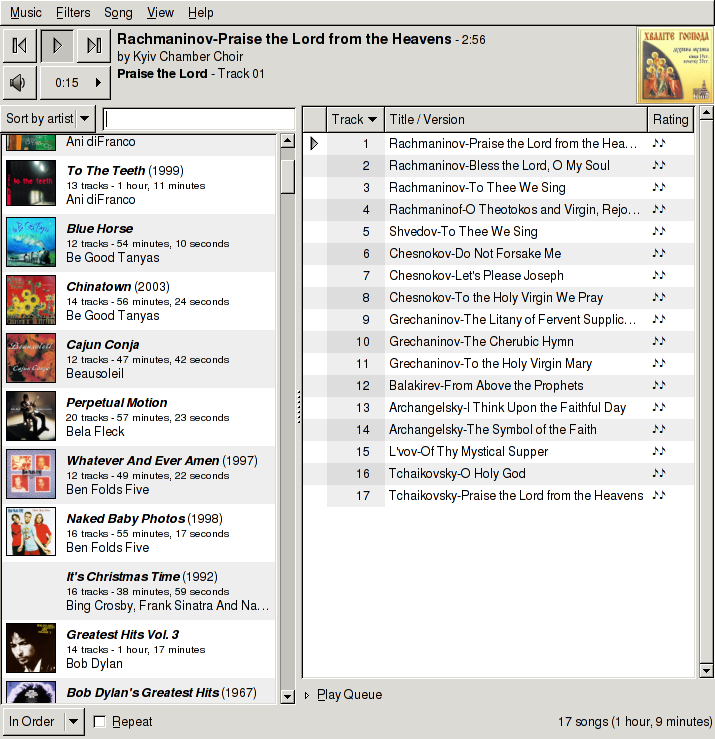
screenshot Earlier I dismissed the quod libet music player since it needed 20% of my laptop's cpu to play music. The new version has been improved, it only needs a still exorbitant 13%, but at home I use my shuttle PC for music now, so CPU usage doesn't matter. And I think quod libet is worth the slightly lowered battery life on the road too. There's no end to the features -- and plugins full in all kinds of interesting edges (onscreen display, audioscrobbler, alarm clock) -- and while it's still under development with a rough spot here and there, mostly around the plugins, it mostly just works. I'm especially impressed at how powerful the tag editing is in quod libet. It makes it so easy to clean up the missing and broken metadata in even a large sound library like mine, and the effects are so immediate and nice as things get sorted into the right place, albums ordered as missing track info is added, album covers displayed, that it's addictive just to putter around in there. Some other features that IMHO make it worth using include the ramdom album plugin, which lets it pick a new album at random when it finishes playing the current one (my collection is too varied and big for random track play to work, but this, mostly, does), the gorgeous album list, and the queue, an odd little feature that lets you insert any songs you like into a play queue, to play after the currently playing song. Which solves a lot situations I've been in before. And the little details are all there too, little things like right-clicking on the play button to turn off the music player after the current song finishes; and automatically and quickly finding new music on startup; and properly supporting multiple artist albums. And that just scratches the surface of things I've found to like over a day.. there's a whole regexp/tag based search engine in there, a music prefernces learning system with weighted playback, internet radio, playlists and more. And it's actively developed, and kinda oddly marketed squarely at Debian users. Buh-bye rhythmbox..

Jordi Mallach: One year of Blue Gold

Today, my magic metro card is one year old. When I bought it twelve months ago, I never thought I'd be so lucky. I don't know exact figures, but I think I've done 200 more train rides that it should have let me, and the card should have expired the 1st of February. But it didn't, and I've been using it over and over throught the year. I only was very, very careful when inserting the card or storing it in my wallet so it wouldn't bend or be damaged in some way... it's worth a lot of money! While my primary means of transportation is the bicycle once again, having this handy is a great way to save maybe 25 every month. The Blue Gold Rush is eternal, although time does leave marks on it.


The magic card, when I found its magic properties After some hundred uses...


Go on, my blue friend! I should find someone with equipment that can copy the data in the magnetic band. That would rock.

19 November 2005

Edd Dumbill: The Web as it was meant to be used

Since giving XTech 2006 the tagline "Building Web 2.0", I've received a few questions as to how wise this was. The Web 2.0 label has been accused in some quarters of being a vague, marketing-oriented, term. Perhaps an attempt to kickstart a new bubble. I was going to write further, defending my choice: that, practically speaking, Web 2.0 encapsulates a combination of technologies and practices driving the web forward. Yes, it's a label of convenience, but the implementation trends are real. The maturation of XML, a revival in browser technology, a willingness to share data openly and new web development frameworks. Just as I embarked on distilling these thoughts into a fuller form, Paul Graham published an excellent essay on Web 2.0. In it he analyses the Web 2.0 term:
Does "Web 2.0" mean anything? Till recently I thought it didn't, but the truth turns out to be more complicated. Originally, yes, it was meaningless. Now it seems to have acquired a meaning. And yet those who dislike the term are probably right, because if it means what I think it does, we don't need it.
So what's the reasoning that means we don't need the term? Graham writes: "Web 2.0 means using the web the way it's meant to be used." There's nothing fundamentally new, but there is a groundswell of understanding of what's been there all along. For me, that's a wonderful encapsulation of both current web trends and my aspirations for XTech. "Web 2.0" is a just a handy label for this. "The Web as it was meant to be used" will strike a chord with many web practitioners today--whether it's sensible use of web services with REST, improving user interaction in web design, or open semantics and data interchange. If you're involved in using the web as it's meant to be used, consider submitting an XTech proposal.

Next.

Previous.