Search Results: "nic"

13 June 2011

Christian Perrier: So, what happened with Kikithon?

I mentioned this briefly yesterday, but now I'll try to summarize the story of a great surprise and a big moment for me. All this started when my wife Elizabeth and my son Jean-Baptiste wanted to do something special for my 50th birthday. So, it indeed all started months ago, probably early March or something (I don't yet have all the details). Jean-Baptiste described this well on the web site, so I won't go again into details, but basically, this was about getting birthday wishes from my "free software family" in, as you might guess, as many languages as possible. Elizabeth brought the original idea and JB helped her by setting up the website and collecting e-mail addresses of people I usually work with: he grabbed addresses from PO files on Debian website, plus some in his own set of GPG signatures and here we go. And then he started poking dozens of you folks in order to get your wishes for this birthday. Gradually, contributions accumulated on the website, with many challenges for them: be sure to get as many people as possible, poking and re-poking all those FLOSS people who keep forgetting things... It seems that poking people is something that's probably in the Perrier's genes! And they were doing all this without me noticing. As usually in Debian, releasing on time is a no-no. So, it quickly turned out that having everything ready by April 2nd wouldn't be possible. So, their new goal was offering this to me on Pentecost Sunday, which was yesterday. And...here comes the gift. Aha, this looks like a photo album. Could it be a "50 years of Christian" album? But, EH, why is that pic of me, with the red Debconf5 tee-shirt (that features a world map) and a "bubulle" sign, in front of the book? But, EH EH EH, what the .... are doing these word by H0lger, then Fil, then Joey doing on the following pages? And only then, OMG, I discover the real gift they prepared. 106, often bilingual, wishes from 110 people (some were couples!). 18 postcards (one made of wood). 45 languages. One postcard with wishes from nearly every distro representatives at LinuxTag 2011. Dozens of photos from my friends all around the world. All this in a wonderful album. I can't tell what I said. Anyway, JB was shooting a video, so...we'll see. OK, I didn't cry...but it wasn't that far and emotion was really really intense. Guys, ladies, gentlemen, friends....it took me a while to realize what you contributed to. It took me the entire afternoon to realize the investment put by Elizabeth and JB (and JB's sisters support) into this. Yes, as many of you wrote, I have an awesome family and they really know how to share their love. I also have an awesome virtual family all around the world. Your words are wholeheartedly appreciated and some were indeed much much much appreciated. Of course, I'll have the book in Banja Luka so that you can see the result. I know (because JB and Elizabeth told me) that many of you were really awaiting to see how it would be received (yes, that includes you, in Germany, who I visited in early May!!!). Again, thank you so much for this incredible gift. Thank you Holger Levsen, Phil Hands, Joey Hess, Lior Kaplan, Martin Michlmayr, Alberto Gonzalez Iniesta, Kenshi "best friend" Muto, Praveen Arimbrathodiyil, Felipe Augusto van de Wiel, Ana Carolina Comandulli (5 postcards!), Stefano Zacchiroli (1st contribution received by JB, of course), Gunnar Wolf, Enriiiiiico Zini, Clytie Siddall, Frans Pop (by way of Clytie), Tenzin Dendup, Otavio Salvador, Neil McGovern, Konstantinos Margaritis, Luk Claes, Jonas Smedegaard, Pema Geyleg, Meike "sp tzle queen" Reichle, Alexander Reichle-Schmehl, Torsten Werner, "nette BSD" folks, CentOS Ralph and Brian, Fedora people, SUSE's Jan, Ubuntu's Lucia Tamara, Skolelinux' Paul, Rapha l Hertzog, Lars Wirzenius, Andrew McMillan (revenge in September!), Yasa Giridhar Appaji Nag (now I know my name in Telugu), Amaya Rodrigo, St phane Glondu, Martin Krafft, Jon "maddog" Hall (and God save the queen), Eddy Petri or, Daniel Nylander, Aiet Kolkhi, Andreas "die Katze geht in die K che, wunderbar" Tille, Paul "lets bend the elbow" Wise, Jordi "half-marathon in Banja Luka" Mallach, Steve "as ever-young as I am" Langasek, Obey Arthur Liu, YAMANE Hideki, Jaldhar H. Vyas, Vikram Vincent, Margarita "Bronx cross-country queen" Manterola, Patty Langasek, Aigars Mahinovs (finding a pic *with* you on it is tricky!), Thepittak Karoonboonyanan, Javier "nobody expects the Spanish inquisition" Fern ndez-Sanguino, Varun Hiremath, Moray Allan, David Moreno Garza, Ralf "marathon-man" Treinen, Arief S Fitrianto, Penny Leach, Adam D. Barrat, Wolfgang Martin Borgert, Christine "the mentee overtakes the mentor" Spang, Arjuna Rao Chevala, Gerfried "my best contradictor" Fuchs, Stefano Canepa, Samuel Thibault, Eloy "first samba maintainer" Par s, Josip Rodin, Daniel Kahn Gillmor, Steve McIntyre, Guntupalli Karunakar, Jano Gulja , Karolina Kali , Ben Hutchings, Matej Kova i , Khoem Sokhem, Lisandro "I have the longest name in this list" Dami n Nicanor P rez-Meyer, Amanpreet Singh Alam, H ctor Or n, Hans Nordhaugn, Ivan Mas r, Dr. Tirumurti Vasudevan, John "yes, Kansas is as flat as you can imagine" Goerzen, Jean-Baptiste "Piwet" Perrier, Elizabeth "I love you" Perrier, Peter Eisentraut, Jesus "enemy by nature" Climent, Peter Palfrader, Vasudev Kamath, Miroslav "Chicky" Ku e, Mart n Ferrari, Ollivier Robert, Jure uhalev, Yunqiang Su, Jonathan McDowell, Sampada Nakhare, Nayan Nakhare, Dirk "rendez-vous for Chicago marathon" Eddelbuettel, Elian Myftiu, Tim Retout, Giuseppe Sacco, Changwoo Ryu, Pedro Ribeoro, Miguel "oh no, not him again" Figueiredo, Ana Guerrero, Aur lien Jarno, Kumar Appaiah, Arangel Angov, Faidon Liambotis, Mehdi Dogguy, Andrew Lee, Russ Allbery, Bj rn Steensrud, Mathieu Parent, Davide Viti, Steinar H. Gunderson, Kurt Gramlich, Vanja Cvelbar, Adam Conrad, Armi Be irovi , Nattie Mayer-Hutchings, Joerg "dis shuld be REJECTed" Jaspert and Luca Capello. Let's say it gain:

Vincent Bernat: Anycast DNS

In a recently published article, Paul Vixie, past author and architect of BIND, one of the most popular internet domain server, explains why DNS servers should use anycast for increased reliability and faster answers. The main argument against unicast is that some resolvers may not be smart enough to select the best server to query and therefore, they may select a server on the other side of the planet. Since, you cannot go faster than light, you get a penalty of about 100 milliseconds in this case.

Unicast & anycast Most addresses that you handle are unicast addresses, i.e. the address of a single receiver. Any time you send a packet to an unicast address, it will be forwarded to this single receiver. Another common network addressing system is multicast (which happens to include broadcast). When you send a packet to a multicast address, several receivers may get it. The packet is copied as needed by some nodes. Anycast addresses allow you to send a packet to a set of receivers but only one of them will receive it. The packet will not be copied. Usually, the idea behind anycast is that the packet is sent to the nearest receiver. There is no universal way to determine if an IP address is an unicast address or an anycast address just by looking at it. For example 192.5.5.241 is an anycast address while 78.47.78.132 is an unicast address. ISC, which maintains BIND, operates the F root domain server, one of the 13 Internet root name servers. This server is queried by using 192.5.5.241 IPv4 anycast address or 2001:500:2f::f IPv6 anycast address. ISC has published a document explaining how anycast works. Several nodes around the globe announces the same subnet using BGP. When one router running BGP has to send a query to the anycast address, it will have several choices in its BGP table. It will usually select the shortest path and route the query to the corresponding router. Some nodes may choose to restrict the announcement about the subnet containing the anycast address. They are called local nodes (by opposition to other global nodes). This allows them to serve query only from their clients and use cheaper connectivity and hardware.

Lab Let s play with anycast by setting up a lab to experiment with it. We want to setup an IPv6 anycast DNS service using two global nodes, G1 and G2, and one local node, L1. We build some kind of mini-Internet. See : Anycast lab

Setting up the lab This lab will use UML guests for all nodes. For more details on how this works, look at my previous article about network labs with User Mode Linux. You first need to grab the lab:
$ git clone https://vincentbernat@github.com/vincentbernat/network-lab.git
$ cd network-lab/lab-anycast-dns
$ ./setup
You will need to install the dependencies needed by the script on your host system. The script was tested on Debian unstable. If some of the dependencies do not exist in your distribution, if they don t behave as in Debian or if you don t want to install them on your host system, you can use debootstrap to create a working system:
$ sudo debootstrap sid ./sid-chroot http://ftp.debian.org/debian/
[...]
$ sudo chroot ./sid-chroot /bin/bash
# apt-get install iproute zsh aufs-tools
[...]
# apt-get install bird6
[...]
# exit
$ sudo mkdir -p ./sid-chroot/$HOME
$ sudo chown $(whoami) ./sid-chroot/$HOME
$ ROOT=./sid-chroot ./setup
We are running a lot of UML guests in this lab. We assign 64 MB to each host. UML guests do not use host memory until they need it but because of cache subsystem, you can expect that each guest will use 64 MB of memory. This means that you need about 2 GB of RAM to run this lab. Moreover, each guest will create a file representing its memory. Therefore, you need about 2 GB of free space in /tmp too. Routers are named after their AS number. The router of AS 64652 is just 64652. Paris, NewYork and Tokyo are the exception. The lab will use only one switch but we will use VLAN to create several L2 networks. Each link in our schema is an L2 network. Each link will get its own L3 network. Those networks are prefixed with 2001:db8:ffff:. Leaf AS have their own L3 network 2001:db8:X::/48 where X is the AS number minus 60000. Look at /etc/hosts on each host to get the IP of all hosts.

Mini-Internet routing AS 64600 is some kind of Tier-1 transit network (like Level 3 Communications). It has three points of presence: Paris, New York and Tokyo. AS 64650 is an European regional transit network, AS 64640 is an East Asian regional transit network and AS 64610, 64620 and 64630 are North American regional transit network which are peering each other. Other leaf AS are local ISP. This is not really what Internet looks like but shaping our lab like a tree allows us to not deal with a lot of BGP stuff: we ensure that the shortest path (in number of BGP hops) from one client to one server is the best path. Each BGP router will get a basic BGP configuration containing only the list of peers. Since Paris, Tokyo and NewYork are in the same AS, they will use iBGP. They are fully meshed for this purpose but this does not provide redundancy because iBGP routes are not redistributed inside iBGP. A more complex setup would be needed to provide redundancy inside AS 64600. We don t use an IGP inside leaf AS as we should: for the sake of simplicity, we redistribute directly connected routes into BGP. While in my previous lab, I used Quagga, I will use BIRD in this one. It is a more modern daemon with a clean design on how routing tables may interact. It also performs better. However, it lacks several features from Quagga. The configuration for BIRD is autogenerated from /etc/hosts. We use only one routing table inside BIRD. This table will be exported to the kernel and to any BGP instance. Some directly connected routes will be imported (those representing client networks) as well as all routes from BGP instances. Here is an excerpt of 64610 s configuration:
protocol direct  
   description "Client networks";
   import filter  
     if net ~ [ 2001:db8:4600::/40 40,48  ] then accept;
     reject;
    ;
   export none;
 
protocol kernel  
   persist;
   import none;
   export all;
 
protocol bgp  
   description "BGP with peer NewYork";
   local as 64610;
   neighbor 2001:db8:ffff:4600:4610::1 as 64600;
   gateway direct;
   hold time 30;
   export all;
   import all;
 
We do not export inter-router subnets to keep our routing tables small. This also means that those IP addresses are not routable in spite of the use of public IP addresses. Here is the routing table as seen by 64610 (use birdc6 to connect to BIRD):
bird> show route
2001:db8:4622::/48 via 2001:db8:ffff:4610:4620::2 on eth3 [bgp4 18:52] * (100) [AS64622i]
                   via 2001:db8:ffff:4600:4610::1 on eth0 [bgp1 18:52] (100) [AS64622i]
2001:db8:4621::/48 via 2001:db8:ffff:4610:4620::2 on eth3 [bgp4 18:52] * (100) [AS64621i]
                   via 2001:db8:ffff:4600:4610::1 on eth0 [bgp1 18:52] (100) [AS64621i]
2001:db8:4612::/48 via 2001:db8:ffff:4610:4612::2 on eth2 [bgp3 18:52] * (100) [AS64612i]
2001:db8:4611::/48 via 2001:db8:ffff:4610:4611::2 on eth1 [bgp2 18:52] * (100) [AS64611i]
As you can notice, it knows several paths to the same network, however, it only selects the best one (based on the length of the AS path):
bird> show route 2001:db8:4622::/48 all
2001:db8:4622::/48 via 2001:db8:ffff:4610:4620::2 on eth3 [bgp4 18:52] * (100) [AS64622i]
        Type: BGP unicast univ
        BGP.origin: IGP
        BGP.as_path: 64620 64622
        BGP.next_hop: 2001:db8:ffff:4610:4620::2 fe80::e05f:a3ff:fef2:f4e0
        BGP.local_pref: 100
                   via 2001:db8:ffff:4600:4610::1 on eth0 [bgp1 18:52] (100) [AS64622i]
        Type: BGP unicast univ
        BGP.origin: IGP
        BGP.as_path: 64600 64620 64622
        BGP.next_hop: 2001:db8:ffff:4600:4610::1 fe80::3426:63ff:fe5e:afbd
        BGP.local_pref: 100
Let s check that everything works with traceroute6 on C1:
# traceroute6 G2.lab
traceroute to G2.lab (2001:db8:4612::2:53), 30 hops max, 80 byte packets
 1  64652-eth1.lab (2001:db8:4652::1)  -338.277 ms  -338.449 ms  -338.502 ms
 2  64650-eth2.lab (2001:db8:ffff:4650:4652::1)  -338.324 ms  -338.363 ms  -338.384 ms
 3  Paris-eth2.lab (2001:db8:ffff:4600:4650::1)  -338.191 ms  -338.329 ms  -338.282 ms
 4  NewYork-eth0.lab (2001:db8:ffff:4600:4600:1:0:2)  -338.144 ms  -338.182 ms  -338.235 ms
 5  64610-eth0.lab (2001:db8:ffff:4600:4610::2)  -338.078 ms  -337.958 ms  -337.944 ms
 6  64612-eth0.lab (2001:db8:ffff:4610:4612::2)  -337.778 ms  -338.103 ms  -338.041 ms
 7  G2.lab (2001:db8:4612::2:53)  -338.001 ms  -338.045 ms  -338.080 ms
Let s see what happens if we shut the link between NewYork and 64610. This link is VLAN 10. Since vde_switch does not allow to shut a port, we will change the VLAN of port 9 to VLAN 4093. After at most 30 seconds, the BGP session between NewYork and 64610 will be torn down and packets from C1 to G2 will take a new path:
# traceroute6 G2.lab
traceroute to G2.lab (2001:db8:4612::2:53), 30 hops max, 80 byte packets
 1  64652-eth1.lab (2001:db8:4652::1)  -338.382 ms  -338.499 ms  -338.503 ms
 2  64650-eth2.lab (2001:db8:ffff:4650:4652::1)  -338.284 ms  -338.317 ms  -338.151 ms
 3  Paris-eth2.lab (2001:db8:ffff:4600:4650::1)  -337.954 ms  -338.031 ms  -337.924 ms
 4  NewYork-eth0.lab (2001:db8:ffff:4600:4600:1:0:2)  -337.655 ms  -337.751 ms  -337.844 ms
 5  64620-eth0.lab (2001:db8:ffff:4600:4620::2)  -337.762 ms  -337.507 ms  -337.611 ms
 6  64610-eth3.lab (2001:db8:ffff:4610:4620::1)  -337.531 ms  -338.024 ms  -337.998 ms
 7  64612-eth0.lab (2001:db8:ffff:4610:4612::2)  -337.860 ms  -337.931 ms  -337.992 ms
 8  G2.lab (2001:db8:4612::2:53)  -337.863 ms  -337.768 ms  -337.808 ms

Setting up anycast DNS Our anycast DNS service has three nodes. Two global ones, located in Europe and North America and one local one targeted at customers of AS 64620 only. The IP address of this anycast DNS server is 2001:db8:aaaa::53/48. We assign this address to G1, G2 and L1. We also assign 2001:db8:aaaa::1/48 to 64651, 64612 and 64621. BIRD configuration is adapted to advertise this network:
protocol direct  
   description "Client networks";
   import filter  
     if net ~ [ 2001:db8:4600::/40 40,48  ] then accept;
     if net ~ [ 2001:db8:aaaa::/48 ] then accept;
     reject;
    ;
   export none;
 
We use NSD as a name server. This is an authoritative only name server. The configuration is pretty simple. We just ensure that it is bound to the IPv6 anycast address (otherwise, it may answer with the wrong address). The zone file is customized to answer the name of the server:
#(C1) host -t TXT example.com 2001:db8:aaaa::53
Using domain server:
Name: 2001:db8:aaaa::53
Address: 2001:db8:aaaa::53#53
Aliases:
example.com descriptive text "G1"
#(C5) host -t TXT example.com 2001:db8:aaaa::53
Using domain server:
Name: 2001:db8:aaaa::53
Address: 2001:db8:aaaa::53#53
Aliases:
example.com descriptive text "G2"
If we try from C3, we may be redirected to L1 while we are not a customer of AS 64620. A common way to handle this is to let 64621 tag the route with a special community that will let know 64620 that the route should not be exported.
protocol direct  
   description "Client networks";
   import filter  
     if net ~ [ 2001:db8:4600::/40 40,48  ] then accept;
     if net ~ [ 2001:db8:aaaa::/48 ] then  
          bgp_community.add((65535,65281));
          accept;
      
     reject;
    ;
   export none;
 
The community used is known as the no-export community. BIRD knows how to handle it. However, we hit here some limitations of BIRD:
  1. The correct way to let 64622 knows about this route is to build a BGP confederation for AS 64620 and let AS 64622 and AS 64621 be part of it. This means that those three AS will be seen as AS 64200 from outside of the confederation. Moreover, the no-export community would allow to export the route only within the confederation. This is exactly what we need but BIRD does not support confederations.
  2. BIRD first selects the best route to export then apply filtering. This means that even if 64620 knows non-filtered route to 2001:db8:aaaa::/48, it will select the route to L1, filter it out and export nothing to 64622.
Therefore, we need to fallback to ask BIRD to not export the route to AS 64600, 64610 and 64630 on 64620. We could use a special community to filter out the route but we keep it simple and just filter the route directly.
filter keep_local_dns  
   if net ~ [ 2001:db8:aaaa::/48 ] then reject;
   accept;
 
protocol bgp  
   description "BGP with peer NewYork";
   local as 64620;
   neighbor 2001:db8:ffff:4600:4620::1 as 64600;
   gateway direct;
   hold time 30;
   export filter keep_local_dns;
   import all;
 
Voil . Only C4 will be able to query L1. If AS 64621 is missing, it will query G2 instead. One major point about anycast is to know that redundancy is done at the AS level only. If the name server on L1 does not work correctly, requests will still be routed to it. Therefore, with anycast, you still need to provide redundancy inside each AS (or stop advertising the anycast network as soon as there is a failure).

Beyond DNS Anycast can be used to serve HTTP requests too. This is less commonly used because your connection may be rerouted to another node while it is still running. This is not a problem with DNS because there is no connection (you send a query, you receive an answer). There are at least two CDN (MaxCDN and CacheFly) which uses anycast to ensure low roundtrip time and very high reliability. Setting up an HTTP server with an anycast address is no different than setting up a DNS server. However, you need to ensure maximum stability of the routing path to avoid the connection to be dropped while running. I suppose that this is done by hiring some high-level BGP expert. You can also mix unicast and anycast:
  • anycast DNS answers the IP address of a nearby unicast HTTP server, or
  • anycast DNS answers the IP address of an anycast HTTP server that will issue a redirect to an unicast HTTP server when downloading or streaming large files.

Craig Small: Debian Linux on HP DV6-6023TX

It was time to update my creaking old laptop. I ordered HP6-6023TX online and after a few days it arrived just before a long weekend. I first backed up Windows 7 onto a set of DVDs and found that either my blank DVDs are old or this new DVD drive is far more fussy. There were quite a few coasters made until I gave up and bought some new ones. DVDs seemed to be trouble for me that day. I downloaded the Debian 6.0.4 DVD image but couldn t burn it. Brasero would just keep saying calculating checksum and go no further. So after waiting too long, the CD iso was downloaded and installed. Installation of debian onto the laptop was straightforward. That is if you used a wired connection. Wireless needs the non-free firmware and I gave up trying to work out how to install it at debian-installer time as it didn t see the tar.gz full of firmware on the USB stick. Wireless worked perfectly once I loaded everything on. So at this point with not much trouble I had an almost fully working setup. Even the webcam and sound was working. Video Fun The laptop is one of these strange modern ones that has two video cards. The low-spec one is an Intel Sandybridge while the higher one is an AMD/ATI Radeon HD 6700M. The idea being you use the ATI when plugged in and the Intel on batteries. Xorg worked first go, but only on the Intel chip. Trying to force X to use the ATI driver with an Xorg configuration resulted in the Xserver crashing. Next attempt was the fglrx packages within Debian. aticonfig said it didn t know about the card. The reason for this is that the Debian packages use fglrx version11.4 and I needed for my card 11.5 So close but so far away. OK, so building the ATI software can t be that hard can it? A nice set of instructions on the Debian wiki and we had errors. The first problem is that the packaging used is ancient. The second problem is much more serious; it won t compile. I was stuck about here until I hopped onto the Debian irc channel and asked about it and someone found a very useful webpage about compiling the ATI drivers on Debian which importantly had information about the patches you need, especially the blk patch. Success! the program compiled and installed. A small xorg.conf specifying the fglrx driver and the BusID and we were up and running. I now have accelerated graphics on the laptop. Ouch, my eyes! I do actually get outside (one of my hobbies is gardening and that is an outdoor activity) so I don t need a monitor screen trying to give me a suntan. The default screen brightness on the laptop could be described as sub-nova . I m sure there is some alien astronomers several light-years away who will in many years time wonder what that flash from the unimpressive end of the milky-way was about. To protect your eyes and keep the neighborhood complaints down you can reduce the brightness to something sane. You do this in the power management settings which for me is System -> Preferences -> Power Management. I can see again!

Joachim Breitner: 401 page family book published

Over the course of the last five years, some relatives of me and I have been working on a family book which lists all descendants of my grandgrandgrandgrandfather Isaak Riehm, born 1799, and his wife Charlotte. My task was everything related to maintaining the data, running the infrastructure and generating the final book. In the end, we have collected biographical details, often with the person s live story, of 703 descendants, 285 partners and 416 parents-in-law. Together with an extensive preface the book now has a respectable size of 401 pages, includes 144 pictures and maps and over 200 copies have been printed and sold through the family.

The book cover
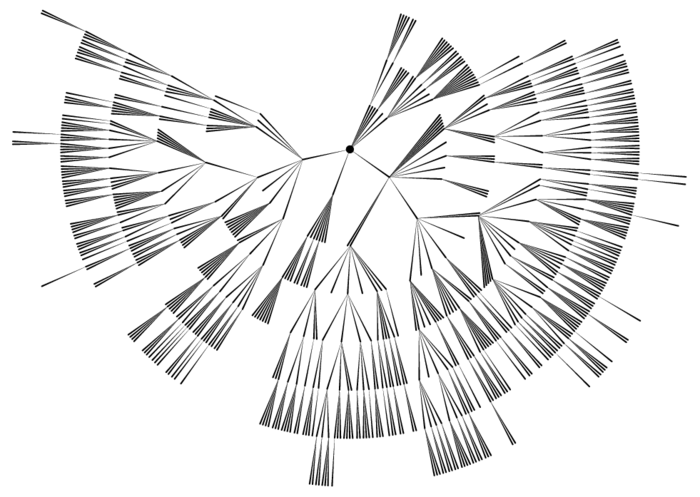
Although I do not think that the details of the lives of my family is very interesting for the general public, or even suitable for general release, I do want to show the fruit of our work. Therefore, I have created a stripped-down on-line version that only covers the first four generations. I bundled the book body with the cover and the end sheets into one complete PDF file (caution, large: 54MB, and of course in German). Some nifty embellishments of the book that I especially like are the abstract looking descendant fan in the front-end and back-end sheets, the separating bars between the persons which indicate the livespan of that person between 1799 and 2011 and the maps of the birth places and Isaak s travel destinations in the preface. Now to the technical details: Naturally, I used only Free Software in the genesis of the work (The cover is an exception, as it was not created by me). The most important is definitely gramps, a free genealogy system that held all our data. It is written in python and extensible with plug-ins, so I was able to create a custom report that takes the data relevant for us, filters for people who have agreed to appear in the book, and then generate LaTeX code that typesets the book, ready to be printed. I learned a great deal of LaTeX for this project, which uses over 30 different packages and required me to create a font of my own (which, as a side product, lead to a publication in the Linux-Magazin). For the maps I found the Generic Mapping Tools (GMT) and the freely available data for that of great use. I still had to manually collect the coordinates for all the places I wanted to show up in the map. Here, I relied mostly on Wikipedia. The fan which appears in the end sheets is laid out using a Haskell program (naturally, I have to use Haskell somewhere).
The front-end sheet
Of course, generating the book is only one side of the story; first, the data has to be collected and edited. For that, I wrote a plug-in to gramps that creates forms for each person. These forms contain the current known data and are used to correct and extend our knowledge. One variant of the form, created using LaTeX, was printed and mailed by snail-mail around the country and beyond, for those who are not reachable by mail. The other variant is an HTML form, hosted on a password-protected web site. Changes to that form cause the server to send an e-mail with a description of the changes (and only the changes, not the fields that are left untouched) to the mailing list of our team. There, the changes can be reviewed, e.g. for spelling and stylistic issues, and finally I copy n pasted them into gramps. These parts are implemented in python as well. Since genealogical data is never complete or up-to-date, I have set up a password-protected mediawiki based web site for the book where we collect corrections and additions to the data in the book. We have never anticipated that it would be so much work and that it would take us so long to finish this project, but we pulled it through and we are very happy with the result. Also, the reception has been very good and it was definitely a success. At this point I d like to express my gratitude to the hundreds of Free Software developers out there whose code we used and without whom it would not have been possible publish the book in the current form at all! Update: Due to some requests, I am making the code that I wrote available. You can download the tarball. Note that the code is a big mess and will not be usable right away. I guess if you can get the code to run and actually adjust to your needs, then you can as well write it yourself. Nevertheless it might be useful as inspiration or reference.

11 June 2011

Dirk Eddelbuettel: United Sounds of America: New York

Last night was the kick-off concert in a series the Chicago Symphony has been preparing (and pushing) for the last little while: United Sounds of America: A Journey through Musical Roots. Five concerts featuring New York (last night), Chicago/Route 66 (tonight), New Orleans (tomorrow), Detroit (next Friday) and Austin (next Saturday). The New York evening was organized by pianist Bill Charlap (wikipedia) who also headlined and MC-ed the first set. Covering the birth of Jazz until early post-war bebop in chronological fashion, it was a pretty decent jazz set with a very nice band featuring Kenny Washington (dr), Peter Washington (b), Jeremy Pelt (tp), Jimmy Greene (ts) and Ken Peplowski (cl) --- and local favourite Kurt Elling (wikipedia) who was simply outstanding with the classic songbook material. Having seen him live once before a few years ago, I happened to listen a lot to Elling of late, following the random find of this stream from a live concert in February as well as his two most recent records, the Grammy-winning Dedicated to You (which retakes the wonderful Coltrane/Hartman album from 1963) and the simply amazing very recent The Gate (which you should go and buy right now). And I was not disappointed. He has a great four-octave-spanning baritone voice and great stage presence. The second set was dedicated to post-war folk and singer/songwriter material and organized by Suzanne Vega. That was neat too, if somewhat different in format and more like your standard (rock-ish) concert. Vega brought her own band featuring Gerry Leonard (g), Mike Visceglia (b), Graham Hawthorne (dr) along with guest appearances by Tom Paxton (g, vocals) and Richard Julian (g, vocals). Somehow Vega seems a little trapped in her own success in the 1980s and rehashed a lot of old hits. Nothing wrong that per se as it is good material (more on that below). Only during three encores did she provide new material which was ... excellent. So maybe some rebalancing towards new stuff was neat. Also nice was the additiona of four string players from the Chicago Symphony which had joined the band for a Simon and Garfunkel's song The Boxer. Oh, and of course seeing Vega perform Tom's Diner was nice, especially in such a fast and rocking version, even enhanced by the those strings. Just a few months ago I had gone over the passage from the original a-capella version of Tom's Diner to the various beat-box remixes which were then remixed by Vega in various live performances (e.g. videos of a capella, rockish, another rockish and beatboxish versions). Good fun, and it is nice to see she is playing along and enjoying it as well. All told, a really nice iniative by the CSO. If you're in Chicagoland, go and see some of the remaining shows.

10 June 2011

Neil Williams: Putting the magic smoke back into the ring main

Haven't been in my new home that long and through a long chain of contacts, my neighbour was finally able to contact me. (Just goes to show that having Debian friends nearby who like board games turns out to make some things JustWork.)
So, when I got the message and got home the flat was fine - just with no electrical power. Murphy's Law ensured that my laptop was also low on power, as was my mobile phone and my landline is cordless and the router was, naturally, not working. My communication options were suddenly rather limited.

The 50yr old wiring in this block finally surrendered the magic smoke and caused a fire downstairs (mostly melted insulation) before it disconnected. I got home around 1pm, electricians to fix the problem arrived about 5pm and haven't finished quite yet. (It's now 12:11am). A relatively large hole in the lawn was dug (a hard task in itself seeing as this area is officially in a drought and the ground is like iron), two junction boxes rebuilt, new connection made from downstairs to upstairs, the work just went on and on.

I'll get some accurate details when I manage to speak to my brother - I do a little bit of hardware but I deal in 1W or a few hundred mA, when a 80A cable melts I'm just a bit out of my depth. I've not seen a fuse that size since I left school.

Thanks to those Debian and non-Debian people who helped me actually contact the relevant people today. I was due to get so many things done today, instead I got through the worry to end up incredibly bored - it turns out to be surprisingly difficult to find things to do when there is no mains power, all the batteries in mobile devices are flat and it's too dark to read.
:-(

Nathan Handler: irssi bansearch.pl script

As a freenode staffer and Ubuntu Operator, a frequent question that I am asked is, Why can t I join #channel? or Why can t I talk in #chanel? . To answer this question, I normally check the ban and quiet lists for #channel, and then I check what channel modes are applied. For small channels, this is not too bad, but for channels with very large ban/quiet lists, it can take some time. This is why I have created bansearch.pl. This irssi script will attempt to determine why a user is unable to join/talk in a channel. Currently, the script is maintained in a Launchpad bzr branch. To get and install the script, run the following commands from your home directory. bzr branch lp:~nhandler/+junk/bansearch
mkdir -p ~/.irssi/scripts/autorun
ln -s ~/bansearch/bansearch.pl ~/.irssi/scripts/bansearch.pl
ln -s ~/.irssi/scripts/bansearch.pl ~/.irssi/scripts/autorun/bansearch.pl
You can leave out the last command if you do not want the script to run automatically when you start irssi. Using the script is quite simple. You can use it like this: /script load bansearch.pl
/bansearch nick [#channel]
If you do not specify a channel, it will use the current channel. The script will currently look for bans and quiets matching the user. It has some limited extban support, but it does not support CIDR bans. It also supports looking at channel modes that might prevent the user from joining/talking. The script knows whether the user is identified, so $a extbans, $~a, and cmode +r are all supported, and the script will only warn you about them if they match the user. The script was written for freenode, so while basic ban/quiet searching might work on other IRC networks, the channel mode checks will probably not work properly. The script is still fairly new, so there are still bugs in it. If you find any, please let me know, and I will try and patch them as quickly as possible. I am also open to any feedback about how to improve the script.

Gunnar Wolf: Reading revolutions: Online digital text and implications for reading in academe A (very informal) review

It's been a long time since I last took some time to read First Monday A great online publication, if you are not familiar with it, that I would categorize (and no, I'm not probably well-informed in it to be authoritative) as dealing with social, psychological aspects of the cultural shifts the online world has brought upon us (often dealing with topics related to Free Software communities, the reason I first met the publication). Firstmonday is an Open Access champion from early on. It follows an approachable but academic format (this means, it is peer-reviewed, its articles give extensive lists of references, and the articles are not the short reads we have got used to finding on the net, but, quoting from their audience profile, English is not the first language of many First Monday readers; A large percentage of First Monday readers are not a part of academia; Cultures, educational backgrounds, and fields of study vary greatly among First Monday readers.) This means, it's at least a great publication for me to follow :) Anyway After a long time not following it, I have just read Reading revolutions: Online digital text and implications for reading in academe, by Barry W. Cull; First Monday, Volume 16, Number 6 - 6 June 2011 Nice, interesting read. As I was planning on telling about the article to a couple of friends more into the subjects than myself, I'll comment+quote some bits on it. Before going any further: The article makes several references to Maryanne Wolf. No relation to her I'm not lulling my (two? are you both still reading?) readers towards her work ;-) The article talks about the differences social, even dips into some physiological aspects that the activity of reading is sustaining due to the shift from an activity done mainly from books (or other similar printed material) to the computer screen. Of course, we all know from our own experience many of the basic traits Shorter attention spans, a different reading pattern (skimming instead of reading; browsing through several related items instead of in-depth reading a single text as a knowledge unit). The article begins with an overview of reading and humankind. Cull quotes Maryanne Wolf's phrase, despite the fact that it took our ancestors about 2,000 years to develop an alphabetic code, children are regularly expected to crack this code in about 2,000 days . An interesting point I never thaught of is the start of reading as a purely mental activity, detaching reason from verbalization, ~1200 years ago:
Interestingly, these early scribes first did their work by reading out loud to themselves. Not until the ninth century did monastic regulations begin requiring silent reading. By the thirteenth century the practice of men reading silently and alone became commonplace. This shift to silent reading was a profound change, one that Darnton suggested involved a greater mental adjustment than the shift to printed text
. One last important point in this older history, that I'm quoting because I know I'll need the reference later on for one of my texts is about reading as a social activity Yes, also related to the quietness I just mentioned:
Interestingly, with the democratization of the printed text, there was a return to reading aloud. Reading was a solitary silent process only for the educated elite who could afford to buy books. For the rest of the population, as Darnton pointed out, reading was a social activity which took place in workshops, barns, and taverns [and] while children played, women sewed, and men repaired tools.
After this introduction (obviously one of the most interesting parts to me), Cull gives numbers showing how reading is evolving (in the USA and Canada), and quotes some prediction on how the future will end up adapting. Of course, I live in a place with a very different society, so I cannot comment much. Then he confronts some studies regarding specifically leisure reading, as it is a much more trustable factor than just literacy (in a world as highly literate as ours is, many people only read when they have to and have never or very seldom experienced the pleasure of reading just for the sake of it), bringing into the discussion the Internet (and computers in general) usage patterns. I found also very interesting the next section, regarding the pattern changes many libraries are facing now, specially academic/research-oriented libraries:
For several millennia, right up until just two decades ago, the central role of a library was to collect and house physical texts: from clay tablets, to scrolls, to printed books (Battles, 2003; Manguel, 2006). While printed text remains essential to most academic libraries, today s libraries have also become a core conduit via which researchers access scholarly texts online. Just within the last few years, Canadian academic libraries, in a situation similar to libraries throughout the Western world, have reached an interesting tipping point librarians now spend the majority of their collections budgets on electronic instead of printed texts.
( )
Libraries are convinced that digital text, now in its infancy, is likely to have a long future. Not only do they purchase electronic texts, but most academic libraries have also become publishers of electronic texts, whether they are digitizing large portions of their book holdings, or focusing on scanning a relatively small number of archival documents from their unique special collections.
And yes, doing some work with our Institute's library, I can confirm this trend. About e-books: I have got quite into that topic since the Kindle won my heart (and my money!) half a year ago. The little device completly changed my reading habits, I have read lots more since I carry it. And yes, I have never considered a full tablet-like device The article talks long about the difference, about the disadvantage that multitasking means to the human brain (oh, do I suffer from it!) I liked this snippet, quoting Steve Jobs a couple of years ago, regarding an Apple e-book reader question:
When Apple was rumoured to be working on an e book reader a few years ago, CEO Steve Jobs expressed his lack of interest: It doesn t matter how good or bad the product is, the fact is that people don t read anymore, he reportedly said, continuing by stating that 40 percent of the people in the U.S. read one book or less last year. The whole conception is flawed at the top because people don t read anymore (Markoff, 2008). Nicholas Carr (2010) has summed up Apple s involvement in the tablet phenomenon this way: Jobs is no dummy. As a text delivery system, the iPad is perfectly suited to readers who don t read anymore .
The issue for me is, I do enjoy reading, but I am an information addict. I know that if I have parallel information flows, my attention will surely dilute between them. Of course, as I read this article on-screen, it was hard for me to take the needed discipline not to be distracted by IMs or IRC highlights during the whole reading (which was also as an excercise for myself ;-) ). I am surprised to see this on student preferences (and even more surprised to see this data comes from my university):
In a study of students at the Universidad Nacional Aut noma de M xico (UNAM), the majority of students preferred print, and 63 percent reported that they could bear reading a document on a computer screen for no more than one hour (Ram rez Leyva, 2003). When it comes to course textbooks, a marked student preference for paper over e books has recently been found (Woody, 2010).
As we approach the end, it talks about another important topics I have often tried (and often failed) to communicate to my users: That of paratext, the meaning of the different texts, covers, items, layouts, etc. that are not part of the text itself but do shape the way we face it. To some of us, this seems obvious. To others, it is so hard to understand It closes with two more topics I will refer to. One is the permanent connectivity. All the time, more people are connected virtually all of their waking time. This affects not only learning habits but priorities. Will this near constant access to information interfere with students desire to comprehend and remember information, necessary to the educational process of turning it into knowledge? Author and university business school lecturer Don Tapscott recently suggested that students might not have to stress about the details those you can check Finally, regarding the continuity and ellaboration found in texts that are each time more common He quotes Maryanne Wolf:
I am worried about kids who are immersed in digital culture. They will get to college and they will have been Twittering so much that they won t have the patience to read those really long cognitively convoluted and complex sentences. They may not have developed those rich networks which are required in order to read at a high level of sophistication. The effort is what we are going to lose. They are becoming not so much a lazy reader, but an atrophied reader
As you can see, not only this post is meant to tell my couple-of-interested-friends to read the article, but it's mainly meant as a mental placeholder for myself. I will be surely refering to some of these items.

Raphaël Hertzog: People behind Debian: Philipp Kern, Stable Release Manager

Philipp is a Debian developer since 2005 and a member of the release team since 2008. Since he took the responsibility of Stable Release Manager, the process has evolved for the best. I asked him to explain how the release team decides what s fit for stable or not. His work on the buildd infrastructure is also admirable but I ll let him describe that. My questions are in bold, the rest is by Philipp. Who are you? I m a 24 year old Computer Science student, living in Karlsruhe, Germany. As a student assistant I m currently in two jobs: one is taking care of getting our university IPv6 network in shape, or rather generally getting fringe technologies into the network. The second is taking care of a s390x machine in the basement which my faculty got sponsored recently. In my spare time I tend my Debian duties and I m active in the student council (Fachschaft) as a sys-admin, software developer and until recently as treasurer. I got accepted as a Debian Developer in 2005. I m only really active since I was invited to join the Release Team in early 2008 after I contributed rewrites of some scripts that got lost in a disk crash of ftp-master. In late 2008 I also took on wanna-build/buildd duties. What s your notable achievement within Debian? For one I worked on the deployment of a single buildd/sbuild combination over all of our buildds and I rebased it on the sbuild in the archive several times already. All buildds basically look the same on all architectures, with only few variations. The chroots are now also created in a mostly predictable manner. Then we finally got build autosigning after years of constant poking. However the policy decision to allow it was made by the ftp-masters anyway, for which I m grateful, as it eases the workload of the buildd maintainers, the Security Team and the Release Team quite a bit. On the release side there s the integration of volatile into the proper structures of Debian. But there I m guilty for choosing the bad name squeeze-updates is, in comparision with security s squeeze/updates. Let s see if we can improve that for wheezy. The policy for stable updates have changed over time. Can you summarize what kind of updates are allowed nowadays? All the changes that were made to the policy were driven by the aim to keep stable (and to some lesser degree oldstable) usable throughout its lifetime. I have to admit that we got slightly more liberal in what we accept since I took over. The previous stable update policy included the fixes of critical bugs that break the system in interesting ways and security fixes. We also opened up the possibility of including important fixes for annoying bugs on a case-by-case basis. The whole don t update that much part of the stable release management is rooted in let s don t change the behaviour of a running system and let s have as few regressions as possible . We currently try to counter that with a review process that only allows self-contained fixes that were tested in unstable first, if applicable. In the future I d also like to have a feedback process that includes the users of the packages to report problems more early. In fact that s also why we now send calls for testing to debian-stable-announce one week in advance (see this mail as an example). So stable is updated through point releases that happen roughly every two months for stable and roughly every four for oldstable. They are accompanied by announcements and new CD/DVD sets. To be able to push some updates with less delay to our users and to avoid that they have to pick them from proposed-updates, there is stable-updates. The current policy for this suite is available in this post on debian-devel-announce. It boils down to everything urgent like tzdata, regression fixes and volatile packages. We noticed that some packages in stable just weren t useful anymore when they got updated through volatile. Hence those are folded into stable, too. We also relaxed the rules a bit so that leaf packages like clive, that rely on external websites not to change their URLs, can be updated too. If somebody wonders what happened to the and a half releases Those were intended to mark the inclusion of new hardware support (mostly by including a co-installable new kernel version). This kind of flag point release is thankfully no longer needed because our marvellous kernel team now backports certain hardware drivers to the kernel version in stable. They have some trouble soliciting test feedback for them, though. It would be cool if more people using stable could respond to their calls for testing. What are your plans for Debian Wheezy? Luckily the wanna-build/buildd side isn t much dependent on release cycles. The stable release management also just takes care of what gets dumped on them by the testing RMs. ;-) The near-term goals are certainly: Apart from that my work is mainly squashing the bugs on buildd.debian.org for the wanna-build part, so if you want something fixed, you need to report it, I m afraid. You have several roles within Debian, in particular stable release manager and member of the wanna-build team. Which role do you enjoy more and why? So the regular duties of the SRM, apart from setting up policies, are reviewing requests for uploads to proposed-updates, accepting them, chasing builds and scheduling point releases. It s mainly steady work. As for the Release Team it s working in a fabulous team where everyone s doing an awesome job. For me the wanna-build role is holding the things together and fixing up stuff that breaks while the world continues to evolve. And occassionally taking a stab at the ftp-masters. So rather different. My heart is probably siding with the buildd side because it s infrastructure but release work is fun, too. What s the biggest problem of Debian? Mainly that we re not quick in picking up new technologies and that we got slow on innovation. Distro-wide changes are usually a very big effort to coordinate and to finally complete. I guess people should be able to push fixes for release goals more eagerly into the archive. Also it seems to me that many DDs are actually disengaging from the release process, especially during the freeze but also before, which makes me a bit sad. However I m still not sure how we could counter that. As we re all volunteers you can t suddenly make others love the idea of releasing something together, I guess. Do you have wishes for Debian Wheezy? It s getting old, but there s certainly multiarch. Also a usable Python 3 is something I d really appreciate. Is there someone in Debian that you admire for their contributions? Peter Palfrader did an awesome job of getting a nicely working team together for DSA and got many tasks as automated as they are now. It s a pleasure to work with them and setting up a new buildd is, for example, a real breeze. He also developed a sane archive snapshot service, kudos for that.
Thank you to Philipp for the time spent answering my questions. I hope you enjoyed reading his answers as I did. Subscribe to my newsletter to get my monthly summary of the Debian/Ubuntu news and to not miss further interviews. You can also follow along on Identi.ca, Twitter and Facebook.

3 comments Liked this article? Click here. My blog is Flattr-enabled.

9 June 2011

Bdale Garbee: FreedomBox

Earlier this year, I agreed to join the board of Eben Moglen's FreedomBox Foundation, and to chair the recently announced Technical Advisory Committee. To date, most of the time I've been able to personally invest in the foundation has gone towards work "behind the scenes", all of which was necessary, but little of which is worthy of external report or attention. I now believe it's time to take a more active role in communicating what we're actually trying to do, and how I think we can get there. To that end, I intend to be more visible in discussions on the freedombox-discuss mailing list. I'm also accumulating a list of interesting technical challenges that I'll articulate here over time, along with status reports I believe are worthy of broad dissemination.

Matthew Garrett: IPv6 routers

I have a WRT-54G. I've had it for some years. It's run a bunch of different firmware variants over that time, but they've all had something in common. There's no way to configure IPv6 without editing text files, installing packages and punching yourself in the face repeatedly. Adam blogged about doing so today, and I suspect he may be in need of some reconstructive surgery now.

I spent yesterday looking at disassembled ACPI tables and working out the sequence of commands the firmware was sending to the hard drive. I'm planning on spending tomorrow writing x86 assembler to parse EFI memory maps. I spend a lot of time caring about stupidly awkward implementation details worked out from staring at binary dumps. The last thing I want to do is have to spend more than three minutes working out how to get IPv6 working on my home network because that cuts into the time I can spend drinking to forget.

Thankfully this is the future and punching yourself in the face is now an optional extra rather than bundled. Recent versions of Tomato USB (ie, newer than actually released) have a nice web UI for this. I registered with Tunnelbroker.net, got a tunnel, copied the prefix and endpoint addresses into the UI, hit save and ever since then NetworkManager has given me a routable IPv6 address. It's like the future.

Because I'm lazy I ended up getting an unofficial build from here. The std built doesn't seem to include IPv6, so I grabbed the miniipv6 one. The cheat-sheet for identifying builds is here. And I didn't edit a single text file. Excellent.

( Comments Comment on this)

8 June 2011

Andrew Pollock: [tech/security] I'd pay for an ISP service that excluded China

I say this after probably 48 hours of what I estimate is a sustained 60 kB/s of brute force SIP traffic from 61.146.178.173 has been sent my way. I'd very cheerfully sign up for a service that had all Chinese IP addresses null routed, and provided a proxy server for any HTTP access. I have no business needing direct IP connectivity to China, and I certainly do it not want it from China to me. I was pleasantly surprised to be able to call up Comcast's Business Class technical support tonight and ask them if they could null route the above IP address, and they seemed to imply they could (they opened up a ticket for a level 2 person to do something at least). Now if only I didn't have to pick up the phone to interact with Comcast's Business Class technical support, it'd be just lovely. I'm just glad I'm not in Australia where this would be blowing my monthly quota and/or causing me to receive excess usage charges. Bloody UDP. You can firewall it off, but it keeps coming. My initial stopgap Netfilter rule counted 1.5G of traffic before I replaced it with an adaptation of my SSH brute force mitigation rules, and the new rule has seen nearly 5G of traffic now. It's one thing to try to brute force something, but to keep trying after you stop getting responses is just plain stupid.

Francois Marier: Sample Python application using Libgearman

Gearman is a distributed queue with several language bindings.

While Gearman has a nice Python implementation (python-gearman) of the client and worker, I chose to use the libgearman bindings (python-libgearman) directly since they are already packaged for Debian (as python-gearman.libgearman).

Unfortunately, these bindings are not very well documented, so here's the sample application I wished I had seen before I started.

Using the command-line toolsBefore diving into the Python bindings, you should make sure that you can get a quick application working on the command line (using the gearman-tools package).

Here's a very simple worker which returns verbatim the input it receives:
gearman -w -f myfunction cat
and here is the matching client:
gearman -f myfunction 'test'
You can have have a look at the status of the queues in the server by connecting to gearmand via telnet (port 4730) and issuing the status command.

Using the Python libgearman bindingsOnce your gearman setup is working (debugging is easier with the command-line tools), you can roll the gearman connection code into your application.

Here's a simple Python worker which returns what it receives:
#!/usr/bin/python

from gearman import libgearman

def work(job):
workload = job.get_workload()
return workload

gm_worker = libgearman.Worker()
gm_worker.add_server('localhost')
gm_worker.add_function('myfunction', work)

while True:
gm_worker.work()
and a matching client:
#!/usr/bin/python

from gearman import libgearman

gm_client = libgearman.Client()
gm_client.add_server('localhost')

result = gm_client.do('myfunction', 'test')
print result
This should behave in exactly the same way as the command-line examples above.

Returning job errorsIf you want to expose to the client errors in the processing done by the worker, modify the worker like this:
#!/usr/bin/python

from gearman import libgearman

def work(job):
workload = job.get_workload()
if workload == 'fail':
job.send_fail()
return workload

gm_worker = libgearman.Worker()
gm_worker.add_server('localhost')
gm_worker.add_function('myfunction', work)

while True:
gm_worker.work()
and the client this way:
#!/usr/bin/python

from gearman import libgearman

gm_client = libgearman.Client()
gm_client.add_server('localhost')

result = gm_client.do('myfunction', 'fail')
print result
LicenseThe above source code is released under the following terms:
CC0
To the extent possible under law, Francois Marier has waived all copyright and related or neighboring rights to this sample libgearman Python application. This work is published from: New Zealand.

Matt Zimmerman: DEX finishes first batch of derivative patches for Debian

It s been a few months since Zack and I announced the DEX project, which aims to improve the Debian ecosystem by working jointly with derivative distributions. Our first milestone The goal of our first project, nicknamed ancient-patches, was to clear out an old batch of a few hundred Ubuntu patches whose status was unclear. We couldn t tell which ones had been merged into Debian, which were waiting in the BTS, and which had yet to be submitted to Debian. All of them were several years old. I m pleased to announce that this project is now complete. Thanks to help from David Paleino, Colin Watson, Nathan Handler and Steve Langasek, we were able to clear over 95% of the patches in a matter of days. These were the easy ones: patches which were obsolete, or had already been applied. We discussed the remainder, and resolved all of the patches whose status was still unclear. This left the harder ones: patches stalled in the BTS, and patches where there was no consensus about what to do with them. One of the stalled patches was merged into Debian via an NMU, eliminating the delta between Debian and Ubuntu. Another had been submitted to Debian by a third party, but was no longer shipping in Ubuntu, so we considered it obsolete for purposes of this project. This has left only two patches out of the original list of 277. Both of them are filed in the BTS and have been discussed with the relevant maintainer team. One of them is expected to be obsoleted when a new upstream version is packaged, which implements similar functionality. The other is being discussed with the upstream developers, but there is no conclusion yet about whether it can be merged upstream or in Debian. Conclusions Although we weren t quite able to clear the whole list, we still consider the project to be a success because: What s next In the most recent DEX update on debian-derivatives, I highlighted a few important events for DEX: We re looking forward to seeing DEX develop further. If you d like to get involved, come and join us on the debian-derivatives mailing list or IRC (#debian-derivatives on freenodeOFTC). Matt Zimmerman and Stefano Zacchiroli

Cosimo Alfarano: OpenNI in Debian

The world of augmented reality is quite fashinating.

I recently got interested into Natural Interaction due to the popularity of Microsoft's Kinect and decided to package OpenNI for Debian.

OpenNI is a framework aiming to making natural interaction transparent to the user/developer, publishing a unified API and abstracting the access to different sensors and modules. Currently it supports some Asus sensors and there is a branch on github supporting also Kinect (which is the one we're packaging).

Some cool projects are already using OpenNI: ROS, PointClouds and OpenCV come to my mind immediately.

We'are working on OpenNI package in the Multimedia Maintainers group on Alioth, the package is still not ready to be uploaded to unstable and upstream has some major problems like the lack of SONAME in its produced library, so some communication with upstream is needed but for preliminary use the packages are in a decent state: OpenNI, PrimeSense Sensor, NITE (non-free).

NITE is a closed source module set for advanced body and scene recognition, unfortunately PrimeSense didn't opensource them, thus I decided to use the same approach of flashplugin-nonfree and write a downloader.

For the sake of completeness, unstable already has libfreenect which purpose is similar but specifically oriented to Kinect.

I am studying both and really hope that in the next future some open source project will make (at least) skeleton and hand recognition available under an open license. People are already working on it, according to Google.

Lars Wirzenius: Test driven distribution development

Disclaimer: There is a huge discussion going on right now in the debian-devel mailing list, about different ways to rearrange how Debian development happens, and maybe to provide a Debian users with an additional release. This blog entry is not a comment on that discussion, which I am ignoring. The discussion did, however, prompt a dent about "test driven development". That prompted a short exchange of thoughts with Tom Marble, and this blog post is a cleaned up version of my part in that discussion.
Currently Debian development happens roughly like this: all packages are uploaded to a part of the Debian archive called unstable. Once they've been in use for a while without serious problems, they get automatically copied into another part called testing. Every year or two, testing is frozen and any remaining problems are fixed, after which all of testing gets copied into yet another part of the archive called stable, and that's the actual release. There is a little bit of automatic testing, but only a little. Almost all testing is done by people, by them using unstable or testing on their usual computers. If they have problems, they report them. Contrast this with development using Test Driven Development, or TDD, and other modern development methodologies. Here's a rough summary of what I do when I write (much) of my software. In addition, I measure coverage to make sure all parts of the code gets tested. I usually aim for 100% coverage, except for those parts that very hard or quite pointless to test. (That's easier to achieve than you'd think, but that's the topic of another blog post.) This all sounds like a lot of bureaucratic nonsense, but what I get out of this is this: once all tests pass, I have a strong confidence that the software works. As soon as I've added all the features I want to have for a release, I can push a button to push it out. (Well, actually there's a little bit more to it.) This does mean I never have bugs in my software. Of course I do. However, there's a lot fewer of them. In fact, there's so few of them, after tests pass, that I would almost be happy to make an automatic release after every successful run of "make check". Another aspect of the way I do development is distributed version control. The relevant feature is powerful branching and merging. Most things I develop happen in short-lived single-purpose branches: whenever I start work on a feature or bugfix, I create a branch for it. (Unless I'm feeling particularly lazy, which happens more often than you'd think.) When I've finished the feature, or fixed the bug, I merge the branch back into the trunk branch. This way, the trunk is always in releaseable state. It might not have all the features I want for the next release, but the features that are there, do work. The branch probably has bugs, but if I've written tests that are good enough, I know the software works well enough. Or that's the idea. Sometimes things go wrong. Then I write more tests and the next time goes better. (It doesn't have to be perfect, as long as it gets better every time.) See the contrast between automatic tests with good coverage, and the Debian style of relying on user feedback? There's no need to wait for user feedback with automatic tests. This speeds up development, makes releasing easier, but most importantly takes away any reason to fear making changes, even big changes. Automatic tests and good test coverage are easy achieve in small projects. For a system as huge as Debian, good test coverage is quite hard to achieve. The thing about automatic tests, though, is that even a little bit of it is helpful, and after you have a few tests, it gets easier to add more. The first test is the hardest to get done, since you need to set up all the infrastructure for it. Debian does do a bit of automatic testing already. (See lintian, piuparts, autopkgtest, edos, etc.) I don't want to belittle that, but I think we could do better. Here's what I would love to see: Since full test coverage is going to be impossible for Debian, some subset should be targeted. Perhaps something like this would suffice to start with: These tests would not guarantee that a set of changes would not break Debian, but they would give a high confidence that at least basic stuff would still work after the changes. Now, obviously implementing all of this I'm dreaming of (it is just past midnight, after all) is going to be impossible. There's way too much work to do, there's not enough tools for writing tests, and it would require too much computing power to run, and so on and so forth. But it's late, and I've had a bad day, and I might as well dream of something nice. Anyway, anyone interested in these things should perhaps help drive DEP8.

7 June 2011

Lars Wirzenius: TDDD systest tool proof of concept

Continuing my earlier musings about test driven distro development, and the tools that would require. I imagine something like this: We might also want this scenario: There might be other scenarios that would be useful to test as well. Even from these two, it's clear there's a need for at least three separate tools: I've written a rudimentary version of the first tool: vmdebootstrap. I've since learned there's a bunch of others that might also work. There's room for more: someone should write (or find) a tool to make a snapshot of a real system and create a VM image that mimicks it, for example. Anyway, for now, I'll assume that one of the existing tools is good enough to get started. For the second tool, I wrote a quick-and-dirty proof-of-concept thing, see systest.py. Here's a sample of how it might be used:
liw@havelock$ ./systest -v --target 192.168.122.139 --user tomjon
test 1/6: cat
test 2/6: only-ssh-port
ERROR: Assertion failed: ['22/tcp', '139/tcp', '445/tcp'] != ['22/tcp']
[status 1]
liw@havelock$ ./systest -v --target 192.168.122.139 --user tomjon \
    cat ping6-localhost ping-localhost simple-dns-lookup ssh-login
test 1/5: cat
test 2/5: ping6-localhost
test 3/5: ping-localhost
test 4/5: simple-dns-lookup
test 5/5: ssh-login
liw@havelock$ 
The first run failed, because the VM I'm testing against has some extra ports open. Some of the tests will require logging into the machine, via ssh, and for that one needs to specify the user to use. systool may overlap heavily on system monitoring tools, and possibly the production implementation should be based on those. I think it's best to design such a tool for the more general purpose of testing whether a system currently works rather than as an integrated part of a more specific larger tool. This lets the tool be useful for other things than just testing specific things about Debian. (The production implementation would then need to not have all the tests hardcoded, of course. SMOP.) The third tool I have not spent a lot of time on yet. One thing at a time. Given these tools, one would then need to decide how to use them. The easiest way would be to use them like lintian and piuparts: run them frequently on whatever packages happen to be in testing or unstable or experimental, and put links to the test reports to the PTS, and hope that people fix things. That is the easiest way to start things. Once there's a nice set of test cases and scenarios, it may be interesting to think about more aggressive ways: for example, preventing packages from migrating to testing unless the test suite passes with them. If the tests do not pass, one of four things is broken: If things are set up properly, the last one should be rare. The other three always require manual inspection: it is not possible to automatically know whether the test itself, or the code it tests, is at fault. it is, however, enough to know that something is wrong. If the tests are written well, they should be robust enough to not be the culprits very often. (Someone wanting to make a rolling distrbution, or even better, making a monthly mini-release, might benefit from this sort of automated testing.)

DebConf team: Small update about Travel Sponsorship for DebConf11 (Posted by Travel Sponsorship team)

As usual many people requested travel sponsorship to attend DebConf 11 and are now waiting eagerly on the outcome of their request. We are sorry, that we can t give you much details yet. To give you an idea of the time line, here is a small explanation of the process. About 100 people requested travel sponsorship. In total that would about 50 000 Euro. Problem is currently we don t exactly know, how much money we may spend on travel sponsorship ourselves (By the way: If a potential sponsor is reading this, please contact us; DebConf also accepts donations). So, we formed a team of 13 persons (the mail only lists twelve, one was added later). The team members will start to rate each and every single request in two criteria: Contributor Level and sponsorship amount. With limited amounts we obviously want to sponsor those first, who contribute a lot to Debian, preferably if they don t travel first class. After that s done, we ll have a long, but ordered list, but the team still needs to meet and discuss different cases and similar. Our team isn t really small and consists of people living all over the world, it s quite hard to actually schedule a meeting everyone can attend. (Which is not a bug, but a feature: More people from more countries should in the end result in a fair rating of the sponsorship requests.) So, in the end, we ll meet on 19th of June. Sounds late, please keep in mind, that every team member has to rate all sponsorship requests (including some research) and all of them are volunteers with actual daytime jobs. But even if you don t hear anything from us short after that date, don t panic! As said we really don t know, yet, how much money we can spend on travel sponsorship. Our sponsor-hunting-team is constantly working on the acquisition of more money, so every now and then the budget for travel sponsorship gets increased, meaning that we can mail a couple of more people on our ordered list. So it might take a while, till we get to all, but we try very hard to do so.

John Goerzen: Back from Joplin

I m just back from spending a few days volunteering with the tornado recovery effort in Joplin, MO. The biggest image that remains in my mind is of the first time I saw a person picking through a large pile of rubble. The person was standing on top of what used to be a house. Now it was a pile of wood, glass, carpet, siding, and roofing material. I m sure there was hope for finding some treasure or other maybe a photo album or videos of children. In any case, it made me feel so lucky, even unfairly lucky, to have not had to go through that. This scene was repeated several times, but mostly the houses that devastated appeared abandoned by the time we were there, now two weeks after the event. But I heard stories, and lots of them. The victims of the storm, who were perhaps trying to rebuild that part of their house that got smashed by a tree or a pickup, or trying to get their intact belongings out before abandoning the house, or whatever, were mostly surprisingly upbeat. They were working out in 95-degree heat, many without electricity, running water, or sewer service. Almost every person I met that suffered a loss from the tornado wanted to tell their story. Many also told of their plans for the future, which were full of hope and even upbeat. These were people doing a hard job in terrible conditions and still showing hope. Another testament to the disaster was the most unusual set of vehicles you ve ever seen parked at any hotel you can care to think of, for at least an hour-and-a-half radius in the direction I came from. Besides the usual cars and minivans, there might be FEMA vehicles, electric company trucks, Red Cross vans, construction trucks of every kind, police and law enforcement from all over, etc. There was quite obviously an influx of people helping out in Joplin. My primary task there was to provide communications support for the effort as an amateur radio operator. Amateurs (or hams ) are something of a volunteer first responder of sorts during times of crisis; most of us own and are very familiar with operating equipment that can communicate over very long distances without the need for any on-site infrastructure. Amateur radio was the only method of communication for some Joplin hospitals in the immediate aftermath. The communications emergency is over, but the response isn t. I was assigned to work with the Salvation Army. They were doing a lot of things in Joplin, and had hundreds of volunteers working with them. I don t think I even know what many of them were doing I do know they had set up several warehouses across the city working with donating clothing, food, etc. The part I was involved with was primarily the canteen operation. The SA sent in food service trucks from several parts of the country. These trucks would roam up and down the streets in the damaged area, trying to get past every single street several times a day. Anybody that we could see would be offered food and water. No strings attached, no questions asked. This included homeowners, electric line workers, construction crews, sanitation workers, and quite a few nonprofit groups that sent well-meaning and useful volunteers into the area but didn t think to provide them with a large supply of water due to sending them into an area without any. Oops. In any case, with extreme heat and no running water, conditions were dangerous. The canteens also knew of certain at-risk families that were living in homes that were mostly intact in the disaster areas, and made a special point to check in on them. They also generally looked to make sure that people looked like they were healthy. Each canteen also had a counselor on board that would visit with people while we quickly prepared their meal they all seemed to welcome that. Amateur Radio s Role The operation of this size had quite a logistics challenge. I d hear of things like an unexpected need of 70 lunches, or a semi showing up with donations before there was space, or an unexpected but very welcome donation of a large quantity of ice cream without a place to store it (so the canteen trucks, which have freezers, needed to pick it up quickly). That s where us hams came in. Each canteen had an amateur radio operator on board. Each major location also had a ham stationed there, and the head of operations also often had a shadow a ham that would follow him around wherever he went to relay messages back and forth. We also had hams with pickups (with radios in them, of course) that could transport things around the city to places that needed them, hams at headquarters managing all the communication and generally investigating questions that didn t have immediately obvious answers, etc. Radios were used instead of cellphones for a few reasons. One big one is that everybody on the operation can hear what everyone else s needs are, since it s a group communications situation rather than one-to-one. It s easy to give a general alert to everyone ( come get your ice cream now please! ) and people that have suggestions can chime in. This came in extremely handy more than once. Also, it frees the people doing other jobs from having to spend time chasing someone s voicemail, finding phone numbers, etc; that gets delegated to us in some cases. I heard from the head of canteen operations, for whom this was the first disaster he d worked that had amateur radio support, how wonderful it was to have this going on. I also heard a secondhand report that some police officers that were also amateurs had listened to our operation and reported that we sound more professional than 911 dispatch and do a better job. On Sunday I was assigned to a canteen. This meant I didn t have a lot of radio traffic to pass, so although I had it in my ear all day, I wasn t actively talking on the radio very much. So I rode in back, helping hand out water, carry meals to people, and so forth. On Saturday, I was the shadow for the head of operations. That was a difficult task, because he barely ever moved at a pace slower than a run, sometimes would abruptly zip out somewhere, etc. But it was also enlightening and vital. He was a real get it done sort of guy, and was the key to quite a few things. Having someone available to relay questions to and from him was a good thing. And today I worked as a transport person and at headquarters. Due to not having a pickup there, I didn t actually get called on much to transport things, but in general between jobs the whole time I d act as a runner if needed, or simply try to figure out the details of how things were run for next time. I wound up taking net control (being the control operator at headquarters, and generally managing communications so that people don t talk over each other and such) for about an hour. So I got to do a little of just about every amateur radio task. Thoughts I am thankful for the opportunity to go, and the good feeling of helping people in need the first I ve ever had the chance to do that in a disaster. It s a good feeling to have a skill that is useful and appreciated. Sometimes it felt like handing out food and water is something pretty small in the scheme of things. But on the other hand, it gives people a chance to have contact with someone that cares, an opportunity to have people that can notice problems drive by a few times a day, and an opportunity to help meet people s basic needs. And sometimes in a fluid situation, there might be more volunteers than are needed, so I did spend some time sitting waiting for the next task. But overall, I m convinced that the work I helped facilitate was a good thing and provided a good and needed service in Joplin. This has been quite the experience and I m sure it s changed me too, though I don t yet know how.

6 June 2011

Steve McIntyre: Silly Cars!

Jo bought me a voucher last Christmas to spend some time on a race track, driving an Aston Martin and a Lamborghini. Finally we got around to using it last week. Jo is just as much a petrol-head as me, so I surprised her by buying the same experience voucher for her - call it a wedding present. Good call - she didn't stop grinning all day, even on the long drive home! The Aston Martin was a DB9 Volante (i.e. the convertible). Lovely car, but a little softer than I'd expected (maybe due to it being the convertible). I preferred the Lamborghini Gallardo, pictured here in a nice subtle colour. *grin* Lamborghini The nice folks doing the official photos at the track also took some extra photos of us sitting in another supercar - an Audi R8 V10 convertible. We've got those photos coming on CD in the post, and I'll post one when they land.

Next.

Previous.