Search Results: "ean"

10 January 2011

Christian Perrier: [life] How to discourage the use of public transport

As some of my readers may now, I'm a regular user of public transport. Even though I'm living in an area (far suburbs of Paris) where the use of cars for nearly everything is common, I managed up to now to not use my car for my daily commute. I was using the public bus line of our town, that starts close from our house and ends up at the local train station where I can commute to U line of Paris transport system (then C line, then another bus ride). You can compare this complicated 1h30 travel to the 35 minutes drive I would have if I was using my car. I *was*. I'll stop from tomorrow. The reason is simple: my U train start hour is 6h57. The bus formerly started at 6h36, then reached the train station at 6h51, which was a quite good commute. That made me leave our house at about 6h25, considering a 10min walk from the house to the bus stop. That's 32 minutes for....3 kilometers. Already needs some motivation, right? This changed today (with minimal notice). To catch the same train, I should have a bus at 6h31, thus leave 5 minutes earlier, so *nearly 40 minutes before the train schedule*. Considering that driving from our place to the train station is about 12 minutes, the deal is now made. I'll stop being the only non captive person using the bus in our neighbourhood (all others are people who can't use a car). So much for environment, etc. This is an 'interesting' way to understand why it is so easy to discourage proper use of public transport and minimize the impact on environment. A small change can lead to such effects. Of course, as you may expect, I won't stop there. Letters to the (public-funded) bus company and people in charge of public transport in our city (the bus line deficit is funded by the city), will follow very soon. Tehre are indeed many other reasons why people don't use our local buses that much. One being that, even though there are 2 trains every 15 minutes leaving the station (U and N lines), both alternated with a 7.5 minutes interval....there is only one bus every 15 minutes....on each bus line. Sometimes, even, you don't know why, there's a 23 minutes gap. Imagine waiting for your bus for more than 20 minutes at night in winter...when you're about 2-3 kilometers away from your home... Sure, that would need a lot of funding to have a really convenient system. But how about spending the billions of euros spent in super-highways, toll tunnels, etc., in public transport infrastructure? Funding my local bus line to have 2 buses every 15 minutes at peak hours would cost about the price of 100m of a 3-lane highway, for one year. Make the deal. (All that will indeed reinforce my backup system : run from my house to the train station, for 3km and 15 minutes...which involves another run at the end of my train ride, for 4km and 20 minutes. That, however, involves some "logistics" organization to be sure that I don't spend the day working in my stinking running suit. That also means up to 56km run every week, which I can't always do, particularly if I plan a race for the next week-end!) Another side effect: I will have less time for Debian as my bus commutes were used for hacking, while it will be much more difficult when driving my car to the train station, isn't it?

8 January 2011

Dirk Eddelbuettel: RcppArmadillo 0.2.11

Just before Xmas, Conrad Sanderson released version 1.1.0 of Armadillo, his templated C++ library for linear algebra. Which I only noticed this week, so here comes version 0.2.11 of RcppArmadillo, our Rcpp-based integration into R. The only other change is the addition of an unexported function SHLIB which can be used to compiled a single source file into a loadable shared library file for R, while automagically find Rcpp and RcppArmadillo headers and the Rcpp library. The short NEWS file extract follows, also containing Conrad's entry for 1.1.0:
0.2.11  2011-01-06
    o   Upgraded to Armadillo Version 1.1.0    Climate Vandal 
         * Extended submatrix views, including access to elements whose
           indices are specified in a separate vector
         * Added handling of raw binary files by save/load functions
         * Added cumsum()
         * Added interpretation of matrices as triangular via
           trimatu()/trimatl() 
         * Faster solve(), inv() via explicit handling of triangular matrices 
         * The stream for logging of errors and warnings can now be changed 
    o   New unexported R function SHLIB, a small wrapper around R CMD SHLIB,
        which can be used as   Rscript -e "RcppArmadillo:::SHLIB('foo.cpp')"
And courtesy of CRANberries, here is the diff to the previous release 0.2.10:
 ChangeLog                                                   17 
 DESCRIPTION                                                 12 
 R/SHLIB.R                                                only
 inst/NEWS                                                   13 
 inst/doc/Makefile                                            5 
 inst/doc/RcppArmadillo-unitTests.pdf                     binary
 inst/doc/unitTests-results/RcppArmadillo-unitTests.html     16 
 inst/doc/unitTests-results/RcppArmadillo-unitTests.txt      34 
 inst/include/armadillo                                       9 
 inst/include/armadillo_bits/Col_meat.hpp                    25 
 inst/include/armadillo_bits/Col_proto.hpp                    5 
 inst/include/armadillo_bits/Cube_meat.hpp                   54 +
 inst/include/armadillo_bits/Cube_proto.hpp                   7 
 inst/include/armadillo_bits/Mat_meat.hpp                   469 ++++++++++++
 inst/include/armadillo_bits/Mat_proto.hpp                   54 +
 inst/include/armadillo_bits/Proxy.hpp                       63 +
 inst/include/armadillo_bits/Row_meat.hpp                    25 
 inst/include/armadillo_bits/Row_proto.hpp                    3 
 inst/include/armadillo_bits/arma_version.hpp                11 
 inst/include/armadillo_bits/auxlib_meat.hpp                102 ++
 inst/include/armadillo_bits/auxlib_proto.hpp                13 
 inst/include/armadillo_bits/debug.hpp                      101 +-
 inst/include/armadillo_bits/diskio_meat.hpp                280 +++++++
 inst/include/armadillo_bits/diskio_proto.hpp                 9 
 inst/include/armadillo_bits/field_meat.hpp                  23 
 inst/include/armadillo_bits/field_proto.hpp                  3 
 inst/include/armadillo_bits/fn_cumsum.hpp                only
 inst/include/armadillo_bits/fn_dot.hpp                      66 +
 inst/include/armadillo_bits/fn_elem.hpp                  only
 inst/include/armadillo_bits/fn_inv.hpp                      27 
 inst/include/armadillo_bits/fn_max.hpp                      17 
 inst/include/armadillo_bits/fn_mean.hpp                     17 
 inst/include/armadillo_bits/fn_median.hpp                   15 
 inst/include/armadillo_bits/fn_min.hpp                      21 
 inst/include/armadillo_bits/fn_misc.hpp                    604 ----------------
 inst/include/armadillo_bits/fn_prod.hpp                     15 
 inst/include/armadillo_bits/fn_solve.hpp                    22 
 inst/include/armadillo_bits/fn_stddev.hpp                   15 
 inst/include/armadillo_bits/fn_sum.hpp                      25 
 inst/include/armadillo_bits/fn_trimat.hpp                only
 inst/include/armadillo_bits/fn_var.hpp                      15 
 inst/include/armadillo_bits/forward_proto.hpp                7 
 inst/include/armadillo_bits/glue_solve_meat.hpp             32 
 inst/include/armadillo_bits/glue_solve_proto.hpp            12 
 inst/include/armadillo_bits/lapack_proto.hpp               103 ++
 inst/include/armadillo_bits/op_cumsum_meat.hpp           only
 inst/include/armadillo_bits/op_cumsum_proto.hpp          only
 inst/include/armadillo_bits/op_dot_meat.hpp                 46 +
 inst/include/armadillo_bits/op_dot_proto.hpp                 9 
 inst/include/armadillo_bits/op_find_meat.hpp                59 -
 inst/include/armadillo_bits/op_inv_meat.hpp                 13 
 inst/include/armadillo_bits/op_inv_proto.hpp                14 
 inst/include/armadillo_bits/op_trimat_meat.hpp           only
 inst/include/armadillo_bits/op_trimat_proto.hpp          only
 inst/include/armadillo_bits/podarray_meat.hpp                7 
 inst/include/armadillo_bits/span.hpp                         9 
 inst/include/armadillo_bits/subview_elem1_meat.hpp       only
 inst/include/armadillo_bits/subview_elem1_proto.hpp      only
 inst/include/armadillo_bits/subview_meat.hpp               321 ++++++--
 inst/include/armadillo_bits/subview_proto.hpp                1 
 inst/include/armadillo_bits/typedef.hpp                      4 
 inst/include/armadillo_bits/unwrap.hpp                     135 +++
 62 files changed, 2155 insertions(+), 829 deletions(-)
More information is on the RcppArmadillo page. Questions, comments etc should go to the rcpp-devel mailing list off the R-Forge page.

Christian Perrier: Becoming Libre (update)

I have been pointed that the changelog for libreoffice packages in Debian shows that the Debian maintainer (Ren Engelhard) and the Ubuntu maintainer (Matthias Klose, aka doko) for LibreOffice are obviously sharing their packaging work. That's of course what I would expect to happen...so let's put some light on this. I can actually only hope that more formal announcements from Canonical won't forget to mention such contribution. The link pointed by the announcement I indirectly linked in my former blog post was a post by Matthias in ubuntu-devel. It does not mention the work in Debian, but I can't really blame doko for that....that wasn't meant to be a formal announcement (doko even said he should have been skiing instead of doing libreoffice packaging work...:-)). So, shortly said, my concerns were probably exxagerated and we should celebrate the arrival of LibreOffice packages in both Debian and Ubuntu. And let's hope that both communities will cook together a nice formal announcement about this! It could very well be posted the same day in Debian News and the equivalent announcement channel in the Ubuntu community. And, let's dream, even involve people from The Document Foundation too.

7 January 2011

Steve McIntyre: Isohybrid CDs being produced

New feature for Debian CDs We've had a wishlist bug (#551951) open against debian-cd for some time, asking for the creation of "isohybrid" CD images for i386 and amd64. These are special in that as well as the normal CD-based ISO9660 filesystem they also contain a valid-looking DOS-style partition table. Thus, if you simply copy one of these images raw to a USB stick a normal PC BIOS will boot the image directly. This would be a neat feature, making it much easier for people to use standard Debian installer images on their USB sticks without having to follow a lot more instructions. Support for this feature was added in syslinux/isolinux quite a while back (thanks to H Peter Anvin and the other syslinux contributors), but this depended on post-processing images with the isohybrid program. Due to the special way that we make our CD and DVD images to produce jigdo images as well, that wouldn't work for us: the jigdo files would no longer match the ISO files. Bugger...! Recently, along came more help in the form of Thomas Schmitt (author of xorriso) and George Danchev, its Debian maintainer. Recent versions of xorriso support creating isohybrid images directly, which is very handy. We've worked together in the last few months on porting my old JTE code (which creates our jigdo images) from cdrkit to xorriso, and after a lot of testing and debugging we now have things working fully. I've added a small amount of code in debian-cd to use the new xorriso features, and for the last couple of weeks all of the i386, amd64 and i386-amd64 multi-arch CDs and DVDs have been built as hybrids. It's been a delight working with Thomas and George - they're enthusiastic, helpful and friendly. Thanks, guys! What does this mean for end users? Instead of having to specially prepare USB sticks for the installer, you can now simply use dd to write the image straight to the raw stick, e.g.:
# dd if=debian-testing-i386-netinst.iso of=/dev/sdX
The USB stick should now boot directly, showing exactly the same bootup screen as if you'd written the image directly to a CD. Yay! I'm expecting to be using this code from now on for new releases, i.e. d-i beta and RC releases and for Squeeze itself when we get there. I'm not planning on backporting this code into the Lenny branch of debian-cd as it's a lot of work and I don't want to destabilise things there. What's next? We need to clear up some of the maintenance around the code as it stands; I'm planning on moving libjte inside my existing jigit package, as that's a sensible place to put it. That will come after the Squeeze release, though. We need to finalise boot support for other architectures in xorriso; I added support for them into mkisofs/genisoimage a long time ago and we've already moved some of that into xorriso. Thomas and George have also been working hard to give me faster/better size estimation code, useful for making debian-cd run faster. Finally: I'd like to add support into xorriso for creating the nasty HFS hybrid images that are needed for booting Macs. The code that does this in cdrkit is probably some of the worst that I've ever worked with, and I'd like to get away from it. If only Apple hadn't stupidly built their proprietary platform around this shit and had used open standards instead. :-( Once we have these bits in xorriso, I'll be able to move production of all of the CDs across from genisoimage to xorriso. Very nearly there for being able to drop the last remnants of Schily-ware from the Debian archive...

Raphaël Hertzog: How to create custom RSS feeds with WordPress

WordPress has many alternate built-in feeds: per category, per tag, per author, per search-keyword. But in some cases, you want feeds built with some more advanced logic. Let s look at the available options. WordPress advanced built-in feeds You can create feeds for unions or intersections of tags, you just have to use a URL like /tag/foo,bar/feed/ (all articles tagged with foo or bar) or /tag/foo+bar/feed/ (all articles tagged with foo and bar). You can also have feeds excluding a category, although that requires you to know the category identifier (and hardcode it in the URL like this: /?feed=rss2&cat=-123 where 123 is the category id that you want to exclude). But there s no simple way to have a feed that excludes articles with a given tag. The best solution found involves creating a custom feed. I ll show you a variation of this below. Creating a custom feed
  1. First of, install the Feed Wrangler plugin, it will take care of registering our custom feeds with wordpress.
  2. Go to Settings > Feed Wrangler in your WordPress administrative interface and create a new feed, let s call it myfeed .
  3. You should now create a feed-myfeed.php file and put it in your current theme s directory. The initial content of that file should be this:
    <?php
    include('wp-includes/feed-rss2.php');
    ?>
  4. At this point, you already have a new feed that you can access at /feed/myfeed/ (or /?feed=myfeed). It s a complete feed like the main one.
Now, we re going to look at ways to customize this feed. We re going to do this by changing/overriding the default query that feed-rss2.php s loop will use. A feed excluding articles with a tag If you want to create a feed that excludes the tag foo , you could use this:
<?php
global $wp_query;
$tag = get_term_by("slug", "foo", "post_tag");
$args = array_merge(
        $wp_query->query,
        array('tag__not_in' => array($tag->term_id))
);
query_posts($args);
include('wp-includes/feed-rss2.php');
?>
That was relatively easy, thanks to the tag__not_in query parameter. Now you can further customize the feed by adding supplementary query parameters to the $args array. The documentation of query_posts details the various parameters that you can use. A feed excluding articles with a custom field (meta-data) I went further because I did not want to use a tag to exclude some posts: that tag would have been public even if it was only meaningful to me. So I decided to use a custom field to mark the posts to exclude from my new feed. I named the field no_syndication and I always give it the value 1 . This time it s not so easy because we have no query parameter that can be used to exclude posts based on custom fields. We re going to use the post__not_in parameter that can be used to exclude a list of posts. But we must first generate the list of posts that we want to exclude. Here we go:
<?php
global $wp_query;
$excluded = array();
$args_excluded = array(
    'numberposts'     => -1,
    'meta_key'        => 'no_syndication',
    'meta_value'      => 1,
    'post_type'       => 'post',
    'post_status'     => 'published'
);
foreach (get_posts($args_excluded) as $item)  
        $excluded[] = $item->ID;
 
$args = array_merge(
        $wp_query->query,
        array('post__not_in' => $excluded)
);
query_posts($args);
include('wp-includes/feed-rss2.php');
?>
A feed with modified content You might want to add a footer to the articles that are syndicated. I use the Ozh Better Feed plugin for this but it applies to all your feeds. You could do that sort of transformation only in your customized feed by using the WordPress filter named the_content_feed. Here s a simple example:
<?php
function myfeed_add_footer($content)  
        return $content . "<hr/>My footer here";
 
add_filter('the_content_feed', 'myfeed_add_footer');
include('wp-includes/feed-rss2.php');
?>
I ll stop here but obviously you have lots of options and many ways to tweak all the snippets above. They have been tested with WordPress 3.0.4. Note that in all those examples, I took care to not duplicate the code from feed-rss2.php, instead I used include() to execute it. That way my custom feeds will automatically benefit from all the future enhancements and fixes made by the WordPress developers. But if you have to modify the XML structure of your custom feeds, you can paste the content of feed-rss2.php in your file and change it like you want

One comment Liked this article? Click here. My blog is Flattr-enabled.

Simon Josefsson: On Password Hashing and RFC 6070

The RFC Editor has announced a new document, RFC 6070, with test vectors for PKCS5 PBKDF2. The document grow out of my implementation of SCRAM for GNU SASL. During interop testing, more than one other implementation turned out to have mistakes in the PBKDF2 implementation. It didn t help that there weren t any stable test vectors for PBKDF2, so that we could do black-box testing of our PBKDF2 implementations against well-known and stable test vectors. Debugging this was time consuming. The document addresses this problem. So what is PBKDF2?

Briefly, the PBKDF2 is the state of the art way to convert a password string into a cryptographic binary key. There are many ways to design such an algorithm. To understand why PBKDF2 is designed the way it is we need some basic understanding. The typical attack you would be concerned with is if someone compromises your authentication servers and steals the credential database. This is what happened with the recent Gawker attack, where passwords were apparently stored in clear text. The first security improvement compared to storing passwords in clear text is to only store a hashed or encrypted form of the password. Hashing is preferable over encryption in this context, because with encryption it is possible to go back to the unencrypted form (if you know the key) whereas with a hash it is computationally infeasible to do so. The downside of hashing is that it is impossible to be compatible with all kind of authentication systems: the hash of the password in the database needs to be computed using the same algorithm as the system will be using. Unfortunately there are many different schemes out there to do password hashing, including the old Unix crypt(3) algorithm and the Windows LM-hash. You normally never know in advance what kind of systems your hashed credential database needs to work for, so you have to pick some set of algorithms and hope for the best. The next security improvements are iterations and salting. Iterations means to run the hash function not once, but hundreds or even thousands of times, on the input data (e.g., password). The extra time is hardly noticeable for the user, but for an attacker who is testing an entire dictionary of common passwords against your hash, making the work cost thousand times higher quickly makes the attack vector computationally infeasible. Salting means to include something other than the password in the input to the hash function, typically a random string. Without salting, a pre-computed rainbow table would provide a dictionary attack against all hashed password databases (one rainbow table per hashing algorithm). By using a sufficiently long and random salt, a rainbow table for one system is not applicable to another system. Since generating a rainbow table is time consuming, this adds another barrier to the attacker. PBKDF2 combines these three concepts hashing, iteration and salting into one construct, and it is designed flexible enough so that it can work on any pseudo-random function. In practice, I ve only ever seen HMAC-SHA1 be used. Some final words on the publication behind RFC 6070: Out of my earlier publications, this was the document that (by a large margin) spent the least time in the IETF process. You see various milestones of the document in the RFC 6070 datatracker history page. The time in the publication process was from 2010-08-09 to 2011-01-06. One month was in the AUTH48 state, of which the initial 20 days were waiting for me to respond. Thank you to my sponsoring AD, Sean Turner, for making this possible!

6 January 2011

Gunnar Wolf: Back with Ruby on Debian polemics

Once again, a polemic regarding how to properly integrate the Ruby language and libraries with the Debian distribution has been ignited. Similar arguments were presented in November and December 2008 and September 2010 And excuse me for just refering to my own blog, but there are links to some other posts from there... and there will surely be many others I just missed. There were even nice collaboration attempts (such as DebGem, announced in January 2009... But which apparently never stuck on, as it is still listed as in its public Beta period and lists only support for Debian 4.0 and Ubuntu 8.04 and 8.10). Some days ago, while I was on vacation, I received a mail from Lucas Nussbaum expressing the burnout he had been suffering from this situation. Some days after that, he posted a corresponding blog post - Giving up on Ruby packaging. The comments following his post are most interesting The one comment I'd like to highlight (noting I skimmed a whole deal of them) is by Paul Brannan, one of the original RubyGems authors. Yes, possibly the design criteria for Gems included some mutually-conflicting goals, and they cover some of Debian's goals. Unfortunately, this conflicting criteria... Was resolved to the opposite way we would have wanted (specifically, that a sysadmin should be able to install software with the same tools he was already familiar with). And of course, there are deeper disagreements, which are rightly stemmed from different priorities: Debian (+derivatives) is meant to make user's and sysadmin's lifes simpler. Gems are meant to make developers' lifes simpler. And while all developers are some sort of users, and sysadminsthe reverse is (obviously) not so. A developer maintaining several different codebases will surely suffer (well, this particular developer has surely suffered) if he has to maintain them all using coherent versions of system libraries. When a system is programmed, its developers want to use the greatest, latest tools to offer the best experience and functionality. And it's natural for libraries to evolve over time. However, any sysadmin will grind their teeth at the prospect of having many different versions of libraries, as the Gem model proposes. Why? Well, I was bitten by a minor example of it Bug fixes do not get backported. Of course, if simple bugs are not backported, security and stability of the system as a whole suffers. Often, new software versions will not only add functionality, but improve on how things are done. Not only bugs get corrected, but we get better response times, better memory handling, etc. It might sound harsh to say this, and even more, as a developer it feels I am talking against myself But while development time should be minimized during the system design/implementation, once systems are in production, it should be used to allow for friendlier sysadmin relations. I have to wear both hats at my real-life job. So, what is my take on this? Of course, blaming myself for choosing the wrong version is a no-go. When evaluating a library before using it in my projects, I try to look at its history and API-stability. APIs that change often speak about immature libraries which are still trying to get the right way to implement their functionality; just-started projects might be great and revolutionary, but they do not yet show any kind of long-term committment... And can lead (and have often led me) to painful rewrites when the Next Big Thing is reached. As for the users: Even if your favorite language has the best and friendliest distribution method, users just do not care about what language was a particular piece of software implemented in. Users want to be able to install and uninstall with their system's usual tools. Directly using Gems, CPAN, PEAR and whatnot is just unnatural for users, however convenient they are for developers. Distributions offer a non-technical advantage in this regard as well: A human filter. As an example, as I write this there are 19392 Ruby Gems and 19092 Perl modules in CPAN (note that CPAN stores some older versions but discourages authors from keeping too many - So no, they are still very different in size). Debian has around 30,000 packages. Why is that? Because all Debian packages _must_ be human-generated, human-reviewed, human-submitted. This means, a person must think each packaged piece of code is worth packaging, is stable enough and provides value to users as it is, and is fit for being part of a stable release. I am not saying with this that 90% of CPAN and Gems are crap I am saying that they are probably early implementations, to be installed, tested and improved by developers, and still not apt for general public use. Or maybe not interesting enough to be packaged as a service for the non-techie public at large. Oh, and one last point: Ruby is not a new language anymore. It is a mature, powerful language with different implementations, every time more stable... But it is a language deeply affected by the (not so new anymore either) the appearance of Rails. Why do I say this? Because although the language is in no way tied to Web development, many of its strongest uses are Web-oriented. How does this affect the current discussion? Well, because many people argue that users are no longer needed to install the software. Web systems are installed by sysadmins and used via a Web browser, and sysadmins are expected be more skilled than casual users. Still, in Debian (and in other distributions, surely) we try to make sysadmin's lives simpler I have (again, talking out of personal experience) installed several webapps (and system tools, and whatnot) for which I never followed any instructions besides aptitude install foo Using different languages, frameworks, and so on. Can I troubleshoot their installs? Probably, as there is a common logic for how the distribution I have chosen and specialized in works. Can I find causes for bugs in them? Possibly, although there are some languages and frameworks I dare not touch. Can I get help on getting them out of a tight spot? Surely, as there is a central bug tracking system for my distribution And one of the maintainer's tasks is to separate the problems related to the distribution (packaging, installing, simple user questions and misconceptions) to those derived from real bugs upstream. Anyway I am not saying that our way is the best way. No, by a long shot. Again, developers should have an easy, convenient way for installing whatever they want to play with. And to publish it without jumping through hoops. With this post, I'm only trying to express again why Debian works the way it does. And hope for better cooperation in the future. And as for several comments of what I read in Lucas' post, I think that there is interest for this synergy among some of the most committed Ruby people.

Daniel Kahn Gillmor: Liberating Knowledge: A Librarian's Manifesto

A friend just pointed me to Liberating Knowledge: A Librarian's Manifesto for Change by Barbara Fister, an academic librarian who also happens to write mystery novels. She has an excellent perspective on the meaning of libraries, and the tradeoffs involved with the current societal trend toward privatizing knowledge through so-called "intellectual property" regulations. In a great critique of the passivity of academia and libraries in the face of attempts at intellectual enclosure by private corporations, she writes:
This uninformed indifference is laying the groundwork for a new tragedy of the commons: a world in which knowledge is turned into intellectual property, monetizied, and made artificially scarce.
She closes with a six-point manifesto that begins:
Liberation bibliography arises out of outrage at the injustice of the current system. It s not about saving money, it s about the empowering nature of knowledge and the belief that it shouldn t be a luxury good for the few.
The article abounds in examples of heinous arrangements in the current system that seem to be accepted as standard procedure, and clear thinking about what the actual tradeoffs are (and how we, as a society, are making them poorly). If i had one objection, it would be that she neglects to mention increased surveillance as one of the problems that come with privatization of knowledge. Our abilities to read privately and anonymously, and to correspond confidentially are at risk because of these systems of control. Anyway, I'd love to see more open allegiances between librarians and free software folks; the ideals and struggles are very much in parallel. Go talk to your librarian friends about this stuff today!Tags: academia, freedom, intellectual property, libraries

Enrico Zini: Streaming JSON objects with python

Streaming JSON objects with python Dear Lazyweb, Suppose I'd like to create an HTTP service that gives you a looong list of JSON objects. For example, one JSON object for every package in Debian. One way I could do that is to just transfer a big, dozens of megabytes JSON array with one element per package. With the standard json module in python, this requires the client to buffer all the data in memory for decoding, as the JSON result would be something like this:
[
    info for package 1  ,
    info for package 2  ,
  ...dozens of megabytes...
    info for package 30000  ,
  ...
]
However, it would be reasonable to engineer things so that the client can process packages one at a time, as they are produced. This can dramatically reduce client memory usage, as well as remove a large latency between the start of the request and the start of processing. One trivial idea would be to just send JSON objects one after the other, and sort of call load multiple times. It doesn't work:
import json
from cStringIO import StringIO
a = StringIO()
json.dump( 1:3 , a)
json.dump( 2:4 , a)
a.reset()
print a.getvalue()
print json.load(a)
gives:
$ python z1.py 
 "1": 3 "2": 4 
Traceback (most recent call last):
  File "z1.py", line 8, in <module>
    print json.load(a)
  File "/usr/lib/python2.6/json/__init__.py", line 267, in load
    parse_constant=parse_constant, **kw)
  File "/usr/lib/python2.6/json/__init__.py", line 307, in loads
    return _default_decoder.decode(s)
  File "/usr/lib/python2.6/json/decoder.py", line 322, in decode
    raise ValueError(errmsg("Extra data", s, end, len(s)))
ValueError: Extra data: line 1 column 8 - line 1 column 16 (char 8 - 16)
And the json module documentation does not provide any way of telling the "stream" decoder to just stop parsing after the first valid object. An alternative can be to use chunked transfer encoding and transfer each JSON object in a separate HTTP chunk. It would add the overhead of a little HTTP header per JSON object, which could be significant when generating lots of small JSON objects, but it would be an implementation that strictly follows HTTP and JSON standards to the letter in a clean way. Except:
  1. How do you stream HTTP chunks in WSGI? The WSGI specification's only mention of chunks is that if you produce a result as a generator of "chunks", they are just sent one after the other (effectively, concatenated) in the response stream.
  2. How do you read and process one chunk at a time with urllib/urllib2? I searched on Google but I only found people in tears.
Another alternative is to wrap the JSON objects in some custom container protocol, but then we are not talking standards anymore. Is this all you can do with the standard python library? Can this only be done by adding a dependency on a C library with two obscure separately maintained bindings, or by writing my own JSON parser? Ideas? Please mail enrico@enricozini.org and I'll add them here. Updates Wouter van Heyst mentions that he heard of ijson, which indeed has my exact use case in the synopsis, but after some research looks like a third binding for yajl. Aigars Mahinovs suggests using YAML instead of JSON. Indeed YAML supports streaming very well (it's even already supported in DDE, but last time I tried to do anything serious with it, PyYaml was slooow. Of course, this being the Python ecosystem, There Are Lots Other Ways To Do It And You Shall Be Patronised For Not Chosing The Proper One, but Debian only has PyYaml. Another itch with YAML is that there is no YAML parser in the standard python library, which requires clients to add an extra dependency. Jyrki Pulliainen has so far mailed my favourite solution: disable formatting in the encoder and separate JSON objects with newlines:
we built a streaming JSON app as a part of our platform. However, we
didn't stream a single JSON object as that was a bit cumbersome. When
having syntax like:
[
  <json-obj1>,
  <json-obj2>,
  ....
  <json-objN>
]
The reader has some problems. Should it read the whole stream to find
the closing bracket ] even if the stream would me tens of megabytes?
Should it try to split on , and parse single objects? What if the
objects contain , so should there be some regexp magic?
We ended up streaming separate JSON objects separated by newlines
(\n). This way the reader can read until hitting \n or end of stream
and then split the result on newlines. The new stream looked like
this:
<json-obj1>\n
<json-obj2>\n
...
<json-objN>\n
This way we could efficiently stream hundreds of thousands of JSON
objects from server to client without reserving a load of memory. For
the WSGI part how to do this, the best would probably to do a
generator that would yield a single JSON object with the newline (we
didn't use WSGI back then). Reading can be done using any reader
capable of handling streams. We used pycurl for reading, but I can't
really recommend it as it is way too complicated for a simple task
like this :p
Hopefully this helps!
This means that if the client has no access to a JSON reader that supports a stream of concatenated toplevel objects, they can still trivially code it on top of any JSON library. This means that working clients can be written based just on Squeeze's python standard library. That's what I'm going to do; I'll probably implement it as a separate 'jsons' output format for DDE, because producing a JSON response with multiple toplevel obejcts somehow breaks the JSON standard. Thanks to all who provided this excellent information!

5 January 2011

Iustin Pop: More Haskell

It's no secret to the people I around me that over the past two years I've become a Haskell fan, to put it mildly. I mean, what's not to like? Just in the past month: The downside is that whenever I feel Ok, now I kind of know my way around Haskell , I learn of another thing that completely resets how I feel about my Haskell understanding. The most recent example is Template Haskell. I mean, there are people who already blame Haskell for its arcane syntax, which I like. But Template Haskell goes a step forward and allows you to use a Haskell library to write Haskell code, with an even more contorted syntax or at least that how it looks for now to my eyes. Gladly this is not easily doable in a recursive way (meta-TH code writing TH code that will write Haskell code), otherwise heads would explode (at least mine). But even though it seems very complicated, I feel that the power that it enables (a macro system that generates code that will be statically checked) is removing one of the last big advantages that (for me) Python had over Haskell: it's easy to do class modification in Python and introspection (e.g. via metaclasses) to automate boiler plate away, but it's of course not type safe (so unittests galore). With TH, you can do the same customization of data types (and not only) and compile-time introspection (called reification) to alter (some) of the properties of the respective type, for example automatic instance derivation, so one less reason to say this particular problem is harder to do in Haskell than in other languages . I haven't yet used TH for my own code and until I actually use it extensively I won't be sure it's actually a good replacement for throw a __metaclass__ in there and automate the boring parts away . But in any case, it looks to be yet another awesome tool in the Haskell programmer's toolbox, which I can't wait to use.

Christian Perrier: Becoming Libre

After reading about noise made around Ubuntu switching to LibreOffice, I just decided to look at what we have in Debian. And, of course, with no surprise, I found the work of our tireless Ren Engelhard, who built Debian packages for LibreOffice, in experimental (as, currently, unstable is targeted to the squeese release). I hope that Debian and Ubuntu efforts to get LibreOffice packages are synced...though the announcement pointed by Simon Phipps leaves me with huge doubts about this really happening. Hopefully, Ubuntu zealots or Canonical employees will prove me wrong. And, in the meantime...no more OpenOffice.org packages on my system. LibreOffice packages are here and meant to stay here.

4 January 2011

Mark Brown: Building firmware images for Nexus S

Since I couldn t seem to readily find any useful instructions for building firmware images for the Nexus S I thought I d publish some. In a clean directory this sequence of commands should result in a working set of application layer images. They assume you ve already got all the Android build dependencies installed:
repo init -u git://android.git.kernel.org/platform/manifest.git -b gingerbread
repo sync
MYDROID=$(pwd)
export MYDROID
. ./build/envsetup.sh
make PRODUCT-full_crespo-user
The resulting images will be in the directory out/target/product/crespo. You can get this running on your device by flashing the boot, recovery and system images:
out/host/linux-x86/bin/fastboot flash boot out/target/product/crespo/boot.img
out/host/linux-x86/bin/fastboot flash recovery out/target/product/crespo/recovery.img
out/host/linux-x86/bin/fastboot flash system out/target/product/crespo/system.img
Note that using these firmware images will void any warranty you have on the phone you ll need to unlock the phone using fastboot oem unlock, but note that this is irreversible. Similar instructions should work for Nexus One too, using passion instead of crespo in the make command above.

John Goerzen: Looking back at 2010: reading

A year ago, I posted my reading list for 2010. I listed a few highlights, and a link to my Goodreads page, pointing out that this wasn t necessarily a goal, just a list of things that sounded interesting. I started off with Homer s Iliad, which I tremendously enjoyed and found parallels to modern life surprisingly common in that ancient tale. I enjoyed it so much, in fact, that I quickly jumped to a book that wasn t on my 2010 list: The Odyssey. I made a somewhat controversial post suggesting that the Old Testament of the Bible can be read similar to how we read The Odyssey. Homer turned out to be much more exciting than I d expected. Jordan s Fires of Heaven (WoT #5) was a good read, though it is one of those books that sometimes is action-packed and interesting, and other times slow-moving and almost depressing. I do plan to continue with the series but I m not enjoying it as much as I did at first. War and Peace is something I started late last year. I m about 400 pages into it, which means I ve not even read a third of it yet. It has some moving scenes, and is a fun read overall, but the work it takes to keep all the many characters straight can be a bit frustrating at times. Harvey Cox s The Future of Faith was one of the highlights of the year. A thought-provoking read by someone that embraces both science and religion, and shows a vision of religion that returns to its earlier roots, less concerned about what particular truths a person believes in than it is about more fundamental issues. Marcus Borg s Jesus: Uncovering the Life, Teachings, and Relevance of a Religious Revolutionary began with a surprisingly engaging history lesson on how agriculture caused the formation of domination societies. It also described in a lot of detail how historians analyze ancient texts their drafting, copying, etc. It paints a vivid portrait of Jewish society in the time that Jesus would have lived, and follows the same lines of thought as Cox regarding religion finally moving past the importance of intellectual assent to a set of statements. Among books that weren t on my 2010 list, I also read and here I m not listing all of them, just some highlights: The Cricket on the Hearth in something of a Christmastime tradition of reading one of the shorter Dickens works. I enjoyed it, but not as much as I enjoyed A Christmas Carol last year. Perhaps I made up for that by watching Patrick Stewart as Scrooge instead. How to Disappear Completely was a fun short humorous read, with a very well-developed first-person narrative. Paralleling my interest in amateur radio, I read and studied three books in order to prepare myself for the different exams. In something of a surprise, I laughed a lot at Sh*t My Dad Says, which was more interesting and funny than I expected it to be. All I can say is that Justin s got quite the dad and quite the interesting childhood. I even read two other recent releases: The Politician (about John Edwards) and Game Change (about the 2008 presidential race). Both were interesting, vibrant, and mostly unsourced so hard to know exactly how much to take from them. And finally, reflecting on and travel before my first trip to Europe, Travel as a Political Act, which encourages us to find the fun in my cultural furniture rearranged and my ethnocentric self-assuredness walloped. And that was fun. Now to make up the 2011 list

3 January 2011

Mike Hommey: The measured effect of I/O on application startup

I did some experiments with the small tool I wrote in previous post in order to gather some startup data about Firefox. It turns out it can t flush directories and other metadata from the page cache, making it unfortunately useless for what I m most interested in. So, I gathered various startup information about Firefox, showing how page cache (thus I/O) has a huge influence on startup. The data in this post are mean times and 95% confidence interval for 50 startups with an existing but fresh profile, in a mono-processor GNU/Linux x86-64 virtual machine (using kvm) with 1GB RAM and a 10GB raw hard drive partition over USB, running, except when said otherwise, on an i7 870 (up to 3.6GHz with Intel Turbo Boost). The Operating System itself is an up-to-date Debian Squeeze running the default GNOME environment. Firefox startup time is measured as the difference between the time in ms right before starting Firefox and time in ms as returned by javascript in a data:text/html page used as home page. Startup vs. page cache
Average startup time (ms)
Entirely cold cache (drop_caches) 5887.62 0.88%
Cold cache after boot 3382.0 0.51%
Selectively cold cache (see below) 2911.46 0.48%
Hot cache (everything previously in memory) 250.74 0.18%
The selectively cold cache case makes use of the flush program from previous post and a systemtap script used to get the list of files read during startup. This script will be described in a separate post. As you can see, profiling startup after echo 3 > /proc/sys/vm/drop_caches takes significantly more time than in the normal conditions users would experience, because of all system libraries that would normally be in the page cache being flushed, hence biasing the view one can have of the actual startup performance. Mozilla build bots were running, until recently, a ts_cold startup test that, as I understand it, had this bias (which is part of why it was stopped). The Hot cache value is also interesting because it shows that the vast majority of cold startup time is due to hard disk I/O (and no, there is no page faults number difference). I/O vs CPU Interestingly, testing on a less beefy machine (Core 2 Duo 2.2GHz) with the same USB disk and kvm setup shows something not entirely intuitive:
Average (ms)
Entirely cold cache 6748.42 1.01%
Cold cache after boot 3973.64 0.53%
Selectively cold cache 3445.7 0.43%
Hot cache 570.58 0.70%
I, for one, would have expected I/O bound startups to only be slower by around 320ms, which is roughly the hot cache startup difference, or, in other words, the CPU bound startup difference. But I figured I was forgetting an important factor. I/O vs. CPU scaling Modern processors do frequency scaling, which allows the processor to run slowly when underused, and faster when used, thus saving power. It was first used on laptop processors to reduce power drawn from the battery, allowing batteries to last longer, and is now used on desktop processors to reduce power consumption. It unfortunately has a drawback, in that it introduces some latency when the scaling kicks in. A not so nice side effect of frequency scaling is that when a process is waiting for I/O, the CPU is underused, making the CPU usually run at its slowest frequency. When the I/O ends and the process runs again, the CPU can go back to full speed. This means every I/O can induce, on top of latency because of, e.g. disk seeks, CPU scaling latency. And it actually has much more impact than I would have thought. Here are results on the same Core 2 Duo, with frequency scaling disabled, and the CPU forced to its top speed :
Average (ms)
Entirely cold cache 5824.1 1.13%
Cold cache after boot 3441.8 0.43%
Selectively cold cache 3025.72 0.29%
Hot cache 576.88 0.98%
(I would have liked to do the same on the i7, but Intel Turbo Boost complicates things and I would have needed to get two new sets of data) Update: I actually found a way to force one core at its max frequency and run kvm processes on it, giving the following results:
Average (ms)
Entirely cold cache 5395.94 0.83%
Cold cache after boot 3087.47 0.31%
Selectively cold cache 2673.64 0.21%
Hot cache 258.52 0.35%
I haven t gathered enough data to have accurate figures, but it also seems that forcing the CPU frequency to a fraction of the fastest supported frequency gives the intuitive results where the difference between all I/O bound startup times is the same as the difference for hot cache startup times. As such, I/O bound startup improvements would be best measured as an improvement in the difference between cold and hot cache startup times, i.e. (cold2 - hot2) - (cold1 - hot1), at a fixed CPU frequency. Startup vs. desktop environment We saw above that the amount of system libraries in page cache directly influences application startup times. And not all GNU/Linux systems are made equal. While the above times were obtained under a GNOME environment, some other desktop environments don t use the same base libraries, which can make Firefox require to load more of them at cold startup. The most used environment besides GNOME is KDE, and here is what cold startup looks like under KDE:
Average startup time (ms)
GNOME cold cache 3382.0 0.51%
KDE cold cache 4031.9 0.48%
It s significantly slower, yet not as slow as the entirely cold cache case. This is due to KDE not using (thus not pre-loading) some of the GNOME core libraries, yet using libraries in common, like e.g. libc (obviously), or dbus.

Rapha&#235;l Hertzog: 16 Debian contributors that you can thank

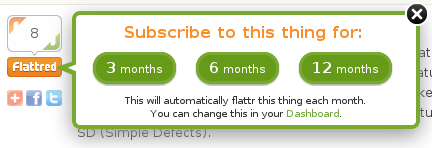
I put 5 EUR in Flattr each month and I like to spend those among other Debian contributors. That s why I keep a list of Debian people that I have seen on Flattr (for most of them I noticed through an article on Planet Debian). Directory of Debian contributors that you can thank I thought this list could be useful for others so I put it on a web page. Then I realized that limiting this to Flattr was not a good idea, and indeed several developers already propose multiple ways to be thanked. I went back through my list and looked up each developer s website to identify a Thank me page (it can be Donate , Support me , Amazon Wishlist , etc.). Obviously this means that Debian contributors who are not on Flattr do not appear on the initial list even if they have some Thank me page please help me fix this and send me the missing entries if you know of any. Click here to view the directory. The initial listing contains 16 developers and 8 of them have an additional (non-Flattr) Thank me link. Please note the warning I put on the page: the inclusion in the directory should not be taken as an endorsement of the amount or quality of the work done for Debian. You are supposed to make up your own judgment when deciding who you want to thank (but the links can help you learn more about what each contributor is doing). Flattr subscriptions explained Since this article replaces the traditional Flattr FOSS issue for this month, I wanted to introduce a new Flattr feature I recently discovered. With Flattr you have to click on some things every month or your monthly fee is given to a random charity. Now you can avoid this pitfall by subscribing to some things that you like. A subscription acts like an automatic click during a period of 3/6/12 months. If you want to subscribe to something, you just have to click a second time on the Flattr button and you will see this:
Screenshot with Flattr subscription choices Once you clicked on the desired duration, the subscription is recorded and the button will appear like this:

Screenshot with a subscribed flattr button Easy, isn t it? PS: I installed a WordPress plugin to make it super easy to share my articles on the most common social networks.

One comment Liked this article? Click here. My blog is Flattr-enabled.

2 January 2011

Lucas Nussbaum: Giving up on Ruby packaging

I have finally reached a decision regarding my involvement in the Debian Ruby packaging efforts. I have decided to stop. This has been a very hard decision to make. I have invested huge amounts of time in that work over the years. I still love the language, and will continue to use it on a daily basis for my own developments. I still hope that it will succeed. I know that some people will be disappointed by that decision (and that others will think your work was useless anyway, people should use RVM and rubygems ). But I also know that I won t be able to push for all the required changes alone. I just don t have the time, nor the motivation. For the record, here are the changes I would have liked to see in the Ruby community. The core Ruby development community should mature.
The core Ruby development community is still dominated by Japanese developers. While not a bad thing in itself, it is easily explained by the fact that the main development mailing list, where most of the important decisions are taken, is in japanese. ruby-dev@ should be closed, and all the technical discussions should happen on the english-speaking ruby-core@ list instead. The release management process should also improve. Currently, it looks like a total mess. The following Ruby development branches are actively maintained:
ruby_1_8 (106 commits over the last six months)
ruby_1_8_6 (4 commits over the last six months)
ruby_1_8_7 (35 commits over the last six months)
ruby_1_9_1 (4 commits over the last six months)
ruby_1_9_2 (227 commits over the last six months)
trunk (1543 commits over the last six months) While the state of the ruby_1_8_6 and ruby_1_9_1 branches is clear (very important bugfixes only), the state of all of the other branches is rather unclear.
What s the stable Ruby branch? 1.8 or 1.9? If it s 1.9, why are people still actively developing in the ruby_1_8 branch? How long will they continue to be maintained in parallel, dividing the manpower? Is a Ruby 1.8.8 release to be expected? Will it be ABI/API compatible with 1.8.7? Is the ruby_1_8_7 branch really bugfixes-only? How much testing of it has been done? If it s bugfixes-only and regression-free, I should push it to Debian squeeze, due to be released in a few weeks. But would you recommend that? Due to past breakages in the ruby_1_8_7 branch, it s unlikely that we will do it.
Is the ruby_1_9_2 a regression-free, bugfix-only branch? If yes, isn t 227 commits over 6 months a lot? What will be the version of the next release of trunk ? When is it expected? Will it be ABI-compatible with the current ruby_1_9_2 branch? API-compatible?
New releases in the 1.8.7 and 1.9.2 branches were done on december 25th. Why were they no betas or RCs allowing wider testing? How much testing has been done behind the scenes? Most of those questions have no clear answer. The Ruby development community should build a common understanding of the status of the various branches, and of their release expectations. Releasing on december 25th of each year sounds fun, but is releasing when everybody is on vacation really a good idea? It would be fantastic to have something similar to Python Enhancement Proposals in the Ruby community. But having open discussions in english about the major issues would already be great. Ruby is not just the interpreter.
The Ruby development community should clearly define what the Ruby platform is. There are some big players, like Rails, and newer interpreter releases should not be done before ensuring that those big players still work. Also, since we have alternative Ruby interpreters, like JRuby, Rubinius and MacRuby, we need a clear process on how they integrate with the rest of the ecosystem. For example, having each of them rely on their own outdated fork of the whole stdlib is ridiculous, since it s not where they compete. The Ruby community should acknowledge that RVM and Rubygems are not for everybody. People who say so should be laughed at. Of course, RVM and Rubygems are nice tools for some people. But it is completely wrong to believe that compiling from source using RVM should be the standard way of installing Ruby, or that all people interested in installing Redmine should know that Ruby has its own specific packaging system. The Ruby community should work with their target platforms to improve how Ruby is distributed instead of reinventing the wheel. That includes Debian, but also RedHat-based distros, for example. It is likely that it won t be possible to reach a one-size-fits-all situation. But that s real life. Some people in the Ruby community should stop behaving like assholes. As one of the Debian Ruby maintainers, I have been routinely accused of creating crippled packages on purpose (FTR, I don t think that the Debian packages are crippled, despite what the rumors says). Debian is not the only target of that. Just yesterday, someone called for abandonning YARV (the new Ruby VM in Ruby 1.9), calling it Yet Another Random Vailure. This kind of comments is really hurting the people who are investing their free time in Ruby, and is turning away people who consider getting involved. In Debian, we have had a lot of problems getting people to help with Ruby maintenance since they are getting shit from the community all the time. So, what s the future for Ruby in Debian? Update: there s also a number of interesting comments about this post on this site.
Update 2: First, thanks a lot for all the interesting comments. I will make some follow-up posts trying to summarize what was said. It seems that this post also triggered some reactions on ruby-core@, with Charles Olivier explaining the JRuby stdlib fork, and Yui Naruse clarifying that all questions are welcomed on ruby-core@. This is great, really.

1 January 2011

Stephan Peijnik: ISC dhcpd and IP assignments from a pool to specific hosts only

Assigning an IP address statically to a host with a given MAC address using ISC dhcpd is quite trivial, one host entry, a hardware ethernet entry and a fixed-address entry and you are up and running.
But what if you want to assign IP addresses from a pool to only a few hosts with specific MAC addresses?

Before you ask yourself why someone might want to do that, have a look at my (very real) use-case.
I am currently working on setting up an installation server for my employer, ANEXIA Internetdienstleistungs GmbH. The server itself uses PXE, TFTP and FAI for installing systems. To be able to do PXE booting one has to set up an DHCP server to provide configuration details, like the TFTP Server Address and the boot filename.

Now what one should consider is that this system is designed to provide automatic installations for internet-facing hosts, namely ones in public IP networks. Running a DHCP server in such a network is not a good idea. We neither want to dish out configurations to each and every hosts that asks for them, neither do not want to do a PXE boot each and every time one of our systems is restarted. Now the combination of FAI and pxelinux allows for default configurations which force local booting, but this still causes the (re-)boot time for those systems to increase and potentially also increases the load on the TFTP server. Also, let's not even consider thinking about whether this setup is "clean" or not. I personally believe that dishing out IP addresses in a public IP network is a bad thing(tm) and I guess a lot of people will be nodding when reading these lines.

What I was asking myself is how to get something like that set up in a cleaner way, and guess what, I found a solution.
The basic idea behind this is only providing IP configuration via DHCP to a specific set of hosts (with a specific set of MAC addresses) and not providing any information to all other hosts. The specific set of hosts are those that we want to do an install run on. This is a no-brainer and I guess the right way to do that, but implementing this approach is not as straight-forward as I initially thought.

Actually the implementation of that idea caused me a bit of a headache and cost me a few work-hours to get right, that's why I'd like to share the configuration details with you.


Let's have a look at how to get such a setup using ISC dhcpd. We are using the fact that ISC dhcpd allows you to not only configure a subnet, but rather also pools inside subnets, which can have allow and deny rules. Such rules can be in the form of "allow/deny member of <class>", where classes (and subclasses, keep on reading for details) can be defined inside the configuration file as well.</class>

What we first did was creating a subnet with a pool declaration, as follows:
subnet 10.0.0.0 netmask 255.255.255.0
option routers 10.0.0.254;
option broadcast-address 10.0.0.255;
filename "fai/pxelinux.0";
next-server 10.0.0.254;
server-name "10.0.0.254";
pool
allow members of "install";
range 10.0.0.10 10.0.0.230;
This one configures the subnet 10.0.0.0/24, with 10.0.0.254 being the network gateway, 10.0.0.254 being the TFTP server and "fai/pxelinux.0" being the TFTP filename. Additionally pool allows us to define a range of IP addresses we want to use, along with a line stating that only members of the "install" class should get a network configuration. If you do not have any other subnet defined in your config and a client that is not in this "install" class asks for an IP address you will see something like this in your syslog: "dhcpd: DHCPDISCOVER from 11:22:33:44:55:66 via eth1: network 10.0.0/24: no free leases". dhcpd will not even answer these requests and thus the client will not even know that there is a DHCP server running here. Exactly what we wanted.

I wrote about this giving me a headache, but so far things have been pretty straight-forward. Getting this far did not take very long, believe me.

Next thing we did was defining that "install" class as follows:

class "install" match hardware;
Again, not very hard to do. This tells dhcpd to look for subclasses of "install" with a matching hardware-address. So let's have a look at the subclass for, let's say the host with MAC address "11:22:33:44:55:66":

subclass "install" 1:11:22:33:44:55:66;
I intentionally highlighted the leading "1:" there. This means nothing more or less than "ethernet". Without that leading "1:" you won't get anywhere. Matching will fail, simple as that. It took me a while to find information about this in "man 5 dhcp-eval". Quoting parts of the interesting section:

The hardware operator returns a data string whose first element is
the type of network interface indicated in packet being considered,
and whose subsequent elements are client s link-layer address. [...] Hardware types include ethernet (1), token-ring (6), and fddi (8).
Now, with the combination of the subnet, pool, class and subclass directives we could get the setup we wanted: a DHCP server only providing IP configuration to a specific set of hosts and ignoring all other DHCP requests.

If you have any comments about this setup or ideas on how to get something similar set-up using another approach feel free to leave a comment.

Personal final note: accidentally typing 80 instead of 08 in a MAC address will cost you an additional two hours and will even have you re-compile ISC dhcpd with eval debugging turned on, believe me. :-)

Steve Kemp: It would be nice if we could record which files populate or read

It would be really neat if there were some tool which recorded which dotfiles an application read, used, or created. As an example emacs uses .emacs, but won't create it. However firefox will create and fill ~/.mozilla if it isn't present, and links will create ~/.links2. What would we do with that data? I'm not sure off the top of my head, but I think it is interesting to collect regardless. Perhaps a simple tool such as apt-file to download the data and let you search:
who-creates ~/.covers
who-creates ~/.dia
Obviously the simple use is to purge user-data when matching packages are removed - e.g. dpkg-posttrigger hook. But that's a potentially dangerous thing to do. Anyway I'm just pondering - I expect that over time applications will start switching to using "centralised" settings such as ~/.gconf2 etc. In the menatime I've started cleaning up ~/ on my own machines - things like ~/.spectemurc, ~/.grip, etc. ObQuote: What a long sword. I like that in a man - Blood of the Samurai (Don't be tempted; awful film.)

31 December 2010

Russell Coker: Links December 2010

Aaron Huey gave a disturbing TED talk titled America s native prisoners of war [1]. He says the last chapter in any successful genocide is the one in which the oppressor can remove their hands and say my god, what are these people doing to themselves, they re killing each other, they re killing themselves while we watch them die .Peter Haas gave an interesting TED talk about how the poor engineering work in Haiti contributed to the significant death toll from the earthquake [2]. He advocates training for builders to prevent death and property damage from the next earthquake which is a lot cheaper than cleaning up the mess after buildings have fallen down.Wired has an interesting article on Phylo, a new crowd-sourced science game where you can sequence DNA [3]. The article also has links to other crowd-sourced science games.Brendan Scott gives a good summary of some of the most interesting news articles related to Wikileaks [4].Petter Reinholdtsen published a detailed and informative letter that Peruvian Congressman Edgar Villanueva wrote to Microsoft on the topic of a Peruvian bill to compell the government to use free software [5]. This has a lot of great ideas for anyone who wants to lobby their government for free software related legislation.Melissa McEwan wrote an informative blog post about why she doesn t trust men [6]. I can t do justice to this with a summary so just read it if you are male.Diana Laufenberg gave an interesting and inspiring TED talk about ways of teaching children [7]. Her main point was about embracing failure, having children learn from their mistakes. I think that perhaps embracing failure is only going to work with an exceptional teacher such as Diana, and that the majority of teachers would probably fail if they tried to implement it. She does have some really interesting examples of how she teaches so it s worth watching even if you don t agree with the central point.

28 December 2010

Steve Kemp: Minor success has been achieved in reimplimenting mod_rewrite

So yesterday I mentioned the mod_rewrite-compatible proxy server. Today I've spent several hours getting to grips with that. I've progressed far enough along that the trivial cases are handled, as the following test case shows:
void
TestParamteredMatch (CuTest * tc)
 
    /**
     * We pretend this came in via the network.
     */
    char *request = "GET /login/steve.kemp/secret#password HTTP/1.1\n\n";
    /**
     * This is the mod_rewrite rule we're going to test.
     */
    char *rule    = "RewriteRule
                       ^/login/(.*)/(.*)/*$
                         /cgi-bin/index.cgi?mode=login;lname=$1;lpass=$2";
    int res = 0;
    /* Parse the HTTP request */
    struct http_request *req = http_request_new (request);
    CuAssertPtrNotNull (tc, req);
    /* Ensure it looks sane. */
    CuAssertStrEquals(tc, "/login/steve.kemp/secret#password", req->path );
    /* Create the rewrite rule */
    struct rewrite_rule *r = rewrite_rule_new (rule);
    CuAssertPtrNotNull (tc, r);
    /* Assert it contains what we think it should. */
    CuAssertStrEquals(tc, "^/login/(.*)/(.*)/*$", r->pattern );
    /* Apply - expect success (==1) */
    res = rewrite_rule_apply( r, req );
    CuAssertIntEquals (tc, 1, res );
    /* Ensure path is updated. */
    CuAssertStrEquals(tc, "/cgi-bin/index.cgi?mode=login;lname=steve.kemp;lpass=secret#password", req->path );
    free_http_request (req);
    free_rewrite_rule (r);
 
So all is good? Sadly not. I was expecting to handle a linked list of simple rules, but I've now realised that this isn't sufficient. Consider the following two (real) examples:
#
#  If the path is /robots.txt and the hostname isn't repository.steve.org.uk
# then redirect to the master one.
#
RewriteCond % http_host  !^repository\.steve\.org\.uk
RewriteRule /robots.txt$  http://repository.steve.org.uk/robots.txt [R=permanent,L]
#
#  Request for :  http://foo.repository.steve.org.uk 
#  becomes:  http://repository.steve.org.uk/cgi-bin/hgwebdir.cgi/foo/file/tip
#
RewriteCond % http_host  .
RewriteCond % http_host  !^repository.steve.org.uk [NC]
RewriteCond % http_host  ^([^.]+)\.repository.steve.org.uk [NC]
RewriteRule ^/$ http://repository.steve.org.uk/cgi-bin/hgwebdir.cgi/%1/file/tip [QSA,L]
So rather than having a simple linked list of rules for each domain I need to have a list of rules - each of which might in turn contain sub-rules. In terms of parsing this is harder than I'd like because it means I need to maintain state to marry up the RewriteCond & RewriteRules. Still the problem isn't insurmountable and I'm pleased with the progress I've made. Currently I can implement enough of mod_rewrite that I could handle all of my existing sites except the single site I have with the complex rule demonstrated above. (In all honesty I guess I could simplify my setup by dropping the wildcard hostname handling for the repository.steve.org.uk name, but I do kinda like it, and it makes for simple canonical mercurial repositories.) ObQuote: - 300

Next.

Previous.