Search Results: "cas"

15 July 2010

Biella Coleman: A User s Guide to Lulzy Media, the Pleasure of Trickery, and the Politics of Spectacle: From the Luddities to Anonymous

One of my favorite conferences is HOPE, which I have missed the last 2 times as I was away from NYC, so I am glad I am around this year. I find it especially valuable when there is some controversy brewing in the air, as there is with Wikileaks, Adrian Lamo, and Manning. I am also giving a talk, description below, with a fabulous postdoctoral researcher, Finn Brunton, who works on spam! But we will be talking about pleasure, trickery, and exploitable media for activists. Our talk is late, like really late: 11:00 PM on Saturday night. At first I was a bit annoyed at the scheduling but then I figured, when will i ever give a talk at 11:00 PM?
Following a brief lecture on Project Chanology, the question will be posed: how can we harness the power of lulzy virality, of pleasure, of trickery, of spectacular trolling for purposes above and beyond sharing the wisdom of Advice Dog? It ll start with a brief look at great activist media in the past, from Guernica and the picture of the whole Earth to projects by the Yes Men - how they spread ideas and helped people get informed, organize, and act. What makes the creation of lulzy memes different? Learn about how to create exploitable forms and rapid variations, and mechanisms for bringing the best stuff forward. Can we make media memes with goals beyond lulz, and teach activists who ve never heard of 4chan to make them too? Part lecture, part workshop, this will feature cameos by Rageguy, Pablo Picasso, V, alt.pave.the.earth, Kathe Kollwitz, Courage Wolf, Stewart Brand, Sarah Palin, Batman, Goya, Philosoraptor, Adolf Hitler, Trollface, Shepard Fairey, Joseph Ducreux, David Cameron, lots of Spartan warriors, and lots and lots of (trollish) cats.

14 July 2010

Biella Coleman: Annual Review of Anthropology on Digital Media

I don t remember how but I remember when I first stumbled on an Annual Review of Anthropology. Reading the first one was like stumbling accidentally into a pirate chest of gold doubloons. I was simultaneously flabbergasted, elated, and somewhat annoyed. I could not believe how helpful of a resource the articles were, how interesting it was to learn about the state of the field (since each review covers one topic) and what a time saver it was in terms of research. I was annoyed only because no one had really properly clued me into its existence and felt like it was one of the things that every graduate student should know about like before they even entered their program. When I got asked to write one a few years ago, a mix of conflicting emotions welled up. I was honored and horrified at the same time for I knew that it would require some of the heaviest lifting I have ever engaged in, which turned out to be the case. I almost quit twice but managed to turn in the first draft on time, before the deadline (thanks to a scheduled trip to NZ). After a parade of months of reading, drafting, and rethinking, the uncorrected proofs are now online on the ARA wesbite (you need library access to fetch it and the link is tiny and on the right hand corner). The corrected proofs will be there in a few months but all the mistakes at this point are typos, although I would check back to get the final copy for the purposes of citation. There is a lot more I want to say about the piece and the process of writing it but I will leave such ruminations for future posts. For now, it suffices to say that with a piece like this, you become a dart board, as my friend cleverly put it the other night. I am sure I have overlooked folks (I was working within very thrifty parameters, 6000 words, 150 citations though I managed to get a bit more) and I could have pushed everything further than I did, though this again was very hard to do given the constraints. I decided in the end to be as inclusive as I could, which meant sacrificing a few lines of thought, which I hope to pick up in the future. The part I like the most is the last bit, where I conclude by with the help of systems administrators and spam.

Biella Coleman: Annual Review of Anthropology on Digital Media

I don t remember how but I remember when I first stumbled on an Annual Review of Anthropology. Reading the first one was like stumbling accidentally into a pirate chest of gold doubloons. I was simultaneously flabbergasted, elated, and somewhat annoyed. I could not believe how helpful of a resource the articles were, how interesting it was to learn about the state of the field (since each review covers one topic) and what a time saver it was in terms of research. I was annoyed only because no one had really properly clued me into its existence and felt like it was one of the things that every graduate student should know about like before they even entered their program. When I got asked to write one a few years ago, a mix of conflicting emotions welled up. I was honored and horrified at the same time for I knew that it would require some of the heaviest lifting I have ever engaged in, which turned out to be the case. I almost quit twice but managed to turn in the first draft on time, before the deadline (thanks to a scheduled trip to NZ). After a parade of months of reading, drafting, and rethinking, the uncorrected proofs are now online on the ARA wesbite (you need library access to fetch it and the link is tiny and on the right hand corner). The corrected proofs will be there in a few months but all the mistakes at this point are typos, although I would check back to get the final copy for the purposes of citation. There is a lot more I want to say about the piece and the process of writing it but I will leave such ruminations for future posts. For now, it suffices to say that with a piece like this, you become a dart board, as my friend cleverly put it the other night. I am sure I have overlooked folks (I was working within very thrifty parameters, 6000 words, 150 citations though I managed to get a bit more) and I could have pushed everything further than I did, though this again was very hard to do given the constraints. I decided in the end to be as inclusive as I could, which meant sacrificing a few lines of thought, which I hope to pick up in the future. The part I like the most is the last bit, where I conclude by with the help of systems administrators and spam.

Mike Hommey: I/O patterns on ELF binary initialization

[ I meant to finish this article much earlier, but i had to leave it in a half-written draft state for quite some time due to other activities ] One particular issue that arises with big binary files is that of I/O patterns. It looks like it is not something under the usual scope for both ld.so and programs/libraries, but it can have a dramatic influence on startup times. My analysis is far from complete, would need to be improved by actually investigating ld.so code further, and so far has been limited to libxul.so built from mozilla-central, with the help of icegrind, on x86-64 linux. As I wrote recently, icegrind allows to track memory accesses within mmap()ed memory ranges. As ld.so does mmap() the program and library binaries, tracking the memory accesses within these mmap()s allows to get a better idea at I/O patterns when an ELF binary is initialized. I only focused on local accesses within a single given binary file (libxul.so) because the case of Firefox loading many files at startup is already being scrutinized, and because most of the non-Firefox files being read at Firefox startup (system and GNOME libraries) are most likely already in the page cache. I also focused on that because it was an interesting case that could be helpful to understand how big (and maybe less big) binaries may be affected by the toolchain (compiler, linker and dynamic linker) and possibly by some coding practices. For the record, what I did to get these results is to use icegrind and elflog, with further additions to the sections file with some output from objdump -h : I added sections that elflog wouldn t give (such as .plt, .hash, .dynsym, etc.), and even down to the entry level for the .rela.dyn section. The latter is particularly interesting because icegrind only outputs the first access for any given section. To see sequential accesses within that section, you need to split it in smaller pieces, which I did for .rela.dyn entries (each one being 24 bytes on x86-64). Uncommenting some parts of the icegrind code was also useful to track where some accesses were made from, code-wise. Now, the interesting data: One of the first accesses is a nullification of a few variables within the .bss section. The .bss section is usually an anonymous piece of memory, that is, a range of mmap()ed memory that is not backed by a file, and filled with zeroes by the kernel (I think it even does that lazily). It is used for e.g. variables that are initialized with zeroes in the code, and obviously, any code accessing these variables would be addressing at some offset of the .bss section. It means the section needs to start in memory at the offset it has been assigned by the linker at build time. This is actually where problems begin. When the .bss section offset as assigned by the linker doesn t align on a page (usually 4KB), the mmap()ed .bss can t be at that location, and really starts on the next page. The remainder is still mmap()ed from the binary file, and ld.so will itself fill that part. As the .bss section doesn t start on a page boundary, any write at this location will trigger the kernel reading the entire page. This means one of the first set of data being read from the file is the end of the section preceding .bss, and the beginning of the following one. Most likely, respectively the .data and .comment sections. While this probably doesn t matter much when the binary file is small, when it is big enough, reading in a non sequential manner will trigger hard disk seeks, and we all know how they can hurt performance. Although thankfully, cheap SSDs should be coming some day, in the meanwhile, we still need to cope with the bad performance. The interesting part is, the .bss section is really empty in the binary file, so its virtual memory address could be anywhere. Why the linker wouldn t align it at a page boundary without having to resort to a linker script is beyond me. The next accesses go back and forth between .dynamic, .gnu.hash, .dynstr, .gnu.version_r, .gnu.version and .dynsym. These are probably all related to symbol version resolution and DT_NEEDED library loading. While most of these sections are at the beginning of the file (not necessarily in the order they are read from), the .dynamic section is much nearer to the end, but way before .data, so that it won t even have been loaded as a by-product of the .bss section loading. After that, the .rela.dyn section is read, and for each relocation entry it contains, the relocations are being applied. Relocations is one of the mechanisms by which position independent code (PIC) is made possible. When a library is loaded in memory, it is not necessarily loaded at the same address every time. The code and data contained in the library thus need to cope with that constraint. Fortunately, while the base address where the library is mmap()ed in memory is not necessary constant, the offsets of the various sections are still as codified in the binary. The library code can thus directly access data at the right offset if it knows the base offset of the library (which is what is done on the x86 ABI), or if it knows where the current instruction is located (which is what is done on the x86-64 ABI). Static data (initialized in e.g. a const or a global variable, or, in C++ case, vtables), on the other hand, may contain pointers to other locations. This is where relocation enters the scene. The .rela.dyn section contains a set of rules describing where in the binary some pointers need to be adjusted depending on the base library offset (or some other information), and how they should be updated. ld.so thus reads all .rela.dyn entries, and applies each relocation, which means that while .rela.dyn is being read sequentially, reads and writes are also performed at various places of the binary, depending on the content of the .rela.dyn entries. This is where this gets ugly for Firefox: there are near 200000 such relocations. On x86-64 an entry is 24 bytes (12 on x86), and each of these is going to read/write a pointer (8 bytes on x86-64, 4 on x86) at some random (though mostly ordered) location. The whole .rela.dyn section not being read ahead, what actually happens is that it is read in small batches, with seeks and reads of other data at various locations in between. In libxul.so case, this spreads over .ctors, .data.rel.ro, .got, and .data. The relocation entries are somehow ordered by address to be rewritten, though they occasionally jump backwards. Some of these relocations also appear to be touching to .gnu.version, .dynsym and .dynstr, because their type involves a symbol resolution. Once .rela.dyn relocation have been dealt with comes .rela.plt s turn. The principle is the same for this section: entries describe what kind of relocation must be done where, and how the result must be calculated. The scope of this section, though, is apparently limited to .got.plt. But before explaining these relocations, I ll explain what happens with the PLT. The PLT (Procedure Linkage Table) is used when calling functions from external libraries. For example, in a Hello World example, the PLT would be used for calls to the puts function. The function making the call would in fact call the corresponding PLT location. The PLT itself, on x86 and x86-64, at least, consists of 3 instructions (I ll skip the gory details, especially for x86, where the caller needs to also set some register before calling the PLT). The first instruction is the only one to be called most of the time: it reads the final destination in the .got.plt section, and jumps there. That final destination, obviously, is not fixed in the library file, since it needs to be resolved by its symbol. This is why the two subsequent instructions exist : originally, the destination stored in the .got.plt section points back to the second instruction ; the first instruction will effectively be a nop (no operation), and the following instructions will be executed. They will jump into code responsible for symbol resolution, update of the .got.plt entry for the next call, and call of the real function. But pointing back to the second instruction is like the pointers in static data we saw above : it s not possible in position independent code. So, the .rela.plt relocations are actually filling the .got.plt section with these pointers back to the PLT. There are a tad more than 3000 such relocations. All these relocations should be going away when prelinking the binaries, but from my several experimentations, it looks like prelinking only avoids relative relocations, and not the others, while it technically could skip all of them. prelink even properly applies all the relocations in the binary, but executing the binary rewrites the same information at startup for all but relative relocations. That could well be a bug in either ld.so not skipping enough relocations or prelink not marking enough relocations to be skipped. I haven t dug deep enough in the code to know how prelinking works exactly. Anyways, prelinking is not a perfect solution, as it also breaks ASLR. Sure, prelink can randomize library locations, but it relies on the user or a cron job doing so at arbitrary times, but that s far from satisfying. An interesting thing to note, though, is that a good part of the relocations prelinking doesn t rid us of in libxul.so (more than 25000) are due to the __cxa_pure_virtual symbol, which is used for, well, pure virtual methods. In other words, virtual methods that don t have an implementation in a given class. The __cxa_pure_virtual function is set as method in the corresponding field(s) of the class VTABLE in the .data.rel.ro section. This function is provided by libstdc++, and as such, is dynamically linked. But this function is just a dummy function, doing nothing. Defining an empty __cxa_pure_virtual function to be included in libxul.so makes these relocations become relative, thus taken care of by prelinking. After all relocations occur, the library initialization itself can begin, and the content of the .init section is executed. That section, indirectly, executes all functions stored in the .ctors section. This includes static initializers, which are unfortunately called backwards, as Taras pointed out already. Each of these static initializers are also accessing various locations in the .data or .bss sections, which may or may not have already been loaded during the relocation phase. The execution of these initializers will also (obviously) read various pieces of the .text section (despite its name, it contains executable sections, i.e. functions code). The initialization of the library ends there, and no access should happen until a function from the library is called. In libxul.so case, XRE_main is first called, then many other functions, but that s another story. All that needs to be remembered about the startup process past this point is that the .text section will be read heavily, as well as the various data, got, plt and dynamic symbol sections, in a very scattered way. While most of these sections may have been retrieved in memory already, as a byproduct of the various initialization processes described above, some may have not, increasing even more the need to seek at all places in the binary file. Now the main problem with all these I/O patterns at startup, is that it seems the only way reorganizing the binary layout may have a visible impact is by considering all the above, and not only a part of it, because only addressing a part of it is very likely to only move part of the problem to a different layer. All in all, making sure the relevant sections of libxul.so are read by the kernel before ld.so enters the game is a good short-term solution to avoid many seeks at startup.

13 July 2010

Fathi Boudra: What s going on in Debian Qt world?

Qt 4.7.0 beta 2 and Qt Creator 2.0.0 have been released upstream. There s some
noticeable changes in our Qt packages compared to Qt 4.6.x series:
- legacy Qt Assistant (ADP) is removed
- new Qt declarative module is introduced
- Qt Multimedia and Qt Webkit aren t being built anymore In case your package depends on the deprecated Qt Assistant, it is still being
shipped in a separated Qt Assistant compatibility package called
qt-assistant-compat. Qt Multimedia is now shipped from Qt Mobility API instead of Qt. The module has
been renamed to Qt Mobility MultimediaKit. Qt Mobility delivers a set of APIs
for mobile device functionality. Qt WebKit is shipped standalone, separated from Qt. Hopefully, it will make
Qt WebKit security support easier. There are also a new component in the family: Qt Messaging Framework (QMF).
The Qt Messaging Framework, QMF, consists of a C++ library and daemon server
process that can be used to build email clients, and more generally software
that interacts with email and mail servers. Finally, I have started to ship a snapshot of a new Phonon backend: Phonon VLC,
one backend to rule them all ! All the packages can be found in Debian Experimental repository, except
Qt Simulator, a simulator for Qt applications running on Nokia devices.
This package should land soon in Debian archives. I encourage you to try building your Qt applications against these packages and
please, report any bugs you encounter. Enjoy. http://packages.qa.debian.org/q/qt4-x11.html
http://packages.qa.debian.org/q/qtcreator.html
http://packages.qa.debian.org/q/qt-assistant-compat.html
http://packages.qa.debian.org/q/qtmobility.html
http://packages.qa.debian.org/q/qtwebkit.html
http://packages.qa.debian.org/q/qmf.html
http://packages.qa.debian.org/p/phonon-backend-vlc.html
http://bugs.debian.org/cgi-bin/bugreport.cgi?bug=587759

12 July 2010

Russell Coker: Tracking down Write/Execute mmap() calls with LD_PRELOAD

One of the access controls in SE Linux is for execmem which is used to stop processes from creating memory regions that are writable and executable (as they make it easier to compromise programs and get them to execute supplied code). When the SE Linux audit log tells you that a program is attempting such access it s sometimes difficult to discover where in the code such an access occurs, for example if you have a large code base and mmap() is called in many places it can be difficult to determine which one is the culprit. Especially if you have a source package that contains multiple binaries that use a common shared library and you don t know which bits of library code are called by each executable. To solve this problem in the case of freshclam to provide extra information for Debian bug report #588599 [1] I wrote the following little shared object which can be compiled with gcc -shared -g -fPIC mmap.c -o mmap.so and used with LD_PRELOAD=./mmap.so whatever . Then when the program in question (or any non-SUID program it executes) calls mmap() with both PROT_EXEC and PROT_WRITE set the program will abort. If you run this through gdb then the program will break and you will get a back-trace of the function calls that led to the undesired mmap(). One thing to note is that this method only catches direct calls to a library function outside libc. When the libc code calls the library function (EG all the fwrite() etc code that calls mmap()) the LD_PRELOAD hack won t catch it. Thanks to Keith Owens for pointing this out. #include <dlfcn.h>
#include <stdio.h>
#include <sys/mman.h>
#include <stdlib.h>
#undef NDEBUG
#include <assert.h> void *libc6 = NULL; void *(*real_mmap)(void *, size_t, int, int, int, off_t); void do_init()

libc6 = dlopen("libc.so.6", RTLD_LAZY RTLD_GLOBAL);
if(!libc6)

printf("Aieee\n");
exit(1);

real_mmap = (void * (*)(void *, size_t, int, int, int, off_t))dlsym(libc6, "mmap");
void *mmap(void *addr, size_t length, int prot, int flags, int fd, off_t offset)

if(!real_mmap)
do_init();
assert(!(prot & PROT_EXEC) !(prot & PROT_WRITE));
return real_mmap(addr, length, prot, flags, fd, offset);

11 July 2010

Petter Reinholdtsen: Idea for storing LTSP configuration in LDAP

Vagrant mentioned on IRC today that ltsp_config now support sourcing files from /usr/share/ltsp/ltsp_config.d/ on the thin clients, and that this can be used to fetch configuration from LDAP if Debian Edu choose to store configuration there. Armed with this information, I got inspired and wrote a test module to get configuration from LDAP. The idea is to look up the MAC address of the client in LDAP, and look for attributes on the form ltspconfigsetting=value, and use this to export SETTING=value to the LTSP clients. The goal is to be able to store the LTSP configuration attributes in a "computer" LDAP object used by both DNS and DHCP, and thus allowing us to store all information about a computer in one place. This is a untested draft implementation, and I welcome feedback on this approach. A real LDAP schema for the ltspClientAux objectclass need to be written. Comments, suggestions, etc?
# Store in /opt/ltsp/$arch/usr/share/ltsp/ltsp_config.d/ldap-config
#
# Fetch LTSP client settings from LDAP based on MAC address
#
# Uses ethernet address as stored in the dhcpHost objectclass using
# the dhcpHWAddress attribute or ethernet address stored in the
# ieee802Device objectclass with the macAddress attribute.
#
# This module is written to be schema agnostic, and only depend on the
# existence of attribute names.
#
# The LTSP configuration variables are saved directly using a
# ltspConfig prefix and uppercasing the rest of the attribute name.
# To set the SERVER variable, set the ltspConfigServer attribute.
#
# Some LDAP schema should be created with all the relevant
# configuration settings.  Something like this should work:
# 
# objectclass ( 1.1.2.2 NAME 'ltspClientAux'
#     SUP top
#     AUXILIARY
#     MAY ( ltspConfigServer $ ltsConfigSound $ ... )
LDAPSERVER=$(debian-edu-ldapserver)
if [ "$LDAPSERVER" ] ; then
    LDAPBASE=$(debian-edu-ldapserver -b)
    for MAC in $(LANG=C ifconfig  grep -i hwaddr  awk ' print $5 ' sort -u) ; do
	filter="( (dhcpHWAddress=ethernet $MAC)(macAddress=$MAC))"
	ldapsearch -h "$LDAPSERVER" -b "$LDAPBASE" -v -x "$filter"   \
	    grep '^ltspConfig'   while read attr value ; do
	    # Remove prefix and convert to upper case
	    attr=$(echo $attr   sed 's/^ltspConfig//i'   tr a-z A-Z)
	    # bass value on to clients
	    eval "$attr=$value; export $attr"
	done
    done
fi
I'm not sure this shell construction will work, because I suspect the while block might end up in a subshell causing the variables set there to not show up in ltsp-config, but if that is the case I am sure the code can be restructured to make sure the variables are passed on. I expect that can be solved with some testing. :) If you want to help out with implementing this for Debian Edu, please contact us on debian-edu@lists.debian.org. Update 2010-07-17: I am aware of another effort to store LTSP configuration in LDAP that was created around year 2000 by PC Xperience, Inc., 2000. I found its files on a personal home page over at redhat.com.

9 July 2010

Francois Marier: Improving the performance of Request Tracker by reducing latency

Request Tracker is a really neat support tool, but one of the common complaints I heard from people using it during a previous project was that it was pretty slow.

There wasn't much we could do about the (overloaded) server it was running on, but I found that enabling mod_deflate really helped.

After watching this great video though, I was inspired to look into it a bit more, focussing this time on latency.

Description of tests
Also note that I was looking for the "best case" for each of the different configurations and so each screenshot was taken after reloading the homepage 10-20 times to maximize cache hits (thanks in large part to mod_expires).

(Is there a nice automated way of measuring average latency?)

Stock RT 3.6Using the default apache2-modperl2 config file (as supplied by RT), here's what the homepage (logged in as root) looked like before I changed anything:


The purple section here indicates the time spent waiting for the server. This shows that the server (running Mason inside mod_perl) is doing quite a bit of processing, including a lot more work than you'd expect while serving static files. It's quite impressive to see how fast the images are being served (directly by Apache) in comparison with the Javascript and the CSS files (which go through Mason).

The reason while Javascript and CSS files have to be served by mod_perl is that they are in fact templates. They contain a few Mason variables which must be substituted before being served.

Looking into it further though, all of these replacements have to do with variables defined in RT_SiteConfig.pm (mostly the install path). Here's an example:
var path = "" ? "" : "/";
which gets turned into:
var path = "/rt" ? "/rt" : "/";
So as long as these paths don't change, then there is no need to re-generate these files.

Static Javascript and CSSThis next diagram was produced after configuring Apache to serve all Javascript and CSS files directly from Apache:


The way I did that (without modifying any of the original files) was by saving the Javascript/CSS sent to the browser and using mod_rewrite rules to serve these files instead of the original templated ones:

# Serve static files directly
RewriteRule ^/usr/share/request-tracker3.6/html/NoAuth/js/ahah.js$ /var/www/rt/ahah.js
RewriteRule ^/usr/share/request-tracker3.6/html/NoAuth/js/cascaded.js$ /var/www/rt/cascaded.js
RewriteRule ^/usr/share/request-tracker3.6/html/NoAuth/js/class.js$ /var/www/rt/class.js
RewriteRule ^/usr/share/request-tracker3.6/html/NoAuth/js/combobox.js$ /var/www/rt/combobox.js
RewriteRule ^/usr/share/request-tracker3.6/html/NoAuth/js/list.js$ /var/www/rt/list.js
RewriteRule ^/usr/share/request-tracker3.6/html/NoAuth/js/titlebox-state.js$ /var/www/rt/titlebox-state.js
RewriteRule ^/usr/share/request-tracker3.6/html/NoAuth/js/util.js$ /var/www/rt/util.js
RewriteRule ^/usr/share/request-tracker3.6/html/NoAuth/css/3.5-default/main-squished.css$ /var/www/rt/main-squished.css
RewriteRule ^/usr/share/request-tracker3.6/html/NoAuth/css/print.css$ /var/www/rt/print.css
RewriteRule ^/usr/share/request-tracker3.6/html/NoAuth/webrtfm.css$ /var/www/rt/webrtfm.css

Removing unnecessary images

Finally, one thing I noticed from this last graph is that the rounded corners in the theme require a number of small images. While these don't take a whole lot of bandwidth, they do require quite a bit of back and forth between the browser and the server.

So I replaced all of the "rounded corner" images in the main-squished.css file with the following CSS attributes:

-moz-border-radius-topleft: 8px;
-moz-border-radius-topright: 8px;
-moz-border-radius-bottomleft: 8px;
-moz-border-radius-bottomright: 8px;
-webkit-border-top-left-radius: 8px;
-webkit-border-top-right-radius: 8px;
-webkit-border-bottom-left-radius: 8px;
-webkit-border-bottom-right-radius: 8px;

(yes, Internet Explorer users probably don't get the rounded corners... oh well)

This eliminated a number of roundtrips and shaved off a few more milliseconds:


Merging CSS and Javascript filesBy this stage, the pages are pretty snappy so there is not much to be gained anymore, but I figured I'd try to reduce the latency a bit more by combining all Javascript files into one (and doing the same for CSS files with the exception of print.css). This is what I got:


(Note that I also took the opportunity to minify both squished files to reduce the filesize.)

Not a huge improvement and I unfortunately had to copy quite a few Mason templates from /usr/share/request-tracker3.6/html/ to /usr/local/share/request-tracker3.6/html/ and then replace all of the script tags with a single one in html/Elements/Header.

Others things to look intoI've stopped here, but there might be ways to further reduce the processing time on the server (hence the latency) by tuning mod_perl/Mason or Postgres. The RT wiki also has a few pointers.

Replacing Apache with Nginx (which means moving to FastCGI) was something I considered, but after trying it out, it turned out that it would add about 100ms of extra latency.

Feel free to leave a comment if you've found something else that makes a big difference on your site.

8 July 2010

Biella Coleman: Debian in the World: Buidling an Institution vs Managing a Crowd

So there are times that I think of course anyone remotely interested in Free Software, virtual projects, and similar endeavors knows about Debian and its strange rituals. I am pretty mistaken, actually. Recently I have attended various events where it has been made clear to me that there are hordes of folks interested in the politics of openness, access, and free software who have heard about Debian but don t really know what it takes, socially and politically, to manage such a project. Luckily I had the chance to spread some of the esoteric knowledge during a talk at MIT for the Knight News Challenge winners and I have received many emails, excited and some surprised about the governance structures of Debian. If interested, here is a video of my talk, which is quite short, so I don t go into as much detail as I would like. There is a great audio quote from a Debian developer, taken from this class visit for which there is a podcast and which I recommend as well. If you can t play flash, you can download the a video of the talk here (look at the right hand side of the page for download link). update: Interesting blog post on Why the open source way trumps the crowdsourcing way that explores some of the issues I raise in the panel talk. I don t think it always trumps open source but it is certainly a niche form of production that is useful in some cases but all too often confused with expert peer production in quite unproductive and empirically wrong ways.

Biella Coleman: Debian in the World: Buidling an Institution vs Managing a Crowd

So there are times that I think of course anyone remotely interested in Free Software, virtual projects, and similar endeavors knows about Debian and its strange rituals. I am pretty mistaken, actually. Recently I have attended various events where it has been made clear to me that there are hordes of folks interested in the politics of openness, access, and free software who have heard about Debian but don t really know what it takes, socially and politically, to manage such a project. Luckily I had the chance to spread some of the esoteric knowledge during a talk at MIT for the Knight News Challenge winners and I have received many emails, excited and some surprised about the governance structures of Debian. If interested, here is a video of my talk, which is quite short, so I don t go into as much detail as I would like. There is a great audio quote from a Debian developer, taken from this class visit for which there is a podcast and which I recommend as well. If you can t play flash, you can download the a video of the talk here (look at the right hand side of the page for download link). update: Interesting blog post on Why the open source way trumps the crowdsourcing way that explores some of the issues I raise in the panel talk. I don t think it always trumps open source but it is certainly a niche form of production that is useful in some cases but all too often confused with expert peer production in quite unproductive and empirically wrong ways.

Neil Williams: check-deps.sh and xapt

check-deps.sh
Phil Hands and I devised a little script which is currently packaged as part of multistrap to check the dependencies of a .deb package before installing it - called check-deps.sh and can be found at /usr/share/multistrap/check-deps.sh. I just thought I'd publicise it a bit because it can help with one of my common test cases - when a binary package changes dependencies but you haven't uploaded it yet.

check-deps.sh takes a .deb to the command line -f --file option and outputs the dependencies of that .deb and whether those dependencies (at the requested versions) exist in your apt-cache policy. Optionally, you can use check-deps.sh to also then install those dependencies (not the dependencies that would come from the current version in the repository) and the package itself.

I've found this to be a much more friendly way of satisfying runtime dependencies of a package. Where things like pbuilder would just force install the .deb and then get apt-get -f install to try and fix things, check-deps.sh will fail if the required dependencies are not available in the first place.

The benefits are two-fold. First you get to see the full list and you can easily see if your work to drop a dependency has just resulted in another package bringing that dependency back in etc. Secondly, you can test whether your .deb is installable without breaking your system and then having to remove it - e.g. against backports or a Debian derivative test chroot. It should be possible to extend the script to read Build-Depends but that means reading the input from the source package, not the built binary. Might be just as easy to have a second script for Build-Depends.

(Comments are still disabled due to spammers and time-wasters, but if you would like to see check-deps.sh more widely used or extended it isn't that hard to find my email address at debian.org.)

xapt
Another new perl script, this time using the multistrap and apt-grip core to replace the apt-cross breakage to install cross-dependencies of a Debian source package. xapt has very few dependencies (dpkg-dev, dpkg-cross, apt, perl) and very simple logic. It doesn't try to second-guess which packages to use as dependencies of cross packages, it just gets them all. As such, it still isn't the tool we need for optimal cross-dependency resolution, but then neither is apt-cross - come to that, Multiarch or sysroot aren't going to provide the right tool any time soon either. So xapt at least gets over the worst of the design problems in apt-cross (by not using the apt perl bindings mainly) and seems to just work within clean chroots which is where apt-cross has the most problems.

xapt will be a new binary package, so it will need to go through NEW but I'm looking at using it as part of pdebuild-cross because it is faster than apt-cross and seems to work much more efficiently than apt-cross inside a clean chroot. xapt does not care about multiarch or sysroot, it just gets the packages and passes them to dpkg-cross. Normally, xapt cleans up after itself but you can choose to leave the built packages in /var/lib/xapt/output if that is useful.

7 July 2010

Rapha&#235;l Hertzog: Joining Ubuntu as a Debian developer

I m a Debian developer since 1998 and have been fostering cooperation between Debian and Ubuntu since its inception with various levels of success. I recently decided to go one step further and join Ubuntu as an official member. I wanted to be able to vote and to promote best cooperation practices from the Ubuntu side as well (and not only in Debian). Joining as a Debian developer should be relatively easy, it is well known in the Debian community that Mark Shuttleworth once said:
Every Debian developer is also an Ubuntu developer, because one way to contribute to Ubuntu is to contribute to Debian.
So I sought to verify that too! Here s the result. I prepared my application page collecting 2 testimonials from Lucas Nussbaum and Colin Watson, I registered for the next EMEA membership meeting (which happened yesterday, irc logs here), and I attended. (I just followed the instructions on the wiki) During the meeting, when it was my turn, I pasted my short introduction and got immediately +1 votes from several board members, they didn t even want to hear from me, they were already convinced. :-) I still responded to a few questions and elaborated on my goals and was promptly accepted even if I made it clear that my technical contributions will continue to be done within Debian. A few minutes later I was added to the ubuntumembers launchpad group and this morning I followed the instructions to add my feed to Planet Ubuntu and here I am The whole process has been very smooth and the meeting shows a very welcoming attitude. Even someone who was denied the Ubuntu member status was cheered for his work and encouraged to try again when he can present some testimonials from other members. Hello Planet Ubuntu! Flattr this Share/Bookmark 11 comments Support my work

6 July 2010

Enrico Zini: A golden rule in Debian things

A golden rule in Debian things If there's something that doesn't go the way you think, write:
I don't understand, please explain me
instead of:
You don't understand, I'll explain you
In the first case, you'll likely get an answer that starts with "I'm sorry". In the second case, you'll likely FAIL.

Matt Zimmerman: We ve packaged all of the free software what now?

Today, virtually all of the free software available can be found in packaged form in distributions like Debian and Ubuntu. Users of these distributions have access to a library of thousands of applications, ranging from trivial to highly sophisticated software systems. Developers can find a vast array of programming languages, tools and libraries for constructing new applications. This is possible because we have a mature system for turning free software components into standardized modules (packages). Some software is more difficult to package and maintain, and I m occasionally surprised to find something very useful which isn t packaged yet, but in general, the software I want is packaged and ready before I realize I need it. Even the long tail of niche software is generally packaged very effectively. Thanks to coherent standards, sophisticated management tools, and the principles of software freedom, these packages can be mixed and matched to create complete software stacks for a wide range of devices, from netbooks to supercomputing clusters. These stacks are tightly integrated, and can be tested, released, maintained and upgraded as a unit. The Debian system is unparalleled for this purpose, which is why Ubuntu is based on it. The vision, for a free software operating system which is highly modular and customizable, has been achieved. Rough edges This is a momentous achievement, and the Debian packaging system fulfills its intended purpose very well. However, there are a number of areas where it introduces friction, because the package model doesn t quite fit some new problems. Most of these are becoming more common over time as technology evolves and changes shape. Why are we stuck?
I suppose it is tempting, if the only tool you have is a hammer, to treat everything as if it were a nail.
Abraham Maslow
The packaging ecosystem is very strong. Not only do we have powerful tools for working with packages, we also benefit from packages being a well-understood concept, and having established processes for developing, exchanging and talking about them. Once something is packaged, we know what it is and how to work with it, and it fits into everything else. So, it is tempting to package everything in sight, as we already know how to make sense of packages. However, this may not always be the right tool for the job. Various attempts have been made to extend the packaging concept to make it more general, for example: Other package managers aim to solve a specific problem, such as providing lightweight package management for embedded systems, or lazy dependency installation, or fixing the filesystem hierarchy. There is a long list of package managers of various levels which solve different problems. Most of these systems suffer from an important fundamental tradeoff: they are designed to manage the entire system, from the kernel through applications, and so they must be used wholesale in order to reap their full benefit. In other words, in their world, everything is a package, and anything which is not a package is out of scope. Therefore, each of these systems requires a separate collection of packages, and each time we invent a new one, its adherents set about packaging everything in the new format. It takes a very long time to do this, and most of them lose momentum before a mature ecosystem can form around them. This lock-in effect makes it difficult for new packaging technologies to succeed. Divide and Conquer No single package management framework is flexible enough to accommodate all of the needs we have today. Even more importantly, a generic solution won t account for the needs we will have tomorrow. I propose that in order to move forward, we must make it possible to solve packaging problems separately, rather than attempting to solve them all within a single system. But I like things how they are! We don t have a choice. The world is changing around us, and distributions need to evolve with it. If we don t adapt, we will eventually give way to systems which do solve these problems. Take, for example, modern web browsers like Firefox and Chromium. Arguably the most vital application for users, the browser is coming under increasing pressure to keep up with the breakneck pace of innovation on the web. The next wave of real-time collaboration and multimedia applications relies on the rapid development of new capabilities in web browsers. Browser makers are responding by accelerating deployment in the field: both aggressively push new releases to their users. A report from Google found that Chrome upgrades 97% of their users within 21 days of a new release, and Firefox 85% (both impressive numbers). Mozilla recently changed their maintenance policies, discontinuing maintenance of stable releases and forcing Ubuntu to ship new upstream releases to users. These applications are just the leading edge of the curve, and the pressure will only increase. Equally powerful trends are pressing server applications, embedded systems, and data to adapt as well. The ideas I ve presented here are only one possible way forward, and I m sure there are more and better ideas brewing in distribution communities. I m sure that I m not the only one thinking about these problems. Whatever it looks like in the end, I have no doubt that change is ahead.

Martin-&#201;ric Racine: On pohjant hden alla, T koti mulla mainen, M el m st laulan...

My girlfriend and I were out picking up a cake at the bakery last week, when my phone rang: Without knowing, at that moment, I had just become a citizen of the country in which I have been living for the past 12 years. It was only yesterday, upon receiving the decision in the mail and looking at the date on the certificate that I realized that, when I got the phone call, the decision had already been made and the bureaucracy was only looking for reassurances that I fully intend upon acquitting my civic obligations as soon as humanely possible. To say that reading the decision was a highly emotional moment is an understatement. Trying to explain the intensity of this moment to my girlfriend, I compared it to the day when a teenager reaches adulthood. This instant brought a similar feeling: suddenly, the whole EU opens its doors to me and I'm free to decide how to best use the opportunities it offers. What next? For now, completing this government training to become a bureaucrat. Funnily enough, becoming a citizen resolved the whole issue of background checks, which also suddenly triples the number of possible venues for the on-job part of the training. In my case, it looks like I'll be spending the next few months at the Ministry of Employment and Entrepreneurship, working on EU projects that fund R&D efforts and export sales ventures in each member state. After that, I'm not sure. On one hand, I'd like to apply for the Ministry of Foreign Affairs' KAVAKU recruitment program for future diplomats. On the other hand, that ministry is extremely picky about whom it accepts and it's not particularly known for favoring naturalized individuals. This being said, our current Minister recently published rather ambitious plans to completely reform the Ministry by bringing in seasoned professionals from the private sector who could efficiently promote Finnish know-how and products abroad, rather than hiring more of the same Public Administration graduates, so, who knows? Maybe the time is right for someone like me to join the ranks of the Finnish diplomacy? An other option that I'm considering is to permanently move to Estonia. When my last job there ended, I was left with the feeling that I could have accomplished a lot more, if only I were in a legal position to move there, rather than commute a couple of times a week. Beyond the pioneering work that myself and my diplomat friends at the Estonian embassy did in Turkey, there was a demand for us to perform the same magic in other countries of interest to Estonia. Unfortunately, not being in a position to be on-site and no longer having a job that paid for me to be there often enough meant that I had to pass on that opportunity. Now, seeing how one of my friends recently left the diplomacy and is open to new challenges, I'm wondering if now might be a good time to resume our operation and prepare our next campaign? Wow... So much to think about, now that a whole continent opened its doors to me. Hienoa! Olen suomalainen.

5 July 2010

Thorsten Glaser: LSM/RMLL; mksh R40, R41 plans

The current version of mksh had use of arc4random(3) removed, including set -o arc4random , to speed it up (on some architectures, a lot) this will break some existing scripts (such as /etc/rc *cough* on MirBSD ). Hence I decided to publish the next version of mksh(1) as R40 based upon current development, and defer plans for associative arrays (and multidimensional arrays) for mksh R41. There s also already the change to Build.sh arguments, so this suits me quite fine. (Read: if running MirBSD, don t upgrade mksh at the moment.) There will be a new MirBSD snapshot once this is fixed, maybe a few more changes to the shell for better POSuX compliance, and the recently mentioned patent on LFNs (long filename) in FAT will be taken into account with a patch to msdosfs. I ll travel to LSM/RMLL 2010, the Libre Software Meeting (Rencontres Mondiales du Logiciel Libre) tomorrow until the weekend, to hack some on FusionForge (this is worktime for me), visit XTaran, Uriel, and maybe a couple of other usual people . Thundersday, between 10:00 UTC and 12:00 UTC, eurynome will be shut down by gecko2@ due to power supply maintenance on the host system data centre. We have a new mirror in the Americas, thanks a lot to Mike 'Fuzzy' Partin! Benny will mention it on the webpages once it s working.

Julian Andres Klode: Review: Lenovo ThinkPad Edge 15

Wednesday, after some weeks with a flickering screen (or more precisely, something is causing GTK+ to redraw and the kernel to print ^@ in the terminal when you touch the screen, see http://jak-linux.org/tmp/20100628_002.mp4) in my 3 years old HP Compaq 6720s (which seems to be a software-hardware combination problem, at least it works in Ubuntu); I decided to buy a new laptop. It took me a few minutes to find the Lenovo ThinkPad Edge 15 NVL7VGE; which I ordered at notebooksbilliger.de at around 14:30 CEST using Express. On Thursday morning at 6:40 CEST, the device arrived. The laptop features an Intel Core i5 430 M processor with integrated graphics, 4 GiB of RAM, 320 GB hard disk storage, matte screen, and of course a TrackPoint. The machine comes pre-installed with Windows 7 Professional which is not very nice (and Lenovo does not take Windows licenses back). I booted Ubuntu 10.04 from an USB disk which worked a few times, but not always, so I upgraded the BIOS to make USB booting reliable (as Lenovo published multiple BIOS updates already, one fixing this USB booting issue). The first step was booting Ubuntu 10.04 from an USB hard disk to check the Linux support. Using Ubuntu, everything worked out of the box, including stuff like HDMI audio support or output switching. An exception may be the DVD drive, which only works if you set the SATA mode to compatibility. Non-DVD media also works in AHCI mode, but only if you start with a disc inserted in the drive. Playing DVDs requires setting a region code using setregion(8) [otherwise they do not work at all] and SATA compatibility mode [otherwise they only work partially]. Another issue is the HDMI output, as the TV is not correctly detected and some parts at the top and the bottom of the image are missing (that is, the GNOME panels) (but that happens with different screens and ATI cards as well). Oh, and closing the lid with a screen attached and the internal screen disabled works only as long as you do not open it again, because that causes the GPU to stop. On the input side, we have one keyboard, one TrackPoint, and a touch pad. All of them work out of the box, but they have a few problems on the hardware side: The cursor keys on the keyboard are incredibly small and the touchpad is very large. The keyboard is different from the one in the HP Compaq: First of all, there is space between the keys (like Apple keyboards); and secondly, you need to apply more pressure in order to use the keys. The device feels more solid than the HP Compaq 6720s, especially touching the screen does not change the colors on the screen. I don t know how long the keyboard will last, but I hope that I will still have symbols on them in 5 months (which was not the case for the HP Compaq 6720s keyboard). Power consumption is another interesting point. When the device is idle and the screen is disabled, the device seems to consume about 10W. With screen enabled, consumption varies between 13W (idle) 35W (building source code); if the values received via ACPI are correct. The device ships with a 48 Wh battery which after some time was displayed as 53 Wh in gnome-power-statistics (only the when loaded state, capacity is displayed as 47.5Wh). According to Lenovo, the laptop lasts 4.5 hours on battery, meaning consumption of 47.5 Wh / 4.5 h = 10.5 Wh which is a bit overly optimistic if you want to work on the device. After checking everything, I took over my Debian sid installation from my old laptop (which I installed in 2008). It runs happely now, although I still need to get accustomed to the new keyboard and the large touch pad. All in all, the price of 765 I paid for the device seems to be OK. Now I only need to remove the Windows 7 sticker and hope that the device lasts long enough until I want to buy a new one (probably 2013, if the aliens don t invade us 2012).
Filed under: General

4 July 2010

Bernd Zeimetz: gimp-plugin-registry 3.5-1

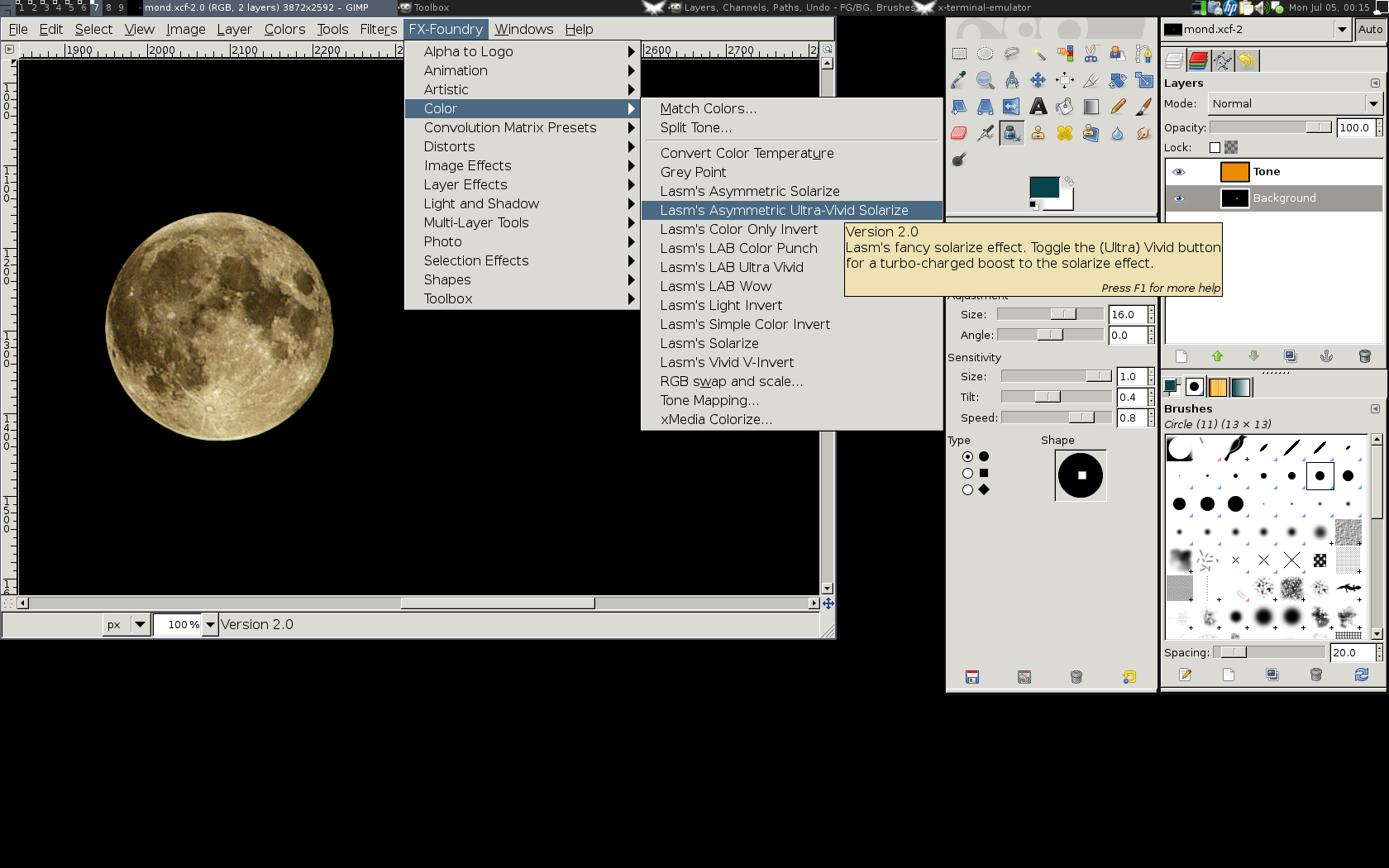
During the last three months and since my last blog-post about gimp-plugin-registry a lot happened: Mainly a large number of new plugins was added, but also various enhancements and bugfixes went into the package, together with updates for various already included plugins. The GIMP screenshot with open FX-Foundry menu For those who don't know gimp-plugin-registry yet, it is a collection of scripts and plugins for The GIMP. The name is based on the webpage GIMP Plugin Registry, where most (new) plugins and scripts are listed. So far the package ships with 170 scripts/plugins. Most of the scripts are written in TinyScheme, but there are also several plugins in C or Python. Probably most noticeable is the inclusion of the GIMP FX Foundry, which is an awesome collection of 124 scripts. Below follows a list of all scripts and plugins as shown in the long description of the Debian package. New plugins are marked with a bold fontface. If there is any interest from other distributions to include the package, I'd be happy to help out to make an integration as easy as possible. The few interesting parts could be ripped out of debian/rules and shipped as a normal Makefile, so they could be used easily. More complicated is the generation of the package description and copyright information, but I guess instead of writing debian/coyright and debian/control, it should be possible to integrate the information into a rpm spec file template or similar files. So in case you're interested to port the package to Fedora, OpenSuSE or some other distribution, don't hesitate to contact me! The sources are available via git, see git.recluse.de for details. For wishes, suggestions and bug reports either use the Debian BTS or Launchpad. While I prefer bugs via the BTS, it might be easier for non-Debian users to file bugs in the Ubuntu Launchpad.
Torsten Landschoff: Postprocessing conference videos

I was planning to attend DebConf New York this year, but for a number of reasons I decided not to go. Fortunately, Ferdinand Thommes organized a MiniDebConf in Berlin at LinuxTag and I managed to attend. Thanks, Ferdinand! There were a number of interesting Talks. I especially liked the talk of our DPL, and those about piuparts and git-buildpackage. In contrast to the other LinuxTag talks, we had a livestream of our talks and recorded (most) of them. The kudos for setting this up goes to Alexander Wirt, who spent quite a few hours to get it up and running. I have to apologize for being late in bringing my Notebook, which was intended to do the theora encoding of the livestream. This was a misunderstanding on my part, I should have known that this is not going to be setup in the night before show time So to compensate the extra hours he had to put in for me, I offered to do the post processing of the videos. Basic approach for post processing The main goal of post processing the videos was (of course) to compress them to a usable size from the original 143 GB. I also wanted to have a title on each video, and show the sponsors at the end of the video. My basic idea to implement that consisted of the following steps:
  1. Create a title animation template.
  2. Generate title animations from template for all talks.
  3. Use a video editor to create a playlist of the parts title talk epilogue.
  4. Run the video editor in batch mode to generate the combined video.
  5. Encode the resulting video as ogg theora.
As always with technology, it turned out that the original plan needed a few modifications. Title animations
<video controls="controls" height="288" src="http://www.landschoff.net/blog/uploads/2010/07/mdc2010_title_anim1.ogv" width="360 "></video>
Originally I wanted to use Blender for the title animation, but I knew it is quite a complicated bit of software. So I looked for something simpler, and stumbled across an article that pointed me towards Synfig Studio for 2D animation. This is also in Debian, so I gave it a try. I was delighted that Synfig Studio has a command line renderer which is just called synfig and that the file format is XML, which would make it simple to batch-create the title animations. My title template can be found in this git repository. Batch creation of title animations I used a combination of make and a simple python script to replace the author name and the title of the talk into the synfig XML file. The data for all talks is another XML file talks.xml. Basically, I used a simple XPath expression to find the relevant text node and change the data using the ElementTree API of lxml python module. The same could be done using XSLT of course (for a constant replacement, see this file) but I found it easier to combine two XML files in python. Note that I create PNG files with synfig and use ffmpeg to generate a DV file from those. Originally, I had synfig create DV files directly but those turned out quite gray for some reason. I am now unable to reproduce this problem. Combining the title animation with the talk For joining the title animation with the talk, I originally went with OpenShot, which somebody of the video team had running at the conference. My idea was to mix a single video manually and just replace the underlying data files for each talk. I expected that this would be easy using the openshot-render command, which renders the output video from the input clips and the OpenShot project file. However, OpenShot stores the video lengths in the project file and will take those literally, so this did not work for talks of different play times I considered working with Kino or Kdenlive but they did not look more appropriate for this use case. I noticed that OpenShot and Kdenlive both use the Media Lovin Toolkit under the hood, and OpenShot actually serializes the MLT configuration to $HOME/.openshot/sequence.xml when rendering. I first tried to read that XML file from python (using the mlt python bindings from the python-mlt2 package) but did not find an API function to do that. So I just hard coded the video sequence in python. I ran into a few gotchas on the way: Things to improve While the results look quite okay for me now, there is a lot of room for improvement. Availability

Christine Spang: Christine Spang: [h]ledger rocks my world

I hate keeping track of money. Bank accounts, credit cards, investing it's such a hassle. Hell, sometimes I even hate the fact that money exists and needs to be dealt with in the first place. But I admit that it's an easier system than bartering for everything. In college I pretty much ignored most things financial. I rarely had more money than I needed, and put little financial planning into deciding what I could and could not spend money on besides, "I'm going to make X dollars this summer," and, "think twice." But now that I have a steady paycheck, it seems like a good idea to know where all my money goes, so I can make better decisions about how I'm spending (and saving) it. But I've kept procrastinating starting to do so, because GUI programs like Gnucash and HomeBank seem like such a hassle. Their first screen is dauntingly complex, and if you don't know much about accounting it's scary and difficult to be asked to set up a big set of accounts when first starting to use the program, without having any prior experience with what you personally would find useful to keep track of. Entering data through menus and dialogs is tedious and slow. hledger (or ledger, which came first) had been appearing on my radar recently, not least because Iron Blogger uses it). hledger changed my opinion of accounting software. In about 15 minutes, using only the sample transactions from the manual, I was able to enter all my assets and liabilities bank accounts, credit card, student loans, money I've borrowed from people and never paid back though I said I would, etc. And then, I could run 'hledger balance' and it would tell me what sorts of things I had spent money on in the past few days, as far back as I could bother looking up actual transactions for, rather than entering a single transaction with a balance forward. Duuude, awesome! I'm a geek. I like statistics and data about my life, as long as it's not a huge pain to collect the data in the first place. More data means more on which to base decisions, decisions which will then be freer from the bias of what I find memorable enough to remember having done. Here's what I like best about ledger: I don't think I'd be enjoying keeping track of my money nearly so much without a tool like hledger. It gets out of your way to let you focus on the hard things, like choosing categories for the things you spend money on and remembering to record the data in the first place.

Next.

Previous.