Search Results: "spa"

14 September 2010

Kees Cook: my part in the ecosystem

I was asked to write about what I do at Canonical and what I do in the Free Software community at large. There is obviously a great deal of overlap, but I ll start with the things I m involved with when I m wearing my Ubuntu hat. My primary job at Canonical is keeping Ubuntu secure. This means that I, along with the rest of the Ubuntu Security Team, coordinate with other Free Software distributions and upstream projects to publish fixes together so that everyone in the community has the smallest possible window of vulnerability, no matter if they re running Ubuntu, Debian, RedHat/Fedora, SUSE/openSUSE, Gentoo, etc. Between vendor-sec, oss-security, and the steady stream of new CVEs, there is plenty going on. In addition to updates, the Security Team works on pro-active security protections. I work on userspace security hardening via patches to gcc and the kernel, and via build-wrapper script packages. Much of this work has been related trying to coordinate these changes with Debian, and to clean up unfinished pieces that were left unsolved by RedHat, who had originally developed many of the hardening features. Things like proper /proc/$pid/maps permissions, real AT_RANDOM implementation, upstreaming executable stack fixing patches, upstreaming kernel NX-emu, etc. Most of the kernel work I ve done has gotten upstream, but lately some of the more aggressive protections have been hitting frustrating upstream roadblocks. Besides the hardening work, I also improve and support the AppArmor Mandatory Access Control system, as well as write and improve confinement profiles for processes on Ubuntu. This work ends up improving everyone s experience with AppArmor, especially now that it has gotten accepted upstream in the Linux kernel. I audit code from time to time, both on the clock with Canonical and in my free time. I m no Tavis Ormandy, but I try. ;) I ve found various security issues in Xorg, Koffice, smb4k, libgd2, Inkscape, curl+GnuTLS, hplip, wpa_supplicant, Flickr Drupal module, poppler/xpdf, LimeSurvey, tunapie, and the Linux kernel. With my Canonical hat off, I do all kinds of random things around the Free Software ecosystem. I m a sysadmin for kernel.org. In Debian, I maintain a few packages, continue to try to push for security hardening, and contribute to the CVE triage efforts of the Debian Security Team. I ve written or maintain several weird projects, including MythTVFS for browsing MythTV recordings, GOPchop for doing non-encoding editing of MPEG2-PS streams, Perl s Device::SerialPort module, and the TAP paging server Sendpage. For a selection of things I ve contributed to other project, I ve implemented TPM RNG access in rng-tools, made contributions to Inkscape s build and print systems, implemented CryptProtect for Wine, wrote a PayPal IPN agent in PHP that actually checks SSL certificates unlike every other implementation I could find, added additional protocol-specific STARTTLS negotiations to OpenSSL, implemented the initial DVD navigation support in MPlayer, updated serial port logic in Scantool for communicating with vehicle CAN interfaces, tried to add support for new types of timeouts in Snort and Ettercap, fixed bugs in mutt, and added HPUX audio support to the Apple ][ emulator XGS. As you can see, I like making weird/ancient protocols, unfriendly file formats, and security features more accessible to people using Free Software. I ve done this through patches, convincing people to take those patches, auditing code, testing fixes and features, and doing packaging work. When I go to conferences, I attend UDS, DefCon, OSCon, and LinuxCon. I ve presented in the past at OSCon on various topics including security, testing, and video formats, and presented at the Linux Security Summit (miniconf before LinuxCon this year) on the need to upstream various out-of-tree security features available to the Linux kernel. I love our ecosystem, and I love being part of it. :)

Raphaël Hertzog: How to customize dpkg-source s behaviour in your Debian source package

dpkg-source is the program that generates the Debian source package when a new package version is built. It offers many interesting command-line options but they are often not used because people don t know how to ensure that they are used every time the package is built. Let s fill that gap! It is possible to forward some options to dpkg-source by typing them on the dpkg-buildpackage command line but you d have to remember to type them every time. You could create a shell alias to avoid typing them but then you can t have different options for different packages. Not very practical. The proper solution has been implemented last year (in dpkg 1.15.5). It is now possible to put options in debian/source/options. Any long option (those starting with -- ) can be put in that file, one option per line with the leading -- stripped. Here s an example:
# Bzip2 compression for debian.tar
compression = "bzip2"
compression-level = 7
# Do not generate diff for changes in config.(sub guess)
extend-diff-ignore = "(^ /)config.(sub guess)$"
Notice that spaces around the equal sign are possible contrary on the command line. You can use quotes around the value but it s not required. The debian/source/options file is part of the source package so if someone else grabs the resulting source package and rebuilds everything, they will use the options that you defined in that file. You can also use debian/source/local-options but this time the file will not be included in the resulting source package. This is interesting for options that you want to use when you build from the VCS (Version Control Repository, aka git/svn/bzr/etc.) but that people downloading the resulting source package should not have. Some options (like --unapply-patches) are only allowed in that file to ensure a consistent experience for users of source packages. You can learn more about the existing options in the dpkg-source manual page. Read it, I m sure you ll learn something. Did you know that you can tell dpkg-source to abort if you have upstream changes not managed by an existing patch in debian/patches? It s --abort-on-uptream-changes and it s only allowed in debian/source/local-options. Be sure to subscribe to the RSS feed or to the email newsletter to not miss useful documentation for Debian contributors! Flattr this Share/Bookmark 3 comments Support my work

13 September 2010

Alexander Wirt: Etch Backports removed from backports.debian.org

Today the Backports for Debian Etch got removed from the backports.debian.org archive. Should you really still need them, the backports are still available from http://archive.debian.org/debian-backports [1] but we recommend everybody to upgrade from Etch with backports to Lenny (with backports) now, as there is no security support anymore for Etch.Over its lifetime etch-backports accumulated a total of 508 different backports, resulting in more than 2250 binary packages for all Debian architectures offered to the users. All together the available backports and their source occupied 13Gb of mirrorspace and the backports team would like to thank every contributor and mirror admin for their work and help to make this possible.[1] deb http://archive.debian.org/debian-backports etch-backports main

Iustin Pop: 3ware raid resize via pivot_root

How pivot_root won against a stupid RAID controller This post is brought to you by a very stupid 3ware 9650SE RAID controller, which doesn't understand the concept of growing a RAID array after all disks have been replaced by bigger ones. Or, well, it can, but the procedure, involving sending array dumps to the technical support, then receiving a program to run under DOS (!), doesn't inspire me with confidence. Furthermore, this stupid RAID card doesn't allow easy reordering (if it's possible, and I just missed it, please let me know) of the RAID arrays at runtime, only from the BIOS screen, and I didn't have access to that (only poor man's serial console under Linux). So, after buying new harddrives, and replacing the original ones in the RAID1 array with double the capacity, I realised I have to do a manual conversion. Basically, go into single-user mode, remount all read-only, split the RAID1 array into its (identical) components, change root directory to the second disk, re-partition the first disk, copy the data from the 2nd to the 1st disk, then re-add the 2nd disk to the 1st one (repartitioned) to re-establish the RAID1. All this, on a headless (no keyboard, no VGA) machine, just with a serial console. Of course, if this is just your local machine, you can easily reboot from an external media, and do all this easily from a full user-space. In any case, I'm writing this down, as there seem to be no easily findable guides on how to do the resize on a 3ware with its restrictions. Procedure Disclaimer: you might lose data via this, there are no guarantees. Have up-to-date backups. First, make sure you have power control (you can power-cycle the box if needed) and the serial console works. Also, make absolutely sure that the RAID array is fully consistent, and that you don't have any bad sectors on the drives, as you will lose redundancy during the operation. If /usr is not on your root file-system, then you need to copy /usr/sbin/chroot to somewhere on it. Also, if you have tools for the array that are not on your root file-system, you should copy them there now. In my case, that was tw_cli. First reboot Reboot into init=/bin/sh. Note: I've tried to simply go into single-user mode, or to reboot with emergency, but this doesn't work, because in both modes, beside the init process with PID 1 and your shell, there's another init process (the parent of the shell), and I didn't know how to tell it to re-execute itself. To the main init process it's easy, you just run telinit u, but that child keeps the old root directory mounted. If it's possible to re-exec that child too, then this step can be skipped please let me know how! Changing the root mount Make sure everything is mounted read-only (should be), then split the raid array into its component drives, using whatever tool the card needs. For me, it was:
# tw_cli /c0/u0 migrate type=single
The second drive now should be visible e.g. as /dev/sdc, so mount it somewhere, and pivot_root to it:
# mount -o ro /dev/sdcX /mnt
# cd /mnt/
# pivot_root . mnt/
# exec chroot .
At this point, the new root (on some partition on /dev/sdc) is mount at the root, and the exec call replaced the current shell with another one that has the right root directory. So nothing should keep the old root directory (at /dev/sdaX) in use, and umount /mnt (or umount /dev/sdaX) should succeed now. Recreate the first raid array Now, since it's no longer in use, you can delete and recreate the first raid array. Once it's available, you have two choices: I did the latter, since I wanted to use the new alignment standards (the initial installation was still using sector 63 for the boot partition, etc.) as a future preparation for either SSD or 4K-sector drives. So I used: In any case, either copy the entire disk, or each partition in turn, or possibly pvmove from the old to the new disk, etc. Switch back the root mount At this point, /dev/sdc is no longer used, and you can again change the root directory. This is similar to the first pivot_root, but now using /dev/sda as a target. All the instructions are the same. Convert back to RAID1 Now, since (in our example) /dev/sdc is no longer in-use, you can delete that drive and rejoin it to the first drive, recreating the RAID1 array. In my case:
# tw_cli
/> /c0/u2 delete
blah blah [y/n] y
/> /c0/u0 migrate type=raid1 disk=X
At this point, the machine is again redundant (or will be once the resync finishes), but it still needs one more step or it won't boot correctly. Reinstall the boot-loader Now, for reinstall the boot loader, you'll probably need to mount /boot (and mount it read-write), and do whatever you need. In my case, I re-ran lilo, but grub-install /dev/sda should also work. Final reboot And now, you only need to reboot into the normal, resized system. Since you can't easily use shutdown when booted with /bin/sh as init, just use /proc/sysrq-trigger to sync/unmount/reboot. Thoughts While I use a hardware RAID controller for the battery backup it offers, I have never thought it cannot do such a simple operation (compare with mdadm --grow /dev/mdX --size=max). Second, I knew about pivot_root but have not used it before. It's a very very nice thing, and the only downside is that you can't really use it with more than a few processes, since it's hard/impossible to change a random process' root directory. But anyway, it works, and it's damn handy for doing things to the root file-system or in general to the root drive (e.g. just repartitioning it) when you can't boot from another media (e.g. remote machine).

Alastair McKinstry: So what should we call these things ?

The Exoclimes conference ended on an interesting perennial problem: what should we call these things we work on? The climate folks pointed out what the astronomers have grown used to: the telephone numbers we use as planet names. The two most studied Hot Jupiters, for example, are HD209458b and HD189733b. Come on, we could do better than that. In fact the naming worries started earlier when Frank Selsis asked people to avoid calling the planets he works on "super-Earths" (or should that be Super-Earths?). Dimitar Sasselov had accidentally kicked up a kerfuffle in the media a few weeks back by calling them "Earth-like" planets, when he meant "Earth-sized" planets. Selsis pointed out non-scientists will interpret "super-Earth" to mean "like Earth, only Better!", when we mean its just a bigger ball of rock and ice than Earth. But what to call them? Well, at least one planet already has a name, sort of: HD 209458b is frequently called 'Osiris'. And there is a published list of possible planet names. But Osiris the Egyptian god is more famous than Osiris the planet, confusing google. And people are going to assume things based on the planet names: are we really going to name a planet Vulcan? One suggestion was that if we found a system with seven planets we could call them after the Seven Dwarfs, but this was ruled out: don't mention the war (but dwarfs could also mean brown dwarfs!) At the end of the conference, there was show of hands: who agreed with naming planets? of about 100 present, all in favour, none against. The delegate to the IAU commision on the matter, which had voted against, duly noted. Perhaps we will name them then. Tags , ,

Amaya Rodrigo: Of inner peace and struggle

[Nothing related to Debian here, move on if you don't care about my recurring obsession with the end of the world, Cassandra pains, or Big Phat Living Room Revolution yearnings].

Although I am still looking for a community of anarcho-primitivists that want to accept me joining their frugal living, and simply slip off the social construct, the system, the fucking face of earth, call it what you will, I could find some comfort in my favourite feminist blogger's take on the subject of my midlife crisis regarding ecology, capitalism, patriarchy, child bearing, overpopulation, meat consumption and all the rumination of consuming thoughts that (still) make my life miserable and have kept me running away from human contact for a year.

[Emphasis mine]

At what point does human culture depart from the Natural? With the invention of computers? TV? Cars? The cotton gin? Electricity? Taco stands? Gunpowder? The printing press? Written language? Shoes? Crop cultivation? Yurts? The wheel? Did humans become unnatural when the good old days of picturesque, endless agrarian toil, feudal oppression, unchecked disease, ignorance, and death from dysentery at 35 turned into the bad new days of urban post-industrial capitalism where a pound of fair-trade organic coffee costs $12.99 and your email inbox is full of spam?

ah. Everything humans do, or have ever done, is natural. We can t do anything else. The idea that modern culture is un-natural is nostalgic and inaccurate. Living off the grid in a yurt is good in some absolute sense, whereas driving an SUV from a suburban bungalow to the stripmall is bad ? Come on. This a romantic, but misguided view. The cosmic reaction to a 20 Ford Expedition is the same as to a sanctimonious Prius: bupkis. The universe doesn t give a fuck about you or your lifestyle choices. It doesn t give a fuck about the economy, oil spills, or civil unrest in Blargistan. It doesn t give a fuck about katydids. Eventually our whole planet will be erased from space, and the galaxy won t bat an eye. The inevitable extinction of our species (imminent, according to research here at Spinster Laboratories) via the exhaustion of available resources is as natural as a fresh-picked peach. As Andre 3000 and other dude philosophers have observed, nothing is forever.

Yes, yes, when people use the word natural what they really mean is free of chemical additives and maybe some of the assorted hippie concepts that go with that narrative. Barter economies, home furnishings made from bamboo, vegan cookbooks, living in the country. While I would argue that it is just as natural for people to put chemical additives in things as it is to not put chemical additives in things, I admit that it is appealing to fantasize that the source of human misery is an unnatural isolation from Nature, and that doing yoga on an organic rubber mat and drinking organic spinach smoothies will put me back in sync with the cosmos.

But alas, I m already in sync with the cosmos, and so are you. In other words, this is it. This is what we ve become, and this is what we get. Which is not to say that a person can t fantasize about a verdant paradise full of songbirds and polar bears and Bengal tigers, untouched by human influence. Only, that world isn t a world we could actually live in. The minute you add contented children, lazy from a carefree day at the swimming hole, eating ripe plums on the porch at sunset to that scenario, natural history changes, and it s right back to our scorched-earth dystopia. Our giant brains use up resources, it s as simple as that.

As long as we re still here, though, we might as well try to make the best of it.

http://blog.iblamethepatriarchy.com/2010/06/19/heads-up-art-week-starts-on-monday/


Though the comfort is somewhat ephemeral, because deep inside, I know she's wrong, I know another way is feasible, but I have given up already, I have very well come to terms with extiction, I get an enormous pleasure from the thought of the very well deserved human mass suicide-by-cop^Wnature, and in fact, I trust and hope it will save me personally from facing the hard times ahead, as I am a damn coward, paralized by fear, hopeless about the flock ever getting it (is it so hard, really?), while doing as much as I can but completely overwhelmed by the need of changing a world everyone seems to like just as it is. I can certainly empathize with much more disturbed ways of airing similar anguish, among many other examples, such as The Unabomber, or The Weather Underground. I don't even want to go there as I know violence all too well and it is not fun to be on the receiving end. But I see the screaming desperation behind the motives of acts I am not at the liberty to discuss here. I wonder if consumption of resources in the form of books will numb the disorder or make it worse and what sort of medical arrangement the stablishment has for it. As you click away the previous links will mean nothing to you because a)it is Wikipedia after all, and b)you probably don't even understand what the problem of eating animal corpses is, humans are omnivores after all, and what is all this nonsense about dropping language altogether.

WTF, there was no comfort after all, and I am still a nutjob.

Eddy Petrișor: Fixing a bookmark corruption in Iceweasel/Firefox

At some point in the past my bookmarks broke in such a way that I wasn't able anymore to alter in any way the bookmarks, deletions, additions, reorganisation, nothing worked.

Way before this event I set up a git repo in my .mozilla directory and committed everything in the directory (except obvious cache files and such) in the repo. I didn't make a cronjob with this since I didn't thought of a proper way to make sure the browser wasn't started (the data might have been inconsistent at commit time), and, since most of the time I have the browser started, it seemed rather useless to try to automate for a very, very small window of time when the browser data would be in a consistent state. As a consequence, I did occasional manual commits in the git repo.

When the bookmarks issue appeared I realised that my last git commit was so old that it didn't made any sense to try to restore since I would have had lost bookmarks, passwords and plugins. So I made a checkpoint commit os the broken profile and resorted to all sorts of manual attempts at fixing the issue, but all my efforts of playing with the bookmarks.* files proved to be useless.

I concluded that icewesel/firefox 3.5.x was using some other mechanism and decided to dig into the issue at some latter time when time allowed me to analyse and fix it. Today was that day.

I began by creating a backup for the bookmarks via the Bookmarks Manager export function. After a hickup, it managed to save a proper bookmarks.html file. I tried to import that file, but the breakage remained.

Then I decided I should prepare for the worst, installed an addon which allowed me to save all stored passwords and created a new account (started firefox from the command line with 'firefox -ProfileManager') with the intention to transplant files from the old files into the new one. Short after that I realised that it would be smarter to commit the new profile, too, import the bookmarks from the backup file and replace the touched files back into the old profile.

After the import and closing the browser, git informed me that the modified files were:
XPC.mfasl
XUL.mfasl
cookies.sqlite
localstore.rdf
places.sqlite
pluginreg.dat
urlclassifier3.sqlite


At this point the modification of the binary .mfasl files looked very ugly to me, but I had a hunch that the only relevant file to my problem was the places.sqlite file and I went on to check the contents of the file with sqlitebrowser. After inspecting also the urlclassifier3.sqlite file (whose contents were unreadable), I decided to give it a try at simply placing the places.sqlite file in the old profile and see if the problem would be fixed that way. After all, I had the whole profile's state in git so any breakage could have been undone easily.

I started firefox using the old profile and the problem was fixed. Yay!

Now I have my bookmarks back and a suggestion for the mozilla people: please don't keep useless files like bookmarks.html in the profile once they become outdated, they are misleading.

P.S.: I still have to think of a way to make automated sane commits. Maybe I'll try to make an iceweasel/firefox addon. This could be a nice idea since I could learn something new, too.

12 September 2010

Lucas Nussbaum: Ruby packaging in Debian and Ubuntu: Mythbusting and FAQ

A lot is being said on how Ruby is packaged in Debian and Ubuntu. In this post, I m trying to go through the most common myths and give my position as a Debian Ruby maintainer. Note that those are my views, not necessarily those of the other Debian Ruby maintainers. Myth: Ruby is completely outdated in Debian and Ubuntu There s a culture in the Ruby community of always using the latest bleeding-edge version. There s also a culture (though this one has recessed a bit, I think) that it s perfectly fine to change APIs in incompatible ways if it makes the software slightly better. In Debian (and Ubuntu) stable releases, we try to provide a rock-solid version of Ruby that won t be allowed to change API during the support lifetime of a release. Bugfixes for important bugs can be applied, but that s basically all. So it s not surprising that Ruby in released versions of Debian and Ubuntu is behind the latest upstream version. In development branches, we are following the latest upstream versions quite closely. Debian 6.0 squeeze , to be released by the end of the year, includes Ruby 1.8.7-p302, and will include 1.9.2-p0 (the currently of Ruby 1.9.2 in squeeze is currenty a SVN snapshot from beginning of august). There are people interested in installing a packaged Ruby that just works, and other people interested in installing their own version of Ruby (through RVM and such). People in the Ruby community tend to forget about the first category, and consider that, because they install Ruby from source or with RVM, that should be the solution for everybody. We need the Ruby community to respect that different people have different ways of using Ruby, and to stop recommending that everyone using Debian and Ubuntu should install Ruby from source. We also need to leverage the backports services for both Debian and Ubuntu to provide a way to install the latest upstream version on stable releases. The only reason why we are not doing it yet is lack of time. Myth: Ruby is split into a myriad of packages in Debian In the past (pre-2005), a decision was made to split some libraries from the standard library into separate packages. This was motivated by: Most of the split was undone a very long time ago, and the readline and openssl splits were undone this year. The current package in Debian squeeze has: It is always possible to merge more packages, but merging any of the other packages would significantly increase the size of what you get by default, and might discourage people to use it in some contexts (disk space is not always cheap. Think embedded systems and smartphones). Myth: Rubygems is crippled in Debian There are two differences in the rubygems Debian packages. First, gems are installed in /var/lib/gems, not /usr/local/lib/gems. That is because rubygems are seen as state for the Rubygems package, not independant software installed separately. A change for this is currently being discussed, and should be done after the squeeze release. (I don t think that it s reasonable to push that change now). A consequence of installing to /var/lib/gems is that gems binary are outside of $PATH. After the change, gems binary would also be installed in /usr/local/bin. Second, gem update --sytem is disabled in the Debian package, because that would replace code from the Rubygems Debian package with code downloaded from the Internet, and can break your system in subtle ways. We have changed this (in SVN, not in any package in the archive yet) to allow gem update --system if a specific environment variable is set, which gives us the opportunity to display a warning message. Myth: Ruby is slow on Debian Ruby is built with the pthread threading code, because not using it breaks many native Ruby libraries (Ruby-gnome2, for example). And other Linux distributions are doing the same. There are some very old benchmark results floating around in some blogs that show that the pthread code has a performance impact of about 20%. There are been patches for that for a long time (applied in Ruby Enterprise Edition), but they were never properly sent back. Actually, all the discussions about this issue were rumors and blog posts, and there wasn t even a bug report about it! After the bug was reported properly, it was fixed in a timely manner. The fix is not yet included in the Ruby 1.8.7, but is being applied as a patch to the Debian package since 1.8.7.299-2. (So the Debian package is actually newer and faster than upstream Ruby in that regard). What makes Ruby so difficult to maintain in Debian? The main problems we have with Ruby are portability issues. The only officially supported platform for Ruby is IA32 (i386 in Debian), and everything else is best effort. It means that it is not even supported officially on x86_64/amd64! Debian supports a dozen of architectures, and the Ruby package has to work on each of them. Ruby 1.8 is mostly OK nowadays thanks to the help of Debian porters, but we still have serious problems with 1.9.2, since the test suite fails on sparc, hppa, ia64 and Debian GNU/kFreeBSD. Why doesn t Ruby use the alternatives system on Debian? The alternatives system provides a way to switch between different software providing the same functionality. Currently, if you want to use Ruby 1.9.2, you need to use the ruby1.9.1 executable (1.9.1 = ruby compatibility version here). The alternatives system would allow to switch ruby to ruby1.9.1 on a system-wide basis. However, the situation of applications and libraries working only with Ruby 1.8 should be clarified: those should use /usr/bin/ruby1.8 instead of /usr/bin/ruby. Another problem is that the way to specify packages dependencies still need to be determined. There s nothing impossible to do about that, it just needs someone to do the work. Where do we go from here? The Ruby developers (or expert users) community is generally very hostile towards Debian. Many harsh words and insults are used in discussions mentioning Debian in the ruby-core@ mailing list, and there are frequent recommendations to avoid the Debian packages and install from sources, which is quite demotivating (Actually, what prompted that blog post is someone calling Debian-specific changes unforgivable). This atmosphere makes it hard to recruit people, and the Debian Ruby teams are completely understaffed, which is clearly the major blocker to improving the situation further. We are 3 co-maintainers for the interpreter packages, and I m the only Debian Developer that is really active on a regular basis in the pkg-ruby-extras team (that does libraries and applications packaging). We desperately need help, but at the same time I have no time to improve our documentation and make it easier to join the team. While I haven t reached a final decision yet, I am also likely to stop doing Ruby work in Debian after squeeze is released, as I am getting increasingly tired and demotivated.

Alastair McKinstry: Exoclimes: the diversity of planetary scientists

I'm just back from ExoClimes 2010: Exploring the Diversity of Planetary Atmospheres. An excellent conference: the PDFs of the talks and posters are now online, and they are putting the videos of the talks up soon. But in particular the organizers deserves thanks for bringing exoplanetary scientists and observers together with climate modelers doing Earth (and Mars, Titan, Venus, ...) models.
Model complexity graph Peter Cox on model complexity
The last talk on Friday was by Peter Cox on Climate change and exoplanet sciences that was far better than expected for the "graveyard shift". One theme of the conference was the need for a 'heirarchy' of models, from simple energy-balance models to full circulation (GCM) models: using progressively more complex models to understand more bits of whats going on. Exoplanet workers mostly use simpler models, progressing now to GCMs, while Earth modellers are moving beyond GCMs to "Earth system" models including biology, etc. Peter pointed out the two styles of work: the exoplanet modelers are short of data, and risk being too speculative. We know little of what the planets are like, and concentrate on implementing physics in the models to see what they might be like. Earth modelers on the other hand are if anything swamped with data: the tendency here is to make the model fit the data, by adjusting parameters until it does so. The danger of this approach is that the model will then not work away from current present-Earth conditions. Tim Lenton pointed out some work that was done with the Met Office model, where they took the radiative transfer part of the model and tested it for other planets, and paleo-Earth conditions. The model blew up : it wasn't capable of x2 or x4 current CO2 levels. (This has since been corrected). Over dinner there were interesting discussions on the different styles within the communities. While the underlying GCMs used come from the Earth sciences, its quite common within the exoplanetary community for a researcher to work on all parts of the model: dynamics one day, radiative transfer the next. In Earth climate work people have become more specialized and someone is a 'radiative transfer' person, and won't touch other parts of the code (even if they can follow them in the huge codes we have today!). On the other hand, there is a greater tradition of model inter-comparison in Earth sciences, where we compare the model outputs to each other for some known test cases ( Held & Suarez, the CMIP5 project, etc.) Apart from some initial work by Emily Rauscher, little has been done on this in exoplanetary models; it was agreed more of this would be a good idea. Radiative transfer (the interaction of 'sunlight' with the atmosphere, where it gets absorbed, scattered and re-radiated) in particular seems to be an area that could benefit from this. In this middle ground Francois Forget showed the work on the LMDZ model and applying GCMs to terrestrial planets. They've successfully applied this model to Mars, Titan, and partially to Venus (a much tougher problem, due to its heavy clouds giving a long radiative timescale). There are problems with correctly explaining super-rotation though. This is where the atmosphere rotates faster than the planet: on Venus for example the planet rotates every 243 days, while the clouds rotate around the planet every 4 days. Sebastian Lebonnois described the possible mechanisms for Venus and Titan; Johnathan Mitchell so did some interesting work on this recently. Different regimes are involved for different rotation rates of the planet. Ralph Lorenz pointed out the lack of "real paleo-Earth" climate work at the moment. While geology has inspired a lot of work on the atmospheric composition, what with the different gas mixtures (meaning earth-model radiative transfer codes don't work) and the faster dynamics meaning super-rotation could apply (Earth's day was about 8 hours long in the Archean era), we don't have a model of the climate yet. It looks like we should treat Earth as an exoplanet. Tags , , ,

Christian Perrier: Release team...

(update: yesterday's version was using http://wiki.debian.org/Teams/ReleaseTeam as reference, while http://www.debian.org/intro/organization is the one that's up-to-date. Those watching the current traffic in debian-release can probably realize the huge *thank you* deserved by the entire release team for the work they're doing. So, how about spamming the release team members with (private!) "thank you" messages when they unblock a package of yours? And (even more difficult) also one when they don't unblock your package...but spent time reviewing it and more time to explain you why they prefer not unblocking it... In any case, thank you, Neil Maulkin, Adam adsb, Dann dannf, Felipe faw, Jurij trave11er, Luk luk, Mehdi mehdi, Pierre MadCoder, Julien jcristau (doh, French Cabal!)...and Martin zobel (who's apparently forgotten on the page). Not to forget Adam adsb and Phil phil for managing stable releases....and the Wise Release Wizards (vorlon, aba, luk, HE). Hat off, guys (only guys there, yet another place for d-w to show up).

11 September 2010

Christian Perrier: Release team...

Those watching the current traffic in debian-release can probably realize the huge *thank you* deserved by the entire release team for the work they're doing. So, how about spamming the release team members with (private!) "thank you" messages when they unblock a package of yours? And (even more difficult) also one when they don't unblock your package...but spent time reviewing it and more time to explain you why they prefer not unblocking it... In any case, thank you, Neil Maulkin, Adam adsb, Dann dannf, Felipe faw, Jurij trave11er, Luk luk, Mehdi mehdi, Pierre MadCoder, Julien jcristau (doh, French Cabal!). Not to forget Adam adsb and Phil phil for managing stable releases....and the Wise Release Wizards (vorlon, aba, HE). Hat off....

10 September 2010

Bernd Zeimetz: refactoring the guruplug server plus

As mentioned in my last blog post the GuruPlug Server Plus needs some major refactoring before it can be used. Not doing so will make you end up with a fried brick. There are various stories in the forums about cooling it properly, so you might want to have a look first instead of following mine blindly. And of course - whatever you do - it is your fault when you end up with a brick, not mine!.

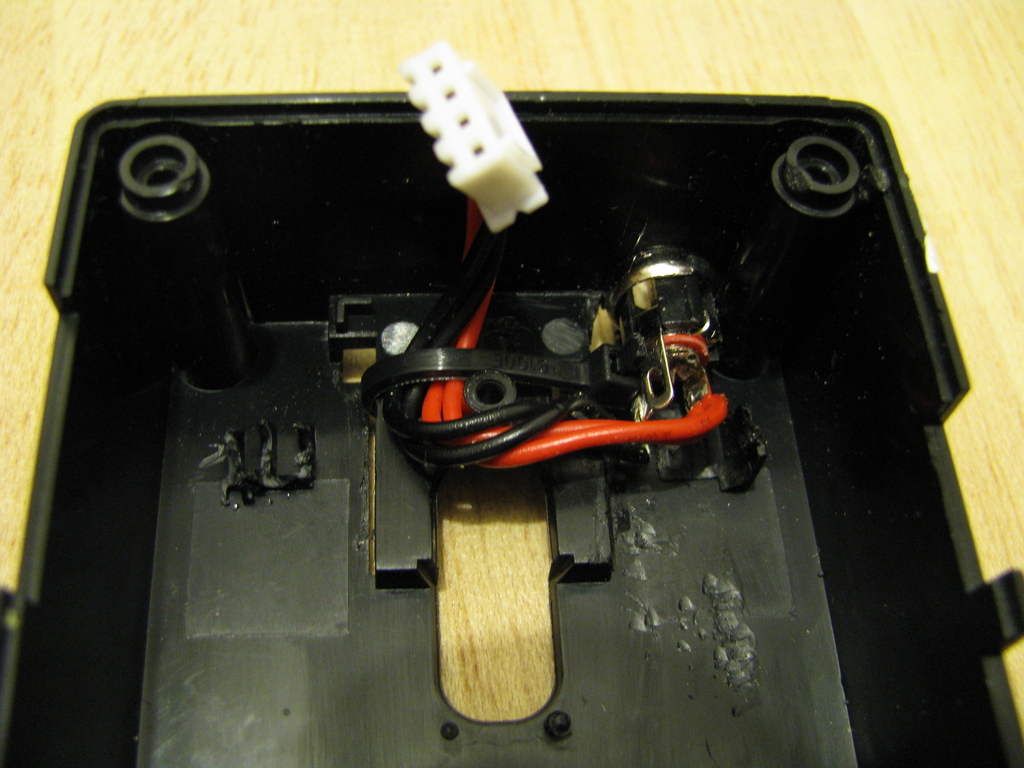
Replacing the power supply As I would never ever trust the PSU (see my last blog post for the gory details) and some additional free space in the case is necessary, it is time to rip it out. As replacement I've ordered an external 5V/20W PSU. To connect it to the plug I've drilled a hole into the case and added a proper connector after soldering the original cable from the old PSU to it. Make sure to add some retainer to stop the cable from touching the CPU/memory heat sinks later. GuruPlug Server Plus PSU replacement GuruPlug Server Plus PSU cabling

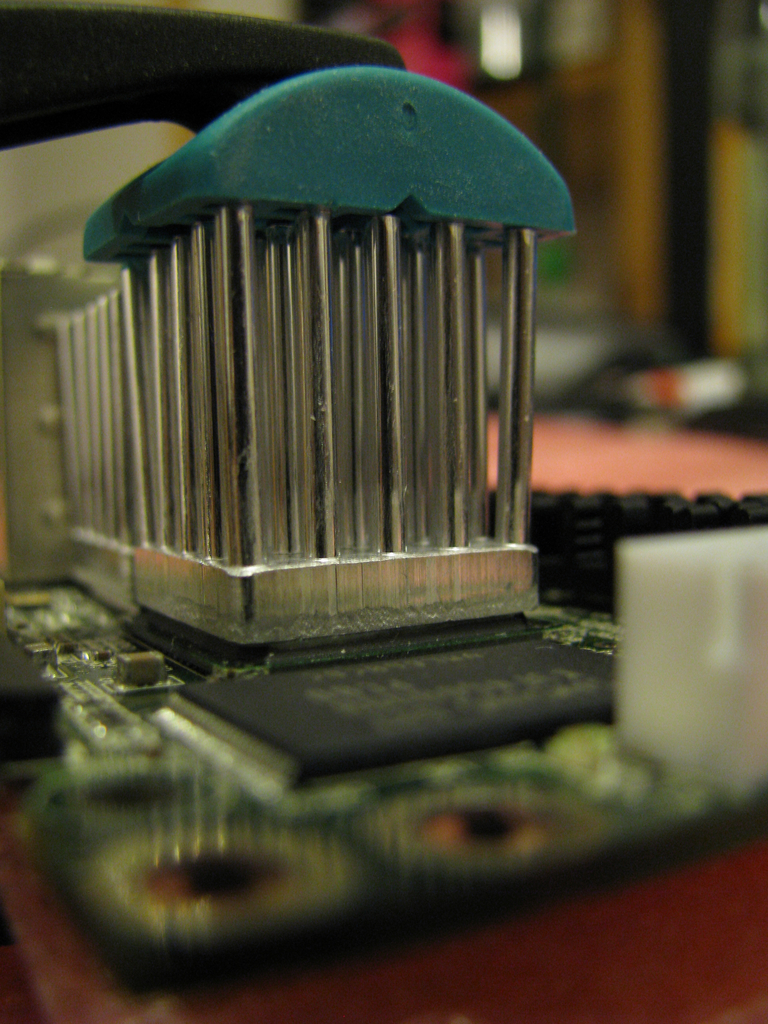
Proper heatsinks One of the biggest problems in the original GuruPlug design is the heat spreading and collecting piece of alloy, which probably makes things even worse than better. After some discussion in #debian-devel the idea came up, that the board should be able to run fine without a heatsink - at least when idling. That is the case, indeed. So let's get rid of that piece of alloy, together with the holders and springs. Unfortunately heat things are necessary to handle some work load. To mount them make sure you get some good thermal glue as you don't want to insulate the chips from their heat sinks. I've used Arctic Silver II thermal glue - not cheap, but working well. Make sure to clean the heat sinks and chips properly with alcohol (2-Propanol is my favourite for that), so there is no fat and dust left. When you use the glue be careful to read the documentation properly and make sure you apply only as much as necessary - a thin coating is enough. After applying the glue and mounting the heat sink you need a clamp to put some pressure on it while the glue dries.

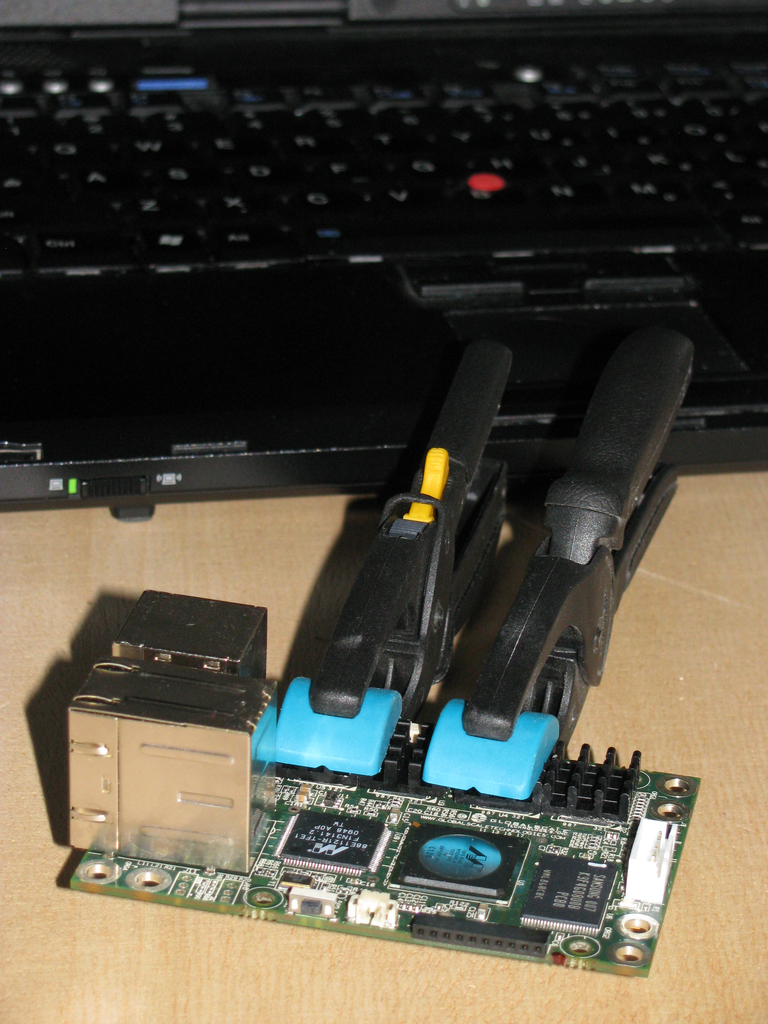
Heat sinks for the memory As there is a lot of space around the memory chips, I've got some 14x14x6mm heat sinks. Luckily there are only small parts on the other side of the board, so it was not hard to attach clamps to ensure the glue is able to dry properly. In case largish amounts of glue are squeezing out between heat sink and chip you probably want to start from scratch and clean everything (quickly!) with alcohol again. GuruPlug Server Plus memory heat sink clamping

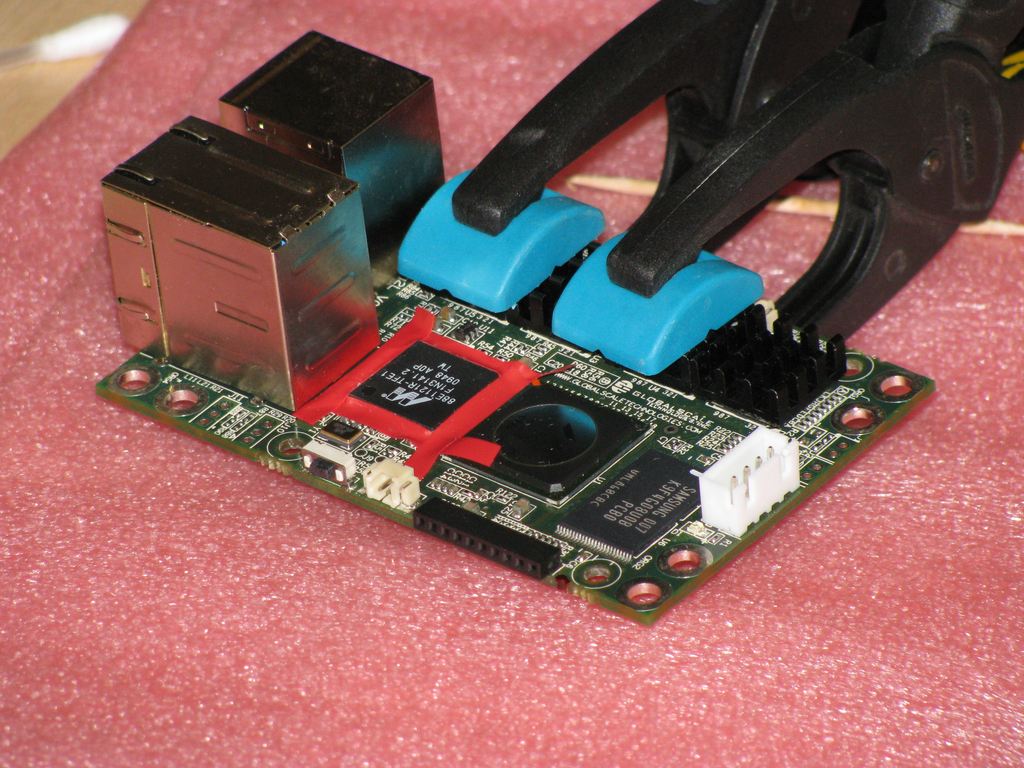
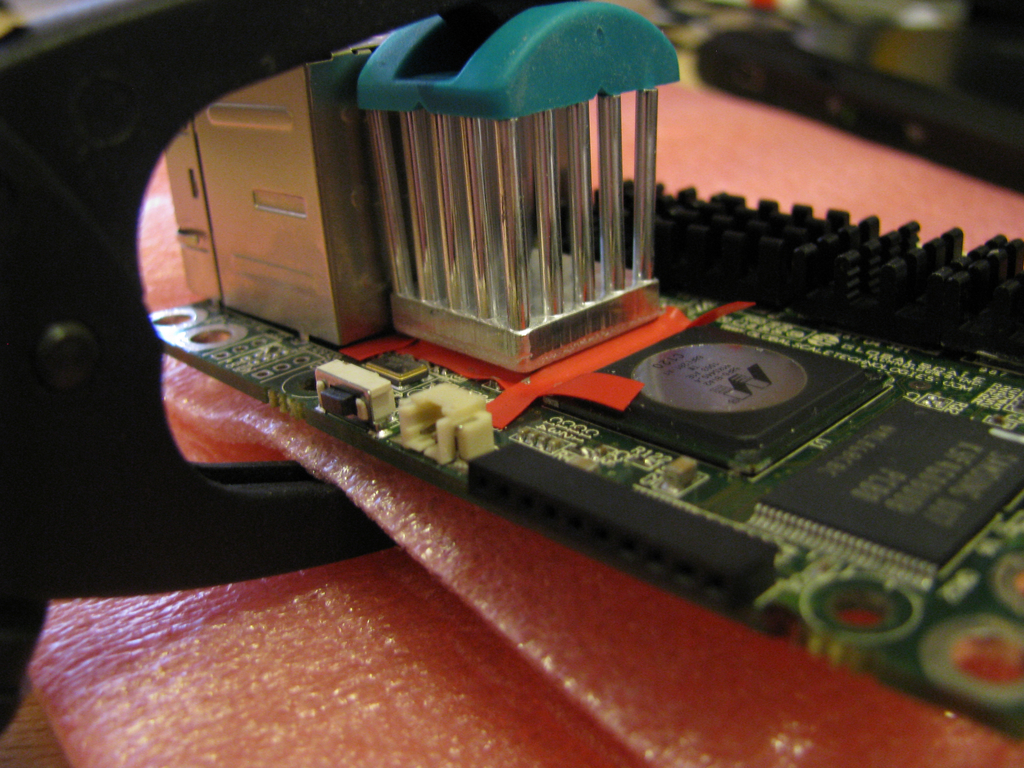
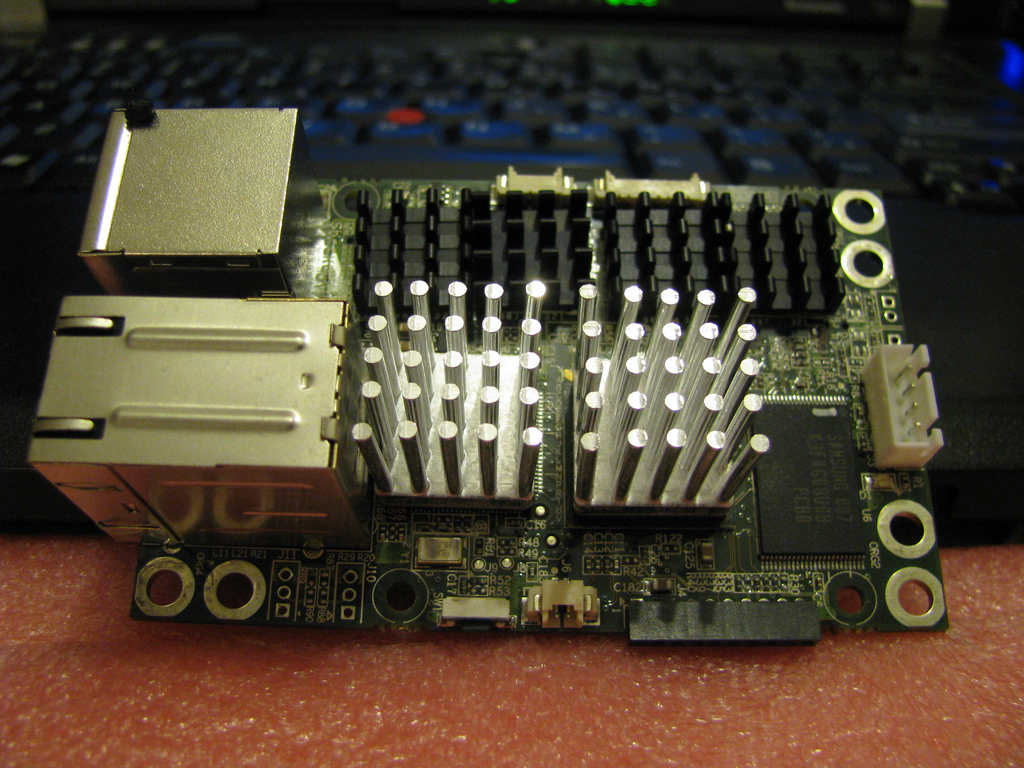
Gigabit Ethernet PHY and CPU heatsinks PHY and CPU need proper heatsinks as they're becoming pretty hot under load. Due to space limitations I had to stick with a 17x17x20mm heat sink for the PHY. I've tried to get a largish heat sink with BGA mount for the CPU, but I was not able to find one in short time and without ordering 1000 of them. So I've got another one of the 17x17x20mm model for the CPU. Later I found two other heat sinks which might fit on the GuruPlug's CPU: Malico 19x19x25mm or a Advanced Thermal Solutions Maxigrip. But for now the smaller one will have to do the job, also I'm scared to removed it without destroying the CPU. To mount the heat sink on the PHY a bit of preparation is necessary to ensure that the glue doesn't result in short cuts on the IC's pins. The arctic silver documentation recommends to use silicone on the pins to stop the glue. As I neither had the proper silicone nor did I want to make such a mess, I've decided to get a sticky insulating tape and some tooth picks to mount it properly on the IC pins. Make sure to do a proper job here! With good clamps you can work on the PHY while the memory heat sink glue is still drying. GuruPlug Server Plus - preparing the PHY The other problem on this side of the board is that some higher parts are mounted on the lower side of the board, so make sure to get some foam to protect them from your clamps. Except of the size of the heat sinks there is no real difference to the small ones: add glue, mount the heat sink and fix it with a clamp. GuruPlug Server Plus - mounting the PHY heatsink Before the glue dries completely make sure you remove the duct tape strips again. Be careful not to wipe any excess glue onto the IC pins. If you manage to do so you might want to remove and clean everything properly. So just be careful and everything should be fine. GuruPlug Server Plus - mounting the PHY heatsink 3 Mounting the heat sink on the CPU is easier as the CPU is a nice BGA package. No need to protect pins an there are none. GuruPlug Server Plus - mounting the CPU heatsink

Finished As you're able to see on the photo I did not the very perfect job, but fine enough to work properly. GuruPlug Server Plus - heatsinks

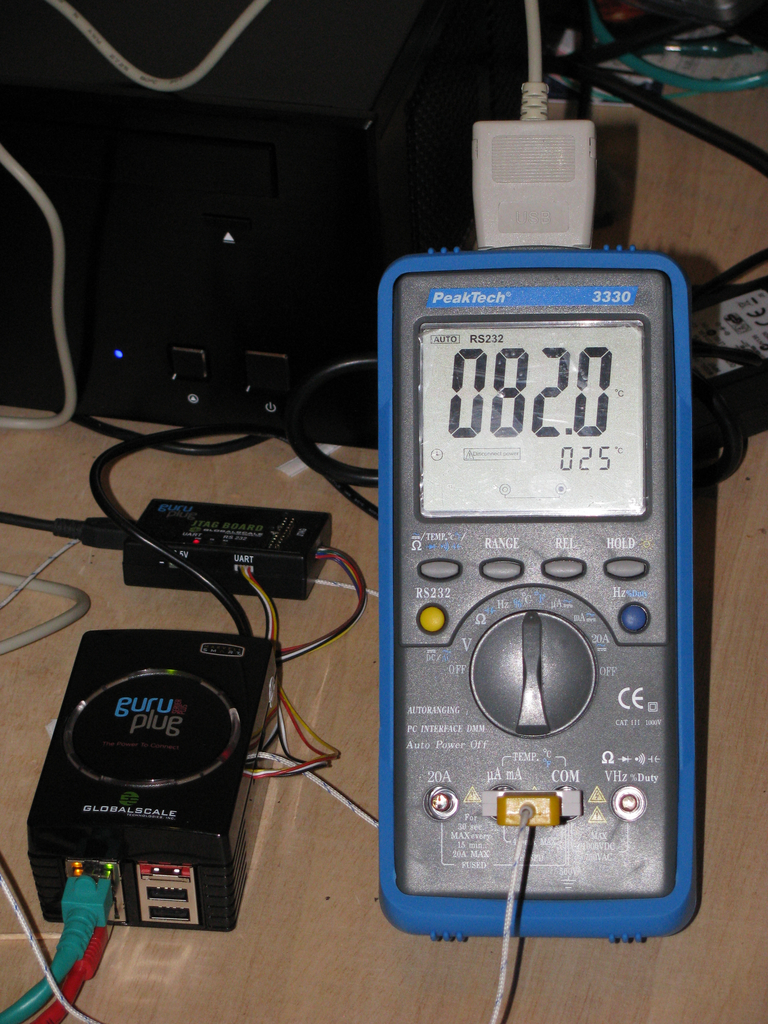
First tests with the new heatsinks Some tests with stress and some heavy network traffic showed quickly that the heat sinks are working well! But not well enough to be able to mount them into the original closed case (how the hell was this supposed to work before!?). Without any air to breath the temperature on the CPU heat sink went up to 85 deg C quickly. So on the CPU's die are > 100 deg C, which is at least close to the max allowed temperature. GuruPlug Server Plus - still too hot

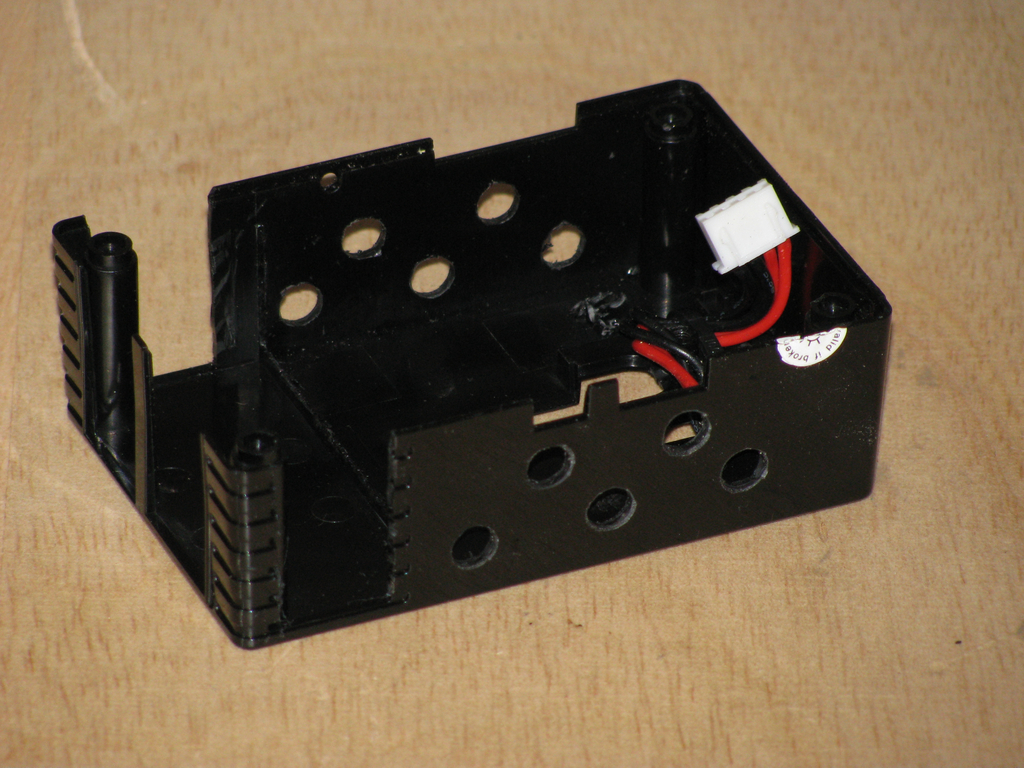
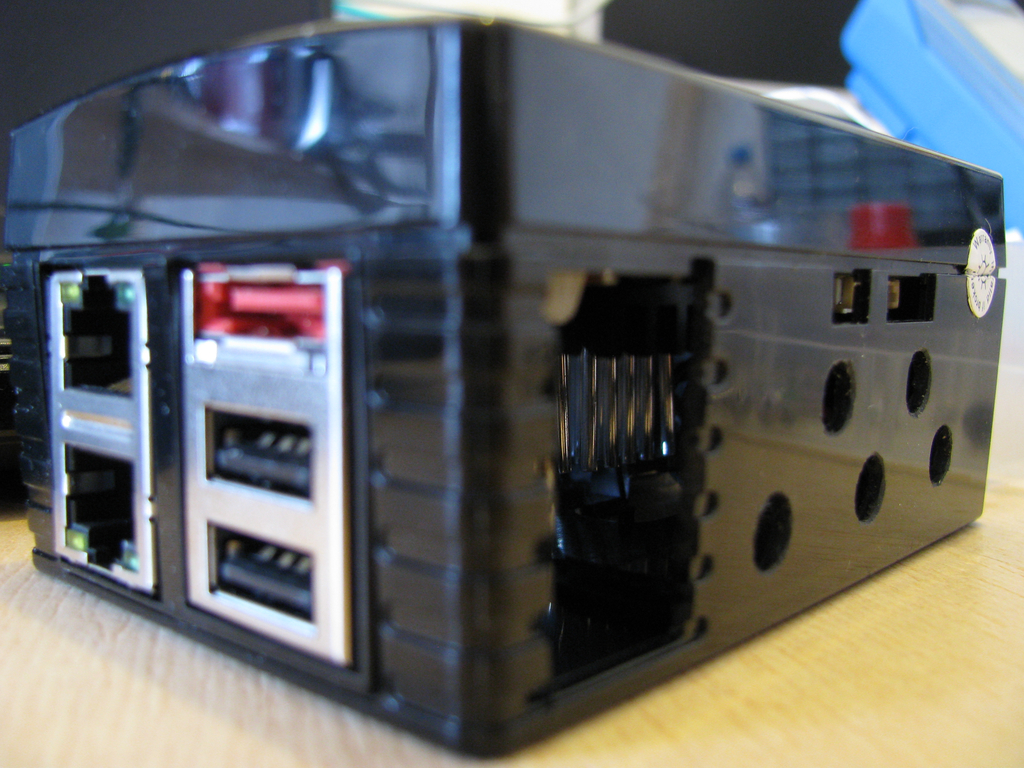
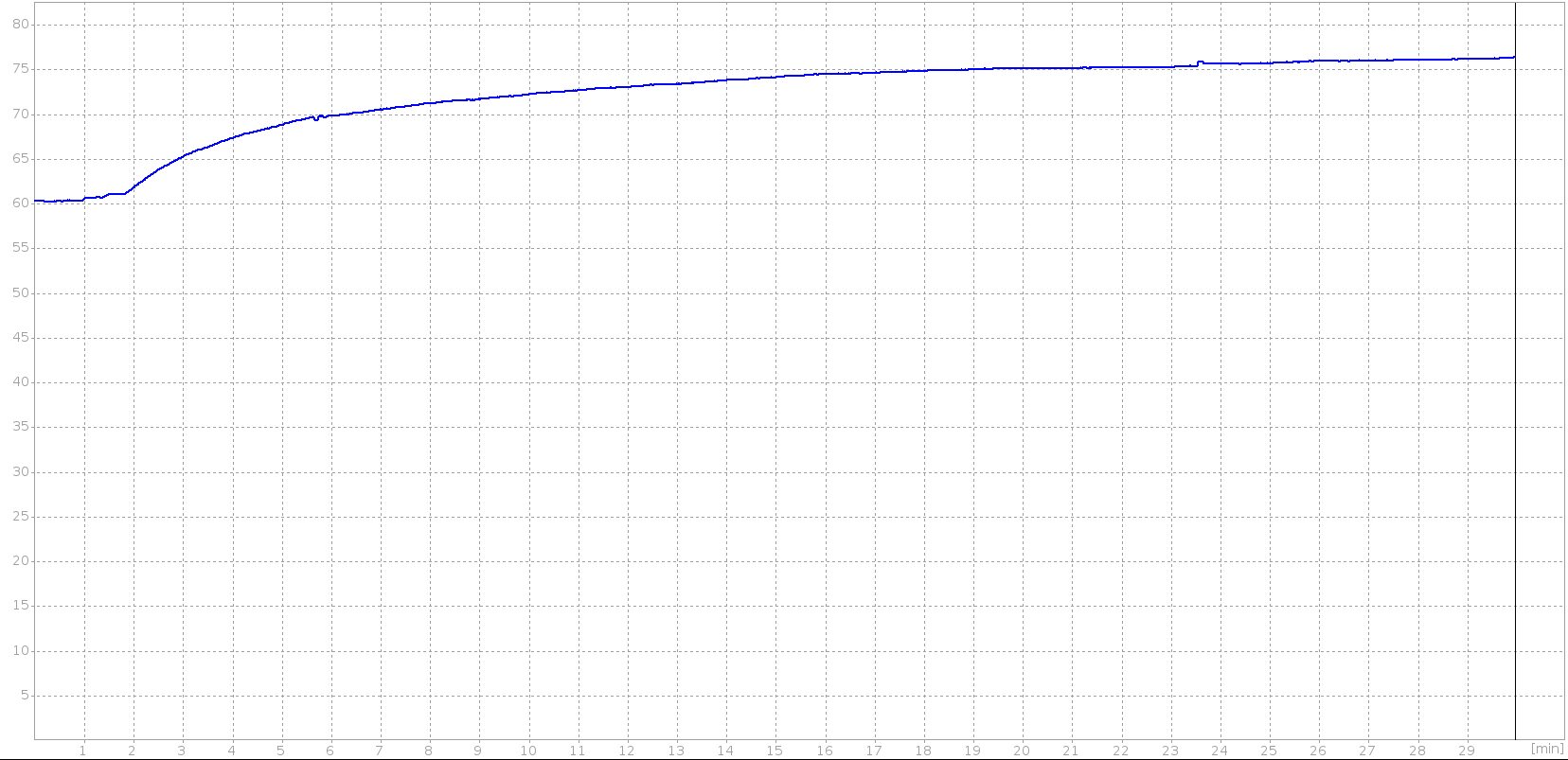
Adding air holes Obviously some additional air holes are necessary. After meeting my drill and cutter, the original case looks a bit like a piece of cheese now. GuruPlug Server Plus - case with air holes 1 GuruPlug Server Plus - case with air holes 2 Some more tests show that the temperature sticks around 76 deg C under heavy load now. That is still pretty hot, especially when the temperature in the room becomes hotter in summer. As I'm not going to run a lot of traffic trough it (my cable connection is limited to 20 MBit/s anyway), I guess it will work. Below is a graph I've recorded with my multimeter and qtdmm. It shows that the temperature rises to ~76 deg C and stays there. GuruPlug Server Plus - temperature curve Not sure if I could introuce some more load, the CPU had a load of 6 running stress. Network traffic was around 2x100MBit/s again. I could imagine with 2xGBit the CPU and PHY would become much hotter (no idea if it would be able to handle it at all, though). The PHY was usually a bit cooler than the CPU, so I didn't spend time to measure the temperature properly.

Conclusion My opinion is still the the original design of the plug is an insane QA and design failure. There is no way that it could ever work as shipped originally. If I'd have to design a new case for it, it should have a single insulated compartment for a PSU to ensure that no contact with high voltage is possible. The case around all other parts should be made of alloy with a lot of air holes. So the case could be used as heat sink (properly done, not with these insulating duct tape strips) and at the same time allow air circulation and a nice view on the LEDs on the board. Of course the case would be much more expensive than, but I'm sure it would work properly and would be worth the money. And if done peoperly, it would look much better than this blinking plastic thing. I could imagine it would sell well! So at the end I'm wondering what GlobalScale Technologies will do. I doubt it will be possible to create the 'professional upgrade kit' as they had announced before. Replacing all units is the only proper way. We'll see what happens. At least my GuruPlug is working well now and it will be used as replacement for my OpenWRT router soon. WiFi is not working, but that will be handled by my media center anyway. GuruPlug Server Plus - running plug

9 September 2010

Joerg Jaspert: Debian work

It has been a pretty exhausting time since my last blog post in my area of Debian land . If you followed the news you should have seen some of it. Last weekend there was the point release. For those I have the (good?) position to sit in the middle of the working queue, where the hardest part (sorting out which stuff to include, getting it all build, etc) is already done. Still, due to the amount of steps neccessary to take its usually a multi-hour thing. This one release was even slower, as we had to wait for hours until the package lists had all been built - unfortunately the thing writing that keeps berkeley db files of data around as cache - and uses the FULL path to the files as key. How stupidly annoying when the path changes during a server move. Ohwell. The other big part that got a tiny bit of press coverage was the move from www.backports.org over to backports.debian.org. This was actually waiting for me for a good longish while already (err, well, since well before DC9 this was decided to happen) but now I finally got myself moved. This turned out to be much more work than I ever feared (which is part of the reason why it took so long), but some numbers: The db update alone took me a week to figure out which steps to do in which order. Good to have an automated system, if you the manage to have the updates run specific to the main archive. Ups. When I was done with the database (during which I managed to just erase all work done by formorer and rhonda on the webpage, ups^2) I had some code and config cleanups to do, and especially manage to get it all running with a new path layout. Much less complicated, but enough work to do, before I finally was far enough to get it all move so far that formorer could start testing it and we could turn off the old system. At this time I had to fix up our shell scripts for our cron jobs, but that (with one exception) was a nearly straight forward easy task. And on Wednesday I managed another goal - backports is fully running the master branch of dak, the exact same code as on ftp-master. The cronjobs are slightly different, as well as the config (of course, duh), but otherwise its the same. My current goal and the last things left on this move todo is to change the cronjobs so that debian as well as backports do run the SAME scripts, but their configs list which tools should be run when. Considering that my dinstall cron already contains something pretty much a state machine I think I m insane enough to get this in shell, but when I told that to Mark (you know, the second ftpmaster :) ), I heard something very much like vomiting (you know, 700km between us, this might mean something) and then the plea to use a real language for the task. Oh my. I like my shell. :)
There is one big black cloud on the horizon to see. I have to do something similar for security. They are at a dak (and database) version pretty similar to what bpo had. They do need to support this obnoxious spare new format too before they can support security for squeeze, so there is no way I can ignore that archive for much longer. I already asked DSA for a vm in which I can play (not good to interrupt security archive for long), but probably wont start on this before the upcoming FTPMaster meeting. Pretty busy otherwise. Wellwell, I hope it will be less painful, as I now know the steps already. :)

Matthew Garrett: Linux backlight control

Backlight control is one of those things that you'd think would be simple, but ha ha this is computing so of course it's an utter disaster and everything is a huge mess. There's three main classes of backlight control in the x86 world, all of which have drawbacks:
Right now, if there's an ACPI backlight interface then that's usually the only thing we'll show you. We can do that because we can identify if there's an ACPI backlight interface when we parse the ACPI tables at the start of booting, and that information can be registered before we start setting up any other backlights. The problem comes when we have no ACPI backlight interface. We don't have any idea whether there's a platform mechanism until a platform driver loads, which could be at any time. As a result, we've been reluctant to expose GPU-level backlight control because doing so would often give you two separate backlight controls and no indication as to which should be used. Userspace doesn't really have a way to make that decision either, so everyone ends up unhappy.

This is especially problematic with some machines which provide no ACPI or known platform control (or, in the case of some Samsungs, only provide platform control if you have a special Linux BIOS that Samsung won't give you) but can control the backlight via the gpu. Right now you get nothing, because giving you something would potentially break other systems and the needs of the many etc. Sorry! But this is obviously problematic in the long term, especially because multi-GPU machines tend to have multiple ACPI backlight interfaces, so I've been working on a better approach.

When a backlight device is registered, it appears under /sys/class/backlight. If it's an ACPI device it has a symlink pointing to some random ACPI device. If it's a platform device it's pointing at something like "dell-laptop" which is approximately unhelpful when it comes to figuring out what it controls. If it's a GPU-level device then it probably points at the PCI device, which is helpful except in the case where you have multiple backlight controls on a single GPU. So, by and large, you have no good way to identify which backlight control is preferable unless you keep a huge list of all possible backlights along with some scoring.

The first thing I've added to improve this is a "type" attribute. This tells you whether a given backlight is firmware-level (like ACPI), platform-level (like the various laptop drivers) or performs raw register writes (like a GPU driver). That lets userspace decide which interface is preferable. It'll typically be the ACPI interface, because that's the most likely to keep synchronisation and so avoid bizarre brightness bugs. The next thing has been to start fixing up the parent links. There's nothing we can do for the platform level devices, but the ACPI drivers could at least point at PCI devices rather than into ACPI space. That means that multi-GPU systems can now identify which interface to use based on the currently active GPU. Finally, I've started pointing the GPU-level backlight controls at the specific output rather than merely at the PCI device. This probably makes little difference for laptops as such, but once we start exposing backlight control for monitors that support ddcci it'll make things much easier as we'll know which backlight control corresponds to which monitor.

I've then written a small library that accepts information about the output and picks the "best" backlight for the device. It's obviously based on a pile of heuristics and there's a couple of bits of API that I suspect need to be nailed down yet, but it means that this code only needs to be written once. It's then simple to glue this into X drivers, which means that they can expose a "Backlight" xrandr property on each relevant display. That means that backlight control is then handled at the session level with the X server acting as the privileged agent, which simplifies a bunch of things and means we can finally let hal die entirely. Long-term this means we'll have unified backlight control for all of your displays, which is a wonderful thing.

Summary: We kind of suck right now, but there's a reasonably clear path to getting better.

Neil Williams: pbuilder not finding $ HOME /.pbuilderrc anymore?

This took a bit of searching, so it's here for reference. I'm sure it'll catch out people who upgrade from Lenny to Squeeze as the initial presentation can be deeply mysterious and frustrating.

I keep my pbuilder stuff outside /var/, so I have a file /home/neil/.pbuilderrc and until recently, this worked fine. Naturally, pbuilder needs sudo to call it, so sudo pbuilder update was a routine command. Then it suddenly stopped working and it was mysterious, pbuilder was looking for /home/root/.pbuilderrc which was just weird. root/.pbuilderrc might make a little more sense, /home/root is just plain wrong.

First, blame pbuilder, no, not changed recently - certainly not since I last ran the command successfully. Hmm.

sudo then? Recently updated, aha, the changes listed in the PTS describes something being documented in NEWS.Debian relating to pbuilder - dig, dig, the answer (indirectly) was in the README. Need to add a command to user lines in sudoers:
, env_keep+="HOME"

Also, act on this guidance in sudo visudo:
# Uncomment to allow members of group sudo to not need a password


Even more nastily, sudo does still need a password (because I've set rootpw later) but this line is still required.

Now restart sudo sudo invoke-rc.d sudo restart which is horribly recursive. (Yes, I did mess up visudo at one point and have to use just plain su to get back access.)

Ho hum. It works, so why do I feel that I've done something bad?

(comments still disabled because of spammers - captchas simply don't work, neither does OpenID, so don't blame me. Those who know me already know how to contact me. The details aren't exactly hidden.)

Christoph Berg: belier

Sometimes remote accounts are only reachable with a series of ssh/su/sudo commands. Using ProxyCommands in .ssh/config works for simple cases, but not with several hops, or if passwords have to be entered. The belier tool takes as input a series of user@hostname strings and will produce an expect script that does the actual login work.
$ cat input
user@host1 root pw1
user2@host2 pw2
$ bel -e input
$ cat host2.sh
#!/usr/bin/expect -f
set timeout 10
spawn ssh -o NoHostAuthenticationForLocalhost=yes -o StrictHostKeyChecking=no  user@host1
expect -re  "(% # \\$) $"
send -- "su - root\r"
expect ":"
send -- "pw1\r"
expect -re  "(% # \\$) $"
send -- "ssh -o NoHostAuthenticationForLocalhost=yes -o StrictHostKeyChecking=no  user2@host2\r"
expect -re  @[^\n]*: 
send -- "pw2\r"
expect -re  "(% # \\$) $"
interact +++ return
The generated host2.sh script uses ugly ssh options, but is easily edited. Now I need the same thing for scp... Update: Carl Chenet, belier's author, kindly pointed me to the documentation which has examples how belier can set up ssh tunnels to copy files.

Raphaël Hertzog: Can Debian achieve world domination without being on Facebook?

Debian Developers who like Debian on FacebookFacebook is not very popular among free software hackers. When I announced my Facebook page on identi.ca (see here) I got a few replies suggesting it was odd for me to use Facebook. Indeed there are many good reasons why Facebook should be avoided: it is a centralized and proprietary service that is not very privacy-friendly. But the truth is that lots of people are using it (even Debian developers, can you recognize them on the picture?) and some are using their Facebook news feed as their main source of news. You might wonder how many persons that represents, so here are the figures: the Debian Facebook page has 48,361 fans and the Ubuntu one has 247,932 fans. That s right, an announce put on the Debian facebook page would reach more persons than the most popular announce list that Debian is currently running (debian-announce@lists.debian.org has about 29,000 subscribers). Unfortunately that Debian Facebook page is empty and I don t even know who the administrator is. The Ubuntu page on the contrary is properly configured to relay news from The Fridge and Jono Bacon is posting some custom updates from time to time. Debian contributors regularly mention world domination as the ultimate goal of the universal operating system (I even feature this in my blog header banner! :-) ). But working towards world domination means in my opinion that we should communicate our ideals of freedom to as many people as possible, even if they are using a service that we don t want to promote. The Debian social contract acknowledges that some users have to use non-free software and we provide the non-free section for them. In the same spirit, I believe we must have a presence on Facebook. That does not mean that we endorse Facebook, and we should surely promote Joindiaspora once it s usable. But in the mean time we should reach out to Facebook users and allow them to follow us with the platform of their choice. That s the choice I recently made when I decided to setup a public facebook page featuring my free software work, my blog and my book. So if you are a Facebook user, click here to visit my page and click on Like if you want to follow this blog in your Facebook news feed. I also share interesting Debian or Ubuntu related articles that I discover while reading my RSS subscriptions. Below are the usual facebook widgets for the 3 pages quoted in this article (they might not show up if you read this article through an RSS feed):
<iframe allowtransparency="true" frameborder="0" scrolling="no" src="http://www.facebook.com/plugins/likebox.php?id=103161013077063&amp;width=292&amp;connections=0&amp;stream=false&amp;header=false&amp;height=62" style="border:none; overflow:hidden; width:292px; height:62px;"></iframe>
<iframe allowtransparency="true" frameborder="0" scrolling="no" src="http://www.facebook.com/plugins/likebox.php?id=9801962186&amp;width=292&amp;connections=0&amp;stream=false&amp;header=false&amp;height=62" style="border:none; overflow:hidden; width:292px; height:62px;"></iframe>
<iframe allowtransparency="true" frameborder="0" scrolling="no" src="http://www.facebook.com/plugins/likebox.php?id=6723083591&amp;width=292&amp;connections=0&amp;stream=false&amp;header=false&amp;height=62" style="border:none; overflow:hidden; width:292px; height:62px;"></iframe> Flattr this Share/Bookmark 14 comments Support my work

8 September 2010

Julien Danjou: Emacs, Org, whatever the weather!

Another week, another Emacs extension! I had (once again) a wonderful idea: what if I could have the weather forecasts in my Org agenda? Wouldn't that be wonderful? My quest started by looking for a service offering a good weather forecast API. I found nothing simple as the hidden Google Weather API, which is nice, but not documented. Not at all. Not a single line. Nah. Then, I wrote a google-weather extension, implementing a basic Emacs Lisp API to retrieve data from the Google service:

ELISP> (google-weather-data->forecast (google-weather-get-data "Paris"))
(((9 8 2010)
  (low "53")
  (high "63")
  (icon "http://www.google.com/ig/images/weather/rain.gif")
  (condition "Rain"))
 ((9 9 2010)
  (low "53")
  (high "69")
  (icon "http://www.google.com/ig/images/weather/chance_of_rain.gif")
  (condition "Scattered Showers"))
 ((9 10 2010)
  (low "54")
  (high "72")
  (icon "http://www.google.com/ig/images/weather/partly_cloudy.gif")
  (condition "Partly Cloudy"))
 ((9 11 2010)
  (low "55")
  (high "75")
  (icon "http://www.google.com/ig/images/weather/partly_cloudy.gif")
  (condition "Partly Cloudy")))
My API even implements data caching, which is nice to speed up the agenda display. By the way, I think my next job will be to hack on the url-cache feature of Emacs, which is utterly buggy and has probably never be used. But that's another topic. Finally, I just had to write another module on top of that to export the forecasts to Org. A screen shot is probably better than a long and boring explanation, so here's the result. My only regret is that the icons provided by Google are ugly squares, so I did not want to use them. On the other hand, I did not found any icon set that would have all the icons Google provides (around 20). So I felt back on the icon naming specification to map the Google images to standard images. Any better idea would be welcome, of course. All the information can be found on the Google Weather for Emacs extension homepage. Flattr this

Roland Mas: Gnus, Dovecot, OfflineIMAP, search: a HOWTO

A long time ago, when I was first introduced to email, I was using the Mail program from Unix. I quickly converted to Elm, then Mutt, which were both better in terms of interface. Then I found out about Gnus, and I wouldn't dream of letting it go now. However, Gnus has started showing its age several times, and several times have I needed to upgrade the way I was using it: first because I needed to sort and split email, then because I took the sorting out of Gnus and into Procmail for more advanced filtering (including spam filtering), then because I switched to storing the emails on an IMAP server so I could read them remotely from several computers. My setup as of a few days ago was functional, but since I have grown over time to splitting emails into several hundred folders, checking for new messages was becoming more and more boring. So it's time to jump in with all the cool kids and switch to a modern solution: still Gnus of course, but with Dovecot, OfflineIMAP for synchronisation, and let's add email searches into the mix while we're at it. My web searches didn't turn up a simple step-by-step HOWTO, but I assembled bits from different places, and here's my attempt at documenting my new setup. Goals Assumptions Dovecot setup We'll use Dovecot as a local IMAP server. And since we're lazy, we'll access it over a pipe, and dispense with the network part. OfflineIMAP setup OfflineIMAP is basically an optimised two-way synchronisation mechanism between two email repositories . We'll use it in IMAP-to-IMAP mode.
 [general]
 accounts = MyAccount
 pythonfile = .offlineimap.py
 [Account MyAccount]
 localrepository = LocalIMAP
 remoterepository = RemoteIMAP
 # autorefresh = 5
 # postsynchook = notmuch new
 [Repository LocalIMAP]
 type = IMAP
 preauthtunnel = MAIL=maildir:$HOME/Maildir /usr/lib/dovecot/imap
 holdconnectionopen = yes
 [Repository RemoteIMAP]
 type = IMAP
 remotehost = mail.example.com
 remoteuser = jsmith
 remotepass = swordfish
 ssl = yes
 nametrans = lambda name: re.sub('^INBOX.', '', name)
 # folderfilter = lambda name: name in [ 'INBOX.important', 'INBOX.work' ]
 # folderfilter = lambda name: not (name in [ 'INBOX.spam', 'INBOX.commits' ])
 # holdconnectionopen = yes
 maxconnections = 3
 # foldersort = lld_cmp
 # Propagate gnus-expire flag
 from offlineimap import imaputil
 def lld_flagsimap2maildir(flagstring):
   flagmap =  '\\seen': 'S',
              '\\answered': 'R',
              '\\flagged': 'F',
              '\\deleted': 'T',
              '\\draft': 'D',
              'gnus-expire': 'E' 
   retval = []
   imapflaglist = [x.lower() for x in flagstring[1:-1].split()]
   for imapflag in imapflaglist:
       if flagmap.has_key(imapflag):
           retval.append(flagmap[imapflag])
   retval.sort()
   return retval
 def lld_flagsmaildir2imap(list):
   flagmap =  'S': '\\Seen',
              'R': '\\Answered',
              'F': '\\Flagged',
              'T': '\\Deleted',
              'D': '\\Draft',
              'E': 'gnus-expire' 
   retval = []
   for mdflag in list:
       if flagmap.has_key(mdflag):
           retval.append(flagmap[mdflag])
   retval.sort()
   return '(' + ' '.join(retval) + ')'
 imaputil.flagsmaildir2imap = lld_flagsmaildir2imap
 imaputil.flagsimap2maildir = lld_flagsimap2maildir
 # Grab some folders first, and archives later
 high = ['^important$', '^work$']
 low = ['^archives', '^spam$']
 import re
 def lld_cmp(x, y):
   for r in high:
       xm = re.search (r, x)
       ym = re.search (r, y)
       if xm and ym:
           return cmp(x, y)
       elif xm:
           return -1
       elif ym:
           return +1
   for r in low:
       xm = re.search (r, x)
       ym = re.search (r, y)
       if xm and ym:
           return cmp(x, y)
       elif xm:
           return +1
       elif ym:
           return -1
   return cmp(x, y)
The first part of this file adds a new flag that OfflineIMAP will propagate back and forth. By default, only the standard IMAP flags are propagated; we also want to synchronize the gnus-expire flag that Gnus uses to mark expirable articles. It's a hack, but it works for now (maybe someday OfflineIMAP will propagate all the flags it finds?). The second part of that file can be dispensed with (and won't be used unless the foldersort option is uncommented in .offlineimaprc): it's only there to ensure that some important folders are propagated first, and some others go last. I don't know exactly how they are sorted by default, but I'd like the most important ones to come first, so I can start reading them while the archives and the spam are still being fetched. Gnus configuration
(require 'offlineimap)
(add-hook 'gnus-before-startup-hook 'offlineimap)
Bonus: email searches The simple way:
(require 'nnir)
This goes in your .gnus. Then your group buffer will get a new command. Mark some folders with #, then M-x gnus-group-make-nnir-group (or use the G G shortcut), and type in a set of keywords. This search is performed by the IMAP server (Dovecot), which may or may not be very efficient, especially if you select many folders. Bonus+: email searches, faster The real cool kids use Notmuch nowadays, at least for email indexing and searching. It's fast, it allows complex queries, and it's generally cool. The downside is that it uses up quite some disk space for its indices, in addition to the actual emails. For that reason I'll keep it to my main computer, and I'll stick to nnir on my laptop (which has the same setup apart from that).
(require 'notmuch)
(add-hook 'gnus-group-mode-hook 'lld-notmuch-shortcut)
(require 'org-gnus)
(defun lld-notmuch-shortcut ()
(define-key gnus-group-mode-map "GG" 'notmuch-search)
)
(defun lld-notmuch-file-to-group (file)
"Calculate the Gnus group name from the given file name.
"
(let ((group (file-name-directory (directory-file-name (file-name-directory file)))))
  (setq group (replace-regexp-in-string ".*/Maildir/" "nnimap+local:" group))
  (setq group (replace-regexp-in-string "/$" "" group))
  (if (string-match ":$" group)
      (concat group "INBOX")
    (replace-regexp-in-string ":\\." ":" group))))
(defun lld-notmuch-goto-message-in-gnus ()
"Open a summary buffer containing the current notmuch
article."
(interactive)
(let ((group (lld-notmuch-file-to-group (notmuch-show-get-filename)))
      (message-id (replace-regexp-in-string
                   "^id:" "" (notmuch-show-get-message-id))))
  (if (and group message-id)
      (progn 
  (switch-to-buffer "*Group*")
  (org-gnus-follow-link group message-id))
    (message "Couldn't get relevant infos for switching to Gnus."))))
(define-key notmuch-show-mode-map (kbd "C-c C-c") 'lld-notmuch-goto-message-in-gnus)
Wrap-up This setup can be replicated on several computers, of course. I have it on two, and there's no reason I couldn't have more. The flags do get propagated back and forth, including the Gnus-specific expirable flag. Accessing the local Dovecot is much faster than going through the DSL to the master IMAP server, and I'm pretty convinced that OfflineIMAP and its multi-threading is also faster than Gnus is, even talking to the same remote server. The email searching with Notmuch is a nice bonus, especially since they're fast too (and this despite my 8-year-old computer). There are a few minor glitches. I can live with them, but I should let you know anyway. Apart from that, I'm pretty happy with this new setup. So I hope this documentation will be useful to others, so I can spread the happiness around. Send your thanks to the authors of the software involved (Gnus, Dovecot, OfflineIMAP, offlineimap.el, Procmail, and so on). Let's see how many years I'll keep that system!

Chris Lamb: irccat plugin for supybot

Like irccat but for when you are already running a Supybot instance.
import supybot
from twisted.internet import reactor, protocol
from twisted.protocols import basic
class IRCCatProtocol(basic.LineOnlyReceiver):
    delimiter = '\n'
    def lineReceived(self, text):
        irc = self.factory.irc
        for channel in irc.state.channels:
            irc.queueMsg(supybot.ircmsgs.notice(channel, text))
class IRCCat(supybot.callbacks.Plugin):
    def __init__(self, irc):
        super(IRCCat, self).__init__(irc)
        factory = protocol.Factory()
        factory.protocol = IRCCatProtocol
        factory.irc = irc
        self.server = reactor.listenTCP(12345, factory)
    def die(self):
        self.server.stopListening()
Class = IRCCat
You can then post messages with:
$ echo hai2u   nc -q0 hostname 12345

Next.

Previous.