Dirk Eddelbuettel: Rcpp now used by 10 percent of CRAN packages

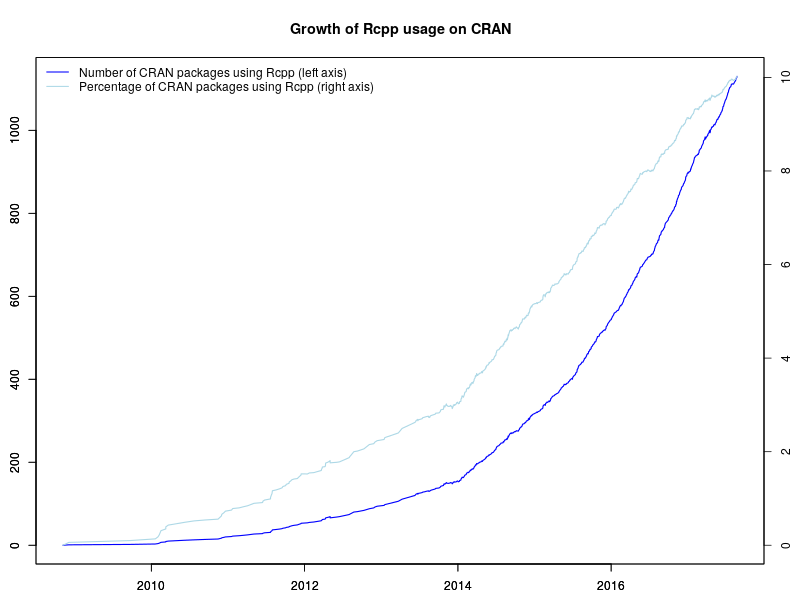 Over the last few days, Rcpp passed another noteworthy hurdle. It is now used by over 10 percent of packages on CRAN (as measured by Depends, Imports and LinkingTo, but excluding Suggests). As of this morning 1130 packages use Rcpp out of a total of 11275 packages. The graph on the left shows the growth of both outright usage numbers (in darker blue, left axis) and relative usage (in lighter blue, right axis).
Older posts on this blog took note when Rcpp passed round hundreds of packages, most recently in April for 1000 packages. The growth rates for both Rcpp, and of course CRAN, are still staggering. A big thank you to everybody who makes this happen, from R Core and CRAN to all package developers, contributors, and of course all users driving this. We have built ourselves a rather impressive ecosystem.
So with that a heartfelt Thank You! to all users and contributors of R, CRAN, and of course Rcpp, for help, suggestions, bug reports, documentation, encouragement, and, of course, code.
This post by Dirk Eddelbuettel originated on his Thinking inside the box blog. Please report excessive re-aggregation in third-party for-profit settings.
 I upgraded my last major machine from



 I have been playing around with

 In order to proceed further on our USB/STM32 oddessy, we need to start to build
a USB descriptor set for our first prototype piece of code. For this piece,
we're going to put together a USB device which is vendor-specific class-wise
and has a single configuration with a interface with a single endpoint which
we're not going to actually implement anything of. What we're after is just
to get the information presented to the computer so that



 Post-Solskogen, there hasn't been all that many commits in the main Nageru
repository, but that doesn't mean the project is standing still. In
particular, I've been working with NVIDIA to shake out a crash bug in their
drivers (which in itself uncovered some interesting debugging techniques,
although in the end, the bug turned out just to be uncovered by the boring
standard technique of analyzing crash dumps and writing a minimal program
to reproduce). But I've also been looking at intraframe codecs; my sort-of
plan was to go to
 On the heels of the very recent
 Three months ago, I gave a talk at the

 For more in-depth explanation on the different ways to encode a routing table
into a trie and a better understanding of radix trees, see
the
 The
 Getting meaningful results is challenging due to the size of the address
space. None of the scenarios have a fallback route and we only measure time for
successful hits
 Only 50% of the time is spent in the actual route lookup. The remaining time is
spent evaluating the routing rules (about 30 ns). This ratio is dependent on the
number of routes we inserted (only 1000 in this example). It should be noted the
 Here is an approximate breakdown on the time spent:
 All kernels are compiled with
 Despite its more complex insertion logic, the IPv4 subsystem is able to insert 2
million routes in less than 10 seconds.
 The memory usage is therefore quite predictable and reasonable, as even a small
single-board computer can support several full views (20 MiB for each):
 The
 At the
 laser-cutter sprint
So I'm overcoming my jetlag after DebConf17 by helping to make the

 And now I'm even teaching weasel how to use this thing (and he already made interesting
new mistakes) and it looks like Ganneff & formorer are next. Fun fun fun!
Oh, and the Alioth sprint also seems to be quite productive, but I'll leave reporting about this
to others.
 I had to write a small Python application to listen for some broadcast message
and process the message. This broadcast messages are actually sort of discovery
messages to find some peers in a network. Writing a simple UDP Server to listen
on a particular port was easy; but while designing an application I was
wondering how can I plugin this server into my main code. There are 2
possibility



 Do you know what s happening in the wires of your network? There is a major
FLOSS player in the field of real time intrusion detection (IDS), inline
intrusion prevention (IPS) and network security monitoring (NSM).
I m talking about Suricata, a mature, fast and robust network threat detection
engine. Suricata is a community driven project, supported by the

 Like