Search Results: "ina"

31 March 2014

Andrew Pollock: [life] My girlfriend's name is Anshu

I've been referring to Anshu as "my girlfriend" in all my blog posts because I haven't gotten around to writing this post yet. I've finally gotten around to it. Anshu and I met at a speed dating event 8 months ago. I quite enjoyed the speed dating experience, and having done it, would prefer it over Internet dating. I think it helped that at the time I was working from home, getting above and beyond the amount of alone time that my introversion required for me to recharge, so I was in the right frame of mind for it. I did pretty well, I got 6 matches from the night, one of which was Anshu. Anshu is an Indian-Australian dual national. She emigrated about 12 years ago to do her Masters degree here, and decided to stay. This is my first inter-ethnic relationship, and it's been a very interesting expansion of my cultural horizons. Anshu is vegetarian, so I've expanded my vegetarian cooking repertoire significantly since we've been seeing each other. I already do "Meatless Monday" with Zoe, so it wasn't that difficult a transition for me.

Russ Allbery: Review: Sundiver

Review: Sundiver, by David Brin
Series: Uplift #1
Publisher: Bantam
Copyright: February 1980
Printing: September 1995
ISBN: 0-553-26982-8
Format: Mass market
Pages: 340
Sundiver is the first book of Brin's Uplift series, which I think it's fair to say are the books that made his reputation as an author. It's less well-known than the later sequels Startide Rising and The Uplift War for reasons that I'll get into in a moment. This was a re-read; I've read the first Uplift series before (and Startide Rising separately before that), but not in many years, and I wanted to re-read them and review them. I haven't finished doing that yet, several months after I re-read Sundiver, largely because this book wasn't as enjoyable as I remembered. The Uplift series is set in a heavily populated galaxy with a multitude of alien races. It follows the SF alien life pattern where the galaxy was well-populated and fully developed long before humans discovered it. The Earth is a relatively obscure backwater, and humans are expected to adopt to and follow the rules and restrictions that the other races had long-since established. This primarily means a complex and very formal system of caste and patronage: species brought to sapience by the technology of their patrons are expected to serve their patron races for millennia, and one's status in the galaxy is determined by the length of those patronage chains and the number of species one has fostered in turn. As is typical for stories of this sort, humans break the rules in unexpected ways. They have no known patrons, having apparently evolved sapience entirely on their own (although the galactic races are quite dubious of this theory). And they have uplifted two species to sapience (chimpanzees and dolphins) before their discovery by the rest of galactic civilization, although in fairly primitive ways and not properly by galactic standards. Set against this background, Sundiver is a science fiction puzzle story of a fairly old style. The protagonist, Jacob Demwa, is a scientific investigator who retired after a tragedy that killed his love. He's recruited out of that retirement and into this plot by an alien who is sympathetic to humans. A human exploration mission into the chromosphere of the Sun, treated as ridiculous by most of the galactics since the shared Library Institute certainly contains more information about stars than human technology could possibly uncover, has found strange and apparently sapient creatures living there: flocks of cattle-like creatures that are apparently being herded. There is no reference to such star-dwellers in the Library, which raises the possibility that humans have discovered something novel. That would be quite a coup against the galactics. But after the destruction of one of the solar exploration ships, it starts looking like these creatures are hostile. Jacob reminded me of a mix between a Larry Niven short story protagonist, working through the practical impact of a physics puzzle, and Isaac Asimov's Elijah Baley. What exactly is going on, both scientifically and politically, remains unclear for nearly the entire book. Both Jacob and the reader are constantly forming and then discarding hypotheses as events overtake them. The stakes are more interesting than a lot of science fiction novels: rather than survival or war, the stakes are prestige, influence, and status, with subtle but possibly vital effects on what position humans will take among the other species of the galaxy. All this sounds promising, and is why I remembered this book fondly. Unfortunately, re-reading it was a disappointing experience on several fronts. First, the characterization varies between trite and stereotyped. The aliens suffer from the standard alien characterization problem: each of them is an exemplar of their species, and all of the aliens feel like archetypes. While there are some twists in the inter-alien politics, one never gets a sense of the aliens as varied and complex societies in their own right. The humans are more varied, but that primarily means varieties of irritating. The worst is Peter LaRoque, a journalist who is set up as a villain of the story, and who is such an unremitting and over-the-top stereotype of everything possibly bad about journalists (and French people) that every scene containing him felt like someone scraping fingernails on a chalkboard. The other characters are a bit better, but not by much. Jacob himself has a bizarre, semi-mystical psychological problem from trauma that seems to give his amoral subconscious a life of its own. Brin appears to be setting this up to have major plot significance, but it never made any sense to me, didn't matter much in the end, and seems to mostly be an excuse for Jacob's hypercompetence. Sundiver's treatment of female characters also annoyed me enough to be worth a mention. The primary female character, Helene, is clearly intended to be a strong character with her own agency (she's both station commander and a starship captain), and Brin makes a lot of the humans switching to different words than male and female as a sign of a more egalitarian future. But this all feels skin-deep. The inevitable romance is all about Helene's attractiveness and ability to listen to Jacob, her logic is described as unscientific, and I got more and more annoyed by her portrayal as the book went along. She's not entirely without agency in the story, but she's much closer to a damsel in distress than the independent character Brin appeared to be trying for. It's hard to shake the feeling that she's being persistently belittled by the story. But this is a scientific puzzle story more than a mystery; characterization would be nice, but isn't strictly required. On re-read, the part of Sundiver that annoyed me the most was how much of a letdown the plot resolution was. I'm going to avoid any specific spoilers here, but I found the ending of both quite disappointing and a sign of the major problem with this series as a whole. The setup over-promises and Brin fails to deliver, a pattern that will repeat itself in this series. We get tantalizing hints of a new solar species, of revelations about the past of humanity, of deep galactic politics, and of vast knowledge contained in the Library that humans don't yet have access to. We get superficial archetypes for characters, politics that seem more like the bickering of children, plot twists that persistently take the story in more mundane and less interesting directions, and a sense of wonder, or lack thereof, that feels more like a Scooby Doo story than what I expect from science fiction. Some of the plot twists are unexpected and almost add some interest to the story, but don't make enough sense in the context of the story to be satisfying. And, of course, there's an climactic action sequence involving physical combat, as is required of all good Star Trek (original series) episodes. (I was waiting for Jacob's shirt to fall off.) The problem I have always had with Brin as a writer is that his ideas are far better than his ability to write characters and plots. In the hands of a better author, the Uplift universe background has so much potential. And I think Brin is a better author a few years later; my recollection is that both Startide Rising and The Uplift War do a better job of delivering on their promises. But Sundiver is deservedly forgettable. The good ideas rarely go anywhere beyond the obvious, the characters are irritating and often don't make sense, and the story is disappointing. I can't say I'm sorry to have read it, since my memory edited it down into a much better story, but I can only recommend it as background for later, better books. Rating: 4 out of 10

29 March 2014

Dirk Eddelbuettel: R / Finance 2014 Open for Registration

The annoucement below just went to the R-SIG-Finance list. More information is as usual at the R / Finance page:
Now open for registrations: R / Finance 2014: Applied Finance with R
May 16 and 17, 2014
Chicago, IL, USA
The registration for R/Finance 2014 -- which will take place May 16 and 17 in Chicago -- is now open! Building on the success of the previous conferences in 2009, 2010, 2011, 2012 and 2013, we expect around 300 attendees from around the world. R users from industry, academia, and government will joining 30+ presenters covering all areas of finance with R. We are very excited about the four keynotes by Bill Cleveland, Alexios Ghalanos, Bob McDonald and Luke Tierney. The main agenda (currently) includes sixteen full presentations and twenty-one shorter "lightning talks". We are also excited to offer four optional pre-conference seminars on Friday morning. To celebrate the sixth year of the conference in style, the dinner will be returning to The Terrace of the Trump Hotel. Overlooking the Chicago River and skyline, it is a perfect venue to continue conversations while dining and drinking. More details of the agenda are available at:
http://www.RinFinance.com/agenda/
Registration information is available at
http://www.RinFinance.com/register/
and can also be directly accessed by going to
http://www.regonline.com/RFinance2014
We would to thank our 2014 Sponsors for the continued support enabling us to host such an exciting conference:
International Center for Futures and Derivatives at UIC Revolution Analytics
MS-Computational Finance at University of Washington OneMarketData
RStudio
On behalf of the committee and sponsors, we look forward to seeing you in Chicago!
Gib Bassett, Peter Carl, Dirk Eddelbuettel, Brian Peterson,
Dale Rosenthal, Jeffrey Ryan, Joshua Ulrich
See you in Chicago in May!

This post by Dirk Eddelbuettel originated on his Thinking inside the box blog. Please report excessive re-aggregation in third-party for-profit settings.

28 March 2014

Matthias Klumpp: Appstream: The next step

appstream-logoWith the release of GNOME-Software 3.12, it s also time for another update about what is going on behind the scenes of Appstream, the project providing all the data needed to make software-centers work. So here is the long overdue update :) If you have attended my FOSDEM talk or seen the slides, you know about the concept of component metadata to describe (almost) all software components which make up a Linux system, as well as their public interfaces they provide for users and other software to access. This metadata specification was originally designed as part of the Listaller project for use with the 3rd-party software installer.
But we already have the Appstream specification, which describes applications available on a distribution. And technically, applications are nothing but specialized components.
When I was asked about extending the Appstream spec with fonts and codecs, I decided to give up the Listaller components concept and merge it with the Appstream project, effectively creating a single source of metadata for all software in distributions. Appstream and components were separate, because Appstream was designed just for application metadata shown in software-centers, while component-metadata was more technical and not user-visible. This separation, however, did not reflect reality. Software centers want to show things components were designed for (codecs, fonts, ), and application meta-information also can contain technical items not shown in a software-center, but useful for other functionality (e.g. for mimehandler finding). So, if you like clear naming of things (like I do), you can now think of the upcoming Appstream release 0.6 as Appstream not being a stream of application metadata, but rather metadata provided for use in applications. ;-) Extending Appstream with components has a number of benefits:
First of all, users will soon get systems which are able to automatically install missing firmware, codecs, fonts and even libraries or Python-modules. This happens in a distro-agnostic way, so any application can request installations of missing components through Appstream and PackageKit without having to care about distribution details. For distributors, you will get more information about the software upstream provides: Which public interfaces does it make available? What is the upstream s homepage? Summary? Short release-descriptions? Exposed library symbols? etc. This data was available before, of course, but we made it machine-readable and standardized now. This will also allow us to match software across distributions quickly, allowing efficient exchange of patches between distributions, and answering questions upstream has like in which distribuions is my software available, and in which version? . Tracking upstream software is also easier now. Last but not least, the metadata format gives upstreams a small say in how their software gets packaged (= how it gets split / if there is a metapackage depending on the split parts). For upstream authors, it is much easier to maintain just a few Appstream XML metafiles, instead of adding a Listaller component file as well (which was not XML). Most data for creating the metainfo files is already available, some can even be filled in automatically by the build-system. With all the advantages this new system has comes a small disadvantage: These changes broke the backwards-compatibility of the Appstream spec, so to use Appstream data in version 0.6 or higher, you need to adjust your parsers. But of course you are using a library to access the data anyway, which already does that for you ;-) GNOME-Software 3.12 has almost complete support for the new (but still not released) Appstream 0.6 spec through it s libappstream-glib library. The libappstream library in Appstream s Git branch will get 0.6 support as well very soon. The only thing you need to do is adjust your code for the new library version, which broke it s API as well due to a rewrite in C (I hope that we can provide language bindings again very soon).
Soon, there will also be a Qt library for accessing Appstream, since some people expressed a demand for it (and working with GObject in Qt C++ code always feels a litle bit odd).
The 0.6 specification is still being fine-tuned to iron out some issues which might come up and mainly to improve the documentation and adjust all tools. It will be released in 2-3 weeks, and bring not only components support, but also lots of other small improvements and additions for better description of applications/components. In some cases, tag names have changed to have less ambiguous names. Thanks to Richard Hughes for helping with the spec our discussions about the Appstream spec are highly productive and in the end lead to a better specification. Also, the new 0.6 specification includes many extensions used in GNOME-Software by default now, which makes it easier for other distributions to provide them for GS. The current draft for the Appstream 0.6 specifications can be found here. Some details might still change before the final release. As soon as the spec is final, there will be a ML announcement for distributors as well (watch the XDG distributions list), so there is enough time for distributors to future-proof their Appstream distro-data generators (I will also describe the changes more detailed then). If you are confused now about the whole components stuff: Fear not! ;-) I will do some more detailed posts in a few weeks explaining upstream projects how to provide metadata properly (after the 0.6 release). I will also finish the wiki page for Appstream AppData in KDE projects, where we can then use 0.6-style data in KDE right away.

Thomas Goirand: Automatic backport script

Since I have to do a lot of backports for the OpenStack packages in Debian Wheezy, I got tired of doing them by hand. Therefore, I have created a script to automate the task. I m not particularly proud (or ashamed) of that script, but I just want to share it. Probably some fellow readers will happily provide me with enhancements and ideas. Note that the use of mk-build-deps implies that the equivs package has to be installed. What I do is run this build-backport script within a cowbuilder, to make sure I always have a clean backport environment.
#!/bin/sh
set -e
set -x
PKG_NAME=$ 1 
BPO_DISTRO=wheezy-backports
BPO_POSTFIX=bpo70+1
REPO_ROOT=/home/ftp
REPO_DEST=icehouse-backports
if [  whoami  = "jenkins" ] ; then
        BUILD_ROOT=/var/lib/jenkins/jobs/openstack-pkg-tools/builds/$ BUILD_NUMBER 
else
        BUILD_ROOT=~/sources
fi
# Get info from packages.debian.org
PKG_INFO_FILE= mktemp -t pkg_info_file.XXXXXX 
wget --no-check-certificate -O $ PKG_INFO_FILE  http://packages.debian.org/sid/$ PKG_NAME 
DEB_VERSION= rmadison $ PKG_NAME    grep sid   awk ' print $3 ' 
UPSTREAM_VERSION= echo $ DEB_VERSION    cut -d'-' -f1    cut -d":" -f2 
DSC_URL= cat $ PKG_INFO_FILE    grep dsc   cut -d'"' -f2 
rm $ PKG_INFO_FILE 
# Prepare build folder and go in it
MY_CWD= pwd 
rm -rf $ BUILD_ROOT /$PKG_NAME
mkdir -p $ BUILD_ROOT /$PKG_NAME
cd $ BUILD_ROOT /$PKG_NAME
# Download the .dsc and extract it
dget -d -u $ DSC_URL 
PKG_SRC_NAME= ls *.dsc   cut -d_ -f1 
PKG_NAME_FIRST_CHAR= echo $ PKG_SRC_NAME    awk ' print substr($0,1,1) ' 
dpkg-source -x *.dsc
echo "Now running mk-build-deps -i $ PKG_SRC_NAME -$ UPSTREAM_VERSION /debian/control"
mk-build-deps -i $ PKG_SRC_NAME -$ UPSTREAM_VERSION /debian/control
# Build the package as backport using cowbuilder
cd $ PKG_SRC_NAME -$ UPSTREAM_VERSION 
dch --bpo -m "Backported for $ BPO_DISTRO ."
dpkg-buildpackage
cd ..  
PKG_FINAL_DEST=$ REPO_ROOT /debian/pool/$ REPO_DEST /main/$ PKG_NAME_FIRST_CHAR /$ PKG_SRC_NAME 
ssh archive.gplhost.com "mkdir -p $ PKG_FINAL_DEST "
scp *.orig.tar.* *$ DEB_VERSION ~$ BPO_POSTFIX * archive.gplhost.com:$ PKG_FINAL_DEST 

Dirk Eddelbuettel: Upcoming Rcpp talks and workshops

A number of talks about Rcpp are scheduled over the next couple of months: So the month of June is still pretty open. If someone wants me to talk somewhere else, preferably on a Saturday, feel free to get in touch.

This post by Dirk Eddelbuettel originated on his Thinking inside the box blog. Please report excessive re-aggregation in third-party for-profit settings.

27 March 2014

Aigars Mahinovs: Photo migration from Flickr to Google Plus

I've been with Flickr since 2005 now, posting a lot of my photos there, so that other poeple from the events, that I usually take photos of, could enjoy them. But lately I've become annoyed with it. It is very slow to uplaod to and even worse to get photos out of it - there is no large shiny button to Download a set of photos, like I noticed in G+. So I decided to try and copy my photos over. I am not abandoning or deleting my Flickr account yet, but we'll see. The process was not as simple as I hoped. There is this FlickrToGpluss website tool. It would have been perfect .. if it worked. In that tool you simply log in to both services, check which albums you want to migrate over and at what photo size and that's it - the service will do the migration directly on their servers. It actually feeds Google the URLs of the Flickr photos so the photos don't even go trought the service itself, only metadata does. Unfortunately I hit a couple snags - first of all the migration stopped progressing a few days and ~20 Gb into the process (out of ~40 Gb). And for the photos that were migrated their titles were empty and their file names were set to Flickr descriptions. Among other things that meant that when you downloaded the album as a zip file with all the photots (which was the feature that I was doing this whole thing for) you got photos in almost random order - namely in the order of their sorted titles. Ugh. So I canceled that migration (by revoking priviledges to that app on G+, there is no other way to see or modify progress there) and sat down to make a manual-ish solution. First, I had to get my photos out of Flickr. For that I took Offlickr and ran it in set mode:
./Offlickr.py -i 98848866@N00 -p -s -c 32
The "98848866@N00" is my Flickr ID which I got from this nice service, then -p to download photos (and not just metadata), -s to download all sets and -c 32 to do the download in 32 parallel threads. An important thing to do is to take all you photos that are not in a set in Flickr and add them to a new 'nonset" so that those photos are also picked up here, there is an option under Organize to select all non-set photos. It worked great, but there were a couple tiny issues:
  1. There is a bug in Offlickr that it does not honor pages in Flickr sets, so it only downloads first 500 images in each set, fix for that is in that bug;
  2. It also wanted Python2.6 for some reason, but worked fine with Python2.7
  3. With that number of threads sometimes Flickr actually failed to respond with the photo, serving a 500 error page instead. Offlickr does not check return code and happily daves that HTML page as the photo. To work around that I simply deleted the HTML errors and then ran the same Offlickr command again so that it re-downloads the missing files. Had to repeat that a few times to get all of them:
ack-grep -l -R "504 Gateway Time-out" dst/   xargs rm
After all that I had my photos, all 40 Gb of them on my computer. Should I upload them to G+ now? Not yet! See the photos all had lost their original file names. It turns out Flickr simply throws that little nugget of information away. It is nowhere to be found, neither in metadata or the UI or the Exif of the photos. Also some of my photos had clever descriptions that I did not want to loose or re-enter in G+ and also geolocation information. Flickr does not embed that info into the Exif of the image, instead it is provided separately - Offlickr saves that as an XML file next to each image. So I wrote a simple and hacky script to re-embed that info. It did 3 things:
  1. Embed title of the photo into the Description EXIF tag, so that G+ automatically picks it up as title of the photo;
  2. Embed the GEO location information into the proper EXIF tags, so that G+ picks that up automatically;
  3. Create a new file name based on original picture taken datetime and EXIF Canon FileNumber field (if such exists), so that all photos in an album are sequential.
It uses exiftool for the actual heavy lifting. After all that was finished I tested the result by uploading a few images to G+ and testing that their title is being set correctly, that they have a sane file name and that geo information works. After that I just uploaded them all. I tried figuring out the G+ API (they actually have it) but I was unable to pass the tutorial, so I abandoned it and simply uploaded the photos of each set int their own tab via a browser. That took a few hours. But that is much faster that with Flickr. Like 4 MB/s versus 0.5 MB/s faster. And here is the result. So far I kind of like it. We'll see how it goes after a year or so. Now on to an even more fun problem - I now have ~40 Gb of photos from Flickr/G+ and ~100 Gb of photos locally. Those sets partially intersect. I know for a fact that there are photos in Flickr set that are not in my local set and it is pretty obvoious that there are some the other way round. Now I need to find them. Oh and I cann't use simple hashes, because Exif has changed and so have the file names for most of them. And not to forget that I often take a burst of 3-4 pictures, so there are bound to be a some near-duplicate photos in each set too. This shall be fun :)

Mario Lang: Demonstrating a common m17n a11y problem with a web audio game

There is a rather infamous multilingualisation bug in almost every screen reader I have ever used. As a german native speaker, I usually set my operating system user interface language to german. However, since I do a lot of technical work, I frequently end up on english websites. But if I temporarily switch my speech synthesis language to english, certain user interface elements and key names are not translated! So the screen reader continues to say "Eingabe" or "Leertaste", but with an english accent! I consider this behaviour hilarious, especially in 21st century. To demonstrate how hilarious it actually is, I have made a little browser audio game. Voice snippets have been contributed by my girlfriend. A natural voice is still a lot better than sampled speech synthesizers, and sounds more fun as we think. The idea is simple: Angela will announce a key name, and you are supposed to hit it on the keyboard as fast as possible. After a round of 50 guesses (time to answer will decrease with every guess) a final score will be announced. I usually don't write any JavaScript. I still managed to hack this up (with a little help from Simon) in roughly 2 hours of browsing Stackoverflow. The game is here. The code is on GitHub. If you have any problems getting this to work, please let me know or send a pull request. I'd like to get it working at least on iOS as well (after all, it is the touch device platform with best accessibility support currently), however, I could not get mobile safari to behave. So patches to enable use on touch devices are welcome. It should be simple, just add a few buttons which call the pressed function with the appropriate character as parameter. However, I tried, and something is fishy regarding window.setTimeout since it does not behave the same way as if you use it with Firefox. Oh, and my favourite key name is "Runt Glamour Zoo" :-) Now, this was funny. But it is also very sad. If you play this game, remember that blind and visually impaired computer users really have to cope with such accented pronounciations on a daily basis. We grew used to it, but if I take a step backward, it's really unacceptable that we still have to cope with this daily. And this is the simple part of the bug, since it is only dealing with key labels, which are internal to the system. It gets much worse if you want your screen reader to automatically switch to the correct synthesis language. Language detection is apparently not good enough to be implemented, at least that's what they tell me. And if the document (HTML) specifies a language, it's wrong in more than 50% of the cases. This is a disaster. Come to think of it, that is probably a reason why I prefer braille over speech. With braille, this problem goes away completely.

Diego Escalante Urrelo: Setting up Apache + PHP + MySQL on OSX with Homebrew

Recently I ve been doing some hacking for Chamilo LMS, a Free Software E-Learning system. For various reasons I had to do this on OSX, which meant setting up a web development environment. This lead me to MAMP, an OSX bundle with Apache + MySQL + PHP. However MAMP had many weird quirks that forced me to maintain a local set of patches just to get things working. I finally had the time to look into a saner option, take some notes in the process, and write a blog post.
Important advice. This post enables it.

Important life advice. This post enables it.

A popular alternative was using OSX s installed Apache with a newer PHP version from Homebrew. This sounded dangerous because you can t just apt-get install --reinstall apache if you break something. I preferred a pure Homebrew installation also because: I couldn t find a simple and straightforward resource for this specific setup, so I present you with my tutorial/recipe to get Apache + MySQL + PHP, via Homebrew, running on OSX. I took these notes on OSX 10.7.5 while building Apache/2.2.26 (Unix) with PHP 5.5.10 and MySQL 5.6.16. #1- A healthy Homebrew install First of all you need to install Homebrew. Head over to Homebrew s homepage for instructions. Even if you already have it, I recommend a health check and an update+upgrade: $ brew doctor
$ brew update && brew upgrade
Pay attention to whatever that says and follow the instructions if there s any. You also want to add Homebrew binary paths to your $PATH, even if the directories don t exist yet. Add this to .bash_profile or whatever your shell uses:
PATH=/usr/local/opt/php55/bin/:/usr/local/sbin:/usr/local/bin:$PATH #2- PHP and all its additional recipes The PHP recipes are maintained in a different repo, but don t worry, this is not a duct taped chaos, it s properly maintained: $ brew tap jgonzales/php
$ brew install php55 --with-intl
You might want to add --with-pgsql if you want to work with PostgreSQL. MySQL, Apache and CLI support is built by default. After the installation there are two quick things to do. First, timezone configuration:
(editing /usr/local/etc/php/5.5/php.ini)
date.timezone = America/Lima (or whatever works for you)
And second, PEAR permissions:
$ chmod -R ug+w /usr/local/Cellar/php55/5.5.10/lib/php #3- Setting up boring MySQL Now let s brew MySQL:
$ brew install mysql With that done, go ahead and start the server so we can initialize the basic tables, and secure the installation defaults:
$ unset TMPDIR
$ mysql_install_db --verbose --user= whoami --basedir="$(brew --prefix mysql)" --datadir=/usr/local/var/mysql --tmpdir=/tmp
$ mysql.server start
$ mysql_secure_installation

Remember: You shouldn t use sudo, so be careful with your muscle memory!
Clint Eastwood... Yeah.

Mr. Eastwood acknowledges the warning.

#4- Brewing Apache (httpd) And finally, it s time to brew Apache. You can do so with:
$ brew install httpd When that s done burning your lap, you can start configuring Apache. I chose to keep httpd.conf as pristine as possible and do everything in a VirtualHost. Remember you need to run this on something other than port 80 because you won t run httpd as root: Note that I m enabling virtual hosts and using my own paths. If you want to configure Apache differently, you probably know what you are doing. So, get off my lawn you damn kid. #5- Brownie points: PHPMyAdmin In my virtual hosts configuration I included some lines for PHPMyAdmin. That s because I m old school and I love PHPMyAdmin. You can follow into my wrinkled foot steps with:
$ brew install phpmyadmin #6- Profit You can check everything is fine by creating an index.php with a call to phpinfo() inside your configured root from httpd-vhosts.conf. Make sure OSX s Apache is not running and start (or restart) the servers:
$ apachectl start/stop/graceful(restart)
$ mysql.server start/stop/restart
Now open go to http://localhost:8000/ and http://localhost:8000/phpmyadmin. Enjoy your success. Maybe do a victory dance:
This might seem like a lot of work, but it s fairly quick with this cheat sheet. It s also very safe and easy to keep updated with brew update && upgrade. A final note: All the suggestions and instructions that are printed after installing each package can be read again with brew info <recipe>. No need to write them down. Happy hacking!

26 March 2014

Russell Coker: The Aspie Accent

I am often asked about my accent . The most common guess is that it s a British accent, while I lived in London for about a year I don t think that my accent changed much during that time (people have commented on the way I speak since I was in primary school). Also there isn t a British accent anyway, the Wikipedia page of Regional Accents of English has the first three sections devoted to accents in the island of Britain (and Northern Ireland is part of the United Kingdom which people often mean when they sat Britain ). The Received Pronounciation is the main BBC accent and the accent that is most associated with Britain/England/the UK (which are three different things even though most people don t know it) and I don t think that I sound like that at all. I ve had various other guesses, the Netherlands (where I lived for a few years but mostly spoke to other foreigners), New Zealand (which I ve visited a couple of times for conferences), Denmark (the closest I got was attending a conference in Sweden), and probably others I can t remember. If I actually had developed an accent from another country then it would probably be from the US. The amount of time I ve spent watching Hollywood movies and watching US TV shows greatly exceeds the amount of time I ve spent listening to people from all other countries. The fact that among all the people who wanted to try and guess where my accent supposedly originated none have ever included the US seems like strong evidence to suggest that I don t have any sort of accent that really derives from another country. Also I have never had someone mistake me for being a resident of their own country based on accent which seems like clear evidence that all claims about me having a foreign accent are bogus. Autism forums such as WrongPlanet.net [1] always turn up plenty of results for a search on accent . In such discussions it seems that a British accent is most common mistake and there are often theories raised about why that is often related to speaking in a formal or precise way or by using a large vocabulary. Also in such discussions the list of countries that people supposedly have accents from is very inclusive, it seems that any country that the listener has heard of but doesn t know that well is a good candidate. The fact that Aspies from outside the US are rarely regarded as having an American accent could be due to the fact that Hollywood has made most of the world population aware of what most American accents sound like. Also if I really had some sort of accent from another country then probably someone would comment on that when I m outside Australia. When I m travelling people tend to recognise my accent as Australian, while it doesn t please me when someone thinks that I sound like Crocodile Dundee (as happened in the Netherlands) it might not be entirely inaccurate. This is Annoying The way the issue of accent is raised is generally in the form of people asking where I m from, it seems to imply that they don t think I belong in Australia because of the way I speak. It s particularly annoying when people seem unable to realise that they are being obnoxious after the first wrong guess. When I reply no to the first are you from $COUNTRY question and don t offer any further commentary it s not an invitation to play 20 questions regarding where I m supposedly from, it s actually an indication that I m not interested in a conversation on that topic. A Social Skills 101 course would include teaching people that when someone uses one-word answers to your questions it usually means that they either don t like your questions or don t want to talk to you. Social Skills vs Status The combination of persistence and misreading a social situation which are involved when someone interrogates me about my supposed accent are both parts of the diagnostic criteria for Autism. But I generally don t get questions about my accent in situations where there are many Aspies (IE anything related to the Free Software community). I think that this is because my interactions with people in the Free Software community are based around work (with HR rules against being a jerk) and community events where no-one would doubt that I belong. I mostly get questions about my accent from random middle-class white people who feel entitled to query other people about their status who I meet in situations where there is nothing restraining them from being a jerk. For example random people I meet on public transport.

Steve Kemp: A diversion on off-site storage

Yesterday I took a diversion from thinking about my upcoming cache project, largely because I took some pictures inside my house, and realized my offsite backup was getting full. I have three levels of backups: Unfortunately my rsync-based personal server is getting a little too full, and will certainly be full by next year. S3 is pricy, and I don't trust the "unlimited" storage people (backblaze,etc) to be sustainable and reliable long-term. The pricing on Google-drive seems appealing, but I guess I'm loathe to share more data with Google. Perhaps I could dedicated a single "backup.account@gmail.com" login to that, separate from all-else. So the diversion came along when I looked for Amazon S3-comptible, self-hosted, servers. There are a few, most of them are PHP-based, or similarly icky. So far cloudfoundry's vlob looks the most interesting, but the main project seems stalled/dead. Sadly using s3cmd to upload files failed, but certainly the curl based API works as expected. I looked at Gluster, CEPH, and similar, but didn't yet come up with a decent plan for handling offsite storage, but I know I have only six months or so before the need becomes pressing. I imagine the plan has to be using N-small servers with local storage, rather than 1-Large server, purely because pricing is going to be better that way. Decisions decisions.

Neil Williams: LAVA packages for Debian

Packaging LAVA for Debian unstable with notes on other distributions I ve been building packages for LAVA on Debian unstable for several months now and I ve been running LAVA jobs on the laptop and on devices in my home lab and on an ARMv7 arndale too. Current LAVA installations use lava-deployment-tool which has only supported Ubuntu 12.04 LTS Precise Pangolin. There has been a desire in LAVA to move away from a virtual environment, to put configuration files in FHS compliant paths, to use standard distribution packages for dependencies and so to make LAVA available on more platforms than just precise. Packaging opens the door to installing LAVA on Debian, Ubuntu, Fedora and any other recent distribution. Despite LAVA currently being reliant on 12.04 Precise, some of the python dependencies of LAVA have been able to move forward using the virtual environment provided by builtout and pypi. This means that LAVA, as packaged, requires a newer base OS suite than precise for Ubuntu, the minimal base is Saucy Salamander 13.10 and for Debian it would be Jessie (testing) although there is currently a transition ongoing in Debian which means that uwsgi is not in testing and Debian unstable would be needed instead. The work to migrate configuration snippets out of deployment-tool and to ensure that the tarball built using setuptools contains all of the necessary files for the package has already been done. The packaging itself is clean and most of the work is done upstream. There is, as ever, more to do but the packages work smoothly for single install LAVA servers where the dispatcher is on the same machine as the django web frontend. The packages have also migrated to Django1.6, something which is proving difficult with the deployment-tool as it has not kept pace with the changes outside the virtual environment, even if other parts of LAVA have. LAVA will be switching to packages for installation instead of deployment-tool and this will mean changes to how LAVA works outside the Cambridge lab. When the time comes to swich to packaging, the plan is to update deployment-tool so that it no longer updates /srv/lava/ but instead migrates the instance to packages. Main changes
  1. Configuration files move into /etc/
    • Device configuration files /etc/lava-dispatcher/devices/
    • Instance configuration files/etc/lava-server/
  2. Log files move into /var/log/
    • Adding logrotate support no more multi-Gb log files in /srv/lava/
  3. Commitment to keeping the upstream code up to date with dependencies
  4. Support for migrating existing instances, using South.
  5. Packaging helpers
    • add devices over SSH instead of via a combination of web frontend and SSH.
    • Developer builds with easily identifiable version strings, built as packages direct from your git tree.
  6. New frontend
    • Although django1.6 does not change the design of the web frontend at all, LAVA will take the opportunity to apply a bootstrap frontend which has greater support for browsers on a variety of devices, including mobile. This also helps identify a packaged LAVA from a deployment LAVA.
  7. Documentation and regular updates
The Plan LAVA has made regular releases based on a monthly cycle and these will be provided as source tarballs at http://www.linaro.org/downloads/ for distributions to download. The
official monthly release and any intervening updates will be made available for distributions to use for their own packaging. Additionally, Debian packages will be regularly built for use within LAVA and these will be available for those who choose to migrate from Ubuntu Precise to Debian Jessie. LAVA will assist maintainers who want to package LAVA for their distributions and we welcome patches from such maintainers. This can include changes to the developer build support script to automate the process of supporting development outside LAVA. Initially, LAVA will migrate to packaging internally, to prove the process and to smooth out the migration. Other LAVA instances are welcome to follow this migration or wait until the problems have been ironed out. The Issues Build Dependencies For Debian unstable, the list of packages which must be installed on your Debian system to be able to build packages from the lava-server and lava-dispatcher source code trees are:
debhelper (>= 8.0.0) python   python-all   python-dev   python-all-dev 
python-sphinx (>= 1.0.7+dfsg)   python3-sphinx python-mocker 
python-setuptools python-versiontools
(python-versiontools may disappear before the packages are finalised) In addition, to be able to install lava-server, these packages need to be built from tarballs released by Linaro (the list may shorten as changes upstream are applied)
linaro-django-pagination, 
python-django-restricted-resource (>= 0.2.7), 
lava-tool (>= 0.2), lava-utils-interface (>= 1.0), 
linaro-django-xmlrpc (>= 0.4),
python-versiontools (>= 1.8),
python-longerusername,
linaro-dashboard-bundle (>= 1.10.2), 
lava-dispatcher (>= 0.33.3)
lava-coordinator, lava-server-doc
The list for lava-dispatcher is currently:
python-json-schema-validator, lava-tool (>= 0.4), 
lava-utils-interface, linaro-dashboard-bundle (>= 1.10.2), 
The packages available from my experimental repository are using a new packaging branch of lava-server and lava-dispatcher where we are also migrating the CSS to Bootstrap CSS. Installing LAVA on Debian unstable
$ sudo apt-get install emdebian-archive-keyring
Add the link to my experimental repository (amd64, i386, armhf & arm64) to your apt sources, e.g. by creating a file /etc/apt/sources.list.d/lava.list containing:

deb http://people.linaro.org/~neil.williams/lava sid main
Update with the new key

$ sudo apt-get update
It is always best to install postgresql first:

$ sudo apt-get install postgresql
There are then three options for the packages to install (Please be careful with remote worker setup, it is not suitable for important installations at this time.):
  1. Single instance, server and dispatcher with recommended tools
    apt-get install lava
    Installs linaro-image-tools and guestfs tools.
  2. Single instance, server and dispatcher
    apt-get install lava-server
    Installs enough to run LAVA on a single machine, running jobs on boards on the same LAN.
  3. Experimental remote worker support
    apt-get install lava-worker
    Needs a normal lava-server installation to act as the master scheduler but is aimed at supporting a dispatcher and boards which are remote from that master.
The packages do not assume that your apache2.4 setup is identical to that used in other LAVA installations, so the LAVA apache config is installed to /etc/apache2/sites-available/ but is not enabled by default. If you choose to use the packaged apache config, you can simply run:

$ sudo a2ensite lava-server
$ sudo apache2ctl restart
(If this is a fresh apache install, use a2dissite to disable to default configuration before restarting.) Information on creating a superuser, adding devices and administering your LAVA install is provided in the README.Debian file in lava-server:

$ zless /usr/share/doc/lava-server/README.Debian.gz
Provisos and limitations Please be aware that packaged LAVA is still a work-in-progress but do let us know if there are problems. Now is the time to iron out install bugs and other issues as well as to prepare LAVA packages for other distributions. It will be a little while before the packages are ready for upload to Debian I ve got to arrange the download location and upload the dependencies first and some of that work will wait until more work has gone in upstream to consolidate some of the current dependencies.

Mario Lang: Accessible DNS hosting with LuaDNS

I used to host my internet infrastructure at Hurricane Electric. It all started in october 1998 with POP3/SMTP, HTTP and DNS. In the coming years, I began to host all services except DNS on my own. But I kept using he.net for its DNS management interface. It was dead simple, and therefore accessible. All they had was a basic textarea with BIND alike configuration in it. I could log in to their admin interface and change my DNS records as desired. A few years ago, they auto-upgraded my account to their new shiny DNS panel, which, surprise surprise, is no longer accessible with a simple text browser. After a bit of bitching with support, they ended up downgrading my account back to the old functionality, so I was happy again. However, as you might guess, last time I needed to change a DNS record, I found that the DNS panel has been ugpraded yet again and is again no longer accessible to me. So it was time to leave the sinking ship. But I needed to find an accessible DNS hosting service. Not an easy task, given that everyone seems to do more or less the same thing these days.
Git to the rescue! After a bit of web searching it became apparent that most offers these days are not what I want. I want a simple interface without any danger of accessibility issues. In most cases, you can not test the DNS management interface before signup. After a few dead ends, I took a step back and said to myself: "So, what is it that I am actually looking for? If this were a wishlist item, how would I like my workflow to be?" And the answer came immediately: "I want my zonefiles in a git repo!" So I decided to turn my search upside down and search exactly for that. And guess what, I found exactly what I was looking for: LuaDNS. LuaDNS has 5 nameservers in Europe, Asia and North America. As the name implies, it offers a way to write your zone files with Lua. This can be quite helpful for programmatically generating zones. However, it also supports BIND alike zone files, which is what I use. The idea is simple: You create a Git repository on GitHub or BitBucket and let LuaDNS know where it is. A web hook can be setup to automatically trigger zone rebuilds once you push to your repository. So all my accessibility problems around DNS hosting are suddenly completely gone. Once I edited/commited my zone files and pushed to my repository, LuaDNS will automatically pull from the repository and update my zones.
  • I can edit my zones with my editor of choice without having to go through the web.
  • I have history for my DNS changes.
  • I can revert changes easily.
  • Changes can have descriptive commit log entries.
  • All the usual advantages of Git.
And I will never have to fight with an inaccessible web interface again. That said, LuaDNS has a web interface for administering account settings. It works very nice with Lynx. I hope they keep it that way.
Current LuaDNS limitations There are two things I don't particularily like about LuaDNS currently:
  • There are currently no AAAA records for their DNS servers. This is apparently being worked on and is supposed to be fixed somewhere around april 2014. Note that AAAA records are perfectly supported by LuaDNS zone files, it is just that none of the DNS servers they provide to you offers any AAAA records yet. So IPv6-only hosts might have trouble to reach your site if they don't use an IPv4 enabled recursor (a rather rare setup I guess).
  • Due to the way BIND alike zone files work in LuaDNS (SOA records are autogenerated), you can currently not sign your zones. I've been told DNSSEC is on the list of things to work on at LuaDNS, so I am looking forward to see what they will implement.
The team is friendly and was very fast to react on a question via email. Looks good, I'll stay. Now that I think of it, this article might be considered an answer to Steve Kemps question what would you pay for: I'd pay for a VCS based DNS hosting solution that allows me to use DNSSEC, if its web interface were kept clean and simple and therefore accessible. However, I don't mind a free account for low volume usage at all. Especially if that makes it easy to test the service and make sure it works as expected.

Russ Allbery: krb5-strength 3.0

krb5-strength is the password strength checking code that we use at Stanford for our primary Kerberos realm. We've had quite a lot of difficulty deciding exactly what password strength checking we want to do and how we want to handle password history. The good part is that this is to the advantage of everyone else, since now more flexible password strength checking code is available. The major change in this release is the addition of a password history implementation for Heimdal. Implemented as an external password quality check program, it can stack with other password quality check programs, such as the one included in this distribution. Previous passwords are hashed with PBKDF2 with SHA-2. Note that this has somewhat extensive Perl module dependencies, since it was originally written as a separate project. Also in this release is yet another password dictionary type: SQLite. This is probably a bit slower than straight lookups in CDB, and it's definitely less space-efficient since it stores each word both forward and reversed, but it can reject any password that is within edit distance one of a dictionary word. (Edit distance one means that the word can be formed from the password by adding, removing, or changing a single character.) The cdbmake-wordlist utility has been renamed to krb5-strength-wordlist and can now generate the SQLite dictionary as well as the CDB dictionary. Finally, another configuration option has been added: minimum_different. If set, passwords must contain at least this many different characters. This can be used to reject passwords that are long strings of the same character or short repeating patterns, which are otherwise difficult to detect with a straight dictionary-driven approach. You can get the latest release from the krb5-strength distribution page.

Dirk Eddelbuettel: RProtoBuf 0.4.1

A new bug-fix release release 0.4.1 of RProtoBuf, is now on CRAN. RProtoBuf provides GNU R bindings for the Google Protocol Buffers ("Protobuf") data encoding library used and released by Google, and deployed as a language and operating-system agnostic protocol by numerous projects. Murray once more shouldered most of the actual burden and fixed a number of issues detailed below.
Changes in RProtoBuf version 0.4.1 (2014-03-25)
  • Document and add a test for the deprecated group functionality.
  • Add a CITATION file pointing to our arXiv.org preprint.
  • Fix a bug in the show method for EnumDescriptor types.
  • Import all top-level enums from imported .proto files.
  • Removed duplicate enum value type from the unit tests that caused problems with the most recent libprotobuf-2.5. (without option allow_alias).
CRANberries also provides a diff to the previous release. More information is at the RProtoBuf page which has a draft package vignette, a 'quick' overview vignette and a unit test summary vignette. Questions, comments etc should go to the rprotobuf mailing list off the RProtoBuf page at R-Forge.

This post by Dirk Eddelbuettel originated on his Thinking inside the box blog. Please report excessive re-aggregation in third-party for-profit settings.

25 March 2014

Julien Danjou: The Hacker's Guide to Python released!

And done! It took me just 8 months to do this entire book project around Python. From the first day I started writing to today, where I finally publish and sell almost entirely myself this book. I'm really proud of what I've achieved so far, as this was something totally new to me. Doing all of that has been a great adventure, and I'll promise I'll write something about that later on. A making of. For now, you can enjoy reading the book and learn a bit more about Python. I really hope it'll help you bring your Python-fu to a new level, and help you build great projects! Go check it out, and since this is first day of sale, enjoy 20% off by using the offer code THGTP20.

Francesca Ciceri: A crafty roundup: projects from the last months

A quick roundup of things I made during the last months, following tutorials here and there. finished projects for babies 1: a soft bunny more or less based on this one 2: skelly man! You can find pattern and instructions on Chez Beeper Bebe's blog 3: bibs: the embroidered one is based on this pattern by Charlotte Lyons on SouleMama's blog, the other re-uses the same pattern but add a bird applique instead. finished projects for women 1, 4: my first try with the beautiful Weekender Bag ended with something else entirely: apparently, where euclidean geometry principles apply, cutting a piece of fabric 10 cm smaller will result in a bag 10 cm smaller!
Go figure! Fhtang! I'm happy anyway with the final result, but it resembles more a tote bag than a weekender one. I then made also a successful Weekender, but haven't taken a pic yet. If you try that pattern, you may find this blogpost helpful. 2: This is my try at copycatting this model without a pattern and didn't end very well.
However, a couple lessons learned: 3: Blouse with knit-stretchy stuff! (You love me when I speak technical, don't you?)
I did that without pattern, mostly using a similar top I have as inspiration/guide

Russell Coker: Nexus5 Armourdillo Hybrid Case

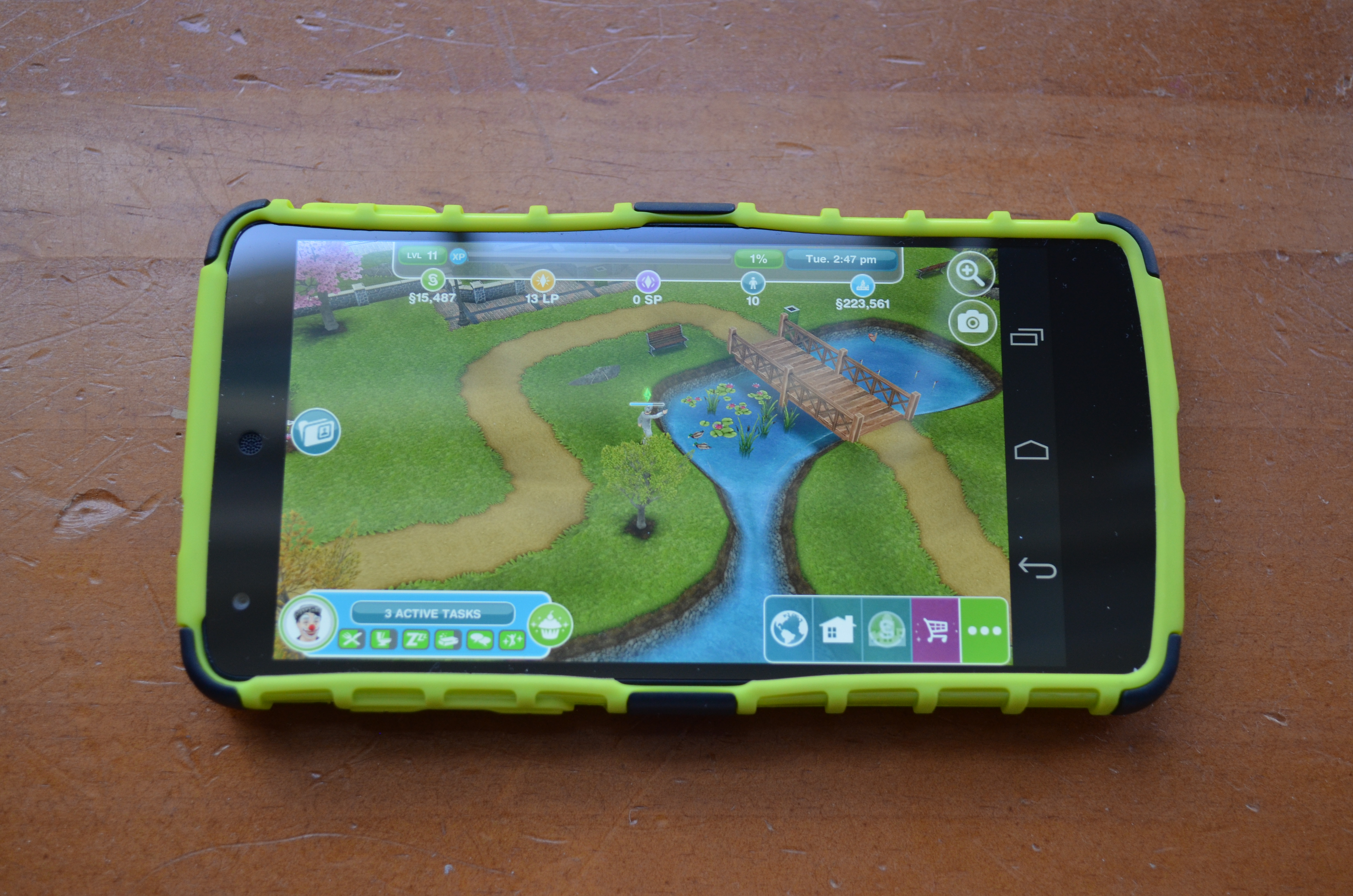
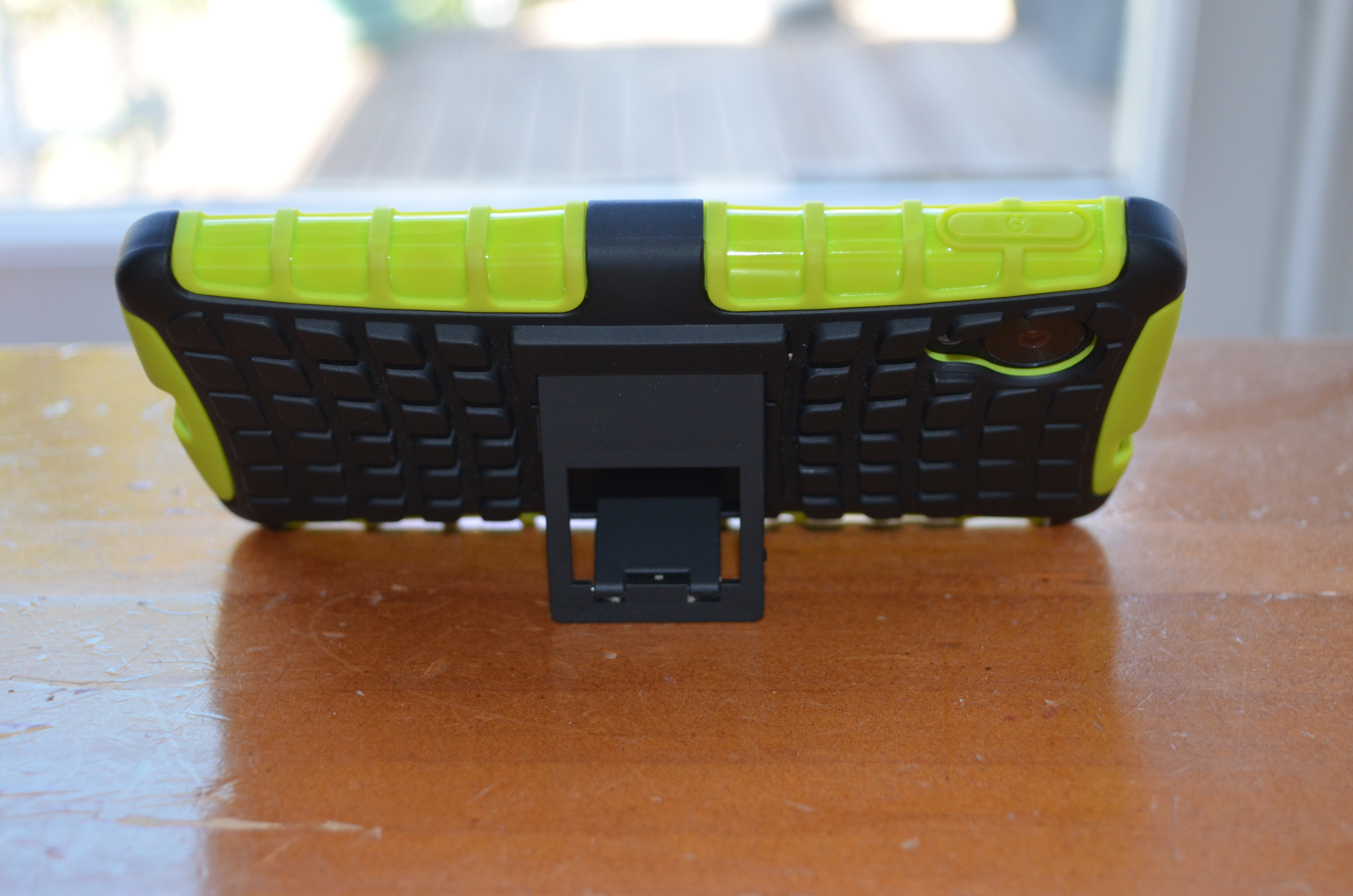
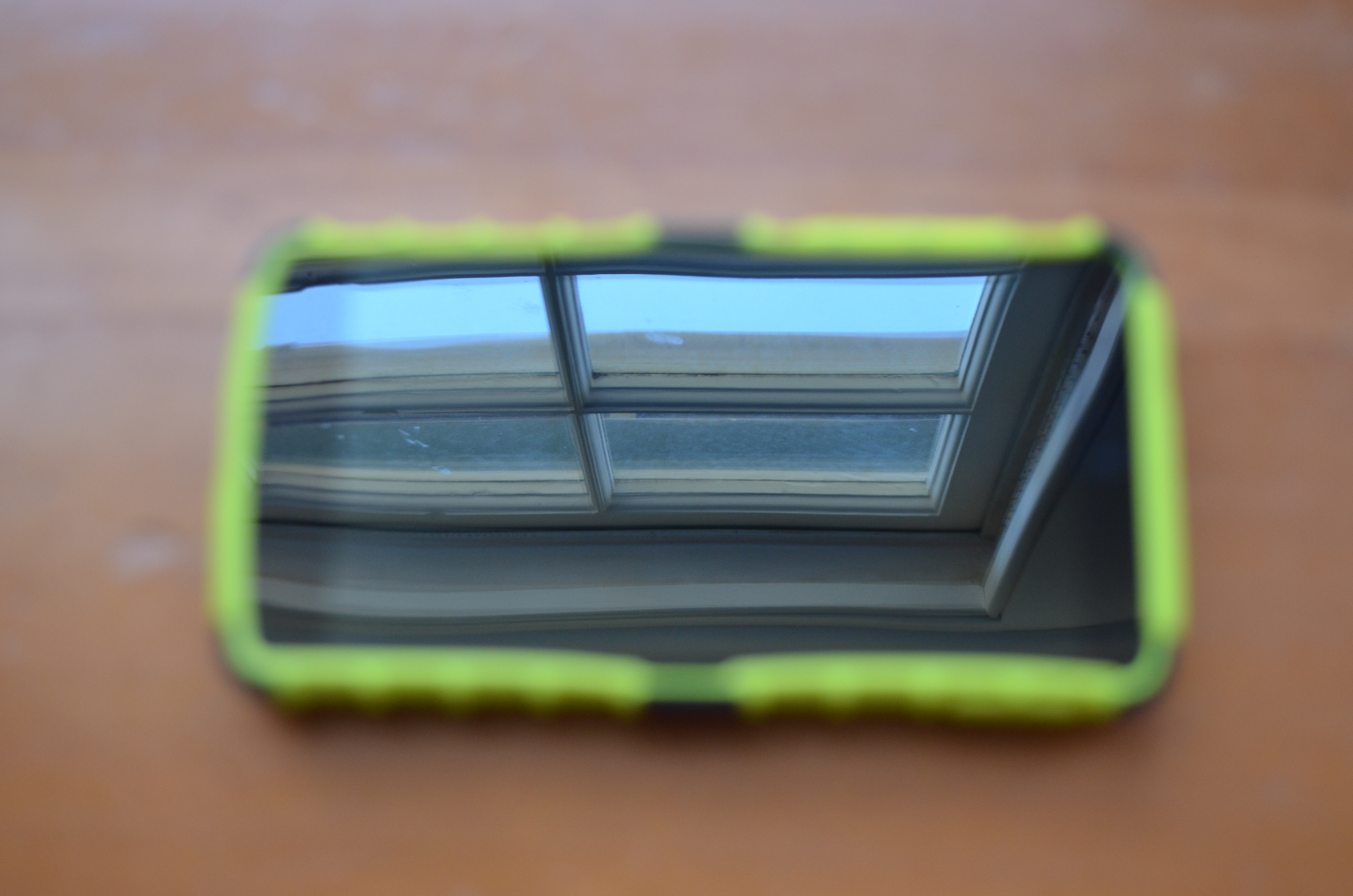
back of case showing both layersfront of casecase standshowing the mirror surface of the Nexus 5 I ve just been given an Armourdillo Hybrid case for the Nexus 5 [1] to review. The above pictures show the back of the case, the front of the case, the stand, and the front of the case with the screen blank. When I first photographed the case the camera focused on a reflection of the window, I include that picture for amusement and to demonstrate how reflective the phone screen is. This case is very hard, the green plastic is the soft inner layer which is still harder than the plastic in a typical gel case . The black part is polycarbonate which is very hard and also a little slippery. The case is designed with lots of bumps for grip (a little like the sole of a running shoe) so it s not likely to slip out of your hand. But the polycarbonate slides easily on plastic surfaces such as the dash of a car. It s fortunate that modern cars have lots of cup holders that can be used for holding a phone. I haven t dropped the phone since getting the new case, but I expect that the combination of a hard outer shell and a slightly softer inner shell (to cushion the impact) will protect it well. All the edges of the case extend above the screen so dropping the phone face down on a hard flat surface shouldn t cause any damage. The black part has a stand for propping the phone on it s side to watch a movie. The stand is very solid and is in the ideal position for use on soft surfaces such as a doona or pillow for watching TV in bed. Appearance This case is mostly designed to protect the phone and the bumps that are used for grip detract from the appearance IMHO. I think that the Ringke Fusion case for my Nexus 4 [2] looks much better, it s a trade-off between appearance and functionality. My main criteria for this case were good protection (better than a gel case) and small size (not one of the heavy waterproof cases). It was a bonus to get a green case for the Enlightened team in Ingress. NB Armourdillo also offers a blue case for the Resistance team in Ingress as well as other colors. MobileZap also have a number of other cases for the Nexus 5 [3].

Andrew Pollock: [life] Day 56, Kindergarten, rain, taxes

There was quite the torrential downpour overnight. It woke me up, and it woke Zoe up too, and at about 1:45am she ended up in bed with me. I think she managed to invent a new baby sleep position, where she was on my pillow, perpendicular to me along the bed head, and had somehow ejected the pillow that was on her side of the bed. We got up, with a slow start, and the weather was still looking a bit dicey, so Zoe wanted to go to Kindergarten by car. That actually meant we were the first ones there, because I'd been working to a timetable of leaving home by bike. One of the chickens was starting to hatch (and subsequently hatched around noon) so that was exciting. Funnily enough, Zoe had spent all morning telling me how she didn't want to go to Kindergarten, but by the time we got there, she didn't seem to mind being there all that much. After I got home from Kindergarten, I biked down to Bulimba to go to the bank to finalise opening my business bank accounts. I've since discovered that one can't do much without an ABN, I can't even get a cheque book, so I've sicked my accountant on that one for me. I got stuck into my US taxes some more today, and made a very satisfactory amount of progress on them. I think I should be able to finish them off in the next session I get to work on them. I felt like getting out of the house after that. It was looking quite like rain again, making picking up Zoe by bike out, so I ran a few errands in the car before getting to Kindergarten quite early. Zoe was fast asleep, but I let her have a long, slow wake up, and that made our departure much easier. She got to have a little hold of one of the baby chicks before we left. Today I learned that baby chicks smell absolutely divine. We got home, and Zoe did some self-directed craft for a bit, and then wanted to play hide and seek, so we did that and finally got around to looking at all of the Woolworths DreamWorks Heroes cards she's been collecting. I was disappointed to discover there's only a single card per pack, so that's going to mean I have to spend at least $840 on groceries, excluding duplicates, before we get all of them. I'm glad the checkout operators aren't sticking to the rules and are handing them out a little more generously than that. After that, we did a bit more rough and tumble play, and then it was time to start making dinner, so Zoe watched a DVD. We got dinner out of the way relatively early, so I practiced plaiting her hair (I've surprised myself with the half-decent job I can do) and then did bath time and bed time. Bed time was a little protracted (she didn't like her bedroom and wanted to sleep in my bed) but otherwise seems to have gone smoothly.

24 March 2014

Michael Prokop: Building Debian+Ubuntu packages on EC2

In a project I recently worked on we wanted to provide a jenkins-debian-glue based setup on Amazon s EC2 for building Debian and Ubuntu packages. The idea is to keep a not-so-strong powered Jenkins master up and running 24 7, while stronger machines serving as Jenkins slaves should be launched only as needed. The project setup in question is fully open sourced (more on that in a separate blog post), hereby I am documenting the EC2 setup in usage. Jenkins master vs. slave Debian source packages are generated on Jenkins master where a checkout of the Git repository resides. The Jenkins slaves do the actual workload by building the binary packages and executing piuparts (.deb package installation, upgrading, and removal testing tool) on the resulting binary packages. The Debian packages (source+binaries) are then provided back to Jenkins master and put into a reprepro powered Debian repository for public usage. Preparation The starting point was one of the official Debian AMIs (x86_64, paravirtual on EBS). We automatically deployed jenkins-debian-glue on the system which is used as Jenkins master (we chose a m1.small instance for our needs). We started another instance, slightly adjusted it to already include jenkins-debian-glue related stuff out-of-the-box (more details in section Reduce build time below) and created an AMI out of it. This new AMI ID can be configured for usage inside Jenkins by using the Amazon EC2 Plugin (see screenshot below). IAM policy Before configuring EC2 in Jenkins though start by adding a new user (or group) in AWS s IAM (Identity and Access Management) with a custom policy. This ensures that your EC2 user in Jenkins doesn t have more permissions than really needed. The following policy should give you a starting point (we restrict the account to allow actions only in the EC2 region eu-west-1, YMMV):
 
  "Version": "2012-10-17",
  "Statement": [
     
      "Action": [
        "ec2:CreateTags",
        "ec2:DescribeInstances",
        "ec2:DescribeImages",
        "ec2:DescribeKeyPairs",
        "ec2:GetConsoleOutput",
        "ec2:RunInstances",
        "ec2:StartInstances",
        "ec2:StopInstances",
        "ec2:TerminateInstances"
      ],
      "Effect": "Allow",
      "Resource": "*",
            "Condition":  
                "StringEquals":  
                    "ec2:Region": "eu-west-1"


  ]
 
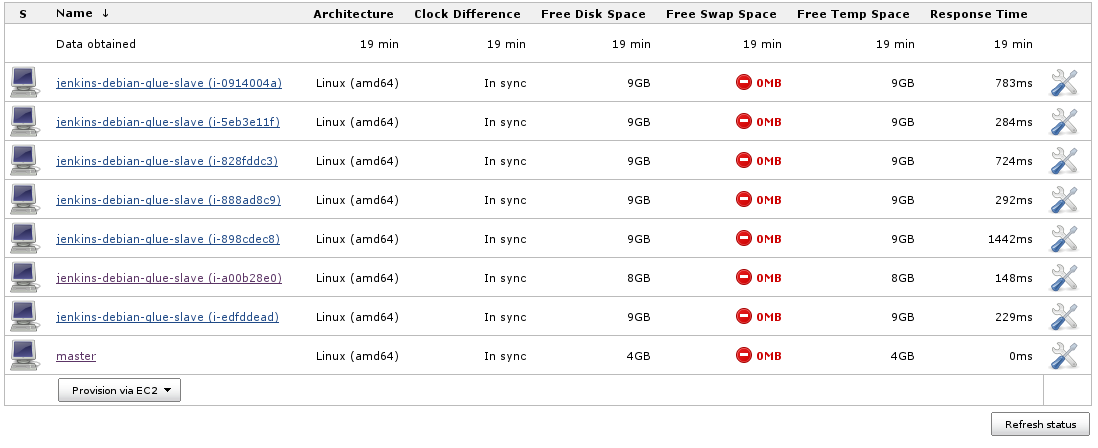
Jenkins configuration Configure EC2 access with Access Key ID , Secret Access Key , Region and EC2 Key Pair s Private Key (for SSH login) inside Jenkins in the Cloud section on $YOUR_JENKINS_SERVER/configure. Finally add an AMI in the AMIs Amazon EC2 configuration section (adjust security-group as needed, SSH access is enough): As you can see the configuration also includes a launch script. This script ensures that slaves are set up as needed (provide all the packages and scripts that are required for building) and always get the latest configuration and scripts before starting to serve as Jenkins slave. Now your setup should be ready for launching Jenkins slaves as needed: NOTE: you can use the Instance Cap configuration inside the advanced Amazon EC2 Jenkins configuration section to place an upward limit to the number of EC2 instances that Jenkins may launch. This can be useful for avoiding surprises in your AWS invoices. :) Notice though that the cap numbers are calculated for all your running EC2 instances, so be aware if you have further machines running under your account, you might want to e.g. further restrict your IAM policy then. Reduce build time Using a plain Debian AMI and automatically installing jenkins-debian-glue and further jenkins-debian-glue-buildenv* packages on each slave startup would work but it takes time. That s why we created our own AMI which is nothing else than an official Debian AMI with the bootstrap.sh script (which is referred to in the screenshot above) already executed. All the necessary packages are pre-installed and also all the cowbuilder environments are already present then. From time to time we start the instance again to apply (security) updates and execute the bootstrap script with its &dash&dashupdate option to also have all the cowbuilder systems up2date. Creating a new AMI is a no-brainer and we can then use the up2date system for our Jenkins slaves, if something should break for whatever reason we can still fall back to an older known-to-be-good AMI. Final words How to set up your Jenkins jobs for optimal master/slave usage, multi-distribution support (Debian/Ubuntu) and further details about this setup are part of another blog post. Thanks to Andreas Granig, Victor Seva and Bernhard Miklautz for reading drafts of this.
Next.

Previous.