Search Results: "ads"

12 September 2015

Ritesh Raj Sarraf: Google Take Action - Encryption

So I got an email yesterday from Google's Jess Hemerly, talking about how they care about encryption To quote a small snippet of the email:
We use locks to keep our homes and our possessions safe offline. But how can we protect our digital things, like photos on a smartphone or email traveling across the web? The answer is encryption.
To change, it has to start from home. That means, add encryption support to Gmail. Add encryption to Google Photos. To every service you provide. So that, if tomorrow, your service is compromised, you don't public our data. What all the service providers need to realize, is that it is not the tool that needs encryption, but the data. You could claim that newer Androids are safer because encryption is enabled by default. But the data that you are backing up on your cloud, is not encrypted. It only makes sense to have an end-to-end encryption, or rather, encryption at source. Had you just stacked the interface to have write() transparently call encrypt() for any and all data, there'd be no worry about privacy. But wait, then how'd you munch.

Categories:

Keywords:

Like:

Lars Wirzenius: Obnam 1.17 released (backup software)

I have just released version 1.17 of Obnam, my backup program. See the website at http://obnam.org for details on what the program does. The new version is available from git (see http://git.liw.fi) and as Debian packages from http://code.liw.fi/debian, and uploaded to Debian, and soon in unstable. The NEWS file extract below gives the highlights of what's new in this version. It includes highlights for 1.15 and 1.16 as well, as I didn't announce those in this blog. Version 1.17, released 2015-09-12
  • Luk Pol ek added the --fsck-skip-checksums setting to greatly speed up obnam fsck.
  • Lars Wirzenius fixed a bug that caused Obnam to sometimes back up the parent of the backup live data root. In other words, if running obnam backup $HOME/important, then Obnam might backup the whole of the home directory, instead of just the important subdirectory.
Version 1.16, released 2015-09-06
  • Fixed another typo in a variable name ("netloc"), found by Benedikt Neuffer.
  • Fixed a lot of missing module imports, unnecessary module imports, and other minor bugs and style issues found by pylint. Pylint now gets run automatically by the test suite. This includes a fix in exclude_pathnames_plugin.py to add a missing import and fix variable namaes, by Diane Trout. A similar fix was also contributed by Mesar Hameed.
  • Luk Pol ek fixed an unlocking problem when GnuPG fails during an Obnam run. The lock should now be removed rather than left behind.
Version 1.15, released 2015-08-19
  • Fixed a typo in a variable name ("netloc"), found by Dirk.

Michal Čihař: Weblate for translating everything

Weblate is not only useful for translating software, it can help in translating any content. Let's look where our users are using it. Software translation is the most usual use case. This is actually where Weblate was used for first time and still provides great support for that. As an example (and oldest project hosted in Weblate) you can look at phpMyAdmin, where Weblate also helps to keep in sync translation for different maintenance branches. It can also help you in using same terminology in command line utility and graphical one like it is done in Gammu and Wammu translations. Weblate also supports localization of mobile application. Android support was originally implemented for OsmAnd project, but now they also translate iOS application using Weblate. Another use case is for translating documentation. You need to have some infrastructure to do, but there are several free software project to help here as well. For phpMyAdmin documentation or documentation for python module Odorik the Sphinx documentation generator is used, which has support for translation of the documentation. I've recently published quick howto for this setup. Another great tool for translating documentation is Publican, it is Docbook based tool and is used for translating The Debian Administrator's Handbook. Last but not least, you can use Weblate to translate your website. For example website for Weblate itself is translated this way. Did you miss your use case for Weblate? Please let me know. PS: I've heard that one Linux distribution will start using Weblate soon.

Filed under: English phpMyAdmin SUSE Weblate 0 comments

11 September 2015

Matthias Klumpp: Deploying Limba packages: Ideas & current status

LimbaHubThe Limba project does not only have the goal to allow developers to deploy their applications directly on multiple Linux distributions while reducing duplication of shared resources, it should also make it easy for developers to build software for Limba. Limba is worth nothing without good tooling to make it fun to use. That s why I am working on that too, and I want to share some ideas of how things could work in future and which services I would like to have running. I will also show what is working today already (and that s quite something!). This time I look at things from a developer s perspective (since the last posts on Limba were more end-user centric). If you read on, you will also find a nice video of the developer workflow  1. Creating metadata and building the software To make building Limba packages as simple as possible, Limba reuses already existing metadata, like AppStream metadata to find information about the software you want to create your package for. To ensure upstreams can build their software in a clean environment, Limba makes using one as simple as possible: The limba-build CLI tool creates a clean chroot environment quickly by using an environment created by debootstrap (or a comparable tool suitable for the Linux distribution), and then using OverlayFS to have all changes to the environment done during the build process land in a separate directory. To define build instructions, limba-build uses the same YAML format TravisCI uses as well for continuous integration. So there is a chance this data is already present as well (if not, it s trivial to write). In case upstream projects don t want to use these tools, e.g. because they have well-working CI already, then all commands needed to build a Limba package can be called individually as well (ideally, building a Limba package is just one call to lipkgen). I am currently planning DeveloperIPK packages containing resources needed to develop against another Limba package. With that in place and integrated with the automatic build-environment creation, upstream developers can be sure the application they just built is built against the right libraries as present in the package they depend on. The build tool could even fetch the build-dependencies automatically from a central repository. 2. Uploading the software to a repository While everyone can set up their own Limba repository, and the limba-build repo command will help with that, there are lots of benefits in having a central place where upstream developers can upload their software to. I am currently developing a service like that, called LimbaHub . LimbaHub will contain different repositories distributors can make available to their users by default, e.g. there will be one with only free software, and one for proprietary software. It will also later allow upstreams to create private repositories, e.g. for beta-releases. 3. Security in LimbaHub Every Limba package is signed with they key of its creator anyway, so in order to get a package into LimbaHub, one needs to get their OpenPGP key accepted by the service first. Additionally, the Hub service works with a per-package permission system. This means I can e.g. allow the Mozilla release team members to upload a package with the component-ID org.mozilla.firefox.desktop or even allow those user(s) to own the whole org.mozilla.* namespace. This should prevent people hijacking other people s uploads accidentally or on purpose. 4. QA with LimbaHub LimbaHub should also act as guardian over ABI stability and general quality of the software. We could for example warn upstreams that they broke ABI without declaring that in the package information, or even reject the package then. We could validate .desktop files and AppStream metadata, or even check if a package was built using hardening flags. This should help both developers to improve their software as well as users who benefit from that effort. In case something really bad gets submitted to LimbaHub, we always have the ability to remove the package from the repositories as a last resort (which might trigger Limba to issue a warning for the user that he won t receive updates anymore). What works Limba, LimbaHub and the tools around it are developing nicely, so far no big issues have been encountered yet. That s why I made a video showing how Limba and LimbaHub work together at time: Still, there is a lot of room for improvement Limba has not yet received enough testing, and LimbaHub is merely a proof-of-concept at time. Also, lots of high-priority features are not yet implemented. LimbaHub and Limba need help! At time I am developing LimbaHub and Limba alone with only occasional contributions from others (which are amazing and highly welcomed!). So, if you like Python and Flask, and want to help developing LimbaHub, please contact me the LimbaHub software could benefit from a more experienced Python web developer than I am  (and maybe having a designer look over the frontend later makes sense as well). If you are not afraid of C and GLib, and like to chase bugs or play with building Limba packages, consider helping Limba development :-)

Daniel Pocock: Payment for shadow work

A significant court ruling yesterday means that companies in the EU have to pay employees for time spent traveling to and from work. If something seems too good to be true, it usually is. Once you get past the headline, you find that it only applies to workers who are going to appointments outside their workplace. Some companies have been careless about scheduling such appointments, sometimes leaving an employee more than 2 hours from his home at the end of the day and this new ruling may just force them to either try a little harder to schedule appointments with consideration for the employee or pay for the extra time if excessive travel sometimes occurs. The ruling may be good news for IT workers, road congestion and the environment. With companies now becoming more efficient in managing travel time, they may well need to improve the software they use for scheduling the employee's time. With certain types of employee potentially having a shorter journey after the last appointment, this means less road congestion and less pollution. Professionals who have to fly may also be taking note: if you work in Paris but have to fly to London one day for meetings, then your working time starts when you leave your home at 05:30 and finishes at 22:00 when you get home. Shadow work comes in many forms It is good to see society taking note of the hidden cost of shadow work. What about all those other nasty and inefficient practices that take time but you don't get paid for them? Have you ever wondered why some companies send bills and statements to you by email or post, but others expect you to waste 5 minutes of your time logging in to their web site to download the bill or statement? Should people be paid for this time too and would that force these companies to stop being so lazy? Some companies have been trying to avoid doing the right thing by arguing that email is not secure, but this just doesn't add up: the original PGP MIME specs for email encryption were published through the IETF process in 1996. Barclaycard recently began offering to send credit card statements using encrypted PDF, proving that many of the excuses given by other companies are just that: excuses. For developers For people who are interested in improving the way their organization sends communications to customers, a popular choice is the Apache Camel integration framework. I've deployed Camel for customer trade notification and other purposes at several large and well known firms in financial services. It has a rich set of features for transforming messages, including a PGP data format for encryption and it is able to send messages out using a vast number of connectivity options, including many of the basic ones like SMTP, SMPP (for SMS), XMPP/Jabber and message queues.

10 September 2015

Gunnar Wolf: So you want to get our book?

OK, I already bragged that our book on Operating Systems is finally printed and has, thus, been formally published. What I had not yet mentioned is how we planned its physical distribution. Yes, it is available for sale at some UNAM libraries... But coming to UNAM is sadly an option only for people who are in Mexico City. I have been quite busy, and was unable to come up with anything earlier, but I have finally finished setting up a decent although minimal web page for the book. In it, I mention the possible ways you can get your own printed copy of Fundamentos de sistemas operativos:
  • If you are in Mexico, the advised way is to call or mail the library at Instituto de Investigaciones Econ micas (+52-55)5623-0080 or ventiiec@unam.mx.
    They will ship the book (they would ship it overseas, but it'd be too expensive!) and are able to process electronic payment opetions.
    The book printed at UNAM has substantive part of its pages printed in color, and let me tell you... It's worth it.
  • If you are not in Mexico or you prefer not to deal with a human, you can buy the book from the on-demand printing service lulu.com.
    For cost reasons, it is printed in black and white, but it is the same content (minus two typos ;-) ). Lulu.com is an international company, so they will get it shipped to you cheaper and faster And I have requested the book to be made available to libraries such as Amazon and Barnes and Noble (and was told it should take a couple of weeks to have it ready there).
Of course, the book is and will always be free for downloading, and its sources are online so you can easily derive from it as well. Enjoy! (and please report me any bugs you see!)

Gunnar Wolf: UNAM, more open than ever before.

Today I was refered to the publication of an "agreement" signed by my university's Rector: The Agreement that establishes the General Guidelines for the Open Access Policy of Universidad Nacional Aut noma de M xico. This is a document we have been waiting and pushing for throughout several years; I got involved in the Network of Digital Collections (Red de Acervos Digitales), RAD-UNAM back in 2011, and am honored to be its current coordinator, but this group has roots back in 2005. And, of course, by then several other people had been working on the topic without formal coordination. Not only we are happy because the agreement explicitly mentions our group as one of The Venues for Open Access publishing and dissemination in UNAM. In its seventh point, it mentions:
In the matters of Open Access, academic entities and university dependencies have the following obligations:
(...)
VII. Promote and support the creation and maintenance of institutional repositories, as well as the deposit of the digital resources produced by its academic community, which should be incorporated into Red de Acervos Digitales de la UNAM
(...)
So... We have done a good job. And there will be surely more to follow! I'm including here a copy of the agreement by itself (without the whole number of the Gaceta UNAM) because I will surely have to refer to it in the future.
AttachmentSize
Lineamientos generales para la pol tica de acceso abierto de la Universidad Nacional Aut noma de M xico89.83 KB

Dirk Eddelbuettel: Rcpp 0.12.1: First boat load of fixes!

The first updated in the 0.12.* series of Rcpp is now on the CRAN network for GNU R this morning, and I will push a Debian package. This follows the 0.12.0 release from late July which started to some serious new features. Rcpp has become the most popular way of enhancing GNU R with C++ code. As of today, 461 packages on CRAN depend on Rcpp for making analyses go faster and further. This release once again features contributions from a number of new contributors, with Florian Plaza O ate and Dan Dillon joining the fray with several pull requests each. Kurt Hornik also helped with a fix for a bad interaction between very recent R (3.2.2) changes and Rcpp; another related one was also addressed. A big Thanks! to everybody helping with code, bug reports or documentation, See below for a detailed list of changes extracted from the NEWS file.
Changes in Rcpp version 0.12.1 (2015-09-10)
  • Changes in Rcpp API:
    • Correct use of WIN32 instead of _WIN32 to please Windows 10
    • Add an assignment operator to DimNameProxy (PR #339 by Florian)
    • Add vector and matrix accessors .at() with bounds checking (PR #342 by Florian)
    • Correct character vector conversion from single char (PR #344 by Florian fixing issue #343)
    • Correct on use of R_xlen_t back to size_t (PR #348 by Romain)
    • Correct subsetting code to allow for single assignment (PR #349 by Florian)
    • Enable subset assignment on left and righ-hand side (PR #353 by Qiang, fixing issue #345)
    • Refreshed to included tinyformat template library (PR #357 by Dirk, issue #356)
    • Add operator<<() for vectors and matrices (PR #361 by Dan fixing issue #239)
    • Make String and String_Proxy objects comparable (PR #366 and PR #372 by Dan, fixing issue #191)
    • Add a new class Nullable for objects which may be NULL (PR #368 by Dirk and Dan, fixing issue #363)
    • Correct creation and access of large matrices (PR #370 by Florian, fixing issue #369)
  • Changes in Rcpp Attributes:
    • Correctly reset directory in case of no-rebuilding but Windows code (PR #335 by Dirk)
  • Changes in Rcpp Modules:
    • We no longer define multiple Modules objects named World in the unit tests with was seen to have a bad effect with R 3.2.2 or later (PR #351 by Dirk fixing issue #350).
    • Applied patch by Kurt Hornik which improves how Rcpp loads Modules (PR #353 by Dirk)
  • Changes in Rcpp Documentation:
    • The Rcpp.bib file with bibliographic references was updated.
Thanks to CRANberries, you can also look at a diff to the previous release As always, even fuller details are on the Rcpp Changelog page and the Rcpp page which also leads to the downloads page, the browseable doxygen docs and zip files of doxygen output for the standard formats. A local directory has source and documentation too. Questions, comments etc should go to the rcpp-devel mailing list off the R-Forge page.

This post by Dirk Eddelbuettel originated on his Thinking inside the box blog. Please report excessive re-aggregation in third-party for-profit settings.

Chris Lamb: Joining strings in POSIX shell

A common programming task is to glue (or "join") items together to create a single string. For example:
>>> ', '.join(['foo', 'bar', 'baz'])
"foo, bar, baz"
Notice that we have three items but only two commas this can be important if the tool we passing doesn't support trailing delimiters or we simply want the result to be human-readable. Unfortunately, this can be inconvenient in POSIX shell where we construct strings via explicit concatenation. A na ve solution of:
RESULT=""
for X in foo bar baz
do
    RESULT="$ RESULT , $ X "
done
... incorrectly returns ", foo, bar, baz". We can solve this with a (cumbersome) counter or flag to only attach the delimiter when we need it:
COUNT=0
RESULT=""
for X in foo bar baz
do
    if [ "$ COUNT " = 0 ]
    then
        RESULT="$ X "
    else
        RESULT="$ RESULT , $ X "
    fi
    COUNT=$((COUNT + 1))
done

One alternative is to use the little-known ":+" expansion modifier. Many people are familiar with ":-" for returning default values:
$ echo $ VAR:-fallback 
By contrast, the ":+" modifier inverts this logic, returning the fallback if the specified variable is actually set. This results in the elegant:
RESULT=""
for X in foo bar baz
do
    RESULT="$ RESULT:+$ RESULT ,  $ X "
done

Norbert Preining: Getting CafeOBJ via MacPorts

I have finally finished the Portfile for CafeOBJ, which allows users to install CafeOBJ via the usual port command of MacPorts. For one needs to add our local source (which only ships CafeOBJ port), but I hope to get the port into the standard distribution soon. cafeobj-logo Necessary steps:
  • Add the following line to your MacPorts sources.conf, which usually resides in /opt/local/etc/macports/sources.conf:
    http://cafeobj.org/macport/ports.tar.gz
  • After that, call the following two commands (as root or with sudo), the first syncronizing the ports, the second one installing CafeOBJ:
    port sync
    port install cafeobj
This should give you a working installation of CafeOBJ 1.5.3. The port will be updated as soon as 1.5.4 is released (which should be rather soon). Enjoy, and please leave comments and suggestions how to improve the port file here, per email, or at our bug tracker.

Antoine Beaupr : Switched to bootstrap theme

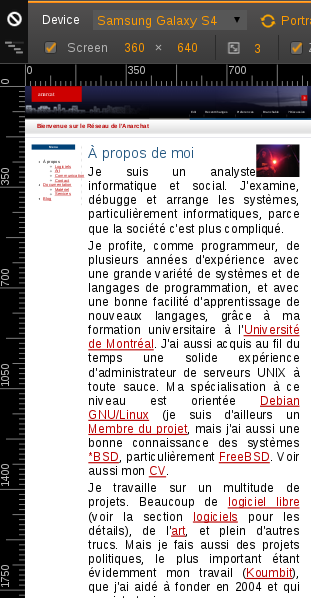
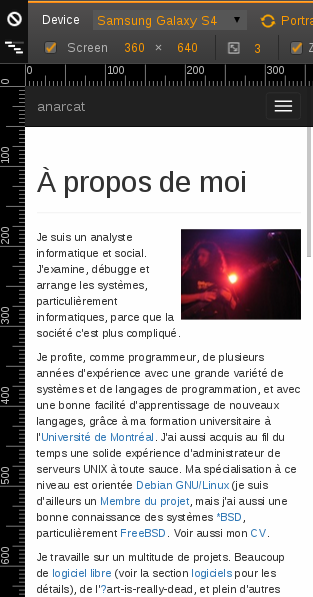
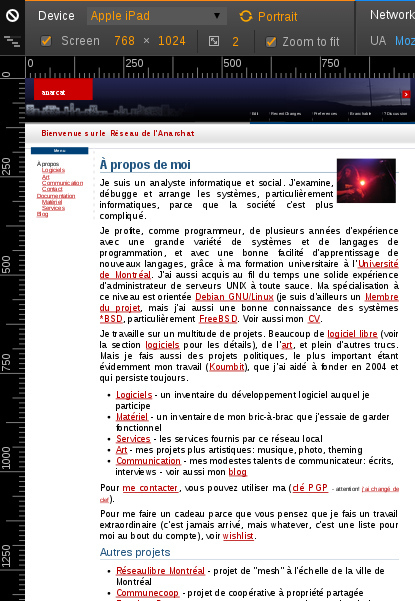
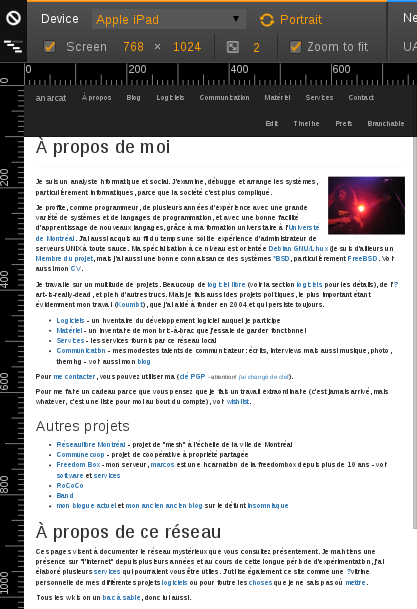
I finally gave up and drank the cool-aid of the Bootstrap theme. The main reason was that I noticed the site was basically unusable on any mobile device, including tablet computers like the iPad, which are unfortunately very, very common. Phones wouldn't render the site in a legible way either, unfortunately. The change is rather drastic, so I figured it was important to mention it here. I am not so satisfied pretty exctied with the result: the theme is very basic, if not absent. I actually like that purified form now, and it works across devices now much better. But I do feel I just made my blog look like everyone else that uses Bootstrap. We seem to enter an era where non-graphic designers (like me) are back to building web pages that all look the same, not very different, in a way, from the old days of plain HTML, like the default ikiwiki theme. I did some work to change the look at least minimally, but the top black navbar is really a killer giveaway this is a bootstrap theme. Bootstrap does a lot for the typography, at least when checking the presslabs checklist or the practical typography checklist, but I still had to change the main body width, which helped a lot I think. Anyways, the old Night City theme is still available for download and I could still flip it back on here if I need to.

What changed The new theme keeps the distractions away, but ironically, it's slower than the previous theme even though there are no images and basically no colors at all. On my tests, it now loads in about 3.42 seconds on the "Regular 2G (250Kbps)" simulation of Chromium with 72KB in 12 requests. Whereas my tests with the previous theme were taking 3.25 seconds with 43.5KB in 17 requests. This is due to the Bootstrap CSS, which takes a whopping 19KB itself, but especially because I now load JQuery, which takes a whopping 32.8KB! And that is probably gzip-compressed, as the original is more around 90KB. But at least the thing is readable on phones and tablets now. Compare:

Samsung S3, before Screenshot of a fake rendering on the Samsung Galaxy S3 in night city

Samsung S3, after Screenshot of a fake rendering on the Samsung Galaxy S3 in bootstrap I like this: much simpler, purer version on smaller devices. And we see what counts: the freaking text. Of course, on tablets, it doesn't fare as well: the top menu gets wrapped around...

Apple iPad, before Screenshot of a fake rendering on the iPad in night city

Apple iPad, after Screenshot of a fake rendering on the iPad in bootstrap Apparently, the fix would be for me to "customize the @grid-float-breakpoint variable" in LESS (which I thought was a pager, but seems to be a CSS preprocessor, graaah). Still, I think it's better that way, more readable, and less crufty.

How it was done After doing a thorough evaluation of all the Bootstrap ikiwiki themes I could find (there are more than 4 at least!), I figured I prefered the Jak Linux one. It seemed to be better implemented than the others, cleaner, and I liked the mean black border on top. Black is cool. Oh, and I liked the subtle footer as well. Subtle is cool. Unfortunately, that theme originally required a custom plugin to have a menu on top, which i thought was silly. So I patched it to make it work with the sidebar plugin, which turned out to be trivially simple: just dump the sidebar content, and make the sidebar page have explicit HTML tags in it that match Bootstrap's required classes. I also added the regular action links in the top navbar, but that does overload it quite a bit. I also did some code cleanups and various other small changes, all of which are available in my personnal git repo.

What doesn't work So of course, there are always problems. The first problem is the extra bandwidth usage. Not sure that can be fixed, other than switching to the upcoming Bootstrap 4, which is smaller than Bootstrap 3, bizarrely. The more annoying problems are weird alignment issues. If the screen gets two narrow without kicking some collapse rules in place (the iPad bug above), the navbar rows overflow and look ugly. Even more bizarre, in some cases the right navbar can just completely disappear, in fact, that's the only fix I could find: to assign the hidden-xs and hidden-sm classes to the navbar-right <UL> element. But then it just goes away, which is pretty darn stupid. Still - I assigned the classes to a few actions that seemed low priority, both in the theme and in the sidebar page. Similarly, the search form at the bottom of the page doesn't seem to want to fit in the footer properly. No idea why and I can't bother to figure that one out. I ended up merging this with the backlinks, tags and trails navigation items. Oh, and amazingly enough: comments are simply not rendered at all right now. Oops. I seemed to have picked the single bootstrap Ikiwiki theme that does *not* have comments rendering... Aaaargh. For now I just copy-pasted stuff from the [ramseydsilva][] theme and it looks pretty ugly, but at least it works. I ended up theming comments the same way i did for Night City, which looks pretty good, but is not in sync with the LESS stuff in Bootstrap. I also add to add back trails, backlinks and favicon... looks like the Jak theme wasn't made for a blog after all... but that's now fixed! :) Another improvement would be to change the font from the canonical Helvetica to something prettier, like suggested in Practical Typography, in the font recommendations section, or the presslabs checklist. So far I have settled on Mozilla's Fira font (which means, yes, one set of objects is actually loading from the CDN, sorry). Feedback welcome.

9 September 2015

Rhonda D'Vine: Sookee

It's time for some new music. And given that this artist was suggested to me at least twice by different people I guess I finally have to feature her. This time it's about Sookee, a rapper from Berlin with queer-feministic background. I guess if you listen and see the first song you might know why she was suggested to me, and also why I consider her an important artist to share. So without further delay, here are the songs: As you can see, Sookee isn't just some artist but transports a lot of messages. And even when you might not understand them because they are in German I hope you get the concept nevertheless. :) Enjoy!

/music permanent link Comments: 0 Flattr this

8 September 2015

Daniel Silverstone: Orchestration, a cry for help

Over the past few years, a plethora of orchestration frameworks have been exploding onto the scene. Many have been around for quite a while but not all have the same sort of community behind them. For example there's a very interesting option in Joey Hess' Propellor but that is hurt by needing to be able to build Propellor on all the hosts you manage. On the other hand, Ansible is able to operate without installing extra software on your target hosts, but instead it ends up very latency-bound which can cause problems when your managed hosts are "far away". I have considered CFEngine, Chef, Puppet and Salt in addition to the above mentioned options, but none of them feel quite right to me. I am looking for a way to manage a small number of hosts, at least one of which is not always online (my laptop) and all of which are essentially snowflakes whose sparkleybits I want some reasonable control over. I have a few basic requirements which I worry would be hard to meet -- I want to be able to make changes to my hosts by editing a file and committing/pushing it to a git server. I want to be able to manage a host entirely over SSH from one or more systems, ideally without having to install the orchestration software on the target host, but where if the software is present it will get used to accelerate matters. I don't want to have to install Ruby or PHP on any system in order to have orchestration, and some of the systems I wish to manage simply can't compile Haskell stuff sanely. I'm not desperately interested in learning yet more DSLs, but I appreciate that it will be necessary, but I really don't want to have to learn more than one DSL simply to run one frameworks. I don't want to have to learn strange and confusing combinations of file formats. For example, Ansible quite sensibly uses YAML for its structured data except for its host/group lists. It uses Jinja2 for its templating and looping, except for some things which it generates its own looping constructs inside its YAML. I also personally find Ansible's sportsball oriented terminology to be confusing, but that might just be me. So what I'm hoping is that someone will be able to point me at a project which combines all the wonderful features of the above, with a need to learn only one DSL and which doesn't require to be installed on the managed host but which can benefit from being so installed, is driven from git, and won't hurt my already overly burdened brain. Dear Lazyweb, pls. kthxbye.

Dirk Eddelbuettel: It was twenty years ago today...

sgt pepper Hm, wasn't there a catchy tune that started that way? Just kidding. But about twenty years ago today I sent this email about a new Debian package upload -- and that makes it (as best as I can tell) the earliest trace of me doing Debian work. It so happened that I did upload two packages in July of 1995 as well, but it was so early in the project that we did not have a mailing list archive for such things yet (!!). And I have a vague recollection that the two in July were an adoption---whereas the post referenced above announced efax as my first new package added to the distribution. And there were more to come ... Anyway, thanks for all the fish! Twenty years with Debian has been a great, great ride. I learned a lot from a lot of fantastic people, and I hope I helped a few people along the way with a package or two I still maintain. Debian remains a truly fabulous project which I hope will go strongly for another 20 (or even 22).

This post by Dirk Eddelbuettel originated on his Thinking inside the box blog. Please report excessive re-aggregation in third-party for-profit settings.

Craig Small: WordPress 4.3 getting slow you might need an update

Wordpress under water I recently received Debian bug report #798350 where the user had a problem with wordpress. After upgrading to version 4.3, the webservers performance degrades over time. The problem is also reported at the wordpress site with bug WordPress ticket 33423 including the fix. I have backported the relevant changeset and uploaded Debian wordpress package 4.3+dfsg-2 which only contains this changeset. For a lot of people, including myself, you probably won t hit this bug but if it impacts you, then try this update.

Eriberto Mota: Debian: how to use blhc to solve hardening issues when packaging

Implementing the hardening When packaging in Debian, is very common to see the lintian messages 'hardening-no-relro' and 'hardening-no-fortify-functions' in some softwares written in C or C++. To solve these issues, we can use the 'blhc' tool (apt-get install blhc). Please, get the revision 1.11-9 of the icmpinfo package. You can get this revision from http://snapshot.debian.org or from http://eriberto.pro.br/debian/icmpinfo. As a shortcut, you can use the following command:
$ dget -u http://eriberto.pro.br/debian/icmpinfo/icmpinfo_1.11-9.dsc
The icmpinfo 1.11-9 is almost clean for lintian (in 2015-09-07, Standards-Version 3.9.6). The only problem is:
W: icmpinfo: hardening-no-relro usr/sbin/icmpinfo
To track the problem I will use blhc over the .build file:
$ blhc icmpinfo_1.11-9_amd64.build
LDFLAGS missing (-Wl,-z,relro): cc -g -O2 -fstack-protector-strong -Wformat -Werror=format-security -o icmpinfo recvping.o print.o err.o icmpinfo.o pid.o
Note that the problem is some missing options (-Wl,-z,relro) for LDFLAGS when building icmpinfo (for newbies, in GCC, -o is used to indicate the name to be used for the final binary after the compilation). If you are using the DebHelper compat 9 (debian/compat=9) and the DebHelper 9 (debhelper >= 9 in Build-Depends field in d/control), some variables as CFLAGS, LDFLAGS, CPPFLAGS and CXXFLAGS will be automatically passed during calls to dh_auto_* programs (yes, you should use the new and reduced d/rules format - see as example the debian/rules of the icmpinfo 1.11-9; if you still have doubts, $ man dh). Now, we need discover the reason why the LDFLAGS is being changed between its generation by the Debian build system and its utilization by the upstream's source code. So, we need to check the upstream Makefile. There is in Makefile (after a 'quilt push -a', to apply all current patches):
LDFLAGS= $(CFLAGS)
OBJECTS= recvping.o print.o err.o icmpinfo.o pid.o
TARGET = icmpinfo
$(TARGET): $(OBJECTS)
 $(CC) $(LDFLAGS) -o $@ $(OBJECTS) $(LDLIBS)
Hummm... The LDFLAGS content generated by Debian is being dropped by Makefile because it is saying that "LDFLAGS = CFLAGS content". This line is a problem because the upstream Makefile needs to take and use the CFLAGS and LDFLAGS independently. To fix the issue, you can use this patch:
--- icmpinfo-1.11.orig/Makefile
+++ icmpinfo-1.11/Makefile
@@ -20,13 +20,13 @@ VERS = 1.11
 
 RM = rm -f
 
-LDFLAGS= $(CFLAGS)
+#LDFLAGS= $(CFLAGS)
 
 OBJECTS= recvping.o print.o err.o icmpinfo.o pid.o
 TARGET = icmpinfo
 
 $(TARGET): $(OBJECTS)
- $(CC) $(LDFLAGS) -o $@ $(OBJECTS) $(LDLIBS)
+ $(CC) $(LDFLAGS) $(CFLAGS) -o $@ $(OBJECTS) $(LDLIBS)
 
 tgz: clean
 rm -f CHECKSUMS.asc
After a 'debuild' is a fact the problem is solved and the lintian is happy. See the blhc results:
$ blhc ../icmpinfo_1.11-9_amd64.build
$
Now, we can improve the hardening. To see the current status, we can use the 'blhc --all' command. See here:
blhc --all ../icmpinfo_1.11-9_amd64.build
CFLAGS missing (-fPIE): cc -g -O2 -fstack-protector-strong -Wformat -Werror=format-security -D_FORTIFY_SOURCE=2 -c -o recvping.o recvping.c
CFLAGS missing (-fPIE): cc -g -O2 -fstack-protector-strong -Wformat -Werror=format-security -D_FORTIFY_SOURCE=2 -c -o print.o print.c
CFLAGS missing (-fPIE): cc -g -O2 -fstack-protector-strong -Wformat -Werror=format-security -D_FORTIFY_SOURCE=2 -c -o err.o err.c
CFLAGS missing (-fPIE): cc -g -O2 -fstack-protector-strong -Wformat -Werror=format-security -D_FORTIFY_SOURCE=2 -c -o icmpinfo.o icmpinfo.c
CFLAGS missing (-fPIE): cc -g -O2 -fstack-protector-strong -Wformat -Werror=format-security -D_FORTIFY_SOURCE=2 -c -o pid.o pid.c
LDFLAGS missing (-fPIE -pie -Wl,-z,now): cc -Wl,-z,relro -g -O2 -fstack-protector-strong -Wformat -Werror=format-security -o icmpinfo recvping.o print.o err.o icmpinfo.o pid.o
Well, we know that CFLAGS and LDFLAGS are present. Now, we can force the DebHelper to pass some extra options to make hardening better. Generally, is only needed to add the following line to debian/rules:
export DEB_BUILD_MAINT_OPTIONS = hardening=+all
See the results (after a new debuild command):
$ blhc --all ../icmpinfo_1.11-9_amd64.build
$
More examples Let me to show other example. I will use the mac-robber 1.02-3 (however, I disabled the Makefile.patch in debian/patches/series). After a debuild, the following lintian messages are presented:
W: mac-robber: hardening-no-relro usr/bin/mac-robber
I: mac-robber: hardening-no-fortify-functions usr/bin/mac-robber
Using blhc:
$ blhc ../mac-robber_1.02-3_amd64.build 
CFLAGS missing (-g -O2 -fstack-protector-strong -Wformat -Werror=format-security): gcc -D_FILE_OFFSET_BITS=64 -o mac-robber mac-robber.c
CPPFLAGS missing (-D_FORTIFY_SOURCE=2): gcc -D_FILE_OFFSET_BITS=64 -o mac-robber mac-robber.c
LDFLAGS missing (-Wl,-z,relro): gcc -D_FILE_OFFSET_BITS=64 -o mac-robber mac-robber.c
We need to verify what is the problem in Makefile with CFLAGS, CPPFLAGS and LDFLAGS when generating the binary 'mac-robber' (just recalling, -o mac-robber in GCC command). See:
linux_notstatic: 
 $(CC) -D_FILE_OFFSET_BITS=64 -o mac-robber mac-robber.c
There are no references to CFLAGS, CPPFLAGS and LDFLAGS. To solve the problem, we need patch the Makefile to make this:
linux_notstatic: 
 $(CC) $(CFLAGS) $(LDFLAGS) $(CPPFLAGS) -D_FILE_OFFSET_BITS=64 -o mac-robber mac-robber.c
As last example, is possible that the Makefile is overriding the content sent by DebHelper when building. See this line from a hypothetical Makefile:
CFLAGS = -g -Wall
As you can see, the Makefile is redefining CFLAGS; consequently, it is discarding any previous content sent by DebHelper. To solve this issue, we can use the following patch:
-CFLAGS = -g -Wall
+CFLAGS += -g -Wall
So, the content received from DebHelper will be added to '-g -Wall'. Default parameters As curiosity, to see the basic parameters created by DebHelper as hardening, use the command:
$ dpkg-buildflags
To see the all parameters, use the command:
$ DEB_BUILD_MAINT_OPTIONS=hardening=+all dpkg-buildflags
More information More information about the hardening can be viewed at two places: https://wiki.debian.org/Hardening https://wiki.debian.org/HardeningWalkthrough I hope this help. Enjoy!

7 September 2015

Ben Armstrong: Hike at Blomidon Park: Late Summer, 2015

I had the wonderful privilege to go camping and hiking with my kids scouting group, the Pathfinders of Tantallon SDA church. The day started with a quick trip to Pugwash with one of the leaders to bring back some chairs to their school, and then we headed back out to Blomidon to meet up with the group. Click the photo below to start the slideshow.
The road trip started early to fetch some chairsThe road trip started early to fetch some chairs click to start
The smudgy truck windows make an interesting filter Still an hour or more away from our first stop More funky filtering, this time with trees participating Wentworth valley taken over the cluttered dash We disturbed a great blue heron s breakfast at Wallace The beach at Pugwash SDA Camp where we loaded the chairs Trucking along past Truro After dropping off chairs, finally approaching Blomidon Getting very close to Blomidon Some bikers out to enjoy the views Interesting white berries Interesting red berries My first up close look at the point with my hiking buddy, Dave, on the first day An experimental panorama. Not sure I have the knack for keeping the horizon straight. We must bring the group out here tomorrow! Fast ringneck snake! Hard to get a clear shot Pre-dawn over the campground The first blush of coming dawn The Moon and Venus just before dawn Evergreens surrounding our camp site, pre-dawn Seems I m still the only one up Half of the tents on the spacious group site Half of the tents on the spacious group site My daughter, the artist My two youngest and their best friend Some relaxing down time after breakfast Not sure who said what, but apparently they were hilarious. :) The smoke was a bit much for my eldest Geoff entertaining the troops Dave making breakfast Dave making breakfast Breakfast just wrapping up Relaxing while we finish breakfast Looks like that needs some tweaking A bit too smoky The whole group The whole group Just goofing around Who s winning? Enjoying the last embers of the breakfast fire before heading to Jodrey Trail I admire this young lady s great eye for photography She has some sweet gear A lot of old hardwoods out here Dave did this hike with me yesterday Excellent hiking buddy! Words can t describe how much more stunning these views are in person All the cameras came out Got to get that perfect shot! A tree clinging to the eroding ground above the sheer cliff A lookoff on Jodrey Trail A lookoff on Jodrey Trail Lining up her shot /a> A lookoff on Jodrey Trail A lookoff on Jodrey Trail A lookoff on Jodrey Trail A fern with sharply serrated sturdy leaves I m not familiar with Breaking camp at group site 404 One final chance to enjoy the view from the park entrance before heading home
facebooktwittergoogle_plusredditpinterestlinkedinmail

Steve Kemp: The Jessie 8.2 point-release broke for me

I have about 18 personal hosts, all running the Jessie release of Debian GNU/Linux. To keep up with security updates I use unattended-upgrades. The intention is that every day, via cron, the system will look for updates and apply them. Although I mostly expect it to handle security updates I also have it configured such that point-releases will be applied by magic too. Unfortunately this weekend, with the 8.2 release, things broke in a significant way - The cron deamon was left in a broken state, such that all cronjobs failed to execute. I was amazed that nobody had reported a bug, as several people on twitter had the same experience as me, but today I read through a lot of bug-reports and discovered that #783683 is to blame:

  • Old-cron runs.
  • Scheduled unattended-upgrades runs.
  • This causes cron to restart.
  • When cron restarts the jobs it was running are killed.
  • The system is in a broken state.
The solution:
# dpkg --configure -a
# apt-get upgrade
I guess the good news is I spotted it promptly, with the benefit of hindsight the bug report does warn of this as being a concern, but I guess there wasn't a great solution. Anyway I hope others see this, or otherwise spot the problem themselves. In unrelated news the seaweedfs file-store I previously introduced is looking more and more attractive to me. I reported a documentation-related bug which was promptly handled, even though it turned out I was wrong, and I contributed CIDR support to whitelisting hosts which was merged in well. I've got a two-node "cluster" setup at the moment, and will be expanding that shortly. I've been doing a lot of little toy-projects in Go recently. This weekend I was mostly playing with the nats.io message-bus, and tying it together with sinatra.

6 September 2015

Lunar: Reproducible builds: week 19 in Stretch cycle

What happened in the reproducible builds effort this week: Toolchain fixes Dmitry Shachnev uploaded sphinx/1.3.1-6 with improved patches from Val Lorentz. Chris Lamb submitted a patch for ibus-table which makes the output of ibus-table-createdb deterministic. Niko Tyni wrote a patch to make libmodule-build-perl linking order deterministic. Santiago Vila has been leading discussions on the best way to fix timestamps coming from Gettext POT files. Packages fixed The following 35 packages became reproducible due to changes in their build dependencies: apache-log4j2, dctrl-tools, dms, gitit, gnubik, isrcsubmit, mailutils, normaliz, oaklisp, octave-fpl, octave-specfun, octave-vrml, opencolorio, openvdb, pescetti, php-guzzlehttp, proofgeneral, pyblosxom, pyopencl, pyqi, python-expyriment, python-flask-httpauth, python-mzml, python-simpy, python-tidylib, reactive-streams, scmxx, shared-mime-info, sikuli, siproxd, srtp, tachyon, tcltk-defaults, urjtag, velvet. The following packages became reproducible after getting fixed: The package is not in yet in unstable, but linux/4.2-1~exp1 is now reproducible! Kudos to Ben Hutchings, and most fixes are already merged upstream. Some uploads fixed some reproducibility issues but not all of them: Patches submitted which have not made their way to the archive yet:
  • #797432 on torus-trooper by Reiner Herrmann: set locale to C when sorting source file list.
  • #797437 on flow-tools by Chris Lamb: use pre-defined hostname and date of the latest debian/changelog entry in build string.
  • #797505 on cloudprint by Chris Lamb: remove embedded .pyc files.
  • #797506 on comix by Chris Lamb: remove embedded .pyc files.
  • #797508 on litl by Chris Lamb: remove date from documentation generated with LaTeX.
  • #797518 on gyoto by Chris Lamb: set date in documentation generated with LaTeX to the latest debian/changelog entry.
  • #797539 on cadabra by Chris Lamb: use date of the latest debian/changelog entry as build time.
  • #797543 on xotcl by Chris Lamb: sort source list in Makefile.
  • #797579 on ferret-vis by Chris Lamb: use date of the latest debian/changelog entry as build time.
  • #797711 on libkinosearch1-perl by Niko Tyni: sort source list in Build.PL.
  • #797871 on xbae by Chris Lamb: use date of the latest debian/changelog entry as build time.
reproducible.debian.net Some bugs that prevented packages to build successfully in the remote builders have been fixed. (h01ger) Two more amd64 build jobs have been removed from the Jenkins host in favor of six more on the new remote nodes. (h01ger) The munin graphs currently looks fine, so more amd64 jobs will probably be added in the next week. diffoscope development Version 32 of diffoscope has been released on September 3rd with the following new features:
  • A new --fuzzy-threshold option to specify the TLSH score used as cut-off for fuzzy matching. Specifying 0 will disable fuzzy-matching entirely. Suggested by Jakub Wilk.
  • A new --new-file option to treat absent files as empty. This make diffoscope a great tool to look at the content of an archive at once by comparing it with a non-existent file (example). Suggested by Jakub Wilk.
  • Comparisons of symlinks and devices given on the command line is now possible.
  • Default values are displayed in --help.
It also fixes many bugs. Head over to the changelog for the full list. Version 33 was released the day after to fix a bug introduced in the packaging. Documentation update Chris Lamb blessed the SOURCE_DATE_EPOCH specification with the version number 1.0 . Lunar documented how the .file assembler directive can help with random filenames in debug symbols. Package reviews 235 reviews have been removed, 84 added and 277 updated this week. 29 new FTBFS bugs were filled by Chris Lamb, Chris West (Faux), Daniel Stender, and Niko Tyni. New issues identified this week: random_order_in_ibus_table_createdb_output, random_order_in_antlr_output, nondetermistic_link_order_in_module_build, and timestamps_in_tex_documents. Misc. Thanks to Dhole and Thomas Vincent, the talk held at DebConf15 now has subtitles! Void Linux started to merge changes to make packages produced by xbps reproducible.

Dirk Eddelbuettel: RcppDE 0.1.4

A second maintenance release 0.1.4 of our RcppDE package, following on the heels of the recent 0.1.3. release arrived on CRAN today. RcppDE is a "port" of DEoptim, a popular package for derivative-free optimisation using differential optimization, to C++. By using RcppArmadillo, the code becomes a lot shorter and more legible. This version changes the package-internal code to use Rcpp Attributes which makes things a little simpler (and possibly more robust as well). Courtesy of CRANberries, there is also a diffstat report for the most recent release.

This post by Dirk Eddelbuettel originated on his Thinking inside the box blog. Please report excessive re-aggregation in third-party for-profit settings.

Next.

Previous.