Search Results: "ms"

14 January 2015

Ritesh Raj Sarraf: Apport in Debian

Looking at the PTS entries, I realized that it has been more than 2 yrs, since I pushed the first Apport packages into Debian. We have talked about it in the past, and do not see a direct need for apport yet. That is one reason why it still resides (and will continue to) in Experimental. Even though not used as a bug reporting tool, Apport can still be a great tool for (end) users to detect crashes. It can also be used to find further details about program crashes and pointers to look further. This post is a call for help if there is anybody, who'd be interested to work on maintaining Apport in Debian. Most work include maintaining new upstream releases, and porting the Debian CrashDB to newer versions, as and when necessary. As said above, it is not going to be a bug reporting tool, but rather a bug monitoring tool.

Categories:

Keywords:

Ritesh Raj Sarraf: apt-offline 1.6

I am pleased to announce the release of apt-offline - 1.6 This release is mostly a bug fix release, which every user should upgrade to. It also fixes a major bug in the way we limited the validation of GPG integrity, for the APT repository lists (Thank you Paul Wise). Also, In the last release, we migrated from custom magic library to the python shipped ctype python-magic library. That allowed some bugs to creep, and hopefully now, all those bugs should be fixed. A big thanks to Roland Summers for his bug reports and continuous feedback. What is apt-offline ?
Description-en: offline APT package manager
 apt-offline is an Offline APT Package Manager.
 .
 apt-offline can fully update and upgrade an APT based distribution without
 connecting to the network, all of it transparent to APT.
 .
 apt-offline can be used to generate a signature on a machine (with no network).
 This signature contains all download information required for the APT database
 system. This signature file can be used on another machine connected to the
 internet (which need not be a Debian box and can even be running windows) to
 download the updates.
 The downloaded data will contain all updates in a format understood by APT and
 this data can be used by apt-offline to update the non-networked machine.
 .
 apt-offline can also fetch bug reports and make them available offline.
Debian changelog for the 1.6 release.
apt-offline (1.6) experimental; urgency=medium
  * [2a4a7f1] Don't abuse exception handlers.
    Thanks to R-Sommer
  * [afc51b3] MIME type for a deb package.
    Thanks to R-Sommer
  * [ec2d539] Also include debian-archive-keyring.
    Thanks to Hans-Christoph Steiner (Closes: #748082)
  * [dc602ac] Update MIME type for .gpg
  * [c4f9b71] Cycle through possible apt keyrings.
    Thanks to Paul Wise (Closes: #747163)
  * [de0fe4d] Clarify manpage for install
  * [b5e1075] Update manpage with some doc about argparse positional
    values to arguments
  * [c22d64d] Port is data type integer.
    Thanks to Roland Sommer
  * [67edebe] autodetect release name
  * [5803141] Disable python-apt support
 -- Ritesh Raj Sarraf <rrs@debian.org>  Wed, 14 Jan 2015 15:34:45 +0530
[1] https://alioth.debian.org/projects/apt-offline/

Categories:

Keywords:

13 January 2015

Simon Josefsson: Replicant 4.2 0003 on I9300

The Replicant project released version 4.2 0003 recently. I have been using Replicant on a Samsung SIII (I9300) for around 14 months now. Since I have blogged about issues with NFC and Wifi earlier, I wanted to give a status update after upgrading to 0003. I m happy to report that my NFC issue has been resolved in 0003 (the way I suggested; reverting the patch). My issues with Wifi has been improved in 0003, with my merge request being accepted. What follows below is a standalone explanation of what works and what doesn t, as a superset of similar things discussed in my earlier blog posts. What works out of the box: Audio, Telephony, SMS, Data (GSM/3G), Back Camera, NFC. 2D Graphics is somewhat slow compared to stock ROM, but I m using it daily and can live with that so it isn t too onerus. Stability is fine, similar to other Android device I m used to. Video playback does not work (due to non-free media decoders?), which is not a serious problem for me but still likely the biggest outstanding issue except for freedom concerns. 3D graphics apparently doesn t work, and I believe it is what prevents Firefox from working properly (it crashes). I m having one annoying but strange problem with telephony: when calling one person I get scrambled audio around 75% of the time. I can still hear what the other person is saying, but can barely make anything out of it. This only happens over 3G, so my workaround when calling that person is to switch to 2G before and switch back after. I talk with plenty other people, and have never had this problem with anyone else, and it has never happened when she talks with anyone else but me. If anyone has suggestion on how to debug this, I m all ears. Important apps to get through daily life for me includes K9Mail (email), DAVDroid (for ownCloud CalDav/CardDAV), CalDav Sync Adapter (for Google Calendars), Conversations (XMPP/Jabber chat), FDroid (for apps), ownCloud (auto-uploading my photos), SMS Backup+, Xabber (different XMPP/Jabber accounts), Yubico Authenticator, MuPDF and oandbackup. A couple of other apps I find useful are AdAway (remove web ads), AndStatus, Calendar Widget, NewsBlur and ownCloud News Reader (RSS readers), Tinfoil for Facebook, Twidere (I find its UI somewhat nicer than AndStatus s), and c:geo. A number of things requires non-free components. As I discussed in my initial writeup from when I started using Replicant I don t like this, but I m accepting it temporarily. The list of issues that can be fixed by adding non-free components include the front camera, Bluetooth, GPS, and Wifi. After flashing the Replicant ROM image that I built (using the fine build instructions), I m using the following script to add the missing non-free files from Cyanogenmod.
# Download Cyanogenmod 10.1.3 (Android 4.2-based) binaries:
# wget http://download.cyanogenmod.org/get/jenkins/42508/cm-10.1.3-i9300.zip
# echo "073a464a9f5129c490502c77374495c38a25ba790c10e27f51b43845baeba6bf  cm-10.1.3-i9300.zip"   sha256sum -c 
# unzip cm-10.1.3-i9300.zip
adb root
adb remount
adb shell mkdir /system/vendor/firmware
adb shell chmod 755 /system/vendor/firmware
# Front Camera
adb push cm-10.1.3-i9300/system/vendor/firmware/fimc_is_fw.bin /system/vendor/firmware/fimc_is_fw.bin
adb push cm-10.1.3-i9300/system/vendor/firmware/setfile.bin /system/vendor/firmware/setfile.bin
adb shell chmod 644 /system/vendor/firmware/fimc_is_fw.bin /system/vendor/firmware/setfile.bin
# Bluetooth
adb push cm-10.1.3-i9300/system/bin/bcm4334.hcd /system/vendor/firmware/
adb shell chmod 644 /system/vendor/firmware/bcm4334*.hcd
# GPS
adb push cm-10.1.3-i9300/system/bin/gpsd /system/bin/gpsd
adb shell chmod 755 /system/bin/gpsd
adb push cm-10.1.3-i9300/system/lib/hw/gps.exynos4.so /system/lib/hw/gps.exynos4.so
adb push cm-10.1.3-i9300/system/lib/libsecril-client.so /system/lib/libsecril-client.so
adb shell chmod 644 /system/lib/hw/gps.exynos4.so /system/lib/libsecril-client.so
# Wifi
adb push cm-10.1.3-i9300/system/etc/wifi/bcmdhd_apsta.bin_b1 /system/vendor/firmware/
adb push cm-10.1.3-i9300/system/etc/wifi/bcmdhd_apsta.bin_b2 /system/vendor/firmware/
adb push cm-10.1.3-i9300/system/etc/wifi/bcmdhd_mfg.bin_b0 /system/vendor/firmware/
adb push cm-10.1.3-i9300/system/etc/wifi/bcmdhd_mfg.bin_b1 /system/vendor/firmware/
adb push cm-10.1.3-i9300/system/etc/wifi/bcmdhd_mfg.bin_b2 /system/vendor/firmware/
adb push cm-10.1.3-i9300/system/etc/wifi/bcmdhd_p2p.bin_b0 /system/vendor/firmware/
adb push cm-10.1.3-i9300/system/etc/wifi/bcmdhd_p2p.bin_b1 /system/vendor/firmware/
adb push cm-10.1.3-i9300/system/etc/wifi/bcmdhd_p2p.bin_b2 /system/vendor/firmware/
adb push cm-10.1.3-i9300/system/etc/wifi/bcmdhd_sta.bin_b0 /system/vendor/firmware/
adb push cm-10.1.3-i9300/system/etc/wifi/bcmdhd_sta.bin_b1 /system/vendor/firmware/
adb push cm-10.1.3-i9300/system/etc/wifi/bcmdhd_sta.bin_b2 /system/vendor/firmware/
adb push cm-10.1.3-i9300/system/etc/wifi/nvram_mfg.txt /system/vendor/firmware/
adb push cm-10.1.3-i9300/system/etc/wifi/nvram_mfg.txt_murata /system/vendor/firmware/
adb push cm-10.1.3-i9300/system/etc/wifi/nvram_mfg.txt_murata_b2 /system/vendor/firmware/
adb push cm-10.1.3-i9300/system/etc/wifi/nvram_mfg.txt_semcosh /system/vendor/firmware/
adb push cm-10.1.3-i9300/system/etc/wifi/nvram_net.txt /system/vendor/firmware/
adb push cm-10.1.3-i9300/system/etc/wifi/nvram_net.txt_murata /system/vendor/firmware/
adb push cm-10.1.3-i9300/system/etc/wifi/nvram_net.txt_murata_b2 /system/vendor/firmware/
adb push cm-10.1.3-i9300/system/etc/wifi/nvram_net.txt_semcosh /system/vendor/firmware/
I hope this helps others switch to a better phone environment!

Daniel Pocock: Silent data loss exposed

I was moving a large number of image files around and decided to compare checksums after putting them in their new home. Ouf of several thousand files, about 80GB of data, I found that seventeen of them had a checksum mismatch. Running md5sum manually on each of those was showing a correct checksum, well, up until the sixth file and then I found this:
$ md5sum DSC_2624.NEF
94fc8d3cdea3b0f3479fa255f7634b5b  DSC_2624.NEF
$ md5sum DSC_2624.NEF
25cf4469f44ae5e5d6a13c8e2fb220bf  DSC_2624.NEF
$ md5sum DSC_2624.NEF
03a68230b2c6d29a9888d2358ed8e225  DSC_2624.NEF
Yes, each time I run md5sum on the same file it gives a different result. Out of the seventeen files, I found one other displaying the same problem and the others gave correct checksums when I ran md5sum manually. Definitely not a healthy disk, or is it? This is the reason why checksumming filesystems like Btrfs are so important. There are no errors or warnings in the logs on the system with this disk. Silent data loss at its best. Is the disk to blame though? It may be tempting to think this is a disk fault, most people have seen faulty disks at some time or another. In the old days you could often hear them too. There is another possible explanation though: memory corruption. The data read from disk is normally cached in RAM and if the RAM is corrupt, the cache would return bad data. I dropped the read cache:
# echo 3 > /proc/sys/vm/drop_caches 
and tried md5sum again and observed the file checksum is now correct. It would appear the md5sum command had been operating on data in the page cache and the root cause of the problem is memory corruption. Time to run a memory test and then replace the RAM in the machine.

Erich Schubert: Big data predictions for 2015

My big data predictions for 2015:
  1. Big data will continue to fail to deliver for most companies.
    This has several reasons, including in particular: 1: lack of data to analyze that actually benefits from big data tools and approaches (and which is not better analyzed with traditional tools). 2: lack of talent, and failure to attract analytics talent. 3: stuck in old IT, and too inflexible to allow using modern tools (if you want to use big data, you will need a flexible "in-house development" type of IT that can install tools, try them, abandon them, without going up and down the management chains) 4: too much marketing. As long as big data is being run by the marketing department, not by developers, it will fail.
  2. Project consolidation: we have seen hundreds of big data software projects the last years. Plenty of them on Apache, too. But the current state is a mess, there is massive redundancy, and lots and lots of projects are more-or-less abandoned. Cloudera ML, for example, is dead: superseded by Oryx and Oryx 2. More projects will be abandoned, because we have way too many (including much too many NoSQL databases, that fail to outperform SQL solutions like PostgreSQL). As is, we have dozens of competing NoSQL databases, dozens of competing ML tools, dozens of everything.
  3. Hype: the hype will continue, but eventually (when there is too much negative press on the term "big data" due to failed projects and inflated expectations) move on to other terms. The same is also happening to "data science", so I guess the next will be "big analytics", "big intelligence" or something like that.
  4. Less openness: we have seen lots of open-source projects. However, many decided to go with Apache-style licensing - always ready to close down their sharing, and no longer share their development. In 2015, we'll see this happen more often, as companies try to make money off their reputation. At some point, copyleft licenses like GPL may return to popularity due to this.

12 January 2015

Daniel Pocock: Lumicall: big steps forward, help needed

I've recently made more updates to Lumicall, the free, open source and secure alternative to Viber and Skype. Here are some of the highlights:
  • The dialing popup is now optional, so if you want to call your friends with Lumicall / SIP but they don't want to see the popup when making calls themselves, you can disable the popup on their phone.
  • The dialer popup now shows results asynchronously so you can dial more quickly
  • SIP SIMPLE messaging is now supported, Lumicall is now taking on WhatsApp
  • Various bugs in the preferences/settings have been fixed and adding SIP accounts is now easier
  • Dialing with a TURN relay is now much more reliable
  • It is now possible to redial SIP calls in the call history without seeing the nasty Android bug / popup telling you that you don't have Internet calling configured
F-Droid not updated yet F-Droid is not yet carrying the latest version. The F-Droid team may need assistance as they appear to be reviewing a lot of the third-party dependencies used by apps they distribute to make sure the full stack is 100% free software. If people want to continue having the option to get Lumicall and other free software through F-Droid instead of Google Play then helping the F-Droid community is the number one way you can help Lumicall. Other ways you can help, even without coding You don't have to be a developer to help with Lumicall. Taking on Viber, Skype and now WhatsApp as well may not sound easy. It isn't. Your help could make the difference though. Here are some of the things that need assistance:
  • Helping to get it on Wikipedia, they keep deleting the page while happily hosting pages about similar products like Sipdroid and CSipSimple
  • Helping get the latest dependencies and Lumicall version into F-Droid
  • UI design ideas
  • Web site assistance
  • Documentation and screenshots, e.g. for use with Asterisk and FreeSWITCH and various SIP proxies
  • Translation
  • Messaging: to be the default SMS app on an Android device, Lumicall would need a full messaging UI and the ability to replace all functions of the default SMS app. Can anybody identify any other free software that does this and is modular enough to share the relevant code with Lumicall?
  • ZRTP: can you help improve the ZRTP stack used by Lumicall?
Try SIP SIMPLE messaging When composing a message to a Lumicall user, the SIP address is written sip:number @sip5060.net. E.g. if the number is +442071234567 then the SIP address to use when calling or composing a message is sip:+442071234567 @sip5060.net Debian Developers should be able to interact with Lumicall users from rtc.debian.org using the SIP over WebSocket messaging. Getting the latest Lumicall It is available from:

Petter Reinholdtsen: Norwegian Bokm l subtitles for the FSF video User Liberation

A few days ago, the Free Software Foundation announced a new video explaining Free software in simple terms. The video named User Liberation is 3 minutes long, and I recommend showing it to everyone you know as a way to explain what Free Software is all about. Unfortunately several of the people I know do not understand English and Spanish, so it did not make sense to show it to them. But today I was told that English subtitles were available and set out to provide Norwegian Bokm l subtitles based on these. The result has been sent to FSF and made available in a git repository provided by Github. Please let me know if you find errors or have improvements to the subtitles.

Ritesh Raj Sarraf: What firmware

Dear Lazy Web, I have an HP Envy J104TS laptop. Recently I saw an interesting message in the kernel log. [99360.969652] [Firmware Bug]: battery: (dis)charge rate invalid. Does anybody know what firmware is it referring to here ? I don't think the current set of firmwares shiped by linux are involved in battery related information. Is it the BIOS ?
[95474.561491] IPv6: ADDRCONF(NETDEV_UP): wlan0: link is not ready
[95474.803578] r8169 0000:0f:00.0 eth0: link down
[95474.803627] IPv6: ADDRCONF(NETDEV_UP): eth0: link is not ready
[95474.933797] IPv6: ADDRCONF(NETDEV_UP): wlan0: link is not ready
[95477.111599] wlan0: authenticate with 00:03:7f:fe:00:02
[95477.127389] wlan0: send auth to 00:03:7f:fe:00:02 (try 1/3)
[95477.129315] wlan0: authenticated
[95477.131352] wlan0: associate with 00:03:7f:fe:00:02 (try 1/3)
[95477.133605] wlan0: RX AssocResp from 00:03:7f:fe:00:02 (capab=0x411 status=0 aid=3)
[95477.133686] wlan0: associated
[95477.133703] IPv6: ADDRCONF(NETDEV_CHANGE): wlan0: link becomes ready
[99125.123138] device vethNLAABF entered promiscuous mode
[99125.123377] IPv6: ADDRCONF(NETDEV_UP): vethNLAABF: link is not ready
[99125.188568] IPv6: ADDRCONF(NETDEV_CHANGE): vethNLAABF: link becomes ready
[99125.188615] lxcbr0: port 1(vethNLAABF) entered forwarding state
[99125.188631] lxcbr0: port 1(vethNLAABF) entered forwarding state
[99140.239301] lxcbr0: port 1(vethNLAABF) entered forwarding state
[99360.969652] [Firmware Bug]: battery: (dis)charge rate invalid.
[99361.729291] NMI watchdog: enabled on all CPUs, permanently consumes one hw-PMU counter.
[99361.864205] EXT4-fs (dm-2): re-mounted. Opts: errors=remount-ro,data=writeback,commit=0
[99361.905210] EXT4-fs (sda6): re-mounted. Opts: data=ordered,commit=0
[102236.267648] lxcbr0: port 1(vethNLAABF) entered disabled state
[102236.556452] lxcbr0: port 1(vethNLAABF) entered disabled state
[102236.557476] device vethNLAABF left promiscuous mode
[102236.557483] lxcbr0: port 1(vethNLAABF) entered disabled state

Categories:

Keywords:

Russell Coker: Systemd Notes

A few months ago I gave a lecture about systemd for the Linux Users of Victoria. Here are some of my notes reformatted as a blog post: Scripts in /etc/init.d can still be used, they work the same way as they do under sysvinit for the user. You type the same commands to start and stop daemons. To get a result similar to changing runlevel use the systemctl isolate command. Runlevels were never really supported in Debian (unlike Red Hat where they were used for starting and stopping the X server) so for Debian users there s no change here. The command systemctl with no params shows a list of loaded services and highlights failed units. The command journalctl -u UNIT-PATTERN shows journal entries for the unit(s) in question. The pattern uses wildcards not regexs. The systemd journal includes the stdout and stderr of all daemons. This solves the problem of daemons that don t log all errors to syslog and leave the sysadmin wondering why they don t work. The command systemctl status UNIT gives the status and last log entries for the unit in question. A program can use ioctl(fd, TIOCSTI, ) to push characters into a tty buffer. If the sysadmin runs an untrusted program with the same controlling tty then it can cause the sysadmin shell to run hostile commands. The system call setsid() to create a new terminal session is one solution but managing which daemons can be started with it is difficult. The way that systemd manages start/stop of all daemons solves this. I am glad to be rid of the run_init program we used to use on SE Linux systems to deal with this. Systemd has a mechanism to ask for passwords for SSL keys and encrypted filesystems etc. There have been problems with that in the past but I think they are all fixed now. While there is some difficulty during development the end result of having one consistent way of managing this will be better than having multiple daemons doing it in different ways. The commands systemctl enable and systemctl disable enable/disable daemon start at boot which is easier than the SysVinit alternative of update-rc.d in Debian. Systemd has built in seat management, which is not more complex than consolekit which it replaces. Consolekit was installed automatically without controversy so I don t think there should be controversy about systemd replacing consolekit. Systemd improves performance by parallel start and autofs style fsck. The command systemd-cgtop shows resource use for cgroups it creates. The command systemd-analyze blame shows what delayed the boot process and
systemd-analyze critical-chain shows the critical path in boot delays. Sysremd also has security features such as service private /tmp and restricting service access to directory trees. Conclusion For basic use things just work, you don t need to learn anything new to use systemd. It provides significant benefits for boot speed and potentially security. It doesn t seem more complex than other alternative solutions to the same problems. https://wiki.debian.org/systemd http://freedesktop.org/wiki/Software/systemd/Optimizations/ http://0pointer.de/blog/projects/security.html

Chris Lamb: Giant's Causeway puzzle

https://d1icoid1cnixnp.cloudfront.net/yadt/blog.Image/image/original/23.jpeg Over Christmas I found the above puzzle at my parent's house. I don't know if it has a name but it seemed apt to name it after The Giant's Causeway. The idea is that you swap and/or rotate the outer tiles until the colours at the edges match. The center tile is fixed, or at least I assume it is as the wooden edges are deliberately less rounded. Of course, solving it manually would be boring so here's a dumb brute force solution. I actually admire how inefficient and stupid it is...
import itertools
class Tile(list):
    def __getitem__(self, x):
        return super(Tile, self).__getitem__(x % len(self))
    def rotate(self, x):
        return Tile(self[x:] + self[:x])
COLOURS = ('YELLOW', 'WHITE', 'BLACK', 'RED', 'GREEN', 'BLUE')
YELLOW, WHITE, BLACK, RED, GREEN, BLUE = range(len(COLOURS))
TILES = (
    Tile((WHITE, YELLOW, RED, BLUE, BLACK, GREEN)),
    Tile((RED, BLUE, BLACK, YELLOW, GREEN, WHITE)),
    Tile((WHITE, BLACK, YELLOW, GREEN, BLUE, RED)),
    Tile((WHITE, BLUE, GREEN, YELLOW, BLACK, RED)),
    Tile((GREEN, BLUE, BLACK, YELLOW, RED, WHITE)),
    Tile((RED, YELLOW, GREEN, BLACK, BLUE, WHITE)),
)
CENTER = Tile((WHITE, BLACK, RED, GREEN, BLUE, YELLOW))
def pairwise(it):
    a, b = itertools.tee(it)
    next(b, None)
    return itertools.izip(a, b)
def validate(xs):
    for idx, x in enumerate(xs):
        if x[idx + 3] != CENTER[idx]:
            raise ValueError("Tile does not match center")
    for idx, (a, b) in enumerate(pairwise(xs)):
        if a[idx + 2] != b[idx + 5]:
            raise ValueError("Tile does not match previous anticlockwise tile")
    return xs
def find_solution():
    # For all possible tile permutations..
    for xs in itertools.permutations(TILES):
        # ... try all possible rotations
        for ys in itertools.product(range(len(COLOURS)), repeat=len(COLOURS)):
            try:
                return validate([x.rotate(y) for x, y in zip(xs, ys)])
            except ValueError:
                pass
    raise ValueError("Could not find a solution.")
for x in find_solution():
    print ', '.join(COLOURS[y] for y in x)
This prints (after 5 minutes!):
$ python giants.py
GREEN, BLUE, RED, WHITE, BLACK, YELLOW
WHITE, BLUE, GREEN, YELLOW, BLACK, RED
YELLOW, GREEN, BLACK, BLUE, WHITE, RED
GREEN, WHITE, YELLOW, RED, BLUE, BLACK
RED, BLUE, BLACK, YELLOW, GREEN, WHITE
BLUE, BLACK, YELLOW, RED, WHITE, GREEN
python giants.py  269.08s user 0.02s system 99% cpu 4:29.36 total
UPDATE: Seems like this puzzle is called "Circus Seven". Now to dust off my Prolog...

11 January 2015

Ben Hutchings: Linux suspend/resume regression in Debian 7.8

There was a regression in Linux 3.2.65, which unfortunately was included in this weekend's Debian stable point release (7.8) as I didn't point out the bug reports to the stable release team. At least some systems are now failing to resume after suspending to RAM; instead they reboot. I have tracked down the change that caused this, and it should be fixed as part of a security update soon. The change is in code specific to 64-bit x86 (i.e. the Debian amd64 architecture). If you need suspend/resume to work, you might wish to avoid upgrading the linux-image-3.2.0-4-amd64 package until that future update. Update: I have uploaded packages with the problematic changes reverted to people.debian.org. The version number is 3.2.65-1+deb7u1~test (lower than the next security update will be). Mail 774436@bugs.debian.org if this doesn't work for you.

Enrico Zini: halmerweg

<3 Bremen Greedy people exploit our cultural differences to justify fighting wars to seize wealth for themselves, when sharing and enjoying cultural diversity makes us far richer than if we possess material wealth
Greedy people exploit our cultural differences to justify fighting wars to seize wealth for themselves, when sharing and enjoying cultural diversity makes us far richer than if we possess material wealth!
From a recursive murales in Bremen Halmerweg.

10 January 2015

Keith Packard: Back to HP

Re-joining HP Thursday was my first day back with HP. I've joined Steve Geary's group to work on Linux support for the machine I had a great time at Intel and wish my old team all the best.

9 January 2015

Diego Escalante Urrelo: Link Pack #02

First sequel to my Link Pack series (I ll remove the quotes when it s LP#05): Link Pack #01. This time I m going for fewer articles, to try to keep things less overwhelming. There s no special theme, and I m actually leaving out some nice things I read recently. On the plus side, that means I have good material for a Link Pack #03. Also, I m gonna stick with Link Pack as a name, because it s good enough :-).
A Teenager s View on Social Media: Written by an actual teen
A well thought and realistic take on how social media is being used nowadays by teenagers. I have seen the patterns the author describes, and actually follow many of them. Does that mean I m still a teenager? It s interesting that the messaging and group-messaging part of the article is very US centric, or at least very US centric from my point of view. WhatsApp is the default messenger application south of the states, and fills the role of somewhere you can chat with people without having to give them your full personal information , that is, a place where you can chat with someone without running out of SMS and without adding them on Facebook (which would open them to stalk your whole profile and other friends). Some carriers in South Am rica offer unlimited plans for specific applications like WhatsApp. What Would Jesus Buy? (2007) Full movie
Reverend Billy Talen from the Church of Stop Shopping Gospel is trying to prevent the Shopocalypse from happening. It s an entertaining story of a group of funny guys and girls trying to share a message with comedy (that means A+ on my list). Simple and independent, a nice film. 13 Nutrition Lies That Made The World Sick And Fat
A pet peeve of mine. Nutrition is not really that complicated, but unfortunately there are a lot of myths that make people take really bad decisions. If you only read one thing in 2014 2015, read this.
Bottom Line: The low-fat, high-carb diet recommended by the mainstream nutrition organizations is a miserable failure and has been repeatedly proven to be ineffective. ( ) Bottom Line: Low-carb diets are the easiest, healthiest and most effective way to lose weight and reverse metabolic disease. It is pretty much a scientific fact at this point.
GM s hit and run: How a lawyer, mechanic, and engineer blew open the worst auto scandal in history
Cars are so complex nowadays, and dependent on electronics, that I m honestly afraid of them. I have made software for many years and I know how hard, impossible, it is to get things perfect . I can t imagine how hard it is for something so critical as brakes, steering wheels, etc. Even cameras can t get focus right some times, and it s been many many years.
Countless articles have been written about General Motors and its massive recalls earlier this year. What hasn t been fully told is how GM might have gotten away with multiple counts of consumercide were it not for the efforts of three men: a Georgia lawyer, a Mississippi mechanic, and a Florida engineer. ( ) Brooke Melton needn t have died that night. She was killed by a corporation s callous disregard for the safety of its customers, made worse by a regulatory agency reluctant to regulate.
The Long Game: Part 1 and The Long Game: Part 2
Two very short (less than 5 minutes) video essays about how notable people in the story of creativity are always celebrated without mentioning the boring years when they were nothing but losers. It s a fun little video, worth a watch for the idea and the interesting editing. It feels like someone really wanted to create these.

Richard Hartmann: Release Critical Bug report for Week 02

The UDD bugs interface currently knows about the following release critical bugs: How do we compare to the Squeeze and Wheezy release cycles?
Week Squeeze Wheezy Jessie
43 284 (213+71) 468 (332+136) 319 (240+79)
44 261 (201+60) 408 (265+143) 274 (224+50)
45 261 (205+56) 425 (291+134) 295 (229+66)
46 271 (200+71) 401 (258+143) 427 (313+114)
47 283 (209+74) 366 (221+145) 342 (260+82)
48 256 (177+79) 378 (230+148) 274 (189+85)
49 256 (180+76) 360 (216+155) 226 (147+79)
50 204 (148+56) 339 (195+144) ???
51 178 (124+54) 323 (190+133) 189 (134+55)
52 115 (78+37) 289 (190+99) 147 (112+35)
1 93 (60+33) 287 (171+116) 140 (104+36)
2 82 (46+36) 271 (162+109) 157 (124+33)
3 25 (15+10) 249 (165+84)
4 14 (8+6) 244 (176+68)
5 2 (0+2) 224 (132+92)
6 release! 212 (129+83)
7 release+1 194 (128+66)
8 release+2 206 (144+62)
9 release+3 174 (105+69)
10 release+4 120 (72+48)
11 release+5 115 (74+41)
12 release+6 93 (47+46)
13 release+7 50 (24+26)
14 release+8 51 (32+19)
15 release+9 39 (32+7)
16 release+10 20 (12+8)
17 release+11 24 (19+5)
18 release+12 2 (2+0)
Graphical overview of bug stats thanks to azhag:

Dirk Eddelbuettel: random 0.2.3

A new release of my random package for truly (hardware-based) random numbers as provided by random.org is now on CRAN. The main change is a switch to the curl() function from the eponymous package by Jeroen Ooms. This was caused by random.org now using https instead of http, annd the fact that te url() function from R does not cope well with the redirect. Besides this (enforced) change, everything else remains the same. Courtesy of CRANberries comes a diffstat report for this release. Current and previous releases are available here as well as on CRAN.

This post by Dirk Eddelbuettel originated on his Thinking inside the box blog. Please report excessive re-aggregation in third-party for-profit settings.

8 January 2015

Wouter Verhelst: ExtreMon example

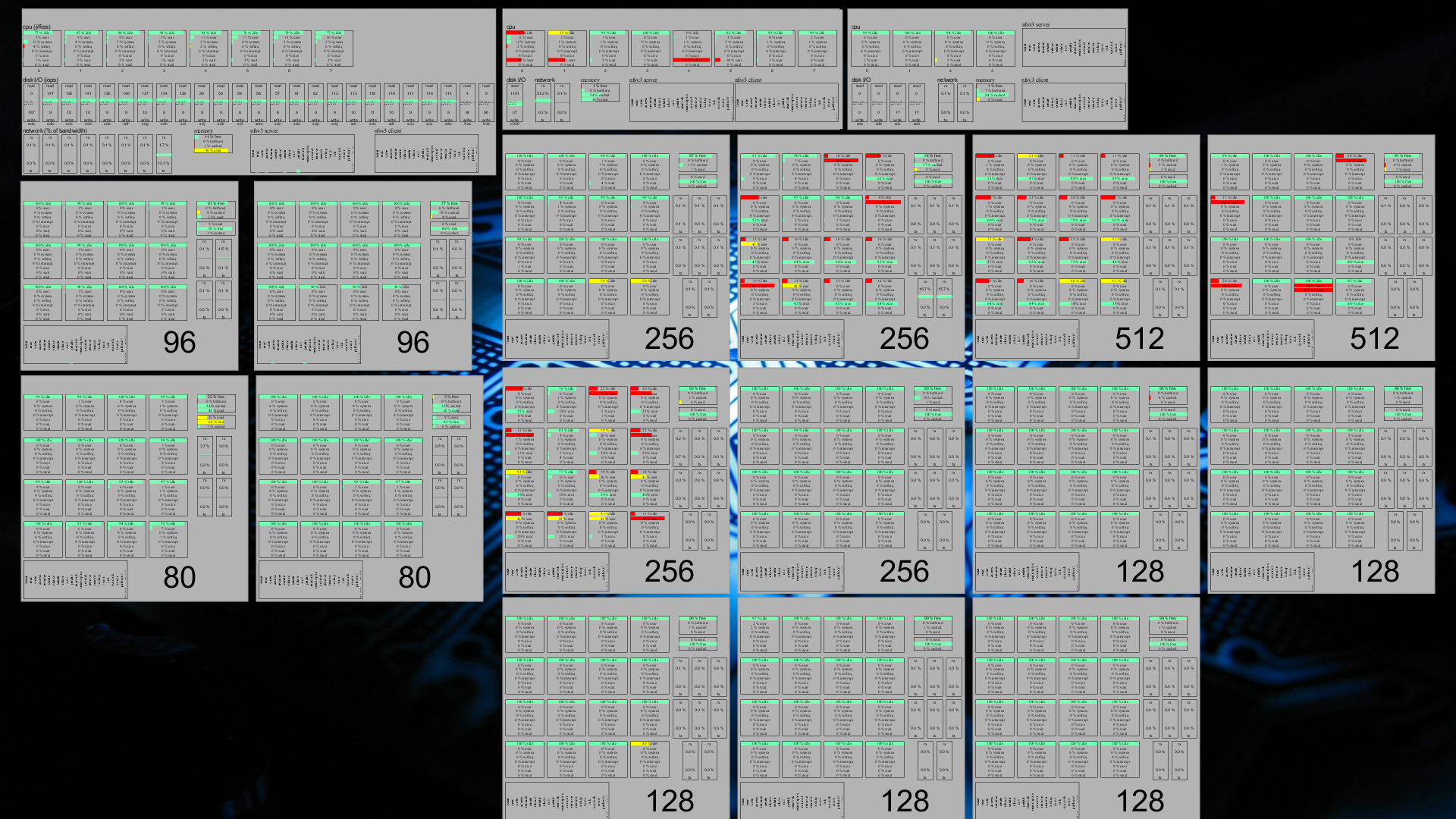
About a month ago, I blogged about extremon. As a reminder, ExtreMon is a monitoring tool that allows you to view things as they are happening, rather than with the ~5 minute delay that munin gives you, and also avoiding the quad-state limitation of Nagios' "good", "bad", "ugly", and "unknown" states. No, they're not really called that. Yes, I know you knew that. Anyway. In my blog post, I explained how you can set up ExtreMon, and I also set up a fairly limited demo version on my own server. But I have since realized that while it is functional, it doesn't actually show why ExtreMon is so great. In an effort to remedy that, I present you an example of what ExtreMon can do. Let's start with a screenshot of the ExtreMon console at the customer for which I spent time trying to figure out how to get it up and running: Click for full sized version. You'll note that even in that full-sized version, many things are unreadable. This is because the ExtreMon console allows one to move around (right mouse button drag for zoom; left mouse button drag for moving around; control+RMB for rotate; center mouse button to reset to default); so what matters is that everything fits on the screen, not whether it is all readable (if you need to read, you zoom). The image shows 18 rectangles. Each rectangle represents a single machine in this particular customer's HPC cluster. The top three rectangles are the cluster's file servers; the rest are its high performance nodes. You'll note that the left fileserver has 8 processor cores (top row), 8 network cards (bottom row, left part), and it also shows information on its memory usage (bottom row, small rectangle in the middle) as well as its NFS client and server procedure calls (bottom row, slightly larger rectangles to the right). This file server is the one on which I installed ZFS a while back; hence the large amount of disks visible in the middle row. The leftmost disk is the root filesystem (which is an ext4 off a hardware RAID1); the two rightmost "disks" are the PCIe-attached SSDs which are used for the ZFS L2ARC and write log. The other disks in this file server nicely show how ZFS does write load balancing over all its disks. The second file server has a hardware RAID1 on which it stores all its data; as such, there is only one disk graph there. It is also somewhat more limited in network, as it has only two NICs. It does, however, also have 8 cores. The last file server has no more than four processor cores; in addition, it also does not have a hardware RAID controller, so it must use software RAID over its four hard disks. This server is used for archival purposes, mostly, since it is insufficient for most anything else. As said, the other nodes are the "compute nodes", where the hard work is done. Most of these compute nodes have 16 cores each; two have 12 instead. When this particular screenshot was taken, four of the nodes (the ones showing red in their processor graphs) were hard at work; the others seem to have been mostly idling. In addition to the familiar memory, NFS (client only), network, and processor graphs, these nodes also show a "swap space" graph (just below the memory one), which seems fine for most nodes, except for the bottom left one (which shows a few bars that are coloured yellow rather than green). The green/yellow/red stuff is supposed to represent the "ok", "warning", "bad" states that would be familiar from Nagios. In this particular case, however, where "processor is busy all the time" is actually a wanted state, a low amount of idleness on the part of the processor isn't actually a problem, on the contrary. I did consider, therefore, to modify the ExtreMon configuration so that the processor graphs would not show red when the system was under high load; however, I found that differences in colour like this actually makes it more easy to see, at a glance, which machines are busy -- and that's one of the main reasons why we wanted to set this up. If you look carefully, you can find a particular processor core in the graph which shows 100% usage for "idle", "system", and "softirq", at the same time. Obviously that can't be the case, so there's a bug somewhere. Frank seems to believe it is a bug in CollectD; I haven't verified that. At any rate, though, this isn't usually a problem, due to the high update frequency of ExtreMon. The amount of data that's flowing through ExtreMon is amazing: Which renders a grand total of 2887 data points that are shown in this particular screenshot; and then I'm not even counting all the intermediate values, some of which also pass through ExtreMon. Nor am I counting the extra bits which have since been added (this screenshot is a few days old, now, and I'm still finetuning things). Yet even so, ExtreMon manages to update those values once every few seconds, in the worst case. As a result, the display isn't static for a moment, constantly moving and updating data so that what you see is never out of date for more than a second or two. Awesome.

Russell Coker: Conference Suggestions

LCA 2015 is next week so it seems like a good time to offer some suggestions for other delegates based on observations of past LCAs. There s nothing LCA specific about the advice, but everything is based on events that happened at past LCAs. Don t Oppose a Lecture Question time at the end of a lecture isn t the time to demonstrate that you oppose everything about the lecture. Discussion time between talks at a mini-conf isn t a time to demonstrate that you oppose the entire mini-conf. If you think a lecture or mini-conf is entirely wrong then you shouldn t attend. The conference organisers decide which lectures and mini-confs are worthy of inclusion and the large number of people who attend the conference are signalling their support for the judgement of the conference organisers. The people who attend the lectures and mini-confs in question want to learn about the topics in question and people who object should be silent. If someone gives a lecture about technology which appears to have a flaw then it might be OK to ask one single question about how that issue is resolved, apart from that the lecture hall is for the lecturer to describe their vision. The worst example of this was between talks at the Haecksen mini-conf last year when an elderly man tried at great length to convince me that everything about feminism is wrong. I m not sure to what degree the Haecksen mini-conf is supposed to be a feminist event, but I think it s quite obviously connected to feminism which is of course was why he wanted to pull that stunt. After he discovered that I was not going to be convinced and that I wasn t at all interested in the discussion he went to the front of the room to make a sexist joke and left. Consider Your Share of Conference Resources I ve previously written about the length of conference questions [1]. Question time after a lecture is a resource that is shared among all delegates. Consider whether you are asking more questions than the other delegates and whether the questions are adding benefit to other people. If not then send email to the speaker or talk to them after their lecture. Note that good questions can add significant value to the experience of most delegates. For example when a lecturer appears to be having difficulty in describing their ideas to the audience then good questions can make a real difference, but it takes significant skill to ask such questions. Dorm Walls Are Thin LCA is one of many conferences that is typically held at a university with dorm rooms offered for delegates. Dorm rooms tend to have thinner walls than hotel rooms so it s good to avoid needless noise at night. If one of your devices is going to make sounds at night please check the volume settings before you start it. At one LCA I was startled at about 2AM but the sound of a very loud porn video from a nearby dorm room, the volume was reduced within a few seconds, but it s difficult to get to sleep quickly after that sort of surprise. If you set an alarm then try to avoid waking other people. If you set an early alarm and then just get up then other people will get back to sleep, but pressing snooze repeatedly for several hours (as has been done in the past) is anti-social. Generally I think that an alarm should be at a low volume unless it is set for less than an hour before the first lecture in which case waking people in other dorm rooms might be doing them a favor. Phones in Lectures Do I need to write about this? Apparently I do because people keep doing it! Phones can be easily turned to vibrate mode, most people who I ve observed taking calls in LCA lectures have managed this but it s worth noting for those who don t. There are very few good reasons for actually taking a call when in a lecture. If the hospital calls to tell you that they have found a matching organ donor then it s a good reason to take the call, but I can t think of any other good example. Many LCA delegates do system administration work and get calls at all times of the day and night when servers have problems. But that isn t an excuse for having a conversation in the middle of the lecture hall while the lecture is in progress (as has been done). If you press the green button on a phone you can then walk out of the lecture hall before talking, it s expected that mobile phone calls sometimes have signal problems at the start of the call so no-one is going to be particularly surprised if it takes 10 seconds before you say hello. As an aside, I think that the requirement for not disturbing other people depends on the number of people who are there to be disturbed. In tutorials there are fewer people and the requirements for avoiding phone calls are less strict. In BoFs the requirements are less strict again. But the above is based on behaviour I ve witnessed in mini-confs and main lectures. Smoking It is the responsibility of people who consume substances to ensure that their actions don t affect others. For smokers that means smoking far enough away from lecture halls that it s possible for other delegates to attend the lecture without breathing in smoke. Don t smoke in the lecture halls or near the doorways. Also using an e-cigarette is still smoking, don t do it in a lecture hall. Photography Unwanted photography can be harassment. I don t think there s a need to ask for permission to photograp people who harass others or break the law. But photographing people who break the social agreement as to what should be done in a lecture probably isn t. At a previous LCA a man wanted to ask so many questions at a keynote lecture that he had a page of written notes (seriously), that was obviously outside the expected range of behaviour but probably didn t justify the many people who photographed him. A Final Note I don t think that LCA is in any way different from other conferences in this regard. Also I don t think that there s much that conference organisers can or should do about such things.

7 January 2015

Chris Lamb: Web scraping: Let's move on

Every few days, someone publishes a new guide, tutorial, library or framework about web scraping, the practice of extracting information from websites where an API is either not provided or is otherwise incomplete. However, I find these resources fundamentally deceptive the arduous parts of "real world" scraping simply aren't in the parsing and extraction of data from the target page, the typical focus of these articles. The difficulties are invariably in "post-processing"; working around incomplete data on the page, handling errors gracefully and retrying in some (but not all) situations, keeping on top of layout/URL/data changes to the target site, not hitting your target site too often, logging into the target site if necessary and rotating credentials and IP addresses, respecting robots.txt, target site being utterly braindead, keeping users meaningfully informed of scraping progress if they are waiting of it, target site adding and removing data resulting in a null-leaning database schema, sane parallelisation in the presence of prioritisation of important requests, difficulties in monitoring a scraping system due to its implicitly non-deterministic nature, and general problems associated with long-running background processes in web stacks. Et cetera. In other words, extracting the right text on the page is the easiest and trivial part by far, with little practical difference between an admittedly cute jQuery-esque parsing library or even just using a blunt regular expression. It would be quixotic to simply retort that sites should provide "proper" APIs but I would love to see more attempts at solutions that go beyond the superficial.

Dirk Eddelbuettel: RcppCNPy 0.2.4

A new release of the RcppCNPy package is now on CRAN. This release mostly solidifies and fixes things. Support for saving integer objects, which was expanded in release 0.2.3, was not entirely correct. Operations on big-endian systems were not up to snuff either. Wush Wu helped in getting this right with very diligent testing and patching particularly on big-endian hardware. We also got a pull request from Romain to reflect better const correctness at the Rcpp side of things. Last but not least we obliged by the CRAN Maintainers to not assume one could call gzip from system() call because, well, you guessed it.
Changes in version 0.2.4 (2015-01-05)
  • Support for saving integer objects was not correct and has been fixed.
  • Support for loading and saving on 'big endian' systems was incomplete, has been greatly expanded and corrected, thanks in large part to very diligent testing as well as patching by Wush Wu.
  • The implementation now uses const iterators, thanks to a pull request by Romain Francois.
  • The vignette no longer assumes that one can call gzip via system as the world's leading consumer OS may disagree.
CRANberries also provides a diffstat report for the latest release. As always, feedback is welcome and the rcpp-devel mailing list off the R-Forge page for Rcpp is may be the best place to start a discussion. GitHub issue tickets are also welcome.

This post by Dirk Eddelbuettel originated on his Thinking inside the box blog. Please report excessive re-aggregation in third-party for-profit settings.

Next.

Previous.