Search Results: "ean"

6 February 2011

Benjamin Mako Hill: Editor-to-Reader Ratios on Wikipedia

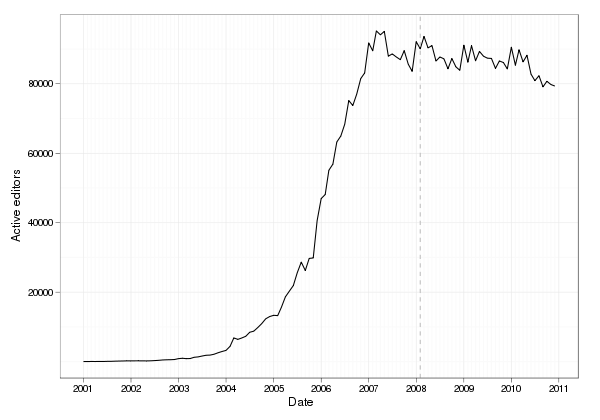
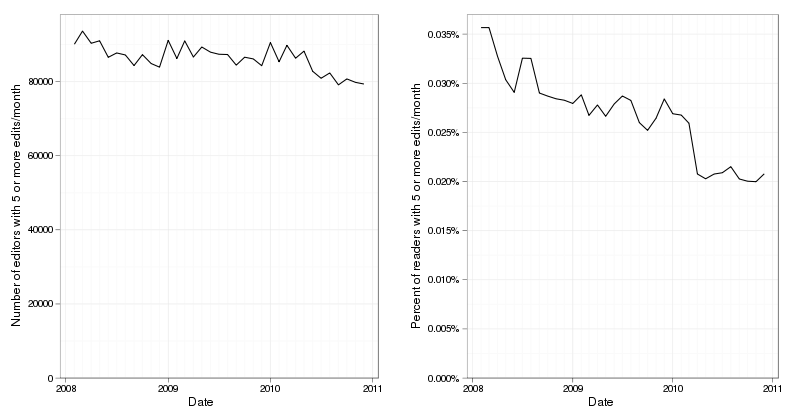
It's been reported for some time now that the number of active editors on Wikipedia (usually defined as people who have edited at least 5 times in a given month) peaked in 2007 and has been mostly stable since then. A graph of the total number of active editors in every month since Wikipedia's founding is shown below. The graph shows the aggregate numbers for all language Wikipedias. English Wikipedia is the largest component of this and is generally more variable. That said, very similar patterns exist for most larger languages. /copyrighteous/images/active_editors_all_wikpiedia.png Felipe Ortega, who has provided many of these statistics, has warned against fatalist claims. Although there seems to be a decrease in the total number of active editors over the last two years, the situation seems to have somewhat stabilized in most languages. New editors in Wikipedia are replacing folks at almost the rate that they are leaving. It is also widely known that the number of readers of Wikipedia has been increasing during this period. According to the report cards released by the foundation using comScore data, the number of unique visitors to Wikipedia each month has increased by 61 million people in the last year -- over 17%. This discrepancy between rising readership and stable or sinking editorship should raise major concern. After all, the Wikimedia Foundation's mission is two part: (1) to empower and engage people around the world to collect and develop educational content and (2) to disseminate it effectively and globally. Although the Foundation report cards include measures of raw levels of editorship, a better metric of engagement and empowerment might be the proportion of readers who engage in editing. I could not find reliable data on the number of unique readers reached each month for more than a few months in the last year. What is available, however, is wonderful data on page views each month going back to 2008. Analysis of the data from available report cards show that, at least during the last year, there is a very stable ratio of 35 page views per unique visitor, as estimated by comScore. Using that measure, we can do a back of the envelope estimation on the proportion of users that are editors for the period where page view data is available, dating back from February 2008 ( marked with the grey dashed lined above). The graphs below show the very different results you get when you consider the change in the number of Wikipedia editors and the change in the editor-to-reader ratio. Once again, these data are combined data for all language Wikipedias although graphs look very similar for most larger languages. The results are striking. Although there has been a 12% decrease between February 2008 and December 2010 in the number of active editors, there is a 42% decrease in the proportion of readers who edit at least five times a month. We can see that fulfilling the first half of the Wikimedia mission remains a struggle. /copyrighteous/images/wikipedia_editors_combined_graph.png Although the graphs above do not say anything directly about the most active core contributors to Wikipedia, the fact that Wikipedia is being maintained by a tiny -- and shrinking -- proportion of its readership does mean that the idea behind Wikipedia is under threat. Although none are as big as Wikipedia, there are lots of good encyclopedias out there. The reason Wikipedia is different, interesting, and important is because -- unlike all those others -- Wikipedia is the encyclopedia that anyone can edit. Wikipedia is powerful because it allow its users to transcend their role as consumers of the information they use to understand the world. Wikipedia allows users to define the reference works that define their understanding of the their environment and each other. But 99.98% of the time, readers do not transcend that role. I think that's a problem. Worse, that the number is growing. The Wikimedia Foundation recently ran a major successful effort to attract donations in its annual fundraiser. Jimmy Wales' smiling mug is apparently enough in the way of motivation to get something like 1% of its readers to donate money to support the project. I think that's very good news. If the Wikimedia community can entice even half of those people to contribute through an increased involvement in the projects themselves, they might do more than ensure Wikipedia's continued growth. They would help take a step toward the empowerment and engagement of those users in sharing their own knowledge, and the continued fulfillment of a critically important mission.

5 February 2011

Joerg Jaspert: Squeeze Release

So after quite a while I again had the opportunity to do the ftpmaster works of a Debian release. Not quite my first and hopefully not my last one, lets see. And, like last time, Mark joined to help with the work. Again, a few moments and not a detailed log (times in UTC): Right now (that is, 21:38 UTC) I am mosty waiting for the rest of the people working on the release (CD builders, press, website, ) to finish their task (building hundreds of images just takes ages). When that is done we can then do a coordinated push to the world. Last plans for that would mean in about an hour . Lets see, Mr. Murphy sure can be around. Thanks go out to everyone involved in preparing this release, be it in the past by fixing bugs, uploading packages, doing whatever was needed, as well as doing the work today. Update: If you miss us setting the new testing AKA wheezy to something inside there - there is no need to. It is simply the continutation of testing with just another name, which did not get changed contents, so nothing done for that. :)

Craig Small: Syntax Highlighting with Mid-Century themes

As a site that discusses a variety of programming languages, I thought it would be good to have syntax highlighting for the code snippets. This blog runs Movable Type so it had to fit in with the setup I have already. So I found the Syntax Highlighter module ok and the initial installation went fine, it was simply:
  1. Download the .zip archive
  2. Unzip the archive into a temporary directory
  3. Copy the plugins/SyntaxHighlighter directory to my plugins directory
  4. Copy the mt-static/plugins/SyntaxHighlighter directory to static/plugins
You then need to edit the HTML Head template and add to the bottom of it the following line:
<$MTSyntaxHighlighterInclude$>
Next, I like to use Markdown as my markup language. But you can only have one type text filter. Another plugin called FormatStack solves this. Create a new stack and put Syntax Highlighter before Markdown. You can then create documents with both sorts of tags and it works quite nicely, well almost. Mid Century Problems This is probably not a Mid-Century specific problem but the modern templates or styles may cause a problem. You ll find you switch styles and suddenly, no more syntax highlighting. The problem is the onLoad functions get overloaded. Some styles have an onload property on their body. You ll see lines similiar to
 <body id="blogbase" class="whatever" onload="mtEntryOnLoad">
This onload event stops other onload events, which means Syntax Highlighter cannot do its thing. The fix is rather simple, you just adjust the templates so they look like the following:
<body id="blogbase" class="mt-entry-archive layout-wtt">
<script type="text/javascript">
 mtAttachEvent("load", mtEntryOnLoad);
</script> 
After doing this and publishing it all worked! You may also see this sort of problem with other plugins that use the mtAttachEvent() Javascript call. Reducing Includes By default, the script includes all syntaxes it knows. If you want to only include some, you do this by specifying what brushes you want. For example if you only will highlight perl and python scripts then you can change the line to:
<$MTSyntaxHighlighterInclude brush="perl,python"$>
Syntax Themes The other attribute the Include line will take is theme. There are several themes but default is alternating white on grey with the rest being variations on light text on a dark background.

Craig Small: ncurses into experimental

Sven has been very busy getting a new Debian ncurses packages into order. With the multiple changes made and the fact that so many things depend on the shared libraries, we decided that it is best to put the first cut of these packages into experimental.

We're now using the Quilt 3.0 source format for our packages, which means that we should have a better handle on the patches, especially as they all now have Dep-3 patch tags .

So what has changed, why should you go over and try the experimental packages?

Craig Small: A few minor updates

No real terribly exciting updates lately but all important in their own way. ncurses A new version of ncurses got uploaded into sid. It should hopefully fix the backspace versus delete problem some of the FreeBSD people have been having with some of the terminal emulators. Oh, and if you are pining for the good old days when 8 colours and 64kB of memory was good enough for everyone, checkout ncurses-examples which have a bunch of interesting things you can do with curses, including some games. Anyone remeber the tower of Hanoi? dh-make dh-make, the tool to take a raw tar (or zip) archive and make a Debian package has been updated too. One of the interesting side-effects of maintaining dh-make is you find out (usually through bug reports) the little changes that happen to the Debian package build process. Most people, including myself, though the main big thing between versions 1 and 2 and version 3 of the source formats was the inclusion of quilt patches right inside the source files. And probably for the sake of "main things" this is true. What I didn't realise is that dpkg-source has changed in other ways too. Bug 580804 tripped this one up. For most people, you run dh_make, fix some things up and use debuild. If you didn't have the original tar file (perhaps you got the source from git or svn) you just use --creatorig and it copies the current directory into ../whatever-1.2.3.orig Source format 3 doesn't like this. Previously it would find that there was no orig.tar.gz archive but there was a orig directory and make the archive from that. Now you have to do it yourself and dh_make does it like that too. pidgin-musictracker Now this should of been a pretty simple stock-standard upstream upgrade. Download the file, uupdate, debuild and release. The problem is that upstream didn't fix their po files. These are the translation files that convert the raw english texts in a program into whatever language. This means the first time you run the build process, you have no diff file. However when you run it the second time, part of the install target rebuilds the po files (mainly the line references), you have differences and then a big diff file of these po updates. The real fix is to make sure your po files are up to date before you release! The trick is that they don't automatically and I have been caught myself; though it happens in the release testing phase (because my release testing involves usually building the debian archive so I see my own problem). irc came to the rescue again. Someone there suggested getting dpkg-source to ignore the changes. The way you do that is put parameters into debian/source/options. I wanted to ignore the changes to the po and pot files so my file has:
extend-diff-ignore=po/.*\.pot?
I put that in and it works!

3 February 2011

Rapha&#235;l Hertzog: People behind Debian: Mike Hommey, Firefox/Iceweasel maintainer

Mike Hommey, our Iceweasel maintainer

For as long as I have known Mike, he s been maintaining one of the largest (and most widely used) package: Iceweasel, Debian s default web browser. It s effectively Mozilla s Firefox although it has been renamed to avoid some rules enforced by Mozilla s trademark policy. But we might see Firefox back in Debian read on to know Mike s plans. His story is also very interesting in that he went from simple user to Iceweasel maintainer, and now he s working for Mozilla Corporation. But you already knew that contributing to free software is a good way to grow skills and gain experience that are valuable on the job market, right? ;-) My questions are in bold, the rest is by Mike. Who are you? I am Mike Hommey. I am French, even if my name doesn t sound so. I have been a GNU/Linux user since 1995, using Debian since 1999, and started packaging in 2003. After a long time in the NM queue, I became a DD in 2005. The main reason I started being actively involved is quite selfish: I wanted some things done, and I just did them. My first packages were extensions for the Mozilla Suite, the old one that directly inherited from Netscape Communicator. Later on, I wanted some of these extensions to work with the new kid on the block: Phoenix; or maybe it was already Firebird. By then, integrating extensions was a hassle, and the mozilla-browser maintainer had come up with a script that would make it easier for extension packages. So I ported that script for use with Phoenix/Firebird and sent it to the BTS. Then Phoenix/Firebird became Firefox, and it grew a real extension manager. Except that is was entirely not suited for extensions installed by the packaging system. So I made it work better. And made a few more changes to make Firefox work better. All through patches or NMUs. Then I became co-maintainer, then Firefox couldn t keep its name and became Iceweasel, and, fast-forward until today, I m now taking care of Iceweasel/Xulrunner and Iceape in stable, unstable, experimental and an external repository. This 8 years-long story (wow, I hadn t even realized it had been that long until I wrote it) tells you something: newcomers shouldn t be afraid to stick their hands anywhere, even in big packages. I was only a Mozilla and Phoenix end-user when I started. Apart from Mozilla-related packaging, I also happen to (co-)maintain some other packages in Debian, most notably webkit, though I haven t been very active in the pkg-webkit team recently. There are several reasons for that, the main one being that there are other team members getting the job done. And I can t say that much about the pkg-mozilla team, since there are effectively no other team members. What s your biggest achievement within Debian? I am quite proud that Squeeze will be the first Debian release where Iceweasel works on all supported architectures. Previously, we only knew the package compiled on all these architectures. Starting with Squeeze, we know it passes several of the test suites coming with the source code. This ensures most of the browser is functional. It was actually far from being the case before, as it appeared when the test suites were first enabled. I think it is very important to have properly working packages on all our supported architectures. The current evolution of hardware shows how important it still is. Who would have thought a few years back that we would see ARM or MIPS based netbooks today ? What are your plans for Debian Wheezy? For Debian Wheezy, I would like to improve Iceweasel/Icedove/Iceape integration with the packaging system. Something that would allow to use the apt database to find extensions or plugins, on top of the current behaviour. I also want to improve desktop integration, most notably for KDE. Another thing I d like to see happen is to package google breakpad independently (its source code is currently embedded in chromium and iceweasel, though not built, as far as I know), and have our Mozilla products builds be able to send their crash reports upstream. It is very important that upstream gets direct visibility over what crashes on GNU/Linux systems. It helps making them aware of issues that would otherwise probably remain unnoticed, as there are much more users using distributions packages than upstream tarballs. And not all Debian users report crashes to the BTS. I know at least Fedora and SuSE are already doing it. More importantly, I want to avoid the sad situation we got with Squeeze, where we re going to release a 18 months old Iceweasel. We got there for a combination of reasons, one being that I was preparing for a freeze in December 2009 and focusing on getting 3.5 in shape instead of the then upcoming 3.6. The result was that we didn t get 3.6 packages before upstream released 3.6.3 in April 2010. By then it was too late, considering the uncertainty of the release schedule, to update reverse dependencies and get 3.6 ready for Squeeze. Things are different for 4.0. I m already getting ahead of things, and while reverse dependencies haven t been taken care of, all beta releases have been made available through http://mozilla.debian.net/, usually within hours after upstream release (sometimes even a few hours before official announcement, but always after availability on ftp.mozilla.org). A great share of our patches were also pushed upstream. Several things made that possible: There will be a couple major upstream releases until Wheezy comes along, and I want to make them available early in unstable, even if that means breaking reverse dependencies until they are fixed. Finally, I would like to get other people involved, starting with the Icedove maintainer. Volunteers are very much welcome, for any kind of involvement: bug triaging, documentation (which we are deeply lacking), testing, code People interested can contact the pkg-mozilla team list. As the Debian packaging gets less time consuming, I should be able to spend more time mentoring, which should help. If you could spend all your time on Debian, what would you work on? I actually have been working almost full time on Debian for a few months during a more-or-less purposeful unemployment period. That s when I attempted to add an alert popup when Iceweasel or extensions are upgraded (which was eventually removed because not working very effectively). That s when I worked on Iceweasel 3.6 and the first 4.0 betas. That s when I pushed more than 70 patches upstream, and got upstream commit access. I know for a fact that keeping up with upstream and answering bug reports is already time consuming, and time comes in finite quantity. Working full time on Debian allows to do more than that, as I ve been able to experience first hand. Unfortunately, that doesn t help pay the bills, so it would be best if time could be shared with other persons. Like, actual members in the pkg-mozilla team. ;) Anyways, if I were to work full time on Debian again, I d like to do more than packaging, and help improve some of our infrastructure, most notably the buildd network, to grow some automated way to get packages built on all or some of our architectures. Call that PPA if you want, though I don t think we need something exactly like PPA. We sure do have porter boxes, but there is a huge overhead to get packages built there: you need to first try, then see you lack build dependencies, then wait for admins to install them, then come back and launch your build, and finally come back again much later to see how it went. And that s when it goes smoothly. Repeat for each architecture. It s already cumbersome when it s a small package, so imagine when it s Iceweasel. I d like to be able to push a (signed) .dsc somewhere, say I want it built on that and that architecture, and get binary packages and logs back. It could then be up to developers to distribute them, or not. Sometimes, you re just interested in test suite results. Another related wish would be a way to access build trees of failed builds, possibly on the buildd where it failed. What s the biggest problem of Debian? Lack of contributors, lack of contributors, and lack of contributors. It can sound weird to say that in a community of 1000+ people. But the sad reality is that we ve seen, repeatedly, calls for help in various places from various understaffed teams (most often of effectively one member) for years. So there is obviously a problem getting people to invest time in these teams either on the long term, or at all. I know this is not a very significant metric, but it already should say a lot: I wouldn t be surprised if more than 2/3 of the number of source lines of code in Debian come from less than 5% of the number of packages in the archive, and see less than 5% of the DD/DM population involved. If someone feels like doing the actual math, I m curious to know how far I m from reality, and in what direction. We also lack manpower to be able to make our release development smoother. In a perfect world where manpower is not a scarce resource, we should work on $release+1 when $release is being frozen. Said otherwise, we should have been able to start working on Wheezy in August 2010, or even earlier. You ve been working for Mozilla Corporation for a few months. How does the work look like and what are you working on? I am actually not working full time for MoCo; I am only contracting for 4 days a week. That was a request I made to keep having enough spare time for Debian or other activities. I am working from home, and am pretty much free about when I work, as long as I work long enough. I take advantage of this freedom and the saved commuting time to live a healthier life by doing some sports in the daytime (which also happens to be cheaper). I mostly work with Taras Glek and other people on various aspects of Firefox startup performance. This involves pretty interesting low-level stuff, in which I actually got involved before being contracted. This work has nothing to do with packaging Iceweasel, though I can have a few opportunities to do things somehow related. You told in your blog that you were discussing with Mozilla how Debian could use the Firefox trademark. Can you tell us a bit about the progress you made? I have got an informal approval of the patches we are applying to the Iceweasel 4.0 beta packages. There are a few concerns about using the system cairo library, and the embedded copy of libpng needs to be used to have support for the animated PNGs that are used in the user interface and that are required in Firefox feature-set. Other than that, there are pretty much no objection on the technical side. We managed to get to some common ground as to how to manage stable updates and more generally, changes to our packages, but I m still waiting for an actual agreement draft. While I, as the maintainer, am fine with the way it should look according to my discussions with the people involved at Mozilla, I ll seek review from my fellow Debian Developers when I ll have something to show. I haven t decided yet how this will reflect on the Debian packages, though. For example, would Iceweasel stay? But I do hope Wheezy will get Firefox back. Is there someone in Debian that you admire for their contributions? Not someone, but all past, present and future release team members. This is a team that receives a lot of critics (and I indirectly gave one a few paragraphs ago), yet manages to keep doing an amazing job and its members are very committed to their task. I admire their dedication.
Thank you to Mike for the time spent answering my questions. I hope you enjoyed reading his answers as I did. Subscribe to my newsletter to get my monthly summary of the Debian/Ubuntu news and to not miss further interviews. You can also follow along on Identi.ca, Twitter and Facebook.

8 comments Liked this article? Click here. My blog is Flattr-enabled.

1 February 2011

Marco Silva: A Super Vaca for DebConf11

In Portuguese we use the word vaquinha, which means little cow, to refer to a group of people contributing money for some common goal. In a meeting of the organization of the DebConf12 BID of Belo Horizonte, I, Rafael, R gis and Samuel decided to create a vaquinha to become a sponsor of DebConf11. With the help of Amazing Val ssio, we created a website and we are collecting donations. The idea is simple: people donate and their name is shown on the website. If they give more than R$50,00, they also receive an exclusive T-shirt. We mixed the idea of vaquinha with the Super Cow Powers from APT. The site is only in Portuguese, since our main focus is to ask for donations from brazilians, but nothing stops foreigns from donating. Our plan is to become Bronze Sponsors, but if we can't all that money, we'll just give to DebConf11 whatever we have. I hope you like the idea, and maybe have a similar initative in your country.

Cyril Brulebois: Debian XSF News #3

Time for a third Debian XSF News issue! Debian XSF News #3 It s been a year On a personal note, it s been a year to the day since I first looked into X. After having hacked on the Debian Installer to make it use X.Org instead of DirectFB, I did some heavy bug triaging, resulting in a drop in the xorg-server bug count in March. The same happened past week as written above, resulting in a second drop. In the meanwhile, the bug count remained more or less stable, since we try to reply quickly to new bugs, and since Julien Viard de Galbert does bug triaging on a weekly basis: BTS graph for xorg-server One might ask: what does maintaining X mean?

31 January 2011

Stefano Zacchiroli: who the bloody hell cares about Debian

A down-under talk on the role of Debian, A.D. 2011 I'm back from LCA 2011, which I've attended to share some thoughts about the role that Debian plays in the Free Software ecosystem, 18 years after its inception (yes, we are that old^Welder). The talk title---Who the bloody hell cares about Debian? [1]---was meant to be rather provocative. The idea was indeed to challenge the meme that, in the era of distributions that release every 6 months, a distribution with a release cycle of circa 2 years (like Debian, considering the past 5 years) is not a project that deserves your attention anymore. Is it really the case? In the talk I (obviously) claim it is not, using two main arguments. The first argument is based on the observation that Debian offers a set of pretty rare, if not unique, features among mainstream FOSS distributions. Those features consist of a mix of technical and "political" aspects: (1) a focus on package quality, with no distinction among first and second class packages; (2) a strong culture of software freedom, which refuses to offer non-free software (or firmware) by default to users and distribution developers (as parts of the infrastructure used to make Debian); (3) independence from commercial interests, with no single company or entity that could claim to babysit Debian; and (4) a decision making model based on a weighted sum of do-ocracy and democracy, which implies that by doing (rather than talking) everyone has a chance to have an impact on Debian. Considering all that and looking at the most popular FOSS distributions, one can easily identify Debian as one of the few remaining players who both care about Free Software and can be trusted in making choices not driven by profit. Mind you, I've nothing against companies in general and I'm very well aware that many FOSS companies carry a good deal of the burden of developing and promoting Free Software. Nonetheless, in days in which it is striking how quickly FOSS-friendly companies can become very much FOSS-unfriendly, I can't help putting my trust and efforts into community-driven projects, better if with no attached company label whatsoever. Furthermore, having distributions like Debian around can encourage other company-backed distributions to demand more and more independence and clarifications about the relationships between the community and the backing company. The second argument about the relevance of Debian is more pragmatic and rather straightforward: Debian is the root of a huge tree of derived-distribution (AKA "derivatives"), more than 120 according to popular distribution indexing sites. Each Debian derivative focuses its attention on, and directs its people power to, customizing Debian for a specific target and build entierly upon Debian work for all parts that do not need customization. That possibility is one key advantage of Free Software, after all. A well-known derivative example is Ubuntu, which is probably the most popular Debian derivative, enjoying a user base way larger than that of Debian itself. Ubuntu is heavily customized with respect to Debian and still had only about (at the time of Natty) 25% of packages which either differed from their Debian counterparts or that did not exist in Debian at all. Other Debian derivatives tend to be way less customized than that. Either way, if you are running a Debian derivative, chances are that you heavily depend on Debian and on its well-being. (Yes, it is so also if you didn't know about that, sorry.) Let's now fast-forward to the end of the talk, skipping my usual comments on how to keep the whole tree of Debian derivatives sustainable and beneficial for Free Software as a whole (i.e. by reducing as much as possible the viscosity of patch flow along the derivatives tree). Feedback People's reaction to such a provocative talk has been positive and we have enjoyed a fairly long Q&A session discussing the topics mentioned above as well as other Debian-related topics. A (commented) summary of the obtained feedback is reported below. Judging from the recurrent questions and suggestions I've received doing Debian talks in the past 8 months, I dare to say that LCA feedback is fairly representative of the feelings of many Debian users. Slides of the talk are available, while a video will eventually be posted at http://linuxconfau.blip.tv.
[1] Kudos to Francois Marier for suggesting the title. If the title doesn't ring a bell for you (it didn't for me in the beginning), you might want to check out the story of this ad. Update: minor rephrasing in the 4th paragraph

28 January 2011

Lars Wirzenius: Egypt blocks all communication: thoughts

The government of Egypt has blocked almost all Internet and mobile phone access, and, probably, every other form of communication as well. The government wants to prevent its citizens from protesting and demanding the president to resign. I wish the people of Egypt well. When the blocks are taken down, I hope the people report that the country is peaceful and that they have finally gotten some freedom. The government of Egypt claims to be democratic, but what they are doing should not be possible in a democracy. The fundamental aspect of a democracy is that every citizen should have the right to vote, but it is not the only necessary right for a democracy. Making your concerns heard to the government, and to other people, is also a fundamental right. As is hearing what other people have to say. Riots and violence are not acceptable ways to protest. Cutting everyone off is not going to prevent that, however, and it greatly harms any chance of peaceful resolution. But that's hard to see, when you're effectively a dictator, sitting at the top of a high tower, looking down at the common people. If the government is actively, and violently, hostile towards its people, the people have three choices: they can submit and accept the situation and continue suffering; they can oppose peacefully; or they can oppose violently. It requires great wisdom to oppose peacefully, and quite a lot of patience. It's easy, from my northern European point of view, to look at Egypt from afar, and think lofty thoughts. We here in the cold are not safe from such oppression, however. Evil people in the US have already tried to give the US president similar powers months ago. They're trying again. It is only a matter of time until this will be proposed in the EU, too, if it hasn't been already. In a crisis, people need timely access to reliable information, otherwise the crisis gets made worse by rumors and people making bad decisions based on bad data. Switching off communications is never the right solution, from the people's point of view. Those in power obviously think differently. See also: Information on how to bypass some of the blocks in Egypt.

Amaya Rodrigo: Indignez Vous!

If There is any sort of food for thought worth reading, this is it.
INDIGNEZ-VOUS! GET ANGRY! CRY OUT by St phane Hessel


St phane Hessel, author of Indignez-vous!
After 93 years, it is almost the final act. The end for me is not very far off any more. But it still leaves me a chance to be able to remind others of what acted as the basis of my political engagement. It was the years of resistance to the Nazi occupation -- and the program of social rights worked out 66 years ago by the National Council of the Resistance!

It is to Jean Moulin [murdered founder of the Council] that we owe, as part of this Council, the uniting of all elements of occupied France -- the movements, the parties, the labor unions -- to proclaim their membership in Fighting France, and we owe this to the only leader that it acknowledged, General de Gaulle. From London, where I had joined de Gaulle in March 1941, I learned that this Council had completed a program and adopted it on March 15th, 1944, that offered for liberated France a group of principles and values on which would rest the modern democracy of our country.

These principles and these values, we need today more than ever. It is up to us to see to it, all together, that our society becomes a society of which we are proud, not this society of immigrants without papers -- expulsions, suspicion regarding the immigrants. Not this society where they call into question social security and national retirement and health plans. Not this society where mass media are in the hands of the rich. These are things that we would have refused to give in to if we had been the true heirs of the National Council of the Resistance.


From 1945, after a dreadful drama [WWII], it was an ambitious
resurrection of society to which the remaining contingent of the Council
of the Resistance devoted itself. Let us remember them while creating
national health and pensions plans such as the Resistance wished, as its
program stipulated, "a full plan of French national health and social
security, aimed at assuring all citizens the means of existence whenever
they are unable to obtain them by a job; a retirement allowing the old
workers to finish their days with dignity."

The sources of energy, electricity, and gas, mines, the big banks, were
nationalized. Now this was as the program recommended: "... the return
to the nation of big monopolized means of production, fruits of common
labor, sources of energy, wealth from the mines, from insurance
companies and from big banks; the institution of a true economic and
social democracy involving the ousting of the big economic and financial
fiefdoms from the direction of the economy."

General interest must dominate over special interest. The just man
believes that wealth created in the realm of labor should dominate over
the power of money.

The Resistance proposed, "a rational organization of the economy
assuring the subordination of special interests to general interest, and
the emancipation of 'slaves' of the professional dictatorship that was
instituted just as in the fascist states," which had used the interim
[for two years after the war] government of the Republic as an agent.

A true democracy needs an independent press, and the Resistance
acknowledged it, demanded it, by defending "the freedom of the press,
its honor, and its independence from the State, the power of money and
foreign influence." This is what relieved restrictions on the press from
1944 on. And press freedom is definitely what is in danger today.

The Resistance called for a "real possibility for all French children to
benefit from the most advanced education," without discrimination.
Reforms offered in 2008 go contrary to this plan. Young teachers, whose
actions I support, went so far as refusing to apply them, and they saw
their salaries cut by way of punishment. They were indignant,
"disobeyed," judging these reforms too far from the ideal of the
democratic school, too much in the service of a society of commerce and
not developing the inventive and critical mind enough. 2

All the foundations of the social conquests of the Resistance are
threatened today.

The motive of the Resistance: indignation (Indignez-vous!)

Some dare to say to us that the State cannot afford the expenses of
these measures for citizens any more. But how can there be today a lack
of money to support and extend these conquests while the production of
wealth has been considerably augmented since the Liberation period when
Europe was in ruins? On the contrary, the problem is the power of money,
so much opposed by the Resistance, and of the big, boldfaced, selfish
man, with his own servants in the highest spheres of the State.

Banks, since privatized again, have proved to be concerned foremost for
their dividends and for the very high salaries of their leaders, not the
general interest. The disparity between the poorest and the richest has
never been so great, and amassing money, competition, so encouraged.

The basic motive of the Resistance was indignation!

We, the veterans of the resistance movements and combat forces of Free
France, we call on the young generation to live by, to transmit, the
legacy of the Resistance and its ideals. We say to them: Take our place,
"Indignez-vous!" [Get angry! or Cry out!].

The political, economic, intellectual leaders, and the whole society do
not have to give in, nor allow oppression by an actual international
dictatorship of the financial markets, which threatens peace and
democracy.

I wish for you all, each of you, to have your own motive for
indignation. It is precious. When something outrages you as I was
outraged by Nazism, then people become militant, strong, and engaged.
They join this current of history, and the great current of history must
continue thanks to each individual. And this current goes towards more
justice, more freedom, but not this unbridled freedom of the fox in the
henhouse. The rights contained in the UN Universal Declaration of Human
Rights of 1948 are just that, universal.

If you meet somebody who does not benefit from it, feel sorry for them
but help them to win their rights.

Two visions of history

When I try to understand what caused fascism, what made it so we were
overcome by Hitler and the Vichy [French government that collaborated
with Hitler], I tell myself that the propertied, with their selfishness,
were terrifically afraid of Bolshevik revolution. They were allowed to
lead with their fear.

But if, today as then, an active minority stands up, it will be enough;
we shall be the leavening that makes the bread rise. Certainly, the
experience of a very old person like me, born in 1917, is different from
the experience of the today's young persons. I often ask professors for
the opportunity to interact with their students, and I say to them: You
don't have the same obvious reasons to engage you. For us, to resist was
not to accept German occupation, defeat. It was comparatively simple.
Simple as what followed, decolonization. Then the war in Algeria.

It was necessary that Algeria become independent, it was obvious. As for
Stalin, we all applauded the victory of the Red Army against the Nazis
in 1943. But already we had known about the big Stalinist trials of
1935, and even if it was necessary to keep an ear open towards communism
to compensate against American capitalism, the necessity to oppose this
unbearable form of totalitarianism had established itself as an
obviousness. My long life presented a succession of reasons to outrage
me.

These reasons were born less from an emotion than a deliberate
commitment. As a young student at normal school [teachers college] I was
very influenced by Sartre, a fellow student. His "Nausea" [a novel],
"The Wall," [play], and "The Being and Nothingness" [essay] were very
important in the training of my thought. Sartre taught us, "You are
responsible as individuals." It was a libertarian message. The
responsibility of a person can not be assigned by a power or an
authority. On the contrary, it is necessary to get involved in the name
of one's responsibility as a human being.

When I entered the French Ecole Normale Superieure, Ulm Street, in Paris
in 1939, I entered it as a fervent adherent of the philosopher Hegel,
and I adhered to the thought of Maurice Merleau-Ponty. His teaching
explored concrete experience, that of the body and of its relations with
the senses, one big singular sense faced with a plurality of senses. But
my natural optimism, which wants all that is desirable to be possible,
carried me rather towards Hegel. Hegelism interprets the long history of
humanity as having a meaning: It is the freedom of man progressing step
by step. History is made of successive shocks, and the taking into
account of challenges. The history of societies thus advances; and in
the end, man having attained his full freedom, we have the democratic
state in its ideal form.

There is certainly another understanding of history. It says progress is
made by "freedom" of competition, striving for "always more"; it can be
as if living in a devastating hurricane. That's what it represented to a
friend of my father, the man who shared with him an effort to translate
into German "The Search for Time Lost" [novel] by Marcel Proust.

That was the German philosopher Walter Benjamin. He had drawn a
pessimistic view from a painting by the Swiss painter Paul Klee,
"Angelus Novus," where the face of the angel opens arms as if to contain
and push back a tempest, which he identifies with progress. For
Benjamin, who would commit suicide in September 1940 to escape Nazism,
the sense of history is the overpowering progression of disaster upon
disaster.

Indifference: the worst of attitudes

It is true the reasons to be indignant can seem today less clearly
related or the world too complex. Who's doing the ordering, who decides?
It is not always easy to differentiate between all the currents that
govern us. We are not any more dealing with a small elite whose joint
activities can be clearly seen. It is a vast world, of which we have a
feeling of interdependence.

We live in an interconnectivity as never before. But in this world there
still are intolerable things. To see them, it is well and necessary to
look, to search. I say to the young people, Search little, and that is
what you are going to find. The worst of attitudes is indifference, to
say "I can do nothing there, I'll just manage to get by." By including
yourself in that, you lose one of the essential elements that makes the
human being: the faculty of indignation and the commitment that is a
consequence of it.

They [young people] can already identify two big new challenges:

1. The huge gap which exists between the very poor and the very rich and
that does not cease increasing. It is an innovation of the 20th and 21st
centuries. The very poor in the today's world earn barely two dollars a
day. The new generation cannot let this gap become even greater. The
official reports alone should provoke a commitment.

2. Human rights and state of the planet: I had the chance after the
Liberation to join in the writing of the Universal Declaration of Human
Rights, adopted by the United Nations organization, on December 10th,
1948, in Paris at the palace of Chaillot. It was as principal private
secretary of Henry Laugier, the adjunct general-secretary of the UN, and
as and secretary of the Commission on Human Rights that I with others
was led to participate in the writing of this statement. I wouldn't know
how to forget the role in its elaboration of Ren Cassin, who was
national commissioner of justice and education in the government of Free
France in London in 1941 and won the Nobel peace prize in 1968, nor that
of Pierre Mend s-France in the Economic and Social Council, to whom the
text drafts we worked out were submitted before being considered by the
Third Committee (Social, Humanitarian and Cultural) of the General
Assembly. It was ratified by the 54 member states in session of the
United Nations, and I certified it as secretary.

It is to Ren Cassin that we owe the term "universal rights" instead of
"international rights" as offered by our American and British friends.
This [universal versus international] was key because, at the end of the
Second World War, what was at stake was to becomeereignty," which a
nation can emphasize while it devotes itself to crimes against humanity
on its own soil. Such was the case of Hitler, who felt himself supreme
and authorized to carry out a genocide. This universal statement owed
much to universal revulsion towards Nazism, fascism, and totalitarianism
-- and owes a lot, in our minds, to the spirit of the Resistance.

I had a feeling that it was necessary to move quickly so as not to be
dupes of the hypocrisy that there was in the UN membership, some whom
claimed these values already won but had no intention at all to promote
them faithfully -- claimed that we were trying to impose values on them.

I can not resist the desire to quote Article 15 of the Universal
Declaration of Human Rights (1948): "Everyone has the right to a
nationality." Article 22 says, "Everyone, as a member of society, has
the right to social security and is entitled to realization, through
national effort and international cooperation and in accordance with the
organization and resources of each State, of the economic, social and
cultural rights indispensable for his dignity and the free development
of his personality." And if this statement has a declarative scope, and
not statutory, the Declaration nevertheless has played a powerful role
since 1948. It saw colonized people take it up in their fight for
independence; it sowed minds in a battle for freedom.

I note with pleasure that in the course of last decades there has been
an increase in nongovernmental organizations (NGOs) and social movements
such as ATTAC (Association for the Taxation of Financial Transactions);

also FIDH (International Federation for Human Rights) and Amnesty
International, which are active and competitive. It is obvious that to
be effective today it is necessary to act in a network, to use all
modern means of communication.

To the young people, I say: Look around you, you will find topics that
justify your indignation facts about treatment of immigrants, of
"illegal" immigrants, of the Roma [aka Gypsies]. You will find concrete
situations that lead you to strong citizen action. Search and you shall
find!

My indignation regarding Palestine outrages by Israel [Indignez-vous!]

Today, my main indignation concerns Palestine, the Gaza Strip, and the
West Bank of Jordan. This conflict is outrageous. It is absolutely
essential to read the report by Richard Goldstone, of September 2009, on
Gaza, in which this South African, Jewish judge, who claims even to be a
Zionist, accuses the Israeli army of having committed "acts comparable
to war crimes and perhaps, in certain circumstances, crimes against
humanity" during its "Operation Cast Lead," which lasted three weeks.

I went back to Gaza in 2009 myself, when I was able to enter with my
wife thanks to our diplomatic passports, to study first-hand what this
report said. People who accompanied us were not authorized to enter the
Gaza Strip. There and in the West Bank of Jordan. We also visited the
Palestinian refugee camps set up from 1948 by the United Nations agency
UNRWA, where more than three million Palestinians expelled off their
lands by Israel wait even yet for a more and more problematical return.

As for Gaza, it is a roofless prison for one and a half million
Palestinians. A prison where people get organized just to survive.
Despite material destruction such as that of the Red Crescent hospital
by Operation Cast Lead, it is the behavior of the Gazans, their
patriotism, their love of the sea and beaches, their constant
preoccupation for the welfare of their children, who are innumerable and
cheerful, that haunt our memory. We were impressed by how ingeniously
they face up to all the scarcities that are imposed on them. We saw them
making bricks, for lack of cement, to rebuild the thousands of houses
destroyed by tanks. They confirmed to us that there had been 1400 deaths
including women, children, and oldsters in the Palestinian camp
during this Operation Cast Lead led by the Israeli army, compared to
only 50 injured men on the Israeli side. I share conclusions of the
South African judge. That Jews can, themselves, perpetrate war crimes is
unbearable. Alas, history does not give enough examples of people who
draw lessons from their own history. [The author, St phane Hessel, had
a Jewish father.]

Terrorism, or exasperation?

I know that Hamas [party of Palestine freedom fighters], which had won
the last legislative elections, could not help it that rockets were
launched on Israeli cities in response to the situation of isolation and
blockade in which Gazans exist. I think, naturally, that terrorism is
unacceptable; but it is necessary to acknowledge (from experience in
France) that when people are occupied by forces immensely superior to
their own, popular reaction cannot be altogether bloodless.

Does it serve Hamas to send rockets onto the town of Sd rot [Israeli
town across the border from Gaza]?

The answer is no. This does not serve their purpose, but they can
explain this gesture by the exasperation of Gazans. In the notion of
exasperation, it is necessary to understand violence as the regrettable
conclusion of situations not acceptable to those who are subjected them.

Thus, they can tell themselves, terrorism is a form of exasperation. And
that this "terrorism" is a misnomer. One should not have to resort to
this exasperation, but it is necessary to have hope. Exasperation is a
denial of hope. It is comprehensible, I would say almost natural, but it
still is not acceptable. Because it does not allow one to acquire
results that hope can possibly, eventually produce.

Nonviolence: the way we must learn to follow

I am persuaded that the future belongs to nonviolence, to reconciliation
of different cultures. It is by this way that humanity will have to
enter its next stage. But on this I agree with Sartre: We cannot excuse
the terrorists who throw bombs, but we can understand them. Sartre wrote
in 1947: "I recognize that violence in whatever form it may manifest
itself is a setback. But it is an inevitable setback because we are in a
world of violence. And if it is true that recourse to violence risks
perpetuating it, it is also true it is the sure means to make it stop."

To that I would add that nonviolence is a surer means of making violence
stop. One can not condone the terrorism, using Sartre or in the name of
this principle, during the war of Algeria, nor during the Munich Games
of 1972 the murder attempt made against Israeli athletes. Terrorism is
not productive, and Sartre himself would end up wondering at the end of
his life about the sense of violence and doubt its reason for being.

However, to proclaim "violence is not effective" is more important than
to know whether one must condemn or not those who devote themselves to
it. Terrorism is not effective. In the notion of effectiveness, a
bloodless hope is needed. If there is a violent hope, it is in the poem
of William Apollinaire "that hope is violent," and not in policy.

Sartre, in March 1980, within three weeks of his death, declared: "It is
necessary to try to explain why the world of today, which is horrible,
is only an instant in a long historical development, that hope always
has been one of the dominant forces in revolutions and insurrections,
and how I still feel hope as my conception of the future." [Note 5]

It is necessary to understand that violence turns its back on hope. It
is necessary to prefer to it hope, hope over violence. Nonviolence is
the way that we must learn to follow. So must the oppressors.
10

It is necessary to arrive at negotiations to remove oppression; it is
what will allow you to have no more terrorist violence. That's why you
should not let too much hate pile up.

The message of Mandela and Martin Luther King finds all its pertinence
in the world that overcame the confrontation of ideologies [e.g.,
Nazism] and conquered totalitarianism [e.g.,Hitler]. It is also a
message of hope in the capacity of modern societies to overcome
conflicts by a mutual understanding and a vigilant patience. To reach
that point is necessarily based on rights, against es, such as the
military intervention in Iraq.

We had this economic crisis, but we still did not initiate a new policy
of development. Also, the summit of Copenhagen against climatic warming
did not bring about a true policy for the preservation of the planet.

We are on a threshold between the terror of the first decade and the
possibilities of following decades. But it is necessary to hope, it is
always necessary to hope. The previous decade, that of 1990s, had been a
time of great progress. The United Nations had enough wisdom to call
conferences such as those of Rio on environment, in 1992, and that of
Beijing on women, in 1995. In September 2000, on the initiative of the
general secretary of United Nations, Kofi Annan, the 191 member
countries adopted a statement on the "eight objectives of the millennium
for development," by which they notably promised to reduce poverty in
the world by half before 2015.

My big regret is that neither Obama nor the European Union has yet
committed themselves to what should be the provision for a useful forum
bearing on the fundamental values.

Conclusion

How to conclude this call to be indignant? By saying still what, on the
occasion of the sixtieth anniversary of the program of the National
Council of the Resistance, we said on March 8th, 2004 -- we veterans of
the resistance movements and combat forces of Free France (1940-1945) --
that certainly "Nazism was conquered, thanks to the sacrifice of our
brothers and sisters of the Resistance and United Nations against
fascist barbarism. But this threat did not completely disappear, and our
anger against injustice is ever intact." [Note 6] Also, let us always be
called in "a truly peaceful insurrection against means of mass
communication that offer as a vista for our youth only the consumption
of mass trivia, contempt of the weakest and the culture, a generalized
amnesia, and the hard competition of all against all."

To those who will make the 21st century, we say with our affection:

TO CREATE IS TO RESIST; TO RESIST IS TO CREATE.

Rapha&#235;l Hertzog: 3 ways to not clutter your Debian source package with autogenerated files

It s quite common that the upstream build system generates/updates some files but does not clean them up properly when you call make clean. In that case, when you rebuild the package a second time in the same tree, the generated Debian source package will contain those changes. You usually don t want those changes. They make your package harder to review because they contain unneeded modifications (either directly in the .diff.gz with the old source format, or in a new patch in debian/patches/debian-changes-<ver> with the 3.0 (quilt) source format). I ll show you 3 ways to avoid this problem. They are all workarounds, the proper fix would be to improve the upstream build system to really clean up the generated files. This is usually possible for files that are created , but it s much more cumbersome for files that are updated (you would have to keep a backup of the original file so that you can restore it). The traditional fix Instead of relying on the upstream build system to do the work, we modify the clean target in debian/rules to remove the files that are left-over. Since debian/rules clean is always called before a source package is built, those generated files are not included as changes compared to what upstream provided. A common work-around: always build from a clean state As you have noted, the problem only happens when you build (source and binaries) twice in a row in the same tree. Some VCS-helper tools always build the Debian package in a temporary tree which is exported from the VCS. This is the case of svn-buildpackage by default and of git-buildpackage if you use its --git-export-dir option. I don t like this solution because it solves the problem only for the maintainer. Anyone else who is working on top of the package without using the same VCS-helper tool would be affected by the problem. A new way to avoid the problem Since it s now possible to store dpkg-source options in the source package itself, we can conveniently have everybody use the --extend-diff-ignore option. It tells dpkg-source to ignore some files when checking whether we have made changes to upstream files. For example if you want to ignore changes made on the files config.sub , config.guess and Makefile you could put this in debian/source/options:
# Don't store changes on autogenerated files
extend-diff-ignore = "(^ /)(config\.sub config\.guess Makefile)$"
You need to know a bit about Perl regular expressions since that s what is used by dpkg-source to match the filenames to exclude. Note that this approach always works, even when you can t remove the file. So it saves you having to make a backup of the unmodified file just to be able to restore it before the next build.
Found it useful? Be sure to not miss other packaging tips (or lessons), click here to subscribe to my free newsletter and get new articles by email.

No comment Liked this article? Click here. My blog is Flattr-enabled.

Wouter Verhelst: Good news and bad news

... in the world of Belgian Tennis. I learned yesterday that Justine Henin, ex-number 1 tennis player and still one of the great talents amongst women's tennis, is forced to stop her come-back attempt due to an elbow injury which she had been dealing with since the last Wimbledon. I don't want to guess what's going through her mind at this point in time, but it must be terrible. She'd been working so hard for tennis for all her life, but took a break from the sport because she realized that she needed to give her life apart from the sport a serious boost. And when she'd done that and realized that she still loves tennis and wants to do a come-back, this happens before she'd even been able to accomplish even one of her goals that she'd set for her come-back. Terrible. Justine, on the off chance that you read this: you have my greatest possible sympathies. The slightly better news also involves an injury; but this time it's not a Belgian player, but it involves Venus Williams. Now I'm not one to gloat at sportspeople's problems, and I do wish Venus all the best and a speedy recovery; but since her injury means she won't be able to make it for the Fed Cup tie against Belgium, slightly over a week from now, the result is that Belgium is now favourite for winning this tie. Of course, the team can't claim having won until the tie is over, but hey. Too bad I can't be there. But there's this other thing that I'm involved with, which just happens to be in the same weekend. Oh well.

Wouter Verhelst: Dear lazyweb,

I found out the hard way that my laptop's BIOS is not battery-backed. This means that if the battery runs flat (or it is removed for a prolonged time), that BIOS forgets two things: the system time (which is annoying, but easily fixed), and the MAC address of eth0 (which is more than annoying). As a result, my laptop's MAC address is now set to something rather invalid. Since this MAC address is configured in a few DHCP servers here and there which give me a fixed IP address when they notice my laptop on the network, I'd like to set it back to what it should be. With ip link set eth0 address <mac> I can easily set the address back to what it used to be. But, of course, that isn't permanent, and once we reboot, it's gone. So, dear lazyweb: how does one change a MAC address in a permanent way?

Dominique Dumont: FOSDEM: see you there

I'm going to FOSDEM, the Free and Open Source Software Developers' European Meeting I ll make 2 presentations about Config::Model applications. One on configuration upgrades. The other one is more presenting ideas on sharing packaging work between distributions. Note that I ll make these presentations quite late Sunday and I ll have to leave about 30mns after the last presentation. So if you already have questions about Config::Model, it would be better to contact me before the presentations. See you there

Jonathan McDowell: We fear undocumented change

I love revision control. I love the ability to track changes over time, whether that be to see why I changed something in the past, or to see why a particular thing has stopped working, or to see if a particular thing is fixed in a more recent version than the one I'm using. However I have a few opinions about the use of revision control that are obviously not shared by other people. Here are a few of them:

27 January 2011

Michal &#268;iha&#345;: Installation of S60 applet to the phone using Gammu

I've (again) changed schedule of what to implement and I've spend fourth Hackweek 6 day by doing more cleanup and documentation work than real coding. The major new feature is support for direct installation of the applet to the phone, so the installation is now easier. There were minor improvements on the both sides to allow support for calls and deleting of SMS messages. Adding calendar and todo entries is still left for future (hopefully tomorrow). I've done (more or less) final cleanup of my changes in the applet itself and I've sent changes back upstream hoping for merging them (I'd give you link to the mail, but the archive does not work). Rest of the time was spent collecting feedback from users testing the code (surprisingly there are already few brave users who gave it a try). It resulted in few bug fixes and improved documentation. Last but not least - all code is is available in our Git repository and check documentation for information how to set it up.

Filed under: English Gammu Suse 0 comments Flattr this!

26 January 2011

Michal &#268;iha&#345;: Sending SMS on Symbian phone using Gammu

Third Hackweek 6 day went a bit differently than I planned, but there is still lot of progress. I've added some more calls to the Series60 remote protocol, so that some things now work much faster (eg. getting number of contacts, calendar entries). The applet now also has a function to toggle Bluetooth so it does not have to be done elsewhere in phone menus. On Gammu side I focused on messaging support, so now Gammu can list messages in the phone or send new message. Modification of calendar entries is left for tomorrow, hopefully I will get to it and the support will be more or less complete and I will have Friday for final cleanup. And as usual - all code is is available in our Git repository and check documentation for information how to set it up.

Filed under: English Gammu Suse 2 comments Flattr this!

Rapha&#235;l Hertzog: My Debian related goals for 2011

Like last year, here s a list of Debian related projects that I d like to tackle this year. I might not do them all, but I like to write them down, I am more productive when I have concrete objectives.
  1. Translate my Debian book into English.
    I will run a fundraising campaign with Ulule.com and if enough people are interested, I will spend a few months with Roland Mas to translate the book. Hopefully this project can be completed until the summer.
  2. Finish multiarch support in dpkg.
    I m working on this with Guillem Jover right now, thanks to Linaro who is sponsoring my work.
  3. Make deb files use XZ compression by default.
    It s a simple change in dpkg-deb and it would literally save gigabytes of space on mirrors. It s particularly important so that single CD/DVD can have a more complete set of software. #556407 (on DAK) needs to be fixed first though and a project-wide discussion is in order. Some archs might want to have a different default.
  4. Be more reactive to review/merge dpkg patches.
    While we welcome help, we have a backlog of patches sitting in the BTS and it happened several times that we failed to review/merge submitted branches in a decent time. It s very frustrating for the contributor. I already tried to improve the situation by creating the Review/Merge Queue but nobody stepped up to help review and update the patches.
    As I am getting more familiar with the C part of dpkg, I hope to be able to jump in when Guillem doesn t have the time or the interest.
  5. Implement the rolling distribution proposed as part of the CUT project and try to improve the release process.
    I really want the new rolling distribution but it will inevitably have an impact on the release process. It can t be done as a standalone project. I would also like to see progress in the way we deal with transitions (see discussion here).
  6. Work more regularly on the developers-reference.
    Hopefully I will be able to combine this with my blog writing activities, i.e. write blog articles on the topics that the developers-reference shall cover and then adapt my articles with some docbook markup.
To the above list, I shall add a few supplementary goals related to funding my Debian work:
  1. Write a 10-lesson course called Smart Package Management .
    It will delivered by email to my newsletter subscribers.
  2. Create an information product (most likely an ebook or an online training) and sell it on my blog.
    The precise topic has not yet been defined although I have a few ideas. Is there something that you would like me to teach you? Leave your suggestions in a comment.
  3. By the end of the year, have at least 1/3 of my time funded by donations and/or earnings of my information products.
    More concretely it means 700 each month or a 9-fold increase compared to the current income level (around 80 /month mostly via Flattr).
That makes up lots of challenges for this year. You can help me reach those goals, join my Debian Supporters Guild and you ll be informed every time that I start something new or when you can help in specific ways.

6 comments Liked this article? Click here. My blog is Flattr-enabled.

Francois Marier: Serving pre-compressed files using Apache

The easiest way to compress the data that is being served to the visitors of your web application is to make use of mod_deflate. Once you have enabled that module and provided it with a suitable configuration file, it will compress all releant files on the fly as it is serving them.

Given that I was already going to minify my Javascript and CSS files ahead of time (i.e. not using mod_pagespeed), I figured that there must be a way for me to serve gzipped files directly.

"Compiling" Static FilesI decided to treat my web application like a c program. After all, it starts as readable source code and ends up as an unreadable binary file.

So I created a Makefile to minify and compress all CSS and Javascript files using YUI Compressor and gzip:

all: build

build:
find static/css -type f -name "[^.]*.css" -execdir yui-compressor -o .css \;
find static/js -type f -name "[^.]*.js" -execdir yui-compressor -o .js \;
cd static/css && for f in *.css.css ; do gzip -c $$f > basename $$f .css .gz ; done
cd static/js && for f in *.js.js ; do gzip -c $$f > basename $$f .js .gz ; done

clean:
find static/css -name "*.css.css" -delete
find static/js -name "*.js.js" -delete
find static/css -name "*.css.gz" -delete
find static/js -name "*.js.gz" -delete
find -name "*.pyc" -delete

This leaves the original files intact and adds minified .css.css and .js.js files as well as minified and compressed .css.gz and .js.gz files.

How browsers advertise gzip supportThe nice thing about serving compressed content to browsers is that browsers that support receiving gzipped content (almost all of them nowadays) include the following HTTP header in their requests:
Accept-Encoding = gzip,deflate
(Incidently, if you want to test what non-gzipped enable browsers see, just browse to about:config and remove what's in the network.http.accept-encoding variable.)

Serving compressed files to clientsTo serve different files to different browsers, all that's needed is to enable Multiviews in our Apache configuration (as suggested on the Apache mailing list):

<Directory /var/www/static/css>
AddEncoding gzip gz
ForceType text/css
Options +Multiviews
SetEnv force-no-vary
Header set Cache-Control "private"
</Directory>

<Directory /var/www/static/js>
AddEncoding gzip gz
ForceType text/javascript
Options +Multiviews
SetEnv force-no-vary
Header set Cache-Control "private"
</Directory>

The ForceType directive is there to force the mimetype (as described in this solution) and to make sure that browsers (including Firefox) don't download the files to disk.

As for the SetEnv directive, it turns out that on Internet Explorer, most files with a Vary header (added by Apache) are not cached and so we must make sure it gets stripped out before the response goes out.

Finally, the Cache-Control headers are set to private to prevent intermediate/transparent proxies from caching our CSS and Javascript files, while allowing browsers to do so. If intermediate proxies start caching compressed content, they may incorrectly serve it to clients without gzip support.

Next.

Previous.