Search Results: "ana"

19 September 2010

Joerg Jaspert: FTPMaster meeting, II - NO baklava

Wanted to post this yesterday, but somehow didnt work out, so here we go now Another meeting day passed, another lot of commits into our repository, another day without entirely breaking the system. But wait, one more chance to break it today, maybe we finally manage. :) Yesterday we got volatile sorted out for Squeeze (Lenny stays like it is, seperate). Its now a suite on ftp-master, and we have all the neccessary information and workflow around it defined. At least so far that we can operate the suite, we don t define what gets into it, we just take that from the volatile team (or, I think, in future, from the SRMs) in a kind of textfile similar to how testing works. Besides having Alex unbreak our bts categorize script, Mark fixing up our BYHAND processing and implementing the volatile stuff I mentioned above, we also merged a patchset from Luca that allows us to provide the packages.debian.org service with a tree containing changelogs, copyright files, NEWS.Debian and README.Debian. Metadata basically. Which they extracted in the past, and that was taking up quite a lot of resources. Much easier if we provide it and they just use it. This is now done for both, the main archive as well as the backports archive. As soon as I upgrade the security archive it will also be done there, which should additionally enable packages.debian.org to display those files for all archives (run by FTPMaster). This update is scheduled for the upcoming week, DSA already gave me the needed bits and pieces on a host so I can do it without breaking security during the process. We currently export this metadata set only to the packages.debian.org host. We do want to provide it to more, but I am waiting for a reply from DSA as to which machine I should use for the open access to those files. When I have that reply it should be available for you all. As a sidenote from that: If you need to compute any data that has to do with the Debian archive (information out of source/binary packages or something around it) and if you do that with your own scripts - you are most likely doing it wrong. Talk to us. We might be able to help you extracting the data you need and keep it updated. Recent examples for that are the above changelogs, but also things like the package-file-mapping snapshot uses to easily determine which file belongs to which source/version, but also information like the Maintainers index, the Uploaders index and whatnot. The simple way is - ask us. We are processing a shitload of data, it might not be too complicated to let your set fall out somewhere at the side, but if you never ask you will never find out Today we start working on some internals of dak and will have some more discussion on agenda points like data.debian.org and the git source format. We already had some words on other points, but those are ones which will take a long time more to fix, like generally reworking the internals of our database to enable us having multiple archives with pretty different access levels inside one machine. (Think of security archive on ftpmaster host. You want to ensure embargoed security issues actually stay embargoed until they are released. Means a good set of neccessary changes inside the database to handle this. We have ideas, but getting them implemented will take a bit).
And of course we had been out for food too, helps to stay alive. Turkish restaurant. All nice and well - until they told us they have NO BAKLAVA. Args. Suckers. They ruined this year! WAAAAAAAAAAAAAAAAH. I wish them a windows OS for their live! If not worse! (Can it be worse than windows?) ;-)

Russ Allbery: eyrie.org now with IPv6

I've now enabled IPv6 for both eyrie.org systems and have published corresponding DNS records (although DNS as always may take some time to update). Panix mentioned a while back that they now supported IPv6 (with, as usual, a great admin console interface that made it trivial to turn it on and set up proper reverse DNS), but I knew there were going to be some issues with setting it up so I put it off. Amusingly, it was Debian that finally pushed me into configuring it: I kept getting the AAAA record for security.debian.org first and waiting for the connection to time out before connecting to the IPv4 address, and I got tired of waiting. For the most part, I just had to turn it on and everything simply worked. There were only a couple bits of weirdness:

18 September 2010

Jamie McClelland: From vservers to KVM

Given the impending deprecation of vservers, I've decided to make the switch to KVM on my laptop. Although lxc is a closer approximation to vservers, I decided to go with KVM due to it's support in Virtual Machine Manager. My first step was to confirm that my CPU would support kvm:
egrep -o "svm vmx" /proc/cpuinfo
If that command outputs either svm or vmx (depending on whether you have Intel or AMD hardware) then your CPU supports virtualization. I'm working on a host machine called chicken, which has a logical volume called vg_chicken0. All vservers on chicken operate on a root filesystem that is backed by their own logical volume. In this post, I'll describe the steps to convert the vserver hobo (which operates on a filesystem mounted on the host in /var/lib/vservers/hobo and is backed by the logical volume called vg_chicken0-hobo_root). Both chicken and hobo are running debian squeeze. vservers don't have a kernel installed or grub. KVM virtual servers need both. I was hoping I could simply enter the vserver, install both a kernal and grub and be ready to go. However, grub installation will fail miserably because grub can't figure out how to install on the underlying disk (which is hidden from the vserver). Next, I tried launching a kvm instance, passing a debirf generated ISO with the -c (cdrom) option. However, grub recognized that it was being installed onto a device that did not have a partition table (the logical volume was directly formatted with a file system). So, since I had disk space to spare, I created a new logical volume:
lvcreate --size 5GB --name hobo_root_new vg_chicken0
I then added a gpt partition table (why not prepare for the coming 2TB disks?) and created two partitions. One partition for grub2 and one for everything else:
parted /dev/mapper/vg_chicken0-hobo_root_new mklabel gpt
parted /dev/mapper/vg_chicken0-hobo_root_new unit s mkpart biosboot 2048 4095 
parted /dev/mapper/vg_chicken0-hobo_root_new set 1 bios_grub on 
parted /dev/mapper/vg_chicken0-hobo_root_new unit s mkpart primary 4096
When prompted for the end of the last partition, choose: -1 and accept the adjustment. I had to eyeball cat /proc/partitions to figure out which dm device was the second partition (dm-19). I then created a file system:
mkfs -t ext3 /dev/dm-19
Mounted it:
mount /dev/dm-19 /mnt
And rsync'ed the data:
rsync -a /var/lib/vservers/hobo/ /mnt/
With the data in place, I chroot'ed and installed the packages I needed. When prompted, I chose not to install grub to the disk, because I wanted to wait until I had an environment in which the proper disk would be available to grub as it will when the virtual server boots (see below):
chroot /mnt
mount /proc
aptitude install linux-image-2.6-amd64 grub2
umount /proc
exit
Then, I cleaned up:
umount /mnt
umount /var/lib/vservers/hobo
lvremove vg_chicken0/hobo_root
lvrename vg_chicken0/hobo_root_new hobo_root
dmsetup remove /dev/mapper/vg_chicken0-hobo_root_newp1
dmsetup remove /dev/mapper/vg_chicken0-hobo_root_newp2
kpartx -d /dev/mapper/vg_chicken0-hobo_root
And I removed it from /etc/fstab. Next, I created a new kvm virtual server, using the disk /dev/mapper/vg_chicken0-hobo_root and passing a debirf cd image with -c: virt-install --name hobo --ram 512 --disk /dev/mapper/vgchicken0-hoboroot -c /usr/local/share/debian/ISOs/debirf-rescuesqueeze2.6.32-5-vserver-amd64.iso After logging in, I installed grub2 (aptitude update; aptitude install grub2) and then I installed grub:
mount /dev/sda2 /mnt/
grub-install --no-floppy --root-directory=/mnt /dev/sda
After running grub-install, edit /mnt/boot/grub/device.map so it reads:
(hd0) /dev/sda
Then, rerun grub-install command. I tried generating the grub.cfg file, but got an error message indicating that grub-probe would not detect the device providing / (because I was running on a ram file system from debirf). I added the following to /mnt/etc/fstab:
/dev/sda2  /     ext3 errors=remount-ro 0 1
proc       /proc proc defaults          0 0
And then re-generate the initrd image:
chroot /mnt
mount /proc
update-initramfs -u
So, I rebooted the virtual machine by typing:
exit
reboot
This dropped me into a grub shell. I manually typed:
root (hd0,gpt2)
linux /vmlinuz root=/dev/sda2 ro
initrd /initrd.img
boot
Once booted, I logged in a completed the task with:
update-grub

17 September 2010

Jo Shields: Mono mythbusting, September 2010 edition

There are corners of the Internest where foolish people congregate, and invent stories. These foolish stories are then read as gospel by trusting people, and reposted, until the original made-up source is concealed from view. As an attempt to stem this flow of disinformation, here are some commonly held but incorrect beliefs about the Mono framework, and an explanation of the reality of the situation, as far as I understand it. The next Mono version is co-developed with Microsoft There is a grain of truth behind this one, but it s a gross mischaracterisation. Mono 2.8, when it ships, will bundle, for convenience, a number of Free Software libraries, which are released by Microsoft under a license considered Free Software by the Free Software Foundation, the Ms-PL. These are: So, to summarise, there are five Free Software libraries written by Microsoft under the Ms-PL included in Mono 2.8 but only two of those five are new, and none of them were co-developed in any meaningful sense. Mono development is dead There have been reports that Mono development has ended, on the basis that no commits have been made to Novell s Subversion server for a few weeks. However, these reports miss one minor detail Mono has moved to Github.com. There were 35 commits from 9 different people to the main mono.git repository (of dozens of repositories under the main Mono project) in the last 2 days, at time of writing far from dead. Mono lacks features found in Microsoft.NET Mono lacks libraries found in Microsoft.NET, such as the Windows Presentation Framework GUI toolkit. In terms of features, i.e. things implemented at a compiler or runtime level, Mono is typically more advanced. This is helped in no small part by Mono s Free Software development model, allowing experimentation and what if changes to the core runtime which a sluggish corporate behemoth like Microsoft cannot accommodate. To give three real-world examples, Mono allows embedding of its compiler as a service, and provides a REPL shell this is a planned feature for .NET 5.0, but has been available for years in Mono; Mono.Simd provides a number of data structures which will run on any version of Mono or Microsoft.NET, but will use optimized CPU extensions like SSE when run on a sufficiently new version of Mono, on an appropriate architecture as far as I m aware, there is nothing like this available or planned for Microsoft.NET. Mono is able to produce fully compiled, static executables which do not need to JIT anything at runtime this is used for iPhone compilation, for example, where JITters are not permitted. There is no comparable feature in Microsoft.NET. Clearly, Microsoft.NET can only be thought of as more featureful if one defines features in terms of does it have lots of libraries? in terms of functionality, Mono is ahead. Mono can sneak onto your system without your knowledge If you don t have the mono-runtime package installed, you can t run Mono apps. It is possible to install some Mono apps alongside the awful-yet-popular mononono equivs package, since the popular equivs script fails to place Conflicts on the correct packages (F-Spot will be blocked, Tomboy will not). No package in Debian or Ubuntu embeds its own copy of the Mono runtime, and we have no plans to make any changes to packaging which would allow execution of any C# application without mono-runtime installed. If one is using a different OS, then things may be different e.g. The Sims 3 for Mac & PC uses embedded Mono, which you wouldn t know about without looking. Canonical are pursuing a pro-Mono agenda, and are responsible for it being pushed in Debian Mono development has been happening in Debian for longer than Canonical has existed the first upload was made in April 2002. Ubuntu is made primarily from software already available in Debian deemed of sufficient quality, and when F-Spot and Tomboy became parts of the default Ubuntu desktop system in 2006, both pieces of software were already available in Debian and deemed of sufficient quality. Nobody working on Mono in Debian is paid by Canonical actually, that s not entirely true, three packages related to accessibility are officially maintained by someone who was hired by Canonical after doing the initial packaging work when he worked for Novell. But the Mono runtime itself, Canonical have no influence over its direction in Debian. As for a pro-Mono agenda , they ve always taken an extremely pragmatic approach to language choice, never showing any real preference for one language or another when it comes to app selection. They don t exhibit any overt anti-Mono policies, which is not the same thing. The names of people contributing to Mono in Debian are not secret check the pkg-mono team page on Alioth. The System.Windows.Forms namespace is protected by Microsoft patents The truth is, nobody knows for sure if SWF, or any other part of Mono, or any other framework such as Vala or Python, is covered by Microsoft patents. The way the US patent system is contrived, it is actively dangerous to check whether something contains any patents when you write it, as you are liable for triple damages should it later emerge that there WAS a patent, even if your searching missed the fact. You cannot patent an API or namespace only a specific implementation of a software concept, in those countries where software patents are permitted. There has never been any evidence shown that Mono s implementation of SWF, or indeed any part of Mono, infringes any Microsoft-held patents, because if that were the case, then the code would be rewritten to avoid the issue much like the approach taken by Linux kernel developers when a patent becomes apparent. The belief within the Mono community is that the core parts of Mono as defined in ECMA334/335 are safe (they are covered by the Microsoft Community Promise patent grant); any of the Ms-PL libraries mentioned above is definitely safe (Ms-PL includes an explicit patent grant); and the rest of the package is likely safe too (on the basis that it is a named component of the Open Innovation Network s list of protected software and on the basis that there s unlikely to be anything patentable in one of many implementations of basic ideas like database connectors). Nobody knows for sure, because that s how the system works. But, again, nobody knows for sure that Microsoft patents don t apply to other frameworks such as Python there is simply a belief and an assumption that they do not. MonoDevelop contributors removed GPL code from MonoDevelop, in an attack on the GPL This is somewhat disingenuous, given MonoDevelop is LGPL. The MonoDevelop team excised the remaining GPL code (and there wasn t much of it) in order to grant greater Freedom to developers. Previously, the entire MonoDevelop IDE was a GPL combination, meaning any add-ins for the IDE also needed to be GPL, regardless of developer choice. Now, any developer can write an add-in for MonoDevelop, using the license of their choice, whether another Free license like the Mozilla Public License, or a proprietary closed-source add-in. They are still welcome to produce GPL add-ins, if they want to, as well. Mono won t run random Microsoft.NET apps anyway, so isn t really cross-platform Actually, this one is often true. When developers write apps for Windows primarily, they rarely take the time to think is this the correct way to do it? and will often plough on with an assumption about the Windows way of doing things. It might be simple things like filesystem assumptions (assuming a case-insensitive filesystem, or assuming a backslash is used to separate directories, not a forward slash). It might be more involved, such as using P/Invokes into Windows-specific C libraries, when a more cross-platform alternative is possible. So, often, random applications for Microsoft.NET won t run on Mono. The reverse is also true F-Spot or GNOME Do are fairly heavily tied to Linux (or to UNIX-like OSes with X11, at any rate), through the libraries they invoke being fairly platform-specific. You can write platform-specific Java, with one quick piece of JNI, too. It should be noted, however, that Mono makes the chance of .NET applications being ported to Linux (and/or Mac) much more likely, since even in the worst case scenario, a company only needs to fix a portion of their source to make it cross-platform. The Mono team have a tool called MoMA, which will scan an application and its libraries, and give you detailed reports on the app s portability. This info is used at both ends by app vendors who want to become more portable, and by the Mono team who want to fill in the most frequently encountered blanks. And, it should be stressed, writing cross-platform apps is entirely possible if one desires it e.g. the IRC client Smuxi is pure cross-platform C#, and the executables compiled on Mono on Linux will run fine on Microsoft.NET on Windows. Portability in this direction is important too consider how many people have been introduced to Free Software thanks to availability of Free apps on Windows like OpenOffice.org, Firefox, Pidgin or GIMP. You can download Tomboy for Windows, and work is ongoing on fixing Banshee portability issues (which are mostly caused by gStreamer). Mono on Android is a terrible idea which will be super slow There are two efforts to enable developers to write Android applications with Mono a paid proprietary product from Novell called MonoDroid, and an untitled porting effort by big-name Android hacker Koushik Dutta. I have no insight into MonoDroid since it hasn t been released yet, but Koush did some benchmarks of his work which exhibited some remarkable figures compared to Dalvik (and even compared to Sun Java for ARM). Those numbers haven t been updated to reflect the Froyo Dalvik JITter, but Mono on Android is still very exciting from a performance perspective. Mono isn t really Free Software The source code is all available under Free Software licenses. So, um, yes it is. We don t need Mono because we have $LANG By the same logic, we don t need $LANG because we have Mono. By all means, use the language of your choice other developers will use the language of their choice too. If you want to use Vala or Python or Java, then by all means, go ahead. It doesn t mean there s no room for more languages, better suited to other usage patterns. Haskell is great for some types of development, so is Fortran, and so is C#. You might not need Mono because of $LANG, but there are others in the world with different needs. Mono apps are all slow, and crash your computer, and stuff No userland app can crash your Linux system, unless there s a bug in the kernel, or you have some severe problems with your hardware. If you ve ever observed a crash as a result of running a Mono app, then it s really coincidence that Mono is tickling whichever part of your system is busted. As for slow startup time may well be slower than for apps written in C or Vala. There s a delay due to the JITter needing to compile all the libraries used by the application (we may AOT the most common libraries in a future Mono package version, at upstream s recommendation). Once an app is running, it should be fast compared to a Python app, and memory-light compared to a Java app. The new garbage collector in Mono 2.8 should also offer significant improvements to performance, especially under heavy workloads. Ubuntu s default GTK+ themes require Mono This is my favourite recent nonsense to emerge from the Internest. There are reports mostly restricted to IRC and blog comments, that (paraphrasing here) removing Mono removes the Ubuntu themes . Here s the reality: in Ubuntu 10.04, a new visual style was implemented throughout the distro. As part of this, small icons (e.g. notification area icons) were set to be black-and-white by default, and colourised when attention is needed (e.g. the power-off icon turns red when a reboot is needed, the messaging indicator turns green when there s a new message). All of these new monochrome icons are in a package named ubuntu-mono . Removing the ubuntu-mono icon package will also remove the new Ubuntu GTK+ themes, in the light-themes package. So there s your explanation: the themes have a dependence on some monochrome icons, not on the Mono framework.

Matthew Garrett: USB runtime power management

I've just committed some patches to the rawhide (not F14) tree that re-enable USB autosuspend on some devices. This set includes a workaround in the bluetooth input code that should handle the case where people were seeing their input devices become laggy when autosuspend was enabled, but there's still some chance that other bluetooth devices will behave slightly oddly. If that's the case then try:

echo on >/sys/class/bluetooth/hci0/device/power/control

and see if it improves things. If so then please file a bug and include information about the device you're trying to connect to.

The other thing this patchset does is enable USB HCD runtime power management by default. This means that if you have a host controller with nothing connected, or with connected but suspended devices, the host controller will be powered down. It'll automatically power back up if a device is connected or a connected device sends a wakeup event. The obvious failure mode here is that your USB ports stop working. If that happens, please file a bug and include the output of lspci and dmidecode (you may want to edit the dmidecode output to make sure that your serial numbers are removed). In both cases, assign the bug to me (mjg at redhat.com).

Once this seems fairly stable I'm going to be looking at powering down more mostly unused PCI devices. SD readers and firewire controllers are typically unused and both support generating wakeup events, so they're the next step.

Alexander Reichle-Schmehl: Release Critical Bug report for Week 37

The unofficial rc bug tracker currently knows about the following bugs:
In Total:423
Affecting Squeeze:317
Squeeze only:107
Remaining to be fixed in Squeeze:210
Of these 210 bugs, the following tags are set:
Pending in Squeeze:15
Patched in Squeeze:36
Duplicates in Squeeze:22
Contrib or non-free in Squeeze:7
Claimed in Squeeze:2
Delayed in Squeeze:7
Can fixed in a security Update:11
Otherwise fixed in Squeeze:18
Ignoring all the above (multiple tags possible), 126 bugs need to be fixed by Debian Contributers to get Debian 6.0 Squeeze released. However, with the view of the Release Managers, 255 need to be dealt with for the release to happen. Please see my older post for an explanation of the different numbers.

Russell Coker: Preferring Low Quality and Microsoft Software

Is Low Quality in Italian Academia related to the choice of Low Quality Software? Diego Gambetta and Gloria Origgi wrote an interesting paper titled L-worlds: The curious preference for low quality and its norms [1]. The paper describes how in Italian universities (and large portions of Italian life) there are covert agreements that both parties in a transaction (the employee and the employer or the buyer and the seller) will deliver less than agreed while pretending that they are offering the agreed exchange. People who offer high quality in exchanges are discriminated against because they make people who offer low quality in exchange feel guilty. Nathan suggests that this is the explanation for people choosing to pay for inferior software from Microsoft instead of getting superior software for free [2]. Now it does seem quite plausible that someone who is offering low quality goods in the manner of Italian academia would refuse to consider software from any company other than Microsoft, after all the easiest way of selecting software is to phone a MS representative and be told exactly what to buy. But I don t think that this explains even a significant fraction of the people who refuse free software. There is no direct analogy between bilateral agreements to produce low quality and the choice of MS Software because MS Software is quite expensive (they demand what would be considered a high quality trade in the jargon of the paper). If someone was to buy one of the cheaper laptops in Australia (around $650 new) and upgrade to the full version of Windows 7 along with purchasing the home version of MS Office then the cost of software would be almost as much as the cost of hardware. If they wanted one other MS product then the cost of MS software would probably be greater than the cost of hardware. Hardware costs are steadily falling and MS prices are only increasing, for people who use MS software we should expect that soon the MS tax will be the majority of the costs of running a typical PC. Good Reasons for Choosing MS One thing we have to consider is that there are people who have good reasons for using MS software. One example is the companies that depend on proprietary applications which are central to their business. When the entire company s data is stored in an undocumented proprietary database it s really not easy to change to a different application even when everyone in the company knows the software to be of amazingly low quality. If the vendor of the proprietary application in question decides to only support MS Windows then it s customers (victims?) have no choice about which OS to use. One interesting thing to note about such companies that are locked in to proprietary software is that the amount that they spend per year on license and support fees is usually greater than the cost of hiring one good programmer. If a few such companies formed a consortium to develop free software to manage their business where each company paid the salary of one programmer then after a couple of years of development they could move to the free software and reduce their operating expenses. Another category of users who have a good reason to choose MS is the people who play games seriously. If you want to play games then MS Windows does offer some real advantages. The price of games will usually be a fraction of the hardware cost (the serious gamers spend a lot more on hardware than most people) and MS Windows is apparently the best PC OS for commercial games. Personally I ve found that there are more than enough free games on Linux to waste my time, Warzone 2100 [3] is one that I currently play, and I ve tried Battle for Wesnoth [4] in the past and found it too time consuming and addictive. How a Preference for Low Quality could lead to Microsoft I think that everyone who has any significant experience in the computer industry has encountered companies that have large areas of low quality. This generally tends to be in large corporations as small companies can t afford the waste. In some large corporations Linux on the desktop is never considered, even when people are hired as Linux sysadmins and there are obvious productivity benefits to having the same OS on the desktop as on the servers (even if two desktop PCs are required so that proprietary software can be run on MS-Windows). Major wrote a good satire of the corporate IT non-working culture with a comparison to medical work [5], it illustrates the principle of a coalition to ensure low quality. He later documented how he was sacked by the low quality coalition at a company that uses a lot of Microsoft software [6]. So it does seem that when customers don t care at all about the quality of the result it does help drive some sales for Microsoft. But that doesn t explain the market share that they have. It takes a lot of work to get Market Share without Quality Microsoft has spared no effort in gaining market share. Every possible effort including buying out small competitors, aggressively FUDing competition, using all manner of legal attacks (including the threat of patent suits), and deliberately breaking standards has been used. I think it s reasonable to assume that the MS senior management are not entirely stupid, they do so many things that are unethical and possibly illegal because they know that they need to do so to maintain their market share. The result is that the market capitalisation of MS is almost as high as that of Apple and Apple makes vastly superior products. Given the amount of effort that MS uses to keep market share it seems apparent that they aren t just relying on customers not caring about quality. Should users have to Understand Computers? My observation is that most users don t want to know much about how their computers work. The desire to understand computers seems to be about as common as the desire to understand cars, people just want to buy one that looks good and have it work. The difference is that cars are very compatible while computers aren t. Cars have the same controls in the same places and large parts of the design are specified by law so that they can t differ between models. Proprietary software is usually intentionally incompatible with other software (both open and proprietary) to try and gain a competitive advantage. Hardware is often incompatible due to the rapid developments in technology and the requirements for new interfaces to take advantage of new features. In concept it seems reasonable for someone who is about to spend $30,000 on a car and $1000 on a computer (for hardware and software) to spend 30 times longer considering which brand of car to buy. One could argue that more than 30 times as much consideration should be given to the car as most people can t afford to discard a car that they don t like. As people spend a few minutes considering which brand of car to buy they can be excused for spending a few seconds considering which type of computer to buy. But once a choice has been made about which software to use it s very difficult to change to something else, while in comparison it s easy to drive a car that was manufactured by a different company. So a poorly informed choice made at an early stage can have costly long-term affects when buying software. If we had mandated open standards for file formats and data interchange then users would be able to make choices that don t result in their data being locked in to some proprietary format. Such standards could be set through government tender processes, if every government agency was to only buy software that complies with open standards then the proprietary software vendors would scramble to make their products less incompatible. The result would be that bad choices in purchasing software could become learning experiences that result in better purchases in future instead of being a lock on users that forces them to keep using the same software that doesn t satisfy their needs. Conclusion I think that the best thing about the paper by Diego Gambetta and Gloria Origgi is that it highlights the issue of low quality. No-one wants to be considered a loser, so maybe this can encourage people to strive for high quality (or at least try to make their work suck a little less). Regardless of the conclusion they eventually reach, it s probably good for people to occasionally wonder do I suck? .

16 September 2010

Michal Čihař: Cleaning up phpMyAdmin's feature requests

The phpMyAdmin's feature tracker is kind of special thing, which grows all the time. From time to time I try to go through all of them and properly mark those who are fixed meanwhile or do not make sense anymore. Today I started with 277 (49 of them already marked as fixed in upcoming releases). After random accessing the list and about one hour I'm down to 266 (53 out of them fixed in git). Well 15 less is not that much better, but at least I managed to kill some long waiting zombies, which turned out to be bugs instead of feature requests.

Vincent Sanders: The turmoil of an entropy key release.

Last week we released 1.1.3 of the Entropy Key software. Poor Daniel struggled for days to get this out the door but finally he managed to build all the various debs, rpms and tars for the supported platforms and Rob got it all uploaded and announced.

The release is kinda strange in that it was the first in which the main changes were for performance. OK there is an improvement to resilience in the face of failed re-keying which some users were seeing in high load situations, but that high load was (in some cases) being caused by the daemon itself.

The process was mainly driven by one of our users, Nix, who was experiencing ekeyd using "too much" CPU on his system.

Of course on our servers during testing ekeyd it had used around a percent of CPU, certainly nothing that flagged as a problem in our own use (yes we eat our own dogfood ;-) Alas for this user on a 500MHz geode it was guzzling down 10% of his CPU which was clearly unacceptable.

This user however instead of guessing what the problem might be or simply leaving it up to us did something about it. He instrumented ekeyd, located the garbage collector tuning parameters as being incorrectly set and supplied a patch. Did he stop there? no! he then went on to profile the code further and clean up the hotspots. This resulted in ekeyd falling to less than 1% of the runtime of his system.

By reducing the CPU usage of ekeyd to this level it became more apparent where a previously reported bug was coming from, which enabled me to address it.

I know sometimes I complain about Open Source software but at times like this it makes me happy that we released the ekeyd software freely. This is how its supposed to be! Everyone working to make better software and benefiting together.

It has not just been on this occasion either, throughout the last year since our very first 1.0 release there has been helpful and useful feedback, patches from several users and even the odd thankyou mail. This project then has been a positive Open Source experience and I look forward to another constructive year maintaining this software.


Andrew McMillan: Changing an old habit

I'm a keen amateur photographer and have been since I was at school. Of course back then it involved smelly chemicals, strange lights and dark rooms. The expense and hassle of film eventually did it in for me and in 2000 I bought my first digital camera. After a series of increasingly sophisticated devices, back in 2007 I bought a Nikon D80 and soon thereafter I discovered that you can do things with raw camera files that have some analogies to the darkroom processing of my youth. For most of the time since then I've used UFraw for processing my raw images, combined with increasingly sophisticated batch files to harass it into shape. It has increasingly frustrated me that UFraw doesn't do several things that are essential to processing most files, since once the image leaves that programming it usually ends up in an 8-bpp processing path. It seems to me that the saving the processed image into an 8bpp format like jpeg is the last step before leaving the image alone. Of course this can't always be the case since sometimes a judicious use of the 'Resynthesizer' plugin can make some unsightly elements just disappear, or one needs to carefully apply some censorship to the 14 year old in the background so that the 7 year-old's parents can put the photo on the mantelpiece without worrying about what Granny will say about how much better children's manners were in her day. I'm hoping too, that when I have grandchildren I'll be able to tell them that 'in my day we only had 8 bits per pixel, and we were lucky', but The Gimp isn't there yet, no matter how much promise Gegl seems to offer. The thing that has particularly annoyed me is sharpening. UFraw doesn't, and as a result my workflow has either involved applying some blanket sharpening, much like the camera does, or moving the image into a second tool just to apply some sharpening. This week has been particularly demanding, as the school asked me to 'take some photographs of the production'. So of course that's a thousand-odd photos that I want to do a cull down to a hundred or so, and then I want to quickly do justice to the good ones so I can move on to other stuff. Well this time my frustration with UFraw hit that ceiling that got me to try something else. I've done this in the past, and found myself going full circle and ending up right back at UFraw with a few extra lines added to my script, but this time I tried rawstudio and in processing the 'can you do the class shots overnight please' test it produced much nicer results in much less time than I have ever been able to with UFraw. So I've switched, and the more I use it the more convinced I am that UFraw will be getting uninstalled pretty soon. That's not to say that rawstudio is perfect: it isn't. In particular it has some user interface failures that are kind of annoying to me, but they aren't enough to stop me using it. In fact I liked it so much that I immediately had to pull the nightly repository and build that, just to get the new saturation handling. The user-interface niggles that do get to me are: Things that I immediately love, over what UFraw gave me: Things that I immediately miss from UFraw: There are a bunch of things that RawStudio also does that I haven't particularly found a use for yet, but which I suspect I will quite like when I do. The image classification and stuff seems likely to be useful, for sure. In choosing to switch RawStudio I also looked at RawTherapee, which has recently relicensed under the GPL, but I chose RawStudio because it has vastly better performance on my laptop, and because I found the interface much more immediately accessible. RawTherapee also exceeds what UFraw can do in many ways, and looks like it might be useful for the really difficult cases, but learning to drive it with any facility could take some time. Especially if you only have an i7 740QM with 6G RAM, it would seem.

Dirk Eddelbuettel: BLAS, BLASter, BLAStest: Some benchmark results, and a benchmarking framework

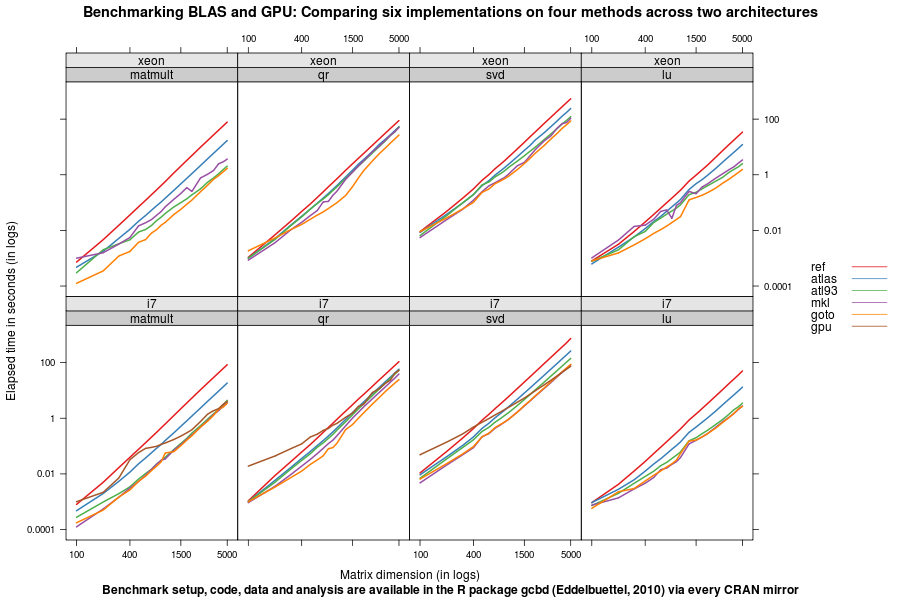
Usage of accelerated BLAS libraries seems to shrouded in some mystery, judging from somewhat regularly recurring requests for help on lists such as r-sig-hpc (gmane version), the R list dedicated to High-Performance Computing. Yet it doesn't have to be; installation can be really simple (on appropriate systems). Another issue that I felt needed addressing was a comparison between the different alternatives available, quite possibly including GPU computing. So a few weeks ago I sat down and wrote a small package to run, collect, analyse and visualize some benchmarks. That package, called gcbd (more about the name below) is now on CRAN as of this morning. The package both facilitates the data collection for the paper it also contains (in the vignette form common among R packages) and provides code to analyse the data---which is also included as a SQLite database. All this is done in the Debian and Ubuntu context by transparently installing and removing suitable packages providing BLAS implementations: that we can fully automate data collection over several competing implementations via a single script (which is also included). Contributions of benchmark results is encouraged---that is the idea of the package. The paper itself describes the background and technical details before presenting the results. The benchmark compares the basic reference BLAS, Atlas (both single- and multithreaded), Goto, Intel MKL and a GPU-based approach. This blog post is not the place to recap all results, so please do see the paper for more details. But one summary chart regrouping the main results fits well here: GPU/CPU Benchmark Results This chart, in a log/log form, shows how reference BLAS lags everything, how multithreaded newer Atlas improves over the standard Atlas package currently still the default in both distros, how the Intel MKL (available via Ubuntu) is fairly good but how Goto wins almost everything. GPU computing is compelling for really large sizes (at double precision) and too costly at small ones. It also illustrates variability and different computational cost across the methods tested: svd is more expensive than level-3 matrix multiplication, and the different implementations are less spread apart. More details are in the paper; code, data etc are in the package gcbd. The larger context is to do something like this benchmarking exercise, but across distributions, operating systems and possibly also GPU cards. Mark and I started to talk about this during and after R/Finance earlier this year and have some ideas. Time permitting, that work should be happening in the GPU/CPU Benchmarks (gdb) project, and that's why this got called gcbd as a simpler GPU/CPU Benchmarks on Debian Systems study.
15 September 2010

Gunnar Wolf: On enjoying history, opposed to what happens around me

Portadas de los discos de Diana Uribe I have always liked learning and understanding history. Since I discovered him, for a couple of years already I always try to catch Javier Garciadiego's program Conversaciones sobre historia, Saturday 9AM in the Horizonte 108 radio station (can be listened to online). This program started by going over the events just before the beginning of the 1910 revolution in Mexico - and along slightly over five years, one hour per week and following different threads, the program has reached the end of the Cristiada, in the early 1930s. Garciadiego has a very nice, followable, amenable way of telling history, and I have recommended his program to many friends. This last June, I spent some days in Guatemala City, for DrupalCamp Centroam rica. I stayed with my good Colombian friend, Dilson, and at his house he had framed a poster of the History of the Civilizations. Of course, I got my nose close to it, guessing as many faces as possible in the lot. And he showed me his last Christmas present: Two books, each of them with 6 CDs. One is Historia de las Civilizaciones, the second one is Historia de las independencias. They are made by Colombia's very well known and well regarded historian Diana Uribe. I copied the CDs in order to listen to them later And wow, was I impressed! Diana Uribe makes a great narrative about topics that to some people would seem boring and dry. As I said, I have always found passion in understanding the human processes that have shaped civilization and brought us all the way to where we stand now. Well, Diana Uribe manages to bring more "normal" people to this passion. While looking for information on her to share in this blog post, I found so many places offering download of her disks, with apparently young people talking about how she has got them all so excited and interested in history... That's, I think, the best "thank you" any academician can get: having non-specialists say how her work has opened up the passion of one of the world's least sexy professions to them. And yes there are so many "thank you" and "I want" commentaries, so much of what I would call "fan mail", that it took me a bit to find an online library carrying both works. And yes, at ~US$50 each, I do intend to buy them. Now, why am I writing this today? Well, yes, because I finished listening to the series today, but besides During this year, most of Latin American countries conmemorate their 200 years of existence. Most of the independentist struggles in the continent started in 1809-1810. And today is the "partying" day in Mexico Says the legend that in the night between September 15 and 16, 1810, a priest who is always painted as old and charismatic called on his small town urging the people to rise and fight for independence, and as a result of that, only 11 years later Mexico was a fully independent country, spanning from Costa Rica to California, and... well, a nice and very idealized myth. A century later, in 1910, after a very long stability and growth period (attained mostly through repression, the same abstract thing named as "the people" rose against the dictator Porfirio D az, who had been Mexico's president for 30 years. The revolution deeply changed the social face of the country, but politically... After ~15 years of fighting, the result was that a 30 year long dictatorship was replaced by a 70 year long one... And our political system still has not evolved beyond that model. Now, comparing what has not improved nor even stayed the same but went backwards... A century ago, the festivities of the hundred years of independence were a time for showing pride, for showing to the guests from more "civilized" countries how ours was by then a modern, thriving country worth believing in, worth investing in: Besides the important, majestic and well built monuments that were erected and still stand today (i.e. the Column of the Independence or Hemiciclo a Ju rez, many institutions that would socially shape the next century even after D az's death, even after he had been declared not the role model we wanted after all were born: The National University (nowadays the most important university in Latin America), the National School for Professors, the Railroad Technical School and many others (see Javier Aranda's note for some more details)... The celebration was well-thought and planned. Of course, it didn't go into some darker corners, the country was as uneven and unfair as it can be for the poorer indigenous population (which back then was a majority), and what not. But this year? Well, we are expecting an impressive show tonight (which I won't see, even though I'd like to, as I no longer have a TV and even if I had wanted to go downtown for the celebration, different government branches are insisting we should just sit and watch it by TV at home as it can be too crowded... so not even that was well thought out Of course not every Mexican can go to the same square and see the same de-facto president do the ritual, but some more redundancy could be thought, spreading acts through all of the city instead of concentrating the festivities all along Reforma. But anyway Leaving aside our current de-facto ruler's inabilities to do anything worthy, which are already well known and documented... I took this opportunity to listen to a great work, and am most happy to do it, and to be able to share it with you.

Matthew Garrett: Thoughts on upstreams

Last month I gave a presentation on the interaction between Android and kernel upstream at Linuxcon. The video for that is now available here (requires registration). Contrary to stories you may have heard, I do not dropkick anyone through a window.

There's some parallels between the Android/upstream scenario and Canonical's approach to upstream. Mark wrote a lengthy defence of Canonical's focus on components that they feel need development, while not putting development effort into things they feel are good enough already. That's pretty consistent with the discussions I had with him at the Ubuntu development meeting in Oxford over six years ago. Back then the focus was on taking all the excellent software that already existed and concentrating on providing it as a single polished and integrated product. It was successful - what's easy to forget now is that the first release of Ubuntu was massively more usable out of the box than any other Linux distribution available at the time, and it's absolutely undeniable that its release spurred increased efforts on the part of competitors. But I don't think the same focus is being applied any more.

The most obvious (and most controversial) example is the Ayatana project. Ayatana's a pretty explicit statement that Canonical don't view the existing Gnome UI as being suitable for their vision of the Linux desktop. That's absolutely fine. However, unlike many of the papercut projects, Ayatana is a set of complete reimplementations of functionality that behave differently to their upstream equivalents. There's no meaningful sense in which that's not a fork of Gnome. And, let me emphasise, I don't think that's a bad thing.

Let's go back to Android. While we talk about how much we'd have preferred it if Google had interacted with upstream before implementing wakelocks, the realistic outcome is that there's no way that we'd have accepted them even if they'd been posted years before hardware shipped. If there'd been a productive outcome to that aspect of the conversation it would have involved Android having a very different power management policy. Sometimes you're not going to convince people that something is better without implementing it and seeing how well it works. The problem with wakelocks is not that they exist or that Google feels they work better than the alternative, but that they end up integrated into drivers in a way that can cause divergence between mainline and Android.

Ayatana potentially has the same outcome. At some level, well-integrated applications have to be aware of the environment in which they're running. The application indicator patches are an example of that. Carrying conditional code increases maintenance burden, reduces test coverage and is a net loss in the long run. If upstream Gnome never gains support for this functionality, and if Ubuntu continues to depend on it, then Canonical have a delta that they'll have to carry forever. That benefits nobody.

Forking because you believe that your approach is better is a completely valid development model, but in the long run can cause problems if you don't have a long-term strategy for how to resolve that fork. For all we criticise Google's ability to get Android code into the mainline kernel, they've put orders of magnitude more effort into doing so than Canonical have in terms of getting Ayatana's code into mainline Gnome. This isn't a function of Google's relative size - the Android kernel team is on the order of 10 people. It's not enough of a difference to explain the disparity.

Canonical would be perceived as much better team players if there was an indication of their long-term plan in terms of Unity and the Ayatana projects and getting that code into mainline Gnome and integrating with the Gnome shell. It's completely unsurprising that they're viewed with distrust until that happens.

14 September 2010

Russell Coker: How to Start Learning Linux

I was asked for advice on how to start learning Linux. Rather than replying via email I m writing a blog post for future people who ask such questions and also to get comments from other people which may provide information I missed. Join a LUG The best thing to do is to start by joining your local Linux Users Group (LUG). Linux International maintains a list of LUGs that is reasonably comprehensive [1]. Even if there isn t a LUG near enough for you to attend meetings you can learn a lot from a mailing list of a LUG that s close to your region. There is usually no great reason not to join the mailing list of a LUG in a different region or country, but a local LUG is that the advice will often be tailored to issues such as the local prices of hardware and the practices of your government. Also note that Linux International doesn t list all LUGs, the MLUG group in Melbourne [2] and the BLUG group in Ballarat [3] aren t listed. Anyone who joins LUG (the group based in Melbourne, Victoria that I m a member of) will be advised of the smaller groups in the region if they ask on the list. As an aside it would probably make sense for the main LUV web page [4] to have links to local LUGs and to the LI page of users groups and for other LUGs to do the same. It s pretty common for a Google search to turn up the web site of a LUG that s near the ideal location but not quite right. Also it would be good if LUV could have a link to the Victorian Linux Users Group in Canada this should reduce the confusion a bit and they have a link to us [5]. Play with Linux Get a spare PC (with no important data) and try installing different distributions of Linux on it. Make sure that it never has anything particularly important so you can freely try things out without worrying about the risk of losing data. Part of the learning process usually involves breaking a system so badly that it needs to be reinstalled. Linux can run on really old hardware, an old system with 64M of RAM will do for learning (but 128M will really be preferred and 256M will be even better). Learn with other Beginners LUV has a very active beginners group, with a beginners mailing list and special beginners meetings. A group that has such things will be more helpful as you can easily learn from other people who are at a similar level to you. Also you can spend time learning Linux with friends, just spend a weekend with some friends who want to learn Linux and play with things you can often learn more by trying things than by reading books etc. Do some Programming One of the advantages of Linux (and other Free Software OSs) is that it comes with a full range of programming languages for free. You can get a much greater understanding of an OS by writing programs for it and a typical Linux distribution gives you all the tools you need. Any other Ideas? Does anyone have any other suggestions? Please leave a comment.

Gregory Colpart: Capture input/output of a process with gdb

My tip of day. When you lose control of a process (for example with a process launched with disown or, another example, when you close your SSH terminal with unsynced mutt), thanks gdb.
$ tty
/dev/pts/13
$ gdb --pid= pidof mutt 
(gdb) call close(0)
(gdb) call close(1)
(gdb) call close(2)
(gdb) call open("/dev/pts/13", 2, 0)
(gdb) call dup(0)
(gdb) call dup(0)
(gdb) detach
Detaching from program: /usr/bin/mutt-org, process 2932
Thanks to this comment on superuser.com for the original idea. Edit: correction on dup() calls. Thanks to Peter Pentchev for his explanation in comments.

Raphaël Hertzog: How to customize dpkg-source s behaviour in your Debian source package

dpkg-source is the program that generates the Debian source package when a new package version is built. It offers many interesting command-line options but they are often not used because people don t know how to ensure that they are used every time the package is built. Let s fill that gap! It is possible to forward some options to dpkg-source by typing them on the dpkg-buildpackage command line but you d have to remember to type them every time. You could create a shell alias to avoid typing them but then you can t have different options for different packages. Not very practical. The proper solution has been implemented last year (in dpkg 1.15.5). It is now possible to put options in debian/source/options. Any long option (those starting with -- ) can be put in that file, one option per line with the leading -- stripped. Here s an example:
# Bzip2 compression for debian.tar
compression = "bzip2"
compression-level = 7
# Do not generate diff for changes in config.(sub guess)
extend-diff-ignore = "(^ /)config.(sub guess)$"
Notice that spaces around the equal sign are possible contrary on the command line. You can use quotes around the value but it s not required. The debian/source/options file is part of the source package so if someone else grabs the resulting source package and rebuilds everything, they will use the options that you defined in that file. You can also use debian/source/local-options but this time the file will not be included in the resulting source package. This is interesting for options that you want to use when you build from the VCS (Version Control Repository, aka git/svn/bzr/etc.) but that people downloading the resulting source package should not have. Some options (like --unapply-patches) are only allowed in that file to ensure a consistent experience for users of source packages. You can learn more about the existing options in the dpkg-source manual page. Read it, I m sure you ll learn something. Did you know that you can tell dpkg-source to abort if you have upstream changes not managed by an existing patch in debian/patches? It s --abort-on-uptream-changes and it s only allowed in debian/source/local-options. Be sure to subscribe to the RSS feed or to the email newsletter to not miss useful documentation for Debian contributors! Flattr this Share/Bookmark 3 comments Support my work

Dominique Dumont: Creating a DEP-5 parser with Config::Model

Hello Following a discussion on #debian-perl IRC channel, I ve proposed to provide a script to parse DEP-5 files. The goal is to be able to parse *and* validate DEP-5 files. DEP-5 is a
proposal to make debian/copyright machine-interpretable. This proposal is driven by Lars Wirzenius. With Config::Model, any evolution of DEP-5 specification will
be easy to include in the DEP-5 model read by Config::Model. What DEP-5 model ? To keep a long story short, let s say that DEP-5 model is a description of DEP-5 syntax and semantic that can be used by Config::Model to perform validation. For more detail on how to create a model, please read this doc. In other word, DEP-5 model is DEP-5 document translated into a special format. First step was to directly edit the doc and munge it into a YAML document describing the structure of DEP-5. Here s a small extract of this YAML file (slightly edited to remove most long descriptions) :
 
---
class:
  Debian::Dep5:
    class_description: >
       Machine-readable debian/copyright
    accept:
      name_match: X-.*
      type: leaf
      value_type: string
    element:
      Format-Specification:
        mandatory: 1
        type: leaf
        value_type: uniline
        description: >-
          URI of the format specification, such as ...
      Name:
        type: leaf
        value_type: uniline
      Files:
        type: hash
        index_type: string
        ordered: 1
        cargo:
          type: node
          config_class_name: Debian::Dep5::Content

During this YAML file creation step, the problem raised by the License keyword became obvious because of License properties: Long story short, I had to add to Config::Model the possibility to specify a Parse::RecDescent grammar to validate a value. More on this later. Of course, the first draft of a model in YAML was far from being perfect. So the second step was to load it with config-edit-model. I had to fix a number of YAML errors and then some errors in the model description. Then, I had to write a parser to load the DEP-5 data into Config::Model tree. I first used Rapha l Hertzog s Dpkg::Control::Hash module. But this one is not able to cope with repeated fields without clobbering them. So I had to provide my own parser. The parser is divided in 2 parts:
- the parse function to load DEP-5 data in a simple data structure
- the read function to load the simple data structure into Config::Model s configuration tree You can view the code on Config::Model repository. Then the model is divided in 3 configuration classes: And the full model of Dep-5 can be also read on Config::Model repository: (The models are biggish because they include help text taken from DEP-5 documentation) Now some explanation is required on how is performed the License validation. The trick is that each License used must be listed in Dep5 s license parameter which is specified this way (in YAML syntax):
 
License:
  type: hash
  index_type: string
  allow_keys_matching: '^(?i:Apache Artistic BSD etc... other)[\d\.\-]*\+?$'
  cargo:
     type: leaf
     value_type: string
So this License element contains the list of licenses with their full text and only Licenses whose name matches the regular expression are accepted. Now, let s explain how the files are tied to the declaredlicenses. The Debian::Dep5::Content class had a License element that represent the relation between the files and the License(s). This bond is represented by Debian::Dep5::License configuration class. The abbrev and full_license elements are fairly obvious. The abbrev element is another matter. Here s its declaration (minus the description and help):
 abbrev:
 type: leaf
 value_type: uniline
 default: other
So far, so good. Now the meaty part: the validation requirement based on Parse::RecDescent
grammar: "license (oper license)(s?)
          oper: 'and'   'or'
          license: /[\\w\\-\\.\\+]+/i\n
               # PRD action to check if the license text is provided
               $return = $arg[0]->grab('! License')->defined($item[0]);
               "
This grammar specifies: This way, an abbreviation cannot be used without a proper License statement. This code is the first stab. Some more work is to be done soon: Anyway, I ll soon release Config::Model with this first version of DEP-5 parser. As always feedback are more than welcome. All the best update: added missing Parse::RecDescent link

13 September 2010

Amaya Rodrigo: Of inner peace and struggle

[Nothing related to Debian here, move on if you don't care about my recurring obsession with the end of the world, Cassandra pains, or Big Phat Living Room Revolution yearnings].

Although I am still looking for a community of anarcho-primitivists that want to accept me joining their frugal living, and simply slip off the social construct, the system, the fucking face of earth, call it what you will, I could find some comfort in my favourite feminist blogger's take on the subject of my midlife crisis regarding ecology, capitalism, patriarchy, child bearing, overpopulation, meat consumption and all the rumination of consuming thoughts that (still) make my life miserable and have kept me running away from human contact for a year.

[Emphasis mine]

At what point does human culture depart from the Natural? With the invention of computers? TV? Cars? The cotton gin? Electricity? Taco stands? Gunpowder? The printing press? Written language? Shoes? Crop cultivation? Yurts? The wheel? Did humans become unnatural when the good old days of picturesque, endless agrarian toil, feudal oppression, unchecked disease, ignorance, and death from dysentery at 35 turned into the bad new days of urban post-industrial capitalism where a pound of fair-trade organic coffee costs $12.99 and your email inbox is full of spam?

ah. Everything humans do, or have ever done, is natural. We can t do anything else. The idea that modern culture is un-natural is nostalgic and inaccurate. Living off the grid in a yurt is good in some absolute sense, whereas driving an SUV from a suburban bungalow to the stripmall is bad ? Come on. This a romantic, but misguided view. The cosmic reaction to a 20 Ford Expedition is the same as to a sanctimonious Prius: bupkis. The universe doesn t give a fuck about you or your lifestyle choices. It doesn t give a fuck about the economy, oil spills, or civil unrest in Blargistan. It doesn t give a fuck about katydids. Eventually our whole planet will be erased from space, and the galaxy won t bat an eye. The inevitable extinction of our species (imminent, according to research here at Spinster Laboratories) via the exhaustion of available resources is as natural as a fresh-picked peach. As Andre 3000 and other dude philosophers have observed, nothing is forever.

Yes, yes, when people use the word natural what they really mean is free of chemical additives and maybe some of the assorted hippie concepts that go with that narrative. Barter economies, home furnishings made from bamboo, vegan cookbooks, living in the country. While I would argue that it is just as natural for people to put chemical additives in things as it is to not put chemical additives in things, I admit that it is appealing to fantasize that the source of human misery is an unnatural isolation from Nature, and that doing yoga on an organic rubber mat and drinking organic spinach smoothies will put me back in sync with the cosmos.

But alas, I m already in sync with the cosmos, and so are you. In other words, this is it. This is what we ve become, and this is what we get. Which is not to say that a person can t fantasize about a verdant paradise full of songbirds and polar bears and Bengal tigers, untouched by human influence. Only, that world isn t a world we could actually live in. The minute you add contented children, lazy from a carefree day at the swimming hole, eating ripe plums on the porch at sunset to that scenario, natural history changes, and it s right back to our scorched-earth dystopia. Our giant brains use up resources, it s as simple as that.

As long as we re still here, though, we might as well try to make the best of it.

http://blog.iblamethepatriarchy.com/2010/06/19/heads-up-art-week-starts-on-monday/


Though the comfort is somewhat ephemeral, because deep inside, I know she's wrong, I know another way is feasible, but I have given up already, I have very well come to terms with extiction, I get an enormous pleasure from the thought of the very well deserved human mass suicide-by-cop^Wnature, and in fact, I trust and hope it will save me personally from facing the hard times ahead, as I am a damn coward, paralized by fear, hopeless about the flock ever getting it (is it so hard, really?), while doing as much as I can but completely overwhelmed by the need of changing a world everyone seems to like just as it is. I can certainly empathize with much more disturbed ways of airing similar anguish, among many other examples, such as The Unabomber, or The Weather Underground. I don't even want to go there as I know violence all too well and it is not fun to be on the receiving end. But I see the screaming desperation behind the motives of acts I am not at the liberty to discuss here. I wonder if consumption of resources in the form of books will numb the disorder or make it worse and what sort of medical arrangement the stablishment has for it. As you click away the previous links will mean nothing to you because a)it is Wikipedia after all, and b)you probably don't even understand what the problem of eating animal corpses is, humans are omnivores after all, and what is all this nonsense about dropping language altogether.

WTF, there was no comfort after all, and I am still a nutjob.

Robert Collins: What do I do @ work?

I recently moved withing Canonical from being a paid developer of Bazaar to take on a larger challenge Technical Architect for Launchpad. Its been two months now, and its time to put my head up out of the coal face, have a look around and regroup. When I worked on Bazaar, every day when I started work got up I was working on a tool anyone can use, designed for collaboration upon sourcecode, for people writing software. This is a toolchain component right at the heart of the free software world. Bazaar and tools like it get used everyday to manage, distribute and collaborate on the sourcecode that makes up the components of Ubuntu, Debian, Fedora and so forth. Every time someone new starts using Bazaar for a new free or open source project, well I felt happy happy that in my small part I m helping with this revolution we re carrying out. Launchpad is pretty similar to Bazaar in some ways. Obviously they are both free software, both are written in Python, and both are sponsored by Canonical, my employer. And they both are designed to assist in collaboration and communication between free software developers albeit in rather different ways. Bazaar is a tool anyone can install locally, run as a command line, GUI, or local webserver, and share code either centrally (e.g. by pushing to Launchpad), or in a peer to peer fashion, acting as their own server. Launchpad, by contrast is a website which (usually) folk will use as a service in their browser, from the comand line FTP (for package building), ssh (for Bazaar branch pushing or pulling), or even local GUI programs using the Launchpad API service. This makes it more approachable for first time collaborators, but its less able to be used offline, and it has all the usual caveats of web sites : it needs a username and password, it s availability depends on the operators on the team I m part of. So there s a lot less room for error: if we do something wrong, the system is unavailable, and users can t just apt-get install an older release. With Launchpad our goal is to to get all the infrastructure that open source need out of the way, so that they can focus on their code, collaboration within their team and almost uniquely collaboration with other teams. As well as being open source, Launchpad is free for all open source projects to use Ubuntu is our single biggest user they use it for all bugtracking, translation and package building, and have a hugefraction of the total storage overhead in the database. Launchpad is a pretty nice system, so people use it, and as a result (on a technical basis) it is suffering from its own success: small corner cases in the code turn up every day or two, code written years ago to deal with a relatively small data set now has to deal with data sets a thousand or more times larger (one table, for instance, has over 600,000,000 rows in it. For the last two months then, I ve been working on Launchpad. As Technical Architect, I need to ensure that the things that we (users, stakeholders and developers of Launchpad) want to do are supported by the structure of the system : the platform(s) we re building on, the way we approach problems, coding standards and diagnostic tools. That sounds pretty dry and hands off, but I m finding its actually very balanced. I wrote a presentation when I started the job, which encapsulated the challenges I saw in front of the team on this purely technical front, and what I thought I needed to do. I think I was about right in my expectations: On a typical day, I ll be hands on in a problem helping get it diagnosed, talking long term structural changes with someone around how to make things more efficient / flexible / maintainable, and writing a small patch here or there to help move things along. In the two months since I took on this challenge, we ve made significant headway on the problem of performance for Launchpad : many inefficient code paths have been identified and removed, some new infrastructure has been created as is being rolled out to make individual pages faster, and we ve massively increased the diagnostic data we get when things go wrong. We ve introduced facilities for responding more rapidly to issues in the software (but they have to be rolled out across the system) and I hope, over the next 4 months we ll reach the first of my performance goals: for any webpage in Launchpad, it will complete rendering in 99% of the time. (Note that we already meet this goal if you measure the whole system, but this is biased by some pages being very frequently hit and also being very small).

Eddy Petrișor: Fixing a bookmark corruption in Iceweasel/Firefox

At some point in the past my bookmarks broke in such a way that I wasn't able anymore to alter in any way the bookmarks, deletions, additions, reorganisation, nothing worked.

Way before this event I set up a git repo in my .mozilla directory and committed everything in the directory (except obvious cache files and such) in the repo. I didn't make a cronjob with this since I didn't thought of a proper way to make sure the browser wasn't started (the data might have been inconsistent at commit time), and, since most of the time I have the browser started, it seemed rather useless to try to automate for a very, very small window of time when the browser data would be in a consistent state. As a consequence, I did occasional manual commits in the git repo.

When the bookmarks issue appeared I realised that my last git commit was so old that it didn't made any sense to try to restore since I would have had lost bookmarks, passwords and plugins. So I made a checkpoint commit os the broken profile and resorted to all sorts of manual attempts at fixing the issue, but all my efforts of playing with the bookmarks.* files proved to be useless.

I concluded that icewesel/firefox 3.5.x was using some other mechanism and decided to dig into the issue at some latter time when time allowed me to analyse and fix it. Today was that day.

I began by creating a backup for the bookmarks via the Bookmarks Manager export function. After a hickup, it managed to save a proper bookmarks.html file. I tried to import that file, but the breakage remained.

Then I decided I should prepare for the worst, installed an addon which allowed me to save all stored passwords and created a new account (started firefox from the command line with 'firefox -ProfileManager') with the intention to transplant files from the old files into the new one. Short after that I realised that it would be smarter to commit the new profile, too, import the bookmarks from the backup file and replace the touched files back into the old profile.

After the import and closing the browser, git informed me that the modified files were:
XPC.mfasl
XUL.mfasl
cookies.sqlite
localstore.rdf
places.sqlite
pluginreg.dat
urlclassifier3.sqlite


At this point the modification of the binary .mfasl files looked very ugly to me, but I had a hunch that the only relevant file to my problem was the places.sqlite file and I went on to check the contents of the file with sqlitebrowser. After inspecting also the urlclassifier3.sqlite file (whose contents were unreadable), I decided to give it a try at simply placing the places.sqlite file in the old profile and see if the problem would be fixed that way. After all, I had the whole profile's state in git so any breakage could have been undone easily.

I started firefox using the old profile and the problem was fixed. Yay!

Now I have my bookmarks back and a suggestion for the mozilla people: please don't keep useless files like bookmarks.html in the profile once they become outdated, they are misleading.

P.S.: I still have to think of a way to make automated sane commits. Maybe I'll try to make an iceweasel/firefox addon. This could be a nice idea since I could learn something new, too.

Next.

Previous.


