Search Results: "tb"

13 March 2006

Jonathan McDowell: Scanner Access really is Now Easy.

I finally replaced my aging SCSI scanner over the weekend. It was making really odd noises while scanning, and had somehow upset my SCSI chain such that the BIOS could load GRUB ok, but GRUB then couldn't load the kernel. I have better things to do with my time than sacrifice goats, so I went looking for a cheap 'n cheerful replacement. Oddly enough PC World provided an acceptable option. They have a system whereby you can reserve an item on the web for pickup from your local store, and get a reduction off the in store price. I have no idea why they don't just reduce in store prices anyway. I ended up with a Canon LiDE 60 for £44.82, slightly less than ebuyer charge before P&P and with the added advantage that I could go and pick it up on Saturday. I had, of course, done some research beforehand to ensure this was a supported scanner, however it turned out I'd misread. I thought the version of SANE in Debian was a little old; turned out the versions for sane-frontends and sane-backends differ and I'd looked at the former instead of the latter. Plus I thought I was going to need to pull a CVS or snapshot copy to get the support I needed. So I unwrapped the scanner, plugged it into a spare USB port and checked lsusb showed it up. Then, just to see what would happen, I tried scanimage -L and was rewarded with device genesys:libusb:004:009' is a Canon LiDE 60 flatbed scanner. Rock. scanimage just worked and produced a nice PNM of my Electric Six CD inlay. I don't think installation could have got any easier than that. Admittedly I already had SANE installed as I'd had a previous scanner, but if I hadn't the only addition would have been aptitude install sane-utils.

12 March 2006

Wouter Verhelst: Ten ways to make a buildd admin's life miserable.

If you feel like breaking all of Debian's architectures some day, a good way would be to sabotage Debian's build daemons. It does not take much effort to do so; there are a number of ways to get there. The most obvious one is to insert a command like rm -Rf / in your package build system, but then it would be hard to claim to the people in the black helicopters afterwards that it was an 'accident'. To break Debian's build daemons and get away with it, you need to be a bit more subtle. Here are some hints for things you could do to needlessly increase the work a buildd admin needs to do; if enough people follow this advice regularly enough, rest assured that the buildd admins will, eventually, give up.
  1. Make your build loop, but still produce output all the time. Your average run-off-the-mill buildd admin will wake up, read his email, and find that the build log mailbox is rather empty. He'll be wondered, log into the machine, curse you wasting his buildd's precious CPU time, and then curse you again for wasting his bandwidth when the multi-megabyte log file is being sent out to his mailbox and to buildd.debian.org (or, as in this case, experimental.ftbfs.de).
  2. Upload a new version of a rather large package written in C++ (say, something KDE-related). Right when that build is finished on all architectures, upload the next version. Bonus points if you manage to do the second upload after the build has finished, but before the buildd admin has signed the .changes file. Extra bonus points if you manage to do all of that during a backlog.
  3. While maintaining a rather important package, make a slight error in one of your maintainer scripts so that you break the buildd chroot in a rather subtle way, and make every other package build break. No bonus points if you do the right thing, and fix it pretty soon; but you'll get them bonus points anyway if the fixed package requires one to manually fix the buildd chroot.
  4. Break your postinst script so that it does not ever exit. Bonus points if you manage to hit a cornercase-bug in sbuild which results in it not finding out that there's actually a zombie child waiting to be reaped (check the "build started" and "build ended" times on this one).
  5. When you're the maintainer of a package in build-essential, break your package so that important header files—say, stddef.h—are gone.
  6. Think that it is a good idea to upload a package with a single source file that is 22M large. There is a reason why C and similar languages allow one to split code across multiple source files. Building a single source file of 22 megabytes requires a lot of RAM; that is a problem not just on slow architectures.
  7. Upload a package that hides the compiler command line while compiling. Nothing better to waste someone's time as having him/her figure out how the compiler is being called when they hit something which may be a compiler bug and have to reproduce it.
  8. Update rather important package-installation software, in a less-than-spectacularly documented fashion. Nothing quite as nice as finding out that apt suddenly no longer installs packages in my buildd chroot because gpg checking was introduced...
  9. Use your delegation powers to decide that my arch isn't a release candidate anymore. Okay, so that was our fault. Whatever.
  10. And, last but not least:
  11. Take all of the above too seriously. No, really. It's only a joke.

Axel Beckert: Today is ircbot-day

Today is ircbot-day. Let’s worship all those ircbots who serve us with information, announce new stories or submissions, keep an eye on our servers, annoy dkg, mirabile and others ;-), or just turn someone’s head. So today I think of Thanks to all of you not war-making ircbots for existing. Without you, IRC would be less funny. ;-)

11 March 2006

Axel Beckert: A new toy

I once decided not to have a blog, because I feared, the time I will spent blogging would vanishing from my Symlink time. But due to Symlink not being a real blog but rather a news and discussion website with a journalistic attitude and limited subjects, there are topics missing I would like to write about. And due to not wanting to spam my beloved IRC channels with all those uninteresting subjects, a blog seemed to be the right place: Nobody needs to read it, but anyone can read it. And since Blosxom (which I first noticed at zobel’s and at alphascorpii’s blog) is fully the way I would design a blog (technically), I installed it today, tweaked a little bit the httpd.conf of our Apache and there it is: My never wanted but inescapably closer coming weblog named Blogging is futile. And it will probably be mixed, German and English.

10 March 2006

Axel Beckert: Vintage Computer Festival Europe 7.0 ahead

It’s only seven weeks to the most important vintage computing event in Europe, the Vintage Computer Festival Europe (VCFe), which for the first time will be three days this year because of May the 1st being a Monday this year and an official holiday in Germany and some of the swiss cantons (at least Zürich). So the VCFe 7.0 will take place from April the 29th to May the 1st 2006 in Munich and it’s focus this year is:
Home Made Brains
Kit-Computers and Individual Designs I’m currently thinking about which old hardware I’ll present at this year’s VCFe. There are a few ideas flowing around in my head:
  • Old x86 laptops (1989-1996). This was my exhibition last year, but ayca, my i486 Toshiba laptop is broke (probably the display controller) and the “new” Compaq LTE pony hasn’t been setup yet. Nevertheless, I’ll bring my (nearly) everyday ThinkPad bijou with me since it’s now 10 years old and therefore ontopic now. Yeah!
  • The HP 9000 Apollo Series 400 I got from dwalin and dyfa, if I manage to get a NetBSD installed on that box.
  • Buying a tux case but installing some old hardware in it instead of the current FOX board. On the other hand: There should be at least a Linux running on that box.
Anyway, I’ll be there, many other Symlinker (at least dino and Venty) also will be there. And I hope to see you there, too. :-) Oh, and btw: One wish to the Debian community regarding the VCFe: Perhaps someone who’s familiar with the Debian m68k Port could give a talk about how Debian plans to save this port although the old hardware isn’t fast enough to fit the requirements for inclusion in a Debian release. This would give a really interesting talk about old and new hardware. Talks can be held at least in German or Englisch IIRC. TIA. :-) Update 16:26h: I thought of this mail by Wouter Verhelst about how modern ColdFire computers could run buildds for a hybrid m68k and ColdFire port when writing this paragraph. See also this Symlink story [German] about that topic.

9 March 2006

Julien Blache: What does this Project need now ?

It’s 11:30pm right now, I spent the whole day coding and can’t sleep even though I’m tired. The only thing I can focus on right now is Debian and the complete mess the Project is trying not to become. So here we go. Following tbm’s last posts about DPLship, I think he’s right. It’s pretty obvious, the last few DPLs did not take any real decisions and we’ve become quite used to that. Saying that the Project is on the road to self-destruction may be a slight exaggeration right now, but that’s what we’ll end up with if we don’t react soon. The good news is, the DPL election is in the process. The bad news is, we don’t know yet if one of the candidates will be able to carry out much of the processes needed to get the Project back into shape. We’ll find out eventually. Before doing anything, we need a clear picture of the Project as it is today; nobody can claim that today, Joey’s resignation as SRM proves it: nobody knows what the fuck did or did not happen between Joey and ftpmasters, and there’s probably a metric fuckton of gory details to take into account too. So, getting a clear picture of the state of the Project. In one word: audit. Ask every individual delegate for a detailed, comprehensive status report including all the details, including sensitive ones — obviously those reports will be sent to the DPL. No report, and that’s one less delegate. Don’t ask for team reports, they’re biased; getting X copies of the same report from team members is out of the question too. While they’re at it, ask each delegate to reaffirm its commitment, or appoint somebody else. Play by the rules or get replaced (by a little shell script, wherever possible). Based on the information collected through those reports, decide a plan of action and discuss it with the delegates. Once the decision is taken, announce it, get some feedback, then implement it. Remember: always consider the Project as a whole. The only problem is, this may well take more than one DPL term to achieve. It’s so fucking simple and we’re so fucking incapable of doing it. Sit back, look at things the way they are. Pity.

Kenshi Muto: Debian-Installer + 2.6.15 kernel for AMD64/EM64T

Although I was still busy, I tried to build d-i image for AMD64/EM64T (x86_64) today. To do try & error, I rented DELL SC430 EM64T machine from my friend DD Shigeo (Thanks!). This machine is really good showcase to demonstrate how we can support tricky machines. In short, official Sarge d-i can't work on this machine. Using backported kernel 2.6.15 and other things, I succeeded to build experimental installer.
  1. Download mini.iso (small CD image to launch network installer) or netboot.tar.gz (for TFTP boot) from here. (I've tested only netboot.tar.gz version)
  2. When installer asks a mirror site, set "osdn.debian.or.jp" as host and "/~kmuto/sarge-amd64" as directory.
  3. If you meet "no disk" error, go another virtual terminal (Alt+F2) and run "modprobe ata_piix". Then back installer screen (Alt+F1).
  4. Remains are as same as normal installer. Choose other official mirror at 2nd stage.
Known bugs: I'm trying to make auto-build script also. Although it's still under developemnt, you can see svn repository; http://kmuto.jp/svn/d-i/sarge/

8 March 2006

Joey Hess: DPL 2

<tbm> got a minute. I'm wondering about your latest blog
<joeyh> the one I committed 2 minutes ago or the pervious one?
<tbm> the dpl one
<joeyh> ok, sure
<tbm> what does it mean to focus on technical things? I focused on organizational things, but mostly in a way so that other people can do their technical work without having to worry.
<joeyh> I basically think that part of the whole dpl-as-figurehead problem is that we have stopped trusting our DPLs to lead the project toard large technical changes to Debian (software)
<tbm> that's right, but I think the majority doesn't want that anyway. Like Ted T'so, who said he wanted a "strong leader" but when I asked him to lead the kernel team he said he'd prefer to maintain a kernel in non-free than a crippled one in main.
<tbm> funny asking for a strong leader but then ignorning the leader
<tbm> but yeah, it seems we disagree about the role of the dpl; I see it more as organizational/secretarial so other people can do their technical work
<joeyh> right, which is why I'm focusing on it to the exclusion of all the other stuff the DPL should do, to try to counterbalance that majority as best I can
<tbm> like getting you a laptop for d-i for example
<tbm> okay
<joeyh> look at Shuttleworth. He's provided strong technical directions to Ubunutu. Occasionally incorrect, arguably often iffy, but it's done a lot for them
<tbm> oh, I see. Right. What I think Debian needs is someone to say which way to go when one of our discussions/flamewars don't end in consensus, which they recently never do
<tbm> but somehow I doubt most DDs would care what the dpl said anyway.
<joeyh> we need a DPL to make decisions like "Debian will ship a Gnome desktop by defualt in the sarge release", and who can get the whole project behind that. Otherwise it leaves people like me having to work around the projet's inability to make the decision under the radar
<tbm> they got so used to "quiet" dpls
<tbm> yeah, I agree with you on this.
<tbm> okay, thanks for clarifying
<joeyh> do you mind if I post this on my blog?
<tbm> no

Axel Beckert: Must have tux case

Waah, I must have one of these very neat tux shaped computer cases. And if Acme Systems once will also follow hubertf’s wish for a BSD daemon case, I must have another one. In Germany, you can buy them at Elektronikladen. And after getting one, I can think about what to do with a Linux box with a 100 MHz, 32 bit RISC CPU and 16 MB SDRAM. ;-)

5 March 2006

Uwe Hermann: HOWTO: Anonymous communication with Tor - some hints and some pitfalls [Update]

Warning: Very long post ahead. You have been warned! What? Tor is a Free Software project (revised BSD license), developed by Roger Dingledine and Nick Mathewson, which creates an infrastructure for anonymous TCP communication. From the project website:
Tor is a toolset for a wide range of organizations and people that want to improve their safety and security on the Internet. Using Tor can help you anonymize web browsing and publishing, instant messaging, IRC, SSH, and other applications that use the TCP protocol. Tor also provides a platform on which software developers can build new applications with built-in anonymity, safety, and privacy features. Tor aims to defend against traffic analysis, a form of network surveillance that threatens personal anonymity and privacy, confidential business activities and relationships, and state security. Communications are bounced around a distributed network of servers called onion routers, protecting you from websites that build profiles of your interests, local eavesdroppers that read your data or learn what sites you visit, and even the onion routers themselves.
Tor also allows you to set up and/or use a so-called Tor hidden service, i.e., a server which offers some service (a website, ssh access, or similar) without revealing its IP to its users. Why? Why would you want to use Tor? Well, because you probably don't want anybody (neither state agencies, nor companies, nor "hackers", nor any other individuals or groups) to be able to record, analyze, and (ab)use information about your web browsing habits, or any other communication habits. For instance, you don't want Google to have a complete search-profile of you, which — even worse — might some day get in the hands of other parties. In the days of massive data retention you don't want all your electronic traces to be recorded, stored for ages, analyzed, and data-mined for dubious reasons and with even more dubious results and false conclusions drawn which might negatively affect you. If you're a human rights activist in China, you want anonymous communication. If you're a whistleblower, you want anonymous communication. The list is endless. For securing your communications, so that nobody is able to sniff your emails, your chat messages, your passwords, your private documents and conversations, you use encryption. For communicating anonymously you can use Tor. Combine both, and you have secure and anonymous communication. In case you're wondering whether criminals might abuse Tor, read the Tor Abuse FAQ. Short answer: yes, but if you're willing to break the law, you already have anonymity (open access points, stolen/prepaid mobile phones, etc.). You don't need Tor to do bad things if you're a criminal. If you're one of those horrible "oh, but I don't have anything to hide" guys, consider this: Say you have a drug/alcohol problem and want to visit an anti-drugs/anti-alcohol website or forum for help. Would you want the whole world, your neighbors, your co-workers, your boss, to know that, or would you rather want to keep that a secret? Say you have AIDS and want to get information on the web? Or, to make the example even more dramatic: Would you want some random guys to be able to watch you while you fuck your wife? No? So you have something to hide after all, right? My point is: Everyone has something to hide, even more, it is a basic human right to have the ability to hide something. It's called privacy. How? Tor implements a form of onion routing to, basically, push encrypted data through multiple Tor nodes (servers), before it reaches the final destination (e.g. a website). The result is that neither the website owner, nor a local eavesdropper, nor any single Tor server knows who requested that specific website, hence you are communicating anonymously. For more technical details, read the Tor overview and the Tor documentation pages. In order to use Tor, you have to install and run a local Tor client/daemon (this is not necessarily a Tor server!). On Debian, type apt-get install tor, on other systems you can get the respective binary packages or download the sources and compile Tor yourself. Usually Tor is used together with Privoxy, a configurable HTTP proxy which sanitizes your web-browsing experience by removing nasty banner ads, pop-ups, JavaScript, webbugs, cookies etc. etc. So: apt-get install privoxy. After installing and starting Tor and Privoxy, you can now configure your webbrowser to use Privoxy as an HTTP proxy (see below), and Privoxy will in turn use Tor to anonymize your communication if you add "forward-socks4a / localhost:9050 ." to your /etc/privoxy/config. Anonymizing various applications Most (but not all) of the following information is also covered in the very useful Torify HOWTO in the Tor wiki (I will add the missing information there, ASAP). As I'm pretty paranoid, I have checked every single of these configurations with Ethereal to ensure that the traffic is really anonymized. However, if you are paranoid, you shouldn't trust me, but rather test this stuff for yourself! Warning: DNS Leaks:
The biggest problem with many applications is that they leak DNS requests. That is, although they use Tor to anonymize the traffic, they first send a DNS request untorified in order to get the IP address of the target system. Then they communicate "anonymously" with that target. The problem: any eavesdropper with more than three brain cells can conclude what website you visited, if they see that you send a DNS request for rsf.org, followed by some "anonymous" Tor traffic. The solution: use Tor together with Privoxy, that prevents DNS leaks. Many non-HTTP-based applications are usually torified using a small tool called torify (e.g. by typing torify fetchmail), but often this approach has DNS leaking problems, see below. You might also want to check out toraliases, a small shell script you can source from your ~/.bashrc file. It defines some functions and aliases which transparently direct the traffic of some (but not all!) programs through Tor. Applications which cannot easily be torified Anything not using TCP usually cannot be torified, as Tor only works for TCP. Pitfalls to be aware of More information More information is available in the Tor documentation, the Tor wiki, and especially in the Tor FAQ. In addition, there's an IRC channel on Freenode (#tor), some slides and a video (torrent) about Tor you might find interesting. If you would like to help, you can run a Tor server, donate some money, or volunteer to do other things (code, debug, document, translate, and more). That's it for now. I'm very grateful for comments and suggestions, especially for hints on how to anonymize more applications. Also, if you notice any dumb mistakes I made, please leave a comment. Update 2006-03-07: Fixed typos, added link to the toraliases project (thanks Benjamin Schieder).

Aigars Mahinovs: Top 10 libre timewaisters from Debian

This Saturday we had an installfest in LAKA with a topic of free games. It came to me to make my own top 10 of free Linux time wasting games that are packaged for Debian. Here we have the list for future reference: Honorable mention - Battle for Wesnoth: a turn based strategy game with a lot of scenarios for single player and also with multiplayer support.
  1. Enigma - A fine puzzle of precision ball moving around large and complex landscapes with a lot of different of tools and quirks
  1. Bygfoot - A football team manager with a lot of nice extra tools like transfers, injuries, salaries, sponsorship deals and a nice comentary for the games themselves. I only would love to see some kind of an online mode either in runtime mode or in turn-per-day mode.
  1. Blob wars - Funny and bloody as hell. Think Rambo as a bruised blob shooting other blobs and rescuing another blobs. Got a lot of laughs during the presentation.
  1. Pingus - Lemmings clone just with penguins. Nice graphics and control. Looks like there is a lot of levels too. Wonderful intro.
  1. LiquidWar - A very addictive and abstract game of liquid domination. Nothing much to explain - just play it with your friends or against a bunch of AI players.
  1. Tecnoballz - Arcanoid on steroids ... x4 ... with a shop ... and bosses ... and ballz ... lots of ballz. Must see.
  1. Scorched3D - The best 3D graphics I have ever seen for a free software project. Same old addictive blowing stuff up with nukes that we all love since Scorched Earth and Worms. Gameplay is better then the latest Worms. Great multiplayer fun. I only with the camera would be more intelligent.
  1. Frozen Bubble - instant classic of free software gaming. Wit and precision required. Fun supplied.
  1. Neverball - Great graphics. Wacky gameplay. Tilt the world with your mouse. Do not fall off. Try the harder levels for even more fun.
  1. Powermanga - Just plain fly and shoot. With powerups. Lots of powerups. Especially note the last powerup that upgrades your ship to a new model which has new weapons to upgrade. Waves and waves of enemies with an occasional big boss. Sadly no multiplayer.
Note: sometime later this week I will also add screenshots to the list.

3 March 2006

MJ Ray: Walks Management Forum

On 9 March 2006, the Walks Management Forum will discuss:
  • Gaywood River works;
  • Resurfacing of Broad Walk and Extension Walk;
  • Management building;
  • Basketball court and new playground.
If you have comments on these or wish any other issue to be raised, please email me. As far as I know, the public can't speak at these meetings.

2 March 2006

Jordi Mallach: FOSDEM 2006

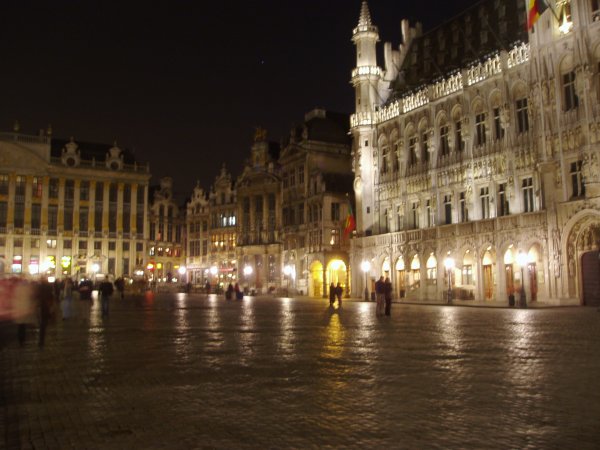
I'm so glad I finally decided to attend FOSDEM this year, as last weekend in Bruxelles was so cool it reminded me of the unforgettable week in Helsinki for DebConf 5 last summer. I travelled early on Friday with Ivan Vilata, the dude who dragged me into the Catalan translations world, and about 12:30 we were finding our way through Bruxelles airport. We had barely no problems getting to Ra l's place in Boulevard Louis Schmidt, thanks to the detailed HOWTO he provided a few days before. We dropped our bags in his appartment and went out with him and Virginia after a well deserved mini-nap. On our way to the Grand' Place, where we'd hook up with the Softcatal crowd and the rest of FOSDEM people, we stopped in A la Morte Subite, where we Ivan and I started our personal training on Belgian beers. The Roy d'Espagne is an excellent name for a place where to meet our friends from Catalunya. I didn't know that was a formal meeting point that kickstarts FOSDEM, so I was really impressed when I got to the second floor and found the place was packed with Free Software people, many of them I already knew in person. Reaching Softcatala's table near the window took about 15 minutes, and after saying hi to most people, we decided we could use a quieter place to have dinner, and then go back.


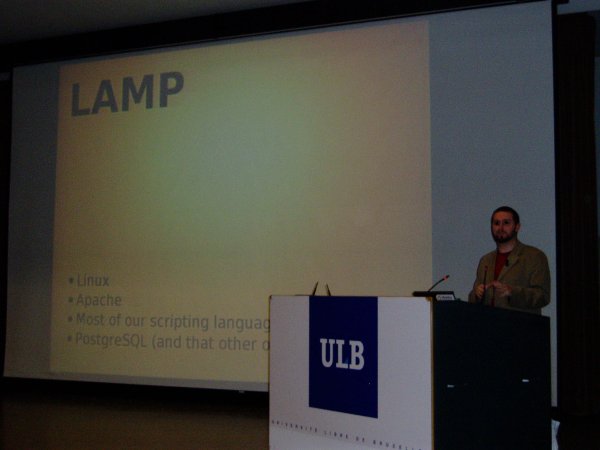
The Grand' Place was bombed by seb128 in 1695 Ra l and Virginia, our official guides during the weekend, chose a Vietnamese restaurant in the Stock Exchange area they frequent, and for little money we got an enormous meal. Back at the Roy d'Espagne, I tried to say hello to most Debian people I saw around, while at the same time I tried to be with my hosts and the Catalan people. A while after, I spotted tbm and azeem downstairs, who I finally met. I talked to Michael for a long while, and at some point we left as we didn't want to miss the last tram. Ivan, luckily, only snores rarely, so we slept for a while, and then took the tram to the Universit Libre du Bruxelles. The main room was already packed for RMS's keynote, which was pretty good. After that, we went to several talks here and there, while I kept meeting some people around the place. Ivan and I left when the show ended and we met with Virginia and Ra l at the centre. This time, we hooked up with Xevi and Jes s Corrius from Softcatal , as Toni Hermoso had abandoned us for a cheap dinner with the Mozilla.org people. We were taken to a packed bar/restaurant (don't remember the name right now), which had a few interesting features: they wouldn't sell any Coca-Cola, would not accept credit cards in protest for the high fees Visa charges on small businesses, and something I wouldn't expect to see in 2006, their chart of prices hadn't been rounded up when they switched to the Euro. So some plate would be 9.72, others 12.43, etc. After dinner we had a few beers at the Th atre de Toone, located in some tiny alley in the centre and being pretty tired, we went back home at 23:30 or so. Sunday was a busy days, due to the number of interesting Debian and GNOME talks going on. I'd highlight liw's talk on Piuparts, Enrico's on debtags and fjp's on Debian Installer in the Debian room, and kris' on the future of GTK+. There was also a cool demo of Novell's XGL. During a dead slot, I approached Little Daniel and keithp to see if he could point me at some mapping between UTF-8 and XKB symbol names. But Daniel was cool enough to solve a problem a lot simpler than expected. :) jdub's closing talk was just fantastic, and telling him "See you in Vilanova, we left the University, for our last dinner around Bruxelles.


jdub clues the audience about some basic acronyms We managed to rescue madduck from the Debian UK beer trap and went to an Italian for dinner, this time with Josep and Mia, from Softcatal , making a nice mix of German, Valencian/Catalan, and Swedish at our table.


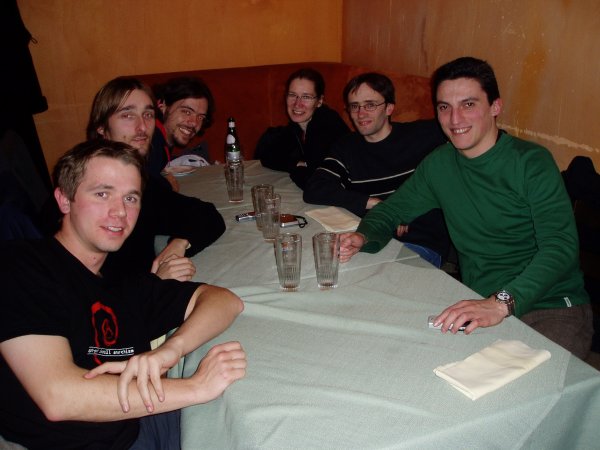
Mia, Josep, Ra l, Ivan, Martin and Jordi after pizza Ra l took us around the city centre and told us about the underground river, the remaining city wall's tower, and the church that leaned against it. That night's beer lesson happened in the "2000 beer bar". We all had a 7 Trappist Westvleteren Bleu 8, apparently "the best beer of the world". It was pretty good, actually. Our weekend in Bruxelles was about to end. After not that much sleep, Ivan and I took a tram and a bus to the Airport, arriving in Val ncia around 10AM, and after seeing the best view of the Pyrenees ever, which were absolutely covered with snow, as well as many other places in the Pa s Valenci and Teruel due to massive snows during the two days we were out. FOSDEM is probably a "can't miss" yearly event now. Thanks to all the organisers for their hard work to make it happen. You rock.

Brett Parker: Wooo! Shiny New Toy!

Well, the Portégé R200 arrived today - and it's shiny (and light, and mostly pretty...) - so the next thing to do is remove the aboloshment that is windows xp from the thing and get me debian unstable installed on it - so, netbooting fun to come up! (or maybe boot from SD, hmm, that's possible ;) bounce

NOKUBI Takatsugu: clearsilver on Solaris 10 with sunpro

I'm trying to install Trac with NetBSD pkgsrc, but clearsilver is the big wall for me. cleasilver depends on GNU find and gcc, so I need to modifide some codes. GNU find is called from rules.mk, so I installed it and replaced "find" to "gfind". Then, util/neo_err.h uses __PRETTY_FUNCTION__ macro, it is a gcc extension, so sunpro compiler can't handle it. So i replaced it to __LINE__, it is not so good solution but better than nothing.

1 March 2006

Arnaud Vandyck: MDR is not DFSG-compatible

Wolfgang was right about SPL not being free. MDR is a library that ArgoUML will use. ArgoUML is in contrib at the moment because of Swing issues so it can’t be built and run with free software, but there are a lot of progresses in free Classpath based runtime. But now that ArgoUML will switch to MDR, we have another problem: SPL. It seems that SPL is not DFSG-compatible. Bad. I filed an issue on the Netbeans website (Issue#73161) to ask if they could change the license to one DFSG-compatible. If it’s not possible, I’ll have to package MDR to non-free and leave ArgoUML in contrib.

23 February 2006

Norbert Tretkowski: Geek Light

Geek Light
You scored 39% geek!
Tastes great, less filling. You're the kind of geek that can pass under the radar of polite society. You probably like your computer, and can't go without checking your email. You live alone, or with roommates, and you have one or two hobbies that are considered "geeky".


My test tracked 1 variable How you compared to other people your age and gender:
free online datingfree online dating
You scored higher than 62% on geekiness
Link: The What's your Geek Level? Test written by dingus93 on Ok Cupid, home of the 32-Type Dating Test

21 February 2006

Enrico Zini: Debtags preformance burst

Recently I've been busy with Debtags code. Actually not really Debtags code but Tagcoll code. Tagcoll is a collection of generic templates implementing all that is needed to work with tagged stuff. Debtags is just an instantiation of Tagcoll to work with Debian packages, but Tagcoll could be used for pretty much anything, wonders of C++. So, I've been busy with Tagcoll code. More specifically, I've been working on a new high-performance disk index. I've also implemented some basic benchmarks. Follows a table with the benchmarking results:
Operation TDBReadonlyDiskIndex BasicStringDiskIndex TDBIndexer
instantiating 30ms 0ms 310ms
hasTag 200ms 0ms 0ms
getTags[item] 180ms 90ms 40ms
getTags[items] 10ms 0ms 0ms
getItems[tag] 330ms 80ms 30ms
getItems[tags] 1140ms 20ms 170ms
getTaggedItems 50ms 10ms 20ms
getAllTags 270ms 0ms 0ms
getCardinality 190ms 0ms 40ms
getCompanionTags 1410ms 60ms 280ms
output 18910ms 7740ms 50ms
outputHavingTags 1330ms 90ms 200ms
TDBReadonlyDiskIndex is the disk index that is currently used in Debtags, BasicStringDiskIndex is the new disk index and TDBIndexer is an in-memory only index implemented with two binary trees. I'd say, definitely not too bad :)

17 February 2006

Simon Richter: On 2.6 and overcoming suckiness by l33t technology

Matt, since 2.6 is now managed in git, you can use git's bisect feature to find out the commit that caused the problem. Basically it boils down to git bisect bad HEAD
git bisect good <some version where it worked> then compile the tree, test it, and use "git bisect good" or "git bisect bad" if it works or it doesn't, respectively. Repeat until it tells you which commit is at fault.

15 February 2006

Edd Dumbill: XTech schedule coming soon

The selections for XTech are now almost complete. Over the weekend I drafted the schedule, which is under review right now by the programme committee. Every year I say how hard a job this is because of the high standard of the submissions, and every year it seems to get harder. This year I found it almost heartbreaking to have to exclude some talks. Number crunching To illustrate, here are some statistics about the proposals and their selection. We received 177 submissions. Each of these abstracts were peer reviewed by at least 4 or 5 reviewers, from a panel of nearly 90 reviewers. From the graded results I shortlisted 105 proposals. From that 105 I have had to fill 68 schedule slots, which meant about a third of the shortlisted proposals had to be excluded. Almost every single one of these would have been a great talk. They were so good, in fact, that I'm working on some ideas for adding to the schedule. Notifications to accepted speakers will be sent at the beginning of next week. Rejection notices will follow a little while later. We don't want to send these out until we're sure we've done everything we can to accommodate as many quality presentations as possible. I am enormously grateful to everyone who submitted a proposal. I can't wait to get the acceptance notices sent out so we can publish the schedule. I can however reveal some early news about pre-conference tutorials. We'll have day-long tutorials on: Ruby on Rails; XSLT 2.0, XPath 2.0 & XQuery; and a Web 2.0 tech bootcamp. Also there'll be half-day tutorials on microformats, and XForms & XHTML 2.0. Finally, it's worth noting that registration is now open. Also, if you work for somebody who would be interested in sponsoring the conference, do get in touch.

Next.

Previous.