Search Results: "ina"

11 April 2014

Andrew Pollock: [life] Day 73: A fourth-generation friendship

Oh man, am I exhausted. I've known my friend Kim for longer than we remembered. Until Zoe was born, I thought the connection was purely that our grandmothers knew each other. After Zoe was born, and we gave her my birth mother's name as her middle name, Kim's mother sent me a message indicating that she knew my mother. More on that in a moment. Kim and I must have interacted when we were small, because it predates my memory of her. My earliest memories are of being a pen pal with her when she lived in Kingaroy. She had a stint in South Carolina, and then in my late high school years, she moved relatively close to me, at Albany Creek, and we got to have a small amount of actual physical contact. Then I moved to Canberra, and she moved to Melbourne, and it was only due to the wonders of Facebook that we reconnected while I was in the US. Fast forward many years, and we're finally all back in Brisbane again. Kim is married and has a daughter named Sarah who is a couple of years older than Zoe, and could actually pass of as her older sister. She also has as a younger son. Since we've been back in Brisbane, we've had many a play date at each other's homes, and the girls get along famously, to the point where Sarah was talking about her "best friend Zoe" at show and tell at school. The other thing I learned since reconnecting with Kim in the past year, is that Kim's aunt and my mother were in the same grade at school. Kim actually arranged for me to have a coffee with her aunt when she was visiting from Canberra, and she told me a bunch of stuff about my Mum that I didn't know, so that was really nice. Kim works from home part time, and I offered to look after Sarah for a day in the school holidays as an alternative to her having to go to PCYC holiday care. Today was that day. I picked up Zoe from Sarah this morning, as it was roughly in the same direction as Kim's place, and made more sense, and we headed over to Kim's place to pick up Sarah. We arrived only a couple of minutes later than the preferred pick up time, so I was pretty happy with how that worked out. The plan was to bring Sarah back to our place, and then head over to New Farm Park on the CityCat and have a picnic lunch and a play in the rather fantastic playground in the park over there. I hadn't made Zoe's lunch prior to leaving the house, so after we got back home again, I let the girls have a play while I made Zoe's lunch. After some play with Marble Run, the girls started doing some craft activity all on their own on the balcony. It was cute watching them try to copy what each other were making. One of them tried gluing two paper cups together by the narrow end. It didn't work terribly well because there wasn't a lot of surface to come into contact with each other. I helped the girls with their craft activity briefly, and then we left on foot to walk to the CityCat terminal. Along the way, I picked up some lunch for myself at the Hawthorne Garage and added it to the small Esky I was carrying with Zoe's lunchbox in it. It was a beautiful day for a picnic. It was warm and clear. I think Sarah found the walk a bit long, but we made it to the ferry terminal relatively incident free. We got lucky, and a ferry was just arriving, and as it happened, they had to change boats, as they do from time to time at Hawthorne, so we would have had plenty of time regardless, as everyone had to get off one boat and onto a new one. We had a late morning tea at the New Farm Park ferry terminal after we got off, and then headed over to the playground. I claimed a shady spot with our picnic blanket and the girls did their thing. I alternated between closely shadowing them around the playground and letting them run off on their own. Fortunately they stuck together, so that made keeping track of them slightly easier. For whatever reason, Zoe was in a bit of a grumpier mood than normal today, and wasn't taking too kindly to the amount of turn taking that was necessary to have a smoothly oiled operation. Sarah (justifiably) got a bit whiny when she didn't get an equitable amount of time getting the call the shots on what the they did, but aside from that they got along fine. There was another great climbing tree, which had kids hanging off it all over the place. Both girls wanted to climb it, but needed a little bit of help getting started. Sarah lost her nerve before Zoe did, but even Zoe was a surprisingly trepidatious about it, and after shimmying a short distance along a good (but high) branch, wanted to get down. The other popular activity was a particularly large rope "spider web" climbing frame, which Sarah was very adept at scaling. It was a tad too big for Zoe to manage though, and she couldn't keep up, which frustrated her quite a bit. I was particularly proud of how many times she returned to it to try again, though. We had our lunch, a little more play time, and the obligatory ice cream. I'd contemplated catching the CityCat further up-river to Sydney Street to then catching the free CityHopper ferry, but the thought of then trying to get two very tired girls to walk from the Hawthorne ferry terminal back home didn't really appeal to me all that much, so I decided to just head back home. That ended up being a pretty good call, because as it was, trying to get the two of them back home was like herding cats. Sarah was fine, but Zoe was really dragging the chain and getting particularly grumpy. I had to deploy every positive parenting trick that I currently have in my book to keep Zoe moving, but we got there eventually. Fortunately we didn't have any particularly deadline. The girls did some more playing at home while I collapsed on the couch for a bit, and then wanted to do some more craft. We made a couple of crowns and hot-glued lots of bling onto them. We drove back to Kim's place after that, and the girls played some more there. Sarah nearly nodded off on the way home. Zoe was surprisingly chipper. The dynamic changed completely once we were back at Sarah's house. Zoe seemed fine to take Sarah's direction on everything, so I wonder how much of things in the morning were territorial, and Sarah wasn't used to Zoe calling the shots when she was at Zoe's place. Kim invited us to stay for dinner. I wasn't really feeling like cooking, and the girls were having a good time, so I decided to stay for dinner, and after they had a bath together we headed home. Zoe stayed awake all the way home, and went to bed without any fuss. It's pretty hot tonight, and I'm trialling Zoe sleeping without white noise, so we'll see how tonight pans out.

Dirk Eddelbuettel: RcppCNPy 0.2.3

R 3.1.0 came out today. Among the (impressive and long as usual) list of changes is the added ability to specify CXX_STD = CXX11 in order to get C++11 (or the best available subset on older compilers). This brings a number of changes and opportunities which are frankly too numerous to be discussed in this short post. But it also permits us, at long last, to use long long integer types. For RcppCNPy, this means that we can finally cover NumPy integer data (along with the double precision we had from the start) on all platforms. Python encodes these as an int64, and that type was unavailable (at least in 32-bit OSs) until we got long long made available to us by R. So today I made the change to depend on R 3.1.0, and select C++11 which allowed us to free the code from a number if #ifdef tests. This all worked out swimmingly and the new package has already been rebuilt for Windows. I also updated the vignette, and refreshed its look and feel. Full changes are listed below.
Changes in version 0.2.3 (2014-04-10)
  • src/Makevars now sets CXX_STD = CXX11 which also provides the long long type on all platforms, so integer file support is no longer conditional.
  • Consequently, code conditional on RCPP_HAS_LONG_LONG_TYPES has been simplified and is no longer conditional.
  • The package now depends on R 3.1.0 or later to allow this.
  • The vignette has been updated and refreshed to reflect this.
CRANberries also provides a diffstat report for the latest release. As always, feedback is welcome and the rcpp-devel mailing list off the R-Forge page for Rcpp is the best place to start a discussion.

This post by Dirk Eddelbuettel originated on his Thinking inside the box blog. Please report excessive re-aggregation in third-party for-profit settings.

10 April 2014

Steve Kemp: A small assortment of content

Today I took down my KVM-host machine, rebooting it and restarting all of my guests. It has been a while since I'd done so and I was a little nerveous, as it turned out this nerveousness was prophetic. I'd forgotten to hardwire the use of proxy_arp so my guests were all broken when the systems came back online. If you're curious this is what my incoming graph of email SPAM looks like:
I think it is obvious where the downtime occurred, right? In other news I'm awaiting news from the system administration job I applied for here in Edinburgh, if that doesn't work out I'll need to hunt for another position.. Finally I've started hacking on my console based mail-client some more. It is a modal client which means you're always in one of three states/modes: As a result of a lot of hacking there is now a fourth mode/state "text-mode". Which allows you to view arbitrary text, for example scrolling up and down a file on-disk, to read the manual, or viewing messages in interesting ways. Support is still basic at the moment, but both of these work:
  --
  -- Show a single file
  --
  show_file_contents( "/etc/passwd" )
  global_mode( "text" )
Or:
function x()
   txt =   "$ colour:red Steve",
           "$ colour:blue Kemp",
           "$ bold Has",
           "$ underline Definitely",
           "Made this work"  
   show_text( txt )
   global_mode( "text")
end
x()
There will be a new release within the week, I guess, I just need to wire up a few more primitives, write more of a manual, and close some more bugs. Happy Thursday, or as we say in this house, Hyv torstai!

9 April 2014

Andrew Pollock: [life] Day 71: Tumble Tastics trial, painting and plaster fun

Zoe slept in even later this morning. I'm liking this colder weather. We had nothing particular happening first thing today, so we just snuggled in bed for a bit before we got started. Tumble Tastics were offering free trial classes this week, so I signed Zoe up for one today. She really enjoyed going to Gold Star Gymnastics in the US, and has asked me about finding a gym class over here every now and then. Tumble Tastics is a much smaller affair than Gold Star, but at 300 metres from home on foot, it's awesomely convenient. Zoe scootered there this morning. It seems to be physically part of what I'm guessing used to be the Church of Christ's church hall, so it's not big at all, but the room that Zoe had her class in still had plenty of equipment in it. There were 8 kids in her class, all about her size. I peeked around the door and watched. Most of the class was instructor led and mainly mat work, but then part way through, the parents were invited in, and the teacher walked us all through a course around the room, using the various equipment, and the parents had to spot for their kids. The one thing that cracked me up was when the kids were supposed to be tucking into a ball and rocking on their backs. Zoe instead did a Brazilian Jiu-Jitsu break-fall and fell backwards slapping the mat instead. It was good to see that some of what she learned in those classes has kicked in reflexively. She really enjoyed the rope swing and hanging upside down on the uneven bars. The class ran for 50 minutes (I was only expecting it to last 30 minutes) and Zoe did really well straight off. I think we'll make this her 4th term extra-curricular activity. We scootered home the longer way, because we were in no particular hurry. Zoe did some painting when we got home, and then we had lunch. After lunch we goofed off for a little bit, and then we did quiet time. Zoe napped for about two and a half hours, and then we did some plaster play. I'd picked up a fish ice cube tray from IKEA on the weekend for 99 cents (queue Thrift Shop), and I bought a bag of plaster of Paris a while back, but haven't had a chance to do anything with it yet. I bribed Zoe into doing quiet time by telling her we'd do something new with the ice cube tray I'd bought. We mixed up a few paper cups with plaster of Paris in them and then I squirted some paint in. I'm not sure if the paint caused a reaction, or the plaster was already starting to set by the time the paint got mixed in, but it became quite viscous as soon as the paint was mixed in. We did three different colours and used tongue depressers to jam it into the tray. Zoe seemed to twig that it was the same stuff as the impressions of her baby feet, which I thought was a pretty clever connection to make. After that, there was barely enough time to watch a tiny bit of TV before Sarah arrived to pick Zoe up. I told her that her plaster would be set by the time she got dropped off in the morning. I procrastinated past the point of no return and didn't go for a run. Instead I decided to go out to Officeworks and print out some photos to stick in the photo frame I bought from IKEA on the weekend.

Dirk Eddelbuettel: BH release 1.54.0-1

A new release of the BH package is now on CRAN and its mirrors. BH provides (a sizeable subset of) the Boost library for C++, particularly (large) parts delivered as pure template headers not requiring linking. See the BH page for more details. This release provides our first update relative to the Boost tarballs we started with. It moves us from 1.51.0 (which was getting a little long in the tooth) to 1.54.0. This is just about the first time ever that I didn't package something straight from the current release (now 1.55.0). My aim was to to balance the oh, shiny, new aspect with some stability. Comments welcome--maybe I will go to the bleeding edge next time. As before, the CRAN is created by running bcp over a number of selected components of Boost. If you'd like to see additional ones include, please do get in touch too. Before uploading, I also tested against all of these sixteen CRAN dependents I could quickly test on my server given the installed dependencies there. The complete list changes follows below.
Changes in version 1.54.0-1 (2014-04-07)
  • Upgraded to Boost 1.54.0
  • Adjust build script local/script/CreateBoost.sh accordingly
  • Renamed generation_runge_kutta_cash_karp54_classic.hpp to generation_runge_kutta_cash_karp54_cl.hpp to remain within 100-character limit for tar
Courtesy of CRANberries, there is also a diffstat report for the most recent release. Comments and suggestions are welcome via the mailing list or issue tracker at the GitHub repo.

This post by Dirk Eddelbuettel originated on his Thinking inside the box blog. Please report excessive re-aggregation in third-party for-profit settings.

8 April 2014

Tanguy Ortolo: Disable your spammed addresses with Postfix

Using address extension Postfix (and many other mail servers) offers one nice address extension feature: addresses like <user+whaterver@> are implicit aliases to <user@>. This allows users to implement a simple measure to fight spam:
  1. when SomeCompany or whatever asks for your email address, give them <user+somecompany@>;
  2. if you start receiving spam at that address, you know who sold or was stolen your address;
  3. finally, you will be able to disable that address so messages are simply refused with a permanent error code.
Road sign  you shall not pass  with Gandalf
Disabling an extended address So, here is how to implement that last step with Postfix, when you detect that your extended address <user+evilcorp@> is being spammed. In /etc/postfix/main.cf:
smtpd_recipient_restrictions =
    check_recipient_access hash:/etc/postfix/recipients,
    [ ]
Then, create /etc/postfix/recipients containing the addresses to disable:
user+evilcorp@example.com   553 5.7.1 I did not subscribe to receive spam, go away
Of course, the error codes and message can be freely configured, just make sure you are using a permanent error code so senders do not retry. Hash that table, reload Postfix and it is done:
# postmap /etc/postfix/recipients
# service postfix reload
After that, your mail server will reject messages sent to these addresses. And it will do so at the RCPT TO step, saving your bandwidth for more useful things.

Daniel Pocock: reConServer for easy SIP conferencing

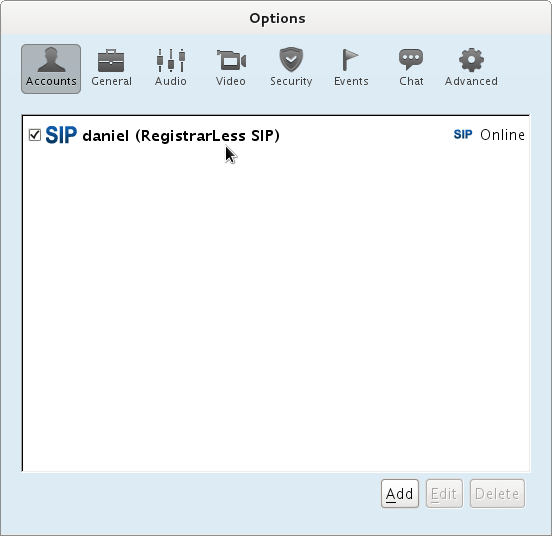
In the lead up to the release of Debian wheezy, there was quite some debate about the Mumble conferencing software which uses the deprecated and unsupported CELT codec. Although Mumble has very recently added Opus support, it is still limited by the fact that it is a standalone solution without any support for distributed protocols like SIP or XMPP. Making SIP conferencing easy Of course, people could always set up SIP conferences by installing Asterisk but for many use cases that may be overkill and may simply introduce alternative security and administration overheads. Enter reConServer The popular reSIProcate SIP stack includes a high-level programming API, the Conversation Manager, dubbed librecon. It was developed and contributed to the open source project by Scott Godin of SIP Spectrum. In very simple terms, a Conversation object with two Participants is a phone call. A Conversation object with more than two Participants is a conference. The original librecon includes a fully functional demo app, testUA that allows you to control conferences from the command line. As part of Google Summer of Code 2013, Catalin Constantin Usurelu took the testUA.cxx code and converted it into a proper daemon process. It is now available as a ready-to-run SIP conferencing server package in Debian and Ubuntu. The quick and easy way to try it Normally, a SIP conferencing server will be linked to a SIP proxy and other infrastructure. For trying it out quickly, however, no SIP proxy is necessary. Simply install the package with the default settings and then configure a client to talk to the reConServer directly by dialing the IP address of the server. For example, set the following options in /etc/reConServer/reConServer.config:
UDPPort = 5062
EnableAutoAnswer = true
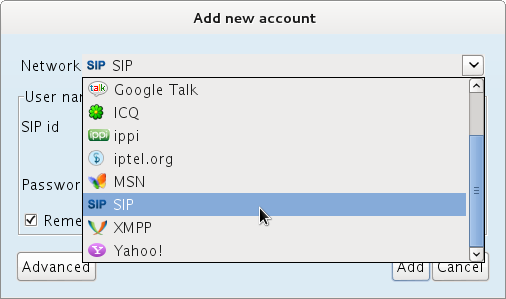
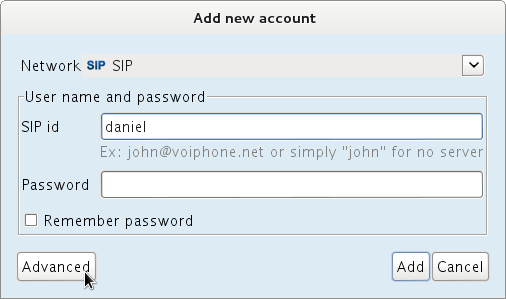
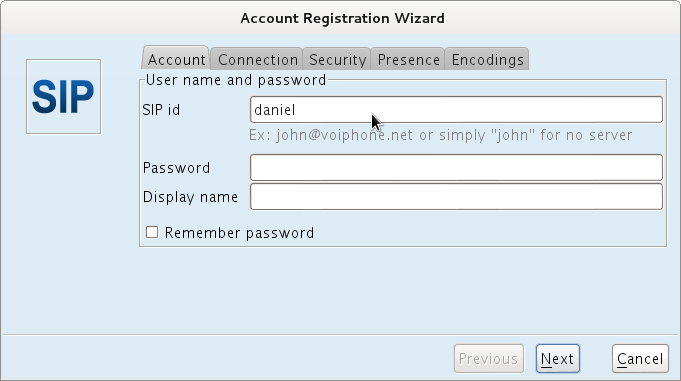
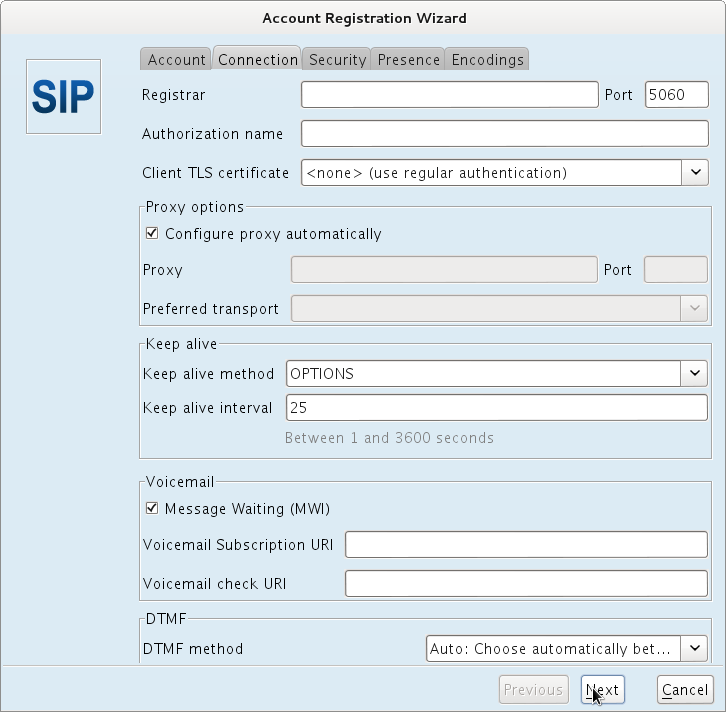
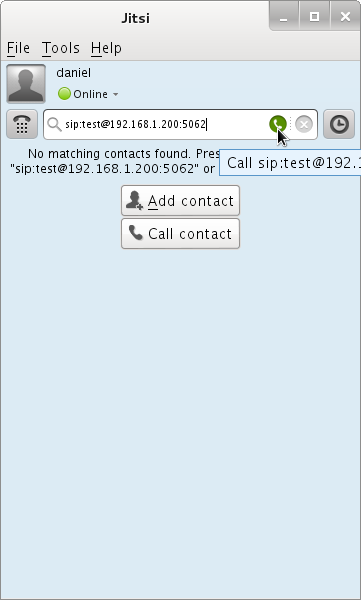
and it will happily accept all SIP calls sent to the IP address where it is running. Now configure Jitsi to talk to it directly in serverless SIP configuration: Notice here that we simply put a username without any domain part, this tells Jitsi to create an account that can operate without a SIP proxy or registration server: Calling in to the conference Notice in the screenshot below we simply dial the IP address and port number of the reConServer process, sip:192.168.1.100:5062. When the first call comes in, reConServer will answer and place the caller on hold. When the next caller arrives, the hold should automatically finish and audio will be heard. Next steps To make it run as part of a proper SIP deployment, set the necessary configuration options (username, password, proxy) to make reConServer register to the SIP proxy. Users can then call the conference through the proxy. To discuss any problems or questions, please come and join the recon-users mailing list or the Jitsi users list Consider using Wireshark to observe the SIP packets and learn more about the protocol.

Andrew Pollock: [life] Day 70: Visiting relatives and home visiting doctors

Zoe did indeed sleep in this morning, by a whole 30 minutes. It was nice. She seemed no worse for wear for her lip injury, and it was looking better this morning. Wow, "bimonthly" is ambiguous. I had my "every two month" in person co-parenting sync up lunch with Sarah today. Phew, that was a mouthful. Anyway, I had that today, and normally that would fall on a Kindergarten day, but it's school holidays. So we paid grandma and grandpa a visit, and they looked after Zoe for me so I could make the meeting. Mum and Dad have been away on a driving holiday, so Zoe hasn't seen them for a while, and it's been even longer since we've been to their house. She really loves going to their house because it's big, with a big back yard with a swing set. There's all sorts of exciting things like grandpa's worm farm, a sand pit, a china tea set, a piano, a tricycle and remote controlled cars. Zoe basically just works her way around the house entertaining herself. It's great. I usually get to put my feet up and read the newspaper. After I got back from my lunch meeting, we headed over to Greenslopes Private Hospital to visit my cousin, who's just had major surgery. On the way, Zoe napped in the car. I made a brief side trip to clear my post office box along the way. Amusingly, Zoe wakes up from short naps in the car way better than at Kindergarten. I don't know if it has anything to do with the quality of sleep she's getting or what it is, but I easily woke her up and extracted her from the car when we arrived at the hospital. No meltdowns. And that's pretty typical of car naps. I've had a discomfort in my right ear for the last couple of days, and it grew into increasing pain throughout the day today. It got to the point where, while I was driving home, that I deciding to get it looked at by a doctor, ASAP. One of my favourite things about being back in Australia is the availability of home visiting doctors. It was actually faster and cheaper for me to get a home doctor out to look at me tonight than it was to get an appointment with my regular doctor. I wouldn't have gotten an appointment until some time tomorrow at the earliest (assuming he had appointments available), because I made the decision to see a doctor after 5pm, when they'd closed. Instead, I had a doctor at my door in a little more than 2 hours of making the request. It also worked out cheaper, because the home doctor bulk bills Medicare, whereas my regular doctor does not. Add in the massive convenience of not having to lug a small child anywhere while I get seen by a doctor, and it's a major convenience. I love socialised healthcare. It turned out I have an outer ear infection. So all we had to do after the doctor came was find a pharmacy that was still open after 7pm to get my ear drop prescription filled. All of that mucking around meant that Zoe got to bed a little later than usual. It's another cool night tonight, so I'm hoping she'll sleep well and have another sleep in.

Russ Allbery: Review: With Charity for All

Review: With Charity for All, by Ken Stern
Publisher: Anchor
Copyright: November 2013
ISBN: 0-307-74381-0
Format: Trade paperback
Pages: 244
I've been reading a lot lately about how to measure charitable organizations and where best to give your money, which has already prompted a rethinking of which organizations I want to support. Most of that has been shorter, on-line blog posts, but I've been wanting a deeper analysis. This is the first of a couple of books I've found on the topic. (The second, an analysis of microfinance, is waiting for me to have more time to read.) For this kind of book, the background of the author matters a lot. Stern was the former CEO of National Public Radio for eight and a half years, so he has practical experience in the business side of non-profits. He's credited with improving NPR's financial position and management and oversaw an era of rapid growth. In With Charity for All, he speaks frankly about his own personal experiences as well as his research. My impression is that he's typical of competent business managers of non-profits: not particularly radical, focused mostly on business issues, and the sort of person that a non-profit needs to turn a mission or cause into a sustainable organization. It's worth noting in advance that With Charity for All is specifically about the United States charitable sector and US laws and approaches. Some of this may generalize to other countries, but non-profit and charity law is very different between different countries, and the US attitude towards government, non-profits, and the appropriate division of responsibilities between them often doesn't match the prevailing view elsewhere. This book may well be interesting to people outside the US, but only if they're curious about the US charitable sector. The short summary of the message of this book is that we're not getting our money's worth out of charity, either as donors or as taxpayers who are indirectly subsidizing these organizations. This is not (usually) due to any outright fraud, although there certainly is some of that due to the almost total lack of oversight of charitable organizations. Rather, it's the result of a complex combination of history and institutional momentum, focus on the aspects of a charity that play well to potential donors, a concerted effort at feel-good marketing, well-intentioned but misguided donor dictates, adoption of approaches and business practices from the for-profit sector, and, above everything else, the almost complete absence of evidence-based evaluation of charities. Evidence-based evaluation is currently a hot trend among charities. I heard about this book via one of the organizations that is focusing on this (GiveWell). This is not what sites like Charity Navigator do, and indeed Stern talks at some length about the serious limitations of the Charity Navigator approach. All that sites of that type can do is look at spending breakdowns. Stern makes a strong argument that a focus on reducing overhead, as measured by those financial forms, is misguided and leads to very ineffective and unorganized charities. Worse, all Charity Navigator can tell you is if the charity is spending money on something they declare to be in line with their goal, not whether that money did any good whatsoever. The short and depressing news is that most of that money does little or no good, and worse, that most charities have no systematic way of measuring whether it does any good. I'm particularly interested in how to ground charities in more concrete evidence, and Stern's discussion does not disappoint. But one of the things I liked about the book is that he doesn't stop there. Other topics include the dizzying variety of charities and the resulting confusion and dispersion of resources, the non-profits that are practically indistinguishable from for-profit companies except that they get huge tax breaks (sports organizations, as you might expect, are probably the worst offenders, but Stern has harsh commentary on the US hospital system), the mess of compensation in the non-profit sector, and the serious problems created by major donors who want to get directly involved and oversee how their money is spent. All of these topics are fascinating, if a bit depressing in the aggregate. As is typical for a book of this sort, it's a lot easier to see the problems than to describe the solutions. Stern does try to offer his own prescriptions, most of which are variations on more oversight: more regulation, more effort put into measuring results, more concrete standards for success or failure, and a stronger culture of treating tax-exempt status as a privilege, not a right, that has to be defended by showing clear social benefit. I'm convinced those steps would be helpful, although less convinced that we're able to get there from here. One of his ideas I am already using on a small scale: pooling charitable donations with professional evaluators who can take the time to look deeper than financial breakdowns and do some independent measurement of results, or at least survey relevant studies done by others and possibly demand more be done. This model of a mutual fund for charitable giving has some promise, I think (more than a managed mutual fund, in fact), and is very similar to what GiveWell is doing. This is an advocacy book, and one that's primarily focused on concrete, measurable deliverables and on the finances. There are a few places where I have reason to be dubious of the black-and-white conclusions Stern draws. For example, he makes much of the bill collecting practices of charitable hospitals, which I agree is a travesty, but doesn't mention that non-profit hospitals produce better health outcomes. I'm also not sure his analysis is as directly applicable to advocacy organizations, where measuring success is a much more challenging proposition. I think the Southern Poverty Law Center is one of the best charities in the United States (admittedly based largely on gut feeling and presentation), but the nature of their work is not amenable to the style of analysis that Stern is doing here. It's therefore worth taking this book with a grain of salt. But, that said, Stern's conclusions are in line with things I've read elsewhere. I think he's pointing in the right direction, and I would recommend this book to anyone who gives regularly to charity. Hopefully it won't just cause you to stop. There are charities out there that are trying hard to measure their results and ensure they deliver social value for the money that we give them. Our system just doesn't support them very well, yet. Rating: 8 out of 10

Dirk Eddelbuettel: RcppArmadillo 0.4.200.0

Conrad released a new upstream release 4.200 for Armadillo, his templated C++ library for linear algebra, earlier today. As usual, this was rolled up in a new RcppArmadillo release 0.4.200.0; I had actually made two pre-releases leading up his 4.200 release and was hence not expecting any surprises. Prior to uploading to CRAN, I also tested against all 61 reverse dependencies of the package. Last but not least, I also updated the corresponding Debian package.
Changes in RcppArmadillo version 0.4.200.0 (2014-04-07)
  • Upgraded to Armadillo release Version 4.200 (Flintlock Swoop)
    • faster transpose of sparse matrices
    • more efficient handling of aliasing during matrix multiplication
    • faster inverse of matrices marked as diagonal
Courtesy of CRANberries, there is also a diffstat report for the most recent release As always, more detailed information is on the RcppArmadillo page. Questions, comments etc should go to the rcpp-devel mailing list off the R-Forge page.

This post by Dirk Eddelbuettel originated on his Thinking inside the box blog. Please report excessive re-aggregation in third-party for-profit settings.

7 April 2014

Holger Levsen: 20140407-some-jenkins-activities

Some jenkins.debian.net activities Yesterday and today I've spent some time time on jenkins.debian.net, so that it's finally only available via https, or so I thought. I quickly learned that it's better still serving via http, but only when queried from localhost :) Second, I've moved the git repo to QA group namespace on alioth and set up IRC notifications using the wonderful KGB client. There is no mailinglist which receives commit diffs yet, but thats also because it's mostly still me working on this. Though since yesterday there are now seven committers in the git history, which is two more than before: Niels Thykier submitted job configuratios for running the lintian testsuite on stable, testing and sid on every commit to the lintian git repo. The test suite passes nicely on testing and unstable but fails for stable as it needs backports and we need to make the job to install those. Gabriele Giacone submitted several patches so that soon hurd wgnu/hurd can be tested too. Currently this fails for two reasons, both of which are very temporarily: the hurd .iso image which was here this morning is gone now, and secondly I haven't installed (the locally build packages for) qemu and qemu-kvm packages with the fixes for #742386 as that .iso ain't there so this is pointless atm ;-) But I'm very happy to have a hopefully soon working job which will regularily test installation of Debian hurd and I do hope that some Debian kfreebsd enthusiasts will pick up and fix the existing jobs for kfreebsd tests. (Hint hint hint! I'm also totally happy to help with that!) This reminds me to mention one last bit: Thanks to Paul Wise, jenkins.d.n bugs are now tracked in the BTS among other Debian QA group bugs!

Vasudev Kamath: Loading Python modules/plug-ins at runtime

Some times it is desired to load arbitrary python files or pre- installed python modules during application run time.I had encountered 2 such usecases, one is in SILPA application and other is dictionary-bot which I was refactoring recently.
Case 1: Loading installed python module In case of SILPA I need to load pre-installed modules and here is the old code , that is a bit hacky code I copied from Active State Python recipies. I found a bit better way to do it using importlib module as shown below.
from __future__ import print_function
import sys
import importlib
def load_module(modulename):
    mod = None
    try:
        mod = importlib.import_module(modulename)
    except ImportError:
        print("Failed to load  module ".format(module=modulename),
                     file=sys.stderr)
    return mod
Here importlib itself takes care of checking if modulename is already loaded by checking sys.modules[modulename], if loaded it returns that value, otherwise it loads the module and sets it to sys.modules[modulename] before returning module itself.
Case 2: Loading python files from arbitrary location In case of dictionary bot my requirement was bit different, I had some python files lying around in a directory, which I wanted to plug into the bot during run time and use them depending on some conditions. So basic structure which I was looking was as follows.
      pluginloader.py
      plugins
       
       __ aplugin.py
       
       __ bplugin.py
pluginloader.py is the file which needs to load python files under plugins directory. This was again done using importlib module as shown below.
import os
import sys
import re
import importlib
def load_plugins():
    pysearchre = re.compile('.py$', re.IGNORECASE)
    pluginfiles = filter(pysearchre.search,
                           os.listdir(os.path.join(os.path.dirname(__file__),
                                                 'plugins')))
    form_module = lambda fp: '.' + os.path.splitext(fp)[0]
    plugins = map(form_module, pluginfiles)
    # import parent module / namespace
    importlib.import_module('plugins')
    modules = []
    for plugin in plugins:
             if not plugin.startswith('__'):
                 modules.append(importlib.import_module(plugin, package="plugins"))
    return modules
Above code first searches for all python file under specified directory and creates a relative module name from it. For eg. file aplugin.py will become .aplugin. Before loading modules itself we will load the parent module in our case plugins, this is because relative imports in python expects parent module to be already loaded. Finally for relative imports to work with importlib.import_module we need to specify parent module name in package argument. Note that we ignore files begining with __, or specifically we don't want to import __init__.py, this will be done when we import parent module. The above code was inspired from a answer on StackOverflow, which uses imp module, I avoided imp because its been deprecated from Python 3.4 in favor of importlib module.

Andrew Pollock: [life] Day 69: Walk to King Island, a picnic at Wellington Point, the long slow acquisition of some linseed and a split lip

Today was a really good day, right up until the end, when it wasn't so good, but could have been a whole lot worse, so I'm grateful for that. I've been wanting to walk out to King Island at low tide with Zoe for a while, but it's taken about a month to get the right combination of availability, weather and low tide timing to make it possible. Today, there was a low tide at about 10:27am, which I thought would work out pretty well. I wasn't sure if the tide needed to be dead low to get to King Island, so I thought we could get there a bit early and possibly follow the tide out. I invited Megan and Jason to join us for the day and make a picnic of it. It turned out that we didn't need a really low tide, the sand bar connecting King Island to Wellington Point was well and truly accessible well before low tide was reached, so we headed out as soon as we arrived. I'd brought Zoe's water shoes, but from looking at it, thought it would be walkable in bare feet. We got about 10 metres out on the sand and Zoe started freaking out about crabs. I think that incident with the mud crab on Coochiemudlo Island has left her slightly phobic of crabs. So I went back to Jason's car and got her water shoes. I tried to allay her fears a bit by sticking my finger in some of the small holes in the sand, and even got her to do it too. I'm actually glad that I did get her water shoes, because the shell grit got a bit sharp and spiky towards King Island, so I probably would have needed to carry her more than I did otherwise. Along the way to the island we spotted a tiny baby mud crab, and Zoe was brave enough to hold it briefly, so that was good. We walked all the way out and partially around the island and then across it before heading back. The walk back was much slower because where was a massive headwind. Zoe ran out of steam about half way back. She didn't like the sand getting whipped up and stinging her legs, and the wind was forcing the brim of her hat down, so I gave her a ride on my shoulders for the rest of the way back. We had some lunch after we got back to Wellington Point, and Zoe found her second wind chasing seagulls around the picnic area. After an ice cream, we went over to the playground and the girls had a great time playing. It was a pretty good park. There was this huge tree with a really big, thick, horizontal branch only about a metre or two off the ground. All the kids were climbing on it and then shimmying along the branch to the trunk. Zoe's had a few climbs in trees and seems not afraid of it, so she got up and had a go. She did really well and did a combination of scooting along, straddling the branch and doing a Brazilian Jiu-Jitsu-style "bear crawl" along the branch. It was funny seeing different kids' limits. Zoe was totally unfazed by climbing the tree. Megan was totally freaking out. But when it came to walking in bare feet in an inch of sea water, Zoe wanted to climb up my leg like a rat up a rope, in case there were crabs. Each to their own. Zoe wanted to have a swim in the ocean, so I put her into her swimsuit, but had left the water shoes back in the car. Once again, she freaked out about crabs as soon as we got ankle deep in the water, and was freaking out Megan as well, so the girls elected to go back to playing in the park. After a good play in the park, we headed back home. We'd carpooled in Jason's truck, with both girls in the back. I'd half expected Zoe to fall asleep on the way back, but the girls were very hyped up and had a great time playing games and generally being silly in the back. When we got back to our place, Jason was in need of a coffee, so we walked to the Hawthorne Garage and had coffee and babyccinos, before Megan and Jason went home. It was about 3:30pm at this point, and I wanted to make a start on dinner. I was making a wholemeal pumpkin quiche, which I've made a few times before, and I discovered we were low on linseed. I thought I'd push things and see if Zoe was up for a scooter ride to the health food shop to get some more and kill some time. She was up for it, but ran out of steam part way across Hawthorne Park. Fortunately she was okay with walking and didn't want me to carry her and the scooter. It took us about an hour to get to the health food shop. Zoe immediately remembered the place from the previous week where we'd had to stop for a post-meltdown pit stop and declared she needed to go to the toilet again. We finally made it out of the shop. I wasn't looking forward to the long walk back home, but there were a few people waiting for a bus at the bus stop near the health food shop, and on checking the timetable, the bus was due in a couple of minutes, so we just waited for the bus. That drastically shortened the trip back. Zoe managed to drop the container of linseed on the way home from the bus stop, but miraculously the way it landed didn't result in the loss of too much of the contents, it just split the container. So I carefully carried the container home the rest of the way. By this stage it was quite a bit later than I had really wanted to be starting dinner, but we got it made, and Zoe really liked the pumpkin quiche, and ate a pretty good dinner. It was after dinner when things took a turn for the worse. Zoe was eating an ice block for dessert, and for whatever reason, she'd decided to sit in the corner of the kitchen next to the dishwasher, while I was loading it. I was carrying over one of the plates, and the knife managed to fall off the plate, bounce off the open dishwasher door and hit her in the mouth, splitting her lip. Zoe was understandably upset, and I was appalled that the whole thing had happened. She never sits on the kitchen floor, let alone in the corner where the dishwasher is. And this knife came so close to her eye. Fortunately the lip didn't look too bad. It stopped bleeding quickly, and we kept some ice on it and the swelling went down. I hate it when accidents happen on my watch. I feel like I'm fighting the stigma of the incompetent single Dad, or the abusive single Dad, so when Zoe sustains an injury to the face like a fat lip, which could be misinterpreted, I, well, really hate it. This was such a freak accident, and it could have gone so much worse. I'm just so glad she's okay. Zoe recovered pretty well from it, and I was able to brush her teeth without aggravating her lip. She went to bed well, and I suspect she's going to sleep really well. It's a bit cooler tonight, so I'm half-expecting a sleep in in the morning with any luck.

Russ Allbery: Review: Fantasy & Science Fiction, September/October 2011

Review: Fantasy & Science Fiction, September/October 2011
Editor: Gordon van Gelder
Issue: Volume 121, No. 3 & 4
ISSN: 1095-8258
Pages: 258
Another review of a magazine that I finished quite some time ago. Apologies for any inaccuracies or lack of depth in the reviews. There wasn't much in Charles de Lint's reviews in this issue that interested me, but Michelle West covers a great selection of books. Two of them (The Wise Man's Fear and The Quantum Thief) are already on my to-read list; the third, The Postmortal, sounded interesting and would go on my list to purchase if I didn't already have so many good books I've not read. Otherwise, this issue is short on non-fiction. The only other essay entry is a film review from Kathi Maio, which is the typical whining about all things film that F&SF publishes. "Rutger and Baby Do Jotenheim" by Esther M. Friesner: Baby is a former pole dancer with a toy poodle named Mister Snickers, which warns you right away that this story is going to involve a few over-the-top caricatures and more use of the word "piddle" than one might ideally want. Rutger is a mythology professor who tolerates her for the standard reasons in this sort of pairing. They're travelling across country to Baby's sister's wedding when their car breaks down in Minnesota, prompting an encounter with frost giants. As you might expect, this is a sort of fractured fairy tale, except based on Norse mythology instead of the more typical Grimm fare. The fun is in watching these two apparent incompetents (but with enough knowledge of mythology to clue in the reader) reproduce the confrontation between Thor and Utgard-Loki. The fight with old age is particularly entertaining. If you've read any of Friesner's other stories, you know what to expect: not much in the way of deeper meaning, but lots of fun playing with stereotypes and an optimistic, funny outcome. Good stuff. (7) "The Man Inside Black Betty" by Sarah Langan: This story comes with a mouthful of a subtitle: "Is Nicholas Wellington the World's Best Hope?" It's also a story that purports to be written by a fictional character, in this case one Saurub Ramesh (with Langan credited as having done "research"). It's told in the style of first-person journalism, relating the thoughts and impressions of Ramesh as he interviews Nicholas Wellington. The topic is Black Betty: a black hole above Long Island Sound. Wellington is a scientific genius and iconoclast with radical theories of black holes that contradict how the government has been attempting to deal with Black Betty, unsuccessfully. The structure here was well-handled, reminding me a lot of a Michael Lewis article during the financial collapse. Langan has a good feel for how journalism of this type mixes personalities, politics, and facts. But it's all setup and no story. We get some world building, and then it's over, with no resolution except pessimism. Meh. (4) "A Borrowed Heart" by Deborah J. Ross: Ross starts with the trappings of urban fantasy transplanted into a Victorian world: supernatural creatures about, a protagonist who is a high-class prostitute, and sex and a sucubus by the second page. It evolves from there into a family drama and an investigation, always giving the reader the impression that a vampire will jump out at any moment. But the ending caught me entirely by surprise and was far more effective due to its departure from the expected path. Well done. (7) "Bright Moment" by Daniel Marcus: The conflict between terraforming and appreciation for the universe as we find it is an old story pattern in science fiction, and Marcus doesn't add much here. I think the story would have been stronger if he'd found a way to write the same plot with a pure appeal to environmental beauty without the typical stakes-raising. But he does sprinkle the story with a few interesting bits, including a pod marriage and a futuristic version of extreme sports as a way of communing with nature. (6) "The Corpse Painter's Masterpiece" by M. Rickert: This is typical of my reaction to a Rickert story: shading a bit too much towards horror for me, a bit too cryptic, well-written but not really my thing. It's about a corpse painter who does the work of an informal mortician, improving the appearance of bodies for their funerals, and the sheriff who brings him all the dead bodies. It takes an odd macabre twist, and I have no idea what to make of the ending. (4) "Aisle 1047" by Jon Armstrong: Armstrong is best known for a couple of novels, Grey and Yarn, which entangle their stories in the future of marketing and commerce. One may be unsurprised, then, that this short story is on similar themes, with the intensity turned up to the parody point. Tiffan3 is a department-store saleswoman, spouting corporate slogans and advertising copy while trying to push customers towards particular products. The story follows the escalation into an all-out brand war, fought with the bubbly short-cut propaganda of a thirty-second commercial. For me, it fell awkwardly between two stools: it's a little too over-the-top and in love with its own bizarre alternate world to be effective satire, but the world is more depressing than funny and the advertising copy is grating. More of a curiosity than a successful story, I think. (5) "Anise" by Chris DeVito: Stories that undermine body integrity and focus on the fascinated horror of violation of physical boundaries aren't generally my thing, so take that into account in this review. Anise's husband died, but that's not as much of a problem as it used to be. Medical science can resurrect people via a sort of permanent, full-body life support system, making them more cyborg than human. "Anise" is about the social consequences of this technology in a world where a growing number of people have a much different relationship with their body than the typical living person today. It's a disturbing story that is deeply concerned with the physical: sex, blood, physical intimacy in various different forms, and a twisted type of psychological abuse. I think fans of horror will like this more than I did, although it's not precisely horror. It looks at the way one's perception of self and others can change by passing through a profound physical transformation. (5) "Spider Hill" by Donald Mead: I liked this story a lot better. It's about witchcraft and farm magic, about family secrets, and a sort of coming-of-age story (for a girl rather than a boy, for once). The main character is resourceful, determined, but also empathetic and aware of the impact of her actions, which made her more fun to read about. I doubt I'll remember this for too long, but when skimming through it again for a review, I had fond memories of it. (6) "Where Have All the Young Men Gone?" by Albert E. Cowdrey: Cowdrey in his paranormal investigation mode, which I like better than his horror mode. For once, the protagonist isn't even a lower-class or backwoods character. Instead, he's a military historian travelling in Austria who runs across a local ghost story. This is a fairly straightforward ghost investigation that follows a familiar path (albeit to an unusual final destination), but Cowdrey is a good story-teller and I liked the protagonist. (7) "Overtaken" by Karl Bunker: This is the sort of story that delivers its moral with the force of a hammer. It's not subtle. But if you're in the right mood for that, it's one of the better stories of its type. It's about a long-journey starship, crew in hibernation, that's overtaken by a far newer and faster mechanized ship from Earth that's attempting to re-establish contact with the old ships. The story is a conversation between the ship AIs. Save this one until you're in the mood for an old-fashioned defense of humanity. (8) "Time and Tide" by Alan Peter Ryan: Another pseudo-horror story, although I think it's better classified as a haunting. A wardrobe recalls a traumatic drowning in the childhood of the protagonist. As these things tend to do in stories like this, reality and memory start blurring and the wardrobe takes on a malevolent role. Not my sort of thing. (3) "What We Found" by Geoff Ryman: Any new Geoff Ryman story is something to celebrate. This is a haunting story on the boundaries between the scientific method and tribal superstition, deeply entangled with the question of how one recovers from national and familial trauma. How can we avoid passing the evils and madness of one generation down to the next? Much of the story is about family trauma, told with Ryman's exceptional grasp of character, but the science is entangled in an ingenious way that I won't spoil. As with Air, this is in no way science fiction. The science here would have fascinating and rather scary implications for our world, but clearly is not how science actually works. But as an insight into politics, and into healing, I found it a startlingly effective metaphor. I loved every bit of this. By far the best story of the issue. (9) Rating: 7 out of 10

6 April 2014

Julien Danjou: Doing A/B testing with Apache httpd

When I started to write the landing page for The Hacker's Guide to Python, I wanted to try new things at the same time. I read about A/B testing a while ago, and I figured it was a good opportunity to test it out. A/B testing If you do not know what A/B testing is about, take a quick look at the Wikipedia page on that subject. Long story short, the idea is to serve two different version of a page to your visitors and check which one is getting the most success. When you found which version is better, you can definitely switch to it. In the case of my book, I used that technique on the pre-launch page where people were able to subscribe to the newsletter. I didn't have a lot of things I wanted to test out on that page, so I just used that approach on the subtitle, being either "Learn everything you need to build a successful Python project" or "It's time you make the most out of Python". Statistically, each version would be served half of the time, so both would get the same number of view. I then would build statistics about which page was attracting the most subscribers. With the results I would be able to switch definitively to that version of the landing page. Technical design My Web site, this Web site, is entirely static and served by Apache httpd. I didn't want to use any dynamic page, language or whatever. Mainly because I didn't want to have something else to install and maintain just for that on my server. It turns out that Apache httpd is powerful enough to implement such a feature. There are different ways to build it, and I'm going to describe my choices here. The first thing to pick is a way to balance the display of the page. You need to find a way so that if you get 100 visitors, around 50 will see the version A of your page, and around 50 will see the version B of the page. You could use a random number generator, pick a random number for each visitor, and decides which page he's going to see. But it turns out that I didn't find a way to do that with Apache httpd at first sight. My second thought was to pick the client IP address. But it's not such a good idea, because if you got visitors from, for example, people behind a company firewall, they are all going to be served the same page, so that kind of kills the statistics. Finally, I picked time based balancing: if you visit the page on a second that is even, you get version A of the page, and if you visit the page on a second that is odd, you get version B. Simple, and so far nothing proves there are more visitors on even than odd seconds, or vice-versa. The next thing is to always serve the same page to a returning visitor. I mean that if the visitor comes back later and get a different version, that's cheating. I decided the system should always serve the same page once a visitor "picked" a version. To do that, it's simple enough, you just have to use cookies to store the page the visitor has been attributed, and then use that cookie if he comes back. Implementation To do that in Apache httpd, I used the powerful mod_rewrite that is shipped with it. I put 2 files in the books directory, named either "the-hacker-guide-to-python-a.html" and "the-hacker-guide-to-python-b.html" that got served when you requested "/books/the-hacker-guide-to-python".
RewriteEngine On
RewriteBase /books

# If there's a cookie called thgtp-pre-version set,
# use its value and serve the page
RewriteCond % HTTP_COOKIE thgtp-pre-version=([^;])
RewriteRule ^the-hacker-guide-to-python$ % REQUEST_FILENAME -%1.html [L]

# No cookie yet and
RewriteCond % HTTP_COOKIE !thgtp-pre-version=([^;]+)
# the number of seconds of the time right now is even
RewriteCond % TIME_SEC [02468]$
# Then serve the page A and store "a" in a cookie
RewriteRule ^the-hacker-guide-to-python$ % REQUEST_FILENAME -a.html [cookie=thgtp-pre-version:a:julien.danjou.info,L]

# No cookie yet and
RewriteCond % HTTP_COOKIE !thgtp-pre-version=([^;]+)
# the number of seconds of the time right now is odd
RewriteCond % TIME_SEC [13579]$
# Then serve the page B and store "b" in a cookie
RewriteRule ^the-hacker-guide-to-python$ % REQUEST_FILENAME -b.html [cookie=thgtp-pre-version:b:julien.danjou.info,L]

With that few lines, it worked flawlessly. Results The results were very good, as it worked perfectly. Combined with Google Analytics, I was able to follow the score of each page. It turns out that testing this particular little piece of content of the page was, as expected, really useless. The final score didn't allow to pick any winner. Which also kind of proves that the system worked perfectly.
But it still was an interesting challenge!

4 April 2014

Daniel Pocock: Best real-time communication (RTC / VoIP) softphone on the Linux desktop?

The Debian community has recently started discussing the way to choose the real-time communications (RTC/VoIP) desktop client for Debian 8 (jessie) users. Debian 7 (wheezy), like Fedora, ships GNOME as the default desktop and the GNOME Empathy client is installed by default with it. Simon McVittie, Empathy package maintainer has provided a comprehensive response to the main discussion points indicating that the Empathy project comes from an Instant Messaging (IM) background (it is extremely easy to setup and use for XMPP chat) but is not a strong candidate for voice and video. Just how to choose an RTC/VoIP client then? One question that is not answered definitively is just who should choose the default RTC client. Some people have strongly argued that the maintainers of individual desktop meta-packages should choose as they see fit. Personally, I don't agree with this viewpoint and it is easy to explain why. Just imagine the maintainers of GNOME choose one RTC application and the maintainers of XFCE choose an alternative and these two RTC applications don't talk to each other. If a GNOME user wants to call an XFCE user, do they have to go to extra effort to get an extra package installed? Do they even have to change their desktop? For power users these questions seem trivial but for many of our friends and family who we would like to contact with free software, it is not amusing. When the goal of the user is to communicate freely and if they are to remain free to choose any of the desktops then a higher-level choice of RTC client (or at least a set of protocols that all default clients must support) becomes essential. Snail mail to the rescue? There are several friends and family I want to be able to call with free software. The only way I could make it accessible to them was to burn self-booting Debian Live desktop DVDs with an RTC client pre-configured. Once again, as a power-user maybe I have the capability to do this - but is this an efficient way to overcome those nasty proprietary RTC clients, burning one DVD at a time and waiting for it to be delivered by snail mail? A billion browsers can't be wrong WebRTC has been in the most recent stable releases of Firefox/Iceweasel and Chrome/Chromium for over a year now. Many users already have these browsers thanks to automatic updates. It is even working well on the mobile versions of these browsers. In principle, WebRTC relies on existing technologies such as the use of RTP as a transport for media streams. For reasons of security and call quality, the WebRTC standard mandates the use of several more recent standards and existing RTC clients simply do not interoperate with WebRTC browsers. It really is time for proponents of free software to decide if they want to sink or swim in this world of changing communications technology. Browsers will not dumb-down to support VoIP softphones that were never really finished in the first place. Comparing Empathy and Jitsi There are several compelling RTC clients to choose from and several of them are now being compared on the Debian wiki. Only Jitsi stands out offering the features needed for a world with a billion WebRTC browser users.
Feature Empathy WebRTC requirement? Comments
Internet Connectivity Establishment (ICE) and TURN (relay) Only for gmail XMPP accounts, and maybe not for much longer For all XMPP users with any standards-based TURN server, soon for SIP too Mandatory Enables effective discovery of NAT/firewall issues and refusal to place a call when there is a risk of one-way-audio. Some legacy softphones support STUN, which is only a subset of ICE/TURN.
AVPF X Mandatory Enables more rapid feedback about degrading network conditions, packet loss, etc to help variable bit rate codecs adapt and maximise call quality. Most legacy VoIP softphones support AVP rather than AVPF.
DTLS-SRTP X Mandatory for Firefox, soon for Chrome too DTLS-based peer-to-peer encryption of the media streams. Most legacy softphones support no encryption at all, some support the original SRTP mechanism based on SDES keys exchanged in the signalling path.
Opus audio codec X Strongly recommended. G.711 can also be used but does not perform well on low bandwidth/unreliable connections Opus is a variable bit rate codec the supercedes codecs like Speex, SILK, iLBC, GSM and CELT. It is the only advanced codec browsers are expected or likely to implement. Most of the legacy softphones support the earlier codec versions (such as GSM) and some are coded in such a way that they can't support any variable bit-rate codec at all.
Retrofitting legacy softphones with all of these features is no walk in the park. Some of them may be able to achieve compliance more easily by simply throwing away their existing media code and rebuilding on top of the WebRTC media stack used by the browsers However, the Jitsi community have already proven that their code can handle all of these requirements by using their media processing libraries to power their JitMeet WebRTC video conferencing server Dreams are great, results are better Several people have spoken out to say they want an RTC client that has good desktop integration (just like Empathy) but I'm yet to see any of them contribute any code to such an effort. Is this type of desktop integration the ultimate priority and stubbornly non-negotiable though? Is it more an example of zealous idealism that may snuff out hope of bringing the optimum communications tools into the hands of users? As for solving all the other problems facing free communications software, the Jitsi community have been at it for more than 10 years. Just have a look at their scorecard on Github to see what I mean. Jitsi lead developer Emil Ivov has a PhD in multimedia and is a regular participant in the IETF, taking on some of the toughest questions, like how to make a world with two protocols (SIP and XMPP) friendly for real users. A serious issue for all Linux distributions Communications technology is one of the most pervasive applications and also one of the least forgiving. Users have limited patience with phones that don't work, as the Australian Russell Crowe demonstrated in his infamous phone-throwing incident. Maximizing the number of possible users is the key factor that makes networks fail or succeed. It is a knife that cuts both ways: as the free software community struggles with this issue, it undermines our credibility on other issues and makes it harder to bring free desktops to our friends, families and workplaces. Do we really want to see the rest of our work in these areas undermined, especially when there is at least one extremely viable option knocking at the door?

Michael Vogt: apt 1.0

APT 1.0 was released on the 1. April 2014 [0]! The first APT version was announced on the 1. April exactly 16 years ago [1]. The big news for this version is that we included a new apt binary that combines the most commonly used commands from apt-get and apt-cache. The commands are the same as their apt-get/apt-cache counterparts but with slightly different configuration options. Currently the apt binary supports the following commands: Here is what the new progress looks like in 1.0:
apt-progress You can enable/disable the install progress via:
# echo 'Dpkg::Progress-Fancy "1";' > /etc/apt/apt.conf.d/99progressbar
If you have further suggestions or bugreport about APT, get in touch and most importantly, have fun!

Luciano Bello: Private folder in Dropbox

I wanted to have a directory in my Dropbox where every file placed get some sort of encryption. They might be personal pictures (if you know what I mean), finance notes, patent ideas, or the like. I create those files constantly, often with my phone. While I would like to back them up on the cloud, I don t need to access them regularly. The problem is that I don t want my phone to storage them (at least not plain) for obvious reasons. And, on top of this, Android s Dropbox app does not allow to disable synchronization by folder. So, here is the scheme I came up with. Maybe it is also useful for you or you get some idea how to improve it. You will need an always-on-line computer with Dropbox client (for Dropbox synchronization), GnuPG (for cipher the files), and a really nice tool called incron (which monitors a directory and trigger actions). The instructions: That s all, each time you put something in your private folder, incron will cipher it and leave it there.

Mario Lang: Accessible voting graphs

It is that time of the year again, Debian is electing the Project Leader for 2014/15. Whenever a Debian vote is in progress, I find myself rather happy to rediscover that Debian is providing text mode voting graphs. These are quite accessible to me as a braille user. It is rather unusual for me as a blind person to be able to access any graphs on the internet at all. All this has been made possible by gnuplots ability to generate text plots, and Manoj's willingness to implement it during his term as project secretary. Thanks to Gnuplot and Manoj, and thanks to the current secretary for keeping this feature, it is (at least to me) a very nice to have, and actually makes Debian rather unique. I personally don't know of any other major projects which provide text graphs. We are indeed setting a very good example here. It would be nice if other projects would adopt this as well. This is bridging the digital divide for me. For completeness sake I should probably mention that text graphs are not an universal solution for blind users. Those of us who do not use braille will probably have a very hard time extracting any meaningful information from this ASCII character salad. But to a braille user used to reading two dimensional information from the screen, it does actually work rather well. Some solutions from the 90s, when people didn't have graphical terminals readily available everywhere, are still very good accessibility workarounds. I am going to post another article about how I play chess on a computer, with newsgroup-style chessboard diagrams. Now that I think of it, these two topics are very related. There are some rather nifty solutions floating around from the good old text mode days which we need to revive before they finally get forgotten on the internet.

Andrew Pollock: [life] Day 66: Story time, Science Friday, impromptu play date, scootering and the Hawthorne Markets

Zoe slept through last night, which was lovely. We had nothing really planned for today. The Bulimba Library has a story time thing at 10:30am on a Friday. I've never bothered to take Zoe because it would have been too much of a hustle to get her there after her Brazilian Jiu-Jitsu class, particularly by bike. Since today we didn't have a BJJ class, it made getting to story time much easier. So we had a nice lazy start to the day, and then Zoe just wanted to procrastinate anyway, so since we were in no particular rush, I let her play in her room for a bit and I read for a while. We eventually had teeth and hair brushed and biked over to the library. Not having been to the story time thing before, I assumed it was in the kids area, but it turned out it was downstairs in the general purpose room, which we only discovered after story time had started. I'm certainly glad I never busted a gut to get to the library in time for it, because it wasn't anything particularly exciting. They did give all the kids a colouring sheet and there was some colouring and a couple of songs, but really it was nothing to phone home about. I did run into Jacob and his mum Laura from Kindergarten. They live locally, and so I invited them over for lunch and a play date. They had some grocery shopping to do, and I had to go to the pharmacy to get a prescription filled, so we agreed to meet at our place in about an hour. We biked to the pharmacy to get my prescription filled and some more sunscreen for Zoe, and the pharmacist gave her a free Chupa Chups We biked home, and grabbed some balloons from the convenience store next door for our Science Friday activity. I was slightly more organised today, and figured out what I wanted to do in the morning while Zoe was watching TV. We did yeast and sugar and warm water in a bottle with a balloon on top and watched it inflate itself with all the carbon dioxide produced by the yeast eating the sugar. The only problem was the balloons we bought were total rubbish. They'd been on the shelf for too long and they'd all stuck to themselves and either popped when I tried to blow them up or had holes in them. So we marched back to the corner store in our lab coats to get some more, and the store keeper gave Zoe one of the little flashlights she keeps playing with in the bowl at the check out. It was a good day for freebies. We were able to complete our Science Friday activity before Laura and Jacob and his baby brother Ethan came over for lunch. Zoe didn't have a particularly good lunch, I think it was the distraction of having Jacob there as well. After lunch, they couldn't really agree on anything to play. Laura said Jacob just plays out in the yard at Kindergarten the whole day. The one thing they both managed to agree on briefly was bubbles. Ethan was getting tired and needed a nap by about 2pm, so they left. Zoe wanted to ride her scooter, but I had to clean up from lunch and the aftermath of the play date on the balcony first, so she went and played some games on her Nexus 7 while I did that, and then we headed out on the scooter. It was about 2:30pm by this point, and the Hawthorne Markets, which have now moved to a Friday "twilight" thing, were due to start at 4pm, so I figured we could just kill time on the scooter. It's funny how the scooter is now the in thing as of Tuesday. It's sat unused on the balcony for most of the year, but I'm glad she wants to use it now because it guarantees she moves faster than if she were to walk and want to be picked up every 5 minutes. We scootered around to the playground and she played there until about 3:45pm, when we headed around to the markets. We ran into Nicky Noo from the Ooniverse Family Cafe, who we'd met on Tuesday, and she made Zoe another dog balloon and she got her face painted. After that, it was the obligatory jumping castle for a while. It was getting time to get home for Sarah to pick her up, when I dropped the dog balloon on the ground and it popped. That made Zoe very sad. Then the lack of a decent lunch kicked in. Zoe wanted some poffertjes, but they would have taken too long, so I gave her a few of the free samples to tide her over, and we headed home. Sarah was waiting for her when we got home, so we parted ways at that point. I like how the days that have nothing planned often end up as full if not fuller than the days when I do have something planned.

Next.

Previous.