Search Results: "ean"

13 February 2011

Thorsten Glaser: FOSDEM was a blast!

I just need to work more on bilocality. While I did find two geocaches, one at the South/Noon Train Station (taalverwarringen ), one in the buurt of the University, I did manage to miss the AW building completely and utterly. Wow. Except, that Haiku guy came over to talk for a bit (nice). And I drew. An Atari logo with swirl, for that weird stuff I recently have been found doing. More mksh-current news coming soon, stay tuned. In the meanwhile, I met bonsaikitten IRL (at FOSDEM, yes, too) who kindly made a live ebuild , i.e. a source package building -current. Finally let s say a big thank you to the person mostly manning our booth, gecko2, and to Benny for talking to people, getting That Other Packaging Thingy working, and pimping the website a bit.

12 February 2011

Tim Retout: Gnash and cookies

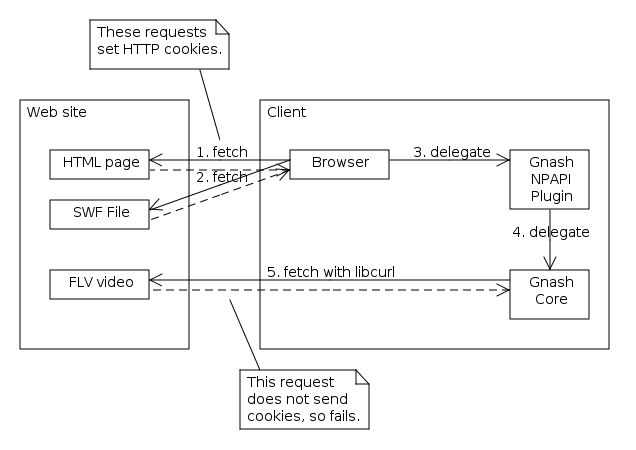
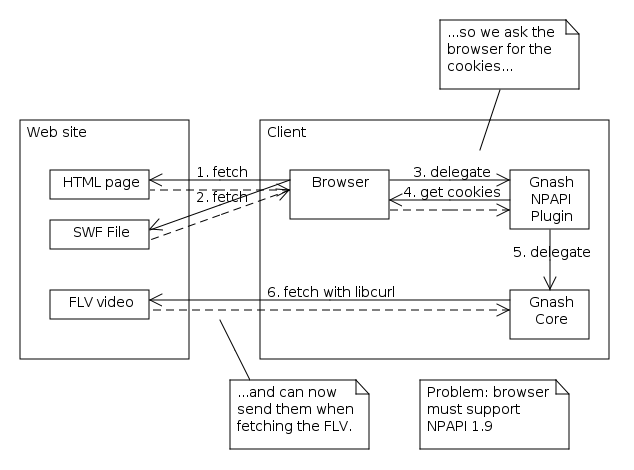
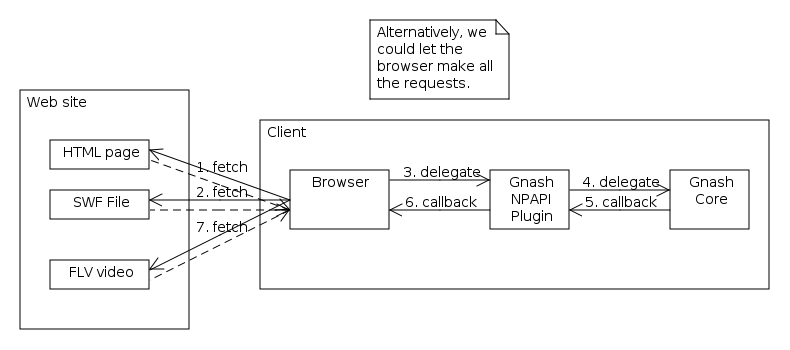
A new release of Gnash, version 0.8.9, is due in the near future. Plenty of bugs have been fixed, but some users are still going to have problems playing YouTube videos. Here's a short explanation. At some point last year, YouTube started setting HTTP cookies in your web browser, to keep track of which of their video servers is nearest to your machine. This lets them provide a better experience for you (I guess). Here's a diagram of what goes on in your browser: Diagram showing browser fetching HTML and SWF files, and Gnash core fetching FLV video independently. As of Gnash 0.8.8, a workaround was added, calling an NPAPI function NPN_GetValueForURL to ask the web browser for the relevant cookies. New diagram: Diagram showing Gnash core asking browser for cookies, and still fetching FLV video independently. The downside is that this function was only added in NPAPI version 1.9. This means: What does Adobe's plugin do? I imagine it's something like the following: Diagram showing browser making all HTTP requests, and Gnash core requesting data through the Gnash plugin So, the good news is, this problem should almost certainly get fixed over the coming Debian release cycle, if only because all the browsers will get updated. In the meantime, disabling cookies (and removing stale ones from YouTube) is a workaround.

Evgeni Golov: Privacy-over-IP does not exist

Did not exist.Will never exist.There was quite a lot of buzz about privacy with that new IPv6 thingy. Some say it is bad, as you will have a static address. Some say the privacy extensions will fix everything. I say: lemme rant ;)First of all, that was the internet, when I started using it back in 1999:

 [  New Yorker Magazine, March 1993] On the Internet nobody knows that you are a dog'
[ New Yorker Magazine, March 1993] On the Internet nobody knows that you are a dog And that s the internet today:

robcottingham.ca - How the hell does Facebook know I'm a dog?
[ robcottingham.ca] How the hell does Facebook know I m a dog?

Well, I d say that s not correct. Even in 1999 facebook could know you are a dog (if you ignore the fact, that there was no facebook in 1999), it s just noone really cared about it. But let s start from the beginning :)An IP-address is a 32-bit integer

An IP-address is technically a 32-bit integer, formatted into 4 8-bit parts (you can read more about IPv4 at Wikipedia), which makes a total of 4,294,967,296 possible IP-addresses. Your ISP has a range in this address-space it can give to its customers (you). My ISP (Unitymedia) owns about 300,000 IP-addresses (based on the RIPE database), which is about 0.007% of the whole address-space. If you look at the RIPE page, you see two common netname prefixes (DE-KNRW and DE-IESY-HFC) which match two regions of Germany where my ISP has its customers (Unitymedia is a merge of ish and iesy). What does that mean? It means one can map a Unitymedia customer into one of these regions, even if he would change his IP-address (Unitymedia uses DHCP with high lease-times, so this does not happen actually). It does not map the customer to a dog yet, but I bet real GeoIP databases can map them correctly to a city (I didn t try much, but this site suggests it works: http://www.ip-adress.com/?lc=en at least they map me correctly to Duesseldorf).Dynamic IP-addresses do not improve privacy

Given the above facts, even if Unitymedia would give me a new IP-address every X hours (many DSL-providers have X=24), it is still possible to map me into a set of about 150,000 users (here user means customer, there still may be multiple computers connected via the same line). I would even go further and say the set is much smaller, as I think I am not able to get every free IP-address from DE-KNRW-*, as these should be bound to cities/regions (GeoIP databases exist, you rememember?) and I do not move with my line.Routers and reverse DNS kill privacy

Currently, my IP-address is 62.143.232.104, which has a reverse DNS entry ip-62-143-232-104.unitymediagroup.de and does not say anything about me or my location, besides of the obvious Unitymedia customer . But look at the traceroute:

4  7111A-MX960-01-ae5.frankfurt.unity-media.net (80.81.192.181)
5  13NOC-MX960-01-ae8.kerpen.unity-media.net (80.69.107.26)
6  1411G-MX960-01-ae9.neuss.unity-media.net (80.69.107.2)
7  1411J-MX960-01-ae1.bilk.unity-media.net (80.69.107.70)
8  PH-1411J-uBR10k-06-Te-1-2-0.bilk.unity-media.net (80.69.102.106)
Frankfurt is about 250km from here, Kerpen about 60, Neuss about 10 and Bilk is a part of the city I live in, about 4km away from my home. I guess you get the idea :)Browsers kill privacy tooDo I have to say more than a link to https://panopticlick.eff.org/? My Chromium scores one in 1,400,000. How much IP-addresses did I have to hide in again?We are at the dog level now, dogs use BoneOS with FireBark, not Linux with Chromium :)IPv6 kills cute kittensOh, and privacy, because with IPv6, there are 2^128 IPv6-addresses out there, of which your provider will maybe own a /32 (2^96 addresses) and give you a /48 (2^80 addresses) or (more likely) /64 (2^64 addresses). Then you enable the great IPv6 privacy extensions (RFC4941) and happily hide in your own assigned subnet, still being a customer of your ISP, still living in the same city and using your old browser It s just about mapping subnets instead of individual IP-addresses then. And we can t get lower as the dog levelPeople can annoy meI did not write all this to teach you, you can do yourself with Wikipedia and RFCs. There is a person out there, who thinks using a random name, mail address and twitter account could fool me into thinking that s a new, yet unknown, person to me. Well, I am not stupid, sorry. When you comment on my blog, your IP-address is logged, when I approve the comment, I often look at the reverse DNS and the whois entry of that IP-address (sorry, I AM paranoid). I even might check my webserver logs (or Piwik) where did you come from (Google etc), writing accidentally in your comment does not help :) Also, if you are trying to fool me, don t use your own computer, running Windows 7 and Firefox which I installed. Oh, and probably do not use your home line which I used to login into my admin-area using my unique Chromium ;)Sorry Hanna Lena, the chicken has just eaten her own eggs And yes, one can track down a single person on this big thing called internet, IPv6 will not change this (in any direction).

Wouter Verhelst: Ten years of Debian

My first ever Linux installation was done in the late nineties 1998 or thereabouts but was a RedHat 4.5 installation rather than a Debian one. The reason for that was fairly simple: the Infomagick sixpack CD set that I'd bought contained RedHat, Debian, and Slackware, but the RedHat installation was the only one that could be installed directly from CD the other two required me to write floppies and boot from those to start the installation, and I wasn't very fond of that idea. It was only a few years and a few broken RedHat upgrades later that I saw the light and considered trying out this Debian thing that some of my classmates were talking about. The fact that I'd just bought my own computer (rather than having to compete for time with my siblings on my parents' computer) was a good reason to do a fresh Linux installation. I'd been planning to install Linux From Scratch, but as what was still known as the LFS HOWTO told me you'd need a working Linux installation to do that, I considered my options. Since I'd developed a strong dislike of RedHat, I wasn't interested in doing another RedHat anymore. So, I downloaded the most recent version of Debian at the time (Potato Test Cycle III), wrote it to a CD, and installed. I've probably still got the CD lying around somewhere. A few months later, I found these "Linux Gazette" packages in the archive, with the latest packaged issue being 47, but the latest upstream version being much higher. Trying to figure out what was going on, I mailed the maintainer, Adrian Bridgett, who encouraged me to take over maintenance. Thus began my life of actively contributing to Open Source software. In November 2000, I applied to become a Debian Developer. In January 2001, Martin Michlmayr was assigned to be my AM. And in early February 2001, now just over ten years ago, I'd become a Debian Developer. Yes, that was fast, and no, I probably wasn't really ready yet, at the time. Originally, I only cared much about these Linux Gazette packages. But, as time went on, I started looking around, too. A friend passed me an old Macintosh Centris 610. As I tried to install Debian on it, I found that it didn't actually run very well. This turned out to be due to it having a broken 68LC040 processor, so I bought me another m68k-based mac, one with a full 68040 processor (a Centris 650). Thus I became involved in the m68k port and buildd maintenance. As these old machines came with 80MB or 250MB SCSI hard disks of which I had none laying around, and a then-recent Debian installation had minimum requirements of about 200MB, I was in need of network storage to be able to do anything useful with the mac. NFS didn't work as expected; the RTC implementation on m68k mac hardware was reverse engineered and didn't work too well at the time, which meant that the clock would run slower if the machine was under load, and that in turn would mean that make would get confused about timestamps, since they would suddenly appear to originate from the future (in NFS, it's the server that assigns time stamps, not the client). There was a simple solution, however; Pavel Macheck had written this neat 'Network Block Device', which would let the client do its own filesystem on network storage. Only it wasn't packaged; but then, that was easy to fix. Thus I started maintaining the single piece of software that I've worked the most on, to date. A few years later, Pavel lost interest in maintaining NBD, and handed over upstream maintenance to me and maintenance of the kernel side to Paul Clements. Thus began my life in upstream work. And while I originally joined Debian with the intent of using it as a learning experience and stepping stone on my way to more "important" free software, I found that it wasn't as satisfying as was my work for Debian. Over the years, there's been this duality where I've felt like I was doing too much and not enough at the same time. Too much, because the things I was doing would eat up much of my spare time, leaving little time left for other hobbies. Not enough, because I witnessed other people doing much more for Debian than I did, and I wanted to make a difference. As the years passed by, many things have changed. Not only in Debian, but also besides it. I became an independent contractor, focusing mostly on supporting people in using Debian (although I support them with other distributions, too). The importance of a port went from 'something which these weird porter people are doing, and that we should probably help them with if it doesn't work, but is their problem really' to 'something that I really really really have to make sure works for my packages', and back for the port that I cared about most. After several years of trying, I finally managed to explain to my parents what this Debian thing is, why it matters, and what my role in the whole thing is. We did a few releases, some taking longer than I would've liked. People joined the project, and left again. Some of my friends died. My fame in the project rose, even though I wasn't aware of it initially; and thus I was rather surprised when someone asked me whether I was "the Wouter Verhelst" at a key signing party. Recently, I've started looking back, and considered the things which Debian has meant to me. Ten years ago, I was 22, still in college, and had way too much spare time on my hands. I'd recently gotten my first Internet installation, and all these online communities were very new to me. Yes, that was all probably rather late. Debian has changed my life in many ways; it has allowed me to meet various kinds of people, both online and in meatspace. I've been to Helsinki, Edinburgh, Mar del Plata, C ceres, and New York City, places that I might otherwise not have visited. Each of these trips was an incredible experience that I have fond memories of; and while the most fond ones originate from Helsinki, I cherish the memories of each of these trips as some of the best trips I've ever done. Working on Debian has forced me to learn about the inner workings of a Linux-based system, which is knowledge that has helped me tremendously professionally, too. And finally, working on Debian has given me a unique perspective on this whole FOSS community, which has helped shape my ethics and my view of the world. While I believe that I would've subscribed to most of that ideology at any rate, I'm not sure that the details of my beliefs and understanding would've been exactly the same. And while I don't agree on every position that the project subscribes to as a whole, I do believe that the philosophies that lie at the core of this project contain just the right mix of pragmatism and ideology that makes it possible for our project to thrive in a changing world of not only a growing group of people who subscribe unconditionally to the free software ideals, but also business people who care mostly about money. Over the years, somehow I moved from "one of the recent batch of new Debian Developers" to "someone who's been with the project longer than most". It still feels weird to see people shut up because you've built up a reputation in some area, and you give your gut opinion on some subject without researching it too much. I try not to let that happen too often. Today, ten years and just over a week ago, my life as a Debian Developer started, and it would change the way I looked at the world, the things I would do in my spare time, and the people I would meet. I wouldn't have it any other way. Thanks, Debian, for what's been a blast; may the next ten years be as inspiring to me and everyone as the past ten!

Yves-Alexis Perez: Xfce 4.8 and Debian

Now that Squeeze has been released, we (the pkg-xfce group) are in the process of uploading 4.8 to Debian. And we are uploading it to experimental for good reasons. Not that 4.8 is broken, but the packages are, and we're aware of it. Some packages are still in NEW, some are not uploaded because of some licensing issues, some have not been uploaded because we didn't yet have the time. What does this mean for you? That you should *not* upgrade to Xfce 4.8. Not all packages will be upgraded, and mixing 4.6 and 4.8 is a bad idea. We don't know yet what will happen (and that's the whole point of uploading to experimental), and it seems that there are issues indeed. So unless you're willing to fix the problems, don't upgrade to 4.8. It's not complete and it *will* break your install. I wouldn't recommend building and installing from our svn repository (for the sames reasons) nor from another (since upgrade path won't be guaranteed and we won't be able to fix them for you). So please be patient, we will upload 4.8 to unstable at one point, and there will still be polishing to be made if you want to help.

11 February 2011

Joachim Breitner: GNUnify started

Yesterday night I arrived in Pune for the GNUnify conference where I m a speaker. I should speak more often at such conferences, they really pamper the speakers: I was picked up with a car from the train station, brought to a posh restaurant where other speakers were already dining and afterwards accommodated in the guest house of the Symbiosis University, which means a spacious room with my own bathroom (with running hot water) and best of all: Internet connectivity after midnight! Tonight I was alone, the next night I ll be sharing it with another speaker.
Today we had breakfast at the conference venue and the first talks started. I attended a talk about Openmoko, but nothing new to me so far. I was happy to see Debian listed as one of the Distributions for the FreeRunner, given that I once co-initiated that port. Nevertheless it could not bring me to try using the FreeRunner again, reliability is just not good enough. I asked for the next best (in terms of freedom and geek-compatibility) phone, but there is no obvious good answer. The n700 seems to be a dead end, given that Nokia might ditch Meego. The Geeksphone sounds like a good candidate, but is out of stock. My Haskell talk will start in 30 minutes. I hope I ll reach my audience and haskell-cafe will see more Indian names soon... The talks are recorded. I guess I should have dressed better.

10 February 2011

Marco Silva: Using Horizontal Sharding in SQLAlchemy to display multiple DBs

My problem was: I had a number of databases generated in different machines and I wanted to query them as if they were one, using the database the data came from as a field while querying and while showing results. The databases are SQLite3 files, generated using SQLAlchemy in a Python program. I solved this by using SQLAlchemy, which was good because I could use the same ORM mapping that the program used. I noticed that the Horizontal Sharding SQLAlchemy extension would fit well the problem, although not perfectly. I had to make some changes in some classes of this extension, and now it works fine. It was possible to filter the data using database as a criteria, but I couldn't get the database information from each line of a query result. I made a simple patch to SQLAlchemy, which wasn't likely to be introduced in the distribution, but worked for me, and sent it to its bug tracker. The change was included in SQLAlchemy in a very different fashion, as expected, but since I'm using the released version from SQLAlchemy, I kept on using my version of the patch. I don't want to do direct changes in SQLAlchemy source code, so I made the change in my program:
class ShardedSessionShardId(ShardedSession):
    def __init__(self, *args, **kwargs):
        super(ShardedSessionShardId, self).__init__(*args, **kwargs)
        self._query_cls = ShardedQueryShardId
class ShardedQueryShardId(ShardedQuery):
    def _execute_and_instances(self, context):
        if self._shard_id is not None:
            result = self.session.connection(
                            mapper=self._mapper_zero(),
                            shard_id=self._shard_id).execute(context.statement, self._params)
            news = list(self.instances(result, context))
            for new in news:
                new.shard_id = self._shard_id
            return iter(news)
        else:
            partial = []
            for shard_id in self.query_chooser(self):
                result = self.session.connection(
                            mapper=self._mapper_zero(),
                            shard_id=shard_id).execute(context.statement, self._params)
                news = list(self.instances(result, context))
                for new in news:
                    new.shard_id = shard_id
                partial = partial + news
            # if some kind of in memory 'sorting'
            # were done, this is where it would happen
            return iter(partial)
create_session = sessionmaker(class_=ShardedSessionShardId)
Another problem is that I had to make each result be included in the query, even if two results from different DBs have the same primary key. I achieved this by changing two classes: WeakInstanceDict, and Mapper. For using the new WeakInstanceDict, I had again to change the ShardedSession variation:
class WeakInstanceDictNoIdentity(WeakInstanceDict):
    def add(self, state):
        # if state.key in self:
        #     if dict.__getitem__(self, state.key) is not state:
        #         raise AssertionError("A conflicting state is already "
        #                             "present in the identity map for key %r"
        #                             % (state.key, ))
        # else:
            dict.__setitem__(self, state.key, state)
            self._manage_incoming_state(state)
class ShardedSessionShardId(ShardedSession):
    def __init__(self, *args, **kwargs):
        super(ShardedSessionShardId, self).__init__(*args, **kwargs)
        self._query_cls = ShardedQueryShardId
        self._identity_cls = WeakInstanceDictNoIdentity
        self.identity_map = self._identity_cls()
To start using the new Mapper, I simply replaced each call to mapper with MapperNoIdentity:
class MapperNoIdentity(Mapper):
    def _instance_processor(self, context, path, adapter,
                                polymorphic_from=None, extension=None,
                                only_load_props=None, refresh_state=None,
                                polymorphic_discriminator=None):
        """Produce a mapper level row processor callable
           which processes rows into mapped instances."""
        pk_cols = self.primary_key
        if polymorphic_from or refresh_state:
            polymorphic_on = None
        else:
            if polymorphic_discriminator is not None:
                polymorphic_on = polymorphic_discriminator
            else:
                polymorphic_on = self.polymorphic_on
            polymorphic_instances = util.PopulateDict(
                                        self._configure_subclass_mapper(
                                                context, path, adapter)
                                        )
        version_id_col = self.version_id_col
        if adapter:
            pk_cols = [adapter.columns[c] for c in pk_cols]
            if polymorphic_on is not None:
                polymorphic_on = adapter.columns[polymorphic_on]
            if version_id_col is not None:
                version_id_col = adapter.columns[version_id_col]
        identity_class = self._identity_class
        def identity_key(row):
            return identity_class, tuple([row[column] for column in pk_cols])
        new_populators = []
        existing_populators = []
        load_path = context.query._current_path + path
        def populate_state(state, dict_, row, isnew, only_load_props):
            if isnew:
                if context.propagate_options:
                    state.load_options = context.propagate_options
                if state.load_options:
                    state.load_path = load_path
            if not new_populators:
                new_populators[:], existing_populators[:] = \
                                    self._populators(context, path, row,
                                                        adapter)
            if isnew:
                populators = new_populators
            else:
                populators = existing_populators
            if only_load_props:
                populators = [p for p in populators
                                if p[0] in only_load_props]
            for key, populator in populators:
                populator(state, dict_, row)
        session_identity_map = context.session.identity_map
        if not extension:
            extension = self.extension
        translate_row = extension.get('translate_row', None)
        create_instance = extension.get('create_instance', None)
        populate_instance = extension.get('populate_instance', None)
        append_result = extension.get('append_result', None)
        populate_existing = context.populate_existing or self.always_refresh
        if self.allow_partial_pks:
            is_not_primary_key = _none_set.issuperset
        else:
            is_not_primary_key = _none_set.issubset
        def _instance(row, result):
            if translate_row:
                ret = translate_row(self, context, row)
                if ret is not EXT_CONTINUE:
                    row = ret
            if polymorphic_on is not None:
                discriminator = row[polymorphic_on]
                if discriminator is not None:
                    _instance = polymorphic_instances[discriminator]
                    if _instance:
                        return _instance(row, result)
            # determine identity key
            if refresh_state:
                identitykey = refresh_state.key
                if identitykey is None:
                    # super-rare condition; a refresh is being called
                    # on a non-instance-key instance; this is meant to only
                    # occur within a flush()
                    identitykey = self._identity_key_from_state(refresh_state)
            else:
                identitykey = identity_key(row)
            # instance = session_identity_map.get(identitykey)
            # if instance is not None:
            #     state = attributes.instance_state(instance)
            #     dict_ = attributes.instance_dict(instance)
            #     isnew = state.runid != context.runid
            #     currentload = not isnew
            #     loaded_instance = False
            #     if not currentload and \
            #             version_id_col is not None and \
            #             context.version_check and \
            #             self._get_state_attr_by_column(
            #                     state,
            #                     dict_,
            #                     self.version_id_col) != \
            #                             row[version_id_col]:
            #         raise orm_exc.ConcurrentModificationError(
            #                 "Instance '%s' version of %s does not match %s"
            #                 % (state_str(state),
            #                     self._get_state_attr_by_column(
            #                                 state, dict_,
            #                                 self.version_id_col),
            #                         row[version_id_col]))
            # elif refresh_state:
            if refresh_state:
                # out of band refresh_state detected (i.e. its not in the
                # session.identity_map) honor it anyway.  this can happen
                # if a _get() occurs within save_obj(), such as
                # when eager_defaults is True.
                state = refresh_state
                instance = state.obj()
                dict_ = attributes.instance_dict(instance)
                isnew = state.runid != context.runid
                currentload = True
                loaded_instance = False
            else:
                # check for non-NULL values in the primary key columns,
                # else no entity is returned for the row
                if is_not_primary_key(identitykey[1]):
                    return None
                isnew = True
                currentload = True
                loaded_instance = True
                if create_instance:
                    instance = create_instance(self,
                                                context,
                                                row, self.class_)
                    if instance is EXT_CONTINUE:
                        instance = self.class_manager.new_instance()
                    else:
                        manager = attributes.manager_of_class(
                                                instance.__class__)
                        # TODO: if manager is None, raise a friendly error
                        # about returning instances of unmapped types
                        manager.setup_instance(instance)
                else:
                    instance = self.class_manager.new_instance()
                dict_ = attributes.instance_dict(instance)
                state = attributes.instance_state(instance)
                state.key = identitykey
                # manually adding instance to session.  for a complete add,
                # session._finalize_loaded() must be called.
                state.session_id = context.session.hash_key
                session_identity_map.add(state)
            if currentload or populate_existing:
                if isnew:
                    state.runid = context.runid
                    context.progress[state] = dict_
                if not populate_instance or \
                        populate_instance(self, context, row, instance,
                            only_load_props=only_load_props,
                            instancekey=identitykey, isnew=isnew) is \
                            EXT_CONTINUE:
                    populate_state(state, dict_, row, isnew, only_load_props)
            else:
                # populate attributes on non-loading instances which have
                # been expired
                # TODO: apply eager loads to un-lazy loaded collections ?
                if state in context.partials or state.unloaded:
                    if state in context.partials:
                        isnew = False
                        (d_, attrs) = context.partials[state]
                    else:
                        isnew = True
                        attrs = state.unloaded
                        # allow query.instances to commit the subset of attrs
                        context.partials[state] = (dict_, attrs)
                    if not populate_instance or \
                            populate_instance(self, context, row, instance,
                                only_load_props=attrs,
                                instancekey=identitykey, isnew=isnew) is \
                                EXT_CONTINUE:
                        populate_state(state, dict_, row, isnew, attrs)
            if loaded_instance:
                state._run_on_load(instance)
            if result is not None and \
                        (not append_result or
                            append_result(self, context, row, instance,
                                    result, instancekey=identitykey,
                                    isnew=isnew)
                                    is EXT_CONTINUE):
                result.append(instance)
            return instance
        return _instance
I had to include some auxiliary definitions to make the rewrites work:
_none_set = frozenset([None])
_runid = 1L
_id_lock = util.threading.Lock()
def _new_runid():
    global _runid
    _id_lock.acquire()
    try:
        _runid += 1
        return _runid
    finally:
        _id_lock.release()
It would be good to be able to set these identity requirements as a parameter. My last problem was selecting more than one database to search. setshard only worked for one, so I created a new field in query, called shards, and checked for it on querychooser:
def query_chooser(query):
    try:
        return query.shards
    except AttributeError:
        pass
    return tcs.keys()
So, when I want to look only in a list of shards, I set this field. I'm aware that this is not a recommended python idiom, but, well, it works fine.

Raphaël Hertzog: Best practices when sponsoring Debian packages

Sponsoring a package means uploading a package for someone else (usually a new contributor starting out as package maintainer). This is an activity reserved to Debian Developer who are supposed to be knowledgeable about packaging. This article tries to document the process to ensure the sponsor is doing a reasonably good job according to Debian s standards. Sponsoring a package in the Debian archive is not a trivial matter. It means that you verified the packaging and that it is of the level of quality that Debian strives to have. Let s have a look to what you can and should do when you re sponsoring a package. Sponsoring the initial upload Sponsoring a brand new package into Debian requires a thorough review of the Debian packaging. Building the package and testing the software is definitely not enough! You should open every file in the debian directory and look out for potential problems. Here s a checklist that you can use to perform the audit: If the audit did not reveal any problem, you can upload the package. But remember that even if you re not the maintainer, the sponsor is still responsible of what he uploaded to Debian. That s why you re encouraged to keep up with the package through the Package Tracking System. Sponsoring an update of an existing package You will usually assume that the package has already gone through a full review. So instead of doing it again, you will carefully analyze the difference between the current version and the new version prepared by the maintainer. If you have not done the initial review yourself, you might still want to have a more deeper look just in case the initial reviewer was sloppy. To be able to analyze the difference you need both versions. Download the current version of the source package (with apt-get source) and rebuild it (or download the current binary packages with aptitude download). Download the source package to sponsor (usually with dget). Read the new changelog entry, it should tell you what to expect during the review. The main tool you will use is debdiff, you can run it with two source packages (.dsc files), or two binary packages, or two .changes files (it will then compare all the binary packages listed in the .changes). If you compare the source packages (excluding upstream files in the case of a new upstream version, for example by filtering the output of debdiff with filterdiff -i '*/debian/*'), you must understand all the changes you see and they should be properly documented in the Debian changelog. If everything is fine, build the package and compare the binary packages to verify that the changes on the source package have no unexpected consequences (like some files dropped by mistake, missing dependencies, etc.). You might want to check out the Package Tracking System to verify if the maintainer has not missed something important. Maybe there are translations updates sitting in the BTS that could have been integrated. Maybe the package has been NMUed and the maintainer forgot to integrate the changes from the NMU in his package. Maybe there s a release critical bug that he has left unhandled and that s blocking migration to testing. Whatever. If you find something that she could have done (better), it s time to tell her so that she can improve for next time. And so that she has a better understanding of her responsibilities. If you have found no problem, upload the new version. Otherwise ask the maintainer to provide you a fixed version.
This article will be repurposed to enhance the Debian Developers Reference, hopefully leading to a fix for the wishlist bug #453313. Click here and help me fix more of those. You re also welcome to suggest improvements in the comments. Are there other checks that you re always doing? Do you have some handy tip to make it easier to review a package?

7 comments Liked this article? Click here. My blog is Flattr-enabled.

Russell Coker: LCA2011, Harassment, etc

The conference LCA 2011 had an anti-harassment policy [1] which was violated by a keynote speech. The speaker and the conference organisers apologised, but of course the matter didn t end there.Discussion continued on the lca-chat list (for conference delegates) [2], on the Linux-aus list (for members of Linux Australia the parent body of the LCA conference) [3], and in some blog posts.There is also some discussion on an LWN article that is linked from an ITWire article [4].I think that the policy was reasonable and from all the descriptions it seems to have worked reasonably well. With such things there are always possibilities to tweak things, so probably there will be future policies which are better in some ways, but it seemed to do the job. The way that the LCA organisers handled the situation was appropriate. In the discussion there were some comments with logical failures that I think need further analysis, I ll summarise them one per paragraph with the heading being a para-phrase of the claim.Is it Offensive?A particularly relevant blog post is Skud s post about avoiding the use of the word offense [5]. In the various discussions about the speech in question most of the people who disapprove of the erotic images don t use the word offense , this is presumably due in part to the influence of Skud s post. This hasn t stopped people claiming that the debate is about whether the images are offensive, I m not sure if this is a deliberate straw-man attack or just cluelessness.The anti-harassment policy does use the word offensive in two places, I think that this was a mistake but it doesn t detract from the overall meaning of the document.Is it Harassment?There was some discussion about whether the actions in question were harassment. Wordnet s definition of harassment includes the act of tormenting by continued persistent attacks and criticism . It seems unlikely that any of the people in the audience who objected to the erotic content in the lecture slides had never seen unwanted erotic material before. So I think that it s worth considering this incident as just another entry in a list of similar incidents that some of the delegates have experienced, and thus as a continuation of persistent attacks IE harassment. Melissa McEwan s post about the variety of harassment that she has received from men is worth reading in this regard [6].I think that a reasonable analogy here is the school bullying campaigns that were experienced by many members of the Linux community when they were younger. School bullying in most cases is not about a small number of extreme incidents, but about a large number of small incidents each of which when considered independently can be rationalised as something that isn t significant (excusing such incidents independently is what allows bullying to be rife in most schools). In many cases of high school bullying the victim is blamed for supposedly over-reacting after a reaction is compared to some small incident at the end of a long harassment campaign, some of the criticism of the Geek Feminists seems to echo this pattern.It seems to me that some of the more dismissive comments which demonstrated a lack of regard for the experiences of other people can reasonably be considered as harassment too (which is also something that Melissa McEwan mentions). Note that I am specifically not advocating that the discussion be shut down, merely that the people who claim that it s only the (supposed) opinion of the majority that matters are part of the problem. However the fact that the apology for the talk received applause from the majority of the audience seems to indicate that the majority is in fact in favor of the anti-harassment policy.Derald Wing Sue, Ph.D. and David P. Rivera (a doctoral candidate in counseling psychology) have written a couple of interesting short articles about this for Psychology Today. Bullying and Microaggressions describes bullying as more than physical violence and also discusses adult bullies [7]. The Power to Define Reality describes the way that the experiences of people who lack power can have the reality of their experiences denied [8] this one really relates to some of the discussions about harassment.But it s Legal!It has been claimed that the legal system works well in Australia and that Australian law should be the only necessary guide to content. A trivial counter-case that was noted in the discussion is the fact that pure sales presentations are not accepted at LCA and such presentations are certainly legal! There is a good precedent for prohibiting things that are legal as part of the conference speaker agreement.More generally the legal system changes slowly and still infringes on what many people in our community regard as basic human rights. There is no reason why an Australian conference should have as it s standards the bare minimum that is required by Australian law.It was pointed out that workplace social norms translate well between cultures, they are usually more stringent than Australian law requires and Australian workplace law is a lot more stringent than the laws relating to conferences and other public events. It seems to me that a presentation which would result in a visit from HR if given at the office shouldn t be regarded as suitable for a conference such as LCA.But there is a Balance of Men and Women in Erotic Pictures!The complaints are not about a lack of balance in the erotic material, but it s presence there at all. Defending the slides on the basis that there was a supposed balance of male and female misses the point that most people just want no erotic material in presentations at conferences.Also it seems to me that if there are pictures which aren t offensive then the way to demonstrate this would be to publish them and say look, they aren t offensive . If it takes 600 words in a blog post to justify the use of some images then that alone seems to be evidence that the images were poorly chosen.But the talk was EffectiveSome of the people who have commented on this issue mentioned that they couldn t remember what was said when the images in question were displayed. When images from the talk are remembered and the main content of the talk isn t that seems to be a failure of the talk.When a major sponsor of the conference complains and requests that the talk video never be published that also seems like a major failure of the talk.I think that the effective talks are ones that educate people and inspire them to do something positive and useful. A talk that inspires a discussion about whether the speaker deserves censure doesn t seem effective.There are claims that there is no way the talk could have made the point as well if it wasn t for the images in question. But I can t believe that someone who is capable enough to get awarded a keynote speaking position at a conference such as LCA is incapable of finding other images to make the same point.But Similar Images are on MTVWhen people want MTV content they can watch MTV.Why Can t we just try Educating Men?It was claimed that education works in dealing with such issues in corporate environments and sporting clubs. My observation of the corporate environment is that such training must be extremely rare in Australia, the Netherlands, and probably the UK due to the fact that none of my employers have done it. I have heard first-hand reports of diversity training from people who work in the US. I expect that the fact that people who fail diversity training in a corporate environment get a meeting with HR is a major factor in it s effectiveness.The long email discussions and blog comment threads when these incidents happen could theoretically be used as training. But when you have some men using multiple mailing lists and dozens of posts arguing without appearing to learn it seems clear that they are not about to learn anything no matter what education is offered. It seems to me that you could broadly divide the free software community into two groups, those who want to learn how to do things better (but who are unlikely to make gross errors anyway), and those who won t learn.Besides, having a keynote speaker at a major conference apologise should be educational.But Clueless Nerds Hit on GirlsI don t know why every discussion about the treatment of women ends up getting a mention of this supposed issue.But Women Could make False AccusationsIn any classification system you have to make some sort of balance between false-positives and false-negatives. If the aim is to get zero false-positives then the incidence of false-negatives will increase. So if the aim was to never ever have a false accusation brought against a man for sexual harassment then the vast majority of real harassment cases would result in no action at all.I don t think it s reasonable to expect that most women who are mistreated should suffer in silence just to reduce the possibility that men might be falsely accused.The Rape Statistics cited in the discussion may be InaccurateThere is no possible way of interpreting rape statistics to make it not be a serious problem, now matter how you analyse the available information it happens far too often and has a significant impact on the victim. Also the suggested reinterpretation of the statistics didn t contradict the claim that it is likely that there are multiple rape victims attending LCA. So interpreting the statistics in a different way to get different numbers doesn t change anything. Trying to diminish the significance of rape generally doesn t support any other arguments that you might make.There are things that you can just discuss for the heck of it and things which should be discussed with care (if at all) to avoid needlessly hurting people. In these sorts of discussions the right thing to do is to avoid debating the numbers as much as possible.I think that the numbers produced by RAINN [9] are as good as we can get.But I am very supportive of women in our communityIf you spend all your time arguing with women and don t listen to what they have to say then you really aren t supporting them.ConclusionAfter publishing this post I ll email the URL to a few of the men who helped inspire it, I will explain how disappointed I am and how I expect better from them. I encourage others to do the same.Also when such discussions happen I encourage men to vote in favor of the positions advocated by women. Writing a message that addresses points in the debate can be difficult and if the debate is rapid then you may find that every point that you might make has been made by someone else. But in that case just posting to agree with the women can really mean a lot.

Charles Plessy: Chain reaction

Now that maintain several dozens of packages in Debian, I think twice before uploading a new one. Does it have a future, a public ? Some of the packages I prepare are available on git.debian.org, and are listed in Debian Med's tasks pages. It would not take me long to finish most of them, but that does not take into account the time others will spend on it. They will make our archive bigger and our quality tests longer to execute. Somebody will translate their description. Somebody else will perhaps write a security patch someday, or a patch to make the package compilable with a new version of GCC. All in all, each package has a footprint in Debian's ecosystem. That footprint starts early, as soon as the package is sent to the NEW queue. For instance, I kept by mistake some old content in the copyright file of clustalw, that was recently freed and has to go through the NEW queue to be transferred from the non-free to the main area of our archive. That costed a small of exchange of emails, that could have been avoided. Our packages should be perfect, but that is difficult to achieve alone. For that reason, I proposed two years ago a package review system, that functions like a chain reaction. The principle is simple. After uploading to the NEW queue, download two neighbor packages and check their copyright file. The errors found can be corrected by their maintainer before the the FTP team inspects it, which save their time. For instance, after uploading tabix, I found an error in mediathekview, that was corrected. That compensates for my mistake with clustalw. If each person receiving a package review does a review of two other packages, that will create a chain reaction that will clean the queue from the simplest mistakes, leaving only the really problematic cases. As Torsten noted recently, the NEW queue is getting long. So how about trying to help ?

9 February 2011

Jonathan Wiltshire: Point Release Security Co-ordinator

In Bits from the Security Team a few weeks ago, Thijs Kinkhorst wrote:
Since a couple of years we ve been handing off security issues of minor or
theoretical impact but for which a fix would be desirable at some point, like
certain classes of denial-of-service attacks, off to stable point updates.
We re looking for a person that wants to coordinate this: monitor the Security
Tracker for issues classified as such by the Security Team, converse with
maintainers to get such updates done and coordinate with the stable release
managers on this.
I m happy to confirm, now that it s been announced, that I am that person: point release security co-ordinator. Affected packages If your package fulfils these criteria: it is a candidate for updating in stable or oldstable, and you ll probably receive a mail from me at some point asking you to do so. You can pre-empt this mail of course, by backporting your fix to the affected versions and contacting the release team to get your fix into stable, without waiting for me. In such a case, please drop me a note with the details so I can tick your off on my hit^W candidate list. Making a stable/oldstable upload This is documented in the Developer s Reference, but to summarise:
  1. Prepare your fix, targetting stable or oldstable, and build it in an up-to-date chroot for that release
  2. Send a diff of the new package to the release team, asking for permission to upload
  3. Upload as normal, and wait for it to be included in the next point release. Meanwhile, notify the security team of your upload, if it fixes a CVE.
Tracking candidate packages I m going to start off tracking filed bugs for SPU candidates and OSPU candidates with usertags in the BTS, under my own address. In time that might be merged into an address used by the security team, but for now I m still finding a good workflow so it s much easier this way.
Comments
Point Release Security Co-ordinator is a post from: jwiltshire.org.uk Flattr

Alexander Wirt: squeeze-backports and lenny-backports-sloppy started

The backports team is proud to announce the next generation of backports:
squeeze-backports. From now on all contributors will be able to upload
backports of packages available in wheezy (testing) to squeeze-backports.
Additionally the previously announced lenny-backports-sloppy is now officially
open for uploads.

To ensure the basic principle that a system consisting of lenny plus
lenny-backports can be upgraded to squeeze proper, the handling of the
lenny-backports branch has changed. From now on uploads to lenny-backports
need manual approval from a backports team member similar to the handling of
the proposed-updates queue within the regular archive. Feel free to upload
packages here, especially security updates to previously backported versions,
but please ensure the versions are lower than those in stable /
stable-security.

If you feel the need of newer versions for lenny than which are available in
squeeze, please do upload them to lenny-backports-sloppy. The rules for this
suite are practically the same as for squeeze-backports: Do base your uploads
on packages available in testing (wheezy) and build them in the appropriate
environment.

Please remember when using lenny-backports-sloppy you can't easily upgrade to a
plain squeeze. This suite is specificly meant to contain newer versions than
squeeze. While the aim is to only carry packages that will also be provided in
squeeze-backports for upgrade possibilities, we can't guarantee that, so be
careful.

User visible change to squeeze-backports

As the apt maintainers had been so kind to introduce a new archive wide option
in squeeze, the usage of backports.debian.org is easier than ever before: In
the past you had to explicitly configure pinning for the backports repository
to enjoy the full feature set including upgrades to new versions of packages
you had installed from there. As this is cumbersome, errorprone and a nuisance
this new setting got introduced. With this feature backports get handled in a
way that updates for packages installed from squeeze-backports will happen out
of the box.

And last but definitely not least, let us send a big "thank you" to all
contributors that backports.debian.org enjoys to have - you made it possible to
serve more than 1400 binary packages through 837 source backports since
lenny-backports got kicked into life. Keep up the good work.

Thank you very much!

8 February 2011

Cyril Brulebois: Debian XSF News #4

Here comes the forth Debian XSF News issue! I usually try to keep the items sorted chronologically (but grouped by topic when possible), so if you re wondering about the current status of X in unstable, make sure you read the last entry.
Mike Hommey: Knowing how much disk seeks hurt

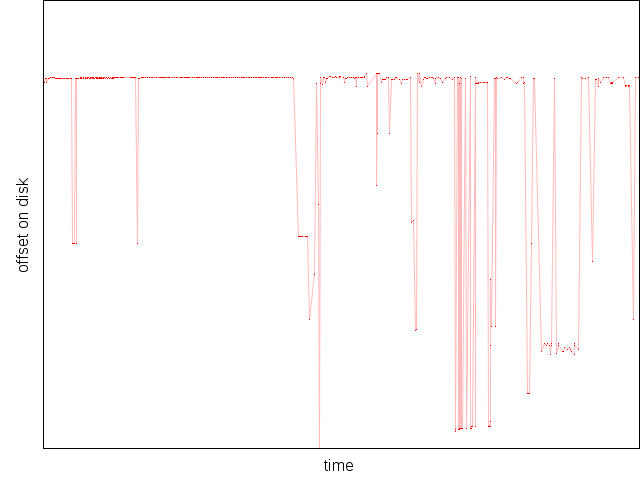
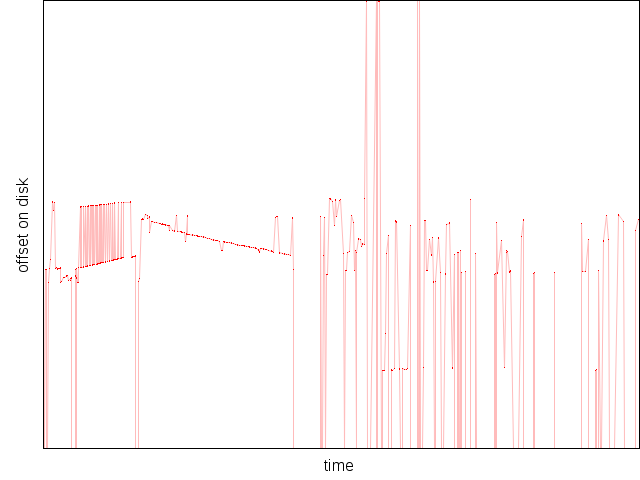
We all know disk seeks hurt. But we usually don t have a precise idea how much. How about getting that idea? Here is a little experiment I ran a few days ago. I took the output from the systemtap script tracking I/O I wrote, on a Firefox startup after boot. Each line of that output, which gives a timestamp (which we don t care about here), a file name, and an offset, represents a 4096 bytes read (one page). The first set of data points I got is how much time it takes to reproduce this read pattern after a reboot, and how that compares to Firefox startup time. For what it s worth, I did group following reads, to avoid doing too many system calls, and also avoided kernel readahead by using direct I/O, meaning I would only read exactly what the kernel reads when Firefox normally starts. All the following tests were done under the usual conditions (see previous posts), but I limited the tests to the x86-64 architecture, because all that really matters is the disk. I ll mention, however, that the amount of data read in these tests is 34,729,984 bytes, and that the original I/O pattern looks like this: Zooming around the main location where most I/O happen, we can see the pattern is still bumpy: This somehow looks familiar, doesn t it? We already know for a fact that even these patterns that, on the whole disk, look like pretty much insignificant, have an important impact on startup time. Try to imagine what kind of difference could be observed if we were reordering all these reads. Anyways, back to that I/O simulation, we first need to see how far it is from the actual Firefox startup. We would rather that simulated I/O + warm startup/hot cache end up close to the real thing. However, we need to keep in mind, as we saw in a previous post, that CPU scaling, when mixed with I/O, has an influence on startup time. Warm startup not involving I/O, the CPU can run at maximum speed the whole time. As such, for a fair comparison, we need to compare to cold startup time with the CPU forced at maximum speed, which we saw is faster than startup time with CPU scaling.
Average time (ms)
Simulated cold startup 2,764.26 0.42%
Warm startup 250.74 0.18%
Simulated cold + warm 3015
Real cold startup 3087.47 0.31%
Difference 72.47 (2.35%)
Close enough, I d say. The difference is most probably caused by metadata reads and a few other things, that isn t in the systemtap script scope. Now we know our simulated I/O is close to reality, what happens if we reorder all these reads according to the position on disk?
Average time (ms) Corresponding transfer rate
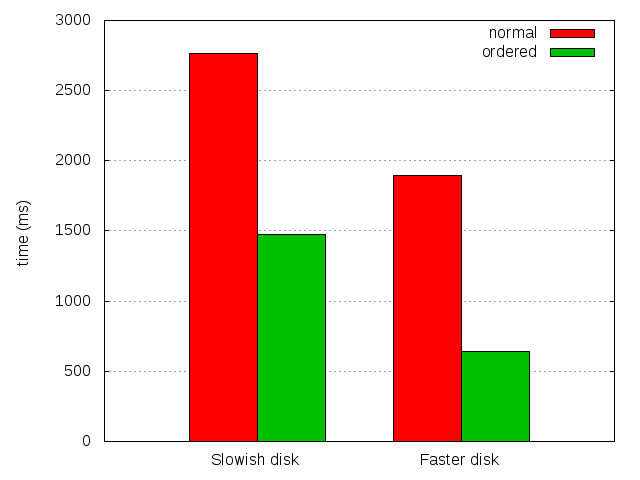
Simulated I/O 2,764.26 0.42% 12.56 MB/s
Reordered I/O 1,473.34 0.43% 23.57 MB/s
Difference 1,290.92 (46.7%) n/a
That s almost twice as fast ! And the disk doesn t even have a big throughput (around 30MB/s). Let s see what it does with a disk with a bigger throughput (85MB/s).
Average time (ms) Corresponding transfer rate
Simulated I/O 1,898.66 0.16% 18.29 MB/s
Reordered I/O 644.0 0.15% 53.93 MB/s
Difference 1,254.66 (66.08%) n/a
That s almost three times as fast ! The faster the disk, the bigger the improvement we can get by reordering and grouping I/O, which is not unexpected, but here we can see how much having to go back and forth on the disk hurt badly. Obviously, the numbers from the faster disk can t be directly compared to the ones from the slower disk, because the data was not arranged the same way on the disk, and file system fragmentation, as well as how the file system is filled also have their own share to add to the problem. And because it s more impressive to see on a graph than in a result table: Disks seeks hurt. Badly.

Lars Wirzenius: Growing the Debian development community

In an article about gender issues among American atheists, Sharon Moss and Lyz Liddell give a list of things to consider to be better community, not just for women:
  • Be a leader. Take responsibility for the tone of your group. If potential new members are being made to feel uncomfortable and aren t coming back, you re doing it wrong. As a leader, it is your job to prioritize the comfort of your attendees in programs, group dynamics, and communications. Try to put yourself in other members shoes and also ask for feedback.
  • Promote a sense of community. Take the time to socialize and get to know each other. If you re group isn t primarily a social group, thinking about adding some social time. Go to breakfast before the protest, compose your letters to the editor over coffee, or grab a pizza and beer after that lecture. When you know each other, you have each others backs. Being a jerk isn t tolerated.
  • Moderate discussions. Make sure everyone has the opportunity to participate- new people, quiet people, etc. Don t let conversation be dominated by one or two people who must win.
  • Embrace and accept different ways of communicating. Whether someone is an aggressive debater or not, make sure they re still welcome. The other atheist in the room isn t your enemy.
  • Encourage subgroups. Every event your group hosts doesn t need to appeal to your entire membership. Many women appreciate women-only space to express their nonbelief and to connect with other atheist women. Here at the Humanist Community of Central Ohio, we started a subgroup book club called Reasonable Women. When it grew to have about 25 regular members and was beginning to be a little too large and unwieldy to function as a book club, we created a second group, Heathen Chicks, which is just a social group that meets at a local cafe. It isn t just about creating women only space, for us, this has been a way to draw more women into other events our group hosts.
  • Foster women in leadership. Groups with women in leadership positions tend to have more women. Encourage women in your group to be visible in leadership.
These should work pretty well for Debian as well. I mean for the project in general, for getting all kinds of new people in, and getting them to stay, not just women, even if the gender imbalance is perhaps the biggest glaring problem we have. As a concrete suggestion, maybe it would be a good idea to continue the Debian party line that Joey set up for the squeeze release. We already have IRC, but having an audio chat with your Debian peers might be a nice addition. Specifically a social one, instead of something intended to boost productivity.

7 February 2011

Vincent Sanders: It is a bit breezy

The weather has been a bit odd round here for a while now. The snow storms in December and early January were a mild inconvenience for me but as I work from home the advice not to travel was not too much of a problem.

It seems however that now February is here and the snow is gone we are in for some pretty strong storms. This actually affected me today when my neighbours garden wall was blown over!

As you can see my nice new IP camera captured the event, well OK the frame before and after but you get the idea. Unfortunately for my neighbour the wall collapsed onto his pickup causing extensive damage.

A short time later when my weather station was recording gusts well over 50mph nearby drains started flowing the wrong way and it became a case of water, water everywhere!

It seems that when the new buildings were erected a few years ago that the architect while maximising used space on the building plot may have inadvertently created something of a wind tunnel.

The Gap between our properties is on a parallel (north to south) to the valley below. The wind seems to travel along the crest of the valley and be funnelled through any spaces between the houses. Fortunately the rest of the properties on green lane are pretty old and the spacing between is very generous and the funnelling effect is minimal.

I wonder if we could fit a wind turbine in there? Alas it was too much for my secondary anemometer which is now smashed in three parts.

Also gaining access to the gable end wall of my property has become somewhat perilous (Hence the wonky APT antenna I cannot get fixed). Yes that really is a guy balancing on a ladder 10m high in a strong wind. And indeed the platform the ladder is resting on is built from scaffolding board wedged between the houses.

I guess the hospital emergency room being 300m away means medical assistance is on hand, even so he is braver than I am. So my weather satellite imagery will just have to come from the internet like everyone else's for a while.

Matthew Garrett: Hardware vexation

My laptop (an HP 2530p) gets quite a lot of abuse. It's been with me enough to have done the equivalent of going round the world 4 or 5 times, and it's typically just thrown in a bag without any particular care or attention being given to its care or wellbeing. It's been dropped a couple of times with the only damage being some corners that aren't really as even as they should be. All in all, it's survived amazingly well. But it recently started refusing to boot, merely flashing its LEDs. After finally finding a list of what these mean, I narrowed it down to the memory. Taking it apart and putting it back together again got things working for a while, but then it happened again. And again. So, since I have one memory module and two slots, I decided to just move the RAM in the hope that there's something physically wrong with the slot. It worked! Until I got to the BIOS splash and it informed me that Intel AMT requires that there be memory in slot 0. And didn't give me an opportunity to continue without AMT.

My hardware is conspiring against me.

Alexander Reichle-Schmehl: What a night! What a day!

Wow, that was a night. I'm still quite tired from the weekend. Someone told me, that ~ 1 000 people subscribed to our live denting via identi.ca, and about 12 000 via twitter. And that does not even include those, who followed us via the respective web interfaces! While it was quite exhausting (we tried to watch about 7 irc channels for the important stuff, I partly had ~80 windows in my irssi (which is especially bad, since I only have keyboard shortcuts for the first 40) and there whas also a constant need to watch for mails and due to translations also our spamfilters), it was also very nice to think that somewhere there are release parties going on with people looking at our dents, maybe even having them running on a big monitor or projector ;) One thing that remains to be done, are the left-over dents we prepared as time killers: Since the release process went quite smoothly (and we didn't have the time to check all our dents for the limit of 140 chars ;) we still have some of them left. Since some of them where requested (and I poked other people to get me the numbers) here are the remaining dents: I especially like the one about debian-curiosa ;) Update 1: The 600 USD where collected during DebConf5, not DebConf3. Update 2: Small clarification about the number of subscriptions on identi.ca and twitter: They didn't followed a live-stream channel, but they do follow our general channel. We are not sure, how many people where subribed before we announced the live denting; some saw 700 subscribers on identi.ca, which would mean ~200 seem to have subscribed for the release dents (still not including the ones just following us the old fashioned way via a browser).

Pau Garcia i Quiles: Luggage and RyanAir

FOSDEM ended yesterday and here I am sitting at Charleroi Airport (also known as Brussels South , quite a misleading name given that it s 80 Km from Brussels). I have already passed all controls, check-in and everything. While I wait for boarding, I am watching the shameful spectacle of airport personnel (let me reiterate that: airport personnel, not Ryanair s) enforcing RyanAir s 10 Kg cabin baggage limit. According to RyanAir, they want to minimize the weight the plane carries to use less fuel. So far, so good. Here is what I have seen: people who do not carry any baggage (very few, they have probably checked it in because it exceeded size or weight), people who are below the 10 Kg limit and people who are way over it (and have been told to check luggage in). I am OK with those cases. There is still a fourth case: people who are slightly over 10 Kg. I ve seen a woman whose bag was 10.15 Kg to be told to pay 20 EUR to check her bag, or go back to the RyanAir desk to check-in the bag. She opened her bag, took a scarf, put it on and now the bag matched the weight limit. Yes, RyanAir is charging 20 EUR/Kg for hand baggage from 10 Kg on. What a rip-off. A couple of East-European girls were about 1 Kg in excess each. They put a couple of extra jumpers on and now baggage was under 10 Kg. Many people were about 1 Kg in excess. When they were told their suitcase better got lighter or pay 20 to 40 EUR. Most of them just took something (camera, food, slippers, whatever) and put in the pockets of their coats. Fortunately, RyanAir is not charging for body and clothes weight (yet?). In all those cases the plane will end up transporting the same weight and RyanAir won t get one more dime, so why RyanAir? Why are you such a shameful company? Why are you enforcing ludicrous and pointless policies? Don t you know after passing the control everybody just put everything back into the suitcase? Of course you do. So after watching this ridiculous spectacle go on for a while, I had a devious idea: let s organize a fat people conference and fly them all over to and from using RyanAir. Further, all of them should carry exactly 10 Kg hand baggage.

Jonathan McDowell: Why Linux? (Part 6: Freedom)

(This is part of a series of posts on Why Linux?) I think of myself as reasonably pragmatic in my approach to Free/Open Source software. I don't get worked up over which set of language people want to use. I use devices that require binary firmware to be downloaded to them (because just because I can't see it doesn't mean it doesn't exist). I have non-free in my sources.list. And yet, talking to other Linux users these days, I realize I'm much more of a Freedom nut job than average. I want the source, be it for a driver, a minor widget, or a full app. I don't buy nVidia. I will sacrifice a degree of functionality in order to get Free. And while I think WINE is an excellent piece of software, I think the best end result is that it's no longer necessary, not that it's a perfect implementation of the ABI. How does any of this help justify my use of Linux in the work place? As previously mentioned, I'm a developer. Most developers don't operate in a vacuum; they have to inter-operate with other ecosystems. And usually somewhere along the line there's a failure to document exactly how something is handled, or an ambiguity about what exact choice might be taken. If I have access to the source then I can check that out for myself. If I don't, I have to guess. As an example, a long time ago I was involved in writing a serial console driver for QNX. There came a point where the behaviour wasn't quite as we'd expect. Although the organisation had a license for the source, I wasn't allowed to look at it. Instead I had to come up with a series of suitable questions that someone who could look at the source could answer without violating any NDAs. If I'd been able to look at the source directly we'd have all saved a lot of time. And that's an example where someone could look at the source, rather than having to make a bunch of guesses and instrument tests to see which was right. Access to the Linux source has helped me in other commercial contexts too. At Black Cat we were able to take advantage of patches like grsecurity in order to tighten up shell account boxes. I wrote the IPv6 support for l2tpns, because we had access to the source and could. I've been able to look at the source to understand exactly what SCSI responses are sent in certain circumstances too (or understand exactly what the error that a user land test program was getting back meant). Also I'm a big believe in Linus' Law. I do think that good Free software is much better than proprietary software (there's some really bad Free software out there though, I'm not disputing that). The fact that smart people can look at it and scratch whatever their itch is means that we get a gradual process of improvement that can't be ignored. Equally as long as someone has an interest in the software, end users can't be left high and dry by organisations abandoning still users applications. I think that should be a powerful driver to business to look towards Free software. (Before my more astute readers point it out; yes, I am employed writing non-free software. See the first sentence. One day I'll find a job working on Free software that ticks enough of the other boxes to be viable.)

Next.

Previous.