Joachim Breitner uploaded ghc/7.8.4-9 which uses a hash of the command line instead of the pid when calculating a random directory name.
Lunar uploaded mozilla-devscripts/0.42 which now properly sets the timezone. Patch by Reiner Herrmann.
Dmitry Shachnev uploaded python-qt4/4.11.4+dfsg-1 which now outputs the list of imported module in a stable order. The issue has been fixed upstream. Original patch by Reiner Herrmann.
Norbert Preining uploaded tex-common/6.00 which tries to ensure reproducible builds in files generated by dh_installtex.
Daniel Kahn Gillmor's report on help2man started a discussion with Brendan O'Dea and Ximin Luo about standardizing a common environment variable that would provide a replacement for an embedded build date. After various proposals and research by Ximin about date handling in several programming languages, the best solution seems to define SOURCE_DATE_EPOCH with a value suitable for gmtime(3).
Martin Borgert wondered if Sphinx could be changed in a way that would avoid having to tweak debian/rules in packages using it to produce HTML documentation.
#788238 on kfreebsd-10 by Steven Chamberlain: fix mtimes in source tarball.
#788246 on pyepr by Juan Picca: set documentation date for Sphinx.
#788247 on grapefruit by Juan Picca: set documentation date for Sphinx.
#788249 on pastescript by Juan Picca: set documentation date for Sphinx.
#788275 on geoip-database by Reiner Herrmann: sets the embedded timestamp to the date from the latest changelog entry and normalizes the used timezone to UTC..
#788336 on irrlicht by akira: removes $datetime from the file footer.html. Now fixed upstream..
#788393 on brian by Juan Picca: set documentation date for Sphinx.
#788402 on linop by Juan Picca: set documentation date for Sphinx.
#788403 on pyevolve by Juan Picca: set documentation date for Sphinx.
#788406 on argvalidate by Juan Picca: set documentation date for Sphinx.
#788467 on astroquery by Juan Picca: set documentation date for Sphinx.
#788476 on mpi4py by Juan Picca: set documentation date for Sphinx.
#788599 on wtforms by Juan Picca: set documentation date for Sphinx.
#788618 on rumor by Holger Levsen: set TZ to UTC when building the documentation.
#788722 on thuban by Reiner Herrmann: set the date embedded in man pages to the changelog date.
reproducible.debian.net
A new variation to better notice when a package captures the environment has been introduced. (h01ger)
The test on Debian packages works by building the package twice in a short time frame. But sometimes, a mirror push can happen between the first and the second build, resulting in a package built in a different build environment. This situation is now properly detected and will run a third build automatically. (h01ger)
OpenWrt, the distribution specialized in embedded devices like small routers, is now being tested for reproducibility. The situation looks very good for their packages which seems mostly affected by timestamps in the tarball. System images will require more work on debbindiff to be better understood. (h01ger)
debbindiff development
Reiner Herrmann added support for decompling Java .class file and .ipk package files (used by OpenWrt). This is now available in version 22 released on 2015-06-14.
Documentation update
Stephen Kitt
documented
the new --insert-timestamp available since
binutils-mingw-w64 version 6.2
available to insert a ready-made date in PE binaries built with
mingw-w64.
Package reviews
195 obsolete
reviews have
been removed, 65 added and 126 updated this week.
New identified issues:
Misc.
Holger Levsen reported an issue with the locales-all package that Provides: locales but is actually missing some of the files provided by locales.
Coreboot upstream has been quick to react after the
announcement
of the tests set up the week
before. Patrick Georgi has fixed all issues in a couple of days and all
Coreboot images are now reproducible (without a payload).
SeaBIOS is one of the most frequently used payload
on PC hardware and can now be made
reproducible
too.
Paul Kocialkowski wrote to the mailing
list
asking for help on getting U-Boot tested for
reproducibility.
Lunar had a chat with maintainers of Open Build
Service to better
understand the difference between their system and what we are doing for
Debian.
It is a bit work to figure out the ownership structure of companies
in Norway. The information is publicly available, but one need to
recursively look up ownership for all owners to figure out the complete
ownership graph of a given set of companies. To save me the work in
the future, I wrote a script to do this automatically, outputting the
ownership structure using the Graphviz/dotty format. The data source
is web scraping from Proff, because
I failed to find a useful source directly from the official keepers of
the ownership data, Br nn ysundsregistrene.
To get an ownership graph for a set of companies, fetch
the code from git and run it using the organisation number. I'm
using the Norwegian newspaper Dagbladet as an example here, as its
ownership structure is very simple:
% time ./bin/eierskap-dotty 958033540 > dagbladet.dot
real    0m2.841s
user    0m0.184s
sys     0m0.036s
%
The script accept several organisation numbers on the command line,
allowing a cluster of companies to be graphed in the same image. The
resulting dot file for the example above look like this. The edges
are labeled with the ownership percentage, and the nodes uses the
organisation number as their name and the name as the label:
To view the ownership graph, run "dotty dagbladet.dot" or
convert it to a PNG using "dot -T png dagbladet.dot >
dagbladet.png". The result can be seen below:
Note that I suspect the "Aller Holding A/S" entry to be incorrect
data in the official ownership register, as that name is not
registered in the official company register for Norway. The ownership
register is sensitive to typos and there seem to be no strict checking
of the ownership links.
Let me know if you improve the script or find better data sources.
The code is licensed according to GPL 2 or newer.
Update 2015-06-15: Since the initial post I've been told that
"Aller
Holding A/S" is a Danish company, which explain why it did not
have a Norwegian organisation number. I've also been told that there
is a web
services API available from Br nn ysundsregistrene, for those
willing to accept the terms or pay the price.
As with all the previous versions, I have prepared a mega update for the Kobo firmware 3.16.0, including all my favorite patches and features. Please see details for 3.15.0, 3.13.1 and 3.12.1. As before, the following addons are included: Kobo Start Menu, koreader, coolreader, pbchess, ssh access, custom dictionaries, plus as a new treat, some side-loaded fonts. What I dropped this time is most of the kobohack part, as the libraries seem to get outdated. But I included the dropbear ssh server from the kobohack package.
So what are all these items:
firmware (thread): the basic software of the device, shipped by Kobo company
Kobo Start Menu (V07, update 4 thread): an menu that pops up before the reading software (nickel) starts, which allows to start alternative readers (like koreader) etc.
KOreader (koreader-nightly-20150608, thread): an alternative document reader that supports epub, azw, pdf, djvu and many more
pbchess and CoolReader (2015.5, thread): a chess program and another alternative reader, bundled together with several other games
ssh access (old post: makes a full computer from your device by allowing you to log into it via ssh
custom dictionaries (thread): in particular Japanese-English
side-loaded fonts: GentiumBasic and GentiumBookBasic, Verdana, DroidSerif, and Charter-eInk
Please see this post for details.
Here is the combined Kobo-3.16.0-combined/KoboRoot.tgz
Update procedure
First install the normal firmware as obtained from above. Then, install the KoboRoot.tgz from above.
WARNINGS
Here a a few things you need to do after you have installed the mega update:
ssh passwords and telnet disabling needs to be done! This is an important step, please see this old post and follow the steps from step 9.
The combined KoboRoot.tgz is provided without warranty. If you need to reset your device, don t blame me!
Some people are very bad at responding to e-mails. Or they don t check
their mailbox as often as I do, who knows. Anyway, sometimes I want to
ping somebody about an e-mail that I sent some time ago. Till now, I
did it by going through a list of my sent e-mails and resending
messages that were unreplied. However, that was somewhat inefficient.
As a solution, I coded a post-new hook for
notmuch that tags all unreplied
messages. The implementation is rather short and straightforward (see
GitHub repo). It marks
all replied messages with response and everything else with
noresponse. The precise definition of replied message is: a
message whose ID is mentioned in at least one In-Reply-To header in
your mailbox.
To solve my initial problem, I also tag my sent, but unreplied
messages with noack so that I can easily obtain the list of people
to ping eventually. I also have the backlog tag which groups
e-mails sent to me and which I haven t replied yet.
Feel free to use it if you find it useful.
For reasons that fail my, my internal SATA DVD drive is very seldom seen by the kernel at startup. My guess is that it takes very long to start, and the kernel doesn't wait that long before deciding that it had all SCSI devices, so it misses it. It's actually very annoying, since you can't use the drive at all. After digging around, I finally stumbled on the rescan-scsi-bus tool from the scsitools package. Running (as root, of course)
~ rescan-scsi-bus -w -l
(sometimes two or three times) is enough to get the device back up, with the /dev/dvd udev symlink.Hope this'll help !
I know very little about hardware.
I think I have a good understanding on many aspects of what happens inside a computer, but my knowledge is clearly firmer on what happens once an operating system is already running. And even then, my understanding of the lower parts of reality is shaky at most At least according to my self-evaluation, of course, comparing to people I'm honored to call "my peers".
During the last ~18 months, my knowledge of this part of reality, while still far from complete, has increased quite a bit Maybe mostly showing that I'm basically very cheap: As I have come across very cheap (or even free for me!) hardware, I have tried to understand and shape what happens in levels below those where I dwell.
I have been meaning to do a writeup on the MIPS Creator CI20, which was shipped to me for free (thanks++!) by Imagination Technologies; I still want to get more familiar with the board and have better knowledge before reporting on it. Just as a small advance, as this has been keeping me somewhat busy: I got this board after their offer to Debian Developers, and prompted because I'll be teaching some modules on the Embedded Linux diploma course dictated by Facultad de Ingenier a, UNAM Again, I'll blog about that later.
My post today follows Riku's, titled Dystopia of things, where he very clearly finds holes in the Internet of Things offering of one specific product and one specific company, but allows for generalizations on what we will surely see as the model. Riku says:
Today, the GPL sources for hub are available - at least the kernel and a patch for busybox. The proper GPL release is still only through written offer. The sources appeared online April this year while Hub has been sold for two years already. Even if I ordered the GPL CD, it's unlikely I could build a modified system with it - too many proprietary bits. The whole GPL was invented by someone who couldn't make a printer do what he wanted. The dystopian today where I have to rewrite the whole stack running on a Linux-based system if I'm not happy what's running there as provided by OEM.
This is not exactly the situation on the boards/products (it's a disservice to call the cute CuBox-i just a board!) I mention I'm using, but it's neither too far. Being used to the easy x86 world, I am used to bitching on specific hardware that does not get promptly recognized by the Linux kernel But even with the extra work UEFI+SecureBoot introduces, getting the kernel to boot is something we just take for granted. In the MIPS and ARM worlds, this is not so much of a given; I'm still treating the whole SPL and DeviceTree world as a black box, but that's where a lot of the work happens.
The boards I am working on try to make a point they are Open Hardware. The CI20 is quite impressive in this regard, as not only it has a much more complete set of on-board peripherials than any other, but a wealth of schematics, datasheets and specifications for the different parts of its components. And, of course, the mere availability of the MIPSfpga program to universities worldwide is noteworthy Completely outside of my skillset, but looks most interesting.
However... Despite being so much almost-Free-with-a-capital-F, all those boards fail our definitions of freedom in several ways. And yes, they lead us to a situation similar to what Riku describes, to what Stallman feared... To a situation not really better to where we stand on openly closed-source, commodity x86 hardware: Relying on binary blobs and on non-free portions of code to just use our hardware, or at least to use many of the features that would be available to us otherwise.
As an example, both the CI20 and the CuBox-i vendors provide system images able to boot what they describe as a Debian 7 system, based on a 3.0 Linux kernel (which Debian never used; IIRC the CuBox-i site said it was derived from a known-good Android kernel)... Only that it's an image resulting of somebody else installing and configuring it. Why should we trust their image to be sane? Yes, the resulting installation is quite impressive (i.e. the CI20's 3D demos are quite impressive for a system that feels otherwise sluggish, and out of my ARM experience, I'd wager it feels sluggish mostly because of a slow SSD)...
I have managed to do clean Debian installs on most of my ARM machines (the CuBox-i as described in my previous blog post; this post from Elena of Valhalla'' prompted me into trying the already well documented way of running the official Debian Installer, which worked like a charm and gave me a very nice and responsive Debian 8 install Modulo yes, the Banana's non-free video interface, which AFAICT uses the non-free Mail binary driver... And which I haven't had the time to play with yet. Of course, my CuBox is in a similar situation, where it works like a charm as a personal server, but is completely worthless as a set-top box.
So, with those beautiful, small, cheap SoC systems, we are close to where we stood twenty years ago with x86 Linux: Good support for a small set of peripherials, but a far cry from having a functional system with exclusively free software. ,
Still... Playing with these boards has taught me a lot, and has clearly taught me I'm still standing on the first steps of the n00b level. I have a lot to learn to be able to responsibly teach my part of the diploma course, and I'm very thankful for the differences in hardware (and, of course, for the hardware manufacturers, specially for the MIPS Creator CI20 and the Lemaker Banana Pi for giving me boards to work on!)
I shall keep posting on this topic.
The recent AWS introduction of the Elastic File System gives you an automatic grow-and-shrink capability as an NFS mount, an exciting option that takes away the previous overhead in creating shared block file systems for EC2 instances.
However it should be noted that the same auto-management of capacity is not true in the EC2 instance s Elastic Block Store (EBS) block storage disks; sizing (and resizing) is left to the customer. With current 2015 EBS, one cannot simply increase the size of an EBS Volume as the storage becomes full; (as at June 2015) an EBS volume, once created, has fixed size. For many applications, that lack of resize function on its local EBS disks is not a problem; many server instances come into existence for a brief period, process some data and then get Terminated, so long term managment is not needed.
However for a long term data store on an instance (instead of S3, which I would recommend looking closely at from a durability and pricing fit), and where I want to harness the capacity to grow (or shrink) disk for my data, then I will need to leverage some slightly more advanced disk management. And just to make life interesting, I wish to do all this while the data is live and in-use, if possible.
Enter: Logical Volume Management, or LVM. It s been around for a long, long time: LVM 2 made a debut around 2002-2003 (2.00.09 was Mar 2004) and LVM 1 was many years before that so it s pretty mature now. It s a powerful layer that sits between your raw storage block devices (as seen by the operating system), and the partitions and file systems you would normally put on them.
In this post, I ll walk through the process of getting set up with LVM on Debian in the AWS EC2 environment, and how you d do some basic maintenance to add and remove (where possible) storage with minimal interruption.
Getting Started
First a little prep work for a new Debian instance with LVM.
As I d like to give the instance its own ability to manage its storage, I ll want to provision an IAM Role for EC2 Instances for this host. In the AWS console, visit IAM, Roles, and I ll create a new Role I ll name EC2-MyServer (or similar), and at this point I ll skip giving it any actual privileges (later we ll update this). As at this date, we can only associate an instance role/profile at instance launch time.
Now I launch a base image Debian EC2 instance launched with this IAM Role/Profile; the root file system is an EBS Volume. I am going to put data that I ll be managing on a separate disk from the root file system.
First, I need to get the LVM utilities installed. It s a simple package to install: the lvm2 package. From my EC2 instance I need to get root privileges (sudo -i) and run:
apt update && apt install lvm2
After a few moments, the package is installed. I ll choose a location that I want my data to live in, such as /opt/. I want a separate disk for this task for a number of reasons:
Root EBS volumes cannot currently be encrypted using Amazon s Encrypted EBS Volumes at this point in time. If I want to also use AWS encryption option, it ll have to be on a non-root disk. Note that instance-size restrictions also exist for EBS Encrypted Volumes.
It s possibly not worth make a snapshot of the Operating System at the same time as the user content data I am saving. The OS install (except the /etc/ folder) can almost entirely be recreated from a fresh install. so why snapshot that as well (unless that s your strategy for preserving /etc, /home, etc).
The type of EBS volume that you require may be different for different data: today (Apr 2015) there is a choice of Magnetic, General Purpose 2 (GP2) SSD, and Provisioned IO/s (PIOPS) SSD, each with different costs; and depending on our volume, we may want to select one for our root volume (operating system), and something else for our data storage.
I may want to use EBS snapshots to clone the disk to another host, without the base OS bundled in with the data I am cloning.
I will create this extra volume in the AWS console and present it to this host. I ll start by using a web browser (we ll use CLI later) with the EC2 console.
The first piece of information we need to know is where my EC2 instance is running. Specifically, the AWS Region and Availability Zone (AZ). EBS Volumes only exist within the one designated AZ. If I accidentally make the volume(s) in the wrong AZ, then I won t be able to connect them to my instance. It s not a huge issue, as I would just delete the volume and try again.
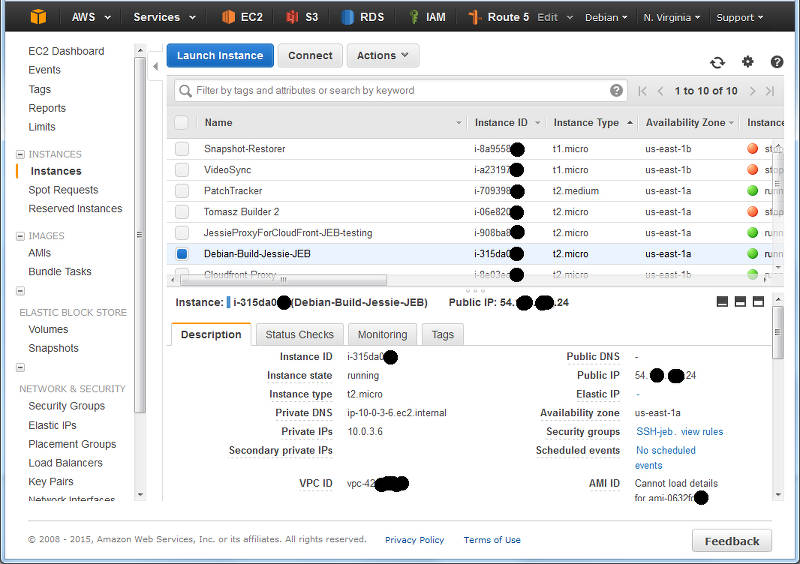
I navigate to the Instances panel of the EC2 Console, and find my instance in the list:
A (redacted) list of instance from the EC2 console.
Here I can see I have located an instance and it s running in US-East-1A: that s AZ A in Region US-East-1. I can also grab this with a wget from my running Debian instance by asking the MetaData server:
The returned text is simply: us-east-1a .
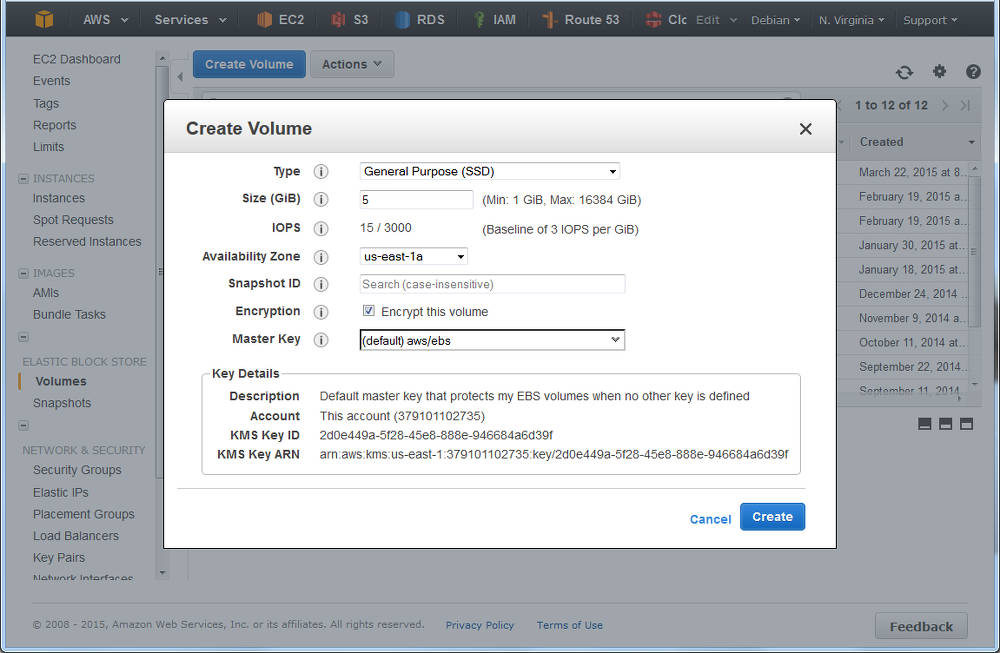
Time to navigate to Elastic Block Store , choose Volumes and click Create :
Creating a volume in AWS EC2: ensure the AZ is the same as your instance
You ll see I selected that I wanted AWS to encrypt this and as noted above, at this time that doesn t include the t2 family. However, you have an option of using encryption with LVM where the customer looks after the encryption key see LUKS.
What s nice is that I can do both have AWS Encrypted Volumes, and then use encryption on top of this, but I have to manage my own keys with LUKS, and should I lose them, then I can keep all the cyphertext!
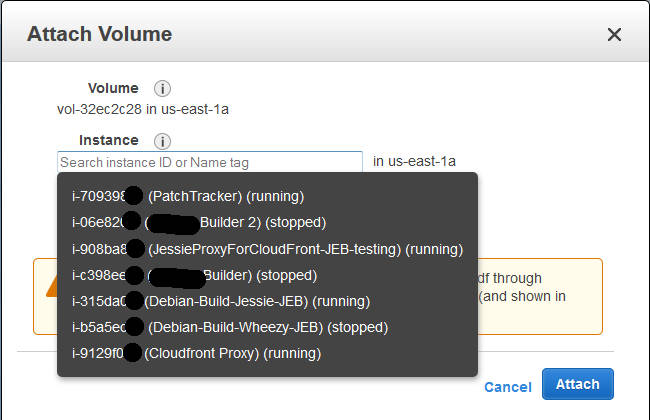
I deselected this for my example (with a t2.micro), and continue; I could see the new volume in the list as creating , and then shortly afterwards as available . Time to attach it: select the disk, and either right-click and choose Attach , or from the menu at the top of the list, chose Actions -> Attach (both do the same thing).
Attaching a volume to an instance: you ll be prompted for the compatible instances in the same AZ.
At this point in time your EC2 instance will now notice a new disk; you can confirm this with dmesg tail , and you ll see something like:
[1994151.231815] xvdg: unknown partition table
(Note the time-stamp in square brackets will be different).
Previously at this juncture you would format the entire disk with your favourite file system, mount it in the desired location, and be done. But we re adding in LVM here between this raw device, and the filesystem we are yet to make .
Marking the block device for LVM
Our first operation with LVM is to put a marker on the volume to indicate it s being use for LVM so that when we scan the block device, we know what it s for. It s a really simple command:
pvcreate /dev/xvdg
The device name above (/dev/xvdg) should correspond to the one we saw from the dmesg output above. The output of the above is rather straight forward:
Physical volume "/dev/xvdg" successfully created
Checking our EBS Volume
We can check on the EBS volume which LVM sees as a Physical Volume using the pvs command.
Here we see the entire disk is currently unused.
Creating our First Volume Group
Next step, we need to make an initial LVM Volume Group which will use our Physical volume (xvdg). The Volume Group will then contain one (or more) Logical Volumes that we ll format and use. Again, a simple command to create a volume group by giving it its first physical device that it will use:
# vgcreate  OptVG /dev/xvdg
  Volume group "OptVG" successfully created
And likewise we can check our set of Volume Groups with vgs :
The Attribute flags here indicate this is writable, resizable, and allocating extents in normal mode. Lets proceed to make our (first) Logical Volume in this Volume Group:
# lvcreate -n OptLV -L 4.9G OptVG
  Rounding up size to full physical extent 4.90 GiB
  Logical volume "OptLV" created
You ll note that I have created our Logical Volume as almost the same size as the entire Volume Group (which is currently one disk) but I left some space unused: the reason for this comes down to keeping some space available for any jobs that LVM may want to use on the disk and this will be used later when we want to move data between raw disk devices.
If I wanted to use LVM for Snapshots, then I d want to leave more space free (unallocated) again.
We can check on our Logical Volume:
The attribytes indicating that the Logical Volume is writeable, is allocating its data to the disk in inherit mode (ie, as the Volume Group is doing), and that it is active. At this stage you may also discover we have a device /dev/OptVG/OptLV, and this is what we re going to format and mount. But before we do, we should review what file system we ll use.
Filesystems
Popular Linux file systems
Name
Shrink
Grow
Journal
Max File Sz
Max Vol Sz
btrfs
Y
Y
N
16 EB
16 EB
ext3
Y off-line
Y
Y
2 TB
32 TB
ext4
Y off-line
Y
Y
16 TB
1 EB
xfs
N
Y
Y
8 EB
8 EB
zfs*
N
Y
Y
16 EB
256 ZB
For more details see Wikipedia comparison. Note that ZFS requires 3rd party kernel module of FUSE layer, so I ll discount that here. BTRFS only went stable with Linux kernel 3.10, so with Debian Jessie that s a possibility; but for tried and trusted, I ll use ext4.
The selection of ext4 also means that I ll only be able to shrink this file system off-line (unmounted).
I ll make the filesystem:
# mkfs.ext4 /dev/OptVG/OptLV
mke2fs 1.42.12 (29-Aug-2014)
Creating filesystem with 1285120 4k blocks and 321280 inodes
Filesystem UUID: 4f831d17-2b80-495f-8113-580bd74389dd
Superblock backups stored on blocks:
  32768, 98304, 163840, 229376, 294912, 819200, 884736
Allocating group tables: done
Writing inode tables: done
Creating journal (32768 blocks): done
Writing superblocks and filesystem accounting information: done
And now mount this volume and check it out:
# mount /dev/OptVG/OptLV /opt/
# df -HT /opt
Filesystem  Type  Size  Used Avail Use% Mounted on
/dev/mapper/OptVG-OptLV ext4  5.1G  11M  4.8G  1% /opt
Lastly, we want this to be mounted next time we reboot, so edit /etc/fstab and add the line:
/dev/OptVG/OptLV /opt ext4 noatime,nodiratime 0 0
With this in place, we can now start using this disk. I selected here not to update the filesystem every time I access a file or folder updates get logged as normal but access time is just ignored.
Time to expand
After some time, our 5 GB /opt/ disk is rather full, and we need to make it bigger, but we wish to do so without any downtime. Amazon EBS doesn t support resizing volumes, so our strategy is to add a new larger volume, and remove the older one that no longer suits us; LVM and ext4 s online resize ability will allow us to do this transparently.
For this example, we ll decide that we want a 10 GB volume. It can be a different type of EBS volume to our original we re going to online-migrate all our data from one to the other.
As when we created the original 5 GB EBS volume above, create a new one in the same AZ and attach it to the host (perhaps a /dev/xvdh this time). We can check the new volume is visible with dmesg again:
[1999786.341602] xvdh: unknown partition table
And now we initalise this as a Physical volume for LVM:
# pvcreate /dev/xvdh
  Physical volume "/dev/xvdh" successfully created
And then add this disk to our existing OptVG Volume Group:
# vgextend OptVG /dev/xvdh
  Volume group "OptVG" successfully extended
We can now review our Volume group with vgs, and see our physical volumes with pvs:
There are now 2 Physical Volumes we have a 4.9 GB filesystem taking up space, so 10.09 GB of unallocated space in the VG.
Now its time to stop using the /dev/xvgd volume for any new requests:
# pvchange -x n /dev/xvdg
  Physical volume "/dev/xvdg" changed
  1 physical volume changed / 0 physical volumes not changed
At this time, our existing data is on the old disk, and our new data is on the new one. Its now that I d recommend running GNU screen (or similar) so you can detach from this shell session and reconnect, as the process of migrating the existing data can take some time (hours for large volumes):
During the move, checking the Monitoring tab in the AWS EC2 Console for the two volumes should show one with a large data Read metric, and one with a large data Write metric clearly data should be flowing off the old disk, and on to the new.
A note on disk throughput
The above move was a pretty small, and empty volume. Larger disks will take longer, naturally, so getting some speed out of the process maybe key. There s a few things we can do to tweak this:
EBS Optimised: a launch-time option that reserves network throughput from certain instance types back to the EBS service within the AZ. Depending on the size of the instance this is 500 MB/sec up to 4GB/sec. Note that for the c4 family of instances, EBS Optimised is on by default.
Size of GP2 disk: the larger the disk, the longer it can sustain high IO throughput but read this for details.
Size and speed of PIOPs disk: if consistent high IO is required, then moving to Provisioned IO disk may be useful. Looking at the (2 weeks) history of Cloudwatch logs for the old volume will give me some idea of the duty cycle of the disk IO.
Back to the move
Upon completion I can see that the disk in use is the new disk and not the old one, using pvs again:
So all 5 GB is now unused (compare to above, where only 96 MB was PFree). With that disk not containing data, I can tell LVM to remove the disk from the Volume Group:
# vgreduce OptVG /dev/xvdg
  Removed "/dev/xvdg" from volume group "OptVG"
Then I cleanly wipe the labels from the volume:
# pvremove /dev/xvdg
  Labels on physical volume "/dev/xvdg" successfully wiped
If I really want to clean the disk, I could choose to use shred(1) on the disk to overwrite with random data. This can take a lng time
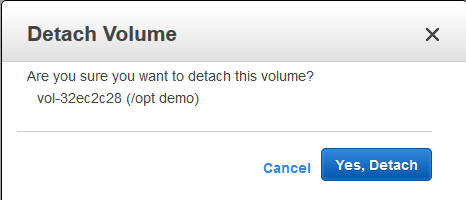
Now the disk is completely unused and disassociated from the VG, I can return to the AWS EC2 Console, and detach the disk:
Detach an EBS volume from an EC2 instance
Wait for a few seconds, and the disk is then shown as available ; I then chose to delete the disk in the EC2 console (and stop paying for it).
Back to the Logical Volume it s still 4.9 GB, so I add 4.5 GB to it:
# lvresize -L +4.5G /dev/OptVG/OptLV
  Size of logical volume OptVG/OptLV changed from 4.90 GiB (1255 extents) to 9.40 GiB (2407 extents).
  Logical volume OptLV successfully resized
We now have 0.6GB free space on the physical volume (pvs confirms this).
Finally, its time to expand out ext4 file system:
# resize2fs /dev/OptVG/OptLV
resize2fs 1.42.12 (29-Aug-2014)
Filesystem at /dev/OptVG/OptLV is mounted on /opt; on-line resizing required
old_desc_blocks = 1, new_desc_blocks = 1
The filesystem on /dev/OptVG/OptLV is now 2464768 (4k) blocks long.
And with df we can now see:
# df -HT /opt/
Filesystem  Type  Size  Used Avail Use% Mounted on
/dev/mapper/OptVG-OptLV ext4  9.9G  12M  9.4G  1% /opt
Automating this
The IAM Role I made at the beginning of this post is now going to be useful. I ll start by adding an IAM Policy to the Role to permit me to List Volumes, Create Volumes, Attach Volumes and Detach Volumes to my instance-id. Lets start with creating a volume, with a policy like this:
This policy puts some restrictions on the volumes that this instance can create: only within the given Availability Zone (matching our instance), only GP2 SSD (no PIOPs volumes), and size no more than 250 GB. I ll add another policy to permit this instance role to tag volumes in this AZ that don t yet have a tag called InstanceId:
Now that I can create (and then tag) volumes, this becomes a simple procedure as to what else I can do to this volume. Deleting and creating snapshots of this volume are two obvious options, and the corresponding policy:
Of course it would be lovely if I could use a variable inside the policy condition instead of the literal string of the instance ID, but that s not currently possible.
Clearly some of the more important actions I want to take are to attach and detach a volume to my instance:
Now with this in place, we can start to fire up the AWS CLI we spoke of. We ll let the CLI inherit its credentials form the IAM Instance Role and the polices we just defined.
and at this stage, the above manipulation of the raw block device with LVM can begin. Likewise you can then use the CLI to detach and destroy any unwanted volumes if you are migrating off old block devices.
After long time of waiting we finally released TeX Live 2015. Get some champagne, and ready to party!
Get it via downloading the net-installer, by obtaining a DVD, or downloading the iso. Besides the huge list up updates to packages and loads of bug fixes to all the programs, here are some notable news:
new LaTeX2e release which automatically includes fixltx2e
pdfTeX got improved jpeg support (exif and JFIF)
luaTeX got a new library newtokenlib
XeTeX got image handling fixes
MetaPost got a new numbersystem binary, and Japanese variants were added (upmpost and updvitomp)
MacTeX s Ghostscript packages got a facelift with better CJK support, other Unix-like distributions can do the same with my the newly included script cjk-gs-integrate (also one one my projects)
architectures: *kfreebsd was removed,and some additional platforms available as custom binaries. The DVD does not contain all platforms (due to space reasons), but all of them can be installed via the net-installer.
Regular updates of the repository will start in due course.
Thanks to all the contributors for the hard work. Let s have a party!
>22000 source packages in Debian main today
Just now Debian main for the first time had more than 22000 source packages in unstable, 22001 at this moment to be exact. Very few weeks ago for the first time there were more than 45000 binary packages for unstable/amd64(+all) in main - and today this number is up to 45542!
Thanks and kudos to everyone involved to make it happen. You make countless people smile each day! Keep up the good work!
(And, that said, cleaning the archive from cruft and making sure only "good" packages enter is also a very important part of this work. Thanks to those who care about that too.)
Since I wrote last about Linux backup tools, back in a 2008 article about BackupPC and similar toools and a 2011 article about dedpulicating filesystems, I ve revisited my personal backup strategy a bit.
I still use ZFS, with my tool simplesnap that I wrote about in 2014 to perform local backups to USB drives, which get rotated offsite periodically. This has the advantage of being very fast and very secure, but I also wanted offsite backups over the Internet. I began compiling criteria, which ran like this:
Remote end must not need any special software installed. Storage across rsync, sftp, S3, WebDAV, etc. should all be good candidates. The remote end should not need to support hard links or symlinks, etc.
Cross-host deduplication at at least the file level is required, so if I move a 4GB video file from one machine to another, my puny DSL wouldn t have to re-upload it.
All data that is stored remotely must be 100% encrypted 100% of the time. I must not need to have any trust at all in the remote end.
Each backup after the first must send only an incremental s worth of data across the line. No periodic re-uploading of the entire data set can be done.
The repository format must be well-documented and stable.
So, how did things stack up?
Didn t meet criteria
A lot of popular tools didn t meet the criteria. Here are some that I considered:
BackupPC requires software on the remote end and does not do encryption.
None of the rsync hardlink tree-based tools are suitable here.
rdiff-backup requires software on the remote end and does not do encryption or dedup.
duplicity requires a periodic re-upload of a full backup, or incremental chains become quite long and storage-inefficient. It also does not support dedup, although it does have an impressive list of dumb storage backends.
ZFS, if used to do backups the efficient way, would require software to be installed on the remote end. If simple zfs send images are used, the same limitations as with duplicity apply.
The tools must preserve POSIX attributes like uid/gid, permission bits, symbolic links, hard links, etc. Support for xattrs is also desireable but not required.
bup and zbackup are both interesting deduplicators, but do not yet have support for removing old data, so are impractical for this purpose.
burp requires software on the server side.
Obnam and Attic/Borg Backup
Obnam and Attic (and its fork Borg Backup) are both programs that have a similar concept at their heart, which is roughly this: the backup repository stores small chunks of data, indexed by a checksum. Directory trees are composed of files that are assembled out of lists of chunks, so if any given file matches another file already in the repository somewhere, the added cost is just a small amount of metadata.
Obnam was eventually my tool of choice. It has built-in support for sftp, but its reliance on local filesystem semantics is very conservative and it works fine atop davfs2 (and, I d imagine, other S3-backed FUSE filesystems). Obnam s repository format is carefully documented and it is very conservatively designed through and through clearly optimized for integrity above all else, including speed. Just what a backup program should be. It has a lot of configurable options, including chunk size, caching information (dedup tables can be RAM-hungry), etc. These default to fairly conservative values, and the performance of Obnam can be significantly improved with a few simple config tweaks.
Attic was also a leading contender. It has a few advantages over Obnam, actually. One is that it uses an rsync-like rolling checksum method. This means that if you add 1 byte at the beginning of a 100MB file, Attic will upload a 1-byte chunk and then reference the other chunks after that, while Obnam will have to re-upload the entire file, since its chunks start at the beginning of the file in fixed sizes. (The only time Obnam has chunks smaller than its configured chunk size is with very small files or the last chunk in a file.) Another nice feature of Attic is its use of packs , where it groups chunks together into larger pack files. This can have significant performance advantages when backing up small files, especially over high-latency protocols and links.
On the downside, Attic has a hardcoded fairly small chunksize that gives it a heavy metadata load. It is not at all as configurable as Obnam, and unlike Obnam, there is nothing you can do about this. The biggest reason I avoided it though was that it uses a single monolithic index file that would have to be uploaded from scratch after each backup. I calculated that this would be many GB in size, if not even tens of GB, for my intended use, and this is just not practical over the Internet. Attic assumes that if you are going remote, you run Attic on the remote so that the rewrite of this file doesn t have to send all the data across the network. Although it does work atop davfs2, this support seemed like an afterthought and is clearly not very practical.
Attic did perform much better than Obnam in some ways, largely thanks to its pack support, but the monolothic index file was going to make it simply impractical to use.
There is a new fork of Attic called Borg that may, in the future, address some of these issues.
Brief honorable mentions: bup, zbackup, syncany
There are a few other backup tools that people are talking about which do dedup. bup is frequently mentioned, but one big problem with it is that it has no way to delete old data! In other words, it is more of an archive than a backup tool. zbackup is a really neat idea it dedups anything you feed at it, such as a tar stream or zfs send stream, and can encrypt, too. But it doesn t (yet) support removing old data either.
syncany is fundamentally a syncing tool, but can also be used from the command line to do periodic syncs to a remote. It supports encryption, sftp, webdave, etc. natively, and runs on quite a number of platforms easily. However, it doesn t store a number of POSIX attributes, such as hard links, uid/gid owner, ACL, xattr, etc. This makes it impractical for use for even backing up my home directory; I make fairly frequent use of ln, both with and without -s. If there were some tool to create/restore archives of metadata, that might work out better.
Long ago, in days of yore, we assumed that any software worth having would be
packaged by the operating system we used. Debian with its enormous pile of
software (over 20,000 sources last time I looked) looked to basically contain
every piece of free software ever. However as more and more people have come
to Linux-based and BSD-based systems, and the proliferation of *NIX-based
systems has become even more diverse, it has become harder and harder to ensure
that everyone has access to all of the software they might choose to use.
Couple that with the rapid development of new projects, who clearly want to get
users involved well before the next release cycle of a Linux-based distribution
such as Debian, and you end up with this recommendation to bypass the operating
system's packaging system and simply curl sudo bash -.
We, the OS-development literati, have come out in droves to say "eww, nasty,
don't do that please" and yet we have brought this upon ourselves. Our
tendency to invent, and reinvent, at the very basic levels of distributions has
resulted in so many operating systems and so many ways to package software (if
not in underlying package format then in policy and process) that third party
application authors simply cannot keep up. Couple that with the desire of the
consumers to not have their chosen platform discounted, and if you provide
Debian packages, you end up needing to provide for Fedora, RHEL, SuSE, SLES,
CentOS, Mint, Gentoo, Arch, etc.etc; let alone supporting all the various BSDs.
This leads to the simple expedience of curl sudo bash -.
Nobody, not even those who are most vehemently against this mechanism of
installing software, can claim that it is not quick, simple for users, easy to
copy/paste out of a web-page, and leaves all the icky complexity of sorting
things out up to a script which the computer can run, rather than the nascent
user of the software in question. As a result, many varieties of software have
ended up using this as a simple installation mechanism, from games to
orchestration frameworks - everyone can acknowledge how easy it is to use.
Now, some providers are wising up a little and ensuring that the url you are
curling is at least an https:// one. Some even omit the sudo from the
copy/paste space and have it in the script, allowing them to display some basic
information and prompting the user that this will occur as root before going
ahead and elevating. All of these myriad little tweaks to the fundamental idea
improve matters but are ultimately just putting lipstick on a fairly sad
looking pig.
So, what can be done? Well we (again the OS-development literati) got
ourselves into this horrendous mess, so it's up to us to get ourselves back
out. We're all too entrenched in our chosen packaging methodologies,
processes, and policies, to back out of those; yet we're clearly not properly
servicing a non-trivial segment of our userbase. We need to do better.
Not everyone who currently honours a curl sudo bash - is capable of
understanding why it's such a bad idea to do so. Some education may reduce
that number but it will never eliminate it.
For a long time I advocated a switch to wget && review && sudo ./script
approach instead, but the above comment, about people who don't understand why
it might be a bad idea, really applies to show how few of those users would
even be capable of starting to review a script they downloaded, let alone able
to usefully judge for themselves if it is really safe to run. Instead we need
something better, something collaborative, something capable of solving the
accessibility issues which led to the curl sudo bash - revolt in the first
place.
I don't pretend to know what that solution might be, and I don't pretend to
think I might be the one to come up with it, but I can hilight a few things I
think we'll need to solve to get there:
Any solution to this problem must be as easy as curl sudo bash - or
easier. This might mean a particular URI format which can have os-specific
ways to handle standardised inputs, or it might mean a pervasive tool which
does something like that.
Any solution must do its best to securely acquire the content the user
actually wanted. This means things like validating SSL certificates,
presenting information to the user which a layman stands a chance of
evaluating to decide if the content is likely to be what they wanted,
and then acting smoothly and cleanly to get that content onto the user's
system.
Any solution should not introduce complex file formats or reliance on any
particular implementation of a tool. Ideally it would be as easy to
implement the solution on FreeBSD in shell, or on Ubuntu as whizzy 3D GUIs
written in Haskell. (modulo the pain of working in shell of course)
The solution must be arrived at in a multi-partisan way. For such a
mechanism to be as usefully pervasive as curl sudo bash - as many platforms
as possible need to get involved. This means not only Debian, Ubuntu,
Fedora and SuSE; but also Arch, FreeBSD, NetBSD, CentOS etc. Maybe even
the OpenSolaris/Illumos people need to get involved.
Given the above, no solution can be "just get all the apps developers to learn
how to package software for all the OS distributions they want their app to run
on" since that way madness lies.
I'm sure there are other minor, and major, requirements on any useful solution
but the simple fact of the matter is that until and unless we have something
which at least meets the above, we will never be rid of curl sudo bash - :-
just like we can never seem to be rid of that one odd person at the party,
noone knows who invited them, and noone wants to tell them to leave because
they do fill a needed role, but noone really seems to like.
Until then, let's suck it up and while we might not like it, let's just let
people keep on curl sudo bash -ing until someone gets hurt.
P.S. I hate curl sudo bash - for the record.
Television loudness is the source of frustration for viewers
everywhere. Some channels are very load, others are less loud, and
ads tend to shout very high to get the attention of the viewers, and
the viewers do not like this. This fact is well known to the TV
channels. See for example the BBC white paper
"Terminology
for loudness and level dBTP, LU, and all that" from 2011 for a
summary of the problem domain. To better address the need for even
loadness, the TV channels got together several years ago to agree on a
new way to measure loudness in digital files as one step in
standardizing loudness. From this came the ITU-R standard BS.1770,
"Algorithms to
measure audio programme loudness and true-peak audio level".
The ITU-R BS.1770 specification describe an algorithm to measure
loadness in LUFS (Loudness Units, referenced to Full Scale). But
having a way to measure is not enough. To get the same loudness
across TV channels, one also need to decide which value to standardize
on. For European TV channels, this was done in the EBU Recommondaton
R128, "Loudness
normalisation and permitted maximum level of audio signals", which
specifies a recommended level of -23 LUFS. In Norway, I have been
told that NRK, TV2, MTG and SBS have decided among themselves to
follow the R128 recommondation for playout from 2016-03-01.
There are free software available to measure and adjust the loudness
level using the LUFS. In Debian, I am aware of a library named
libebur128
able to measure the loudness and since yesterday morning a new binary
named bs1770gain
capable of both measuring and adjusting was uploaded and is waiting
for NEW processing. I plan to maintain the latter in Debian under the
Debian
multimedia umbrella.
The free software based TV channel I am involved in,
Frikanalen, plan to follow the
R128 recommondation ourself as soon as we can adjust the software to
do so, and the bs1770gain tool seem like a good fit for that part of
the puzzle to measure loudness on new video uploaded to Frikanalen.
Personally, I plan to use bs1770gain to adjust the loudness of videos
I upload to Frikanalen on behalf of the
NUUG member organisation. The program seem to be able to measure
the LUFS value of any media file handled by ffmpeg, but I've only
successfully adjusted the LUFS value of WAV files. I suspect it
should be able to adjust it for all the formats handled by ffmpeg.
Up to recently, the only social presence for Weblate was my personal Twitter account. It's time to change that.
You can now follow news and information about Weblate on Twitter, Facebook or Google+.
This year, on top of the many excellent contributed talks, BoFs, and other
events always part of DebConf (some of which have already been announced) we
are excited to have confirmed the following keynote speakers.
During the Open Weekend (Saturday, August 15th and Sunday, August 16th), we
will have keynotes delivered by:
Bradley M. Kuhn,
President, Software Freedom Conservancy / Board of Directors, Free Software Foundation
(Wikipedia page)
Werner Koch,
Creator and Lead Developer, GnuPG Project / g10 Code GmbH
(Wikipedia page)
Bdale Garbee,
Chief Technologist Open Source and Linux, HP / Debian Project
(Wikipedia page)
On the last day of DebConf, we look forward to the closing keynote by:
Jacob Appelbaum,
Security Researcher and Journalist / Tor Project
(Wikipedia page)
For more information about our invited speakers, please see
http://debconf15.debconf.org/invited_speakers.xhtml
Citizenfour Screening
Additionally, there will be a screening of the
Citizenfour movie,
winner of the Best Documentary Feature Academy Award on the evening of Friday,
August 21st.
You still have time to submit your talk
There are only a few days left before the end of the Call for Proposals on June
15th. Events submitted after that date might not be part of the official
DebConf schedule. So, please, hurry, check out the
proposal submission guide
and submit your event.
Regards from the DebConf Team
Last weekend Hermann Zapf, one of the greatest font designers and typographers of our times, has passed away at the age of 96. Much has been written about his life, his immense sphere of influence, his excellent typefaces, and some of the links to other obituaries can be found here at the end. There is nothing of value I can contribute, but let Hermann Zapf speak for himself with a few images from two books by or dedicated to him.
The books I have taken these photos from are:
Manuale Zapficum Typographic arrangements of words by and about the work of Hermann Zapf & Gudrun Zapf von Hesse. Cary Graphic Arts Press, Rochester 2008 (shown on the right below).
Alphabetgeschichten Eine Chronik technischer Entwicklungen von Hermann Zapf. Mergenthaler Edition, Linotype GmbH. Cary Graphic Arts Press, Rochester 2007 (shown on the left below).
In his long life, Hermann Zapf has created a wide range of typefaces, some if which have become the main staple in the printing business, most notably Palatino, Janson, Optima, and Zapf Dingbats. But there are many more:
While probably not as popular anymore as some years (decades?) ago, Palatino still is one of my favorite typefaces. I often wished to have the freedom to choose my own fonts for publications, but normally that doesn t happen. Palatino has found many offspring (or imitations?), and there are excellent renderings for use with (La)TeX, too.
Hermann Zapf also had connections with Don Knuth and the AMS (American Mathematical Society), and he designed for the AMS the Euler typeface, using Knuth s MetaFont program.
Last weekend, when I heard of Hermann Zapf s death, I was at a conference at Tsukuba University. What a coincidence that all the signs in the building (floor numbers, indications, etc) were set in another of his great typefaces, the Optima. I had a strange feeling, and reset my presentation in Optima/Euler in honor of Hermann Zapf s great life.
Although I never met Hermann Zapf personally I missed the TeX conferences where he participated it was to a great extent his influence that years ago I got started in typography. Living a life like he did, dedicating himself to the beauty and expressiveness of letters, design, calligraphy, seems like a dream for me. But beauty can be found even in the strangest equation in mathematics, the queerest theorem in logic. While not all of us are as gifted as Hermann Zapf in creating beauty, we should strive to increase our ability to appreciate the beauty.
The beauty of letters is subtle, evasive, and needs training, that is practice, to be appreciated. Hermann Zapf taught us how even self-training can lead to excellence. His letters, which I meet every day, are a permanent reminder to strive for beauty and clarity, and never relent in our exercise.
Thanks Hermann Zapf.
Links to tributes around the world
English
Linotype (Type foundry where Zapf started working) Bigelow and Holmes (Type designers) New York Times (Newspaper) Type Drawers Quarz (News magazine) Kaveh Bazargan (next president of TUG) TeX Overflow (Q&A website concerning TeX)
German
FontShop (Type foundry and internet shop) Deutschland Funk (News station) S ddeutsche (Newspaper) Echo (Newspaper) Heise (Techology News page)
I get quite a bit of recruitment spam, especially via my LinkedIn profile,
but today's Twitter-madness (recruiter scraped my twitter and then contacted
me) really took the biscuit. I include my response (stripped of identifying
marks) for your amusement:
On Tue, Jun 09, 2015 at 10:30:35 +0000, Silly Recruiter wrote:
> I have come across your profile on various social media platforms today and
> after looking through them I feel you are a good fit for a permanent Java
> Developer Role I have available.
Given that you followed me on Twitter I'm assuming you found a tweet or two in
which I mention how much I hate Java?
> I can see you are currently working at Codethink and was wondering if you
> were considering a change of role?
I am not.
> The role on offer is working as a Java Developer for a company based in
> Manchester. You will be maintaining and enhancing the company's core websites
> whilst using the technologies Java, JavaScript, JSP, Struts, Hibernate XML
> and Grails.
This sounds like one of my worst nightmares.
> Are you interested in hearing more about the role? Please feel free to call
> or email me to discuss it further.
Thanks, but no.
> If not, do you know someone that is interested? We offer a  500 referral fee
> for any candidate that is successful.
I wouldn't inflict that kind of Lovecraftian nightmare of a software stack on
anyone I cared about, sorry.
D.
I then decided to take a look back over my Twitter and see if I could find
what might have tripped this. There's some discussion of Minecraft modding but
nothing which would suggest JavaScript, JSP, Struts, Hibernate XML or Grails.
Indeed my most recent tweet regarding Java could hardly be construed as
positive towards it.
Sigh.
While updating the TeX Live package for Debian for the upcoming 2015 release, one of my aims was to convert as much as possible of the TeX configuration infrastructure to use dpkg triggers. We used the trigger mechanism already for the update of the font map configuration file (calls to updmap-sys), but till now neither for files installed into texmf trees, nor for format generation. In this blog I will describe the new management of all TeX related configuration files, while in the following one I will describe how things have been implemented with dpkg triggers. In due time this information will also be codified in the Debian TeX sub-policy.
Let us start with recalling the different actions that have to be taken when TeX packages are installed, removed, or updated.
Required actions for TeX packages
Filename database
The simplest case are packages that only include files ment to be loaded while running TeX or Metafont or similar programs. In this case the file name database of TeX (and the one of ConTeXt) needs to be updated. Usually this is done by calling mktexlsr on the changed trees, plus, if ConTeXt is installed, running mtxrun --generate.
Font map activation
More complicated are font packages that provide PostScript fonts. These packages need to ship a so called map file which maps TeX font names to PostScript fonts names. Examples are lm.map which defines this mapping for the Latin Modern fonts. All these map files have to be collected in one or more updmap.cfg files, and then a call to updmap(-sys) is necessary to generate configuration files for dvips, pdftex, and some other programs.
Format and hyphenation definitions
Even more complicated is the case of additional hyphenation patterns and additional format definitions. At the moment, hyphenation patterns are only shipped from the TeX Live packages itself, but additional format definitions are already provided by other packages than the TeX Live ones. Again, in both cases all the different format and hyphenation pattern definitions must be combined, into configuration files fmtutil.cnf and several language.* files, respectively. After this some incantation of fmtutil(-sys) is necessary to update the format dumps of TeX.
Status up to Debian/TeX Live 2014
Up to now most of these actions are done in the postinstall script of the providing packages, generated by dh_installtex. The tex-common package shipped besides the program dh_installtex also postinstall and postrm snippets that took care of all the necessary steps, and ensuring that configuration succeeds even if some of the programs were missing.
While this worked quite nicely for many years, I saw several disadvantages:
The postinstall script of many packages got bloated with a lot of complicated code. While this is not bad by itself, it is bad when a bug is found in this generated code because it requires a rebuild of all packages using dh_installtex.
As before, fixes or improvements in tex-common are not picked up automatically, due to separate code.
Package authors might forget to call dh_installtex and only install the files, which would result in unusable (for TeX) files.
Furthermore, /etc/texmf/ was filled with snippet-configuration directories, e.g., /etc/texmf/hyphen.d/ and /etc/texmf/fmt.d/ where the standard configuration of TeX was saved, and system administrators could change the necessary settings.
While this is a good thing, i.e., to give system administrators the chance to change their configuration, it carries a big risk: most system administrators, most users, have not the blankest idea how to write a proper format definition for TeX, nor a proper entry for a hyphenation pattern. And the TeX engines are not forgiving in this respect and will bail out immediately.
Finally, having so many configuration files hanging around in /etc/texmf/ makes it complicated to update between releases, where these files might have changed completely, files might have been added or removed.
New layout for Debian/TeX Live 2015 and onward
Thanks to a rewrite of fmtutil in Perl (also one of my endeavors), and adding the capability to read multiple fmtutil.cnf files in the same way updmap can read multiple updmap.cfg files, starting with Debian/TeX Live 2015 we can finally do the following:
switch to completely trigger based activation;
moving all format and hyphen related configuration files out of /etc/texmf/.
So let us dive into the details, following the above order:
Filename database
Update of the filename databases is now done automatically via a trigger on the two directories that are searched by kpathsea and used by Debian packages: /usr/share/texlive/texmf-dist/ (for TeX Live packages) and /usr/share/texmf/ (for all other packages).
Thus, if a Debian package installs files into one of these directories, automatically mktexlsr (and, if ConTeXt is installed also mtxrun) is run from the tex-common trigger action.
As a consequence for package maintainers of TeX related packages, if you are not adding font maps, formats, or hyphens, there is no need anymore to call dh_installtex or do anything TeX specific besides installing the files into the proper locations.
Font map activation
Here nothing has changed from the previous status, I just repeat that map snippets should be installed into /var/lib/tex-common/fontmap-cfg/texlive/ (for TeX Live packages) and /var/lib/tex-common/fontmap-cfg/texmf/ (for all other packages).
One snippet can contain arbitrary many Map or MixedMap lines. Example: /var/lib/tex-common/fontmap-cfg/texmf/tex-gyre.cfg:
There is a necessary action to be taken in postinst and postrm, which is calling update-texmf-conf map (but take care when writing your own code in postrm, as update-texmf-conf might not be available!).
Format and hyphenation definitions
Format definitions and hyphenations are now treated in the very same way as font maps. That is:
Format and hyphenation definitions need to be installed into the relevant sub-directories of /var/lib/tex-common/fmtutil-cnf/ and /var/lib/tex-common/hyphen-cnf, respectively. Relevant sub-directories here refers to either texlive (for TeX Live packages) or texmf (for all other packages), similar to the font map case.
Maintainer scripts need to call update-texmf-conf format and update-texmf-conf hyphen, respectively.
Package maintainers are advised to use dh_installtex as it also caters for the removal of format dumps under /var/lib/texmf/web2c.
Format of the configuration files
Files under /var/lib/tex-common/fmtutil-cnf/ must consist of syntactically correct lines for fmtutil.cnf, that is white-space separated entries where the first word is the name of the format, the second the name of the engine, the third the respective hyphenation configuration file or a literal if none, and the rest of the line are additional arguments to the respective initex program, where the last entry is the ini-file. A typical example would be /var/lib/tex-common/fmtutil-cnf/texlive/texlive-omega.cnf:
Files under /var/lib/tex-common/hyphen-cnf have a slightly changed syntax from the ones we used to have back in /etc/texmf/hyphen.d. The new syntax is taken directly from the TeX Live database, execute statement AddHyphen. That is one line of key=value pairs, where the following keys are allowed: name, synonyms, lefthyphenmin, righthyphenmin, file, file_patterns, file_exceptions, and luaspecial. A typical example would be /var/lib/tex-common/hyphen-cnf/texlive/texlive-lang-polish.cnf:
In addition, package maintainers that have shipped files in /etc/texmf/fmt.d or /etc/texmf/hyphen.d are advised to remove them on package upgrade, using PACKAGE.maintscript and the proper rm_conffile directive (see the musixtex package for an example.
Overriding system settings
In case an administrator wants to override any of the default setting, it has become much easier in case of font maps and formats, due to the multi-feature of the respective programs. For hyphenations a separate configuration file needs to be provided.
Overriding font maps and formats
This can be handled by dropping a updmap.cfg or fmtutil.cnf file, respectively, into either /etc/texmf/web2c/ or /usr/local/share/texmf/web2c/ (both will work). The new files will be evaluated by the respective programs (updmap(-sys) and fmtutil(-sys), respectively), and allow by default to override entries in other files. Please see the manual page of the two programs for details, or this entry for updmap and this entry for fmtutil.
Overriding hyphenation patterns
When generating the various language.* files, update-language evaluates last the file /etc/texmf/web2c/local-hyphen.cnf, which should contain hyphenation patterns in the very same format as described above. Using this entry one can add additional patterns, or override given ones.
Current status of uploads
Several packages have already been uploaded to experimental: tex-common, musixtex, context, texinfo. What remains are the TeX Live packages itself, but here we are facing two problems:
texlive-bin has been in NEW queue for over a month, and now has been rejected due to new complains on the since years unchanged copyright file. Well, I had already a new version in the upload queue, which extends the copyright file. So I had to build a new -1 version and re-upload it to the NEW queue. Let us see whether this one will go through. (now accepted and in experimental!)
There is an un-overridable lintian error which will create an auto-reject when uploading my packages. This lintian error is bogus, as reported both to the lintian maintainers and to ftp-masters. Unfortunately no reaction from ftp-masters for now, so I don t waste anyones time uploading the packages for now.
So, in case you cannot wait for the next century to happen (or, that all the packages are accepted), and still want to give it a shot, here are the apt-get lines:
deb http://people.debian.org/~preining/TeX/ exp/
deb-src http://people.debian.org/~preining/TeX/ exp/
but be warned, there might be more changes coming in.
Warnings: First, in case you have already texlive-binaries 2015.20150524.37493-2 installed, please downgrade to the new version -1 which is now on the server. They are the same packages, only the version number has changed. Yes, and if you test it, don t be surprised if suddenly you are left with a not-working TeX system. Don t tell me I didn t warn you
Anyway, I hope to hear some feedback and installation reports.
Conclusion
While packaging has become easier for maintainers, and there is less clutter in /etc/texmf/, we now are depending on dpkg to call the tex-common triggers. Thus, if this happens rather often, then especially fmtutil-sys --all will be called several times. This is a slight regression from the previous setup, but paid off (IMNSHO) by the arguments given in the beginning.
That said, there will be of course a certain time of transition until the new setup has proven its merits, and bugs are ironed out. But having bugs that need to be mostly fixed only in one package, namely tex-common, seems like an easier task to me.
Enjoy.
What happened about the reproducible
builds effort for this week:
Presentations
On May 26th,Holger Levsen presented reproducible builds in Debian at CCC Berlin for the Datengarten 52. The presentation was in German and the slides in English. Audio and video recordings are available.
Toolchain fixes
Dmitry Shachnev uploaded pyqt5/5.4.1+dfsg-3 which makes pyuic output imports in stable order. Original patch by Reiner Herrmann.
Lunar uploaded mozilla-devscripts/0.41 which uses the UTC timezone when calling zip or unzip.
Patches submitted which did not make their way to the archive yet:
#787327 on vim by Reiner Herrmann: set a constant user and set modified-by option.
#787650 on lush by Daniel Kahn Gillmor: remove __DATE__ and __TIME__ macros from source.
#787669 on cloc by Daniel Kahn Gillmor: use time of latest debian/changelog entry in manpage.
#787675 on ricochet by Daniel Kahn Gillmor: patch configure to allow an external build date and set it to the time of latest debian/changelog entry.
#787804 on clipper by akira: set HTML_TIMESTAMP to NO in Doxygen configuration.
#787829 on colobot by akira: set HTML_TIMESTAMP to NO in Doxygen configuration.
#787865 on fastjet by akira: call Doxygen with HTML_TIMESTAMP set to NO.
#787916 on cal3d by akira: remove $datetime from the file api_footer.html.
#787918 on dime by akira: remove $datetime from the file footer.html.
Daniel Kahn Gilmor also started discussions for emacs24 and the unsorted lists in generated .el files, the recording of a PID number in lush, and the reproducibility of ISO images in grub2.
reproducible.debian.net
Notifications are now sent when the build environment for a package has changed between two builds. This is a first step before automatically building the package once more. (Holger Levsen)
jenkins.debian.net was upgraded to Debian Jessie. (Holger Levsen)
A new variation is now being tested: $PATH. The second build will be done with a /i/capture/the/path added. (Holger Levsen)
Holger Levsen with the help of Alexander Couzens wrote extra job to test the reproducibility of coreboot. Thanks James McCoy for helping with certificate issues.
Mattia Rizollo made some more internal improvements.
strip-nondeterminism development
Andrew Ayer released strip-nondeterminism/0.008-1. This new version fixes the gzip handler so that it now skip adding a predetermined timestamp when there was none.
Holger Levsen sponsored the upload.
Documentation update
The pages about timestamps in manpages generated by Doxygen, GHC .hi files, and Jar files have been updated to reflect their status in upstream.
Markus Koschany documented an easy way to prevent Doxygen to write timestamps in HTML output.
Package reviews
83 obsolete
reviews have
been removed, 71 added and 48 updated this week.
Meetings
A meeting was held on 2015-06-03. Minutes and full logs are available.
It was agreed to hold such a meeting every two weeks for the time being. The time of the next meeting should be announced soon.
I recently obtained the newest Dell's Ubuntu developer offering, XPS 13 (2015, model 9343). I opted in for FullHD non-touch display, mostly because of better battery life, the actual no need for higher resolution, and matte screen which is great outside. Touch would have been "nice-to-have", but in my work I don't really need it.
The other specifications include i7-5600U CPU, 8GB RAM, 256GB SSD [edit: lshw], and of course Ubuntu 14.04 LTS pre-installed as OEM specific installation. It was not possible to directly order it from Dell site, as Finland is reportedly not online market for Dell... The wholesale company however managed to get two models on their lists and so it's now possible to order via retailers. [edit: here are some country specific direct web order links however US, DE, FR, SE, NL]
In this blog post I give a quick look on how I started up using it, and do a few observations on the pre-installed Ubuntu included. I personally was interested in using the pre-installed Ubuntu like a non-Debian/Ubuntu developer would use it, but Dell has also provided instructions for Ubuntu 15.04, Debian 7.0 and Debian 8.0 advanced users among else. Even if not using the pre-installed Ubuntu, the benefit from buying an Ubuntu laptop is obviously smaller cost and on the other hand contributing to free software (by paying for the hardware enablement engineering done by or purchased by Dell). Unboxing
The Black Box. (and white cat)
Opened box.
First time lid opened, no dust here yet!
First time boot up, transitioning from the boot logo to a first time Ubuntu video.
A small clip from the end of the welcoming video.
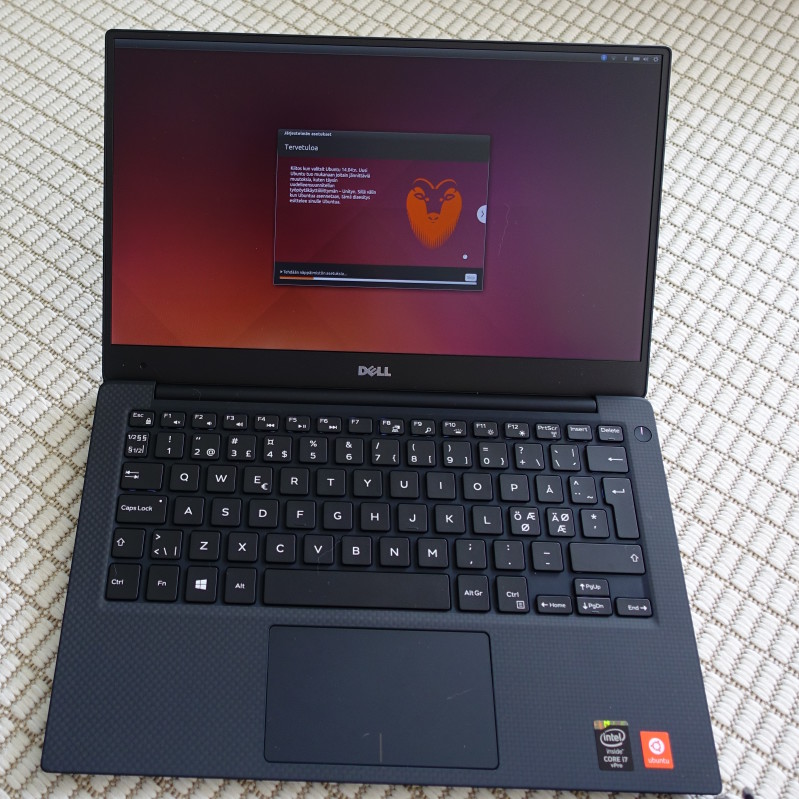
First time setup. Language, Dell EULA, connecting to WiFi, location, keyboard, user+password.
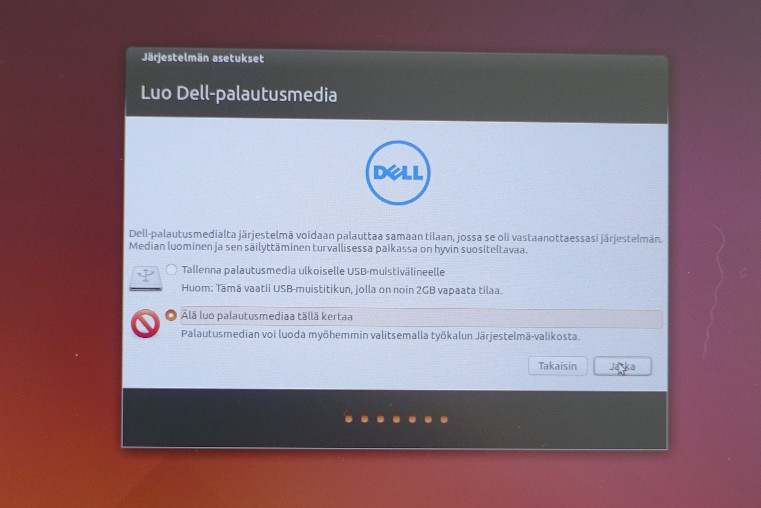
Creating recovery media. I opted not to do this as I had happened to read that it's highly recommended to install upgrades first, including to this tool.
Finalizing setup.
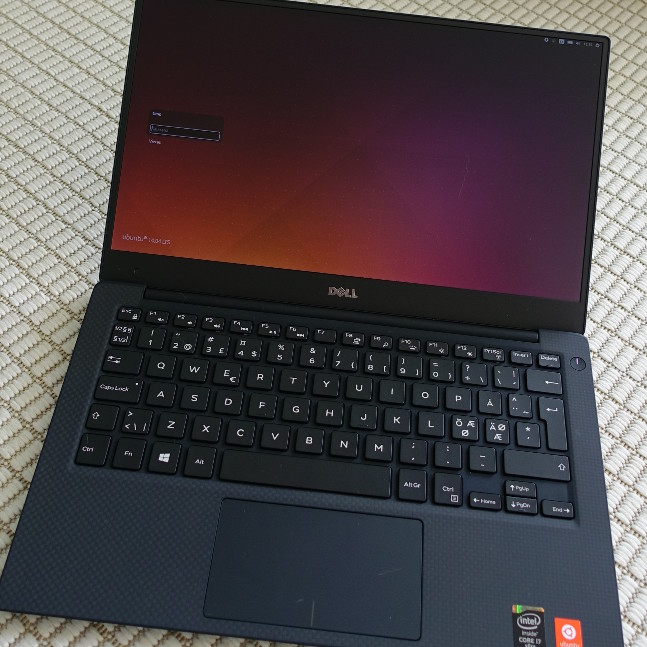
Ready to log in!
It's alive!
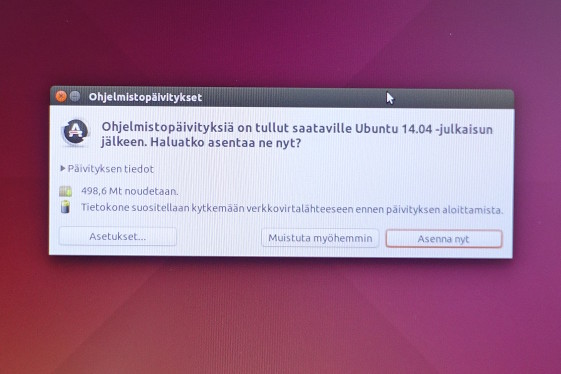
Not so recent 14.04 LTS image... lots of updates.
Problems in the First BatchUnfortunately the first batch of XPS 13:s with Ubuntu are going to ship with some problems. They're easy to fix if you know how to, but it's sad that they're there to begin with in the factory image. There is no knowledge when a fixed batch will start shipping - July maybe?
First of all, installing software upgrades stops. You need to run the following command via Dash Terminal once: sudo apt-get install -f (it suggests upgrading libc-dev-bin, libc6-dbg, libc6-dev and udev). After that you can continue running Software Updater as usual, maybe rebooting in between.
Secondly, the fixed touchpad driver is included but not enabled by default. You need to enable the only non-enabled Additional Driver as seen in the picture below or instructed in Youtube.
Dialog enabling the touchpad driver.
Clarification: you can safely ignore the two paragraphs below, they're just for advanced users like me who want to play with upgraded driver stacks.
Optionally, since I'm interested in the latest graphics drivers especially in case of a brand new hardware like Intel Broadwell, I upgraded my Ubuntu to use the 14.04.2 Hardware Enablement stack (matches 14.10 hardware support): sudo apt install --install-recommends libgles2-mesa-lts-utopic libglapi-mesa-lts-utopic linux-generic-lts-utopic xserver-xorg-lts-utopic libgl1-mesa-dri-lts-utopic libegl1-mesa-drivers-lts-utopic libgl1-mesa-glx-lts-utopic:i386
Even though it's much better than a normal Ubuntu 14.10 would be since many of the Dell fixes continue to be in use, some functionality might become worse compared to the pre-installed stack. The only thing I have noticed though is the internal microphone not working anymore out-of-the-box, requiring a kernel patch as mentioned in Dell's notes. This is not a surprise since the real eventual upstream support involves switching from HDA to I2S and during 14.10 kernel work that was not nearly done. If you're excited about new drivers, I'd recommend waiting until August when the 15.04 based 14.04.3 stack is available (same package names, but 'vivid' instead of 'utopic'). [edit: I couldn't resist myself when I saw linux-generic-lts-vivid (3.19 kernel) is already in the archives. 14.04.2 + that gives me working microphone again!] ConclusionDell XPS 13 Developer Edition with Ubuntu 14.04 LTS is an extremely capable laptop + OS combination nearing perfection, but not quite there because of the software problems in the launch pre-install image. The laptop looks great, feels like a quality product should and is very compact for the screen size.
I've moved over all my work onto it and everything so far is working smoothly in my day-to-day tasks. I'm staying at Ubuntu 14.04 LTS and using my previous LXC configuration to run the latest Ubuntu and Debian development versions. I've also done some interesting changes already like LUKS In-Place Conversion, converting the pre-installed Ubuntu into whole disk encrypted one (not recommended for the faint hearted, GRUB reconfiguration is a bit of a pain).
I look happily forward to working a few productive years with this one!
 What happened about the reproducible
builds effort for this week:
Presentations
On June 7th, Reiner Herrmann
presented the project at the
Gulaschprogrammiernacht 15 in Karlsruhe, Germany.
Video and audio
recordings
in German are available, and so are the slides in
English.
Toolchain fixes
 Note that I suspect the "Aller Holding A/S" entry to be incorrect
data in the official ownership register, as that name is not
registered in the official company register for Norway. The ownership
register is sensitive to typos and there seem to be no strict checking
of the ownership links.
Let me know if you improve the script or find better data sources.
The code is licensed according to GPL 2 or newer.
Update 2015-06-15: Since the initial post I've been told that
"
 As with all the previous versions, I have prepared a mega update for the Kobo firmware 3.16.0, including all my favorite patches and features. Please see details for

 I know very little about hardware.
I think I have a good understanding on many aspects of what happens inside a computer, but my knowledge is clearly firmer on what happens once an operating system is already running. And even then, my understanding of the lower parts of reality is shaky at most At least according to my self-evaluation, of course, comparing to people I'm honored to call "my peers".
During the last ~18 months, my knowledge of this part of reality, while still far from complete, has increased quite a bit Maybe mostly showing that I'm basically very cheap: As I have come across very cheap (or even free for me!) hardware, I have tried to understand and shape what happens in levels below those where I dwell.
I have been meaning to do a writeup on the
 The recent

 >22000 source packages in Debian main today
Just now Debian main for the first time had more than 22000 source packages in unstable,
 Long ago, in days of yore, we assumed that any software worth having would be
packaged by the operating system we used. Debian with its enormous pile of
software (over 20,000 sources last time I looked) looked to basically contain
every piece of free software ever. However as more and more people have come
to Linux-based and BSD-based systems, and the proliferation of *NIX-based
systems has become even more diverse, it has become harder and harder to ensure
that everyone has access to all of the software they might choose to use.
Couple that with the rapid development of new projects, who clearly want to get
users involved well before the next release cycle of a Linux-based distribution
such as Debian, and you end up with this recommendation to bypass the operating
system's packaging system and simply
 Up to recently, the only social presence for
 This year, on top of the many excellent contributed talks, BoFs, and other
events always part of DebConf (some of which have already been announced) we
are excited to have confirmed the following keynote speakers.
During the Open Weekend (Saturday, August 15th and Sunday, August 16th), we
will have keynotes delivered by:

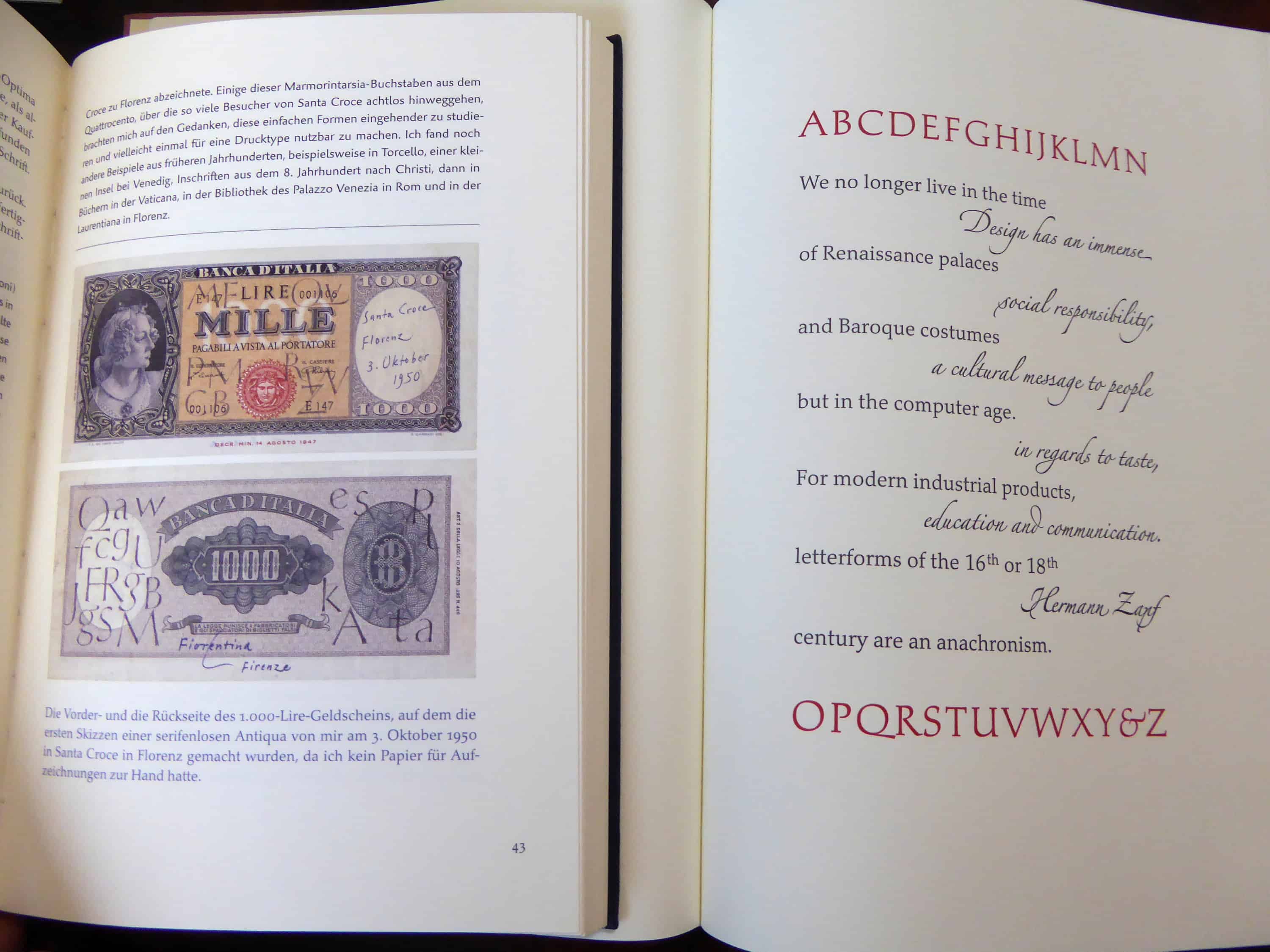
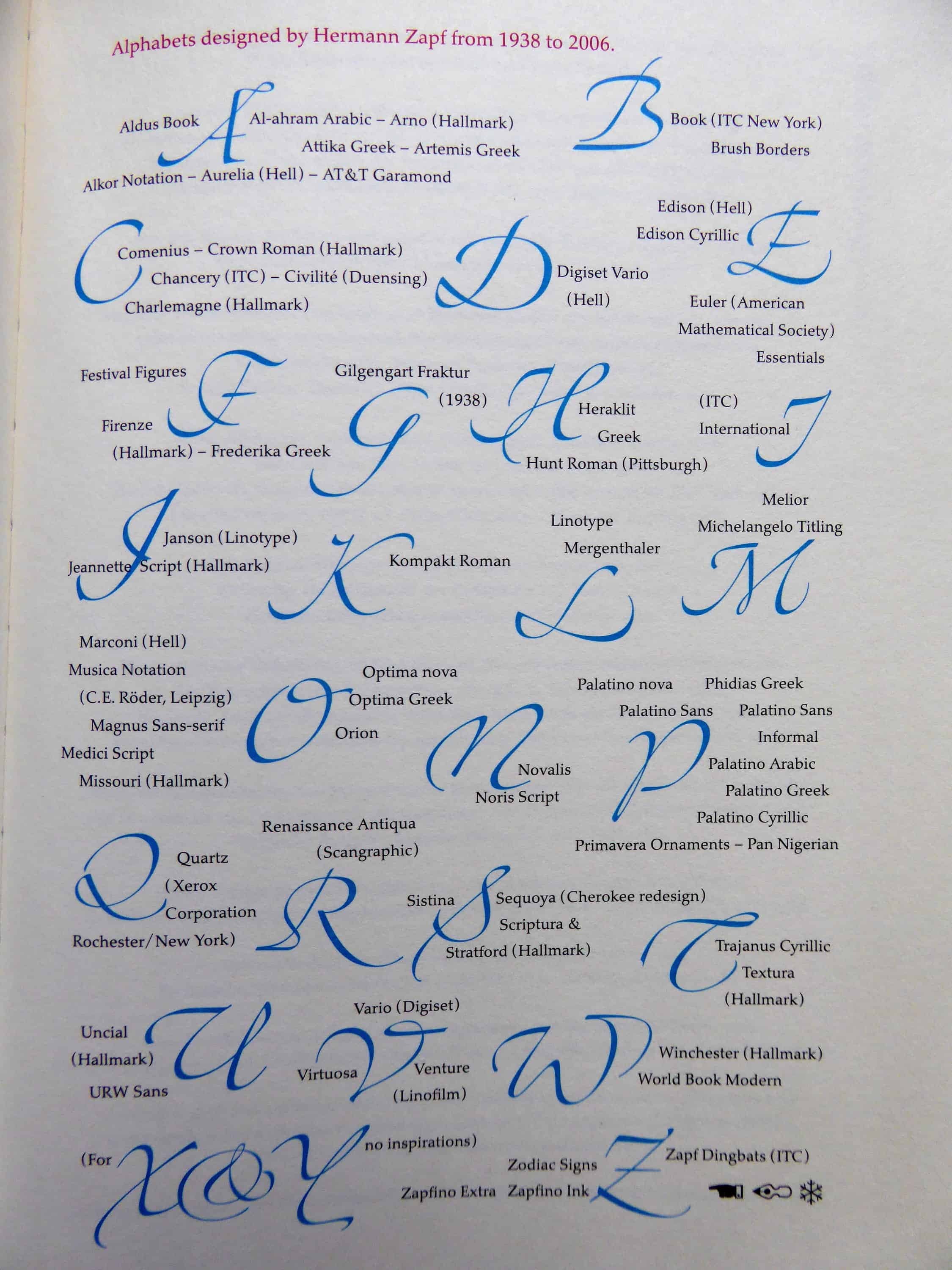

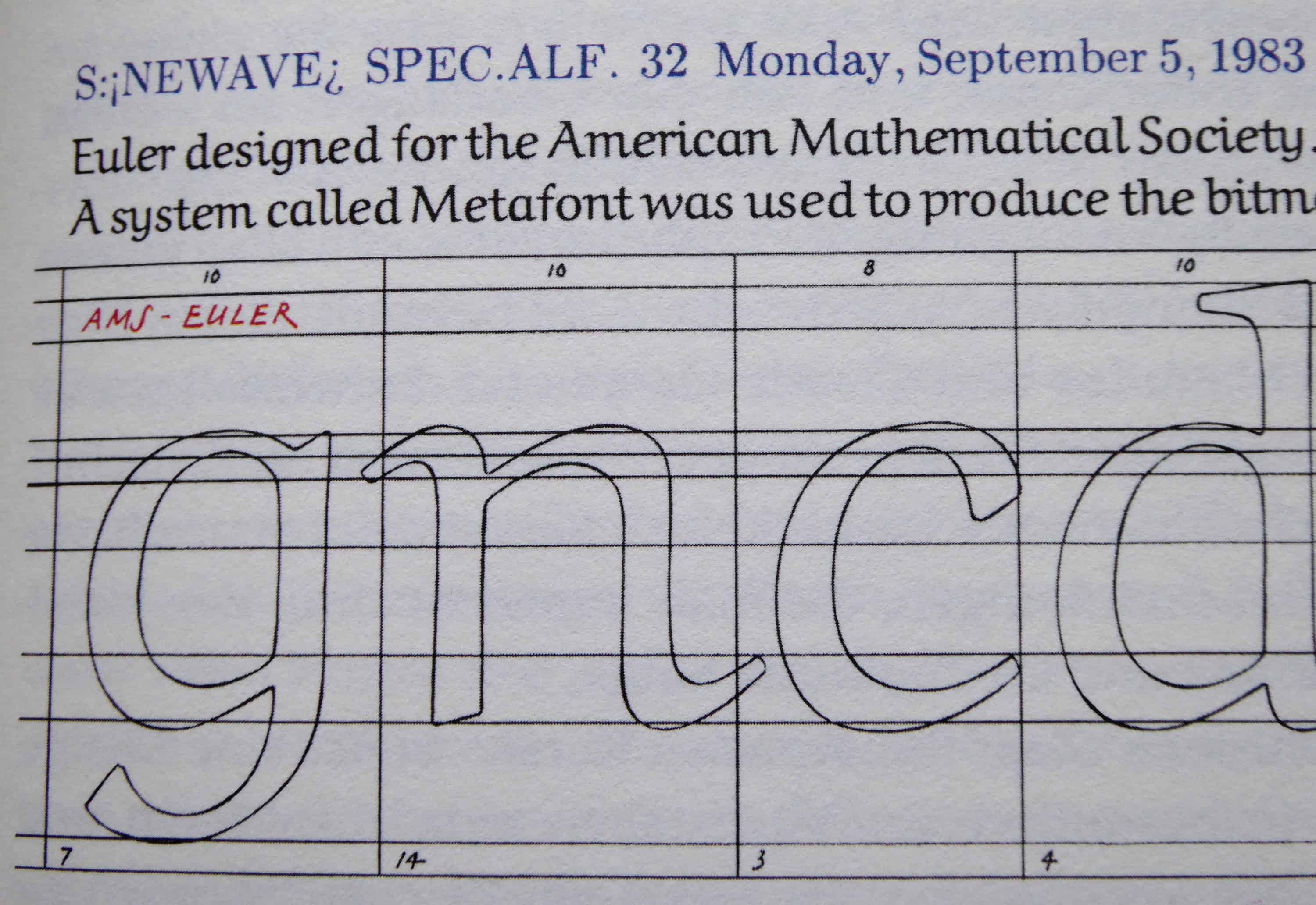


 Let us start with recalling the different actions that have to be taken when TeX packages are installed, removed, or updated.
Required actions for TeX packages
Filename database
The simplest case are packages that only include files ment to be loaded while running TeX or Metafont or similar programs. In this case the file name database of TeX (and the one of ConTeXt) needs to be updated. Usually this is done by calling mktexlsr on the changed trees, plus, if ConTeXt is installed, running mtxrun --generate.
Font map activation
More complicated are font packages that provide PostScript fonts. These packages need to ship a so called map file which maps TeX font names to PostScript fonts names. Examples are lm.map which defines this mapping for the Latin Modern fonts. All these map files have to be collected in one or more updmap.cfg files, and then a call to updmap(-sys) is necessary to generate configuration files for dvips, pdftex, and some other programs.
Format and hyphenation definitions
Even more complicated is the case of additional hyphenation patterns and additional format definitions. At the moment, hyphenation patterns are only shipped from the TeX Live packages itself, but additional format definitions are already provided by other packages than the TeX Live ones. Again, in both cases all the different format and hyphenation pattern definitions must be combined, into configuration files fmtutil.cnf and several language.* files, respectively. After this some incantation of fmtutil(-sys) is necessary to update the format dumps of TeX.
Status up to Debian/TeX Live 2014
Up to now most of these actions are done in the postinstall script of the providing packages, generated by dh_installtex. The
 Anyway, I hope to hear some feedback and installation reports.
Conclusion
While packaging has become easier for maintainers, and there is less clutter in /etc/texmf/, we now are depending on dpkg to call the tex-common triggers. Thus, if this happens rather often, then especially fmtutil-sys --all will be called several times. This is a slight regression from the previous setup, but paid off (IMNSHO) by the arguments given in the beginning.
That said, there will be of course a certain time of transition until the new setup has proven its merits, and bugs are ironed out. But having bugs that need to be mostly fixed only in one package, namely tex-common, seems like an easier task to me.
Enjoy.
 I recently obtained the newest Dell's Ubuntu developer offering, XPS 13 (2015, model 9343). I opted in for FullHD non-touch display, mostly because of better battery life, the actual no need for higher resolution, and matte screen which is great outside. Touch would have been "nice-to-have", but in my work I don't really need it.