Search Results: "sto"

15 February 2013

Iustin Pop: Garmin Montana

Garmin Montana notes Sometimes, I get waaay too excited about gadgets, and I have to share it. So, sorry, here it goes :) For some reason that is not very important, I was looking for a better solution for GPSes with maps. Side-note: if you ask why Android is not good enough , here's the story: last year, knowing that Google Maps supports caching (finally), I upgraded Maps, preloaded London, and went on a trip. Only to exit the Victoria underground station and to stare ~20 minutes in light rain at my phone, wondering why it doesn't get a fix. I gave up in the end, and used the cached maps for getting around. Later I learned the reason: Maps was not broken, but without data, Android can't get a lock easily; and more-over, the recent Maps update without GPS active even once afterwards, to do whatever it needed, meant I couldn't get a lock until back in Switzerland. Or, alternatively: while on a trip to Japan, it turns out that Google Maps caching is not supported there, probably because of rights over mapping data. So I had location, but only temporary cached maps (from the wifi in the hotels). Due to this kind of problems makes I consider Android maps a toy, so I wanted a GPS device with proper maps (on the device, not in the cloud), and with good GPS capabilities (no fancy A-GPS or anything, just plain good standalone GPS). Having had good experiences with the sport line of Garmin (but which doesn't have maps, so it's out of the question), I looked at Garmin. Many people complained about some things (same all over the place): The latter is something that jumped at me from many of the blogs/fora that I read; I like customisable power tools , not one-button mice. The other thing that I didn't really like was that most devices are very focused on a niche: the n vi line on automotive, the Zumo line on motorbikes, and the hand-held lines with some blurring of hiking/geocaching/etc. So no one-size fits all device Features! Customisation! That is, until I found out the Montana series. My my, I was blown. Both by the price (I couldn't believe how expensive it was, without maps!) and by the features. As it turns out, the Montana has different profiles , and it can act: That is for flexibility. As for performance/features: Now for the downsides. Being a multi-functional device, it's not as good as a dedicated one: But the small (for me) draw-backs aside, it's definitely not a dumbed-down device. It's the first device that I have which I feel it a bit too customisable . From completely changeable menus, to profiles that remember their maps selection, to many dashboards, to almost-programmable shortcuts (e.g. a shortcut to change profile, set destination to a given way point, reset the trip log, and turn track logging on) a bit overwhelming at first. Add the 3-axis compass, barometric altimeter, ANT+ support and you get a very powerful device. Software As to the software, yes it has some bugs - mainly that the device crashes sometimes (abruptly) if you play too much with the routes (didn't happen to me yet on the road , only when testing it at home). On the PC-side, Garmin's BaseCamp is nice, but doesn't hold a candle to Google Maps, for example, in terms of UI; I don't mean shininess, but simply how well the UI works. The most annoying thing is how it doesn't scale detail appropriately with the zoom level. But it works, and I can plan hikes offline, and upload both tracks and routes to it (this is important: it seems other recent Garmins can't replay tracks, only routes). And I can load many maps, and toggle them at will, etc. The many maps feature is not to be overlooked. I could have, for example, standard Garmin maps loaded, but just in case they're insuficiently detailed or out of date (hey, Navteq is slow ), I can also have Open Street Maps from two days ago. The routing is then done on the currently active maps, so you are not restricted to a single mapping provider. And of course you can also have custom POIs (Point of interest) on it. Bycicle use The bicycle mount is solid enough, so that on a rough roads it's held firmly. From my ~20 minute test this morning, a few things to note: Voice output By default, the unit can only beep, but if coupled via a 3.5" jack to headphones or via the automotive mount, it can properly speak; quality varies with voice, and whether it is TTS or not. I managed to find one voice (non-TTS) that sounds really well, but of course with less information, and one TTS voice that sounds OK-ish but gives full info. By full info , I mean the following: the behaviour of the various TTS voices is not consistent. For example, on a simulated route, various voices were saying the following: I don't know why these differences, or if they are consistent across routes. But I'll keep with voice E for now :) Summary So, sorry again for sounding like an ad (I don't have any relation with Garmin the company), but I find this device awesome - powerful, rugged, and working (so far) very well. I'm glad that there still exist companies who don't believe they know better than their customers, and instead offer you with a tool that you can make it work just like you want. Or almost ;-) Garmin's tag line: Big and Tough Goes anywhere, everywhere . I tend to agree :)

Richard Hartmann: Release Critical Bug report for Week 07

Technology Technology is... weird. I am in a cabbin in the middle of Lapland an hour away from the next city to speak of. GPS
N 66 15.958
E 24 59.981

look it up. We haven't had power for the last 60 minutes, the electrical heaters are out and we are trying to keep the main room warm with a wood stove while the wood-burning sauna above is ready to receive us the minute I hI push this post. The cabbin has become noticiably colder already, supply of logs small enough to actually burn is limited, we don't have an axe, but we have a car so we can leave if need be. The next house is about six kilometers away, no idea if they have power or not; the woods are dark all round other than for snowshine. Yet, I am sitting here, LED lamp lighting the room, GPS telling me what location to write into this post, laptop running on battery, cell phone with EGPRS supplying me with bugstats plus picture (even though I had to do most of it by hand as LWP::Simple barfs on the timeout) and allowing me to push to ikiwiki. As I said, technology is... weird. Bugology The UDD bugs interface currently knows about the following release critical bugs: How do we compare to the Squeeze release cycle?
Week Squeeze Wheezy Diff
43 284 (213+71) 468 (332+136) +184 (+119/+65)
44 261 (201+60) 408 (265+143) +147 (+64/+83)
45 261 (205+56) 425 (291+134) +164 (+86/+78)
46 271 (200+71) 401 (258+143) +130 (+58/+72)
47 283 (209+74) 366 (221+145) +83 (+12/+71)
48 256 (177+79) 378 (230+148) +122 (+53/+69)
49 256 (180+76) 360 (216+155) +104 (+36/+79)
50 204 (148+56) 339 (195+144) +135 (+47/+90)
51 178 (124+54) 323 (190+133) +145 (+66/+79)
52 115 (78+37) 289 (190+99) +174 (+112/+62)
1 93 (60+33) 287 (171+116) +194 (+111/+83)
2 82 (46+36) 271 (162+109) +189 (+116/+73)
3 25 (15+10) 249 (165+84) +224 (+150/+74)
4 14 (8+6) 244 (176+68) +230 (+168/+62)
5 2 (0+2) 224 (132+92) +222 (+132/+90)
6 release! 212 (129+83) +212 (+129/+83)
7 release+1 194 (128+66) +194 (+128/+66)
Graphical overview of bug stats thanks to azhag:

Robert Collins: More subunit needs

Of course, as happens sadly often, the scope creeps.. Additional pain points Zope s test runner runs things that are not tests, but which users want to know about layers . At the moment these are reported as individual tests, but this is problematic in a couple of ways. Firstly, the same test runs on multiple backend runners, so timing and stats get more complex. Secondly, if a layer fails to setup or teardown, tools like testrepository that have watched the stream will think a test failed, and on the next run try to explicitly run that test but that test doesn t really exist, so it won t run [unless an actual test that needs the layer is being run]. Openstack uses python coverage to gather coverage statistics during test runs. Each worker running tests needs to gather and return such statistics. The current subunit protocol has no space to hand this around, without it pretending to be a test [see a pattern here?]. And that has the same negative side effect test runners like testrepository will try to run that test . While testrepository doesn t want to know about coverage itself, it would be nice to be able to pass everything around and have a local hook handle the aggregation of that data. The way TAP is reflected into subunit today is to mangle each tap test into a subunit test , but for full benefits subunit tests have a higher bar they are individually addressable and runnable. So a TAP test script is much more equivalent to a subunit test. A similar concept is landing in Python s unittest soon subtests which will give very lightweight additional assertions within a larger test concept. Many C test runners that emit individual tests as simple assertions have this property as well there may be 5 or 10 executables each with dozens of assertions, but only the executables are individually addressable there is no way to run just one assertion from an executable as a test . It would be nice to avoid the friction that currently exists when dealing with that situation. Minimum requirements to support these Layers can be supported via timestamped stdout output, or fake tests. Neither is compelling, as the former requires special casing in subunit processors to data mine it, and the latter confuses test runners. A way to record something that is structured like a test (has an id the layer, an outcome in progress / ok / failed, and attachment data for showing failure details) but isn t a test would allow the data to flow around without causing confusion in the system. TAP support could change to just show the entire output as progress on one test and then fail or not at the end. This would result in a cognitive mismatch for folk from the TAP world, as TAP runners report each assertion as a test , and this would be hidden from subunit. Having a way to record something that is associated with an actual test, and has a name, status, attachment content for the TAP comments field that would let subunit processors report both the addressable tests (each TAP script) and the individual items, but know that only the overall scripts are runnable. Python subtests could use a unique test for each subtest, but that has the same issue has layers. Python will ensure a top level test errors if a subtest errors, so strictly speaking we probably don t need an associated-with concept, but we do need to be able to say that a test-like thing happened that isn t actually addressable. Coverage information could be about a single test, or even a subtest, or it could be about the entire work undertaken by the test process. I don t think we need a single standardised format for Coverage data (though that might be an excellent project for someone to undertake). It is also possible to overthink things :) . We have the idea of arbitrary attachments for tests. Perhaps arbitrary attachments outside of test scope would be better than specifying stdout/stderr as specific things. On the other hand stdout and stderr are well known things. Proposal version 2 A packetised length prefixed binary protocol, with each packet containing a small signature, length, routing code, a binary timestamp in UTC, a set of UTF8 tags (active only, no negative tags), a content tag one of (estimate + number, stdin, stdout, stderr, file, test), test-id, runnable, test-status (one of exists/inprogress/xfail/xsuccess/success/fail/skip), an attachment name, mime type, a last-block marker and a block of bytes. The std/stdout/stderr content tags are gone, replaced with file. The names stdin,stdout,stderr can be placed in the attachment name field to signal those well known files, and any other files that the test process wants to hand over can be simply embedded. Processors that don t expect them can just pass them on. Runnable is a boolean, indicating whether this packet is describing a test that can be executed deliberately (vs an individual TAP assertion, Python sub-test etc). This permits describing things like zope layers which are top level test-like things (they start, stop and can error) though they cannot be run.. and it doesn t explicitly model the setup/teardown aspect that they have. Should we do that? Testid is for identifying tests. With the runnable flag to indicate whether a test really is a test, subtests can just be namespaced by the generator reporters can choose whether to be naive and report every test , or whether to use simple string prefix-with-non-character-seperator to infer child elements. Impact on Python API If we change the API to:
class TestInfo(object):
    id = unicode
    status = ('exists', 'inprogress', 'xfail', 'xsuccess', 'success', 'fail', 'error', 'skip')
    runnable = boolean
class StreamingResult(object):
    def startTestRun(self):
        pass
    def stopTestRun(self):
        passs
    def estimate(self, count, route_code=None, timestamp=None):
        pass
    def file(self, name, bytes, eof=False, mime=None, test_info=None, route_code=None, timestamp=None):
        """Inform the result about the contents of an attachment."""
    def status(self, test_info, route_code=None, timestamp=None):
        """Inform the result about a test status with no attached data."""
This would permit the full semantics of a subunit stream to be represented I think, while being a narrow interface that should be easy to implement. Please provide feedback! I ll probably start implementing this soon.

14 February 2013

Russell Coker: Conversion of Video Files

To convert video files between formats I use Makefiles, this means I can run make -j2 on my dual-core server to get both cores going at once. avconv uses 8 threads for it s computation and I ve seen it take up to 190% CPU time for brief periods of time, but overall it seems to average a lot less, if nothing else then running two copies at once allows one to calculate while the other is waiting for disk IO. Here is a basic Makefile to generate a subdirectory full of mp4 files from a directory full of flv files. I used to use this to convert my Youtube music archive for my Android devices until I installed MX Player which can play every type of video file you can imagine [1]. I ll probably encounter some situation where this script becomes necessary again so I keep it around. It s also a very simple example of how to run a batch conversion of video files. MP4S:=$(shell for n in *.flv ; do echo $$n sed -e s/^/mp4\\// -e s/flv$$/mp4/ ; done)

all: $(MP4S)

mp4/%.mp4: %.flv
avconv -i $< -strict experimental -b $$(~/bin/video-encoding-rate $<) $@ > /dev/null Here is a more complex Makefile. I use it on my directory of big videos (more than 1280*720 resolution) and scales them down for my favorite Android devices (Samsung Galaxy S3, Samsung Galaxy S, and Sony Ericsson Xperia X10). My Galaxy S3 can t play a FullHD version of Gangnam Style without going slow so I need to do this even for the fastest phones. This makefile generates three subdirectories of mp4 files for the three devices. S3MP4S:=$(shell for n in *.mp4 ; do echo $$n sed -e s/^/s3\\// -e s/.mp4$$/-s3.mp4/ -e s/.flv$$/-s3.mp4/; done)
XPERIAMP4S:=$(shell for n in *.mp4 ; do echo $$n sed -e s/^/xperiax10\\// -e s/.mp4$$/-xperiax10.mp4/ -e s/.flv$$/-xperiax10.mp4/; done)
SMP4S:=$(shell for n in *.mp4 ; do echo $$n sed -e s/^/galaxys\\// -e s/.mp4$$/-galaxys.mp4/ -e s/.flv$$/-galaxys.mp4/; done)

all: $(S3MP4S) $(XPERIAMP4S) $(SMP4S)

s3/%-s3.mp4: %.mp4
avconv -i $< -strict experimental -s $(shell ~/bin/video-scale-resolution 1280 720 $<) $@ > /dev/null

galaxys/%-galaxys.mp4: %.mp4
echo avconv -i $< -strict experimental -s $(shell ~/bin/video-scale-resolution 800 480 $<) $@ > /dev/null

xperiax10/%-xperiax10.mp4: %.mp4
echo avconv -i $< -strict experimental -s $(shell ~/bin/video-scale-resolution 854 480 $<) $@ > /dev/null The following script is used by the above Makefile to determine the resolution to use. Some Youtube videos have unusual combinations of width and height (Linkin Park seems to like doing this) so I scale them down so it fits the phone in one dimension and the other dimension is scaled appropriately. This requires a script from the Mplayer package and expects it to be in the location that it s used in the Debian package, for distributions other than Debian a minor change will be required. #!/bin/bash
set -e
OUT_VIDEO_WIDTH=$1
OUT_VIDEO_HEIGHT=$2

eval $(/usr/share/mplayer/midentify.sh $3)
XMULT=$(echo $ID_VIDEO_WIDTH*100/$OUT_VIDEO_WIDTH bc)
YMULT=$(echo $ID_VIDEO_HEIGHT*100/$OUT_VIDEO_HEIGHT bc)
if [ $XMULT -gt $YMULT ]; then
NEWX=$OUT_VIDEO_WIDTH
NEWY=$(echo $OUT_VIDEO_WIDTH*$ID_VIDEO_HEIGHT/$ID_VIDEO_WIDTH/2*2 bc)
else
NEWX=$(echo $OUT_VIDEO_HEIGHT*$ID_VIDEO_WIDTH/$ID_VIDEO_HEIGHT/2*2 bc)
NEWY=$OUT_VIDEO_HEIGHT
fi
echo $ NEWX x$ NEWY Note that I can t preserve TAB characters in a blog post. So those Makefiles won t work until you replace strings of 8 spaces with a TAB character.

Robert Collins: Time to revise the subunit protocol

Subunit is seven and a half years old now Conrad Parker and I first sketched it up at a CodeCon camping and coding, a brilliant combination in mid 2005.
revno: 1
committer: Robert Collins <robertc@robertcollins.net>
timestamp: Sat 2005-08-27 15:01:20 +1000
message:  design up a protocol with kfish
It has proved remarkably resilient as a protocol the basic nature hasn t changed at all, even though we ve added tags, timestamps, support for attachments of arbitrary size. However a growing number of irritations have been building up with it. I think it is time to design another iteration of the protocol, one that will retain the positive qualities of the current protocol, while helping it become suitable for the next 7 years. Ideally we can keep compatibility and make it possible for a single stream to be represented in any format. Existing design The existing design is a mostly human readable line orientated protocol that can be sniffed out from the regular output of make or other build systems. Binary attachments are done using HTTP chunking, and the parser has to maintain state about the current test, tags, timing data and test progression [a simple stack of progress counters]. How to arrange subunit output is undefined, how to select tests to run is undefined. This makes writing a parser quite easy, and the tagging and timestamp facility allow multiplexing streams from two or more concurrent test runs into one with good fidelity but also requires that state be buffered until the end of a test, as two tests cannot be executing at once. Dealing with debuggers The initial protocol was intended to support dropping into a debugger just pass each line read through to stdout, and connect stdin to the test process, and voila, you have a working debugger connection. This works, but the current line based parsers make using it tedious the line buffered nature of it makes feedback on what has been typed fiddly, and stdout tends to be buffered, leading to an inability to see print statements and the like. All in-principle fixable, right ? When running two or more test processes, which test process should stdin be connected to? What if two or more drop into a debugger at once? What is being typed to which process is more luck than anything else. We ve added some idioms in testrepository that control test execution by a similar but different format one test per line to list tests, and have runners permit listing and selecting by a list. This works well, but the inconsistency with subunit itself is a little annoying you need two parsers, and two output formats. Good points The current protocol is extremely easy to implement for emitters, and the arbitrary attachments and tagging features have worked extremely well. There is a comprehensive Python parser which maps everything into Python unittest API calls (an extended version of the standard, with good backwards compatibility). Pain points The debugging support was a total failure, and the way the parser depraminates it s toys when a test process corrupts an outcome line is extremely frustrating. (other tests execute but the parser sees them as non-subunit chatter and passes the lines on through stdout). Dealing with concurrency The original design didn t cater for concurrency. There are three concurrency issues the corruption issue (see below for more detail) and multiplexing. Consider two levels of nested concurrency: A supervisor process such as testrepository starts 2 (or more but 2 is sufficient to reason about the issue) subsidiary worker processes (I1 and I2), each of which starts 2 subsidiary processes of their own (W1, W2, W3, W4). Each of the 4 leaf processes is outputting subunit which gets multiplexed in the 2 intermediary processes, and then again in the supervisor. Why would there be two layers? A concrete example is using testrepository to coordinate test runs on multiple machines at once, with each machine running a local testrepository to broker tests amongst the local CPUs. This could be done with 4 separate ssh sessions and no intermediaries, but that only removes a fraction of the issues. What issues? Well, consider some stdout chatter that W1 outputs. That will get passed to I1 and from there to the supervisor and captured. But there is nothing marking the chatter as belonging to W1: there is no way to tell where it came from. If W1 happened to fail, and there was a diagnostic message printed, we ve lost information. Or at best muddled it all up. Secondly, buffering imagine that a test on W1 hangs. I1 will know that W1 is running a test, but has no way to tell the supervisor (and thus the user) that this is the case, without writing to stdout [and causing a *lot* of noise if that happens a lot]. We could have I1 write to stdout only if W1 s test is taking more than 5 seconds or something but this is a workaround for a limitation of the protocol. Adding to the confusion, the clock on W1 and W3 may be very skewed, so timestamps for everything have to be carefully synchronised by the multiplexer. Thirdly, scheduling if W1/W2 are on a faster machine than W3/W4 then a partition of equal-timed tests onto each machine will lead one idle before the other finishes. It would be nice to be able to pass tests to run to the faster machine when it goes idle, rather than having to start a new runner each time. Lastly, what to do when W1 and W2 both wait for user input on stdin (e.g. passphrases, debugger input, $other). Naively connecting stdin to all processes doesn t work well. A GUI supervisor could connect a separate fd to each of I1 and I2, but that doesn t help when it is W1 and W2 reading from stdin. So additional requirement over baseline subunit:
  1. make it possible for stdout and stderr output to be captured from W1 and routed through I1 to the supervisor without losing its origin. It might be chatter from a noisy test, or it might be build output. Either way, the user probably will benefit if we can capture it and show it to them later when they review the test run. The supervisor should probably show it immediately as well the protocol doesn t need to care about that, just make it possible.
  2. make it possible to pass information about tests that have not completed through one subunit stream while they are still incomplete.
  3. make it possible (but optional) to pass tests to run to a running process that accepts subunit.
  4. make it possible to route stdin to a specific currently process like W1. This and point 3 suggest that we need a bidirectional protocol rather than the solely unidirectional protocol we have today. I don t know of a reliable portable way to tell when some process is seeking such input, so that will be up to the user I think. (e.g. printing (pdb) to stdout might be a sufficiently good indicator.)
Dealing with corruption Consider the following subunit fragment:
test: foo
starting serversuccess:foo
This is a classic example of corruption: the test foo started a server and helpfully wrote to stdout explaining that it did that, but missed the newline. As a result the success message for the test wasn t printed on a line of its own, and the subunit parser will believe that foo never completed. Every subsequent test is then ignored. This is usually easy to identify and fix, but its a head-scratcher when it happens. Another way it can happen is when a build tool like make runs tests in parallel, and they output subunit onto the same stdout file handle. A third way is when a build tool like make runs two separate test scripts serially, and the first one starts a test but errors hard and doesn t finish it. That looks like:
test: foo
test: bar
success: bar
One way that this sort of corruption can be mitigated is to put subunit on it s own file descriptor, but this has several caveats: it is harder to tunnel through things like ssh and it doesn t solve the failing test script case. I think it is unreasonable to require a protocol where arbitrary interleaving of bytes between different test runner streams will work so the make -j2 case can be ignored at the wire level though we should create a simple way to safely mux the output from such tests when the execute. The root of the issue is that a dropped update leaves bad state in the parser and it never recovers. So some way to recover, or less state to carry in the parser, would neatly solve things. I favour reducing parser state as that should shift stateful complexity onto end nodes / complex processors, rather than being carried by every node in the transmission path. Dependencies Various suggestions have been made JSON, Protobufs, etc A key design goal of the first subunit was a low barrier to entry. We keep that by being backward compatible, but being easy to work with for the new revision is also a worthy goal. High level proposal A packetised length prefixed binary protocol, with each packet containing a small signature, length, routing code, a binary timestamp in UTC, a set of UTF8 tags (active only, no negative tags), a content tag one of (estimate + number, stdin, stdout, stderr, test- + test id), test status (one of exists/inprogress/xfail/xsuccess/success/fail/skip), an attachment name, mime type, a last-block marker and a block of bytes. The content tags: Test status values are pretty ordinary. Exists is used to indicate a test that can be run when listing tests, and inprogress is used to report a test that has started but not necessarily completed. Attachment names must be unique per routing code + testid. So how does this line up? Interleaving and recovery We could dispense with interleaving and say the streams are wholly binary, or we can say that packets can start either after a \n or directly after another packet. If we say that binary-only is the approach to take, it would be possible to write a filter that would apply the newline heuristic (or even look for packet headers at every byte offset. I think mandating adjacent to a packet or after \n is a small concession to make and will avoid tools like testrepository forcing users to always configure a heuristic filter. Non-subunit content can be wrapped in subunit for forwarding (the I1 in W1->I1->Supervisor chain would do the wrapping). This won t eliminate corruption but it will localise it and permit the stream to recover: the test that was corrupted will show up as incomplete, or with incomplete attachment data. listing Test listing would emit many small non-timestamped packets. It may be useful to have a wrapper packet for bulk amounts of fine grained data like listing is, or for multiplexers with many input streams that will often have multiple data packets available to write at once. Selecting tests to run Same as for listing while passing regexes down to the test runner to select groups of tests is a valid use case, thats not something subunit needs to worry about : if the selection is not the result of the supervisor selecting by test id, then it is known at the start of the test run and can just be a command line parameter to the backend : subunit is relevant for passing instructions to a runner mid-execution. Because the supervisor cannot just hand out some tests and wait for the thing it ran to report that it can accept incremental tests on stdin, supervisor processes will need to be informed about that out of band. Debugging Debugging is straight forward . The parser can read the first 4 or so bytes of a packet one at a time to determine if it is a packet or a line of stdout/stderr, and then either read to end of line, or the binary length of the packet. So, we combine a few things; non-subunit output should be wrapped and presented to the user. Subunit that is being multiplexed and forwarded should prepend a routing code to the packet (e.g. I1 would append 1 or 2 to select which of W1/W2 the content came from, and then forward the packet. S would append 1 or 2 to indicate I1/I2 the routing code is a path through the tree of forwarding processes). The UI the user is using needs to supply some means to switch where stdin is attached. And stdin input should be routed via stdin packets. When there is no routing code left, the packet should be entirely unwrapped and presented as raw bytes to the process in question. Multiplexing Very straight forward unwrap the outer layer of the packet, add or adjust the routing code, serialise a header + adjusted length + rest of packet as-is. No buffering is needed, so the supervisor can show in-progress tests (and how long they have been running for). Parsing / representation in Python or other languages The parser should be very simple to write. Once parsed, this will be fundamentally different to the existing Python TestCase->TestResult API that is in used today. However it should be easy to write two adapters: old-style <-> this new-style. old-style -> new-style is useful for running existing tests suites and generating subunit, because thats way the subunit generation is transparent. new-style->old-style is useful for using existing test reporting facilities (such as junitxml or html TestResult objects) with subunit streams. Importantly though, a new TestResult style that supports the features of this protocol would enable some useful features for regular Python test suites: The API might be something like:
class StreamingResult(object):
    def startTestRun(self):
        pass
    def stopTestRun(self):
        pass
    def estimate(self, count, route_code=None):
        pass
    def stdin(self, bytes, route_code=None):
        pass
    def stdout(self, bytes, route_code=None):
        pass
    def test(self, test_id, status, attachment_name=None, attachment_mime=None, attachment_eof=None, attachment_bytes=None):
        pass
This would support just-in-time debugging by wiring up pdb to the stdin/stdout handlers of the result object, rather than actual stdin/stdout of the process a simple matter once written. Alternatively, the test runner could replace sys.stdin/stdout etc with thunk file-like objects, which might be a good idea anyway to capture spurious output happening during a test run. That would permit pdb to Just Work (even if the test process is internally running concurrent tests.. until it has two pdb objects running concurrently :) Generation new streams Should be very easy in anything except shell. For shell, we can have a command line tool that when invoked outputs a subunit stream for one instruction. E.g. test foo completed + some attachments or test foo starting .

Michal &#268;iha&#345;: phpMyAdmin translations status

Next round of phpMyAdmin 4.0 translation status report is coming. So let's look at which translations are at 100% right now (some changes this week due to new strings to translate): There are also several languages which need just few strings to be complete: As you can see, there is still lot of languages missing, this might be your opportunity to contribute to phpMyAdmin. Also you are welcome to translate phpMyAdmin 4.0 using translation server. If your language is already fully translated and you want to help as well, you can translate our documentation as well.

Filed under: English Phpmyadmin 0 comments Flattr this!

13 February 2013

Lars Wirzenius: Public libraries bad for authors and publishers?

Brett points at a Guardian article on Terry Deary and his opinion that libraries are no longer relevant. In fact, Mr. Deary goes further: he thinks libraries are destroying the book business by preventing authors, publishers, and bookshops from getting paid. From the article:
As one of the most popular library authors his books were borrowed more than 500,000 times during 2011/12 Deary will have received the maximum amount possible for a writer from the Public Lending Right scheme, which gives authors 6.2p every time one of their books is borrowed, up to a cap of 6,600. "If I sold the book I'd get 30p per book. I get six grand, and I should be getting 180,000. But never mind my selfish author perception what about the bookshops? The libraries are doing nothing for the book industry. They give nothing back, whereas bookshops are selling the book, and the author and the publisher get paid, which is as it should be. What other entertainment do we expect to get for free?" he asked.
He's making several of the same false claims that people in the media business always make whenever they see people enjoying any kind of cultural products without paying for them.
  1. Every loan from a library is not a lost sale. More than 500 thousand loans does not mean 500 thousand lost sales. When borrowing a book is free, people will do it even if they aren't sure if they're going to like a book. The cheapest book by Mr. Deary I Amazon UK is 4.27 when sold as new by amazon (I'll ignored used books for the moment). The threshold for buying a book at that price is much, much higher than borrowing on for free.
  2. Letting people have stuff for free does not automatically mean they won't pay for other stuff. Indeed, they may well pay for the very stuff they got for free. See the several experiments to let customers set their own price for music, books, or computer games, or the success Cory Doctorow has letting people download e-books of his novels for free, and then letting people donate one or more hardcopies of the book to schools and libraries. This is not a model that will work well for everyone, but it proves the point: charging people money for each copy is not necessary to make good profit. In fact, studies of "Internet pirates", or people who download music and movies (and books) more or less illegally from the Internet, show that such people tend to spend more money on music and movies (and books!) than the average person. That's not something the publishers want to talk about, or hear. (I am talking here about real research, not the propganda material that lobbying organisations produce.)
  3. Why would people buy a book in the first place? They need to know they'll like it, but more importantly, they need to like reading in the first place. See point 1: if books cost any amount of money, the threshold for getting one is high. If you don't have easy, convenient access to books when you're a child, you're unlikely to be a reader of books when you're an adult. Public libraries are the perfect way to give people access to a wide variety of literature. In fact, they're about the most perfect marketing ploy in the history of media: the libraries pay for the books, and they pay each time they loan out a book, and every time a new future customer is brainwashed that much more into getting more stuff in the future. Libraries are not just for children, of course. Adult readers use them as well, and they're just as important as children, as far as the marketing ploy is concerned.
It's a bit sad that bookshops are dying out. Public libraries have, however, nothing to do with it. Online booksellers are usually cheaper, and have vastly larger catalogues, and that's a much more likely culprit. Also, bookshops have no intrinsic right to exist: they're middle-men who make a living by making it more convenient for customers to get what they want, and if they get out-competed, that's business life. Now, I neglected above to consider the possibility of buying used books. The reason for that is that media companies, and their lobbying organisations, would like to make selling of used books, music recordings, movies, and computer games not happen anymore. For example, Sony, and files patents for, stopping people from playing used games on its game consoles, even without Internet access. Mr. Deary seems to be following the MPAA and RIAA checklist on how to talk about those evil people who enjoy something without paying for it every time. It can't be long before he starts asking for a ban on selling used books. Let's hope, however, that reality and facts and sense win this time, and that we can let Mr. Deary live alone in his little horrible hallucination.

Brett Parker: Public Libraries...

OK - so I've just been reading the Gaurdian Article on Terry Deary saying that Libraries are outdated and should be got rid of. I entirely disagree with him, I spent a fair amount of my youth borrowing books from my local library, when I had no income, and so the only alternative to borrowing from the library would have been saving up for second hand books... which he wouldn't have seen a penny from. These days I buy Quite A Few books (OK - so, mostly on the kindle these days, but still), if it hadn't have been for libraries when I was younger and couldn't afford to purchase books, I may never have properly picked up the reading habit. His claim that they're killing bookshops is also, in my opinion, entirely wrong. Bookshops are closing more because of the ease of ordering books online and getting them delivered to your door, with a huge collection of books available from large warehouses rather than the stock that a book store can sell easily. We've got a vast collection of literature available to us now, and it's only ever going upwards, no book shop or single library is going to be able to cater for the entirely different needs of their customers. Libraries do inter library lending, which means that the collection of rarer, less popular books are still available (potentially with a bit of a wait), and every time the book is lent the author gets some funds. If he seriously thinks that if libraries closed the number of people reading his material would stay the same I think he's mistaken. He also doesn't seem to take in to account at all the second hand book market. All I have to say is NYARGH.

Patrick Matth i: otrs and geoip-database updates

I have just uploaded the monthly update of geoip-database to Debian unstable and squeeze-backports, unblock request already filled. I also uploaded otrs2 in the new version 3.2.1+dfsg1-1, which is also fixing bug #690306, fixing because the upgrade will abort with a list of MySQL tables where the administrator has to fix ether the engine from MyISAM to InnoDB (or the other way, as he want to) and by fxing the default engine of his MySQL database server. Ugly issue, ugly hack, but there is no better solution.. Full changelog of otrs Debian packaging:
   * New upstream release.
     - Add new dependency libyaml-libyaml-perl.
     - Refresh patch 03-postmaster.
     - Refresh patch 05-opt.
     - Refresh patch 13-dont-chown-links.
     - Refresh patch 16-disable-DashboardProductNotify.
     - Refresh patch 19-fix-SetPermissions-to-include-some-more-dirs.
     - Rewrite patch 25-use-locale-country, since all_country_names() does not
       accept arguments.
     - Refresh patch 26-font-paths.
     - Rewrite patch 04-backup.
     - Rewrite patch 15-usable-apache-config.
     - Rewrite patch 21-use-debian-libjs-packages.
     - Rewrite patch 23-load-debian-libjs.
     - Remove old database schemas and add new 3.2 ones.
   * Monitor all releases again.
   * Drop patch 24-default-myisam and check with the new otrs.CheckDB.pl script,
     if the available tables and the used storage engine are equal. If it is not
     the case the installation should abort, so that the administrator can fix
     his MySQL server or the already created tables.
     Closes: #690306
   * Remove deprecated packaging notes from README.Debian.
   * Remove deprecated NEWS file from packaging.
   * Remove deprecated files from otrs2.examples.
   * Solve duplicate-changelog-files by not installing the CHANGES file.
   * Remove some more deprecated files from otrs2.docs.
   * Add lintian override for empty-binary package otrs.
   * Remove some old permission fixes from debian/rules.
   * Add upstream patch 01-innodb-fk-error to fix some foreign key errors if the
     tables are created with InnoDB.

12 February 2013

Martin Pitt: umockdev: record and mock hardware for debugging and testing

What is this? umockdev is a set of tools and a library to mock hardware devices for programs that handle Linux hardware devices. It also provides tools to record the properties and behaviour of particular devices, and to run a program or test suite under a test bed with the previously recorded devices loaded. This allows developers of software like gphoto or libmtp to receive these records in bug reports and recreate the problem on their system without having access to the affected hardware, as well as writing regression tests for those that do not need any particular privileges and thus are capable of running in standard make check. After working on it for several weeks and lots of rumbling on G+, it s now useful and documented enough for the first release 0.1! Component overview umockdev consists of the following parts: Example: Record and replay PtP/MTP USB devices So how do you use umockdev? For the debug a problem use case you usually don t want to write a program that uses libumockdev, but just use the command line tools. Let s capture some runs from libmtp tools, and replay them in a mock environment: Example: using the library to fake a battery If you want to write regression tests, it s usually more flexible to use the library instead of calling everything through umockdev-run. As a simple example, let s pretend we want to write tests for upower. Batteries, and power supplies in general, are simple devices in the sense that userspace programs such as upower only communicate with them through sysfs and uevents. No /dev nor ioctls are necessary. docs/examples/ has two example programs how to use libumockdev to create a fake battery device, change it to low charge, sending an uevent, and running upower on a local test system D-BUS in the testbed, with watching what happens with upower --monitor-detail. battery.c shows how to do that with plain GObject in C, battery.py is the equivalent program in Python that uses the GI binding. You can just run the latter like this:
  umockdev-wrapper python3 docs/examples/battery.py
and you will see that upowerd (which runs on a temporary local system D-BUS in the test bed) will report a single battery with 75% charge, which gets down to 2.5% a second later. The gist of it is that you create a test bed with
  UMockdevTestbed *testbed = umockdev_testbed_new ();
and add a device with certain sysfs attributes and udev properties with
    gchar *sys_bat = umockdev_testbed_add_device (
            testbed, "power_supply", "fakeBAT0", NULL,
            /* attributes */
            "type", "Battery",
            "present", "1",
            "status", "Discharging",
            "energy_full", "60000000",
            "energy_full_design", "80000000",
            "energy_now", "48000000",
            "voltage_now", "12000000",
            NULL,
            /* properties */
            "POWER_SUPPLY_ONLINE", "1",
            NULL);
You can then e. g. change an attribute and synthesize a change uevent with
  umockdev_testbed_set_attribute (testbed, sys_bat, "energy_now", "1500000");
  umockdev_testbed_uevent (testbed, sys_bat, "change");
With Python or other introspected languages, or in Vala it works the same way, except that it looks a bit leaner due to proper object semantics. Packages I have a packaging branch for Ubuntu and a recipe to do daily builds with the latest upstream code into my daily builds PPA (for 12.10 and raring). I will soon upload it to Raring proper, too. What s next? The current set of features should already get you quite far for a range of devices. I d love to get feedback from you if you use this for anything useful, in particular how to improve the API, the command line tools, or the text dump format. I m not really happy with the split between umockdev (sys/dev) and ioctl files and the relatively complicated CLI syntax of umockdev-record, so any suggestion is welcome. One use case that I have for myself is to extend the coverage of ioctls for input devices such as touch screens and wacom tablets, so that we can write some tests for gnome-settings-daemon plugins. I also want to find a way to pass ioctls back to the test suite/calling program instead of having to handle them all in the preload library, which would make it a lot more flexible. However, due to the nature of the ioctl ABI this is not easy. Where to go to The code is hosted on github in the umockdev project; this started out as a systemd branch to add this functionality to libudev, but after a discussion with Kay we decided to keep it separate. But I kept it in git anyway, given how popular it is today. For the bzr lovers, Launchpad has an import at lp:umockdev. Release tarballs will be on Launchpad as well. Please file bugs and enhancement requests in the git hub tracker. Finally, if you have questions or want to discuss something, you can always find me on IRC (pitti on Freenode or GNOME). Thanks for your attention and happy testing!

Petter Reinholdtsen: "Electronic" paper invoices - using vCard in a QR code

Here in Norway, electronic invoices are spreading, and the solution promoted by the Norwegian government require that invoices are sent through one of the approved facilitators, and it is not possible to send electronic invoices without an agreement with one of these facilitators. This seem like a needless limitation to be able to transfer invoice information between buyers and sellers. My preferred solution would be to just transfer the invoice information directly between seller and buyer, for example using SMTP, or some HTTP based protocol like REST or SOAP. But this might also be overkill, as the "electronic" information can be transferred using paper invoices too, using a simple bar code. My bar code encoding of choice would be QR codes, as this encoding can be read by any smart phone out there. The content of the code could be anything, but I would go with the vCard format, as it too is supported by a lot of computer equipment these days. The vCard format support extentions, and the invoice specific information can be included using such extentions. For example an invoice from SLX Debian Labs (picked because we ask for donations to the Debian Edu project and thus have bank account information publicly available) for NOK 1000.00 could have these extra fields:
X-INVOICE-NUMBER:1
X-INVOICE-AMOUNT:NOK1000.00
X-INVOICE-KID:123412341234
X-INVOICE-MSG:Donation to Debian Edu
X-BANK-ACCOUNT-NUMBER:16040884339
X-BANK-IBAN-NUMBER:NO8516040884339
X-BANK-SWIFT-NUMBER:DNBANOKKXXX
The X-BANK-ACCOUNT-NUMBER field was proposed in a stackoverflow answer regarding how to put bank account information into a vCard. For payments in Norway, either X-INVOICE-KID (payment ID) or X-INVOICE-MSG could be used to pass on information to the seller when paying the invoice. The complete vCard could look like this:
BEGIN:VCARD
VERSION:2.1
ORG:SLX Debian Labs Foundation
ADR;WORK:;;Gunnar Schjelderups vei 29D;OSLO;;0485;Norway
URL;WORK:http://www.linuxiskolen.no/slxdebianlabs/
EMAIL;PREF;INTERNET:sdl-styret@rt.nuug.no
REV:20130212T095000Z
X-INVOICE-NUMBER:1
X-INVOICE-AMOUNT:NOK1000.00
X-INVOICE-MSG:Donation to Debian Edu
X-BANK-ACCOUNT-NUMBER:16040884339
X-BANK-IBAN-NUMBER:NO8516040884339
X-BANK-SWIFT-NUMBER:DNBANOKKXXX
END:VCARD
The resulting QR code created using qrencode would look like this, and should be readable (and thus checkable) by any smart phone, or for example the zbar bar code reader and feed right into the approval and accounting system. The extension fields will most likely not show up in any normal vCard reader, so those parts would have to go directly into a system handling invoices. I am a bit unsure how vCards without name parts are handled, but a simple test indicate that this work just fine. Update 2013-02-12 11:30: Added KID to the proposal based on feedback from Sturle Sunde.

9 February 2013

Christian Perrier: Bug #700000 has been reported...and I won the bet..:-)

Here it is. Debian had seven hundred thousand bugs reported in its history. Yet another French winner, indeed two, this time: The French gang already got #200000 (by Michel Grentzinger) and #400000 (by /me), and #600000 by Cyril "KiBi" Brulebois. We're good at stupid games, as it seems. Of course, I will soon open the wiki page for the bug #800000 bet, which will again include a place where you can also bet for bug #1000000. Be patient, the week-end is coming..:-)

Matthew Garrett: Samsung laptop bug is not Linux specific

I bricked a Samsung laptop today. Unlike most of the reported cases of Samsung laptops refusing to boot, I never booted Linux on it - all experimentation was performed under Windows. It seems that the bug we've been seeing is simultaneously simpler in some ways and more complicated in others than we'd previously realised.

So, some background. The original belief was that the samsung-laptop driver was doing something that caused the system to stop working. This driver was coded to a Samsung specification in order to support certain laptop features that weren't accessible via any standardised mechanism. It works by searching a specific area of memory for a Samsung-specific signature. If it finds it, it follows a pointer to a table that contains various magic values that need to be written in order to trigger some system management code that actually performs the requested change. This is unusual in this day and age, but not unique. The problem is that the magic signature is still present on UEFI systems, but attempting to use the data contained in the table causes problems.

We're not quite sure what those problems are yet. Originally we assumed that the magic values we wrote were causing the problem, so the samsung-laptop driver was patched to disable it on UEFI systems. Unfortunately, this doesn't actually fix the problem - it just avoids the easiest way of triggering it. It turns out that it wasn't the writes that caused the problem, it was what happened next. Performing the writes triggered a hardware error of some description. The Linux kernel caught and logged this. In the old days, people would often never see these logs - the system would then be frozen and it would be impossible to access the hard drive, so they never got written to disk. There's code in the kernel to make this easier on UEFI systems. Whenever a severe error is encountered, the kernel copies recent messages to the UEFI variable storage space. They're then available to userspace after a reboot, allowing more accurate diagnostics of what caused the crash.

That crash dump takes about 10K of UEFI storage space. Microsoft require that Windows 8 systems have at least 64K of storage space available. We only keep one crash dump - if the system crashes again it'll simply overwrite the existing one rather than creating another. This is all completely compatible with the UEFI specification, and Apple actually do something very similar on their hardware. Unfortunately, it turns out that some Samsung laptops will fail to boot if too much of the variable storage space is used. We don't know what "too much" is yet, but writing a bunch of variables from Windows is enough to trigger it. I put some sample code here - it writes out 36 variables each containing a kilobyte of random data. I ran this as an administrator under Windows and then rebooted the system. It never came back.

This is pretty obviously a firmware bug. Writing UEFI variables is expressly permitted by the specification, and there should never be a situation in which an OS can fill the variable store in such a way that the firmware refuses to boot the system. We've seen similar bugs in Intel's reference code in the past, but they were all fixed early last year. For now the safest thing to do is not to use UEFI on any Samsung laptops. Unfortunately, if you're using Windows, that'll require you to reinstall it from scratch.

comment count unavailable comments

8 February 2013

Keith Packard: MicroPeakUSB

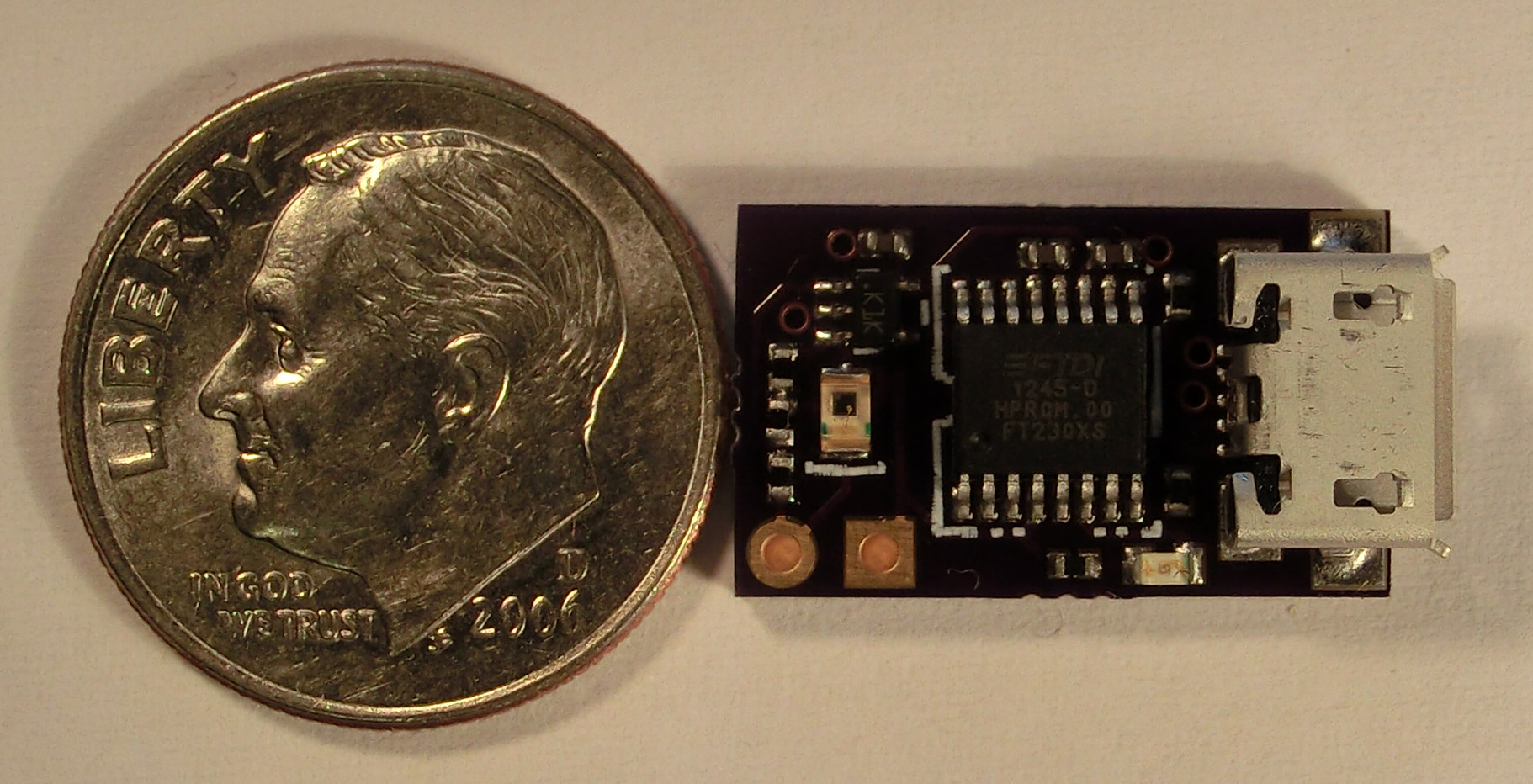
MicroPeak USB Interface now available. Altus Metrum is pleased to announce the immediate availability of the MicroPeak USB interface. MicroPeak USB Interface MicroPeak and the MicroPeak USB Interface MicroPeak is fun to use all by itself, providing a quick way to know how high your rocket has flown. But, for those people itching for more data, MicroPeakUSB offers a way to download raw flight data and analyze that on your computer. MicroPeakUSB doesn t require any changes to the MicroPeak hardware new MicroPeak firmware transmits the entire flight log through the on-board LED to a phototransistor on the MicroPeakUSB Interface and then to the USB port on your computer. Existing MicroPeak owners can contact us for a special deal on the MicroPeak USB interface and upgrading the MicroPeak firmware.
Olivier Berger: RDF development in PHP with a PostGreSQL triple store thanks to the LibRDF OO wrapper for redland/librdf

Redland/librdf offers powerful features like being able to persist an RDF model to a relational database (only PostGreSQL seems to work on my setup with 1.0.16, but I may have misconfigured it). You can then do SPARQL queries over the model, and lots of other nice things. Unfortunately, the default PHP bindings are not really object-oriented, so the code isn t looking so good. But thanks to a gentleman named David Shea, there is an object-oriented library named LibRDF (case is sensitive), that helps write nice looking PHP. I discovered it via the blog post of Felix Ostrowski, who took over the maintenance of the LibRDF library (still the docs live on the original author s site). In his post, Felix illustrates how you may use it to parse Richard Cyganiak s FOAF profile. But the examples he gives don t illustrate the full potential of persistence of the RDF graph into the DB. Here s my contribution in 2 examples that will hopefully help : first, one that load Richard s FOAF to the DB, and one, that later retrieve the saved model and perform the same query (both pushed to my github clone of the library). There may be some problems with the use of librdf, including its availability, as it is not full PHP of course and I ve heard of memory management problems, but, depening on your needs, this may be quite handy for writing Linked Data applications.

Russ Allbery: Still here

Well, I had a very nice run at the start of this year in writing journal entries nearly every day, and then I seem to have gotten much quieter. This is not actually because less stuff is going on, but I started working on larger projects without meaningful daily progress, and I also got drawn into some very rewarding creative work that has kicked my schedule in the ass. Schedules are something that I've always struggled with. I'm fairly convinced that I have even more than the natural human tendency towards a longer than 24-hour schedule. (I lived in 28-hour days and 6-day weeks for one full quarter when I was a college student and rather liked it, but it wasn't practical enough to stay with.) This means that, without applying a lot of discipline, I tend to stay up later and later because I'm engaged in interesting things and don't want to stop, and then drift further and further out of sync with the world. When I was just out of college and working as just another member of a team that wasn't very close-knit, I just shrugged and let it happen. I used to get into work at about two or three in the afternoon and work until well past midnight. It had some lovely properties, such as getting to work most of my "day" after everyone else had left and the building was quiet. Unfortunately, it's really not compatible with a lead position that requires interaction with people and quite a few meetings and other types of coordination. Given that I can't just let my schedule go wherever, I realized a year or two ago that I do much better if I can stick to a fairly reliable and consistent schedule and go to bed at a regular time, even if I'm involved in something. It cuts off my evenings in a way I don't like, but it makes mornings much more pleasant and it makes it easier to schedule and stick with various chores like exercise. But it's remarkably hard to get back into that mode once I've gotten out of it, particularly when I get caught up in things in the evenings. This meander is mostly my way of getting these thoughts out of my head and on a screen in front of me so that I'll think about them and build up enough willpower to go back to a regular schedule. It really is worth it; I was keeping one through most of January and it had a lot to do with why January was awesome. Hopefully a more sustantive update tomorrow.

Christian Perrier: Bug #700000 has been reported...and I won the bet..:-)

Here it is. Debian had seven hundred thousand bugs reported in its history. Yet another French winner, indeed two, this time: The French gang already got #200000 (by Michel Grentzinger) and #400000 (by /me), and #600000 by Cyril "KiBi" Brulebois. We're good at stupid games, as it seems. Of course, I will soon open the wiki page for the bug #800000 bet, which will again include a place where you can also bet for bug #1000000. Be patient, the week-end is coming..:-)

MJ Ray: Clevo 7872-9040/A built Jan 13 with Debian 6

My trusty Asus seems to have succumbed to graphic fault. I got an OS-free Zoostorm as its replacement, to avoid paying the MS tax. Zoostorm is one brand that Clevo laptops are sold under. It was actually a Clevo 7872-9040/A built Jan 13. I installed Debian 6 on it. The download button was easy to spot on the front page, but I actually used mini.iso so I could use a smaller usb stick. The first larger stick I tried was a dud and I m not sure where other sticks went in the move. The base installation went fine and most things went well, but the wireless networking and sound required an upgrade, but more on that next tech post.

7 February 2013

Russell Coker: Links February 2013

Aaron on Software wrote an interesting series of blog posts about psychology and personal development collectively Titled Raw Nerve , here s a link to part 2 [1]. The best sections IMHO are 2, 3, and 7. The Atlantic has an insightful article by Thomas E. Ricks about the failures in leadership in the US military that made the problems in Afghanistan and Iraq a lot worse than they needed to be [2] Kent Larson gave an interesting TED talk about how to fit more people in cities [3]. He covers issues of power use, transport, space use, and sharing. I particularly liked the apartments that transform and the design for autonomous vehicles that make eye contact with pedestrians. Andrew McAfee gave an interesting TED talk titled Are Droids Taking Our Jobs [4]. I don t think he adequately supported his conclusion that computers and robots are making things better for everyone (he also presented evidence that things are getting worse for many people), but it was an interesting talk anyway. I Psychopath is an interesting documentary about Sam Vaknin who is the world s most famous narcissist [5]. The entire documentary is available from Youtube and it s really worth watching. The movie Toy Story has been recreated in live action by a couple of teenagers [6]. That s a huge amount of work. Rory Stewart gave an interesting TED talk about how to rebuild democracy [7]. I think that his arguments against using the consequences to argue for democracy and freedom (he suggests not using the torture doesn t work and women s equality doubles the workforce arguments) are weak, but he made interesting points all through his talk. Ernesto Sirolli gave an interesting TED talk about aid work and development work which had a theme of Want to help someone? Shut up and listen! [8]. That made me think of Mary Gardiner s much quoted line from the comments section of her Wikimania talk which was also shut up and listen . Waterloo Labs has some really good engineering Youtube videos [9]. The real life Mario Kart game has just gone viral but there are lots of other good things like the iPhone controlled car and eye controlled Mario Brothers. Robin Chase of Zipcar gave an interesting TED talk about various car sharing systems (Zipcar among others), congestion taxes, the environmental damage that s caused by cars, mesh networks, and other things [10]. She has a vision of a future where most cars are shared and act as nodes in a giant mesh network. Madeleine Albright gave an interesting TED talk about being a female diplomat [11]. She s an amazing speaker. Ron Englash gave an interesting TED talk about the traditional African use of fractals [12]. Among the many interesting anecdotes concerning his research in Africa he was initiated as a priest after explaining Georg Cantor s set theories. Racialicious has an insightful article about the low expectations that members of marginalised groups have of members of the privileged groups [13]. Rick Falkvinge has a radical proposal for reforming copyrights with a declared value system [14]. I don t think that this will ever get legislative support, but if it did I think it would work well for books and songs. I think that some thought should be given to how this would work for Blogs and other sources of periodical content. Obviously filing for every blog post would be an unreasonable burden. Maybe aggregating a year of posts into one copyright assignment block would work. Scott Fraser gave an interesting TED talk about the problem with eyewitness testimony [15]. He gave a real-world example of what had to be done to get an innocent man acquitted, it s quite amazing. Sarah Kendzior wrote an interesting article for al Jazeera about the common practice in American universities to pay Adjunct Professors wages that are below the poverty line [16]. That s just crazy, when students pay record tuition fees there s more than enough money to pay academics decent wages, where does all the money go to anyway?

Christoph Berg: PostgreSQL minor releases

We've just put the new PostgreSQL minor releases live on apt.postgresql.org. Building 5 major versions for 10 distributions produces quite a lot of stuff: Compiling took a bit more than 10 hours on a 2-cpu VM. Of course that includes running regression tests and the postgresql-common testsuite. Note: This will be the last update published on pgapt.debian.net. Please update your sources.list entries to point to apt.postgresql.org!

Next.

Previous.