Search Results: "pm"

15 January 2006

Edd Dumbill: A clean sweep

Firstly, if you haven't the faintest interest in the software I use to write this weblog, please feel free to go and do something more interesting right now. Now I'm in the company of dedicated readers of colophons, I will proceed. Redesign and reimplementation  This weblog, which has now been running for over two and a half years, originally ran on some custom software I'd hacked up in Zope: at that time my web development platform of choice. Today, I've relaunched with another custom content management engine, this time written using Rails. It's been a lot of fun to write, and a good excuse to sharpen my Rails skills further. The design has also been fun. It's a little basic right now, but I hope easy to read. Of course, the font is Lucida Grande, which ensures that I am fully Web 2.0 compliant.
The main new feature is that the tags I give articles are now made public. I used to tag posts for my RSS feed, but not publish them on the site. Now they are public--what few tags I currently have--and it's possible to find RSS and Atom feeds just for certain subsections of my writing. I worry sometimes about spamming the various Planet aggregator sites my blog features in, so this gives me a way to direct content specifically at them. That said, at least for Planet XML I like hearing about everything the community members have to say, not just their on-topic posts. New URLs My blog now has a new location, http://times.usefulinc.com/, and new places for  RSS and Atom feeds: Tools used

Edd Dumbill: XTech topic musings

Compiled over the last few weeks, here's a random list of some subjects I'd love to see covered in XTech 2006. There's now only three weeks left of the call for participation -- so it's definitely time get that proposal in! Mail me if you have any questions.
  • OpenDocument vs. Microsoft Office Open XML (am I the only one annoyed by how this format is abbreviated as "Open XML"?)
  • Ruby on Rails 1.0
  • Firefox 1.5, including its many new features for developers. I loved the idea from Tristan Nitot that extensions are a way to keep Firefox successful. There's a lot of potential here. Anybody want to attend a tutorial on making Firefox extensions?
  • W3C Rich Web Clients Activity
  • XSLT 2.0 adoption and implementation--anyone but Saxon?
  • The Web Desktop. I was incredibly interested in this post of Miguel de Icaza's. For a long time I've felt RDF could hold the desktop together, data-wise, but he also proposes that HTTP and web services could do a similar thing. I suspect these are two strands of development that go hand in hand.
  • Design, usability and patterns for AJAX web applications.
  • Open Content Alliance
  • RSS and Atom: despite the release of Atom, RSS continues to grow down its own path. I reckon it's about time to sort out where each are going, and what they're best for.
  • XSL-FO: I use this technology regularly for preparing PDFs with RenderX, and the specification itself is mature. It seems time to take stock of XSL-FO and where it might go in future.
Submit your proposal here: XTech 2006 Call for Participation. XTech will be held 16-19 May 2006, Amsterdam, Netherlands.

Edd Dumbill: Cool toys for Firefox and Emacs

Firefox extensions The release of Firefox 1.5 has awakened my interest in the browser, and a few extensions can make life easier.
View Rendered Source Chart
Really handy for a structured view of an HTML page's source. The big advantage is that is displays generated source too, perfect for figuring out AJAX applications.
Foxpose
Sheer eye candy. Thumbnail all your tabbed pages into one page.
Del.icio.us
Browser button for working with the del.icio.us bookmarks site. I've been reluctant to use remote bookmarks before, this extension might just push me over the edge. Really well thought-out integration with the browser.
Rails in Emacs Seeing as I'm not quite prepared to switch to OS X just in order to get TextMate, I figured it was time again to play with my editing environment. Pages from InVisible Blog and Scott Barron give a lot of tips as to the current state of play with Rails and Emacs. I've now got a reasonably pleasant setup, though I wasn't inclined to go the whole way to running the ECB IDE inside Emacs. On Ubuntu, the packages you are looking for are: speedbar eieio semantic ruby-elisp mmm-mode. I also found pabbrev a very handy interface for tab completion. Screenshot of Emacs editing a Rails application The future for Ruby and Emacs is looking hopeful. I learned that a proper Ruby grammar for the semantic package is being worked on, which will enable class browsing and intelligent completion. I am still disappointed that there's no version of Emacs that uses Xft or Pango for anti-aliased font rendering. To get sharp fonts, I still need to use a bitmap font like misc-fixed. If I were in the business of offering bounties for open source development, dragging Emacs into the GTK2/Pango era would be the biggest one. Checking the mailing lists indicates that Pango is not suitable for Emacs, but no alternative scheme ever seems to bear fruit. Yet if Aquamacs can do it... If somebody came along with a decent TextMate-a-like for GNOME, I'd pay good money for it. I've never been really happy with an editor since Cygnus Ed. Hallski and I keep talking about this, and only just manage to resist wasting months of time on trying to write one ourselves.

Edd Dumbill: Opinions and free software

Since interviewing the creator of Ruby on Rails, David Heinemeier Hansson, I've been thinking a little more about what he calls "opinionated software." That handy little phrase seems to sum up what attracts me to a lot of technology, at all levels. What I like Free software--it's not really economics that drew me to free software, but the principles and aims. When you release or use free software, you're exercising your right to free speech and adding your voice to an argument. Desktop environments--GNOME 2.0: The move from GNOME 1.0 to version 2.0 was highly opinionated (Mac users, think OS 9 to OS X). Complexity of user interface was thrown out in favour of sensible defaults. Web standards--CSS, RDF, XHTML: not only is there a right way to do things, but it turns out to be better too! I don't automatically fall in love with everything that emerges from the W3C, but some things are so obviously the right way it's impossible not to love them--warts and all. Muine music player--this player throws out the paraphernalia of iTunes clones and gets you close to the music. Queue, play. What I want to do. Epiphany web browser--a simple text bar does for bookmark lookup, search and URLs. The bookmarks work like del.icio.us tags. Despite the lure of Firefox extensions, simplicity and efficiency keeps me with Epiphany. Make friends and enemies The thing about opinions is that people are inclined to disagree with them. Opinions won't please everybody and, being opinionated, you will never carry everybody with you. But opinions give you something with which to scythe through indifference. In both my writing and software development work taking a particular stance enables me to create interest, and gives direction to my projects. I tend to get bored easily, and if I'm bored, then my readers and users will never make it. Being opinionated in software development is easier when there's a strong leader, or it's a one-person project. It's more of a dilemma if you're running a free software project with multiple contributors. Such projects need such contributions, but run a risk of losing focus and style. I think that there we need to be brave again. If being opinionated means losing potential users, it also means losing potential contributors. Opinions help in dealing with users, too. It's obvious that the mere act of listening to users isn't good enough. They often won't say what they mean, or their requests mask a deeper issue. How often have you given your boss exactly what he asked for, to find it wasn't what he wanted? A combination of reading-between-the-lines and having opinions helps cut a way through the noise of user feedback. Stirring the pot Here are a few wishes for some free software projects that I want to see succeed further, but which really need to get opinionated to be effective. These projects aren't failing, but they're not reaching the potential I know is there. Each of them are infrastructural in some way, and that's probably where the temptation to avoid being opinionated is strongest. But here's the genius: the rewards of being opinionated here are high. Ruby on Rails is the existence proof.
  • Beagle, live search technology for GNOME. Needs to decide where its primary use will be, and get on and hit the 1.0 point for that use only. Choose one or two neat applications for integration, and be so utterly cool that every other app author flocks to integrate too.
  • Synchronization. First MultiSync, then OpenSync, have rumbled on for ages, without ever being truly effective for any particular device. My take: choose a few "must-have" target devices--say, iPods and Nokia phones--and make them work completely. Nearly-but-not-quite pleases nobody.
  • Mono. Mono's great, but where's the story? There's loads of potential in the people and the ideas behind the project, but playing catchup with Microsoft isn't very inspiring. Early projects like Muine helped Mono's cachet here, but we need more. My personal favourite option would have been a completely free alternative to ASP.NET for web applications. (I've seen a project called MonoRail, but don't know if it's the one...)
What's better? A handful of users with the "right" idea about how fundamentally important you are to everything, or loads of users who only see a portion of the capabilities of a project? Copy the experts It may seem like cheating to copy Apple's lead, but a lot of what they've done in OS X is to take a stand on what's useful and not. On many occasions this has inconvenienced people, but it's not eroded that special lure that Apple products hold. There's not harm in asking "What have Apple done?" with some of our projects. Another poster-child for being opinionated is Ubuntu Linux. Technically, it's only marginally better than other Linux distributions. Strategically, it's miles ahead. Its founder, Mark Shuttleworth, had very solid opinions about where Ubuntu should go, and pursued them. Over time, these have pervaded the product itself, but at the start it was the message and the style that made the difference. Opinions not expressed are rarely effective.

Edd Dumbill: The Web as it was meant to be used

Since giving XTech 2006 the tagline "Building Web 2.0", I've received a few questions as to how wise this was. The Web 2.0 label has been accused in some quarters of being a vague, marketing-oriented, term. Perhaps an attempt to kickstart a new bubble. I was going to write further, defending my choice: that, practically speaking, Web 2.0 encapsulates a combination of technologies and practices driving the web forward. Yes, it's a label of convenience, but the implementation trends are real. The maturation of XML, a revival in browser technology, a willingness to share data openly and new web development frameworks. Just as I embarked on distilling these thoughts into a fuller form, Paul Graham published an excellent essay on Web 2.0. In it he analyses the Web 2.0 term:
Does "Web 2.0" mean anything? Till recently I thought it didn't, but the truth turns out to be more complicated. Originally, yes, it was meaningless. Now it seems to have acquired a meaning. And yet those who dislike the term are probably right, because if it means what I think it does, we don't need it.
So what's the reasoning that means we don't need the term? Graham writes: "Web 2.0 means using the web the way it's meant to be used." There's nothing fundamentally new, but there is a groundswell of understanding of what's been there all along. For me, that's a wonderful encapsulation of both current web trends and my aspirations for XTech. "Web 2.0" is a just a handy label for this. "The Web as it was meant to be used" will strike a chord with many web practitioners today--whether it's sensible use of web services with REST, improving user interaction in web design, or open semantics and data interchange. If you're involved in using the web as it's meant to be used, consider submitting an XTech proposal.

Matthew Palmer: Evolution vs Revolution

To rewrite, or not to rewrite, that is the question. If there's one thing programmers seem to love doing, it's rewriting a piece of software from scratch. Which is funny, because "the industry" spends a lot of time bemoaning duplication of effort and generally touting "reusability" and "component-based software development". Joel on Software has a fairly good treatise on why rewriting software, in general, is a Bad Thing. I may not agree with him all the time, Joel is always worth a read, and I certainly can't fault his reasoning on this issue. My primary experience with rewriting software, as with most things software-related, is in the Free Software world. Although I've been involved in (or led) rewrites of proprietary software in the past, I've seen a lot more "let's rewrite it all" death-marches in FOSS. While I wouldn't characterise them universally as "failures", they don't seem to have the beneficial effect the authors were probably hoping for. What does seem to happen, in these FOSS projects, is that the developers squirrel themselves away in their backyard labs, using the latest and greatest in software engineering processes and tools, to produce... the same end result. (If you produce something totally different, it's not a rewrite, it's a new piece of software that does much the same things as the old one). When I say "the same end result", I mean exactly that -- it does the same thing, the code is still subject to coderot over time, and so on. It doesn't seem like much useful output has been produced. So why do we do it? Joel gives some good reasons (and why they're not such good reasons). Rewrites always take a very, very long time to do. It's in their nature. They're also very demoralising -- you're not really creating anything new, you're just recreating existing functionality. In the beginning, though, it's amazingly exciting -- a whole new world of bugfree code, an engineering marvel, something for the annals of software history. But several months later, as your new code is becoming cruftier by the day, and you're just duplicating functionality that already exists, you get bored. And boredom is the death knell of FOSS projects. I presume that this excitement-fading-to-boredom progression is why everyone starts rewrites, but they're often abandoned (or, at least, take a lot longer to complete than estimated). I'd make a comparison to that favourite target of unfair comparisons, marriage, but I know my wife reads my blog, so I won't. <grin>. This boredom factor is what has affected the python-appserver backed rewrite of IRM (from php3-style PHP). I took on maintenance of the existing PHP codebase over a year ago, and the rewrite had been in progress for a while at that point. IRM now has a bunch of useful new features, and there still isn't any indication of a useable tarball emerging from the rewrite. A rewrite in progress is a terrible thing. It tends to make people wary of working on the existing codebase, if it's going to be a deadend. Without something to work on, they'll tend to wander off to other projects. However, sometimes (due to existing deployments), users will work on the deadend. If the developers have been more-or-less neglecting the existing codebase while they take on their glorious rewrite, then the rest of the world is going to have been playing with and tweaking the existing code, adding their own improvements and modifications. The result of this, when the new rewrite finally releases, is that there's great wodges of third-party code that's incompatible with the rewrite, and a large chunk of your userbase says "stuff it" and sticks with what they know. This is what looks like happening in the world of SysCP. A few days ago, I found out that they're planning on doing a rewrite from the functional-spaghetti-PHP of the current version to the cult-of-MVC-PHP. This is nice, but their current estimate is of a first RC release in February. I take this estimate with a boulder of salt -- for the full collection of usual reasons (boredom, real life, overoptimism, etc). The fact that there's not a huge amount of movement on the commit log doesn't inspire confidence, either, and despite early claims of a massive development team, only one person has been committing recently. In the meantime, I'm tasked with adding a number of small features to the current SysCP codebase, which we need for work. When the rewrite comes out, it's highly unlikely that there will be a business case for rewriting my features for the new code, and it's not likely that the features we need will make it into core. So, SysCP will probably fork -- the old, featureful, crufty codebase, vs the new, shiny codebase. If there's sufficient new features to warrant an upgrade, we'll take the plunge, but what SysCP does now is very close to what we want, so it'll take a fair amount of shiny! to get us to move. This is a general issue of software development in FOSS -- if you take your eye off the ball, for any reason, someone else will probably pick it up and run with it. Your rewrite will be a completely new project, and you'll get some of the users and the fork of your old codebase will continue to live on in another guise. Let's face it, though -- your code is going to accumulate cruft. Over time, it morphs into this bletcherous pile of huge functions, multi-purpose classes, and reams and reams of bug reports. How do you deal with this cruft? Surely at some point it's easier just to throw it out and start again? Reality says no. Joel gave the key advice in the article linked above (go read it if you haven't already -- seriously), and it's strongly hinted in my article title. Don't revolt; instead, evolve your codebase. Tweak it, evolve it, move it slowly (and compatibly) towards your utopian ideal of perfect code. You won't get there, but you'll almost certainly get closer by gradual and continuous improvement than you would be going back to the start line and walking in a different direction. There's one big question that's nagging at me, though -- what happens when you want to switch languages? I'm loving Ruby on Rails at the moment, and so are several other people at work, but we've got (both personally and professionally) huge swathes of code in PHP (and other second-rate languages) that needs to be dealt with. It's a lot harder to evolve code into a different language than apply a gradual degunking. I have a number of ideas on this point, but I'd love to hear your ideas too. In a few months, I'll have a lot better idea of what works and what doesn't in massive PHP to Rails conversions, and I'm sure everyone out there in the blogosphere will hear about them in due time.

14 January 2006

Alexis Sukrieh: Backup Manager mailing lists

After setting up the Backup Manager’s website, I took the time to install mailman in order to handle mailing lists nicely (congrats to the mailman maintainer, it installs itself like a charme). Everything is now ready for welcoming subscribers to the backup-manager mailing lists. I’m about to release a new version of Backup Manager, featuring a new method for making customized backup: you are now able to enter a command and all the output sent to stdout by this command will be used as the archive content. It can then be compressed with the tool of your choice if needed. Here is an example of the concept:
command=ssh myhost -c 'mysqldump -uuser -ppass database'
filetype=sql
compressor=bzip2
This will be provided to backup-manager through arrays, so we can implement as many archive methods as we like.
I called this method the “pipe” method, I gues you know why. This is already available in the svn repository.

Bartosz Fenski aka fEnIo: Debian GNU/kFreeBSD

When I bought notebook I had to find out some use for previous box. It was great opportunity to test etch installer (and my Polish translation at the same time) so I did it several times using miscellaneous settings. Eventually it was time to find out some real use for this box. I decided to try out some non-Linux port of Debian. The most stable and actively developed seemed to be kFreeBSD.
I installed it about month ago. I must admit it works great despite some initial stability problems related to buggy mount, quickly workarounded with help from people from #gnu-kbsd channel. (thanks!)
I use it mainly as a backup machine and small www server, but since it handles it without a hitch I'm probably going to make it also print and Samba server.
I was sceptical to GNU userland used with non-Linux kernels, but admittedly we're getting closer and closer to the day when switching between kernels would be piece of cake ;)
(fenio@kfbsd)~#uptime
 15:36:57 up 21 days,  6:23,  1 user,  load average: 0.23, 0.08, 0.04
(fenio@kfbsd)~#
As you can see it works. It lays in one of my wardrobe, without the case and unplugged from any external devices. I couldn't remove graphic card due to some weird BIOS limits, so it has some PCI card worth less than the beer I'm drinking now ;)
Here's its photo. Sorry for quality, but I don't have any camera around, so it's made with my cellphone.
bsd
If someone wondered if non-Linux Debian ports are worth try, then I have to say YES, THEY ARE!
Using this opportunity I would like to thank everyone involved in their development. Keep up the good work!
Now it's time to give a try to Debian GNU/Hurd... have to start gathering the hardware for that ;)

Horms: Smart Speakers?

I've been thinking about what I'd do if I bought an aparemtment and renovated it. Natrually, embeding technology in the walls is near the top of the list. But I'm not entirely sure of my options. For instance, does anyone know if there is sound equipment available that will refuse to play Alanis Morissette?

13 January 2006

Adam Rosi-Kessel: How Music Should and Will Be Sold

Dave Douglas’ new album, Keystone, can be purchased as a CD (includes a DVD as well, free shipping), MP3 (entire album, cheaper than the CD), or MP3 (individual tracks). Douglas has started his own web-based label, Greenleaf Music. I’d like to see the MP3 album, which is now $10, even more cheaper than the CD, which is $15, but this model makes a lot more sense to me than the DRM-encumbered iTunes Music Store, where you end up paying as much or more for an album than a CD version of the same thing. Douglas also has some sheet music on his site which is interesting. This quote from the About Greenleaf page is right on:
And how will Greenleafs business approach differ? “We endeavor to be as innovative in our marketing plans as the artists are in their music,” says Friedman. “We plan to re-evaluate current approaches to everything from package design to marketing, promotion and sales strategies and look at every marketing expense in light of its potential resonance with each individual project. We will count on web marketing as a means of artist development and as our artists will be on tour, utilize the live performances to sell records and create sales bases. We also believe that what interests listeners is not just the recorded product, but the artists themselves. As such we are interested in making available sheet music, artist commentary, discussion and more.”
I expect we will look back on these sort of efforts and wonder why it wasn’t obvious to everyone at the time that this is the way the music industry would end up.

Anthony Towns: Yay for hatemail

So following Florian’s chastisement of my “threatening” fellow Debian developers, Charles Plessy becomes annoyed by a bug in apt-file (its default configuration expects curl, but wget is what’s installed on most systems), at which point Luk Claes then starts threatening to NMU whether the maintainer likes it or not. Naturally that’s not the correct thing to do for a report the maintainer’s addressed and said is not a bug, 0-day NMU policy or not. Naturally, pointing this out brings Charles back into the fray, to complain further. A followup to that produces this off-list reply from Charles:
On Fri, Jan 13, 2006 at 05:13:15PM +1000, Anthony Towns wrote :
> I'm not disputing whether it's a bug or not, the maintainer is. If
> you are *helping* the maintainer, then fine: do an NMU.
Dear Anthony,
I would love to, but I am not a developer. And I am amazed to see that
more energy is spent in arguing rather than solving the problem. I hope
Luke will NMU this package and close those shameful bugs.
> In my experience you almost always get a better response from people if
> you assume they've got a good reason for doing what they have been doing,
> rather than just trying to add extra punctuation to your sentences.
> Admittedly, punctuation is pretty cool...
That kind of sentence reflects your inclination for ad-hominem attacks.
They poison the -devel list.
Best,
So yay for people who aren’t developers, in the n-m queue or maintaining a package, who don’t understand Debian’s processes, yet still think it’s great to pontificate about what Debian’s processes are, go on about how developers are “arrogant experts” and who think “punctuation is pretty cool” is a “poisonous ad hominem attack”. But what I hate most is people who think they’re contributing to Debian by mailing people privately to tell them how horrible they are. Gag. For those playing along at home, the proper process to follow in a dispute with a maintainer is to bring it up to the technical committee, not to try forcing the situation, whether that be by reopening bugs or playing bug ping-pong. It’s really not complicated. It’s even documented (5.8.3 of the Developers Reference).

12 January 2006

Joe Wreschnig: Angry, Drunken Dwarves

So previously, if you were stalking me for some reason and tried to track my hacking activity, there was a hole of a few months between finishing pydance and going back to more Debian work. Not anymore. Two years later than expected, I m announcing Angry, Drunken Dwarves, an insanely fun block-dropping game that plays a lot like Puzzle Fighter, at least at first. It has seven playable characters, six levels of AI, secret game modes and characters, and an original soundtrack. Unfortunately, one of the things that held up the release and never got solved was the lack of Windows packages. I m really sorry, especially to the people who helped design it and use Windows. Hopefully someone steps up to provide those soon. I m not providing Debian packages either, until I can get other things related to Debian finished. Anyone can feel free to hijack my ITP and upload it if they want. I apologize for the code. It spans two or three Python minor revisions, and for about the last 1/6 of development the Pygame community was falling apart and it was hard to care much. (P.S. Due to a last minute incredible stupidity by the Numeric developers, the release was actually delayed another 20 minutes. This project is cursed.)

Sam Hocevar: No subject

My Debian automatic installer works pretty well now. I still have to clean the code, because it's full of printf("sarass\n"); and printf("%s %s\n", foo, bar); everywhere. Hard to debug a program with 1.44M of disk space :) It's 8pm and I'm still at the office... When I'm back home I won't have much time to hack on videolan. Blah, there's so little time, and so much to be done. raph: any chance to get a tt><project> tag ? :)

Sam Hocevar: No subject

I went a bit further at work with my automatic Debian installer. Unfortunately I broke everything when trying to add NFS install support, I hope I'll get that fixed tomorrow. When going back home I wanted to buy The Matrix but unfortunately it was 10pm and the only open store I found didn't have it. So I bought a few comics and spent my evening reading them instead of coding.

Matthew Palmer: Xinerama is the r0x0r

I was motivated, this morning, to look into whether my laptop chipset (Intel 915GM, for anyone interested) could do this funky multihead thing. Much to my surprise, it was (a) possible, (b) quite simple, and (c) incredibly useful. I now have a 15" Dell LCD screen on a cardboard box behind my laptop docking station. What is it useful for, you ask? Let me count the ways (with the help of the <ol> tag, of course):
  1. I've gotten a couple of PDF versions of my current "must always have with me" technical books (Programming Ruby and Agile Web Development With Rails, since you didn't ask), and now I can stick them on the other monitor to refer to while I'm coding.
  2. I can stick my xchat window up on the external monitor, so I can quickly glance at what's going on without having to touch anything. With the ability to stick a window on all desktops, I can have xchat no matter where I go!
  3. If I want to show somebody else something, it's handy to be able to push it up onto the top screen so they can more easily see it without having to crane down at my laptop screen (plus, if they go "what about <smudge>that?</smudge>", it's work's monitor that's getting grotted on, not my laptop screen that I have to stare at for 10+ hours a day).
Since I rarely (read: never unless I'm forced to) reboot my machine, instead relying on the magical marvels of sleep/hibernate, I did have one major concern with this multihead thing -- when I'm out-and-about, obviously I'm not going to have my external monitor with me, so how do I view things that are up on the other screen (either because I left them there when I was in the office, or because the window autoplacer stuck them there)? It turns out to be a fairly trivial and rarely noticed problem (except when I shove the mouse at the top of the screen to hit a button and my mouse disappears off into the wilderness). The answer to the invisible window problem is trivial -- I wave my mouse around where I can't see it until the window I want is highlighted in the miniview, then hit Alt-M to lasso it, and drag the little beastie into the light. Much easier than trying to guess where the title bar is to bring it down. In the interests of sharing the love (and having a record of what I did for next time), here is the sum total of what I had to add to my xorg.conf to make it all work on Ubuntu Breezy (along with some comments to make it easier to understand what's happening):
Section "ServerFlags"
        Option  "DefaultServerLayout" "double"
        #Option "DefaultServerLayout" "Default Layout"
EndSection
# This Device section is effectively identical to the one for the
# primary screen, with the addition of the Screen 1 parameter to
# select the alternate display device.
Section "Device"
        Identifier      "vgaout"
        Driver          "i810"
        BusID           "PCI:0:2:0"
        Option          "MonitorLayout" "CRT"
        Screen          1
        Option          "DDC" "false"
EndSection
# external display
Section "Monitor"
        Identifier      "generic"
        # I kept all these loose because most monitors support
        # autodetection.
        HorizSync       27 - 96
        VertRefresh     50 - 110
        Option "DPMS"
EndSection
Section "Screen"
        Identifier      "external"
        Device          "vgaout"
        Monitor         "generic"
        DefaultDepth    24
        SubSection "Display"
                Depth           24
                # I'd have added many more modes here, but
                # the amazingly crufty external LCD I'm using
                # only supports 1024x768.
                Modes           "1024x768"
        EndSubSection
EndSection
# xinerama layout
Section "ServerLayout"
        Identifier      "double"
        # The 0 0 (I think) identifies this as the "root" monitor
        Screen          "Default Screen" 0 0
        # You can also use Below, LeftOf, or RightOf to position
        # your shiny subscreen
        Screen          "external" Above "Default Screen"
        InputDevice     "Generic Keyboard"
        InputDevice     "Configured Mouse"
        # Never, ever forget this option.  You'll get laughed at
        Option          "Xinerama" "true"
EndSection

11 January 2006

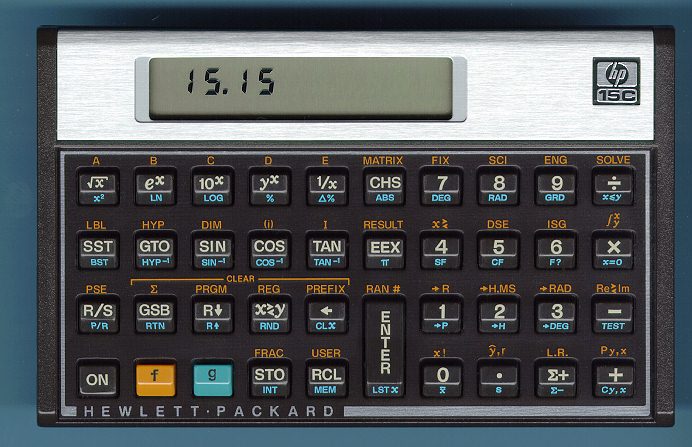
Jesus Climent: New old HP calculator.

Yesterday i happened to find a piece of antique in the basement, which was discarded from one of the Nokia units. A HP 15c machine. This picture shows it all: I kind of like it. It is vintage QTC, and even works fine ;)

Aigars Mahinovs: Help needed for Simple Backup development.

I have long understood that to make a good free software project, having multiple authors/contributors is essential. To that end, while I am fixing bugs and writing a few new features into the main SBackup codebase (see Changelog), I am inviting new people to contribute to SBackup development.
Many users have a need for an essential feature - backup to removable media. With current architecture of SBackup this goal is quite easy to achieve, but it would take a lot of time away from bugfixing and some other important features that I plan to do before 1.0. Also this feature is very independent of the rest of code, so I think it would be great way for somebody else to help the development of SBackup to become the ultimate simple backup system for desktops and servers alike. I have written a specification of how the new functionality (codenamed BackupBurner) should function and there is already a half-ready Glade interface in the source code.
So - volunteers, please step forward out of the cosy confines of the lazyweb :)

MJ Ray: The Walks and Cycling

The Walks Management Forum meets on Thursday 12th January at 6pm at the council's main offices meeting room 1. I think it's open to public viewing (like most council meetings), but the public can't speak (like most council meetings - grrr), only members. Send me any comments that you have on: Internal Drainage Board works on the Gaywood River; landscaping works in St James Park; bat "mitigation" measures; or foundation design for the new kiosk and footbridge; and I'll pass them on. As part of the Walks project, I'm trying to get the potholed, overgrown and sometimes awkward cycleways brought up to standard. The Walks has three long off-road paths which offer vital "greenway" connections from residential and industrial areas to parts of the town centre, including the rail and bus stations, cinema and library. Here's the last draft I have for a current tricky junction: St John's/Blackfriars cycleway junction proposal The "mini-roundabout" effect will probably be lost, to use the effect of missing markings to make people slow down. If you have comments on this, especially if it links to Sustrans advice, please email it to me (follow permalink for address).

Kenshi Muto: CUPS 1.2.0 b1

I uploaded new development snapshot of CUPS 1.2 -- cupsys 1.1.99.b1.r4748 -- to experimental. This version has many interesting changes for fearless people.

Next.

Previous.