Search Results: "ms"

27 January 2015

Laura Arjona: Upgrading my computers to Debian Jessie: Husband s laptop (Acer Aspire 5250)

This is an old laptop, with AMD E-300 processor, 6 GB RAM, Radeon HD 6310 VGA and Atheros AR9485 wireless network adapter. It was running Windows 7 (preinstalled). The hard disk failed, and I put the hard disk of another laptop (a broken Acer Aspire One D255) on it. Surprisingly, the Windows 7 on it booted (after some self-configuration that took quite long), but it was a Windows 7 Home 32bits, so it was only recognizing 4 GB RAM. That was the perfect excuse to convince my husband to install Debian in the laptop and begin his transition to a free OS. Yay! I installed Debian Jessie from scratch last summer. Everything went well (the installer went fine, 8 months before than its RC1 release, congrats Debian-boot team!). I needed the non-free radeon driver for the graphical display :/ Jessie is running GNOME3 desktop, and I ve been seeing all these months the transition to 3.14 version, and later, the integration of the Lines theme (by Juliette Belin), which I like very much. I have problems to watch high quality videos, in every player that I tried (VLC, Totem, mplayer) the audio and video are not synced, and video sometimes freezes. I m almost sure that the problem is what mplayer says: Your system is too SLOW to play this! . I tried to install the ATI non-free driver for better performance, but after successfully install it and reboot, GNOME was not starting (I got a black screen, no gdm greeting me). I could log in tty2, though. I don t know if I did something wrong, how to solve the problem, and I don t wanted to waste time, so I uninstalled it and returned to the non-free firmware that goes to the Linux kernel. For now, when I need to watch a video that gives those problems, I upload the file to my GNU MediaGoblin site, or use WinFF to reduce size/quality. Overall impression Fine! Both my husband and me are very happy. The installation went really well. I m not a GNOME expert user but I find it easy, intuitive, and he found it easy too. My husband uses the computer to surf the web, watch some videos and online series (we had to install non-free flash plugin from Adobe #grr), read mail from the browser, write something in LibreOffice and print it (hey! we just plug the printer/scanner and it works, no need to install drivers!), scan some image and send it by email I set Debian as default in GRUB, and the switch from Windows has been very natural for him (he was already using Firefox and LibreOffice in Windows. He still says I m a Windows user although he is just using Debian for months!). He bought an IPhone 4S (#grr!) and I tried to connect it as shown in the corresponding Debian wiki page, but it didn t work (I got segmentation fault when connecting the phone). However, it is recognized by Shotwell and we can copy all the photos and videos to the computer, which is what we wanted to do. So no problem on that side, either. In conclussion, one more computer at home running Debian ( future stable ), and we don t run Windows at home anymore :)
Filed under: My experiences and opinion Tagged: Debian, English, Moving into free software

Matthias Klumpp: AppStream 0.8 released!

Yesterday I released version 0.8 of AppStream, the cross-distribution standard for software metadata, that is currently used by GNOME-Software, Muon and Apper in to display rich metadata about applications and other software components. What s new? The new release contains some tweaks on AppStreams documentation, and extends the specification with a few more tags and refinements. For example we now recommend sizes for screenshots. The recommended sizes are the ones GNOME-Software already uses today, and it is a good idea to ship those to make software-centers look great, as others SCs are planning to use them as well. Normal sizes as well as sizes for HiDPI displays are defined. This change affects only the distribution-generated data, the upstream metadata is unaffected by this (the distro-specific metadata generator will resize the screenshots anyway). Another addition to the spec is the introduction of an optional <source_pkgname/> tag, which holds the source package name the packages defined in <pkgname/> tags are built from. This is mainly for internal use by the distributor, e.g. it can decide to use this information to link to internal resources (like bugtrackers, package-watch etc.). It may also be used by software-center applications as additional information to group software components. Furthermore, we introduced a <bundle/> tag for future use with 3rd-party application installation solutions. The tag notifies a software-installer about the presence of a 3rd-party application bundle, and provides the necessary information on how to install it. In order to do that, the software-center needs to support the respective installation solution. Currently, the Limba project and Xdg-App bundles are supported. For software managers, it is a good idea to implement support for 3rd-party app installers, as soon as the solutions are ready. Currently, the projects are worked on heavily. The new tag is currently already used by Limba, which is the reason why it depends on the latest AppStream release. How do I get it? All AppStream libraries, libappstream, libappstream-qt and libappstream-glib, are supporting the 0.8 specification in their latest version so in case you are using one of these, you don t need to do anything. For Debian, the DEP-11 spec is being updated at time, and the changes will land in the DEP-11 tools soon. Improve your metadata! This call goes especilly to many KDE projects! Getting good data is partly a task for the distributor, since packaging issues can result in incorrect or broken data, screenshots need to be properly resized etc. However, flawed upstream data can also prevent software from being shown, since software with broken data or missing data will not be incorporated in the distro XML AppStream data file. Richard Hughes of Fedora has created a nice overview of software failing to be included. You can see the failed-list here the data can be filtered by desktop environment etc. For KDE projects, a Comment= field is often missing in their .desktop files (or a <summary/> tag needs to be added to their AppStream upstream XML file). Keep in mind that you are not only helping Fedora by fixing these issues, but also all other distributions cosuming the metadata you ship upstream. For Debian, we will have a similar overview soon, since it is also a very helpful tool to find packaging issues. If you want to get more information on how to improve your upstream metadata, and how new metadata should look like, take a look at the quickstart guide in the AppStream documentation.

Jingjie Jiang: Yet another post.

In the middle of OPW internship I originally thought taking part in FOSSOPW is a great chance to lift my coding skills and I shouldn t miss it. As time passes by, I now have a new thought towards it. # 1 It do improves your coding skill. Zack, Matthieu and I often have discussions on coding style. For example, once Zack said, For code like this, you should explicitly use an if/else clause, not if-return. I was totally unaware of this sort of issue. Actually I even didn t know how I should call this problem. Matthieu gave me a detailed FYI link on this in no time. Besides, my completeness of thinking is also trained. Recently, I was fixing a HTTP GET Method ?suite=suite-name issue. It s a trivial task. And you know most trivial tasks require lots of scattered modification on the source code base. I did have fixed most places, such as the pages of /src/packagename and /search/ . Zack did a thorough review, and pointed out that the pages rendered by /prefix has some malformed urls in the HTML. Waiiiit, I should have noticed it. But somehow I missed it. Maybe because my mind was wandering at that time? This made me think, I shall have a thorough view of what I should do before getting my hands dirty. Or more preferably, if I could write down what I exactly want to achieve before coding, then silly problems definitely wouldn t occur. This may sound a little bit like TDD. ;). # 2 It makes you look like a (not-that-good) ninja. I use a macbook. It s not my fault! I ve tried several times, but I never successfully find a laptop that is not capable of boiling eggs when running Debian. (and especially KDE+Debian). So I have no way but switched to OSX. The development of Debsources happens on a remote Ubuntu LTS (now Debian SID, haha) virtual machine. Of course I have to install all the dependency on my own, e.g., Postgres, set up port-forwarding, e.g., ssh -D, write automate shell scripts, e.g., dash, but more importantly, I am forced to live under the dark terminal with no GUI. You know the feeling when pain hurts? Yes, exactly! But I survived. How shall I call myself now? A dedicated with-a-lot-of-useless-plugin-installed vimmer? A fond-of-fancy-window tmux-er? Yep, both. I finally found a comfort zone under the black-white-blinking screen. I wonder how people feel when they see a girl hanging out in the library, facing a full-screened black console, typing at a speed of 140wpm (Yeah, I am kidding). I don t know, but please don t call me a geek. Show me your respect, I am a ninja! # 3 It tells you communication is the most important. I bet anyone who has participated in a group-based project would understand what I mean. For one perspective, communication helps to eliminate misunderstanding. So I won t doing some useless stuff for all day and finally find out that it totally doesn t meet the requirement. On the other hand, it speeds up your learning process. I often have problems on git. So in the email I will complain if I mess up with the git repo. After a short while, my dear mentors will reply in detail on how to correctly do the git stuff. My OPW journey is cool! ;).

26 January 2015

Daniel Pocock: Get your Nagios issues as an iCalendar feed

The other day I demonstrated how to get your Github issues/bugs as an iCalendar feed. I'm planning to take this concept further and I just whipped up another Python script, exposing Nagios issues as an iCalendar feed. The script is nagios-icalendar. Usage is explained concisely in the README file, it takes just minutes to get up and running. One interesting feature is that you can append a contact name to the URL and just get the issues for that contact, e.g.:
http://nagios-server.example.org:5001?contact=daniel
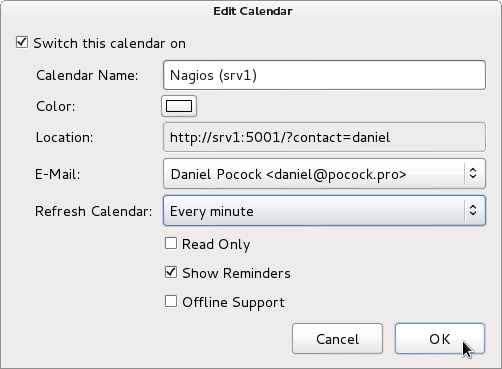
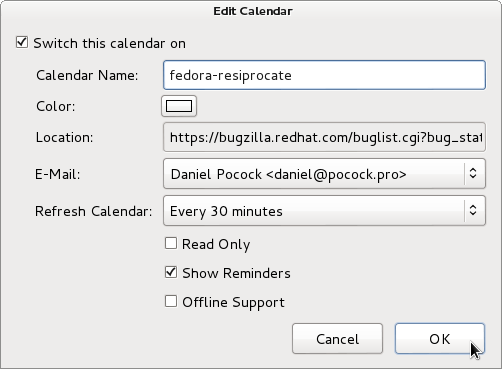
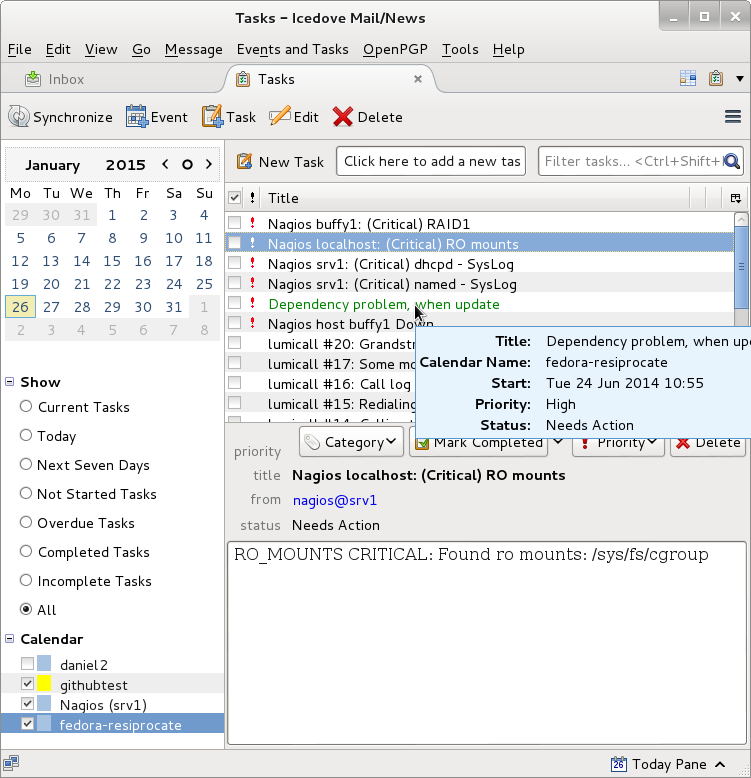
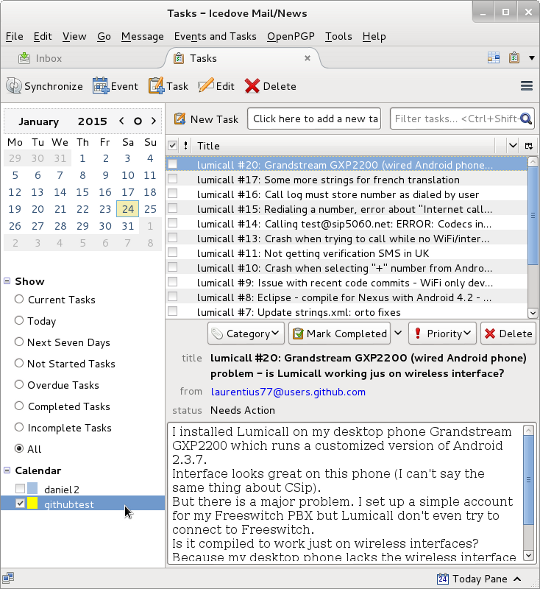
Screenshots Here I demonstrate using Mozilla Lightning / Iceowl-extension to aggregate issues from Nagios, the Fedora instance of Bugzilla and Lumicall's Github issues into a single to-do list.

Vincent Fourmond: Linux kernels for a macbook pro retina

I was unhappy about the recent Linux (3.14-3.16, and I think 3.17 too) kernels on my Macbook Pro Retina (15'), for a few reasons:The latest 3.18-trunk kernel fixes essentially all the above problems, which is just great. Kudos to everyone involved ! Hope it helps...

25 January 2015

Richard Hartmann: KDE battery monitor

Dear lazyweb, using a ThinkPad X1 Carbon with Debian unstable and KDE 4.14.2, I have not had battery warnings for a few weeks, now. The battery status can be read out via acpi -V as well as via the KDE widget. Hibernation via systemctl hibernate works as well. What does not work is the warning when my battery is low, or automagic hibernation when shutting the lid or when the battery level is critical. From what I gather, something in the communication between upower and KDE broke down, but I can't find what it is. I have also been told that Cinnamon is affected as well, so this seems to be a more general problem Sadly, me and anyone else who's affected has been unable to fix this. So, dear lazyweb, please help. In loosely related news, this old status is still valid. UMTS is stable-ish now but even though I saved the SIM's PIN, KDE always displays a "SIM PIN unlock request" prompt after booting or hibernating. Once I enter that PIN, systemd tells me that a system policy prevents the change and wants my user password. If anyone knows how to get rid of that, I would also appreciate any pointers.

Chris Lamb: Recent Redis hacking

I've done a bunch of hacking on the Redis key/value database server recently:
I also made the following changes to the Debian packaging:

Joey Hess: making propellor safer with GADTs and type families

Since July, I have been aware of an ugly problem with propellor. Certain propellor configurations could have a bug. I've tried to solve the problem at least a half-dozen times without success; it's eaten several weekends. Today I finally managed to fix propellor so it's impossible to write code that has the bug, bending the Haskell type checker to my will with the power of GADTs and type-level functions. the bug Code with the bug looked innocuous enough. Something like this:
foo :: Property
foo = property "foo" $
    unlessM (liftIO $ doesFileExist "/etc/foo") $ do
        bar <- liftIO $ readFile "/etc/foo.template"
        ensureProperty $ setupFoo bar
The problem comes about because some properties in propellor have Info associated with them. This is used by propellor to introspect over the properties of a host, and do things like set up DNS, or decrypt private data used by the property. At the same time, it's useful to let a Property internally decide to run some other Property. In the example above, that's the ensureProperty line, and the setupFoo Property is run only sometimes, and is passed data that is read from the filesystem. This makes it very hard, indeed probably impossible for Propellor to look inside the monad, realize that setupFoo is being used, and add its Info to the host. Probably, setupFoo doesn't have Info associated with it -- most properties do not. But, it's hard to tell, when writing such a Property if it's safe to use ensureProperty. And worse, setupFoo could later be changed to have Info. Now, in most languages, once this problem was noticed, the solution would probably be to make ensureProperty notice when it's called on a Property that has Info, and print a warning message. That's Good Enough in a sense. But it also really stinks as a solution. It means that building propellor isn't good enough to know you have a working system; you have to let it run on each host, and watch out for warnings. Ugh, no! the solution This screams for GADTs. (Well, it did once I learned how what GADTs are and what they can do.) With GADTs, Property NoInfo and Property HasInfo can be separate data types. Most functions will work on either type (Property i) but ensureProperty can be limited to only accept a Property NoInfo.
data Property i where
    IProperty :: Desc -> ... -> Info -> Property HasInfo
    SProperty :: Desc -> ... -> Property NoInfo
data HasInfo
data NoInfo
ensureProperty :: Property NoInfo -> Propellor Result
Then the type checker can detect the bug, and refuse to compile it. Yay! Except ... Property combinators There are a lot of Property combinators in propellor. These combine two or more properties in various ways. The most basic one is requires, which only runs the first Property after the second one has successfully been met. So, what's it's type when used with GADT Property?
requires :: Property i1 -> Property i2 -> Property ???
It seemed I needed some kind of type class, to vary the return type.
class Combine x y r where
    requires :: x -> y -> r
Now I was able to write 4 instances of Combines, for each combination of 2 Properties with HasInfo or NoInfo. It type checked. But, type inference was busted. A simple expression like
foo  requires  bar
blew up:
   No instance for (Requires (Property HasInfo) (Property HasInfo) r0)
      arising from a use of  requires'
    The type variable  r0' is ambiguous
    Possible fix: add a type signature that fixes these type variable(s)
    Note: there is a potential instance available:
      instance Requires
                 (Property HasInfo) (Property HasInfo) (Property HasInfo)
        -- Defined at Propellor/Types.hs:167:10
To avoid that, it needed ":: Property HasInfo" appended -- I didn't want the user to need to write that. I got stuck here for an long time, well over a month. type level programming Finally today I realized that I could fix this with a little type-level programming.
class Combine x y where
    requires :: x -> y -> CombinedType x y
Here CombinedType is a type-level function, that calculates the type that should be used for a combination of types x and y. This turns out to be really easy to do, once you get your head around type level functions.
type family CInfo x y
type instance CInfo HasInfo HasInfo = HasInfo
type instance CInfo HasInfo NoInfo = HasInfo
type instance CInfo NoInfo HasInfo = HasInfo
type instance CInfo NoInfo NoInfo = NoInfo
type family CombinedType x y
type instance CombinedType (Property x) (Property y) = Property (CInfo x y)
And, with that change, type inference worked again! \o/ (Bonus: I added some more intances of CombinedType for combining things like RevertableProperties, so propellor's property combinators got more powerful too.) Then I just had to make a massive pass over all of Propellor, fixing the types of each Property to be Property NoInfo or Property HasInfo. I frequently picked the wrong one, but the type checker was able to detect and tell me when I did. A few of the type signatures got slightly complicated, to provide the type checker with sufficient proof to do its thing...
before :: (IsProp x, Combines y x, IsProp (CombinedType y x)) => x -> y -> CombinedType y x
before x y = (y  requires  x)  describe  (propertyDesc x)
onChange
    :: (Combines (Property x) (Property y))
    => Property x
    => Property y
    => CombinedType (Property x) (Property y)
onChange = -- 6 lines of code omitted
fallback :: (Combines (Property p1) (Property p2)) => Property p1 -> Property p2 -> Property (CInfo p1 p2)
fallback = -- 4 lines of code omitted
.. This mostly happened in property combinators, which is an acceptable tradeoff, when you consider that the type checker is now being used to prove that propellor can't have this bug. Mostly, things went just fine. The only other annoying thing was that some things use a [Property], and since a haskell list can only contain a single type, while Property Info and Property NoInfo are two different types, that needed to be dealt with. Happily, I was able to extend propellor's existing (&) and (!) operators to work in this situation, so a list can be constructed of properties of several different types:
propertyList "foos" $ props
    & foo
    & foobar
    ! oldfoo    
conclusion The resulting 4000 lines of changes will be in the next release of propellor. Just as soon as I test that it always generates the same Info as before, and perhaps works when I run it. (eep) These uses of GADTs and type families are not new; this is merely the first time I used them. It's another Haskell leveling up for me. Anytime you can identify a class of bugs that can impact a complicated code base, and rework the code base to completely avoid that class of bugs, is a time to celebrate!

24 January 2015

Daniel Pocock: Get your Github issues as an iCalendar feed

I've just whipped up a Python script that renders Github issue lists from your favourite projects as an iCalendar feed. The project is called github-icalendar. It uses Python Flask to expose the iCalendar feed over HTTP. It is really easy to get up and running. All the dependencies are available on a modern Linux distribution, for example:
$ sudo apt-get install python-yaml python-icalendar python-flask python-pygithub
Just create an API token in Github and put it into a configuration file like this:
api_token: 6b36b3d7579d06c9f8e88bc6fb33864e4765e5fac4a3c2fd1bc33aad
bind_address: ::0
bind_port: 5000
filter: all
Run it from the shell:
$ ./github_icalendar/main.py github-ics.cfg
and connect to it with your favourite iCalendar client. Consolidating issue lists from Bugzilla, Github, Debian BTS and other sources A single iCalendar client can usually support multiple sources and thereby consolidate lists of issues from multiple bug trackers. This can be much more powerful than combining RSS bug feeds because iCalendar has built-in support for concepts such as priority and deadline. The client can use these to help you identify the most critical issues across all your projects, no matter which bug tracker they use. Bugzilla bugtrackers already expose iCalendar feeds directly, just look for the iCalendar link at the bottom of any search results page. Here is an example URL from the Mozilla instance of Bugzilla. The Ultimate Debian Database consolidates information from the Debian and Ubuntu universe and can already export it as an RSS feed, there is discussion about extrapolating that to an iCalendar feed too. Further possibilities
  • Prioritizing the issues in Github and mapping these priorities to iCalendar priorities
  • Creating tags in Github that allow issues to be ignored/excluded from the feed (e.g. excluding wishlist items)
  • Creating summary entries instead of listing all the issues, e.g. a single task entry with the title Fix 2 critical bugs for project foo
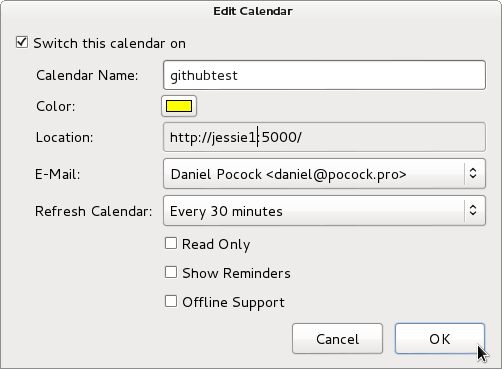
Screenshots The screenshots below are based on the issue list of the Lumicall secure SIP phone for Android. Screenshot - Mozilla Thunderbird/Lightning (Icedove/Iceowl-extension on Debian)

Dirk Eddelbuettel: RcppAnnoy 0.0.5

A new version of RcppAnnoy is now on CRAN. RcppAnnoy wraps the small, fast, and lightweight C++ template header library Annoy written by Erik Bernhardsson for use at Spotify. RcppAnnoy uses Rcpp Modules to offer the exact same functionality as the Python module wrapped around Annoy. This version contains a trivial one-character change requested by CRAN to cleanse the Makevars file of possible GNU Make-isms. Oh well. This release also overcomes an undefined behaviour sanitizer bug noticed by CRAN that took somewhat more effort to deal with. As mentioned recently in another blog post, it took some work to create a proper Docker container with the required compiler and subsequent R setup, but we have one now, and the aforementioned blog post has details on how we replicated the CRAN finding of an UBSAN issue. It also took Erik some extra efforts to set something up for his C++/Python side, but eventually an EC2 instance with Ubuntu 14.10 did the task as my Docker sales skills are seemingly not convincing enough. In any event, he very quickly added the right fix, and I synced RcppAnnoy with his Annoy code. Courtesy of CRANberries, there is also a diffstat report for this release. More detailed information is on the RcppAnnoy page page.

This post by Dirk Eddelbuettel originated on his Thinking inside the box blog. Please report excessive re-aggregation in third-party for-profit settings.

Diego Escalante Urrelo: Link Pack #05

Lever Rukhin Photographs Los Angeles From His Car
Lever Rukhin shoots the sketchiest parts of Los Angeles from his car, taking a really unique perspective that helps you perceive what LA looks like, if you were in a car An experience that is apparently common to all LA people. People drive too much in the US :-). It s a very interesting interview that goes well with his full site: Lev Rukhin. What I love about this, besides the whole premise, is that Lev went the extra mile and actually hacked his car to make the images he wanted:
Phoblographer: It looks like many of these images have artificial lighting in them. What s your gear setup, and how do you introduce so much light into the scene from your car? Lever: About 9 months ago, I affixed a Mola beauty dish onto the roof rack of my 75 Volvo and juice it with a profoto bi-tube. This takes a bit of practice, as making a turn changes the light completely, which I always try to keep balanced. The Canon 5D3 with a 24mm f1.4 is set up on a tripod. The strobe has allowed me to capture more detail as well as creating a somewhat surreal feel to the sets.
Lev Rukhin Lev Rukhin http://www.levrukhin.com/
The Invisible Woman: A conversation with Bj rk
Bj rk is that Icelandic singer we all hear about but never really pay much attention to because her music is too smart for our simple ears. In this interview she goes over how her latest album is a very personal work, and unexpectedly (?) ends talking about how problematic it s been to be a female auteur in her generation. I have seen the same problem she denounces about people assuming that the male members of a team did all the work while the women just sticked to making coffee and sandwiches. I ve worked with exceptional women that don t get enough credit, but I ve also worked with potentially exceptional women who don t give themselves enough credit. It s a very interesting read, specially since it comes from someone who couldn t be higher in the art food chain. Bj rk is god-damn Bj rk. Only thing that bugs me is that Pitchfork decided to hold back most of the interview for publishing next month. I ll try to go back and read it in full, but I wonder if the technique works for them or if perhaps they are missing the opportunity for a bigger impact. But I digress.
Pitchfork: The world has a difficult time with the female auteur. B: I have nothing against Kanye West. Help me with this I m not dissing him this is about how people talk about him. With the last album he did, he got all the best beatmakers on the planet at the time to make beats for him. A lot of the time, he wasn t even there. Yet no one would question his authorship for a second. If whatever I m saying to you now helps women, I m up for saying it. For example, I did 80% of the beats on Vespertine and it took me three years to work on that album, because it was all microbeats it was like doing a huge embroidery piece. Matmos came in the last two weeks and added percussion on top of the songs, but they didn t do any of the main parts, and they are credited everywhere as having done the whole album. [Matmos ] Drew [Daniel] is a close friend of mine, and in every single interview he did, he corrected it. And they don t even listen to him. It really is strange.
In Defense of the Selfie Stick
Miguel proposes a different take on the consequences of the selfies stick:
When you ask someone to take a picture of you, technically, they are the photographer, and they own the copyright of your picture. ( ) All of a sudden, your backpacking adventure in Europe requires you to pack a stack of legal contracts. Now your exchange goes from Can you take a picture of us? to Can you take a picture of us, making sure that the church is on the top right corner, and also, I am going to need you to sign this paper .
I don t know what s with the selfie stick hate. Let people have fun, it doesn t hurt. If anything, it prevents them from asking you to take their photo, and if we already established you are the kind of people not a big fan of strangers, all the better, right? Why Top Tech CEOs Want Employees With Liberal Arts Degrees
Here s a small extra. When I decided to pursue a humanities/art formal training, I got many naysayers telling me that I was screwing up not specializing even more as a formal (titled) engineer. I argued then, and now, that if I was gonna pay for training, I might as well pay for training outside my comfort zone. The result resonates perfectly with this article. Of course, it s not like the thing is settled, but I can back the various quotes in there. Working with purely technical/engineering types can be an echo chamber, and having trained myself in the humanities and arts I have become incredibly much more sensitive to the human factor of things. I used to think I was already good at this (because we hacker types have lots of confidence), but studying humanities like human communication, social conflict and development, film language, etc; it all has made me a much more capable hacker of things. There s also a nice argument to be made about joining the arts when you are already highly skilled on technical matters. Like Robert Rodr guez s teacher (mentioned in his diary/book Rebel Without a Cause, which I also have to review soon) used to say (generous paraphrasing here): the world is of those who can be their own creative and their own technician.
Both Yi and Sheer recognize that the scientific method is valuable, with its emphasis on logic and reason, especially when dealing with data or engineering problems. But they believe this approach can sometimes be limiting. When I collaborate with people who have a strictly technical background, says Yi, the perspective I find most lacking is an understanding of what motivates people and how to balance multiple factors that are at work outside the realm of technology.
Interesting food for thought, specially if you know an engineer that ditches the arts as of little value for personal growth in their careers/life.
Read more Link Pack, you ll love it

23 January 2015

Chris Lamb: Slack integration for Django

I recently started using the Slack group chat tool in a few teams. Wishing to add some vanity notifications such as sales and user growth milestones from some Django-based projects, I put together an easy-to-use integration between the two called django-slack. Whilst you can use any generic Python-based method of sending messages to Slack, using a Django-specific integration has some advantages:
Here is an example of how to send a message from a Django view:
from django_slack import slack_message
@login_required
def view(request, item_id):
    item = get_object_or_404(Item, pk=item_id)
    slack_message('items/viewed.slack',  
        'item': item,
        'user': request.user,
     )
    return render(request, 'items/view.html',  
        'item': item,
     )
Where items/viewed.slack (in your templates directory) might contain:
 % extends django_slack % 
 % block text % 
  user.get_full_name   just viewed   item.title   (  item.content urlize  ).
 % endblock % 
.slack files are regular Django templates text is automatically escaped as appropriate and that you can use the regular template filters and tags such as urlize, loops, etc. By default, django-slack posts to the #general channel, but it can be overridden on a per-message basis by specifying a channel block:
 % block channel % 
#mychannel
 % endblock % 
You can also set the icon, URL and emoji in a similar fashion. You can set global defaults for all of these attributes to avoid DRY violations within .slack templates as well. For more information please see the project homepage or read the documentation. Patches and other contributions are welcome via the django-slack GitHub project.

Richard Hartmann: Release Critical Bug report for Week 04

The UDD bugs interface currently knows about the following release critical bugs: >How do we compare to the Squeeze and Wheezy release cycles?
Week Squeeze Wheezy Jessie
43 284 (213+71) 468 (332+136) 319 (240+79)
44 261 (201+60) 408 (265+143) 274 (224+50)
45 261 (205+56) 425 (291+134) 295 (229+66)
46 271 (200+71) 401 (258+143) 427 (313+114)
47 283 (209+74) 366 (221+145) 342 (260+82)
48 256 (177+79) 378 (230+148) 274 (189+85)
49 256 (180+76) 360 (216+155) 226 (147+79)
50 204 (148+56) 339 (195+144) ???
51 178 (124+54) 323 (190+133) 189 (134+55)
52 115 (78+37) 289 (190+99) 147 (112+35)
1 93 (60+33) 287 (171+116) 140 (104+36)
1 93 (60+33) 287 (171+116) 140 (104+36)
2 82 (46+36) 271 (162+109) 157 (124+33)
3 25 (15+10) 249 (165+84) 172 (128+44)
4 14 (8+6) 244 (176+68) 187 (132+55)
5 2 (0+2) 224 (132+92)
6 release! 212 (129+83)
7 release+1 194 (128+66)
8 release+2 206 (144+62)
9 release+3 174 (105+69)
10 release+4 120 (72+48)
11 release+5 115 (74+41)
12 release+6 93 (47+46)
13 release+7 50 (24+26)
14 release+8 51 (32+19)
15 release+9 39 (32+7)
16 release+10 20 (12+8)
17 release+11 24 (19+5)
18 release+12 2 (2+0)
Graphical overview of bug stats thanks to azhag:

Enrico Zini: mozilla-facepalm

Mozilla marketplace facepalm This made me sad. My view, which didn't seem to be considered in that discussion, is that people concerned about software freedom and security are likely to stay the hell away from such an app market and its feedback forms. Also, that thread made me so sad about the state of that developer community that I seriously do not feel like investing energy into going through the hoops of getting an account in their bugtracker to point this out. Sigh.

Jaldhar Vyas: Mini-Debconf Mumbai 2015

Last weekend I went to Mumbai to attend the Mini-Debconf held at IIT-Bombay. These are my impressions of the trip. Arrival and Impressions of Mumbai Getting there was a quite an adventure in itself. Unlike during my ill-fated attempt to visit a Debian event in Kerala last year when a bureaucratic snafu left me unable to get a visa, the organizers started the process much earlier at their end this time and with proper permissions. Yet in India, the wheels only turn as fast as they want to turn so despite their efforts, it was only literally at the last minute that I actually managed to secure my visa. I should note however that Indian government has done a lot to improve the process compared to the hell I remember from, say, a decade ago. It's fairly straightforward for tourist visas now and I trust they will get around to doing the same for conference visas in the fullness of time. I didn't want to commit to buying a plane ticket until I had the visa so I became concerned that the only flights left would be either really expensive or on the type of airline that flies you over Syria or under the Indian Ocean. I lucked out and got a good price on a Swiss Air flight, not non-stop but you can't have everything. So Thursday afternoon I set off for JFK. With only one small suitcase getting there by subway was no problem and I arrived and checked in with plenty of time. Even TSA passed me through with only a minimal amount of indignity. The first leg of my journey took me to Zurich in about eight hours. We were only in Zurich for an hour and then (by now Friday) it was another 9 hours to Mumbai. Friday was Safala Ekadashi but owing to the necessity of staying hydrated on a long flight I drank a lot of water and ate some fruit which I don't normally do on a fasting day. It was tolerable but not too pleasant; I definitely want to try and make travel plans to avoid such situations in the future. Friday evening local time I got to Mumbai. Chhattrapati Shivaji airport has improved a lot since I saw t last and now has all the amenities an international traveller needs including unrestricted free wifi (Zurich airport are you taking notes?) But here my first ominous piece of bad luck began. No sign of my suitcase. Happily some asking around revealed that it had somehow gotten on some earlier Swiss Air flight instead of the one I was on and was actually waiting for me. I got outside and Debian Developer Praveen Arimbrathodiyil was waiting to pick me up. Normally I don't lke staying in Mumbai very much even though I have relatives there but that's because we usually went during July-August the monsoon season when Mumbai reverts back to the swampy archipelago it was originally built on. This time the weather was nice, cold by local standards, but lovely and spring-like to someone from snowy New Jersey. There have been a lot of improvements to the road infrastructure and people are actually obeying the traffic laws. (Within reason of course. Whether or not a family of six can arrange themselves on one Bajaj scooter is no business of the cops.) The Hotel Tuliip (yes, two i's. Manager didn't know why.) Residency where I was to stay while not quite a five star establishment was adequate for my needs with a bed, hot water shower, and air conditioning. And a TV which to the bellhops great confusion I did not want turned on. (He asked about five times.) There was no Internet access per se but the manager offered to hook up a wireless router to a cable. Which on closer inspection turned out to have been severed at the base. He assured me it would be fixed tomorrow so I didn't complain and decided to do something more productive thank checking my email like sleeping. The next day I woke up in total darkness. Apparently there had been some kind of power problem during the night which tripped a fuse or something. A call to the front desk got them to fix that and then the second piece of bad luck happened. I plugged my Thinkpad in and woke it up from hibernation and a minute later there was a loud pop from the power adapter. Note I have a travel international plug adapter with surge protector so nothing bad ought to have happened but the laptop would on turning on display the message "critical low battery error" and immediately power off. I was unable to google what that meant without Internet access but I decided not to panic and continue getting ready. I would have plenty of opportunity to troubleshoot at the conference venue. Or so I thought... I took an autorickshaw to IIT. There also there have been positive improvements. Being quite obviously a foreigner I was fully prepared to be taken along the "scenic route." But now there are fair zones and the rickshaws all have (tamperproof!) digital fare meters so I was deposited at the main gate without fuss. After reading a board with a scary list of dos and don'ts I presented myself at security only to be inexplicably waved through without a second glance. Later I found out they've abandoned all the security theatre but not got around to updating the signs yet. Mumbai is one of the biggest, densely populated cities in the world but the IIT campus is an oasis of tranquility on the shores of Lake Powai. It's a lot bigger than it looked on the map so I had to wander around a bit before I reached the conference venue but I did make for the official registration time. Registration I was happy to meet several old friends (Such as Kartik Mistry and Kumar Appiah who along with Praveen and myself were the other DDs there,) people who I've corresponded with but never met, and many new people. I'm told 200+ people registered altogether. Most seemed to be students from IIT and elsewhere in Mumbai but there were also some Debian enthusiasts from further afield and most hearteningly some "civilians" who wanted to know what this was all about. With the help of a borrowed Thinkpad adapter I got my laptop running again. (Thankfully, despite the error message, the battery itself was unharmed.) However, my streak of bad luck was not yet over. It was that very weekend that IIT had a freak campus-wide network outage something that had never happened before. And as the presentation for the talk I was to give had apparently been open when I hibernated my laptop the night before, the sudden forced shutdown had trashed the file. (ls showed it as 0 length. An fsck didn't help.) I possibly had a backup on my server but with no Internet access I had no way to retrieve it. I still remained cool. The talk was scheduled for the second day so I could recover it at the hotel. Keynotes Professor Kannan Maudgalya of the FOSSEE (Free and Open Source Software for Education) Project which is part of the central government Ministry for Human Resource Development spoke about various activities of his project. Of particular interest to us are: FOSSEE is well funded, backed by the government and has enthusiastic staff so we should be seeing a lot more from them in the future. Veteran Free Software activist Venky Hariharan spoke about his experiences in lobbying the government on tech issues. He noted that there has been a sea change in attitudes towards Linux and Open source in the bureacracy of late. Several states have been aggressively mandating the use of it as have several national ministries and agencies. We the community can provide a valuable service by helping them in the transition. They also need to be educated on how to work with the community (contributing changes back, not working behind closed doors etc.) Debian History and Debian Cycle Shirish Agarwal spoke about the Debian philosophy and foundational documents such as the social contract and DFSG and how the release cycle works. Nothing new to an experienced user but informative to the newcomers in the audience and sparked some questions and discussion. Keysigning One of my main missions in attending was to help get as many isolated people as possible into the web of trust. Unfortunately the keysigning was not adequately publicized and few people were ready. I would have led them through the process of creating a new key there and then but with the lack of connectivity that idea had to be abandoned. I did manage to sign about 8-10 keys during other times. Future Directions for Debian-IN BOF I led this one. Lots of spirited discussion and I found feedback from new users in particular to be very helpful. Some take aways are: Lil' Debi Kumar Sukhani was a Debian GSoC student and his project which he demonstrated was to be able to install Debian on an Android phone. Why would you want to do this? Apart from the evergreen "Because I can", you can run server software such as sshd on your phone or even use it as an ARM development board. Unfortunately my phone uses Blackberry 10 OS which can run android apps (emulated under QNX) but wouldn't be able to use this. When I get a real Android phone I will try it out. Debian on ARM Siji Sunny gave this talk which was geared more towards hardware types which I am not but one thing I learned was thee difference between all the different ARM subarchitectures. I knew Siji first from a previous incarnation when he worked at CDAC with the late and much lamented Prof. R.K. Joshi. We had a long conversation about those days. Prof. Joshi/CDAC had developed an Indic rendering system called Indix which alas became the Betamax to Pango's VHS but he was also very involved in other Indic computing issues such as working with the Unicode Consortium and the preseration of Sanskrit manuscripts which is also an interest of mine. One good thing that cameout of Indix was some rather nice fonts. I had thought they were still buried in the dungeons of CDAC but apparently they were freed at one point. That's one more thing for me to look into. Evening/Next morning< My cousin met me and we had a leisurely dinner together. It was quite late by the time I got back to the hotel. FOSSEE had kindly lent me one of their tablets (which incidently are powerful enough to run LibreOffice comfortably.) so I thought I might be able to quickly redo my presentation before bedtime. Well, wouldn't you know it the wifi was not fixed. As I should have guessed but all the progress I'd had made me giddily optimistic. There was an option of trying to find an Internet cafe in a commercial area 15-20 minutes walk away. If this had been Gujarat I would have tried it but although I can more or less understand Hindi I can barely put together two sentences and Marathi I don't know at all. So I gave up that idea. I redid the slides from memory as best I could and went to sleep. In the morning I checked out and ferried myself and my suitcase via rickshaw back to the IIT campus. This time I got the driver to take me all the way in to the conference venue. Prof. Maudgalya kindly offered to let me keep the tablet to develop stuff on. I respectfully had to decline because although I love to collect bits of tech the fact it is it would have just gathered dust and ought to go to someone who can make a real contribution with it. I transferred my files to a USB key and borrowed a loaner laptop for my talk. Debian Packaging Workshop While waiting to do my talk I sat in on a workshop Praveen ran taking participants through the whole process of creating a Debian package (a ruby gem was the example.) He's done this before so it was a good presentation and well attended but the lack of connectivity did put a damper on things. Ask Me Anything It turned out the schedule had to be shuffled a bit so my talk was moved later from the announced time. A few people had already showed up so I took some random questions about Debian from them instead. GNOME Shell Accessibility With Orca Krishnakant Mane is remarkable. Although he is blind, he is a developer and a major contributor to Open Source projects. He talked about the Accessibility features of GNOME and compared them (favorably I might add) with proprietary screen readers. Not a subject that's directly useful to me but I found it interesting nonetheless. Rust: The memory safe language Manish Goregaokar talked about one of the new fad programming languages that have gotten a lot of buzz lately. This one is backed by Mozilla and it's interesting enough but I'll stick with C++ and Perl until one of the new ones "wins." Building a Mail Server With Debian Finally I got to give my talk and, yup, the video out on my borrowed laptop was incompatible with the projector. A slight delay to transfer everything to another laptop and I was able to begin. I talked about setting up BIND, postfix, and of course dovecot along with spamassassin, clamav etc. It turned out I had more than enough material and I went atleast 30 minutes over time and even then I had to rush at the end. People said they liked it so I'm happy. The End I gave the concluding remarks. Various people were thanked (including myself) mementos were given and pictures were taken. Despite a few mishaps I enjoyed myself and I am glad I attended. The level of enthusiasm was very high and lessons were learned so the next Debian-IN event should be even better. My departing flight wasn't due to leave until 1:20AM so I killed a few hours with my family before the flight. Once again I was stopping in Zurich, this time for most of a day. The last of my blunders was not to take my coat out of my suitcase and the temperature outside was 29F so I had to spend that whole time enjoing the (not so) many charms of Zurich airport. Atleast the second flight took me to Newark instead of JFK so I was able to get home a little earlier on Monday evening, exhausted but happy I made the trip.

Michael Prokop: check-mk: monitor switches for GBit links

For one of our customers we are using the Open Monitoring Distribution which includes Check_MK as monitoring system. We re monitoring the switches (Cisco) via SNMP. The switches as well as all the servers support GBit connections, though there are some systems in the wild which are still operating at 100MBit (or even worse on 10MBit). Recently there have been some performance issues related to network access. To make sure it s not the fault of a server or a service we decided to monitor the switch ports for their network speed. By default we assume all ports to be running at GBit speed. This can be configured either manually via:
cat etc/check_mk/conf.d/wato/rules.mk
[...]
checkgroup_parameters.setdefault('if', [])
checkgroup_parameters['if'] = [
  (  'speed': 1000000000 , [], ['switch1', 'switch2', 'switch3', 'switch4'], ALL_SERVICES,  'comment': u'GBit links should be used as default on all switches'  ),
] + checkgroup_parameters['if']
or by visting Check_MK s admin web-interface at WATO Configuration -> Host & Service Parameters -> Parameters for Inventorized Checks -> Networking -> Network interfaces and switch ports and creating a rule for the Explicit hosts switch1, switch2, etc and setting Operating speed to 1 GBit/s there. So far so straight forward and this works fine. Thanks to this setup we could identify several systems which used 100Mbit and 10MBit links. Definitely something to investigate on the according systems with their auto-negotiation configuration. But to avoid flooding the monitoring system and its notifications we want to explicitly ignore those systems in the monitoring setup until those issues have been resolved. First step: identify the checks and their format by either invoking cmk -D switch2 or looking at var/check_mk/autochecks/switch2.mk:
OMD[synpros]:~$ cat var/check_mk/autochecks/switch2.mk
[
  ("switch2", "cisco_cpu", None, cisco_cpu_default_levels),
  ("switch2", "cisco_fan", 'Switch#1, Fan#1', None),
  ("switch2", "cisco_mem", 'Driver text', cisco_mem_default_levels),
  ("switch2", "cisco_mem", 'I/O', cisco_mem_default_levels),
  ("switch2", "cisco_mem", 'Processor', cisco_mem_default_levels),
  ("switch2", "cisco_temp_perf", 'SW#1, Sensor#1, GREEN', None),
  ("switch2", "if64", '10101',  'state': ['1'], 'speed': 1000000000 ),
  ("switch2", "if64", '10102',  'state': ['1'], 'speed': 1000000000 ),
  ("switch2", "if64", '10103',  'state': ['1'], 'speed': 1000000000 ),
  [...]
  ("switch2", "snmp_info", None, None),
  ("switch2", "snmp_uptime", None,  ),
]
OMD[synpros]:~$
Second step: translate this into the according format for usage in etc/check_mk/main.mk:
checks = [
  ( 'switch2', 'if64', '10105',  'state': ['1'], 'errors': (0.01, 0.1), 'speed': None ), # MAC: 00:42:de:ad:be:af,  10MBit
  ( 'switch2', 'if64', '10107',  'state': ['1'], 'errors': (0.01, 0.1), 'speed': None ), # MAC: 00:23:de:ad:be:af, 100MBit
  ( 'switch2', 'if64', '10139',  'state': ['1'], 'errors': (0.01, 0.1), 'speed': None ), # MAC: 00:42:de:ad:be:af, 100MBit
  [...]
]
Using this configuration we ignore the operation speed on ports 10105, 10107 and 10139 of switch2 using the the if64 check. We kept the state setting untouched where sensible ( 1 means that the expected operational status of the interface is to be up ). The errors settings specifies the error rates in percent for warnings (0.01%) and critical (0.1%). For further details refer to the online documentation or invoke cmk -M if64 . Final step: after modifying the checks configuration make sure to run cmk -IIu switch2 ; cmk -R to renew the inventory for switch2 and apply the changes. Do not forget to verify the running configuration by invoking cmk -D switch2 : Screenshot of 'cmk -D switch2' execution

22 January 2015

Diego Escalante Urrelo: Link Pack #04

Writing Your Way to Happiness (nytimes.com)
Researches believe that the way we think about, and remember, our story can be so powerful that it can actually influence our happiness and success. It s a nice little article summarizing actual research. The main study referred put fresh university students to test: a group received tools to rewrite their memory and story of their academic performance, another group didn t. The first group improved their grades and had only 1 student drop school within a year, the other group had 4 drop outs and no specific improvement. I ve been thinking about this as I recently rewrote my About page and also started writing down some past Travel journals. Looking back and rewriting your own story is incredibly empowering, it s a fantastic rush of confidence and self-assertion. Memory is always betraying us, and remembering our success is not particularly high on the list of things to keep.
The concept is based on the idea that we all have a personal narrative that shapes our view of the world and ourselves. But sometimes our inner voice doesn t get it completely right. Some researchers believe that by writing and then editing our own stories, we can change our perceptions of ourselves and identify obstacles that stand in the way of better health. It may sound like self-help nonsense, but research suggests the effects are real. Students who had been prompted to change their personal stories improved their grade-point averages and were less likely to drop out over the next year than the students who received no information. In the control group, which had received no advice about grades, 20 percent of the students had dropped out within a year. But in the intervention group, only 1 student or just 5 percent dropped out.
Old Masters at the Top of Their Game (nytimes.com)
Fantastic read on how these artists defy the conventions of old meaning useless. Masters at their art, they haven t quit nor have laid to rest and cash their reputation. They keep making, they stay alive (physically and metaphorically) through art. No rush to get to their age, but still a really interesting letter from the future . Full of cheat codes, read this now.
Now I am 79. I ve written many hundreds of essays, 10 times that number of misbegotten drafts both early and late, and I begin to understand that failure is its own reward. It is in the effort to close the distance between the work imagined and the work achieved wherein it is to be found that the ceaseless labor is the freedom of play, that what s at stake isn t a reflection in the mirror of fame but the escape from the prison of the self. T. H. White, the British naturalist turned novelist to write The Once and Future King, calls upon the druid Merlyn to teach the lesson to the young prince Arthur: You may grow old and trembling in your anatomies, you may lie awake at night listening to the disorder of your veins, you may miss your only love, you may see the world about you devastated by evil lunatics, or know your honour trampled in the sewers of baser minds. There is only one thing for it then to learn. Learn why the world wags and what wags it. That is the only thing which the mind can never exhaust, never alienate, never be tortured by, never fear or distrust, and never dream of regretting.
A Life with a View (ribbonfarm.com)
A somewhat tricky read, but with a nice payback. Take your time, and savor it slowly. It s a very interesting look into how we keep wanting new stuff, and how we shield from ourselves by looking for the place with no yearns , the place where we won t want anything anymore doesn t exist. Chains very well into the reads I shared a few days ago on practical contentment.
The arrival fallacy is about seeking a life from which one can look with a complacent equanimity upon the rest of reality, without yearning. It is an ideal of a life that is defined primarily by blindness to itself. You yearn while you see your life as others see it, until you arrive at a situation where you can disappear into the broader background, and see comfortably without being seen discomfittingly, especially by yourself. Once you re there, the yearning stops, so the theory goes. Of course it is a laughably bad theory.
How To Escape From A Moving Car (mrporter.com)
By Adam Kirley, stunt double for Daniel Craig in the crazy crane scene of Casino Royale (where 007 jumps from monkey nuts high to donkey bonkers high, a badger bum crazy distance). Really funny, and one of those things I always find myself thinking Almost as much as what to do in case of a Post Office Showdown (xkcd.com)
Everyone s first instinct is to put their hands or legs down first. That s the worst thing you can do: you will break something. The pointy parts of your body hurt elbows, knees, hips, ankles. Put your fists under your chin, and bring your elbows together. Keep your chin tucked in to your chest to protect your head. The best point of impact is the back of the shoulder and your back. If you dive out directly onto your shoulder you ll break it.
What the World Looks Like with Social Anxiety (collegehumor.com)
Funny vignettes about how the world looks like when you are socially anxious. I can only really identify with the last one:
cfd04d22a6dfa4fb858dee8d3d5592afShea Strauss.
Helsinki Bus Station Theory (fotocommunity.com)
Don t get off the bus. Art comes to those who wait and persevere. At first, you replicate the same route others have done, but only if you stay long enough in such path you begin to find your own path. Although perhaps a little more classic in conception, this is an interesting text advising artists to don t give up just because they don t compare well to the masters of their current art or genre. Only those who persevere will catch up and diverge from the masters. You could say that diverging early is also a way to find your path, but there s still a case to be made for learning from those who came before. Whether you want to imitate them, or rebel against them, you still need to know them. My take: it doesn t hurt to pick up some biographies or works from past masters and see what made them masters. Create your master genealogy, kinda like in Steal Like an Artist (which I recently read but haven t got around to write about yet).
Georges Braque has said that out of limited means, new forms emerge. I say, we find out what we will do by knowing what we will not do. And so, if your heart is set on 8 10 platinum landscapes in misty southern terrains, work your way through those who inspire you, ride their bus route and damn those who would say you are merely repeating what has been done before. Wait for the months and years to pass and soon your differences will begin to appear with clarity and intelligence, when your originality will become visible, even the works from those very first years of trepidation when everything you did seemed so done before.
At 90, She s Designing Tech For Aging Boomers (npr.org)
The inspiring tale of a 90 year old woman who joined IDEO to contribute a unique point of view to the design process. You can never stop learning, life never ceases to be interesting. It s short, and not incredibly shocking, but that this has happened somewhere as referenced and revered as IDEO says a lot.
And for the bulging demographic of baby boomers growing old, Beskind has this advice: Embrace change and design for it.

Previously on Link Pack

21 January 2015

Tomasz Buchert: Expired keys in Debian keyring

A new version of Stellarium was recently released (0.13.2), so I wanted to upload it to Debian unstable as I usually do. And so I did, but it was rejected without me even knowing, since I got no e-mail response from ftp-masters. It turns out that my GPG key in the Debian keyring expired recently and so my upload was rightfully rejected. Not a big deal, actually, since you can easily move the expiration date (even after its expiration!). I did it already and the updated key is already propagated, but be aware that Debian keyring does not synchronize with other keyservers! To update your key in Debian (if you are a Debian Developer or Mantainer) you must send your updated keys to keyring.debian.org like that (you should replace my ID with your own):
$ gpg --keyserver keyring.debian.org --send-keys 24B17D29
Debian keyring is distributed as a standard DEB package and apparently it may take up to a month to have your updated key in Debian. It seems that I may be unable to upload packages for some time. But the whole story made me thinking: am I the only one who forgot to update his key in Debian keyring? To verify it I wrote the following snippet (works in Python 2 and 3!) which shows keys expired in the Debian keyring (well, two of them). As a bonus, it also shows keys that have non-UTF8 characters in UIDs see #738483 for more information.
#
# be sure to do "apt-get install python-gnupg"
#
import gnupg
import datetime
def check_keys(keyring, tab = ""):
    gpg = gnupg.GPG(keyring = keyring)
    gpg.decode_errors = 'replace' # see: https://bugs.debian.org/738483
    keys = gpg.list_keys()
    now = datetime.datetime.now()
    for key in keys:
        uids = key['uids']
        uid = uids[0]
        if key['expires'] != '':
            expire = datetime.datetime.fromtimestamp(int(key['expires']))
            diff = expire - now
            if diff.days < 0:
                print(u' EXPIRED: Key of   expired   days ago.'.format(tab, uid, -diff.days))
        mangled_uids = [ u for u in uids if u'\ufffd' in u ]
        if len(mangled_uids) > 0:
            print(u' MANGLED: Key of   has some mangled uids:  '.format(tab, uid, mangled_uids))
keyrings = [
    "/usr/share/keyrings/debian-keyring.gpg",
    "/usr/share/keyrings/debian-maintainers.gpg"
]
for keyring in keyrings:
    print(u"CHECKING  ".format(keyring))
    check_keys(keyring, tab = "    ")
I m not going to show the output of this code, because it contains names and e-mail adresses which I really shouldn t post. But you can run it yourself. You will see that there is a small group of people with expired keys (including me!). Interestingly, some keys have expired a long time ago: there is one that expired more than 7 years ago! The outcome of the story is: yes, you should have an expiration date on your key for safety reasons, but be careful - it can surprise you at the worst moment.

Enrico Zini: miniscreen

Playing with python, terminfo and command output I am experimenting with showing progress on the terminal for a subcommand that is being run, showing what is happening without scrolling away the output of the main program, and I came out with this little toy. It shows the last X lines of a subcommand output, then gets rid of everything after the command has ended. Usability-wise, it feels like a tease to me: it looks like I'm being shown all sorts of information then they are taken away from me before I managed to make sense of them. However, I find it cute enough to share:
#!/usr/bin/env python3
#coding: utf-8
# Copyright 2015 Enrico Zini <enrico@enricozini.org>.  Licensed under the terms
# of the GNU General Public License, version 2 or any later version.
import argparse
import fcntl
import select
import curses
import contextlib
import subprocess
import os
import sys
import collections
import shlex
import shutil
import logging
def stream_output(proc):
    """
    Take a subprocess.Popen object and generate its output, line by line,
    annotated with "stdout" or "stderr". At process termination it generates
    one last element: ("result", return_code) with the return code of the
    process.
    """
    fds = [proc.stdout, proc.stderr]
    bufs = [b"", b""]
    types = ["stdout", "stderr"]
    # Set both pipes as non-blocking
    for fd in fds:
        fcntl.fcntl(fd, fcntl.F_SETFL, os.O_NONBLOCK)
    # Multiplex stdout and stderr with different prefixes
    while len(fds) > 0:
        s = select.select(fds, (), ())
        for fd in s[0]:
            idx = fds.index(fd)
            buf = fd.read()
            if len(buf) == 0:
                fds.pop(idx)
                if len(bufs[idx]) != 0:
                    yield types[idx], bufs.pop(idx)
                types.pop(idx)
            else:
                bufs[idx] += buf
                lines = bufs[idx].split(b"\n")
                bufs[idx] = lines.pop()
                for l in lines:
                    yield types[idx], l
    res = proc.wait()
    yield "result", res
@contextlib.contextmanager
def miniscreen(has_fancyterm, name, maxlines=3, silent=False):
    """
    Show the output of a process scrolling in a portion of the screen.

    has_fancyterm: true if the terminal supports fancy features; if false, just
    write lines to standard output

    name: name of the process being run, to use as a header

    maxlines: maximum height of the miniscreen

    silent: do nothing whatsoever, used to disable this without needing to
            change the code structure

    Usage:
        with miniscreen(True, "my process", 5) as print_line:
            for i in range(10):
                print_line(("stdout", "stderr")[i % 2], "Line # ".format(i))
    """
    if not silent and has_fancyterm:
        # Discover all the terminal control sequences that we need
        output_normal = str(curses.tigetstr("sgr0"), "ascii")
        output_up = str(curses.tigetstr("cuu1"), "ascii")
        output_clreol = str(curses.tigetstr("el"), "ascii")
        cols, lines = shutil.get_terminal_size()
        output_width = cols
        fg_color = (curses.tigetstr("setaf") or
                    curses.tigetstr("setf") or "")
        sys.stdout.write(str(curses.tparm(fg_color, 6), "ascii"))
        output_lines = collections.deque(maxlen=maxlines)
        def print_lines():
            """
            Print the lines in our buffer, then move back to the beginning
            """
            sys.stdout.write("  progress:".format(name))
            sys.stdout.write(output_clreol)
            for msg in output_lines:
                sys.stdout.write("\n")
                sys.stdout.write(msg)
                sys.stdout.write(output_clreol)
            sys.stdout.write(output_up * len(output_lines))
            sys.stdout.write("\r")
        try:
            print_lines()
            def _progress_line(type, line):
                """
                Print a new line to the miniscreen
                """
                # Add the new line to our output buffer
                msg = "   ".format("." if type == "stdout" else "!", line)
                if len(msg) > output_width - 4:
                    msg = msg[:output_width - 4] + "..."
                output_lines.append(msg)
                # Update the miniscreen
                print_lines()
            yield _progress_line
            # Clear the miniscreen by filling our ring buffer with empty lines
            # then printing them out
            for i in range(maxlines):
                output_lines.append("")
            print_lines()
        finally:
            sys.stdout.write(output_normal)
    elif not silent:
        def _progress_line(type, line):
            print(" :  ".format(type, line))
        yield _progress_line
    else:
        def _progress_line(type, line):
            pass
        yield _progress_line
def run_command_fancy(name, cmd, env=None, logfd=None, fancy=True, debug=False):
    quoted_cmd = " ".join(shlex.quote(x) for x in cmd)
    log.info("%s running command %s", name, quoted_cmd)
    if logfd: print("runcmd:", quoted_cmd, file=logfd)
    # Run the script itself on an empty environment, so that what was
    # documented is exactly what was run
    proc = subprocess.Popen(cmd, stdout=subprocess.PIPE, stderr=subprocess.PIPE, env=env)
    with miniscreen(fancy, name, silent=debug) as progress:
        stderr = []
        for type, val in stream_output(proc):
            if type == "stdout":
                val = val.decode("utf-8")
                if logfd: print("stdout:", val, file=logfd)
                log.debug("%s stdout: %s", name, val)
                progress(type, val)
            elif type == "stderr":
                val = val.decode("utf-8")
                if logfd: print("stderr:", val, file=logfd)
                stderr.append(val)
                log.debug("%s stderr: %s", name, val)
                progress(type, val)
            elif type == "result":
                if logfd: print("retval:", val, file=logfd)
                log.debug("%s retval: %d", name, val)
                retval = val
    if retval != 0:
        lastlines = min(len(stderr), 5)
        log.error("%s exited with code %s", name, retval)
        log.error("Last %d lines of standard error:", lastlines)
        for line in stderr[-lastlines:]:
            log.error("%s: %s", name, line)
    return retval
parser = argparse.ArgumentParser(description="run a command showing only a portion of its output")
parser.add_argument("--logfile", action="store", help="specify a file where the full execution log will be written")
parser.add_argument("--debug", action="store_true", help="debugging output on the terminal")
parser.add_argument("--verbose", action="store_true", help="verbose output on the terminal")
parser.add_argument("command", nargs="*", help="command to run")
args = parser.parse_args()
if args.debug:
    loglevel = logging.DEBUG
elif args.verbose:
    loglevel = logging.INFO
else:
    loglevel = logging.WARN
logging.basicConfig(level=loglevel, stream=sys.stderr)
log = logging.getLogger()
fancy = False
if not args.debug and sys.stdout.isatty():
    curses.setupterm()
    if curses.tigetnum("colors") > 0:
        fancy = True
if args.logfile:
    logfd = open("output.log", "wt")
else:
    logfd = None
retval = run_command_fancy("miniscreen example", args.command, logfd=logfd)
sys.exit(retval)

Jonathan McDowell: Moving to Jekyll

I ve been meaning to move away from Movable Type for a while; they no longer provide the Open Source variant, I ve had some issues with the commenting side of things (more the fault of spammers than Movable Type itself) and there are a few minor niggles that I wanted to resolve. Nothing has been particularly pressing me to move and I haven t been blogging as much so while I ve been keeping an eye open for a replacement I haven t exerted a lot of energy into the process. I have a little bit of time at present so I asked around on IRC for suggestions. One was ikiwiki, which I use as part of helping maintain the SPI website (and think is fantastic for that), the other was Jekyll. Both are available as part of Debian Jessie. Jekyll looked a bit fancier out of the box (I m no web designer so pre-canned themes help me a lot), so I decided to spend some time investigating it a bit more. I d found a Movable Type to ikiwiki converter which provided a starting point for exporting from the SQLite3 DB I was using for MT. Most of my posts are in markdown, the rest (mostly from my Blosxom days) are plain HTML, so there wasn t any need to do any conversion on the actual content. A minor amount of poking convinced Jekyll to use the same URL format (permalink: /:year/:month/:title.html in the _config.yml did what I wanted) and I had to do a few bits of fix up for some images that had been uploaded into MT, but overall fairly simple stuff. Next I had to think about comments. My initial thought was to just ignore them for the moment; they weren t really working on the MT install that well so it s not a huge loss. I then decided I should at least see what the options were. Google+ has the ability to embed in your site, so I had a play with that. It worked well enough but I didn t really want to force commenters into the Google ecosystem. Next up was Disqus, which I ve seen used in various places. It seems to allow logins via various 3rd parties, can cope with threading and deals with the despamming. It was easy enough to integrate to play with, and while I was doing so I discovered that it could cope with importing comments. So I tweaked my conversion script to generate a WXR based file of the comments. This then imported easily into Disqus (and also I double checked that the export system worked). I m sure the use of a third party to handle comments will put some people off, but given the ability to export I m confident if I really feel like dealing with despamming comments again at some point I can switch to something locally hosted. I do wish it didn t require Javascript, but again it s a trade off I m willing to make at present. Anyway. Thanks to Tollef for the pointer (and others who made various suggestions). Hopefully I haven t broken (or produced a slew of new posts for) any of the feed readers pointed at my site (but you should update to use feed.xml rather than any of the others - I may remove them in the future once I see usage has died down). (On the off chance it s useful to someone else the conversion script I ended up with is available. There s a built in Jekyll importer that may be a better move, but I liked ending up with a git repository containing a commit for each post.)

Next.

Previous.