Search Results: "mak"

21 September 2013

Niels Thykier: Lintian 2.5.18

I have just uploaded Lintian 2.5.18 to unstable. While fixing 22 bugs, it only features 5 new tags. The release also include fixes to some false-positives, such as python:any dependencies triggering python-script-but-no-python-dep, a rewritten README file. We also included a patch to make Lintian accept the Original-Maintainer field by default for non-Debian vendors (even if they do not have a profile and Lintian ends up loading the debian/main profile). We also added support for running Lintian directly from a git checkout or source tree without setting LINTIAN_ROOT (or passing root). Since that was the primary use-case for root that option has now been deprecated. I also had lintian and lintian-info require the include-dir and [no-]user-dir options as the first if given at all. I would like to thank Bastien Roucari s, Gaudenz Steinlin, Gunnar Wolf, J r my Bobbio and Lucas Nussbaum for contributing to Lintian and the many who submitted reports or suggestions for improvements. I would also like to thank Brian hugmeir Fraser, who assisted me in identifying and working around a bug in Perl s glob function when run under threads (filed upstream as RT#119897).

20 September 2013

Vincent Sanders: Man is fully responsible for his nature and his choices.

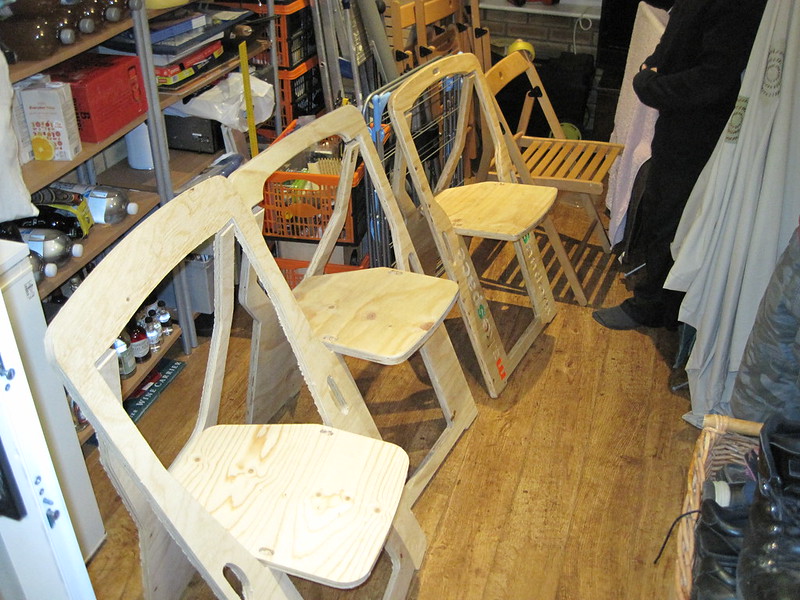
Well at least he should be according to Sartre though I am not entirely convinced the repercussions of my choice to manufacture another folding chair were entirely thought through.

After my most recent posting the urge to do "just one more iteration" became too great and I succumbed. I therefore present version 4 of my folding chair which corrects all the previously discovered issues.

The popliteal height (420mm) and buttock popliteal length (400mm) are both comfortable for a wide selection of people. The seat slopes a few degrees front to back and the back rest no longer comes further forward than the rear of the seat.

There is a small gap above where the seat folds in when flat but that is only an aesthetic issue when being stored.

Manufacture wise the design is simple to produce although I really will have to teach our CNC router how to use the round over bit to reduce the finishing steps as currently that takes longer than the CNC operation.

In future if I make more of these I will use this design and, once she is less annoyed at me for making another chair, I am going to consult with my wife on adding some cushioning material to the seat and backrest.

And of course that concludes my furniture making for a while...yeah, right!

there have been comments which have complained about my usage of space on sheets and suggested I waste too much material. That is probably true and in my own defence I have not been working with this machine for very long and am not quite used to what I can "get away with" yet.

Side X folding stool
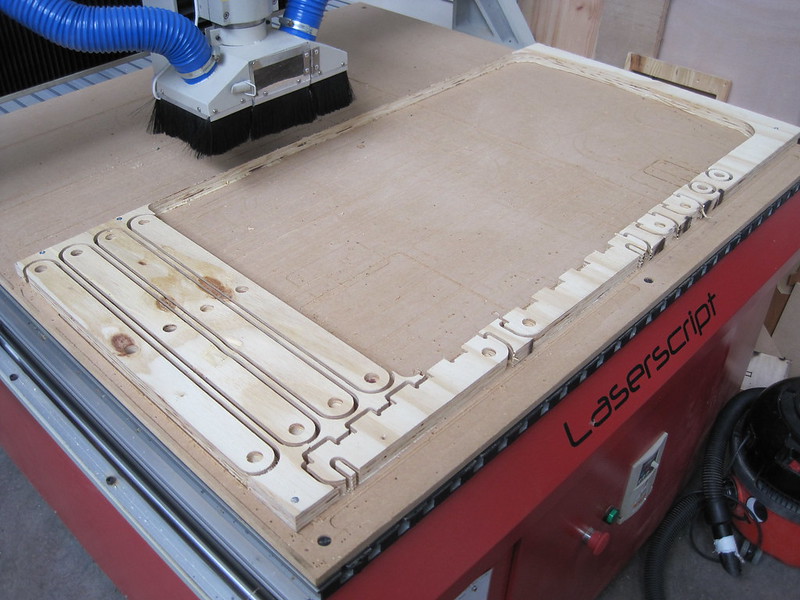
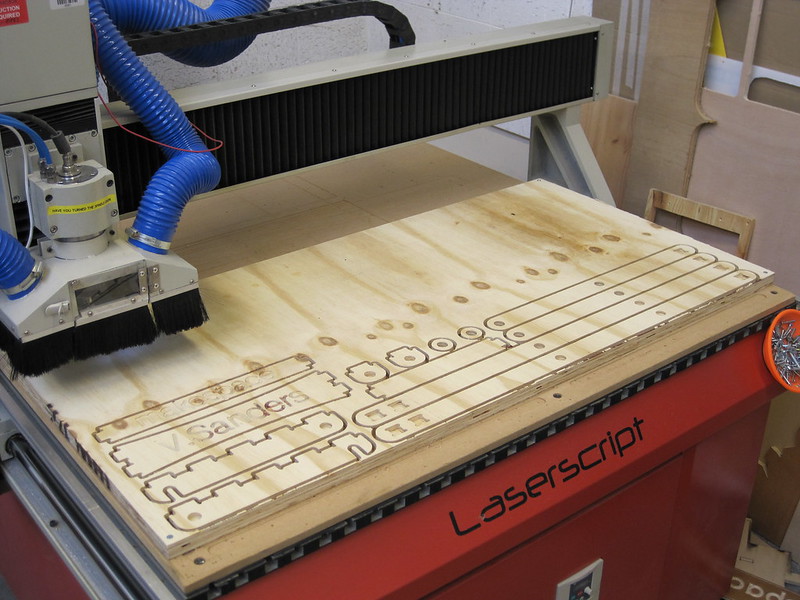
I was looking at the sheet after removing the last chair design and had a thought, I had not attempted a side X type folding design and perhaps I could squeeze one into the offcuts? I kinda got carried away, it roughly went:


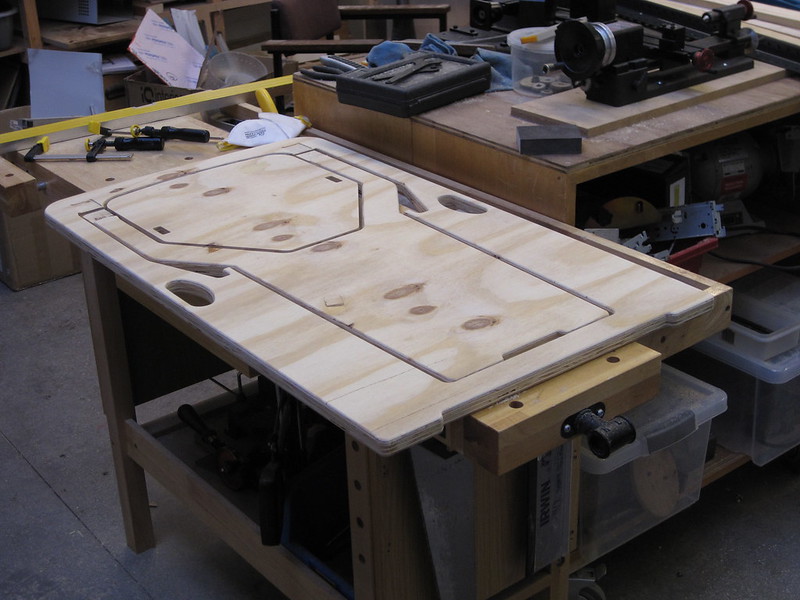
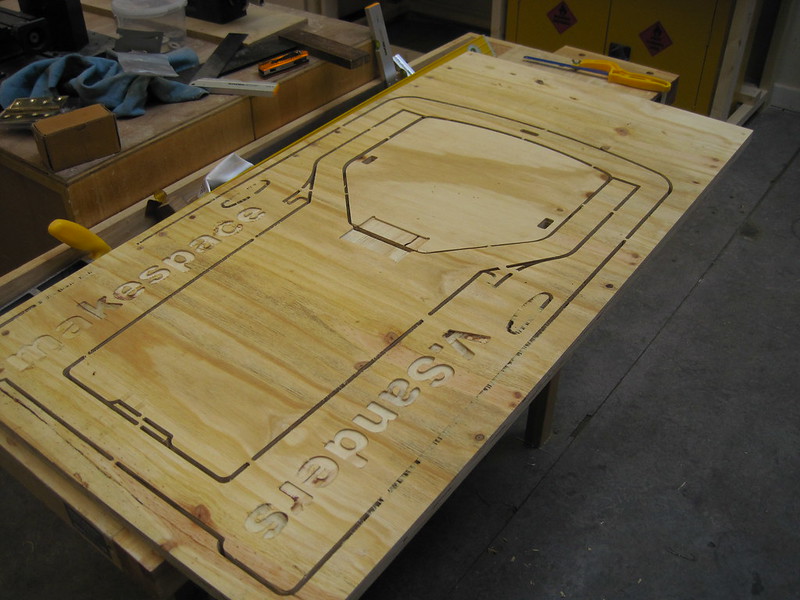
Side X folding stool cut from sheet offcut
If all of that sounds like and utterly mad way to design a size X stool, you are of course correct, but it worked, and it was a very fast process taking less than four hours from idea to stool.

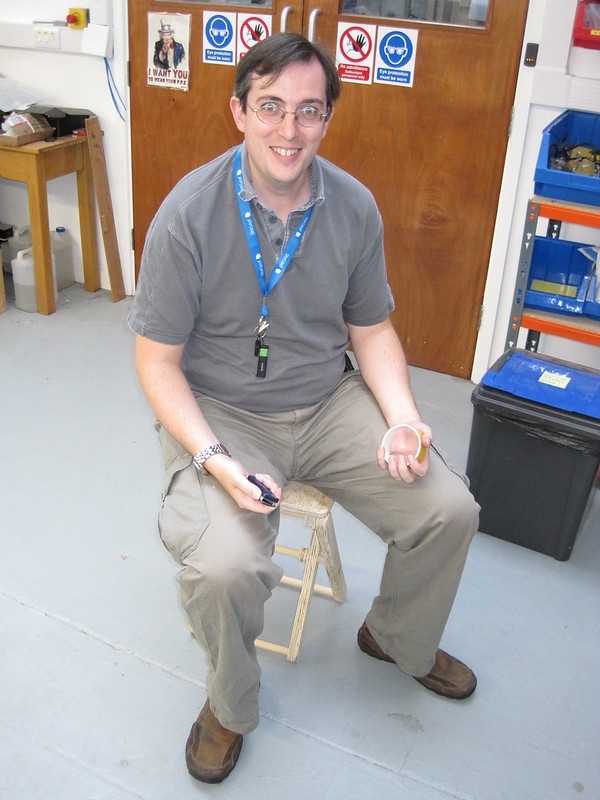
Paul testing the dry fit side X stool
There are a couple of issues:

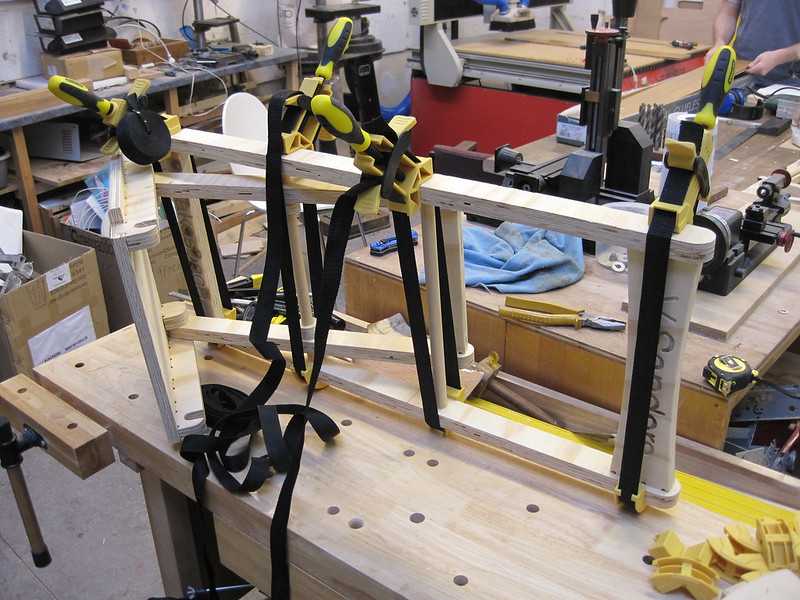
Clamping stool why the glue drys
The seat went together dry fit and Paul tested it for me, however that last issue soon made me realise that this time I was going to have to resort to glue. Yes, sorry, this design needs to be glued to remain stable (I know plywood contains glue...please stop telling me that).


It is pretty simple to put together and aside from needing half the clamps in makespace to hold it in place while the glue dried, I had no trouble.

Though this is definitely not a case of use glue "sparingly" I put generous amounts in all the dowel joints and all the seat slots and got very little ooze so I guess it could have used more.

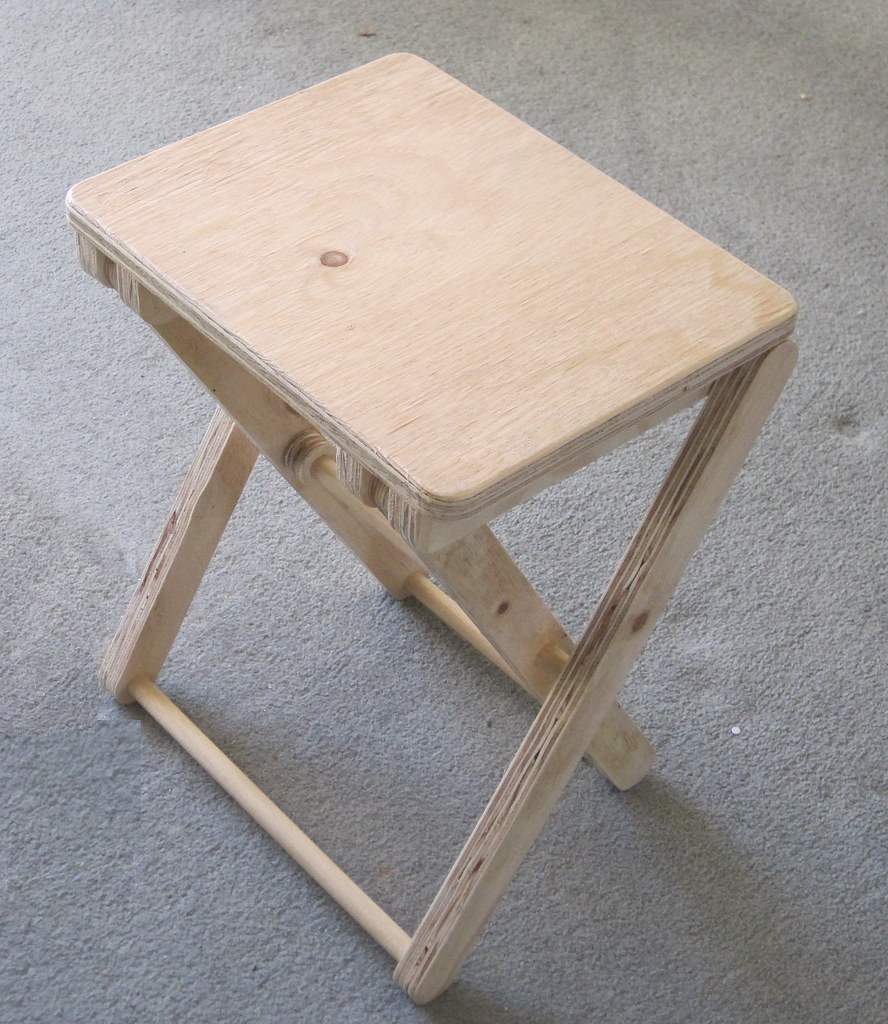
The final varnished stool is pretty robust but folds up nicely the concept of hooking to its own pivot dowel means it stays closed when flat which makes it very portable.

Total cost was an estimated 10.00 ( 4.25 dowel, 2.50 of 24mm ply, 1.75 for 18mm ply, 0.50 tool wear, 1.00 varnish) though the materials in my case could be argued to have cost nothing.

It has been suggested that I could make an entire picnic table and chairs set this way but if I did I would reduce the stool height by 50mm and examine ways to use less dowel.

This is usually the bit where I point you all at the freely usable design files on github and all the photos on flikr and wrap up.

But you know what the Monty Python boys say? "Nobody Expects the Spanish inquisition"

Or in this case my final (and yes I am going to do something else next) chair design. It is based on the stool, in fact it is the stool design with the outer legs extended and a back rest added.

The modified design reduces the dowel requirements to 775mm but requires a bit more sheet material (cannot get this one entirely from offcuts).

Total cost was an estimated 10.50 ( 2.50 dowel, 4.50 of 24mm ply, 1.75 for 18mm ply, 0.50 tool wear, 1.25 varnish).
Because it is based on the stool design it suffers from the height issue and in addition the back rest is a bit far back to be completely comfortable.

Neither of the side X designs have flaws that interest me enough to follow the iterative approach again to solve them. Both the designs work well enough and rounded out my adventures with folding chairs and indeed furniture for now.

As always the design files are on github and the images are on flikr.


Russell Coker: Qi Phone Charging

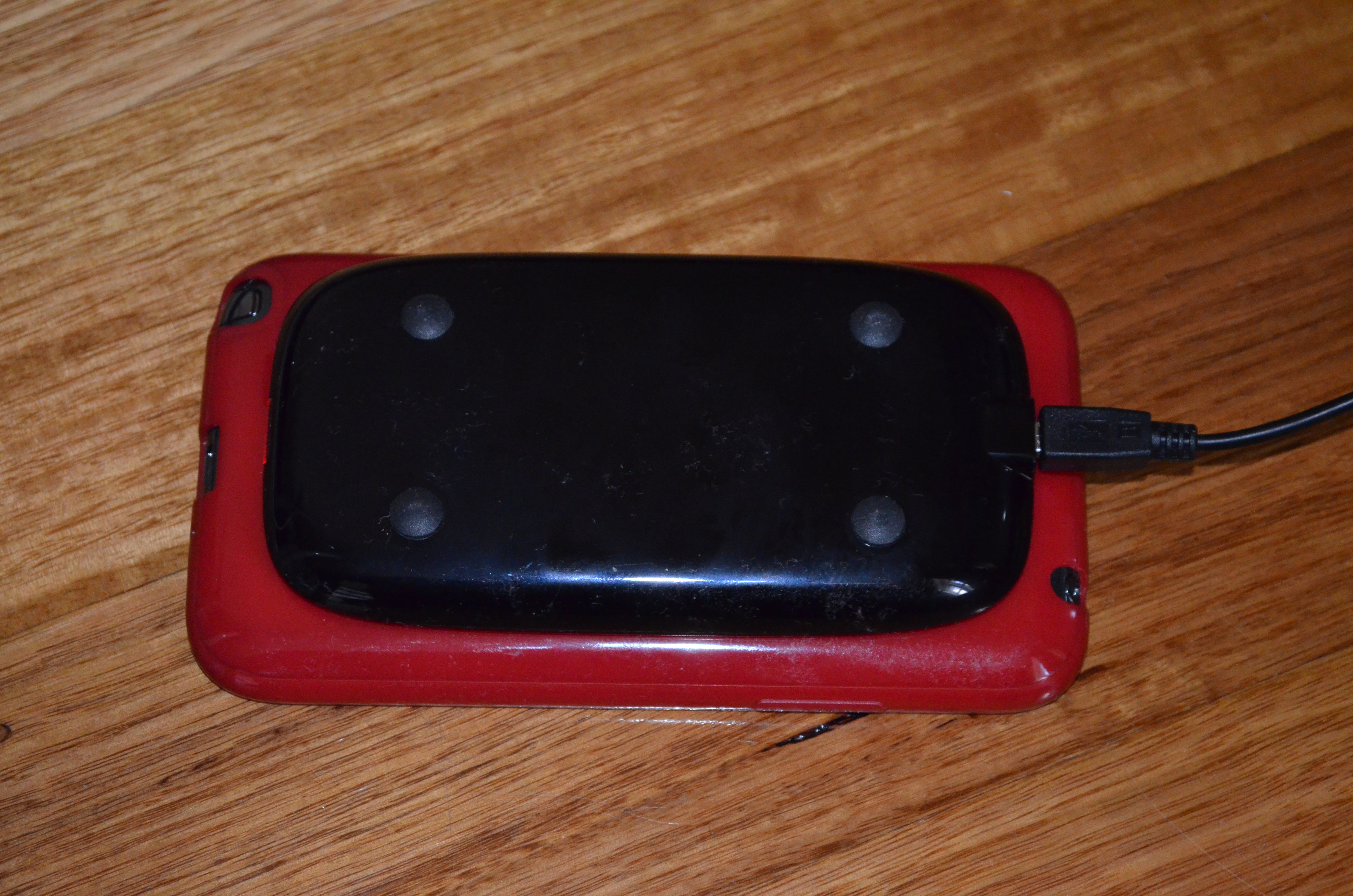
I have just bought a wireless phone charging system based on the Qi Inductive Power Standard. I bought a charging device which connects to a standard micro-USB cable and receivers for the Samsung Galaxy Note 2 and Samsung Galaxy S3 phones I own. Both those phones have contacts in the back of their case that are designed for wireless charging so you can install a charging device inside them. The charging devices make the case fit a little tight, and the charging device is stuck to the phone battery with contact adhesive, this makes it impractical to change the battery on a phone with such a device and makes it a little more difficult to swap out a battery case. One nice feature of the Nexus 4 is that it has Qi charging built in, that saved me $19 and was also more convenient. I believe that the main advantage of a wireless charger is to avoid the risk of damage to the phone if it s dropped while connected to a USB charger. This allows the phone to be charged in situations where you might need to quickly or regularly unplug it to go somewhere. One example of how I might use it is when working at an office so I could charge my phone while at my desk and then quickly take it with me if I had to go to a meeting (sadly I have worked in many offices where they have so many meetings). Another example is for sysadmin work where I have to frequently visit devices to fix them. The wireless charging mat that I bought from Kogan connects to a standard micro-USB plug, the good thing about this is that it s easy to find cables and it can take power from any PC. The bad thing about this is that the resistance of the USB cable is a factor that limits the power that a phone can receive, when using wireless charging you have the limit of the cable resistance as well as some power loss from the wireless transmission. After any extended period of charging the charging mat feels warm to the touch and the phone that s been resting on it feels warmer than usual. The warmth is an indication of energy loss which means longer charging times, a longer charging time isn t necessarily a problem as the convenience of wireless charging can allow longer charging times, but if you want to charge your phone in a hurry before you go somewhere then wireless isn t a good choice. In the past I ve discovered that the battery in a Samsung Galaxy S3 can t be charged if the phone is at 46C [1]. 46C might seem extremely hot to people in some parts of the world (EG northern Europe and Canada) but the temperature in even southern parts of mainland Australia can get that hot and it can be hotter in central and northern parts, so phone temperature can be a real issue. Currently my house is at 21C according to a digital thermometer, the Galaxy S3 and the Note 2 are being charged from USB and report temperatures of 27C and 23C respectively. While the thermometer in my house and those in the phones probably aren t really accurate it seems reasonable to assume that the battery of a relatively idle smart-phone that s being charged will be a few degrees warmer than the ambient temperature. The Qi charger makes things a lot worse as it even feels warm to the touch. So maybe a phone on a Qi charger would be 8 degrees warmer than the ambient temperature or more. That implies that in Australian summer weather a Qi charger won t be useful outside or in any building that lacks air-conditioning. So I think we can give up on the idea of using Qi devices to charge phones at a BBQ. Picture of Qi charger on top of Samsung Galaxy Note 2 The final problem I have is that the Qi device is quite small, I took the above picture with my phone face-down because no part of the charger is visible in normal use. With that size I can t just dump a phone like a Note 2 on top of the charging mat and expect it to work. I have to carefully place it so that it balances and so that the wireless receptor inside the phone matches the transmitter in the mat, if the phone isn t placed correctly then the Qi mat won t detect it and won t supply full power to the transmitter. Conclusion I m fairly disappointed in this device. The waste heat makes it unsuitable for Australian summer conditions and slows charging. The difficulty of correctly placing the phone reduces the convenience which is one of the major features. The price was $19 for each charging card for the Note 2 and the S3 and $29 for the charging mat to give a total of $67. I think it s worth the money for me to cover the risk of one of my phones having it s USB port damaged. Using a Qi charger on occasion will decrease the probability of such damage and allow the phone to be used after receiving certain types of damage. The prices of those phones nowadays are $389 for a Galaxy S3 (Kogan price), $250 for a Nexus 4 (when it was on sale in the Google store), and probably about $500 for a Galaxy Note 2 (last time Kogan offered them). So by paying $67 for Qi charging I believe that I m getting some degree of damage insurance for just over $1100 worth of phones. It seems likely that the Nexus 5 will ship with Qi charging support and that the Galaxy Note 3 will also support an optional Qi charging card (which will probably also be $19 or some similar price) so the charging mat should be useful for a long time. While I m disappointed I don t regret buying the device. But I would be hesitant to recommend it to other people and definitely wouldn t recommend it to someone who doesn t have a significant interest and investment in smart phones.

19 September 2013

Daniel Pocock: Install Debian wheezy and jessie directly with btrfs RAID1

Some time ago, I provided an installation report for installing Debian wheezy onto a btrfs RAID1 filesystem. It is not supported directly from the installer partitioning menu partman, but it is not hard to trick the installer to do it, as described in the bug report. I believe this may be a worthy release goal for Debian 8 (jessie), but it is not something I can commit to facilitate myself so I am sharing my experience with it for those who may want to volunteer. Anybody wanting to test it can easily do so with VirtualBox if they don't want to dedicate a real machine to it or if they don't have two real disks in their test machine. My own testing simply involved creating two VirtualBox virtual disks on a single SATA disk. Procedure Here is an abbreviated version of the procedure from the installation report linked above. Run the Debian installer as normal up to the partitioning menu Use manual partition mode Create one big btrfs partition on one HDD (either on a raw partition or on an LV) Designate the partition on one disk as the root FS, designate the partition on the other as unused/unformatted. Continue through the setup, installing to one disk After rebooting into Debian, follow these steps to add the other disk into a RAID1 A variation of this procedure is to use a shell while the installer is running to make the RAID1 during the installation and observe whether /etc/fstab is created correctly. Potential gotchas: is the default fstab sufficient or does it need to be modified after the conversion to RAID1? Does the initframfs need to be regenerated (and potentially modified by hand?) to make it work? Issues to be discussed / resolved Mixing BTRFS filesystems with Logical Volume Management - how many permutations should the installer support? What do people expect/need/require? How to boot if a disk fails? Can grub boot from either? Warning the user when the FS detects instability or failure in either disk

18 September 2013

Craig Small: Goodbye mygbiz

Google seems to try to invent new and interesting ways for spammers to spam me (and many others). I ve still not worked out a good way to block fake googlegroups which follow this method:
  1. Make new fake gmail login
  2. Make new fake google group
  3. Add lots of people s email addresses to the group
  4. Send lots of junk to these people
  5. Repeat when it gets closed down
I m not sure why groups aren t opt-in. A rather simple and standard way to stop this exact problem. Anyhow, the next new spammer enablement that the nice folks at Google have come up with is the mygbiz.com domain. These are temporary email addresses you can use when setting up Google apps. The only thing I have ever seen from them is spam. So I thought I d try to report some to Google. After looping around several help screens that were, despite their name, very unhelpful, I ve come to the conclusion that Google isn t too serious about fixing this problem. If you have postfix, the solution is very simple:
  1. vi /etc/postfix/access_sender
  2. Add a line like mygbiz.com REJECT
  3. postmap /etc/postfix/access_sender
  4. postfix reload
I find the results to this method far superior to trying to get Google interested in being responsible for a domain they run. If you want to use google apps then spend the $50 and get a domain. Alternatively don t use something that spammers abuse. Does it work? You bet it does!
Sep 18 23:26:38 elmo postfix/smtpd[19013]: NOQUEUE: reject: RCPT from mail-ye0-f208.google.com[209.85.213.208]: 554 5.7.1 <grace@sheiladolan.mygbiz.com>: Sender address rejected: Do not send from mygbiz.com domains; from=<grace@sheiladolan.mygbiz.com> to=<ME@MYDOMAIN> proto=ESMTP helo=<mail-ye0-f208.google.com>

Francois Marier: Presenting from a separate user account

While I suspect that professional speakers have separate presentation laptops that they use only to give talks, I don't do this often enough to justify the hassle and cost of a separate machine. However, I do use a separate user account to present from. It allows me to focus on my presentation and not stress out about running into configuration problems or exposing private information. But mostly, I think it's about removing anything that could be distracting for the audience. The great thing of having a separate user for this is that you can do whatever you want in your normal account and still know that the other account is ready to go and configured for presenting on a big screen.

Basics The user account I use when giving talks is called presenter and it has the same password as my main user account, just to keep things simple. However, it doesn't need to belong to any of the UNIX groups that my main user account belongs to. In terms of configuration, it looks like this:
  • power management and screen saver are turned off
  • all sound effects are turned off
  • window manager set to the default one (as opposed to a weird tiling one)
  • desktop notifications are turned off
Of course, this user account only has the software I need while presenting. You won't find an instant messaging, IRC or Twitter client running on there. The desktop only has the icons I need for the presentation: slides and backup videos (in case the network is down and/or prevents me from doing a live demo).

Web browsers While I usually have my presentations in PDF format (for maximum compatibility, you never know when you'll have to borrow someone else's laptop), I use web browsers (different ones to show that my demos work with all of them) all the time for demos. Each browser:
  • clears everything (cookies, history, cache, etc.) at the end of the session
  • has the site I want to demo as the homepage
  • only contains add-ons or extensions I need for the demos
  • has the minimal number of toolbars and doesn't have any bookmarks
  • has search suggestions turned off
  • never asks to remember passwords

Terminal and editors Some of my demos may feature coding demos and running scripts, which is why I have my terminal and editor set to:
  • a large font size
  • a color scheme with lots of contrast
It's all about making sure that the audience can see everything and follow along easily. Also, if you have the sl package installed system-wide, you'll probably want to put the following in your ~/.bashrc:
alias sl="ls"
alias LS="ls"

Rehearsal It's very important to rehearse the whole presentation using this account to make sure that you have everything you need and that you are comfortable with the configuration (for example, the large font size). If you have access to a projector or a digital TV, try connecting your laptop to it. This will ensure that you know how to change the resolution of the external monitor and to turn mirroring ON and OFF ahead of time (especially important if you never use the default window manager or desktop environment). I keep a shortcut to the display settings in the sidebar.

Localization Another thing I like to do is to set my operating system and browser locales to the one where I am giving a talk, assuming that it is a western language I can understand to some extent. It probably doesn't make a big difference, but I think it's a nice touch and a few people have commented on this in the past. My theory is that it might be less distracting to the audience if they are shown the browser UI and menus they see every day. I'd love to have other people's thoughts on this point though. Also, pay attention to the timezone since it could be another source of distraction as audience members try to guess what timezone your computer is set to.

Anything else? If you also use a separate account for your presentations, I'd be curious to know whether there are other things you've customised. If there's anything I missed, please leave a comment!

17 September 2013

Stefano Zacchiroli: sources.debian.net - advanced search and other news

all your ctag (and checksum) are belong to us A few months after the initial announcement, here are some news about the sources.d.n service. I've been late in blogging this, but most of it has been implemented by myself and Matthieu Caneill during DebConf13, which has been a great DebConf, totally exceeding my expectations (and they were already fairly high!). First, you might have noticed some user-visible changes: On the other hand, under the hood: As you usual, your bug reports (and patches!) are more than welcome, just check BUGS before reporting to avoid duplicates.
That's all!

Julien Danjou: Python 3.4 single dispatch, a step into generic functions

I love to say that Python is a nice subset of Lisp, and I discover that it's getting even more true as time passes. Recently, I've stumbled upon the PEP 443 that describes a way to dispatch generic functions, in a way that looks like what CLOS, the Common Lisp Object System, provides. What are generic functions If you come from the Lisp world, this won't be something new to you. The Lisp object system provides a really good way to define and handle method dispatching. It's a base of the Common Lisp object system. For my own pleasure to see Lisp code in a Python post, I'll show you how generic methods work in Lisp first. To begin, let's define a few very simple classes.
(defclass snare-drum ()
())

(defclass cymbal ()
())

(defclass stick ()
())

(defclass brushes ()
())

This defines a few classes: snare-drum, symbal, stick and brushes, without any parent class nor attribute. These classes compose a drum kit, and we can combine them to play sound. So we define a play method that takes two arguments, and returns a sound (as a string).
(defgeneric play (instrument accessory)
(:documentation "Play sound with instrument and accessory."))

This only defines a generic method: it has no body, and cannot be called with any instance yet. At this stage, we only inform the object system that the method is generic and can be then implemented with various type of arguments. We'll start by implementing versions of this method that knows how to play with the snare-drum.
(defmethod play ((instrument snare-drum) (accessory stick))
"POC!")

(defmethod play ((instrument snare-drum) (accessory brushes))
"SHHHH!")

Now we just defined concrete methods with code. They also takes two arguments: instrument which is an instance of snare-drum and accessory that is an instance of stick or brushes. At this stage, you should note the first difference with object system as built into language like Python: the method isn't tied to any class in particular. The methods are generic, and any class can implement them, or not. Let's try it.
* (play (make-instance 'snare-drum) (make-instance 'stick))
"POC!"

* (play (make-instance 'snare-drum) (make-instance 'brushes))
"SHHHH!"

* (play (make-instance 'cymbal) (make-instance 'stick))
debugger invoked on a SIMPLE-ERROR in thread
#<THREAD "main thread" RUNNING 1002ADAF23 >:
There is no applicable method for the generic function
#<STANDARD-GENERIC-FUNCTION PLAY (2)>
when called with arguments
(#<CYMBAL 1002B801D3 > #<STICK 1002B82763 >).

Type HELP for debugger help, or (SB-EXT:EXIT) to exit from SBCL.

restarts (invokable by number or by possibly-abbreviated name):
0: [RETRY] Retry calling the generic function.
1: [ABORT] Exit debugger, returning to top level.

((:METHOD NO-APPLICABLE-METHOD (T)) #<STANDARD-GENERIC-FUNCTION PLAY (2)> #<CYMBAL 1002B801D3 > #<STICK 1002B82763 >) [fast-method]

As you see, the function called depends on the class of the arguments. The object systems dispatch the function calls to the right function for us, depending on the arguments classes. If we call play with instances that are not know to the object system, an error will be thrown. Inheritance is also supported and the equivalent (but more powerful and less error prone) equivalent of Python's super() is available via (call-next-method).
(defclass snare-drum () ())
(defclass cymbal () ())

(defclass accessory () ())
(defclass stick (accessory) ())
(defclass brushes (accessory) ())

(defmethod play ((c cymbal) (a accessory))
"BIIING!")

(defmethod play ((c cymbal) (b brushes))
(concatenate 'string "SSHHHH!" (call-next-method)))

In this example, we define the stick and brushes classes as subclass of the accessory class. The play method defined will return the sound BIIING! regardless of the accessory instance that is used to play the cymbal. Except in the case where it's a brushes instance; only the most precise method is always called. The (call-next-method) function is used to call the closest parent method, in this case that would be the method returning _"BIIING!".
* (play (make-instance 'cymbal) (make-instance 'stick))
"BIIING!"

* (play (make-instance 'cymbal) (make-instance 'brushes))
"SSHHHH!BIIING!"

Note that CLOS is also able to dispatch on object instances themself by using the eql specializer. But if you're really curious about all features CLOS provides, I suggest you read the brief guide to CLOS by Jeff Dalton as a starter. Python implementation Python implements a simpler equivalence of this workflow with the singledispatch function. It will be provided with Python 3.4 as part of the functools module. Here's a rough equivalence of the above Lisp program.
import functools

class SnareDrum(object): pass
class Cymbal(object): pass
class Stick(object): pass
class Brushes(object): pass

@functools.singledispatch
def play(instrument, accessory):
raise NotImplementedError("Cannot play these")

@play.register(SnareDrum)
def _(instrument, accessory):
if isinstance(accessory, Stick):
return "POC!"
if isinstance(accessory, Brushes):
return "SHHHH!"
raise NotImplementedError("Cannot play these")

We define our four classes, and a base play function that raises NotImplementedError, indicating that by default we don't know what to do. We can then write specialized version of this function with a first instrument, the SnareDrum. We then check for the accessory type that we get, and return the appropriate sound or raise NotImplementedError again if we don't know what to do with it. If we run it, it works as expected:
>>> play(SnareDrum(), Stick())
'POC!'
>>> play(SnareDrum(), Brushes())
'SHHHH!'
>>> play(Cymbal(), Brushes())
Traceback (most recent call last):
File "<stdin>", line 1, in <module>
File "/home/jd/Source/cpython/Lib/functools.py", line 562, in wrapper
return dispatch(args[0].__class__)(*args, **kw)
File "/home/jd/sd.py", line 10, in play
raise NotImplementedError("Cannot play these")
NotImplementedError: Cannot play these
>>> play(SnareDrum(), Cymbal())
Traceback (most recent call last):
File "<stdin>", line 1, in <module>
File "/home/jd/Source/cpython/Lib/functools.py", line 562, in wrapper
return dispatch(args[0].__class__)(*args, **kw)
File "/home/jd/sd.py", line 18, in _
raise NotImplementedError("Cannot play these")
NotImplementedError: Cannot play these

The singledispatch module looks through the classes of the first argument passed to the play function, and calls the right version of it. The first defined version of the play function is always run for the object class, so if our instrument is a class that we did not register for, this base function will be called. For whose eager to try and use it, the singledispatch function is provided Python 2.6 to 3.3 through the Python Package Index. Limitations First, as you noticed in the Lisp version, CLOS provides a multiple dispatcher that can dispatch on the type of any of the argument defined in the method prototype, not only the first one. Unfortunately, Python dispatcher is named singledispatch for this good reason: it only knows to dispatch on the first argument. Guido van Rossum wrote a short article about the subject that he called multimethod a few years ago. Then, there's no way to call the parent function directly. There's no equivalent of the (call-next-method) from Lisp nor the super() function that allows to do that in Python class system. This means you will have to use various trick to bypass this limitation. So while I am really glad that Python is going toward that direction, as it's a really powerful way to enhance an object system, it really lacks a lot of more advanced features that CLOS provides out of the box. Though, improving this could be an interesting challenge. Especially to bring more CLOS power to Hy. :-)
The Hacker Guide to Python
A book I'm writing that will be launched soon, talking about designing Python applications, state of the art, and various Python tips. If you want to be the first to hear about the launch, subscribe now.

Vincent Sanders: Ever tried. Ever failed. No matter. Try Again. Fail again. Fail better.


I seem to be adhering to Beckett's approach recently but for some reason, after my previous stool attempts, despite having a functioning design I felt I had to do just one more iteration.

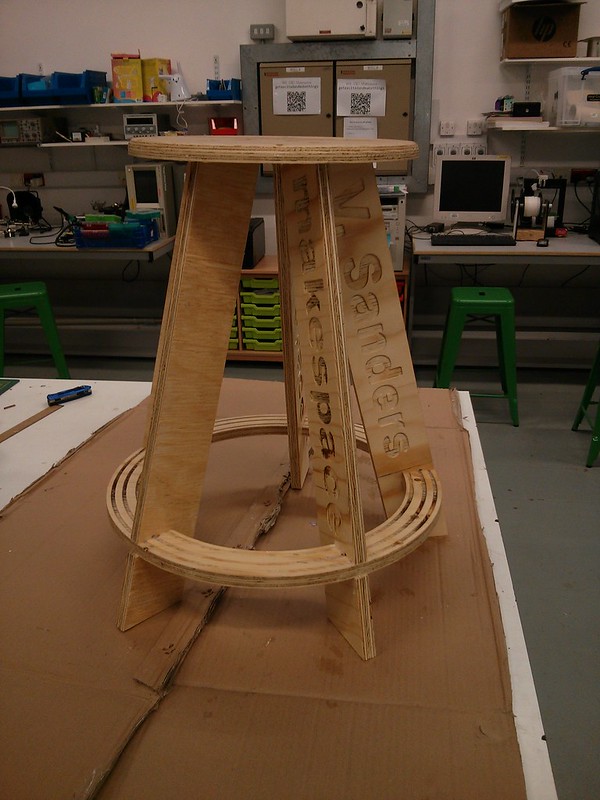
Five legged stoolGoing back to a previous concept of having five legs instead of three while this did not improve the rotational problems with the 12mm thick material, it did make the design more stable overall and less prone to tipping.

The five legged solution realised in 18mm plywood resulted in my final design for this concept. As my friend Stephen demonstrates the design is pretty solid even for those of us with a more ample frame. There are now a couple of them in use at the space alongside the three legged earlier versions.

I was finally satisfied with the result and thought I was done with furniture making for a while. My adorable wife then came up with a challenge, she wanted a practical foldable chair her requirements were:
A frame folding chair, image from wikimedia
Things for individual humans to sit on raised off the floor, or chairs as we call them, have been around for a long time. My previous research for the stool indicated that chairs have a long history with examples still surviving from the ancient egyptians. From this I assumed there would be nothing novel in this project and to quote the song it's all been done before
Foldingchairs
Given this perspective my research started with an image search for "folding chair". The results immediately showed there were two common shapes. Either the chair base was formed with a pair of linked X shapes with the seat across the top, or an A frame style where the seat is across the centre.

My initial thoughts were to replicate the IKEA style A frame design until I noticed that some designs were made from a single sheet of timber with a small number of profile cuts. I searched for pre-existing design files but found none, perhaps I had found something novel to do after all.

A frame chair  1 - Front  2 - Rear  3- seat
Some quick measurements of chairs in shops (and more weird looks, mainly from my family) suggested 900mm is generally the highest a chair ought to stand. I selected a popliteal height of 420mm as a general use compromise which is a bit less than the 430mm of most mass produced chairs. I also decided there should be a front to rear drop across the seat which ought to improve comfort a little.

Material selection was based upon what I had to hand which consisted of a couple of sheets of structural plywood (1220x606x18mm temperate softwood - probably spruce although not specified) which had not become stools yet. Allowing for edge wastage and tool width this gave me a working area from a sheet of 1196x582mm.

I sketched the side view of the chair numbering the three parts. I decided part 1 would be 1000mm total height with top and bottom cross braces 80mm high, assuming the 900mm tall target, the A frame apex would be at 820mm height.

If we assert that the apex is immediately below the top cross brace on part 1 this gives 920mm at which point we have two sides of a right angled triangle (820 and 920) from which we can calculate the top angle is 26 . This also means part 2 will be 840mm long with the same 820 height this gives an angle of 10 .

I did the maths for the seat triangle using the 36 angle and 420mm popliteal height. Having experienced how flexible 18mm plywood was in the face dimension I decided to make the frame sides 50mm wide leaving, after 6mm tool path widths, enough space for a 358mm wide seat .

Once the dimensions were decided the design went pretty quickly producing something that looked similar to the designs I had seen earlier.

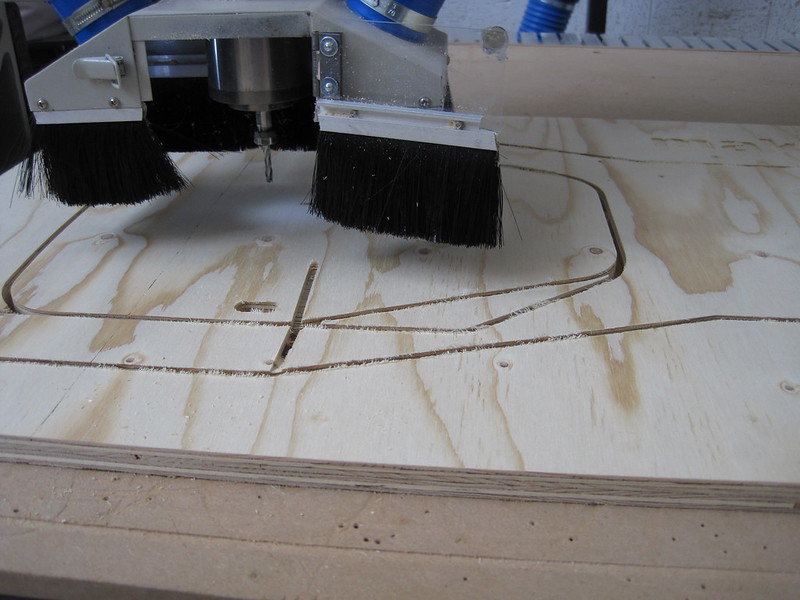
CNC routers can go wrong, spot the fail
Generating toolpaths for this design proved challenging with the CAM software we had available, mainly because arranging multiple "inner" and "outer" cuts along the same path and having the tabs line up was obviously not an anticipated feature.

Things had been going far too well for me and during the routing operation our machine decided to follow an uncommanded toolpath excursion mid job (it cut a dirty great hole through the middle of my workpiece where I did not want it) ruining the sheet of material.

Fortunately, once factory reset and reconfigured, the machine ran the job correctly the second time although we still do not know why it went wrong. The parts were cut free of their tabs and hinges fitted.

The resulting design worked with a couple of problems:
Folding chair in 24mm plywood with edges rounded off
So time for a second iteration, this time I selected a thicker plywood to reduce the bend under large loads (OK already, I mean me). After shopping around for several days I discovered that unlike 12mm and 18mm thick plywood 24mm thick is much harder to find at a sensible price especially if you want it cut into 1220x606 sheets from the full 1220x2440.

I eventually physically went to Ridgeons and looked at what they actually had in the warehouse and got a price on a sheet of brazilian elliotis pine structural plywood for 43.96 which they cut for me while I waited. Being physically present also gave me the opportunity to pick a "less bad" sheet from the stack much to the annoyance of the Ridgeons employee for not just taking the top one.

This time I reduced the apex height by 30mm, the length of part 1 by 80mm. I also reduced the frame width by 10mm relying on the increased thickness of the plywood to maintain the strength. In area terms it is actually an increase in material (50mm*17.7mm = 885 against 40mm*22.80 = 912). I also included rebates for the top hinges within the design allowing them to be mounted flush within the sheet width.

The new design was cut (without incident this time) and the edges rounded off. I also added some simple catches to keep the seat and back inline while being transported.

While this version worked I had made a couple of mistakes again. The first was simply a radius versus diameter error on the handles which meant too much material was removed from a high stress area causing increased bending.

Third version of folding chair ready for finishing
The second error was a stupid mistake that where I had worked the latch holes in the seat to the wrong side of my measure line meaning the apex angle was 35.5 not the expected 33.6 which meant the backrest felt "too far forward"

The third version rectified those two errors and improved the seat front curve a little to further reduce the unneeded material in the back rest.

The fabrication of this design was double sided allowing for the seat hinge to be fully rebated and become flush and also adding some text similar to the stools.

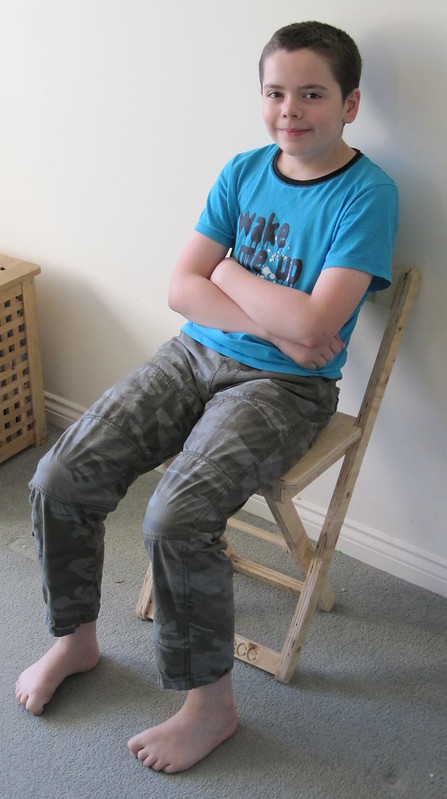
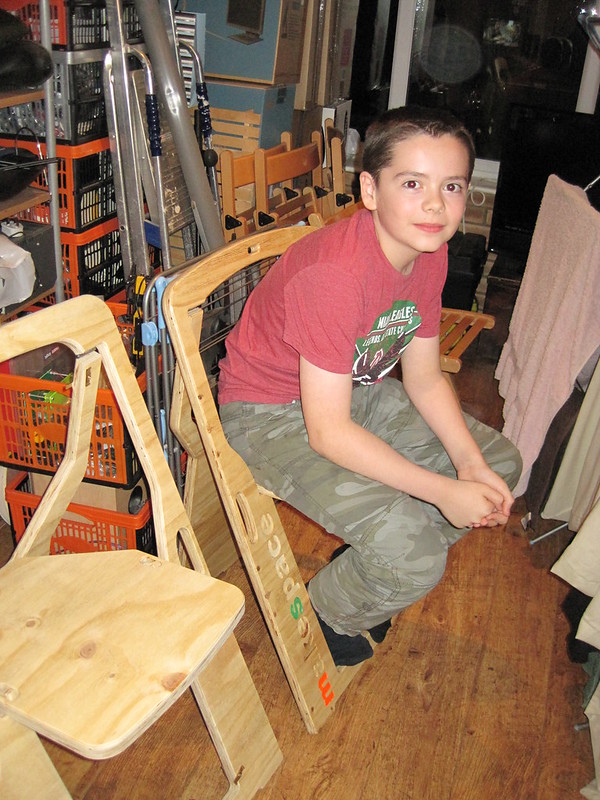
Alex sat on version 3 folding chair
This version still suffers from a backrest that is a bit too far forward and my sons complain it makes them sit up too straight. The problem is that the angle of the front face (23.6 ) means that to move the rest back 20mm means the piece needs to extend another 50mm beyond the frame apex which would probably make the chair feel tall again.

I guess this is a compromise that would take another iteration or two to solve, alas my wife has declared a moratorium on more chairs unless I find somewhere to put the failed prototypes other than her conservatory.

One other addition would be a better form of catch for transport. The ones in version 2 work but are ugly, magnets inset into the frame have been suggested but not actually implemented yet.

Folding chairs versions 1 to 3 and TERJE for comparison
In conclusion I think I succeeded with the original brief and am pretty pleased with the result. A neatly folding chair that can be stacked simply by having a pile of them and are easy to move and setup.

The price per chair is a little higher than I would like at 22 ( 11 for timber, 5 for hinges and screws , 5 for varnish and 1 for tool wear) plus about 2 hours labour (two sided routing plus roundover takes ages)

As previously the design files are available on github and there are plenty more images in the flikr set.

16 September 2013

Gunnar Wolf: My favorite (or rather, one among my favorite) non-original work Leo Masliah #encirc13

It seems I'm catching up with the pace of this course I'm following and that is compelling me to go back to posting on my blog, Arte y cultura en circulaci n: crear y compartir en tiempos digitales . This week's lesson is (again, in Spanish) Las fronteras del remix (the boundaries of remixes). An interesting text, open to everybody (regardless of whether you are signed up for the course or, I hope, whether time has passed since the course took place). And this week's homework is to find "our favorite" non-original work (I picked one among my favorite works And, yes, this is partly because I am part of the "club" of deniers of true originality: We cannot create anything without being part of a surrounding culture, without a common heritage and language with which we speak to our audience) and to find something about it, anything considered important or significative as to its antecedents. What do I like about this work, what grabs my attention. Do I consider it to be a true new creative work? Why? I am taking as an example Leo Masliah, an Uruguayan writer and musician (writer and interpreter). I have followed and enjoyed Masliah's work since 1996, and although by far I'm most familiar with his musical works, I have two books (a novel and a series of short stories). Among his facets, I most enjoy the acid, nihilistic/dadaistic streaks. I chose three of his songs to talk about I am linking to anonline resource where possible, but uploading the three songs to this blog to make his work better known, so that people understand what I talk about, and with my best intentions. Of course, if there is any request to remove the material, I will do it right away. I hope this can be seen as fair/academic use, although this blog is somewhat widely read.

La recuperaci n del unicornio
This song was in the first Masliah cassette I came across, Although musically it is an original work, the lyrics are a clear, almost line-by-line reply to the ever-repeated Unicornio song, by Silvio Rodr guez. This song (which I'm sure that every Spanish speaker reading this lines knows, like it or not It defines for me a good deal of Rodr guez hyper-sweetness and clicheness) has been analyzed over and over looking for a meaning. Silvio recorded this song in 1981, and by 1987 Masliah published this answer, mocking each of the lines.
So, this song can be seen as an original creation, as it contains no literal copy neither of the music nor of the lyrics of the original, but it cannot be understood without being familiar with Silvio's lost unicornio. It would just be an almost-dadaistic rant. But every person that has tasted Silvio Rodr guez cloying song will surely laugh with this one.
No necesitamos otro h roe Balderrama
I find this to be a very unique piece. It bonds together Argentinian folklore and USA pop.
Masliah sings the famous Argentinian song Zamba de Balderrama, (Castilla / Leguizam n), a song lamenting that the very popular bar and artist stage Balderrama, in Salta (North-Western corner of Argentina), seemed to be on the brink of closing. Of course, when Mart n, Constanza, Regina and me went to Balderrama in July 2010, the danger of closing this place had long been averted. And basically every Argentinian knows this song by heart.
The interesting part is that Masliah sings this song (as he presents it as the closing piece for one of his concerts) being short on time, and decides to present two acts together: Zamba de Balderrama and We don't need another hero, by Tina Turner, from the Mad Max soundtrack. So, of course, even if it's obvious that Masliah had to stretch bits to make them fit together, he achieved a very funny, interesting and unique blend of two completely unrelated works. He derives from one as well as from the other, but creates something unique and new.
Donna Lee
I was thinking what to write for this assignment , and had already chosen the two other songs. Yesterday, we were visiting our friends Octavio and Claudia, in Guanajuato, and I heard for the first time the original(?) version of Donna Lee, by Miles Davis (although often credited to Charlie Parker). That led me to remember Masliah's interpretation, in his Cl sicos album. This album is basically made up with similar excercises: Taking an instrumental piece, with Masliah singing over it. Some of the lyrics follow the story (i.e. the children stories), others just talk nonsense to illustrate a point (i.e. "La voz del medio", "the middle voice") follows the non-protagonist score trying not to grab much attention to the lyrics but to highlight the often ignored melody)... Donna Lee is just a fun excercise on following the melody asking what was in the head of the author that led him to invent such a strange, hard music.
Masliah is a great music performer, although often it seems he tries to hide it (i.e. by abusing the dissonances, ex-profeso singing off-key, etc), and a very funny and crazy author. Most of his works have a deep satirical tone, and it's common to find either simple winks or complete "borrowings" in a clear remix fashion, but nobody will doubt on the originality of his works.
AttachmentSize
07-Donna Lee.MP31.79 MB
16 No necesitamos otro h roe - Balderrama.mp33.49 MB
Leo Masl ah-La Recuperaci n Del Unicornio.mp31.87 MB

Petter Reinholdtsen: Third and probably last beta release of Debian Edu Wheezy

The third wheezy based beta release of Debian Edu was wrapped up today. This is the release announcement from Holger Levsen:
Hi, it is my pleasure to announce the third beta release (beta 2 for short) of Debian Edu / Skolelinux based on Debian Wheezy! Please test these images extensivly, if no new problems are found we plan to do this final Debian Edu Wheezy release this coming weekend. We are not aware of any major problems or blockers in beta2, if you find something, please notify us immediately! (More about the remaining steps for the Edu Wheezy release in another mail to the edu list tonight or tomorrow...) Noteworthy changes and software updates for Debian Edu 7.1+edu0~b2 compared to beta1:
  • The KDE proxy setup has been adjusted to use the provided wpad.dat. This also gets Chromium to use this proxy.
  • Install kdepim-groupware with KDE desktops to make sure korganizer understand ical/dav sources.
  • Increased default maximum size of /var/spool/squid and /skole/backup on the main server.
  • A source DVD image containing all source packages is now available as well.
  • Updates for chromium (29.0.1547.57-1~deb7u1), imagemagick (6.7.7.10-5+deb7u2), php5 (5.4.4-14+deb7u4), libmodplug (0.8.8.4-3+deb7u1+git20130828), tiff (4.0.2-6+deb7u2), linux-image (3.2.0-4-486_3.2.46-1+deb7u1).
Where to get it: To download the multiarch netinstall CD release you can use The SHA1SUM of this image is: 3a1c89f4666df80eebcd46c5bf5fedb866f9472f To download the multiarch USB stick ISO release you can use The SHA1SUM of this image is: 702d1718548f401c74bfa6df9f032cc3ee16597e The Source DVD image has the filename debian-edu-7.1+edu0~b2-source-DVD.iso and the SHA1SUM 089eed8b3f962db47aae1f6a9685e9bb2fa30ca5 and is available the same way as the other isos. How to report bugs For information how to report bugs please see
http://wiki.debian.org/DebianEdu/HowTo/ReportBugs About Debian Edu and Skolelinux Debian Edu, also known as Skolelinux, is a Linux distribution based on Debian providing an out-of-the box environment of a completely configured school network. Immediately after installation a school server running all services needed for a school network is set up just waiting for users and machines being added via GOsa , a comfortable Web-UI. A netbooting environment is prepared using PXE, so after initial installation of the main server from CD or USB stick all other machines can be installed via the network. The provided school server provides LDAP database and Kerberos authentication service, centralized home directories, DHCP server, web proxy and many other services. The desktop contains more than 60 educational software packages and more are available from the Debian archive, and schools can choose between KDE, Gnome, LXDE and Xfce desktop environment. This is the seventh test release based on Debian Wheezy. Basically this is an updated and slightly improved version compared to the Squeeze release. Notes for upgrades from Alpha Prereleases Alpha based installations should reinstall or downgrade the versions of gosa and libpam-mklocaluser to the ones used in this beta release. Both alpha and beta0 based installations should reinstall or deal with gosa.conf manually; there are two options: (1) Keep gosa.conf and edit this file as outlined on the mailing list. (2) Accept the new version of gosa.conf and replace both contained admin password placeholders with the password hashes found in the old one (backup copy!). In both cases all users need to change their password to make sure a password is set for CIFS access to their home directory. cheers,
Holger

Debian Med

DebConf 13 report (by Andreas Tille) General impression unofficial  Scenic Hacklab I'm beginning my DebConf report in an unofficial "Scenic Hacklab" right at the edge of the lake in Yverdon. This is the right place to memorise the last days. When I started from this place cycling to Le Camp 12 days ago I was full of great expectations and what should I say - the reality has even beaten these. Once it comes about comparing DebConfs even if it is an unfair comparison due all the differences my secret long term favourite was Helsinki very closely followed by Argentina and also very closely followed by all the other great DebConfs I joined (and I joined all in Europe). Would Le Camp be able to beat it? The short answer is: Yes, it is now my favourite DebConf while I think I do not suffer from the last-Debconf-was-the-best-DebConf-syndrome (and I realised there are others thinking the same). As you might probably know I'm a bit addicted to swimming. While Helsinki had admittedly the better conditions I was at least able to fix the distance issue using my bicycle. (Hey, those Le Camp photographers did a great job in hiding the fact that you can not actually touch the lake right from the meadow of Le Camp.) Being able to have my bicycle at DebConf scored some extra points. However, the really great view of the lake, the inspiring "Scenic Hacklab" which was my favourite place has bumped DebConf13 at first place in my personal ranking. So it comes quite natural to say: "Kudos to the great organisation team!" They did a Swiss-like precise work and perfectly succeeded in hiding any problems (I assume there were some as always) from the attendees so everything went smooth, nice and shiny for the attendees. The local team was even precise in setting up great weather conditions for DebConf. sunrise over  the lake While saying thanks to the local team I would like to also explicitly thank Luca Capello who has quite some share that this DebConf was possible at all (while I have to decrease my DebConf score one point because he was not really there - Luca to bad that you were not able to come full time!) Also thanks to Gunnar and Gannef who helped remotely (another score down because I were missing them this year as well). Even if it was my favourite DebConf I was not able to work down my todo list fully (which was not only uploading one package per day which I at least statistically fullfilled). But that's probably a general feature of todo lists anyway. One item was definitely done: Doing my daily swimming BoF. I actually was able to do the other parts of the triathlon which was skipped by Christian and have done in summary about 150km cycling with 3500m elevation and estimated 7-8km swimming (0m elevation ;-)). Considering the great view at sunrise over the lake I was not hating my "Senile bed escape" disease too much (I was every day waking up at sunset) - it was simply a great experience. I will never forget seeing water drips glimmering like gold inside the morning sun while seeing the Alps panorama in the distant. I hope I was able to help all interested swimmers with the DebConf Beach Map which was just a by-product of my activities in DebCamp. Speaking about OSM: I was astonished that the area was way less covered than I expected. Thanks to several DebConf attendees the situation became better and the map does not only show random trees in the wild but also the tracks leading to these. (Remark: It was no DebConf attendee who is responsible for plastering the map with single trees.) While I had my mapping focus basically close to the edge of the lake I was also able to even map my very own street. :-) I clearly remember one specific mapping tour when I was invited by the DPL: He convinced me to join him on a bicycle tour and since I was afraid to get fired I joined him instead to keep on hacking. Also Sorina was brave enough to join us on the tour and she did quite well. (Sorina, do you remember the agreement about your work on the installer? ;-)) Lucas described the tour as: going uphill on only asphalted roads. Sorina and me were witnessing the mighty DPL powers when we left the wood around Le Camp to reach the described road: The asphalt was just put onto the road - no doubt that it was done on the immediate demand of mighty DPL. :-) DebCamp time was flying like nose dive and a lot of known (and unknown) faces arrived at Le Camp. What I really liked a lot this year was that several really young children has pulled down the average age of DebConf attendees. I clearly remember all the discussion one year ago what to do about children. As always the issue was solved in a typical Debian way: Just do it and bring your children - they had obviously a great time as well. I think the youngest child was 2 months and the oldest "child" above 20. ;-) Actually Baptiste Perrier did great in making the C&W party a success and had obviously a nice time. (I wished my son would have been able to come as well but he needs to write his bachelor s thesis in physics. :-() It was nice to see the kids using all playing facilities and communicating with geeks. Also I would like to point out that even the very young attendees had their share at the success of DebConf: Just think of the three "bell ringing assistants" who helped me ringing the bells for lunch and dinner. I've got this cool job from Didier in the beginning of DebCamp. I must say having some real bells ringing is by far nicer than just the "lunch / dinner starts in 10 minutes" from IRC bot. The only thing I did not understand was that people did not considered ringing the bells at 8:00 for breakfast as a good idea. Regarding the food in general I would also like to send kudos to the kitchen: It was tasty, freshly prepared, regional food with a good change rate. I really liked this. Extra points for having the chance to sit outside when eating. Talks But lets have a look into the conference programme. I'd really recommend watching the videos of the talks Bits from the DPL (video) and Debian Cosmology (video). I considered both talks as entertaining and interesting. I also really hope that the effort Enrico Zini started in Debian Contributors (video) will be successful. I had some talks and BoFs myself starting with Why running a Blend (video) and I admit that (as usual) the number of attendees was quite low even if I think there is some proof (see below) that it is interesting for way more people who should consider working more "blendish" in their team. Do you know how to recruit one developer per year and relax the man power problem in your team? Feel free to watch the video. We have confirmation that ten DDs of our team have considered to join Debian only because Debian Med exists. Admittedly biology and medicine are really leaf topics inside the Debian universe. So if even this topic that has a very tiny share of the Debian users is able to attract this level of attention - how many more people could we win for multimedia, games, GIS and others? So if you feel you are quite overworked with your packaging and you have no time this is most probably wrong. The amount of time is basically a matter of priorities you set for your tasks. Try to put some higher priority onto using the just existing Blends tools I explained in my talk to attract more users and developers to your team and by doing so spread the workload over more people. It works, the prove was given in my main talk. So before you start working on a specific package you should wonder who else could have an even stronger interest to get this work done and provide him with some additional motivation and help to get the common goal done. The interesting thing is that my BoF about How to attract new developers for your team (video) - which was a simple report about some by-product of the Blends work - made it into the main talk room and got way more attention. For me this is the proof that the Blends concept itself is probably badly perceived as something like "a few outsiders are doing damn specific stuff which is not really interesting for anybody else" instead of what is really is: Smoothing the way from specific upstream applications to the end user via Debian. Once you see the video of this BoF you can observe how my friend Asheesh Laroia became more and more excited about the Blends concept and admitted what I said above: We should have more Blends for different fields. Funnily enough Asheesh asked me in his excitement to talk more about Blends. This would have been a really good suggestion ten years ago. At DebConf 3 in Oslo I had my very first talk about Blends (at this time under the name "Debian Internal Projects"). I continuously kept on talking about this (MiniDebConf Peking 2005, DebConf 5, Helsinki (video), DebConf 7, Edinburgh (video), DebConf 8, Mar del Plata (video), DebConf 9, C ceres (video), MiniDebConf Berlin 2010 (video in German), MiniDebConf Paris 2010 (not video recorded), DebConf 11, Banja Luka (video) ... and these are only (Mini)DebConfs my talks page is full of this topic) and every new year I try different ways to communicate the idea to my fellow Debianistas. I'm wondering how I could invent a title + abstract avoiding the term Blends, put "Git", "release" and "systemd versus upstart" in and being able to inform about Blends reasonably by not becoming to off topic with the abstract. I also registered the Debian Science round table. I admit we were lacking some input from remote via IRC which used to be quite helpful in the past. The attendees agreed upon the handling of citations in debian/upstream files which was invented by Debian Med team to create even stronger bounds to our upstream developers by giving their work extra reward and providing users with even better documentation (see my summary in Wiki). As usual I suggested to create some Debian Science offsprings like "Debian Astronomy", "Debian Electronics", "Debian Mathematics", "Debian Physics" etc. who could perfectly leave the Debian Science umbrella to get a more fine grained structure and a more focused team to enhance the contact to our users. Unfortunately there is nobody who volunteers to take over the lead for such Blends. I have given a short summary about this BoF on the Debian Science mailing list. In the Debian Med meeting I have given some status report. No other long term team members were attending DebConf and so I gave some kind of introduction for newcomers and interested people. I touched also the DebiChem topic which maintains some packages that are used by biologists frequently and so we have a good connection to this team. Finally I had registered three BoFs in Blends I'm actually not (or not yet) active part of. My motivation was to turn the ideas I have explained in my main talk into specific application inside these teams and helping them to implement the Blends framework. In the first BoF about Debian GIS I have shown the usual team metrics graphs to demonstrate, that the one packaging team Pkg-OSM is in danger to become MIA. There are only three persons doing actual uploads. Two of them were at DebConf but did not joined the BoF because they do not consider their contribution to Pkg-OSM as a major part of their general Debian work. I will contact the main contributor David Paleino about his opinion to move the packages step by step into maintenance of Debian GIS packaging team to try to overcome the split of two teams that are sharing a good amount of interest. At least if I might become an Uploader for one of the packages currently maintained by Pkg-OSM I will move this to pkg-grass-devel (which is the name of the packaging team of Debian GIS for historical reasons). The attendees of the BoF have considered this plan as sensible. Moreover I talked about my experiences with OSGeo Live - an Ubuntu derivative that tries to provide a full tool chain to work on GIS and OSM problems ... basically the same goal as Debian GIS has just provided by the OSGeo project. I'm lurking on OSGeo mailing list when I asked explicitly I've got the answer that they are working together with Debian GIS and are using common repository (which is IMHO the optimal way of cooperation). However, it seems that several protagonists of OSGeo Live are underestimating the resources provided by Debian. For instance there was a question about Java packaging issues but people were not aware about the existence of the debian-java mailing list. I was able to give an example how the Debian Med team managed to strengthen its ties to BioLinux that is also an Ubuntu derivative for biologists. At our first Debian Med sprint in 2011 we invited developers from BioLinux and reached a state where they are using the very same VCS on Alioth where we are maintaining our packages. At DebConf I was able to upload two packages where BioLinux developers did certain changes for enhancing the user experience. My "work" was just bumping the version number in changelog and so we did profit from the work of the BioLinux developers as well as they are profiting from our work. I plan to dive a bit more into Debian GIS and try to strengthen the connection to OSGeo Live a bit. The next BoF was the Debian Multimedia meeting. It was nice that the current leader of Ubuntu Studio Kaj Ailomaa joined the meeting. When I was explaining my ideas about cooperation with derivatives I repeated my detailed explanation about the relation with BioLinux. It seems every topic you could cover inside Debian has its related derivative. So to me it seems to be quite natural to work together with the developers of the derivative to join forces. I actually consider a Blend a derivative done the right way = inside Debian. The final work for the derivers that might be left for them is doing some shiny customising of backgrounds or something like this - but all the hard work could and should be done in common with the relevant Debian team. My dream is to raise such relevant teams inside Debian ... the Blends. Finally the last BoF of this series was the Debian Games meeting. As always I presented the team metrics graphs and the Debian Games team members who attended the BoF were quite interested. So it seems to be some unknown fact that team metrics are done for several teams in side Debian and so I repeat the link to it for those who are not yet aware of it. As a result of the BoF Debian Games team members agreed to put some more effort into maintaining their Blends tasks. Moreover Miriam Ruiz wants to put some effort into reviving Debian Jr. Regarding Debian Jr. there was an interesting talk about DouDouLinux - in case you might want to watch the video I'd recommend skipping the first 30min and rather watch the nice live demo. There was also an ad hoc BoF about Debian Jr scheduled to bring together all people interested into this cute project and Per Anderson volunteered to take over the lead. I have given a summary about this specific BoF at the Debian Jr list. For some other talks that I'd regard as remarkable for some reasons: I'd regard the talk "Debian-LAN" by Andreas Mundt as some hidden pearl because it did not got a lot of attention but after having seen the video I was quite impressed - specifically because it is also relevant for the Blends topic. Memories I also liked "Paths into Debian" by Moray Allan (and I was only able to enjoy the latter talks thanks to the great work of the video team!) because it also scratched the same topic I was concerned about in my mentoring talk. Related to this was in my opinion also "Women in Debian 2013" were we tried to find out reasons for the lack of woman compared to other projects and how to overcome this issue. Geert hovering  over the grass Besides the talks I will probably never forget two specific moments that make DebConf so special. One of these moments is recorded on an image that clearly needs no words - just see Geert hovering over the grass. Another strong moment in my personal record was in the DebConf Newbies BoF "First time at DebConf" that unfortunately was not recorded but at least for this statement it would have been very great if we would have some reference better than personal memory. Aarsh Shah a GSoC student from India suddenly raised up and said: "Four months ago I was not even aware that Free Software exists. Now I'm here with so many people who are totally equal. If I will tell my mother at home that I was standing in the same queue where the Debian Project Leader was queuing up for food she will never believe me." He was totally excited about things we are regarding as normal. IMHO we should memorise moments like this that might be part of the key to success in cultures, where Debian is widely unknown and very rarely in use. Amongst these not scheduled great moments the scheduled day trip was also a great thing. I had a really hard time to decide what tour I might join but ended up in the "long distance walking (or should I say running) group". Inspired by the "running Bubulle" who was flashing between the walking groups we went uphill with 5.4km/h which was a nice exercise. Our destination the large cliff was an exciting landscape and I guess we all enjoyed the dinner organised by the "Trout cabal". ;-) say goodby to  friends So I had a hard time to leave Le Camp and tried hard to make sure my memories will remain as long as possible. Keeping some signs attached to my bicycle, conserving the "Scenic Hacklab" sign for my private "scenic hacklab @ home" was one part. I also have cut some branches of the Buxus sempervirens in Le Camp and have put them in my garden at home (where I create some hedgerow from places where I spent some great time). These will probably build a great part of the hedgerow ... Thanks for reading this longish report. Looking forward to see you all in Germany 2015 (or earlier) Andreas. Scenic Hacklab  @ home

15 September 2013

Ben Hutchings: The terrible state of EFI variable storage

EFI includes support for storing persistent 'variables': it implements a key-value store where keys are (UUID, string) and values are arbitrary blobs. (There are also some flags that restrict when the variables can be accessed.) The physical storage medium is normally flash. The Linux efivars module provides access to variable storage, both through a specific interface in sysfs and through the somewhat abstracted pstore interface. An EFI implementation reads the boot order and (if applicable) Secure Boot configuration from specific EFI variables. An operating system can add arbitrary variables, using its own UUID(s). On Linux, the efibootmgr utility is used to read and write the boot order and the pstore interface is used within the kernel to dump kernel log messages or other information when particular events occur. Since efivars is needed to set the boot order on EFI systems, it's a critical part of installation. But it wasn't being loaded on Debian systems until efibootmgr was run. This doesn't work so well when using a rescue system, as the installation kernel and installed kernel may be different (Debian bug 703363). In future (Debian package version 3.2.41-1) this will be loaded automatically on EFI systems. But now comes a new problem: bugs in the implementation of variable storage can prevent a system from booting, and even worse, they may prevent manual recovery without special equipment (the system is 'bricked'). Matthew Garrett recently talked about this and mentioned that some Samsung laptops are bricked if the variable storage becomes more than 50% full. efivars now has some extra checks to avoid triggering this (both in mainline and in stable branches). This isn't the end of the story, unfortunately. Remember that nothing can be overwritten in flash without erasing a relatively large block, and that writes may fail after a few thousand erase cycles (number depending on the type of flash used). Therefore, deleting a variable usually does not free storage immediately, and overwriting a variable usually reduces the amount of free storage. In the case of the Samsung laptops, unused storage is apparently reclaimed at the next reboot. However, while testing the backported efivars changes I found that my EFI-booting system (Asus P8Z68-V LX motherboard) does not reclaim unused storage until it's very nearly full. Since the firmware itself increments a counter variable on every boot, using 36 more bytes of storage, I was able to observe the available space dropping to under 100 bytes, and then after another boot jumping to about 42K (out of 64K). This means that well over 50% of storage was unused, yet efivars would refuse to write any variables because the firmware didn't reclaim it. This would prevent (re)installation of Linux, as the boot configuration could not be written. On the assumption that both behaviours are common, I've settled on a compromise that I hope minimises overall risk: But it's essential that we find a way to identify and work safely with both behaviours. Not only do I want to eliminate the possibility of bricking or installaton failure, but I want to make EFI-backed pstore safe to enable. Crash logs are often hard to obtain and pstore can help to solve that problem. Updated 2013-09-15: The free space check has been revised (in Linux 3.2.48, 3.5.7.17, 3.8.13.5, 3.9.7 and 3.10) based on advice from Samsung. The kernel leaves at least 5K (rather than 50%) of the EFI variable store free. If it is about to breach this limit, it attempts to write a dummy variable that is larger than the free space, which will either fail or trigger garbage collection. The normal variable can then be written if garbage collection freed up enough space. This check can be disabled using the kernel parameter efi_no_storage_paranoia, but there should be no need to do so.

Christoph Berg: Jessie, the HP 6715b, and Wifi

If you are upgrading your HP/Compaq 6715b to Debian Jessie, and suddenly Wifi stops working because the PCI device is gone, install the "rfkill" package:

# lspci   tail -2
02:04.1 FireWire (IEEE 1394): Ricoh Co Ltd R5C832 IEEE 1394 Controller (rev 02)
10:00.0 Ethernet controller: Broadcom Corporation NetLink BCM5787M Gigabit Ethernet PCI Express (rev 02)
# rfkill list 1
1: hp-wifi: Wireless LAN
    Soft blocked: yes
    Hard blocked: no
# rfkill unblock wifi
# rfkill list 1
1: hp-wifi: Wireless LAN
    Soft blocked: no
    Hard blocked: no
# lspci   tail -2
10:00.0 Ethernet controller: Broadcom Corporation NetLink BCM5787M Gigabit Ethernet PCI Express (rev 02)
30:00.0 Network controller: Broadcom Corporation BCM4311 802.11a/b/g (rev 02)
Reports on the internet say that the same could be done by going into the BIOS and selecting "Reset to default" - this makes the Wifi LED active until about udev is started on the next boot. To be done: figure out how to automate this.

14 September 2013

Lars Wirzenius: Ending squeeze support in my software

I have upgraded all of my own computers from Debian 6.0 (squeeze) now. I no longer use it myself at all. Some of my software already doesn't work on squeeze (particularly, yarn, which is part of cmdtest). I do not want to spend my time finding ways to support, say, the python-markdown library version that is in squeeze: I would rather make functional improvements than support ancient software versions. I am hereby ending my support of squeeze in my own software. This means I will be removing squeeze from my apt repository on code.liw.fi, and will no longer test that my software works in squeeze, and will not be making packages for squeeze. (I am removing squeeze from the apt repository so that people don't wrongly assume it is being kept up to date.) This change affects users of Obnam. Obnam was not part of the squeeze release of Debian, but I have maintained packages of it for squeeze on code.liw.fi. If any of my software that is packaged in squeeze has security bugs, or bugs that would be considered release-critical by Debian, I will fix those, but only by making the minimal necessary change to the version in squeeze rather than backporting the current version. Debian is committed to support squeeze for several more months, and I will help Debian do that for my packages.

Joachim Breitner: Adding safe coercions to Haskell

Yesterday, I pushed my first sizable contribution to GHC, the Haskell compiler. The feature solves the problem that newtypes are not always free: If we have newtype Age = MkAge Int, then we have all learned that the Age function has zero run-time cost. But if the Int that we want to convert is inside another type, the conversion is no longer free: Converting a Maybe Int to a Maybe Age using, for example, fmap Age, will cause time and space overhead at runtime, and there was no way around it. Well, there is unsafeCoerce, but really, that ought to be avoided. So after some discussion with and encouragement of Simon Peyton Jones at RDP in Eindhoven this year I worked on a design (which was developed, as far as I know, by Simon, Roman Cheplyaka, Stephanie Weirich, Richard Eisenberg and me). In GHC 7.8, there will be a function coerce :: Coercible a b => a -> b that works, from the user point of view, like unsafeCoerce (i.e. no run-time cost), but with the big difference that it will only typecheck if the compiler can infer that it indeed is safe to coerce between a and b. So it will derive Coercible Age Int, and Coercible Int Age, and Coercible (Maybe Age) (Maybe Int) and even stuff like Coercible (Int -> Age) (Age -> Int), but not Coercible Int Bool. It will also not coerce between Age and Int if the constructor MkAge is not exported, to respect module boundaries. Under the hood this relies on the also new feature of roles, which were solved to make the previously unsafe GeneralizedNewtypeDeriving feature safe again, and which also guarantee that coerce is indeed as safe as the name suggests. The feature will come with 7.8, but not fully advertised , so things might change again for 7.10, and bugs with the feature may not necessarily qualify to be fixed in further 7.8.x releases, so beware. It also does not automatically convert fmap Age into coerce, but it is a step in that direction.
Russell Coker: Is Portslave Still Useful?

Portslave is a project that was started in the 90 s to listen to a serial port and launch a PPP or SLIP session after a user has been authenticated, I describe it as a project not a program because a large part of it s operation is via a shared object that hooks into pppd, so if you connect to a Portslave terminal server and just start sending PPP data then the pppd will be launched and use the Portslave shared object for authentication. This dual mode of operation makes it a little tricky to develop and maintain, every significant update to pppd requires that Portslave be recompiled at the minimum, and sometimes code changes in Portslave have been required to match changes in pppd. CHAP authentication was broken in a pppd update in 2004 and I never fixed it, as an aside the last significant code change I made was to disable CHAP support, so I haven t been actively working on it for 9 years. I took over the Portslave project in 2000, at the time there were three separate forks of the project with different version numbering schemes. I used the release date as the only version number for my Portslave releases so that it would be easy for users to determine which version was the latest. Getting the latest version was very important given the ties to pppd. When I started maintaining Portslave I had a couple of clients that maintained banks of modems for ISP service and for their staff to connect to the Internet. Also multi-port serial devices were quite common and modems where the standard way of connecting to the Internet. Since that time all my clients have ceased running modems. Most people connect to the Internet via ADSL or Cable, and when people travel they use 3G net access via their phone which is usually cheaper, faster, and more convenient than using a modem. The last code changes I made to Portslave were in 2010, since then I ve made one upload to Debian for the sole purpose of compiling against a new version of pppd. I have no real interest in maintaining Portslave, it s no longer a fun project for me, I don t have enough spare time for such things, and no-one is paying me to work on it. Currently Portslave has two Debian bugs, one is from a CMU project to scan programs for crashes that might indicate security flaws, it seems that Portslave crashes if standard input isn t a terminal device [1]. That one shouldn t be difficult to solve. The other Debian bug is due to Portslave being compiled against an obsolete RADIUS client library [2]. It also shouldn t be that difficult to fix, when I made it use libradius1 that wasn t a difficult task and it should be even easier to convert from one RADIUS library to another. But the question is whether it s worth bothering. Is anyone using Portslave? Is anyone prepared to maintain it in Debian? Should I just file a bug report requesting that Portslave be removed from Debian?

13 September 2013

Justus Winter: cgroupfs is as cgroupy as it gets...

... at least until the cgroup interface is fixed. So, what can it do? So, what's missing? So, what's wrong with Linux cgroup API? Well for one thing the whole API is underspecified. Yes, there is Documentation/cgroups/cgroups.txt, but that is not a specification, that's a howto at best. Second, the notification API is not particularly nice:
To register a new notification handler you need to:
 - create a file descriptor for event notification using eventfd(2);
 - open a control file to be monitored (e.g. memory.usage_in_bytes);
 - write "<event_fd> <control_fd> <args>" to cgroup.event_control.
   Interpretation of args is defined by control file implementation;
Seriously? There is a POSIXly way to pass file-descriptors around, but smashing the decimal representation of it into a string is not the way to do that. Linux gets away with this hack because the kernel knows the process who wrote(2) that string in the first place, parse the string into an integer and look it up in the table of file descriptors for that process. Now the trouble for cgroupfs is, that it is not the kernel and even if it were, it wouldn't solve the problem because on Hurd there are no file descriptors (well there are, but that's only to appease all the POSIX programs out there). Instead Hurd has ports, and you can send messages to ports, and this is pretty much everything that you can do on a Mach system. Reading a file works roughly like this:
  1. You open a file and get a port X.
  2. You send a message like "I'm like really interested in the first Y bytes of that file" to X.
  3. Whoever has the receiving end of X (probably the one who gave you X in the first place) answers your request.
Ports look pretty much like file descriptors, they are (usually small) integers, you can make them, destroy them, pass them around easily (yes, ports are first class objects in the Mach messaging system). Everything is implemented atop of this mechanism. It is transport-agnostic, the other end could be on another machine and you wouldn't even know. You can create proxies or filters (in fact, that is exactly how the firewall eth-filter is implemented). It's beautiful and extensible at it's heart, like Lego bricks. So if X were a port to e.g. memory.usage_in_bytes and the cgroups interface would be less braindead^W^Wmore carefully designed so that on Hurd it could be transported like ports usually are, then cgroupfs could in fact use port X' to look up which file the caller is interested in (this is possible because cgroupfs was the one handing out the port in the first place) and generate notifications for that file. This is not possible when X is "serialized for transport" using sprintf because port names are specific for each process, so X != X'. The kernel would do the translation while sending the message, but it obviously cannot do that if the number is carried in a character array. I'm not sure what I'm going to do next week. The gsoc timeline suggests a soft-pencils-down, time to scrub code and write documentation, not sure that this is applicable to me as I have pushed most of my work upstream as early as possible. I guess I will nag Samuel so that he merges the outstanding patches and continue working on my gnumach patch.

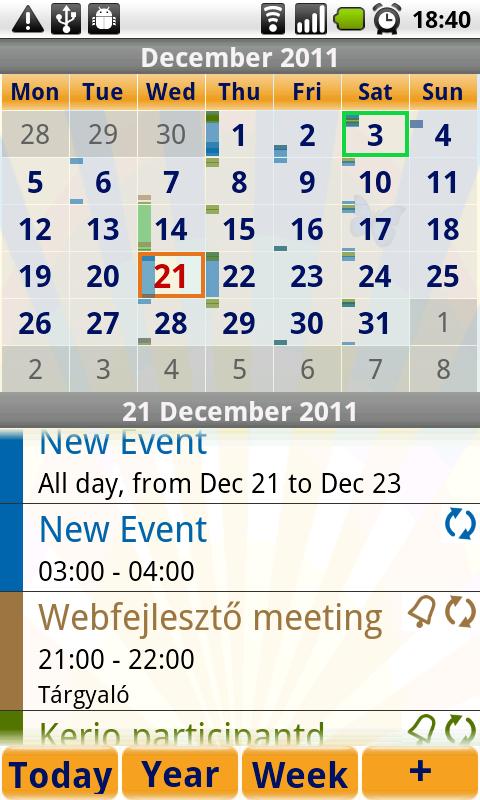
Daniel Pocock: Calendar and Contact data with free software in the Smartphone era

Since the rise of smartphones, first Blackberry, then iPhone and now Android, the world at large has had a convenient option to fall back on for management of contact and calendar data. The data itself seems somewhat trivial: many of us software developers have worked with a plethora of obscenely more obscure schemas. It is unlikely that most people would ever have to perform an operation on their address book that requires a statistical toolkit like the R project or any of the other advanced tools we now have for data processing. In terms of data, addresses and phone numbers can appear quite boring. So why hasn't the free software community mastered it and cloud providers are currently running rampant hoovering up the data of billions of users? Ruling out LDAP One problem that people have faced is the existence of different standards. LDAP has quite a high profile and appears to be supported by default in many desktop applications. For this reason, it tends to grab people's attention but after a close look, many people find it is not the right solution. LDAP tends to work well for organisations where the data is centrally managed and in situations where fine-grained access control is not required. LDAP servers often need a capable UNIX administer to manage effectively. To top it off, LDAP itself does not provide an effective solution for two-way synchronization of data with remote and mobile users. The emergence of SyncML, CalDAV, GroupDAV and CardDAV Addressing this final problem (two-way mobile/portable device sync) has brought on the development of further standards. Initially, SyncML (now known as Open Mobile Alliance Data Synchronization and Device Management) grabbed significant attention, partly because it had been included in some of the first generation of smartphones from once-prominent vendors like Nokia. Open source server solutions for SyncML did not gain traction though. The most prominent is Funambol, however, it is not packaged in any major Linux distribution and it requires some basic Java knowledge to maintain it effectively. Like LDAP it appears to be most comfortable in enterprise use cases and doesn't appeal to the people who run a private mail and web server. SyncML has further suffered with the lack of support in more recent generations of smartphones. WebDAV was formalised in 1999 and there are now various derivative standards such as CalDAV and CardDAV which use WebDAV as a foundation. However, standards didn't arrive at this place directly: CalDAV only appeared as RFC 4791 in 2007 and CardDAV as RFC 6352 in 2011. In the meantime, some vendors experiemented with an alternative called GroupDAV. GroupDAV is largely obsolete now and GroupDAV v2 is a subset of CalDAV and CardDAV. Finally gaining traction The good news is, CardDAV and CalDAV are gaining traction, in no small part due to support from Apple and the highly proprietary iPhone. Some free software enthusiasts may find that surprising. It appears to be a strategic move from Apple, using open standards to compete with the dominance of Microsoft Exchange in large corporate networks. Both protocols are supported natively in iPhones and Mac OS X. More exciting, Apple releases their Contacts Server and Calendar Server as open source software, making it easier to look under the hood and observe any deviations from the standards. Apple's adoption of CardDAV and CalDAV has been accompanied by a similar effort in free software, however, support is more patchy. The Mozilla Lightning calendar plug-in for Thunderbird (known as the iceowl-extension plugin for icedove on Debian) has supported CalDAV for some time. In contrast, Thunderbird's address book lacks native support for CardDAV and has other limitations (discussed in detail below). Limited CardDAV support in Thunderbird can be achieved using the third-party SOGo Connector, which is not just for ScalableOGo server. The Evolution PIM appears to support both CardDAV and CalDAV relatively smoothly and appears to be more functional and easier to get started with. Free software servers are also emerging. DAViCal, despite the name, supports both CardDAV and CalDAV. It is a good solution for people who have an existing mail server and don't want to transition to an all-in-one groupware suite. Packages available in Debian make it easy to deploy and get started. It is a PHP solution, using a PostgreSQL database underneath. For people who do want a groupware suite, CardDAV and CalDAV are supported in products like ScalableOGo and Zimbra. For people who don't want a server at all and just want to sync between a desktop and a mobile device, there are options like Calypso. Mobile support: the missing link A number of people have blogged about using the Android apps CardDAV-Sync and CalDAV-Sync to complete the picture. I've tested these myself and verified that they work. However, there is one vital thing missing: the source code. Nobody knows what is inside these apps except the developer. That makes it impossible for other developers to troubleshoot them and improve them and it also makes it impossible to be certain that they do not leak information. An alternative is the aCal app for Android. Despite the name, aCal can synchronize the address book as well as the calendar. However, in my tests against DAViCal, I found that the addressbook can only be synced once and that on subsequent syncs, it fails to discover any new server-side contacts. aCal source code is available on gitorious.
aCal appears to be a compelling solution for Android users, hopefully the contact sync will be fixed soon. It only syncs once after installation and then fails to detect any new contacts. Thunderbird's limitations It has already been mentioned that the Thunderbird address book can be synchronized to a CardDAV server by adding the SOGo Connector plugin. However, this is not a perfect solution. The plugin itself is fine: the SOGo web site describes the connector (as opposed to the SOGo Integrator plugin) as a portable solution: in other words, it is vendor neutral, compatible with any standards-compliant server. The first limitation is that it is necessary to duplicate the setup process for both the calendar sync and the address book sync. This is just a question of convenience.
The SOGo Connector plugin configuration window is very trivial. I recommend using read-only mode to avoid the problems with multiple email addresses or telephone numbers. More serious limitations exist in the address book itself: if the CardDAV server has more than 2 email addresses, they will not appear in the Thunderbird address book. Changing an email address on the client side will result in loss of those additional email addresses on the server-side. The Mozilla team initially committed to rewrite the address book from the ground up but it is not clear whether that work is still in progress. DAViCal confusion I had been using DAViCal for quite some time as a CalDAV server before I recently decided to try and use it for CardDAV as well. As a calendar server, it had been working fine. I have a small number of users with some private calendars and also some shared calendars. When I installed the SOGo Connector plugin and went to setup the client-side configuration, it asked me for the server URL. Having used CalDAV already, I simply tried copying the existing CalDAV URL, which is of the form https://myserver.example.org/davical/caldav.php/daniel/home The URL was accepted and I could create address book entries on the client side. No errors appeared. I then tried setting up the same URL as an address book in Evolution. This time, I found I was able to create contacts and sync them to the server and access them from another copy of Evolution. It appeared DAViCal was working fine and I felt that Thunderbird or the SOGo Connector was somehow broken, because the Evolution clients were syncing but Thunderbird was not. The lack of any errors from the Thunderbird GUI further undermined my confidence in the SOGo Connector. Nonetheless, I decided to dig a little deeper, looking through the DAViCal source code. This brought me to the realisation that each URL could be flagged as either a calendar resource or an address book resource. This had not been obvious to me before. Evolution had effectively been storing the contact entries into a calendar URL and DAViCal had been happily accepting them. SOGo Connector, querying the URL, appears to have received both calendar and contact records from DAViCal and given up.
Here is where I configured the extra resource for an address book store under my user account in DAViCal In the DAViCal web management console, I created an extra resource for my user ID and set the appropriate checkbox to mark the resource as an address book. Then I put this resource URL into all the clients and found that they were all able to sync with each other. DAViCal's maintainer has explained that this is a limitation in the CardDAV/CalDAV protocols: technically, it is valid for the client to store the wrong type of objects in each URL. Clients need to be more resilient when they stumble across objects they don't expect in a particular resource. Conclusion A complete free software based contact-management solution can be easily deployed using any of the servers mentioned above, particularly if Evolution is the preferred client software. Using Thunderbird as a client, it can also work, but attention is needed to avoid data loss on sync. Thunderbird could also be used in a read-only mode to access address books maintained with Evolution. Mobile support is still patchy on Android. The closed source solution (CardDAV-Sync and CalDAV-Sync) appears to work and a promising open source close, aCal, appears to be "nearly there". Some people would obviously prefer to use a standalone contact/calendar server, while others may prefer an all-in-one groupware suite. Both approaches appear to be feasible, but the standalone contact/calendar server appears to offer a more compelling way to start quickly and have minimal administrative overhead, particularly due to the fact that DAViCal is available in a supported package.
This is the contact server configuration window in Evolution. It offers slightly more options than SOGo Connector in Thunderbird and appears to be a more finished solution overall.

MJ Ray: Upgrading to Debian 7 wheezy

So I have upgraded my main workstation at last, but there are a few things I wanted to figure out. Some of these I found an answer to, but others I haven t and some answers open more questions: Where did debian-menu.menu go and why doesn t lxlauncher have the Debian menu by default anyway? Answer: It seems this is a combination of debian bug 333848 and bug 722563 which I reported yesterday in that lxlauncher doesn t use the debian menus. Workaround for now: install menu-xdg and hack the lxlauncher menu file. Why don t my xterm shells load .profile any more? Did I bodge that before without making a note? How do I stop kernel or initrd or whatever it is configuring the network with the dhcp settings at boot time instead of the better wicd ones that are available once the system is up? Continuing with networking, how did network-manager (which doesn t cope with my network configuration) get installed again? Answer: debian bug 645656 explains that debian is simply following a silly decision taken upstream and refers to attempts to make network-manager optional as the Crusade . Workaround: remove gnome and install its dependencies like gnome-core directly instead. Drawback: any new dependencies of gnome will have to be installed manually. Why is the audio capture volume at 10% by default and what s the best way to change that? I suspect this might be 682731 but that bug is untouched in over a year. I m tempted to remove pulseaudio, but gnome-core Depends pulseaudio so this is yet more hardware-breaking caused by gnome dependency changes and the only way out of this one would be to remove gnome-core and install its dependencies. Or maybe I should just give up and finally remove gnome because its packages have jumped the shark. I installed gnome to make the system easier to use and it s broken it in at least two ways now. One question that makes me hesitate is: why is gdm3 faster to start than lightdm?

Next.

Previous.