Search Results: "ean"

21 February 2011

Stefano Zacchiroli: Squeeze, Debian, and the FSF

Short version: Dear FSF, thanks for your appreciation of Debian Squeeze achievements in getting rid of non-free firmware blobs. We still disagree on the overall freeness assessment of Debian, but I'm positive that steps like this one can further future collaboration, in the interest of both projects. Long version follows.
Historically, the relationships among Debian and the FSF have gone through mixed fortune (and that's quite an euphemism). On the one hand, Debian is committed to 100% Free Software, is an open project explicitly inspired by "the spirit of GNU", has been sponsored by FSF in its infancy, and properly calls itself "GNU/Linux" (or even "GNU/kFreeBSD"). On the other hand, Debian is the project who considers the GNU FDL license to be only conditionally free and which is not considered to be an entirely Free system according to FSF.
So much for the history corner. As a long time member of the Debian Project, as well as an FSF(E) fellow, I've always felt a bit sad about this state of affairs. Not because the two projects should have aligned goals; they clearly focus on different aspects of the quest for a Free (Software) world. Not even because they should agree on how to build a Free distribution: history has shown that FSF technical positions do not always get along with Debian's more "pragmatic" style, as embodied by point 5 of the Social Contract. Rather, my sadness is rooted in the belief that not getting along have encouraged duplication of efforts which could have been easily avoided (e.g. multiple distributions concurrently freeing up kernels). Furthermore, I'm more and more convinced that Debian nowadays enjoys a rather privileged position among Free Software vendors. Indeed, even though GNU/Linux distributions have reached a popularity we didn't dare to imagine 15 years ago or so, most distributions are under the direct or indirect control of commercial vendors. Those commercial vendors play a very important role in the promotion of Free Software. For instance, they are structured in ways that enable them to seal OEM deals with hardware manufacturers to sell computers with GNU/Linux pre-installed. Commercial vendors, by their own nature, are also in general better at marketing than non-commercial vendors. On the flip side however, commercial vendors are not yet relevant enough to drive proprietary drivers out of the market and, as a consequence, cannot yet afford not to support hardware which need such proprietary bits to work. Among mainstream GNU/Linux distributions[1] Debian is one of the very few vendors if not the only one that is both very relevant and, thanks to its independence, can afford taking Free Software's side: no commercial urgency can force Debian to negotiate on that. That is quite an asset to be used in the promotion of Free Software, especially to a public that is interested in and willing to understand what Free Software really is about. Such an "aware" public is on the rise as of lately, together with the general awareness increase of risks entailed by living a digital life, when that life is not under our control (think, as an example, at how often the "Facebook privacy debate" has hit mainstream medias in the last year). The "aware" public is the natural target of both Debian and the FSF. Dividing it would not serve well the cause of Free Software. With all that in mind, last August I took the chance of being on the "right" side of the Atlantic Ocean for DebConf10, to discuss possible venues of collaboration among Debian and the FSF. I sat down and discussed at length with John Sullivan, who I happen to know for his Debian involvement, in his capacities of FSF representative and operations manager. We discussed various topics, with the intention of bringing them up to the respective communities[2]. Then, inevitably, we ended up talking about the overall freeness of Debian and his exclusion from FSF listing of Free systems. (FSF is of course entitled to such judgements, pretty much as Debian is entitled to its own judgements on FSF licenses. Nevertheless those judgements contribute to dividing our public and might lead to wasteful duplication of efforts, where Free Software could better be served by collaboration.) The main ground for exclusion from that list used to be the compromises Debian has made in the past about non-free firmware blobs. But, as I pointed out back in August, those compromises would have been gone starting with Squeeze, making that argument moot. Today 6 months later I'm delighted to cheer at FSF's decision to publicly recognize the achievements Debian has delivered with Squeeze.
Thanks! It's a nice gesture that I've very much appreciated. I'm confident steps like this one will help future collaboration if, on both sides, we will be able to spot actual venues for collaboration. Needlessly to say, I still disagree with the overall FSF assessment of Debian non-freeness. Apparently, it still stands on the basis that Debian also provides a repository of nonfree software [ ] [which] is not part of the Debian system. [ ] but users would be hard-pressed to make a distinction and that people can readily learn about software available through it by browsing Debian's online package database. I respect the principle of non advertising non-free software and I even agree that it is a good principle. But unfortunately it's also a very blurry principle on which, in my opinion, Debian actually scores very well. No non-free software is offered to users by Debian; it's just for users that really want to have non-free software (or need to, in order to run a Free OS on their computers), that Debian tries to stay out of their way. For the "aware" public discussed above, I think it's much better to draw the line where software freedom ends and use that line to explain what does crossing it entails, than locking them up pretending non-free software do not exist. But fair enough: for the time being, I guess, we will need to agree to disagree on this one. Getting a little bit closer in the occasion of the Squeeze release is still an important step forward. It's up to each of us now to seek out initiatives which attract the interest of both projects and that can benefit from synergies.
[1] Sorry, I've no decent definition of "mainstream distribution" to offer, besides folklore and well-established distribution review sites. (Heck, I don't even have a decent definition of "well-established distribution review site" to offer!).
[2] which hasn't happened yet, due to the proverbial amount of available spare time.

Lucas Nussbaum: Debian Spring Cleanup

We have many orphaned packages in Debian. Those are packages that no longer have a maintainer willing to care for them. They are a problem for several reasons. Often, there have better alternatives (that s often why the maintainer gave up maintenance), but users keep installing them because they show up in apt-cache search. Or, they might be broken, without anybody noticing because they only have a few users. Also, developers need to take them into account. They might slow down transitions, have RC bugs that need fixing, etc. So, there are good reasons to remove some of the orphaned packages from the Debian archive. Not all of them. But those that have been orphaned for a long time without anybody stepping up to take over the maintenance, have very few users according to popcon, etc. Removing some of them also makes it easier to expose the ones that should really find an adopter. Also, that removal is not final. The good reason to do this now is that we are at the beginning of a release cycle, and that it will be easy to reintroduce packages that are really needed during the next two years. Also, packages (both source and binaries) are still available on snapshot.debian.org, so users can still install them from there, and re-uploading them to Debian is very easy if someone wants to adopt them. So, how do I proceed? I use bapase, and go through specific sets of packages (using a custom version of bapase to restrict the list to those packages). For example, orphaned packages that have a popcon lower than 50, have been orphaned for more than 500 days, and whose orphaning bugs have not been modified in the last 100 days. Then, I read the bug log, and decide if there s a reason to keep the package. If there s not, I request the removal. As of today, there are 471 orphaned packages in Debian. The goal is not to get down to zero, but it s certainly possible to get down to 200 or 250. How can you help? Start from the list, and find some easy targets. You can take a look at bug #483252 if you want to re-use my template. Also, one thing that is currently missing in the process is that orphaned packages that have reverse-dependencies should not be removed without removing their dependencies (if appropriate). An easy and efficient way to know if a given package has reverse (build-)?dependencies would be great, so I could integrate this info into bapase and exclude those packages from the list, or mark them somehow.

Sean Finney: Recent debian updates

Packaging updates Help wanted: cacti I've also filed an RFA bug for cacti (and spine), as i'm not really using cacti any more in my day to day work. The packages are in pretty good shape, but it would really be for the best if someone who actually used cacti were able to more thoroughly test new versions before they were uploaded. I'm also open to co-maintaining the package and/or sponsoring uploads; so if you're already using cacti and looking to get involved in debian development, this could be a fun place to start :) Debian patch tracker Finally got around to fixing a couple post-release (and older) issues in the patch-tracker. Hopefully it should be back to updating and following the latest stuff in the archive. Next up I'll see if I can find someone from DSA to upgrade the hosting machine to squeeze and install a few extra dependencies for the next feature update, which contains a pretty substantial rewrite of the guts from some home-rolled wsgi+cheetah goo to a more established and maintainable django-based system. In the meantime, please let me know if you see any problems (via maintenance cat or otherwise), and I will take a look.

Cyril Brulebois: Debian XSF News #6

Enough news to release another Debian XSF News issue, after less than a week. Enough writing for now, I m getting new mails in xorg-announce@.

20 February 2011

Gregor Herrmann: RC bugs 2011/03 - 2011/07

squeeze is released but this doesn't mean the end of the ordinary RC bug; old ones are still around, & new ones keep floating in.

as a short reminder to take the occasional look at the RC bug list I'm again posting what I've done in the last weeks. as you can see no NMUs but only work on packages I have a relation to, & often only uploading packages prepared by others (yeah teamwork!).

Evgeni Golov: Desktop in a shell

People are using computers, everywhere, really! ;)
As you might guess correctly, so do I.Basically, I am using three computers: my laptop (ThinkPad X201s, awesome machine, but pabs told me not to post any more adverts for ThinkPads on Planet Debian *g*), my smartphone (Motorola Milestone, yes, that counts as a computer) and random_pc (for random as in my girlfriends or some other trusted (!!!) friends computer).
My laptop is running Debian GNU/Linux unstable with Xfce4.6, my smartphone is running Android 2.2.1 Froyo, my girlfriend has Ubuntu with GNOME, a friend runs Debian unstable with GNOME, another one Arch Linux with KDE4 and so on. And on all these machines I want be able to work, which means I have to read mail and rss, chat via IRC, JabberXMPP and ICQ, have a look at my to-do list, ssh into different machines, write some code, tweet and dent etc.In the following series of posts I will describe how I can handle about 90% of my work on every (trusted) computer out there, using ssh, screen, mutt, irssi, BitlBee, newsbeuter etc.As I am describing the setup as a Desktop in a shell , let s start with a login- and desktop/window-manager: ssh+screen.sshObviously, you need a machine to ssh into it, where the Desktop will live on. For me, that s my home router/fileserver/vm-server dorei, running Debian GNU/Linux LennySqueeze with OpenSSH as a kind of login manager ;)Yes, my user is allowed to login with a password instead of a public key. And well, that s all for the login-manager, no extra configuration needed.screenAfter logging in, I start my window-manager with screen -rd, -r for reattach a running screen session, -d for detach it if it is already attached somewhere else. Or I can start a new session by just typing screen. Inside the screen I have multiple windows (one can create new ones with ^A c) with all the needed software running. I can switch windows by pressing ^A N, N being the number of the window, ^A n for the next window, ^A p for the previous one or ^A ^a for the last one. Or I can get a window-list with ^A w. If needed, I can rename windows with ^A A, followed by the new name. That should be enough for almost everyone. Let s just add a window-list to the bottom (as you might have seen on GNOME, Xfce, KDE and even Windows ;) by adding the following to the ~/.screenrc:
caption always " "                    # clear line before hardstatus
hardstatus alwayslastline "% = kb [ % B %H:$USER % b ][ %=% w %?%-Lw%?% b (% W %n*%f %t%?(%u)%?% b )% w %?%+Lw%?%?%= % b ][% B  %l % B % W %d.%0m % b ]"
You get the current host- and username, the machine load and the date for free ;)Even if it is possible, I do not have any autostart like stuff in my .screenrc as the machine is running stable and I start the screen and the apps inside maybe once a year after a reboot.screenrcMy .screenrc looks like this:
# detach on hangup
  autodetach on
# don't display the copyright page
  startup_message off
# set scrollback to 2000 lines, default 100
  defscrollback 2000
# set silencewait to 15 seconds, default 30
  silencewait 15
# new shells should be started as login-shells
  shell -$SHELL
# make a fancy statusline
  caption always " "                    # clear line before hardstatus
  hardstatus alwayslastline "% = kb [ % B %H:$USER % b ][ %=% w %?%-Lw%?% b (% W %n*%f %t%?(%u)%?% b )% w %?%+Lw%?%?%= % b ][% B  %l % B % W %d.%0m % b ]"
# make higlighting bold, black on blue background
  sorendition +b bk
# some fixes, no I do not know where they come from :)
  termcap  xterm hs@:cs=\E[%i%d;%dr:im=\E[4h:ei=\E[4l
  terminfo xterm hs@:cs=\E[%i%p1%d;%p2%dr:im=\E[4h:ei=\E[4l
  termcapinfo  xterm Z0=\E[?3h:Z1=\E[?3l:is=\E[r\E[m\E[2J\E[H\E[?7h\E[?1;4;6l
  termcapinfo xterm* OL=100
  termcapinfo xterm 'VR=\E[?5h:VN=\E[?5l'
  termcapinfo xterm 'k1=\E[11~:k2=\E[12~:k3=\E[13~:k4=\E[14~'
  termcapinfo xterm 'kh=\EOH:kI=\E[2~:kD=\E[3~:kH=\EOF:kP=\E[5~:kN=\E[6~'
  termcapinfo xterm 'hs:ts=\E]2;:fs=\007:ds=\E]2;screen\007'
  termcapinfo xterm 'vi=\E[?25l:ve=\E[34h\E[?25h:vs=\E[34l'
  termcapinfo xterm 'XC=K%,%\E(B,[\304,\\\\\326,]\334, \344, \366, \374,~\337'
  termcapinfo xterm* be
  termcapinfo xterm xterms xs ti@:te=\E[2J
  termcapinfo wy75-42 xo:hs@
  termcapinfo wy* CS=\E[?1h:CE=\E[?1l:vi=\E[?25l:ve=\E[?25h:VR=\E[?5h:VN=\E[?5l:cb=\E[1K:CD=\E[1J
  termcapinfo  hp700 'Z0=\E[?3h:Z1=\E[?3l:hs:ts=\E[62"p\E[0$~\E[2$~\E[1$ :fs=\E[0 \E[61"p:ds=\E[62"p\E[1$~\E[61"p:ic@'
  termcap  vt100* ms:AL=\E[%dL:DL=\E[%dM:UP=\E[%dA:DO=\E[%dB:LE=\E[%dD:RI=\E[%dC
  terminfo vt100* ms:AL=\E[%p1%dL:DL=\E[%p1%dM:UP=\E[%p1%dA:DO=\E[%p1%dB:LE=\E[%p1%dD:RI=\E[%p1%dC
  termcapinfo linux C8
# some bindings
  bind k
  bind ^k
  bind .
  bind ^\
  bind \\
  bind ^h
  bind h
  bind 'w' windowlist -b
  bind 'W' windows
  bind 'K' kill
  bind 'I' login on
  bind 'O' login off
  bind ' ' history
  bind = resize =
  bind + resize +3
  bind - resize -3
# Mutt demands this
# http://wiki.mutt.org/?MuttFaq/Appearance
 defbce on
 term screen-bce
That s all for my screen setup. The obvious, boring screenshot follows:See you next time, when I will present my mutt setup here.

19 February 2011

Russell Coker: On Burning Platforms

Nokia is in the news for it s CEO announcing that they have a Burning Platform , Jeff Waugh gives an interesting analysis of the situation [1].What is a Platform for Phones?This whole scenario makes me wonder about what a platform should mean in terms of mobile devices. Wikipedia says A computing platform is some sort of hardware architecture and software framework (including application frameworks) that allows software to run. Typical platforms include a computer s architecture, operating system, programming languages and related user interface (run-time system libraries or graphical user interface). [2]I think that Nokia s problem was that it didn t leverage it s strength in making great phone hardware. Nokia used to have a commanding share of the market due to simply making better phones. They had phones that were upwardly compatible (the same UI and used the same chargers), their phones were always very solidly constructed, and they had some good design features such as having the battery comprise part of the case which allowed a replacement battery to be physically larger for longer battery life. Even now they have hardware features which are better than the rest such as the N8 which is widely regarded as having the best camera of any phone. Nokia also did some smart things like releasing their N800 series of phones with more open software than most companies used, they supported running arbitrary Linux applications.While they kept the platform as the API interface on a phone OS and maintained several different OSs (with multiple versions in production at any time) they made a less desirable platform for developers and a lot more development work for themselves.Nokia fragmented their own market. There is no technical reason why they couldn t manufacture a phone that is capable of running a choice of their own OS as well as Android (or alternatively their own OS or the Windows Phone OS). There may be technical issues that prevent designing a phone to run either Android or Windows phone, but they could have got two out of three options available.On top of a hardware phone platform we could have multiple software platforms, Android, Windows, Meego, etc. The users could then decide which one to use.A Hardware Platform for PhonesI think that it would be ideal if a phone company offered phones with a choice of OS and allowed the user to change the OS. The N8 is a great phone and the hardware is really appealing, I would have definitely bought one for my wife if it ran Android. Also the resale value of phones can be improved if they can be re-purposed. If someone knew that people on ebay were paying good rates for an old phone because it could be re-programmed then they would be more likely to buy it. As phones are essentially free for most people due to telco deals, a phone that has a resale value of $200 is a lot more desirable than one with a resale value of $100 if all other things are equal.I would like to see the mobile phone as a platform just as the IBM PC compatible was a platform. Imagine if IBM had sued Compaq into oblivion when they first cloned the PC, if that had happened I don t think that I would be using an IBM PC (Thinkpad) right now. The early IBM PCs really weren t great systems for home use, for pretty much anything you might want to do the early PCs didn t compete well with CP/M systems and systems from Commodore and Apple. It was only when cheap clones flooded the market that the PC platform took off. Modern PCs can boot from disks that were created 20 years ago. At every time during the PC s history there has been a choice of OSs available that work with the standard BIOS boot loader and expect certain essential hardware (such as a BIOS interface for video, keyboard, and storage). This choice increased the market allowing economies of scale in production. It also allowed competition between vendors which forced the margins to be low and resulted in PCs becoming cheap over the last 20 years every aspect of a PC apart from Intel CPUs and Microsoft Software has steadily dropped in price.I would like to see phones designed with a common boot loader, a common core set of CPU functions (I believe that with ARM CPUs a lot is optional), and common interfaces to the touch-screen and the GSM system. The boot loader would ideally have support for booting multiple OSs, in a typical end-user case the store would provide the phone configured to quietly only boot one of the available OSs but it would be trivial to offer the user a choice of OS at boot time for advanced users. The process of installing a custom ROM image in a phone is regarded as dangerous at the moment and most people who would like to do such things are hesitant due to the risk of bricking their phone. If booting the last good OS was an option then more people would try new OSs. With the current situation I am a little hesitant to re-program my new phones (and I m braver about such things than most people).One of the many problems with the current situation is that the phone vendor has to officially support every phone OS. One example of the problems with this is the Sony Ericsson Xperia X10 which is a fine piece of hardware that has been saddled with an older version of Android for it s entire life, Sony has stated that they won t produce any more updates and thus the demand for this phone is a lot lower than it might be. I believe that this is why the Xperia X10 is significantly cheaper than any other phone with similar features. Sony is losing money because they have a closed hardware platform and don t support the recent versions of Android!Ways of Booting the OSIt shouldn t be a technical challenge to have support for basic touch-screen IO and 3G Internet access in the boot loader of the phone. Then an OS such as Android could be loaded from the network before being booted without needing an older version of Android running. 80386 systems with a few megs of RAM used to be able to boot from a LAN, a modern phone has much more powerful hardware and a network connection that s at least as good as 10base2 networking so it should be able to do the same.Modern phones have micro-SD cards for local storage. There s no reason why the OS couldn t be loaded on micro-SD card. Fixing the OS on a phone that was bricked could be achieved by putting the micro-SD card in a PC and then copying the files across just as I often fix PC OS problems by installing the hard drive in a working system.Changing the OS of a phone should be easier than changing a PC between Ubuntu and Fedora (the Linux distributions that seem to have the most usage by less technical users).ConclusionIf Sony had made their platform the hardware then they could have spent their effort on what they do well (making great phone hardware) and delegated almost all of the work related to creating the OS to other companies (Google, MS, telcos, etc).If the entire industry moved to a hardware platform for phones then the result would be lower prices and some thin margins for manufacturers. This would be good for users and OK for manufacturers. The current situation however is quite bad for users who can never get phones to do exactly what they want and not so good for phone manufacturers such as Nokia (and everyone else who does business with Microsoft) who find themselves on the wrong side of market forces. The phone as a hardware platform shouldn t be too bad for Microsoft either, they did OK on the PC hardware platform.

Kees Cook: ptracing siblings

In Ubuntu, the use of ptrace is restricted. The default allowed relationship between the debugger and the debuggee is that parents are allowed to ptrace their descendants. This means that running gdb /some/program and strace /some/program Just Works. Using gdb s attach and strace s -p options need CAP_SYS_PTRACE, care of sudo. The next most common use-case was that of crash handlers needing to do a live ptrace of a crashing program (in the rare case of Apport being insufficient). For example, KDE applications have a segfault handler that calls out to kdeinit and requests that the crash handling process be started on it, and then sits in a loop waiting to be attached to. While kdeinit is the parent of both the crashing program (debuggee) and the crash handling program (debugger), the debugger cannot attach to the debugee since they are siblings, not parent/descendant. To solve this, a prctl() call was added so that the debugee could declare who s descendants were going to attach to it. KDE patched their segfault handler to make the prctl() and everything Just Works again. Breakpad, the crash handler for Firefox and Chromium, was updated to do effectively the same thing, though they had to add code to pass the process id back to the debuggee since they didn t have it handy like KDE. Another use-case was Wine, where for emulation to work correctly, they needed to allow all Wine processes to ptrace each other to correctly emulate Windows. For this, they just declared that all descendants of the wine-server could debug a given Wine process, there-by confining their ptrace festival to just Wine programs. One of the remaining use-cases is that of a debugging IDE that doesn t directly use ptrace itself. For example, qtcreator will launch a program and then later attach to it by launching gdb and using the attach command. This looks a lot like the crash handler use-case, except that the debuggee doesn t have any idea that it is running under an IDE. A simple solution for this is to have the IDE run its programs with the LD_PRELOAD environment variable aimed at a short library that just calls prctl() with the parent process id, and suddenly the IDE and its descendants (i.e. gdb) can debug the program all day long. I ve got an example of this preloadable library written. If it turns out this is generally useful for IDEs, I could package it up like fakeroot and faketime.

18 February 2011

Gustavo Noronha Silva: A clutter port of WebKit

In case you missed the news on webkit-dev, Collabora has been working on developing a clutter port of WebKit. It shares the build system with EFL, and most of the backend code comes from the GTK+ port. That means networking is handled by soup, drawing by cairo, multimedia by GStreamer, and so on. If you d like to give it a try, you can clone the repository from gitorious: $ git clone git://gitorious.org/webkit-clutter/webkit-clutter.git Then to build it you use cmake. From inside the source code directory do this: $ mkdir build
$ cd build
$ cmake .. -DPORT=Clutter -DSHARED_CORE=1 -DBUILD_MX_LIB=1
$ make
The BUILD_MX_LIB option is optional it will build what we call the Mx toolkit library in addition to the vanilla one. Then you can test that the library is built and working by running the programs inside the Programs directory. Enjoy!

17 February 2011

Raphaël Hertzog: People behind Debian: Maximilian Attems, member of the kernel team

Maximilian, along with the other members of the Debian kernel team, has the overwhelming job of maintaining the Linux kernel in Debian. It s one of the largest package and certainly one where dealing with bug reports is really difficult as most of them are hardware-specific, and thus difficult to reproduce. He s very enthusiastic and energetic, and does not fear criticizing when something doesn t please him. You ll see. My questions are in bold, the rest is by Maximilian. Who are you? My name is Maximilian Attems. I am a theoretical physicist in my last year of PhD at the Technical University of Vienna. My main research area is the early phase of a Quark-Gluon Plasma as produced in heavy ion collisions at the LHC at CERN. I am developing simulations that take weeks on the Vienna Scientific Cluster (in the TOP 500 list). The rest of the lab is much less fancy and boils down to straight intel boxes without any binary blobs or external drivers (although lately we add radeon graphics for decent free 3D). Mathematica and Maple are the rare exceptions to the many dev tools of Debian (LaTeX, editors, git, IDE s, Open MPI, ..) found at the institute, as those are unfortunately yet unmatched in Free Software for symbolic computations. The lab mostly runs a combination of Debian stable (testing starting from freeze) for desktops and oldstable/stable for servers. Debian is in use for more than 10 years. So people in the institute know some ups and downs of the project. Newcomers like my room neighbors are always surprised how functional a free Debian Desktop is. :) What s your biggest achievement within Debian? Building lots and lots of kernels together with an growing uptake of the officially released linux images. I joined the Debian kernel team shortly after Herbert Xu departed. I had been upstream Maintainer of the linux-2.6 janitor project for almost a year brewing hundreds of small cleanups with quilt in a tree named kjt for early linux-2.6. In Debian we had lots of fun in sorting out the troubles that the long 2.5 freeze had imposed: Meaning we were sitting on a huge diverging monolithic semi-good patchset. It was great fun to prepare 2.6.8 for Sarge with a huge team enthusiastic in shipping something real close to mainline (You have to imagine that back then you had no stable or longterm release nor any useful free tools like git. This involved passing patches around, hand editing them and seeing what the result does.) From the Sarge install reports a common pattern emerged that the current Debian early userspace was causing lots of boot failures. This motivated me to develop an alternative using the new upstream initramfs features. So I got involved in early userspace. Thanks to large and active development team initramfs-tools got a nice ecosystem. It still tries to be as generic and flexible as possible and thus gains many nice features. Also H. Peter Anvin (hpa) gave me the official co-maintenance of klibc. klibc saw uptake and good patches from Google in the last 2 years. I am proud that the early userspace is working out fairly well these days, meaning you can shuffle discs around and see your box boot. Later on we focused on 2.6.18 for Etch, which turned out to a be good release and picked up by several other distributions. Only very much later we would see such a sync again. With 2.6.26 for Lenny we got somehow unlucky as we just missed the new longterm release by one release. We also pushed for another update very late (during freeze) in the release cycle, which turned out to semi-work as too much things depend on linux-2.6. For Squeeze 2.6.32 got picked thanks to discussions at Portland Linux Plumbers and it turned out to be a good release picked up by many distributions and external patchsets. The long-term support is going very well. Greg KH is doing a great job in collecting various needed fixes for it. Somehow we had hoped that the Squeeze freeze would start sooner and that the freeze duration would be shorter, since we were ready for a release starting from the actual freeze on. The only real big bastard on the cool 2.6.32 sync is Red Hat. Red Hat Enterprise 6.0 is shipping the linux-2.6 2.6.32 in obfuscated form. They released their linux-2.6 as one big tarball clashing with the spirit of the GPL. One can only mildly guess from the changelog which patches get applied. This is in sharp contrast to any previous Red Hat release and has not yet generated the sharp and snide comments in press it deserves. Red Hat should really step back and not make such stupid management moves. Next to them even the semi-maintained Oracle Unbreakable 2.6.32 branch looks better: It is git fetchable. What are your plans and those of the kernel team for Debian Wheezy? Since 2.6.32 many of the used patches landed upstream or are on the way (speakup, Kbuild Debian specific targets, ..). The proper vfs based unionfs is something we d be looking forward. We haven t yet picked the next upstream release we will base Wheezy on, so currently we can happily jump to the most recent ones. There are plans for better interaction with Debian Installer thanks to generating our udebs properly in linux-2.6 source itself. Also we are looking forward to using git as tool of maintenance. We d hope that this will also allow for even better cross distribution collaboration. Concerning early userspace I plan to release an initramfs-tools with more generic userspace for the default case and finally also a klibc only for embedded or tuning cases. What do you like most in Debian? For one thing I do like the 2 year release cycle. It is not too long to have completely outdated software and on the other hand it gives enough time to really see huge progress from release to release. Also at my institute the software is is recent enough without too much admin overhead. For servers the three years support are a bit short, but on the manageable side. I do enjoy a lot the testing distribution. For my personal use it is very stable and thus I mainly run testing on my desktop and work boxes. (Occasionally mixing in things from sid for unbreaking transition or newer security fixes). Debian is independent and not a commercial entity. I think this is its main force and even more important these days. I enjoy using the Debian platform a lot at work thus in return this motivates me to contribute to Debian itself. I also like the fact that we strive for technical correctness. Is there some recurrent problem that hinders the progress of Debian? The New Maintainer process is a strange way to discourage people to contribute to Debian. It is particularly bureaucratic and a huge waste of time both for the applicant and his manager. It should be completely thrown overboard. One needs a more scalable approach for trust and credibility that also enhances the technical knowledge for coding and packaging of the applicant. NM is currently set in stone as any outside critics is automatically rejected. Young and energetic people are crucial for Debian and the long-term viability of the project, this is the reason why I d consider the New Maintainer process as Debian s biggest problem. Note from Rapha l Hertzog: I must say I do not share this point of view on the New Maintainer process, I have witnessed lots of improvements lately thanks to the addition of the Debian Maintainer status, and to the fact that a good history of contribution can easily subsume the annoying Tasks & Skills questionnaire. Another thing I miss is professional graphics input both for the desktop theme and the website. I know that effort has been done there lately and it is good to see movement there, but the end result is still lacking. Another trouble of Debian is its marketing capabilities. It should learn to better sell itself. It is the distribution users want to run and use not the rebranded copies of itself with lock-in sugar . Debian is about choice and it offers plenty of it: it is a great default Desktop. Linus Torvalds doesn t find Debian (and/or Ubuntu) a good platform to hack on the kernel. Do you know why and what can we do about this? The Fedora linux-2.6 receives contributions from several Red Hat employed upstream sub-Maintainers. Thus it typically carries huge patches which are not yet upstream. As a consequence eventual userland troubles get revealed quite quickly and are often seen there first. The cutting edge nature of Fedora rawhide is appealing for many developers. The usual Debian package division of library development files and the library itself is traditionally an entry barrier for dev on Debian. Debian got pretty easily usable these days, although we could and should again improve a lot more in this sector. Personally I think that Linus hasn t tried Debian for years. I have the feeling that the implication of the Debian Kernel team in LKML has been on the rise. Is that true and how do you explain this? Ben Hutchings is the Nr.1 contributor for 2.6.33. He also is top listed as author of patches on stable 2.6.32. Debian is not listed as organization as many send their linux-2.6 patches from their corporate or personal email address and thus it won t be attributed to Debian. There is currently no means to see how many patches get forwarded for the stable tree, but I certainly forwarded more then fifty patches. I was very happy when Greg KH personally thanked me in the 2.6.32.12 release. In the Squeeze kernel, the firmwares have been stripped and moved into separate packages in the non-free section. What should a user do to ensure his system keeps working? There is a debconf warning on linux-2.6 installation. It is quite clear that the free linux-2.6 can t depend on the firmware of the non-free archive (also there is no strict dependency there technically). On the terminal you d also see warnings by update-initramfs on the initramfs generation for drivers included in the initramfs. The debconf warning lists the filename(s) of the missing firmware(s). One can then apt-cache search for the firmware package name and install it via the non-free repository. The check runs against the current loaded modules. The match is not 100% accurate for special cases as the one where the device might be handled well by this driver without firmware, but is accurate enough to warrant the warning. The set of virtualization technologies that the official Debian kernel supports seems to change regularly. Which of the currently available options would you recommend to users who want to build on something that will last? KVM has been a smooth ride from day zero. It almost got included instantly upstream. The uptake it has is great as it sees both dev from Intel and AMD. Together with libvirt it s management is easy. Also the performance of virtio is very good. The linux containers are the thing we are looking forward for enhanced chroots in the Wheezy schedule. They are also manageable by libvirt. Xen being the bad outside boy has an incredible shrinking patchset, thus is fair to expect to see it for Wheezy and beyond. For many it may come a bit late, but for old hardware without relevant CPU it is there. Many tend to overstate the importance of the virtualization tech. I d be much more looking forward to the better Desktop support in newer linux-2.6. The Desktop is important for linux and something that is in heavy use. The much better graphics support of the radeon and nouveau drivers: The performance optimizations thanks to dcache scalability work and the neat automatic task-grouping for the CPU scheduler are very promising features for the usability of the linux desktop. Another nice to have feature is the online defrag of ext4 and its faster mkfs. Even cooler would be better scalability in ext4 (This side seems to have seen not enough effort lately). Is there someone in Debian that you admire for their contributions? Hans Peter Anvin and Ted Tso are a huge source of deep linux-2.6 knowledge and personal wisdom. I do enjoy all sorts of interactions with them. Christoph Hellwig with Matthew Wilcox and also William Irwin for setting up the Debian kernel Team. Several Debian leaders including the previous and the current one for their engagement, which very often happens behind the scene. The Debian Gnome Team work is great, also the interactions have always been always easy and a pleasure. Martin Michlmayr and previously Thiemo Seufer do an incredible job in porting Debian on funny and interesting ARM and MIPS boxes. Debian has a lot of upcoming potential on this area. I m looking forward to other young enthusiastic people in that area. Colin Watson is bridging Debian and Ubuntu, which is an immense task. Michael Prokop bases on Debian an excellent recovery boot CD: http://www.grml.org. I d be happy if any Debian Developer would work as carefully coding and working.

Thank you to Maximilian for the time spent answering my questions. I hope you enjoyed reading his answers as I did. Subscribe to my newsletter to get my monthly summary of the Debian/Ubuntu news and to not miss further interviews. You can also follow along on Identi.ca, Twitter and Facebook.

One comment Liked this article? Click here. My blog is Flattr-enabled.

Cyril Brulebois: Debian XSF News #5

Time for a fifth Debian XSF News issue!

16 February 2011

Steve Kemp: Upgrading from Lenny to Squeeze

Rather than waiting for a few months, as I typically do, I decided to be brave and upgrade my main virtual machine from Lenny to Squeeze. That host runs QPSMTPD, Apache, thttpd, and my blogspam server; nothing too complex or atypical. The upgrade was mostly painless; I was interrupted several times by debconf asking me if I wished to replace configuration files I'd modified, but otherwise there were only two significant messages in the process:
crm114
crm114 warned me that its spam database and/or configuration files had changed and would most likely result in brokenness, post-upgrade, and I should do something to stop avoiding lost mail. Happily this was expected.
sysv-rc
It transpired I had a couple of local init scripts which didn't have dependency information succesfully encoded into them; so I couldn't migrate to dependency-based bootup. Given that this server gets a reboot maybe once every six months that wasn't really worth telling me about; but nevermind. No harm done.
That aside there were no major surprises; all services seemed to start normally and my use of locally-compiled backports meant that custom services largely upgraded in a clean fashion. The only exception was my patched copy of mutt which was replaced unexpectedly. That meant my lovely mutt-sidebar was horribly full of mailboxes, rather than showing only new messages. I created a hasty backported mutt package for Squeeze and made it available. (This patch a) enables the side-bar, and b) allows you to toggle between the display of all mailboxes and those with only new mail in them. It is buggy if you're using IMAP; but works for me. I would not choose to live without it.) Now that I've had a quick scan over the machine the only other significant change was an upgrade of the mercurial revision control system, the updated templates broke my custom look & feel and also required some Apache mod_rewrite updates to allow simple clones via HTTP. (e.g. "hg clone http://asql.repository.steve.org.uk/"). So in conclusion: ObQuote - "Hmm, upgrades " - The Matrix Reloaded (shudder).

Gunnar Wolf: Responsible biking: We are not exempt from the traffic rules!

As you know, I very often advocate using the bycicle as the main means of transportation in Mexico City. The city is very apt for biking through it, and contrary to the fears of mostly everybody, the city is neither aggressive nor as dangerous as people say. However, I have seen cyclists which seem to be looking for the best ways to be hit by a car, or to hit a pedestrian. Yesterday, I read this note in La Jornada: The local Environment Secretary calls cyclists to respect vial regulations. Many cyclists assume they are a special case of pedestrians, and zig-zag as they please between the road and the walkway, or just stay in the walkway. That is dangerous, both to pedestrians and to themselves. You might find children, elderly or motion-challenged people on your way. Also, not only will pedestrians only expect other people in the walkway, moving at their pace or slightly more, but cars will also not expect somebody moving at 10-20Km/h. A car driver pulling out of his garage, or crossing a street, will not have enough warning when he sees you, and you are very likely to end up in an accident. Since ~5 years ago, Mexico City is growing a grid of Metrob s and confined troleb s cero emisiones (trolleybus) lanes. Many cyclists use those lanes That is VERY dangerous. Public transport vehicles are large, have a lot of inertia, and will take longer to react to finding you ahead of them. Besides, they can go way faster than a regular bike (~60Km/h for metrob s, ~40Km/h for troleb s), and have to stop every couple of blocks. So, you will be uncomfortable if trailing them, and you will be a liability to ~100 people if you go ahead of them. Besides, it is illegal to drive in the confined lanes if you are not a public, semimassive transport vehicle! Surprisingly many people have argued they prefer riding their bicycles against the traffic I think they prefer staring at Death into its blue, glowing eyes (or into its long, thin whiskers)... By far, most cars that hit a bicycle do so from the side, when crossing a road. And if you arrive at a crossing from the wrong way, the way a driver does not expect you, don't expect the driver to be aware of you. Also, in the much less likely event of a car running into you, would it be better to be hit at 80Km/h (60Km/h of the car plus 20Km/h of your own speed on a full frontal crash), or at 40Km/h (substracting instead of adding)? Yes, some people say that looking at the car will allow you to maneuver How far in advance would you know a car coming from the front will hit you? One second? That's 22 meters at 80Km/h (again, if you realize the 60Km/h car is heading straight to you, at 20Km/h). Too short notice for you to do anything Any maneuver will most likely end in an accident. And the driver would not be so much to blame, as he would not be anticipating you riding against the traffic. Make sure you get seen. By night, always use proper lights (red on the back, white on the front, and reflective material to the sides). Day or night, wear bright, reflective clothes (or over-clothes material). Act in a predictable fashion. Remember you are riding a vehicle and are subject to the same rules any driver is A cyclist is not exempt from driving correctly! Do not jump red lights. Never ride on the walkway. Do your best to enjoy the ride. And ride. Yes, ride, take the streets, enjoy the streets. But don't attempt to drive the traffic out of it The streets belong to us all, and we can all share them. PS I also saw this note in the same paper: Sunday Rides in "Campo Militar N mero Uno". The main military field was open as a park this weekend! I have to make sure it is regularly open I am definitively going there!

Russell Coker: Mplayer, Squeeze, and SE Linux on i386

I ve just updated my SE Linux repository for Squeeze to better support running mplayer on the i386 architecture, below is the APT sources.list line:deb http://www.coker.com.au squeeze selinuxThe first issue is a bug in the compilation of the SDL libraries which makes them request an executable stack (bug #613535). Recompiling the libraries on my system caused this bug to go away, so it must be some issue with the compilation process. I have previously summarised the execstack issue, but we haven t solved this yet [1].The next issue is the fact that the ffmpeg libraries require execmod access (see my previous post for the details of the execmod issue [2]. The execmod issue with ffmpeg is pretty much the same as it was when I first wrote about the issue in 2008 [3]Finally the allow_execmem boolean needs to be set on i386 with the command setsebool -P allow_execmem 1 to allow libGL the access it needs. This is an issue I haven t been able to solve, I don t know why libGL needs write and execute access to memory, I posted to the SE Linux list about this some time ago but didn t get any good answers [4]. Any suggestions would be appreciated.

15 February 2011

Pietro Abate: xen 4 on debian squeeze

It's time to upgrade my xen servers to squeeze. I've already put this off too long and now I've to task to go from etch to squeeze in one long step. In order to avoid problems I just did a first upgrade etch -> lenny and then to squeeze. However, since so much has changed in the meantime, and so much twicking of essential components is needed (such as Xen !), I guess I could have gone directly from etch to squeeze in one go, and fix everthing in the process... Anyway, to late for this kind of considerations.
 
The xen debian wiki is full of invaluable information. Kudos to the xen team for their hard work. To get you started on squeeze you need to install the xen hypervisor. Everything is provided by one package:
aptitude install xen-linux-system-2.6-xen-amd64
This will pull the latest linux kernel and xen-hypervisor to run on dom0 . By default the hypervisor is probably not going to be the default kernel. If you want to change this, you should edit the grub default values :
vi /etc/default/grub
to make sure that the default kernel on dom0 is the xen-hypervisor. This is tricky, because grub let you define a default w.r.t the list of available kernels. so if you install a new kernel, you have to change the default accordingly with the list of kernels in /boot/grub/grub.cfg. It would be nice if I could define the default kernel with a label instead of a number... ( ref #505517 ) Alternatively, as suggested in the wiki, you can just move the xen kernel out of the way ...
mv -i /etc/grub.d/10_linux /etc/grub.d/50_linux
When installing xen related tools, aptitude will also probably install by default rinse and xenwatch. The first one is to boostrap redhat machines and maybe you don't need it. The second one is a GUI and will pull in a lot of X-related dependencies. If we have similar needs, you can just remove what is not needed...
aptitude purge rinse rpm rpm-common
aptitude purge xenwatch
Something that is new, is the new schema for virtual devices. Now all vms will see /dev/xdva1 instead of /dev/sda1 as before. This needs to be changed in the domU as well as in the xen config files (/etc/xen/vm.cfg). One fantastic news is that xen 4 now uses pyGrub. It is not mandatory (so if you want, you can stick with the old configuration file). But if you use pygrub, on the domU you can install whatever kernel you want. Finally, your users will have complete freedom to pick and choose their kernels ! There was a small detail I didn't notice on the debian wiki, that is, if you try to use grub2 in squeeze, it will fail when probing the device#601974 . The workaround described in the wiki is to use xvd a,b,c,... as device names (and not xvd 1,2,3,... ) to make grub happy. Once you have changed then naming schema, grub will be able to see the disks and install the bootloader. Another solution is to install the os-prober from unstable / experimental. It seems a patch is on the works. On newly created images, you can also pass the --scsi parameter to xen-create-image to ignore this problem altogeher... I'm not sure if this will have other implications...
 
The console name is also changes from tty to xhv0 . To get back the console you should add this line in the inittab of all you VMs.
vc:2345:respawn:/sbin/getty 38400 hvc0
A last note is about the merge upstream of the xen patch !! \o/ yeiiii !!

14 February 2011

Gunnar Wolf: Subsidizing private education?

Hrmh... I am listening to a local news radio station. Of course, what I am about to write lacks information and insight but it follows a conversation I have had with several groups of friends. Our de-facto president has decreed that the tuition for private schools will be deducted from the Impuesto sobre la renta (revenue/profit tax) up to a given tuition level (IIRC up to MX$2000 a month per child per school). The interviewed subsecretary said they expect this deduction will reach MX$13,000 million, around US$1,000 million. This is, about a third of what is assigned to the National University (UNAM). At a first sight, this sounds good. However, I just thought about a discussion I have had with many friends. This money the government will hand back to the taxpayers has to be cut from somewhere (after all, we are not in a country with huge superavit or anything like that). Why does this sound unfair ot me? Because it benefits the few in perjudice of the many. I did a quick search, and found this work based on numbers published by INEGI ten years ago: According to the last table, the money spent on private education was between 5% and 10% of that spent on public education Of course, it is almost impossible to infer the number of students from this alone. I know I could find authoritative data on this regard by searching a bit more, but after all I don't want to spend all (work!) evening on a blog post unless it creates some discussion. Lets say, just for the sake of the exercise, that this means that ~3% of the country's students learn in a private school. In Mexico, the quality of the basic public education (primary/secondary, ages 6 to 18) has fallen hugely in the last decades. Even when I was to school (but not when my parents), the first subjective sign that a family had broken the low-income barrier is that they were finally able to send their children to private schools. Because, no matter how bad they are, public schools are perceived to be worse. Of course, I was among the "lucky" ones to be in a private school. Higher education (universitary level) is still way better ranged. Anyway... I want to get this post over with. Why do I oppose this subsidies/tax devolution? Because it will lead to widen the difference between private and public education. And because it will be benefical only for medium-high and high classes People who are formaly employed (as I am) do not present a tax declaration, so we won't get any deductions. Between and of the country's economically active population work informally (from selling in the street to covering up huge transactions in large locals). Most of the population don't (directly) pay "impuesto sobre la renta", and will not get the benefit of this subsidy. This money has to be taken from other sources in order to be given to private education. If the government wants to improve the education for everybody, why not assign it to the public sector? To specific areas in the public sector, if they don't want to hand it over to the (yes, very, incredibly) corrupt SNTE (National Union of Education Workers)?

Mark Brown: Updating the kernel on the Nexus S

Building the kernel for the Nexus S is straightforward the kernel is public as one would expect so it s simply a matter of building it using the standard Linux build system (the machine is called herring in the code). There is one gotcha, though the driver for the BCM4329 WiFi controller is a loadable kernel module rather than being built into the image. This means you need to copy it onto the device filesystem separately to flashing the kernel itself if you re only updating the kernel. The procedure I use for this is below it s straightforward but I m posting it here to make it a bit more discoverable. First we make the system partition writable:
adb root
adb remount
Then copy the BCM4329 driver over (the path to the driver here is running from the root of the kernel tree:
adb push drivers/net/wireless/bcm4329/bcm4329.ko /system/modules
Finally, reboot into the bootloader and flash the actual kernel:
adb reboot bootloader
fastboot flash zimage arch/arm/boot/zImage
fastboot reboot
Note that some of these commands may return before the operation they ve started has completed so you may need to wait for the phone at various points. As with updating the main system firmware the above requires an unlocked device which voids your warranty.

Raphaël Hertzog: Debian Cleanup Tip #3: get rid of third-party packages

Last week, we learned how to get rid of obsolete packages. This time, we re going to learn how to bring back your computer to a state close to a pure Ubuntu/Debian installation. Thanks to the power of APT, it s easy to add new external repositories and install supplementary software. Unfortunately some of those are not very well maintained. They might contain crappy packages or they might simply not be updated. An external package which was initially working well, can become a burden on system maintenance because it will be interfering with regular updates (for example by requiring a package that should be removed in newer versions of the system). So my goal for today is to teach you how to identify the packages on your system that are not coming from Debian or Ubuntu. So that you can go through them from time to time and keep only those that you really need. Obsolete packages are a subset of those, but I ll leave them alone. We took care of them last week. Each (well-formed) APT repository comes with a Release file describing it (example). They provide some values that can be used by APT to identify packages contained in the repository. All official Debian repositories are documented with Origin=Debian (and Origin=Ubuntu for Ubuntu). You can verify the origin value associated to each repository (if any) in the output of apt-cache policy:
[...]
 500 http://ftp.debian.org/debian/ lenny/main i386 Packages
     release v=5.0.8,o=Debian,a=stable,n=lenny,l=Debian,c=main
     origin ftp.debian.org
[...]
From there on, we can simply ask aptitude to compute a list of packages which are both installed and not available in an official Debian repository:
$ aptitude search '?narrow(?installed, !?origin(Debian))!?obsolete'
or
$ aptitude search '~S ~i !~ODebian !~o'
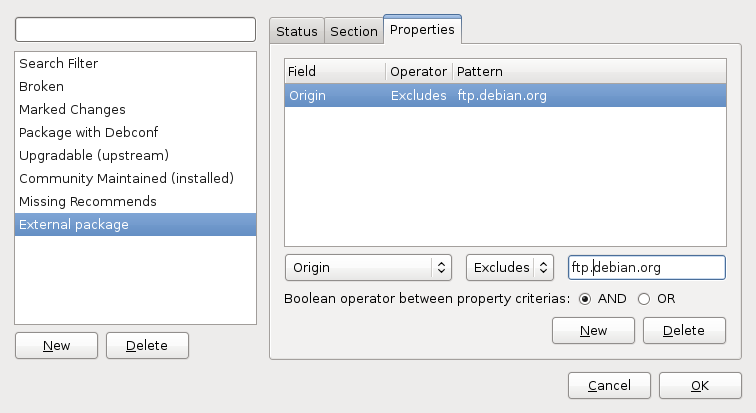
You can replace search with purge or remove if you want to get rid of all the packages listed. But you re more likely to want to remove only a subset of carefully chosen packages you re probably still using some of the software that you installed from external repositories. With synaptic, you can also browse the content of each repository. Click on the Origin button and you have a list of repositories. You can go through the non-Debian repositories and look which packages are installed and up-to-date. But you can do better, you can create a custom view. Click on the menu entry Settings > Filter . Click on New to create a new filter and name it External packages . Unselect everything in the Status tab and keep only Installed . Go in the Properties tab and here add a new entry Origin Excludes ftp.debian.org . In fact you must replace ftp.debian.org with the hostname of your Debian/Ubuntu mirror. The one that appears on the origin line in the output of apt-cache policy (see the excerpt quoted above in this article). Note that the term Origin is used to refer to two different things, a field in the release file but also the name of the host for an APT repository. It s a bit confusing if you don t pay attention. Close the filters window with OK. You now have a new listing of External packages under the Custom Filters screen. You can see which packages are installed and up-to-date and decide whether you really want to keep it. If the package is also provided by Debian/Ubuntu and you want to go back to the version provided by your distribution, you can use the Package > Force version menu entry.
Click here to subscribe to my free newsletter and get my monthly analysis on what s going on in Debian and Ubuntu. Or just follow along via the RSS feed, Identi.ca, Twitter or Facebook.

8 comments Liked this article? Click here. My blog is Flattr-enabled.

13 February 2011

Lior Kaplan: Someone wants to port kkbswitch to QT4 ?

As part of the KDE3/QT3 cleanup after the Squeeze release, Debian is about to remove the kkbswitch package from it s archives (unstable, testing). I got a request to keep the package available as it solves some complicated situations when having more than two keyboard layouts. As a response to that request I m staring to look for someone who is willing to port kkbswitch to QT4. I d be more than happy to continue maintaining the package if such a port is done.
Filed under: Debian GNU/Linux, Free software applications

Steve McIntyre: Dad ill again

A few years ago, I mentioned my dad's fight with cancer. He survived that, and has carried on for several more years since. He had a replacement hip fitted last year to improve his mobility, and was looking set to enjoy a good long retirement. Until... Just before Christmas symptoms suggested that the cancer had returned, and with a vengeance. Tests confirmed it. We were hoping that Dad would fight on and win through again this time, and I was looking forwards to him being at my wedding this September. But there have been a lot of unexpected complications this time and it's just not going to happen. I spoke to him last on Tuesday this week, but he was delirious at the time. He hasn't really been conscious in any meaningful way since. I'm composing this message in the hospital in Southport where I'm now waiting for my dad to die. We've been told by his doctors that it's not going to be long now, but they said that on Wednesday too. My dad has always been stubborn, always a fighter; we know that this is a fight he can't win, but that isn't stopping him from trying his hardest. At least he's being kept comfortable for his last few days, with plenty of strong painkillers on hand when needed. Please let it end soon.

Next.

Previous.