After 1.5 month of work, I am proud to officialy release OUnit 2.0.0. This is a major rewrite of OUnit to include various feature that I think was missing from OUnit1. The very good news is that the port of the OASIS test suite has proven that this new version of OUnit can drastically improve the running time of a test suite.
OUnit is a unit test framework for OCaml. It allows one to easily create unit-tests for OCaml code. It is based on HUnit, a unit testing framework for Haskell. It is similar to JUnit, and other XUnit testing frameworks.
Download OUnit v2.0.0Documentation of v2.0.0Website
The basic features:
better configuration setup
environment variable
command line options
configuration files
improved output of the tests:
allow vim quickfix to jump in the log file where the error has happened
output HTML report
output JUnit report
systematic logging (verbose always on), but output log in a file
choose how to run your test:
run tests in parallel using processes (auto-detect number of CPU and run as many worker processes)
run tests concurrently using threads
use the old sequential runner
choose which test to run with a chooser that can do smart selection of tests:
simple: just run test in sequence
failfirst: run the tests that failed in the last run first and skip the success if they are still failing
some refactoring:
bracket: use a registration in the context but easier to use
remove all useless functions in the OUnit2 interface
non-fatal section: allow to fail inside non-fatal section without quitting immediately the whole test
allow to use OUnit1 test inside OUnit2 (smooth the transition)
timer that makes tests fail if they take too long, only when using the processes runner (I was not able to do it cleanly using threads and sequential)
allow to parametrize filenames so that you can use OUNIT_OUTPUT_FILE=ounit-$(suite_name),log and have $(suite_name) replace by the test suite name
create locks to avoid accessing the same resources within a single process or the whole application (typically to avoid doing a chdir while another thread is doing a chdir elsewhere)
create a in_testdata_dir function to locate test data, if any
Migration path
OUnit 2.0.0 still provides the OUnit module which is exactly the same as the last OUnit 1.X version. This way, you are not forced to migrate. However, this means that you will gain no advantage of the new release and even some slowdown due to increase complexity of the code. Though, I strongly recommend to upgrade to OUnit2.
Here is a checklist to do the migration:
replace all open OUnit by open OUnit2
the test function now takes test_ctxt argument, so replace all fun () -> ...) by fun test_ctxt -> ...
bracket are now inlined so bracket setUp f tearDown is now let x = bracket setUp tearDown test_ctxt in
make sure that you don't change global process state like chdir or Unix.putenv or that you don't rely on another test setting something for the next test
The OASIS test suite migration
In order to check that everything was working correctly, I have migrated the OASIS test suite to OUnit2. This is a big test suite (210 test cases) and it includes quite big sequences of tests (end to end tests from calling oasis setup to compiling and installing the results). This was really time consuming and I wish to see a significant speedup for the tests with OUnit2.
You can see the result in term of code of the full migration here.
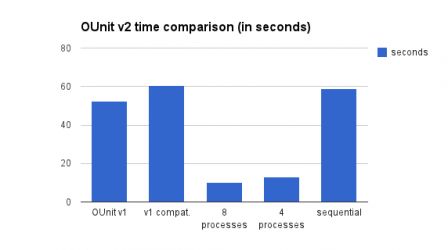
Here are the results on my Intel Core i7 920/SSD:
oUnit1 over oUnit2: 60.39s (OUnit v2.0.0 using the OUnit v1 layer)
Migration to OUnit2 (166 tests):
processes (8 shards): 10.12s
processes (autodect, 4 shards): 12.99s
sequential: 58.77s
The migration was quite heavy because this test suite had a big design problem. It uses in-place modification of the test data. I think I pick this design because I thought this was a good idea to decrease the running time. As a matter of fact, this was a huge mistake, that keeps popping failed test cases because one of the previous tests was failing. I have refactored all this and now we start by copying the test data into a temporary directory, which ensure that everything is always starting from pristine test data.
During the redesign, I have decided to reduce the number of tests by merging some of them. This should have no big impact on the running time, although this is not as pure 1:1 comparison with OUnit v1. Although it is still testing exactly the same thing. This explain the loss of ~50 tests, which in fact has been merged in other tests.
The overall speedup is 4x compared to OUnit v1, when using processes. However there is a 12% increase compared to OUnit v1 for sequential and a 15% increase when using OUnit v1 compatibility layer. While this is not very good score, I hope this is small enough to compensate the huge win of being able to run tests in parallel with processes.
And now the magic !
At this point, if you read carefully the numbers, you would have noticed that there is a 4.5x decrease in speed when you compare sequential and 4 processes for OUnit2. Since we are only actively testing in 4 shards, it looks strange. I don't expect a super-linear speedup due to the use of processes. I have checked that every tests was indeed running and found no solutions to this mystery. Right now, I think this is due to the fact that we are running less tests in more processes which should lighten the load of the GC (which may not trigger at all). I am not sure about this explanation and will welcome any bug report which shows a problem in the implementation of either sequential or processes runner. Although, this is great.
Help still wanted
If you find any bugs with OUnit v2, this is the time to submit a bug.
OUnit BTS
If you want to try to fix bugs by yourself, please checkout the latest version of OUnit:
$> darcs get http://forge.ocamlcore.org/anonscm/darcs/ounit/ounit
A new version of Rcpp is now
on the CRAN network for
GNU R;
binaries for Debian have been uploaded
as well.
Once more, this release brings a large number of exciting changes to
Rcpp. Some concern
usability, some bring new features, some increase performance; see
below for the detailed list. We have now released three updates on a
quarterly cycle; if we keep this up the next version ought to be ready at the
end of December.
As in the past, we tested the release rather rigorously by checking against all
packages I could (relatively easily) built on my server: this time it
successfully passed \code R CMD check for all 107 packages I can build
locally out of a total of 136 packages. (Two failed: one for an error in
\code Makevars , and one for the need of an X11 server during tests; this may
get addressed in the in test script next time). As all of these 107 packages
passed, we do not expect any issues with dependent packages. Should
there be issues we would appreciate a note, preferably with reproducible
code, to the
rcpp-devel
mailing list.
The complete NEWS
entry for 0.10.4 is below; more details are in the ChangeLog file in the package and on the
Rcpp Changelog page.
Changes in Rcpp version 0.10.5 (2013-09-28)
Changes in R code:
New R function demangle that calls the DEMANGLE macro.
New R function sizeof to query the byte size of a
type. This returns an object of S3 class bytes that has a print method showing bytes and bits.
Changes in Rcpp API:
Add defined(__sun) to lists of operating systems to test for when checking for lack of backtrace() needed for stack traces.
as<T*>, as<const T*>, as<T&>
and as<const T&> are now supported, when T is a class exposed by modules, i.e. with RCPP_EXPOSED_CLASS
DoubleVector as been added as an alias to NumericVector
New template function is<T> to identify if an R object
can be seen as a T. For example is<DataFrame>(x).
This is a building block for more expressive dispatch in various places
(modules and attributes functions).
wrap can now handle more types, i.e. types that iterate over
std::pair<const KEY, VALUE> where KEY can be converted to a
String and VALUE is either a primitive type (int, double)
or a type that wraps. Examples :
std::map<int, double> : we can make a String from an int, and double is primitive
boost::unordered_map<double, std::vector<double> >: we can make
a String from a double and std::vector<double> can wrap itself
Other examples of this are included at the end of the wrap unit test
file (runit.wrap.R and wrap.cpp).
wrap now handles containers of classes handled by modules. e.g. if you expose a class Foo via modules, then you can wrap
vector<Foo>, ... An example is included in the wrap unit test file.
RcppLdFlags(), often used in Makevars files of
packages using Rcpp, is now exported from the package namespace.
Changes in Attributes:
Objects exported by a module (i.e. by a RCPP_MODULE call
in a file that is processed by sourceCpp) are now directly
available in the environment. We used to make the module object
available, which was less useful.
A plugin for openmp has been added to support use of OpenMP.
Rcpp::export now takes advantage of the more flexible
as<>, handling constness and referenceness of the input types.
For users, it means that for the parameters of function exported by modules,
we can now use references, pointers and const versions of them.
The file Module.cpp file has an example.
No longer call non-exported functions from the tools package
No longer search the inline package as a fallback when loading plugins for the the Rcpp::plugins attribute.
Changes in Modules:
We can now expose functions and methods that take
T& or const T& as arguments. In these situations
objects are no longer copied as they used to be.
Changes in sugar:
is_na supports classes DatetimeVector and DateVector
Changes in Rcpp documentation:
The vignettes have been moved from inst/doc/ to the vignettes directory which is now preferred.
The appearance of the vignettes has been refreshed by switching to the Bistream Charter font, and microtype package.
Deprecation of RCPP_FUNCTION_*:
The macros from the preprocessor_generated.h file
have been deprecated. They are still available, but they print a message in addition to their expected behavior.
The macros will be permanently removed in the first Rcpp release after July 2014.
Users of these macros should start replacing them with more up-to-date code, such as using 'Rcpp attributes' or 'Rcpp modules'.
During the last week I was attending the first Heidelberg Laureates Forum as one of the lucky 200 accepted young scientists. The HFL is a (from now on hopefully yearly) event that brings together Fields Medalists, Abel Prize laureates and Turing Award winners with young scientists (undergraduates, Ph.D. students and postdocs) from both fields in the city of Heidelberg. The extremely well organized week consisted of lectures from the laureates, some workshops held by postdocs, excursions and plenty of good food. Videos of the lectures are available (but don t work on Linux, at least not for me ), and I have shot a few pictures of the event as well. I believe that my favourite lectures where Michael Atiyah s Advice to a Young Mathematician , Vladimir Voevodsky s Univalent Foundations of Mathematics , William Morton Kahan s Desperately Needed Remedies for the Undebuggability of Large-Scale Floating-Point Computations in Science and Engineering and Alan Kay s Putting Turing to Work .
Where are all the functional programmers?
During that event, one gets to talk to many other math and computer scientists researchers; sometimes just Where are you from? and What do you do? , sometimes long discussions. Unfortunately, I hardly found one who is into functional programming language research is that only because the event was parallel to ICFP (which I really would have liked to attend as well), or is functional programming really just about 1% of all computer science?
What is a proof?
My other research interest lies in interactive theorem proving, especially using Isabelle. Of course that is a topic that one can discuss with almost everyone at that event, including the mathematicians. The reactions were rather mixed: On the one end of the spectrum, some mathematicians seriously doubt that they would ever trust a computer to check proofs and that it would ever be efficient enough to use. Others would not mind having a button that tells whether their paper written in LaTeX is correct , but were not keen to invest time or thought into making the proof readable by the computer. And then there were some (but very few!) who had not heard of theorem proving before and were very excited by the prospect of being able to obtain certainty about their proofs immediately and without having to bother other scientists with it.
During the mathematician s panel discussions, where I posed the question Do you see value in or even a need for machine-checked proofs in mathematics. , Efim Zelmanov (Fields Medal 1994) said a proof is what other mathematicians see as a proof . I found this attitude a bit surprising for me, a proof has always been a rigorous derivation within a formal system (say, ZFC set theory), and what we write in papers is a (less formal) description of the actual proof, whose existence we believe in. Therefore I was very happy to see Vladimir Voevodsky give a very committed talk about Univalent Foundations and how using that as the language for mathematics will allow more of mathematics to be cast in a formal, machine-checked form.
I got the chance to discuss this with him in person, as I wanted to hear his option on Isabelle, and especially on the usefulness of the style of structured proof that Isar provides, and which is closer to the style of proofs that mathematicians use in papers. He said that he enjoyed writing his proof in the style required in Type Theory and in Coq, and that maybe mathematicians should and will adjust to the language of the system, while I believe that a structured proof languages like Isar, independent of the underlying logic (HOL in this case; which is insufficient to form a base for all of abstract mathematics), is a very useful feature and that proof assistants should adjust to the mathematicians.
We also briefly discussed the idea of mine to work with theorem provers already with motivated students in high schools, e.g. in math clubs, and found that simple proofs about arithmetic of natural numbers could be feasible here, without being too trivial.
All in all a very rewarding and special week, and I can only recommend to try to attend one of the next forums, if possible.
Packt recently published a book on Version Control using Bazaar written by
Janos Gyerik. I was curious what the book was like, and they kindly
provided me with a digital copy.
The book is split into roughly five sections: an introduction to version
control using Bazaar's main commands, an overview of the available workflows,
some chapters on the available extensions and integration, some more advanced topics
and finally, a quick introduction to programming using bzrlib.
It is assumed the reader has no pre-existing knowledge about version control
systems. The first chapters introduce the reader to the concept of revision
history, branching and merging and finally collaboration. All concepts are
first discussed in theory, and then demonstrated using the Bazaar command-line
UI and the bzr-explorer tool. The book follows roughly the same
track as the official documentation, but it is more extensive
and has more fancy drawings of revision graphs.
The middle section of the book discusses the modes in which Bazaar
can be used - centralized or decentralized - as well as
the various ways in which code can be landed in the main branch ("workflows").
The selection of workflows in the book is roughly the same as those in the
official Bazaar documentation. The author briefly touches on a number of other
software engineering topics such as code reviews, code formatting and automated
testing, though not sufficiently to make it useful for people who are
unfamiliar with these techniques. Both the official documentation and the book
complicate things unnecessarily by listing every possible option.
The next chapter is a basic howto on the use of Bazaar with various hosting
solutions, such as Launchpad, Redmine and Trac.
The Advanced Features chapter covers a wide range of obscure and less obscure
features in Bazaar: uncommit, shelves, re-using working trees, lightweight
checkouts, stacked branches, signing revisions and using e-mail hooks.
The chapter on foreign version control system integration is a more extensive
version of the public docs. It has some factual inaccuracies; in particular, it
recommends the installation of a 2 year old buggy version of bzr-git.
The last chapter provides quite a good introduction to the Bazaar APIs and
plugin writing. It is a fair bit better than what is available publically.
Overall, it's not a bad book but also not a huge step forward from the official
documentation. I might recommend it to people who are interested in
learning Bazaar and who do not have any experience with version control yet.
Those who are already familiar with Bazaar or another version control system
will not find much new.
The book misses an opportunity by following the official documentation so
closely. It has the same omissions and the same overemphasis on describing
every possible feature. I had hoped to read more about Bazaar's data model, its
file format and some of the common problems, such as parallel imports, format
hell and slowness.
It has taken just over two weeks for blogspam to reject 1 million SPAM comments.
I'm not sure how paranoid I should be about false-positives now, (I
accept false-negatives easily enough).
Using node.js is pretty good for making toy servers, and on that basis here's another toy server:
This is a small server which is designed to accept HTTP-POSTs containing a payload of a message, these are stored and later retrieved. Seems like a simple thing, right? Imagine how it is used:
root@server1:~# record-log Upgraded mysql
root@server2:~# record-log Tweaked /etc/sysctl.conf
root@server3:~# record-log Added user 'bob'
root@server3:~# record-log Added user 'steve'
Later:
root@server3:~# get-recent
1.2.3.4 2013-09-28T08:08:09.211Z
root:Added user 'bob'
1.2.3.4 2013-09-28T08:08:10.211Z
root:Added user 'steve'
In short it makes it easy to record "activity", and later retrieve it. A host can only fetch the entries it stored, but if you've got access to the remote server then you can get all logs.
I suspect a more standard solution is to use syslog-ng, and logger, or similar. But it is a cute hack and I suspect if you've the discipline to record actions then this is actually reasonably useful.
"Big Data" has been hyped a lot, and due to this now is burning down to
get some reality checking. It's been already overdue, but it is now happening.
I have seen a lot of people be very excited about NoSQL databases; and
these databases do have their use cases. However, you just cannot put
everything into NoSQL mode and expect it to just work. That is why we have
recently seen NewSQL databases, query languages for NoSQL databases etc. -
and in fact, they all move towards relational database management again.
Sound new database systems seem to be mostly made up of three aspects:
in-memory optimization instead of optimizing for on-disk operation (memory just
has become a lot cheaper the last 10 years), the execution of queries on the
servers that store the actual data (you may want to call this "stored
procedures" if you like SQL, or "map-reduce" if you like buzzwords), and
optimized memory layouts (many of the benefits of "colum store" databases
come from having a single, often primitive, datatype for the full column to
scan, instead of alternating datatypes in records.
However, here is one point you need to consider: is your data actually
this "big"? Big as in: Google scale.
I see people use big data and Hadoop a lot when they just
shouldn't. I see a lot of people run Hadoop in a VM on their
laptop. Ouch.
The big data technologies are not a one-size-fits-all solution. They are
the supersize-me solution, and supersize just does not fit every task.
When you look at the cases where Hadoop is really successful, it is mostly
in keeping the original raw data, and enabling people to re-scan the
full data again when e.g. their requirements changed. This is where Hadoop
is really good at: managing 100 TB of data, and allowing you to quickly filter
out the few GB that you really need for your current task.
For the actual analysis - or when you don't have 100 TB, and a large
cluster anyway - then just don't try to hadoopify everything.
Here is a raw number from a current experiment. I have a student work
on indexing image data; he is implementing some state of the art techniques.
For these, a large number of image features are extracted, and then clustering
is used to find "typical" features to improve image search.
The benchmarking image set is 56 GB (I have others with 2 TB
to use next). The subset the student is currently processing is 13 GB.
Extracting 2.3 million 128 dimensional feature vectors reduces this to about
1.4 GB. As you can see, the numbers drop quickly.
State of the art seems to be to load the data into Hadoop, and run
clustering (actually, this is more of a vector quantization than clustering)
into 1000 groups. Mahout is the obvious candidate to run this on Hadoop.
However, as I've put a lot of effort into the data mining software
ELKI, I considered also to try
processing it in ELKI.
By cutting the data into 10 MB blocks, Mahout/Hadoop can run the
clustering in 52x parallel mappers. k-Means is an iterative algorithm, so it
needs multiple processes. I have fixed the number of iterations to 10, which
should produce a good enough approximation for my use cases.
K-means is embarrassingly parallel, so one would expect the cluster to really shine
at this task. Well, here are some numbers:
Mahout k-Means took 51 minutes on average per iteration
(The raw numbers are 38:24, 62:29, 46:21, 56:20, 52:15, 45:11, 57:12, 44:58,
52:01, 50:26, so you can see there is a surpisingly high amount of variance
there).
ELKI k-Means on a single CPU core took 4 minutes 25 seconds
per iteration, and 45 minutes total, including parsing the input
data from an ascii file. Maybe I will try a parallel implementation next.
So what is happening? Why is ELKI beating Mahout by a factor of 10x?
It's (as always) a mixture of a number of things:
ELKI is quite well optimized. The Java Hotspot VM does a good job at
optimizing this code, and I have seen it to be on par with R's k-means, which
is written in C. I'm not sure if Mahout has received a similar amount of
optimization yet. (In fact, 15% of the Mahout runtime was garbage
collection runtime - indicating that it creates too many objects.)
ELKI can use the data in a uniform way, similar to a column store database.
It's literally crunching the raw double[] arrays. Mahout on the
other hand - as far as I can tell - is getting the data from a sequence file,
which then is deserialized into a complex object. In addition to the actual
data, it might be expecting sparse and dense vectors mixed etc.
Size: this data set fits well into memory. Once this no longer holds,
ELKI will no longer be an option. Then MapReduce/Hadoop/Mahout wins.
In particular, such an implementation will by design not keep the
whole data set in memory, but need to de-serialize it from disk again on
each iteration. This is overhead, but saves memory.
Design: MapReduce is designed for huge clusters, where you must expect
nodes to crash during your computation. Well, chances are that my computer
will survive 45 minutes, so I do not need this for this data size. However,
when you really have large data, and need multiple hours on 1000
nodes to process it, then this becomes important to survive losing
a node. The cost is that all interim results are written to the distributed
filesystem. This extra I/O comes, again, at a cost.
Let me emphasize this: I'm not saying, Hadoop/Mahout is bad. I'm
saying: this data set is not big enough to make Mahout beneficial.
Conclusions: As long as your data fits into your main memory and
takes just a few hours to compute, don't go for Hadoop.
It will likely be faster on a single node by avoiding the overhead
associated with (current) distributed implementations.
Sometimes, it may also be a solution to use the cluster only for preparing
the data, then get it to a powerful workstation, and analyze it there. We did
do this with the images: for extracting the image features, we used a
distributed implementation (not on Hadoop, but on a dozen PCs).
I'm not saying it will stay that way. I have plans for starting
"Project HELKI", aka "ELKI on Hadoop". Because I do sometimes hit the
barrier of what I can compute on my 8 core CPU in an "reasonable" amount
of time. And of course, Mahout will improve over time, and hopefully lose
some of its "Java boxing" weight.
But before trying to run everything on a cluster, always try to run it
on a single node first. You can still figure out how to scale up later, once
you really know what you need.
And last but not least, consider whether scaling up really makes sense.
K-means results don't really get better with a larger data set. They are
averages, and adding more data will likely only change the last few
digits. Now if you have an implementation that doesn't pay attention to
numerical issues, you might end up with more numerical error than you gained
from that extra data.
In fact, k-means can effectively be accelerated by processing a sample
first, and only refining this on the full data set then. And:
sampling is the most important "big data" approach. In particular when
using statistical methods, consider whether more data can really be expected to
improve your quality.
Better algorithms: K-means is a very crude heuristic. It optimizes the sum
of squared deviations, which may be not too meaningful for your problem. It is
not very noise tolerant, either. And there are thousands of variants. For
example bisecting k-means, which no longer is embarrassingly parallel (i.e.
it is not as easy to implement on MapReduce), but took just 7 minutes doing
20 iterations for each split. The algorithm can be summarized as starting with
k=2, then always splitting the largest cluster in two until you have the
desired k. For many use cases, this result will be just as good as the full
k-means result.
Don't get me wrong. There are true big data problems. Web scale search,
for example. Or product and friend recommendations at Facebook scale.
But chances are that you don't have this amount of data.
Google probably doesn't employ k-means at that scale either.
(actually, Google runs k-means on 5 mio keypoints for vector quantization;
which, judging my experience here, can still be done one a single host; in
particular with hierarchical approaches such as bisecting k-means)
Don't choose the wrong tool for the wrong problem!
The Freedombox
project have been going on for a while, and have presented the
vision, ideas and solution several places. Here is a little
collection of videos of talks and presentation of the project.
A larger list is available from
the
Freedombox Wiki.
On other news, I am happy to report that Freedombox based on Debian
Jessie is coming along quite well, and soon both Owncloud and using
Tor should be available for testers of the Freedombox solution. :) In
a few weeks I hope everything needed to test it is included in Debian.
The withsqlite package is already in Debian, and the plinth package is
pending in NEW. The third and vital part of that puzzle is the
metapackage/setup framework, which is still pending an upload. Join
us on IRC
(#freedombox on irc.debian.org) and
the
mailing list if you want to help make this vision come true.
Recently I've been playing gtetrinet, against the publicly accessible server at tetrinet.debian.net.
If you're unfamiliar with the game it is a multi-player variant of Tetris. You clear many lines and your opponents suffer. Want to make them suffer some more? Use the special blocks you acquire.
Special blocks? How about shuffling your opponents playing field? Adding new semi-formed rows? etc. All good stuff.
There is support for up to six players. To fire a special block at the player in field 1 you press "1". To fire the special block to the player in field 6 press "6". But to fire a block at yourself, to clear your playing field ("nuke") or remove a single line ("clear") you have to know what player-number you are, which will change from day to day, as it is literally a marker for the order you joined the channel in.
It seems obvious that there should be a special-case keybinding "fire to self", and indeed there was bug #291844 filed in 2005 saying as much. I've just submitted a functional patch to resolve this, and already my playing is getting better.
Join me sometime.
The current default D-BUS configuration (at least on Ubuntu) disallows monitoring method calls on the system D-BUS (dbus-monitor --system), which makes debugging rather cumbersome; this has worked years ago, but apparently got changed for security reasons. It took me a half an hour to figure out how to enable this for debugging, and as this has annoyingly little Google juice (I didn t find any solution), let s add some.
The trick seems to be to set a global policy to be able to eavesdrop any method call after the individual /etc/dbus-1/system.d/*.conf files applied their restrictions, for which there is already a convenient facility. Create a file /etc/dbus-1/system-local.conf with
<?xml version="1.0" encoding="UTF-8" ?>
<!DOCTYPE busconfig PUBLIC
  "-//freedesktop//DTD D-BUS Bus Configuration 1.0//EN"
  "http://www.freedesktop.org/standards/dbus/1.0/busconfig.dtd">
<busconfig>
  <policy user="root">
    <!-- Allow everything to be sent -->
    <allow send_destination="*" eavesdrop="true"/>
    <!-- Allow everything to be received -->
    <allow eavesdrop="true"/>
    <allow send_type="method_call"/>
  </policy>
</busconfig>
Then sudo dbus-monitor --system displays everything. Needless to say that you don t want this file on any production system!
Does anyone know an easier way? My first naive stab was to run dbus-monitor as root, but that doesn t make any difference at all.
Update: Turns out this is already described in a better way at https://wiki.ubuntu.com/DebuggingDBus. Yay me for not finding that.. I updated above recipe to limit access to root, which is much better indeed.
A friend is teaching a class on data analysis. She is building a simple and rough data set for the class to examine, and to spur discussion. You can contribute in half a minute! Here's how:
get a stopwatch or other sort of timer (whatever device you're reading this on probably has such a thing).
start the timer, but don't look at it.
wait for what you think is 30 seconds, and then look at the timer
how many actual seconds elapsed?
The data doesn't need to be particularly high-precision (whole second values are fine). The other data points my friend is looking for are age (in years, again, whole numbers are fine) and gender. You can send me your results by e-mail, (i suspect you can find my address if you're reading this blog). Please put "half a minute for science" in the subject line, and make sure you include:
Continuing last month progress report onOUnit2. The release is just a few days away, I am testing real life application and the core of the work is already in the VCS.
The basic features:
better configuration setup
environment variable
command line options
configuration files
improved output of the tests:
allow vim quickfix to jump in the log file where the error has happened
output HTML report
output JUnit report
systematic logging (verbose always on), but output log in a file
choose how to run your test:
run tests in parallel using processes (auto-detect number of CPU and run as many worker processes)
run tests concurrently using threads
use the old sequential runner
choose which test to run with a chooser that can do smart selection of tests:
simple: just run test in sequence
failfirst: run the tests that failed in the last run first and skip the success if they are still failing
some refactoring:
bracket: use a registration in the context but easier to use
remove all useless functions in the OUnit2 interface
non-fatal section: allow to fail inside non-fatal section without quitting immediately the whole test
allow to use OUnit1 test inside OUnit2 (smooth the transition)
timer that makes tests fail if they take too long, only when using the processes runner (I was not able to do it cleanly using threads and sequential)
allow to parametrize filenames so that you can use OUNIT_OUTPUT_FILE=ounit-$(suite_name),log and have $(suite_name) replace by the test suite name
create locks to avoid accessing the same resources within a single process or the whole application (typically to avoid doing a chdir while another thread is doing a chdir elsewhere)
create a in_testdata_dir function to locate test data, if any
Still remaining to do, but quite straightforward:
sys admin (website, release process)
update the whole documentation
Some things that I decided not to do for OUnit 2.0 release:
introduce a 'cached' state to avoid rerunning a test if you can programmaticaly determine that the result will be the same.
The main development is now done, but before releasing I decided to test it first on a real scale application. The first big migration to OUnit2, will be the OASIS test suite. This is a pretty big test suite (100+ tests) that takes a fair amount of time to run. I hope that during the next week I will be able to port the whole test suite and come back with some timing results.
You can follow my progress on porting OASIS to OUnit 2.0, in github.
Help wanted
If you have a long standing issue with OUnit, this is the time to submit a bug.
OUnit BTS
If you want to try the dev version of OUnit:
$> darcs get http://forge.ocamlcore.org/anonscm/darcs/ounit/ounit
Patches always welcome.
You can read the documentation of the devel version the website.
This is my final report :) the GSoC was great, I learned a lot about
the Hurd and Mach programming in general. I am also very pleased to
announce that I reached my initial goal and almost all of my patches
already made it upstream and into Debian :)
I spent my last week fixing issues I introduced
and splitting up /hurd/init into two programs. This
would make it possible to integrate the patch that frees PID 1 for
sysvinit into the Hurd upstream sources. I didn't quite finish the
separation, but my proof of concept works and I will finish this as my
next Hurd project.
Looking back at the last fourteen weeks, I accomplished the following:
I implemented /proc/mounts, umount, freed up PID 1 for sysvinit, fixed
ifupdown, sysvinit and initscripts on Hurd, implemented a
proof-of-concept cgroupfs and fixed many small issues along the
way. Almost all of my patches are already upstream and in Debian, a
Debian/Hurd booting using sysvinit is just a few uploads away.
It has been a lot of fun and I will definitively see you around :)
Justus
I ve just been given a set of Hive Bluetooth speakers by MobileZap (see this link for all their Bluetooth speakers) [1].
The speakers charge by a micro-USB cable so I started charging them in my car immediately after collecting them. To connect them to a phone or other Bluetooth device you just press the Bluetooth button on top and get the phone to be visible and scanning for devices, they identify themselves as Hive , after that they just work. My first test of using them was playing Ingress and the quality of the sound was impressive, I had thought that the Ingress recommendation to use headphones was due to the risk of annoying other people or alerting other players, but the quality of the sound was impressive and the internal speakers of a phone can t do it justice.
After getting home I did some tests listening to music. For watching music videos it didn t work so well as the sound was too far removed from the video, but the audio quality was very good. I listened to Vow by Garbage (a good benchmark for stereo sound) and even though the Hive speakers are only 16.5cm wide I could still notice the stereo effect when they were about 1.5m away from me. The audio quality didn t compare well with my Bose QC-15 headphones, but for affordable and portable speakers it was quite good and an obvious improvement over the speakers that are built in to any phone I ve used.
According to the Bluetooth Wikipedia page the range of a class 2 device is 10m and the range of a class 3 device is 1m. When my Samsung Galaxy Note 2 is talking to it I get a reliable range of about 5 meters and a mostly working range of 6 or 7 meters (sound randomly drops out and gets choppy). It could be that other phones would support a longer range due to having a higher transmission power (either class 1 or being closer to the limits of class 2) and a more sensitive receiver. But it doesn t seem likely that a 5m range is going to be a problem.
Volume and Quality
The speakers are rated at 5 Watt, when running at maximum volume (both through the phone volume setting and the volume control on the speakers) the sound is reasonably distortion free, as good as can be expected from playing an MP3 that s not compressed with the highest quality. Sound Meter [2] reports the sound volume as almost 85dB on a Galaxy S3 and as almost 100dB on a Galaxy Note 2, that would be somewhere between the volume of a busy street or alarm clock and the volume of a subway train or blow dryer which seems like a reasonable description, I find it very unpleasant to be within a meter of the speakers at maximum volume. With the typical amount of background noise in my house I can play music on the Hive speakers at one end of my house and hear it clearly at the other end.
These speakers are more than capable of supplying the music for any party I d want to host or attend. I m not really into wild parties, but I think that anyone who has a one room party would be more than satisfied with the Hive speakers. Obviously the sound quality of portable speakers in a box that s 16.5cm wide and 6cm high isn t going to equal that of a full size set of speakers, but I think that hardly anyone who attends a party would expect better sound quality than the Hive speakers can provide. The aim of such speakers is to be portable, not really expensive, and to provide good sound quality within those constraints. I think that they meet such aims well.
Over the years there have been many occasions when I have used a Thinkpad to provide the music for a party and found it to be quite loud enough. My current Thinkpad is a T420 which can produce 75dB according to my Galaxy S3 or 85dB according to my Galaxy Note 2. So it seems that I only really need about 10dB less than the maximum volume of the Hive speakers.
Appearance
The designers obviously made an effort on the appearance of the device. They have gone with the Hive concept and used hexagons everywhere. It really looks nice.
Unfortunately when I took the photo there was some dust on it which didn t look bad to the eye but caught the camera flash. But with a matte black device there s always the problem of light colored dust. Even with a bit of dust it still looks great as a set of speakers, the dust just detracts from the appearance in photos.
Line In
One of the features I looked for was an audio line input so I could connect it directly to a non-Bluetooth device. I m assuming that this feature works as it s something that s difficult to stuff up when designing such a product, but I haven t got around to testing it. Once I started using the device I just found that I didn t have a real need for that feature.
One thing that it might be useful for is PC desktop speakers that are powered by a USB port on the monitor. Currently I have a bearable (but not great) set of speakers for each PC and I don t need to change anything. But having the option of another set of speakers is very handy in case I suddenly need to make hardware changes.
Other People s Reviews
When I review a product I generally try and get opinions from random other people if possible. My mother and my mother-in-law were both impressed by the Hive speakers and expressed interest in owning a set. My mother-in-law was particularly interested as she uses her phone to listen to radio stations from outside Australia (I m going to get her onto Aldi for cheap 3G data ASAP so she can listen to Internet radio when travelling).
Generally the impression that other people have of this device seems to be very positive. It seems that Bluetooth speakers aren t just a Geek toy.
Conclusion
While I m very impressed by this product, at this stage I m not sure whether I would pay for this one or something cheaper if I was paying for it. MobileZap offers a range of other products that look appealing at lower price points. It really depends on how much I use it.
I ve just got a Makerbot Replicator 3D printer working and I ve found the Hive speakers very useful for the purpose of drowning out it s noise. If I keep doing that sort of thing then I ll get enough use out of the speakers to justify the price.
A common theme that comes up in free software evangelism is the question of how to tap into the huge expenditure that small to medium-sized businesses make for off-the-shelf licensed software. It is well known that many small companies are paying over the odds compared to the site-license rates given to big business, so why is it that small businesses are not rushing to adopt free and open source solutions?
The answer is not likely to be found by fighting a battle on pricing (even though it is a battle that free software is inherently well prepared for). Rather, the most compelling strategy involves helping businesses find better ways to solve their own problems.
A problem that every business encounters in every industry is the maintenance of proper financial records. Up until now, packaged solutions like GnuCash and HomeBank, available in many Linux distributions, have only catered for the smallest businesses and household accounting. At the other end of the spectrum, solutions like Compiere/Adempiere and OpenERP require a level of effort to install and maintain that makes them unsuitable for small users and businesses that don't need their full range of features. OpenERP briefly appeared as a Debian package but subsequently dropped out due to difficulties supporting the package.
There is another choice, PostBooks. PostBooks has recently been packaged for Debian and this experience leads me to believe it will be supportable in Fedora and other distributions too. PostBooks, which started off as a commercial product, was re-licensed as an open source solution in 2007. In March 2013, PostBooks was project of the month on Sourceforge.
Of particular note,
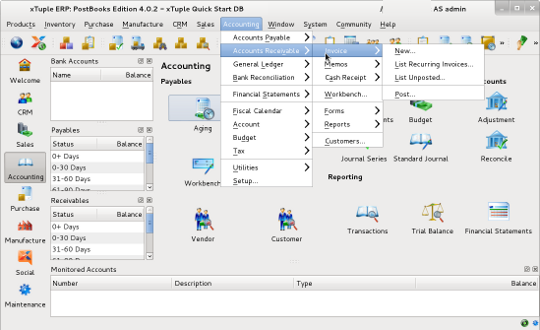
PostBooks has a Qt-based GUI where users of equivalent commercial solutions are likely to feel comfortable very quickly
PostBooks does not depend on any dedicated server processes other than a PostgreSQL database
Using the quickstart database, it can be set up in less than half a day, making it suitable for many consultants and freelancers who may otherwise use a product having a setup wizard (such as QuickBooks).
However, with features like inventory, invoicing, a sophisticated data import GUI (known as CSVImp), a true SQL backend, multi-currency and multiple concurrent users, it scales beyond the use cases that Quickbooks and Sage Accounting are capable of servicing.
The company behind PostBooks, xTuple, is well established and offers related services such as training and an annual user conference (which takes place in just a few weeks). Many business users are likely to find this style of support very reassuring and familiar, even if they don't plan to immediately take advantage of these things.
Limitations
Two particular limitations caught my attention early when evaluating PostBooks:
There is no integrated support for tracking credit card expenditure, which is another very common requirement for many small businesses and professional/freelance consultants.
The developers have acknowledged these limitations and offered to complete these solutions with a crowd-funding campaign dubbed Feature Mob 2.
While everybody likes a free lunch, I personally feel that developers are perfectly entitled to request payment for their work. Having already taken a great leap of faith in open-sourcing a product that had previously been developed in-house, companies like xTuple need to look at new ways to generate revenue.
Having looked at some of the prices of equivalent solutions, I felt quite comfortable pledging a similar amount based on four things:
it is based on the Kickstarter model, they only keep the money if their funding target is reached and feature implementation goes ahead
they are releasing the work as open source
the desire to have the option of using a highly capable free software solution that will be around well into the future
the probability that this is one piece of software that is likely to create more commercial opportunities for free software developers
Next steps
People trying the packages and people who potentially want to package PostBooks for other distributions are very welcome to come and ask questions in the xTuple Debian maintainers packaging list or using the xTuple web forums. Please also feel free to report bugs through the Debian bug tracker.
The third lesson of the Arte y cultura en circulaci n: crear y compartir en tiempos digitales course was quite easy, at least for me, as it's one of the topics I've been involved with for a long time: Authors' rights and ways to exercise them.
This lesson starts by talking about the paradoxes created in the reality beneath copyright mostly due to the zero-cost-for-perfect-copy reality we live in today, and then goes on to introduce the most widely spread licensing schemes for cultural works nowadays: The Creative Commons licensing schemes.
What I felt very interesting is that the lesson tackles the most common issues raised by authors choosing CC licensing: The Non-Commercial and Non-Derivatives restrictions. While authors are usually not very hard to convince about the virtues (and their personal benefit) in CC licensing, it's usually hard for authors to accept and relinquish the "locks" on non-derivability and non-commercial-use.
Now, as to the homework: This time, I have to admit it was a no-brainer to me. The homework was to take part of a "Licenciat n": Publish some work under a open or free license (a work of any kind; it can be text, photo, video, etc.; it can be a new or a pre-existing work) and argue as to why did you choose said license.
Even the act of writing this blog post means I'm releasing some work. The bottom of my blog reads, All the material found at this site is freely available, and you can use it as you wish, except when the document mentions explicitly different conditions. Yes, this is not a widely known, preexisting licensing scheme, and more or less goes along the lines of CC0 There are some good things I have posted in this blog, some things I am proud about. This post goes more towards the average quality: Not adding anything of great value to the world, just reiterating/reposting what is already said. But I know this blog is syndicated over several different places, and its content might be copied over to other places. I don't need to know or be notified about it. I just care for people to be able to reach back if they want to do it.
But, of course, if I'm asked to do a homework, I prefer not to have it so self-referential. What else to license?
We are over halfway across the Wiki Loves Monuments contest for 2013. This year I am clearly not as active on it as I was last year, but yesterday I uploaded about 60 photos from our recent trips, from historical monuments in some towns/cities within ~150Km of Mexico City: Puebla, Tlaxcala, Cacaxtla, Toluca, Santiago Tianguistenco. I intend to upload more. Those photos are licensed CC-BY-SA. Why? Mainly, because it is the defaul for the contest. One of the lessons learned working on Debian is that the less the license I choose deviates from what the upstream authors of a larger project prefer, the more useful my work will be. And being Wikimedia a host of many related projects, I prefer to completely abide by their recommendations unless there is a real, strong reason not to do so.
Also, I know that at least most the photos I am uploading are not of contest quality (although some are quite nice, but we don't take that long to take a shot, and our camera is probably too basic to get a quality shot, if not by mere chance). I am using the WLM contest as an excuse to categorize and upload my pictures Of course, I'm not including personal photos, but... If I found a building, place or landscape interesting enough to take a photo of, why not make said photo available for whoever needs it, in a canonical, easy to reach media repository (as Wikimedia Commons) is)?
And finally, I think it's time to start getting more open and forward-going with a project that I have been giving a lot of work during the past year, a project that has been even eating quite a bit of my Debian time: My upcoming book. While this book is not yet freely licensed (it is freely distributed online, but does not yet have an explicit license, and I mention it on my teaching/project page. Why? Because it still has some figures and data which are not mine, and which I have to re-elaborate to be able to legally license it.
But anyway I am writing a book on the subject of Operating Systems, and am basing my teaching on it. The first semester was basically hell for me, as I was working almost full time on it, and needed to allocate some time as well to the rest of my formal work. This second semester has been quite smoother. And there is a very important (to me) initiative to which I (or should I now start saying, we) submitted this work: The LATIn Project: An initiative to collaboratively create quality, freely redistributable text books for the university level, natively in Spanish, for their use in Latin American countries.
I was not able to propose this book due to some formalities Projects have to be proposed by professors in participant universities, and UNAM is not one of them. However, I offered this work to people in the Universidad Nacional de Rosario, Argentina, and they managed to push the project forward. Together with people from Universidad Aut noma de Aguascalientes (M xico) and Universidad del Cauca (Colombia), the project was approved by LATIn.
And this LATIn project can also be seen as a why do you agree to license your work this way? candidate: I have already written most of what I'd be happy to call a full book. Of course, I do expect my colleagues to chime in with more content, and I expect us to produce a true collaborative project. But as I am not part of the member universities, they will get paid for their contribution And not me. What do I have to gain from this?
More than anything else, the circulation of my work. I'm sure that, were I to publish from UNAM, I would have a good projection. I was (am!) thinking of looking for opportunities to present the book to teachers on the subject, as well as to computing engineering/science students, but the most attractive part (for me) for LATIn is that part of the prize will be that the book will be used to base work on for teaching at least during 2014 in the three said universities And of course, my/our work will only start then, as we will have to further circulate the work.
Anyway... I expected this post to be small. But as you can see, I am happy with important work perspectives :-)
This is a bug-fix release to my POD translator package, which contains
Pod::Man and Pod::Text and is used by Perl core to format POD
documentation. This is not, alas, the long-awaited overhaul of UTF-8
handling; that's still coming at some point in the future.
The primary changes in this release are various performance patches from
Dagfinn Ilmari Manns ker from work on profiling all the Perl core modules.
I learned from merging those packages that reversing a long string can
make regex replacement operations on the tail faster, even with the time
required to reverse the string twice. I'm surprised.
This release also wraps the Pod::Simple parse_lines and
parse_string_document to set the default output to STDOUT, similar to what
was already done with parse_file, since some of the one-liners that people
were testing would have produced confusing error messages without this.
It fixes handling of POD documents with error sections and no other
content, thanks to a bug report by Andreas Koenig. And it fixes typos and
other documentation issues, thanks to Andreas, David Steinbrunner, and
Brian Gottreu.
You can get the latest release from the podlators distribution page.
One of the earlier examples of students using MIT computer resources
to lay the groundwork for a later commercial endeavour, Zork was
originally written in a LISP derivative called MDL.
This was later tuned into the Zork Implementation Language, a domain
specific language that was compiled to target the Z-machine rather
than a specific piece of hardware. Combined with machine-specific
Z-machine interpreters, this allowed rapid porting of games to a wide
range of platforms - the only thing that needed to be rewritten was
the interpreter, and that could be reused for any future games running
on the same hardware.
Infocom were eventually acquired and killed off, but fan interest in
their games continued. New Z-machine interpreters were written in
order to allow their games (including Zork) to be run on platforms
that Infocom had never targetted. One of the best known is Frotz. This has the advantage
of being (a) portable and (b) including a "dumb" UI that makes no
assumptions about the availablity of any vaguely useful
functionality. Like, say, a Curses library.
So, Frotz seemed like the natural choice when this happened. But despite having a set of functionality that makes it look much
more like an OS than a boot environment, UEFI doesn't actually expose
a standard C library. The EFI
Application Development Kit solves this particular design
decision. Porting Frotz ended up involving far more fixing up of Frotz
bugs that tripped up -Werror than anything else. One note, though -
make sure you include DevShell in the list of required packages at
build time, otherwise file i/o will mysteriously fail.
The tying of file i/o to the shell protocol unfortunately means that
Frotz can't be directly launched by the firmware. The Boot to Zork images
therefore contain a UEFI shell in the standard boot location
(\EFI\BOOT\BOOTX64.EFI) which is executed when the firmware attempts
to boot the device. The shell then looks for a file called
"startup.nsh" in the root directory of the boot device and executes
it. Unfortunately this doesn't actually set the shell equivalent of
the current device, and so just launching Frotz from startup.nsh fails
when Frotz can't open the Zork data file. The solution for this is
simple, if ugly - the script walks through the list of devices,
looking for one that contains ZORK1.DAT in the root directory. It then
changes to that device and launches Frotz. If Frotz exits, it then
resets the system.
This could be avoided by doing some more work and turning Frotz into a
more UEFI-native application. Teaching Frotz to make native UEFI calls
would avoid the requirement for the shell protocols, and the firmware
provides a mechanism to obtain the path of the currently running
executable which would avoid the need to explicitly locate the
device. But I'm lazy and this was a "I'm spending the day on a plane"
project initially inspired by a Sazerac-fuelled conversation during
the UEFI plugfest, not a demonstration of UEFI best practices.
UEFI Boot To Zork and the source code to the modified Frotz can be downloaded here.
Review: Throne of the Crescent Moon, by Saladin Ahmed
Series:
Crescent Moon Kingdoms #1
Publisher:
DAW
Copyright:
January 2013
ISBN:
0-7564-0778-8
Format:
Mass market
Pages:
367
Doctor Adoulla Makhslood is the last ghul hunter in Dhamsawaat. He's an
old man, and tired, and increasingly uncertain whether he wants to
continue putting his life in danger to fight one more fight. But there
are no replacements; his young and idealistic dervish apprentice, despite
obvious skill, is too inexperienced and uninterested in the knowledge and
investigation that makes Adoulla so good at what he does. So, when a
young boy shows up on his doorstep, a survivor of a vicious ghul attack,
he goes hunting once again. And both finds something much darker and
stronger than he expected and meets an unexpected ally: a shape-shifting
girl who is herself a survivor of something far worse than ghuls.
Throne of the Crescent Moon is a first-novel fantasy that has made
quite a splash, including a Hugo nomination (although I thought a win was
unlikely, and I was right). One of the more interesting comments I've
read about it was the observation by
Jo Walton that if it had come out in 1980, it would have been an
amazing, unusually wonderful, non-normative book. That it isn't is
evidence of the changes in fantasy since then. The field has grown.
As you might guess from the publisher's insistence on comparing it with
The Arabian Nights, and from the names mentioned above, this book
is set in an unspecified Middle Eastern culture and draws heavily from its
mythology. It does not contain any western characters; the entire story
is native to its region. The same is true of the mythology, which gave it
a refreshing originality for me. And while I'm not the best one to judge,
the presentation of that setting seemed free of the tint of the exotic.
People live here, there are factions and multiple cultures, and the
supernatural is a backdrop to most of the city.
This would be very unusual decades ago. It's a bit less unusual now, and
the story itself is a familiar ensemble fantasy, if refreshingly free of
extended map exploration journeys. Ahmed brings together five characters
with very different backgrounds and throws their varying talents at a
problem. A few of those elements are a bit too familiar: female
sexuality as a threat to male power is a world-building element that I
could do without, for example. I also found the villain completely
inadequate in its unidimensional evil (reinforced with a few more torture
scenes than I needed to read), and even the attempted complication felt
too predictable to me.
Except for one touch of perspective, I'd call Throne of the
Crescent Moon a competent, enjoyable, but somewhat forgettable fantasy
novel, albeit one that's refreshingly concerned with a city instead of
countrysides and travel. That touch is in the age of several of the
protagonists. We get sections following several of the main characters
in tight third person, but Adoulla is the first protagonist and the focus
of much of the book. And Adoulla is neither young nor inexperienced,
and is not going through the typical fantasy bildungsroman.
He's old, experienced, a bit set in his ways, cranky, cantankerous, and
deeply in love with his city. In tone, this shifts the story towards
Star Wars as seen through the eyes of Obi-Wan Kenobi instead of
Luke Skywalker. And that change I really liked, and would be happy to see
become more common in fantasy.
There was a bit of a downside for me in three of the five main characters
being older. At times, Throne of the Crescent Moon has an elegiac
tone, a feeling of life, power, and time slipping away and cultures and
ways of life being lost. That's not my favorite thematic element. I tend
to find it more depressing than I really want in my reading. But, here,
the mature perspective more than makes up for some occasional negativity.
I particularly liked how the older characters treated the likely budding
young romance, which would have been the center of many books in this
genre, with bemused detachment and playful encouragement without giving it
more significance than it deserves. There's another romance that ends up
being more significant, and which needs the weight of time and well-lived
lives to become so.
I don't think this book deserves a Hugo, but it is an enjoyable fantasy
with some interesting characters and a refreshing perspective and setting.
The villain really isn't adequate to the story, there's a bit too much
torture for my liking, and I could have done without a few of the tropes,
but it's a solid entry in its genre and a pleasant few hours of reading.
And despite being advertised as the first of a series, it comes to a
satisfying conclusion.
Rating: 7 out of 10
On a regular basis, I find myself the odd-man-out when it comes to talking
about how to work with Python on Debian systems. I'm going to write this and
post it so that I might be able to point people at my thoughts without having
to write the same email in response to each thread that pops up.
Turns out I don't fit in with the Debian hardliners (which is to say, the
mindset that pip sucks and shouldn't exist), nor do I fit in with the Python
hardliners (which is to say apt and dpkg are out of date, and neither have
a place on a Development machine).
I think our discourse on this topic has become petty and stupid in general.
Let's all try to step back and drop a bit of the attitude.
pip doesn't suck, and neither does apt.
The truth is, both sides are wrong. As with any subject, the real
answer here is much more nuanced than either side presents it. I'm going to
try and present my opinion on this, in the way that both my Pythonista self
and my Debianite self see the issue. Hopefully I can keep this short, to
the point, and caked with logic.
The case for dpkg (the Debianite in me)
In defense of dpkg and apt, imagine having to install python-gnome2
on all your systems when you install. It'd be hell on earth.
Imagine having a user try to do this. It's insane to assume that
end-users will be using pip for this purpose.
pip is fun and all, but it's also installing 100% untrusted code to your
system (perhaps as root, if you're using pip with sudo for some reason),
and hasn't been reviewed for software freeness, which is something Debian
(and Debian users) take seriously. This isn't even to mention the hell that
pip wreaks on dpkg controlled files / packages.
Try to remember how much of your system running (yes, right now) is running
because of Python or Python modules. Try to imagine how much of a pain in
the ass it'd be if you couldn't boot into GNOME to use nm-applet to connect
to wifi to pip install something. I'm sure even the most extreme pip'er
understands the need for Operating System level package management.
Debian also has a bigger problem scope - we're not maintaining a library
in Debian for kicks, we're maintaining it so that end user applications may
use the library. When we update something like Django, we have to make sure
that we don't break anything using it (although, to be honest, the fact that we
package webapps is an entire rant for later) before we get to update it to the
newest release.
Hell, with a few coffees, I could automate the process of releasing a .deb
with a new upstream release, 100% unattended. I won't, however, since this is
an insane idea. Let's go over a brief list of things I do before uploading a
new package:
Review the entire codebase for simple mistakes.
Review the entire codebase for license issues.
Review the entire codebase for files without source, and track down
(and include source for) any sourceless files (such as pickle
files, etc).
Get to know the upstream, get to know open bugs, write something using
the lib, in case I need to debug later.
Install the package.
Test the package.
Work out any Debian package issues (this is easy).
Now, a brief list of things I do before I update a package:
Review the changes between the last uploaded version (in diff format, if
it's sane, otherwise get the VCS and review), ensure all the above are still
OK.
Review for Debian-local issues (such as how it will upgrade, using
piuparts, and adequate, etc).
Check to make sure it won't break any reverse dependencies.
Review for bugfixes that I might need to bring back to the stable release.
Figure out if I should (or even can) backport the package, if API is
stable.
Review for bugs (upstream or in Debian) that I need to mention in the
debian/changelog.
Clearly, this isn't a quick-and-dirty task. It's not a matter of getting a
package updated (technically), it's a much more detailed process than that.
This is also why Debian is so highly regarded for its technical virtuosity,
and why the
ISS decided to deploy Debian in space,
despite other commercial distros such as Red Hat, or Ubuntu, and
community distros, such as Fedora or Arch.
It's also not Debian's job to package the world in the archive. This is an
insane task, and it's not Debian's place to do it. We introduce libraries
as things need them, not because we wrote some new library that someone
may find slightly useful at some point in the future. maybe.
Upstream developers and language communities (not only Python here) tend to
lose sight of why we're doing this in the first place, which
is our users. This isn't some sort of technical pissing contest to see who can
distribute the software in the best way. Debian-folk always keep end users
as our highest priority.
I quote the
Debian Social Contract, when I say
that Our priorities are our users and free software. No one's trying to
get developers to use dpkg to create software. In fact, as you'll see
below, I actively discourage using system modules for development.
The case for pip (the Pythonista in me)
In defense of pip, the idea that Debian will keep the latest versions of
packages is insane. The idea that we can keep pace with upstream releases is
nuts, and the idea that every upstream release on pypi is ready to ship is
bananas. b-a-n-a-n-a-annas.
As a developer, I don't want to support every release, and I surely don't want
other people depending on some random snapshot.
Often times, I'll put stuff up on pypi as a preview, or to release often, and
solicit feedback without having to give out instructions on using a git
checkout (it's also easier to have them try a version from pypi so I can
cross-ref the git tag to reproduce issues when they file them)
pypi is easy, ubiquitous and works regardless of the platform, which means
less of my development time is spent packaging stuff up for platforms I don't
really care about (Arch, Fedora, OSX, Windows), even though I value
feedback from users on those systems. The effort it takes to release something
is limited to python setup.py sdist upload, and it's in a place (and in a
shape) that anyone can use it without having 10 sets of platform-local
instructions.
Even ignoring all the above, when I'm writing a new app or bit of code,
I want to be sure I'm targeting the latest version of the code I depend on,
so that future changes to API won't hit me as hard. By following
along with my dependencies' development, I can be sure that my code breaks
early, and breaks in development, not production. Upstreams also tend to not
like bug reports against old branches, so ensuring I have the latest code from
pypi means I can properly file bugs.
Lastly, I prefer virtualenv based setups for development, since I'm usually
working on many things at once. This often means version mismatches in
libraries, which brings in API changes (another whole rant here as well).
I don't want to keep installing and uninstalling packages to switch between
the two projects, and using a chroot(8) means a lot of overhead and that it's
disconnected from my development environment / filesystem, so I resort to
virtualenv to isolate my Development environment.
Final notes
I don't want to keep arguing about this. Just accept that the world's a big
place and that there exist use-cases that both apt and pip need to exist
and work in the way they're working now. At the very least, try and understand
there exist smart people on both sides, and no one is trying to screw anyone
over or keep their own little private club to themselves. Hopefully, going
forward, we can make sure that the integration between these two tools gets
better, not worse.
Help make this dream a reality. Contribute to a productive tone, not a
destructive one. In short:
Use pip without sudo always. Don't tell people to use sudo.
Use apt or dpkg when deploying system-wide.
Understand people are going to package, and they will be more concerned
about software using your library then keeping your library up to date.
Understand Debian Developers and package maintainers have to do a lot of
work when updating or sponsoring an upload.
Understand upstream developers can't be bothered to fix every issue
with every release (release early, release often) with some snapshot
you introduced into unstable.
Use pip and virtualenv in development setups, so we can upgrade your
app when we upgrade the lib.
 After 1.5 month of work, I am proud to officialy release OUnit 2.0.0. This is a major rewrite of OUnit to include various feature that I think was missing from OUnit1. The very good news is that the port of the OASIS test suite has proven that this new version of OUnit can drastically improve the running time of a test suite.
OUnit is a unit test framework for OCaml. It allows one to easily create unit-tests for OCaml code. It is based on HUnit, a unit testing framework for Haskell. It is similar to JUnit, and other XUnit testing frameworks.
Download OUnit v2.0.0
Documentation of v2.0.0
Website
The basic features:
 The migration was quite heavy because this test suite had a big design problem. It uses in-place modification of the test data. I think I pick this design because I thought this was a good idea to decrease the running time. As a matter of fact, this was a huge mistake, that keeps popping failed test cases because one of the previous tests was failing. I have refactored all this and now we start by copying the test data into a temporary directory, which ensure that everything is always starting from pristine test data.
During the redesign, I have decided to reduce the number of tests by merging some of them. This should have no big impact on the running time, although this is not as pure 1:1 comparison with OUnit v1. Although it is still testing exactly the same thing. This explain the loss of ~50 tests, which in fact has been merged in other tests.
The overall speedup is 4x compared to OUnit v1, when using processes. However there is a 12% increase compared to OUnit v1 for sequential and a 15% increase when using OUnit v1 compatibility layer. While this is not very good score, I hope this is small enough to compensate the huge win of being able to run tests in parallel with processes.
And now the magic !
At this point, if you read carefully the numbers, you would have noticed that there is a 4.5x decrease in speed when you compare sequential and 4 processes for OUnit2. Since we are only actively testing in 4 shards, it looks strange. I don't expect a super-linear speedup due to the use of processes. I have checked that every tests was indeed running and found no solutions to this mystery. Right now, I think this is due to the fact that we are running less tests in more processes which should lighten the load of the GC (which may not trigger at all). I am not sure about this explanation and will welcome any bug report which shows a problem in the implementation of either sequential or processes runner. Although, this is great.
Help still wanted
If you find any bugs with OUnit v2, this is the time to submit a bug.
OUnit BTS
If you want to try to fix bugs by yourself, please checkout the latest version of OUnit:
 A new version of
 During the last week I was attending the first
 It has taken just over two weeks for

 The current default D-BUS configuration (at least on Ubuntu) disallows monitoring method calls on the system D-BUS (
 A friend is teaching a class on data analysis. She is building a simple and rough data set for the class to examine, and to spur discussion. You can contribute in half a minute! Here's how:


 Of particular note,

 The third lesson of the
 One of the earlier examples of students using MIT computer resources
to lay the groundwork for a later commercial endeavour,
 On a regular basis, I find myself the odd-man-out when it comes to talking
about how to work with Python on Debian systems. I'm going to write this and
post it so that I might be able to point people at my thoughts without having
to write the same email in response to each thread that pops up.
Turns out I don't fit in with the Debian hardliners (which is to say, the
mindset that