Search Results: "ed"

18 September 2017

Russ Allbery: Consolidation haul

My parents are less fond than I am of filling every available wall in their house with bookshelves and did a pruning of their books. A lot of them duplicated other things that I had, or didn't sound interesting, but I still ended up with two boxes of books (and now have to decide which of my books to prune, since I'm out of shelf space). Also included is the regular accumulation of new ebook purchases. Mitch Albom Tuesdays with Morrie (nonfiction)
Ilona Andrews Clean Sweep (sff)
Catherine Asaro Charmed Sphere (sff)
Isaac Asimov The Caves of Steel (sff)
Isaac Asimov The Naked Sun (sff)
Marie Brennan Dice Tales (nonfiction)
Captain Eric "Winkle" Brown Wings on My Sleeve (nonfiction)
Brian Christian & Tom Griffiths Algorithms to Live By (nonfiction)
Tom Clancy The Cardinal of the Kremlin (thriller)
Tom Clancy The Hunt for the Red October (thriller)
Tom Clancy Red Storm Rising (thriller)
April Daniels Sovereign (sff)
Tom Flynn Galactic Rapture (sff)
Neil Gaiman American Gods (sff)
Gary J. Hudson They Had to Go Out (nonfiction)
Catherine Ryan Hyde Pay It Forward (mainstream)
John Irving A Prayer for Owen Meany (mainstream)
John Irving The Cider House Rules (mainstream)
John Irving The Hotel New Hampshire (mainstream)
Lawrence M. Krauss Beyond Star Trek (nonfiction)
Lawrence M. Krauss The Physics of Star Trek (nonfiction)
Ursula K. Le Guin Four Ways to Forgiveness (sff collection)
Ursula K. Le Guin Words Are My Matter (nonfiction)
Richard Matheson Somewhere in Time (sff)
Larry Niven Limits (sff collection)
Larry Niven The Long ARM of Gil Hamilton (sff collection)
Larry Niven The Magic Goes Away (sff)
Larry Niven Protector (sff)
Larry Niven World of Ptavvs (sff)
Larry Niven & Jerry Pournelle The Gripping Hand (sff)
Larry Niven & Jerry Pournelle Inferno (sff)
Larry Niven & Jerry Pournelle The Mote in God's Eye (sff)
Flann O'Brien The Best of Myles (nonfiction)
Jerry Pournelle Exiles to Glory (sff)
Jerry Pournelle The Mercenary (sff)
Jerry Pournelle Prince of Mercenaries (sff)
Jerry Pournelle West of Honor (sff)
Jerry Pournelle (ed.) Codominium: Revolt on War World (sff anthology)
Jerry Pournelle & S.M. Stirling Go Tell the Spartans (sff)
J.D. Salinger The Catcher in the Rye (mainstream)
Jessica Amanda Salmonson The Swordswoman (sff)
Stanley Schmidt Aliens and Alien Societies (nonfiction)
Cecilia Tan (ed.) Sextopia (sff anthology)
Lavie Tidhar Central Station (sff)
Catherynne Valente Chicks Dig Gaming (nonfiction)
J.E. Zimmerman Dictionary of Classical Mythology (nonfiction) This is an interesting tour of a lot of stuff I read as a teenager (Asimov, Niven, Clancy, and Pournelle, mostly in combination with Niven but sometimes his solo work). I suspect I will no longer consider many of these books to be very good, and some of them will probably go back into used bookstores after I've re-read them for memory's sake, or when I run low on space again. But all those mass market SF novels were a big part of my teenage years, and a few (like Mote In God's Eye) I definitely want to read again. Also included is a random collection of stuff my parents picked up over the years. I don't know what to expect from a lot of it, which makes it fun to anticipate. Fall vacation is coming up, and with it a large amount of uninterrupted reading time.

17 September 2017

Sean Whitton: Debian Policy call for participation -- September 2017

Here s a summary of the bugs against the Debian Policy Manual. Please consider getting involved, whether or not you re an existing contributor. Consensus has been reached and help is needed to write a patch #172436 BROWSER and sensible-browser standardization #273093 document interactions of multiple clashing package diversions #299007 Transitioning perms of /usr/local #314808 Web applications should use /usr/share/package, not /usr/share/doc/ #425523 Describe error unwind when unpacking a package fails #452393 Clarify difference between required and important priorities #476810 Please clarify 12.5, Copyright information #484673 file permissions for files potentially including credential informa #491318 init scripts should support start/stop/restart/force-reload - why #556015 Clarify requirements for linked doc directories #568313 Suggestion: forbid the use of dpkg-statoverride when uid and gid ar #578597 Recommend usage of dpkg-buildflags to initialize CFLAGS and al. #582109 document triggers where appropriate #587991 perl-policy: /etc/perl missing from Module Path #592610 Clarify when Conflicts + Replaces et al are appropriate #613046 please update example in 4.9.1 (debian/rules and DEB_BUILD_OPTIONS) #614807 Please document autobuilder-imposed build-dependency alternative re #628515 recommending verbose build logs #664257 document Architecture name definitions #682347 mark editor virtual package name as obsolete #685506 copyright-format: new Files-Excluded field #685746 debian-policy Consider clarifying the use of recommends #688251 Built-Using description too aggressive #749826 [multiarch] please document the use of Multi-Arch field in debian/c #757760 please document build profiles #759316 Document the use of /etc/default for cron jobs #761219 document versioned Provides #767839 Linking documentation of arch:any package to arch:all #770440 policy should mention systemd timers #773557 Avoid unsafe RPATH/RUNPATH #780725 PATH used for building is not specified #793499 The Installed-Size algorithm is out-of-date #810381 Update wording of 5.6.26 VCS-* fields to recommend encryption #823256 Update maintscript arguments with dpkg >= 1.18.5 #833401 virtual packages: dbus-session-bus, dbus-default-session-bus #835451 Building as root should be discouraged #838777 Policy 11.8.4 for x-window-manager needs update for freedesktop menus #845715 Please document that packages are not allowed to write outside thei #853779 Clarify requirements about update-rc.d and invoke-rc.d usage in mai #874019 Note that the -e argument to x-terminal-emulator works like #874206 allow a trailing comma in package relationship fields Wording proposed, awaiting review from anyone and/or seconds by DDs #515856 remove get-orig-source #542288 Versions for native packages, NMU s, and binary only uploads #582109 document triggers where appropriate #610083 Remove requirement to document upstream source location in debian/c #645696 [copyright-format] clearer definitions and more consistent License: #649530 [copyright-format] clearer definitions and more consistent License: #662998 stripping static libraries #682347 mark editor virtual package name as obsolete #683222 say explicitly that debian/changelog is required in source packages #688251 Built-Using description too aggressive #737796 copyright-format: support Files: paragraph with both abbreviated na #756835 Extension of the syntax of the Packages-List field. #786470 [copyright-format] Add an optional License-Grant field #810381 Update wording of 5.6.26 VCS-* fields to recommend encryption #835451 Building as root should be discouraged #845255 Include best practices for packaging database applications #850729 Documenting special version number suffixes #874090 Clarify wording of some passages #874095 copyright-format: Use the synopsis term established in the de Merged for the next release #661928 recipe for determining shlib package name #679751 please clarify package account and home directory location in policy #683222 say explicitly that debian/changelog is required in source packages #870915 [5.6.30] Testsuite: There are much more defined values #872893 Chapters, sections, appendices and numbering #872895 Include multi-page HTML in package #872896 An html.tar.gz has leaked into the .deb? #872900 Very generic info file name #872950 Too much indirection in info file menus #873819 upgrading-checklist.txt: typo pgpsignurlmangle in section 4.11 of V #874411 missing line breaks in summary of ways maintainers scripts are call

Russ Allbery: Free software log (July and August 2017)

I've wanted to start making one of these posts for a few months but have struggled to find the time. But it seems like a good idea, particularly since I get more done when I write down what I do, so you all get a rather belated one. This covers July and August; hopefully the September one will come closer to the end of September. Debian August was DebConf, which included a ton of Policy work thanks to Sean Whitton's energy and encouragement. During DebConf, we incorporated work from Hideki Yamane to convert Policy to reStructuredText, which has already made it far easier to maintain. (Thanks also to David Bremner for a lot of proofreading of the result.) We also did a massive bug triage and closed a ton of older bugs on which there had been no forward progress for many years. After DebConf, as expected, we flushed out various bugs in the reStructuredText conversion and build infrastructure. I fixed a variety of build and packaging issues and started doing some more formatting cleanup, including moving some footnotes to make the resulting document more readable. During July and August, partly at DebConf and partly not, I also merged wording fixes for seven bugs and proposed wording (not yet finished) for three more, as well as participated in various Policy discussions. Policy was nearly all of my Debian work over these two months, but I did upload a new version of the webauth package to build with OpenSSL 1.1 and drop transitional packages. Kerberos I still haven't decided my long-term strategy with the Kerberos packages I maintain. My personal use of Kerberos is now fairly marginal, but I still care a lot about the software and can't convince myself to give it up. This month, I started dusting off pam-krb5 in preparation for a new release. There's been an open issue for a while around defer_pwchange support in Heimdal, and I spent some time on that and tracked it down to an upstream bug in Heimdal as well as a few issues in pam-krb5. The pam-krb5 issues are now fixed in Git, but I haven't gotten any response upstream from the Heimdal bug report. I also dusted off three old Heimdal patches and submitted them as upstream merge requests and reported some more deficiencies I found in FAST support. On the pam-krb5 front, I updated the test suite for the current version of Heimdal (which changed some of the prompting) and updated the portability support code, but haven't yet pulled the trigger on a new release. Other Software I merged a couple of pull requests in podlators, one to fix various typos (thanks, Jakub Wilk) and one to change the formatting of man page references and function names to match the current Linux manual page standard (thanks, Guillem Jover). I also documented a bad interaction with line-buffered output in the Term::ANSIColor man page. Neither of these have seen a new release yet.

Dirk Eddelbuettel: RcppClassic 0.9.7

A rather boring and otherwise uneventful release 0.9.7 of RcppClassic is now at CRAN. This package provides a maintained version of the otherwise deprecated first Rcpp API; no new projects should use it. Once again no changes in user-facing code. But this makes it the first package to use the very new and shiny pinp package as the backend for its vignette, now converted to Markdown---see here for this new version. We also updated three sources files for tabs versus spaces as the current g++ version complained (correctly !!) about misleading indents. Otherwise a file src/init.c was added for dynamic registration, the Travis CI runner script was updated to using run.sh from our r-travis fork, and we now strip the library after they have been built. Again, no user code changes. And no iterate: nobody should use this package. Rcpp is so much better in so many ways---this one is simply available as we (quite strongly) believe that APIs are contracts, and as such we hold up our end of the deal. Courtesy of CRANberries, there are changes relative to the previous release. Questions, comments etc should go to the rcpp-devel mailing list off the R-Forge page.

This post by Dirk Eddelbuettel originated on his Thinking inside the box blog. Please report excessive re-aggregation in third-party for-profit settings.

Iain R. Learmonth: Free Software Efforts (2017W37)

I d like to start making weekly reports again on my free software efforts. Part of the reason for these reports is for me to see how much time I m putting into free software. Hopefully I can keep these reports up.

Debian I have updated txtorcon (a Twisted-based asynchronous Tor control protocol implementation used by ooniprobe, magic-wormhole and tahoe-lafs) to its latest upstream version. I ve also added two new binary packages that are built by the txtorcon source package: python3-txtorcon and python-txtorcon-doc for Python 3 support and generated HTML documentation respectively. I have gone through the scapy (Python module for the forging and dissection of network packets) bugs and closed a couple that seem to have been silently fixed by new upstream releases and not been caught in the BTS. I ve uploaded a minor revision to include a patch that fixes the version number reported by scapy. I have prepared and uploaded a new package for measurement-kit (a portable C++11 network measurement library) from the Open Observatory of Network Interference, which at time of writing is still in the NEW queue. I have also updated ooniprobe (probe for the Open Observatory of Network Interference) to its latest upstream version. I have updated the Swedish debconf strings in the xastir (X Amateur Station Tracking and Information Reporting) package, thanks to the translators. I have updated the direwolf (soundcard terminal node controller for APRS) package to its latest upstream version and fixed the creation of the system user to run direwolf with systemd to happen at the time the package is installed. Unfortunately, it has been necessary to drop the PDF documentation from the package as I was unable to contact the upstream author and acquire the Microsoft Word sources for this release. I have reviewed and sponsored the uploads of the new packages comptext (GUI based tool to compare two text streams), comptty (GUI based tool to compare two radio teletype streams) and flnet (amateur radio net control station software) in the hamradio team. Thanks to Ana Custura for preparing those packages, comptext and comptty are now available in unstable. I have updated the Debian Hamradio Blend metapackages to include cubicsdr (a software defined radio receiver). This build also refreshes the list of packages that can now be included as they had not been packaged at the time of the last build. I have produced and uploaded an initial package for python-azure-devtools (development tools for Azure SDK and CLI for Python) and have updated python-azure (the Azure SDK for Python) to a recent git snapshot. Due to some issues with python-vcr it is currently not possible to run the test suite as part of the build process and I m watching the situation. I have also fixed the auto dependency generation for python3-azure, which had previously been broken. Bugs closed (fixed/wontfix): #873036, #871940, #869566, #873083, #867420, #861753, #855385, #855497, #684727, #683711

Tor Project I have been working through tickets for Atlas (a tool for looking up details about Tor relays and bridges) and have merged and deployed a number of fixes. Some highlights include: bandwidth sorting in search results is now semantically correct (not just an alphanumeric sort ignoring units), added when a relay was first seen to the details page along with the host name if a reverse DNS record has been found for the IP address of the relay and added support for the NoEdConsensus flag (although happily no relays had this flag at the time this support was added). The metrics team has been working on merging projects into the metrics team website to give a unified view of information about the Tor network. This week I have been working towards a prototype of a port of Atlas to the metrics website s style and this work has been published in my personal Atlas git repository. If you d like to have a click around, you can do so. A relay operators meetup will be happening in Montreal on the 14th of October. I won t be present, but I have taken this opportunity to ask operators if there s anything that they would like from Atlas that they are not currently getting. Some feedback has already been received and turned into code and trac tickets. I also attended the weekly metrics team meeting in #tor-dev. Bugs closed (fixed/wontfix): #6787, #9814, #21958, #21636, #23296, #23160

Sustainability I believe it is important to be clear not only about the work I have already completed but also about the sustainability of this work into the future. I plan to include a short report on the current sustainability of my work in each weekly report. I continue to be happy to spend my time on this work, however I do find myself in a position where it may not be sustainable when it comes to hardware. My desktop, a Sun Ultra 24, is now 10 years old and I m starting to see random reboots which so far have not been explained. It is incredibly annoying to have this happen during a long build. Further, the hard drives in my NAS which are used for the local backups and for my local Debian mirror are starting to show SMART errors. It is not currently within my budget to replace any of this hardware. Please contact me if you believe you can help.
This week's energy was provided by Club Mate

Raphaël Hertzog: Freexian s report about Debian Long Term Support, August 2017

A Debian LTS logoLike each month, here comes a report about the work of paid contributors to Debian LTS. Individual reports In August, about 189 work hours have been dispatched among 12 paid contributors. Their reports are available: Evolution of the situation The number of sponsored hours is the same as last month. The security tracker currently lists 59 packages with a known CVE and the dla-needed.txt file 60. The number of packages with open issues decreased slightly compared to last month but we re not yet back to the usual situation. The number of CVE to fix per package tends to increase due to the increased usage of fuzzers. Thanks to our sponsors New sponsors are in bold.

No comment Liked this article? Click here. My blog is Flattr-enabled.

16 September 2017

Dirk Eddelbuettel: pinp 0.0.1: pinp is not PNAS

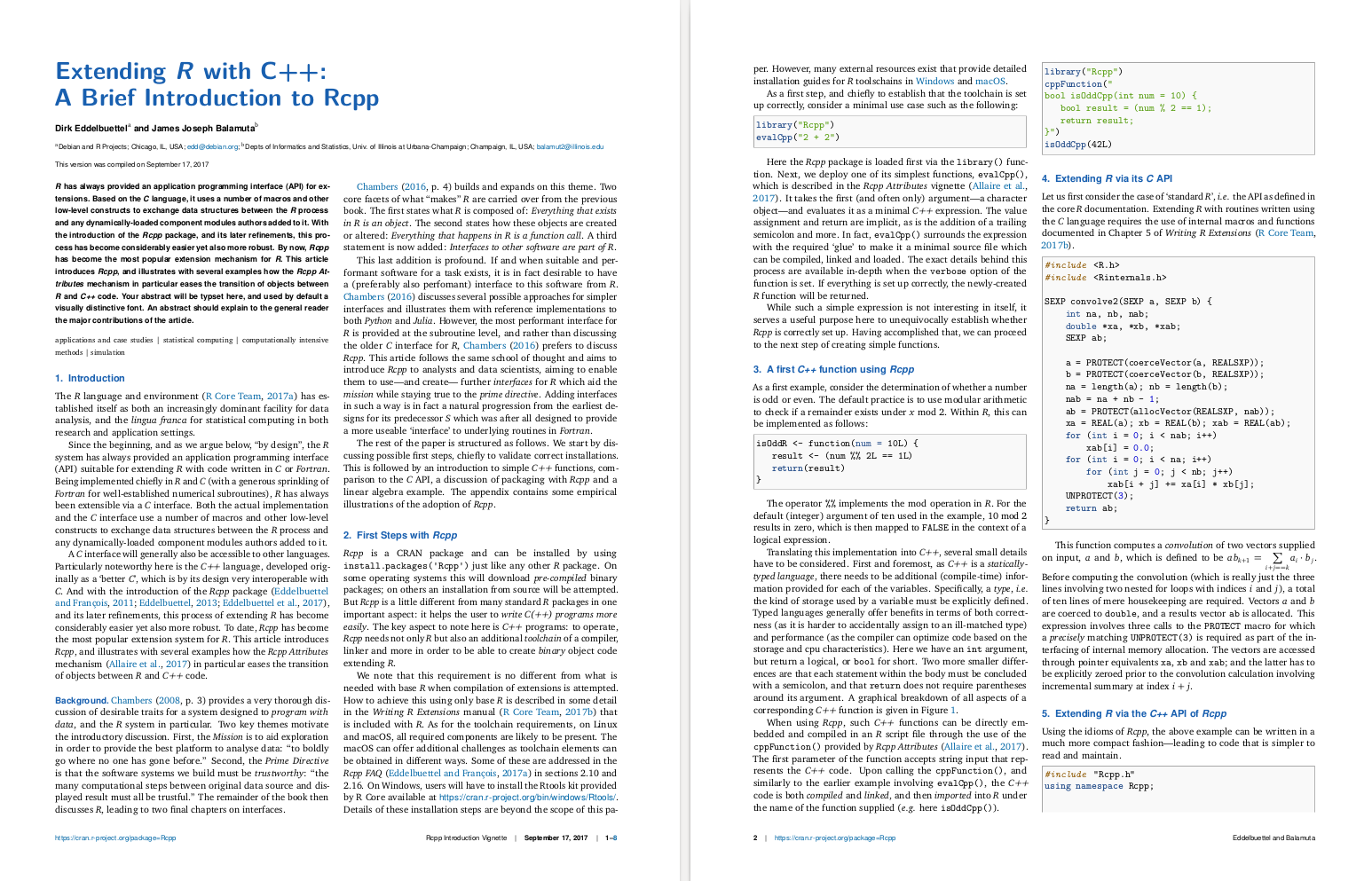
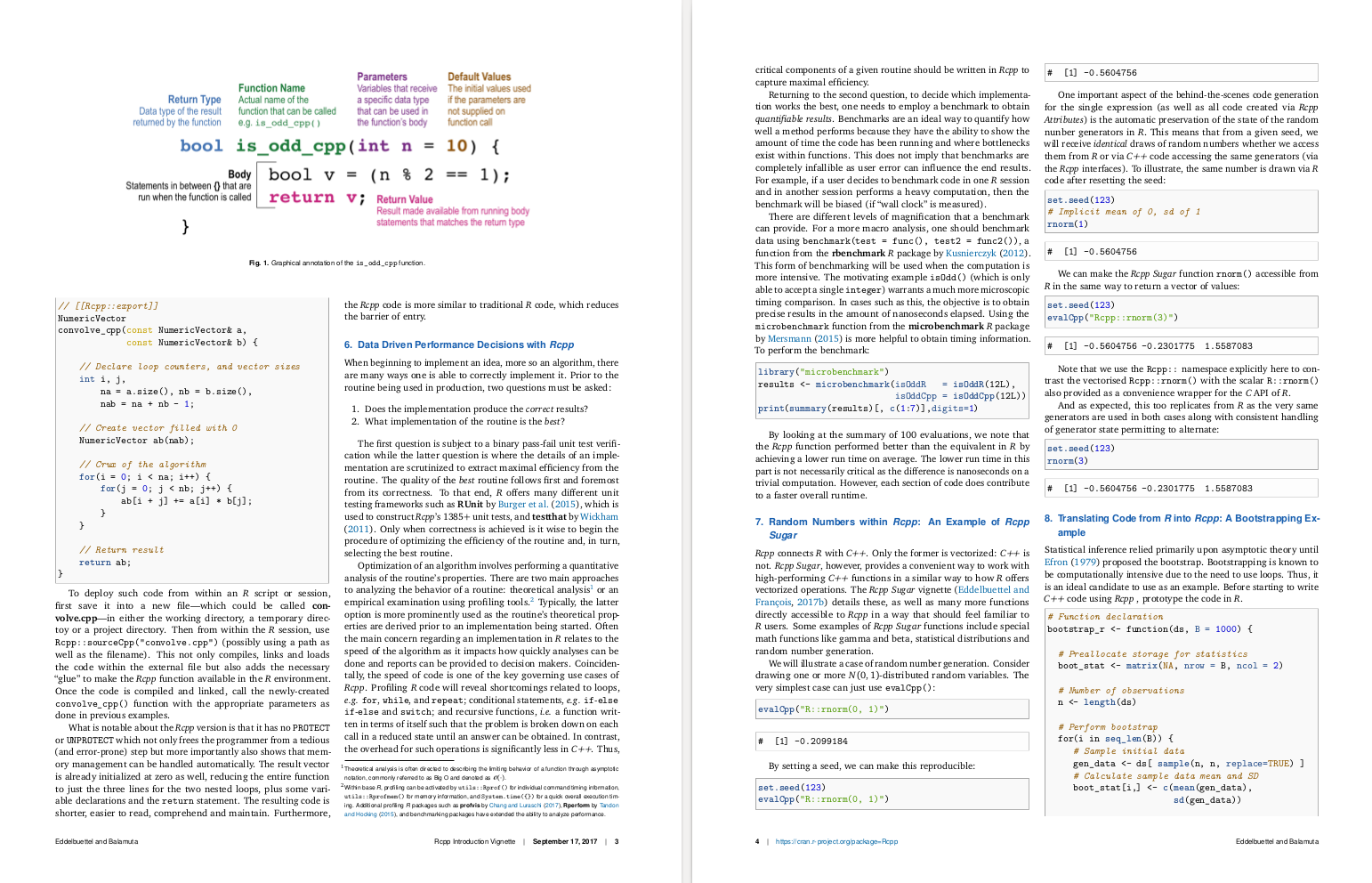
A brandnew and very exciting (to us, at least) package called pinp just arrived on CRAN, following a somewhat unnecessarily long passage out of incoming. It is based on the PNAS LaTeX Style offered by the Proceeding of the National Academy of Sciences of the United States of America, or PNAS for short. And there is already a Markdown version in the wonderful rticles packages. But James Balamuta and I thought we could do one better when we were looking to typeset our recent PeerJ Prepint as an attractive looking vignette for use within the Rcpp package. And so we did by changing a few things (font, color, use of natbib and Chicago.bst for references, removal of a bunch of extra PNAS-specific formalities from the frontpage) and customized a number of other things for easier use by vignettes directly from the YAML header (draft mode watermark, doi or url for packages, easier author naming in footer, bibtex file and more). We are quite pleased with the result which seems ready for the next Rcpp release---see e.g., these two teasers:
and
and the pinp package page or the GitHub repo have the full (four double-)pages of what turned a more dull looking 27 page manuscript into eight crisp two-column pages. We have few more things planned (i.e., switching to single column mode, turning on linenumbers at least in one-column mode). For questions or comments use the issue tracker off the GitHub repo.

This post by Dirk Eddelbuettel originated on his Thinking inside the box blog. Please report excessive re-aggregation in third-party for-profit settings.

Dirk Eddelbuettel: drat 0.1.3

A new version of drat arrived earlier today on CRAN as another no-human-can-delay-this automatic upgrade directly from the CRAN prechecks. It is mostly a maintenance release ensuring PACKAGES.rds is also updated, plus some minor other edits. drat stands for drat R Archive Template, and helps with easy-to-create and easy-to-use repositories for R packages. Since its inception in early 2015 it has found reasonably widespread adoption among R users because repositories with marked releases is the better way to distribute code. The NEWS file summarises the release as follows:

Changes in drat version 0.1.3 (2017-09-16)
  • Ensure PACKAGES.rds, if present, is also inserted in repo
  • Updated 'README.md' removing stale example URLs (#63)
  • Use https to fetch Travis CI script from r-travis

Courtesy of CRANberries, there is a comparison to the previous release. More detailed information is on the drat page.

This post by Dirk Eddelbuettel originated on his Thinking inside the box blog. Please report excessive re-aggregation in third-party for-profit settings.

15 September 2017

Ben Hutchings: Debian LTS work, August 2017

I was assigned 15 hours of work by Freexian's Debian LTS initiative and carried over 1 hour from July. I only worked 10 hours, so I will carry over 6 hours to the next month. I prepared and released an update on the Linux 3.2 longterm stable branch (3.2.92), and started work on the next update. I rebased the Debian linux package on this version, but didn't yet upload it.

Chris Lamb: Which packages on my system are reproducible?

Whilst anyone can inspect the source code of free software for malicious flaws, most software is distributed pre-compiled to end users. The motivation behind the Reproducible Builds effort is to allow verification that no flaws have been introduced either maliciously or accidentally during this compilation process. As part of this project I wrote a script to determine which packages installed on your system are "reproducible" or not:
$ apt install devscripts
[ ]
$ reproducible-check
[ ]
W: subversion (1.9.7-2) is unreproducible (libsvn-perl, libsvn1, subversion) <https://tests.reproducible-builds.org/debian/subversion>
W: taglib (1.11.1+dfsg.1-0.1) is unreproducible (libtag1v5, libtag1v5-vanilla) <https://tests.reproducible-builds.org/debian/taglib>
W: tcltk-defaults (8.6.0+9) is unreproducible (tcl, tk) <https://tests.reproducible-builds.org/debian/tcltk-defaults>
W: tk8.6 (8.6.7-1) is unreproducible (libtk8.6, tk8.6) <https://tests.reproducible-builds.org/debian/tk8.6>
W: valgrind (1:3.13.0-1) is unreproducible <https://tests.reproducible-builds.org/debian/valgrind>
W: wavpack (5.1.0-2) is unreproducible (libwavpack1) <https://tests.reproducible-builds.org/debian/wavpack>
W: x265 (2.5-2) is unreproducible (libx265-130) <https://tests.reproducible-builds.org/debian/x265>
W: xen (4.8.1-1+deb9u1) is unreproducible (libxen-4.8, libxenstore3.0) <https://tests.reproducible-builds.org/debian/xen>
W: xmlstarlet (1.6.1-2) is unreproducible <https://tests.reproducible-builds.org/debian/xmlstarlet>
W: xorg-server (2:1.19.3-2) is unreproducible (xserver-xephyr, xserver-xorg-core) <https://tests.reproducible-builds.org/debian/xorg-server>
282/4494 (6.28%) of installed binary packages are unreproducible.
Whether a package is "reproducible" or not is determined by querying the Debian Reproducible Builds testing framework.


The --raw command-line argument lets you play with the data in more detail. For example, you can see who maintains your unreproducible packages:
$ reproducible-check --raw   dd-list --stdin
Alec Leamas <leamas.alec@gmail.com>
   lirc (U)
Alessandro Ghedini <ghedo@debian.org>
   valgrind
Alessio Treglia <alessio@debian.org>
   fluidsynth (U)
   libsoxr (U)
[ ]


reproducible-check is available in devscripts since version 2.17.10, which landed in Debian unstable on 14th September 2017.

14 September 2017

Lior Kaplan: Public money? Public Code!

An open letter published today to the EU government says:
Why is software created using taxpayers money not released as Free Software?
We want legislation requiring that publicly financed software developed for the public sector be made publicly available under a Free and Open Source Software licence. If it is public money, it should be public code as well. Code paid by the people should be available to the people!
See https://publiccode.eu/ for the campaign details. This makes me think of starting an Israeli version
Filed under: Uncategorized

James McCoy: devscripts needs YOU!

Over the past 10 years, I've been a member of a dwindling team of people maintaining the devscripts package in Debian. Nearly two years ago, I sent out a "Request For Help" since it was clear I didn't have adequate time to keep driving the maintenance. In the mean time, Jonas split licensecheck out into its own project and took over development. Osamu has taken on much of the maintenance for uscan, uupdate, and mk-origtargz. Although that has helped spread the maintenance costs, there's still a lot that I haven't had time to address. Since Debian is still fairly early in the development cycle for Buster, I've decided this is as good a time as any for me to officially step down from active involvement in devscripts. I'm willing to keep moderating the mailing list and other related administrivia (which is fairly minimal given the repo is part of collab-maint), but I'll be unsubscribing from all other notifications. I think devscripts serves as a good funnel for useful scripts to get in front of Debian (and its derivatives) developers, but Jonas may also be onto something by pulling scripts out to stand on their own. One of the troubles with "bucket" packages like devscripts is the lack of visibility into when to retire scripts. Breaking scripts out on their own, and possibly creating multiple binary packages, certainly helps with that. Maybe uscan and friends would be a good next candidate. At the end of the day, I've certainly enjoyed being able to play my role in helping simplify the life of all the people contributing to Debian. I may come back to it some day, but for now it's time to let someone else pick up the reins. If you're interested in helping out, you can join #devscripts on OFTC and/or send a mail to <devscripts-devel@lists.alioth.debian.org>.

Dirk Eddelbuettel: RcppMsgPack 0.2.0

A new and much enhanced version of RcppMsgPack arrived on CRAN a couple of days ago. It came together following this email to the r-package-devel list which made it apparent that Travers Ching had been working on MessagePack converters for R which required the very headers I had for use from, inter alia, the RcppRedis package. So we joined our packages. I updated the headers in RcppMsgPack to the current upstream version 2.1.5 of MessagePack, and Travers added his helper functions allow direct packing / unpacking of MessagePack objects at the R level, as well as tests and a draft vignette. Very exciting, and great to have a coauthor! So now RcppMspPack provides R with both MessagePack header files for use via C++ (or C, if you must) packages such as RcppRedis --- and direct conversion routines at the R prompt. MessagePack itself is an efficient binary serialization format. It lets you exchange data among multiple languages like JSON. But it is faster and smaller. Small integers are encoded into a single byte, and typical short strings require only one extra byte in addition to the strings themselves.

Changes in version 0.2.0 (2017-09-07)
  • Added support for building on Windows
  • Upgraded to MsgPack 2.1.5 (#3)
  • New R functions to manipulate MsgPack objects: msgpack_format, msgpack_map, msgpack_pack, msgpack_simplify, mgspack_unpack (#4)
  • New R functions also available as msgpackFormat, msgpackMap, msgpackPack, msgpackSimplify, mgspackUnpack (#4)
  • New vignette (#4)
  • New tests (#4)

Courtesy of CRANberries, there is also a diffstat report for this release. More information is on the RcppRedis page. More information may be on the RcppMsgPack page. Issues and bugreports should go to the GitHub issue tracker.

This post by Dirk Eddelbuettel originated on his Thinking inside the box blog. Please report excessive re-aggregation in third-party for-profit settings.

Dirk Eddelbuettel: RcppRedis 0.1.8

A new minor release of RcppRedis arrived on CRAN last week, following the release 0.2.0 of RcppMsgPack which brought the MsgPack headers forward to release 2.1.5. This required a minor and rather trivial change in the code. When the optional RcppMsgPack package is used, we now require this version 0.2.0 or later. We made a few internal updates to the package as well.

Changes in version 0.1.8 (2017-09-08)
  • A new file init.c was added with calls to R_registerRoutines() and R_useDynamicSymbols()
  • Symbol registration is enabled in useDynLib
  • Travis CI was updated to using run.sh
  • The (optional MessagePack) code was updated for MsgPack 2.*

Courtesy of CRANberries, there is also a diffstat report for this release. More information is on the RcppRedis page.

This post by Dirk Eddelbuettel originated on his Thinking inside the box blog. Please report excessive re-aggregation in third-party for-profit settings.

13 September 2017

Shirish Agarwal: Android, Android marketplace and gaming addiction.

This would be a longish piece so please bear and play with tea, coffee, beer or anything stronger that you desire while reading below  I had bought an Android phone, a Samsung J5 just before going to debconf 2016. It was more for being in-trend rather than really using it. The one which I shared is the upgraded version (recentish) the one I have is 2 GB for which I had paid around double of what the list price was. The only reason I bought the model is that it had removable battery at the price point I was willing to pay. I did see that Samsung has the same ham-handed issues with audio as previous Nokia devices use to, the speakers and microphone probably the cheapest you can get on the market. Nokia was same too, at least on the lower-end of the market, while Oppo has loud ringtones and loud music, perfect for those who are a bit hard of hearing (as yours truly is). I had been pleasantly surprised by the quality of photos Samsung J5 was churning even though I m less than average shooter, never been really into it so was a sort of wake-up call for where camera sensor technology is advancing. And of course with newer phones the kind of detail it can capture is mesmerizing to say the least, although wide-angle shots still would take some time to get right I guess. If memory serves me right, sometime back Laura Arjona Reina (who handles part of debian-publicity and part of debian-women among other responsibilities) shared a blog post on p.d.o. where she had shared the troubles she had while exporting data from the phone. While she shared that and I lack the time or the energy to try and find it ( the entry is really bookmarkable, at least that specific blog post). What was interesting though that I had gone few years ago to Bangalore, there is an organization which I like and admire CIS great for researchers. Anyways they had done a project getting between 10-20 phones from the market made of Chinese origin (almost all mobiles sold in India, the fabrication of CPU and APU etc. are done in China/Taiwan and then assembled here). Here what is done at the most is assembly which for all political purposes is called manufacturing . All the mobiles kept quite a bit of info. on the device even after you wiped them clean/put some other ROM on them. The CIS site is more than a bit cluttered otherwise would have shared the direct link. I do hope to send an e-mail to CIS and hopefully they will respond with the report and will share that here as and when. It would be interesting to know if after people flash a custom rom if the status quo is the same as it was before. I do suspect it would be the former as flashing ROMs on phones is still a bit of specialized subject at least here in India with even an average phone costing a month or two s salary or more and the idea of bricking the phone scares most people (including yours truly). Anyways, for a long time I was on bed and had the phone. I used 2 games from the android marketplace which both mum and I enjoy and enjoyed. Those are Real jigsaw and Jigsaw puzzle HD . The permissions dialog which Real jigsaw among other games has is horrible and part of me freaks that all such apps. have unrestricted access to my storage area. Ideally, what Android should have done is either partition or give functionality to the user to have private space for their photos and whatever media they have and the rest of the area is like a public park. If anybody has any thoughts on partitioning on Android phone would like to hear that. One game though which really hooked mumma and me is The Island Experiment . It reminded me of my younger days when gaming addiction was not treated as a disease but thankfully now is . I would call myself somewhat of a functional addict as in do my every day things, work etc. but do dream about the game as to what it will show me next. A part of it is the game is web-based (which means it needs constant internet connection) and web access is somewhat pricey, although with Reliance Jio an upcoming data network operator having bundles of money and promising the moon, network issues at least on low-bandwidth game which I and mum are playing hopefully will not have any issues. I haven t used tshark or any such tool to analyze the traffic but I guess it probably just sends short messages of number of clicks in a time period and things like that, all the rest (I guess) is happening on the mobile itself. I know at sometime I probably will try to put a custom rom on it but which one is the question as there are so many and also which is most compatible with my device. It seems I would have to do lot of homework before I can make any choices. Couple of months back, a friend of mine Akshat who has been using Android for few years enabled Developer Options which I didn t know about till he shared that info. with me. I do hope people do check Akshat s repo. as he has made/has quite a few useful scripts, especially if you are into digital photography. I have shared with him gimp scripting few days back so along with imagemagick you might see him doing some rough scripts in it. Of course, if people use it and give feedback he might clean the scripts a bit so it gives useful error messages and gives statement like gimp is not installed on your system, please install it or ask for specific version but as it works in free software it is somewhat directly proportional to the number of users, bugs and users behind it. A good example of what I mean is youtube-dl . I filed 873853 where I shared the upstream ticket. Apparently YouTube again changed few days back and while upstream has fixed it, the youtube-dl maintainer probably needs to find time and get the new version up. Apparently the issues lies in [$] dpkg -L youtube-dl grep youtube.py
/usr/lib/python3/dist-packages/youtube_dl/extractor/youtube.py
Hopefully somebody does the needful. Btw, I find f-droid extremely useful and especially osmand but sadly both of them are not shared or talked about by people  The reason I shared about Developer Options in Android is that few days back I noticed that the phone wonks off and has unpredictable behaviour such as not letting me browse the web, do additions or deletions using the google play store and alike . Things came to a head when few days back I saw a fibre-optic splicing operation being carried by some workers near my home by the state operator which elated me and wanted to shoot the video for it but the battery died/there was no power even though I hadn t used it much. I have deliberately shared the hindi version which tells how that knowledge is now coming to the masses. I had seen fibre-optic splicing more than a decade and a half back at some net conference where it was going to be in your neighbourhood soonish, hopefully it will happen soon  I had my suspicions for quite sometime all the issues with the phone were not due to proper charging. During course of my investigation, found out that in Developer Options there is an option called USB Configuration and changing that from the default MTP (Media Transfer Protocol) (which is basically used to put or take movies, music or any file from the phone to the computer or vice-versa improved much better behaviour on my android phone. But this caused an unexpected side-effect, I got pretty aggressive polling of the phone by the computer even after saying I do not want to share the phone details with the computer. This I filed as 874216 . The phone and I am guessing most Samsung phones today come with an adaptor with a USB male socket which goes in to the phone s usb port. There is the classical port for electricity but like most people heavily rely on usb charging even for deep fully powered down phone for full charging. One interesting project which I saw which came in Debian some days back is dummydroid. I did file a bug about it . I do hope that either the maintainer gives some more documentation. I am sure many people might use and add to the resource if the documentation was/is there. I did take a look at the package and the profile seems to be like an xml pair kind of database. Having more profiles shouldn t be hard if we knew what info. needs to be added and how do we find that info. Lastly, I am slowly transferring all the above knowledge to my mum as well, although in small doses. She, just like me has and had problems coming from resistive touchscreen to capacitive touchscreen. You can call me wrong but resistive touchscreen seemed to be superior and not as error-prone or liable to commit mistakes as is possible in capacitive touchscreens. There may be a setting to higher/lower the threshold for touching which I have not been able to find as of yet. Hope somebody finds something useful in there. I do hope that Debian does become a replacement to be used on such mobiles but then they would have to duplicate/also have some sort of mainstream content with editors to help people find stuff, something that Debian is not so good at currently. Also I m not sure Synaptic is good fit as a mobile store.
Filed under: Miscellenous Tagged: #Android, #capacitive touchscreen, #custom ROMs, #digital photography, #dummydroid, #f-droid, #fabrication, #flashing, #game addiction, #Google Play Store, #Mainstreaming Debian, #mobile connectivity, #Oppo, #osmand, #planet-debian, #resistive touchscreen, #Samsung Galaxy J5, #scripting, #USB charging, #USB configuration, #youtube-dl, gaming

Vincent Bernat: Route-based IPsec VPN on Linux with strongSwan

A common way to establish an IPsec tunnel on Linux is to use an IKE daemon, like the one from the strongSwan project, with a minimal configuration1:
conn V2-1
  left        = 2001:db8:1::1
  leftsubnet  = 2001:db8:a1::/64
  right       = 2001:db8:2::1
  rightsubnet = 2001:db8:a2::/64
  authby      = psk
  auto        = route
The same configuration can be used on both sides. Each side will figure out if it is left or right . The IPsec site-to-site tunnel endpoints are 2001:db8: 1::1 and 2001:db8: 2::1. The protected subnets are 2001:db8: a1::/64 and 2001:db8: a2::/64. As a result, strongSwan configures the following policies in the kernel:
$ ip xfrm policy
src 2001:db8:a1::/64 dst 2001:db8:a2::/64
        dir out priority 399999 ptype main
        tmpl src 2001:db8:1::1 dst 2001:db8:2::1
                proto esp reqid 4 mode tunnel
src 2001:db8:a2::/64 dst 2001:db8:a1::/64
        dir fwd priority 399999 ptype main
        tmpl src 2001:db8:2::1 dst 2001:db8:1::1
                proto esp reqid 4 mode tunnel
src 2001:db8:a2::/64 dst 2001:db8:a1::/64
        dir in priority 399999 ptype main
        tmpl src 2001:db8:2::1 dst 2001:db8:1::1
                proto esp reqid 4 mode tunnel
[ ]
This kind of IPsec tunnel is a policy-based VPN: encapsulation and decapsulation are governed by these policies. Each of them contains the following elements: When a matching policy is found, the kernel will look for a corresponding security association (using reqid and the endpoint source and destination addresses):
$ ip xfrm state
src 2001:db8:1::1 dst 2001:db8:2::1
        proto esp spi 0xc1890b6e reqid 4 mode tunnel
        replay-window 0 flag af-unspec
        auth-trunc hmac(sha256) 0x5b68[ ]8ba2904 128
        enc cbc(aes) 0x8e0e377ad8fd91e8553648340ff0fa06
        anti-replay context: seq 0x0, oseq 0x0, bitmap 0x00000000
[ ]
If no security association is found, the packet is put on hold and the IKE daemon is asked to negotiate an appropriate one. Otherwise, the packet is encapsulated. The receiving end identifies the appropriate security association using the SPI in the header. Two security associations are needed to establish a bidirectionnal tunnel:
$ tcpdump -pni eth0 -c2 -s0 esp
13:07:30.871150 IP6 2001:db8:1::1 > 2001:db8:2::1: ESP(spi=0xc1890b6e,seq=0x222)
13:07:30.872297 IP6 2001:db8:2::1 > 2001:db8:1::1: ESP(spi=0xcf2426b6,seq=0x204)
All IPsec implementations are compatible with policy-based VPNs. However, some configurations are difficult to implement. For example, consider the following proposition for redundant site-to-site VPNs: Redundant VPNs between 3 sites A possible configuration between V1-1 and V2-1 could be:
conn V1-1-to-V2-1
  left        = 2001:db8:1::1
  leftsubnet  = 2001:db8:a1::/64,2001:db8:a6::cc:1/128,2001:db8:a6::cc:5/128
  right       = 2001:db8:2::1
  rightsubnet = 2001:db8:a2::/64,2001:db8:a6::/64,2001:db8:a8::/64
  authby      = psk
  keyexchange = ikev2
  auto        = route
Each time a subnet is modified on one site, the configurations need to be updated on all sites. Moreover, overlapping subnets (2001:db8: a6::/64 on one side and 2001:db8: a6::cc:1/128 at the other) can also be problematic. The alternative is to use route-based VPNs: any packet traversing a pseudo-interface will be encapsulated using a security policy bound to the interface. This brings two features:
  1. Routing daemons can be used to distribute routes to be protected by the VPN. This decreases the administrative burden when many subnets are present on each side.
  2. Encapsulation and decapsulation can be executed in a different routing instance or namespace. This enables a clean separation between a private routing instance (where VPN users are) and a public routing instance (where VPN endpoints are).

Route-based VPN on Juniper Before looking at how to achieve that on Linux, let s have a look at the way it works with a JunOS-based platform (like a Juniper vSRX). This platform as long-standing history of supporting route-based VPNs (a feature already present in the Netscreen ISG platform). Let s assume we want to configure the IPsec VPN from V3-2 to V1-1. First, we need to configure the tunnel interface and bind it to the private routing instance containing only internal routes (with IPv4, they would have been RFC 1918 routes):
interfaces  
    st0  
        unit 1  
            family inet6  
                address 2001:db8:ff::7/127;


routing-instances  
    private  
        instance-type virtual-router;
        interface st0.1;
     
 
The second step is to configure the VPN:
security  
    /* Phase 1 configuration */
    ike  
        proposal IKE-P1  
            authentication-method pre-shared-keys;
            dh-group group20;
            encryption-algorithm aes-256-gcm;
         
        policy IKE-V1-1  
            mode main;
            proposals IKE-P1;
            pre-shared-key ascii-text "d8bdRxaY22oH1j89Z2nATeYyrXfP9ga6xC5mi0RG1uc";
         
        gateway GW-V1-1  
            ike-policy IKE-V1-1;
            address 2001:db8:1::1;
            external-interface lo0.1;
            general-ikeid;
            version v2-only;
         
     
    /* Phase 2 configuration */
    ipsec  
        proposal ESP-P2  
            protocol esp;
            encryption-algorithm aes-256-gcm;
         
        policy IPSEC-V1-1  
            perfect-forward-secrecy keys group20;
            proposals ESP-P2;
         
        vpn VPN-V1-1  
            bind-interface st0.1;
            df-bit copy;
            ike  
                gateway GW-V1-1;
                ipsec-policy IPSEC-V1-1;
             
            establish-tunnels on-traffic;


We get a route-based VPN because we bind the st0.1 interface to the VPN-V1-1 VPN. Once the VPN is up, any packet entering st0.1 will be encapsulated and sent to the 2001:db8: 1::1 endpoint. The last step is to configure BGP in the private routing instance to exchange routes with the remote site:
routing-instances  
    private  
        routing-options  
            router-id 1.0.3.2;
            maximum-paths 16;
         
        protocols  
            bgp  
                preference 140;
                log-updown;
                group v4-VPN  
                    type external;
                    local-as 65003;
                    hold-time 6;
                    neighbor 2001:db8:ff::6 peer-as 65001;
                    multipath;
                    export [ NEXT-HOP-SELF OUR-ROUTES NOTHING ];


The export filter OUR-ROUTES needs to select the routes to be advertised to the other peers. For example:
policy-options  
    policy-statement OUR-ROUTES  
        term 10  
            from  
                protocol ospf3;
                route-type internal;
             
            then  
                metric 0;
                accept;


The configuration needs to be repeated for the other peers. The complete version is available on GitHub. Once the BGP sessions are up, we start learning routes from the other sites. For example, here is the route for 2001:db8: a1::/64:
> show route 2001:db8:a1::/64 protocol bgp table private.inet6.0 best-path
private.inet6.0: 15 destinations, 19 routes (15 active, 0 holddown, 0 hidden)
+ = Active Route, - = Last Active, * = Both
2001:db8:a1::/64   *[BGP/140] 01:12:32, localpref 100, from 2001:db8:ff::6
                      AS path: 65001 I, validation-state: unverified
                      to 2001:db8:ff::6 via st0.1
                    > to 2001:db8:ff::14 via st0.2
It was learnt both from V1-1 (through st0.1) and V1-2 (through st0.2). The route is part of the private routing instance but encapsulated packets are sent/received in the public routing instance. No route-leaking is needed for this configuration. The VPN cannot be used as a gateway from internal hosts to external hosts (or vice-versa). This could also have been done with JunOS security policies (stateful firewall rules) but doing the separation with routing instances also ensure routes from different domains are not mixed and a simple policy misconfiguration won t lead to a disaster.

Route-based VPN on Linux Starting from Linux 3.15, a similar configuration is possible with the help of a virtual tunnel interface3. First, we create the private namespace:
# ip netns add private
# ip netns exec private sysctl -qw net.ipv6.conf.all.forwarding=1
Any private interface needs to be moved to this namespace (no IP is configured as we can use IPv6 link-local addresses):
# ip link set netns private dev eth1
# ip link set netns private dev eth2
# ip netns exec private ip link set up dev eth1
# ip netns exec private ip link set up dev eth2
Then, we create vti6, a tunnel interface (similar to st0.1 in the JunOS example):
# ip tunnel add vti6 \
   mode vti6 \
   local 2001:db8:1::1 \
   remote 2001:db8:3::2 \
   key 6
# ip link set netns private dev vti6
# ip netns exec private ip addr add 2001:db8:ff::6/127 dev vti6
# ip netns exec private sysctl -qw net.ipv4.conf.vti6.disable_policy=1
# ip netns exec private sysctl -qw net.ipv4.conf.vti6.disable_xfrm=1
# ip netns exec private ip link set vti6 mtu 1500
# ip netns exec private ip link set vti6 up
The tunnel interface is created in the initial namespace and moved to the private one. It will remember its original namespace where it will process encapsulated packets. Any packet entering the interface will temporarily get a firewall mark of 6 that will be used only to match the appropriate IPsec policy4 below. The kernel sets a low MTU on the interface to handle any possible combination of ciphers and protocols. We set it to 1500 and let PMTUD do its work. We can then configure strongSwan5:
conn V3-2
  left        = 2001:db8:1::1
  leftsubnet  = ::/0
  right       = 2001:db8:3::2
  rightsubnet = ::/0
  authby      = psk
  mark        = 6
  auto        = route
  keyexchange = ikev2
  keyingtries = %forever
  ike         = aes256gcm16-prfsha384-ecp384!
  esp         = aes256gcm16-prfsha384-ecp384!
  mobike      = no
The IKE daemon configures the following policies in the kernel:
$ ip xfrm policy
src ::/0 dst ::/0
        dir out priority 399999 ptype main
        mark 0x6/0xffffffff
        tmpl src 2001:db8:1::1 dst 2001:db8:3::2
                proto esp reqid 1 mode tunnel
src ::/0 dst ::/0
        dir fwd priority 399999 ptype main
        mark 0x6/0xffffffff
        tmpl src 2001:db8:3::2 dst 2001:db8:1::1
                proto esp reqid 1 mode tunnel
src ::/0 dst ::/0
        dir in priority 399999 ptype main
        mark 0x6/0xffffffff
        tmpl src 2001:db8:3::2 dst 2001:db8:1::1
                proto esp reqid 1 mode tunnel
[ ]
Those policies are used for any source or destination as long as the firewall mark is equal to 6, which matches the mark configured for the tunnel interface. The last step is to configure BGP to exchange routes. We can use BIRD for this:
router id 1.0.1.1;
protocol device  
   scan time 10;
 
protocol kernel  
   persist;
   learn;
   import all;
   export all;
   merge paths yes;
 
protocol bgp IBGP_V3_2  
   local 2001:db8:ff::6 as 65001;
   neighbor 2001:db8:ff::7 as 65003;
   import all;
   export where ifname ~ "eth*";
   preference 160;
   hold time 6;
 
Once BIRD is started in the private namespace, we can check routes are learned correctly:
$ ip netns exec private ip -6 route show 2001:db8:a3::/64
2001:db8:a3::/64 proto bird metric 1024
        nexthop via 2001:db8:ff::5  dev vti5 weight 1
        nexthop via 2001:db8:ff::7  dev vti6 weight 1
The above route was learnt from both V3-1 (through vti5) and V3-2 (through vti6). Like for the JunOS version, there is no route-leaking between the private namespace and the initial one. The VPN cannot be used as a gateway between the two namespaces, only for encapsulation. This also prevent a misconfiguration (for example, IKE daemon not running) from allowing packets to leave the private network. As a bonus, unencrypted traffic can be observed with tcpdump on the tunnel interface:
$ ip netns exec private tcpdump -pni vti6 icmp6
tcpdump: verbose output suppressed, use -v or -vv for full protocol decode
listening on vti6, link-type LINUX_SLL (Linux cooked), capture size 262144 bytes
20:51:15.258708 IP6 2001:db8:a1::1 > 2001:db8:a3::1: ICMP6, echo request, seq 69
20:51:15.260874 IP6 2001:db8:a3::1 > 2001:db8:a1::1: ICMP6, echo reply, seq 69
You can find all the configuration files for this example on GitHub. The documentation of strongSwan also features a page about route-based VPNs.

  1. Everything in this post should work with Libreswan.
  2. fwd is for incoming packets on non-local addresses. It only makes sense in transport mode and is a Linux-only particularity.
  3. Virtual tunnel interfaces (VTI) were introduced in Linux 3.6 (for IPv4) and Linux 3.12 (for IPv6). Appropriate namespace support was added in 3.15. KLIPS, an alternative out-of-tree stack available since Linux 2.2, also features tunnel interfaces.
  4. The mark is set right before doing a policy lookup and restored after that. Consequently, it doesn t affect other possible uses (filtering, routing). However, as Netfilter can also set a mark, one should be careful for conflicts.
  5. The ciphers used here are the strongest ones currently possible while keeping compatibility with JunOS. The documentation for strongSwan contains a complete list of supported algorithms as well as security recommendations to choose them.

Reproducible builds folks: Reproducible Builds: Weekly report #124

Here's what happened in the Reproducible Builds effort between Sunday September 3 and Saturday September 9 2017: Media coverage GSoC and Outreachy updates Debian will participate in this year's Outreachy initiative and the Reproducible Builds is soliciting mentors and students to join this round. For more background please see the following mailing list posts: 1, 2 & 3. Reproduciblity work in Debian In addition, the following NMUs were accepted: Reproduciblity work in other projects Patches sent upstream: Packages reviewed and fixed, and bugs filed Reviews of unreproducible packages 3 package reviews have been added, 2 have been updated and 2 have been removed in this week, adding to our knowledge about identified issues. Weekly QA work During our reproducibility testing, FTBFS bugs have been detected and reported by: diffoscope development Development continued in git, including the following contributions: Mattia Rizzolo also uploaded the version 86 released last week to stretch-backports. reprotest development tests.reproducible-builds.org Misc. This week's edition was written by Bernhard M. Wiedemann, Chris Lamb, Holger Levsen, Mattia Rizzolo & reviewed by a bunch of Reproducible Builds folks on IRC & the mailing lists.

12 September 2017

Markus Koschany: My Free Software Activities in August 2017

Welcome to gambaru.de. Here is my monthly report that covers what I have been doing for Debian. If you re interested in Java, Games and LTS topics, this might be interesting for you. DebConf 17 in Montreal I traveled to DebConf 17 in Montreal/Canada. I arrived on 04. August and met a lot of different people which I only knew by name so far. I think this is definitely one of the best aspects of real life meetings, putting names to faces and getting to know someone better. I totally enjoyed my stay and I would like to thank all the people who were involved in organizing this event. You rock! I also gave a talk about the The past, present and future of Debian Games , listened to numerous other talks and got a nice sunburn which luckily turned into a more brownish color when I returned home on 12. August. The only negative experience I made was with my airline which was supposed to fly me home to Frankfurt again. They decided to cancel the flight one hour before check-in for unknown reasons and just gave me a telephone number to sort things out. No support whatsoever. Fortunately (probably not for him) another DebConf attendee suffered the same fate and together we could find another flight with Royal Air Maroc the same day. And so we made a short trip to Casablanca/Morocco and eventually arrived at our final destination in Frankfurt a few hours later. So which airline should you avoid at all costs (they still haven t responded to my refund claims) ? It s WoW-Air from Iceland. (just wow) Debian Games Debian Java Debian LTS This was my eighteenth month as a paid contributor and I have been paid to work 20,25 hours on Debian LTS, a project started by Rapha l Hertzog. In that time I did the following: Non-maintainer upload Thanks for reading and see you next time.

Arturo Borrero Gonz lez: Google Hangouts in Debian testing (Buster)

debian-suricata logo Google offers a lot of software components packaged specifically for Debian and Debian-like Linux distributions. Examples are: Chrome, Earth and the Hangouts plugin. Also, there are many other Internet services doing the same: Spotify, Dropbox, etc. I m really grateful for them, since this make our life easier. Problem is that our ecosystem is rather complex, with many distributions and many versions out there. I guess is not an easy task for them to keep such a big variety of support variations. In this particular case, it seems Google doesn t support Debian testing in their .deb packages. In this case, testing means Debian Buster. And the same happens with the official Spotify client package. I ve identified several issues with them, to name a few: I m in need of using Google Hangout so I ve been forced to solve this situation by editing the .deb package provided by Google. Simple steps:
% user@debian:~ $ mkdir pkg
% user@debian:~ $ cd pkg/
% user@debian:~/pkg $ wget https://dl.google.com/linux/direct/google-talkplugin_current_amd64.deb
[...]
% user@debian:~/pkg $ dpkg-deb -R google-talkplugin_current_amd64.deb google-talkplugin_current_amd64/
% user@debian:~/pkg $ nano google-talkplugin_current_amd64/DEBIAN/control
% user@debian:~/pkg $ dpkg -b google-talkplugin_current_amd64
% user@debian:~/pkg $ sudo dpkg -i google-talkpluging_current_amd64.deb
I have yet to investigate how to workaround the lsb-core thing, so still I can t use Google Earth.

11 September 2017

Steinar H. Gunderson: rANS encoding of signed coefficients

I'm currently trying to make sense of some still image coding (more details to come at a much later stage!), and for a variety of reasons, I've chosen to use rANS as the entropy coder. However, there's an interesting little detail that I haven't actually seen covered anywhere; maybe it's just because I've missed something, or maybe because it's too blindingly obvious, but I thought I would document what I ended up with anyway. (I had hoped for something even more elegant, but I guess the obvious would have to do.) For those that don't know rANS coding, let me try to handwave it as much as possible. Your state is typically a single word (in my case, a 32-bit word), which is refilled from the input stream as needed. The encoder and decoder works in reverse order; let's just talk about the decoder. Basically it works by looking at the lowest 12 (or whatever) bits of the decoder state, mapping each of those 2^12 slots to a decoded symbol. More common symbols are given more slots, proportionally to the frequency. Let me just write a tiny, tiny example with 2 bits and three symbols instead, giving four slots:
Lowest bits Symbol
00 0
01 0
10 1
11 2
Note that the zero coefficient here maps to one out of two slots (ie., a range); you don't choose which one yourself, the encoder stashes some information in there (which is used to recover the next control word once you know which symbol there is). Now for the actual problem: When storing DCT coefficients, we typically want to also store a sign (ie., not just 1 or 2, but also -1/+1 and -2/+2). The statistical distribution is symmetrical, so the sign bit is incompressible (except that of course there's no sign bit needed for 0). We could have done this by introducing new symbols -1 and -2 in addition to our three other ones, but this means we'll need more bits of precision, and accordingly larger look-up tables (which is negative for performance). So let's find something better. We could also simply store it separately somehow; if the coefficient is non-zero, store the bits in some separate repository. Perhaps more elegantly, you can encode a second symbol in the rANS stream with probability 1/2, but this is more expensive computationally. But both of these have the problem that they're divergent in terms of control flow; nonzero coefficients potentially need to do a lot of extra computation and even loads. This isn't nice for SIMD, and it's not nice for GPU. It's generally not really nice. The solution I ended up with was simulating a larger table with a smaller one. Simply rotate the table so that the zero symbol has the top slots instead of the bottom slots, and then replicate the rest of the table. For instance, take this new table:
Lowest bits Symbol
000 1
001 2
010 0
011 0
100 0
101 0
110 -1
111 -2
(The observant reader will note that this doesn't describe the exact same distribution as last time zero has twice the relative frequency as in the other table but ignore that for the time being.) In this case, the bottom half of the table doesn't actually need to be stored! We know that if the three bottom bits are >= 110 (6 in decimal), we have a negative value, can subtract 6, and then continue decoding. If we are go past the end of our 2-bit table despite that, we know we are decoding a zero coefficient (which doesn't have a sign), so we can just clamp the read; or for a GPU, reads out-of-bounds on a texture will typically return 0 anyway. So it all works nicely, and the divergent I/O is gone. If this pickled your interest, you probably want to read up on rANS in general; Fabian Giesen (aka ryg) has some notes that work as a good starting point, but beware; some of this is pretty confusing. :-)

Next.

Previous.