Search Results: "ean"

2 March 2011

Steve Kemp: I updated my redis-based filesystem

In July last year I made a brief post about a simple filesystem I'd put together which used Redis for the storage. At that time I thought it was a cute hack, and didn't spend too much time with it. But recently I found a use for it so I cleaned it up, synced up the C client for Redis which I used and generally started to care again. If it is useful you can now find it online: The basic idea is the same as it was before, except I did eventually move to an INODE-like system. Each file/directory entry receives a unique identifier (integer) - and then I store the meta-data in a key based off that name. This means for a file I might have keys, and values,like this:
KeyValue
INODE:1:NAMEThe name of the file (e.g. "passwd").
INODE:1:SIZEThe size of the file (e.g. "1661" )
INODE:1:GIDThe group ID of the file's owner (e.g. "0")
INODE:1:UIDThe user ID of the file's owner (e.g. "0")
INODE:1:MODEThe mode of the file (e.g. 0755)
To store these things I use a Redis "SET" which allows me to easily iterate over all the entries in each directory. ObQuote: "They fuck up, they get beat. We fuck up, they give us pensions. " - The Wire

1 March 2011

Bastian Venthur: Summer School: Advanced Scientific Programming in Python

Once again, there will be another round of the Summer School Advanced Scientific Programming in Python . This year in St. Andrews, UK. Quoting from the official announcement:
Scientists spend more and more time writing, maintaining, and debugging software. While techniques for doing this efficiently have evolved, only few scientists actually use them. As a result, instead of doing their research, they spend far too much time writing deficient code and reinventing the wheel. In this course we will present a selection of advanced programming techniques, incorporating theoretical lectures and practical exercises tailored to the needs of a programming scientist. New skills will be tested in a real programming project: we will team up to develop an entertaining scientific computer game. We use the Python programming language for the entire course. Python works as a simple programming language for beginners, but more importantly, it also works great in scientific simulations and data analysis. We show how clean language design, ease of extensibility, and the great wealth of open source libraries for scientific computing and data visualization are driving Python to become a standard tool for the programming scientist. This school is targeted at PhD students and Post-docs from all areas of science. Competence in Python or in another language such as Java, C/C++, MATLAB, or Mathematica is absolutely required. Basic knowledge of Python is assumed. Participants without any prior experience with Python should work through the proposed introductory
materials before the course.
You can apply on-line at http://python.g-node.org Applications must be submitted before May 29, 2011. Notifications of acceptance will be sent by June 19, 2011. No fee is charged but participants should take care of travel, living, and accommodation expenses. Candidates will be selected on the basis of their profile. Places are limited: acceptance rate in past editions was around 30%. Prerequisites: You are supposed to know the basics of Python to participate in the lectures. Please consult the website for a list of introductory material. If your re a scientist and interested in Python, I cannot recommend this summer school highly enough. The Summer School is always fun, the faculty members are very nice and always willing to help and answer questions. The balance between lectures and exercises is in my opinion very good, and you ll learn a lot about Python during the week. The highlight of every Python School is always the Pac Man tournament, where groups of students will implement their own Pac Man agent (in Python) and compete against the other agents in a tournament till the bitter end! The students of the previous editions were usually very happy during and after the School. Speaking of happiness, since no fee is charged for the Summer School, you ll have more money left over to invest into the excellent Scottish pubs!

Julien Danjou: My latest contributions to the Emacs' world

I spend too much time writing Emacs Lisp code these days. Unfortunately, the more I do the more I find new useful tools to improve my work-flow and save time for doing more Lisp. D'oh. I did not work on any big thing these last weeks, so I'm thinking it's a good time to talk about the various code and patches I sent to multiple Emacs packages. el-get el-get, a fabulous tool that installs and handles all the external Emacs packages I use. A friendly war started on the development list about autoloads handling. The discussion was overall pointless, since we had a very hard time to communicate our ideas, and we did not understand each others several times. In the end, el-get now supports autoload correctly and do not load automatically all your packages, improving the startup time, and using the Emacs way to do things. Which is always better, obviously. git-commit-mode

I've started to use git-commit-mode some times ago. I usually use git-commit with the -v option to see what I'm committing. I though it would be useful to color the diff with diff-mode, so I wrote a patch just to do that, which was merged today by Florian. magit

Some weeks ago, I decided to give a try to magit, and loved it. I am not always using it, but for basic operations it is very useful. But I really soon found some things I did not like and therefore send patches to enhance it. First, I've added a patch to honor status.showUntrackedFiles which I use in my home directory. In the mean time, I've also added a patch to allow adding an arbitrary file. Yesterday, I sent another pull request, not closed for now, which adds the possibility to visit files in another window from a diff file, and the support for add-change-log-entry directly from the displayed diff. Useful for these old projects still using ChangeLog files but accessible through git (hi Emacs & Gnus!). Gnus

Nothing remarkable, but I write a couple of fixes and enhancements to the Sieve manage mode, to the Gravatar code and cleaned-up some very very old code. Also added the possibility to set list-identifier as a group parameter. Org-mode

I spent most of my time working on my jd/agenda-format branch, which is soon to be merged. I've also just got developer access to the Org-mode patch work and repository, so I'll be able to break things even more! ;-) ERC

I fixed the bug that annoyed me for a long time. Now erc-track does not reset the last channel status on window visibility changes not made by the user. Flattr this

Russ Allbery: Life update

Wow, it's the last day of February and this is the first journal post I've made for the whole month. Needless to say, this month isn't working out quite the way that I'd intended at the start of year, although this is due to external forces that I hadn't been able to predict. The work project that I've been working on since last September or so (and in some sense since last June) hit the crunch, and I was pulled off of nearly everything else I was doing to work on that full time. I've been working 45-50 hours a week for the whole month, and probably will for a bit of March as well. The good part is that we're hitting our deadlines. We're going to push back by two weeks due to a design problem we missed until integration testing, but it looks like only two weeks. And given that we're picking up the entire complex account management system, teasing it apart from another major system that it's part of, and bringing it up in my group, along with reimplementing some bits around the edges and working on very old and fragile code, I'm very impressed. Unfortunately, that's also eaten my life. I'm trying to keep up with occasional things here and there, but projects like Debian got put almost entirely on hold. When I'm working this much during the week, I basically collapse on the weekends, rather than work on other projects like I normally do. I've been playing video games or just watching TV, and doing a bit of reading, but not working on free software or writing book reviews. I'm going to get a bit of time off at the end of this project, and hopefully will be able to rebalance my life again. This sort of huge push is quite unusual for work, which I like. I don't like working this way, and I've been occasionally rather unhappy with how little life outside of work I feel like I have (I can't imagine what working 60 hours a week regularly would be like). But there's only about a month or a month and a half left and then we'll be done and can go back to a more relaxed pace. I'm going to see if I can get a review finished tonight just because I hate going through a month without posting a book review. I've read five books (and three magazines) that I've not reviewed yet; sadly, the reviewing brain requires quite a bit more energy than the reading brain. Or perhaps not sadly, since it means I'm still reading. Expect posting to be minimal for the next month or so, and then it will hopefully pick up again.

28 February 2011

Jonathan McDowell: Notes on moving to America

I've been out here for 6 months now. At the point in time I was coming out I was pointed at Andrew Pollock's On bootstrapping oneself in the US. I figure some extra data may be useful for anyone considering the same. I moved from the UK rather than Australia. Banking I sorted out my US banking long before I ever moved here; in fact I kicked the process off shortly after I accepted the move offer. Matthew had recommended the HSBC approach, so I did that. This meant when I arrived I had a credit card, debit card and check book. They also allow me to do really easy online transfers between my US and UK accounts. Mobile phone My mobile phone was something else that was dealt with before the move. I bought a Simple Mobile SIM off eBay. I thought I'd end up moving to a contract once I had a credit record here, but actually the $60/month unlimited tariff seems to be fairly reasonable. Their customer service leaves a lot to be desired, but I've sadly come to expect that from phone companies. I've got a Google Voice account which is the number I've been giving out, so it's easily for me to switch providers (or redirect things to a VOIP setup for when I'm back in the UK, but I've got a writeup to do for that at a later point in time). Finding somewhere to live One of my concerns was that it would be hard to find somewhere to live at short notice without any credit history or SSN. This turned out to be ill founded. Both of the managed apartment complexes I looked at were ok with the fact I'd just moved to the country and seemed used to such a setup. The place I went with is privately leased and was a bit more wary, but after a conversation with my US manager (who'd managed me even when I was in the UK) it was fine. Social Security Number AKA existing as an entity as far as the US is concern. I was told to wait at least 10 working days after entry before even applying for this, or I wouldn't be in the system and it could cause delays. I did so and the card turned up within about a week (I had been told up to 2 weeks). Which was good, because work were having problems figuring out how to pay me without one. You do seem to need the SSN for everything. The only times I can remember needing my National Insurance number in the UK is for new jobs and my E111 application. Driving licence I haven't ended up buying a car here; I pretty much don't need one most of the time and I've signed up to ZipCar for easy short term rentals - they're happy to take a UK licence for sign up. However I figured getting a licence here was a good idea in case I did decide to get a car, and even just for ID (I kept having to point people at the DOB on my UK licence - everywhere here seems to card). Applying for a licence ideally relies an SSN, so I did so a few days after I'd got that. I did the car + motorbike written tests and got my learner's permit. I applied for the car theory test the same day, but the first available slot was about 6 weeks later. During this period I did the CMSP basic RiderCourse, which meant that when I passed the car test I was also fully entitled to ride a motorbike here. Other useful notes As I live in the Bay Area I got myself a ClipperCard - it's like Oyster except without the clever discounts. Works on more agencies though and helps avoid having to sort out change. For broadband I went with Sonic.net - I'm in their ADSL2 coverage area so I'm getting a reasonable 17Mb/s connection. The other options were AT&T ADSL (slower) or Comcast cable (evil). I've had zero problems with Sonic; It Just Works. Also I sort of ended up with a trial run thanks to DebConf10 being in New York. Due to the way timings worked out this took place only a few weeks before my move to SF was scheduled. My banking and phone were already in place by this point, so it allowed me to check both were working ok. They were, and I didn't really expect them not to be, but it was a nice safety net to have for the move proper. Overall the main issue I had was that a lot of things were dependant on other things; get the SSN, get a learner's permit, apply for the practical test, wait for the licence to actually turn up etc. It probably took over 3 months for everything to actually happen and come through in the post. I can tell when I actually started to exist in the system because Capital One being junk mailing me about whether I want a credit card with them...

Craig Small: Updating the website

I ve finally got the new website up and running after testing for a while. It has combined the blog and static pages into a single site that hopefully actually works and means I don t have to worry about compiling a site every time I change something. The blog software has been changed from movabletype to wordpress and while the actual migration was straightforward, there was some apache mod_rewrite evilness to update the links. There is probably broken links somewhere. The site is so old now I m not sure of all the links and paths myself. I think I also succeeded in changing the blog without spamming Planet debian with all my old posts, which is a bonus.

27 February 2011

Adnan Hodzic: What s the best Xperia X10 custom ROM?

Everybody hates Xperia When I first got Sony Ericsson Xperia X10 it was running on Android Donut (1.6), my frustrations followed soon after mostly because it was greatly lagging with release of Android 2.1. Finally official 2.1 was released, but troubles didn t stop there, because everybody was waiting for multi-touch support I could go on like this for a very long time. However, to sum it up Sony has no plans of updating X10 anymore, they are releasing brand new phone (Arc) and they are hoping people will pay money to get it after X10 horrors. Even tho 2.1 isn t that old, (31.4% of overall Android users is using it on it), Sony changed its UI to make it look better, but all they actually did is make it look pretty bad + made it abnormally slow. Xperia ROMs From hardware aspect, it s a pretty awesome phone, but from software aspect it waste of nerves. It s obvious that Sony needs to hire more Linux people, because as it seems they have no idea what they are doing. There are of course, 2.2 Froyo and 2.3 Gingerbread straight from Google ROMs, but to be honest phone is only half usable with those. The feeling I get when using these is plain awkward. All these ROMs are stuck on 2.6.29, since as it seems Sony did a very good job protecting its bootloader, what I suggest is to use these for strictly development purposes, and have them dual boot with your working 2.1 2.2.1 Froyo (beta)
http://forum.xda-developers.com/showthread.php?t=917956 Gingerbread 2.3.1 (alpha)
http://forum.xda-developers.com/showthread.php?t=931934 So what is the best ROM? Out of all the ones I tried (and I tried many) it s definitely: kX10 Custom 2.1 SE ROM R2B001
http://forum.xda-developers.com/showthread.php?t=913610 My main argument on what this is the best ROM is because, everything is working, and it s working fast. Author stripped it to the minimum, and what I definitely suggest is that you go with the R2B001 Lite because the Full version comes with too much apps. with it, kinda making this great ROM feel bit bloated. I made a video for you to experience its speed: <iframe allowfullscreen="allowfullscreen" frameborder="0" height="390" src="http://www.youtube.com/embed/8xe0hUx2k28?rel=0" title="YouTube video player" width="480"></iframe> Modifications:
  • 2.1 Generic Firmware (2.1.A.0.435), Rooted with xRecovery, JIT v2, SuperUser, and busybox installed;
  • SuperCircle Battery / Reboot option mod;
  • Ubuntu system fonts with Emoji support (display only)
  • All APKs zipaligned / All non-essential system APKs moved to /data/app for easy uninstall and apps2sd support
build.prop Modifications
  • windowsmgr.max_events_per_sec=260 Makes scrolling smoother
  • wifi.supplicant_scan_interval=180 Slows down the WiFi scan to every 3 minutes, saves battery
  • dalvik.vm.heapsize=26m Optimal heapsize for most X10s
  • mot.proximity.delay=100 Makes the screen off/on proximity sensor more responsive
Surprisingly I m getting much lower score Quadrant score, but also getting a much higher Linpack score: benchmark results of hacked Stock SE 2.1 ROM (2.0.2.A.0.24 root + JIT) Even though, the phone s much much faster. A couple of screenshots, including Linpack/Quadrant benchmark results. Nexus S This is how I m planning to live my remaining days on this phone, if it wasn t for this ROM, I would ve crashed my X10 long time ago. In meantime I m eagerly waiting to put my hands on Nexus S, whose official release we re still waiting for in Europe Thinking Google, please hurry up Smile

Dominique Dumont: How to clean up dependencies with version in Debian packages

Hello Now that Squeeze is out, a lot of cleanup is going in Debian packages. One of them is getting rid of unnecessary dependencies with minimal versions in packages. I.e. getting rid if unnecessary versions like perl (>= 5.8.1).
Because Lenny was shipped with Perl 5.10, requiring Perl with version greater than 5.8 is not necessary and needlessly loads dependencies resolvers. In other words, you re not only doing this cleanup to make your source package lighter, you re doing it also for your users so that package upgrade go faster. Anyway, checking these versioned in a real PITA. So I ve enhanced Dpkg control model in Config::Model to take care of this check. To check your package, install libconfig-model-perl (from Sid), go in your package directory and run this command: config-edit -application dpkg -ui none This command will check your control file, your copyright file and may issue warnings or errors. Some warnings like the versioned dependencies can be fixed automatically with this command: config-edit -application dpkg -ui none -apply-fixes -save Be sure to archive your files before running this command to check what s been done by -apply-fixes options. For more information on using config-edit, please read Using config-model wiki page. All the best

Kai Wasserb ch: KVIrc in Debian

As one of the Co-Maintainers of KVIrc, I'd like to give you a short outlook on what is planned for KVIrc in Debian in the near future or at least in the Wheezy release cycle. Apart from what is listed above, we, the Debian Maintainers of KVIrc, strive to improve its packaging constantly.

26 February 2011

Neil Williams: Why software patents differ from pharmaceutical patents

I was going to make this a comment against Ritesh Raj Sarraf's post about patents and pharmaceuticals but the comment got way too long.

The basic problem is that patents on pharmaceuticals cannot be directly compared to patents on software and the explanation gets a bit involved. It's worse than apples and oranges, it's more like comparing an algorithm to a piece of DNA.

Patented pharmaceuticals must declare the precise chemical formula of the molecule (and a whole lot else besides) before the molecule can be brought to market but the company holding the patent is legally prevented from protecting themselves against slightly different molecules which are blatantly based on the protected molecule. All modification results in a new patentable product, legally separated from the original.

Therefore, the first company to patent a molecule from a new class is instantly joined in the field by other companies who are (obviously) watching the research news channels very carefully. (In their shoes, you would do the same or you go bust.) These companies simply add a flourine ion or change a hydrogen to a hydroxl group or any other number of minor, apparently inconsequential, changes. Changes which, in software, would be deemed a derivative work and would be roughly equivalent to changing a single local variable from a 16bit integer to a 32bit integer in a single function in a single file in the entire codebase. i.e. a trivial bug fix or even a typo.

A molecule with a couple of hundred atoms can have a change affecting one atom and be a completely new patentable item without any risk of the other company being sued for patent infringement, plagiarism, copyright violation (there is no copyright) or any other barrier. It's common to find that molecule foo is joined on the market by a desoxyfoo and a flourofoo etc. with a chlorofoo just around the corner, within months of the class-leader being launched. It can't be compared to software - effectively, every new release gets a new patent which covers the entirety of everything contained in that release, even if 99.999999999% of it is precisely the same as is covered under other several other patents held by extremely litigious competitors.

Modification is simply not prohibited - copying without making any changes whatsoever to the active molecule is prohibited. Changes to the inactive ingredients will be prosecuted - changes to the active ingredient will not. Comparing this with software is likely to drive you insane.

For example, the mere process of packaging an upstream release for a distribution would be patent infringement in pharmaceutical terms - UNLESS you deliberately patch the original source to make an utterly trivial and apparently pointless change. At that point, the upstream completely disown your entire release and you would have to fix every bug yourself - without the original upstream even telling you whether they fixed the same bug themselves, because they aren't ABLE to modify the upstream code without starting a whole new project and they won't tell you why or how they changed things. There is no such thing as an alpha-release of a molecule. Every release is final and no subsequent modification is possible - unless it only affects the inactive ingredients, e.g. by adding a slow release coating. These changes can affect the way that the molecule acts on the test subject / patient but must not change the active ingredient itself in any identifiable way. So the upstream can make a new wrapper (new packaging) but nobody else is allowed to do so until the patent expires. Once the patent expires, every one and their dog is allowed to make identical copies of the active ingredient in their own inactive packaging and these are called generics. Generics still need testing to ensure that the active ingredient truly is the same and that the generic behaves in the same way as the original but this process is cheaper than making a change to the active molecule.

A changed active molecule is an entirely new substance, it gets a new patent and it needs to go through largely the same amount of testing as the patented original but the new company still gets a head start on what the molecule is likely to do and what side-effects (by now noticeable with the class-leader product which is in large scale trials or even on the market) would be harmful to the future usefulness of their new, derivative, molecule. The new company simply jumps onto the bandwagon shouting "I want a piece of that action!" and there is absolutely nothing the original company can do about it, except try to show that their original molecule is better than the new competitors and to try and build a substantial market share before everyone switches to the new derivative. (Prescribers are human and tend therefore to be lazy, so unless there's a reason to change, the class leader will still have substantial share even after several derivatives exist.)

It's an arms race - each company tries to create as many of these potential "me-too" variants as possible in-house, put as many as can be (financially) supported through trials, keep pursuing those which don't have prohibitive side-effects / problems in tests and hope that, at the end, one of their versions will actually turn out to have better effectiveness or fewer side-effects. If not, they just have to market one as "as-effective-and-no-more-harmful-but-CHEAPER-than" the class leader. The majority of "me-too" molecules come under this category - even if the company concerned would try to point to infinitesimal differences in trial data to pretend otherwise. All this with the knowledge that the very hour that the patent expires, a dozen generic manufacturers will flood the market with copies which do not need to recover the massive costs of the original research and are therefore massively cheaper.

How much cheaper? patented molecules may cost 30 for 28 doses on Monday and one generic may cost 3p for 500, another may cost 40p for 10,000 on Tuesday, the day after the patent expiry. Generic houses only need to cover the actual costs of manufacture, not the costs of the original patent etc. and by the time the patent expires, the efforts of the patent holder to generate market share mean that economies of scale become evident. The absolute cheapest isn't necessarily the one who gets the contract either, these things all have expiry dates and all 10,000 have to be sold / supplied from a single location within that date to actually deliver the full savings. So then you get satellite generics who buy in quantities of a few million and pack down into 56 or less so that the total purchased quantity can sit on many shelves instead of just one. It's the same tablet in the end, with the same markings too. All that differs is the marking on the foil and the colour of the cardboard. (Oh and the same foil and colour cardboard can contain tablets with different markings from different manufacturers from one batch to the next, all within the branding of the same repackaging company.)

The original patent-holding company also has an interest in generating their own "me-too" derivatives, sometimes marketed under the name of a company which turns out to be solely owned by the parent of the original company. It can get horribly recursive.
Sometimes, the derivative from the sibling company hits the market before the "true" competitor from a different company - simply because all companies try to have many molecules in development at any one time (because most changed molecules fail in testing) and sometimes they get lucky and come up with two v.similar molecules and have to do something to justify the cost of developing both. That can turn out to be a poisoned chalice rather than two golden geese.

Sometimes, the company fails to get enough variants through testing and the company then gets bought out by a rival - who then gains their research and continues experimenting with other derivative molecules based on the ones already tested and dismissed. The limiting factor is the money.

At this point, I must now declare my cards. I used to be a pharmacist and although I am still entitled to call myself the holder of a Batchelor of Sciences degree in Pharmaceutical Sciences I am most definitely no longer a pharmacist. I therefore defer to my still-registered colleagues in case I've messed up any of the detail here. The above cannot be declared as the opinion of a pharmacist. I am an ex-pharmacist who voluntarily chose to resign his registration to take up full time work as a software developer rather than pay the exorbitant costs of maintaining such registration and all the "proof-of-competency" requirements which such registration requires.

Finally, before you ask, I am very happy to be an ex-pharmacist - my erstwhile colleagues have my ongoing sympathy but no matter how much some of them may beg, they all know that I will not be rejoining them on that side of the dispensary bench if I've got any choice in the matter.

Software is just better. It's all just recycled electrons.

Vincent Fourmond: A praise for TikZ

I have been using xfig for ages to draw figures, and I appreciate it, especially combined with a small script I wrote based on an original idea by Seb Desreux at H&K, fig2ps, that allows painless integration of LaTeX code inside xfig figures. But recently, it seems that I've hit limitations in xfig. Mainly, if it is great when you want to produce sober figures, whenever you want to do something fancier, including shadings and the like, frustration comes in quickly (since it is purely impossible). I've spent a while looking for a decent alternative, until I had a look again at pgf, which since turned into TikZ. That was amazing. It integrates painlessly within LaTeX and is simply great to work with. Drawing complex diagrams with noes and complex relations between them is trivial. It handles moving the nodes very gracefully, and styling can be done in a CSS-like fashion (though it definitely isn't CSS), which means you can first concentrate on structure and then turn your graph into something nice, while for all the other programs I know, you have to handle both structural and stylistic aspects at the same time. Sure enough, you need to like the command-driven approach, as mice won't come in too useful here... As a side note, I wanted to express my admiration of Till Tantau's (TikZ's author) mastery of (La)TeX: TikZ can be seen as an interpreter of a simple graphical language written in pure TeX, which is, according to my humble experience with dirty trick in TeX, is simply amazing. Many thanks, Till !

Rapha&#235;l Hertzog: February 2011 wrap up

February has been again a busy month for me. Here s a quick summary of what I did: Multi-Arch work I have spent many days implementing and refining dpkg s Multi-Arch support with Guillem Jover (dpkg co-maintainer) and Steve Langasek (beta-tester of my code ;-) ). Early testers can try what s in my latest pu/multiarch/snapshot/* branch in my personal git repository. A Debian DVD shop I m always exploring new options to fund my Debian work (besides direct donations) and this month with the Debian Squeeze release I saw an opportunity in selling Debian DVD. Nobody provides DVD with included firmwares and quite a few people would like to avoid the SpaceFun theme. So I built unofficial Debian DVDs that integrate firmware and that install a system with the old theme (MoreBlue Orbit). Click here to learn more about my unofficial DVDs. On my blog In my People behind Debian series, I interviewed Mike Hommey (Iceweasel maintainer) and Maximiliam Attems (member of the kernel team). I started a Debian Cleanup Tip series and already published 4 installments: For contributors, I wrote two articles: the first gives a set of (suggested) best practices for sponsoring Debian packages and adapted my article as a patch for the Developers Reference. In the second article, I shared some personal advice for people who are considering participating on Debian mailing list: 7 mistakes to avoid when participating to Debian mailing lists.
Click here to subscribe to my free newsletter and get my monthly analysis on what s going on in Debian and Ubuntu. Or just follow along via the RSS feed, Identi.ca, Twitter or Facebook.

No comment Liked this article? Click here. My blog is Flattr-enabled.

Joey Hess: infrastructure update

I'm surprised to be on the porch hearing rushing water. I tend to think of up here as high and mostly dry, but not this time of year. Yesterday was such a soaking rain, very annoying at the time as I did chores and drove out from town. Now there are two little creeks here. That's a sound I've missed.. Pity that all the water is going to waste. I discovered the reason the large cistern is not filling up is simply because the pipe into it is not connected to the feeder pipe in the spring. It seems like a complete shambles really, with layer upon layer of pipes, all broken. I will have to wait until the water is down to dig and find out what's going on, and fix it. In the last of the evening light today I got the house's two battery banks finally combined into one bank. I had planned this out long ago, and bought one long cable I'd need, so was surprised to find I needed two long cables. Had to slide batteries around like a big sokoban puzzle, and swap several cables to make it work. While I was away I'd charged up the bank that had gone unused most of the winter. So they were near equalized and the combination seems to have gone ok. I got through the lean part of the year with only half the batteries; there never seemed to be a good time to combine them. It remains to be seen if the solar panels can keep my increased capacity filled. I hope this was only an early taste of spring. Would be nice to have some more icy weather so I can put off dealing with refrigeration a little while longer. I have my eye on a 12v/propane fridge.

25 February 2011

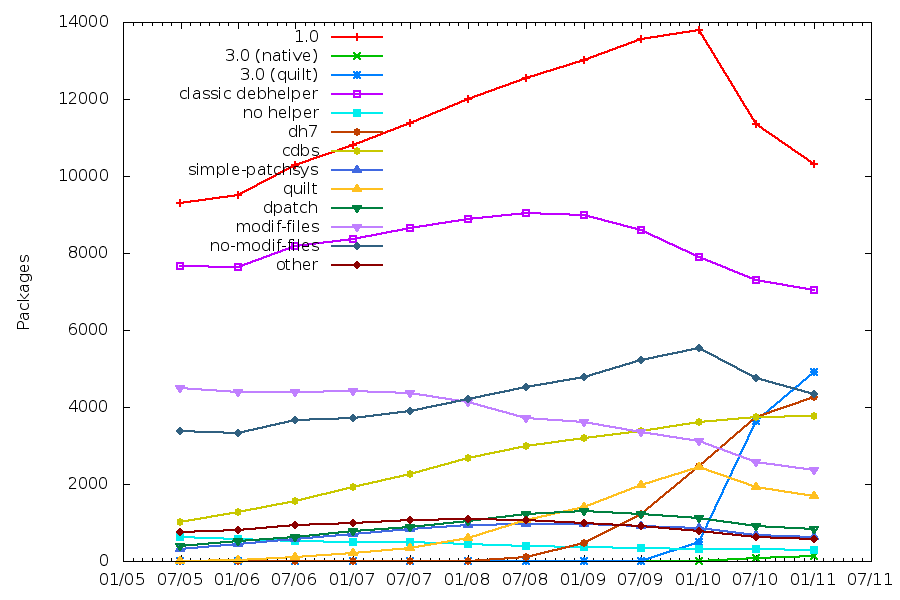
Lucas Nussbaum: Debian is changing

I ve been playing with snapshot.d.o, which is a fantastic resource to look at how Debian has been changing over the years.
Below are some preliminary results about various aspects of source packages: format, packaging helpers, and patch systems.
For clarification: Random comments: If you have other ideas of things to investigate using snapshot.d.o, don t hesitate to ask in comments.

24 February 2011

Pau Garcia i Quiles: Applied for Debian Maintainer, FLOSS workflow works

I have been packaging for Debian for a few years now. My first serious package was Wt back in 2007, but I had been backporting for Ubuntu for at least 2 years already, which means I have been doing .deb packaging for about 5 years (!). Last week I decided it was about time stop nagging my sponsors (Vincent Bernat, Thomas Girard and Sune Vuorela) every time I wanted to update the packages I maintain (witty, ace and libmsn), and I finally started the Debian New Maintainer process. The main reason I had not applied for Debian Maintainer yet was it requires some bureaucracy and, well, I d rather spend my time coding or packaging than doing paperwork :-) I sent my Declaration of Intent and soon after, Thomas and Vincent replied and supported my application with very very nice and kind words. Thank you, guys! I m flattered! :roll: Had I known I would be buttered up so much, I would have certainly applied a long time ago! :-D But you know what is the best part of this? It shows how open source projects take advantage of all the tools and communications channels we have (IRC, mailing lists, sprints, conferences, etc), and make distributed development work very well: here we have a 900-developers project in which two French guys are praising an Spanish guy they have never, ever met face-to-face (only e-mail, occasional IRC, and the most important of all: code review). Meritocracy at its full extent. Have you ever seen that in a traditional 100,000 workers company with hundreds of developers working in a single project?

Sean Finney: git merge -s theirs

...For the cases where, yes, you actually do want it. For the impatient assuming you're in a clean checkout on the tip of your current branch:
git merge -s ours ref-to-be-merged
git diff ref-to-be-merged   git apply -R --index
git commit -F .git/COMMIT_EDITMSG --amend
you can then double check that everything is as you expect with git diff ref-to-be-merged, which should be empty. The longer story It's noted from time to time that git does not have a -s theirs option to complement the -s ours strategy when merging (or, it did, but it was removed long ago, see below). For those not savvy the idea with git merge -s ours is to pretend as though a merge from some other branch has occurred, though the result remains the current branch's contents, unchanged. This is a neat trick that can be used to show that all changes in some branch have been superceded by the current branch, which can help ease merges further down the line as parallel devlopment continues. However, there is no corresponding -s theirs option, which would conversely say that "everything developed up to here is superceded by this other branch". This feature was discussed and discarded by one of the git authors, who instead advised a developer to throw away the previous work and start on a fresh branch:
One big problem "-s theirs" has, compared to the above "reset to origin, discarding or setting aside the failed history" is that your 'master' history that your further development is based on will keep your failed crap in it forever if you did "-s theirs". Hopefully you will become a better programmer over time, and you may eventually have something worth sharing with the world near the tip of your master branch. When that happens, however, you cannot offer your master branch to be pulled by the upstream, as the wider world will not be interested in your earlier mistakes at all.
In what would probably qualify as "most cases", he's right, but sometimes you do want to do this, and not because you have "crap" in your history, but perhaps because you want to change the baseline for development in a public repository where rebasing should be avoided. In debian, for example, it's pretty common for maintainers who use git-buildpackage to build debian packages from git to have two branches: an "upstream" branch and a "debianized" branch. The upstream branch will follow the changes from the upstream project (either by importing tarballs, or by pulling directly from the project's git repo if they also use git), while the debianized branch contains all the packaging related changes as well as any debian-specific changes to the code. In this context, if the upstream project uses git and rebases their history (out of your control), or if they shift development to a different branch, you might want to have a way to merge with their latest changes without rebasing/abandoning your current debian branch. Hence, a "theirs" merge. The author is totally right that the upstream project may be less interested in pulling from such a repository (since they would drag in the entire previous history), and if that's a problem you might need to splinter off the old branch and start a fresh branch instead. But at least for the projects with which I work, I find that it's more likely that pulling is pretty much one way upstream to debian, and that the patches flow back to the upstream project by way of bug trackers, git format-patch sendmail, or quilt patches sitting in the patch-tracker. And if it becomes a problem later you're no worse off, you can still split off a new branch or take some other action. So anyway, I asked Teh Internetz and found a few hits in the right direction, such as this guy at stack overflow, or this guy here. But from an aesthetic point of view I thought their solutions still left some room for improvement--they were both more complicated, involved setting up temporary branches, and I don't know, just weren't pretty on the eyes. So, ending where I started, this is the relatively clean and easy to follow 3 lines I conjured up, which I will give to teh internetz for posterity.
git merge -s ours ref-to-be-merged
git diff ref-to-be-merged   git apply -R --index
git commit -F .git/COMMIT_EDITMSG --amend
Alternatively, if you want to keep the local upstream branches fast-forwardable, a potential compromise is to work with the understanding that for sid/unstable, the upstream branch can from time to time be reset/rebased (based on events that are ultimately out of your control on the upstream project's side). This isn't a big deal and working with that assumption means that it's easy to keep the local upstream branch in a state where it only takes fast-forward updates. However, on the debian branch your less interested in the clean upstream development, and instead want to keep a sane history of the debianization work, so on this branch you still do something like a merge -s theirs (though in this case, you probably want to amend the previous version's ./debian dir back in post-merge). So applying the same approach as above with the slight modification, in practice (assuming you're on the clean tip of the debian unstable branch, that'd be):
git branch -m upstream-unstable upstream-unstable-save
git branch upstream-unstable upstream-remote/master
git merge -s ours upstream-unstable
git diff ref-to-be-merged   git apply -R --index --exclude="debian/*"
git commit -F .git/COMMIT_EDITMSG --amend
PS In spirit, this is a similar approach to what's done by the XSF team, though I would argue that with what I'm describing both the approach and the resulting history are a bit cleaner and easier to follow. Also, thanks to ron, mrvn, jcristau, and nthykier on #debian-devel for some quick reviewing of this.

Steve Kemp: I like languages

One of the reasons I like Scotland is the fun that Scottish people have with language. I'm going to use two examples to illustrate my point: The last one is particularly fun when you use questions such as "How no?" - meaning roughly "Why not?". Languages, and idioms, vary wildly in different parts of the world, even when you restrict yourself to English-speaking languages. I'll not even get started on Accents. The UK is tiny compared to many other countries, yet we have a wide array of accents - Australia, by contrast is huge, but I can think of only two accents across the country. (Rationally I expect that there are many accents in different parts of Australia, and I'm merely ignorant.) In conclusion languages are fun, and some places this is more evident than in others. I will most likely contintue to say "The shop is open from 9 while 4" rather than the more typical "From 9 til 4" - I'm allowed to do that, having grown up in Yorkshire!
(PS. PHP still sucks - Even if you post it upon a PHP-powered blog. ;)
ObQuote: "People take you for granted, you know. We gotta make people miss you." - Hancock

23 February 2011

Pietro Abate: More on Xen 4.0 setup on squeeze

After the upgrade of last week, I didn't have any major problems : xen 4 seems pretty stable and does its job well. One problem I encountered the other day was about the dom0 balloning. By default, xen sets dom0_min_mem to 196Mb and balloning set to true. This is all and good untill you try to use too much memory for your VMs, squeezing dom0 to its minimum amount of memory and causing all sort of problems. On the xen wiki, they reccomend as best practice to reserve a minimum of 512Mb to dom0 for its operations. This is done but setting dom0_mem=512M on the grub command line and the adjusting enable-dom0-ballooning to no and dom0-min-mem accordingly to the amount of memory you choose. On debian, you can set the grub command line once for all just by adding in /etc/default/group the conf variable
GRUB_CMDLINE_XEN="dom0_mem=512M"
Another small problem is related to the reboot sequence. Since I'm using lvm on aoe, the default shutdown sequence (network down first, lvm later) is not going to work for me. As I've few lvm volumes on aoe and others on the physical disk, the proper solution to this problem is to write a custom shutdown script for the aoe lvm volumes and make it run before deconfiguring the network interfaces. In the mean time, to avoid the kernel hanging there forever, I've added these lines to in /etc/syscntl.d/panic.conf
# Reboot 5 seconds after panic
kernel.panic = 5

# Panic if a hung task was found
kernel.hung_task_panic = 1

# Setup timeout for hung task to 300 seconds
kernel.hung_task_timeout_secs = 120
This will instruct the kernel to panic and then reboot if there a task will not respond for more then 120 seconds.

Neil Williams: cross-building, multiarch and binutils

At the Emdebian ARM sprint, cross-building experiments on a Multi-Arch base are going fairly well. It is looking like the hacks in dpkg-cross may finally be avoidable, possibly before Wheezy gets released. Elsewhere, debhelper has been updated to allow dh_strip and other tools to work directly with the binutils package from the cross-building toolchain and not to need binutils-multiarch any more. dpkg-cross has been updated to only Suggest binutils-multiarch, which makes room for more architectures to be covered by binutils-multiarch (which, therefore, will be getting quite a lot bigger quite soon).

Cross-building in Debian is therefore entering a period of transition and the old ways of dpkg-cross - and the tools it has spawned like apt-cross, xapt, pdebuild-cross and others - will be gradually side-lined and finally rendered obsolete. Like all transitions, there will be breakage, there will be pain, there will be things which don't cross-build now and which have no prospect of being fixed until the transition is deeply entrenched. There are packages which used to cross-build and which will stop cross-building and, again, won't be fixable for months. Sadly, Squeeze released with cross-building breakage too, due to changes within apt during the release freeze. A Lenny chroot is possibly the best place to do cross-building for now.

This is a major transition. It WILL break things. Badly and often.
What's more, just because we decide to implement stuff using one method now does not mean that the same method will even exist in a month or two.

In other words, if you've got a working cross-build chroot or installation currently and you absolutely need it to continue working leave it alone.

Don't go changing real packages to use the changes we're trying out!

If you enjoy fixing stuff, don't mind pain and fancy risking your system as I've been doing (unlinking /etc/, deleting /lib64 on amd64 or forcing package installation such that no shared libraries are accessible any longer) then you are:
  1. insane
  2. welcome to join the work

Check out the current state of things via the #emdebian channel on oftc.net and the very risky Emdebian multiarch SVN experiments along with the even more risky Emdebian Multiarch Mirror, courtesy of Steve McIntyre and Phil Hands.

The README in SVN is very clear - DON'T INSTALL THESE OUTSIDE A CHROOT and even if you do, don't come crying to me when it breaks your entire system (even when used inside a chroot).

No warranty, no guarantees, no promises, none of this is fit for any purpose whatsoever and we'll say when we finally have something which might actually be useful.

Russell Coker: Virgin Mobile CRM Upgrade Failure

I ve recently got a new Xperia X10 Android phone for my with with Virgin mobile, it s generally been working OK although I am having some issues [1], I ll write another blog post soon about other problems I ve discovered with the phone and how I ve solved some of the previous ones.I upgraded my wife s phone first because I can t be without Nagios SMS messages if things don t work. So now that things are generally working I want to get myself an Xperia through Virgin (and have my wife s phone get the Nagios SMS in the mean-time). But since last Friday the entire Virgin sales infrastructure has apparently been down. It started with just declining my attempts to purchase a new phone on a separate account, but when I decided to add a second phone to my wife s account the web site told me that they are upgrading their CRM system and it should be fixed on the 22nd of Feb (yesterday). The web site is now saying that I should check back in 2 hours for an update , it s been saying that for a couple of days now.So for most of a week potential Virgin customers have been turned away. It could be that Virgin stores are processing sales on paper, but they offer some significant discounts for web sales the plan I want is a $39 per month plan and I ll get 3 months free for buying on the web. I m not about to visit a store and lose $117! I m sure that many people are losing confidence in Virgin and taking their business elsewhere. I have only just installed the 3G Watchdog free Android app that monitors bandwidth use and automatically turns off 3G when the quota is reached. For the first few days of using the phone which were more data intensive than usual I had no monitoring and no way of using the Virgin web site to discover how much was used. If Virgin bill me extra for data use I ll complain and demand that they alter the bill.This is even worse for pre-paid customers who can t add credit to their account while this happens!Virgin state that they are upgrading the hardware, operating system and database our platform uses to ensure that we can service our Members even better for years to come [2]. I wonder how people get themselves into such a mess. I guess they didn t have a decent test environment to allow testing the upgrade process before doing it on the live data, I can understand a routine small upgrade going wrong and corrupting data in a way that takes some time to resolve. But when everything is upgraded then everything should be tested, and tested before going live! One thing that Virgin could do to regain some credibility is to publish what went wrong and what they learned from it. I would be much more happy to trust my personal data and my business critical phone to a company that learns from it s mistakes and publishes plans on how they do better than one that just does PR.According to Whirlpool they did the same thing on the 25th of January, so they have had two outages of their billing/CRM system in two months! [3]. The Whirlpool thread has discussion about last month s down-time and this month s down-time.On the up-side, Whirlpool user Kevin JD is a Virgin representative who advised customers to send email to telesales@virginmobile.com.au with a contact phone number if they have any issues. It s good to see a company engaging with it s customers.Update: An hour after emailing the URL to this post to Virgin I got a call from a service representative. It wasn t a very productive call as I already knew that their servers are down and they can t do anything. But it s good to know that they are very enthusiastic about making things better. One useful thing that I learned is that my wife s service is probably on a pro-rated bandwidth quota. As she got the phone in the middle of the month we can only do 100M of data transfer not 200M before the end of the month, by my rough calculations I ve downloaded well over 50M of data (maybe as much as 100M) from the Android marketplace. So it might be necessary to negotiate about the bill as soon as their CRM system works.

Next.

Previous.