Search Results: "ads"

8 October 2015

Jonathan McDowell: The sad state of home entertainment software platforms

I got home from a law lecture[1] today and took apart my TV. As you do. I d a couple of motivations for this. The TV is an LG 55LM8600-UC. That -UC is important - it means it s the US model. I shipped it back to the UK along with the rest of my belongings at the start of the year. It s a lovely TV, and I m very happy with the picture quality. Up until now I ve been running it through a 240v->120v transformer, because the back clearly states 120v 50/60Hz. Having had success converting my Roomba PSU to UK voltage I was wondering if it might be easy enough to do the same for the TV. So the first reason for taking it apart was to look at the PSU board and work out if I could replace it with a UK version, or fix up a handful of components myself. Turns out its rated for 100-240v 50/60Hz so it looks like it should be fine to plug into UK mains directly. And, having done so, it all seems fine. However I don t take any responsibility if you try this yourself and it all goes up in smoke. The other reason was to have a general poke at trying to get access to the onboard CPU - the firmware updates are signed and encrypted so I m a bit stuck working from just those. My TV is from the US; it therefore has an ATSC tuner, and is no good for picking up the DVB-T/T2 broadcast in the UK. It also has a range of smart apps built in. Of course are also tailored to the US, so the Amazon Instant Video app connects to amazon.com and is no use with my Amazon UK account. Netflix is smarter about this and detects where you re located rather than requiring logging in to the appropriate geographic site. However the Netflix app is old and doesn t support user profiles. Which causes a problem when I spend an afternoon watching Unbreakable Kimmy Schmidt and it screws up the recommendations for my girlfriend. In an ideal world I d easily be able to update the apps on my TV to recent versions appropriate for my geographic location. Instead, the current state of home entertainment software platforms is at least 10 years behind mobile phones. Some devices allow you to get hold of SDKs even as an end user, but you re stuck with a multiple ecosystems even between different models from the same manufacturer. LG has no interest in updating my 2012-era TV. They d rather I buy a nice new 2015 TV. Which means at present my TV is mostly a really nice monitor for my XBMC/Kodi box. I can get away with using my Blu-ray player for Netflix, as it does user profile, but it s also a US model and again Amazon Instant Video doesn t work with a UK account. I should point out /that/ box is from Panasonic, just in case anyone thinks I m needlessly picking on LG. My amp is an Onkyo and it would be nice if it could stream music from Amazon/Google as well (it supports Spotify and a couple of others already), but again no joy there. I understand there are DRM issues around video and audio content, but these problems seem to have largely been solved in the Android world while still providing a fairly standard development environment and allowing end users to install their own software. It would seem to make more sense if there was a standard TV / Blu-ray platform that the likes of Netflix and Amazon could write apps once for, reducing the effort required on both sides to get the latest and greatest services on end user equipment. I guess this is some of what Google was trying to achieve with Google TV, but it s probably less interesting to them than mobile devices as I certainly don t tend to do things like search on my TV; I just want to view content and would be mighty pissed off if it started advertising things at me unexpectedly. While I m not planning to buy a new TV any time soon, I could do with a UK spec 3D-capable Blu-ray player. Is there anything out there with some commitment to open apps / proper updates? I haven t found anything, but I d love to be proved wrong. [1] It was on the duty of care and negligence, if you care.

Mart n Ferrari: Pining for the good ol' days

Today, Norbert Preining wrote a blog post syndicated in planet talking about Sarah Sharp quitting Linux development, and making a parallel with the Debian community. Once again, he's complaining about how the fun from Debian has been lost because making sexist jokes, or treating other people like shit is not allowed any more. He seems to think the LKML is the ideal environment and that Debian should be more like it. He also celebrates that Ms Sharp12 left Linux, because evidently the freedom to be a jerk to each other is more important than the contributions that she -or any other person that finds that atmosphere toxic, like mjg- has produced or could have produced in the future.
I would like to tell readers of Planet Debian that this view is not the norm in Debian any more. We are working hard to make the project more inclusive, fun, and welcoming to everybody. Sadly, some people are still pining for the good ol' days, and won't give up so easily on their privilege.

  1. Whom he calls "one more SJW", I guess then that after all, this is just about ethics in FOSS development.
  2. At this point, using the term SJW in a discussion should equate to a Godwin, and mean that you lost the argument.
6 comments

Norbert Preining: Looking at the facts: Sarah Sharp s crusade

Much has been written around the internet about this geeky kernel maintainer Sarah Sharp who left kernel development. I have now spent two hours reading through lkml posts, and want to summarize a few mails from the long thread, since most of the usual news sites just rewrap the original blog of hers without adding any background. darth-cookie The whole thread evolved out call for stable kernel review by Greg Kroah-Hartman where he complained about too many patches that are not actually in rc1 before going into stable:
<rant>
  I'm sitting on top of over 170 more patches that have been marked for
  the stable releases right now that are not included in this set of
  releases.  The fact that there are this many patches for stable stuff
  that are waiting to be merged through the main -rc1 merge window cycle
  is worrying to me.
  [...]
from where it developed into a typical Linus rant on people flagging crap for stable, followed by some jokes:
On Fri, Jul 12, 2013 at 8:47 AM, Steven Rostedt <rostedt@goodmis.org> wrote:
> I tend to hold things off after -rc4 because you scare me more than Greg
> does ;-)
 
Have you guys *seen* Greg? The guy is a freakish giant. He *should*
scare you. He might squish you without ever even noticing.
 
              Linus
and Ingo Molnar giving advice to Greg KH:
So Greg, if you want it all to change, create some _real_ threat: be frank 
with contributors and sometimes swear a bit. That will cut your mailqueue 
in half, promise!
with Greg KH taking a funny position in answering:
Ok, I'll channel my "inner Linus" and take a cue from my kids and start
swearing more.
Up to now a pretty decent and normal thread with some jokes and poking, nobody minded, and reading through it I had a good time. The thread continues with a discussion on requirements what to submit to stable, and some side threads on particular commits. And then, out of the blue, Social Justice Warrior (SJW) Sarah Sharp pops in with a very important contribution:
Seriously, guys?  Is this what we need in order to get improve -stable?
Linus Torvalds is advocating for physical intimidation and violence.
Ingo Molnar and Linus are advocating for verbal abuse.
 
Not *fucking* cool.  Violence, whether it be physical intimidation,
verbal threats or verbal abuse is not acceptable.  Keep it professional
on the mailing lists.
 
Let's discuss this at Kernel Summit where we can at least yell at each
other in person.  Yeah, just try yelling at me about this.  I'll roar
right back, louder, for all the people who lose their voice when they
get yelled at by top maintainers.  I won't be the nice girl anymore.
Onto which Linus answers in a great way:
That's the spirit.
 
Greg has taught you well. You have controlled your fear. Now, release
your anger. Only your hatred can destroy me.
 
Come to the dark side, Sarah. We have cookies.
On goes Sarah, gearing up in her SJW mode and starting to rant:
However, I am serious about this.  Linus, you're one of the worst
offenders when it comes to verbally abusing people and publicly tearing
their emotions apart.
 
http://marc.info/?l=linux-kernel&m=135628421403144&w=2
http://marc.info/?l=linux-acpi&m=136157944603147&w=2
 
I'm not going to put up with that shit any more.
Linus himself made clear what he thinks of her:
Trust me, there's a really easy way for me to curse at people: if you
are a maintainer, and you make excuses for your bugs rather than
trying to fix them, I will curse at *YOU*.
 
Because then the problem really is you.
[...]
It is easy to verify what Linus said, by reading the above two links and the answers of the maintainers, both agreed that it was their failure and were sorry. (Mauro s answer, Rafael s answer) It is just the geeky SJW that was not even attacked (who would dare to attack a woman nowadays?). The overall reaction to her by the maintainers can be exemplified by Thomas Gleixner s post:
Just for the record. I got grilled by Linus several times over the
last years and I can't remember a single instance where it was
unjustified.
What follows is a nearly endless discussion with Sarah meandering around, changing permanently her opinion what is acceptable. Linus tried to explain to her in simple words, without success, she continues to rant around. Here arguments are so weak I had nothing but good laugh:
> Sarah, that's a pretty potent argument by Linus, that "acting 
> professionally" risks replacing a raw but honest culture with a
> polished but dishonest culture - which is harmful to developing
> good technology.
> 
> That's a valid concern. What's your reply to that argument?
 
I don't feel the need to comment, because I feel it's a straw man
argument.  I feel that way because I disagree with the definition of
professionalism that people have been pushing.
 
To me, being "professional" means treating each other with respect.  I
can show emotion, express displeasure, be direct, and still show respect
for my fellow developers.
 
For example, I find the following statement to be both direct and
respectful, because it's criticizing code, not the person:
 
"This code is SHIT!  It adds new warnings and it's marked for stable
when it's clearly *crap code* that's not a bug fix.  I'm going to revert
this merge, and I expect a fix from you IMMEDIATELY."
 
The following statement is not respectful, because it targets the
person:
 
"Seriously, Maintainer.  Why are you pushing this kind of *crap* code to
me again?  Why the hell did you mark it for stable when it's clearly
not a bug fix?  Did you even try to f*cking compile this?"
Fortunately, she was immediately corrected and Ingo Molnar wrote an excellent refutation (starting another funny thread) of all her emails, statements, accusations (all of the email is a good read):
_That_ is why it might look to you as if the person was
attacked, because indeed the actions of the top level maintainer were
wrong and are criticised.
 
... and now you want to 'shut down' the discussion. With all due respect,
you started it, you have put out various heavy accusations here and elsewhere,
so you might as well take responsibility for it and let the discussion be
brought to a conclusion, wherever that may take us, compared to your initial view?
(He retracted that last statement, though I don t see a reason for it) Last but not least, let us return to her blog post, where she states herself that:
FYI, comments will be moderated by someone other than me. As this is my blog, not a
government entity, I have the right to replace any comment I feel like with 
 fart fart fart fart .
and she made lots of use of it, I counted at least 10 instances. She seems to remove or fart fart fart any comment that is not in line with her opinion. Further evidence is provided by this post on lkml. Everyone is free to have his own opinion (sorry, his/her), and I am free to form my own opinion on Sarah Sharp by just simply reading the facts. I am more than happy that one more SJW has left Linux development, as the proliferation of cleaning of speech from any personality has taken too far a grip. Coming to my home-base in Debian, unfortunately there is no one in the position and the state of mind of Linus, so we are suffering the same stupidities imposed by social justice worriers and some brainless feminists (no, don t get me wrong, these are two independent attributes. I do NOT state that feminism is brainless) that Linus and the maintainer crew was able to fend of this time. I finish with my favorite post from that thread, by Steven Rosted (from whom I also stole the above image!):
On Tue, 2013-07-16 at 18:37 -0700, Linus Torvalds wrote:
> Emotions aren't bad. Quite the reverse. 
 
Spock and Dr. Sheldon Cooper strongly disagree.
Post Scriptum (after a bike ride) The last point by Linus is what I criticize most on Debian nowdays, it has become a sterilized over-governed entity, where most fun is gone. Making fun is practically forbidden, since there is the slight chance that some minority somewhere on this planet might feel hurt, and by this we are breaking the CoC. Emotions are restricted to the Happy happy how nice we are and how good we are level of US and also Japanese self-reenforcement society. Post Post Scriptum I just read Sarah Sharp s post on What makes a good community? , and without giving a full account or review, I am just pi**ed by the usage of the word microaggressions I can only recommend everyone to read this article and this article to get a feeling how bs the idea of microaggressions has taken over academia and obviously not only academia. Post3 Scriptum I am happy to see Lars Wirzenius, Gunnar Wolf, and Mart n Ferrari opposing my view. I agree with them that my comments concerning Debian are not mainstream in Debian something that is not very surprising, though, and I think it is great that they have fun in Debian, like many other contributors. Post4 Scriptum Although nobody will read this, here is a great response from a female developer:
[...] To Linus: You're a hero to many of us. Don't change. Please. You DO
NOT need to take time away from doing code to grow a pair of breasts
and judge people's emotional states: [...]
Nothing to add here!

7 October 2015

Ben Hutchings: Debian LTS work, September 2015

For my 10th month working on Debian LTS, I was assigned 14.5 hours of work by Freexian's Debian LTS initiative, but only worked for 9 hours. Front desk I had another week in the 'front desk' role, where I triaged new security issues for squeeze. Happily, few of them affected squeeze. linux-2.6 I reviewed a new upstream stable update, 2.6.32.68, and then applied it to our package once it was released. I backported a further 3 security fixes, uploaded the package and issued DLA-310-1. binutils binutils had several buffer overflow bugs to be fixed. They aren't very likely to be exploitable as most users won't be processing untrusted input with binutils. Nevertheless, I backported the fixes from upstream and (early this month) issued DLA-324-1.

Guido G nther: Debian work in September 2015

Debian LTS August was the fifth month I contributed to Debian LTS under the Freexian umbrella. In total I spent eight hours working on: Besides that I did CVE triaging of 9 CVEs to check if and how they affect oldoldstable security as part of my LTS front desk work. Other Debian work I finally sent out the summary of the 8th Debian Groupware Meeting we had in the Linuxhotel earlier this year and gave a short talk about Debian at the Zarafa Tour in the Netherlands.

Steve Kemp: Generating fingerprints from SSH keys

I've been allowing users to upload SSH public-keys, and displaying them online in a form. Displaying an SSH public key is a pain, because they're typically long. That means you need to wrap them, or truncate them, or you introduce a horizontal scroll-bar. So rather than displaying them I figured I'd generate a fingerprint when the key was uploaded and show that instead - This is exactly how github shows your ssh-keys. Annoyingly there is only one reasonable way to get a fingerprint from a key: You can sometimes calculate the key via more direct, but less obvious methods:
awk ' print $2 ' ~/.ssh/id_rsa.pub   base64 -d   md5sum
But that won't work for all key-types. It is interesting to look at the various key-types which are available these days:
mkdir ~/ssh/
cd ~/ssh/
for i in dsa ecdsa ed25519 rsa rsa1 ; do
  ssh-keygen -P "" -t $i -f $ i -key
done
I've never seen an ed25519 key in the wild. It looks like this:
$ cat ~/ssh/ed25519-key.pub
ssh-ed25519 AAAAC3NzaC1lZDI1NTE5AAAAIMcT04t6UpewqQHWI4gfyBpP/ueSjbcGEze22vdlq0mW skx@shelob
Similarly curve-based keys are short too, but not as short:
ecdsa-sha2-nistp256 AAAAE2VjZHNhLXNoYTItbmlzdHAyNTYAAAAIbmlzdHAyNTYAAABBBLTJ5+  \
 rWoq5cNcjXdhzRiEK3Yq6tFSYr4DBsqkRI0ZqJdb+7RxbhJYUOq5jsBlHUzktYhOahEDlc9Lezz3ZUqXg= skx@shelob
Remember what I said about wrapping? Ha! Anyway for the moment I've hacked up a simple perl module SSH::Key::Fingerprint which will accept a public key and return the fingerprint, as well as validating the key is well-formed and of a known-type. I might make it public in the future, but I think the name is all wrong. The only code I could easily find to do a similar job is this node.js package, but it doesn't work on all key-types. Shame. And that concludes this weeks super-happy fun-time TODO-list item.

Norbert Preining: Kobo DRM removal on Linux

Finally it has been done to remove the DRM of a Kobo eBook one does not need to switch to Windows or Mac anymore, deal with the brain-dead Kobo Desktop app, etc etc. The only thing you need is a Kobo device! DRM is evil, we know that, please read up on DRM protection here. kobo-drm I wrote about the Pain of DRM some time ago, and after two years of fighting finally it is here the latest release of Apprentice Alf s DeDRM tools starting with version 6.3.4a makes the Obok plugin usable on Linux, too. Just get the latest tools, unzip them, install the obok_plugin.zip from the Obok_calibre_plugin directory, and restart your Calibre. After that connect your device and press the Obok button, and there we go, you can backup you purchased eBooks on your computer. Of course the same is true on Windows and Mac, so if you have a device, there is no need for Kobo Desktop anymore. Just one warning: Don t use it for pirating ebooks, the tools have the sole purpose to backup and make properly purchased ebooks available on different devices (Linux computer).

Dirk Eddelbuettel: RcppRedis 0.1.6

An incremental RcppRedis release arrived on CRAN yesterday. Russell Pierce contributed four new function for pushing and popping to/from lists, and added authentication support. I added a simple ping command as well.
Changes in version 0.1.6 (2015-10-05)
  • Added support (including new unit tests) for lpop, rpop, lpush, rpush as well as auth via augmented constructor (all thanks to PRs #11 and #13 by Russell Pierce)
  • Added ping command and unit test
Courtesy of CRANberries, there is also a diffstat report for the most recent release. More information is on the RcppRedis page.

This post by Dirk Eddelbuettel originated on his Thinking inside the box blog. Please report excessive re-aggregation in third-party for-profit settings.

6 October 2015

Ben Armstrong: Cranberry Lake and nearby bog Fall, 2015

On one of my regular walks with a friend, we decided today to walk part of the BLT Trail to Cranberry Lake and the bog just past it, an easy 5 km round trip.
On the trail to the lake, golds dominateOn the trail to the lake, golds dominate
A calm day, the lake like glassA calm day, the lake like glass
In the bog, copper and golden huesIn the bog, copper and golden hues
On the margins of the bog, brilliant orange and redOn the margins of the bog, brilliant orange and red
The reds, dark greens and dead trees in counterpointThe reds, dark greens and dead trees in counterpoint
At our turning point, my cranberry patch provided a puckery snackAt our turning point, my cranberry patch provided a puckery snack
facebooktwittergoogle_plusredditpinterestlinkedinmail

Matthew Garrett: Going my own way

Reaction to Sarah's post about leaving the kernel community was a mixture of terrible and touching, but it's still one of those things that almost certainly won't end up making any kind of significant difference. Linus has made it pretty clear that he's fine with the way he behaves, and nobody's going to depose him. That's unfortunate, because earlier today I was sitting in a presentation at Linuxcon and remembering how much I love the technical side of kernel development. "Remembering" is a deliberate choice of word - it's been increasingly difficult to remember that, because instead I remember having to deal with interminable arguments over the naming of an interface because Linus has an undying hatred of BSD securelevel, or having my name forever associated with the deepthroating of Microsoft because Linus couldn't be bothered asking questions about the reasoning behind a design before trashing it.

In the end it's a mixture of just being tired of dealing with the crap associated with Linux development and realising that by continuing to put up with it I'm tacitly encouraging its continuation, but I can't be bothered any more. And, thanks to the magic of free software, it turns out that I can avoid putting up with the bullshit in the kernel community and get to work on the things I'm interested in doing. So here's a kernel tree with patches that implement a BSD-style securelevel interface. Over time it'll pick up some of the power management code I'm still working on, and we'll see where it goes from there. But, until there's a significant shift in community norms on LKML, I'll only be there when I'm being paid to be there. And that's improved my mood immeasurably.

(Edited to add a context link for the "deepthroating of Microsoft" reference)

comment count unavailable comments

Gergely Nagy: What dh-exec is, and what it isn't for

Strange as it may be, it turns out I never wrote about dh-exec yet, even though it is close to being four years old. Gosh, time flies so fast when you're having fun! Since its first introduction, there's been a reasonable uptake in dh-exec use: as of this writing, 129 packages build-depend on dh-exec. One might think this would be a cause for celebration, that the package is put to great use. But it's not.You see, a significant number of those 129 packages are doing it wrong, and need not build-depend on dh-exec at all.The purpose of dh-exec is to allow one to do things stock debhelper can't do, such as renaming files during the dh_install phase, or applying architecture or build profile based filtering, or doing environment variable substitution. There are many legit uses for all of these features, but there are some which can be easily solved without using dh-exec. So first, I'll talk a bit about the don'ts.What not to use dh-exec forOne of the most abused part of dh-exec is its variable substitution feature, and it is often used without need, to install multiarch-related files. While that is one intended use-case, there are few situations currently in the archive that stock debhelper can't handle. Let me explain the situation!Lets assume we have an upstream package, where the build system is something as common as autotools or CMake, for which debhelper can automatically set the appropriate flags and paths. Furthermore, lets assume that the upstream build system would install the following files:
/usr/lib/x86_64-linux-gnu/libalala.so.1.2.3
/usr/lib/x86_64-linux-gnu/libalala.so.1
/usr/lib/x86_64-linux-gnu/libalala.so
/usr/lib/x86_64-linux-gnu/libalala.a
/usr/lib/x86_64-linux-gnu/pkgconfig/libalala.pc
/usr/include/lalala/lalala.h
We want to include the first two in the libalala1 package, the rest in libalala-dev, so what do we do? We use stock debhelper, of course! That is all you need. In this case, there is absolutely no need for dh-exec. While using dh-exec without need is not much of an issue, because it only increases the space required for the build and build times by a tiny bit, I would still strongly recommend not introducing dh-exec needlessly. Why? Because of simplicity and aesthetics.So, if you find yourself doing any of these, or similar, that's a sign you are doing things wrong:
usr/lib/$ DEB_HOST_MULTIARCH 
usr/lib/$ DEB_HOST_MULTIARCH /*.so.* /usr/lib/$ DEB_HOST_MULTIARCH /
usr/lib/$ DEB_HOST_MULTIARCH /pkgconfig/*.pc /usr/lib/$ DEB_HOST_MULTIARCH /pkgconfig
usr/lib/$ DEB_HOST_MULTIARCH /package/*.so /usr/lib/$ DEB_HOST_MULTIARCH /package
Unless there are other directories under usr/lib that are not the multiarch triplet, using stock debhelper and wildcards is not only more succinct, simpler and more elegant, but also lighter on resources required.When dh-exec becomes usefulChanging installation pathsOnce you want to change where things get installed, then dh-exec becomes useful:
usr/lib/*.so.* /usr/lib/$ DEB_HOST_MULTIARCH 
usr/lib/$ DEB_HOST_MULTIARCH /package/* /usr/lib/$ DEB_HOST_MULTIARCH /package-plugins/
some/dir/*.so.* /usr/lib/$ DEB_HOST_MULTIARCH 
This usually happens when upstream's build system can't easily be taught about multiarch paths. For most autotools and CMake-based packages, this is not the case.Variable substitutionConsider this case:
#!/usr/bin/dh-exec
/usr/share/octave/packages/mpi-$ DEB_VERSION_UPSTREAM /hello2dimmat.m /usr/share/doc/octave-mpi/examples/hello2dimmat.m
/usr/share/octave/packages/mpi-$ DEB_VERSION_UPSTREAM /hellocell.m /usr/share/doc/octave-mpi/examples/hellocell.m
Here, the build supplies $ DEB_VERSION_UPSTREAM , and using dh-exec allows one to have a generic debian/links file, that does not need updating whenever the upstream version changes. We can't use wildcards here, because dh_link does not expand them.Renaming filesIn case one needs to rename files during the dh_install phase, dh-exec can be put to use for great results:
ssh-agent-filter.bash-completion => usr/share/bash-completion/completions/ssh-agent-filter
FilteringSometimes one would wish to conditionally install something based on the architecture, or the build profile. In this case, dh-exec is the tool to turn to:
<!stage1 !stage2> ../../libdde-linux26/Makeconf* usr/share/libdde_linux26
usr/lib/gvfs/gvfsd-afc                                          [!hurd-any]
usr/lib/gvfs/gvfsd-gphoto2                                      [linux-any]

Norbert Preining: Craft Beer Kanazawa 2015

Last weekend the yearly Craft Beer Kanazawa Festival took place in central Kanazawa. This year 14 different producers brought about 80 different kind of beers for us to taste. Compared with 6 years ago when I came to Japan and Japan was still more or less Kirin-Asahi-Sapporo country without any distinguishable taste, the situation as improved vastly, and we can now enjoy lots of excellent local beers!
beer-festival-1 Returning from a trip to Swansea and a conference in Fukuoka, I arrived at Kanazawa train station and went directly to the beer festival. A great welcome back in Kanazawa, but due to excessive sleep deprivation and the feeling of finally I want to come home , I only enjoyed 6 beers from 6 different producers. In the gardens behind the Shinoki Cultural Center lots of small tents with beer and food were set up. Lots of tables and chairs were also available, but most people enjoyed flocking around in the grass around the tents. What a difference to last year s rainy and cold beer festival!
beer-festival-5 This year s producers were (in order from left to right, page links according to language): beer-festival-3 With only 6 beers to my avail (due to ticket system), I choose the ones I don t have nearby. Mind that the following comments are purely personal and do not define a quality standards  I just say what I like from worst to best: beer-festival-2 A great beer festival and I am looking for next years festival to try a few more. In the mean time I will stock up beers at home, so that I have always a good Yoho Brewery beer at hand! Enjoy

5 October 2015

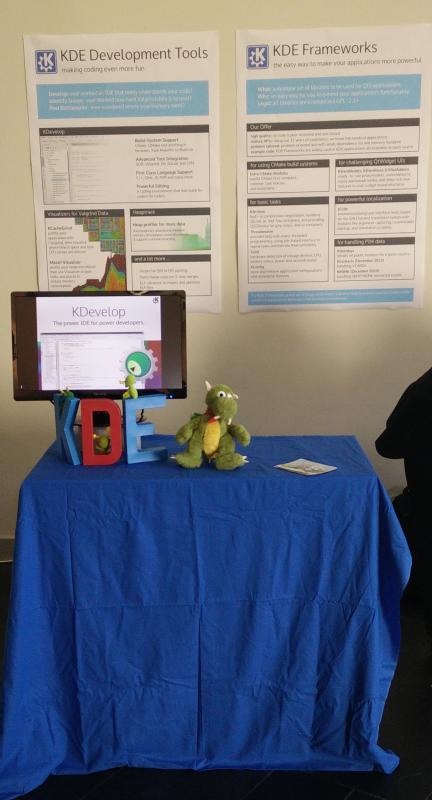
Sune Vuorela: KDE at Qt World Summit

So. KDE has landed at Qt World Summit. kdeboothqtws2015 You can come and visit our booth and KDE 19 years of Qt Experience.
B lint R czey: Debian success stories: Automated signature verification

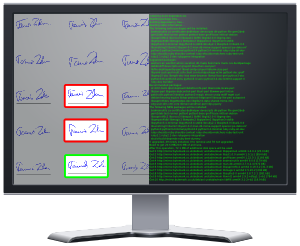
Debian was not generally seen as a bleeding-edge distribution, but it offered a perfect combination of stability and up-to-date software in our field when we chose the platform for our signature verification project. Having an active Debian Developer in the team also helped ensuring that packages which we use were in good shape when the freeze, then the release came and we can still rely on Jessie images with only a few extra packages to run our software stack. Not having to worry about the platform, we could concentrate on the core project and I m proud to announce that our start-up s algorithm won this year s Signature Verification Competition for Online Skilled Forgeries (SigWIComp2015) . The more detailed story can be read already in the English business news and is also on index.hu, a leading Hungarian news site. We are also working on a solution for categorizing users based on cursor/finger movements for targeting content, offers and ads better. This is also covered in the articles.

L szl a signature comparable in quality to the reference signatures

The verification task was not easy. The reference signatures were recorded at very low resolution and frequency and the forgers did a very good job in forging them creating a true challenge for everyone competing. At first glance it is hard to imagine that there is usable information in such small amount of recorded data, but our software is already better than me, for example in telling the difference between genuine and forged signatures. It feels like when the chess program beats the programmer again and again. :-) I would like to thank you all, who helped making Debian an awesome universal operating system and hope we can keep making every release better and better!

Michal &#268;iha&#345;: python-suseapi 0.22

The python-suseapi 0.22 has been released last week. The version number shows nothing special, but one important change has happened - the development repository has been moved. It's now under openSUSE project on GitHub, what makes it easier to find for potential users and also makes team maintenance a bit easier than under my personal account. If you're curious what the module does - it's mostly usable only inside SUSE, providing access to some internal services. One major thing usable outside is the Bugzilla interface, which should be at one day replaced by python-bugzilla, but for now provides some features not available there (using web scraping). Anyway the code has documentation on readhtedocs.org, so you can figure out yourself what it includes.

Filed under: Coding English SUSE 0 comments

Julien Danjou: Gnocchi talk at OpenStack Paris Meetup #16

Last week, I've been invited to the OpenStack Paris meetup #16, whose subject was about metrics in OpenStack. Last time I spoke at this meetup was back in 2012, during the OpenStack Paris meetup #2. A very long time ago!
I talked for half an hour about Gnocchi, the OpenStack project I've been running for 18 months now. I started by explaining the story behind the project and why we needed to build it. Ceilometer has an interesting history and had a curious roadmap these last year, and I summarized that briefly. Then I talk about how Gnocchi works and what it offers to users and operators. The slides where full of JSON, but I imagine it offered a interesting view of what the API looks like and how easy it is to operate. This also allowed me to emphasize how many use cases are actually really covered and solved, contrary to what Ceilometer did so far. The talk has been well received and I got a few interesting questions at the end. The video of the talk (in French) and my slides are available on my talk page and below. I hope you'll enjoy it.

4 October 2015

Philipp Kern: Root on LVM on Debian s390x, new Hercules


Two s390x changes landed in Debian unstable today:
With this it should be possible to install Debian on s390x with root on LVM. I'd be happy to hear feedback about installations with any configuration, be it root on a single DASD or root on LVM. Unless you set both mirror/udeb/suite and mirror/suite to unstable you'll need to wait until the changes are in testing, though. (The debian-installer build does not matter as zipl-installer is not part of the initrd and sysconfig-hardware is part of the installation.)

Furthermore I uploaded a new version of Hercules - a z/Architecture emulator - to get a few more years of maintenance into Debian. See its upstream changelog for details on the changes (old 3.07 new 3.11).

At this point qemu at master is also usable for s390x emulation. It is much faster than Hercules, but it uses newfangled I/O subsystems like virtio. Hence we will need to do some more patching to make debian-installer just work. One patch for netcfg is in to support virtio networking correctly, but then it forces the user to configure a DASD. (Which would be as wrong if Fibre Channel were to be used.) In the end qemu and KVM on s390x look so much like a normal x86 VM that we could drop most of the special-casing of s390x (netcfg-static instead of netcfg; network-console instead of using the VM console; DASD configuration instead of simply using virtio-blk devices; I guess we get to keep zIPL for booting).

Lunar: Reproducible builds: week 23 in Stretch cycle

What happened in the reproducible builds effort this week: Toolchain fixes Andreas Metzler uploaded autogen/1:5.18.6-1 in experimental with several patches for reproducibility issues written by Valentin Lorentz. Groovy upstream has merged a change proposed by Emmanuel Bourg to remove timestamps generated by groovydoc. Ben Hutchings submitted a patch to add support for SOURCE_DATE_EPOCH in linux-kbuild as an alternate way to specify the build timestamp. Reiner Herrman has sent a patch adding support for SOURCE_DATE_EPOCH in docbook-utils. Packages fixed The following packages became reproducible due to changes in their build dependencies: commons-csv. fest-reflect, sunxi-tools, xfce4-terminal, The following packages became reproducible after getting fixed: Some uploads fixed some reproducibility issues but not all of them: Patches submitted which have not made their way to the archive yet: Tomasz Rybak uploaded pycuda/2015.1.3-1 which should fix reproducibility issues. The package has not been tested as it is in contrib. akira found an embedded code copy of texi2html in fftw. reproducible.debian.net Email notifications are now only sent once a day per package, instead of on each status change. (h01ger) disorderfs has been temporarily disabled to see if it had any impact on the disk space issues. (h01ger) When running out of disk space, build nodes will now automatically detect the problem. This means test results will not be recorded as FTBFS and the problem will be reported to Jenkins maintainers. (h01ger) The navigation menu of package pages has been improved. (h01ger) The two amd64 builders now use two different kernel versions: 3.16 from stable and 4.1 from backports on the other. (h01ger) We now graph the number of packages which needs to be fixed. (h01ger) Munin now creates graphs on how many builds were performed by build nodes (example). (h01ger) A migration plan has been agreed with DSA on how to turn Jenkins into an official Debian service. A backport of jenkins-job-builder for Jessie is currently missing. (h01ger) Package reviews 119 reviews have been removed, 103 added and 45 updated this week. 16 fail to build from source issues were reported by Chris Lamb and Mattia Rizzolo. New issue this week: timestamps_in_manpages_generated_by_docbook_utils. Misc. Allan McRae has submitted a patch to make ArchLinux pacman record a .BUILDINFO file.

Dirk Eddelbuettel: RcppArmadillo 0.6.100.0.0

armadillo image The somewhat regular monthly upstream Armadillo update brings us a first release of the 6.* series. This follows an earlier test release announced on the list, and released to the Rcpp drat. And as version 6.100.0 was released on Friday by Conrad, we rolled it into RcppArmadillo release 0.6.100.0.0 yesterday. Following yet another full test against all reverse dependencies, got uploaded to CRAN which has now accepted it. A matching upload to Debian will follow shortly. Armadillo is a powerful and expressive C++ template library for linear algebra aiming towards a good balance between speed and ease of use with a syntax deliberately close to a Matlab. This release a few changes:

Changes in RcppArmadillo version 0.6.100.0.0 (2015-10-03)
  • Upgraded to Armadillo 6.100.0 ("Midnight Blue")
    • faster norm() and normalise() when using ATLAS or OpenBLAS
    • added Schur decomposition: schur()
    • stricter handling of matrix objects by hist() and histc()
    • advanced constructors for using auxiliary memory by Mat, Col, Row and Cube now have the default of strict = false
    • Cube class now delays allocation of .slice() related structures until needed
    • expanded join_slices() to handle joining cubes with matrices
Courtesy of CRANberries, there is also a diffstat report for the most recent CRAN release. As always, more detailed information is on the RcppArmadillo page. Questions, comments etc should go to the rcpp-devel mailing list off the R-Forge page.

This post by Dirk Eddelbuettel originated on his Thinking inside the box blog. Please report excessive re-aggregation in third-party for-profit settings.

Jonathan Carter: Long Overdue Debconf 15 Post

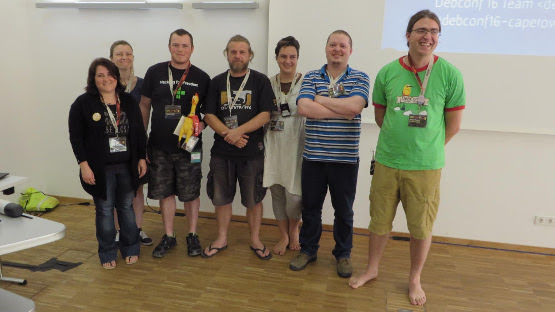
Debconf 15 In August (that was 2 months ago, really!?) I attended DebCamp and DebConf in Heidelberg, Germany. This blog post is somewhat belated due to the debbug (flu obtained during DebConf) and all the catching up I had to do since then. Debcamp Debcamp was great, I got to hack on some of my Python related packages that were in need of love for a long time and also got to spend a lot of time tinkering with VLC for the Video Team. Even better than that, I caught up with a lot of great people I haven t seen in ages (and met new ones) and stayed up waaaaay too late drinking beer, playing Mao and watching meteor showers. Debconf At Debconf, I gave a short talk about AIMS Desktop (slides) but also expanded on the licensing problems we ve had with Ubuntu on that project. Not all was bleak on the Ubuntu front though, some Ubuntu/Canonical folk were present at DebConf and said that they d gladly get involved with porting Ubiquity (the Ubuntu installer, a front-end to d-i) to Debian. That would certainly be useful to many derivatives including potentiall AIMS Desktop if it were to move over to Debian. AIMS Desktop talk slides: We re hosting DebConf in Cape Town next year and did an introduction during a plenary (slides). It was interesting spending some time with the DC15 team and learning how they work, it s amazing all the detail they have to care about and how easy they made it look from the outside, I hope the DC16 team will pull that off as well. Debconf 16 Slides: DC16 at DC15 talk DebConf 16 team members present at DebConf16 during DC16 presentation: I uploaded my photos to DebConf Gallery, Facebook and Google, take your pick ;-), many sessions were recorded, catch them on video.debian.net. If I had to summarize everything that I found interesting I d have to delay posting this entry even further, topics that were particularly interesting were: Pollito s First Trip to Africa In my state of flu with complete lack of concentration for anything work related, I went ahead and made a little short story documenting Pollito s (the DebConf mascot chicken) first trip to Africa. It s silly but it was fun to make and some people enjoyed it ^_^ Well, what else can I say? DebConf 15 was a blast! Hope to see you at Debconf 16!

Next.

Previous.