John Goerzen: Reactions to Has modern Linux lost its way? and the value of simplicity
Apparently I touched a nerve with my recent post about the growing complexity of issues.
There were quite a few good comments, which I ll mention here. It s provided me some clarity on the problem, in fact. I ll try to distill a few more thoughts here.
The value of simplicity and predictability
The best software, whether it s operating systems or anything else, is predictable. You read the documentation, or explore the interface, and you can make a logical prediction that when I do action X, the result will be Y. grep and cat are perfect examples of this.
The more complex the rules in the software, the more hard it is for us to predict. It leads to bugs, and it leads to inadvertant security holes. Worse, it leads to people being unable to fix things themselves one of the key freedoms that Free Software is supposed to provide. The more complex software is, the fewer people will be able to fix it by themselves.
Now, I want to clarify: I hear a lot of talk about ease of use. Gnome removes options in my print dialog box to make it easier to use. (This is why I do not use Gnome. It actually makes it harder to use, because now I have to go find some obscure way to just make the darn thing print.) A lot of people conflate ease of use with ease of learning, but in reality, I am talking about neither.
I am talking about ease of analysis. The Linux command line may not have pointy-clicky icons, but at least at one time once you understood ls -l and how groups, users, and permission bits interacted, you could fairly easily conclude who had access to what on a system. Now we have a situation where the answer to this is quite unclear in terms of desktop environments (apparently some distros ship network-manager so that all users on the system share the wifi passwords they enter. A surprise, eh?)
I don t mind reading a manpage to learn about something, so long as the manpage was written to inform.
With this situation of dbus/cgmanager/polkit/etc, here s what it feels like. This, to me, is the crux of the problem:
It feels like we are in a twisty maze, every passage looks alike, and our flashlight ran out of battieries in 2013. The manpages, to the extent they exist for things like cgmanager and polkit, describe the texture of the walls in our cavern, but don t give us a map to the cave. Therefore, we are each left to piece it together little bits at a time, but there are traps that keep moving around, so it s slow going.
And it s a really big cave.
Other user perceptions
There are a lot of comments on the blog about this. It is clear that the problem is not specific to Debian. For instance:
- Christopher writes that on Fedora, annoying, niggling problems that used to be straightforward to isolate, diagnose and resolve by virtue of the platform s simple, logical architecture have morphed into a morass that s worse than the Windows Registry. Alessandro Perucchi adds that he s been using Linux for decades, and now his wifi doesn t work, suspend doesn t work, etc. in Fedora and he is surprisingly unable to fix it himself.
- Nate bargman writes, in a really insightful comment, I do feel like as though I m becoming less a master of and more of a slave to the computing software I use. This is not a good thing.
- Singh makes the valid point that this stuff is in such a state of flux that even if a person is one of the few dozen in the world that understand what goes into a session today, the knowledge will be outdated in 6 months. (Hal, anyone?)
 In past days, several new free software projects have been added to
 It is time for some more music. This woman was introduced to me by a friend who actually understands what she sings about, because she sings in French. Regardless, her voice and feeling for music touched me deep, so today I want to present to you
 Carlton Ward


 I was asked in

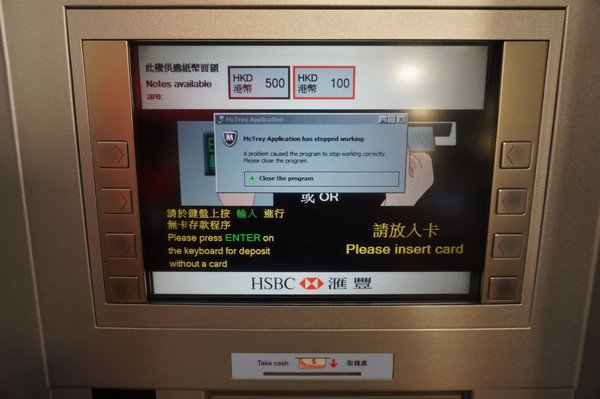
 Seen on an ATM in Hong Kong airport.
 AltOS 1.6 TeleDongle v3.0 support and bug fixes
Bdale and I are pleased to announce the release of


 Happy birthday
Lumicall's
 I would expect brute-force login attacks to be more common. And yes, at some point I got tired of ssh scans, and added rate-limiting firewall rules, even switched the daemon to a nonstandard port... But I have very seldom received an IMAP brute-force attack. I have received countless phishing scams on my users, and I know some of them have bitten because the scammers then use their passwords on my servers to send tons of spam. Activity is clearly atypical.
Anyway, yesterday we got a brute-force attack on IMAP. A very childish atack, attempted from an IP in the largest ISP in Mexico, but using only usernames that would not belong in our culture (mosty English firstnames and some usual service account names).
What I find interesting to see is that each login was attempted a limited (and different) amount of times: Four account names were attempted only once, eight were attempted twice, and so on following this pattern:
 I ve mentioned earlier