Search Results: "ina"

4 May 2014

Jonathan Wiltshire: iptables-persistent overhaul

A couple of weeks ago I finally got round to doing some major surgery on iptables-persistent. First of all it is principally now called netfilter-persistent (although the source package hasn t been renamed) and has a plugin architecture so that it can be extended by other packages. One of those packages is iptables-persistent; others may follow. This opens the way to fixing #662743 and #697088 (patches always welcome). There s also a new binary to handle loading/unloading of rules, instead of having all the logic in an init script. I was therefore able to add systemd support as a first-class unit, and I d appreciate patches for an Upstart service (as I m largely unfamiliar with it). Plugins are simply dropped into /usr/share/netfilter-persistent/plugins.d and must follow certain minimum conventions, detailed in netfilter-persistent(1). They can be any executable, so compiled or interpreted binaries are acceptable. This release finally gets the magic 1.0 identifier. It reaches Jessie today, and is already in Ubuntu Utopic. Flattr
iptables-persistent overhaul is a post from: jwiltshire.org.uk Flattr

Francois Marier: What's in a debian/ directory?

If you're looking to get started at packaging free software for Debian, you should start with the excellent New Maintainers' Guide or the Introduction to Debian Packaging on the Debian wiki. Once you know the basics, or if you prefer to learn by example, you may be interested in the full walkthrough which follows. We will look at the contents of three simple packages.

node-libravatar This package is a node.js library for the Libravatar service. Version 2.0.0-3 of that package contains the following files in its debian/ directory:
  • changelog
  • compat
  • control
  • copyright
  • docs
  • node-libravatar.install
  • rules
  • source/format
  • watch

debian/control
Source: node-libravatar
Priority: extra
Maintainer: Francois Marier <francois@debian.org>
Build-Depends: debhelper (>= 9)
Standards-Version: 3.9.4
Section: web
Homepage: https://github.com/fmarier/node-libravatar
Vcs-Git: git://git.debian.org/collab-maint/node-libravatar.git
Vcs-Browser: http://git.debian.org/?p=collab-maint/node-libravatar.git;a=summary
Package: node-libravatar
Architecture: all
Depends: $ shlibs:Depends , $ misc:Depends , nodejs
Description: libravatar library for NodeJS
 This library allows web application authors to make use of the free Libravatar
 service (https://www.libravatar.org). This service hosts avatar images for
 users and allows other sites to look them up using email addresses.
 .
 node-libravatar includes full support for federated avatar servers.
This is probably the most important file since it contains the bulk of the metadata about this package. Maintainer is a required field listing the maintainer of that package, which can be a person or a team. It only contains a single value though, any co-maintainers will be listed under the optional Uploaders field. Build-Depends lists the packages which are needed to build the package (e.g. a compiler), as opposed to those which are needed to install the binary package (e.g. a library it uses). Standards-Version refers to the version of the Debian Policy that this package complies with. The Homepage field refers to the upstream homepage, whereas the Vcs-* fields point to the repository where the packaging is stored. If you take a look at the node-libravatar packaging repository you will see that it contains three branches:
  • upstream is the source as it was in the tarball downloaded from upstream.
  • master is the upstream branch along with all of the Debian customizations.
  • pristine-tar is unrelated to the other two branches and is used by the pristine-tar tool to reconstitute the original upstream tarball as needed.
After these fields comes a new section which starts with a Package field. This is the definition of a binary package, not to be confused with the Source field at the top of this file, which refers to the name of the source package. In this particular example, they are both the same and there is only one of each, however this is not always the case, as we'll see later. Inside that binary package definition, lives the Architecture field which is normally one of these two:
  • all for a binary package that will work on all architectures but only needs to be built once
  • any for a binary package that will work everywhere but that will need to be built separately for each architecture
Finally, the last field worth pointing out is the Depends field which lists all of the runtime dependencies that the binary package has. This is what will be pulled in by apt-get when you apt-get install node-libravatar. The two variables will be substituted later by debhelper.

debian/changelog
node-libravatar (2.0.0-3) unstable; urgency=low
  * debian/watch: poll github directly
  * Bump Standards-Version up to 3.9.4
 -- Francois Marier <francois@debian.org>  Mon, 20 May 2013 12:07:49 +1200
node-libravatar (2.0.0-2) unstable; urgency=low
  * More precise license tag and upstream contact in debian/copyright
 -- Francois Marier <francois@debian.org>  Tue, 29 May 2012 22:51:03 +1200
node-libravatar (2.0.0-1) unstable; urgency=low
  * New upstream release
    - new non-backward-compatible API
 -- Francois Marier <francois@debian.org>  Mon, 07 May 2012 14:54:19 +1200
node-libravatar (1.1.1-1) unstable; urgency=low
  * Initial release (Closes: #661771)
 -- Francois Marier <francois@debian.org>  Fri, 02 Mar 2012 15:29:57 +1300
This may seem at first like a mundane file, but it is very important since it is the canonical source of the package version (2.0.0-3 in this case). This is the only place where you need to bump the package version when uploading a new package to the Debian archive. The first line also includes the distribution where the package will be uploaded. It is usually one of these values:
  • unstable for the vast majority of uploads
  • stable for uploads that have been approved by the release maintainers and fix serious bugs in the stable version of Debian
  • stable-security for security fixes to the stable version of Debian that cannot wait until the next stable point release and have been approved by the security team
Packages uploaded to unstable will migrate automatically to testing provided that a few conditions are met (e.g. no release-critical bugs were introduced). The length of time before that migration is influenced by the urgency field (low, medium or high) in the changelog entry. Another thing worth noting is that the first upload normally needs to close an ITP (Intent to Package) bug.

debian/rules
#!/usr/bin/make -f
# -*- makefile -*-
%:
    dh $@ 
override_dh_auto_test:
As can be gathered from the first two lines of this file, this is a Makefile. This is what controls how the package is built. There's not much to see and that's because most of its content is automatically added by debhelper. So let's look at it in action by building the package:
$ git buildpackage -us -uc
and then looking at parts of the build log (../node-libravatar_2.0.0-3_amd64.build):
 fakeroot debian/rules clean
dh clean 
   dh_testdir
   dh_auto_clean
   dh_clean
One of the first things we see is the debian/rules file being run with the clean target. To find out what that does, have a look at the dh_auto_clean which states that it will attempt to delete build residues and run something like make clean using the upstream Makefile.
 debian/rules build
dh build 
   dh_testdir
   dh_auto_configure
   dh_auto_build
Next we see the build target being invoked and looking at dh_auto_configure we see that this will essentially run ./configure and its equivalents. The dh_auto_build helper script then takes care of running make (or equivalent) on the upstream code. This should be familiar to anybody who has ever built a piece of free software from scratch and has encountered the usual method for building from source:
./configure
make
make install
Finally, we get to actually build the .deb:
 fakeroot debian/rules binary
dh binary 
   dh_testroot
   dh_prep
   dh_installdirs
   dh_auto_install
   dh_install
...
   dh_md5sums
   dh_builddeb
dpkg-deb: building package  node-libravatar' in  ../node-libravatar_2.0.0-3_all.deb'.
Here we see a number of helpers, including dh_auto_install which takes care of running make install. Going back to the debian/rules, we notice that there is manually defined target at the bottom of the file:
override_dh_auto_test:
which essentially disables dh_auto_test by replacing it with an empty set of commands. The reason for this becomes clear when we take a look at the test target of the upstream Makefile and the dependencies it has: tap, a node.js library that is not yet available in Debian. In other words, we can't run the test suite on the build machines so we need to disable it here.

debian/compat
9
This file simply specifies the version of debhelper that is required by the various helpers used in debian/rules. Version 9 is the latest at the moment.

debian/copyright
Format: http://www.debian.org/doc/packaging-manuals/copyright-format/1.0/
Upstream-Name: node-libravatar
Upstream-Contact: Francois Marier <francois@libravatar.org>
Source: https://github.com/fmarier/node-libravatar
Files: *
Copyright: 2011 Francois Marier <francois@libravatar.org>
License: Expat
Files: debian/*
Copyright: 2012 Francois Marier <francois@debian.org>
License: Expat
License: Expat
 Permission is hereby granted, free of charge, to any person obtaining a copy of this
 software and associated documentation files (the "Software"), to deal in the Software
 without restriction, including without limitation the rights to use, copy, modify,
 merge, publish, distribute, sublicense, and/or sell copies of the Software, and to
 permit persons to whom the Software is furnished to do so, subject to the following
 conditions:
 .
 The above copyright notice and this permission notice shall be included in all copies
 or substantial portions of the Software.
 .
 THE SOFTWARE IS PROVIDED "AS IS", WITHOUT WARRANTY OF ANY KIND, EXPRESS OR IMPLIED,
 INCLUDING BUT NOT LIMITED TO THE WARRANTIES OF MERCHANTABILITY, FITNESS FOR A
 PARTICULAR PURPOSE AND NONINFRINGEMENT. IN NO EVENT SHALL THE AUTHORS OR COPYRIGHT
 HOLDERS BE LIABLE FOR ANY CLAIM, DAMAGES OR OTHER LIABILITY, WHETHER IN AN ACTION OF
 CONTRACT, TORT OR OTHERWISE, ARISING FROM, OUT OF OR IN CONNECTION WITH THE SOFTWARE
 OR THE USE OR OTHER DEALINGS IN THE SOFTWARE.
This machine-readable file lists all of the different licenses encountered in this package. It requires that the maintainer audits the upstream code for any copyright statements that might be present in addition to the license of the package as a whole.

debian/docs
README.md
This file contains a list of upstream files that will be copied into the /usr/share/doc/node-libravatar/ directory by dh_installdocs.

debian/node-libravatar.install
lib/*    usr/lib/nodejs/
The install file is used by dh_install to supplement the work done by dh_auto_install which, as we have seen earlier, essentially just runs make install on the upstream Makefile. Looking at that upstream Makefile, it becomes clear that the files will need to be installed manually by the Debian package since that Makefile doesn't have an install target.

debian/watch
version=3
https://github.com/fmarier/node-libravatar/tags /fmarier/node-libravatar/archive/node-libravatar-([0-9.]+)\.tar\.gz
This is the file that allows Debian tools like the Package Tracking System to automatically detect that a new upstream version is available. What it does is simply visit the upstream page which contains all of the release tarballs and look for links which have an href matching the above regular expression. Running uscan --report --verbose will show us all of the tarballs that can be automatically discovered using this watch file:
-- Scanning for watchfiles in .
-- Found watchfile in ./debian
-- In debian/watch, processing watchfile line:
   https://github.com/fmarier/node-libravatar/tags /fmarier/node-libravatar/archive/node-libravatar-([0-9.]+)\.tar\.gz
-- Found the following matching hrefs:
     /fmarier/node-libravatar/archive/node-libravatar-2.0.0.tar.gz
     /fmarier/node-libravatar/archive/node-libravatar-1.1.1.tar.gz
     /fmarier/node-libravatar/archive/node-libravatar-1.1.0.tar.gz
     /fmarier/node-libravatar/archive/node-libravatar-1.0.1.tar.gz
     /fmarier/node-libravatar/archive/node-libravatar-1.0.0.tar.gz
Newest version on remote site is 2.0.0, local version is 2.0.0
 => Package is up to date
-- Scan finished

pylibravatar This second package is the equivalent Python library for the Libravatar service. Version 1.6-2 of that package contains similar files in its debian/ directory, but let's look at two in particular:
  • control
  • upstream/signing-key.asc

debian/control
Source: pylibravatar
Section: python
Priority: optional
Maintainer: Francois Marier <francois@debian.org>
Build-Depends: debhelper (>= 9), python-all, python3-all
Standards-Version: 3.9.5
Homepage: https://launchpad.net/pyLibravatar
...
Package: python-libravatar
Architecture: all
Depends: $ misc:Depends , $ python:Depends , python-dns, python
Description: Libravatar module for Python 2
 Module to make use of the federated Libravatar.org avatar hosting service
 from within Python applications.
...
Package: python3-libravatar
Architecture: all
Depends: $ misc:Depends , $ python3:Depends , python3-dns, python3
Description: Libravatar module for Python 3
 Module to make use of the federated Libravatar.org avatar hosting service
 from within Python applications.
...
Here is an example of a source package (pylibravatar) which builds two separate binary packages: python-libravatar and python3-libravatar. This highlights the fact that a given upstream source can be split into several binary packages in the archive when it makes sense. In this case, there is no point in Python 2 applications pulling in the Python 3 files, so the two separate packages make sense. Another common example is the use of a -doc package to separate the documentation from the rest of a package so that it doesn't need to be installed on production servers for example.

debian/upstream/signing-key.asc
-----BEGIN PGP PUBLIC KEY BLOCK-----
Version: GnuPG v1
mQINBEpQYz4BEAC7REQD1za69RUnkt6nRCFhSJmmoeJc+yEiWTKc9GOIMAwJDme1
+CMYgVn4Xzf1VQYwD/lE+mfWgyeMomLQjDM1mxx/LOM2a1WWPOk9+PvQwKfRJy92
...
UxDtZm/4yUmU6KvHvOGiDCMuIiB+MqhqJJ5wf80wXhzu8nmC+fyGt6nvu0ggMle8
sAMgXt/aQUTZE5zNCQ==
=RkTO
-----END PGP PUBLIC KEY BLOCK-----
This is simply the OpenPGP key that the upstream developer uses to sign release tarballs. Since PGP signatures are available on the upstream download page, it's possible to instruct uscan to check signatures before downloading tarballs. The way to do that is to use the pgpsigurlmange option in debian/watch:
version=3
opts=pgpsigurlmangle=s/$/.asc/ https://pypi.python.org/pypi/pyLibravatar https://pypi.python.org/packages/source/p/pyLibravatar/pyLibravatar-(.*)\.tar\.gz
which is simply a regular expression replacement string which takes the tarball URL and converts it to the URL of the matching PGP signature.

fcheck The last package we will look at is a file integrity checker. It essentially goes through all of the files in /usr/bin/ and /usr/lib/ and stores a hash of them in its database. When one of these files changes, you get an email. In particular, we will look at the following files in the debian/ directory of version 2.7.59-18:
  • dirs
  • fcheck.cron.d
  • fcheck.postrm
  • fcheck.postinst
  • patches/
  • README.Debian
  • rules
  • source/format

debian/patches This directory contains ten patches as well as a file called series which lists the patches that should be applied to the upstream source and in which order. Should you need to temporarily disable a patch, simply remove it from this file and it will no longer be applied at build time. Let's have a look at patches/04_cfg_sha256.patch:
Description: Switch to sha256 hash algorithm
Forwarded: not needed
Author: Francois Marier <francois@debian.org>
Last-Update: 2009-03-15
--- a/fcheck.cfg
+++ b/fcheck.cfg
@@ -149,8 +149,7 @@ TimeZone        = EST5EDT
 #$Signature      = /usr/bin/sum
 #$Signature      = /usr/bin/cksum
 #$Signature      = /usr/bin/md5sum
-$Signature      = /bin/cksum
-
+$Signature      = /usr/bin/sha256sum
 # Include an optional configuration file.
This is a very simple patch which changes the default configuration of fcheck to promote the use of a stronger hash function. At the top of the file is a bunch of metadata in the DEP-3 format. Why does this package contain so many customizations to the upstream code when Debian's policy is to push fixes upstream and work towards reduce the delta between upstream and Debian's code? The answer can be found in debian/control:
Homepage: http://web.archive.org/web/20050415074059/www.geocities.com/fcheck2000/
This package no longer has an upstream maintainer and its original source is gone. In other words, the Debian package is where all of the new bug fixes get done.

debian/source/format
3.0 (quilt)
This file contains what is called the source package format. What it basically says is that the patches found in debian/patches/ will be applied to the upstream source using the quilt tool at build time.

debian/fcheck.postrm
#!/bin/sh
# postrm script for fcheck
#
# see: dh_installdeb(1)
set -e
# summary of how this script can be called:
#        * <postrm>  remove'
#        * <postrm>  purge'
#        * <old-postrm>  upgrade' <new-version>
#        * <new-postrm>  failed-upgrade' <old-version>
#        * <new-postrm>  abort-install'
#        * <new-postrm>  abort-install' <old-version>
#        * <new-postrm>  abort-upgrade' <old-version>
#        * <disappearer's-postrm>  disappear' <overwriter>
#          <overwriter-version>
# for details, see http://www.debian.org/doc/debian-policy/ or
# the debian-policy package
case "$1" in
    remove upgrade failed-upgrade abort-install abort-upgrade disappear)
    ;;
    purge)
      if [ -e /var/lib/fcheck/fcheck.dbf ]; then
        echo "Purging old database file ..."
        rm -f /var/lib/fcheck/fcheck.dbf
      fi
      rm -rf /var/lib/fcheck
      rm -rf /var/log/fcheck
      rm -rf /etc/fcheck
    ;;
    *)
        echo "postrm called with unknown argument \ $1'" >&2
        exit 1
    ;;
esac
# dh_installdeb will replace this with shell code automatically
# generated by other debhelper scripts.
#DEBHELPER#
exit 0
This script is one of the many possible maintainer scripts that a package can provide if needed. This particular one, as the name suggests, will be run after the package is removed (apt-get remove fcheck) or purged (apt-get remove --purge fcheck). Looking at the case statement above, it doesn't do anything extra in the remove case, but it deletes a few files and directories when called with the purge argument.

debian/README.Debian This optional README file contains Debian-specific instructions that might be useful to users. It supplements the upstream README which is often more generic and cannot assume a particular system configuration.

debian/rules
#!/usr/bin/make -f
# -*- makefile -*-
# Sample debian/rules that uses debhelper.
# This file was originally written by Joey Hess and Craig Small.
# As a special exception, when this file is copied by dh-make into a
# dh-make output file, you may use that output file without restriction.
# This special exception was added by Craig Small in version 0.37 of dh-make.
# Uncomment this to turn on verbose mode.
#export DH_VERBOSE=1
build-arch:
build-indep:
build: build-stamp
build-stamp:
    dh_testdir
    pod2man --section=8 $(CURDIR)/debian/fcheck.pod > $(CURDIR)/fcheck.8
    touch build-stamp
clean:
    dh_testdir
    dh_testroot
    rm -f build-stamp 
    rm -f $(CURDIR)/fcheck.8
    dh_clean
install: build
    dh_testdir
    dh_testroot
    dh_prep
    dh_installdirs
    cp $(CURDIR)/fcheck $(CURDIR)/debian/fcheck/usr/sbin/fcheck
    cp $(CURDIR)/fcheck.cfg $(CURDIR)/debian/fcheck/etc/fcheck/fcheck.cfg
# Build architecture-independent files here.
binary-arch: build install
# Build architecture-independent files here.
binary-indep: build install
    dh_testdir
    dh_testroot
    dh_installdocs
    dh_installcron
    dh_installman fcheck.8
    dh_installchangelogs
    dh_installexamples
    dh_installlogcheck
    dh_link
    dh_strip
    dh_compress
    dh_fixperms
    dh_installdeb
    dh_shlibdeps
    dh_gencontrol
    dh_md5sums
    dh_builddeb
binary: binary-indep binary-arch
.PHONY: build clean binary-indep binary-arch binary install
This is an example of a old-style debian/rules file which you still encounter in packages which haven't yet upgraded to the latest version of debhelper 9, as can be shown by the contents of debian/compat:
8
It does essentially the same thing that what we've seen in the build log, but in a more verbose way.

debian/dirs
usr/sbin
etc/fcheck
This file contains a list of directories that dh_installdirs will create in the build directory. The reason why these directories need to be created is that files are copied into these directories in the install target of the debian/rules file. Note that this is different from directories which are created at the time of installation of the package. In that case, the directory (e.g. /var/log/fcheck/) must be created in the postinst script and removed in the postrm script.

debian/fcheck.cron.d
#
# Regular cron job for the fcheck package
#
30 */2  * * *   root    test -x /usr/sbin/fcheck && if ! nice ionice -c3 /usr/sbin/fcheck -asxrf /etc/fcheck/fcheck.cfg >/var/run/fcheck.out 2>&1; then mailx -s "ALERT: [fcheck]  hostname --fqdn " root </var/run/fcheck.out ; /usr/sbin/fcheck -cadsxlf /etc/fcheck/fcheck.cfg ; fi ; rm -f /var/run/fcheck.out
This file is the cronjob which drives the checks performed by this package. It will be copied to /etc/cron.d/fcheck by dh_installcron.

3 May 2014

Matthias Klumpp: Translated AppStream metadata for KDE!

kde-appstreamIt took some time, but now it s finally done: KDE has translations for AppStream upstream metadata! AppStream is a Freedesktop project to extend metadata about the software projects which is available in distributions, especially regarding applications. Distributions compile a metadata file from data collected from packages, .desktop files and possibly other information sources, and create an AppStream XML file from it, which is then directly or via a Xapian cache read by software-center-like applications such as GNOME-Software or KDEs Apper. Since the metadata available from current sources is not standardized and rather poor, upstream projects can ship small XML files, AppStream upstream metadata or AppData in short. These files contain additional information about a project, such as a long description and links to screenshots. They also provide hints about public interfaces a software provides, for example binaries and libraries, making it possible for distributors to give users exactly the right package name in case they are missing a software component. So, in order to represent graphical KDE applications like they deserve it in the new software centers making use of AppStream, we need to ship AppData files, with long descriptions, screenshots and a few URLs. But how can you create these metadata files? In case you want your graphical KDE app to ship an AppData file, there is now a help page on the Techbase Wiki which provides all information needed to get started! For non-visual stuff or software which just wants to publish it s provided interfaces with AppStream metadata, there is a dedicated page for that as well. Shipping metadata for non-GUI apps will help programmers to satisfy depedencies in order to compile new software, enhance bash-completion for missing binaries and provides some other neat stuff (take a look at this blogpost to get a taste of it). And if you want to read a FAQ about the metadata stuff and get the bigger picture, just go to the Techbase Wiki page about AppStream metadata as well. The pages are not 100% final, so if you have questions, please write me a mail and I ll update the pages, or simply correct/refine it by yourself (it s a wiki afterall). And now to the best thing: As soon as you ship an AppStream upstream metadata file (*.appdata.xml* for apps or *.metainfo.xml* for other stuff), the KDE l10n-script (Scripty!) will automatically start translating it, just like we already do with .desktop files. No further actions are necessary. I already have a large amount of metadata files here, partially auto-generated, which show that we have about 160+ applications in KDE which could get an AppData file, not counting any frameworks or other non-GUI stuff yet. Since that is a bit much to submit via Reviewboard (which I originally planned to do), I hope I can commit the changes directly to the respective repositories, where the maintainers can take a look at it and adjust it to their liking. If that idea does not receive approval, I will just publish a set of data at some place for the KDE app maintainers to take as a reference (the auto-generated stuff needs some fixup to be commit-ready (which I d do in case I can just commit changes)). Either way, it is safe now to write and ship AppData files in KDE projects! In order to get your stuff translated, it is necessary that you follow the AppStream 0.6 metadata specification, and not one of ther older revisions. You can easily detect 0.6 metadata by the <component> root node, instead of <application>, or by it having a metadata_license tag. We don t support the older versions simply because it s not necessary, as there were only two KDE projects shipping AppData before, which are now using 0.6 data as well. Since 0.6, the metadata XML format is guaranteed to be stable, and the only reason which could make me change it in an incompatible way is to prevent something as bad as the end of the world from happening (== won t happen ;-) ). You can find the full specification (upstream and distro data) here. All parsers are able to handle 0.6 data now, and the existing tools are almost all migrated already (might take a few months to hit the distributions though). So, happy metadata-writing! :-) Thanks to all people who helped with making this happen, and especially Burkhard L ck and Albert Astals Cid for their patch-review and help with integrating the necessary changes into the KDE l10n-script.

Dirk Eddelbuettel: RcppSMC 0.1.3 and 0.1.4

The very useful Valgrind tool had flagged an actual error in the package which the CRAN maintainers asked us to address. This was followed by a minor brown-bad oversight of a missing delete, also tagged by Valgrind. Both are pretty ancient bugs which we probably should have found aeons ago. Releases 0.1.3 and 0.1.4 made it to CRAN yesterday in short succession. To recap, RcppSMC combines the SMCTC template classes for Sequential Monte Carlo and Particle Filters (Johansen, 2009, JSS) with the Rcpp package for R/C++ Integration (Eddelbuettel and Francois, 2011, JSS) and thereby allows for easier and more direct access from R to the computational core of the Sequential Monte Carlo algorithm. The two NEWS entries are below:
Changes in RcppSMC version 0.1.4 (2014-05-02)
  • Added missing delete operator to destructor in sampler
Changes in RcppSMC version 0.1.3 (2014-05-01)
  • Bugfix in Sampler.iterate() for memory overrun detected by valgrind
Courtesy of CRANberries, there are also diffstat reports for 0.1.3. and 0.1.4. As always, more detailed information is on the RcppSMC page,

This post by Dirk Eddelbuettel originated on his Thinking inside the box blog. Please report excessive re-aggregation in third-party for-profit settings.

Russell Coker: Source Escrow for Proprietary Software

British taxpayers are paying for extra support for Windows XP due to a lack of planning by the UK government [1]. While the cost of this is trivial compared to other government stupidity (such as starting wars of aggression) this sort of thing should be stopped. The best way to solve such problems is for governments to only use free software. If the UK government used Red Hat Enterprise Linux then when Red Hat dropped support for old versions they would have the option of providing their own support for old versions, hiring any other company to support old versions, or paying Red Hat for supporting it. In that case the Red Hat offer would probably be quite reasonable as competition drives the prices down. It doesn t seem likely that the UK government will start using only free software in the near future. It s not impossible to do so, there are organisations dedicated to this task such as Free-gov.org which aims to develop e-government software that is under GPL licenses [2]. The Wikipedia page List of Linux Adopters [3] has a large section on government use, while not all entries are positive (some have reverted) it shows that it s possible to use Linux for all areas of government. But governments often move slowly and in the case of wealthy countries such as the UK it can be easier to just tax the citizens a little more than to go to the effort of saving money. But when governments use proprietary software they shouldn t be restricted in support. It seems that the only way to ensure that the government can do what it needs is to have a source escrow system. Then if the company that owned the software ceased supporting it anyone who wanted to offer support would be able to do so. This would probably require that software which is out of support be released to the public domain so that anyone who wanted to tender for such support work could first inspect the code to determine if they were capable of doing the work. People who believe the myths about secret source software claim that allowing the source code to be released would damage the company that owns it. This has been proved incorrect by the occasions when source code for software such as MS-Windows has been released on the Internet with no apparent harm. Also Microsoft have a long history of licensing their source code to universities, governments, and other companies for various purposes (including porting Windows to other CPUs). It s most likely that some part of the UK government already has the full source code to Windows XP, and it s also quite likely that computer criminals have obtained copies of the source by now for the purpose of exploiting security flaws. Also they stop supporting software when they can t make money from providing the usual support, so by definition the value to a company of the copyright is approaching zero by the time they decide to cease support. Given the lack of success experienced by companies that specialise in security (for example the attack on RSA to steal the SecurID data [4]) it doesn t seem plausible that Microsoft has had much success in keeping the source to Windows XP (or any other widely used product) secret over the course of 12 years. In summary source code to major proprietary software products is probably available to criminals long before support expires and is of little value to the copyright owners. But access to it can provide value to governments and other users of the software. The only possible down-side to the software vendor is if the new version doesn t provide any benefits to the user. This could be a problem for Microsoft who seem to have the users hate every second version of Windows enough to pay extra for the old version. The solution is to just develop quality software that satisfies the needs of the users. Providing a legal incentive for this would be a good idea.

2 May 2014

Vasudev Kamath: Note to Self: How to use url_for in Flask application

url_for is normally used to avoid hard coding of URL in Flask based webapps. I've been using it in SILPA port written using Flask by. But this was written long back and written as POC to show for Santhosh author of SILPA app which even managed to go into production :-). Recently I started organizing the code and started using flask.Blueprint which was previously written using flask.views.MethodView class and here I started facing problem with old templates. I'm just gonna explain what is the difference when using url_for with MethodView and Blueprint. Lets have some sample code for MethodView first, this code is from Flask documentation.
from flask.views import MethodView
class UserAPI(MethodView):
       def get(self):
           users = User.query.all()
           ...
       def post(self):
           user = User.from_form_data(request.form)
           ...
app.add_url_rule('/users/', view_func=UserAPI.as_view('users'))
Here we have a view which is derived from MethodView which has logic on how to handle the requests. We use add_url_rule to register rule to handle /users/ url end point and we pass the class as view function which is done by as_view class method and we can refer this method in our Jinja2 templates using name users. So a statement like
url_for('users')
in our templates will be converted to /users/ URL when page is rendered to client by Flask. Now when I replaced the MethodView in favor of Blueprint I started getting up werkzeug.routing.BuildError thrown on my face and I had no clue why!. Yeah I know I'm bad at reading documentation but even after reading documentation I was still thinking that
url_for('/')
should return me a proper URL and I was wondering why its failing. Finally after re-reading documentation for url_for it was becoming clear to me, url_for definition looks like below
flask.url_for(endpoint, **values)
Here endpoint is actually a function which is supposed to be serving the URL and **values is the arguments for this function. The URL in question should be defined in python code using decorator. In my case following is the new function serving the web pages for SILPA.
bp = Blueprint('frontend', __name__)
@bp.route(_BASE_URL, defaults= 'page': 'index.html' )
@bp.route(_BASE_URL + '<page>')
def serve_pages(page):
       if page == "index.html":
          return render_template('index.html', title='SILPA',
                               main_page=_BASE_URL,
                               modules=_modulename_to_display)
       elif page == "License":
          return render_template('license.html', title='SILPA License',
                                main_page=_BASE_URL,
                                modules=_modulename_to_display)
       elif page == "Credits":
           return render_template('credits.html', title='Credits',
                                main_page=_BASE_URL,
                                modules=_modulename_to_display)
       elif page == "Contact":
           return render_template('contact.html', title='Contact SILPA Team',
                                main_page=_BASE_URL,
                                modules=_modulename_to_display)
       else:
           # modules requested!.
           if page in _display_module_map:
               return render_template(_display_module_map[page] + '.html',
                                    title=page, main_page=_BASE_URL,
                                    modules=_modulename_to_display)
           else:
               # Did we encounter something which is not registered by us?
               return abort(404)
You can ignore function code but just note the decorators, here I'm registering the function serve_pages with page as argument for URL patterns / and /<page>, _BASE_URL here is mount point of application it can be just / or /mountpoint depending on that URL registered changes. Now I need to modify code for all url_for in my template to look like below
url_for('.serve_pages', page='/License') # for /License
url_for('.serve_pages') # which will turn in to /index.html
The . in front of function is for referring current Blueprint, in my case the Flask will consider it as frontend.serve_pages as function name and generates appropriate URL at run time. So my fault was misunderstanding endpoint argument as URL endpoint but where as its actually function name supposed to serve the page. But when using MethodViews I can simply convert class to a function with my preferred name just like UserAPI.as_view('/') so url_for('/') just works.

1 May 2014

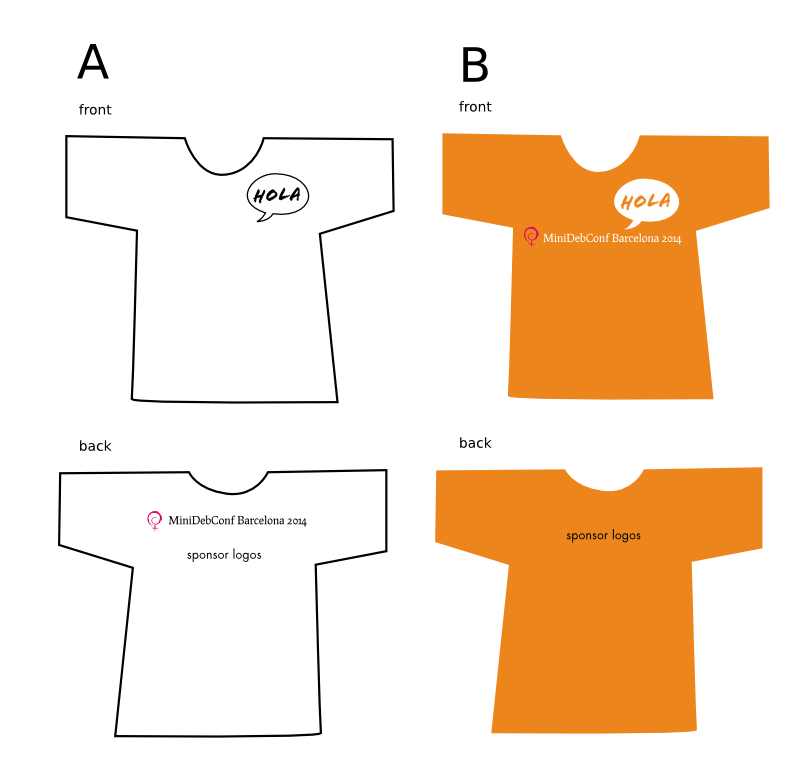
Siri Reiter: Communication building blocks for MiniDebConf Barcelona 2014 (drafts)

Sustainable visual identity design is a design that recycles as many elements as possible with every new piece of communication. Not only is a brand strengthened every time the logo and any other identity forming visual element is used, a lot of work is also saved as well. Every logo variant is a weakening of the brand, not a strengthening. Of course design improvements can be made - always, all year 'round - preferably not right up to the next conference. I consider it a waste of time to create a sublogo for a minidebconf. The Debian logo is perfectly suitable as logo for a Debian conference. In the particular case of the Barcelona MiniDebConf 2014, I think the Debian Women logo is the proper logo to use, though, since it is a Debian Women project, contradictionary as it may sound. The same principle of recycling typography and grids. I'd like as much identity matter - and work - to be reused, as possible. There is no need to reinvent the wheel every time. A visual theme created with illustration and colour schemes is enough as identity indicator for smaller events like MiniDebConfs. In my opinion.

Logo and logotype The Debian Women logo. Event name set in the font Procipio, familiar to the Debian logo. The name is long and cannot be scaled down much. A version with the name set in two lines can be used in narrow space, like on a folder.

Theme The speech bubble is a part of the visual theme. Orange is a color I connect with Spain, sun and oranges. I suggest it used with red like the Debian logo red.

Poster The speech bubbles could be used in a varied form. I've stated a few important statements here. I'd like a shared list of statements. There must be other info on the poster as well. The white space at the bottom is for sponsor logos. The font I use in the speech bubbles in this draft is an Apple font called Flood. I'd like to find a free font with similar qualities.

T-shirt There are many possibilities. I like the idea of printing just a speech bubble in the front and give people the opportunity to write their personal statements with textile pens. Nametags could be badges to be filled out on the spot with a pen.

Siri Reiter: Colortest1

My proposal for visual design for the MiniDebConf has been received well. People seem to like the general idea, which worried me the most. If people hated that idea, I'd have to go back and cook something up on Mir However, organizers in Spain do worry that the visual expression will be confused with that of a local political party. election poster I see no danger of that. They use speech bubbles and orange. So does the telecompany Orange (if it still exists) - and Ubuntu. By the way, I see in this small size that my new choice of font for the speech bubbles is too weak. It needs more work. It's been suggested I try out a brighter orange. The color in the middle is my original choice, the one at the top is fine, but you can almost tell no difference, when they are not placed closely together. The same danger of confusion will (not) be there with any orange from "curry" to "crocus". I show the color in the bottom because it makes it evident how narrow the gap between these colors is - there is very tight room for adjustments. Yellow is too bright and cheap looking, like a discount sign color. I've looked into other colors, but so far I've not found any good replacement, since I no longer have any gut feeling to hang my hat on, except for the Debian logo color - they have to be a good match. I know I'm free to do whatever, Jonas just reminded me, but of all the colors in the World, thinking of Spain, I only feel orange. Not blue, not green, not purple. Red is already used. Yellow looks cheap. A dusty palette is not uplifting I could choose a pink, and that would actually be fun. But pink is not serious. Pink can't be taken seriously. Like women can't? OK, now it's gotta be pink! Well, I'm not really serious now. The serious thing to do for me now will be to watch some Spanish movies to get a new gut feeling about Spain. A dosis of Almod var would be suitable. Alternatively I must chat with some Spanish friends. But maybe, just maybe, the Barcelona organizers will be just as happy with the new orange color as I am. Life can sometimes be that easy.

Siri Reiter: That goddamned perfection again

Since the MiniDebConf Jonas and I have been travelling in Spain, France and finally staying in Belgium for a week, getting some work done. It's been harder than imagined to work during travel. I haven't exercised either, and regained at least three of four kilos I spent much time and effort getting rid in the year preceding. I thrive in my home and find it hard to keep my own time and focus when I am deprived of my own space. It was challenging to give a talk, "Why aren't more designers using Debian or working for Debian", my first public talk. I've been working to recapture my points in writing, to make a stronger statement, but I seem to blur my own views with conflicting ones, and I'm loosing momentum every day. One of my reasons for speaking up was to do it even though I'm not at trained speaker and have "nothing" to contribute but my opinions from the angle of a user that happens to be a designer. Not claiming to be a superior designer, but one that would like to contribute if it was easier to figure out how. And since the community wants to encourage designers to contribute to the Debian project, I figured it to be a good idea to talk about how this has been challenging to me as a dedicated user and completely out of the question for any other designer I know - or knew before the minidebconf. No reseach, no scientific proofs, just my wiew from my "dumb user" and designer's perspective. I saw one single attendant rolling his eyes during my talk. I didn't care at that time, but I've given that look more consideration than the people approaching me after the talk, saying thank you for voicing their opinions and thoughts. I think that's absolutely astonishing and at the same time it's just typically me. It makes me angry, first with myself for not speaking to this man's perception of things, then with myself for not just letting go of that image. I'm really glad that so many seemed to listen with curiosity and interest. What if one more - or half of the auditorium - had rolled their eyes? I don't like to feel that vulnerable. The truth is, though, that I'm really not. I gave the talk against my fear of failure and public humiliation and I'm convinced that my thoughts and actions matter, just as anybody's does, if we dare to say what's on our minds and to take action. I believe it's in anybody's power to "make a difference" and even "change the world" - at least in a small way. I guess that's one of the underlying reasons to be a designer in the first place. That is quite a strong position to take. I've created the wikipage http://wiki.debian.org/Design - well knowing that design is a word with many meanings. Everything is design. Since the talk I've been in doubt about that page. About the project, my aim with it, what to do about it, how to move on with just a tiny babystep, and I realise that I'm simply afraid to be disturbing someone's peace, making people angry or roll their eyes at my fumbling attempts to figure out in public what can be done to make a thriving community of designers collaborating with coders to make better, more usable and attractive software in the free, wide world. I'm starting a design process, not presenting a perfect, finished solution. Now, having put these thoughts into words, perhaps, my mind will be somewhat appeaced and let me move on with my intended tasks of cultivating that acclaimed space in the Debian information jungle into a friendly and welcoming place with info that makes it easier to be a contributing designer in Debian.

Daniel Pocock: reSIProcate v1.9 WebRTC available for Fedora 20 testing

Today I just released reSIProcate v1.9 packages into the Fedora 20 testing updates repository. This means Fedora 20 users can now try WebRTC more easily. The same version is already available in Debian wheezy-backports and Ubuntu trusty. Get started today Install the resiprocate-repro proxy server package using yum. Set up a DNS entry, here is what we will use in the example:
Domain sip-ws1.example.org
WebSocket URL
Use this in JSCommunicator or JsSIP
ws://sip-ws1.example.org
IP address of server 198.51.100.50
so the DNS entry will be
sip-ws1.example.org.     IN    A    198.51.100.50
Notice that in the ws:// URL, we do not specify a port. This means port 80 is used by default. You can also use a non-standard port if you prefer or if you dont' have root permissions. Now edit the file /etc/repro/repro.config, adding a transport definition for WebSockets (WS) and change a few other parameters from their defaults:
# Bind to 198.51.100.50 on port 80
Transport1Interface = 198.51.100.50:80
# Use WS (can also use WSS for TLS, see repro.config for full details)
Transport1Type = WS
# if using WSS, must also change the transport param here
Transport1RecordRouteUri = sip:sip-ws1.example.org;transport=WS
EnableFlowTokens = true
DisableOutbound = false
# Disable all authentication - just for testing
DisableAuth = false
# allow http admin access on all interfaces,
# default is 127.0.0.1
# HttpBindAddress = 0.0.0.0
Now set up a password for the web admin tool using htdigest:
# htdigest /etc/repro/users.txt repro admin
After all that, restart the repro process
# service repro restart
Go to the web interface on port 5080 (only listening on localhost by default), go to the "ADD DOMAIN" page and add sip-ws1.example.org Now restart repro again so it recognises the new domain.
# service repro restart
Finally, you can test it using JSCommunicator or tryit.jssip.net Next steps
  • Set up a TURN server for NAT traversal
  • Use WebSockets over TLS (WSS) instead of regular WS mode
  • Set up authentication (see the various options, including client certificate support, in repro.confg)
  • Connect to regular SIP infrastructure such as Asterisk
Questions? Please come and ask on the repro-users mailing list

Joseph Bisch: GSoC Welcome Package Received

A couple days ago I received my welcome package from Google. The welcome package included a pen and a notepad that has stickers. Notepad and Pen Stickers Since my last update I got the repo setup and started working on the specifications. I have been emailing with my mentors to work out the specs. You can view the git repo. To keep up to date on my progress, you can either read this blog, or you can read the soc-corrdination mailing list once coding starts on the 19th.

MJ Ray: The Kelly Lessons in About 1555 Characters

So the Kelly report of the independent review into the events leading to the Co-operative Bank s capital shortfall was published yesterday. During the day, I was putting odd bits from it out in 140 characters with the hashtags #coops #kellylessons. Here they are in one more permanent place. How many of these lessons has your organisation whether a co-op or not learned?

  1. Running a full-service bank is a complex business Bank failed to understand the limits of its own capability
  2. The most important task for any board is to put in place the right Executive leadership for the business
  3. Ownership of a regulated bank requires a clearly articulated statement addressing mgmt & gov nance relationship
  4. Failures in board oversight are inevitable if the criteria used to elect do not require the necessary skills
  5. A bank board must include sufficient numbers of technically competent directors
  6. Boards need good m gmt info and to demand it if it is not forthcoming. Failure to obtain explains failings
  7. A bank should develop&implement robust risk gov nce&oversight and an appropriate control framework
  8. IT transformation keep as simple as poss , phase delivery.., deploy the right resources, plan for contingencies
  9. Bank should have paid closer attention and responded with greater urgency to what the Regulator told it
  10. Pay careful attention to the advice of external advisors. The Group ignored well-founded inconvenient advice
  11. Postponing dealing with problems is almost never a sustainable solution.
  12. Values need to be translated into meaningful guidance The Bank s ethical positioning should be more apparent
  13. Mantras about scale and ethics are no substitute for strategies grounded in a real understanding
  14. Talent management is critical Lack of capability driven by weaknesses in its recruitment&subsequent m gmt
  15. Tolerating culture of underperformance, weak transparency and a lack of accountability, constrains an organisation
Are there other lessons that you would add?

Andrew Pollock: [life] Day 93: A whole lot of running around

This morning Zoe woke up again at around 4am and ended up in bed with me. I don't even remember why she woke up, and neither does she, but she's assuring me it won't happen tomorrow morning. We'll see. As a result of the disturbed night's sleep, we had a bit of a slow start to the day. Zoe was happy to go off and watch some TV after she woke up for the day, and that let me have a bit more of a doze before I got up, which made things vaguely better for me. ABC 4 Kids has been showing a lot of ads for Ha Ha Hairies, which airs at 10:20am, lately, and it's one of the shows that isn't available on iView. Zoe had been lamenting that she never got to see it, and asking me if she could. Today the schedule was fairly open, so I made sure we were home at 10:20am. That involved a quick dash out to Woolies first to get a few bits and pieces for Zoe's birthday party. While Zoe watched the Ha Ha Hairies, I did some bulk egg hard boiling in the oven. After the Ha Ha Hairies and a little bit of general mucking around, we drove out to Spotlight to pick up the helium tank I'd rented. Zoe nearly fell asleep on the way out there. We picked up the helium tank and headed back home. That errand alone probably took a bit over an hour all up. We got back home and had lunch, but by the time all of that was out of the way, Zoe seemed to have missed the window for her nap. She did have a bit of a rest in bed, flipping through her library books, and I got to read some of my book as well, so that was nice. During that time, I got the call from Bunkers saying they were about half an hour out with the delivery of Zoe's bunk bed (my birthday present for her). That worked out well, as it was towards the start of the two hour window they'd advised me of. The bunk bed was delivered and then we popped out to Overflow to see if they had any food covers for the party food (they did) so we picked up a few of them. Today I learned that "As Seen On TV" is trademarked, and so "Similar To As Seen On TV" is the trademark dodging thing to put on cheap knock-offs. As Overflow is two doors down from Petbarn, we stopped in there as well and grabbed some more kitty litter. One does not just pop into Petbarn with Zoe, so we spent some time there looking at the fish and assorting aquarium paraphernalia. They also had some hermit crabs now too. On the way back home, we stopped in at (a different) Woolies to pick up the half slab of chocolate mudcake that I'd ordered for Zoe's birthday cake. I'd decided that the upright Minion cake I'd initially wanted to do was just way too adventurous for my abilities and not a good use of my time (and the quotes I'd sought for outsourcing it had come in at over $300). I scaled things back to just a flat slab Minion, which may still exceed my cake decorating abilities, but we'll find out tomorrow. There'd been a miscommunication at Woolworths, and my half slab hadn't been boxed up and wasn't ready for my collection. All the bakery staff had already gone home, and I didn't really want to come back tomorrow, because I had this crazy idea of possibly starting on the cake tonight (not going to happen), so a couple of non-bakery staff had to find the cake and figure out how to extract a full slab from the baking tray and cut it in half and box it up. It provided some entertainment for Zoe and I. We finally got home, and I rehashed some frozen leftovers for dinner. I decided to try something different for the bath time and bed time routine to see if it'd reduce procrastination. I got Zoe to pick out the three books she wanted to read at bed time before we got to story time, so we'd have something concrete to negotiate with. I also threw in the possibility of a "bonus story" if she didn't muck around. It seemed to work, and we had a fairly streamlined bath time. There's no doubt she was pretty tired today, and she went to bed without any fuss, so I'm hopeful that we'll have a good night tonight.

C.J. Adams-Collier: I think perhaps they mean could join x86 in the server room

As much as I love PowerPC, and as great as it is that they re doing this OpenPower thing, I don t think that the first step should be to eliminate the competition. Perhaps they should put some effort in to taking back a large part of the market. Didn t these guys read The Art of War?

The OpenPower Foundation, and how IBM and friends could oust x86 from the server room
I d certainly take a look at a server if they sent me one; it looks like Debian still supports powerpc arch on wheezy. ;-)

30 April 2014

Russell Coker: Links April 2014

Yves Rossy is the Jetman, he flys with a wing and four jet engines strapped to his body, he gave an interesting TED talk about flying along with some exciting videos [1]. Larry Brilliant gave an informative and inspiring TED talk about stopping pandemics [2]. I thought that Smallpox was the last disease to be eradicated but I was wrong. Michael Shermer gave an interesting TED talk about pattern recognition and self deception [3]. It s a pity that the kissing prank shown at the end only pranked women, they should be less sexist and prank men too. Raffaello D Andrea gave an interesting TED presentation about Athletic quadcopters [4]. It s very impressive and has the potential for several new human/machine sports. Lisa D wrote an insightful article about Prejudice Spillover discussing the way that people who aren t in minority groups only seem to care about injustice when a member of the majority is targetted by mistake [5]. Ron Garret wrote an insightful post about the Divine Right of Billionaires which debunks some stupid arguments by a billionaire [6]. Ron says that it s often instructive to examine incorrect arguments, especially when those arguments are advanced by smart people and demonstrates it in this post. Lisa D wrote an interesting post about her problems with financial aid bureaucracy [7]. She intended the post to be a personal one about her situation, but I think it illustrates problems with the various aid programs. If aid was available to her with less bureaucracy then she would be doing paid work, completing her studies, and heading towards post-graduate studies. Mark Shuttleworth wrote an insightful article about ACPI, security, and device tree [8]. It s the first time I ve seen a good argument for device tree. TED presented an interesting video-conference interview with Edward Snowden [9]. It s unusually long by TED standards but definitely worth watching. Tom Meagher (who s wife was raped and murdered two years ago) wrote an insightful article about rape culture [10]. Key Lay (the Victorian Chief Commissioner of Police) wrote a good article encouraging men to act to stop violence against women [11]. It s particularly noteworthy when a senior police officer speaks out about this given the difficulties women have had in reporting such crimes to police. Emily Baker wrote an insightful article about the lack of support for soldiers who survive war [12]. A lot of attention and money is spent remembering the soldiers who died in the field but little on those who live suffer afterwards, more soldiers die from suicide than enemy fire. Daniel Pocock wrote an informative article about the failings of SMS authentication for online banking [13]. While he has good points I think he s a little extreme. Stopping the least competent attackers is still a significant benefit as most potential attackers aren t that competent. Jess Zimmerman wrote an interesting article for Time about the Not All Men argument that is a current trend in derailing discussions about the treatment of women [14]. The Belle Jar has an insightful article Why Won t You Educate Me About Feminism about some ways that men pretend to care about the treatment of women [15]. Jon Evans wrote an article for Tech Crunch about the Honywell Bubble Count measure of diversity in people you follow on social media [16]. Currently on Twitter I follow 57 accounts of which 15 are companies and organisations, so I follow 42 people. I follow 13 women 31%, for a visible minority group other than my own it s 2/42 or 5%, for people who live in other countries I think it s 8/42 (although it s difficult to determine where some people live) which is 19%. So my Honywell number is 55. The Top Stocks forum has an interesting post by a Coal Seam Gas (CSG) worker [17]. It seems that CSG is even worse than I thought. Ashe Dryden wrote an informative post for Model View Culture about the backlash that members of minority groups (primarily women) receive when they speak out [18].

Andrew Pollock: [life] Day 92: Kindergarten, cleaning and more birthday party preparation

I'm mostly back into my normal routine now. Next week should be spot on. Today, after my chiropractic adjustment and another walk to the post office to collect another package, I got stuck into cleaning the house. I got that mostly done before my massage, and knocked out the rest of it before I picked up Zoe from Kindergarten. Zoe seems to have successfully dropped her day time nap at Kindergarten now, which certainly makes a huge difference to getting out of the place on time. I'd underestimated the number of kids coming to Zoe's birthday party, so I needed to get some extra goody bags made up, so we headed directly out to Westfield Carindale to raid the The Reject Shop for some more bits and pieces. After we got home from that, Zoe watched a bit of TV and helped me assemble the extra bags, and then we had dinner. After some epic procrastination (on Zoe's behalf) I managed to get her to bed approximately on time. I really need to try some different approaches to getting through the bath time routine, because it's just taking too long. I gave myself a couple of time outs because I could see the situation deteriorating if I didn't. It's unhelpful that my blog seems to be the third hit in Google at the moment for "positive parent procrastination". I don't have the answers.

Christine Spang: becoming a better speaker

Last week, in the spirit of always getting better, I asked Twitter how to practice saying "um" less while speaking. Here's what I learned. Most people suggested to practice intentionally inserting pauses instead of saying "um". Various strategies include voice acting classes, having a friend aid with a buzzer (presumably to help you notice), and to record practice sessions as well as the real deal. Nagle suggested that meditation helped him, which makes sense to me as I've experienced meditation helping me be more mindful in many different areas of my life, including mundane things like noticing that I've touched something that's probably not that clean and remembering not to touch my face until I wash them. Wilfully directing mindfulness toward noticing how I speak is something I'm really stoked about, though it's easy to get swept away in a default "performance mode" in front of a crowd. Hendrick pointed out that Cognitive Behavioural Therapy is the principle behind changing speech behaviour and is a great starting point for more research. This is going to be really useful next time I'm practicing for a talk! Thanks @zmagg, @hendricklee, @bcrypt, @ebroder, @mscain, and @nagle5000 for playing. :) (original Twitter thread)

29 April 2014

Joey Hess: the real Brazil

(click to enlarge)
"This is the real Brazil" -- Fernao After 3 days of travel, including 22 hours driving from Brasilia to the coast of Bahia, I can't say much more. A few things not pictured above.. The two hours of car-swallowing potholes in an arrow-straight highway in a flat plain, playing chicken against oncoming trucks. Night swim in the river in Correntina, followed by a whole grilled fish and ice cold guarana. Bliss. Push starting the car in a small cattle-farming village when it wouldn't start. The first sight of ocean waves and the drum circle last night.

Russell Coker: Autism and the Treatment of Women Again

Background I ve previously written about the claim that people use Autism as an excuse for bad behavior [1]. In summary it doesn t and such claims instead lead to people not being assessed for Autism. I ve also previously written about empathy and Autism in the context of discussions about conference sexual harassment [2]. The main point is that anyone who s going to blame empathy disorders for the widespread mistreatment of women in society and divert the subject from the actions of average men to men in minority groups isn t demonstrating empathy. Discussions of the actions of average men are so often derailed to cover Autism that the Geek Feminism Wiki has a page about the issue of blaming Autism [3]. The Latest Issue Last year Shanley Kane wrote an informative article for Medium titled What Can Men Do about the treatment of women in the IT industry [4]. It s a good article, I recommend reading it. As an aside @shanley s twitter feed is worth reading [5]. In response to Shanley s article Jeff Atwood wrote an article of the same title this year which covered lots of other things [6]. He writes about Autism but doesn t seem to realise that officially Asperger Syndrome is now Autism according to DSM-V (they decided that separate diagnosis of Autism, Asperger Syndrome, and PDD-NOS were too difficult and merged them). Asperger Syndrome is now a term that refers to historic issues (IE research that was published before DSM-V) and slang use. Gender and the Autism Spectrum Jeff claims that autism skews heavily towards males at a 4:1 ratio and cites the Epidemiology of Autism Wikipedia page as a reference. Firstly that page isn t a great reference, I fixed one major error (which was obviously wrong to anyone who knows anything about Autism and also contradicted the cited reference) in the first section while writing this post. The Wikipedia page cites a PDF about the Epidemiology of Autism that claims the 4.3:1 ratio of boys to girls [7]. However that PDF is a summary of other articles and the one which originated the 4.3:1 claim is behind a paywall. One thing that is worth noting in the PDF is that the section containing the 4.3:1 claim also references claims about correlations between race and Autism and studies contradicting such claims it notes the possibility of ascertainment bias . I think that anyone who reads that section should immediately consider the possibility of ascertainment bias in regard to the gender ratio. Most people who are diagnosed with Autism are diagnosed as children. An Autism diagnosis of a child is quite subjective, an important part is an IQ test (where the psychologist interprets the intent of the child in the many cases where answers aren t clear) to compare social skills with IQ. So whether a child is diagnosed is determined by the psychologist s impression of the child s IQ vs the impression of their social skills. Whether a child is even taken for assessment depends on whether they act in a way that s considered to be obviously different. Any child who is suspected of being on the Autism Spectrum will be compared other children who have been diagnosed (IE mostly boys) and this will probably increase the probability that a boy will be assessed. So an Aspie girl might not be assessed because she acts like other Aspie girls not like the Aspie boys her parents and teachers have seen. The way kids act is not solely determined by neuro-type. Our society expects and encourages boys to be louder than girls and take longer and more frequent turns to speak, this is so widespread that I don t think it s possible for parents to avoid it if their kids are exposed to the outside world. Because of this boys who would be diagnosed with Asperger Syndrome by DSM-IV tend to act in ways that are obviously different from other kids. While the combination of Autism and the the social expectations on girls tends to result in girls who are quiet, shy, and apologetic. The fact that girls are less obviously different and that their differences cause fewer difficulties for parents and teachers makes them less likely to be assessed. Note that the differences in behavior of boys and girls who have been diagnosed is noted by the professionals (and was discussed at a conference on AsperGirls that my wife attended) while the idea that this affects assessment rates is my theory. Jeff also cites the book The Essential Difference: Male And Female Brains And The Truth About Autism by Professor Simon Baron-Cohen (who s (in)famous for his Extreme Male Brain theory). The first thing to note about the Extreme Male Brain theory are that it depends almost entirely on the 4.3:1 ratio of males to females on the Autism Spectrum (which is dubious as I noted above). The only other evidence in support of it is subjective studies of children which suffer from the same cultural issues this is why double blind tests should be used whenever possible. The book Delusions of Gender by Cordelia Fine [8] debunks Simon Baron-Cohen s work among other things. The look inside feature of the Amazon page for Delusions of Gender allows you to read about Simon Baron-Cohen s work [9]. Now even if the Extreme Male Brain theory had any merit it would be a really bad idea to cite it (or a book based on it) if you want to make things better for women in the IT industry. Cordelia s book debunks the science and also shows how such claims about supposed essential difference are taken as exclusionary. The Problem with Jeff Atwood Jeff suggests in his post that men should listen to women. Then he and his followers have a huge flame-war with many women over twitter during which which he tweeted Trying to diversify my follows by following any female voices that engaged me in a civil, constructive way recently . If you only listen to women who agree with you then that doesn t really count as listening to women. When you have a stated policy of only listening to women who agree then it seems to be more about limiting what women may feel free to say around you. The Geek Feminism wiki page about the Tone Argument [10] says the following: One way in which the tone argument frequently manifests itself is as a call for civility. A way to gauge whether a request for civility is sincere or not is to ask whether the person asking for civility has more power along whatever axes are contextually relevant (see Intersectionality) than the person being called incivil , less power, or equal power. Often, people who have the privilege of being listened to and taken seriously level accusations of incivility as a silencing tactic, and label as incivil any speech or behavior that questions their privilege. For example, some men label any feminist thought or speech as hostile or impolite; there is no way for anybody to question male power or privilege without being called rude or aggressive. Likewise, some white people label any critical discussion of race, particularly when initiated by people of color, as incivil. Writing about one topic is also a really good idea. A blog post titled What Can Men Do should be about things that men can do. Not about Autism, speculation about supposed inherent differences between men and women which are based on bad research, gender diversity in various occupations, etc. Following up a post on What Can Men Do with discussion (in blog comments and twitter) about what women should do before they are allowed to join the conversation is ridiculous. Jeff s blog post says that men should listen to women, excluding women based on the tone argument is gross hypocrisy. Swearing Jeff makes a big deal of the fact that Shanley uses some profane language in her tweets. This combines a couple of different ways of silencing women. It s quite common for women to be held to a high standard of ladylike behavior, while men get a free pass on doing the same thing. One example of this is the Geek Feminism article about the results of Sarah Sharp s request for civility in the Linux kernel community [11]. That s not an isolated incident, to the best of my recollection in 20+ years my local Linux Users Group has had only one debate about profanity on mailing lists in that case a woman (who is no longer active in the group) was criticised for using lesser profanity than men used both before and after with no comment (as an experiment I used some gratuitous profanity a couple of weeks later and no-one commented). There is also a common difference in interpretation of expressions of emotion, when a woman seems angry then she invariably has men tell her to change her approach (even when there are obvious reasons for her anger) while when a man is angry the possibility that other people shouldn t make him angry will usually be considered. The issues related to the treatment of women have had a large affect on Shanley s life and her friend s lives. It s quite understandable that she is angry about this. Her use of profanity in tweets seems appropriate to the situation. Other Links Newsweek s Gentlemen in Technology article has a section about Jeff [12], it s interesting to note his history of deleting tweets and editing his post. I presume he will change his post in response to mine and not make any note of the differences. Jacob Kaplan-Moss wrote a good rebuttal to Jeff s post [13]. It s a good article and has some other relevant links that are worth reading.

Andrew Pollock: [life] Day 91: Kindergarten, a successful assault on my to do list, haircuts and venus fly traps

I hate the days when I wake up at odd hours for no good reason. This morning I woke up at 4:30am briefly, with no idea why. It makes me wonder if there was some sort of external noise, and that's what woke Zoe up yesterday morning. I got myself going at a reasonable hour this morning, and decided to walk to the Bulimba post office to collect a package that was waiting for me. It was a nice enough morning for a walk, and I'm glad I decided to do it. Along the way, I observed multiple grandmothers walking their grandchildren to school. I've been thinking a lot about next year lately. I feel very strongly about Zoe not having to go into after school care. It seems that one of the new societal norms is the grandparents have to step in with the school transportation and after school care. That's not going to be particularly practical in our situation though, so I'm currently leaning towards seeking some sort of flexible employment next year that will allow me to be able to be available after Zoe finishes school. I was fairly motivated to get stuck into my to do list after my walk. A long standing item was to cancel one of my remaining US credit cards, and the time difference worked out well to do that, so I finally took care of that. I then realised it was a good time for the US East Coast, so I did a Hangout with one of my best friends in New York. It was great to have a catch up. After that, I finished off my US tax return, and also sorted out some other stuff that needed finishing off. I had to go to the Valley to find a FedEx location, so I drove over there, and on the way back stopped off in Bulimba to get some Mother's Day cards. By that stage it was about time to pick up Zoe from Kindergarten, so I quickly grabbed some lunch and then drove over to pick her up. She didn't nap again today, so that made our departure from Kindergarten nice and easy. I'd booked both of us in for haircuts at 3pm, so we got home with enough time for Zoe to ride her scooter to the hairdresser. We had our haircuts and Zoe had a bit of a play in the play corner, and we headed back home. I'd bought a venus fly trap from Bunnings last week while we were picking up other bits and pieces. I wanted to show Zoe how they worked, so we watched a few YouTube videos. This one was particularly good. After that, we went down to the rubbish skip with our fly trap to see if we could catch any flies in it, but Zoe quickly lost interest. So we headed back upstairs, and triggered one with a toothpick. I probably could have done this on a Friday and called it a Science Friday activity with a botany bent. After that, we just watched some TV together on the couch until Sarah arrived to pick her up.

Next.

Previous.