Torsten Werner: More Results from the Debian Community Poll
I have announced the Debian Community Poll and published first results in former blog posts. I'll publish my analysis of the remaining questions about changes to Debian now.
Should Debian remove its non-free component?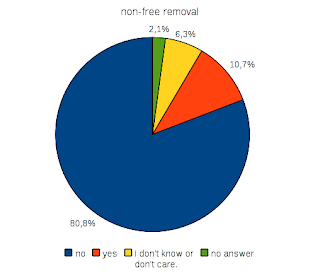
Should Debian spend more money?
Should Debian remove its non-free component?

- 80.8% answered no
- 10.7% answered yes
- 6.3% answered: I don't know or don't care
- 2.1% did not answer
Should Debian spend more money?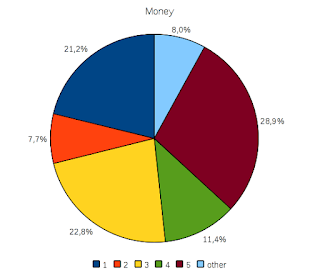
- 28.9% choose answer #5: I don't know or don't care.
- 22.8% choose answer #3: Debian should pay people having important positions in Debian and doing important work.
- 21.2% choose answer #1: Debian should spend more money on organizing developer conferences and team meetings.
- 11.4% choose answer #4: Debian should not spend more money.
- 8.0% choose other (see below) or didn't answer
- 7.7% choose answer #2: Debian should spend more money on free merchandizing, free DVDs, having a sexy web site, and being present on IT events.
There were quite a number of other answers. One participant missed the information about how the money is currently spend. Several participants didn't want to choose one of the provided answers. They either wanted to choose multiple answers or various combinations of them. Most other answers fall into one of the following categories:
- various marketing suggestions with different focus than answer #2
- Debian hosted hardware, infrastructure, services
- funding upstream development
- QA and work on release-blocking issues
- partners and commercial support
- developing important features
- security support for oldstable
- education of prospective developers and contributors
- documentation for users
- improving usability and accessibility
- certifications like LPIC
- getting supported by hardware and non-free software vendors
- beer
- promoting debian in developing countries
- help contributors running a business on Debian
- Bounty system
- updating stable to avoid becoming stale
- developing multimedia codecs
- getting compliant with FSF guidelines for a free system distribution
- developing free replacements to non-free software
- maintaining a database of debian-friendly hardware
- lobbying and politics
- visibility to wider society, even non-IT
- hardware for driver developers
- a more sexy DVD/CD set with graphics (like Fedora, Ubuntu)
- membership to boards of W3C, TEI Consortium, OASIS, etc.
Do you prefer time based releases instead of the "it's ready when it's ready" releases?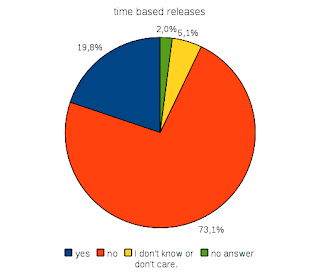
- 73.1% answered no
- 19.8% answered yes
- 5.1% anwered: I don't know or don't care
- 2.0% didn't answer
Which release interval do you prefer?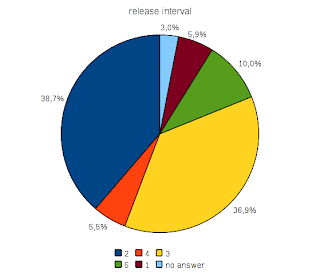
- 38.7% choose answer #2: about 12 months
- 36.9% choose answer #3: 18 - 24 months
- 10.0% choose answer #5: I don't know or don't care.
- 5.9% choose answer #1: about 6 months
- 5.5% choose answer #4: more than 2 years
- 3.0% didn't answer


- 73.1% answered no
- 19.8% answered yes
- 5.1% anwered: I don't know or don't care
- 2.0% didn't answer
Which release interval do you prefer?
- 38.7% choose answer #2: about 12 months
- 36.9% choose answer #3: 18 - 24 months
- 10.0% choose answer #5: I don't know or don't care.
- 5.9% choose answer #1: about 6 months
- 5.5% choose answer #4: more than 2 years
- 3.0% didn't answer

 First there was
 A couple of month ago, my step-father-in-law encountered quite some
problems with the Windows installation on his Notebook and therefore
showed a great interest in
 In the past, I ve helped customers run native Windows applications using emulation (wine) and/or virtualization, and in few cases, native support for C# by open source projects such as Mono. But, as it s been said, there are great benefits of having source code, and I recently worked around an issue in Mono by recompiling a whole .NET project in Debian.
So here s a brief guide reviewing the issues that I found and how I solved each one of them leading to a natively-compiled C# application that runs seamlessly in Debian and Windows, and please remember I m not a C#/.NET/Mono developer:
 I use

 I launched



 Kanzepharaz of the one thousand and eight spires. Kanzepharaz capital of the Empire of K'thorv and since the succesful end to the war that led to the annihilation of the Pleiadic Oligarchy in K'threl, the richest and most splendid city in the Middle World. Kanzepheraz whose real estate prices have soared e'en beyond the calculation of the rainbow abacus of Thobis Himself.
Anathomelis, a princeling of the Imperial Clan needs a location for his new and expanded orgy dome. Yet the only available and affordable on a seventh rank civil allowance place left in the city of one thousand and eight spires is the tomb of Pharaz the First and Subsequent, lich-emperor of the Jerelite dynasty and his eldritch retainers. Before the construction-serfs can move in, the tomb must be cleared of its unshriven and non-rent-paying denizens.
As His Principalities' chief swordbearer it has fallen to you to make the tomb of Pharaz safe for gentrification. Treasures and honors await you if you succeed. Aeons of torment in the Planes of Unlife await you if you fail.
 Two weeks ago,
 Dear Gnome people. Is there a reliable way to right-attach panel applets?
May laptop screen and my external monitor have different resolutions, and I
havn't found a reliable way (except making two panels) of getting some of my
applets to stick to the right. I usually keep my launchers on the left, while
vairous system status icons on the right part. But when switching to a higher
resolution, at most one will move to the right end of the panel at the new
resolition, while the others just stay in place (i.e. left-attached at a given
pixel position).
There are so many smart layout managers, GTK pretty much always uses flexible
layout managers, why is the Gnome panel relying pixel offsets?
It has been suggested to me a couple of times that I could achieve this
via gconf. However, since the gconf changes are not reflected at runtime but
frequently overwritten I did not get this to work reliably even just for two
applets.
Thank you. If you have any comments, please email me via
 So I got a

 While I have spent countless hours working on the new source format known as 3.0 (quilt) , I ve just realized that I have never blogged about its features and the reasons that lead me to work on it. Let s fix this.
The good old 1.0 format
Up to 2008, dpkg-source was only able to cope with a single source format (now named 1.0 ). That format was used since the inception of the project. While it worked fine for most cases, it suffered from a number of limitations mainly because it stored the Debian packaging files as a patch to apply on top of the upstream source tarball.
This patch can have two functions: creating the required files in the debian sub-directory and applying changes to the upstream sources. Over time, if the maintainer made several modifications to the upstream source code, they would end up entangled (and undocumented) in this single patch. In order to solve this problem, patch systems were created (dpatch, quilt, simple-patchsys, dbs, ) and many maintainers started using them. Each implementation is slightly different but the basic principle is always the same: store the upstream changes as multiple patches in the


 If you re running a 64bit system, and you ve got users with access to a video device (
 I finally bought myself an eBook reader. To be precise, I got the