Search Results: "tb"

3 October 2023

Russ Allbery: Review: Monstrous Regiment

Review: Monstrous Regiment, by Terry Pratchett
Series: Discworld #31
Publisher: Harper
Copyright: October 2003
Printing: August 2014
ISBN: 0-06-230741-X
Format: Mass market
Pages: 457
Monstrous Regiment is the 31st Discworld novel, but it mostly stands by itself. You arguably could start here, although you would miss the significance of Vimes's presence and the references to The Truth. The graphical reading order guide puts it loosely after The Truth and roughly in the Industrial Revolution sequence, but the connections are rather faint.
There was always a war. Usually they were border disputes, the national equivalent of complaining that the neighbor was letting their hedge row grow too long. Sometimes they were bigger. Borogravia was a peace-loving country in the middle of treacherous, devious, warlike enemies. They had to be treacherous, devious, and warlike; otherwise, we wouldn't be fighting them, eh? There was always a war.
Polly's brother, who wanted nothing more than to paint (something that the god Nuggan and the ever-present Duchess certainly did not consider appropriate for a strapping young man), was recruited to fight in the war and never came back. Polly is worried about him and tired of waiting for news. Exit Polly, innkeeper's daughter, and enter the young lad Oliver Perks, who finds the army recruiters in a tavern the next town over. One kiss of the Duchess's portrait later, and Polly is a private in the Borogravian army. I suspect this is some people's favorite Discworld novel. If so, I understand why. It was not mine, for reasons that I'll get into, but which are largely not Pratchett's fault and fall more into the category of pet peeves. Pratchett has dealt with both war and gender in the same book before. Jingo is also about a war pushed by a ruling class for stupid reasons, and featured a substantial subplot about Nobby cross-dressing that turns into a deeper character re-evaluation. I thought the war part of Monstrous Regiment was weaker (this is part of my complaint below), but gender gets a considerably deeper treatment. Monstrous Regiment is partly about how arbitrary and nonsensical gender roles are, and largely about how arbitrary and abusive social structures can become weirdly enduring because they build up their own internally reinforcing momentum. No one knows how to stop them, and a lot of people find familiar misery less frightening than unknown change, so the structure continues despite serving no defensible purpose. Recently, there was a brief attempt in some circles to claim Pratchett posthumously for the anti-transgender cause in the UK. Pratchett's daughter was having none of it, and any Pratchett reader should have been able to reject that out of hand, but Monstrous Regiment is a comprehensive refutation written by Pratchett himself some twenty years earlier. Polly is herself is not transgender. She thinks of herself as a woman throughout the book; she's just pretending to be a boy. But she also rejects binary gender roles with the scathing dismissal of someone who knows first-hand how superficial they are, and there is at least one transgender character in this novel (although to say who would be a spoiler). By the end of the book, you will have no doubt that Pratchett's opinion about people imposing gender roles on others is the same as his opinion about every other attempt to treat people as things. That said, by 2023 standards the treatment of gender here seems... naive? I think 2003 may sadly have been a more innocent time. We're now deep into a vicious backlash against any attempt to question binary gender assignment, but very little of that nastiness and malice is present here. In one way, this is a feature; there's more than enough of that in real life. However, it also makes the undermining of gender roles feel a bit too easy. There are good in-story reasons for why it's relatively simple for Polly to pass as a boy, but I still spent a lot of the book thinking that passing as a private in the army would be a lot harder and riskier than this. Pratchett can't resist a lot of cross-dressing and gender befuddlement jokes, all of which are kindly and wry but (at least for me) hit a bit differently in 2023 than they would have in 2003. The climax of the story is also a reference to a classic UK novel that to even name would be to spoil one or both of the books, but which I thought pulled the punch of the story and dissipated a lot of the built-up emotional energy. My larger complaints, though, are more idiosyncratic. This is a war novel about the enlisted ranks, including the hazing rituals involved in joining the military. There are things I love about military fiction, but apparently that reaction requires I have some sympathy for the fight or the goals of the institution. Monstrous Regiment falls into the class of war stories where the war is pointless and the system is abusive but the camaraderie in the ranks makes service oddly worthwhile, if not entirely justifiable. This is a real feeling that many veterans do have about military service, and I don't mean to question it, but apparently reading about it makes me grumbly. There's only so much of the apparently gruff sergeant with a heart of gold that I can take before I start wondering why we glorify hazing rituals as a type of tough love, or why the person with some authority doesn't put a direct stop to nastiness instead of providing moral support so subtle you could easily blink and miss it. Let alone the more basic problems like none of these people should have to be here doing this, or lots of people are being mangled and killed to make possible this heart-warming friendship. Like I said earlier, this is a me problem, not a Pratchett problem. He's writing a perfectly reasonable story in a genre I just happen to dislike. He's even undermining the genre in the process, just not quite fast enough or thoroughly enough for my taste. A related grumble is that Monstrous Regiment is very invested in the military trope of naive and somewhat incompetent officers who have to be led by the nose by experienced sergeants into making the right decision. I have never been in the military, but I work in an industry in which it is common to treat management as useless incompetents at best and actively malicious forces at worst. This is, to me, one of the most persistently obnoxious attitudes in my profession, and apparently my dislike of it carries over as a low tolerance for this very common attitude towards military hierarchy. A full expansion of this point would mostly be about the purpose of management, division of labor, and people's persistent dismissal of skills they don't personally have and may perceive as gendered, and while some of that is tangentially related to this book, it's not closely-related enough for me to bore you with it in a review. Maybe I'll write a stand-alone blog post someday. Suffice it to say that Pratchett deployed a common trope that most people would laugh at and read past without a second thought, but that for my own reasons started getting under my skin by the end of the novel. All of that grumbling aside, I did like this book. It is a very solid Discworld novel that does all the typical things a Discworld novel does: likable protagonists you can root for, odd and fascinating side characters, sharp and witty observations of human nature, and a mostly enjoyable ending where most of the right things happen. Polly is great; I was very happy to read a book from her perspective and would happily read more. Vimes makes a few appearances being Vimes, and while I found his approach in this book less satisfying than in Jingo, I'll still take it. And the examination of gender roles, even if a bit less fraught than current politics, is solid Pratchett morality. The best part of this book for me, by far, is Wazzer. I think that subplot was the most Discworld part of this book: a deeply devout belief in a pseudo-godlike figure that is part of the abusive social structure that creates many of the problems of the book becomes something considerably stranger and more wonderful. There is a type of belief that is so powerful that it transforms the target of that belief, at least in worlds like Discworld that have a lot of ambient magic. Not many people have that type of belief, and having it is not a comfortable experience, but it makes for a truly excellent story. Monstrous Regiment is a solid Discworld novel. It was not one of my favorites, but it probably will be someone else's favorite for a host of good reasons. Good stuff; if you've read this far, you will enjoy it. Followed by A Hat Full of Sky in publication order, and thematically (but very loosely) by Going Postal. Rating: 8 out of 10

30 September 2023

Russell Coker: Links September 2023

Interesting article in Wired about adversarial attacks on ML systems to get them to do things that they are explicitely programmed not to do such as describe how to make illegal drugs [1]. The most interesting part of this is that the attacks work on most GPT systems which is probably due to the similar data used to train them. Vice has an interesting article about the Danish Synthetic Party , a political partyled by an AI [2]. Citizens can vote for candidates who will try to get laws passed that match the AI generated goals, there is no option of voting for an AI character. The policies they are advocating for are designed to appeal to the 20% of Danes who don t vote. They are also trying to inspire similar parties in other countries. I think this has the potential to improve democracy. Vice reports that in 2021 a man tried to assasinate the Queen of England with inspiration from Star Wars and an AI chat bot [3]. While someone who wants to be a real-life Sith is probably going to end up doing something bad we still don t want to have chat bots encourage it. Bruce Schneier wrote an interesting article about milestones for AI involvement in the political process [4]. Sam Varghese wrote an interesting article about the allegations that India is following the example of Saudi Arabia and assasinating people in other countries who disagree with their government [5]. We need to stop this. Ian Jackson wrote an interesting blog post advocating that DKIM PRIVATE keys be rotated and PUBLISHED [6]. The idea is that if a hostile party gets access to the mailbox of someone who received private email from you then in the normal DKIM setup of keys never changing they can prove that the email is authentic when they leak it. While if you mail server publishes the old keys as Ian advocates then the hostile party can t prove that you sent the email in question as anyone could have forged a signature. Anything that involves publishing a private key gets an immediate negative reaction but I can t fault the logic here.

Russell Coker: Choosing Exclusion

There is an article The Inappropriately Excluded by the Polymath Archives [1] that gets cited a lot. Mainly by Mensa types who think that their lack of success is due to being too smart. The Main Claim is Wrong The main claim is:
The probability of entering and remaining in an intellectually elite profession such as Physician, Judge, Professor, Scientist, Corporate Executive, etc. increases with IQ to about 133. It then falls by about 1/3 at 140. By 150 IQ the probability has fallen from its peak by 97%! The first thing to consider is whether taking those professions is a smart thing to do. These are the types of jobs that a school career adviser would tell you are good choices for well paying jobs, but really there s lots of professional positions that get similar pay with less demanding work. Physicians have to deal with people who are sick and patients who die including cases where the physician needs to make a recommendation on incomplete information where the wrong choice will result in serious injury or death, there are significant benefits to being a medical researcher or doing biological engineering. Being a Judge has a high public profile and has a reasonable amount of pressure, good for status but you can probably earn more money with less work as a corporate lawyer. Being a professor is a position that is respected but which in many countries is very poorly paid. In a mid-size company executives probably get about $300k compared to $220k for middle managers and $100k-$180k for senior professional roles in the same company. There has been research on how much happyness is increased by having more money, here is one from CBS saying that income up to $500K can increase happiness[2] which contradicts previous research suggesting that income over $75K didn t provide much benefit. I think that part of this is determined by the conditions that you live in, if you live in a country like Australia with cheap healthcare then you won t feel as great a need to hoard money. Another part is whether you feel obliged to compete with other people for financial status, if driving an old car of a non-prestige brand while my neighbours have new BMWs concerned me then I might desire an executive position. I think that the smart thing to do is to get work that is relatively enjoyable, pays enough for all the essentials and some reasonable luxury, and doesn t require excessive effort or long hours. Unless you have a great need for attention from other people then for every job with a high profile there will be several with similar salaries but less attention. The main point of the article is that people with high IQs all want to reach the pinnacle of their career path and don t do so because they are excluded. It doesn t consider the possibility that smart people might have chosen the option that s best for them. For example I ve seen what my manager and the CIO of my company do and it doesn t look like fun for me. I m happy to have them earn more than me as compensation for doing things I don t want to do. Why is This Happening? This section of the article starts with Because of the dearth of objective evidence, the cause of the exclusion cannot be determined directly which is possibly where they should have given up. Also I could have concluded this blog post with I m not excluded from this list of jobs that suck , but I will continue listing problems with the article. One claim in the article is:
Garth Zietsman has said, referring to people with D15IQs over 152, A common experience with people in this category or higher is that they are not wanted the masses (including the professional classes) find them an affront of some sort. The question I have is whether it s being smart or being a jerk that the masses find to be an affront, I m guessing the latter. I don t recall seeing evidence outside high school of people inherently disliking smarter people. The article claims that We have no reason to conclude that this upper limit on IQ differences changes in adulthood . Schools don t cater well to smart kids and it isn t good for kids to have no intellectual peers. One benefit I ve found in the Free Software community is that there are a lot of smart people. Regarding leadership it claims D.K. Simonton found that persuasiveness is at its maximum when the IQ differential between speaker and audience is about 20 points . A good counter example is Julius Sumner Miller who successfully combined science education and advertising for children s chocolate [3]. Maybe being a little smarter than other people makes it more difficult to communicate with them but being as smart as Julius Sumner Miller can outweigh that. The article goes on to claim that the intellectual elites have an average IQ of 125 because they have to convince people who have an average IQ of 105. I think that if that 20 point difference was really a thing then you would have politicians with an IQ of 125 appointing leaders of the public service with an IQ of 145 who would then hire scientific advisers with an IQ of 165. In a corporate environment a CEO with an IQ of 125 could hire a CIO with an IQ of 145 who could then hire IT staff with an IQ of 165. If people with 165 IQs wanted to be Prime Minister or CEO that might suck for them, but if they wanted to have the most senior technical roles in public service or corporations then it would work out well. For the work I do I almost never speak to a CEO and rarely speak to anyone who regularly speaks to them, if CEOs don t like me and won t hire people like me then it doesn t matter to me as I won t meet them. Inappropriate Educational Options The section on Inappropriate Educational Options is one where I almost agree with the author. I say almost because I don t think that schools are good for anyone. Yes schools have some particular problems for smart kids, but they also have serious problems for kids who are below average IQ, kids who have problems at home, kids who are disabled, etc. Most schools fail so many groups of kids in so many ways that the overall culture of schools can t be functional. Social Isolation The section on Social Isolation is another where I almost agree with the author. But as with schools I think that society overall is poorly structured to support people such that people on the entire range of IQs have more difficulty in finding friends and relationships than they should. One easy change to make would be to increase the minimum wage such that one minimum wage job can support a family without working more than 35 hours a week and to set the maximum work week to something less than 40 hours Atlassian has a good blog post about the data on working weeks [4]. Wired has an article suggesting that 5 hours a day is an ideal work time for some jobs [5]. We also need improvements in public transport and city design to have less wasted time and better options for socialising. Conclusion The blogspot site hosting the article in question also has a very complex plan for funding a magazine for such articles [6]. The problems with that funding model start with selling advertising that converts to shares in a Turks & Caicos company in an attempt to circumvent securities regulations (things don t work that way). Then it goes in to some complex formulas for where money will go. This isn t the smart way to start a company, the smart way is to run a kickstarter with fixed rewards for specific amounts of contributions and then possibly have an offer of profit sharing with people who donate extra or something. As a general rule when doing something that s new to you it s a good idea to look at how others have succeeded at it in the past. Devising an experimental new way of doing something is best reserved to people who have some experience withe the more common methods. Mentioning this may seem like an ad hominem attack, but I think it s relevant to consider this in the context of people who score well in IQ tests but don t do so well in other things. Maybe someone who didn t think that they were a lot smarter than everyone else would have tried to launch a magazine in a more common way and actually had some success at it. In a more general sense I think that people who believe that they are suffering because of being too smart are in a similar category as incels. It s more of a psychological problem than anything else and one that they could solve for themselves.

20 September 2023

Joey Hess: Haskell webassembly in the browser


live demo As far as I know this is the first Haskell program compiled to Webassembly (WASM) with mainline ghc and using the browser DOM. ghc's WASM backend is solid, but it only provides very low-level FFI bindings when used in the browser. Ints and pointers to WASM memory. (See here for details and for instructions on getting the ghc WASM toolchain I used.) I imagine that in the future, WASM code will interface with the DOM by using a WASI "world" that defines a complete API (and browsers won't include Javascript engines anymore). But currently, WASM can't do anything in a browser without calling back to Javascript. For this project, I needed 63 lines of (reusable) javascript (here). Plus another 18 to bootstrap running the WASM program (here). (Also browser_wasi_shim) But let's start with the Haskell code. A simple program to pop up an alert in the browser looks like this:
 -# LANGUAGE OverloadedStrings #- 
import Wasmjsbridge
foreign export ccall hello :: IO ()
hello :: IO ()
hello = do
    alert <- get_js_object_method "window" "alert"
    call_js_function_ByteString_Void alert "hello, world!"
A larger program that draws on the canvas and generated the image above is here. The Haskell side of the FFI interface is a bunch of fairly mechanical functions like this:
foreign import ccall unsafe "call_js_function_string_void"
    _call_js_function_string_void :: Int -> CString -> Int -> IO ()
call_js_function_ByteString_Void :: JSFunction -> B.ByteString -> IO ()
call_js_function_ByteString_Void (JSFunction n) b =
      BU.unsafeUseAsCStringLen b $ \(buf, len) ->
                _call_js_function_string_void n buf len
Many more would need to be added, or generated, to continue down this path to complete coverage of all data types. All in all it's 64 lines of code so far (here). Also a C shim is needed, that imports from WASI modules and provides C functions that are used by the Haskell FFI. It looks like this:
void _call_js_function_string_void(uint32_t fn, uint8_t *buf, uint32_t len) __attribute__((
        __import_module__("wasmjsbridge"),
        __import_name__("call_js_function_string_void")
));
void call_js_function_string_void(uint32_t fn, uint8_t *buf, uint32_t len)  
        _call_js_function_string_void(fn, buf, len);
 
Another 64 lines of code for that (here). I found this pattern in Joachim Breitner's haskell-on-fastly and copied it rather blindly. Finally, the Javascript that gets run for that is:
call_js_function_string_void(n, b, sz)  
    const fn = globalThis.wasmjsbridge_functionmap.get(n);
    const buffer = globalThis.wasmjsbridge_exports.memory.buffer;
    fn(decoder.decode(new Uint8Array(buffer, b, sz)));
 ,
Notice that this gets an identifier representing the javascript function to run, which might be any method of any object. It looks it up in a map and runs it. And the ByteString that got passed from Haskell has to be decoded to a javascript string. In the Haskell program above, the function is document.alert. Why not pass a ByteString with that through the FFI? Well, you could. But then it would have to eval it. That would make running WASM in the browser be evaling Javascript every time it calls a function. That does not seem like a good idea if the goal is speed. GHC's javascript backend does use Javascript FFI snippets like that, but there they get pasted into the generated Javascript hairball, so no eval is needed. So my code has things like get_js_object_method that look up things like Javascript functions and generate identifiers. It also has this:
call_js_function_ByteString_Object :: JSFunction -> B.ByteString -> IO JSObject
Which can be used to call things like document.getElementById that return a javascript object:
getElementById <- get_js_object_method (JSObjectName "document") "getElementById"
canvas <- call_js_function_ByteString_Object getElementById "myCanvas"
Here's the Javascript called by get_js_object_method. It generates a Javascript function that will be used to call the desired method of the object, and allocates an identifier for it, and returns that to the caller.
get_js_objectname_method(ob, osz, nb, nsz)  
    const buffer = globalThis.wasmjsbridge_exports.memory.buffer;
    const objname = decoder.decode(new Uint8Array(buffer, ob, osz));
    const funcname = decoder.decode(new Uint8Array(buffer, nb, nsz));
    const func = function (...args)   return globalThis[objname][funcname](...args)  ;
    const n = globalThis.wasmjsbridge_counter + 1;
    globalThis.wasmjsbridge_counter = n;
    globalThis.wasmjsbridge_functionmap.set(n, func);
    return n;
 ,
This does mean that every time a Javascript function id is looked up, some more memory is used on the Javascript side. For more serious uses of this, something would need to be done about that. Lots of other stuff like object value getting and setting is also not implemented, there's no support yet for callbacks, and so on. Still, I'm happy where this has gotten to after 12 hours of work on it. I might release the reusable parts of this as a Haskell library, although it seems likely that ongoing development of ghc will make it obsolete. In the meantime, clone the git repo to have a play with it.
This blog post was sponsored by unqueued on Patreon.

Valhalla's Things: Chickpea Crackers

Posted on September 20, 2023
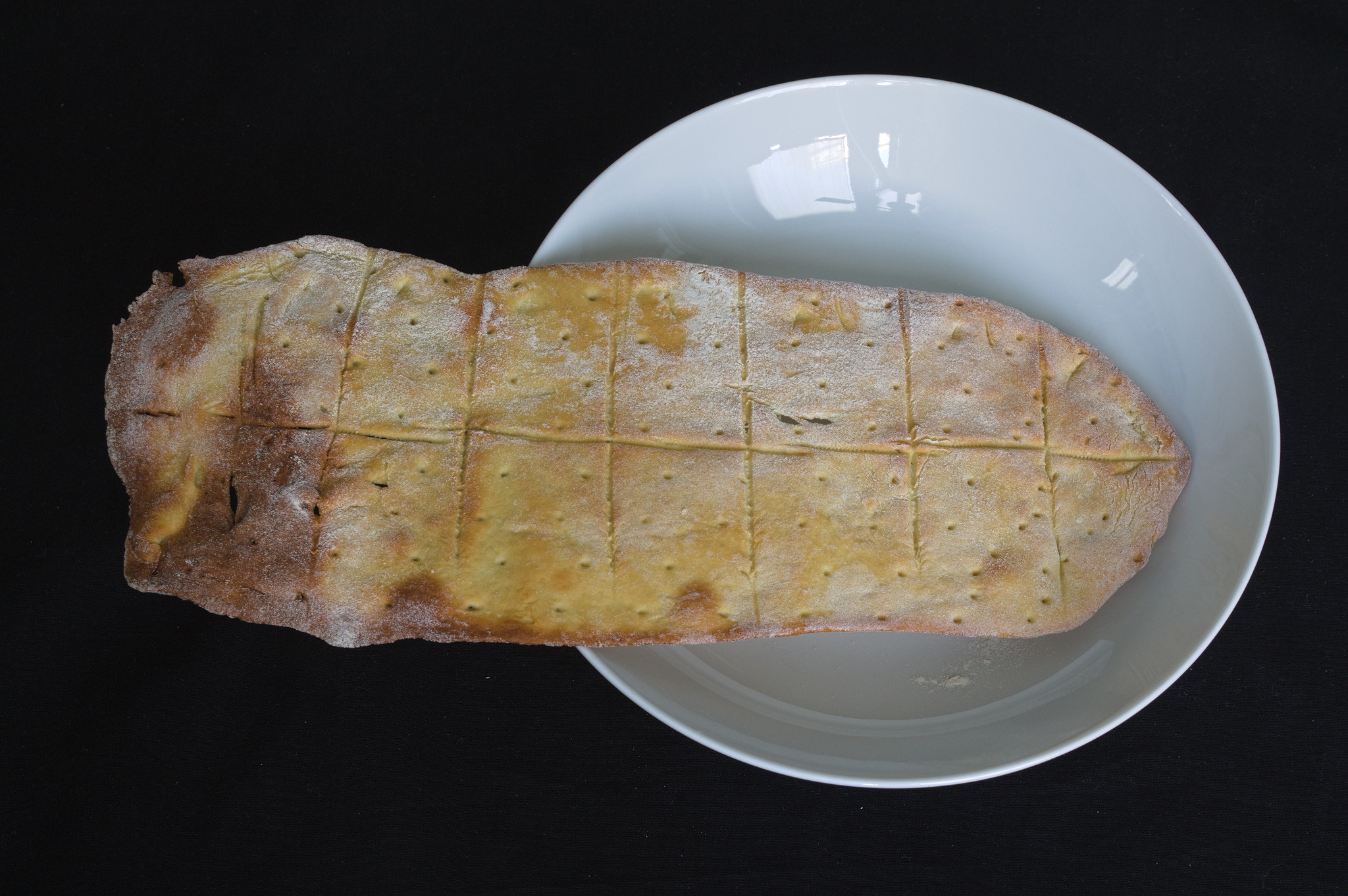
A flatbread, prescored into small portions, but still in one piece on top of a plate and overflowing to the side (it's about 10 cm   30 cm or so). A side is thin and more browned, the other side is a bit thicker and paler. And another half-written article I had in my repo. (Am I doing #FallFinishAlong with blog articles instead of / in addition to craft projects? it feels so). I was in need of snacks. I wanted something bready, but with a bit less carbs and more proteins. I had a bag of chickpea flour. Ingredients were:
  • 100 g wheat flour
  • 100 g chickpea flour
  • 100 g water
  • 3 g salt
  • 1 g dry yeast
Mix everything as usual for bread, leave to rise for 4-6 hours. Divide in 4 parts, roll them out to a thickness of about 1 2 mm, prick them with a fork (or the fancy cracker pricking tool that you don t really need but I may have bought). Optionally spray with a bit of water and sprinkle with salt (coarse or flake is best). Preheat the oven to 240 C and cook for 5 minutes, or preheat the oven to 210 C and cook for 10 minutes for a dryer version. I ve tried both cooking temperatures: the 210 C had the big advantage of being the same as the common bread I was already making, so no additional oven time was required (it was summer. this was a consideration.), but I m not sure which version I like best, so I think in winter I will alternate between the two. Put it in a cotton (linen?) bag and keep it in a dry place, where it will keep for weeks (assuming you ve made a bigger batch :D ). This is now part of my staples.

15 September 2023

John Goerzen: How Gapped is Your Air?

Sometimes we want better-than-firewall security for things. For instance:
  1. An industrial control system for a municipal water-treatment plant should never have data come in or out
  2. Or, a variant of the industrial control system: it should only permit telemetry and monitoring data out, and nothing else in or out
  3. A system dedicated to keeping your GPG private keys secure should only have material to sign (or decrypt) come in, and signatures (or decrypted data) go out
  4. A system keeping your tax records should normally only have new records go in, but may on occasion have data go out (eg, to print a copy of an old record)
In this article, I ll talk about the high side (the high-security or high-sensitivity systems) and the low side (the lower-sensitivity or general-purpose systems). For the sake of simplicity, I ll assume the high side is a single machine, but it could as well be a whole network. Let s focus on examples 3 and 4 to make things simpler. Let s consider the primary concern to be data exfiltration (someone stealing your data), with a secondary concern of data integrity (somebody modifying or destroying your data). You might think the safest possible approach is Airgapped that is, there is literal no physical network connection to the machine at all. This help! But then, the problem becomes: how do we deal with the inevitable need to legitimately get things on or off of the system? As I wrote in Dead USB Drives Are Fine: Building a Reliable Sneakernet, by using tools such as NNCP, you can certainly create a sneakernet : using USB drives as transport. While this is a very secure setup, as with most things in security, it s less than perfect. The Wikipedia airgap article discusses some ways airgapped machines can still be exploited. It mentions that security holes relating to removable media have been exploited in the past. There are also other ways to get data out; for instance, Debian ships with gensio and minimodem, both of which can transfer data acoustically. But let s back up and think about why we think of airgapped machines as so much more secure, and what the failure modes of other approaches might be.

What about firewalls? You could very easily set up high-side machine that is on a network, but is restricted to only one outbound TCP port. There could be a local firewall, and perhaps also a special port on an external firewall that implements the same restrictions. A variant on this approach would be two computers connected directly by a crossover cable, though this doesn t necessarily imply being more secure. Of course, the concern about a local firewall is that it could potentially be compromised. An external firewall might too; for instance, if your credentials to it were on a machine that got compromised. This kind of dual compromise may be unlikely, but it is possible. We can also think about the complexity in a network stack and firewall configuration, and think that there may be various opportunities to have things misconfigured or buggy in a system of that complexity. Another consideration is that data could be sent at any time, potentially making it harder to detect. On the other hand, network monitoring tools are commonplace. On the other hand, it is convenient and cheap. I use a system along those lines to do my backups. Data is sent, gpg-encrypted and then encrypted again at the NNCP layer, to the backup server. The NNCP process on the backup server runs as an untrusted user, and dumps the gpg-encrypted files to a secure location that is then processed by a cron job using Filespooler. The backup server is on a dedicated firewall port, with a dedicated subnet. The only ports allowed out are for NNCP and NTP, and offsite backups. There is no default gateway. Not even DNS is permitted out (the firewall does the appropriate redirection). There is one pinhole allowed out, where a subset of the backup data is sent offsite. I initially used USB drives as transport, and it had no network connection at all. But there were disadvantages to doing this for backups particularly that I d have no backups for as long as I d forget to move the drives. The backup system also would have clock drift, and the offsite backup picture was more challenging. (The clock drift was a problem because I use 2FA on the system; a password, plus a TOTP generated by a Yubikey) This is pretty good security, I d think. What are the weak spots? Well, if there were somehow a bug in the NNCP client, and the remote NNCP were compromised, that could lead to a compromise of the NNCP account. But this itself would accomplish little; some other vulnerability would have to be exploited on the backup server, because the NNCP account can t see plaintext data at all. I use borgbackup to send a subset of backup data offsite over ssh. borgbackup has to run as root to be able to access all the files, but the ssh it calls runs as a separate user. A ssh vulnerability is therefore unlikely to cause much damage. If, somehow, the remote offsite system were compromised and it was able to exploit a security issue in the local borgbackup, that would be a problem. But that sounds like a remote possibility. borgbackup itself can t even be used over a sneakernet since it is not asynchronous. A more secure solution would probably be using something like dar over NNCP. This would eliminate the ssh installation entirely, and allow a complete isolation between the data-access and the communication stacks, and notably not require bidirectional communication. Logic separation matters too. My Roundup of Data Backup and Archiving Tools may be helpful here. Other attack vectors could be a vulnerability in the kernel s networking stack, local root exploits that could be combined with exploiting NNCP or borgbackup to gain root, or local misconfiguration that makes the sandboxes around NNCP and borgbackup less secure. Because this system is in my basement in a utility closet with no chairs and no good place for a console, I normally manage it via a serial console. While it s a dedicated line between the system and another machine, if the other machine is compromised or an adversary gets access to the physical line, credentials (and perhaps even data) could leak, albeit slowly. But we can do much better with serial lines. Let s take a look.

Serial lines Some of us remember RS-232 serial lines and their once-ubiquitous DB-9 connectors. Traditionally, their speed maxxed out at 115.2Kbps. Serial lines have the benefit that they can be a direct application-to-application link. In my backup example above, a serial line could directly link the NNCP daemon on one system with the NNCP caller on another, with no firewall or anything else necessary. It is simply up to those programs to open the serial device appropriately. This isn t perfect, however. Unlike TCP over Ethernet, a serial line has no inherent error checking. Modern programs such as NNCP and ssh assume that a lower layer is making the link completely clean and error-free for them, and will interpret any corruption as an attempt to tamper and sever the connection. However, there is a solution to that: gensio. In my page Using gensio and ser2net, I discuss how to run NNCP and ssh over gensio. gensio is a generic framework that can add framing, error checking, and retransmit to an unreliable link such as a serial port. It can also add encryption and authentication using TLS, which could be particularly useful for applications that aren t already doing that themselves. More traditional solutions for serial communications have their own built-in error correction. For instance, UUCP and Kermit both were designed in an era of noisy serial lines and might be an excellent fit for some use cases. The ZModem protocol also might be, though it offers somewhat less flexibility and automation than Kermit. I have found that certain USB-to-serial adapters by Gearmo will actually run at up to 2Mbps on a serial line! Look for the ones on their spec pages with a FTDI chipset rated at 920Kbps. It turns out they can successfully be driven faster, especially if gensio s relpkt is used. I ve personally verified 2Mbps operation (Linux port speed 2000000) on Gearmo s USA-FTDI2X and the USA-FTDI4X. (I haven t seen any single-port options from Gearmo with the 920Kbps chipset, but they may exist). Still, even at 2Mbps, speed may well be a limiting factor with some applications. If what you need is a console and some textual or batch data, it s probably fine. If you are sending 500GB backup files, you might look for something else. In theory, this USB to RS-422 adapter should work at 10Mbps, but I haven t tried it. But if the speed works, running a dedicated application over a serial link could be a nice and fairly secure option. One of the benefits of the airgapped approach is that data never leaves unless you are physically aware of transporting a USB stick. Of course, you may not be physically aware of what is ON that stick in the event of a compromise. This could easily be solved with a serial approach by, say, only plugging in the cable when you have data to transfer.

Data diodes A traditional diode lets electrical current flow in only one direction. A data diode is the same concept, but for data: a hardware device that allows data to flow in only one direction. This could be useful, for instance, in the tax records system that should only receive data, or the industrial system that should only send it. Wikipedia claims that the simplest kind of data diode is a fiber link with transceivers connected in only one direction. I think you could go one simpler: a serial cable with only ground and TX connected at one end, wired to ground and RX at the other. (I haven t tried this.) This approach does have some challenges:
  • Many existing protocols assume a bidirectional link and won t be usable
  • There is a challenge of confirming data was successfully received. For a situation like telemetry, maybe it doesn t matter; another observation will come along in a minute. But for sending important documents, one wants to make sure they were properly received.
In some cases, the solution might be simple. For instance, with telemetry, just writing out data down the serial port in a simple format may be enough. For sending files, various mitigations, such as sending them multiple times, etc., might help. You might also look into FEC-supporting infrastructure such as blkar and flute, but these don t provide an absolute guarantee. There is no perfect solution to knowing when a file has been successfully received if the data communication is entirely one-way.

Audio transport I hinted above that minimodem and gensio both are software audio modems. That is, you could literally use speakers and microphones, or alternatively audio cables, as a means of getting data into or out of these systems. This is pretty limited; it is 1200bps, and often half-duplex, and could literally be disrupted by barking dogs in some setups. But hey, it s an option.

Airgapped with USB transport This is the scenario I began with, and named some of the possible pitfalls above as well. In addition to those, note also that USB drives aren t necessarily known for their error-free longevity. Be prepared for failure.

Concluding thoughts I wanted to lay out a few things in this post. First, that simply being airgapped is generally a step forward in security, but is not perfect. Secondly, that both physical and logical separation matter. And finally, that while tools like NNCP can make airgapped-with-USB-drive-transport a doable reality, there are also alternatives worth considering especially serial ports, firewalled hard-wired Ethernet, data diodes, and so forth. I think serial links, in particular, have been largely forgotten these days. Note: This article also appears on my website, where it may be periodically updated.

12 September 2023

Jo Shields: Building a NAS

The status quo Back in 2015, I bought an off-the-shelf NAS, a QNAP TS-453mini, to act as my file store and Plex server. I had previously owned a Synology box, and whilst I liked the Synology OS and experience, the hardware was underwhelming. I loaded up the successor QNAP with four 5TB drives in RAID10, and moved all my files over (after some initial DoA drive issues were handled).
QNAP TS-453mini product photoQNAP TS-453mini product photo
That thing has been in service for about 8 years now, and it s been a mixed bag. It was definitely more powerful than the predecessor system, but it was clear that QNAP s OS was not up to the same standard as Synology s perhaps best exemplified by HappyGet 2 , the QNAP webapp for downloading videos from streaming services like YouTube, whose icon is a straight rip-off of StarCraft 2. On its own, meaningless but a bad omen for overall software quality
The logo for QNAP HappyGet 2 and Blizzard's Starcraft 2 side by sideThe logo for QNAP HappyGet 2 and Blizzard s StarCraft 2 side by side
Additionally, the embedded Celeron processor in the NAS turned out to be an issue for some cases. It turns out, when playing back videos with subtitles, most Plex clients do not support subtitles properly instead they rely on the Plex server doing JIT transcoding to bake the subtitles directly into the video stream. I discovered this with some Blu-Ray rips of Game of Thrones some episodes would play back fine on my smart TV, but episodes with subtitled Dothraki speech would play at only 2 or 3 frames per second. The final straw was a ransomware attack, which went through all my data and locked every file below a 60MiB threshold. Practically all my music gone. A substantial collection of downloaded files, all gone. Some of these files had been carried around since my college days digital rarities, or at least digital detritus I felt a real sense of loss at having to replace. This episode was caused by a ransomware targeting specific vulnerabilities in the QNAP OS, not an error on my part. So, I decided to start planning a replacement with:
  • A non-garbage OS, whilst still being a NAS-appliance type offering (not an off-the-shelf Linux server distro)
  • Full remote management capabilities
  • A small form factor comparable to off-the-shelf NAS
  • A powerful modern CPU capable of transcoding high resolution video
  • All flash storage, no spinning rust
At the time, no consumer NAS offered everything (The Asustor FS6712X exists now, but didn t when this project started), so I opted to go for a full DIY rather than an appliance not the first time I ve jumped between appliances and DIY for home storage.

Selecting the core of the system There aren t many companies which will sell you a small motherboard with IPMI. Supermicro is a bust, so is Tyan. But ASRock Rack, the server division of third-tier motherboard vendor ASRock, delivers. Most of their boards aren t actually compliant Mini-ITX size, they re a proprietary Deep Mini-ITX with the regular screw holes, but 40mm of extra length (and a commensurately small list of compatible cases). But, thankfully, they do have a tiny selection of boards without the extra size, and I stumbled onto the X570D4I-2T, a board with an AMD AM4 socket and the mature X570 chipset. This board can use any AMD Ryzen chip (before the latest-gen Ryzen 7000 series); has built in dual 10 gigabit ethernet; IPMI; four (laptop-sized) RAM slots with full ECC support; one M.2 slot for NVMe SSD storage; a PCIe 16x slot (generally for graphics cards, but we live in a world of possibilities); and up to 8 SATA drives OR a couple more NVMe SSDs. It s astonishingly well featured, just a shame it costs about $450 compared to a good consumer-grade Mini ITX AM4 board costing less than half that. I was so impressed with the offering, in fact, that I crowed about it on Mastodon and ended up securing ASRock another sale, with someone else looking into a very similar project to mine around the same timespan. The next question was the CPU. An important feature of a system expected to run 24/7 is low power, and AM4 chips can consume as much as 130W under load, out of the box. At the other end, some models can require as little as 35W under load the OEM-only GE suffix chips, which are readily found for import on eBay. In their PRO variant, they also support ECC (all non-G Ryzen chips support ECC, but only Pro G chips do). The top of the range 8 core Ryzen 7 PRO 5750GE is prohibitively expensive, but the slightly weaker 6 core Ryzen 5 PRO 5650GE was affordable, and one arrived quickly from Hong Kong. Supplemented with a couple of cheap 16 GiB SODIMM sticks of DDR4 PC-3200 direct from Micron for under $50 a piece, that left only cooling as an unsolved problem to get a bootable test system. The official support list for the X570D4I-2T only includes two rackmount coolers, both expensive and hard to source. The reason for such a small list is the non standard cooling layout of the board instead of an AM4 hole pattern with the standard plastic AM4 retaining clips, it has an Intel 115x hole pattern with a non-standard backplate (Intel 115x boards have no backplate, the stock Intel 115x cooler attaches to the holes with push pins). As such every single cooler compatibility list excludes this motherboard. However, the backplate is only secured with a mild glue with minimal pressure and a plastic prying tool it can be removed, giving compatibility with any 115x cooler (which is basically any CPU cooler for more than a decade). I picked an oversized low profile Thermalright AXP120-X67 hoping that its 120mm fan would cool the nearby MOSFETs and X570 chipset too.
Thermalright AXP120-X67, AMD Ryzen 5 PRO 5650GE, ASRock Rack X570D4I-2T, all assembled and running on a flat surface

Testing up to this point Using a spare ATX power supply, I had enough of a system built to explore the IPMI and UEFI instances, and run MemTest86 to validate my progress. The memory test ran without a hitch and confirmed the ECC was working, although it also showed that the memory was only running at 2933 MT/s instead of the rated 3200 MT/s (a limit imposed by the motherboard, as higher speeds are considered overclocking). The IPMI interface isn t the best I ve ever used by a long shot, but it s minimum viable and allowed me to configure the basics and boot from media entirely via a Web browser.
Memtest86 showing test progress, taken from IPMI remote control window
One sad discovery, however, which I ve never seen documented before, on PCIe bifurcation. With PCI Express, you have a number of lanes which are allocated in groups by the motherboard and CPU manufacturer. For Ryzen prior to Ryzen 7000, that s 16 lanes in one slot for the graphics card; 4 lanes in one M.2 connector for an SSD; then 4 lanes connecting the CPU to the chipset, which can offer whatever it likes for peripherals or extra lanes (bottlenecked by that shared 4x link to the CPU, if it comes down to it). It s possible, with motherboard and CPU support, to split PCIe groups up for example an 8x slot could be split into two 4x slots (eg allowing two NVMe drives in an adapter card NVME drives these days all use 4x). However with a Cezanne Ryzen with integrated graphics, the 16x graphics card slot cannot be split into four 4x slots (ie used for for NVMe drives) the most bifurcation it allows is 8x4x4x, which is useless in a NAS.
Screenshot of PCIe 16x slot bifurcation options in UEFI settings, taken from IPMI remote control window
As such, I had to abandon any ideas of an all-NVMe NAS I was considering: the 16x slot split into four 4x, combined with two 4x connectors fed by the X570 chipset, to a total of 6 NVMe drives. 7.6TB U.2 enterprise disks are remarkably affordable (cheaper than consumer SATA 8TB drives), but alas, I was locked out by my 5650GE. Thankfully I found out before spending hundreds on a U.2 hot swap bay. The NVMe setup would be nearly 10x as fast as SATA SSDs, but at least the SATA SSD route would still outperform any spinning rust choice on the market (including the fastest 10K RPM SAS drives)

Containing the core The next step was to pick a case and power supply. A lot of NAS cases require an SFX (rather than ATX) size supply, so I ordered a modular SX500 unit from Silverstone. Even if I ended up with a case requiring ATX, it s easy to turn an SFX power supply into ATX, and the worst result is you have less space taken up in your case, hardly the worst problem to have. That said, on to picking a case. There s only one brand with any cachet making ITX NAS cases, Silverstone. They have three choices in an appropriate size: CS01-HS, CS280, and DS380. The problem is, these cases are all badly designed garbage. Take the CS280 as an example, the case with the most space for a CPU cooler. Here s how close together the hotswap bay (right) and power supply (left) are:
Internal image of Silverstone CS280 NAS build. Image stolen from ServeTheHome
With actual cables connected, the cable clearance problem is even worse:
Internal image of Silverstone CS280 NAS build. Image stolen from ServeTheHome
Remember, this is the best of the three cases for internal layout, the one with the least restriction on CPU cooler height. And it s garbage! Total hot garbage! I decided therefore to completely skip the NAS case market, and instead purchase a 5.25 -to-2.5 hot swap bay adapter from Icy Dock, and put it in an ITX gamer case with a 5.25 bay. This is no longer a served market 5.25 bays are extinct since nobody uses CD/DVD drives anymore. The ones on the market are really new old stock from 2014-2017: The Fractal Design Core 500, Cooler Master Elite 130, and Silverstone SUGO 14. Of the three, the Fractal is the best rated so I opted to get that one however it seems the global supply of new old stock fully dried up in the two weeks between me making a decision and placing an order leaving only the Silverstone case. Icy Dock have a selection of 8-bay 2.5 SATA 5.25 hot swap chassis choices in their ToughArmor MB998 series. I opted for the ToughArmor MB998IP-B, to reduce cable clutter it requires only two SFF-8611-to-SF-8643 cables from the motherboard to serve all eight bays, which should make airflow less of a mess. The X570D4I-2T doesn t have any SATA ports on board, instead it has two SFF-8611 OCuLink ports, each supporting 4 PCI Express lanes OR 4 SATA connectors via a breakout cable. I had hoped to get the ToughArmor MB118VP-B and run six U.2 drives, but as I said, the PCIe bifurcation issue with Ryzen G chips meant I wouldn t be able to run all six bays successfully.
NAS build in Silverstone SUGO 14, mid build, panels removed
Silverstone SUGO 14 from the front, with hot swap bay installed

Actual storage for the storage server My concept for the system always involved a fast boot/cache drive in the motherboard s M.2 slot, non-redundant (just backups of the config if the worst were to happen) and separate storage drives somewhere between 3.8 and 8 TB each (somewhere from $200-$350). As a boot drive, I selected the Intel Optane SSD P1600X 58G, available for under $35 and rated for 228 years between failures (or 11,000 complete drive rewrite cycles). So, on to the big expensive choice: storage drives. I narrowed it down to two contenders: new-old-stock Intel D3-S4510 3.84TB enterprise drives, at about $200, or Samsung 870 QVO 8TB consumer drives, at about $375. I did spend a long time agonizing over the specification differences, the ZFS usage reports, the expected lifetime endurance figures, but in reality, it came down to price $1600 of expensive drives vs $3200 of even more expensive drives. That s 27TB of usable capacity in RAID-Z1, or 23TB in RAID-Z2. For comparison, I m using about 5TB of the old NAS, so that s a LOT of overhead for expansion.
Storage SSD loaded into hot swap sled

Booting up Bringing it all together is the OS. I wanted an appliance NAS OS rather than self-administering a Linux distribution, and after looking into the surrounding ecosystems, decided on TrueNAS Scale (the beta of the 2023 release, based on Debian 12).
TrueNAS Dashboard screenshot in browser window
I set up RAID-Z1, and with zero tuning (other than enabling auto-TRIM), got the following performance numbers:
IOPSBandwidth
4k random writes19.3k75.6 MiB/s
4k random reads36.1k141 MiB/s
Sequential writes 2300 MiB/s
Sequential reads 3800 MiB/s
Results using fio parameters suggested by Huawei
And for comparison, the maximum theoretical numbers quoted by Intel for a single drive:
IOPSBandwidth
4k random writes16k?
4k random reads90k?
Sequential writes 280 MiB/s
Sequential reads 560 MiB/s
Numbers quoted by Intel SSD successors Solidigm.
Finally, the numbers reported on the old NAS with four 7200 RPM hard disks in RAID 10:
IOPSBandwidth
4k random writes4301.7 MiB/s
4k random reads800632 MiB/s
Sequential writes 311 MiB/s
Sequential reads 566 MiB/s
Performance seems pretty OK. There s always going to be an overhead to RAID. I ll settle for the 45x improvement on random writes vs. its predecessor, and 4.5x improvement on random reads. The sequential write numbers are gonna be impacted by the size of the ZFS cache (50% of RAM, so 16 GiB), but the rest should be a reasonable indication of true performance. It took me a little while to fully understand the TrueNAS permissions model, but I finally got Plex configured to access data from the same place as my SMB shares, which have anonymous read-only access or authenticated write access for myself and my wife, working fine via both Linux and Windows. And that s it! I built a NAS. I intend to add some fans and more RAM, but that s the build. Total spent: about $3000, which sounds like an unreasonable amount, but it s actually less than a comparable Synology DiskStation DS1823xs+ which has 4 cores instead of 6, first-generation AMD Zen instead of Zen 3, 8 GiB RAM instead of 32 GiB, no hardware-accelerated video transcoding, etc. And it would have been a whole lot less fun!
The final system, powered up
(Also posted on PCPartPicker)

11 September 2023

John Goerzen: For the First Time In Years, I m Excited By My Computer Purchase

Some decades back, when I d buy a new PC, it would unlock new capabilities. Maybe AGP video, or a PCMCIA slot, or, heck, sound. Nowadays, mostly new hardware means things get a bit faster or less crashy, or I have some more space for files. It s good and useful, but sorta meh. Not this purchase. Cory Doctorow wrote about the Framework laptop in 2021:
There s no tape. There s no glue. Every part has a QR code that you can shoot with your phone to go to a service manual that has simple-to-follow instructions for installing, removing and replacing it. Every part is labeled in English, too! The screen is replaceable. The keyboard is replaceable. The touchpad is replaceable. Removing the battery and replacing it takes less than five minutes. The computer actually ships with a screwdriver.
Framework had been on my radar for awhile. But for various reasons, when I was ready to purchase, I didn t; either the waitlist was long, or they didn t have the specs I wanted. Lately my aging laptop with 8GB RAM started OOMing (running out of RAM). My desktop had developed a tendency to hard hang about once a month, and I researched replacing it, but the cost was too high to justify. But when I looked into the Framework, I thought: this thing could replace both. It is a real shift in perspective to have a laptop that is nearly as upgradable as a desktop, and can be specced out to exactly what I wanted: 2TB storage and 64GB RAM. And still cheaper than a Macbook or Thinkpad with far lower specs, because the Framework uses off-the-shelf components as much as possible. Cory Doctorow wrote, in The Framework is the most exciting laptop I ve ever broken:
The Framework works beautifully, but it fails even better Framework has designed a small, powerful, lightweight machine it works well. But they ve also designed a computer that, when you drop it, you can fix yourself. That attention to graceful failure saved my ass.
I like small laptops, so I ordered the Framework 13. I loaded it up with the 64GB RAM and 2TB SSD I wanted. Frameworks have four configurable ports, which are also hot-swappable. I ordered two USB-C, one USB-A, and one HDMI. I put them in my preferred spots (one USB-C on each side for easy docking and charging). I put Debian on it, and it all Just Worked. Perfectly. Now, I orderd the DIY version. I hesitated about this I HATE working with laptops because they re all so hard, even though I KNEW this one was different but went for it, because my preferred specs weren t available in a pre-assembled model. I m glad I did that, because assembly was actually FUN. I got my box. I opened it. There was the bottom shell with the motherboard and CPU installed. Here are the RAM sticks. There s the SSD. A minute or two with each has them installed. Put the bezel on the screen, attach the keyboard it has magnets to guide it into place and boom, ready to go. Less than 30 minutes to assemble a laptop nearly from scratch. It was easier than assembling most desktops. So now, for the first time, my main computing device is a laptop. Rather than having a desktop and a laptop, I just have a laptop. I ll be able to upgrade parts of it later if I want to. I can rearrange the ports. And I can take all my most important files with me. I m quite pleased!

10 September 2023

Freexian Collaborators: Debian Contributions: /usr-merge updates, Salsa CI progress, DebConf23 lead-up, and more! (by Utkarsh Gupta)

Contributing to Debian is part of Freexian s mission. This article covers the latest achievements of Freexian and their collaborators. All of this is made possible by organizations subscribing to our Long Term Support contracts and consulting services.

/usr-merge work, by Helmut Grohne, et al. Given that we now have consensus on moving forward by moving aliased files from / to /usr, we will also run into the problems that the file move moratorium was meant to prevent. The way forward is detecting them early and applying workarounds on a per-package basis. Said detection is now automated using the Debian Usr Merge Analysis Tool. As problems are reported to the bug tracking system, they are connected to the reports if properly usertagged. Bugs and patches for problem categories DEP17-P2 and DEP17-P6 have been filed. After consensus has been reached on the bootstrapping matters, debootstrap has been changed to swap the initial unpack and merging to avoid unpack errors due to pre-existing links. This is a precondition for having base-files install the aliasing symbolic links eventually. It was identified that the root filesystem used by the Debian installer is still unmerged and a change has been proposed. debhelper was changed to recognize systemd units installed to /usr. A discussion with the CTTE and release team on repealing the moratorium has been initiated.

Salsa CI work, by Santiago Ruano Rinc n August was a busy month in the Salsa CI world. Santiago reviewed and merged a bunch of MRs that have improved the project in different aspects: The aptly job got two MRs from Philip Hands. With the first one, the aptly now can export a couple of variables in a dotenv file, and with the second, it can include packages from multiple artifact directories. These MRs bring the base to improve how to test reverse dependencies with Salsa CI. Santiago is working on documenting this. As a result of the mass bug filing done in August, Salsa CI now includes a job to test how a package builds twice in a row. Thanks to the MRs of Sebastiaan Couwenberg and Johannes Schauer Marin Rodrigues. Last but not least, Santiago helped Johannes Schauer Marin Rodrigues to complete the support for arm64-only pipelines.

DebConf23 lead-up, by Stefano Rivera Stefano wears a few hats in the DebConf organization and in the lead up to the conference in mid-September, they ve all been quite busy. As one of the treasurers of DebConf 23, there has been a final budget update, and quite a few payments to coordinate from Debian s Trusted Organizations. We try to close the books from the previous conference at the next one, so a push was made to get DebConf 22 account statements out of TOs and record them in the conference ledger. As a website developer, we had a number of registration-related tasks, emailing attendees and trying to estimate numbers for food and accommodation. As a conference committee member, the job was mostly taking calls and helping the local team to make decisions on urgent issues. For example, getting conference visas issued to attendees required getting political approval from the Indian government. We only discovered the full process for this too late to clear some complex cases, so this required some hard calls on skipping some countries from the application list, allowing everyone else to get visas in time. Unfortunate, but necessary.

Miscellaneous contributions
  • Rapha l Hertzog updated gnome-shell-extension-hamster to a new upstream git snapshot that is compatible with GNOME Shell 44 that was recently uploaded to Debian unstable/testing. This extension makes it easy to start/stop tracking time with Hamster Time Tracker. Very handy for consultants like us who are billing their work per hour.
  • Rapha l also updated zim to the latest upstream release (0.74.2). This is a desktop wiki that can be very useful as a note-taking tool to build your own personal knowledge base or even to manage your personal todo lists.
  • Utkarsh reviewed and sponsored some uploads from mentors.debian.net.
  • Utkarsh helped the local team and the bursary team with some more DebConf activities and helped finalize the data.
  • Thorsten tried to update package hplip. Unfortunately upstream added some new compressed files that need to appear uncompressed in the package. Even though this sounded like an easy task, which seemed to be already implemented in the current debian/rules, the new type of files broke this implementation and made the package no longer buildable. The problem has been solved and the upload will happen soon.
  • Helmut sent 7 patches for cross build failures. Since dpkg-buildflags now defaults to issue arm64-specific compiler flags, more care is needed to distinguish between build architecture flags and host architecture flags than previously.
  • Stefano pushed the final bit of the tox 4 transition over the line in Debian, allowing dh-python and tox 4 to migrate to testing. We got caught up in a few unusual bugs in tox and the way we run it in Debian package building (which had to change with tox 4). This resulted in a couple of patches upstream.
  • Stefano visited Haifa, Israel, to see the proposed DebConf 24 venue and meet with the local team. While the venue isn t committed yet, we have high hopes for it.

8 September 2023

Reproducible Builds: Reproducible Builds in August 2023

Welcome to the August 2023 report from the Reproducible Builds project! In these reports we outline the most important things that we have been up to over the past month. As a quick recap, whilst anyone may inspect the source code of free software for malicious flaws, almost all software is distributed to end users as pre-compiled binaries. The motivation behind the reproducible builds effort is to ensure no flaws have been introduced during this compilation process by promising identical results are always generated from a given source, thus allowing multiple third-parties to come to a consensus on whether a build was compromised. If you are interested in contributing to the project, please visit our Contribute page on our website.

Rust serialisation library moving to precompiled binaries Bleeping Computer reported that Serde, a popular Rust serialization framework, had decided to ship its serde_derive macro as a precompiled binary. As Ax Sharma writes:
The move has generated a fair amount of push back among developers who worry about its future legal and technical implications, along with a potential for supply chain attacks, should the maintainer account publishing these binaries be compromised.
After intensive discussions, use of the precompiled binary was phased out.

Reproducible builds, the first ten years On August 4th, Holger Levsen gave a talk at BornHack 2023 on the Danish island of Funen titled Reproducible Builds, the first ten years which promised to contain:
[ ] an overview about reproducible builds, the past, the presence and the future. How it started with a small [meeting] at DebConf13 (and before), how it grew from being a Debian effort to something many projects work on together, until in 2021 it was mentioned in an executive order of the president of the United States. (HTML slides)
Holger repeated the talk later in the month at Chaos Communication Camp 2023 in Zehdenick, Germany: A video of the talk is available online, as are the HTML slides.

Reproducible Builds Summit Just another reminder that our upcoming Reproducible Builds Summit is set to take place from October 31st November 2nd 2023 in Hamburg, Germany. Our summits are a unique gathering that brings together attendees from diverse projects, united by a shared vision of advancing the Reproducible Builds effort. During this enriching event, participants will have the opportunity to engage in discussions, establish connections and exchange ideas to drive progress in this vital field. If you re interested in joining us this year, please make sure to read the event page, the news item, or the invitation email that Mattia Rizzolo sent out, which have more details about the event and location. We are also still looking for sponsors to support the event, so do reach out to the organizing team if you are able to help. (Also of note that PackagingCon 2023 is taking place in Berlin just before our summit, and their schedule has just been published.)

Vagrant Cascadian on the Sustain podcast Vagrant Cascadian was interviewed on the SustainOSS podcast on reproducible builds:
Vagrant walks us through his role in the project where the aim is to ensure identical results in software builds across various machines and times, enhancing software security and creating a seamless developer experience. Discover how this mission, supported by the Software Freedom Conservancy and a broad community, is changing the face of Linux distros, Arch Linux, openSUSE, and F-Droid. They also explore the challenges of managing random elements in software, and Vagrant s vision to make reproducible builds a standard best practice that will ideally become automatic for users. Vagrant shares his work in progress and their commitment to the last mile problem.
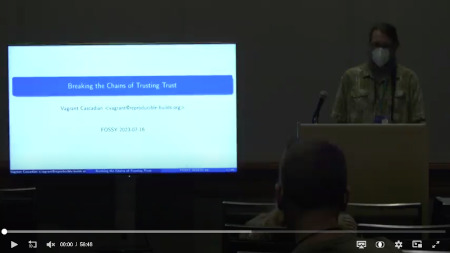
The episode is available to listen (or download) from the Sustain podcast website. As it happens, the episode was recorded at FOSSY 2023, and the video of Vagrant s talk from this conference (Breaking the Chains of Trusting Trust is now available on Archive.org: It was also announced that Vagrant Cascadian will be presenting at the Open Source Firmware Conference in October on the topic of Reproducible Builds All The Way Down.

On our mailing list Carles Pina i Estany wrote to our mailing list during August with an interesting question concerning the practical steps to reproduce the hello-traditional package from Debian. The entire thread can be viewed from the archive page, as can Vagrant Cascadian s reply.

Website updates Rahul Bajaj updated our website to add a series of environment variations related to reproducible builds [ ], Russ Cox added the Go programming language to our projects page [ ] and Vagrant Cascadian fixed a number of broken links and typos around the website [ ][ ][ ].

Software development In diffoscope development this month, versions 247, 248 and 249 were uploaded to Debian unstable by Chris Lamb, who also added documentation for the new specialize_as method and expanding the documentation of the existing specialize as well [ ]. In addition, Fay Stegerman added specialize_as and used it to optimise .smali comparisons when decompiling Android .apk files [ ], Felix Yan and Mattia Rizzolo corrected some typos in code comments [ , ], Greg Chabala merged the RUN commands into single layer in the package s Dockerfile [ ] thus greatly reducing the final image size. Lastly, Roland Clobus updated tool descriptions to mark that the xb-tool has moved package within Debian [ ].
reprotest is our tool for building the same source code twice in different environments and then checking the binaries produced by each build for any differences. This month, Vagrant Cascadian updated the packaging to be compatible with Tox version 4. This was originally filed as Debian bug #1042918 and Holger Levsen uploaded this to change to Debian unstable as version 0.7.26 [ ].

Distribution work In Debian, 28 reviews of Debian packages were added, 14 were updated and 13 were removed this month adding to our knowledge about identified issues. A number of issue types were added, including Chris Lamb adding a new timestamp_in_documentation_using_sphinx_zzzeeksphinx_theme toolchain issue.
In August, F-Droid added 25 new reproducible apps and saw 2 existing apps switch to reproducible builds, making 191 apps in total that are published with Reproducible Builds and using the upstream developer s signature. [ ]
Bernhard M. Wiedemann published another monthly report about reproducibility within openSUSE.

Upstream patches The Reproducible Builds project detects, dissects and attempts to fix as many currently-unreproducible packages as possible. We endeavour to send all of our patches upstream where appropriate. This month, we wrote a large number of such patches, including:

Testing framework The Reproducible Builds project operates a comprehensive testing framework (available at tests.reproducible-builds.org) in order to check packages and other artifacts for reproducibility. In August, a number of changes were made by Holger Levsen:
  • Debian-related changes:
    • Disable Debian live image creation jobs until an OpenQA credential problem has been fixed. [ ]
    • Run our maintenance scripts every 3 hours instead of every 2. [ ]
    • Export data for unstable to the reproducible-tracker.json data file. [ ]
    • Stop varying the build path, we want reproducible builds. [ ]
    • Temporarily stop updating the pbuilder.tgz for Debian unstable due to #1050784. [ ][ ]
    • Correctly document that we are not variying usrmerge. [ ][ ]
    • Mark two armhf nodes (wbq0 and jtx1a) as down; investigation is needed. [ ]
  • Misc:
    • Force reconfiguration of all Jenkins jobs, due to the recent rise of zombie processes. [ ]
    • In the node health checks, also try to restart failed ntpsec, postfix and vnstat services. [ ][ ][ ]
  • System health checks:
    • Detect Debian live build failures due to missing credentials. [ ][ ]
    • Ignore specific types of known zombie processes. [ ][ ]
In addition, Vagrant Cascadian updated the scripts to use a predictable build path that is consistent with the one used on buildd.debian.org. [ ][ ]

If you are interested in contributing to the Reproducible Builds project, please visit our Contribute page on our website. However, you can get in touch with us via:

5 September 2023

Russ Allbery: Review: Before We Go Live

Review: Before We Go Live, by Stephen Flavall
Publisher: Spender Books
Copyright: 2023
ISBN: 1-7392859-1-3
Format: Kindle
Pages: 271
Stephen Flavall, better known as jorbs, is a Twitch streamer specializing in strategy games and most well-known as one of the best Slay the Spire players in the world. Before We Go Live, subtitled Navigating the Abusive World of Online Entertainment, is a memoir of some of his experiences as a streamer. It is his first book. I watch a lot of Twitch. For a long time, it was my primary form of background entertainment. (Twitch's baffling choices to cripple their app have subsequently made YouTube somewhat more attractive.) There are a few things one learns after a few years of watching a lot of streamers. One is that it's a precarious, unforgiving living for all but the most popular streamers. Another is that the level of behind-the-scenes drama is very high. And a third is that the prevailing streaming style has converged on fast-talking, manic, stream-of-consciousness joking apparently designed to satisfy people with very short attention spans. As someone for whom that manic style is like nails on a chalkboard, I am therefore very picky about who I'm willing to watch and rarely can tolerate the top streamers for more than an hour. jorbs is one of the handful of streamers I've found who seems pitched towards adults who don't need instant bursts of dopamine. He's calm, analytical, and projects a relaxed, comfortable feeling most of the time (although like the other streamers I prefer, he doesn't put up with nonsense from his chat). If you watch him for a while, he's also one of those people who makes you think "oh, this is an interestingly unusual person." It's a bit hard to put a finger on, but he thinks about things from intriguing angles. Going in, I thought this would be a general non-fiction book about the behind-the-scenes experience of the streaming industry. Before We Go Live isn't really that. It is primarily a memoir focused on Flavall's personal experience (as well as the experience of his business manager Hannah) with the streaming team and company F2K, supplemented by a brief history of Flavall's streaming career and occasional deeply personal thoughts on his own mental state and past experiences. Along the way, the reader learns a lot more about his thought processes and approach to life. He is indeed a fascinatingly unusual person. This is to some extent an expos , but that's not the most interesting part of this book. It quickly becomes clear that F2K is the sort of parasitic, chaotic, half-assed organization that crops up around any new business model. (Yes, there's crypto.) People who are good at talking other people out of money and making a lot of big promises try to follow a startup fast-growth model with unclear plans for future revenue and hope that it all works out and turns into a valuable company. Most of the time it doesn't, because most of the people running these sorts of opportunistic companies are better at talking people out of money than at running a business. When the new business model is in gaming, you might expect a high risk of sexism and frat culture; in this case, you would not be disappointed. This is moderately interesting but not very revealing if one is already familiar with startup culture and the kind of people who start businesses without doing any of the work the business is about. The F2K principals are at best opportunistic grifters, if not actual con artists. It's not long into this story before this is obvious. At that point, the main narrative of this book becomes frustrating; Flavall recognizes the dysfunction to some extent, but continues to associate with these people. There are good reasons related to his (and Hannah's) psychological state, but it doesn't make it easier to read. Expect to spend most of the book yelling "just break up with these people already" as if you were reading Captain Awkward letters. The real merit of this book is that people are endlessly fascinating, Flavall is charmingly quirky, and he has the rare mix of the introspection that allows him to describe himself without the tendency to make his self-story align with social expectations. I think every person is intriguingly weird in at least some ways, but usually the oddities are smoothed away and hidden under a desire to present as "normal" to the rest of society. Flavall has the right mix of writing skill and a willingness to write with direct honesty that lets the reader appreciate and explore the complex oddities of a real person, including the bits that at first don't make much sense. Parts of this book are uncomfortable reading. Both Flavall and his manager Hannah are abuse survivors, which has a lot to do with their reactions to their treatment by F2K, and those reactions are both tragic and maddening to read about. It's a good way to build empathy for why people will put up with people who don't have their best interests at heart, but at times that empathy can require work because some of the people on the F2K side are so transparently sleazy. This is not the sort of book I'm likely to re-read, but I'm glad I read it simply for that time spent inside the mind of someone who thinks very differently than I do and is both honest and introspective enough to give me a picture of his thought processes that I think was largely accurate. This is something memoir is uniquely capable of doing if the author doesn't polish all of the oddities out of their story. It takes a lot of work to be this forthright about one's internal thought processes, and Flavall does an excellent job. Rating: 7 out of 10

1 September 2023

Simon Josefsson: Trisquel on ppc64el: Talos II

The release notes for Trisquel 11.0 Aramo mention support for POWER and ARM architectures, however the download area only contains links for x86, and forum posts suggest there is a lack of instructions how to run Trisquel on non-x86. Since the release of Trisquel 11 I have been busy migrating x86 machines from Debian to Trisquel. One would think that I would be finished after this time period, but re-installing and migrating machines is really time consuming, especially if you allow yourself to be distracted every time you notice something that Really Ought to be improved. Rabbit holes all the way down. One of my production machines is running Debian 11 bullseye on a Talos II Lite machine from Raptor Computing Systems, and migrating the virtual machines running on that host (including the VM that serves this blog) to a x86 machine running Trisquel felt unsatisfying to me. I want to migrate my computing towards hardware that harmonize with FSF s Respects Your Freedom and not away from it. Here I had to chose between using the non-free software present in newer Debian or the non-free software implied by most x86 systems: not an easy chose. So I have ignored the dilemma for some time. After all, the machine was running Debian 11 bullseye , which was released before Debian started to require use of non-free software. With the end-of-life date for bullseye approaching, it seems that this isn t a sustainable choice. There is a report open about providing ppc64el ISOs that was created by Jason Self shortly after the release, but for many months nothing happened. About a month ago, Luis Guzm n mentioned an initial ISO build and I started testing it. The setup has worked well for a month, and with this post I want to contribute instructions how to get it up and running since this is still missing. The setup of my soon-to-be new production machine: According to the notes in issue 14 the ISO image is available at https://builds.trisquel.org/debian-installer-images/ and the following commands download, integrity check and write it to a USB stick:
wget -q https://builds.trisquel.org/debian-installer-images/debian-installer-images_20210731+deb11u8+11.0trisquel14_ppc64el.tar.gz
tar xfa debian-installer-images_20210731+deb11u8+11.0trisquel14_ppc64el.tar.gz ./installer-ppc64el/20210731+deb11u8+11/images/netboot/mini.iso
echo '6df8f45fbc0e7a5fadf039e9de7fa2dc57a4d466e95d65f2eabeec80577631b7  ./installer-ppc64el/20210731+deb11u8+11/images/netboot/mini.iso'   sha256sum -c
sudo wipefs -a /dev/sdX
sudo dd if=./installer-ppc64el/20210731+deb11u8+11/images/netboot/mini.iso of=/dev/sdX conv=sync status=progress
Sadly, no hash checksums or OpenPGP signatures are published. Power off your device, insert the USB stick, and power it up, and you see a Petitboot menu offering to boot from the USB stick. For some reason, the "Expert Install" was the default in the menu, and instead I select "Default Install" for the regular experience. For this post, I will ignore BMC/IPMI, as interacting with it is not necessary. Make sure to not connect the BMC/IPMI ethernet port unless you are willing to enter that dungeon. The VGA console works fine with a normal USB keyboard, and you can chose to use only the second enP4p1s0f1 network card in the network card selection menu. If you are familiar with Debian netinst ISO s, the installation is straight-forward. I complicate the setup by partitioning two RAID1 partitions on the two NVMe sticks, one RAID1 for a 75GB ext4 root filesystem (discard,noatime) and one RAID1 for a 900GB LVM volume group for virtual machines, and two 20GB swap partitions on each of the NVMe sticks (to silence a warning about lack of swap, I m not sure swap is still a good idea?). The 3x18TB disks use DM-integrity with RAID1 however the installer does not support DM-integrity so I had to create it after the installation. There are two additional matters worth mentioning: I have re-installed the machine a couple of times, and have now finished installing the production setup. I haven t ran into any serious issues, and the system has been stable. Time to wrap up, and celebrate that I now run an operating system aligned with the Free System Distribution Guidelines on hardware that aligns with Respects Your Freedom Happy Hacking indeed!

Paul Wise: FLOSS Activities August 2023

Focus This month I didn't have any particular focus. I just worked on issues in my info bubble.

Changes

Debugging
  • Investigated test failures after Debian pybuild distutils update

Issues

Review
  • Debian BTS usertags: changes for the month

Administration
  • Debian IRC: rescue an alternate channel and make it harder to join accidentally
  • Debian wiki: unblock IP addresses, approve accounts, update emails for accounts

Communication
  • Respond to queries from Debian users and contributors on the mailing lists and IRC

Sponsors The libpst work was sponsored. All other work was done on a volunteer basis.

31 August 2023

Russell Coker: Links August 2023

This is an interesting idea from Bruce Schneier, an AI Dividend paid to every person for their contributions to the input of ML systems [1]. We can t determine who s input was most used so sharing the money equally seems fair. It could end up as yet another justification for a Universal Basic Income. The Long Now foundation has an insightful article about preserving digital data [2]. It covers the history of lost data and the new challenges archivists face with proprietary file formats. Tesla gets fined for having special Elon mode [3], turns out that being a billionaire isn t an exemption from road safety legislation. Wired has an interesting article about the Olympics Destroyer malware that Russia used to attack the 2018 Olympics [4]. Wired has an interesting article about Marcus Hutchins, how he prevented a serious bot attack and how he had a history in crime when he was a teenager [5]. It s good to see that some people can reform. The IEEE has a long and informative article about what needs to be done to transition to electric cars [6]. It s a lot of work and we should try and do it as fast as possible. Linux Tech Tips has an interesting video about a new cooling system for laptops (and similar use cases for moving tens of watts from a thin space) [7]. This isn t going to be useful for servers or desktops as big heavy heatsinks work well for them. But for something to put on top of a laptop CPU or to have several of them connected to a laptop CPU by heat pipes it could be very useful. The technology of piezo electric cooling devices is interesting on it s own, I expect we will see more of that in future.

27 August 2023

Shirish Agarwal: FSCKing /home

There is a bit of context that needs to be shared before I get to this and would be a long one. For reasons known and unknown, I have a lot of sudden electricity outages. Not just me, all those who are on my line. A discussion with a lineman revealed that around 200+ families and businesses are on the same line and when for whatever reason the electricity goes for all. Even some of the traffic lights don t work. This affects software more than hardware or in some cases, both. And more specifically HDD s are vulnerable. I had bought an APC unit several years for precisely this, but over period of time it just couldn t function and trips also when the electricity goes out. It s been 6-7 years so can t even ask customer service to fix the issue and from whatever discussions I have had with APC personnel, the only meaningful difference is to buy a new unit but even then not sure this is an issue that can be resolved, even with that. That comes to the issue that happens once in a while where the system fsck is unable to repair /home and you need to use an external pen drive for the same. This is my how my hdd stacks up
/ is on dev/sda7 /boot is on /dev/sda6, /boot/efi is on /dev/sda2 and /home is on /dev/sda8 so theoretically, if /home for some reason doesn t work I should be able drop down on /dev/sda7, unmount /dev/sda8, run fsck and carry on with my work. I tried it number of times but it didn t work. I was dropping down on tty1 and attempting the same, no dice as root/superuser getting the barest x-term. So first I tried asking couple of friends who live nearby me. Unfortunately, both are MS-Windows users and both use what are called as company-owned laptops . Surfing on those systems were a nightmare. Especially the number of pop-ups of ads that the web has become. And to think about how much harassment ublock origin has saved me over the years. One of the more interesting bits from both their devices were showing all and any downloads from fosshub was showing up as malware. I dunno how much of that is true or not as haven t had to use it as most software we get through debian archives or if needed, download from github or wherever and run/install it and you are in business. Some of them even get compiled into a good .deb package but that s outside the conversation atm. My only experience with fosshub was few years before the pandemic and that was good. I dunno if fosshub really has malware or malwarebytes was giving false positives. It also isn t easy to upload a 600 MB+ ISO file somewhere to see whether it really has malware or not. I used to know of a site or two where you could upload a suspicious file and almost 20-30 famous and known antivirus and anti-malware engines would check it and tell you the result. Unfortunately, I have forgotten the URL and seeing things from MS-Windows perspective, things have gotten way worse than before. So left with no choice, I turned to the local LUG for help. Fortunately, my mobile does have e-mail and I could use gmail to solicit help. While there could have been any number of live CD s that could have helped but one of my first experiences with GNU/Linux was that of Knoppix that I had got from Linux For You (now known as OSFY) sometime in 2003. IIRC, had read an interview of Mr. Klaus Knopper as well and was impressed by it. In those days, Debian wasn t accessible to non-technical users then and Knoppix was a good tool to see it. In fact, think he was the first to come up with the idea of a Live CD and run with it while Canonical/Ubuntu took another 2 years to do it. I think both the CD and the interview by distrowatch was shared by LFY in those early days. Of course, later the story changes after he got married, but I think that is more about Adriane rather than Knoppix. So Vishal Rao helped me out. I got an HP USB 3.2 32GB Type C OTG Flash Drive x5600c (Grey & Black) from a local hardware dealer around similar price point. The dealer is a big one and has almost 200+ people scattered around the city doing channel sales who in turn sell to end users. Asking one of the representatives about their opinion on stopping electronic imports (apparently more things were added later to the list including all sorts of sundry items from digital cameras to shavers and whatnot.) The gentleman replied that he hopes that it would not happen otherwise more than 90% would have to leave their jobs. They already have started into lighting fixtures (LED bulbs, tubelights etc.) but even those would come in the same ban  The main argument as have shared before is that Indian Govt. thinks we need our home grown CPU and while I have no issues with that, as shared before except for RISC-V there is no other space where India could look into doing that. Especially after the Chip Act, Biden has made that any new fabs or any new thing in chip fabrication will only be shared with Five Eyes only. Also, while India is looking to generate about 2000 GW by 2030 by solar, China has an ambitious 20,000 GW generation capacity by the end of this year and the Chinese are the ones who are actually driving down the module prices. The Chinese are also automating their factories as if there s no tomorrow. The end result of both is that China will continue to be the world s factory floor for the foreseeable future and whoever may try whatever policies, it probably is gonna be difficult to compete with them on prices of electronic products. That s the reason the U.S. has been trying so that China doesn t get the latest technology but that perhaps is a story for another day.

HP USB 3.2 Type C OTG Flash Drive x5600c For people who have had read this blog they know that most of the flash drives today are MLC Drives and do not have the longevity of the SLC Drives. For those who maybe are new, this short brochure/explainer from Kingston should enhance your understanding. SLC Drives are rare and expensive. There are also a huge number of counterfeit flash drives available in the market and almost all the companies efforts whether it s Kingston, HP or any other manufacturer, they have been like a drop in the bucket. Coming back to the topic at hand. While there are some tools that can help you to figure out whether a pen drive is genuine or not. While there are products that can tell you whether they are genuine or not (basically by probing the memory controller and the info. you get from that.) that probably is a discussion left for another day. It took me couple of days and finally I was able to find time to go Vishal s place. The journey of back and forth lasted almost 6 hours, with crazy traffic jams. Tells you why Pune or specifically the Swargate, Hadapsar patch really needs a Metro. While an in-principle nod has been given, it probably is more than 5-7 years or more before we actually have a functioning metro. Even the current route the Metro has was supposed to be done almost 5 years to the date and even the modified plan was of 3 years ago. And even now, most of the Stations still need a lot of work to be done. PMC, Deccan as examples etc. still have loads to be done. Even PMT (Pune Muncipal Transport) that that is supposed to do the last mile connections via its buses has been putting half-hearted attempts

Vishal Rao While Vishal had apparently seen me and perhaps we had also interacted, this was my first memory of him although we have been on a few boards now and then including stackexchange. He was genuine and warm and shared 4-5 distros with me, including Knoppix and System Rescue as shared by Arun Khan. While this is and was the first time I had heard about Ventoy apparently Vishal has been using it for couple of years now. It s a simple shell script that you need to download and run on your pen drive and then just dump all the .iso images. The easiest way to explain ventoy is that it looks and feels like Grub. Which also reminds me an interaction I had with Vishal on mobile. While troubleshooting the issue, I was unsure whether it was filesystem that was the issue or also systemd was corrupted. Vishal reminded me of putting fastboot to the kernel parameters to see if I m able to boot without fscking and get into userspace i.e. /home. Although journalctl and systemctl were responding even on tty1 still was a bit apprehensive. Using fastboot was able to mount the whole thing and get into userspace and that told me that it s only some of the inodes that need clearing and there probably are some orphaned inodes. While Vishal had got a mini-pc he uses that a server, downloads stuff to it and then downloads stuff from it. From both privacy, backup etc. it is a better way to do things but then you need to laptop to access it. I am sure he probably uses it for virtualization and other ways as well but we just didn t have time for that discussion. Also a mini-pc can set you back anywhere from 25 to 40k depending on the mini-pc and the RAM and the SSD. And you need either a lappy or an Raspberry Pi with some kinda visual display to interact with the mini-pc. While he did share some of the things, there probably could have been a far longer interaction just on that but probably best left for another day. Now at my end, the system I had bought is about 5-6 years old. At that time it only had 6 USB 2.0 drives and 2 USB 3.0 (A) drives.
The above image does tell of the various form factors. One of the other things is that I found the pendrive and its connectors to be extremely fiddly. It took me number of times fiddling around with it when I was finally able to put in and able to access the pen drive partitions. Unfortunately, was unable to see/use systemrescue but Knoppix booted up fine. I mounted the partitions briefly to see where is what and sure enough /dev/sda8 showed my /home files and folders. Unmounted it, then used $fsck -y /dev/sda8 and back in business. This concludes what happened. Updates Quite a bit was left out on the original post, part of which I didn t know and partly stuff which is interesting and perhaps need a blog post of their own. It s sad I won t be part of debconf otherwise who knows what else I would have come to know.
  1. One of the interesting bits that I came to know about last week is the Alibaba T-Head T-Head TH1520 RISC-V CPU and saw it first being demoed on a laptop and then a standalone tablet. The laptop is an interesting proposition considering Alibaba opened up it s chip thing only couple of years ago. To have an SOC within 18 months and then under production for lappies and tablets is practically unheard of especially of a newbie/startup. Even AMD took 3-4 years for its first chip.It seems they (Alibaba) would be parceling them out by quarter end 2023 and another 1000 pieces/Units first quarter next year, while the scale is nothing compared to the behemoths, I think this would be more as a matter of getting feedback on both the hardware and software. The value proposition is much better than what most of us get, at least in India. For example, they are doing a warranty for 5 years and also giving spare parts. RISC-V has been having a lot of resurgence in China in part as its an open standard and partly development will be far cheaper and faster than trying x86 or x86-64. If you look into both the manufacturers, due to monopoly, both of them now give 5-8% increment per year, and if you look back in history, you would find that when more chips were in competition, they used to give 15-20% performance increment per year.
2. While Vishal did share with me what he used and the various ways he uses the mini-pc, I did have a fun speculating on what he could use it. As shared by Romane as his case has shared, the first thing to my mind was backups. Filesystems are notorious in the sense they can be corrupted or can be prone to be corrupted very easily as can be seen above  . Backups certainly make a lot of sense, especially rsync. The other thing that came to my mind was having some sort of A.I. and chat server. IIRC, somebody has put quite a bit of open source public domain data in debian servers that could be used to run either a chatbot or an A.I. or both and use that similar to how chatGPT but with much limited scope than what chatgpt uses. I was also thinking a media server which Vishal did share he does. I may probably visit him sometime to see what choices he did and what he learned in the process, if anything. Another thing that could be done is just take a dump of any of commodity markets or any markets and have some sort of predictive A.I. or whatever. A whole bunch of people have scammed thousands of Indian users on this, but if you do it on your own and for your own purposes to aid you buy and sell stocks or whatever commodity you may fancy. After all, nowadays markets themselves are virtual. While Vishal s mini-pc doesn t have any graphics, if it was an AMD APU mini-pc, something like this he could have hosted games in the way of thick server, thin client where all graphics processing happens on the server rather than the client. With virtual reality I think the case for the same case could be made or much more. The only problem with VR/AR is that we don t really have mass-market googles, eye pieces or headset. The only notable project that Google has/had in that place is the Google VR Cardboard headset and the experience is not that great or at least was not that great few years back when I could hear and experience the same. Most of the VR headsets say for example the Meta Quest 2 is for around INR 44k/- while Quest 3 is INR 50k+ and officially not available. As have shared before, the holy grail of VR would be when it falls below INR 10k/- so it becomes just another accessory, not something you really have to save for. There also isn t much content on that but then that is also the whole chicken or egg situation. This again is a non-stop discussion as so much has been happening in that space it needs its own blog post/article whatever. Till later.

24 August 2023

Lukas M rdian: Netplan v0.107 is now available

I m happy to announce that Netplan version 0.107 is now available on GitHub and is soon to be deployed into a Linux installation near you! Six months and more than 200 commits after the previous version (including a .1 stable release), this release is brought to you by 8 free software contributors from around the globe.

Highlights Highlights of this release include the new configuration types for veth and dummy interfaces:
network:
  version: 2
  virtual-ethernets:
    veth0:
      peer: veth1
    veth1:
      peer: veth0
  dummy-devices:
    dm0:
      addresses:
        - 192.168.0.123/24
      ...
Furthermore, we implemented CFFI based Python bindings on top of libnetplan s API, that can easily be consumed by 3rd party applications (see full cffi-bindings.py example):
from netplan import Parser, State, NetDefinition
from netplan import NetplanException, NetplanParserException

parser = Parser()
# Parse the full, existing YAML config hierarchy
parser.load_yaml_hierarchy(rootdir='/')
# Validate the final parser state
state = State()
try:
    # validation of current state + new settings
    state.import_parser_results(parser)
except NetplanParserException as e:
    print('Error in', e.filename, 'Row/Col', e.line, e.column, '->', e.message)
except NetplanException as e:
    print('Error:', e.message)
# Walk through ethernet NetdefIDs in the state and print their backend
# renderer, to demonstrate working with NetDefinitionIterator &
# NetDefinition
for netdef in state.ethernets.values():
    print('Netdef', netdef.id, 'is managed by:', netdef.backend)
    print('Is it configured to use DHCP?', netdef.dhcp4 or netdef.dhcp6)

Changelog:

Bug fixes:

21 August 2023

Russ Allbery: Review: Some Desperate Glory

Review: Some Desperate Glory, by Emily Tesh
Publisher: Tordotcom
Copyright: 2023
ISBN: 1-250-83499-6
Format: Kindle
Pages: 438
Some Desperate Glory is a far-future space... opera? That's probably the right genre classification given the setting, but this book is much more intense and character-focused than most space opera. It is Emily Tesh's first novel, although she has two previous novellas that were published as books. The alien majo and their nearly all-powerful Wisdom have won the war by destroying Earth with an antimatter bomb. The remnants of humanity were absorbed into the sprawling majo civilization. Gaea Station is the lone exception: a marginally viable station deep in space, formed from a lifeless rocky planetoid and the coupled hulks of the last four human dreadnoughts. Gaea Station survives on military discipline, ruthless use of every available resource, and constant training, raising new generations of soldiers for the war that it refuses to let end. While Earth's children live, the enemy shall fear us. Kyr is a warbreed, one of a genetically engineered line of soldiers that, following an accident, Gaea Station has lost the ability to make except the old-fashioned way. Among the Sparrows, her mess group, she is the best at the simulated combat exercises they use for training. She may be the best of her age cohort except her twin Magnus. As this novel opens, she and the rest of the Sparrows are about to get their adult assignments. Kyr is absolutely focused on living up to her potential and the attention of her uncle Jole, the leader of the station. Kyr's future will look nothing like what she expects. This book was so good, and I despair of explaining why it was so good without unforgivable spoilers. I can tell you a few things about it, but be warned that I'll be reduced to helpless gestures and telling you to just go read it. It's been a very long time since I was this surprised by a novel, possibly since I read Code Name: Verity for the first time. Some Desperate Glory follows Kyr in close third-person throughout the book, which makes the start of this book daring. If you're getting a fascist vibe from the setup, you're not wrong, and this is intentional on Tesh's part. But Kyr is a true believer at the start of the book, so the first quarter has a protagonist who is sometimes nasty and cruel and who makes some frustratingly bad decisions. Stay with it, though; Tesh knows exactly what she's doing. This is a coming of age story, in a way. Kyr has a lot to learn and a lot to process, and Some Desperate Glory is about that process. But by the middle of part three, halfway through the book, I had absolutely no idea where Tesh was going with the story. She then pulled the rug out from under me, in the best way, at least twice more. Part five of this book is an absolute triumph, the payoff for everything that's happened over the course of the novel, and there is no way I could have predicted it in advance. It was deeply satisfying in that way where I felt like I learned some things along with the characters, and where the characters find a better ending than I could possibly have worked out myself. Tesh does use some world-building trickery, which is at its most complicated in part four. That was the one place where I can point to a few chapters where I thought the world-building got a bit too convenient in order to enable the plot. But it also allows for some truly incredible character work. I can't describe that in detail because it would be a major spoiler, but it's one of my favorite tropes in fiction and Tesh pulls it off beautifully. The character growth and interaction in this book is just so good: deep and complicated and nuanced and thoughtful in a way that revises reader impressions of earlier chapters. The other great thing about this book is that for a 400+ page novel, it moves right along. Both plot and character development is beautifully paced with only a few lulls. Tesh also doesn't belabor conversations. This is a book that provides just the right amount of context for the reader to fully understand what's going on, and then trusts the reader to be following along and moves straight to the next twist. That makes it propulsively readable. I had so much trouble putting this book down at any time during the second half. I can't give any specifics, again because of spoilers, but this is not just a character story. Some Desperate Glory has strong opinions on how to ethically approach the world, and those ethics are at the center of the plot. Unlike a lot of books with a moral stance, though, this novel shows the difficulty of the work of deriving that moral stance. I have rarely read a book that more perfectly captures the interior experience of changing one's mind with all of its emotional difficulty and internal resistance. Tesh provides all the payoff I was looking for as a reader, but she never makes it easy or gratuitous (with the arguable exception of one moment at the very end of the book that I think some people will dislike but that I personally needed). This is truly great stuff, probably the best science fiction novel that I've read in several years. Since I read it (I'm late on reviews again), I've pushed it on several other people, and I've not had a miss yet. The subject matter is pretty heavy, and this book also uses several tropes that I personally adore and am therefore incapable of being objective about, but with those caveats, this gets my highest possible recommendation. Some Desperate Glory is a complete story in one novel with a definite end, although I love these characters so much that I'd happily read their further adventures, even if those are thematically unnecessary. Content warnings: Uh, a lot. Genocide, suicide, sexual assault, racism, sexism, homophobia, misgendering, and torture, and I'm probably forgetting a few things. Tesh doesn't linger on these long, but most of them are on-screen. You may have to brace yourself for this one. Rating: 10 out of 10

20 August 2023

Debian Brasil: Debian Day 30 years in Brazil

This year's Debian day was a pretty special one, we are celebrating 30 years! Giving the importance of this event, the Brazilian community planned a very special week. Instead of only local gatherings, we had a week of online talks streamed via Debian Brazil's youtube channel (soon the recordings will be uploaded to Debian's peertube instance). Nonetheless the local celebrations happened around the country and I've organized one in S o Carlos with the help of GELOS, the FLOSS group at University of S o Paulo. The event happened on August 19th and went on the whole afternoon. We had some talks about Debian and free software (see table below), a coffee break where we had the chance to talk, and finished with a group photo (check this one and many others below). Actually, it wasn't the end, we carried on the conversation about Debian and free software in a local bar :-) We had around 30 people in the event and reached a greater audience via the announcements across the university's press releases and emails sent to our Brazilian mailing lists. You can check some of them below. Below you can check the list of talks.
Time Author Title
14:10 GELOS Intro to GELOS
14:30 Carlos Melara (Charles) A not so Brief Introdution to the Debian Project
15:15 Guilherme Paix o Debian and the Free Culture
15:45 z Free Software: the paths to a free life
16:15 -- Coffee Break
17:15 Prof. Dr. Francisco Jos Monaco The FOSS Ecosystem and You
Here are some photos taken during the event! Preparation for Debian Day
Getting things ready for the event. Intro to GELOS
Intro to GELOS talk. Debian intro
A not so Brief Introdution to the Debian Project talk. Everyone knows Debian
Everyone already knew Debian! Free software
Debian and the Free Culture talk Auditorium
People in the auditorium space. Free software
Free Software: the paths to a free life talk Coffee Break
Coffee Break. FOSS Ecosystem
The FOSS Ecosystem and You talk. Group photo
Group photo. Celebration afterwards
Celebration goes on in the bar.

Russell Coker: GPT Systems and Relationships

Sam Hartman wrote an interesting blog post about his work as a sex and intimacy educator and how GPT systems could impact that [1]. I ve read some positive reviews of Replika a commercial system that is somewhat promoted as a counsellor [2], so I decided to try it out. In my brief trial it seemed to be using all the methods that Android pay to play games are known for. Having multiple types of in-game currency, pay to buy new clothes etc for your friend, etc. Basically it seems pretty horrible. I didn t pay for it and the erotic and romantic features all require payment so I didn t test that. When thinking about this logically, having a system designed to deal with people when they are vulnerable (either being in a romantic relationship or getting counselling) that uses manipulative techniques to get money from them can t have a good result. So a free software system seems the best option. When I first learned of virtual girlfriends I never thought I would feel compelled to advocate for a free software virtual dating program, but that s where the world has got to. Virtual girlfriends have been around for years now. Several years ago I watched a documentary about their use in Japan. It seemed a bit strange when a group of men who had virtual girlfriends had a dinner party with their tablets and phones propped up so their girlfriends could join in as they all appeared to be dating the same girl. The documentary didn t go in to enough detail to cover whether the girlfriend app could learn or be customised enough that they would seem to have different personalities. Virtual boyfriends have also been around for a while apparently without most people noticing. I just Googled it and found a review of a virtual boyfriend app published in 2016! One thing that will probably concern people is the possibility for virtual dating systems to be used for inappropriate things. That is a reasonable thing to be concerned about but I don t think it s possible to prevent technology that has already been released from doing such things. As a general rule technology can always be used for good and bad things so we need to just make it easy to do good things and let the legal system develop ways of dealing with the bad things.

18 August 2023

Scarlett Gately Moore: KDE: A day in the life of the KDE snapcrafter!

KDE MascotKDE Mascot
As mentioned last week, I am still looking for a super awesome team lead for a super amazing project involving KDE and Snaps. Time is running out and well the KDE world will be a better a better place if this project goes through! I would like to clarify, this is a paid position! A current KDE developer would be ideal as it is a small team so your time will be split managing and coding alike. If you or anyone you know might be interested please contact me ASAP! On to snappy things I have achieved this week: Most 23.04.3 is done, I am just testing them now. New applications: kmymoney ( Thanks Carlos! ), kde-dev-utils, and kxstitch ( Thanks Jeremy! ) With that said, I have seen on the internets candidate channel apps being promoted. Please use this channel with utmost care as they are being tested and could quite possibly be very broken! Still working on some QML issues with kirigami platform not found. I have begun the launchpad build issues journey and have been kindly pointed to using snap recipes on launchpad so we aren t doing public uploads which creates temporary recipes to build and cannot be bumped priority wise. So I have sent the request into the kde-devel arena to revisit having per repository snapcraft files ( rejected in the past ) as they do with flatpak files. So far I am getting positive feedback and hopefully this will go through. Once it does I can move forward with fully automating application new releases. Hooray! This week I jumped into the xdg-desktop-portals rabbithole while working on https://bugs.kde.org/show_bug.cgi?id=473003 for neochat. After fixing it with adding plug password-manager-service I am told that auto-connect on that one is discouraged and the libsecret should work out of the box with portals. I found and joined just in time a snapcrafter google meet and we had a long conversation spitballing and testing our portal support. At least in Neon it appears to be broken. I now have some things to do and test to see that we get this functional. Most of our online apps are affected. For now though snap connect neochat:password-manager-service :password-manager-service does work. Auto-connect was rejected as it exposes to much. Understandable. I have started a new thread on the KDE forums for users to ask any questions, or let me know of any issues you may have related to snaps here: https://discuss.kde.org/t/all-things-snaps-questions-concerns-praise/4033 come join the conversation! In the snapcraft arena I have fixed my PR for the much needed qmake plugin! This should be merged and rolled out in the very near future! I would like to continue my hard work on snap things regardless of the project going through. Unfortunately, to do so, I must ask for donations as life isn t free. I am working on self sufficiency but even that costs money to get started! KDE snaps are used by 1.7 million active devices! I do ask that if you use KDE snaps and find my work useful, or know someone that does, to please consider donating to keep my momentum going. There is still much work to be done with Qt6 rolling out. I would like to work on the KDE Plasma snap and KDE PIM suite of apps ( I have started on this ). Even if you can t help, please share! Thank you for your consideration! I have a new donation form for anyone that doesn t like gofundme here:
Gofund me:

Next.

Previous.