Search Results: "mats"

20 January 2008

Martin-Éric Racine: Miscellanea

Things have been rather hectic lately, so I haven't found much time to blog. Here's why: DBE62 The Gigabit Ethernet version of our thin client took more time to produce than I expected, for a number of reasons mostly related to a few improvements we decided to squeeze into the design at the last minute. However, today, we finally reached a point where LinuxBIOS runs as well as it did on our previous DBE61 model and where we no longer need any DOS tool to flash the MAC address into the VIA velocity Gigabit chip we selected. Hurray! Production will only commence in one month, but I'm already excited by the new model's potential, both as a thin client and as an embedded platform. Another good thing is that, thanks to Ubuntu developer Scott Balneaves, we managed to get all the necessary tools to support thin clients based on LinuxBIOS into LTSP, so our Etherboot model works out of the box on Ubuntu, since Gutsy. Hurray! There is one remaining issue related to recent changes in X.org core functionalities that make the AMD driver we need unstable but, again, various AMD, Debian and Ubuntu developers are looking into fixing this, so we should soon have spotless Geode support into Debian and Ubuntu again. T rkiye I visited Turkey twice over the last few months, because I'm putting together a pilot project to better promote the Estonian high-tech sector abroad, in collaboration with the Estonian government. I have to say that the more I visit Turkey, the more I like the place and the more understand why these people see themselves as Europeans because, you know what? They are: practically every significant civilization and religion that is at the core of European culture had major events taking place in in Anatolia or Thrace and, also, a devastatingly huge percentage of the consumer goods sold in Europe are designed and manufactured in Turkey. Learning the rudiments of Turkish has also proven to be a lot of fun. While I'm nowhere near as fluent in Turkish as in Finnish or even in Estonian, the learning curve isn't as steep as I initially expected: Altaic and Ugric languages share a surprising amount of grammatical concepts, while Turkish itself borrowed a lot of vocabulary from French, because the founder of modern Turkey, Atat rk, was very fond of the language. I'll venture that proximity with nearby Middle-Eastern countries that were formerly under French influence has something to do with it too. Identity crisis To me, the most challenging part of these business missions abroad is to represent a whole economic sector from a country of which I'm not a citizen or even a resident. Case in point: Being invited to dinner by a Turkish investor, I noticed the waiter asking my host where his foreign guest might be from. A few minutes later, as the waiter put down a gigantic pita bread with the word "Estonia" spelled in roasted sesame seeds, my host asked, reading my business card: Looking at the waiter and pointing at the gigantic pita, he continues: Honestly, trying to keep a straight face while saying "We" about a country of which I'm not a citizen and where I don't even reside becomes unbearable. At some point, some European bureaucrats will have to admit that I need a new citizenship, to reduce the confusion and to let me find myself a proper national identity again; the sooner, the better. Besides, the absurdity of the situation keeps on jumping at everyone's face: during the second mission to Turkey, I kept on bumping into Finnish diplomats who took personal offense at me for living in their country and yet representing the interests of a competing, neighboring country. If you ask me, I cannot entirely blame them for it. However, as far as I'm concerned, I've done my homeworks: I've been here 10 years, I speak the language and I don't have a criminal record. Given this, you'd think that acquiring citizenship would be a mere formality, but the Ulkomaalaisvirasto doesn't see it that way. If you ask me, this country's very first Minister of Immigration, Mrs.Astrid Thors, ought to unilaterally grant citizenship to anyone who's lived here for at least 5 years, just for the asking, regardless of what circumstances brought them here or of what absurd decisions the Ulkomaalaisvirasto might have previously made on their residence permit status. Doing this would go a long way towards undoing the mess of her predecessors at the Ministry of Interior and it would speak volumes about how much Finnish society has evolved from the days when any foreigner was a commie they had to push over the Eastern border.

17 January 2008

John Goerzen: DjVu: Almost Awesome

Earlier today, I started reading about the DjVu family of document formats. It really sounds slick: file sizes much smaller than PNG (and incredibly smaller than TIFF or PDF) for lossless data with the DjVuText format, file sizes much smaller than JPEG with equivalent quality for the DjVuPhoto format, and an advanced DjVuDocument format that separates the background photo from the foreground text and produces a quite nice output. There are wonderful plugins for browsers on all platforms, and server-side support already in Debian for sending pages incrementally as needed by clients.

I tried this out a bit and indeed it looks great on monochrome scans, and I made a quick try of DjVuPhoto as well. That part looks great.

So here's the bad news.

Debian has no nice way to generate DjVuDocument files. There is a PS/PDF-to-DjVu converter that uses a djvu driver for Ghostscript. But Debian does not include that driver. Though, strangely, the program that depends on this driver is actually in Debian main. (Bug filed.) That program actually will make background-separated images, but only if they are separate objects in the input.

All Debian has is a program csepdjvu, which requires you to somehow manually separate the foreground and background images. Ugh.

So there is no way using software in Debian to produce DjVuDocument files with automatic separation, either from scans or from a digital source. It appears that there may not be Free Software to do this from scans either. This fact is not made clear at all in the DjVu documentation that is around.

16 January 2008

Steve Kemp: Never made it as a wise man

Recently I bought a new desktop PC and rotated my existing machines around, leaving me with one spare. Last night I donated that PC to a local friend, (co-incidentally the same woman who had been out cat-sitter when I went to stay at Megan's parents for Christmas). I said "Its got Debian on it, that funny operating system that you used when you were looking after our kitten, remember?". She said "Linux ssems to be getting popular these days I might as well try it out". But seriously she used it. It had GNOME, it had firefox, she seemed happy. It isn't rocket science these days to point a technicalish user at a Debian Desktop and expect them to know what to do with it. The only minor complication was the lack of flash/java since it was etch/amd64 - but thats probably a plus with the amount of flash adverts! In other news I made a new release of asql last night. This now copes with both Apache's common and combined logformats by default. (Yet another tool of mine which is now being used at work, which motivated the change.) I've also started pushing commits to xen-tools last night, so there'll be a new release soon. Mostly I'm bored with that code though, it doesn't need significant updates to work any longer. All the interesting things have been done, so it's probably only a matter of time until I drift off. (To the extent that I've unsubscribed myself from xen-users & xen-devel mailing lists) Virtualisation is increasingly a commodity these days. If xen dies people probably won't care, there are enough other projects out there doing similar things. Being tied to one particular platform will probably come to be regarded as a mistake. (Talking of which I should try out this lguest thing; I just find it hard to be motivated...)

11 January 2008

Felipe Augusto van de Wiel: 11 Jan 2008

Bits from the Debian i18n meeting (Extremadura 2007)
From December 12th to December 15th, Junta de Extremadura hosted another one of the Debian Meetings; five i18n guys shared ideas, food, buses and fun with the Debian KDE maintainers. We would like to thank Extremadura for hosting us during the Hispalinux Meeting 2007, the event was held at Universad de Derecho (Law University) in Caceres, Spain.

These are the minutes, results and notes from our work, it is a brief description but hopefully complete of what we have done and what is still missing/pending.

Thanks to Cesar (cek) we had the chance to work on churro (i18n.debian.net) locally; the server is still running a 2.4 kernel because of some "tick" problems with 2.6 series, the last one tried was 2.6.21 and we should try newer ones, in order to support upgrades and not get stuck with 2.4, we hope Cesar will find time to test new Debian kernels.

First, let me introduce everybody to the services, robots and resources being hosted by i18n.d.n:

  • MoinMoin wiki for local and simple reference documentation, it contains all the links to the below resources. (http://i18n.debian.net/wiki/)
  • Pootle experimental server
  • dl10n scripts, aka dl10n robots (codename Lion), these scripts are responsible for the status of pseudo URLs used by some translation teams, by the Project Smith and by the NMU Priority List for i18n NMU Campaign
  • Synchronization of the i18n material used by the Debian website to generate translation statistics about PO and PO-debconf
  • Generation of Compendium PO files per-language
  • Different types of statistics
  • Other non user-visible services like a full source mirror for stable, testing, unstable and experimental, used by the scripts and robots.
  • DDTP, Debian Descriptions Translation Project
  • DDTSS, The Debian Distributed Translation Server Satellite, a web front-end for DDTP, now integrated to DDTP to use the Database back-end instead of the e-mail interface.


And, at some point, we found important to state clear the acronyms and names used in related DDTP projects/tools:
  • DDTS, Debian Description Translation Server, this is the main "back-end" used in DDTP, it tends to be the interface between translator tools (present and future ones) and the database;
  • ddt.cgi is a CGI interface that is able to provide info for specific packages or translations, including diffs, related packages and active/inactive descriptions.
  • DDTC which is the old (and still functional) command line client for DDTP.


We took the chance to organize a few things on churro, old accounts were cleaned out and removed, we moved from /org to /srv and got more GBs of space to the "playground". Old files were also removed and some are schedule to deletion on early 2008. With the reallocation of /org we also find some more space to /home and /var, we reorganize some of the links on the web space (specially to remove services from people's accounts), and we changed the mirror script to also synchronize the Packages and Contents files.

Grisu and Martijn worked mainly on DDTP and DDTSS integration. DDTSS now provides statistics for stable, testing and unstable, we are also working with Debian Med to provide support and infrastructure to a specific audience, like packages related to Medicine. The conversion to talk directly with DDTP/DDTS database also provided:

  • Fetching new translations is almost instantaneous and marks translation as requested (avoiding duplicated works via the e-mail interface).
  • After sufficient reviews occurred, the upload is instant
  • Committed DDTS / DDTSS / DDTP website generation into SVN
    • Added READMEs for the above directories


DDTSS now announces the user using authentication because of its integration with the Database backend used by DDTP. Quick trivia: DDTP is now a compound of 25 languages occupying 18 GBytes.

A few days before the meeting we had the offer to use "AUTOBYHAND" to upload a package with the Translation-* files. The package is now called 'ddtp-translations' and we worked during the meeting to create scripts to build the package and to test it on the archive side. This approach allow Debian i18n Team to upload new translations and remove old ones (or inactive ones) without bother FTP Master Team. Special thanks to Anthony Town, he has been working with us to prove tips, fixes and info on how to produce the package and the scripts. The code is available in the debian-l10n SVN under pkg-ddtp-translations:
http://svn.debian.org/viewsvn/debian-l10n/pkg-ddtp-translations

In our case, "BYHAND" processing consists of a simple tarball of the main,contrib,non-free /i18n/Translation-*, we decide to work on a set of scripts to make it easier to create new packages (ddtp-translations) in a consistent way and keeping debian/changelog up-to-date. We also made some suggestions to the script what will run on the archive side to check the tarball structure, base on the examples of debian-maintainers and debtags (tags-override).

One of our initial targets for the meeting with regards to Pootle and Debian was to try big PO files per language, fortunately, Nicolas and Friedel were able to increase Pootle performance enough to get a few languages from DDTP loaded in Pootle. Using the upstream Pootle-diet branch, which uses a database back-end for the generation of statistics, the time to browse the DDTP POs of a language (~20.000 files) went down to a dozen of seconds.

Speaking about Pootle, Friedel gave us a good picture of what is coming next in terms of Pootle's development. There are improvements planned in the areas of permissions and rights delegation, as well as file management (for projects and templates). Improved management of terminology projects is also planned.

Improvements in the QA capabilities of the translate toolkit and Pootle are planned to help with the "false positives" of the pofilter checks. Better reuse of existing translations will become possible by using better translation memory techniques. There is also work planned on formats and converters involving, for example, XLIFF, TMX, TRADOS and WordFast.

Another pending task for quite a while was the CVS migration to SVN, it is now done, with a new layout. Commits to the CVS were disabled and every single script or resource depending on CVS should be changed to use SVN. For now, we are publishing (via HTTP) the status files generated by the pseudo-urls robots until we can fix the scripts to re-enable the commit of the files. You can find them here: http://i18n.debian.net/debian-l10n/status/

We are pretty happy with the changes and results of the work during those days, but we still have some items pending on our TODO list:

  • More advertisement and usage information about PO Compendiums
    There are two use cases are identified:
    • Filling new PO files.
    • QA work to find inconsistent translations.
    Maybe Eddy would love to do that? :-)
  • Extend the duration of the statistics history. (Nekral)
  • Debian packages of the services running on churro
    • DDTP (Grisu)
    • DDTSS (Martijn)
    • dl10n (Nekral)
  • DDTP: add some scripts to handle packages with version in the description (e.g. kernel and kernel modules) (Martijn)
  • DDTP: Standard generation of the translation tarballs (faw)
  • DDTP: document the bracketed stats on the main page (faw)
  • DDTC: should be updated to match the current features. Documentation to ease integration with procmail. (Nekral - low priority)
  • Implement mail service for translation teams with their own robots (e.g. Dutch) (faw)
  • Collect data from http://www.debian.org/devel/website/stats/ (Nekral)
  • http://www.debian.org/intl/l10n/po/,
    http://www.debian.org/intl/l10n/po-debconf/
    are built based on the churro material. It would make more sense to build these statistics on churro (Nekral)
    • We could "fork" the page and add some fancy new features on these pages (Nekral)
    • Add information from the coordination page to indicate that a translation is ongoing. (Nekral)
  • Pootle: missing review indication. Hard with PO back-end. (Friedel)


There are a couple more reports to be sent but they are more focused on i18n specific questions, tools and plans for 2008. So, probably those will be sent only to debian-i18n mail list. If you are interested, please, stay tuned. :-)
Posted on d-d-a: http://lists.debian.org/debian-devel-announce/2008/01/msg00002.html
And a big thanks to Nicolas François (aka nekral), he helped me a lot making notes, preparing the text and reviewing it; and was patient enough to wait for the report while I was solving some personal problems.

3 January 2008

Anthony Towns: tempus fugit

I blogged a fair bit about darcs some time ago, but since then I’ve not been able to get comfortable with the patch algebra’s approach to dealing with conflicting merges – I think mostly because it doesn’t provide a way for the user to instruct darcs on how to recover from a conflict and continue on. I’ve had a look at bzr since then, but it just feels slow, to the point where I tend to rsync things around instead of using it properly, and it just generally hasn’t felt comfortable. On the other hand, a whole bunch of other folks I respect have been a bit more decisive than I have on this, and from where I sit, there’s been a notable trend:
Keith Packard, Oct 2006
Repository formats matter, Tyrannical SCM selection
Ted Tso, Mar 2007
Git and hg
Joey Hess, Oct 2007
Git transitions, etckeeper, git archive as distro package format
Of course, Rusty swings the other way, as do the OpenSolaris guys. The OpenSolaris conclusions seem mostly out of date if you’re able to use git 1.5, and I haven’t learnt quilt to miss its mode of operation the way Rusty does. And as far as the basics go, Carl Worth did an interesting exercise in translating an introduction to Mercurial into the equivalent for git, so that looks okay for git too.

27 December 2007

Miriam Ruiz: SMV Video Format

Some small portable MP3 players also allow reproducing images and videos (does anyone know why they call them MP4 players?), but they need the latter to be in some funny format called SMV (for devices with SigmaTel chipset. Other devices use different formats, such as AMV for devices with Actions chipset, MVS for those with Sunplus chipsets, MTV, DMV or ASF). SMV seems to stand for “SigmaTel Motion Video”, and was developed by SigmaTel Inc to allow users to transform common PC video files and watch them on their portable multimedia players (PMP). I’ve been trying to find out how to convert videos to this format for a while, to be able to watch them in a small gadget I bought some time ago, but haven’t been able to do so from Linux yet. All the converters seem to be privative, and just for Windows, although they seem to work with wine according to some reports I’ve read on the net. I’m not putting any closed-source software in my lappy anyway, so that’s not an option for me. I recently found a web page of someone developing a conversion tool for SMV called smvconv, based on mplayer and ffmpeg and released under a MIT/X11 license. It’s just a small C program and a shell script, and seems to be in a very preliminary stage, but the most important part is that he has also published the structure of SMV files, which seem to be, in fact, quite a simple format composed of some headers, a WAV audio file and some JPEG frames: An SMV file has three sections, concatenated together:
  1. An IMA ADPCM .wav file, with header.
  2. An SMV header.
  3. A number of .jpeg files, with headers, each prepended by a 24-bit (3-byte) little-endian value representing the size, and buffered at the end with nulls, so that they are at predictable locations (the jpeg modulo). SMV is a constant-bit-rate format, but the underlying format (jpeg) is not. Proprietary encoders -according to smvconv’s author- probably make up for this by encoding at various qualities until a jpeg of the proper size is made.
The SMV header is a magic string in ASCII (”SMV002000″) followed by a number of 24-bit (3-byte) little-endian values representing the width, height, header length (in 3-byte words, starting with some magic “002″), some apparently constant value (1), the jpeg modulo, fps, number of frames. some apparently constant values (a 1 and a 0), the number of frames per jpeg, and 4 padding values (65793 == 0×010101). The default qualities seem to be 35kBps (”High”), 25kBps (”Medium”) and 16kBps (”Low”). Lets hope to have some working converter soon, so we can use this feature in those cheap players. I don’t remember where I put the USB connector for mine, but as soon as I find it -it seems to be non-standard, so no way to replace it with a new one, AFAIK- I’ll start experimenting with it.

15 December 2007

Benjamin Mako Hill: Annual Free Software Foundation Fundraiser

It's an end of year tradition for non-profit organizations to do big fund-raising and membership pushes. As I mentioned several days ago, I am personally giving to two organizations this year: the Wikimedia Foundation and the Free Software Foundation. The FSF has a goal of 500 associate members by year-end and it's an important goal that will sustain the foundation's activities. While membership dues keep the lights on, the fact that the foundation has a robust and growing membership is equally, if not more, important. FSF executive director Peter Brown put an appeal online in both video and text versions. In it, he lays out some of the most important issues for the next year. You should watch the video version in OGG Theora or this YouTube version (requires Gnash or non-free Flash). The appeal briefly lays out the FSF's plans for next year. My partner Mika Matsuzaki and my friend Oliver Day shot and edited the video. Please pass the link around to those you feel might be interested. Here's my appeal:
Now is the time to join and give to Free Software Foundation. 2008 is going to be extraordinarily important year for free software. Eben Moglen likes to quote Gandhi's "first they ignore you, then they laugh at you, then they fight you, then you win" progression when describing the free software movement. As I pointed out when I joined the FSF board, we're beginning to see powerful interests fighting free software. It's going to increase in the next few years. Things will probably get a lot uglier for free software before they get better. We can win but things are far from settled. The FSF is the front-line organization in this fight and we need a robust and proactive foundation, and an active and involved membership, if we're going to win. Here are the issues that I'm going to pushing the FSF to pursue in the next year. Expanding activism outside our traditional technologist communities: In part through the work of projects like Defective By Design, we've seen the tide turn for DRM on music in what what may be the FSF's greatest success last year. I'm going to push the FSF to continue the campaign to attack DRM for video, eBooks, and the other places it is cropping up. The most remarkable thing to me about Defective By Design is that its participants and supporters are not, for the most part, people who develop or use GNU/Linux or even know what GNU is! If advocacy for software freedom involves a conversation we can only have with people who understand what POSIX is and how one uses it, we've already lost. Through DbD, BadVista, and other projects, the FSF has made major strides in the last year. It need to do much more and needs your support to do so. Get proactive about software patents: As a community, we've had our head in the sand about software patents for far too long. There are companies and patent trolls sitting on massive, growing piles of software patents. They are not our friends and they do not mean us well. One cannot write non-trivial software today without running a serious risk of infringing patents. The software patents minefield we've found ourselves in is a very fundamental threat to the success of free software and we've already begun to see the first casualties and costs. We must eliminate software patents. Now. The US is very important in this fight (much patent law is "exported" from the US) and almost no organization is working on software patent elimination there. Not enough people are thinking and acting strategically on this issue. The FSF is planning to make major steps in this fight in the coming year and we need your support to do so. Web services and the changing face of software: This last year, I worked to help launch the new version the AGPLv3. The license addresses the role of copyleft for software like web-services which, due to the legal particulars of the GPL, did not extend to the purveyors of web services. Of course, access to source code does not make the users of all web-services free (e.g., the GMails and the Facebooks). Nobody seems to know what freedom for webserver entails. There might not even be good answers. In the next year, I'm going to push the FSF to help start several conversation and to begin to follow up on what I think was an important first step with the AGPLv3. While this is not a major organizational priority yet, it's a major action item that I will be pursuing through the FSF. If you feel strongly about this issue, whatever your position, become a member, stay involved as these projects develop, and have your voice be heard. We don't know the answers yet and we need your input as much as we need your action.
Please, support the FSF in the efforts listed above, and in others, by giving generously. If you're not a member, please join the FSF as an associate member. If you are already a member, please consider making a tax-deductible donation. The FSF is a very lean, very humble organization of passionate and dedicated individuals working tirelessly for software freedom. Every little bit helps. Members pays USD $120 ($10/month) and student members pay half that. FSF has members across the world -- where a weak dollar often makes it even cheaper. Member support and participation builds capacity and credibility for the foundation and keep the organization responsible, responsive, and in tune with our community.

10 December 2007

Evan Prodromou: 19 Frimaire CCXVI

We've got a CodeFest 2008 coming up in Montreal on 5-6 Jan 2008 in a few weeks. Should be a lot of fun: the main theme is going to be microformats implementation. Our previous codefest, on OpenID, was a big success, so I'm looking forward to this one. tags:

Microsoftmats Best part about the announcement of the CodeFest was this set of tags: codefest, facil, microsoftmats, cms, groupware, mediawiki, tikiwiki, xo, .... Microsoftmats seems to be a typo, and a quick Google search for microsoftmats seems to show only typos, so I don't think this is a common nickname, but... ooh, it could be sooo snarky if used well. Especially given Tantek elik's former job. Too bad I like microformats so much. tags:

22 November 2007

Russell Coker: Internet and an Election

Before the election was called the Howard government (being unethical in every way) started using public money to campaign. Part of this election campaign was two documents sent out to every home (AFAIK) coupled with a media campaign, one was about children and drugs, the other was about children and the Internet. I have to wonder how many people were fooled by this, including a picture of John Howard on the first page after the index made it pretty clear what the purpose was. Before I analyse the content of the documents one thing to keep in mind is the cost of the Iraq war, which the Sydney Morning Herald [1] estimates at $3,000,000,000. Note that this doesn’t include the life-long medical and psychiatric care that some veterans will require or the cost to the economy of such people not being productive tax-payers. It does note that 121 employees of the Australian military have been discharged on medical grounds. If each of those 121 people was disabled in a way that significantly impacted their life then the cost could be as much as $242,000,000. Let’s not assume that everyone who is currently serving and regarded as completely fit will be fine in 10 years time either. The Prime Minister gives a personal introduction to each document, the “NetAlert” document states that $189,000,000 is being spent to protect children on the Internet. The “Talking with your kids about drugs” document states that “more than $1.4 billion” has been spent to combat illicit drug use, I’m not sure what time period that covers - it seems to be his entire 10 years as PM so that would be $140,000,000 per annum. Obviously declaring a war of aggression against Saddam Hussein is something that he considers to be more important than protecting Australian children. Now the content of the NetAlert document. It starts with $84,800,000 to provide access to “the best available internet filtering technology“. I have to wonder, how much would it cost to develop some new Internet filtering software from scratch, or what the opportunity cost might be to re-assign resources from organisations such as CSIRO to the task. I expect that in either case the total would be a lot less than $84,800,000. Developing free software for the task would be a much better use of resources and would also allow cooperation with similar programs in other countries. In the unlikely event that $40,000,000 was required to develop such free software it probably wouldn’t be difficult to get a few other governments to kick in some money and make it $10,000,000 per country. Of course saving $70,000,000 doesn’t sound like much (a mere $3 per person in the country), but it is significantly more than the Free Trade Agreement with the US [2] was supposed to bring in (from memory it was promoted as improving the economic position of the country by $50,000,000 but the best available information is that it made our balance of trade worse). $43,500,000 in additional funding for the police to combat online child sex exploitation is small but OK (it would be better if some of that $84,800,000 had been saved on filtering software and allowed greater expenditure in this area). But it should be noted how child rape in Aboriginal communities is used as a political issue and nothing constructive is done about the problem [3]. I believe that protecting children against rape is far more important than controlling illegal porn (which is where the majority of that $43,500,000 will go). Another possible avenue of research would be on more secure computer systems for Australian homes. It’s all very well to install some filtering software, but if the PC running the software in question is hacked then it’s immediately turned off. Attacks that involve turning web cameras on without the knowledge or consent of the owner are not uncommon either, it’s not unreasonable for a child to get out of bed and then do some homework on their computer before getting dressed - with an insecure computer and a web-cam connected this could be a bad thing… If the Australian government was to mandate that all government data be stored in open formats and that all communication with government computer systems can be done with free software (as a matter of principle you should not have to buy expensive software to communicate with your government) then the incidence of insecure desktop OSs would decrease. The document does recommend some basic OS security mechanisms, but if you use an OS that is insecure by design it’s not going to work. The core message of NetAlert is that children should be supervised when using the net. There is one significant problem with this, full supervision of children requires that at least one parent is not working full-time. In a previous post I compared median house prices and median incomes [4] with the conclusion that even with both parents working it’s difficult to afford a house. It would be difficult for a single income that is below the median to be used to pay the rent on a decent house. So it seems that a significant portion (maybe the vast majority) of Australian families will be forced to do what the government would consider to be a compromise of the Internet safety of their children by having both parents working full-time jobs to pay off a large mortgage (or in some cases merely to pay rent). I believe that making houses more affordable would improve the protection of children and provide other significant benefits for society. If you look at chart 1 and chart 2 on the House Prices research note from the Australian Parliamentary Library [5] you can see a significant increase in the difference between CPI increases and house prices increases since 1996 (when John Howard became Prime Minister) and a significant increase in the ratio of house prices to average income. The charts only include data up to 2006 so don’t show the effects of the Howard government’s “workplace reform” which lowers wages for many people who are below the median income. John Howard is responsible for houses being less affordable and parents being forced to spend more time working and less time supervising their children, I find it offensive that he now tells people to spend more time supervising their children. The document does have some good basic advice about how to supervise children and what level of supervision is necessary. The problem is that children from an early age know more than the typical parents. I doubt the ability of typical Australian parents to implement some of the supervision suggestions on 12yo children. I have been considering writing my own documents on how to filter and monitor child Internet access but the main problem is determining ways of doing so that can be implemented by someone who is not a computer expert. In summary, the Howard government is responsible for reducing the supervision of children and therefore exacerbating the problems that they are claiming to solve. Their NetAlert program provides some information that can’t be implemented by the majority of Australians and entirely skips some of the most sensible steps such as using only secure OSs on machines that will be used on the Internet. I believe that Fedora and CentOS should be recommended by the government in this regard because of the combination of good security by default (of which SE Linux is only one component) and the ease of use. Computers are cheap enough that most families with good Internet connections (the ones at risk in this regard) have multiple computers so no extra cost would be incurred.

28 October 2007

Tore S. Bekkedal: Play! - A Video Game Symphony

I recently attended the Play! concert in Oslo, with a friend who was visiting Oslo from Bergen. The concert took place in an expo hall just outside Oslo, which was being used for the Electroworld electronics exposition. Wow, has that ever changed! I was there the first time, three-odd years ago, when it was arranged in Oslo Spektrum, and I was bitterly disappointed! It was nothing but a slightly larger Expert Electronics store. I was angry that I had actually been conned into paying for this. This year, it was completely different. They had a gigantic venue, with lots of interesting booths. Yamaha showed off some truly gorgeous digital pianos, and electronic drum sets, NRK was there, to show off their beautiful HD-1 HDTV production bus, and all kinds of interesting things. Even so, it was very clear that Expert was trying to get you to buy stuff. Something just doesn’t sit right with me about paying money to enter a store which is marketed as an expo. My previous experience with Electroworld meant I was not at all interested in repeating it. I wanted to catch the concert which was being held there. But they wouldn’t let me in unless I bought a ticket for the expo. Having already paid 70 EUR for a concert ticket, I was not enthusiastic about paying 15 more EUR to be allowed to enter the venue. But I relented, and was duly fleeced. I only got around 30 minutes of time before the concert started, so I didn’t get all that much time to look around. The first part of the concert started. The orchestra was the wonderful KORK (AKA Kringkastingsorkesteret, AKA “The Norwegian Radio Orchestra”). They started off with a beautiful fanfare by Nobuo Uematsu. However, their choice of music frustrates me deeply. They played some of the obvious classics, like Mario, Sonic The Hedgehog, some Zelda, but most of the time was wasted on some really lame music. It seems that their repertoire was not chosen based on the musical merit of the games, but on the current popularity. Why else would they be devoting time to some dull, insipid incidental music from WoW, Halo, and Silent Hill, without even an identifiable motif, as opposed to more of Koji Kondo’s wonderful Mario or Zelda tunes, or - damnit - Nobuo Uematsu’s Final Fantasy music? This is the thing that has left me the most disappointed. They practically ignored the elephant in the room of game music, Nobuo Uematsu. His compositions are absolutely beautiful, and they really shine when performed by a classical orchestra. You can practically tell that they’re meant to be performed by them, rather than some dinky Super Nintendo synthesizer chip. The Final Fantasy VI Opera, most of the Final Fantasy VII soundtrack… They then proceed to play One by Metallica. …WTF, you ask? WTF, indeed. Their justification was that it’s in the soundtrack from Guitar Hero. That’s absurd. And it wasn’t even a very good performance. It was still pretty funny that this very serious-looking classically trained vocalist slowly walked up on stage and gave a really good performance - he really did sound like the Metallica vocalist. Almost as an afterthought, at the very last, they play One-Winged Angel, one of the most dramatic and beautiful pieces from Final Fantasy VII. The audience breaks into absolutely wild applause. But - what - they bring in a METAL BAND on stage. A GODDAMNED METAL BAND! And they proceed to absolutely slaughter the whole piece! The choir and orchestra are drowned out by loud electric guitars with riffs that don’t make sense, and a drummer that can’t even keep the damned beat - the bass drum was all over the place! Seemingly not content with simply omitting his music, they have to absolutely demolish the performance of it. I actually have to say that this is by far the most disappointing concert I have ever gone to. Granted, my expectations were high, but just to witness a live performance by this wonderful orchestra of the Prelude, Anxious Heart, Tifa’s Theme, Eyes On Me, Fighting!, Still More Fighting! or Aerith’s Theme would’ve made the 85 EUR worth it. Judging from the audience’s applause when he first mentioned the Final Fantasy series, I think they agreed with me.

20 October 2007

MJ Ray: Giro di Lombardia

Coverage of the last ProTour cycle race of the year is live on Eurosport (free-to-air on 19e) 15.15-17.00 CET and on RaiTre (13e) 15:50-17.00 CET. Strangely, I can’t find a French station for this one. There’s also an introduction to digital satellite TV and digital TV in general at the start of BBC’s current Click show: show times on BBC World and on BBC News24 or the video is available in some formats online. Do you have questions about free-to-air digital satellite TV? Leave me a comment - I’ll have plenty of time to reply now the ProTour season is finished.

26 September 2007

Scott James Remnant: Why I choose Bazaar (a history of revision control)

Like any sensible software developer, I have a close relationship with revision control systems. In my previous job, I was an SCM Engineer (see Software configuration management) which meant I had an even closer relationship than most, since we were running the CVS servers and actively using them to track changes and deployments. We all know, deep down, that revision control systems shouldn’t exist. This kind of thing should be inherent in the design of the operating system, through standard file and filesystem formats. The OLPC interface is making some headway towards that, but for the rest of us, it means using a revision control tool throughout the development process. Unfortunately, even though the tool is expected to be the most-used command on your system, very few of them are particularly easy to use. Thus there’s a large learning curve, and people become religious about their choice since they have invested significant time in using it. Just to spice the mix up, not only will people religiously defend their choice of revision control system, but they’ll do so while actively hating it. In the beginning there was CVS and we all thought that it was pretty good. It was based on the simpler RCS and shared a file-format with it, but introduced control of directory trees and remote operation. Actually, in reality, CVS wasn’t that good. Its command set could be a little strange and inconsistent (e.g. it’s not possible to diff between two dates on a branch); the support for branching assumed that all branches would be merged into the mainline, and only once; and nobody ever really knew how to create a new project in a repository (tip. cvs import is wrong). But we all used it anyway, and we muddled through. It did have some good features; it was simple, fast and pretty reliable–when it did break, you could usually fix the repository yourself. And most importantly of all, we understood how to drive it. And so it was for many years, until Subversion (SVN) came along. Subversion intended to be “a better CVS”, perhaps this goal should have made us suspicious at the time since CVS was already being a pretty good CVS by itself; unfortunately we hated CVS so much we flocked to the new system in hope. In hindsight, Subversion didn’t really improve on CVS much at all. In fact, arguably, the only real improvement was the addition of atomic commits (in CVS, each commit is per-file, so it’s manual labour to work out which change was made to two files at the same time). (Its support for branching, tagging, copying, renaming, etc. were no better than CVS’s when done in the repository by hand.) The cost of this single new feature was a much more complicated interface (with two separate commands), a backend that tended to break down weekly and a lethargic slowness to its operation. Most people I know now justify their use of Subversion instead of CVS by “Subversion is maintained, CVS isn’t” which is a somewhat self-fulfilling justification. While the mass conversion to Subversion, and ensuing disappointment and frustration, was going on; something new appeared on the horizon: Arch. Arch was different, it broke one of the core assumptions of revision control, that of the repository as a cathedral. In CVS, and Subversion like it, if somebody wants to modify your code (even if on a branch) you need to give them access to your own repository. In some cases (especially with CVS), vast access control and permission structures would be in place to ensure proper behaviour. With Arch, you don’t; all you need to give to anyone is read access. Anybody can make their own branch by copying yours and committing to their own copy. This model also necessitated fixing a long standing problem that CVS had; Arch has repeatable (smart) merging. If you merge from a branch, you can merge again later, and again, and again. Arch made this possible through each commit (changeset) having a globally unique identifier; made from the branch’s own globally unique identifier and the changeset number in the branch. Unfortunately while this was a massive step in a new direction, Arch had an absolutely terrible user interface. Its command list was terrifying with over 100 commands, many of which had multiple word names (tla set-tree-version). It exposed too many of its own innards, and expected you to learn them. It also forced baroque file naming semantics on its users and strange policy (though shalt not commit without first running “make clean”). Efforts were made to improve Arch’s user interface through projects such as baz, but they were always to be doomed from the start. We’ve since seen an explosion of new revision control systems; Monotone, Darcs, Git and Bazaar. What’s especially interesting is the commonality between these systems. They are all “distributed” like Arch, though they also all discard the strange “unique branch identifier” convention and instead simply assign a unique identifier to each file or commit. This means that they all support personal branches, and by necessity all support repeatable (smart) merging. So how do they differ, what are their killer features and killer problems? Monotone is all about repository integrity, ensuring that every commit is both authorised and intact. It pays for this with a severe lack of speed. Darcs is based around a “theory of patches”, a branch is not made up of its history but by the collection of patches in it. Unfortunately this often breaks down, and darcs frequently gets stuck calculating even trial and commonplace branch models. Git is very strange to me; its killer feature appears to be the speed at which it can handle very large trees, but the interface is as insane as Arch’s was. It is heavily optimised for the “I only apply patches” development model, at the expense of ordinary development models (it shares an issue with Arch where calculating annotations on an individual file is an expensive operation). What about Bazaar? Its killer feature is that it is designed to work the way you do. The command set is relatively small, and each of them works in the most obvious manner. It also supports plugins so that you can always implement your own workflow. Of all the revision control systems, it’s the only one (that I’m aware of) that supports both distributed and centralised workflows (and lets you go distributed when you need to, e.g. when you’re on a plane). Here’s a few examples of how Bazaar’s command set works the way you do. To start managing some code in bzr:
$ cd myproject
$ bzr init
To add the files, copy in your usual .bzrignore file and just add everything:
$ cp ~/bzrignore .bzrignore
$ bzr add
added foo.c
added bar.c
Check the output for mistakenly added files, adjust .bzrignore and remove the file with bzr rm. A common operation is realising that the commit you’re about to make should really go on a new branch for now:
$ cd ..
$ cp -a myproject myproject-foo
$ cd myproject-foo
$ bzr commit
A copy of a Bazaar branch is a different branch, you can commit to it separately. There’s a bzr branch command for it too (which deals with issues such as bound branches, checkouts, etc.) but it’s nice to demonstrate that Bazaar does what you’d expect even when you don’t use its own commands. Pulling changes from another branch (where you haven’t made any modifications yet) is easy:
$ bzr pull ../myproject
As is merging (when your branches have diverged):
$ bzr merge ../myproject
One particularly nice feature is that after a merge, you see the merge as a single commit and it can be treated as such; but it also has the set of merged commits indented under it–you can examine these as individual commits as well! What’s the downside of Bazaar? Well, it’s not the fastest system (but by no means the slowest), for small to medium sized projects this is never an issue but may be for extremely large projects–fortunately the developers are improving its performance all the time! But that doesn’t matter; it is, honestly, the first revision control system that I don’t hate.

20 September 2007

Miriam Ruiz: Some artwork

I’ve had a look at DebianArt today, and it seems to have nice stuff. I’ve added a small contribution: three wallpapers and some logos. Someone might be interested in them, I guess. I’ve also added SVG versions of Debian logo and Debian-Women logo. It’s a nice feature to be able to upload the works in different formats, as my original ones are Gimp’s XCF files. The resulting PNG are not really optimal for modifications. I didn’t upload the original XCF version of two of the wallpapers, as they weight quite a lot and I don’t really know the policy of DebianArt about that. I’m still trying to find some time to finish my usplash theme. Some time I’ll be able to do it :)

19 September 2007

Neil Williams: gpe-cash developments

If anyone was wondering why I've been quiet / claiming to be busy for the last week or so:
gpe-cash finally has a stable "main window" that supports creating new accounts along with the transactions and splits necessary to support an opening balance in the gnucash objects.
Current SVN requires current QOF CVS, accessible via the respective SourceForge repositories. gpe-cash is nowhere near release right now - the actual balances don't show up for one thing and I still need to write the window that will allow the creation of transactions within the accounts - but one step at a time. I'll see about some screenshots eventually but the gpe-cash main window is quite similar to that of gpe-expenses.
The main side-effect of all this is a much improved SQLite backend for QOF that is closer to being able to properly support double-entry financial data.
Note this does not mean that GnuCash itself will be able to use the QOF SQLite backend - the GnuCash currency/commodity handling is incompatible with QOF so gpe-cash uses the currency handling from gpe-expenses which in turn came from pilot-qof and the range of currencies supported by the Palm Expenses applet. The currencies are directly equivalent to the respective GnuCash currencies but not all GnuCash currencies are supported by pilot-qof, gpe-expenses or gpe-cash. The biggest change in gpe-cash is that this conversion is now working so that the gnucash code sees a gnucash currency when actually it is handling a pilot-qof currency.
gpe-cash is GPL-3+ and single-user (== single-file or single-book) as well as single-currency. Adding multi-currency support is possible but not a priority.
Once gpe-cash is closer to release, the codebase will be able to support gpe-invoice using the GnuCash business objects which will interface with gpe-cash to create invoices from other GPE data and store the payments and charges in gpe-cash.
If multi-currency support can be achieved, it would be possible to create "gpe-shares" as a different add-on to gpe-cash, although that is only theoretical at this stage.
The SQL-type query support inherent in QOF, together with perl support for the XML backend data via libxml-qofqsf-perl and XSL support for same XML backend via datafreedom-qsfxsl should make report generation trivial. I may also be able to add QOF support to the still experimental quicklist. I also plan to include support for import/export from all the datafreedom packages with HomeBank data which is returning to a NEW queue near you quite soon . . .
Overall, I'm getting closer to having a full range of individual applications that achieve a long term goal - the breakup of GnuCash source code into small, individual tools in the Unix tradition, all built on SQL-type queries, multiple backends and generic data handling. (See data-freedom.) Down with bloat!
:-)
<rant>
It's about time users had free financial data as well as merely free financial software. The lack of data interchange between existing free software "financial solutions" is a scandal, IMNSHO.
The rest of the "Office" dataset have a range of file formats and a range of filters. Financial data relies on the horribly broken QIF file that was never designed to be a standard and OFX where support is horribly patchy and doesn't provide data interchange between programs on the same machine.
</rant>

30 August 2007

Pablo S. Torralba: Shell date and time tricks

One of the things I hate the most when programming is dealing with time and date functions and all the special cases which exists. Even more, I have the feeling I'm walking a path many times walked before, so it becomes one of the most unpleasant tasks for me.

Fortunately, it's true, so many others walked before that path so here are some quick tricks for shell programming using the wonderful date UN*X program:
  1. Converting epoch:
    1. From epoch to anything else: date -d @$epoch_value +FORMAT (where FORMAT is of course as described on date(1), and '@' makes the actual undocummented trick).
    2. From anything else to epoch: date +%s
  2. Calculating times
    1. One day forward: date -d "1 day"
    2. One day backwards: date -d "1 day ago"
    3. Just imagine "1 month", "3 months ago" and the like. Not only google is so friendly with human language ;-)
  3. More format conversion: '-d' option accepts several other formats as input, even with calculations:
    1. date -d "1977-08-19 30 years", yeah! my 30th birthday was on sunday. Thanks date, and it was (as epoch): date -d "1977-08-19 30 years" +%s... 1187474400 :-D
    2. Funny ls:

      ls -l while read perms links user group size d t name
      do
      echo $perms $links $user $group $size $( date -d "$d $t 1 day" ) $name
      done
      You can, of course, change the way date is shown. That's because 'YYYY-MM-DD hh:mm' is also a valid input format for date as it is 'YYYY/MM/DD'.
So '@', '1 day' and 'date' saved me the day.

Update: This features and more are indeed described in the coreutils info manual. Thanks mp for pointing it out.

27 August 2007

Russell Coker: Writing a CV for a Contract Position

There is a lot of career advice related to writing CVs in books and floating around the net. Unfortunately almost all of it is tailored to permanent positions. Some advice that I have seen includes researching the company you are applying for and emphasising your experience in related fields. This probably makes some sense if you have targetted a major company to be your employer for the rest of your life. But if you are after contract work (which incidentally tends to pay better than permanent positions) then it’s not going to work. About half the time when applying for contract work you won’t know the name of the company that is receiving your CV until after they have decided whether to grant you an interview. Contractors therefore need to write their CVs to have broad appeal (emphasising common technologies such as C programming and skills such as debugging), and to appeal to a recruiting agent. Some people recommend writing your CV in MS-Word to support agencies and potential employers who are not competent enough to open other file formats (such as PDF and HTML). I strongly disagree with this advice, most contract positions are advertised by multiple recruiting agencies and it would be best for you to be represented by the most competent agency. Therefore having an agency staffed by incompetent people not represent you because they can’t figure out how to read a HTML or PDF file is a good thing! The same applies for employers, while applying for the best paying contracts will often result in some strange and unpleasant working conditions having a manager who can’t open a PDF or HTML file is likely to result in something that is unusually bad - run away! Recruiting agents will often give specific requirements for a CV. Sometimes these requirements are a little odd (such as demanding that references to C programming be removed from a CV when applying for a Unix sys-admin job), but being merely a little odd is no reason to boycot the agency. To solve this I wrote my CV in M4 macros to generate HTML code. When I wanted to apply for a position I would just type make to compile the M4 source into five or more different CVs. Sometimes a recruiting agent would request two versions when applying for one position, it’s a strange request but when five versions were compiled in one pass it was easy to satisfy it. If I liked PDF I could have written M4 macros that generate TeX and have the make process convert TeX to PS and then PS to PDF. Unfortunately I can’t share any macros because the code was not of particularly high quality (which is a little ironic) and because it’s tightly tied in to my CV. The best piece of advice that I can give to anyone trying this is to get columns sorted out as the first issue. If you want to have some lists of programming languages, lists of OSs, and lists of hardware, etc in your CV then it usually works best to have two columns in the page. If the largest list is removed then the other lists need to be shuffled around to get the column lengths to match. Doing this in HTML required some ugly M4 macros. There probably is a better way of doing this in TeX (but I’m really not good at TeX and can’t give advice about it). James has some interesting advice about writing CVs. I think that his most useful points are:
  1. Use file names based on your name so that agents can find your CV in the directory full of CVs

  2. Include complete contact details. One thing he doesn’t mention is that you should buy a mobile phone for the purpose of getting a job even if you don’t want one for any other reason. A 5% difference in pay for a year’s work would cover the cost of many mobile phones and the difference between a good job and a bad one is likely to be more than 5%. If you are afraid of brain cancer then don’t worry, if you only spend a few minutes a month talking to recruiting agents then you are at no risk.

  3. Don’t start a sentence in the career history section with the word worked - everything in that section will be related to where you worked in the past. It seems obvious in retrospect but I realised that I have made this mistake on my CV.

13 August 2007

Simon Richter: Design choices, buttocks and bite marks

There are three more or less important file formats binutils does not support yet: bFLT, OMF and the Amiga's "0x3f3" format. The latter is the easiest to implement, as the other two only specify either the relocatable or the executable form, but not both, and binutils' ld does not handle format conversion of the output very well.

Sven Mueller: Migrating aptitudes knowledge about auto-installed packages

Jonathan McDowell wonders how to take aptitude’s knowledge about auto-installed packages from one computer to the other. Well, I looked into the issue for a few minutes and I found a solution though it doesn’t look nice.
for i in
    # grep installed package names
     COLUMNS=200 dpkg -l   grep -E '^ii'  awk ' print $2 ;'  
do
    # find package in /var/lib/aptitude/pkgstates
    # check for the right state (1 seems to mean
    # auto-installed, 3 manually installed)
    if
        grep-available -s Package,State 
                       -F Package 
                       -X $i /var/lib/aptitude/pkgstates  
          grep -q 'State: 1'
    then
            echo $i
    fi
done
Results in a list of auto-installed packages AFAICT. If you change the “State: 1″ into “State: 3″, it seems you get only manually installed packages. So if you take the latter and feed it to “aptitude install”, your database should be right. If you take the former, you feed the list to “aptitude markauto”. A cleaner solution (which works even if /var/lib/aptitude/pkgstates changes formats) would involve checking “aptitude show” output, evaluating the “Automatically installed:” field. However, simply feeding “aptitude show” output to grep-dctrl (or any equivalent) resultes in the rather irritating error message “grep-dctrl: -:14: expected a colon.”, with the 14 changing to a different line in the packages description (usually a line directly following an empty line). So I’m just giving you an idea here.

12 August 2007

Dirk Eddelbuettel: The amazing Prof. Ripley (cont'ed)

A little mini-meme got started on August 1 when Ben Bolker posted the following code to the r-devel list (and here I substituted the more standard '-' assignment operator for the less standard though-now permitted '='):
x <- readLines("http://developer.r-project.org/R.svnlog.2007")
rx <- x[grep("^r",x)]
who <- gsub(" ","",sapply(strsplit(rx,"\\ "),"[",2))
twho <- table(who)
twho["ripley"]/sum(twho)
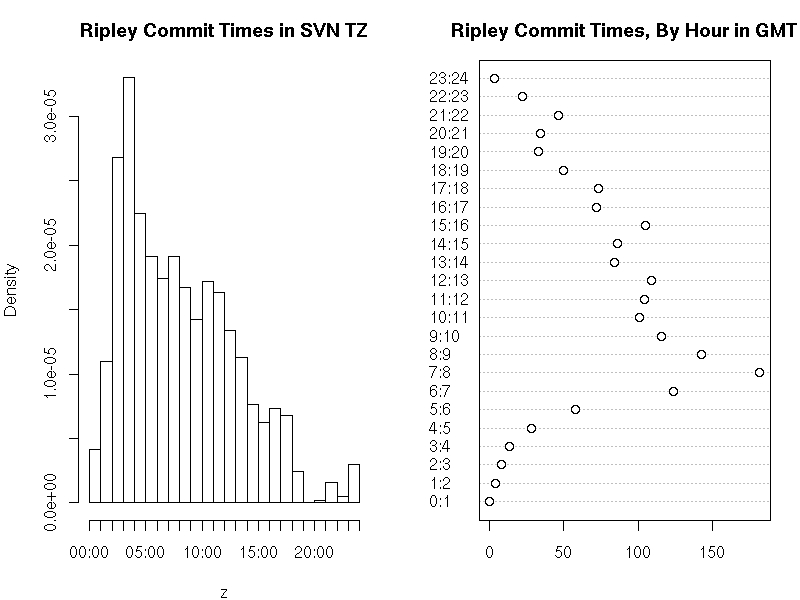
In five lines (that could be shortened to three at the expense of some readibility), the SVN log for R is downloaded directly from the website, the revision authors are extraced and then tabulated by submitter. The relative percentage of Brian Ripley is found to be a staggering 74.8% -- or about three times as much as the other fifteen committers combined. Smokes. [ Oh, and for those who don't know him, he's also got a day job which presumably entails looking after his graduate students at Oxford. Who knows, he may even teach. Kidding aside, he's actually one of the nicest persons you'll ever meet in real life. ] Now yesterday, Simon Jackman who had at first simply repeated Ben's analysis on his own blog followed up with a nice analysis (albeit typeset in a way that rendered the code inoperational, which has now been fixes) that creates both a histogram and a dotplot of commits per hour of the day. Omitting Ben's code which Simon reuses, we have the following for histogram and dotchart:
tod <- unlist(sapply(rx,function(x)strsplit(x,split=" ")[[1]][6]))
tod <- tod[who=="ripley"]
tz <- sub(pattern=".*(-[0-9] 4 ).*",replacement="\\1",x=rx)
tz <- tz[who=="ripley"]
tz <- as.numeric(tz)/100
offset <- 3600*tz
z <- strptime(tod,format="%H:%M:%S")
hist(z,"hours",main="Ripley Commit Times in SVN TZ")
h <- z - offset
h <- format(h,format="%H")
h <- factor(as.numeric(h), levels=0:23)
dotchart(table(h), main="Ripley Commit Times, By Hour in GMT",
         labels=paste(0:23,1:24,sep=":"))
This extracts the commit times, subsets to the ones by Prof. Ripley, extracts the timezones component (as strptime seemingly doesn't do that which is a pain), extracts the tz-less time via strptime into a variable 'z' for which the histogram is drawn. He then corrects the times by the tz offset expressed in seconds, formats is as hour of the day and turns it into a 'factor' (an R data type for qualitative variables which may be ordered as is the case here) and draws a dotplot. This results in the following chart: Simon Jackman's per-hour charts of Brian Ripley's commit patterns Now, nobody has looked at the time series. So we correct this and add the following:
## rather extract both  date and time
dat <- unlist(sapply(rx, function(x)  
  txt <- strsplit(x,split=" ")[[1]]
  paste(txt[5], txt[6])
 ))
## subset on Prof Ripley
dat <- dat[who == "ripley"]
## and convert to POSIXct, correcting by tz as well
datpt <- as.POSIXct(strptime(dat,format="%Y-%m-%d %H:%M:%S")) - offset
## turn into zoo -- we use a constant series of ones as each
## committ is taken as a timestamped event
datzoo <- zoo(1, order.by=datpt)
## and use zoo to aggregate into commits per date
daily <- aggregate(datzoo, as.Date(index(datzoo)), sum)
## now plot as grey bars
plot(daily, col='darkgrey', type='h', lwd=2,
     ylab="Nb of SVN commits, three-week median",
     xlab="R release dates 2.5.0 and 2.5.1 shown in orange",
     main="The amazing Prof. Ripley")
## mark the two R releases of 2007
abline(v=c(as.Date("2007-04-24"),as.Date("2007-06-28")),col='orange',lwd=1.5)
## and do a quick centered rolling median
lines(rollmedian(daily, 21, align="center"), lwd=3)
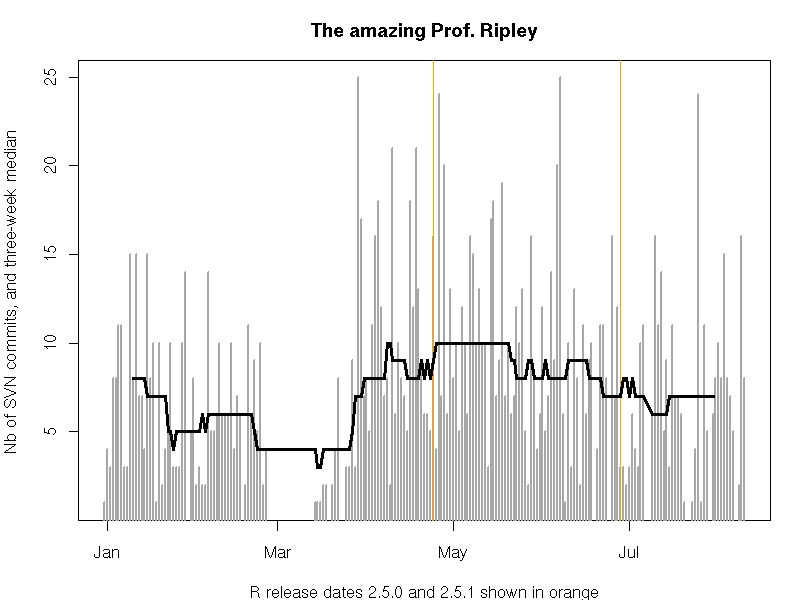
This extracts both date and time, creates a proper R time object (a so-called POSIXct type) from it, fills a zoo ('the' magic class for time series) object with it, uses zoo to aggregate commits per day and plots those in a barchart-alike (I know, I know, ...) plot to which we add the two releases as well as a rolling and centered three-week median (as a real quick hack rather than a proper smooth). Timeseries of Brian Ripley's commit patterns This shows that Prof Ripley averaged about ten commits a day before and after the release of R 2.5.0, and that he has slowed down ever so slightly since then to end up at around a mere seven commits a day. Every day. For the seven-plus months we looked at. So, anyone for analysing his r-help posting frequencies ?

4 August 2007

Russell Coker: Small PC for Creating Word Files

A friend recently asked for advice on a “REALLY small laptop/word processor thingy that would pretty much fit into a (big) pocket, and that only needs to write/word process“. The first problem here is that most people associate “word processing” with desktop publishing and document management. Programs such as MS-Word are considered as having the features required of a word-processor (which includes spelling and grammer checking/correcting, annotations, colours, etc). Programs that have all those features take a lot of CPU power. A Pentium-4 system might be considered the minimum requirement for running a recent version of MS-Word. But a hand-held device can’t have such a powerful CPU (it’s too small to be able to dissipate the heat from such a CPU or contain batteries that can produce enough power to tun it). The next problem is the issue of screen space. A VGA resolution screen (640×480) is regarded as high resolution in the PDA market. Such a resolution does not work with a word-processor that has three toolbars at the top of it’s screen and a paperclip taking up space at the bottom right! I’m sure that everyone who was using computers in the early 1990’s can recall the minimal word-processing programs. One thing to consider is that 640×480 in a 15 inch CRT screen is much more useful than 640×480 in a hand-held device as the larger screen can have fewer pixels per character and therefore display more text on the screen. An added complication is that there are two methods of input for PDAs. One is to have a hardware keyboard (which may be a separate device or may be part of the PDA) and the other is to have a keyboard displayed on the screen. A hardware keyboard makes the device larger and a software keyboard takes up precious screen space (you just can’t win). My PDA is an iPaQ model h3900. It has 64M of RAM, 32M of flash, no hardware keyboard, and a screen resolution of 320×240. I have done some serious writing on my iPaQ (including writing an entire article for Linux Journal) and it works reasonably well. For serious writing you can produce plain text on a PDA and then easily paste it into your program of choice on a PC later (PDAs generally support connection to a PC via serial port and/or USB). The challenge is editing files that originate on a PC using a PDA. Generally I try and use HTML and TeX for my formatted documents so the text versions of those formats are easy to edit once you have learned them. Taking data from a MD-Word file, editing it on a PDA, and then taking it back to the PC would cause many problems and probably wouldn’t be worth attempting. Recently I have been using my iPaQ for writing notes about email and blog posts that I will write. If I get an idea then I immediately write some notes about it on my iPaQ and then usually type it again instead of downloading it. For example the notes for this post were “write about RAM, storage, and screen resolution”. Often getting the initial ideas to start writing is the hard part. Writing a 500 to 1000 word blog post or message is easy once I have the ideas. If I was going to buy a new PDA now I would prefer one with a hardware keyboard, the loss of screen space for a keyboard on the touch-screen is a serious impediment to writing. The maximum amount of text that can be displayed on the screen at any one time limits the complexity of what I work on (see my post about monitors for developers). Another factor is the fact that for small notes the amount of time taken to remove the stylus from it’s bay is greater than the amount of time saved by using it. So I end up writing small notes using my finger-nail on the touch-screen which is significantly slower than using a keyboard (even the crummy ones that PDAs have). Of course the keyboard would still have to be QWERTY and have raised keys so that I can touch-type. I haven’t investigated this seriously as my iPaQ is good enough to last me for another year or two at least and I’ve got an unused spare iPaQ to replace it when it fails. But if anyone has any recommendations of Linux based PDAs with keyboards then I would appreciate some comments.

Next.

Previous.