I m finishing typing up this blog entry hours before my last 13 hour leg back home, after I spent 2 weeks in Busan, South Korea for DebCamp24 and DebCamp24. I had a rough year and decided to take it easy this DebConf. So this is the first DebConf in a long time where I didn t give any talks. I mostly caught up on a bit of packaging, worked on DebConf video stuff, attended a few BoFs and talked to people. Overall it was a very good DebConf, which also turned out to be more productive than I expeced it would.
In the welcome session on the first day of DebConf, Nicolas Dandrimont mentioned that a benefit of DebConf is that it provides a sort of caffeine for your Debian motivation. I could certainly feel that affect swell as the days went past, and it s nice to be excited about some ideas again that would otherwise be fading.
Recovering DPL
It s a bit of a gear shift being DPL for 4 years, and DebConf Committee for nearly 5 years before that, and then being at DebConf while some issue arise (as it always does during a conference). At first I jump into high alert mode, but then I have to remind myself it s not your problem anymore and let others deal with it.
It was nice spending a little in-person time with Andreas Tille, our new DPL, we did some more handover and discussed some current issues. I still have a few dozen emails in my DPL inbox that I need to collate and forward to Andreas, I hope to finish all that up by the end of August.
During the Bits from the DPL talk, the usual question came up whether Andreas will consider running for DPL again, to which he just responded in a slide Maybe . I think it s a good idea for a DPL to do at least two terms if it all works out for everyone, since it takes a while to get up to speed on everything.
Also, having been DPL for four years, I have a lot to say about it, and I think there s a lot we can fix in the role, or at least discuss it. If I had the bandwidth for it I would have scheduled a BoF for it, but I ll very likely do that for the next DebConf instead!
Video team
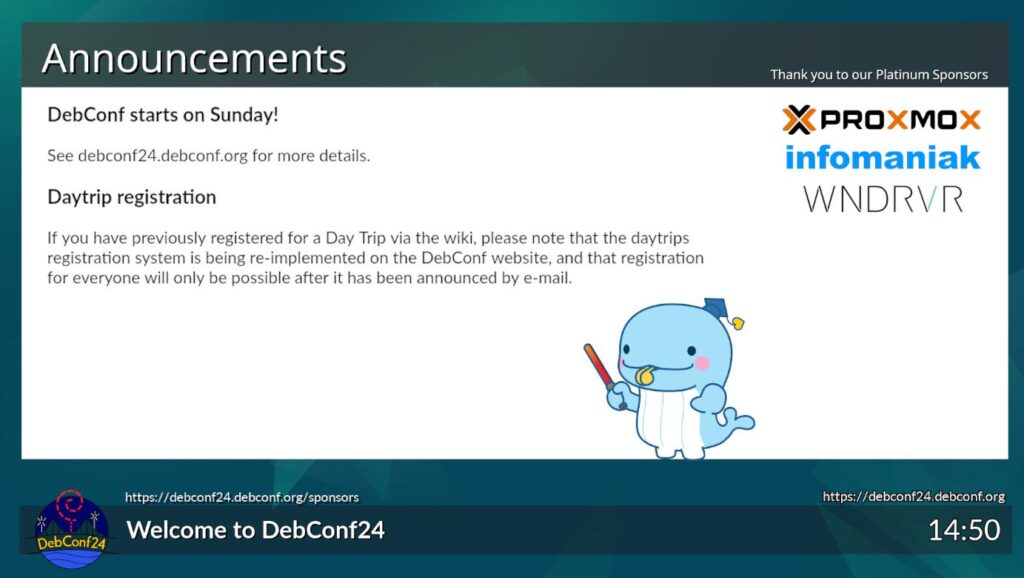
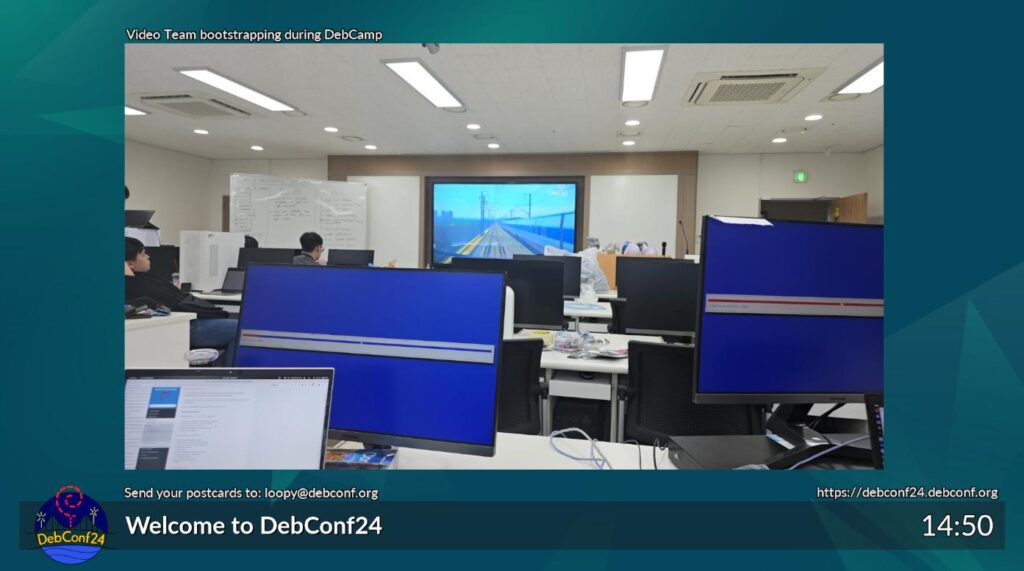
I set up the standby loop for the video streaming setup. We call it loopy, it s a bunch of OBS scenes that provide announcements, shows sponsors, the schedule and some social content. I wrote about it back in 2020, but it s evolved quite a bit since then, so I m probably due to write another blog post with a bunch of updates on it. I hope to organise a video team sprint in Cape Town in the first half of next year, so I ll summarize everything before then.
It would ve been great if we could have some displays in social areas that could show talks, the loop and other content, but we were just too pressed for time for that. This year s DebConf had a very compressed timeline, and there was just too much that had to be done and that had to be figured out on the last minute. This put quite a lot of strain on the organisers, but I was glad to see how, for the most part, most attendees were very sympathetic to some rough edges (but I digress ).
I added more of the OBS machine setup to the videoteam s ansible repository, so as of now it just needs an ansible setup and the OBS data and it s good to go. The loopy data is already in the videoteam git repository, so I could probably just add a git pull and create some symlinks in ansible and then that machine can be installed from 0% to 100% by just installing via debian-installer with our ansible hooks.
This DebConf I volunteered quite a bit for actual video roles during the conference, something I didn t have much time for in recent DebConfs, and it s been fun, especially in a session or two where nearly none of the other volunteers showed up. Sometimes chaos is just fun :-)
Baekyongee is the university mascot, who s visible throughout the university. So of course we included this four legged whale creature on the loop too!
Packaging
I was hoping to do more packaging during DebCamp, but at least it was a non-zero amount:
Uploaded gdisk 1.0.10-2 to unstable (previously tested effects of adding dh-sequence-movetousr) (Closes: #1073679).
Worked a bit on bcachefs-tools (updating git to 1.9.4), but has a build failure that I need to look into (we might need a newer bindgen) update: I m probably going to ROM this package soon, it doesn t seem suitable for packaging in Debian.
Calamares: Tested a fix for encrypted installs, and uploaded it.
Calamares: Uploaded (3.3.8-1) to backports (at the time of writing it s still in backports-NEW).
Pixelorama 1.0 I did some initial packaging for Pixelorama back when we did the MiniDebConf Gaming Edition, but it had a few stoppers back then. Version 1.0 seems to fix all of that, but it depends on Godot 4.2 and we re still on the 3 series in Debian, so I ll upload this once Godot 4.2 hits at least experimental. Godot software/games is otherwise quite easy to run, it s basically just source code / data that is installed and then run via godot-runner (godot3-runner package in Debian).
BoFs
Python Team BoF
Link to the etherpad / pad archive link and video can be found on the talk page: https://debconf24.debconf.org/talks/31-python-bof/
The session ended up being extended to a second part, since all the issues didn t fit into the first session.
I was distracted by too many thing during the Python 3.12 transition (to the point where I thought that 3.11 was still new in Debian), so it was very useful listening to the retrospective of that transition.
There was a discussion whether Python 3.13 could still make it to testing in time for freeze, and it seems that there is consensus that it can, although, likely with new experimental features like disabling the global interpreter lock and the just in time compiler disabled.
I learned for the first time about the dead batteries project, PEP-0594, which removes ancient modules that have mostly been superseded, from the Python standard library.
There was some talk about the process for changing team policy, and a policy discussion on whether we should require autopkgtests as a SHOULD or a MUST for migration to testing. As with many things, the devil is in the details and in my opinion you could go either way and achieve a similar result (the original MUST proposal allowed exceptions which imho made it the same as the SHOULD proposal).
There s an idea to do some ongoing remote sprints, like having co-ordinated days for bug squashing / working on stuff together. This is a nice idea and probably a good way to energise the team and also to gain some interest from potential newcomers.
Louis-Philipe V ronneau was added as a new team admin and there was some discussion on various Sphinx issues and which Lintian tags might be needed for Python 3.13. If you want to know more, you probably have to watch the videos / read the notes :)
Debian.net BoF
Link to the etherpad / pad archive link can be found on the talk page: https://debconf24.debconf.org/talks/37-debiannet-team-bof
Debian Developers can set up services on subdomains on debian.net, but a big problem we ve had before was that developers were on their own for hosting those services. This meant that they either hosted it on their DSL/fiber connection at home, paid for the hosting themselves, or hosted it at different services which became an accounting nightmare to claim back the used funds. So, a few of us started the debian.net hosting project (sometimes we just call it debian.net, this is probably a bit of a bug) so that Debian has accounts with cloud providers, and as admins we can create instances there that gets billed directly to Debian.
We had an initial rush of services, but requests have slowed down since (not really a bad thing, we don t want lots of spurious requests). Last year we did a census, to check which of the instances were still used, whether they received system updates and to ask whether they are performing backups. It went well and some issues were found along the way, so we ll be doing that again.
We also gained two potential volunteers to help run things, which is great.
Debian Social BoF
Link to the etherpad / pad archive link can be found on the talk page: https://debconf24.debconf.org/talks/34-debiansocial-bof
We discussed the services we run, you can view the current state of things at: https://wiki.debian.org/Teams/DebianSocial
Pleroma has shown some cracks over the last year or so, and there are some forks that seem promising. At the same time, it might be worth while considering Mastodon too. So we ll do some comparison of features and maintenance and find a way forward. At the time when Pleroma was installed, it was way ahead in terms of moderation features.
Pixelfed is doing well and chugging along nicely, we should probably promote it more.
Peertube is working well, although we learned that we still don t have all the recent DebConf videos on there. A bunch of other issues should be fixed once we move it to a new machine that we plan to set up.
We re removing writefreely and plume. Nice concepts, but it didn t get much traction yet, and no one who signed up for these actually used it, which is fine, some experimentation with services is good and sometimes they prove to be very popular and other times not.
The WordPress multisite instance has some mild use, otherwise haven t had any issues.
Matrix ended up to be much, much bigger than we thought, both in usage and in its requirements. It s very stateful and remembers discussions for as long as you let it, so it s Postgres database is continuously expanding, this will also be a lot easier to manage once we have this on the new host.
Jitsi is also quite popular, but it could probably be on jitsi.debian.net instead (we created this on debian.social during the initial height of COVID-19 where we didn t have the debian.net hosting yet), although in practice it doesn t really matter where it lives.
Most of our current challenges will be solved by moving everything to a new big machine that has a few public IPs available for some VMs, so we ll be doing that shortly.
Debian Foundation Discussion BoF
This was some brainstorming about the future structure of Debian, and what steps might be needed to get there. It s way too big a problem to take on in a BoF, but we made some progress in figuring out some smaller pieces of the larger puzzle. The DPL is going to get in touch with some legal advisors and our trusted organisations so that we can aim to formalise our relationships a bit more by the time it s DebConf again.
I also introduced my intention to join the Debian Partners delegation. When I was DPL, I enjoyed talking with external organisations who wanted to help Debian, but helping external organisations help Debian turned out to be too much additional load on the usual DPL roles, so I m pursuing this with the Debian Partners team, more on that some other time.
This session wasn t recorded, but if you feel like you missed something, don t worry, all intentions will be communicated and discussed with project members before anything moves forward. There was a strong agreement in the room though that we should push forward on this, and not reach another DebConf where we didn t make progress on formalising Debian s structure more.
Social
Conference Dinner
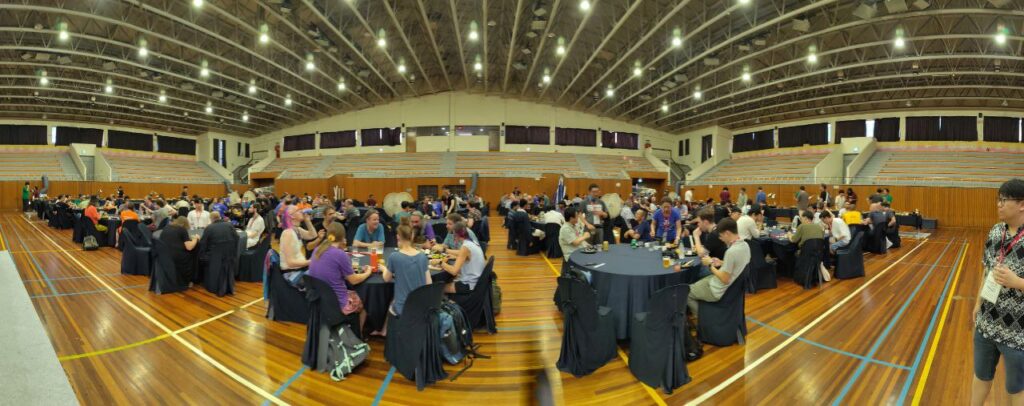
Conference Dinner Photo from Santiago
The conference dinner took place in the university gymnasium. I hope not many people do sports there in the summer, because it got HOT. There was also some interesting observations on the thermodynamics of the attempted cooling solutions, which was amusing. On the plus side, the food was great, the company was good, and the speeches were kept to a minimum, so it was a great conference dinner, even though it was probably cut a bit short due to the heat.
Cheese and Wine
Cheese and Wine happened on 1 August, which happens to be the date I became a DD at DebConf17 in Montr al seven years before, so this was a nice accidental celebration of my Debiversary :)
Since I m running out of time, I ll add some more photos to this post some time after publishing it :P
Group Photo
As per DebConf tradition, Aigars took the group photo. You can find the high resolution version on Debian s GitLab instance.
Debian annual conference Debconf 24, Busan, South Korea Photography: Aigars Mahinovs aigarius@debian.org License: CC-BYv3+ or GPLv2+
Talking
Ah yes, talking to people is a big part of DebConf, but I didn t keep track of it very well.
I mostly listened to Alper a bit about his ideas for his talk about debian installer.
I talked to Rhonda a bit about ActivityPub and MQTT and whether they could be useful for publicising Debian activity.
Listened to Gunnar and Julian have a discussion about GPG and APT which was interesting.
We had the usual continuous keysigning party. Besides it s intended function, this is always a good ice breaker and a way to for shy people to meet other shy people.
and many other fly-by discussions.
Stuff that didn t happen this DebConf
loo.py A simple Python script that could eventually replace the obs-advanced-scene-switcher sequencer in OBS. It would also be extremely useful if we d ever replace OBS for loopy. I was hoping to have some time to hack on this, and try to recreate the current loopy in loo.py, but didn t have the time.
toetally This year videoteam had to scramble to get a bunch of resistors to assemble some tally light. Even when assembled, they were a bit troublesome. It would ve been nice to hack on toetally and get something ready for testing, but it mostly relies on having something like a rasbperry pi zero with an attached screen in order to work on further. I ll try to have something ready for the next mini conf though.
extrepo on debian live I think we should have extrepo installed by default on desktop systems, I meant to start a discussion on this, but perhaps it s just time I go ahead and do it and announce it.
Live stream to peertube server It would ve been nice to live stream DebConf to PeerTube, but the dependency tree to get this going got a bit too huge. Following our plans discussed in the Debian Social BoF, we should have this safely ready before the next MiniDebConf and should be able to test it there.
Desktop Egg there was this idea to get a stand-in theme for Debian testing/unstable until the artwork for the next release is finalized (Debian bug: #1038660), I have an idea that I meant to implement months ago, but too many things got in the way. It s based on Juliette Taka s Homeworld theme, and basically transforms the homeworld into an egg. Get it? Something that hasn t hatched yet? I also only recently noticed that we never used the actualhomeworld graphics (featuring the world image) in the final bullseye release. lol.
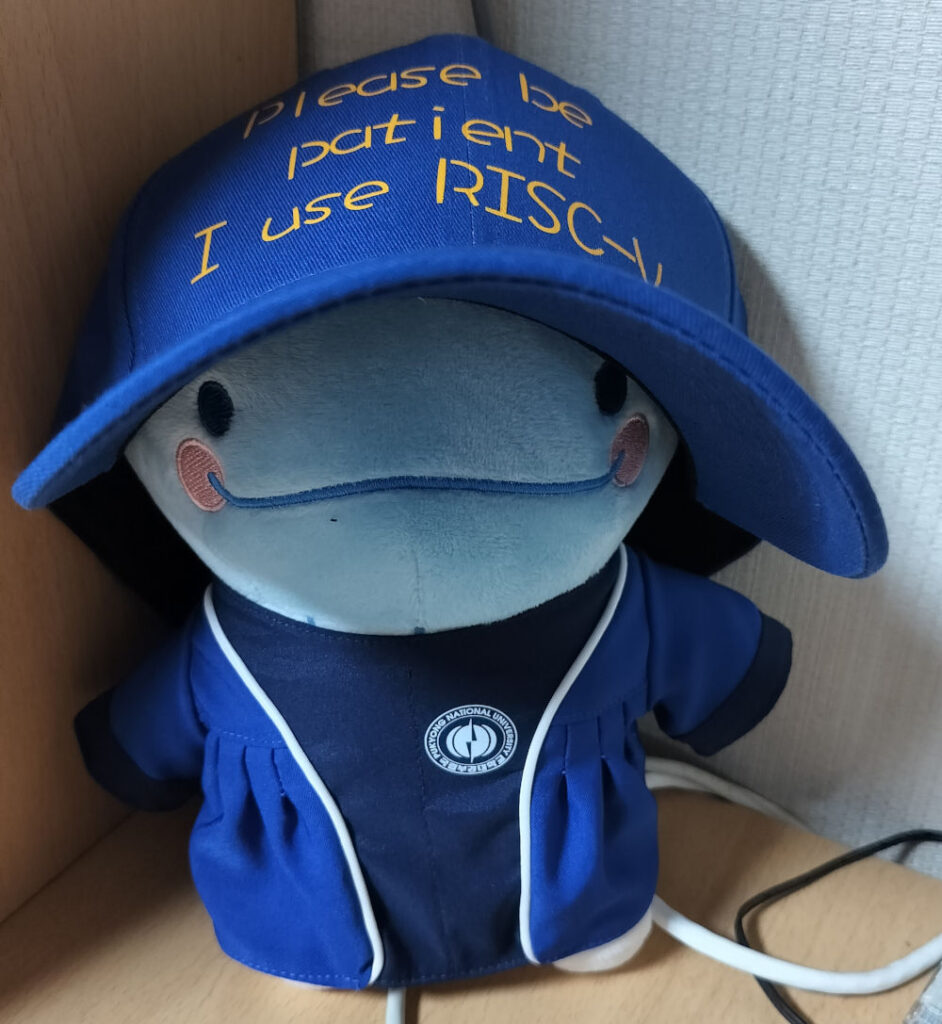
So, another DebConf and another new plush animal. Last but not least, thanks to PKNU for being such a generous and fantastic host to us! See you again at DebConf25 in Brest, France next year!
DebConf24 is now over! I'm very happy I was able to attend this year. If
you haven't had time to look at the schedule yet, here is a
selection of talks I liked.
What happens if I delete setup.py?: a live demo of upgrading to PEP-518 Python packaging
A great talk by Weezel showcasing how easy it is to migrate to PEP-518 for
existing Python projects.
This is the kind of thing I've been doing a lot when packaging upstream
projects that still use setup.py. I encourage you to send this kind of patch
upstream, as it makes everyone's life much easier.
Debian on Chromebooks: What's New and What's Next?
A talk by Alper Nebi Yasak, who has done great work on running Debian and the
Debian Installer on Chromebooks.
With Chromebooks being very popular machines in schools, it's nice to see people
working on a path to liberate them.
Sequoia PGP, sq, gpg-from-sq, v6 OpenPGP, and Debian
I had the chance to see Justus' talk on Sequoia an OpenPGP implementation in
Rust at DebConf22 in Kosovo. Back then, the conclusion was that
sq wasn't ready for production yet.
Well it seems it now is! This in-depth talk goes through the history of the
project and its goals. There is also a very good section on the current
OpenPGP/LibrePGP schism.
Chameleon - the easy way to try out Sequoia - OpenPGP written in Rust
A very short talk by Holger on Chameleon, a tool to make migration to Sequoia
easier.
TL;DW: apt install gpg-from-sq
Protecting OpenPGP keyservers from certificate flooding
Although I used to enjoy signing people's OpenPGP keys, I completely gave up on
this practice around 2019 when dkg's key was flooded with bogus
certifications and have been refusing to do so since.
In this talk, Gunnar talks about his PhD work on fixing this issue and making
sure we can eventually restore this important function on keyservers.
Bits from the DPL
Bits from the DPL! A DebConf classic.
Linux live patching in Debian
Having to reboot servers after kernel upgrades is a hassle, especially with
machines that have encrypted disk drives.
Although kernel live patching in Debian is still a work in progress, it is
encouraging to see people trying to fix this issue.
"I use Debian BTW": fzf, tmux, zoxide and friends
A fun talk by Samuel Henrique on little changes and tricks one can make to
their setup to make life easier.
Ideas to Move Debian Installer Forward
Another in-depth talk by Alper, this time on the Debian Installer and his ideas
to try to make it better. I learned a lot about the d-i internals!
Lightning Talks
Lighting talks are always fun to watch! This year, the following talks happened:
Customizing your Linux icons
A Free Speech tracker by SFLC.IN
Desktop computing is irrelevant
An introduction to wcurl
Aliasing in dpkg
A DebConf art space
Tiny Tapeout, Fomu, PiCI
Data processing and visualisation in the shell
Is there a role for Debian in the post-open source era?
As an economist, I've been interested in Copyright and business models in the
Free Software ecosystem for a while. In this talk, Hatta-san and Bruce Perens
discuss the idea of alternative licences that are not DFSG-free, like
Post-Open.
One of our newest servers, with a hefty 256GB of RAM, recently began killing
processes via the oomkiller.
According to free, only half of the RAM was in use (125GB). About 4GB was
free, with the remainer used by the file cache.
I m used to seeing unexpected free RAM numbers like this and have been
assured that the kernel is simply not wasting RAM. If it s not needed, use it
to cache files to save on disk I/O. That make sense.
However why is the oomkiller being called instead of flushing the file
cache?
I came up with all kinds of amazing and wrong theories: maybe the RAM is
fragmented (is that even a thing?!?), maybe there is a spike in RAM and the
kernel can t flush the cache quickly enough (I really don t think that s a
thing). Maybe our kvm-manager has a weird bug (nope, but that didn t stop me
from opening a spurious bug
report).
I learned lots of cool things, like the oomkiller report includes a
table of the memory in use by each process (via the rss column) - and you
have to muliply that number by 4096 because it s in 4K pages.
That s how I discovered that the oomkiller was killing off processes with only
half the memory in use.
I also learned that lsof sometimes lists the same open file multiple times,
which made me think a bunch of files were being opened repeatedly causing a
memory problem, but really it amounted to nothing.
That last thing I learned, courtesy of an askubuntu
post is that
the /dev filesystem is allocated by default exactly half the RAM on the
system. What a coincidence! That is exactly how much RAM is useable on the
server.
And, on the server in question, that filesystem is full. What?!? Normally, that
filesystem should be using 0 bytes because it s not a real filesystem. But in
our case a process created a 127GB file there - it was only stopped because the
file system filled up.
Thankfully no tragedies to report this week! I thank each and everyone of you that has donated to my car fund. I still have a ways to go and could use some more help so that we can go to the funeral. https://gofund.me/033eb25d I am between contracts and work packages, so all of my work is currently for free. Thanks for your consideration.
Another very busy week getting qt6 updates in Debian, Kubuntu, and KDE snaps.
Kubuntu:
Merkuro and Neochat SRUs have made progress.
See Debian for the qt6 Plasma / applications work.
Debian:
qtmpv in NEW
arianna in NEW
kamera experimental
libkdegames experimental
kdenetwork-filesharing experimental
xwaylandvideobridge NEW
futuresql NEW
kpat WIP
Tokodon Done, but needs qtmpv to pass NEW
Gwenview WIP needs kamera, kio-extras
kio-extras Blocked on kdsoap in which the maintainer is not responding to bug reports or emails. Will likely fork in Kubuntu as our freeze quickly approaches.
KDE Snaps:
Updated QT to 6.7.2 which required a rebuild of all our snaps. Also found an issue with mismatched ffmpeg libraries, we have to bundle them for now until versioning issues are resolved.
Made new theme snaps for KDE breeze: gtk-theme-breeze, icon-theme-breeze so if you use the plasma theme breeze please install these and run
for PLUG in $(snap connections   grep gtk-common-themes:icon-themes   awk ' print $2 '); do sudo snap connect $ PLUG  icon-theme-breeze:icon-themes; done
for PLUG in $(snap connections   grep gtk-common-themes:gtk-3-themes   awk ' print $2 '); do sudo snap connect $ PLUG  gtk-theme-breeze:gtk-3-themes; done
for PLUG in $(snap connections   grep gtk-common-themes:gtk-2-themes   awk ' print $2 '); do sudo snap connect $ PLUG  gtk-theme-breeze:gtk-2-themes; done
This should resolve most theming issues. We are still waiting for kdeglobals to be merged in snapd to fix colorscheme issues, it is set for next release. I am still working on qt6 themes and working out how to implement them in snaps as they are more complex than gtk themes with shared libraries and file structures.
Please note: Please help test the edge snaps so I can promote them to stable.
Dear Debian community,
this are my bits from DPL written at my last day at another great
DebConf.
DebConf attendance
At the beginning of July, there was some discussion with the bursary and
content team about sponsoring attendees. The discussion continued at
DebConf.
I do not have much experience with these discussions. My summary is that
while there is an honest attempt to be fair to everyone, it did not seem to
work for all, and some critical points for future discussion remained. In
any case, I'm thankful to the bursary team for doing such a time-draining
and tedious job.
Popular packages not yet on Salsa at all
Otto Kek l inen did some interesting investigation about
Popular packages not yet on Salsa at all.
I think I might provide some more up to date list soon by some UDD query
which considers more recent uploads than the trends data soon. For
instance wget was meanwhile moved to Salsa (thanks to No l K the for this).
Keep on contacting more teams
I kept on contacting teams in July. Despite I managed to contact way
less teams than I was hoping I was able to present some conclusions in
the Debian Teams exchange BoF and Slide 16/23 of my
Bits from the DPL talk.
I intend to do further contacts next months.
Nominating Jeremy B cha for GNOME Advisory Board
I've nominated Jeremy B cha to
GNOME Advisory Board.
Jeremy has volunteered to represent Debian at
GUADEC in Denver.
DebCamp / DebConf
I attended DebCamp starting from 22 July evening and had a lot of fun with
other attendees. As always DebConf is some important event nearly
every year for me. I enjoyed Korean food, Korean bath, nature at the
costline and other things.
I had a small event without video coverage
Creating web galleries including maps from a geo-tagged photo collection.
At least two attendees of this workshop confirmed success in creating their
own web galleries.
I used DebCamp and DebConf for several discussions. My main focus was on
discussions with FTP master team members Luke Faraone, Sean Whitton, and
Utkarsh Gupta. I'm really happy that the four of us absolutely agree on
some proposed changes to the structure of the FTP master team, as well
as changes that might be fruitful for the work of the FTP master team
itself and for Debian developers regarding the processing of new
packages.
My explicit thanks go to Luke Faraone, who gave a great introduction to
FTP master work in their
BoF.
It was very instructive for the attending developers to understand how the
FTP master team checks licenses and copyright and what workflow is used
for accepting new packages.
In the first days of DebConf, I talked to representatives of DebConf
platinum sponsor WindRiver, who announced the derivative
eLxr. I warmly welcome
this new derivative and look forward to some great cooperation. I also
talked to the representative of our gold sponsor, Microsoft.
My first own event was the
Debian Med BoF.
I'd like to repeat that it might not only be interesting for people
working in medicine and microbiology but always contains some hints how
to work together in a team.
As said above I was trying to summarise some first results of my team
contacts and got some further input from other teams in the
Debian Teams exchange BoF.
Finally, I had my
Bits from DPL talk.
I received positive responses from attendees as well as from remote
participants, which makes me quite happy. For those who were not able to
join the events on-site or remotely, the videos of all events will be
available on the DebConf site soon. I'd like to repeat the explicit need
for some volunteers to join the Lintian team. I'd also like to point out
the "Tiny tasks" initiative I'd like to start (see below).
BTW, if someone might happen to solve my quiz for the background images
there is a
summary page
in my slides which might help to assign every slide to some DebConf. I
could assume that if you pool your knowledge you can solve more than just
the simple ones. Just let me know if you have some solution. You can add
numbers to the rows and letters to the columns and send me:
 2000/2001:  Uv + Wx
 2002: not attended
 2003: Yz
 2004: not attended
 2005:
 2006: not attended
 2007:
 ...
 2024: A1
This list provides some additional information for DebConfs I did not
attend and when no video stream was available. It also reminds you about
the one I uncovered this year and that I used two images from 2001 since
I did not have one from 2000. Have fun reassembling good memories.
Tiny tasks: Bug of the day
As I mentioned in my
Bits from DPL talk,
I'd like to start a "Tiny tasks" effort within Debian. The first type of
tasks will be the
Bug of the day
initiative. For those who would like to join, please join the corresponding
Matrix channel. I'm
curious to see how this might work out and am eager to gain some initial
experiences with newcomers. I won't be available until next Monday, as I'll
start traveling soon and have a family event (which is why I need to leave
DebConf today after the formal dinner).
Kind regards from DebConf in Busan
Andreas.
My Debian contributions this month were all
sponsored by Freexian.
You can also support my work directly via
Liberapay.
OpenSSH
At the start of the month, I uploaded a quick fix (via Salvatore Bonaccorso)
for a regression from
CVE-2006-5051,
found by
Qualys;
this was because I expected it to take me a bit longer to merge OpenSSH
9.8, which had the full fix.
This turned out to be a good guess: it took me until the last day of the
month to get the merge done. OpenSSH 9.8 included some substantial changes
to split the server into a listener binary and a per-session binary, which
required some corresponding changes in the GSS-API key exchange patch. At
this point I was very grateful for the GSS-API integration
test
contributed by Andreas Hasenack a little while ago, because otherwise I
might very easily not have noticed my mistake: this patch adds some entries
to the key exchange algorithm proposal, and on the server side I d
accidentally moved that to after the point where the proposal is sent to the
client, which of course meant it didn t work at all. Even with a failing
test, it took me quite a while to spot the problem, involving a lot of
staring at strace output and comparing debug logs between versions.
There are still some regressions to sort out, including a problem with
socket activation, and problems in
libssh2 and
Twisted due to DSA now
being disabled at compile-time.
Speaking of DSA, I wrote a release
note
for this change, which is now merged.
GCC 14 regressions
I fixed a number of build failures with GCC 14, mostly in my older packages:
grub (legacy),
imaptool,
kali,
knews, and
vigor.
autopkgtest
I contributed a change to allow maintaining Incus container and VM images
in
parallel.
I use both of these regularly (containers are faster, but some tests need
full machine isolation), and the build tools previously didn t handle that
very well.
I now have a script that just does this regularly to keep my images up to
date (although for now I m running this with PATH pointing to autopkgtest
from git, since my change hasn t been released yet):
Python team
I fixed dnsdiag s uninstallability in unstable, and contributed the fix
upstream.
I reverted python-tenacity to an earlier version due to regressions in a
number of OpenStack packages, including
octavia and
ironic. (This seems to be due to
#486 upstream.)
I fixed a build failure in
python3-simpletal due to Python 3.12 removing the old imp module.
I added non-superficial autopkgtests to a number of packages, including
httmock, py-macaroon-bakery, python-libnacl, six, and storm.
I switched a number of packages to build using PEP
517 rather than calling setup.py
directly, including alembic, constantly, hyperlink, isort, khard,
python-cpuinfo, and python3-onelogin-saml2. (Much of this was by working
through the
missing-prerequisite-for-pyproject-backend
Lintian tag, but there s still lots to do.)
I upgraded frozenlist, ipykernel, isort, langtable, python-exceptiongroup,
python-launchpadlib, python-typeguard, pyupgrade, sqlparse, storm, and
uncertainties to new upstream versions. In the process, I added myself to
Uploaders for isort, since the previous primary uploader has
retired.
Other odds and ends
I applied a suggestion by Chris Hofstaedtler to create /etc/subuid and
/etc/subgid in base-passwd, since the
login package is no longer essential.
I fixed a wireless-tools regression due
to iproute2 dropping its (/usr)/sbin/ip compatibility symlink.
I applied a suggestion by Petter Reinholdtsen to add AppStream
metainfo to pcmciautils.
Review: The Book That Wouldn't Burn, by Mark Lawrence
Series:
Library Trilogy #1
Publisher:
Ace
Copyright:
2023
ISBN:
0-593-43793-4
Format:
Kindle
Pages:
561
The Book That Wouldn't Burn is apparently high fantasy, but of the
crunchy sort that could easily instead be science fiction. It is the
first of a trilogy.
Livira is a young girl, named after a weed, who lives in a tiny settlement
in the Dust. She is the sort of endlessly curious and irrepressible girl
who can be more annoying than delightful to adults who are barely keeping
everyone alive. Her settlement is not the sort of place that's large
enough to have a name; only their well keeps them alive in the desert and
the ever-present dust. There is a city somewhere relatively near, which
Livira dreams of seeing, but people from the settlement don't go there.
When someone is spotted on the horizon approaching the settlement, it's
the first time Livira has ever seen a stranger. It's also not a good
sign. There's only one reason for someone to seek them out in the Dust:
to take. Livira and the other children are, in short order, prisoners of
the humanoid dog-like sabbers, being dragged off to an unknown fate.
Evar lives in the library and has for his entire life. Specifically, he
lives in a square room two miles to a side, with a ceiling so high that it
may as well be a stone sky. He lived there with his family before he was
lost in the Mechanism. Years later, the Mechanism spit him out alongside
four other similarly-lost kids, all from the same library in different
times. None of them had apparently aged, but everyone else was dead.
Now, years later, they live a strange and claustrophobic life with way too
much social contact between way too few people.
Evar's siblings, as he considers them, were each in the Mechanism with a
book. During their years in the Mechanism they absorbed that book until
it became their focus and to some extent their personality. His brothers
are an assassin, a psychologist, and a historian. His sister, the last to
enter the Mechanism and a refugee from the sabber attack that killed
everyone else, is a warrior. Evar... well, presumably he had a book,
since that's how the Mechanism works. But he can't remember anything
about it except the feeling that there was a woman.
Evar lives in a library in the sense that it's a room full of books, but
those books are not on shelves. They're stacked in piles and massive
columns, with no organizational system that any of them could discern.
There are four doors, all of which are closed and apparently impenetrable.
In front of one of them is a hundred yards of char and burned book
remnants, but that door is just as impenetrable as the others. There is a
pool in the center of the room, crops surrounding it, and two creatures
they call the Soldier and the Assistant. That is the entirety of Evar's
world.
As you might guess from the title, this book is about a library. Evar's
perspective of the library is quite odd and unexplained until well into
the book, and Livira's discovery of the library and subsequent
explorations are central to her story, so I'm going to avoid going into
too many details about its exact nature. What I will say is that I have
read a lot of fantasy novels that are based around a library, but I don't
think I've ever read one that was this satisfying.
I think the world of The Book That Wouldn't Burn is fantasy, in
that there are fundamental aspects of this world that don't seem amenable
to an explanation consistent with our laws of physics. It is, however,
the type of fantasy with discoverable rules. Even better, it's the type
of fantasy where discovering the rules is central to the story, for both
the characters and the readers, and the rules are worth the effort. This
is a world-building tour de force: one of the most engrossing and
deeply satisfying slow revelations that I have read in a long time. This
book is well over 500 pages, the plot never flags, new bits of
understanding were still slotting into place in the last chapter, and
there are lots of things I am desperately curious about that Lawrence left
for the rest of the series. If you like puzzling out the history and
rules of an invented world and you have anything close to my taste in
characters and setting, you are going to love this book.
(Also, there is at least one C.S. Lewis homage that I will not spoil but
that I thought was beautifully done and delightfully elaborated, and I am
fairly sure there is a conversation happening between this book and Philip
Pullman's His Dark Materials series that I didn't quite untangle
but that I am intrigued by.)
I do need to offer a disclaimer: Livira is precisely the type of character
I love reading about. She's stubborn, curious, courageous, persistent,
egalitarian, insatiable, and extremely sharp. I have a particular soft
spot for exactly this protagonist, so adjust the weight of my opinion
accordingly. But Lawrence also makes excellent use of her as a spotlight
to illuminate the world-building. More than anything else in the world,
Livira wants to understand, and there is so much here to
understand.
There is an explanation for nearly everything in this book, and those
explanations usually both make sense and prompt more questions. This is
such a tricky balance for the writer to pull off! A lot of world-building
of this sort fails either by having the explanations not live up to the
mysteries or by tying everything together so neatly that the stakes of the
world collapse into a puzzle box. Lawrence avoids both failures. This
world made sense to me but remained sufficiently messy to feel like humans
were living in it. I also thought the pacing and timing were impeccable:
I figured things out at roughly the same pace as the characters, and
several twists and turns caught me entirely by surprise.
I do have one minor complaint and one caveat. The minor complaint is that
I thought one critical aspect of the ending was a little bit too neat and
closed. It was the one time in the book where I thought Lawrence
simplified his plot structure rather than complicated it, and I didn't
like the effect it had on the character dynamics. There is, thankfully,
the promise of significant new complications in the next book.
The caveat is a bit harder to put my finger on, but a comparison to Alaya
Dawn Johnson's The Library of Broken
Worlds might help. That book was also about a library, featured a
protagonist thrown into the deep end of complex world-building, and put
discovery of the history and rules at the center of the story. I found
the rules structure of The Book That Wouldn't Burn more
satisfyingly complicated and layered, in a way that made puzzle pieces fit
together in my head in a thoroughly enjoyable way. But Johnson's book is
about very large questions of identity, history, sacrifice, and pain, and
it's full of murky ambiguity and emotions that are only approached via
metaphor and symbolism. Lawrence's book is far more accessible, but the
emotional themes are shallower and more straightforward. There is a
satisfying emotional through-line, and there are some larger issues at
stake, but it won't challenge your sense of morality and justice the way
that The Library of Broken Worlds might. I think which of those
books one finds better will depend on what mood you're in and what reading
experience you're looking for.
Personally, I was looking for a scrappy, indomitable character who would
channel her anger into overcoming every obstacle in the way of thoroughly
understanding her world, and that's exactly what I got. This was my most
enjoyable reading experience of the year to date and the best book I've
read since Some Desperate Glory.
Fantastic stuff, highly recommended.
Followed by The Book That Broke the World, and the ending is a bit
of a cliffhanger so you may want to have that on hand. Be warned that the
third book in the series won't be published until 2025.
Rating: 9 out of 10
The diffoscope maintainers are pleased to announce the release of diffoscope
version 273. This version includes the following changes:
[ Chris Lamb ]
* Factor out version detection in test_jpeg_image. (Re:
  reproducible-builds/diffoscope#384)
* Ensure that 'convert' is from Imagemagick 6.x; we will need to update a
  few things with IM7. (Closes: reproducible-builds/diffoscope#384)
* Correct import of identify_version after refactoring change in 037bdcbb0.
[ Mattia Rizzolo ]
* tests:
  + Add OpenSSH key test with a ed25519 key.
  + Skip the OpenSSH test with DSA key if openssh is >> 9.7
  + Support ffmpeg >= 7 that adds some extra context to the diff
* Do not ignore testing in gitlab-ci.
* debian:
  + Temporarily remove aapt, androguard and dexdump from the build/test
    dependencies as they are not available in testin/trixie.  Closes: #1070416
  + Bump Standards-Version to 4.7.0, no changes needed.
  + Adjust options to make sure not to pack the python s-dist directory
    into the debian source package.
  + Adjust the lintian overrides.
The Combatants
In the red corner, weighing in at nah, I m not going to do that schtick.
The plaintiff in the case is Alegeus Technologies, LLC, a Delaware Corporation that, according to their filings, is a leading provider of a business-tobusiness, white-label funding and payment platform for healthcare carriers and third-party administrators to administer consumer-directed employee benefit programs .
Not being subject to the US bonkers health care system, I have only a passing familiarity with the sorts of things they do, but presumably it involves moving a lot of money around, which is sometimes important.
The defendant is DigiCert, a CA which, based on analysis I ve done previously, is the second-largest issuer of WebPKI certificates by volume.
The History
According to a recently opened Mozilla CA bug, DigiCert found an issue in their domain control validation workflow, that meant it may have been possible for a miscreant to have certificates issued to them that they weren t legitimately entitled to.
Given that validating domain names is basically the YOU HAD ONE JOB! of a CA, this is a big deal.
The CA/Browser Forum Baseline Requirements (BRs) (which all CAs are required to adhere to, by virtue of their being included in various browser and OS trust stores), say that revocation is required within 24 hours when [t]he CA obtains evidence that the validation of domain authorization or control for any Fully Qualified Domain Name or IP address in the Certificate should not be relied upon (section 4.9.1.1, point 5).
DigiCert appears to have at least tried to do the right thing, by opening the above Mozilla bug giving some details of the problem, and notifying their customers that their certificates were going to be revoked.
One may quibble about how fast they re doing it, but they re giving it a decent shot, at least.
A complicating factor in all this is that, only a touch over a month ago, Google Chrome announced the removal of another CA, Entrust, from its own trust store program, citing a pattern of compliance failures, unmet improvement commitments, and the absence of tangible, measurable progress in response to publicly disclosed incident reports .
Many of these compliance failures were failures to revoke certificates in a timely manner.
One imagines that DigiCert would not like to gain a reputation for tardy revocation, particularly at the moment.
The Legal Action
Now we come to Alegeus Technologies.
They ve opened a civil case whose first action is to request the issuance of a Temporary Restraining Order (TRO) that prevents DigiCert from revoking certificates issued to Alegeus (which the court has issued).
This is a big deal, because TROs are legal instruments that, if not obeyed, constitute contempt of court (or something similar) and courts do not like people who disregard their instructions.
That means that, in the short term, those certificates aren t getting revoked, despite the requirement imposed by root stores on DigiCert that the certificates must be revoked.
DigiCert is in a real rock / hard place situation here: revoke and get punished by the courts, or don t revoke and potentially (though almost certainly not, in the circumstances) face removal from trust stores (which would kill, or at least massively hurt, their business).
The reasons that Alegeus gives for requesting the restraining order is that [t]o
Reissue and Reinstall the Security Certificates, Alegeus must work with and
coordinate with its Clients, who are required to take steps to rectify the
certificates. Alegeus has hundreds of such Clients. Alegeus is generally
required by contract to give its clients much longer than 24 hours notice
before executing such a change regarding certification.
In the filing, Alegeus does acknowledge that DigiCert is a voluntary member of the Certification Authority Browser Forum (CABF), which has bylaws stating that certificates with an issue in their domain validation must be revoked within 24 hours.
This is a misstatement of the facts, though.
It is the BRs, not the CABF bylaws, that require revocation, and the BRs apply to all CAs that wish to be included in browser and OS trust stores, not just those that are members of the CABF.
In any event, given that Alegeus was aware that DigiCert is required to revoke certificates within 24 hours, one wonders why Alegeus went ahead and signed agreements with their customers that required a lengthy notice period before changing certificates.
What complicates the situation is that there is apparently a Master Services Agreement (MSA) that states that it constitutes the entire agreement between the parties and that MSA doesn t mention certificate revocation anywhere relevant.
That means that it s not quite so cut-and-dried that DigiCert does, in fact, have the right to revoke those certificates.
I d expect a lot of update to your Master Services Agreement emails to be going out from DigiCert (and other CAs) in the near future to clarify this point.
Not being a lawyer, I can t imagine which way this case might go, but there s one thing we can be sure of: some lawyers are going to able to afford that trip to a tropical paradise this year.
The Security Issues
The requirement for revocation within 24 hours is an important security control in the WebPKI ecosystem.
If a certificate is misissued to a malicious party, or is otherwise compromised, it needs to be marked as untrustworthy as soon as possible.
While revocation is far from perfect, it is the best tool we have.
In this court filing, Alegeus has claimed that they are unable to switch certificates with less than 24 hours notice (due to contractual SLAs ).
This is a pretty big problem, because there are lots of reasons why a certificate might need to be switched out Very Quickly.
As a practical example, someone with access to the private key for your SSL certificate might decide to use it in a blog post.
Letting that sort of problem linger for an extended period of time might end up being a Pretty Big Problem of its own.
An organisation that cannot respond within hours to a compromised certificate is playing chicken with their security.
The Takeaways
Contractual obligations that require you to notify anyone else of a certificate (or private key) changing are bonkers, and completely antithetical to the needs of the WebPKI.
If you have to have them, you re going to want to start transitioning to a private PKI, wherein you can do whatever you darn well please with revocation (or not).
As these sorts of problems keep happening, trust stores (and hence CAs) are going to crack down on this sort of thing, so you may as well move sooner rather than later.
If you are an organisation that uses WebPKI certificates, you ve got to be able to deal with any kind of certificate revocation event within hours, not days.
This basically boils down to automated issuance and lifecycle management, because having someone manually request and install certificates is terrible on many levels.
There isn t currently a completed standard for notifying subscribers if their certificates need premature renewal (say, due to needing to be revoked), but the ACME Renewal Information Extension is currently being developed to fill that need.
Ask your CA if they re tracking this standards development, and when they intend to have the extension available for use.
(Pro-tip: if they say we ll start doing development when the RFC is published , run for the hills; that s not how responsible organisations work on the Internet).
The Givings
If you ve found this helpful, consider shouting me a refreshing beverage.
Reading through legal filings is thirsty work!
Combining BGP confederations and AS override can potentially
create a BGP routing loop, resulting in an indefinitely expanding AS path.
BGP confederation is a technique used to reduce the number of iBGP sessions
and improve scalability in large autonomous systems (AS). It divides an AS into
sub-ASes. Most eBGP rules apply between sub-ASes, except that next-hop, MED, and
local preferences remain unchanged. The AS path length ignores contributions
from confederation sub-ASes. BGP confederation is rarely used and BGP route
reflection is typically preferred for scaling.
AS override is a feature that allows a router to replace the ASN of a
neighbor in the AS path of outgoing BGP routes with its own. It s useful when
two distinct autonomous systems share the same ASN. However, it interferes with
BGP s loop prevention mechanism and should be used cautiously. A safer
alternative is the allowas-in directive.1
In the example below, we have four routers in a single confederation, each in
its own sub-AS. R0 originates the 2001:db8::1/128 prefix. R1, R2, and
R3 forward this prefix to the next router in the loop.
BGP routing loop using a confederation
The router configurations are available in a Git repository. They are
running Cisco IOS XR. R2 uses the following configuration for BGP:
The session with R3 uses both as-override and next-hop-self directives.
The latter is only necessary to make the announced prefix valid, as there is no
IGP in this example.2
Here s the sequence of events leading to an infinite AS path:
R1 selects it as the best path, forwarding it to R2 with AS
path (64501 64500).
R2 selects it as the best path, forwarding it to R3 with AS
path (64500 64501 64502).
R3 selects it as the best path. It would forward it to R1 with AS path
(64503 64502 64501 64500), but due to AS override, it substitutes R1 s
ASN with its own, forwarding it with AS path (64503 64502 64503 64500).
R1 accepts the prefix, as its own ASN is not in the AS path. It compares
this new prefix with the one from R0. Both (64500) and (64503 64502
64503 64500) have the same length because confederation sub-ASes don t
contribute to AS path length. The first tie-breaker is the router ID.
R0 s router ID (1.0.0.4) is higher than R3 s (1.0.0.3). The new
prefix becomes the best path and is forwarded to R2 with AS path (64501
64503 64501 64503 64500).
R2 receives the new prefix, replacing the old one. It selects it as the
best path and forwards it to R3 with AS path (64502 64501 64502 64501
64502 64500).
R3 receives the new prefix, replacing the old one. It selects it as the
best path and forwards it to R0 with AS path (64503 64502 64503 64502
64503 64502 64500).
R1 receives the new prefix, replacing the old one. Again, it competes with
the prefix from R0, and again the new prefix wins due to the lower router
ID. The prefix is forwarded to R2 with AS path (64501 64503 64501 64503
64501 64503 64501 64500).
A few iterations later, R1 views the looping prefix as follows:4
RP/0/RP0/CPU0:R1#showbgpipv6u2001:db8::1/128bestpath-compare
BGP routing table entry for 2001:db8::1/128Last Modified: Jul 28 10:23:05.560 for 00:00:00Paths: (2 available, best #2) Path #1: Received by speaker 0 Not advertised to any peer (64500) 2001:db8::1:0 from 2001:db8::1:0 (1.0.0.4), if-handle 0x00000000 Origin IGP, metric 0, localpref 100, valid, confed-external Received Path ID 0, Local Path ID 0, version 0 Higher router ID than best path (path #2) Path #2: Received by speaker 0 Advertised IPv6 Unicast paths to peers (in unique update groups): 2001:db8::2:1 (64503 64502 64503 64502 64503 64502 64503 64502 64503 64502 64503 64502 64503 64502 64503 64502 64503 64502 64503 64502 64503 64502 64503 64502 64503 64502 64503 64502 64503 64502 64503 64502 64503 64502 64503 64502 64503 64502 64503 64502 64503 64502 64503 64502 64503 64502 64503 64502 64503 64502 64503 64502 64503 64502 64503 64502 64503 64502 64503 64502 64503 64502 64503 64502 64503 64502 64503 64502 64503 64502 64503 64502 64503 64502 64503 64502 64503 64502 64503 64502 64503 64502 64503 64502 64503 64502 64503 64502 64503 64502 64503 64502 64503 64502 64503 64502 64503 64502 64503 64502 64503 64502 64500) 2001:db8::4:0 from 2001:db8::4:0 (1.0.0.3), if-handle 0x00000000 Origin IGP, metric 0, localpref 100, valid, confed-external, best, group-best Received Path ID 0, Local Path ID 1, version 37 best of AS 64503, Overall best
There s no upper bound for an AS path, but BGP messages have size limits (4096
bytes per RFC 4271 or 65535 bytes per RFC 8654). At some
point, BGP updates can t be generated. On Cisco IOS XR, the BGP process crashes
well before reaching this limit.5
The main lessons from this tale are:
never use BGP confederations under any circumstances, and
be cautious of features that weaken BGP routing loop detection.
When using BGP confederations with Cisco IOS XR, use
allowconfedas-in instead. It s available since IOS XR 7.11.
Using BGP confederations is already inadvisable. If you don t use the
same IGP for all sub-ASes, you re inviting trouble! However, the scenario
described here is also possible with an IGP.
When an AS path segment is composed of ASNs from a confederation, it
is displayed between parentheses.
By default, IOS XR paces eBGP updates. This is controlled by the
advertisement-interval directive. Its default value is 30 seconds for eBGP
peers (even in the same confederation). R1 and R2 set this value to 0,
while R3 sets it to 2 seconds. This gives some time to watch the AS path
grow.
This is CSCwk15887. It only happens when using as-override on an
AS path with a too long AS_CONFED_SEQUENCE. This should be fixed around
24.3.1.
apt-upgrade-canary is a helper program to alert when upgrading
packages via apt.
If there are some packages which causes a critical or serious
bug, it shows warnings for terminal.
Then you can stay on current version of package by canceling
upgrades.
This program is aimed to help not to installing
problematic packages via manual upgrades.
Usually, you should delegate package upgrade to
unattended-upgrades and apt-listbugs.
apt-listbugs kindly warns if there are known bugs.
In most cases it is enough safer.
But there is one exception, it is not true that always apt-listbugs
can follow very latest critical or serious bugs in timely manner.
apt-upgrade-canary checks UDD mirror database (it take into account
to cache query not to throw redundant one frequently)
Getting started
Install required packages.
$ sudo apt install -y make ruby-pg ruby-json ruby-term-ansicolor
Use case in action
If there is no serious bugs which is reported against target packages,
apt-upgrade-canary reports no error.
apt-upgrade-canary: no problem
If there are something weird happen, it reports matched bugs.
apt-upgrade-canary: serious case
So you can stay on.
The twelveth release of the qlcal package
arrivied at CRAN today.
qlcal
delivers the calendaring parts of QuantLib. It is provided (for the R
package) as a set of included files, so the package is self-contained
and does not depend on an external QuantLib library (which can be
demanding to build). qlcal covers
over sixty country / market calendars and can compute holiday lists, its
complement (i.e. business day lists) and much more. Examples
are in the README at the repository, the package page,
and course at the CRAN package
page.
This releases synchronizes qlcal with
the QuantLib release 1.35 (made
today) and contains more updates to 2024 calendars.
Changes in version 0.0.12
(2024-07-22)
Synchronized with QuantLib 1.35 released today
Calendar updates for Chile, India, United States, Brazil
Courtesy of my CRANberries, there
is a diffstat report for this
release. See the project page
and package documentation for more details, and more examples. If you
like this or other open-source work I do, you can sponsor me at
GitHub.
The Akismet WordPress anti-spam plugin has changed it s policy to not run on sites that have adverts which includes mine. Without it I get an average of about 1 spam comment per hour and the interface for removing spam takes more mouse actions than desired. For email spam it s about the same volume half of which is messages with SpamAssassin scores high enough to go into the MaybeSpam folder (that I go through every few weeks) and half of which goes straight to my inbox. But fortunately moving spam to a folder where I can later use it to train Bayesian classification is a much faster option on PC and is also something I can do from my phone MUA.
As an experiment I have configured my blog to only take comments from registered users. It will be interesting to see how many spammers make it through that and to also see feedback from genuine people. People who can t comment can tell me about it via the contact methods listed here [1].
I previously wrote about other ways of dealing with hostile comments [2]. Blogging seems to be less popular nowadays so a Planet specific forum doesn t seem a viable option. It s a pity, I think that YouTube and Facebook have taken over from blogs and that s not a good thing.
My work on overhauling dhcpcd as the prime replacement for ISC's discontinued DHCP client is done. The package has achieved stability, both upstream and at Debian. The only remaining points are bug #1038882 to swap the Priorities of isc-dhcp-client and dhcpcd-base in the repository's override, and swaping ifupdown's search order to put dhcpcd first.
Meanwhile, ifupdown's de-facto maintainer prompted me to sollicit opinions on which of the 4 ifupdown implementations should ship with a minimal installation for Trixie. This, in turn, re-opened the debate of what should be Debian's default network configuation framework (see the thread starting with this post).
networkd
Given how most Debian ports (except for Hurd) ship with systemd, which includes a disabled networkd by standard, many people in the thread feel that this should become the default network configuration tool for minimal installations. As it happens, most of my hosts fit that scenario, so I figured that I would give another go at testing networkd on one host.
I used the following minimalistic /etc/systemd/network/dhcp.network:
[Match]
Name=en* wl*
[Network]
DHCP=yes
This correctly configured IPv4 via DHCP, with the small caveat that it doesn't update /etc/resolv.conf without installing resolvconf or systemd-resolved.
However, networkd's default IPv6 settings really are not suitable for public consumption. The key issues (see Bug #1076432):
Temporary addresses are not enabled by default. Worse, the setting is ignored if it was enabled by sysctl during bootup. This is a major privacy issue. Adding IPv6PrivacyExtensions=yes to the above exposed another issue: instead of using the fe80 address generated by the kernel, networkd adds a new one.
Networkd uses EUI64 addresses by default. This is another major privacy issue, since EUI64 addresses are forensically traceable to the interface's MAC address. Worse, the setting is ignored if stable-privacy was enabled by sysctl during bootup. To top it all, networkd does stable-privacy using systemd's time-proven brain-dead approach of reinventing the wheel: instead of merely setting the kernel's address generation mode to 3 and letting it configure the secret address, it expects the secret address to be spelled out in the systemd unit.
Conclusion: networkd works well enough for someone configuring an IPv4-only network from 20 years ago, but is utterly inadequate for IPv6 or dual-stack installations, doubly so on a software distribution that claims to care about privacy and network security.
The Rcpp Core Team is once again pleased to announce a new release
(now at 1.0.13) of the Rcpp package.
It arrived on CRAN earlier
today, and has since been uploaded to Debian. Windows and macOS builds
should appear at CRAN in the next few days, as will builds in different
Linux distribution and of course r2u should catch up
tomorrow too. The release was uploaded last week, but not only does Rcpp always gets flagged because of the
grandfathered .Call(symbol) but CRAN also found two packages
regressing which then required them to take five days to get back to
us. One issue was known; another
did not reproduce under our tests against over 2800 reverse dependencies
leading to the eventual release today. Yay. Checks are good and
appreciated, and it does take time by humans to review them.
This release continues with the six-months January-July cycle started
with release
1.0.5 in July 2020. As a reminder, we do of course make interim
snapshot dev or rc releases available via the Rcpp drat repo as well as
the r-universe page and
repo and strongly encourage their use and testing I run my systems
with these versions which tend to work just as well, and are also fully
tested against all reverse-dependencies.
Rcpp has long established itself
as the most popular way of enhancing R with C or C++ code. Right now,
2867 packages on CRAN depend on
Rcpp for making analytical code go
faster and further, along with 256 in BioConductor. On CRAN, 13.6% of
all packages depend (directly) on Rcpp, and 59.9% of all compiled packages
do. From the cloud mirror of CRAN (which is but a subset of all CRAN
downloads), Rcpp has been downloaded
86.3 million times. The two published papers (also included in the
package as preprint vignettes) have, respectively, 1848 (JSS, 2011) and 324 (TAS, 2018)
citations, while the the book (Springer useR!,
2013) has another 641.
This release is incremental as usual, generally preserving existing
capabilities faithfully while smoothing our corners and / or extending
slightly, sometimes in response to changing and tightened demands from
CRAN or R standards. The move towards a
more standardized approach for the C API of R leads to a few changes;
Kevin did most of the PRs for this. Andrew Johnsom also provided a very
nice PR to update internals taking advantage of variadic templates.
The full list below details all changes, their respective PRs and, if
applicable, issue tickets. Big thanks from all of us to all
contributors!
Changes in
Rcpp release version 1.0.13 (2024-07-11)
Changes in Rcpp API:
Set R_NO_REMAP if not already defined (Dirk in #1296)
Add variadic templates to be used instead of generated code
(Andrew Johnson in #1303)
Count variables were switches to size_t to avoid
warnings about conversion-narrowing (Dirk in #1307)
Rcpp now avoids the usage of the (non-API) DATAPTR function when
accessing the contents of Rcpp Vector objects where possible. (Kevin in
#1310)
Rcpp now emits an R warning on out-of-bounds Vector accesses.
This may become an error in a future Rcpp release. (Kevin in #1310)
Switch VECTOR_PTR and STRING_PTR to new
API-compliant RO variants (Kevin in #1317 fixing #1316)
Changes in Rcpp Deployment:
Small updates to the CI test containers have been made (#1304)
I just got one of those utterly funny spam messages And yes, I recognize
everybody likes building a name for themselves. But some spammers are downright
silly.
I just got the following mail:
From: Hermine Wolf <hwolf850@gmail.com>
To: me, obviously
Date: Mon, 15 Jul 2024 22:18:58 -0700
Subject: Make sure that your manuscript gets indexed and showcased in the prestigious Scopus database soon.
Message-ID: <CAEZZb3XCXSc_YOeR7KtnoSK4i3OhD=FH7u+A5xSMsYvhQZojQA@mail.gmail.com>
This message has visual elements included. If they don't display, please
update your email preferences.
*Dear Esteemed Author,*
Upon careful examination of your recent research articles available online,
we are excited to invite you to submit your latest work to our esteemed
journal, '*WULFENIA*'. Renowned for upholding high standards of excellence
in peer-reviewed academic research spanning various fields, our journal is
committed to promoting innovative ideas and driving advancements in
theoretical and applied sciences, engineering, natural sciences, and social
sciences. 'WULFENIA' takes pride in its impressive 5-year impact factor of
*1.000* and is highly respected in prestigious databases including the
Science Citation Index Expanded (ISI Thomson Reuters), Index Copernicus,
Elsevier BIOBASE, and BIOSIS Previews.

*Wulfenia submission page:*
[image: research--check.png][image: scrutiny-table-chat.png][image:
exchange-check.png][image: interaction.png]
.
Please don't reply to this email

We sincerely value your consideration of 'WULFENIA' as a platform to
present your scholarly work. We eagerly anticipate receiving your valuable
contributions.
*Best regards,*
Professor Dr. Vienna S. Franz
Who cares what Wulfenia is about? It s about you, my stupid Wolf cousin!
I do a lot in free software for ham radio, and Steve at Zero Retries encouraged me to take this email I sent him and translate it into something here.
UK Packet Radio Network UKPRN is going nicely, with the Nottingham and South segment really quite impressively interconnected over RF - https://nodes.ukpacketradio.network/packet-network-map.html?rfonly=1 I m excited to see the growth down there!
We re sorting out forwarding and routes in Aberdeen too, and working to grow the RF path to Inverness.
Prior to arrival in Kenya, you need to apply for an Electronic Travel Authorization (eTA) on their website by uploading all the required documents. This system is in place since Jan 2024 after the country abolished the visa system, implementing the eTA portal. The required documents will depend on the purpose of your visit, which in my case, was to attend a conference.
Here is the list of documents I submitted for my eTA:
Scanned copy of my passport
Photograph with white background
Flight tickets (reservation)
Hotel bookings (reservation)
Invitation letter from the conference
Yellow Fever vaccination certificate (optional)
Job contract (optional)
Reservation means I didn t book the flights and hotels, but rather reserved them. Additionally, optional means that those documents were not mandatory to submit, but I submitted them in the Other Documents section in order to support my application. After submitting the eTA, I had to make a payment of around 35 US Dollars (approximately 3000 Indian Rupees).
It took 40 hours for me to receive an email from Kenya stating that my eTA has been approved, along with an attached PDF, making this one of my smoothest experiences of obtaining travel documents to travel to a country :). An eTA is technically not a visa, but I put the word visa in the title due to familiarity with the term.
Recently, I got vaccinated with yellow fever vaccine as I am planning to travel to Kenya, a high risk country for yellow fever, in the near future. The vaccine takes 10 days to produce the required antibodies, so it should be taken at least 10 days before the date of departure to the at-risk country. In order to get vaccinated, I searched for vaccination centers in Delhi for yellow fever. I found this page by the Indian government which lists vaccination centers for yellow fever all over India. From that list, I made a phone call to the Airport Health Organization, a vaccination center near to the Delhi Airport.
They asked me to write an email stating that I need yellow fever vaccination. After sending the email, they requested a scanned copy of my passport. Subsequently, they emailed me my appointment date, asking me to pay 300 INR in advance along with other instructions.
You have to reach vaccination center at any time between 10 AM to 12 noon. I got there at around 11 AM on my appointment date and got vaccinated in around 40 minutes, followed by obtaining a vaccine certificate in half an hour. One dosage of this vaccine gives immunity against yellow fever for lifetime. Therefore, I can travel to any country at risk of yellow fever. Although some countries may require proof of vaccination within some time frame and some people might need a booster dose to maintain immunity.
 I m finishing typing up this blog entry hours before my last 13 hour leg back home, after I spent 2 weeks in Busan, South Korea for DebCamp24 and DebCamp24. I had a rough year and decided to take it easy this DebConf. So this is the first DebConf in a long time where I didn t give any talks. I mostly caught up on a bit of packaging, worked on DebConf video stuff, attended a few BoFs and talked to people. Overall it was a very good DebConf, which also turned out to be more productive than I expeced it would.
In the welcome session on the first day of DebConf, Nicolas Dandrimont mentioned that a benefit of DebConf is that it provides a sort of caffeine for your Debian motivation. I could certainly feel that affect swell as the days went past, and it s nice to be excited about some ideas again that would otherwise be fading.


 Conference Dinner Photo from Santiago
 Debian annual conference Debconf 24, Busan, South Korea

 Debian annual conference Debconf 24, Busan, South Korea

 Dear Debian community,
this are my bits from DPL written at my last day at another great
DebConf.
DebConf attendance
At the beginning of July, there was some discussion with the bursary and
content team about sponsoring attendees. The discussion continued at
 My Debian contributions this month were all
 It s not often that a company is willing to make

 apt-upgrade-canary is a helper program to alert when upgrading
packages via apt.
If there are some packages which causes a critical or serious
bug, it shows warnings for terminal.
Then you can stay on current version of package by canceling
upgrades.
This program is aimed to help not to installing
problematic packages via manual upgrades.
Usually, you should


 The twelveth release of the
 My work on overhauling dhcpcd as the prime replacement for ISC's discontinued DHCP client is done. The package has achieved stability, both upstream and at Debian. The only remaining points are bug #1038882 to swap the Priorities of isc-dhcp-client and dhcpcd-base in the repository's override, and swaping ifupdown's search order to put dhcpcd first.
Meanwhile, ifupdown's de-facto maintainer prompted me to sollicit opinions on which of the 4 ifupdown implementations should ship with a minimal installation for Trixie. This, in turn, re-opened the debate of what should be Debian's default network configuation framework (see the thread starting with
 The Rcpp Core Team is once again pleased to announce a new release
(now at 1.0.13) of the
 I just got one of those utterly funny spam messages And yes, I recognize
everybody likes building a name for themselves. But some spammers are downright
silly.
I just got the following mail:
 Who cares what Wulfenia is about? It s about you, my stupid Wolf cousin!