Search Results: "dpk"

18 January 2012

Sylvestre Ledru: Major changes in the Debian HDF5 packages

Yesterday, I uploaded hdf5 1.8.8 in unstable. This new version, which has been available in experimental for a while, is a major step in the HDF5 packaging. For those who are using this package, besides the switch from version 1.8.6 to 1.8.8, the changes are the following: More information about the transition:
http://release.debian.org/transitions/html/hdf5.html TODO: Fix the FTBFS (Fail To Build From Sources) under sparc & ia64.

16 January 2012

Raphaël Hertzog: Review of my Debian related goals for 2011

Last year I shared my Debian related goals for 2011 . I tend to put more goals than what I can reasonably complete alone and this year was no exception. Let s have a look.
  1. Translate my Debian book into English: PARTLY DONE
    It took more time than expected to prepare and to run the fundraising campaign but it has been successful and the translation is happening right now.
  2. Finish multiarch support in dpkg: DONE BUT NOT ENTIRELY MERGED YET
    Yes, multiarch support was already in the pipe last year in January. I completed the development between January and April (it was sponsored by Linaro) and since then it has mostly been waiting on Guillem to review it, tweak it, and integrate it.
  3. Make deb files use XZ compression by default: TRIED BUT ABANDONED
    After discussing the issue with Colin Watson and Joey Hess during debconf, I came to the conclusion that it was not really desirable at this point. The objections were that debian-installer was not ready for it and that it adds a new dependency on xz for debootstrap to work on non-Debian systems. I believe that the debian-installer side is no longer a problem since unxz is built in busybox-udeb (since version 1:1.19.3-2). For the other side, there s not much to do except ensuring that xz is portable to all the other OS we care about. DAK has been updated too (see #556407).
  4. Be more reactive to review/merge dpkg patches: PARTLY DONE
    I don t think we had any patch that received zero input. We still have a backlog of patches, and the situation is far from ideal but the situation improved.
  5. Implement the rolling distribution proposed as part of the CUT project and try to improve the release process: NOT DONE
    We had a BoF during debconf, we discussed it at length on debian-devel, but in the end we did nothing out of it. Except Josselin Mouette who wrote a proof of concept for his idea. For me testing is already what people are expecting from a rolling distribution. It s just a matter of documenting how to effectively use testing, and of some marketing by defining rolling as alias to testing.
  6. Work more regularly on the developers-reference: PARTLY DONE
    I did contribute some new material to the document but not as much as I could have hoped. On the other hand, I have been rather reactive to ensure that sane patches got merged. We need more people writing new parts and updating the existing content.
  7. Write a 10-lesson course called Smart Package Management : NOT DONE
  8. Create an information product (most likely an ebook or an online training) and sell it on my blog: NOT DONE
    This was supposed to happen after the translation of the Debian Administrator s Handbook. Since the translation is not yet over, I did not start to work on this yet.
  9. By the end of the year, have at least 1/3 of my time funded by donations and/or earnings of my information products: NOT REACHED
    My target was rather aggressive with 700 each month, and given that I did not manage to complete any information product, I m already very pleased to have achieved a mean amount of 204 of donations each month (min: 91 , max: 364 ). It s more than two times better than in 2010. Thank you! Note that those figures do not take into account the revenues of the fundraising of the Debian Administrator s Handbook since they will be used for its translation.
That makes quite a lot of red (for things that I did not achieve) on the other hand I completed projects that I did not foresee and did not plan. For instance improving dpkg-buildflags and then merging Kees Cook work on hardened build flags was an important step for Debian. This was waiting for so long already

2 comments Liked this article? Click here. My blog is Flattr-enabled.

8 January 2012

Niels Thykier: Testing migration and package relations

While looking at the dpkg Breaks-field[0]
$ aptitude show dpkg
Package: dpkg
[...]
Version: 1.16.1.2
[...]
Breaks: apt (< 0.7.7), aptitude (< 0.4.7-1), dpkg-dev (< 1.15.8), libdpkg-perl (< 1.15.8), pinfo (< 0.6.9-3.1), tkinfo (< 2.8-3.1)
it occurred to me that most (all?) of these relations were irrelevant to Britney when she migrated dpkg 1.16.1.2 to testing. Right now, at least the APT relations are only relevant if you are doing something like a distribution upgrade from Lenny/Squeeze to Wheezy. Similarly, the version constraints in a lot of dependency relations (e.g. libc6 (>= 2.11) ) are satisfied in testing and unstable at the same time. Removing the version constrains on dependencies is a rather minor thing as it is basically just a minor constant time optimization on each dependency check. However, removing an entire clause slightly reduces the problem size a bit. Particularly, the Conflicts/Breaks relations tends to be expensive for us. The first task was to identify the relations that can (or cannot) be simplified. In a Britney run we at most 4 versions of the same package per architecture, though usually only 1 or 2[1]. I devised a small set of rules to simplify the relations. These rules are applied to each package in the relation (atomic proposition, if you will).
  1. If the relation is versioned and it involves a virtual package in any suite, then do not change the relation in any way. Rationale: A virtual package cannot satisfy any versioned relation (Policy Manual 7.5)
  2. If the relation is a dependency (i.e. Pre-Depends or Depends) and the package is not available in any suite, then do not change the relation in any way.
  3. If the relation is versioned and the relation is satisfied in all suites (where the relationed-on package is available), then remove the version constrain. Rationale: If all (present) versions satisfy the relation, then version constrain does not change the semantics.
  4. If the relation is a conflict (i.e. Conflicts or Breaks) and relation is unsatisfiable in all suites, then remove the relation. Rationale: If none of the (present) versions satisfy the conflict-relation, then there is no conflict[2].
The rules are rather conservative in some cases and there is room for improvements. However, one has to remember that removing too few relations costs a bit in runtime, removing too many breaks testing and possibly a lot. Obviously, I prefer the former to the latter (especially because I will be a part of the clean up -crew). I tested my implementation of those four rules above against the current master branch. In short, it produces the same result as the master branch in all the tests so far. In the hand-made test-suite, the tests generally do not have any superfluous relations. Thus, it is slightly slower, though usually within 0.1 seconds of the master branch. On the other hand, in the live-data samples I have collected so far it does vastly better. For the longest run (sample from 2011-12-13), it reduces the runtime with ~70 seconds (from ~215 to ~145 seconds). In the other runs, it reduces total runtime with ~35 and ~2 seconds, respectively. In these samples, only the amd64 and i386 packages are considered (and human hints are ignored). For those interested, the code is available in my branch. :) [0] There is perfectly valid reason for doing that. I might get back to that in a later post. [1] One in unstable, testing, testing-proposed-updates and proposed-updates. The latter may seem a bit weird, but [0] [2] This is the rule that prune relations like the one in the dpkg Breaks-field. Edit: 2011-01/09, clarified that we have at most 4 versions per architecture.

7 January 2012

Paul Wise: apt-get purge defoma

Debian is finally transitioning from the unmaintained and Debian-specific font manager called defoma. The replacement is called fontconfig and it is maintained upstream and in Debian (by upstream) and is cross-distribution with wide support from our upstreams and other distributions. With the upload of libwmf 0.2.8.4-9 (thanks Lo c!) the last package in Debian sid declaring a strict dependency on defoma has removed this dependency. There is still more to do, some more bugs to file and some lenny->squeeze->wheezy upgrade testing to do. Thanks go to Christian PERRIER for slogging through and providing encouragement, bug reports and NMUs. The transition is unfortunately not without loss of functionality; TeX uses a different directory for fonts to the rest of the system. Fonts used by TeX cannot be used by the rest of the system and vice versa. This issue has always existed in Debian and other distributions and is unrelated to the removal of defoma. If your software doesn't use one of the text renderers (such as Pango, Qt or QuesoGLC) that find fonts on their own and fall back on other fonts where needed (due to missing fonts or glyphs), please switch text rendering systems. If you are unable to switch, please use fontconfig to search for font filenames rather than hard-coding them at build time. This message brought to you by the Debian Fonts Task Force. We welcome people who want to help us maintain font packages or improve support and quality assurance for fonts and font related software.

3 January 2012

Rapha&#235;l Hertzog: My Debian Activities in December 2011

This is my monthly summary of my Debian related activities. If you re among the people who made a donation to support my work (364.18 , thanks everybody!), then you can learn how I spent your money. Otherwise it s just an interesting status update on my various projects. Dpkg and Multiarch I had some hope to have a multiarch-enabled dpkg in sid for Christmas as Guillem told me that it was realistic. Alas Guillem got sick. We re in January and we re still not there. While some of Guillem s commits in December were related to multi-arch, the size of his pu/multiarch/master branch did not really shrink. We still have 36 commits to merge most of the work he did was refactoring some parts of the code that were already merged. And he initiated some discussion on interface changes. I participated to those discussions hoping to bring them to a quick resolution. I m still maintaining my own pu/multiarch/full branch, it is based on Guillem s branch but with further fixes that I developed and that he has not yet merged and with a change reverted (Guillem s branch allows crossgrading packages between different architectures while dpkg does not manage this correctly yet). I can only hope that January will be the last month of this never-ending saga. It s been one year since I started working on this project. :- Misc dpkg work I reviewed (and later merged) a patch of Kees Cook to enhance dpkg-buildflags so that it can report which hardening features are enabled. This feature might then be used by tools like lintian to detect missing hardening features. I mentored Gianluca Ciccarelli who is trying to enhance dpkg-maintscript-helper to take care of replacing a directory by a symlink and vice-versa. I took care of #651993 so that dpkg-mergechangelogs doesn t fail when it encounters an invalid version in the changelog, and of #652414 so that dpkg-source --commit accepts a relative filename when a patch file is explicitly given. Guillem also merged a fix I developed for LP#369898. Packaging work WordPress 3.3 came out so I immediately packaged it. Despite my upstream bug report, they did not update their GPL compliance page which offers the corresponding sources for what s bundled in the tarball. So I hunted for the required sources myself, and bundled them in the debian.tar.xz of the Debian source package. It s a rather crude solution but this allowed me to close the release critical bug #646729 and to reintroduce the Flash files that were dropped in the past which is great since the Flash-based file uploader is nicer than the one using the browser s file field. Quilt 0.50 came out after 2 years of (slow) development. The Debian package has many patches and several of them had to be updated to cope with the new upstream release. Fortunately some of them were also merged upstream. It still took an entire morning to complete this update. I also converted the packaging from CDBS to dh with a short rules file. Zim 0.54 came out and I immediately updated the package since it fixed a bug that was annoying me. Review of the ledgersmb packaging As the sql-ledger maintainer (and a user of this software for my accounting), I have been hoping to get ledgersmb packaged as a possible replacement for it. I have been following the various efforts initiated over time but none of them resulted in a real package in Debian. This is a real pity so I tried to fix this by offering to sponsor package uploads. That s why I did a first review of the packaging. It took several hours because you have to explain everything that s not good enough. I also filed a wishlist bug against lintian (#652963) to suggest that lintian should detect improper usage of dpkg-statoverride (this is a mistake that was present in the package that I reviewed). nautilus-dropbox work I wanted to polish the package in time for the Ubuntu LTS release and since Debian Import Freeze is in January, I implemented some of the important fixes that I wanted. The Debian package diverges from upstream in that the non-free binaries are installed in /var/lib/dropbox/ instead of $HOME.
Due to a bug, the files were not properly root-owned so I first fixed this (unpacking the tarball as root lead to reuse of the embedded user & group information, and those information changed recently on the Dropbox side apparently). Then we recently identified other problems related to proxy handling (see #651065). I fixed this too because it s relatively frequent that the initial download triggered during the package configuration fails and in that case it s the user that will re-trigger a package download after having given the appropriate credentials through PackageKit. Without my fix, usage of pkexec would imply the loss of the http_proxy environment variable and thus it would not be possible for a user to download through a proxy. Last but not least I reorganized the Debian specific patches to better separate what can and should be merged upstream, from the changes that upstream doesn t want. Unfortunately Dropbox insists on being able to auto-update their non-free binaries, they are, thus, against the installation under /var/lib/dropbox and the corresponding changes. Book update We re making decent progress in the translation of the Debian Administrator s Handbook, about 6 chapters are already translated (not yet reviewed though). The liberation campaign is also (slowly) going forward. We re at 67% now (thanks to 90 new supporters!) while we were only at 60% at the start of December. Thanks See you next month for a new summary of my activities.

No comment Liked this article? Click here. My blog is Flattr-enabled.

28 December 2011

Bernhard R. Link: symbol files: With great power comes great responsibility

Symbol files are a nice little feature to reduce dependencies of packages. Before there were symbol files libraries in Debian just had shlibs files (both to be found in /var/lib/dpkg/info/. A shlibs file says for each library which packages to depend on when using this library. When a package is created, the build scripts will usually call dpkg-shlibdeps, which then looks which libraries the programs in the library use and then calculate the needed dependencies. This means the maintainers of most packages do not have to care what libraries to depend on, as it is automatically calculated. And as compiling and linking against a newer version of a library can cause the program to no longer work with an older library, it also means those dependencies are correct regardless of which version of a library is compiled against. As shlibs files only have one dependency information per soname, that also means they are quite strict: If there is any possible program that would not work with an older version of a library, then the shlibs file must pull in a dependency for the newer version, so everything needing that library ends up depending on the newer version. As most libraries added new stuff most of the time, most library packages (except some notable extremely API stable packages like for example some X libs) just chose to automatically put the latest package version in the shlibs file. This of course caused library packages to be quite strict: Almost every package depended on the latest version of all libraries, including libc, so practically no package from unstable or testing could be used in stable. To fix this problems, symbols files were introduced. A symbols file is a file (also finally installed in /var/lib/dpkg/info/ alongside the shlibs file) to give a minimum version for each symbol found in the library. The idea is that different programs use different parts of a library. Thus if new functionality is introduced, it would be nice to differentiate which functionality is used and give dependencies depending on that. As the only thing programmatically extractable from a binary file is the list of dynamic symbols used, this is the information used for that. But this only means the maintainer of the library package has now not only one question to answer ("What is the minimal version of this library a program compiled against the current version will need?"), but many questions: "What is the minimal version of this library a program compiled against the current version and referencing this symbol name will need?". Given a symbols file of the last version of a library package and the libraries in the new version of the package, there is one way to catch obvious mistakes: If a symbol was not in the old list but is not in the current library, one needs at least the current version of the library. So if dpkg-gensymbols finds a missing symbol, it will add it with the current version. While this will never create dependencies too strict, it sadly can have the opposite effect of producing dependencies that are not strict enough: Consider for example some library exporting the following header file:
enum foo_action   foo_START, foo_STOP ;
void do_foo_action(enum foo_action);
Which in the next version looks like that:
enum foo_action   foo_START, foo_STOP, foo_RESTART ;
void do_foo_action(enum foo_action);
As the new enum value was added at the end, the numbers of the old constants did not change, so the API and ABI did not change incompatibly, so a program compiled against the old version still works with the new one. (that means: upstream did their job properly). But the maintainer of the Debian package faces a challenge: There was no new symbol added, dpkg-gensymbols will not see that anything changed (as the symbols are the same). So if the maintainer forgets to manually increase the version required by the do_foo_action symbol, it will still be recorded in the symbols file as needing the old version. Thus dpkg will not complain if one tries to install the package containing the program together with the old version of the library. But if that program is called and calls do_foo_action with argument 2 (foo_RESTART), it will not behave properly. To recap:

27 December 2011

Christoph Berg: Generating symbols files from a series of .deb files

PostgreSQL's libpq5 package got its symbols file somewhere around version 8.4, so the symbols in there were all marked with version "8.4~" or greater. As I'm working on pgapt.debian.net aiming at providing packages for all upstream-supported PG versions (currently 8.3 and up), this made packages incompatible with 8.3's libpq5. There didn't seem to be a ready program to feed a series of .deb files which would then run dpkg-gensymbols and build a symbols file, so I wrote this shell script:
#!/bin/sh
set -eu
[ -d tmp ]   mkdir tmp
i=1
for pkg in "$@" ; do
    echo "$pkg"
    test -e "$pkg"
    name=$(dpkg-deb -I "$pkg"   perl -lne 'print $1 if /^ Package: (.+)/')
    version=$(dpkg-deb -I "$pkg"   perl -lne 'print $1 if /^ Version: (.+)/')
    out=$(printf "tmp/%03d_%s" $i "$version")
    dpkg-deb -x "$pkg" "$out"
    dpkg-gensymbols -P"$out" -p"$name" -v"$version" \
        $ oldsymbols:+-I"$oldsymbols"  -O"$out.symbols"   \
        tee "$out.symbols.diff"
    test -s "$out.symbols.diff"   rm "$out.symbols.diff"
    oldsymbols="$out.symbols"
    rm -rf "$out"
    i=$(expr $i + 1)
done
To use it, do the following: The highest-numbered *.symbols file in tmp/ will then have symbol information for all packages. I then did some manual post-processing like s/~rc1-1/~/ to get nice (and backportable) version numbers. Another nice trick (pointed out by jcristau) is to replace the lowest version number of that package (8.2~ here, where libpq changed SONAME) by 0 which will make dpkg-shlibdeps omit the >= version part. (Most packages depending on libpq5 will profit from that.) I'm still pondering whether this script is non-trivial enough add to devscripts. (The people I asked so far only made comments about the mkdir call...)

19 December 2011

Jonathan Wiltshire: Reinstalling at arm s length

Recently I had need to re-purpose a server and for convenience, I decided to do a complete wipe and reinstall since it had previously been used for all sorts of package testing, experiments, dak debugging, the list goes on. I took a careful backup and then cooked up some USB installation media, but it took so long to boot (USB1.1, yay) I ran out of time before the building was locked. Since this box has two hard disks, and not being one to back down from a challenge, I eventually reinstalled it over the weekend with nothing no install media, no reinstall robot or intelligent hands just a reliable internet connection and a healthy dose of courage. Here s how. Target: reinstalled machine with the same network settings, ssh host keys, and other minor configuration ported. The disk layout is to be RAID-1 containing LVM, with separate /var volume and separate /boot partition, also RAID-1.
  1. One disk in the box contained old data, so I cleared that out and wiped it (including the MBR for good measure) and partitioned it.
  2. I set up a degraded RAID-1 array for a small /boot partition, a large RAID-1 array for the LVM and a swap partition.
  3. I mounted the new partitions in the correct layout in /mnt and used debootstrap(8) to get a very basic root set up. I also bind-mounted /sys, /proc, /dev and /dev/pts for now, they can be done properly when the root is a bit more mature.
  4. Next, I copied into the new root /etc/apt/sources.list and chroot(8)ed into it. Now I could apt-get update and tasksel install standard to get an almost fully-functional base system. At this point it is also sensible to install locales, tzdata and console-data and dpkg-reconfigure them, followed by mdadm and lvm2 if required and openssh-server so you can get back in after rebooting. Some or all of these may already be installed by tasksel.
  5. Time to install a kernel before leaving the chroot: apt-get install linux-image-2.6, followed by grub-pc which should detect both installations and set up menu entries for them.
  6. Back in the old system, I copied in the network, hosts, resolv and hostname configuration files, and set up /etc/fstab to my liking.
  7. Install grub to both hard disks if it isn t already so (dpkg-reconfigure grub-pc) and again check that it detects both installations and creates the right menu entries. At this stage, booting from either hard disk will allow the loading of either the new or old installations, which is exactly what we want. It s now time to umount the new installation.
  8. Now I followed the excellent guide for remote kernel upgrades at http://ariekanarie.nl, except in this case we are using the same method to try booting the new system and fall back to the old one if it s a disaster.
  9. Reboot and hope!
At this point I rebooted to find myself back in the old kernel, which was disappointing this means the new kernel has panicked and rebooted, and grub has fallen back to the old system (exactly as planned). It turned out there was nothing in /dev at boot time, and udev doesn t start early enough to populate it before panic. That s easily solved by mounting the installation again and using MAKEDEV as a seed.
  1. With a bit of luck, you re now in the new installation and can dpkg-reconfigure grub-pc again to install grub to both hard disks again. This isn t strictly necessary, but it records this choice in debconf so future upgrades will automatically upgrade the bootloader everywhere it s needed.
  2. Now I could do some tidying up, mount the old installation and copy over all the data I wanted, and after careful checking wipe the first disk clean ready to be added into the RAID arrays.
  3. Finally, add the old disk to the RAID arrays so they are fully redundant.
Sources:
http://www.michael-hammer.at/server_config/debootstrap/
http://d-i.alioth.debian.org/tmp/en.i386/apds03.html
http://www.debian.org/releases/stable/amd64/apds03.html.en
https://wiki.archlinux.org/index.php/Convert_a_single_drive_system_to_RAID
http://ariekanarie.nl/archives/211/remote-kernel-upgrade-with-debianubuntu-and-grub2
Comments
Reinstalling at arm s length is a post from: jwiltshire.org.uk Flattr

16 December 2011

Kai Wasserb ch: QApt was accepted into Debian's archives

Today QApt was accepted into Debian's archives. It took me some time, in fact a lot more than I hoped it'd take, to get the final pieces into place [UPDATE](the inital work was done by Jos , the co-maintainer of QApt)[/UPDATE], but now you're able to use QApt as a simple-to-use wrapper around the whole APT, DPKG and Xapian stack. The target users are C++ programs using the Qt framework. The use cases range from graphical package manager to allowing easy updates of certain packages from within another program. My interest in QApt comes from me being co-maintainer of Kingston, the update notification Plasmoid for KDE. We have a wishlist bug open against Kingston, requesting the addition of a "do update" button. We could have used the update-manager infrastructure, but both Sune and myself weren't too thrilled with that. Luckily there is an alternative in the form of QApt. I'll hope I find some time during the next weeks to implement the update mechanism for Kingston. The next things to come for QApt will be minor cleanups, already waiting in Git, a new upstream bug fix release (no date is set yet) and a multiarchification (already partly done in a local branch).

15 December 2011

Francois Marier: Installing Etherpad on Debian/Ubuntu

Etherpad is an excellent Open Source web application for collaborative text editing. Like Google Docs, it allows you to share documents with others through a secret URL or to set up private documents for which people need a login.

It's a little tricky to install so here's how I did it.

Build a Debian packageBecause the official repository is not kept up to date, you must build the package yourself:
  1. Grab the master branch from the official git repository:
    git clone git://github.com/ether/pad.git etherpad
  2. Build the package:
    dpkg-buildpackage -us -uc

Now, install some of its dependencies:
apt-get install --no-install-recommends dbconfig-common python-uno mysql-server

before installing the .deb you built:
dpkg -i etherpad_1.1.deb
apt-get install --no-install-recommends -f

Application configurationYou will likely need to change a few minor things in the default configuration at /etc/etherpad/etherpad.local.properties:
useHttpsUrls = true
customBrandingName = ExamplePad
customEmailAddress = etherpad@example.com
topdomains = etherpad.example.com,your.external.ip.address,127.0.0.1,localhost,localhost.localdomain

Nginx configurationIf you use Nginx as your web server of choice, create a vhost file in /etc/nginx/sites-available/etherpad:
server  
listen 443;
server_name etherpad.example.com *.etherpad.example.com;
add_header Strict-Transport-Security max-age=15768000;

ssl on;
ssl_certificate /etc/ssl/certs/etherpad.example.com.crt;
ssl_certificate_key /etc/ssl/certs/etherpad.example.com.pem;

ssl_session_timeout 5m;
ssl_session_cache shared:SSL:1m;

ssl_protocols TLSv1;
ssl_ciphers RC4-SHA:HIGH:!kEDH;
ssl_prefer_server_ciphers on;

access_log /var/log/nginx/etherpad.access.log;
error_log /var/log/nginx/etherpad.error.log;

location /
proxy_pass http://localhost:9000/;
proxy_set_header Host $host;

and then enable it and restart Nginx:
/etc/init.d/nginx restart

Apache configurationIf you prefer to use Apache instead, make sure that the required modules are enabled:
a2enmod proxy
a2enmod proxy_http

and then create a vhost file in /etc/apache2/sites-available/etherpad:
<VirtualHost *:443>
ServerName etherpad.example.com
ServerAlias *.etherpad.example.com

SSLEngine on
SSLCertificateFile /etc/apache2/ssl/etherpad.example.com.crt
SSLCertificateKeyFile /etc/apache2/ssl/etherpad.example.com.pem
SSLCertificateChainFile /etc/apache2/ssl/etherpad.example.com-chain.pem

SSLProtocol TLSv1
SSLHonorCipherOrder On
SSLCipherSuite RC4-SHA:HIGH:!kEDH
Header add Strict-Transport-Security: "max-age=15768000"

<Proxy>
Order deny,allow
Allow from all
</Proxy>

Alias /sitemap.xml /ep/tag/\?format=sitemap
Alias /static /usr/share/etherpad/etherpad/src/static

ProxyPreserveHost On
SetEnv proxy-sendchunked 1
ProxyRequests Off
ProxyPass / http://localhost:9000/
ProxyPassReverse / http://localhost:9000/
</VirtualHost>

before enabling that new vhost and restarting Apache:
a2ensite etherpad
apache2ctl configtest
apache2ctl graceful

DNS setupThe final step is to create these two DNS entries to point to your web server:
  • *.etherpad.example.com
  • etherpad.example.com

Also, as a precaution against an OpenOffice/LibreOffice-related bug, I suggest that you add the following entry to your web server's /etc/hosts file to avoid flooding your DNS resolver with bogus queries:
127.0.0.1 localhost.(none) localhost.(none).fulldomain.example.com
where fulldomain.example.com is the search base defined in /etc/resolv.conf.

Other useful instructionsHere are the most useful pages I used while setting this up:

Rapha&#235;l Hertzog: 3.0 (quilt) is the most widely used Debian source package format

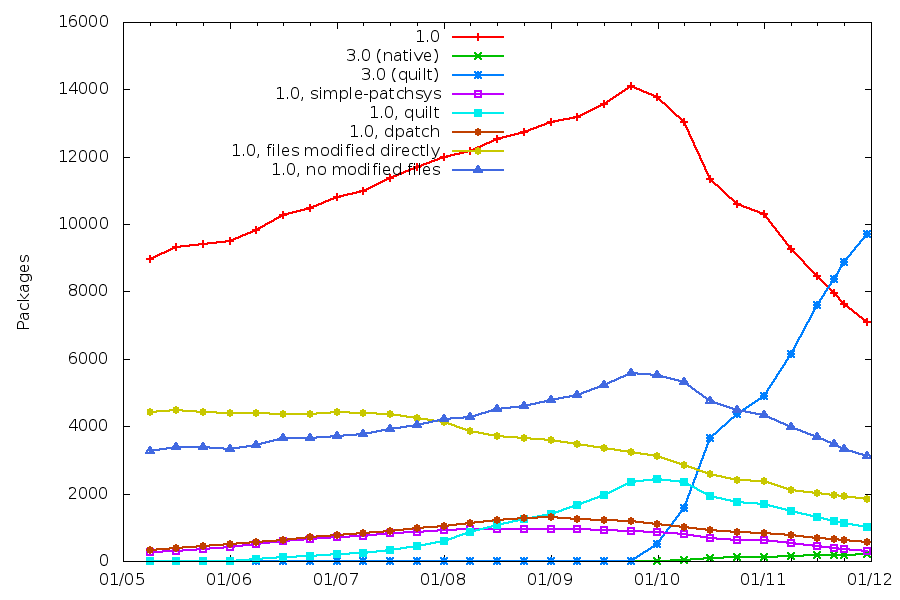
My goal with the 3.0 (quilt) source format has always been to standardize the patch management in Debian source packages. This message seems to have been well understood. dbs and dpatch have been deprecated by their respective maintainers. I made numerous efforts to make this source format useful in as many use cases as possible (but some improvements are still possible) and I have added hints to encourage maintainers to switch. Thanks to this, the adoption rate of this new source format has been very good and it s now the most widely used source package format in Debian only two years after its introduction in Debian unstable. With 9829 source package using 3.0 (quilt) , it surpassed the number of source package still using 1.0 (7368). (Those numbers have been taken from http://upsilon.cc/~zack/stuff/dpkg-v3/ on december 13th 2011.) The number of source packages using 3.0 (quilt) doubled this year.

(Click on the picture to see it full size) Of the 7368 packages using the old format, 6816 packages trigger the missing-debian-source-format lintian tag. This means that only 552 source packages have explicitly opted to keep using the old format and that the bulk of the remaining packages are rarely updated packages that have not been switched yet.

3 comments Liked this article? Click here. My blog is Flattr-enabled.

12 December 2011

Dominique Dumont: What name for Config::Model s new command line ? cfg or something else ?

Hello As Damyan mentioned last summer in Debconf, the current command interface to Config::Model Perl module is rather cumbersome as it involves quite a lot of typing. First, config-edit command name is too long. Even with the help bash completion, this does not compare well with git or hg command. Then all operation require options. For instance, the -application option is required to specify what you will be working on. A required option is a good example of an oxymoron. Which may be funny but which is not user friendly So, here s the synopsis of the new command I m working on:
# edit dpkg config with GUI (Tk or curses, or readline)
cfg edit dpkg 
# just check the validity of the file, show warnings
# and suggested fixes
# does not modify the file
cfg check dpkg
# check the file, remove deprecated parameters,
# migrate data to new parameters and save
cfg migrate dpkg 
# like migrate, but also apply all suggested fixes
cfg fix dpkg 
# like migrate and modify configuration
# with command line argument
cfg modify dpkg source format="quilt (3.0)"
# access dpkg parameters through a fuse file
# system. data are saved when fs is unmounted
cfg fusefs dpkg fuse-dir
# dump configuration data in config-model format
cfg dump dpkg   
# list all available applications
cfg list 
# more general synopsis
cfg [ global_options ] command application [ options ] arguments
This synopsis use dpkg as an example, but it could be used for any of the available models (e.g. ssh, lcdproc, multistrap ). The main question I have for you is: Is cfg name good ? I mean it s short, descriptive enough. But it s also quite ugly. Does anyone have a better idea ? And what do you think of the synopsis shown above ? Are the sub-command name descriptive enough ? All the best

11 December 2011

Gregor Herrmann: RC bugs 2011/49

a quiet RCBW week, here's the usual status report:

3 December 2011

Patrick Schoenfeld: Let me introduce DPKG::Log and dpkg-report

We have customers, which require a report about what we've done during maintenance windows. Usually this includes a report about upgrades, newly installed packages etc. and obviously everything we've done apart from that.
Till now we've prepared them manually. For a greater bunch of systems this is a big PITA, because to be somehow useful you have to collect the data for all systems and after that, prepare a report where you have:

Its also error-prone because humans make mistakes.

Perl to the rescue!
At least the part about generating a report about installed/upgraded/removed packages could be automated, because dpkg writes a well-formed logfile in /var/log/dpkg.log. But I noticed that there appearently is no library specialised at parsing that file. Its not a big deal, because the format of that file is really simple, but a proper library would be nice anyway.
And so I wrote such a library.
It basically takes a logfile, reads it line by line and stores each line parameterized into a generic object.

Its features include:

Based on that, I wrote another library DPKG::Log::Analyse, which takes a log, parses it with DPKG::Log and then extracts the more relevant information such as installed packages, upgraded packages, removed packages etc.

This, in turn, features:
- Info about newly installed packages
- Info about removed packages
- Info about upgraded packages
- Info about packages which got installed and removed again
- Info about packages which stayed halfinstalled or halfconfigured at the end of the logfile (or defined reporting period)


These libraries are already uploaded to CPAN and packaged for Debian.
They passed the NEW queue very quickly and are therefore available for Sid:

http://packages.debian.org/sid/libdpkg-log-perl

As an example use (and for my own use case, as stated above), I wrote dpkg-report, which uses the module and a Template::Toolkit based template to generate a report about what happened in the given logfile.
It currently misses some documentation, but it works somehow like this:

Report for a single host over the full log:
dpkg-report

Report for a single host for the last two days:
dpkg-report --last-two-days

Report for multiple hosts (and logfiles):
The script expects that each log file has the name <systemname>.dpkg.log so that it can guess the hostname from the system and can grab all such log files from a directory if a directory is specified as log-file arguments:</systemname>

dpkg-report --log-file /path/to/logs

This will generate a report about all systems without any merging.

Report for multiple hosts with merging:
dpkg-report --log-file /path/to/logs --merge

This will do the following:
A (fictive) report could look some what like this:

dpkg-Report for all:
------------------------
Newly Installed:
abc
Removed:
foo
Upgraded:
bar (0.99-12 - 1.00-1)
dpkg-Report for test*:
------------------------
Newly Installed:
blub
dpkg-Report for test1:
------------------------
Upgraded:
baz (1.0.0-1 -> 1.0.0-2)
dpkg-Report for test2:
------------------------
Upgraded:
zab (0.9.7 -> 0.9.8)

Currently this report generator is only included in the source package or in the git(hub) repository of the library. I wonder if it makes sense to let the source package build another binary package for it.
But its only a 238 lines perl script with a dependency on the perl library so I'm unsure if it warrants a new binary package. What do others think?

2 December 2011

Rapha&#235;l Hertzog: My Debian Activities in November 2011

This is my monthly summary of my Debian related activities. If you re among the people who made a donation to support my work (310.73 , thanks everybody!), then you can learn how I spent your money. Otherwise it s just an interesting status update on my various projects. Dpkg: Multi-Arch Saga I know lots of people are waiting the landing of multiarch in Debian unstable, and so am I. Things are progressing, though not as quickly as I hoped. Guillem merged about half of the branch between the 24th October and the 6th of November. After that most of the work happened on his personal repository in his pu/multiarch/master branch. I verify this repository from time to time because Guillem does not inform me when he has made progress. I noticed changes on his repository on the 10th, 19th, 23th, 28th of November and on the 1th of December. He announced a long time ago that he had some interface changes and up to now only wrote about the switch from the command-line option --foreign-architecture (to put in /etc/dpkg/dpkg.cfg) to the explicit command dpkg --add-architecture that only needs to be called once (see mail here). As of today (December 2th), the promised email for the other interface changes is still not here. On November 23th, I reviewed Guillem s work and tried to run the code in his branch. I spent the whole day chasing up regressions and submitted lots of fixes to Guillem. Thanks to the extensive test-suite I wrote when I developed my branch, it has been fairly easy to track them all down. All the issues I reported have been fixed in the latest version of Guillem s branch although the fixes are often slightly different from those that I submitted. Dpkg: Squeeze Backport At the start of the month, I uploaded what I expected to be a fairly uncontroversial backport of dpkg 1.16.1.1. It turns out I was wrong. After some discussion, I think we came to an agreement that it was acceptable to backport dpkg-dev and libdpkg-perl only. My goal was not to bring the latest dpkg to users but to make it easier for package maintainers to backport packages using new features provided by dpkg-dev >= 1.16 (such as hardening build flags, the makefile snippets provided in /usr/share/dpkg/, or the improved dpkg-buildflags interface). Thus I modified the source package uploaded to squeeze-backports to build only dpkg-dev and libdpkg-perl. It has been uploaded on November 23th and it s waiting in the NEW queue for a backports admin to process it. Misc Dpkg Work I merged a patch of Colin Watson to be able to verify build-dependencies for a foreign architecture (taking into account the Multi-Arch status of each package listed). I released dpkg 1.16.1.2 with two minor fixes that were sitting in the sid branch. I wanted to get rid of this so that the path is clear for a 1.16.2 upload with multiarch. The package just migrated to testing so we re fine. I spent another day doing dpkg bug triaging on Launchpad, we re now down to 77 bugs with many of them tagged as incomplete and likely to expire in 2 months. The Debian Administrator s Handbook eBookWe released a sample chapter so that it s easier to have an idea of the quality of the book. The chapter covers the APT tools quite extensively. I bet that even you could learn something about apt-get/aptitude The crowfunding campaign on Ulule ended on November 28th.
With 675 supporters, we raised 24385 EUR. Of those, 14935 EUR have been put in the liberation fund and the rest corresponds to the various pre-orders and rewards offered. This means that the translation will happen (we just started) but that the book is currently not going to be released under a free license. Don t despair As planned, the liberation campaign is carried on until the 25 K target is reached! Instead of being hosted on Ulule, this permanent campaign is on the project website at debian-handbook.info/liberation/. Note that any contribution of 10 EUR or more means that you get a copy of the ebook as soon as it s available (even if the liberation target is not reached). Package Tracking System At the start of the month, I filed two ideas of improvements for the PTS in the bug tracking system: #647258 is about showing outstanding bugs that relate to a release goal and #647901 is about warning maintainers that the package is affected by a current transition. If you re a coder and want to start contributing to Debian and its QA team, those bugs could be interesting targets for a start. :-) In both cases, I have been in contact with members of the release team because those ideas require some structured data from the release team as input. Thanks to Meddi Dohguy and Niels Thykier for their help. Later in the month, the topic of relocating the PTS once again came up. For historical reasons, the PTS was hosted on master.debian.org together with the BTS. Nowadays the BTS has its own host and it made no sense anymore to have the PTS separate from the rest of the QA services hosted on qa.debian.org (currently quantz.debian.org). So together with Martin Zobel Helas we took care to plan the migration and on November 19th we executed the plan. It worked like a charm and almost nobody noticed (only one undocumented dependency was missed, which broke the SOAP interface). Misc Packaging Work WordPress was broken in Ubuntu and it was also not properly synchronized with Debian due to an almost useless change on their side. Thus I requested a sync so that the working version from Debian gets imported in Ubuntu. I sponsored the docbook-xsl 1.76.1 upload that I needed for Publican. Then I updated Publican just to discover that the test-suite triggers a new bug in fop (filed as #649476). I disabled the test-suite temporarily and uploaded Publican 2.8 to unstable. BTW, I also filed 2 upstream bugs with patches for issues I discovered while trying to generate the sample chapter of my book (see here and here). I uploaded a version 0.7.1 of nautilus-dropbox and fixed #648215 at the same time. I made an NMU of bison to fix a long-standing release critical bug that hit me once more during an upgrade (see #645038). I uploaded to experimental a new version of gnome-shell-timer compatible with GNOME 3.2. I took the opportunity to install from experimental the few GNOME 3.2 packages which are not yet in unstable Thanks See you next month for a new summary of my activities.

7 comments Liked this article? Click here. My blog is Flattr-enabled.

22 November 2011

Steve Kemp: Goodbye mysql ..

Yesterday evening I updated my server to remove MySQL:
steve:~# dpkg --purge mysql-client-5.1 \
                      mysql-common     \
                      mysql-server-5.1 \
                      mysql-server-core-5.1 \
                      python-mysqldb        \
                      libdbd-mysql-perl     \
                      libdatetime-format-mysql-perl
Until last month I had two database in use, one each for a pair of web-applications. As of now one is using redis - which I'm already using for my image hosting - and the other application is using SQLite. Until recently I had a high opinion of SQLite, although that has now been downgraded a little, it is still a thoroughly excellent piece of software. I was just surprised at little things it was missing, to the extent I had to rewrite my applications SQL. Still one less service is a good thing, and the migration wasn't so painful.. In more productive news I recently acquired a nice external flash - the Yongnuo YN-460 II is (very) cheap and cheerful, it can be fired remotely with my triggers so I've had a lot of fun with opportunistically taking pictures and experimenting with lighting. Most of the results are NSFW, but there are some other examples lurking around including the first time I managed to successfully capture a falling water-drop. (Not the best picture, not the most explicit effect, but fun regardless. I both can and will do better next time!)
Somebody recently asked me to write about "camera stuff under linux" and happily I declined. Why decline? Because there are so many good tools, applications, and utilities. (I use local tools for organisation and duplicate detection, rawtherapee for RAW conversion and GIMP for touchups). Having many available options is fantastic though, and something hard to appreciate for "newcomers" to Linux. (Yeah I waited 90 seconds - if I remembered to add -nojava - for Netscape Navigator to start, under X10, with 8Mb of RAM. Happier days are here. Sure DRM is bad, secure boot .. an open question, but damn we have it good compared to almost any previous point in time!)
ObQuote: "Yeah, obviously it is only a tactical party. I'm only having a party to eventually get sex." - Peep Show

20 November 2011

Gregor Herrmann: RC bugs 2011/46

as expected this week was characterised by fixing bugs around the perl 5.14 transition. besides that I've also uploaded a couple of NMUs with patches kindly provided in the BTS by some tireless bug fixers.

15 November 2011

Rapha&#235;l Hertzog: 20 Things to Learn About APT With the Free Chapter of the Debian Administrator s Handbook

We just released a sample chapter of the Debian Administrator s Handbook. It covers the APT family of tools: apt-get, aptitude, synaptic, update-manager, etc.


Click here to get your free sample chapter I m sure you will enjoy it. There are many interesting things to learn:

If you liked this chapter, click here to contribute a few euros towards the liberation of the whole book. That way you ll get a copy of the ebook as soon as it s available. Thank you! I also invite you to share this sample chapter as widely as possible. We re only at 40% of the liberation fund and there s less than 2 weeks left. I hope this book extract will convince enough people that the book is going to be great, and that it really deserves to be liberated and bundled with Debian!

8 comments Liked this article? Click here. My blog is Flattr-enabled.

11 November 2011

Niels Thykier: build-arch for everyone

The other day, I was asked if it was really possible to get build-arch support in Wheezy (as in, buildds using build-arch) by adding these optional targets. Lets have a look at the data that is available to us: To simplify my calculation I will assume we can fix packages over a course of 150 days (which is 5 months of ~30 days or every day in Dec to April). So 500/150 = 10/3 =~ 3.3 packages from the reduced set should be fixed every day. Erring on the side of caution, we should make that 4 packages every day. So if we fix 4 packages from the reduced set every day, we will definitely fix all of them before Wheezy. But the reduced set are only the source packages that could possibly benefit from having a build-arch target (it builds both arch:all and non-arch:all packages). There could (and probably will) still be sources building non-arch:all packages without a build-arch target. Furthermore, with the rate of 4 a day we will only have a month to get dpkg and buildd support In short, no. I do not expect us to get archive-wide build-arch support on buildds for Wheezy. But I will do my best to ensure that option #4 flip the switch becomes very attractive early in the Wheezy + 1 development schedule. I hope you will join us in this endeavour. Most of the time it is a trivial 3-4 line fix and often you can even throw in some hardening flags to spice it up a bit. The easiest way to help is to fix your (team s) packages listed in the reduced set . Once you are done with that you can look at the rest of your (team s) packages (see the full dd-list). The most important thing to remember is that Build-Depends-Indep is still broken! That is, you cannot rely on Build-Depends-Indep being installed on a buildd in the build target. So any existing workarounds have to stay for now (i.e. check for certain commands or deferring indep till binary-indep is called). If you are in doubt about how to fix a certain package feel free to ask for help. Note: I pull the data directly from lintian.d.o (full set) and UDD (reduced set). I try to remember to refresh it daily. The full set is basically (z)grep cut uniq on the lintian log, the reduced set is found using the UDD query from this script (based on a query done by Jakub Wilk). Since all data is (in)directly based on lintian.d.o only packages that are in sid are considered.

5 November 2011

Christian Perrier: People behind Debian: Rapha l Hertzog, dpkg maintainer, book author

It's about time that Rapha l is interviewed in the "People behind Debian" series he initiated on his blog. Indeed, when he interviews people, Rapha l asks about other people they could suggest for next interviews. So, during mine, I suggested him to be a next "victim". As he couldn't interview himself, I volunteered for this. As you'll see below, Rapha l (who's a friend of mine as I'm a friend of his) likes to speak and that shows in the length of his answers :-) but you always know more about Debian when reading his blog posts, books, mails, etc. I personnally think that he is among the best promoters of the project for years and it was a pleasure for me to conduct this interview. My questions are in bold, the rest is by Rapha l. Who are you? Hi, Rapha l Hertzog, I'm a 32 years old French Debian developer who is married and who has a 2-year old son. I'm running my own company (Freexian) since 2005, I started it 3 years after the end of my computer science studies. I'm also a very proud author of the Cahier de l'Admin Debian, a French book about Debian. You often wrote about your attempts to make your living partly, if not completely, out of your Debian work. Can you describe the way you're trying to do this? My first try has been with Freexian. I always advertised this company as being specialized in Debian GNU/Linux. While Freexian is successful enough to provide me a decent income, I'm not really satisfied with the result because very few of my contracts are about improving Debian. I use Debian daily for the benefit of my customers, writing new customer specific (embedded) software, deploying a service on Debian servers, etc. But except for the occasional bugfix, all this work does not improve Debian (the only exception has been the dpkg multiarch implementation work sponsored by Linaro). The positive side is that I don't need to fill my entire schedule to earn enough money to live. So I'm regularly taking some days off work to be able to contribute to Debian. This is a freedom that I enjoy... My French book has also been a bestseller and depending on the years the royalties represented between 1 and 2 months of supplementary time that I can spend on Debian (that is between 2000 and 4000 EUR of income). Now since last year, I decided to actively work towards my goal of making a living out of my Debian work. I want to build on what has been most successful for me up to now, that is my book. My strategy has been to build an audience around my blog: with a direct contact with my readers I have the opportunity to sell e-books, and without any intermediary taking the biggest part of the price, I don't need a very large audience to be successful. I have also been experiencing micro-donations with Flattr, people who are enjoying my articles on my blog can use it to give a few cents for each article they find useful. With a large enough userbase, this could fund free documentation and would avoid the need for commercial e-books but we're not there currently and I don't know if it will ever reach the critical mass. Last but not least, I'm soliciting donations for my Debian work on the sidebar of my blog, and I have the chance to a have a few (regular) donators. You're a proud father since last year. How do you manage your commitment to the project with your family life? There are few things that I put above Debian in my life, but my family certainly is. I try to handle most of my Debian duties during work hours so that I can spend time with my family on evenings and during week-ends but in truth I never really disconnect from Debian. It happens quite often that I say to my wife I'll come in a few minutes, let me finish this and then I end up responding to a Debian mail, or an IRC query and take 30 minutes instead of the 5 expected ones. I try hard to avoid this but it's difficult. Luckily for me, my wife is very supportive of my Debian involvement and knows me well... By the way my wife is using Debian on her computer, and my son has already played with DoudouLinux (a Debian derivative!). Have you already been accused of self-promotion in your writings? If that would ever happen, what would you answer to that? Yes, more than once. I am proud of what I do for Debian, I enjoy sharing the result of my work. Because of this, some people believe that I'm selfish and egocentric. And this has somewhat increased since I have been soliciting donations: for me it's important to be transparent towards donators so that they see what I really do for Debian. But some people have the feeling that I'm getting undeserved attention and that I bring everything towards my own person. On the other side, as an author, I'm a public figure who is definitely seeking some attention... I don't have any miraculous answer, we are a large and diverse community, it's next to impossible to please everybody. I listen to all the concerns that people bring forward, I take them into account as much as possible, in particular when I believe they are reasonable/well justified, or when they come from people that I highly respect. But sometimes I have to plainly ignore them too... in particular when they are trying to impose their own political view on a topic that's not directly related to the only value that we all share: the social contract. Contributing to Debian is a challenge, we all have to make efforts to put aside our differences and to concentrate on the work that brings us closer to the best free software operating system ever built. You recently launched a campaign to free out the soon-to-be-published "Debian Administrator Handbook", an English version of your well-known book about Debian in French. Can you tell us more about this project? My French book has been very successful at helping people to get started with Debian, and like I already explained, it was also effective to fund a part of my Debian work. So I wanted to make it available world-wide by publishing an English translation of it. I tried to find an English-speaking editor willing to take on the challenge but I found none interested. Not put off by a setback, Roland (my co-author) and I decided to negotiate with our French editor Eyrolles to recuperate the necessary rights to translate the book into English. Handling everything ourselves represents a lot of work, but it also means that we have the freedom required to decide of the license of the resulting book. We would love to see it under a license compatible with the Debian Free Software Guidelines. But at the same time we firmly believe that we deserve a reasonable monetary compensation for the work on the book, so we conditioned its liberation to a predefined amount of money (25 K ) in what we call the "liberation fund". And since we wanted to be sure that we would have the required means to complete the translation, we used a crowfunding platform to seek support of people interested by the book. With such a platform you're only debited if the minimal requested amount is reached. Anyone can participate, pre-order the book and/or put some money in the liberation fund. As of today, we already reached the minimal funding goal (15 K ) so the book translation will happen. But the liberation target has not yet been reached so we don't know yet if the book will be free from the start... you can follow the progress right on the fundraising page or on the website dedicated to the book. PS: If you want to contribute to this project and also make a donation to Debian at the same time, you should check out this page. You're one of the main developers of dpkg, a critical tool for Debian systems. Can you tell us more about the current development challenges it is facing? What will be the new dpkg features for wheezy? The current challenges are not really technical. dpkg is a relatively mature piece of software and it will continue to work for the foreseeable future without needing much maintenance work. The real challenge is trying to setup a healthy developement community around it so that we can keep tackling new interesting problems (there are many listed in the roadmap and in the 225 wishlist bugs). There is a real problem of leadership and communication in the current team. We used to be three, and we're only two nowadays. Guillem is the legitimate leader since he's involved in dpkg's developement since early 2006 while I joined only in late 2007. But in the last 4 years, we did not manage to recruit anyone else on the team. Some persons tried to contribute significant new features (like Sean Finney with a rework of the way we handle configuration files) but they gave up frustrated after a while because we did not manage to review their work (and discuss the design) in any reasonable timeframe. Another famous case is Ian Jackson with his trigger work. His work got merged, but so late that in the mean time he blew up while trying to hijack the maintenance of dpkg. For a long time I was concentrating my work on the Perl part of dpkg (aka dpkg-dev mainly), so I did not feel qualified to review and merge work related to the C part and I was just a worried observator of this situation. I tried to improve it by setting up some basic review infrastructure, it should have brought some lisibility to the status of each change left to be reviewed... but it has not been used and it changed nothing. Over the years, I became much more interested in the C part. My first big contribution in C has been the rewrite of update-alternatives (from Perl to C). I made other small changes in between, but at the start of this year I had this great opportunity to work on the multiarch implementation (FYI, multiarch is the possibility to mix packages from several architectures on a single system). This really forced me to jump into the C codebase and learn a lot about how dpkg is implemented. Thanks to this I have been able to tackle other small projects (like the improved triggers). This would be all great if my multiarch work was already merged, but it's not. It's a large work, I do not mind waiting a bit in particular since Guillem is a highly skilled C programmer. His sharp analysis of new designs are invaluable, when he reviews code he always finds something to improve. I learnt a lot just by reviewing the code he wrote over the years. That said I have been waiting since April without almost no updates from him. With the release team asking us to hurry up, the situation is getting somewhat strained as I really want to see multiarch in Wheezy and I do not really want to short-circuit Guillem. Hum, I may have drifted a bit from your original question... what great new features can people expect? Well multiarch is supposed to be the big new feature, apart from that there aren't many things that matter to the end users. But there are already quite a few changes that are of interest to package maintainers (like hardened build flags, source package improvements, improved triggers, ). What's the biggest problem of Debian? Manicheism and a tendency to quickly polarize the discussions. In reality, there are very few situations where everything is all good or all bad. Ever since I have read The 7 Habits of Highly Effective People I try hard to put into practice the habits of interdependence . Instead of having only my point of view in mind, I try to understand the motivations from the other party ( Seek First to Understand, Then to be Understood ) in order to be able to put forward solutions acceptable to both parties ( Think Win-Win ). I highly recommend this book to anyone. And I invite everybody to at least try to follow those simple advices. Is there someone in Debian you admire for their contributions? There are many and I can't give an exhaustive list... here are some that I would like to highlight (in no particular order): Most of those people are working on improving Debian's infrastructure so that we can all be more effective and do an even better work. This kind of work is not always very visible but it's crucial to Debian's future. Thank you to Rapha l for the time spent answering my questions. I hope you enjoyed reading his answers as I did. And, anyway, it was fun to just play the game "the other way".

Next.

Previous.