Search Results: "daniel"

25 April 2014

Daniel Pocock: Extra fuel charges when carrying passengers in your car?

Some people seem to be justifying the way mobile networks try to discriminate against tethering. One comment even suggests that multiple devices is a valid justification. Really? Isn't it just as simple as measuring the actual volume of megabytes used, regardless of how many devices are connected? Lets consider a couple of analogies:
  • A petrol station puts some fine print at the bottom of their sign in the street: cars with passengers pay an extra 0.05 per litre (or gallon). It is just a gimmick: the marketing man has worked out that he can put a lower price on his big sign this way and people with passengers may well be splitting the fuel bill between them. There is no technical reason for the charge however - the car actually uses more fuel carrying the extra weight anyway.
  • Or imagine this: the marketing man puts up small print that advises a higher charge of 0.05 per litre for fuelling an exotic car like a Ferrari. The only reason for this, of course, is that the Ferrari driver is probably busy (so he doesn't have time to shop around) and wealthy (so the extra charge won't deter him from making any purchase at all, because he has money to pay it).
Of course, these ideas sound a bit outlandish but the only difference between these crazy ideas and tethering charges is that mobile phone networks usually have the monopoly/duopoly to get away with it. Mobile networks actually dread the idea of becoming commodities like fuel. They thrive on price discrimination and they seem to have an endless number of tricks to get extra money out of people who may have it by deliberately crippling parts of the service for everybody else. This goes against the ideals of innovation and efficiency and in the most extreme cases their practices are widely recognised for the sham that they are. Revealing that you have connected a laptop to your phone may be like revealing you live in an affluent area or that you have an expensive car. Plenty of businesses try to exploit such knowledge when deciding how much they can charge you or other aspects of how they provide you with a service. This is why privacy is important in every feature of the technology we use. This rogue behaviour by "creative" marketing men also helps to understand just what would happen in the world of technology if it wasn't for the use of free licenses, open standards, accessible encryption and net neutrality.

24 April 2014

Daniel Pocock: Android betrays tethering data

When I upgraded an Android device the other day, I found that tethering completely stopped working. The updated CyanogenMod had inherited a new bug from Android, informing the carrier that I was tethering. The carrier, Vodafone Italy, had decided to make my life miserable by blocking that traffic. I had a closer look and managed to find a workaround. There is absolutely no difference, from a technical perspective, between data transmitted from a mobile device on-screen application and data transmitted from tethering. Revealing the use of tethering to the carrier is a massive breach of privacy - yet comments in the Google bug tracker suggest it is a feature rather than a bug. This little table helps put that logic in perspective:
Product Person who carries handset
User Mobile network who wants to discriminate against some types of network traffic to squeeze more money out of the Product
Feature Revealing private information about the way the Product uses his/her Internet so the real User can profit.
It is also bad news for the environment: many people are being tricked into buying un-needed USB dongle modems that will end up in the rubbish in 1-2 years time when their contract expires and the company pushes them to upgrade to the next best thing. Behind the scenes What does it really mean in practice, how does Android tell your carrier which data is from tethering? As my device is rooted and as it is my device and I will do what I want with it, I decided to have a look inside. The ip command revealed that there are now two network devices, rmmnet_usb0 and rmmnet_usb1. The basic ip route command reveals that traffic from different source addresses is handled differently and split over the different network devices:
shell@android:/ # ip route
0.0.0.0/1 dev tun0  scope link
default via 100.66.150.89 dev rmnet_usb0
83.224.66.138 via 100.87.31.214 dev rmnet_usb1
83.224.70.94 via 100.87.31.214 dev rmnet_usb1
100.66.150.88/30 dev rmnet_usb0  proto kernel  scope link  src 100.66.150.90
100.66.150.89 dev rmnet_usb0  scope link
100.87.31.212/30 dev rmnet_usb1  proto kernel  scope link  src 100.87.31.213
100.87.31.214 dev rmnet_usb1  scope link
128.0.0.0/1 dev tun0  scope link
192.168.42.0/24 dev rndis0  proto kernel  scope link  src 192.168.42.129
I then looked more closely and found that there is also an extra routing table, it can be found with ip rule
shell@android:/ # ip rule show
0:      from all lookup local
32765:  from 192.168.42.0/24 lookup 60
32766:  from all lookup main
32767:  from all lookup default
shell@android:/ # ip route show table 60
default via 100.87.51.57 dev rmnet_usb1
100.87.51.57 dev rmnet_usb1
192.168.42.0/24 dev rndis0  scope link
In this routing table, it is obvious that data from the tethering subnet (192.168.42.0/24) is sent over the extra device rmnet_usb1. Manually cleaning it up If the phone is rooted, it is possible to very quickly change the routing table to get all the tethering traffic going through the normal rmnet_usb0 interface again. It is necessary to get rid of that alternative routing table first:
ip rule del pref 32765
and then update the iptables entries that refer to interface names:
iptables -t nat -I natctrl_nat_POSTROUTING -s 192.168.0.0/16 -o rmnet_usb0 -j MASQUERADE
iptables -I natctrl_FORWARD -i rmmnet_usb0 -j RETURN
This immediately resolved the problem for me on the Vodafone network in Italy. Conclusion If Google can be bullied into accepting this kind of discriminatory routing in the stock Android builds and it can even propagate into CyanogenMod, then I'm just glad I'm not running one of those Android builds that has been explicitly "enhanced" by a carrier. It raises big questions about who really is the owner and user of the device and who is receiving the value when a person pays money to "buy" a device.

22 April 2014

Daniel Pocock: Automatically creating repackaged upstream tarballs for Debian

One of the less exciting points in the day of a Debian Developer is the moment they realize they have to create a repackaged upstream source tarball. This is often a process that they have to repeat on each new upstream release too. Wouldn't it be useful to:
  • Scan all the existing repackaged upstream source tarballs and diff them against the real tarballs to catalog the things that have to be removed and spot patterns?
  • Operate a system that automatically produces repackaged upstream source tarballs for all tags in the upstream source repository or all new tarballs in the upstream download directory? Then the DD can take any of them and package them when he wants to with less manual effort.
  • Apply any insights from this process to detect non-free content in the rest of the Debian archive and when somebody is early in the process of evaluating a new upstream project?
Google Summer of Code is back One of the Google Summer of Code projects this year involves recursively building Java projects from their source. Some parts of the project, such as repackaged upstream tarballs, can be generalized for things other than Java. Web projects including minified JavaScript are a common example. Andrew Schurman, based near Vancouver, is the student selected for this project. Over the next couple of weeks, I'll be starting to discuss the ideas in more depth with him. I keep on stumbling on situations where repackaged upstream tarballs are necessary and so I'm hoping that this is one area the community will be keen to collaborate on.

14 April 2014

Daniel Kahn Gillmor: OTR key replacement (heartbleed)

I'm replacing my OTR key for XMPP because of heartbleed (see below). If the plain ASCII text below is mangled beyond verification, you can retrieve a copy of it from my web site that should be able to be verified.
-----BEGIN PGP SIGNED MESSAGE-----
Hash: SHA512
OTR Key Replacement for XMPP dkg@jabber.org
===========================================
Date: 2014-04-14
My main XMPP account is dkg@jabber.org.
I prefer OTR [0] conversations when using XMPP for private
discussions.
I was using irssi to connect to XMPP servers, and irssi relies on
OpenSSL for the TLS connections.  I was using it with versions of
OpenSSL that were vulnerable to the "Heartbleed" attack [1].  It's
possible that my OTR long-term secret key was leaked via this attack.
As a result, I'm changing my OTR key for this account.
The new, correct OTR fingerprint for the XMPP account at dkg@jabber.org is:
  F8953C5D 48ABABA2 F48EE99C D6550A78 A91EF63D
Thanks for taking the time to verify your peers' fingerprints.  Secure
communication is important not only to protect yourself, but also to
protect your friends, their friends and so on.
Happy Hacking,
  --dkg  (Daniel Kahn Gillmor)
Notes:
[0] OTR: https://otr.cypherpunks.ca/
[1] Heartbleed: http://heartbleed.com/
-----BEGIN PGP SIGNATURE-----
Version: GnuPG v1
iQJ8BAEBCgBmBQJTTBF+XxSAAAAAAC4AKGlzc3Vlci1mcHJAbm90YXRpb25zLm9w
ZW5wZ3AuZmlmdGhob3JzZW1hbi5uZXRFQjk2OTEyODdBN0FEREUzNzU3RDkxMUVB
NTI0MDFCMTFCRkRGQTVDAAoJEKUkAbEb/fpcYwkQAKLzEnTV1lrK6YrhdvRnuYnh
Bh9Ad2ZY44RQmN+STMEnCJ4OWbn5qx/NrziNVUZN6JddrEvYUOxME6K0mGHdY2KR
yjLYudsBuSMZQ+5crZkE8rjBL8vDj8Dbn3mHyT8bAbB9cmASESeQMu96vni15ePd
2sB7iBofee9YAoiewI+xRvjo2aRX8nbFSykoIusgnYG2qwo2qPaBVOjmoBPB5YRI
PkN0/hAh11Ky0qQ/GUROytp/BMJXZx2rea2xHs0mplZLqJrX400u1Bawllgz3gfV
qQKKNc3st6iHf3F6p6Z0db9NRq+AJ24fTJNcQ+t07vMZHCWM+hTelofvDyBhqG/r
l8e4gdSh/zWTR/7TR3ZYLCiZzU0uYNd0rE3CcxDbnGTUS1ZxooykWBNIPJMl1DUE
zzcrQleLS5tna1b9la3rJWtFIATyO4dvUXXa9wU3c3+Wr60cSXbsK5OCct2KmiWY
fJme0bpM5m1j7B8QwLzKqy/+YgOOJ05QDVbBZwJn1B7rvUYmb968yLQUqO5Q87L4
GvPB1yY+2bLLF2oFMJJzFmhKuAflslRXyKcAhTmtKZY+hUpxoWuVa1qLU3bQCUSE
MlC4Hv6vaq14BEYLeopoSb7THsIcUdRjho+WEKPkryj6aVZM5WnIGIS/4QtYvWpk
3UsXFdVZGfE9rfCOLf0F
=BGa1
-----END PGP SIGNATURE-----

9 April 2014

Daniel Pocock: Double whammy for CACert.org users

If you are using OpenSSL (or ever did use it with any of your current keypairs in the last 3-4 years), you are probably in a rush to upgrade all your systems and replace all your private keys right now. If your certificate authority is CACert.org then there is an extra surprise in store for you. CACert.org has changed their hash to SHA-512 recently and some client/server connections silently fail to authenticate with this hash. Any replacement certificates you obtain from CACert.org today are likely to be signed using the new hash. Amongst other things, if you use CACert.org as the CA for a distributed LDAP authentication system, you will find users unable to log in until you upgrade all SSL client code or change all clients to trust an alternative root.

8 April 2014

Daniel Pocock: reConServer for easy SIP conferencing

In the lead up to the release of Debian wheezy, there was quite some debate about the Mumble conferencing software which uses the deprecated and unsupported CELT codec. Although Mumble has very recently added Opus support, it is still limited by the fact that it is a standalone solution without any support for distributed protocols like SIP or XMPP. Making SIP conferencing easy Of course, people could always set up SIP conferences by installing Asterisk but for many use cases that may be overkill and may simply introduce alternative security and administration overheads. Enter reConServer The popular reSIProcate SIP stack includes a high-level programming API, the Conversation Manager, dubbed librecon. It was developed and contributed to the open source project by Scott Godin of SIP Spectrum. In very simple terms, a Conversation object with two Participants is a phone call. A Conversation object with more than two Participants is a conference. The original librecon includes a fully functional demo app, testUA that allows you to control conferences from the command line. As part of Google Summer of Code 2013, Catalin Constantin Usurelu took the testUA.cxx code and converted it into a proper daemon process. It is now available as a ready-to-run SIP conferencing server package in Debian and Ubuntu. The quick and easy way to try it Normally, a SIP conferencing server will be linked to a SIP proxy and other infrastructure. For trying it out quickly, however, no SIP proxy is necessary. Simply install the package with the default settings and then configure a client to talk to the reConServer directly by dialing the IP address of the server. For example, set the following options in /etc/reConServer/reConServer.config:
UDPPort = 5062
EnableAutoAnswer = true
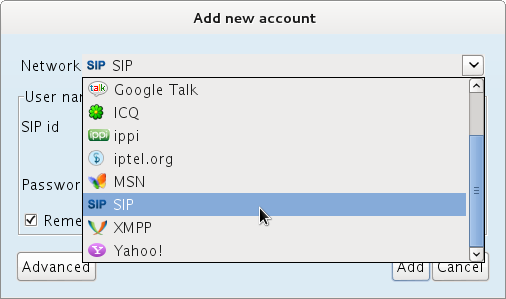
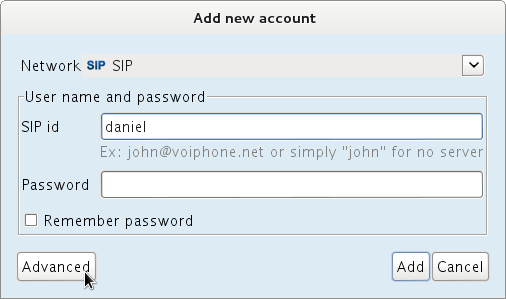
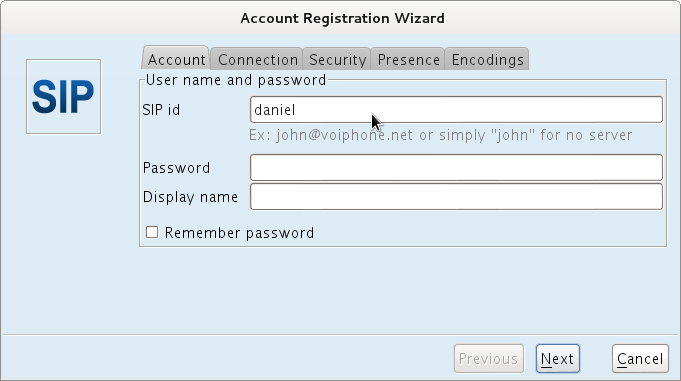
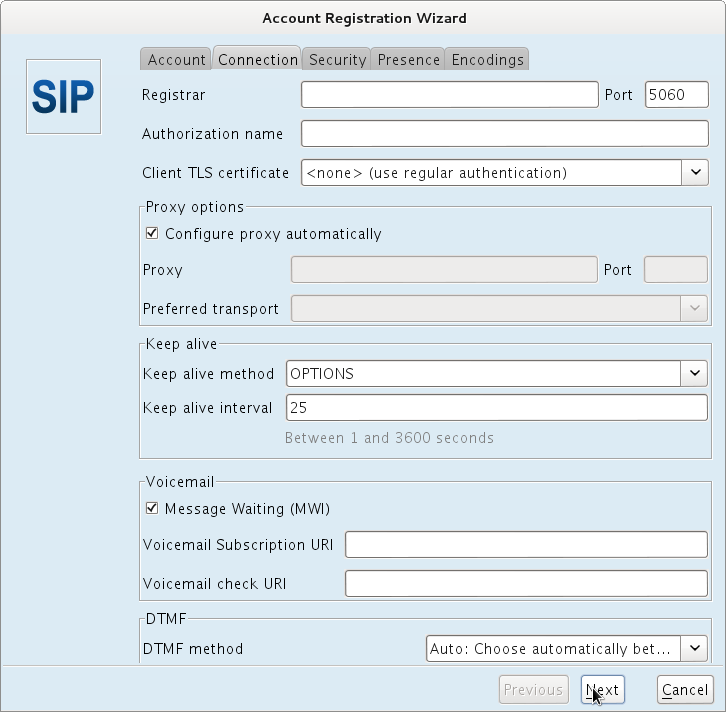
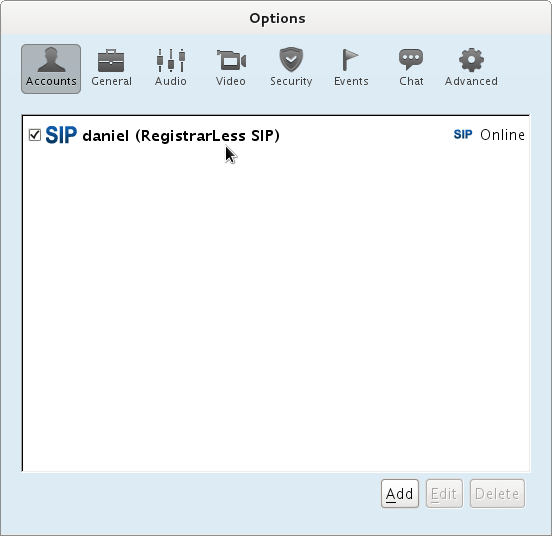
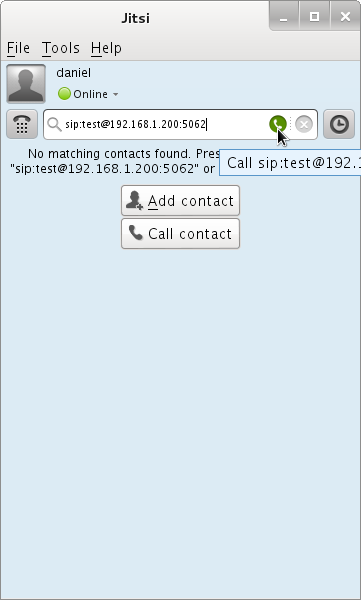
and it will happily accept all SIP calls sent to the IP address where it is running. Now configure Jitsi to talk to it directly in serverless SIP configuration: Notice here that we simply put a username without any domain part, this tells Jitsi to create an account that can operate without a SIP proxy or registration server: Calling in to the conference Notice in the screenshot below we simply dial the IP address and port number of the reConServer process, sip:192.168.1.100:5062. When the first call comes in, reConServer will answer and place the caller on hold. When the next caller arrives, the hold should automatically finish and audio will be heard. Next steps To make it run as part of a proper SIP deployment, set the necessary configuration options (username, password, proxy) to make reConServer register to the SIP proxy. Users can then call the conference through the proxy. To discuss any problems or questions, please come and join the recon-users mailing list or the Jitsi users list Consider using Wireshark to observe the SIP packets and learn more about the protocol.

7 April 2014

Russ Allbery: Review: Fantasy & Science Fiction, September/October 2011

Review: Fantasy & Science Fiction, September/October 2011
Editor: Gordon van Gelder
Issue: Volume 121, No. 3 & 4
ISSN: 1095-8258
Pages: 258
Another review of a magazine that I finished quite some time ago. Apologies for any inaccuracies or lack of depth in the reviews. There wasn't much in Charles de Lint's reviews in this issue that interested me, but Michelle West covers a great selection of books. Two of them (The Wise Man's Fear and The Quantum Thief) are already on my to-read list; the third, The Postmortal, sounded interesting and would go on my list to purchase if I didn't already have so many good books I've not read. Otherwise, this issue is short on non-fiction. The only other essay entry is a film review from Kathi Maio, which is the typical whining about all things film that F&SF publishes. "Rutger and Baby Do Jotenheim" by Esther M. Friesner: Baby is a former pole dancer with a toy poodle named Mister Snickers, which warns you right away that this story is going to involve a few over-the-top caricatures and more use of the word "piddle" than one might ideally want. Rutger is a mythology professor who tolerates her for the standard reasons in this sort of pairing. They're travelling across country to Baby's sister's wedding when their car breaks down in Minnesota, prompting an encounter with frost giants. As you might expect, this is a sort of fractured fairy tale, except based on Norse mythology instead of the more typical Grimm fare. The fun is in watching these two apparent incompetents (but with enough knowledge of mythology to clue in the reader) reproduce the confrontation between Thor and Utgard-Loki. The fight with old age is particularly entertaining. If you've read any of Friesner's other stories, you know what to expect: not much in the way of deeper meaning, but lots of fun playing with stereotypes and an optimistic, funny outcome. Good stuff. (7) "The Man Inside Black Betty" by Sarah Langan: This story comes with a mouthful of a subtitle: "Is Nicholas Wellington the World's Best Hope?" It's also a story that purports to be written by a fictional character, in this case one Saurub Ramesh (with Langan credited as having done "research"). It's told in the style of first-person journalism, relating the thoughts and impressions of Ramesh as he interviews Nicholas Wellington. The topic is Black Betty: a black hole above Long Island Sound. Wellington is a scientific genius and iconoclast with radical theories of black holes that contradict how the government has been attempting to deal with Black Betty, unsuccessfully. The structure here was well-handled, reminding me a lot of a Michael Lewis article during the financial collapse. Langan has a good feel for how journalism of this type mixes personalities, politics, and facts. But it's all setup and no story. We get some world building, and then it's over, with no resolution except pessimism. Meh. (4) "A Borrowed Heart" by Deborah J. Ross: Ross starts with the trappings of urban fantasy transplanted into a Victorian world: supernatural creatures about, a protagonist who is a high-class prostitute, and sex and a sucubus by the second page. It evolves from there into a family drama and an investigation, always giving the reader the impression that a vampire will jump out at any moment. But the ending caught me entirely by surprise and was far more effective due to its departure from the expected path. Well done. (7) "Bright Moment" by Daniel Marcus: The conflict between terraforming and appreciation for the universe as we find it is an old story pattern in science fiction, and Marcus doesn't add much here. I think the story would have been stronger if he'd found a way to write the same plot with a pure appeal to environmental beauty without the typical stakes-raising. But he does sprinkle the story with a few interesting bits, including a pod marriage and a futuristic version of extreme sports as a way of communing with nature. (6) "The Corpse Painter's Masterpiece" by M. Rickert: This is typical of my reaction to a Rickert story: shading a bit too much towards horror for me, a bit too cryptic, well-written but not really my thing. It's about a corpse painter who does the work of an informal mortician, improving the appearance of bodies for their funerals, and the sheriff who brings him all the dead bodies. It takes an odd macabre twist, and I have no idea what to make of the ending. (4) "Aisle 1047" by Jon Armstrong: Armstrong is best known for a couple of novels, Grey and Yarn, which entangle their stories in the future of marketing and commerce. One may be unsurprised, then, that this short story is on similar themes, with the intensity turned up to the parody point. Tiffan3 is a department-store saleswoman, spouting corporate slogans and advertising copy while trying to push customers towards particular products. The story follows the escalation into an all-out brand war, fought with the bubbly short-cut propaganda of a thirty-second commercial. For me, it fell awkwardly between two stools: it's a little too over-the-top and in love with its own bizarre alternate world to be effective satire, but the world is more depressing than funny and the advertising copy is grating. More of a curiosity than a successful story, I think. (5) "Anise" by Chris DeVito: Stories that undermine body integrity and focus on the fascinated horror of violation of physical boundaries aren't generally my thing, so take that into account in this review. Anise's husband died, but that's not as much of a problem as it used to be. Medical science can resurrect people via a sort of permanent, full-body life support system, making them more cyborg than human. "Anise" is about the social consequences of this technology in a world where a growing number of people have a much different relationship with their body than the typical living person today. It's a disturbing story that is deeply concerned with the physical: sex, blood, physical intimacy in various different forms, and a twisted type of psychological abuse. I think fans of horror will like this more than I did, although it's not precisely horror. It looks at the way one's perception of self and others can change by passing through a profound physical transformation. (5) "Spider Hill" by Donald Mead: I liked this story a lot better. It's about witchcraft and farm magic, about family secrets, and a sort of coming-of-age story (for a girl rather than a boy, for once). The main character is resourceful, determined, but also empathetic and aware of the impact of her actions, which made her more fun to read about. I doubt I'll remember this for too long, but when skimming through it again for a review, I had fond memories of it. (6) "Where Have All the Young Men Gone?" by Albert E. Cowdrey: Cowdrey in his paranormal investigation mode, which I like better than his horror mode. For once, the protagonist isn't even a lower-class or backwoods character. Instead, he's a military historian travelling in Austria who runs across a local ghost story. This is a fairly straightforward ghost investigation that follows a familiar path (albeit to an unusual final destination), but Cowdrey is a good story-teller and I liked the protagonist. (7) "Overtaken" by Karl Bunker: This is the sort of story that delivers its moral with the force of a hammer. It's not subtle. But if you're in the right mood for that, it's one of the better stories of its type. It's about a long-journey starship, crew in hibernation, that's overtaken by a far newer and faster mechanized ship from Earth that's attempting to re-establish contact with the old ships. The story is a conversation between the ship AIs. Save this one until you're in the mood for an old-fashioned defense of humanity. (8) "Time and Tide" by Alan Peter Ryan: Another pseudo-horror story, although I think it's better classified as a haunting. A wardrobe recalls a traumatic drowning in the childhood of the protagonist. As these things tend to do in stories like this, reality and memory start blurring and the wardrobe takes on a malevolent role. Not my sort of thing. (3) "What We Found" by Geoff Ryman: Any new Geoff Ryman story is something to celebrate. This is a haunting story on the boundaries between the scientific method and tribal superstition, deeply entangled with the question of how one recovers from national and familial trauma. How can we avoid passing the evils and madness of one generation down to the next? Much of the story is about family trauma, told with Ryman's exceptional grasp of character, but the science is entangled in an ingenious way that I won't spoil. As with Air, this is in no way science fiction. The science here would have fascinating and rather scary implications for our world, but clearly is not how science actually works. But as an insight into politics, and into healing, I found it a startlingly effective metaphor. I loved every bit of this. By far the best story of the issue. (9) Rating: 7 out of 10

4 April 2014

Daniel Pocock: Best real-time communication (RTC / VoIP) softphone on the Linux desktop?

The Debian community has recently started discussing the way to choose the real-time communications (RTC/VoIP) desktop client for Debian 8 (jessie) users. Debian 7 (wheezy), like Fedora, ships GNOME as the default desktop and the GNOME Empathy client is installed by default with it. Simon McVittie, Empathy package maintainer has provided a comprehensive response to the main discussion points indicating that the Empathy project comes from an Instant Messaging (IM) background (it is extremely easy to setup and use for XMPP chat) but is not a strong candidate for voice and video. Just how to choose an RTC/VoIP client then? One question that is not answered definitively is just who should choose the default RTC client. Some people have strongly argued that the maintainers of individual desktop meta-packages should choose as they see fit. Personally, I don't agree with this viewpoint and it is easy to explain why. Just imagine the maintainers of GNOME choose one RTC application and the maintainers of XFCE choose an alternative and these two RTC applications don't talk to each other. If a GNOME user wants to call an XFCE user, do they have to go to extra effort to get an extra package installed? Do they even have to change their desktop? For power users these questions seem trivial but for many of our friends and family who we would like to contact with free software, it is not amusing. When the goal of the user is to communicate freely and if they are to remain free to choose any of the desktops then a higher-level choice of RTC client (or at least a set of protocols that all default clients must support) becomes essential. Snail mail to the rescue? There are several friends and family I want to be able to call with free software. The only way I could make it accessible to them was to burn self-booting Debian Live desktop DVDs with an RTC client pre-configured. Once again, as a power-user maybe I have the capability to do this - but is this an efficient way to overcome those nasty proprietary RTC clients, burning one DVD at a time and waiting for it to be delivered by snail mail? A billion browsers can't be wrong WebRTC has been in the most recent stable releases of Firefox/Iceweasel and Chrome/Chromium for over a year now. Many users already have these browsers thanks to automatic updates. It is even working well on the mobile versions of these browsers. In principle, WebRTC relies on existing technologies such as the use of RTP as a transport for media streams. For reasons of security and call quality, the WebRTC standard mandates the use of several more recent standards and existing RTC clients simply do not interoperate with WebRTC browsers. It really is time for proponents of free software to decide if they want to sink or swim in this world of changing communications technology. Browsers will not dumb-down to support VoIP softphones that were never really finished in the first place. Comparing Empathy and Jitsi There are several compelling RTC clients to choose from and several of them are now being compared on the Debian wiki. Only Jitsi stands out offering the features needed for a world with a billion WebRTC browser users.
Feature Empathy WebRTC requirement? Comments
Internet Connectivity Establishment (ICE) and TURN (relay) Only for gmail XMPP accounts, and maybe not for much longer For all XMPP users with any standards-based TURN server, soon for SIP too Mandatory Enables effective discovery of NAT/firewall issues and refusal to place a call when there is a risk of one-way-audio. Some legacy softphones support STUN, which is only a subset of ICE/TURN.
AVPF X Mandatory Enables more rapid feedback about degrading network conditions, packet loss, etc to help variable bit rate codecs adapt and maximise call quality. Most legacy VoIP softphones support AVP rather than AVPF.
DTLS-SRTP X Mandatory for Firefox, soon for Chrome too DTLS-based peer-to-peer encryption of the media streams. Most legacy softphones support no encryption at all, some support the original SRTP mechanism based on SDES keys exchanged in the signalling path.
Opus audio codec X Strongly recommended. G.711 can also be used but does not perform well on low bandwidth/unreliable connections Opus is a variable bit rate codec the supercedes codecs like Speex, SILK, iLBC, GSM and CELT. It is the only advanced codec browsers are expected or likely to implement. Most of the legacy softphones support the earlier codec versions (such as GSM) and some are coded in such a way that they can't support any variable bit-rate codec at all.
Retrofitting legacy softphones with all of these features is no walk in the park. Some of them may be able to achieve compliance more easily by simply throwing away their existing media code and rebuilding on top of the WebRTC media stack used by the browsers However, the Jitsi community have already proven that their code can handle all of these requirements by using their media processing libraries to power their JitMeet WebRTC video conferencing server Dreams are great, results are better Several people have spoken out to say they want an RTC client that has good desktop integration (just like Empathy) but I'm yet to see any of them contribute any code to such an effort. Is this type of desktop integration the ultimate priority and stubbornly non-negotiable though? Is it more an example of zealous idealism that may snuff out hope of bringing the optimum communications tools into the hands of users? As for solving all the other problems facing free communications software, the Jitsi community have been at it for more than 10 years. Just have a look at their scorecard on Github to see what I mean. Jitsi lead developer Emil Ivov has a PhD in multimedia and is a regular participant in the IETF, taking on some of the toughest questions, like how to make a world with two protocols (SIP and XMPP) friendly for real users. A serious issue for all Linux distributions Communications technology is one of the most pervasive applications and also one of the least forgiving. Users have limited patience with phones that don't work, as the Australian Russell Crowe demonstrated in his infamous phone-throwing incident. Maximizing the number of possible users is the key factor that makes networks fail or succeed. It is a knife that cuts both ways: as the free software community struggles with this issue, it undermines our credibility on other issues and makes it harder to bring free desktops to our friends, families and workplaces. Do we really want to see the rest of our work in these areas undermined, especially when there is at least one extremely viable option knocking at the door?

3 April 2014

Daniel Pocock: LogAnalyzer and rsyslog MongoDB support now in wheezy-backports and Ubuntu

LogAnalyzer is a powerful but simple log file analysis tool. The upstream web site gives an online demo. It is developed in PHP, runs in Apache and has no other dependencies such as databases - it can read directly from the log files. For efficiency, however, it is now trivial to make it work with MongoDB on Debian. Using a database (including MongoDB and SQL backends) also means that severity codes (debug/info/notice/warn/error/...) are retained. These are not available from many log files. The UI can only colour-code and filter the messages by severity if it has a database backend. Package status The packages just entered Debian recently. It has now been migrated to wheezy-backports and Ubuntu so anybody on wheezy or Ubuntu can use it. Quick start with MongoDB The version of rsyslog in Debian wheezy does not support MongoDB output. It is necessary to grab 7.4.8 from backports. Some versions, up to 7.4.4 in backports, had bugs with MongoDB support - if you tried those, please try again now. The backported rsyslog is a drop-in replacement for the standard rsyslog package and for users with a default configuration it is unlikely you will notice any difference. For users who customized the configuration, as always, make a backup before trying the new version.
  • Install all the necessary packages: apt-get install rsyslog-mongodb php5-mongo mongodb-server
  • Add the following to /etc/rsyslog.conf:
    module (load="ommongodb")
    *.* action(type="ommongodb" server="127.0.0.1" db="logs" collection="syslog")
  • Look for the MongoDB settings in /etc/loganalyzer/config.php and uncomment them. Comment out the stuff for disk log access.
  • Restart rsyslog and then browse your logs at http://localhost/loganalyzer

2 April 2014

Francesca Ciceri: On translations

"Take, for example, the opening to Eleanor Catton's The Luminaries: 'The twelve men congragated in the smoking room of the Crown Hotel gave the impression of a party accidentally met.' This is emphatically not the same as starting a novel with 'So there they were: a dozen men in the Crown Hotel, all together in the smoking-lounge, looking like they'd only met there by chance.' Yes, the explicit narrative data conveyed in the two are the same, but just as you wouldn't be happy with your publisher simply producing a sort of casual paraphrase of your writing and publishing that under your name, so your foreign-language publishers are hiring people to write exactly the same book as the one you've written. (Except for all the words, obviously.) Sound difficult? The reality is harder still. Every language is different. There's no single word in one language that maps perfectly onto a word in another - not one. And every language has things it can do, and things it can't."
[...]
"Once the contract is signed, the translator takes a deep breath and dives in. Their job is two-fold, and simple: they read you, then they write you.
They read you with more care than anybody else will, more demandigly, more inquiringly. Yes, your editor might take a moment to consider your punctuation if it doesn't work and needs rethinking, but translators have to think hard about it even - or especially - if it does."
A beautiful piece on translators: "The curious condition of being a translator" by Daniel Hahn via Paula G es on GV-Authors mailing list.

23 March 2014

Gregor Herrmann: RC bugs 2013/49 - 2014/12

since people keep talking to me about my RC bug fixing activities, I thought it might be time again for a short report. to be honest, I mostly stopped my almost daily work at some point in december, partly because the overall number of RC bugs affecting both testing & unstable is quite low (& therefore the number of easy-to-fix bugs), due to the auto-removal policy of the release team (kudos!). but I still kept track about RC bugs I worked on, & here's the list; as you can see, mostly pkg-perl bugs ps: the how-can-i-help package is a nice tool for finding RC bugs in packages you care about. install it if you haven't so far!

20 March 2014

Daniel Pocock: xTuple consults community on best license options

xTuple, the makers of PostBooks, the compelling PostgreSQL-based accounting and CRM suite have started a discussion about how to move to a more recognised license. It is really good to see a company dealing with these issues in an open manner and engaging the community for feedback. For those who are familiar with these issues or have practical experience of how businesses have been successful with GPL and other free licenses, please share your comments on John's blog. Some of the reasons why companies need to think about licensing issues like this:
  • They not only want to be open source, they also want to engage the community through Github, hoping to make it easier for developer collaboration. A familiar license makes this easier.
  • They want to extend the product more rapidly by using other open source libraries and need to maintain compatibility of licenses. Using a less well known license can make this more awkward. In the case of xTuple, they are now using a number of libraries and frameworks to support their powerful new web front end.
  • Having a recognised and respected license like GPL can also be a factor in other initiatives like crowd funding.

17 March 2014

Daniel Pocock: Hangouts Outage? Try WebRTC and JitMeet

With Hangouts being offline right now, it might be a good opportunity to catch up on some of the exciting, free and open alternatives:

4 March 2014

Daniel Pocock: Ganglia-Nagios-Bridge and JMXetric new releases

ganglia-nagios-bridge v1.1.0 A new release of ganglia-nagios-bridge is now available. The package has also been uploaded to Debian for those who use that and it will appear in backports soon. The main improvement in this version is slightly better support for generating an UNKNOWN alert in Nagios when fresh metrics fail to appear in Ganglia. There is also a new wiki comparing the various Ganglia and Nagios integration solutions. JMXetric v1.0.6 and gmetric4j v1.0.6 The latest JMXetric and gmetric4j releases improve support for JBoss, specifically, working around some issues that occur when a profiling agent accesses the logger or MBean platform during JVM startup. The page about JBoss, Wildfly and Tomcat integration details for Ganglia/JMXetric performance monitoring has also been updated to cover these improvements. The process of having JMXetric and gmetric4j packaged is now under way and it has been verified that they just work with the tomcat7 packages on Debian and Ubuntu (config sample included).

3 March 2014

Daniel Pocock: Automatically building Java projects

Another of the GSoC project areas I have offered to mentor involves automatically and recursively building Java projects. Why is this important? Recently, I decided to start using travis-ci to automatically build some of my Java projects. One of the projects, JMXetric, depends on another, gmetric4j. When travis-ci builds JMXetric, it needs to look in Maven repositories to find gmetric4j (and also remotetea / oncrpc.jar and junit). The alternative to fetching things from repositories is to stop using Maven and ship the binary JARs of dependencies in the JMXetric repository itself, which is not desirable for various reasons. Therefore, I submitted gmetric4j into the Maven Central repository by using the Sonatype Nexus service. One discovery I made in this process disturbed me: Sonatype allows me to sign and upload my binary JAR, they don't build it from source themselves, so users of the JAR have no way to know that it really is built from the source I publish in Github. In fact, as anybody who works with Java knows, there is no shortage of Java projects out there that have a mix of binary dependencies in their source tree, sometimes without any easy way to find the dependency sources. HermesJMS is one popular example that is crippled by the inclusion of some JARs that are binary-only. No silver bullet, but there is hope Although there are now tens of thousands of JAR libraries out there in repositories and projects that depend on them (and their transitive dependencies and build tools and such), there is some hope:
  • Many JARs provide a -source JAR including source. This doesn't include all of the build artifacts of a true source package or source tarball, it just provides a subset of the source for use with a debugger.
  • Many Maven pom.xml files now include metadata about where the source is located - example
With that in mind, I'm hopeful that a system could be developed to scrape some of these data sources to find some source code and properly build some subset of the thousands of JARs available in the Maven Central Repository. But why bother if you can't completely succeed? One recent post on maven-users suggested that because nobody would ever be able to build 100% of JARs from source, the project is already doomed to failure. Personally, I feel it is quite the opposite: by failing to build 100% of JARs from source, the project will help to pinpoint those hierarchies of JARs that are not really free software and increase pressure on their publishers to adhere to the standards that people reasonably expect for source distribution or provide a red flag to help dependant projects stop using them. On top of that, the confirmation of true free-software status for many other JARs will make it safer for people to rely on them, package them and distribute them in various ways. Dumping a gazillion new Java packages into Debian Just to clear up one point: being able to automatically build JARs from source (or a chain of dependencies involving hundreds of them) doesn't mean they will be automatically uploaded to the official Debian archive by a Debian Developer (DD). Having this view of the source will make it easier for a DD to look at a set of JARs and decide if they are suitable for packaging, but there would still be some manual oversight involved. The tool would simply take out some of the tedious manual steps (where possible) and give the DD the ability to spot traps (JARs without real source hidden in the dependency hierarchy) much more quickly. How would it work? The project - whether completed under GSoC or by other means - would probably be broken down into a few discrete components. Furthermore, it would utilize some existing tools where possible. All of this makes it easier for a student to focus on and complete some subset of the work even if the whole thing is quite daunting. Here are some of the ideas for the architecture of the solution and the different components to be used or developed:
  • The data set:
    • A database schema, tracking each binary artifact, the source repository location (e.g. Git or SVN URL), source tarball location, source JAR availability and dependency relationships (including versions)
    • A local Maven repository - only containing JARs that we have built locally from some source
    • A set of Git repositories to mirror the upstream repositories of projects that need to be tweaked.
  • Tool set:
    • A web interface or command line tool would be necessary for a user to kick-start the process by specifying some artifact they want to build
    • There would need to be a script that tries to work out all the possible ways to get the source for an artifact (e.g. by looking for a Git URL in the pom.xml from the Maven Central repository). This script would be able to do other things, like identifying the existence of -source JARs which may or may not be sufficient to build the artifact.
    • A script would need to be created for testing the artifact's source tarball or repository for binary artifacts (e.g. copies of junit.jar). Whenever such things were found, the script would mirror the repository into our local git and create a branch with binaries removed. A record of the binaries would be added to the local database so we can symlink them from a trusted source when building.
    • A script would need to be created for testing whether the project includes a recognised build system (such as build.xml for ant or pom.xml for Maven). For projects without such artifacts, the script would need to generate a template build.xml and store it in a local clone of the repository
    • Jenkins would be used to build the JARs. A script would need to be created to build the Jenkins job config file for the artifact, pointing Jenkins to the upstream Git or the local Git repository depending upon the situation.
    • If the project is a Maven or Ivy project, then there are likely to be attempts to find dependencies during the build process. Running under Jenkins, these tools would be configured in such a way that they only look to the local repository and use dependencies that we have already built. If the build fails during dependency resolution, this is where the recursive process would kick off: the attempt to find each missing dependency would be logged to a queue, and the requests in this queue would each be handled by restarting the whole process again at the beginning. Each of these requests would also be logged to the database.
    • Sometimes, the system would be unable to proceed (e.g. because there are no clues about source locations in a given pom.xml). A user interface would need to be constructed to show a list of artifacts with exceptions and allow the user to manually locate the source and supply the URLs. The system would then continue iterating with this new data.
  • Reporting: we already know that for some JARs, we will simply fail to make any progress and we are not going to lose any sleep over that. The important thing is to provide accurate reports to help people make decisions that may involve working around those JARs in future:
    • For what percentage of projects could we determine the license from the pom.xml? Reports on licensing: can we spot any license mismatch in the dependency hierarchy?
    • Tools: which build tools in the chain of dependencies don't provide any source code? Are they optional tools (such as code quality analysis) that we can skip in the build process (e.g. by producing a mock version of the tool or plugin)?
    • Which non-free/sourceless JARs are most widely depended upon by other projects in the free Java eco-system? Can we make a list of the top 10 or 20?
    • Abandonware: can we detect JARs that haven't been updated for an extended period of time, with no activity in the source repository? For these projects in particular, it is a really good idea to make backups of the source repositories (or mirrors of their web sites and source download directories) in case they disappear altogether.

2 March 2014

Daniel Pocock: Google Summer of Code opportunities in JavaScript, HTML5, jQuery and WebRTC

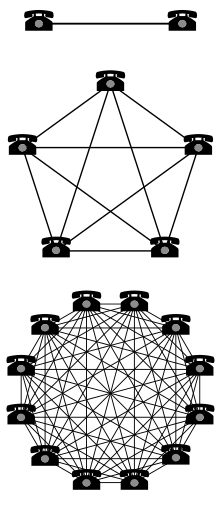
WebRTC is one of the highlights of HTML5. The latest stable releases of Google Chrome (including the free Chromium browser) and Firefox include support for this technology and although the specifications are still being finalized, this is the time when developers can start preparing the first generation of web-apps that will define the future of this technology. The JSCommunicator project aims to make it easy to integrate WebRTC into existing web applications. It provides a high-level API on top of the popular JsSIP SIP stack for JavaScript. The JSCommunicator API provides basic dialing and call control features, allowing you to focus on the application level rather than the SIP level. The configuration file suggests many possible ways it can be deployed and customized without any coding at all. The popular DruCall module for the Drupal CMS provides a practical demonstration of how JSCommunicator can be embedded in other products, multiplying the power of WebRTC for millions of other web developers, bloggers, online shops and other sites. This part of the DruCall source code provides a practical demonstration of how JSCommunicator integrates with PHP and this demonstrates how we extract the parameters from PHP in the JavaScript and convert them to the JSCommunicator configuration object. Practical deployments of WebRTC today The student selected for this GSoC project will focus on two practical, real-world deployments of JSCommunicator: It is particularly important to think about ways to make this technology useful for the Debian Developer community in the pursuit of Debian's work. Not just for Debian A communication product is not much use if there is nobody to talk to. The optimal outcome of this project may involve helping two or three additional free software communities to build portals similar to https://rtc.debian.org so that they can interact with Debian and each other using Federated SIP. As Metcalfe's Law explains, this outcome would be a win-win situation for everybody. Metcalfe's Law - Network effect Mentors needed too The more diverse the mentoring community, the more positive outcomes we can achieve with this project. If you would like to be part of a mentoring team for this project, please email me and subscribe to the Debian SOC co-ordination email list. There is no strict requirement for all mentors in the team to be full Debian Developers and emerging technology like this clearly needs people with strengths in a range of different areas. Get started now For general ideas about getting selected for Google Summer of Code, please see the comments at the bottom of my earlier blog post about Ganglia projects For this project in WebRTC in particular, please:
  • Review the project brief on the Debian wiki
  • Discuss your ideas on the JsSIP Google group
  • Send an email to introduce yourself on the Debian SOC co-ordination email list and give a link to your post on the JsSIP list
  • You must complete a coding test. Please see the open bug list for JSCommunicator, complete one of these tasks and submit a pull request on Github. Please send an email to the JsSIP Google group to discuss your pull request.
  • Explain what features you would create during the summer
  • Explain which other tools or libraries you would like to use
  • Give examples of previous work you have done with HTML and JavaScript
  • Explain how your participation will benefit Debian, free software and the wider world. Give some practical examples.
  • If you are interested in other JavaScript and jQuery opportunities for GSoC 2014, please also read more about the web components in the Ganglia project - if you apply for both Debian and Ganglia, you only have to complete one coding test as part of your application.

28 February 2014

Daniel Pocock: Google Summer of Code opportunities in data science and machine learning with Ganglia

As mentioned in my blog on Monday, the Ganglia Project is proud to be part of Google Summer of Code in 2014 The Ganglia team are offering various types of projects and different parts of Ganglia would welcome students with different skills, for example:
Component Skills
gmond agent C
gmond modules C or Python
JMXetric Java
gmetad and rrdtool for storing time series data C
Ganglia web interface JavaScript and jQuery
Ganglia integration (e.g. ganglia-nagios-bridge) Python
Big data right under your nose I have had many queries from students about how to get into data science. Very few students will be lucky enough to get an internship where they can study time-series from the financial markets and experiment making their own trading algorithms. On the other hand, network performance data is everywhere. It is real-time. It is surprisingly similar in some ways to processing financial data and it provides excellent opportunities for students to practice data science skills and make a meaningful contribution to solving real problems. Finding public Ganglia data with Google Many large organizations, including universities, governments and corporations are using Ganglia to gather metrics from all the hosts in their networks. Some of them even expose this data to the public. Here are two Google searches you can use to find them:
Courtesy of Universit Montpellier 2, France Some sites may even expose their data as an XML feed, you can try and extract it by connecting to the Ganglia server on one of these ports
Port Comments
8649 gmond: sends an XML snapshot to anybody who connects
8651 gmetad: sends an XML snapshot to anybody who connects
8651 gmetad: works a little bit like HTTP, returns a subset of the XML snapshot when you make a GET request
You can discover a Ganglia environment in your campus by looking for a gmond process on your machine and the gmond.conf file, often in /etc/gmond.conf or /etc/ganglia/gmond.conf. That file may contain a clue about the name of the host where Ganglia data is aggregated:
udp_send_channel  
  host = ganglia-reports.example.edu
  port = 8649
  ttl = 1
 
This tells you that the host ganglia-reports.example.edu is collecting the data - you could try the URL http://ganglia-reports.example.edu/ganglia/ in a web browser or try connecting to one of the TCP ports 8649, 8651 or 8652 on that host. Here is an example with netcat:
$ nc ganglia-reports.example.edu 8649   grep ^.H
It will return a list of all hosts that Ganglia knows about. Once you have a data feed, you can then configure a gmetad process on your own system to poll the remote system and generate local RRDs for you to study. Install your own Ganglia It is very easy to get your own Ganglia setup. On a Debian or Ubuntu system, just do:
# apt-get update
# apt-get install ganglia-monitor ganglia-webfrontend
On Fedora and RPM-based systems (such as CentOS or RHEL with EPEL) you can do:
# yum install ganglia-gmond ganglia-web
Everything should be autoconfigured. You can then browse to http://localhost/ganglia to see the charts. If you have several hosts with the gmond agent (just the ganglia-monitor.deb or ganglia-gmond.rpm) on the same LAN, they will automatically find each other using multicast and you will see an aggregated report on the machine with the web server. The data is real-time It is important to keep in mind that the data is real-time. This means you can often detect problems in real-time. If this blog appears on slashdot, for example, then that image from Universit Montpellier 2 will be hit many times. The image actually shows the network load on the web server producing the image, so you will see the slashdot effect graphically in the image itself. Processing real-time data is often the most advanced step in any data science exercise. Initially, you may simply log a few days of data to RRD files to start studying a static data set with your tool of choice, whether it is the R project, Weka or Hadoop Once you have a a hypothesis (for example, an algorithm that understands the normal characteristics of each metric) you may then take each new real-time value from the gmetad XML and test it with the algorithm. The algorithm would then raise an alert if any metric on any host deviates from its normal behavior. Mixing in other sources of data Depending upon the computing environment in your campus or organization, you may also be able to get other data sources, such as a list of people logged in to different machines at different times and the processes that each user starts and stops. This might help to make more accurate predictions about when network or computing resources will be under stress. For example, if users bob, alice and eve all appear on the same host, your algorithm might conclude that the load average will reach an excessive level within 15 minutes and send those three users a suggestion to each try other machines. Making a successful application for GSoC 2014 Here are some tips
  • For all organizations/projects
  • For Ganglia and the data science project in particular
    • Join the ganglia-general mailing list and send an email to introduce yourself
    • Try Ganglia on your own Linux system. Use the packages, it is really easy. Send an email to the list with any questions.
    • Explore the source code in github - ask us questions about it. For the data science project, you may also need to look at RRDtool source code and documentation about making a plugin for R (using C)
    • You don't have to do it our way: if you prefer to work with another tool instead of R, please tell us your idea
    • Write some skeleton code or make a diagram to explain what you want to do. While you do this, do you think of any new questions or problems? Make a list of them.
    • We want to give every student a small coding task as a test. Please tell us which language you prefer (e.g. C, Java, Python) so we can give you a suitable test. If you are really keen, follow the link to bugs I reported in Debian, look for one that is easy and try to write a small patch for it - helping fix bugs that annoy your mentor is likely to be a good way to get on the short-list for selection.

26 February 2014

Daniel Pocock: MtGox is not Bitcoin

Many people may be looking at the Mt Gox implosion and wondering if this is the end for Bitcoin or even cryptocurrency in general. I don't want to speculate either way. Any currency - cryptocurrency included - largely depends on the confidence of its users and the quality of the systems they put in place. If Mt Gox is insolvent, then it is not really any better - or worse - than the fate of Barings Bank (made famous by Nick Leeson) or the Enron employee pension fund. While I won't speculate on whether people should or should not use Bitcoin, banks themselves have explored these counterparty risk issues many times. One of the solutions they have implemented is called delivery-vs-payment, implemented very widely by Continusously Linked Settlement (CLS Group). This type of solution is likely to be no more or less reliable for crypto-currency as it is for traditional cross-border FX settlement. In practice, one method of implementing this solution involves each counterparty breaking a trade down into smaller units (each being 1% of the full amount, for example) and then making 100 small exchanges instead of one lump sum payment. In this example, neither party can lose more than 1% of the trade value. In comparison, MtGox users may have been speculating with 100% of their cash each time they trade and that is why they have come unstuck.

Daniel Pocock: Free communications software takes another big jump

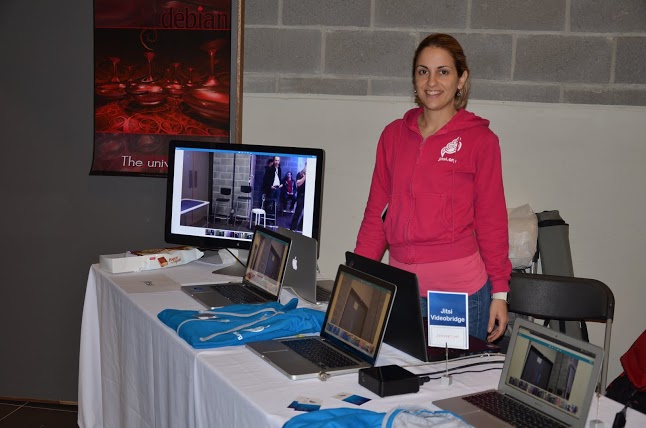
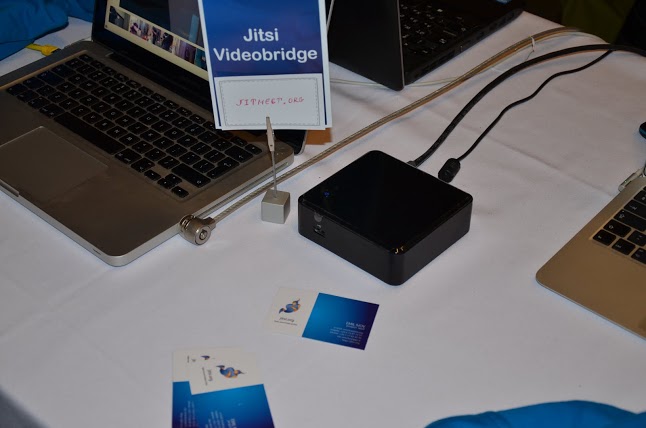
One of the most exciting demonstrations at FOSDEM this year was the new JitMeet web application from the Jitsi team. JitMeet takes the power of the traditional Jitsi Videobridge and makes it accessible to anyone, anywhere (with a modern web browser) using WebRTC. Yana from the Jitsi team with a table full of devices running different operating systems and browsers connecting to a JitMeet video conference. The demo also extended to the Debian table which was immediately underneath (ground floor) and within range of the real-time lounge private WLAN. What makes this so exciting? The thing that stands out for me is that you can run it on any web server under your own control. This gives people real choice in an era when people are starting to realize the risk of using "free" cloud services. Any Linux web server - big or small, running your preferred distribution - can run a JitMeet conference. Here it is running on a very small Intel i3-based NUC with Debian For those who want to know more, you can watch Emil's lightning talk about JitMeet or ask on the Jitsi user mailing list. Emil's lightning talk about JitMeet

24 February 2014

Daniel Pocock: GSoC Organisations announced, Ganglia selected for 2014

Google has just published the list of organisations for Google Summer of Code 2014 It is no surprise that big projects like Debian and Fedora are all back again. On the other hand, I am delighted to announce that the Ganglia project is participating this year. We have started publishing a list of project ideas and we are keen to start having discussion with potential students and anybody who would like to participate in our mentoring team. We have also invited the RRDtool community to be part of this big adventure because RRDtool is such a critical element of Ganglia's success. My Debian project ideas I've also published a couple of project ideas on the Debian wiki before the organisations were confirmed: As I am part of the admin team for Ganglia, these Debian projects can only go ahead if there are some additional mentors willing to participate in them. Please contact me if either of these projects is interesting for you. You don't have to be a Debian Developer to be a mentor for Debian. Given the highly generic nature of these projects, particularly the Java one, they could also be mentored under the umbrella of another organisation. The Java project is particularly suitable for any Linux distribution or project relying on many JARs and all distributions and Java users are likely to extract some benefit from it. Deadlines approaching GSoC works on a strict calendar, please see the dates here if you would like to participate as a mentor, co-mentor or student.

Next.

Previous.