Search Results: "bod"

29 May 2022

Russ Allbery: Review: Kleptopia

Review: Kleptopia, by Tom Burgis
Publisher: Harper
Copyright: 2020
Printing: September 2021
ISBN: 0-06-323613-3
Format: Kindle
Pages: 340
Kleptopia is a nonfiction chronicle of international financial corruption and money laundering told via a focus on the former Soviet republic of Kazakhstan. The primary characters are a British banker named Nigel Wilkins (at the start of the story, the head of compliance in the London office of the Swiss bank BSI), a group of businessmen from Kyrgyzstan and Uzbekistan called the Trio, and a Kazakh oligarch and later political dissident named Mukhtar Ablyazov, although the story spreads beyond them. It is partly a detailed example of what money laundering looks like in practice: where the money comes from, who has it, what they want to do with it, who they hire to move it, and what countries welcome it. But it is more broadly about the use of politics for financial plunder, and what stories we tell about the results. The title of this book feels a bit like clickbait, and I was worried it would be mostly opinion and policy discussion. It is the exact opposite. Tom Burgis is an investigations correspondent at the Financial Times, and this is a detailed piece of investigative journalism (backed by a hundred pages of notes and detailed attributions). Burgis has a clear viewpoint and expresses it when it seems relevant, but the vast majority of this book is the sort of specific account of people, dates, times, and events that one would expect from a full-length investigative magazine piece, except maintained at book length. Even aside from the subject matter, I love that writing like this exists. It's often best in magazines, newspapers, and on-line articles for timeliness, since book publishing is slow, but some subjects require the length of a book. Burgis is the sort of reporter who travels the world to meet with sources in person, and who, before publication, presents his conclusions to everyone mentioned for their rebuttals (many of which are summarized or quoted in detail in the notes so that the reader can draw their own credibility conclusions). Whether or not one agrees with his specific conclusions or emphasis, we need more of this sort of journalism in the world. I knew essentially nothing about Kazakhstan or its politics before reading this book. I also had not appreciated the degree to which exploitation of natural resources is the original source of the money for international money laundering. In both Kazakhstan and Africa (a secondary setting for this book), people get rich largely because of things dug or pumped out of the ground. That money, predictably, does not go to the people doing the hard work of digging and pumping, who work in appalling conditions and are put down with violence if they try to force change. (In one chapter, Burgis tells the harrowing and nightmarish story of Roza Tuletayeva, a striker at the oil field in Zhanaozen.) It's gathered up by the already rich and politically connected, who gained control of former state facilities during the post-Soviet collapse and then maintained their power with violence and corruption. And once they have money, they try to convert it into holdings in European banks, London real estate, and western corporations. The primary thing I will remember from this book is the degree to which oligarchs rely on being able to move between two systems. They make their money in unstable or authoritarian countries with high degrees of political corruption and violence, and are adept at navigating that world (although sometimes it turns on them; more on that in a moment). But they don't want to leave their money in that world. Someone else could betray them, undermine them, or gain the ear of the local dictator. They rely instead on western countries with strong property rights, stable financial institutions, and vast legal systems devoted to protecting the wealth of people who are already rich. In essence, they play both rule sets against each other: make money through techniques that would be illegal in London, and then move their money to London so that the British government and legal system will protect it against others who are trying to do the same. What they get out of this is obvious. What London gets out of it is another theme of this book: it's a way for a lot of people to share the wealth without doing any of the crimes. Money laundering is a very lossy activity. Lots of money falls out of the cart along the way, where it is happily scooped up by bankers, lawyers, accountants, public relations consultants, and the rest of the vast machinery of theoretically legitimate business. Everyone wins, except the people the money is being stolen from in the first place. (And the planet; Burgis doesn't talk much about the environment, but I found the image of one-way extraction of irreplaceable natural resources haunting and disturbing.) Donald Trump does make an appearance here, although not as significant of one as I was expecting given the prominent appearance of Trump crony Felix Sater. Trump is part of the machinery that allows oligarch money to become legally-protected business investment, but it's also clear from Burgis's telling that he is (at least among the money flows Burgis is focused on) a second-tier player with delusions of grandeur. He's more notable for his political acumen and ability to craft media stories than his money-laundering skills. The story-telling is a third theme of this book. The electorate of the societies into which oligarchs try to move their money aren't fond of crime, mob activity, political corruption, or authoritarian exploitation of workers. If public opinion turns sufficiently strongly against specific oligarchs, the normally friendly mechanisms of law and business regulation may have to take action. The primary defense of laundered money is hiding its origins sufficiently that it's too hard to investigate or explain to a jury, but there are limits to how completely the money can hide given that oligarchs still want to spend it. They need to tell a story about how they are modernizing businessmen, aghast at the lingering poor conditions of their home countries but working earnestly to slowly improve them. And they need to defend those stories against people who might try to draw a clearer link between them and criminal activity. The competing stories between dissident oligarch Mukhtar Ablyazov and the Kazakh government led by Nursultan Nazarbayev are a centerpiece of this book. Ablyazov is in some sense a hero of the story, someone who attempted to expose the corruption of Nazerbayev's government and was jailed by Nazerbayev for corruption in retaliation. But Burgis makes clear the tricky fact that Ablyazov likely is guilty of at least some (and possibly a lot) of the money laundering of which he was accused. It's a great illustration of the perils of simple good or bad labels when trying to understand this world from the outside. All of these men are playing similar games, and all of them are trying to tell stories where they are heroes and their opponents are corrupt thieves. And yet, there is not a moral equivalency. Ablyazov is not a good person, but what Nazerbayev attempted to do to his family is appalling, far worse than anything Ablyazov did, and the stories about Ablyazov that have prevailed to date in British courts are not an attempt to reach the truth. The major complaint that I have about Kleptopia is that this is a highly complex story with a large number of characters, but Burgis doesn't tell it in chronological order. He jumps forward and backward in time to introduce new angles of the story, and I'm not sure that was the right structural choice. Maybe a more linear story would have been even more confusing, but I got lost in the chronology at several points. Be prepared to put in some work as a reader in keeping the timeline straight. I also have to warn that this is not in any way a hopeful book. Burgis introduces Nigel Wilkins and his quixotic quest to expose the money laundering activities of European banks early in the book. In a novel that would set up a happy ending in which Wilkins brings down the edifice, or at least substantial portions of it. We do not live in a novel, sadly. Kleptopia is not purely depressing, but by and large the bad guys win. This is not a history of corruption that we've exposed and overcome. It's a chronicle of a problem that is getting worse, and that the US and British governments are failing to address. Burgis's publishers successfully defended a libel suit in British courts brought by the Eurasian Natural Resources Corporation, the primary corporate entity of the Trio who are the primary villains of this book. I obviously haven't done my own independent research, but after reading this book, including the thorough notes, this looks to me like the type of libel suit that should serve as an advertisement for its target. I can't say I enjoyed reading this, particularly at the end when the arc becomes clear. Understanding how little governments and institutions care about stopping money laundering is not a pleasant experience. But it's an important book, well and vividly told (except for the chronology), and grounded in solid investigative journalism. Recommended; I'm glad I read it. Rating: 7 out of 10

26 May 2022

Sergio Talens-Oliag: New Blog Config

As promised, on this post I m going to explain how I ve configured this blog using hugo, asciidoctor and the papermod theme, how I publish it using nginx, how I ve integrated the remark42 comment system and how I ve automated its publication using gitea and json2file-go. It is a long post, but I hope that at least parts of it can be interesting for some, feel free to ignore it if that is not your case

Hugo Configuration

Theme settingsThe site is using the PaperMod theme and as I m using asciidoctor to publish my content I ve adjusted the settings to improve how things are shown with it. The current config.yml file is the one shown below (probably some of the settings are not required nor being used right now, but I m including the current file, so this post will have always the latest version of it):
config.yml
baseURL: https://blogops.mixinet.net/
title: Mixinet BlogOps
paginate: 5
theme: PaperMod
destination: public/
enableInlineShortcodes: true
enableRobotsTXT: true
buildDrafts: false
buildFuture: false
buildExpired: false
enableEmoji: true
pygmentsUseClasses: true
minify:
  disableXML: true
  minifyOutput: true
languages:
  en:
    languageName: "English"
    description: "Mixinet BlogOps - https://blogops.mixinet.net/"
    author: "Sergio Talens-Oliag"
    weight: 1
    title: Mixinet BlogOps
    homeInfoParams:
      Title: "Sergio Talens-Oliag Technical Blog"
      Content: >
        ![Mixinet BlogOps](/images/mixinet-blogops.png)
    taxonomies:
      category: categories
      tag: tags
      series: series
    menu:
      main:
        - name: Archive
          url: archives
          weight: 5
        - name: Categories
          url: categories/
          weight: 10
        - name: Tags
          url: tags/
          weight: 10
        - name: Search
          url: search/
          weight: 15
outputs:
  home:
    - HTML
    - RSS
    - JSON
params:
  env: production
  defaultTheme: light
  disableThemeToggle: false
  ShowShareButtons: true
  ShowReadingTime: true
  disableSpecial1stPost: true
  disableHLJS: true
  displayFullLangName: true
  ShowPostNavLinks: true
  ShowBreadCrumbs: true
  ShowCodeCopyButtons: true
  ShowRssButtonInSectionTermList: true
  ShowFullTextinRSS: true
  ShowToc: true
  TocOpen: false
  comments: true
  remark42SiteID: "blogops"
  remark42Url: "/remark42"
  profileMode:
    enabled: false
    title: Sergio Talens-Oliag Technical Blog
    imageUrl: "/images/mixinet-blogops.png"
    imageTitle: Mixinet BlogOps
    buttons:
      - name: Archives
        url: archives
      - name: Categories
        url: categories
      - name: Tags
        url: tags
  socialIcons:
    - name: CV
      url: "https://www.uv.es/~sto/cv/"
    - name: Debian
      url: "https://people.debian.org/~sto/"
    - name: GitHub
      url: "https://github.com/sto/"
    - name: GitLab
      url: "https://gitlab.com/stalens/"
    - name: Linkedin
      url: "https://www.linkedin.com/in/sergio-talens-oliag/"
    - name: RSS
      url: "index.xml"
  assets:
    disableHLJS: true
    favicon: "/favicon.ico"
    favicon16x16:  "/favicon-16x16.png"
    favicon32x32:  "/favicon-32x32.png"
    apple_touch_icon:  "/apple-touch-icon.png"
    safari_pinned_tab:  "/safari-pinned-tab.svg"
  fuseOpts:
    isCaseSensitive: false
    shouldSort: true
    location: 0
    distance: 1000
    threshold: 0.4
    minMatchCharLength: 0
    keys: ["title", "permalink", "summary", "content"]
markup:
  asciidocExt:
    attributes:  
    backend: html5s
    extensions: ['asciidoctor-html5s','asciidoctor-diagram']
    failureLevel: fatal
    noHeaderOrFooter: true
    preserveTOC: false
    safeMode: unsafe
    sectionNumbers: false
    trace: false
    verbose: false
    workingFolderCurrent: true
privacy:
  vimeo:
    disabled: false
    simple: true
  twitter:
    disabled: false
    enableDNT: true
    simple: true
  instagram:
    disabled: false
    simple: true
  youtube:
    disabled: false
    privacyEnhanced: true
services:
  instagram:
    disableInlineCSS: true
  twitter:
    disableInlineCSS: true
security:
  exec:
    allow:
      - '^asciidoctor$'
      - '^dart-sass-embedded$'
      - '^go$'
      - '^npx$'
      - '^postcss$'
Some notes about the settings:
  • disableHLJS and assets.disableHLJS are set to true; we plan to use rouge on adoc and the inclusion of the hljs assets adds styles that collide with the ones used by rouge.
  • ShowToc is set to true and the TocOpen setting is set to false to make the ToC appear collapsed initially. My plan was to use the asciidoctor ToC, but after trying I believe that the theme one looks nice and I don t need to adjust styles, although it has some issues with the html5s processor (the admonition titles use <h6> and they are shown on the ToC, which is weird), to fix it I ve copied the layouts/partial/toc.html to my site repository and replaced the range of headings to end at 5 instead of 6 (in fact 5 still seems a lot, but as I don t think I ll use that heading level on the posts it doesn t really matter).
  • params.profileMode values are adjusted, but for now I ve left it disabled setting params.profileMode.enabled to false and I ve set the homeInfoParams to show more or less the same content with the latest posts under it (I ve added some styles to my custom.css style sheet to center the text and image of the first post to match the look and feel of the profile).
  • On the asciidocExt section I ve adjusted the backend to use html5s, I ve added the asciidoctor-html5s and asciidoctor-diagram extensions to asciidoctor and adjusted the workingFolderCurrent to true to make asciidoctor-diagram work right (haven t tested it yet).

Theme customisationsTo write in asciidoctor using the html5s processor I ve added some files to the assets/css/extended directory:
  1. As said before, I ve added the file assets/css/extended/custom.css to make the homeInfoParams look like the profile page and I ve also changed a little bit some theme styles to make things look better with the html5s output:
    custom.css
    /* Fix first entry alignment to make it look like the profile */
    .first-entry   text-align: center;  
    .first-entry img   display: inline;  
    /**
     * Remove margin for .post-content code and reduce padding to make it look
     * better with the asciidoctor html5s output.
     **/
    .post-content code   margin: auto 0; padding: 4px;  
  2. I ve also added the file assets/css/extended/adoc.css with some styles taken from the asciidoctor-default.css, see this blog post about the original file; mine is the same after formatting it with css-beautify and editing it to use variables for the colors to support light and dark themes:
    adoc.css
    /* AsciiDoctor*/
    table  
        border-collapse: collapse;
        border-spacing: 0
     
    .admonitionblock>table  
        border-collapse: separate;
        border: 0;
        background: none;
        width: 100%
     
    .admonitionblock>table td.icon  
        text-align: center;
        width: 80px
     
    .admonitionblock>table td.icon img  
        max-width: none
     
    .admonitionblock>table td.icon .title  
        font-weight: bold;
        font-family: "Open Sans", "DejaVu Sans", sans-serif;
        text-transform: uppercase
     
    .admonitionblock>table td.content  
        padding-left: 1.125em;
        padding-right: 1.25em;
        border-left: 1px solid #ddddd8;
        color: var(--primary)
     
    .admonitionblock>table td.content>:last-child>:last-child  
        margin-bottom: 0
     
    .admonitionblock td.icon [class^="fa icon-"]  
        font-size: 2.5em;
        text-shadow: 1px 1px 2px var(--secondary);
        cursor: default
     
    .admonitionblock td.icon .icon-note::before  
        content: "\f05a";
        color: var(--icon-note-color)
     
    .admonitionblock td.icon .icon-tip::before  
        content: "\f0eb";
        color: var(--icon-tip-color)
     
    .admonitionblock td.icon .icon-warning::before  
        content: "\f071";
        color: var(--icon-warning-color)
     
    .admonitionblock td.icon .icon-caution::before  
        content: "\f06d";
        color: var(--icon-caution-color)
     
    .admonitionblock td.icon .icon-important::before  
        content: "\f06a";
        color: var(--icon-important-color)
     
    .conum[data-value]  
        display: inline-block;
        color: #fff !important;
        background-color: rgba(100, 100, 0, .8);
        -webkit-border-radius: 100px;
        border-radius: 100px;
        text-align: center;
        font-size: .75em;
        width: 1.67em;
        height: 1.67em;
        line-height: 1.67em;
        font-family: "Open Sans", "DejaVu Sans", sans-serif;
        font-style: normal;
        font-weight: bold
     
    .conum[data-value] *  
        color: #fff !important
     
    .conum[data-value]+b  
        display: none
     
    .conum[data-value]::after  
        content: attr(data-value)
     
    pre .conum[data-value]  
        position: relative;
        top: -.125em
     
    b.conum *  
        color: inherit !important
     
    .conum:not([data-value]):empty  
        display: none
     
  3. The previous file uses variables from a partial copy of the theme-vars.css file that changes the highlighted code background color and adds the color definitions used by the admonitions:
    theme-vars.css
    :root  
        /* Solarized base2 */
        /* --hljs-bg: rgb(238, 232, 213); */
        /* Solarized base3 */
        /* --hljs-bg: rgb(253, 246, 227); */
        /* Solarized base02 */
        --hljs-bg: rgb(7, 54, 66);
        /* Solarized base03 */
        /* --hljs-bg: rgb(0, 43, 54); */
        /* Default asciidoctor theme colors */
        --icon-note-color: #19407c;
        --icon-tip-color: var(--primary);
        --icon-warning-color: #bf6900;
        --icon-caution-color: #bf3400;
        --icon-important-color: #bf0000
     
    .dark  
        --hljs-bg: rgb(7, 54, 66);
        /* Asciidoctor theme colors with tint for dark background */
        --icon-note-color: #3e7bd7;
        --icon-tip-color: var(--primary);
        --icon-warning-color: #ff8d03;
        --icon-caution-color: #ff7847;
        --icon-important-color: #ff3030
     
  4. The previous styles use font-awesome, so I ve downloaded its resources for version 4.7.0 (the one used by asciidoctor) storing the font-awesome.css into on the assets/css/extended dir (that way it is merged with the rest of .css files) and copying the fonts to the static/assets/fonts/ dir (will be served directly):
    FA_BASE_URL="https://cdnjs.cloudflare.com/ajax/libs/font-awesome/4.7.0"
    curl "$FA_BASE_URL/css/font-awesome.css" \
      > assets/css/extended/font-awesome.css
    for f in FontAwesome.otf fontawesome-webfont.eot \
      fontawesome-webfont.svg fontawesome-webfont.ttf \
      fontawesome-webfont.woff fontawesome-webfont.woff2; do
        curl "$FA_BASE_URL/fonts/$f" > "static/assets/fonts/$f"
    done
  5. As already said the default highlighter is disabled (it provided a css compatible with rouge) so we need a css to do the highlight styling; as rouge provides a way to export them, I ve created the assets/css/extended/rouge.css file with the thankful_eyes theme:
    rougify style thankful_eyes > assets/css/extended/rouge.css
  6. To support the use of the html5s backend with admonitions I ve added a variation of the example found on this blog post to assets/js/adoc-admonitions.js:
    adoc-admonitions.js
    // replace the default admonitions block with a table that uses a format
    // similar to the standard asciidoctor ... as we are using fa-icons here there
    // is no need to add the icons: font entry on the document.
    window.addEventListener('load', function ()  
      const admonitions = document.getElementsByClassName('admonition-block')
      for (let i = admonitions.length - 1; i >= 0; i--)  
        const elm = admonitions[i]
        const type = elm.classList[1]
        const title = elm.getElementsByClassName('block-title')[0];
    	const label = title.getElementsByClassName('title-label')[0]
    		.innerHTML.slice(0, -1);
        elm.removeChild(elm.getElementsByClassName('block-title')[0]);
        const text = elm.innerHTML
        const parent = elm.parentNode
        const tempDiv = document.createElement('div')
        tempDiv.innerHTML =  <div class="admonitionblock $ type ">
        <table>
          <tbody>
            <tr>
              <td class="icon">
                <i class="fa icon-$ type " title="$ label "></i>
              </td>
              <td class="content">
                $ text 
              </td>
            </tr>
          </tbody>
        </table>
      </div> 
        const input = tempDiv.childNodes[0]
        parent.replaceChild(input, elm)
       
     )
    and enabled its minified use on the layouts/partials/extend_footer.html file adding the following lines to it:
     - $admonitions := slice (resources.Get "js/adoc-admonitions.js")
        resources.Concat "assets/js/adoc-admonitions.js"   minify   fingerprint  
    <script defer crossorigin="anonymous" src="  $admonitions.RelPermalink  "
      integrity="  $admonitions.Data.Integrity  "></script>

Remark42 configurationTo integrate Remark42 with the PaperMod theme I ve created the file layouts/partials/comments.html with the following content based on the remark42 documentation, including extra code to sync the dark/light setting with the one set on the site:
comments.html
<div id="remark42"></div>
<script>
  var remark_config =  
    host:   .Site.Params.remark42Url  ,
    site_id:   .Site.Params.remark42SiteID  ,
    url:   .Permalink  ,
    locale:   .Site.Language.Lang  
   ;
  (function(c)  
    /* Adjust the theme using the local-storage pref-theme if set */
    if (localStorage.getItem("pref-theme") === "dark")  
      remark_config.theme = "dark";
      else if (localStorage.getItem("pref-theme") === "light")  
      remark_config.theme = "light";
     
    /* Add remark42 widget */
    for(var i = 0; i < c.length; i++) 
      var d = document, s = d.createElement('script');
      s.src = remark_config.host + '/web/' + c[i] +'.js';
      s.defer = true;
      (d.head   d.body).appendChild(s);
     
   )(remark_config.components   ['embed']);
</script>
In development I use it with anonymous comments enabled, but to avoid SPAM the production site uses social logins (for now I ve only enabled Github & Google, if someone requests additional services I ll check them, but those were the easy ones for me initially). To support theme switching with remark42 I ve also added the following inside the layouts/partials/extend_footer.html file:
 - if (not site.Params.disableThemeToggle)  
<script>
/* Function to change theme when the toggle button is pressed */
document.getElementById("theme-toggle").addEventListener("click", () =>  
  if (typeof window.REMARK42 != "undefined")  
    if (document.body.className.includes('dark'))  
      window.REMARK42.changeTheme('light');
      else  
      window.REMARK42.changeTheme('dark');
     
   
 );
</script>
 - end  
With this code if the theme-toggle button is pressed we change the remark42 theme before the PaperMod one (that s needed here only, on page loads the remark42 theme is synced with the main one using the code from the layouts/partials/comments.html shown earlier).

Development setupTo preview the site on my laptop I m using docker-compose with the following configuration:
docker-compose.yaml
version: "2"
services:
  hugo:
    build:
      context: ./docker/hugo-adoc
      dockerfile: ./Dockerfile
    image: sto/hugo-adoc
    container_name: hugo-adoc-blogops
    restart: always
    volumes:
      - .:/documents
    command: server --bind 0.0.0.0 -D -F
    user: $ APP_UID :$ APP_GID 
  nginx:
    image: nginx:latest
    container_name: nginx-blogops
    restart: always
    volumes:
      - ./nginx/default.conf:/etc/nginx/conf.d/default.conf
    ports:
      -  1313:1313
  remark42:
    build:
      context: ./docker/remark42
      dockerfile: ./Dockerfile
    image: sto/remark42
    container_name: remark42-blogops
    restart: always
    env_file:
      - ./.env
      - ./remark42/env.dev
    volumes:
      - ./remark42/var.dev:/srv/var
To run it properly we have to create the .env file with the current user ID and GID on the variables APP_UID and APP_GID (if we don t do it the files can end up being owned by a user that is not the same as the one running the services):
$ echo "APP_UID=$(id -u)\nAPP_GID=$(id -g)" > .env
The Dockerfile used to generate the sto/hugo-adoc is:
Dockerfile
FROM asciidoctor/docker-asciidoctor:latest
RUN gem install --no-document asciidoctor-html5s &&\
 apk update && apk add --no-cache curl libc6-compat &&\
 repo_path="gohugoio/hugo" &&\
 api_url="https://api.github.com/repos/$repo_path/releases/latest" &&\
 download_url="$(\
  curl -sL "$api_url"  \
  sed -n "s/^.*download_url\": \"\\(.*.extended.*Linux-64bit.tar.gz\)\"/\1/p"\
 )" &&\
 curl -sL "$download_url" -o /tmp/hugo.tgz &&\
 tar xf /tmp/hugo.tgz hugo &&\
 install hugo /usr/bin/ &&\
 rm -f hugo /tmp/hugo.tgz &&\
 /usr/bin/hugo version &&\
 apk del curl && rm -rf /var/cache/apk/*
# Expose port for live server
EXPOSE 1313
ENTRYPOINT ["/usr/bin/hugo"]
CMD [""]
If you review it you will see that I m using the docker-asciidoctor image as the base; the idea is that this image has all I need to work with asciidoctor and to use hugo I only need to download the binary from their latest release at github (as we are using an image based on alpine we also need to install the libc6-compat package, but once that is done things are working fine for me so far). The image does not launch the server by default because I don t want it to; in fact I use the same docker-compose.yml file to publish the site in production simply calling the container without the arguments passed on the docker-compose.yml file (see later). When running the containers with docker-compose up (or docker compose up if you have the docker-compose-plugin package installed) we also launch a nginx container and the remark42 service so we can test everything together. The Dockerfile for the remark42 image is the original one with an updated version of the init.sh script:
Dockerfile
FROM umputun/remark42:latest
COPY init.sh /init.sh
The updated init.sh is similar to the original, but allows us to use an APP_GID variable and updates the /etc/group file of the container so the files get the right user and group (with the original script the group is always 1001):
init.sh
#!/sbin/dinit /bin/sh
uid="$(id -u)"
if [ "$ uid " -eq "0" ]; then
  echo "init container"
  # set container's time zone
  cp "/usr/share/zoneinfo/$ TIME_ZONE " /etc/localtime
  echo "$ TIME_ZONE " >/etc/timezone
  echo "set timezone $ TIME_ZONE  ($(date))"
  # set UID & GID for the app
  if [ "$ APP_UID " ]   [ "$ APP_GID " ]; then
    [ "$ APP_UID " ]   APP_UID="1001"
    [ "$ APP_GID " ]   APP_GID="$ APP_UID "
    echo "set custom APP_UID=$ APP_UID  & APP_GID=$ APP_GID "
    sed -i "s/^app:x:1001:1001:/app:x:$ APP_UID :$ APP_GID :/" /etc/passwd
    sed -i "s/^app:x:1001:/app:x:$ APP_GID :/" /etc/group
  else
    echo "custom APP_UID and/or APP_GID not defined, using 1001:1001"
  fi
  chown -R app:app /srv /home/app
fi
echo "prepare environment"
# replace  % REMARK_URL %  by content of REMARK_URL variable
find /srv -regex '.*\.\(html\ js\ mjs\)$' -print \
  -exec sed -i "s % REMARK_URL % $ REMARK_URL  g"   \;
if [ -n "$ SITE_ID " ]; then
  #replace "site_id: 'remark'" by SITE_ID
  sed -i "s 'remark' '$ SITE_ID ' g" /srv/web/*.html
fi
echo "execute \"$*\""
if [ "$ uid " -eq "0" ]; then
  exec su-exec app "$@"
else
  exec "$@"
fi
The environment file used with remark42 for development is quite minimal:
env.dev
TIME_ZONE=Europe/Madrid
REMARK_URL=http://localhost:1313/remark42
SITE=blogops
SECRET=123456
ADMIN_SHARED_ID=sto
AUTH_ANON=true
EMOJI=true
And the nginx/default.conf file used to publish the service locally is simple too:
default.conf
server   
 listen 1313;
 server_name localhost;
 location /  
    proxy_pass http://hugo:1313;
    proxy_set_header Host $http_host;
    proxy_set_header X-Real-IP $remote_addr;
    proxy_set_header X-Forwarded-For $proxy_add_x_forwarded_for;
    proxy_set_header X-Forwarded-Proto $scheme;
    proxy_set_header Upgrade $http_upgrade;
    proxy_set_header Connection "upgrade";
  
 location /remark42/  
    rewrite /remark42/(.*) /$1 break;
    proxy_pass http://remark42:8080/;
    proxy_set_header Host $http_host;
    proxy_set_header X-Real-IP $remote_addr;
    proxy_set_header X-Forwarded-For $proxy_add_x_forwarded_for;
    proxy_set_header X-Forwarded-Proto $scheme;


Production setupThe VM where I m publishing the blog runs Debian GNU/Linux and uses binaries from local packages and applications packaged inside containers. To run the containers I m using docker-ce (I could have used podman instead, but I already had it installed on the machine, so I stayed with it). The binaries used on this project are included on the following packages from the main Debian repository:
  • git to clone & pull the repository,
  • jq to parse json files from shell scripts,
  • json2file-go to save the webhook messages to files,
  • inotify-tools to detect when new files are stored by json2file-go and launch scripts to process them,
  • nginx to publish the site using HTTPS and work as proxy for json2file-go and remark42 (I run it using a container),
  • task-spool to queue the scripts that update the deployment.
And I m using docker and docker compose from the debian packages on the docker repository:
  • docker-ce to run the containers,
  • docker-compose-plugin to run docker compose (it is a plugin, so no - in the name).

Repository checkoutTo manage the git repository I ve created a deploy key, added it to gitea and cloned the project on the /srv/blogops PATH (that route is owned by a regular user that has permissions to run docker, as I said before).

Compiling the site with hugoTo compile the site we are using the docker-compose.yml file seen before, to be able to run it first we build the container images and once we have them we launch hugo using docker compose run:
$ cd /srv/blogops
$ git pull
$ docker compose build
$ if [ -d "./public" ]; then rm -rf ./public; fi
$ docker compose run hugo --
The compilation leaves the static HTML on /srv/blogops/public (we remove the directory first because hugo does not clean the destination folder as jekyll does). The deploy script re-generates the site as described and moves the public directory to its final place for publishing.

Running remark42 with dockerOn the /srv/blogops/remark42 folder I have the following docker-compose.yml:
docker-compose.yml
version: "2"
services:
  remark42:
    build:
      context: ../docker/remark42
      dockerfile: ./Dockerfile
    image: sto/remark42
    env_file:
      - ../.env
      - ./env.prod
    container_name: remark42
    restart: always
    volumes:
      - ./var.prod:/srv/var
    ports:
      - 127.0.0.1:8042:8080
The ../.env file is loaded to get the APP_UID and APP_GID variables that are used by my version of the init.sh script to adjust file permissions and the env.prod file contains the rest of the settings for remark42, including the social network tokens (see the remark42 documentation for the available parameters, I don t include my configuration here because some of them are secrets).

Nginx configurationThe nginx configuration for the blogops.mixinet.net site is as simple as:
server  
  listen 443 ssl http2;
  server_name blogops.mixinet.net;
  ssl_certificate /etc/letsencrypt/live/blogops.mixinet.net/fullchain.pem;
  ssl_certificate_key /etc/letsencrypt/live/blogops.mixinet.net/privkey.pem;
  include /etc/letsencrypt/options-ssl-nginx.conf;
  ssl_dhparam /etc/letsencrypt/ssl-dhparams.pem;
  access_log /var/log/nginx/blogops.mixinet.net-443.access.log;
  error_log  /var/log/nginx/blogops.mixinet.net-443.error.log;
  root /srv/blogops/nginx/public_html;
  location /  
    try_files $uri $uri/ =404;
   
  include /srv/blogops/nginx/remark42.conf;
 
server  
  listen 80 ;
  listen [::]:80 ;
  server_name blogops.mixinet.net;
  access_log /var/log/nginx/blogops.mixinet.net-80.access.log;
  error_log  /var/log/nginx/blogops.mixinet.net-80.error.log;
  if ($host = blogops.mixinet.net)  
    return 301 https://$host$request_uri;
   
  return 404;
 
On this configuration the certificates are managed by certbot and the server root directory is on /srv/blogops/nginx/public_html and not on /srv/blogops/public; the reason for that is that I want to be able to compile without affecting the running site, the deployment script generates the site on /srv/blogops/public and if all works well we rename folders to do the switch, making the change feel almost atomic.

json2file-go configurationAs I have a working WireGuard VPN between the machine running gitea at my home and the VM where the blog is served, I m going to configure the json2file-go to listen for connections on a high port using a self signed certificate and listening on IP addresses only reachable through the VPN. To do it we create a systemd socket to run json2file-go and adjust its configuration to listen on a private IP (we use the FreeBind option on its definition to be able to launch the service even when the IP is not available, that is, when the VPN is down). The following script can be used to set up the json2file-go configuration:
setup-json2file.sh
#!/bin/sh
set -e
# ---------
# VARIABLES
# ---------
BASE_DIR="/srv/blogops/webhook"
J2F_DIR="$BASE_DIR/json2file"
TLS_DIR="$BASE_DIR/tls"
J2F_SERVICE_NAME="json2file-go"
J2F_SERVICE_DIR="/etc/systemd/system/json2file-go.service.d"
J2F_SERVICE_OVERRIDE="$J2F_SERVICE_DIR/override.conf"
J2F_SOCKET_DIR="/etc/systemd/system/json2file-go.socket.d"
J2F_SOCKET_OVERRIDE="$J2F_SOCKET_DIR/override.conf"
J2F_BASEDIR_FILE="/etc/json2file-go/basedir"
J2F_DIRLIST_FILE="/etc/json2file-go/dirlist"
J2F_CRT_FILE="/etc/json2file-go/certfile"
J2F_KEY_FILE="/etc/json2file-go/keyfile"
J2F_CRT_PATH="$TLS_DIR/crt.pem"
J2F_KEY_PATH="$TLS_DIR/key.pem"
# ----
# MAIN
# ----
# Install packages used with json2file for the blogops site
sudo apt update
sudo apt install -y json2file-go uuid
if [ -z "$(type mkcert)" ]; then
  sudo apt install -y mkcert
fi
sudo apt clean
# Configuration file values
J2F_USER="$(id -u)"
J2F_GROUP="$(id -g)"
J2F_DIRLIST="blogops:$(uuid)"
J2F_LISTEN_STREAM="172.31.31.1:4443"
# Configure json2file
[ -d "$J2F_DIR" ]   mkdir "$J2F_DIR"
sudo sh -c "echo '$J2F_DIR' >'$J2F_BASEDIR_FILE'"
[ -d "$TLS_DIR" ]   mkdir "$TLS_DIR"
if [ ! -f "$J2F_CRT_PATH" ]   [ ! -f "$J2F_KEY_PATH" ]; then
  mkcert -cert-file "$J2F_CRT_PATH" -key-file "$J2F_KEY_PATH" "$(hostname -f)"
fi
sudo sh -c "echo '$J2F_CRT_PATH' >'$J2F_CRT_FILE'"
sudo sh -c "echo '$J2F_KEY_PATH' >'$J2F_KEY_FILE'"
sudo sh -c "cat >'$J2F_DIRLIST_FILE'" <<EOF
$(echo "$J2F_DIRLIST"   tr ';' '\n')
EOF
# Service override
[ -d "$J2F_SERVICE_DIR" ]   sudo mkdir "$J2F_SERVICE_DIR"
sudo sh -c "cat >'$J2F_SERVICE_OVERRIDE'" <<EOF
[Service]
User=$J2F_USER
Group=$J2F_GROUP
EOF
# Socket override
[ -d "$J2F_SOCKET_DIR" ]   sudo mkdir "$J2F_SOCKET_DIR"
sudo sh -c "cat >'$J2F_SOCKET_OVERRIDE'" <<EOF
[Socket]
# Set FreeBind to listen on missing addresses (the VPN can be down sometimes)
FreeBind=true
# Set ListenStream to nothing to clear its value and add the new value later
ListenStream=
ListenStream=$J2F_LISTEN_STREAM
EOF
# Restart and enable service
sudo systemctl daemon-reload
sudo systemctl stop "$J2F_SERVICE_NAME"
sudo systemctl start "$J2F_SERVICE_NAME"
sudo systemctl enable "$J2F_SERVICE_NAME"
# ----
# vim: ts=2:sw=2:et:ai:sts=2
Warning: The script uses mkcert to create the temporary certificates, to install the package on bullseye the backports repository must be available.

Gitea configurationTo make gitea use our json2file-go server we go to the project and enter into the hooks/gitea/new page, once there we create a new webhook of type gitea and set the target URL to https://172.31.31.1:4443/blogops and on the secret field we put the token generated with uuid by the setup script:
sed -n -e 's/blogops://p' /etc/json2file-go/dirlist
The rest of the settings can be left as they are:
  • Trigger on: Push events
  • Branch filter: *
Warning: We are using an internal IP and a self signed certificate, that means that we have to review that the webhook section of the app.ini of our gitea server allows us to call the IP and skips the TLS verification (you can see the available options on the gitea documentation). The [webhook] section of my server looks like this:
[webhook]
ALLOWED_HOST_LIST=private
SKIP_TLS_VERIFY=true
Once we have the webhook configured we can try it and if it works our json2file server will store the file on the /srv/blogops/webhook/json2file/blogops/ folder.

The json2file spooler scriptWith the previous configuration our system is ready to receive webhook calls from gitea and store the messages on files, but we have to do something to process those files once they are saved in our machine. An option could be to use a cronjob to look for new files, but we can do better on Linux using inotify we will use the inotifywait command from inotify-tools to watch the json2file output directory and execute a script each time a new file is moved inside it or closed after writing (IN_CLOSE_WRITE and IN_MOVED_TO events). To avoid concurrency problems we are going to use task-spooler to launch the scripts that process the webhooks using a queue of length 1, so they are executed one by one in a FIFO queue. The spooler script is this:
blogops-spooler.sh
#!/bin/sh
set -e
# ---------
# VARIABLES
# ---------
BASE_DIR="/srv/blogops/webhook"
BIN_DIR="$BASE_DIR/bin"
TSP_DIR="$BASE_DIR/tsp"
WEBHOOK_COMMAND="$BIN_DIR/blogops-webhook.sh"
# ---------
# FUNCTIONS
# ---------
queue_job()  
  echo "Queuing job to process file '$1'"
  TMPDIR="$TSP_DIR" TS_SLOTS="1" TS_MAXFINISHED="10" \
    tsp -n "$WEBHOOK_COMMAND" "$1"
 
# ----
# MAIN
# ----
INPUT_DIR="$1"
if [ ! -d "$INPUT_DIR" ]; then
  echo "Input directory '$INPUT_DIR' does not exist, aborting!"
  exit 1
fi
[ -d "$TSP_DIR" ]   mkdir "$TSP_DIR"
echo "Processing existing files under '$INPUT_DIR'"
find "$INPUT_DIR" -type f   sort   while read -r _filename; do
  queue_job "$_filename"
done
# Use inotifywatch to process new files
echo "Watching for new files under '$INPUT_DIR'"
inotifywait -q -m -e close_write,moved_to --format "%w%f" -r "$INPUT_DIR"  
  while read -r _filename; do
    queue_job "$_filename"
  done
# ----
# vim: ts=2:sw=2:et:ai:sts=2
To run it as a daemon we install it as a systemd service using the following script:
setup-spooler.sh
#!/bin/sh
set -e
# ---------
# VARIABLES
# ---------
BASE_DIR="/srv/blogops/webhook"
BIN_DIR="$BASE_DIR/bin"
J2F_DIR="$BASE_DIR/json2file"
SPOOLER_COMMAND="$BIN_DIR/blogops-spooler.sh '$J2F_DIR'"
SPOOLER_SERVICE_NAME="blogops-j2f-spooler"
SPOOLER_SERVICE_FILE="/etc/systemd/system/$SPOOLER_SERVICE_NAME.service"
# Configuration file values
J2F_USER="$(id -u)"
J2F_GROUP="$(id -g)"
# ----
# MAIN
# ----
# Install packages used with the webhook processor
sudo apt update
sudo apt install -y inotify-tools jq task-spooler
sudo apt clean
# Configure process service
sudo sh -c "cat > $SPOOLER_SERVICE_FILE" <<EOF
[Install]
WantedBy=multi-user.target
[Unit]
Description=json2file processor for $J2F_USER
After=docker.service
[Service]
Type=simple
User=$J2F_USER
Group=$J2F_GROUP
ExecStart=$SPOOLER_COMMAND
EOF
# Restart and enable service
sudo systemctl daemon-reload
sudo systemctl stop "$SPOOLER_SERVICE_NAME"   true
sudo systemctl start "$SPOOLER_SERVICE_NAME"
sudo systemctl enable "$SPOOLER_SERVICE_NAME"
# ----
# vim: ts=2:sw=2:et:ai:sts=2

The gitea webhook processorFinally, the script that processes the JSON files does the following:
  1. First, it checks if the repository and branch are right,
  2. Then, it fetches and checks out the commit referenced on the JSON file,
  3. Once the files are updated, compiles the site using hugo with docker compose,
  4. If the compilation succeeds the script renames directories to swap the old version of the site by the new one.
If there is a failure the script aborts but before doing it or if the swap succeeded the system sends an email to the configured address and/or the user that pushed updates to the repository with a log of what happened. The current script is this one:
blogops-webhook.sh
#!/bin/sh
set -e
# ---------
# VARIABLES
# ---------
# Values
REPO_REF="refs/heads/main"
REPO_CLONE_URL="https://gitea.mixinet.net/mixinet/blogops.git"
MAIL_PREFIX="[BLOGOPS-WEBHOOK] "
# Address that gets all messages, leave it empty if not wanted
MAIL_TO_ADDR="blogops@mixinet.net"
# If the following variable is set to 'true' the pusher gets mail on failures
MAIL_ERRFILE="false"
# If the following variable is set to 'true' the pusher gets mail on success
MAIL_LOGFILE="false"
# gitea's conf/app.ini value of NO_REPLY_ADDRESS, it is used for email domains
# when the KeepEmailPrivate option is enabled for a user
NO_REPLY_ADDRESS="noreply.example.org"
# Directories
BASE_DIR="/srv/blogops"
PUBLIC_DIR="$BASE_DIR/public"
NGINX_BASE_DIR="$BASE_DIR/nginx"
PUBLIC_HTML_DIR="$NGINX_BASE_DIR/public_html"
WEBHOOK_BASE_DIR="$BASE_DIR/webhook"
WEBHOOK_SPOOL_DIR="$WEBHOOK_BASE_DIR/spool"
WEBHOOK_ACCEPTED="$WEBHOOK_SPOOL_DIR/accepted"
WEBHOOK_DEPLOYED="$WEBHOOK_SPOOL_DIR/deployed"
WEBHOOK_REJECTED="$WEBHOOK_SPOOL_DIR/rejected"
WEBHOOK_TROUBLED="$WEBHOOK_SPOOL_DIR/troubled"
WEBHOOK_LOG_DIR="$WEBHOOK_SPOOL_DIR/log"
# Files
TODAY="$(date +%Y%m%d)"
OUTPUT_BASENAME="$(date +%Y%m%d-%H%M%S.%N)"
WEBHOOK_LOGFILE_PATH="$WEBHOOK_LOG_DIR/$OUTPUT_BASENAME.log"
WEBHOOK_ACCEPTED_JSON="$WEBHOOK_ACCEPTED/$OUTPUT_BASENAME.json"
WEBHOOK_ACCEPTED_LOGF="$WEBHOOK_ACCEPTED/$OUTPUT_BASENAME.log"
WEBHOOK_REJECTED_TODAY="$WEBHOOK_REJECTED/$TODAY"
WEBHOOK_REJECTED_JSON="$WEBHOOK_REJECTED_TODAY/$OUTPUT_BASENAME.json"
WEBHOOK_REJECTED_LOGF="$WEBHOOK_REJECTED_TODAY/$OUTPUT_BASENAME.log"
WEBHOOK_DEPLOYED_TODAY="$WEBHOOK_DEPLOYED/$TODAY"
WEBHOOK_DEPLOYED_JSON="$WEBHOOK_DEPLOYED_TODAY/$OUTPUT_BASENAME.json"
WEBHOOK_DEPLOYED_LOGF="$WEBHOOK_DEPLOYED_TODAY/$OUTPUT_BASENAME.log"
WEBHOOK_TROUBLED_TODAY="$WEBHOOK_TROUBLED/$TODAY"
WEBHOOK_TROUBLED_JSON="$WEBHOOK_TROUBLED_TODAY/$OUTPUT_BASENAME.json"
WEBHOOK_TROUBLED_LOGF="$WEBHOOK_TROUBLED_TODAY/$OUTPUT_BASENAME.log"
# Query to get variables from a gitea webhook json
ENV_VARS_QUERY="$(
  printf "%s" \
    '(.             @sh "gt_ref=\(.ref);"),' \
    '(.             @sh "gt_after=\(.after);"),' \
    '(.repository   @sh "gt_repo_clone_url=\(.clone_url);"),' \
    '(.repository   @sh "gt_repo_name=\(.name);"),' \
    '(.pusher       @sh "gt_pusher_full_name=\(.full_name);"),' \
    '(.pusher       @sh "gt_pusher_email=\(.email);")'
)"
# ---------
# Functions
# ---------
webhook_log()  
  echo "$(date -R) $*" >>"$WEBHOOK_LOGFILE_PATH"
 
webhook_check_directories()  
  for _d in "$WEBHOOK_SPOOL_DIR" "$WEBHOOK_ACCEPTED" "$WEBHOOK_DEPLOYED" \
    "$WEBHOOK_REJECTED" "$WEBHOOK_TROUBLED" "$WEBHOOK_LOG_DIR"; do
    [ -d "$_d" ]   mkdir "$_d"
  done
 
webhook_clean_directories()  
  # Try to remove empty dirs
  for _d in "$WEBHOOK_ACCEPTED" "$WEBHOOK_DEPLOYED" "$WEBHOOK_REJECTED" \
    "$WEBHOOK_TROUBLED" "$WEBHOOK_LOG_DIR" "$WEBHOOK_SPOOL_DIR"; do
    if [ -d "$_d" ]; then
      rmdir "$_d" 2>/dev/null   true
    fi
  done
 
webhook_accept()  
  webhook_log "Accepted: $*"
  mv "$WEBHOOK_JSON_INPUT_FILE" "$WEBHOOK_ACCEPTED_JSON"
  mv "$WEBHOOK_LOGFILE_PATH" "$WEBHOOK_ACCEPTED_LOGF"
  WEBHOOK_LOGFILE_PATH="$WEBHOOK_ACCEPTED_LOGF"
 
webhook_reject()  
  [ -d "$WEBHOOK_REJECTED_TODAY" ]   mkdir "$WEBHOOK_REJECTED_TODAY"
  webhook_log "Rejected: $*"
  if [ -f "$WEBHOOK_JSON_INPUT_FILE" ]; then
    mv "$WEBHOOK_JSON_INPUT_FILE" "$WEBHOOK_REJECTED_JSON"
  fi
  mv "$WEBHOOK_LOGFILE_PATH" "$WEBHOOK_REJECTED_LOGF"
  exit 0
 
webhook_deployed()  
  [ -d "$WEBHOOK_DEPLOYED_TODAY" ]   mkdir "$WEBHOOK_DEPLOYED_TODAY"
  webhook_log "Deployed: $*"
  mv "$WEBHOOK_ACCEPTED_JSON" "$WEBHOOK_DEPLOYED_JSON"
  mv "$WEBHOOK_ACCEPTED_LOGF" "$WEBHOOK_DEPLOYED_LOGF"
  WEBHOOK_LOGFILE_PATH="$WEBHOOK_DEPLOYED_LOGF"
 
webhook_troubled()  
  [ -d "$WEBHOOK_TROUBLED_TODAY" ]   mkdir "$WEBHOOK_TROUBLED_TODAY"
  webhook_log "Troubled: $*"
  mv "$WEBHOOK_ACCEPTED_JSON" "$WEBHOOK_TROUBLED_JSON"
  mv "$WEBHOOK_ACCEPTED_LOGF" "$WEBHOOK_TROUBLED_LOGF"
  WEBHOOK_LOGFILE_PATH="$WEBHOOK_TROUBLED_LOGF"
 
print_mailto()  
  _addr="$1"
  _user_email=""
  # Add the pusher email address unless it is from the domain NO_REPLY_ADDRESS,
  # which should match the value of that variable on the gitea 'app.ini' (it
  # is the domain used for emails when the user hides it).
  # shellcheck disable=SC2154
  if [ -n "$ gt_pusher_email##*@"$ NO_REPLY_ADDRESS " " ] &&
    [ -z "$ gt_pusher_email##*@* " ]; then
    _user_email="\"$gt_pusher_full_name <$gt_pusher_email>\""
  fi
  if [ "$_addr" ] && [ "$_user_email" ]; then
    echo "$_addr,$_user_email"
  elif [ "$_user_email" ]; then
    echo "$_user_email"
  elif [ "$_addr" ]; then
    echo "$_addr"
  fi
 
mail_success()  
  to_addr="$MAIL_TO_ADDR"
  if [ "$MAIL_LOGFILE" = "true" ]; then
    to_addr="$(print_mailto "$to_addr")"
  fi
  if [ "$to_addr" ]; then
    # shellcheck disable=SC2154
    subject="OK - $gt_repo_name updated to commit '$gt_after'"
    mail -s "$ MAIL_PREFIX $ subject " "$to_addr" \
      <"$WEBHOOK_LOGFILE_PATH"
  fi
 
mail_failure()  
  to_addr="$MAIL_TO_ADDR"
  if [ "$MAIL_ERRFILE" = true ]; then
    to_addr="$(print_mailto "$to_addr")"
  fi
  if [ "$to_addr" ]; then
    # shellcheck disable=SC2154
    subject="KO - $gt_repo_name update FAILED for commit '$gt_after'"
    mail -s "$ MAIL_PREFIX $ subject " "$to_addr" \
      <"$WEBHOOK_LOGFILE_PATH"
  fi
 
# ----
# MAIN
# ----
# Check directories
webhook_check_directories
# Go to the base directory
cd "$BASE_DIR"
# Check if the file exists
WEBHOOK_JSON_INPUT_FILE="$1"
if [ ! -f "$WEBHOOK_JSON_INPUT_FILE" ]; then
  webhook_reject "Input arg '$1' is not a file, aborting"
fi
# Parse the file
webhook_log "Processing file '$WEBHOOK_JSON_INPUT_FILE'"
eval "$(jq -r "$ENV_VARS_QUERY" "$WEBHOOK_JSON_INPUT_FILE")"
# Check that the repository clone url is right
# shellcheck disable=SC2154
if [ "$gt_repo_clone_url" != "$REPO_CLONE_URL" ]; then
  webhook_reject "Wrong repository: '$gt_clone_url'"
fi
# Check that the branch is the right one
# shellcheck disable=SC2154
if [ "$gt_ref" != "$REPO_REF" ]; then
  webhook_reject "Wrong repository ref: '$gt_ref'"
fi
# Accept the file
# shellcheck disable=SC2154
webhook_accept "Processing '$gt_repo_name'"
# Update the checkout
ret="0"
git fetch >>"$WEBHOOK_LOGFILE_PATH" 2>&1   ret="$?"
if [ "$ret" -ne "0" ]; then
  webhook_troubled "Repository fetch failed"
  mail_failure
fi
# shellcheck disable=SC2154
git checkout "$gt_after" >>"$WEBHOOK_LOGFILE_PATH" 2>&1   ret="$?"
if [ "$ret" -ne "0" ]; then
  webhook_troubled "Repository checkout failed"
  mail_failure
fi
# Remove the build dir if present
if [ -d "$PUBLIC_DIR" ]; then
  rm -rf "$PUBLIC_DIR"
fi
# Build site
docker compose run hugo -- >>"$WEBHOOK_LOGFILE_PATH" 2>&1   ret="$?"
# go back to the main branch
git switch main && git pull
# Fail if public dir was missing
if [ "$ret" -ne "0" ]   [ ! -d "$PUBLIC_DIR" ]; then
  webhook_troubled "Site build failed"
  mail_failure
fi
# Remove old public_html copies
webhook_log 'Removing old site versions, if present'
find $NGINX_BASE_DIR -mindepth 1 -maxdepth 1 -name 'public_html-*' -type d \
  -exec rm -rf   \; >>"$WEBHOOK_LOGFILE_PATH" 2>&1   ret="$?"
if [ "$ret" -ne "0" ]; then
  webhook_troubled "Removal of old site versions failed"
  mail_failure
fi
# Switch site directory
TS="$(date +%Y%m%d-%H%M%S)"
if [ -d "$PUBLIC_HTML_DIR" ]; then
  webhook_log "Moving '$PUBLIC_HTML_DIR' to '$PUBLIC_HTML_DIR-$TS'"
  mv "$PUBLIC_HTML_DIR" "$PUBLIC_HTML_DIR-$TS" >>"$WEBHOOK_LOGFILE_PATH" 2>&1  
    ret="$?"
fi
if [ "$ret" -eq "0" ]; then
  webhook_log "Moving '$PUBLIC_DIR' to '$PUBLIC_HTML_DIR'"
  mv "$PUBLIC_DIR" "$PUBLIC_HTML_DIR" >>"$WEBHOOK_LOGFILE_PATH" 2>&1  
    ret="$?"
fi
if [ "$ret" -ne "0" ]; then
  webhook_troubled "Site switch failed"
  mail_failure
else
  webhook_deployed "Site deployed successfully"
  mail_success
fi
# ----
# vim: ts=2:sw=2:et:ai:sts=2

22 May 2022

Russ Allbery: Review: On a Sunbeam

Review: On a Sunbeam, by Tillie Walden
Publisher: Tillie Walden
Copyright: 2016-2017
Format: Online graphic novel
Pages: 544
On a Sunbeam is a web comic that was published in installments between Fall 2016 and Spring 2017, and then later published in dead tree form. I read the on-line version, which is still available for free from its web site. It was nominated for an Eisner Award and won a ton of other awards, including the Los Angeles Times Book Prize. Mia is a new high school graduate who has taken a job with a construction crew that repairs old buildings (that are floating in space, but I'll get to that in a moment). Alma, Elliot, and Charlotte have been together for a long time; Jules is closer to Mia's age and has been with them for a year. This is not the sort of job one commutes to: they live together on a spaceship that travels to the job sites, share meals together, and are more of an extended family than a group of coworkers. It's all a bit intimidating for Mia, but Jules provides a very enthusiastic welcome and some orientation. The story of Mia's new job is interleaved with Mia's school experience from five years earlier. As a new frosh at a boarding school, Mia is obsessed with Lux, a school sport that involves building and piloting ships through a maze to capture orbs. Sent to the principal's office on the first day of school for sneaking into the Lux tower when she's supposed to be at assembly, she meets Grace, a shy girl with sparkly shoes and an unheard-of single room. Mia (a bit like Jules in the present timeline) overcomes Grace's reticence by being persistently outgoing and determinedly friendly, while trying to get on the Lux team and dealing with the typical school problems of bullies and in-groups. On a Sunbeam is science fiction in the sense that it seems to take place in space and school kids build flying ships. It is not science fiction in the sense of caring about technological extrapolation or making any scientific sense whatsoever. The buildings that Mia and the crew repair appear to be hanging in empty space, but there's gravity. No one wears any protective clothing or air masks. The spaceships look (and move) like giant tropical fish. If you need realism in your science fiction graphical novels, it's probably best not to think of this as science fiction at all, or even science fantasy despite the later appearance of some apparently magical or divine elements. That may sound surrealistic or dream-like, but On a Sunbeam isn't that either. It's a story about human relationships, found family, and diversity of personalities, all of which are realistically portrayed. The characters find their world coherent, consistent, and predictable, even if it sometimes makes no sense to the reader. On a Sunbeam is simply set in its own universe, with internal logic but without explanation or revealed rules. I kind of liked this approach? It takes some getting used to, but it's an excuse for some dramatic and beautiful backgrounds, and it's oddly freeing to have unremarked train tracks in outer space. There's no way that an explanation would have worked; if one were offered, my brain would have tried to nitpick it to the detriment of the story. There's something delightful about a setting that follows imaginary physical laws this unapologetically and without showing the author's work. I was, sadly, not as much of a fan of the art, although I am certain this will be a matter of taste. Walden mixes simple story-telling panels with sweeping vistas, free-floating domes, and strange, wild asteroids, but she uses a very limited color palette. Most panels are only a few steps away from monochrome, and the colors are chosen more for mood or orientation in the story (Mia's school days are all blue, the Staircase is orange) than for any consistent realism. There is often a lot of detail in the panels, but I found it hard to appreciate because the coloring confused my eye. I'm old enough to have been a comics reader during the revolution in digital coloring and improved printing, and I loved the subsequent dramatic improvement in vivid colors and shading. I know the coloring style here is an intentional artistic choice, but to me it felt like a throwback to the days of muddy printing on cheap paper. I have a similar complaint about the lettering: On a Sunbeam is either hand-lettered or closely simulates hand lettering, and I often found the dialogue hard to read due to inconsistent intra- and interword spacing or ambiguous letters. Here too I'm sure this was an artistic choice, but as a reader I'd much prefer a readable comics font over hand lettering. The detail in the penciling is more to my liking. I had occasional trouble telling some of the characters apart, but they're clearly drawn and emotionally expressive. The scenery is wildly imaginative and often gorgeous, which increased my frustration with the coloring. I would love to see what some of these panels would have looked like after realistic coloring with a full palette. (It's worth noting again that I read the on-line version. It's possible that the art was touched up for the print version and would have been more to my liking.) But enough about the art. The draw of On a Sunbeam for me is the story. It's not very dramatic or event-filled at first, starting as two stories of burgeoning friendships with a fairly young main character. (They are closely linked, but it's not obvious how until well into the story.) But it's the sort of story that I started reading, thought was mildly interesting, and then kept reading just one more chapter until I had somehow read the whole thing. There are some interesting twists towards the end, but it's otherwise not a very dramatic or surprising story. What it is instead is open-hearted, quiet, charming, and deeper than it looks. The characters are wildly different and can be abrasive, but they invest time and effort into understanding each other and adjusting for each other's preferences. Personal loss drives a lot of the plot, but the characters are also allowed to mature and be happy without resolving every bad thing that happened to them. These characters felt like people I would like and would want to get to know (even if Jules would be overwhelming). I enjoyed watching their lives. This reminded me a bit of a Becky Chambers novel, although it's less invested in being science fiction and sticks strictly to humans. There's a similar feeling that the relationships are the point of the story, and that nearly everyone is trying hard to be good, with differing backgrounds and differing conceptions of good. All of the characters are female or non-binary, which is left as entirely unexplained as the rest of the setting. It's that sort of book. I wouldn't say this is one of the best things I've ever read, but I found it delightful and charming, and it certainly sucked me in and kept me reading until the end. One also cannot argue with the price, although if I hadn't already read it, I would be tempted to buy a paper copy to support the author. This will not be to everyone's taste, and stay far away if you are looking for realistic science fiction, but recommended if you are in the mood for an understated queer character story full of good-hearted people. Rating: 7 out of 10

21 May 2022

Dirk Eddelbuettel: #37: Introducing r2u with 2 x 19k CRAN binaries for Ubuntu 22.04 and 20.04

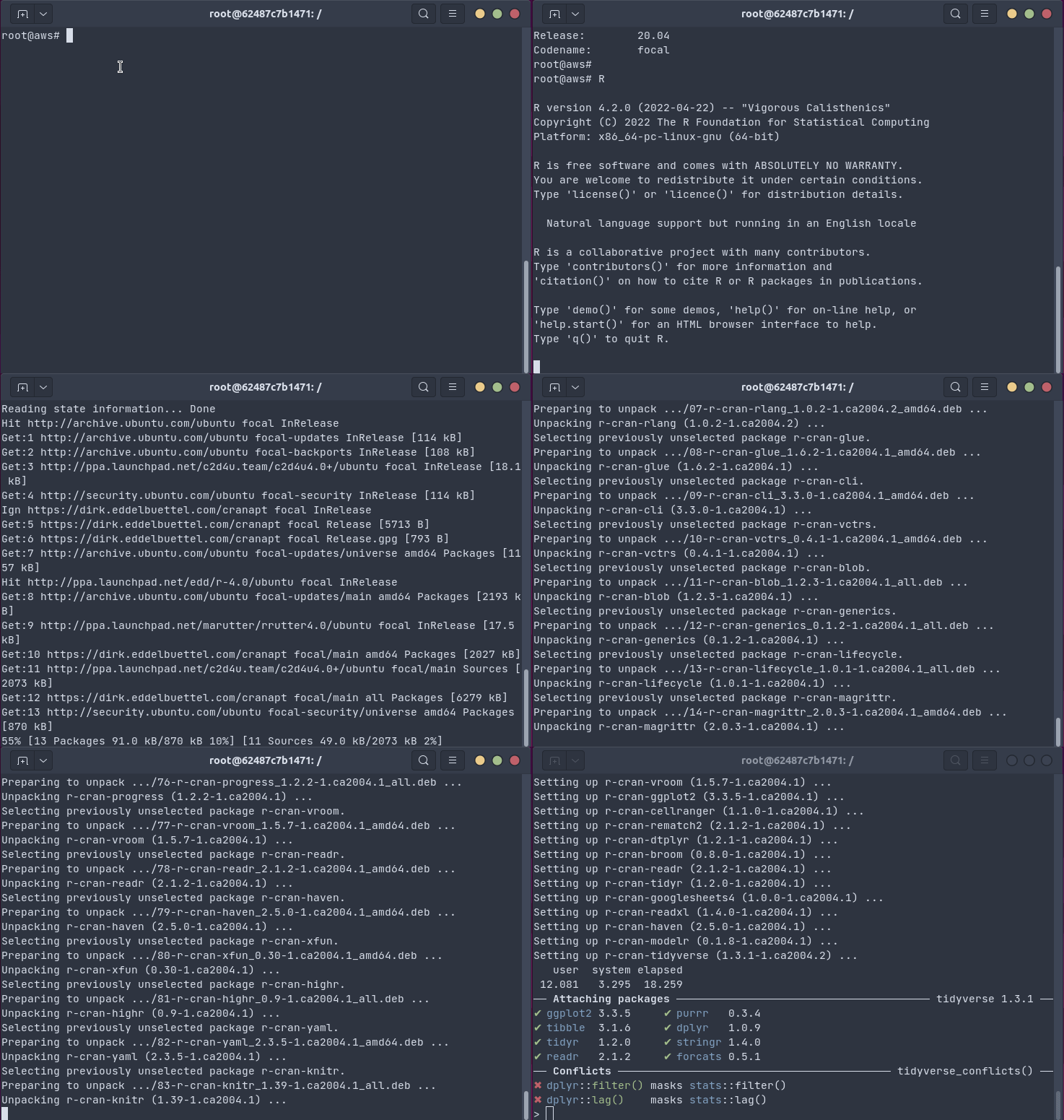
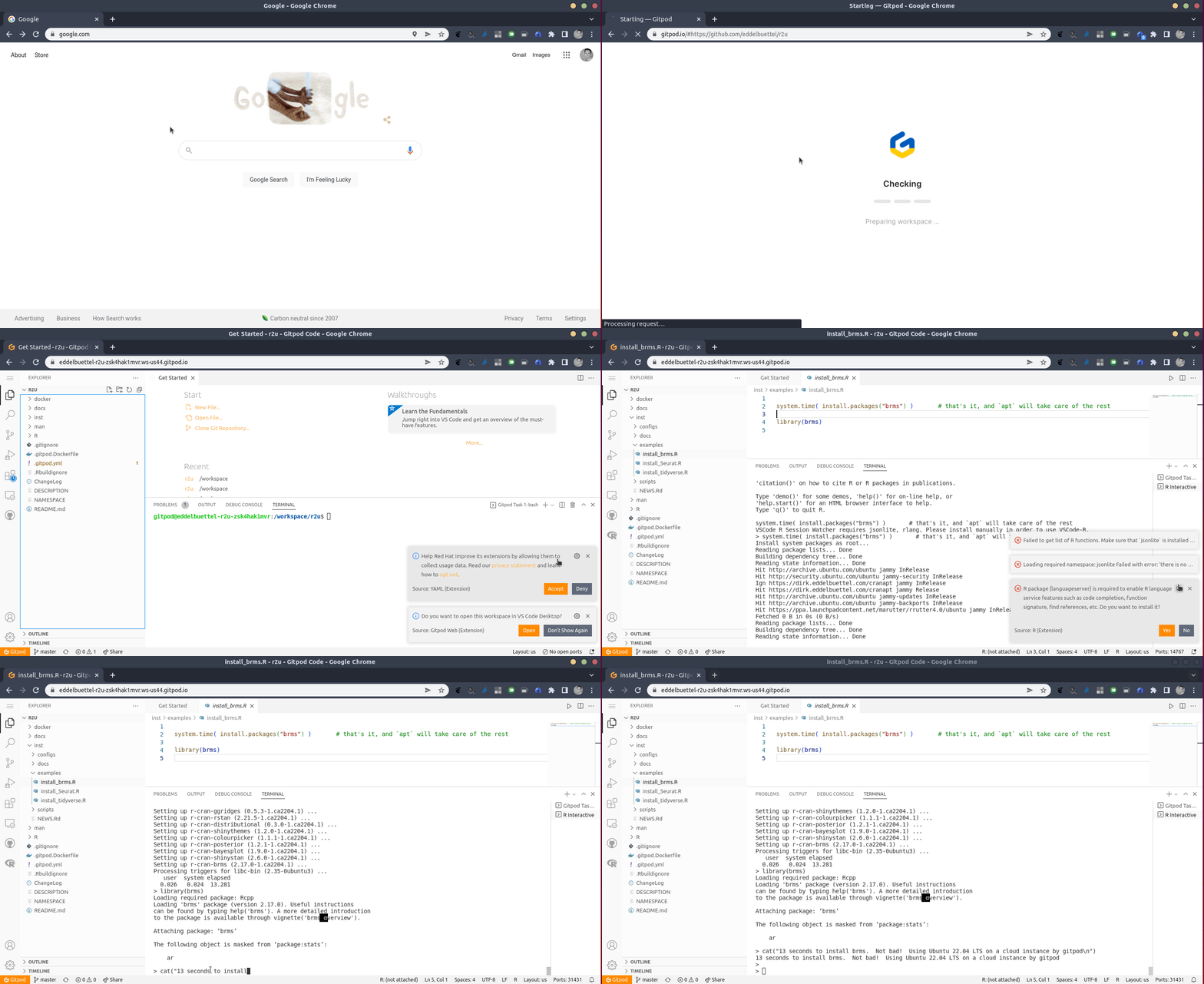
One month ago I started work on a new side project which is now up and running, and deserving on an introductory blog post: r2u. It was announced in two earlier tweets (first, second) which contained the two (wicked) demos below also found at the documentation site. So what is this about? It brings full and complete CRAN installability to Ubuntu LTS, both the focal release 20.04 and the recent jammy release 22.04. It is unique in resolving all R and CRAN packages with the system package manager. So whenever you install something it is guaranteed to run as its dependencies are resolved and co-installed as needed. Equally important, no shared library will be updated or removed by the system as the possible dependency of the R package is known and declared. No other package management system for R does that as only apt on Debian or Ubuntu can and this project integrates all CRAN packages (plus 200+ BioConductor packages). It will work with any Ubuntu installation on laptop, desktop, server, cloud, container, or in WSL2 (but is limited to Intel/AMD chips, sorry Raspberry Pi or M1 laptop). It covers all of CRAN (or nearly 19k packages), all the BioConductor packages depended-upon (currently over 200), and only excludes less than a handful of CRAN packages that cannot be built.

Usage Setup instructions approaches described concisely in the repo README.md and documentation site. It consists of just five (or fewer) simple steps, and scripts are provided too for focal (20.04) and jammy (22.04).

Demos Check out these two demos (also at the r2u site):

Installing the full tidyverse in one command and 18 seconds

Installing brms and its depends in one command and 13 seconds (and show gitpod.io)

Integration via bspm The r2u setup can be used directly with apt (or dpkg or any other frontend to the package management system). Once installed apt update; apt upgrade will take care of new packages. For this to work, all CRAN packages (and all BioConductor packages depended upon) are mapped to names like r-cran-rcpp and r-bioc-s4vectors: an r prefix, the repo, and the package name, all lower-cased. That works but thanks to the wonderful bspm package by I aki car we can do much better. It connects R s own install.packages() and update.packages() to apt. So we can just say (as the demos above show) install.packages("tidyverse") or install.packages("brms") and binaries are installed via apt which is fantastic and it connects R to the system package manager. The setup is really only two lines and described at the r2u site as part of the setup.

History and Motivation Turning CRAN packages into .deb binaries is not a new idea. Albrecht Gebhardt was the first to realize this about twenty years ago (!!) and implemented it with a single Perl script. Next, Albrecht, Stefan Moeller, David Vernazobres and I built on top of this which is described in this useR! 2007 paper. A most excellent generalization and rewrite was provided by Charles Blundell in an superb Google Summer of Code contribution in 2008 which I mentored. Charles and I described it in this talk at useR! 2009. I ran that setup for a while afterwards, but it died via an internal database corruption in 2010 right when I tried to demo it at CRAN headquarters in Vienna. This peaked at, if memory serves, about 5k packages: all of CRAN at the time. Don Armstrong took it one step further in a full reimplemenation which, if I recall correctly, coverd all of CRAN and BioConductor for what may have been 8k or 9k packages. Don had a stronger system (with full RAID-5) but it also died in a crash and was never rebuilt even though he and I could have relied on Debian resources (as all these approaches focused on Debian). During that time, Michael Rutter created a variant that cleverly used an Ubuntu-only setup utilizing Launchpad. This repo is still going strong, used and relied-upon by many, and about 5k packages (per distribution) strong. At one point, a group consisting of Don, Michael, G bor Cs rdi and myself (as lead/PI) had financial support from the RConsortium ISC for a more general re-implementation , but that support was withdrawn when we did not have time to deliver. We should also note other long-standing approaches. Detlef Steuer has been using the openSUSE Build Service to provide nearly all of CRAN for openSUSE for many years. I aki car built a similar system for Fedora described in this blog post. I aki and I also have a arXiv paper describing all this.

Details Please see the the r2u site for all details on using r2u.

Acknowledgements The help of everybody who has worked on this is greatly appreciated. So a huge Thank you! to Albrecht, David, Stefan, Charles, Don, Michael, Detlef, G bor, I aki and whoever I may have omitted. Similarly, thanks to everybody working on R, CRAN, Debian, or Ubuntu it all makes for a superb system. And another big Thank you! goes to my GitHub sponsors whose continued support is greatly appreciated.

This post by Dirk Eddelbuettel originated on his Thinking inside the box blog. Please report excessive re-aggregation in third-party for-profit settings.

18 May 2022

Reproducible Builds: Supporter spotlight: Jan Nieuwenhuizen on Bootstrappable Builds, GNU Mes and GNU Guix

The Reproducible Builds project relies on several projects, supporters and sponsors for financial support, but they are also valued as ambassadors who spread the word about our project and the work that we do. This is the fourth instalment in a series featuring the projects, companies and individuals who support the Reproducible Builds project. We started this series by featuring the Civil Infrastructure Platform project and followed this up with a post about the Ford Foundation as well as a recent ones about ARDC and the Google Open Source Security Team (GOSST). Today, however, we will be talking with Jan Nieuwenhuizen about Bootstrappable Builds, GNU Mes and GNU Guix.
Chris Lamb: Hi Jan, thanks for taking the time to talk with us today. First, could you briefly tell me about yourself? Jan: Thanks for the chat; it s been a while! Well, I ve always been trying to find something new and interesting that is just asking to be created but is mostly being overlooked. That s how I came to work on GNU Guix and create GNU Mes to address the bootstrapping problem that we have in free software. It s also why I have been working on releasing Dezyne, a programming language and set of tools to specify and formally verify concurrent software systems as free software. Briefly summarised, compilers are often written in the language they are compiling. This creates a chicken-and-egg problem which leads users and distributors to rely on opaque, pre-built binaries of those compilers that they use to build newer versions of the compiler. To gain trust in our computing platforms, we need to be able to tell how each part was produced from source, and opaque binaries are a threat to user security and user freedom since they are not auditable. The goal of bootstrappability (and the bootstrappable.org project in particular) is to minimise the amount of these bootstrap binaries. Anyway, after studying Physics at Eindhoven University of Technology (TU/e), I worked for digicash.com, a startup trying to create a digital and anonymous payment system sadly, however, a traditional account-based system won. Separate to this, as there was no software (either free or proprietary) to automatically create beautiful music notation, together with Han-Wen Nienhuys, I created GNU LilyPond. Ten years ago, I took the initiative to co-found a democratic school in Eindhoven based on the principles of sociocracy. And last Christmas I finally went vegan, after being mostly vegetarian for about 20 years!
Chris: For those who have not heard of it before, what is GNU Guix? What are the key differences between Guix and other Linux distributions? Jan: GNU Guix is both a package manager and a full-fledged GNU/Linux distribution. In both forms, it provides state-of-the-art package management features such as transactional upgrades and package roll-backs, hermetical-sealed build environments, unprivileged package management as well as per-user profiles. One obvious difference is that Guix forgoes the usual Filesystem Hierarchy Standard (ie. /usr, /lib, etc.), but there are other significant differences too, such as Guix being scriptable using Guile/Scheme, as well as Guix s dedication and focus on free software.

Chris: How does GNU Guix relate to GNU Mes? Or, rather, what problem is Mes attempting to solve? Jan: GNU Mes was created to address the security concerns that arise from bootstrapping an operating system such as Guix. Even if this process entirely involves free software (i.e. the source code is, at least, available), this commonly uses large and unauditable binary blobs. Mes is a Scheme interpreter written in a simple subset of C and a C compiler written in Scheme, and it comes with a small, bootstrappable C library. Twice, the Mes bootstrap has halved the size of opaque binaries that were needed to bootstrap GNU Guix. These reductions were achieved by first replacing GNU Binutils, GNU GCC and the GNU C Library with Mes, and then replacing Unix utilities such as awk, bash, coreutils, grep sed, etc., by Gash and Gash-Utils. The final goal of Mes is to help create a full-source bootstrap for any interested UNIX-like operating system.
Chris: What is the current status of Mes? Jan: Mes supports all that is needed from R5RS and GNU Guile to run MesCC with Nyacc, the C parser written for Guile, for 32-bit x86 and ARM. The next step for Mes would be more compatible with Guile, e.g., have guile-module support and support running Gash and Gash Utils. In working to create a full-source bootstrap, I have disregarded the kernel and Guix build system for now, but otherwise, all packages should be built from source, and obviously, no binary blobs should go in. We still need a Guile binary to execute some scripts, and it will take at least another one to two years to remove that binary. I m using the 80/20 approach, cutting corners initially to get something working and useful early. Another metric would be how many architectures we have. We are quite a way with ARM, tinycc now works, but there are still problems with GCC and Glibc. RISC-V is coming, too, which could be another metric. Someone has looked into picking up NixOS this summer. How many distros do anything about reproducibility or bootstrappability? The bootstrappability community is so small that we don t need metrics, sadly. The number of bytes of binary seed is a nice metric, but running the whole thing on a full-fledged Linux system is tough to put into a metric. Also, it is worth noting that I m developing on a modern Intel machine (ie. a platform with a management engine), that s another key component that doesn t have metrics.

Chris: From your perspective as a Mes/Guix user and developer, what does reproducibility mean to you? Are there any related projects? Jan: From my perspective, I m more into the problem of bootstrapping, and reproducibility is a prerequisite for bootstrappability. Reproducibility clearly takes a lot of effort to achieve, however. It s relatively easy to install some Linux distribution and be happy, but if you look at communities that really care about security, they are investing in reproducibility and other ways of improving the security of their supply chain. Projects I believe are complementary to Guix and Mes include NixOS, Debian and on the hardware side the RISC-V platform shares many of our core principles and goals.
Chris: Well, what are these principles and goals? Jan: Reproducibility and bootstrappability often feel like the next step in the frontier of free software. If you have all the sources and you can t reproduce a binary, that just doesn t feel right anymore. We should start to desire (and demand) transparent, elegant and auditable software stacks. To a certain extent, that s always been a low-level intent since the beginning of free software, but something clearly got lost along the way. On the other hand, if you look at the NPM or Rust ecosystems, we see a world where people directly install binaries. As they are not as supportive of copyleft as the rest of the free software community, you can see that movement and people in our area are doing more as a response to that so that what we have continues to remain free, and to prevent us from falling asleep and waking up in a couple of years and see, for example, Rust in the Linux kernel and (more importantly) we require big binary blobs to use our systems. It s an excellent time to advance right now, so we should get a foothold in and ensure we don t lose any more.
Chris: What would be your ultimate reproducibility goal? And what would the key steps or milestones be to reach that? Jan: The ultimate goal would be to have a system built with open hardware, with all software on it fully bootstrapped from its source. This bootstrap path should be easy to replicate and straightforward to inspect and audit. All fully reproducible, of course! In essence, we would have solved the supply chain security problem. Our biggest challenge is ignorance. There is much unawareness about the importance of what we are doing. As it is rather technical and doesn t really affect everyday computer use, that is not surprising. This unawareness can be a great force driving us in the opposite direction. Think of Rust being allowed in the Linux kernel, or Python being required to build a recent GNU C library (glibc). Also, the fact that companies like Google/Apple still want to play us vs them , not willing to to support GPL software. Not ready yet to truly support user freedom. Take the infamous log4j bug everyone is using open source these days, but nobody wants to take responsibility and help develop or nurture the community. Not ecosystem , as that s how it s being approached right now: live and let live/die: see what happens without taking any responsibility. We are growing and we are strong and we can do a lot but if we have to work against those powers, it can become problematic. So, let s spread our great message and get more people involved!

Chris: What has been your biggest win? Jan: From a technical point of view, the full-source bootstrap has have been our biggest win. A talk by Carl Dong at the 2019 Breaking Bitcoin conference stated that connecting Jeremiah Orian s Stage0 project to Mes would be the holy grail of bootstrapping, and we recently managed to achieve just that: in other words, starting from hex0, 357-byte binary, we can now build the entire Guix system. This past year we have not made significant visible progress, however, as our funding was unfortunately not there. The Stage0 project has advanced in RISC-V. A month ago, though, I secured NLnet funding for another year, and thanks to NLnet, Ekaitz Zarraga and Timothy Sample will work on GNU Mes and the Guix bootstrap as well. Separate to this, the bootstrappable community has grown a lot from two people it was six years ago: there are now currently over 100 people in the #bootstrappable IRC channel, for example. The enlarged community is possibly an even more important win going forward.
Chris: How realistic is a 100% bootstrappable toolchain? And from someone who has been working in this area for a while, is solving Trusting Trust) actually feasible in reality? Jan: Two answers: Yes and no, it really depends on your definition. One great thing is that the whole Stage0 project can also run on the Knight virtual machine, a hardware platform that was designed, I think, in the 1970s. I believe we can and must do better than we are doing today, and that there s a lot of value in it. The core issue is not the trust; we can probably all trust each other. On the other hand, we don t want to trust each other or even ourselves. I am not, personally, going to inspect my RISC-V laptop, and other people create the hardware and do probably not want to inspect the software. The answer comes back to being conscientious and doing what is right. Inserting GCC as a binary blob is not right. I think we can do better, and that s what I d like to do. The security angle is interesting, but I don t like the paranoid part of that; I like the beauty of what we are creating together and stepwise improving on that.

Chris: Thanks for taking the time to talk to us today. If someone wanted to get in touch or learn more about GNU Guix or Mes, where might someone go? Jan: Sure! First, check out: I m also on Twitter (@janneke_gnu) and on octodon.social (@janneke@octodon.social).
Chris: Thanks for taking the time to talk to us today. Jan: No problem. :)


For more information about the Reproducible Builds project, please see our website at reproducible-builds.org. If you are interested in ensuring the ongoing security of the software that underpins our civilisation and wish to sponsor the Reproducible Builds project, please reach out to the project by emailing contact@reproducible-builds.org.

16 May 2022

Matthew Garrett: Can we fix bearer tokens?

Last month I wrote about how bearer tokens are just awful, and a week later Github announced that someone had managed to exfiltrate bearer tokens from Heroku that gave them access to, well, a lot of Github repositories. This has inevitably resulted in a whole bunch of discussion about a number of things, but people seem to be largely ignoring the fundamental issue that maybe we just shouldn't have magical blobs that grant you access to basically everything even if you've copied them from a legitimate holder to Honest John's Totally Legitimate API Consumer.

To make it clearer what the problem is here, let's use an analogy. You have a safety deposit box. To gain access to it, you simply need to be able to open it with a key you were given. Anyone who turns up with the key can open the box and do whatever they want with the contents. Unfortunately, the key is extremely easy to copy - anyone who is able to get hold of your keyring for a moment is in a position to duplicate it, and then they have access to the box. Wouldn't it be better if something could be done to ensure that whoever showed up with a working key was someone who was actually authorised to have that key?

To achieve that we need some way to verify the identity of the person holding the key. In the physical world we have a range of ways to achieve this, from simply checking whether someone has a piece of ID that associates them with the safety deposit box all the way up to invasive biometric measurements that supposedly verify that they're definitely the same person. But computers don't have passports or fingerprints, so we need another way to identify them.

When you open a browser and try to connect to your bank, the bank's website provides a TLS certificate that lets your browser know that you're talking to your bank instead of someone pretending to be your bank. The spec allows this to be a bi-directional transaction - you can also prove your identity to the remote website. This is referred to as "mutual TLS", or mTLS, and a successful mTLS transaction ends up with both ends knowing who they're talking to, as long as they have a reason to trust the certificate they were presented with.

That's actually a pretty big constraint! We have a reasonable model for the server - it's something that's issued by a trusted third party and it's tied to the DNS name for the server in question. Clients don't tend to have stable DNS identity, and that makes the entire thing sort of awkward. But, thankfully, maybe we don't need to? We don't need the client to be able to prove its identity to arbitrary third party sites here - we just need the client to be able to prove it's a legitimate holder of whichever bearer token it's presenting to that site. And that's a much easier problem.

Here's the simple solution - clients generate a TLS cert. This can be self-signed, because all we want to do here is be able to verify whether the machine talking to us is the same one that had a token issued to it. The client contacts a service that's going to give it a bearer token. The service requests mTLS auth without being picky about the certificate that's presented. The service embeds a hash of that certificate in the token before handing it back to the client. Whenever the client presents that token to any other service, the service ensures that the mTLS cert the client presented matches the hash in the bearer token. Copy the token without copying the mTLS certificate and the token gets rejected. Hurrah hurrah hats for everyone.

Well except for the obvious problem that if you're in a position to exfiltrate the bearer tokens you can probably just steal the client certificates and keys as well, and now you can pretend to be the original client and this is not adding much additional security. Fortunately pretty much everything we care about has the ability to store the private half of an asymmetric key in hardware (TPMs on Linux and Windows systems, the Secure Enclave on Macs and iPhones, either a piece of magical hardware or Trustzone on Android) in a way that avoids anyone being able to just steal the key.

How do we know that the key is actually in hardware? Here's the fun bit - it doesn't matter. If you're issuing a bearer token to a system then you're already asserting that the system is trusted. If the system is lying to you about whether or not the key it's presenting is hardware-backed then you've already lost. If it lied and the system is later compromised then sure all your apes get stolen, but maybe don't run systems that lie and avoid that situation as a result?

Anyway. This is covered in RFC 8705 so why aren't we all doing this already? From the client side, the largest generic issue is that TPMs are astonishingly slow in comparison to doing a TLS handshake on the CPU. RSA signing operations on TPMs can take around half a second, which doesn't sound too bad, except your browser is probably establishing multiple TLS connections to subdomains on the site it's connecting to and performance is going to tank. Fixing this involves doing whatever's necessary to convince the browser to pipe everything over a single TLS connection, and that's just not really where the web is right at the moment. Using EC keys instead helps a lot (~0.1 seconds per signature on modern TPMs), but it's still going to be a bottleneck.

The other problem, of course, is that ecosystem support for hardware-backed certificates is just awful. Windows lets you stick them into the standard platform certificate store, but the docs for this are hidden in a random PDF in a Github repo. Macs require you to do some weird bridging between the Secure Enclave API and the keychain API. Linux? Well, the standard answer is to do PKCS#11, and I have literally never met anybody who likes PKCS#11 and I have spent a bunch of time in standards meetings with the sort of people you might expect to like PKCS#11 and even they don't like it. It turns out that loading a bunch of random C bullshit that has strong feelings about function pointers into your security critical process is not necessarily something that is going to improve your quality of life, so instead you should use something like this and just have enough C to bridge to a language that isn't secretly plotting to kill your pets the moment you turn your back.

And, uh, obviously none of this matters at all unless people actually support it. Github has no support at all for validating the identity of whoever holds a bearer token. Most issuers of bearer tokens have no support for embedding holder identity into the token. This is not good! As of last week, all three of the big cloud providers support virtualised TPMs in their VMs - we should be running CI on systems that can do that, and tying any issued tokens to the VMs that are supposed to be making use of them.

So sure this isn't trivial. But it's also not impossible, and making this stuff work would improve the security of, well, everything. We literally have the technology to prevent attacks like Github suffered. What do we have to do to get people to actually start working on implementing that?

comment count unavailable comments

3 May 2022

Gunnar Wolf: Using a RPi as a display adapter

Almost ten months ago, I mentioned on this blog I bought an ARM laptop, which is now my main machine while away from home a Lenovo Yoga C630 13Q50. Yes, yes, I am still not as much away from home as I used to before, as this pandemic is still somewhat of a thing, but I do move more. My main activity in the outside world with my laptop is teaching. I teach twice a week, and well, having a display for my slides and for showing examples in the terminal and such is a must. However, as I said back in August, one of the hardware support issues for this machine is:
No HDMI support via the USB-C displayport. While I don t expect
to go to conferences or even classes in the next several months,
I hope this can be fixed before I do. It s a potential important
issue for me.
It has sadly not yet been solved While many things have improved since kernel 5.12 (the first I used), the Device Tree does not yet hint at where external video might sit. So, I went to the obvious: Many people carry different kinds of video adaptors I carry a slightly bulky one: A RPi3 For two months already (time flies!), I had an ugly contraption where the RPi3 connected via Ethernet and displayed a VNC client, and my laptop had a VNC server. Oh, but did I mention My laptop works so much better with Wayland than with Xorg that I switched, and am now a happy user of the Sway compositor (a drop-in replacement for the i3 window manager). It is built over WLRoots, which is a great and (relatively) simple project, but will thankfully not carry some of Gnome or KDE s ideas not even those I d rather have. So it took a bit of searching; I was very happy to find WayVNC, a VNC server for wlroot-sbased Wayland compositors. I launched a second Wayland, to be able to have my main session undisturbed and present only a window from it. Only that VNC is slow and laggy, and sometimes awkward. So I kept searching for something better. And something better is, happily, what I was finally able to do! In the laptop, I am using wf-recorder to grab an area of the screen and funnel it into a V4L2 loopback device (which allows it to be used as a camera, solving the main issue with grabbing parts of a Wayland screen):
/usr/bin/wf-recorder -g '0,32 960x540' -t --muxer=v4l2 --codec=rawvideo --pixelformat=yuv420p --file=/dev/video10
(yes, my V4L2Loopback device is set to /dev/video10). You will note I m grabbing a 960 540 rectangle, which is the top of my screen (1920x1080) minus the Waybar. I think I ll increase it to 960 720, as the projector to which I connect the Raspberry has a 4 3 output. After this is sent to /dev/video10, I tell ffmpeg to send it via RTP to the fixed address of the Raspberry:
/usr/bin/ffmpeg -i /dev/video10 -an -f rtp -sdp_file /tmp/video.sdp rtp://10.0.0.100:7000/
Yes, some uglier things happen here. You will note /tmp/video.sdp is created in the laptop itself; this file describes the stream s metadata so it can be used from the client side. I cheated and copied it over to the Raspberry, doing an ugly hardcode along the way:
user@raspi:~ $ cat video.sdp
v=0
o=- 0 0 IN IP4 127.0.0.1
s=No Name
c=IN IP4 10.0.0.100
t=0 0
a=tool:libavformat 58.76.100
m=video 7000 RTP/AVP 96
b=AS:200
a=rtpmap:96 MP4V-ES/90000
a=fmtp:96 profile-level-id=1
People familiar with RTP will scold me: How come I m streaming to the unicast client address? I should do it to an address in the 224.0.0.0 239.0.0.0 range. And it worked, sometimes. I switched over to 10.0.0.100 because it works, basically always Finally, upon bootup, I have configured NoDM to start a session with the user user, and dropped the following in my user s .xsession:
setterm -blank 0 -powersave off -powerdown 0
xset s off
xset -dpms
xset s noblank
mplayer -msglevel all=1 -fs /home/usuario/video.sdp
Anyway, as a result, my students are able to much better follow the pace of my presentation, and I m able to do some tricks better (particularly when it requires quick reaction times, as often happens when dealing with concurrency and such issues). Oh, and of course in case it s of interest to anybody, knowing that SD cards are all but reliable in the long run, I wrote a vmdb2 recipe to build the images. You can grab it here; it requires some local files to be present to be built some are the ones I copied over above, and the other ones are surely of no interest to you (such as my public ssh key or such :-] ) What am I still missing? (read: Can you help me with some ideas? ) Of course, this is a blog post published to brag about my stuff, but also to serve me as persistent memory in case I need to recreate this

29 April 2022

Russ Allbery: Review: Interesting Times

Review: Interesting Times, by Terry Pratchett
Series: Discworld #17
Publisher: Harper
Copyright: 1994
Printing: February 2014
ISBN: 0-06-227629-8
Format: Mass market
Pages: 399
Interesting Times is the seventeenth Discworld novel and certainly not the place to start. At the least, you will probably want to read The Colour of Magic and The Light Fantastic before this book, since it's a sequel to those (although Rincewind has had some intervening adventures). Lord Vetinari has received a message from the Counterweight Continent, the first in ten years, cryptically demanding the Great Wizzard be sent immediately. The Agatean Empire is one of the most powerful states on the Disc. Thankfully for everyone else, it normally suits its rulers to believe that the lands outside their walls are inhabited only by ghosts. No one is inclined to try to change their minds or otherwise draw their attention. Accordingly, the Great Wizard must be sent, a task that Vetinari efficiently delegates to the Archchancellor. There is only the small matter of determining who the Great Wizzard is, and why it was spelled with two z's. Discworld readers with a better memory than I will recall Rincewind's hat. Why the Counterweight Continent would demanding a wizard notorious for his near-total inability to perform magic is a puzzle for other people. Rincewind is promptly located by a magical computer, and nearly as promptly transported across the Disc, swapping him for an unnecessarily exciting object of roughly equivalent mass and hurling him into an unexpected rescue of Cohen the Barbarian. Rincewind predictably reacts by running away, although not fast or far enough to keep him from being entangled in a glorious popular uprising. Or, well, something that has aspirations of being glorious, and popular, and an uprising. I hate to say this, because Pratchett is an ethically thoughtful writer to whom I am willing to give the benefit of many doubts, but this book was kind of racist. The Agatean Empire is modeled after China, and the Rincewind books tend to be the broadest and most obvious parodies, so that was already a recipe for some trouble. Some of the social parody is not too objectionable, albeit not my thing. I find ethnic stereotypes and making fun of funny-sounding names in other languages (like a city named Hunghung) to be in poor taste, but Pratchett makes fun of everyone's names and cultures rather equally. (Also, I admit that some of the water buffalo jokes, despite the stereotypes, were pretty good.) If it had stopped there, it would have prompted some eye-rolling but not much comment. Unfortunately, a significant portion of the plot depends on the idea that the population of the Agatean Empire has been so brainwashed into obedience that they have a hard time even imagining resistance, and even their revolutionaries are so polite that the best they can manage for slogans are things like "Timely Demise to All Enemies!" What they need are a bunch of outsiders, such as Rincewind or Cohen and his gang. More details would be spoilers, but there are several deliberate uses of Ankh-Morpork as a revolutionary inspiration and a great deal of narrative hand-wringing over how awful it is to so completely convince people they are slaves that you don't need chains. There is a depressingly tedious tendency of western writers, even otherwise thoughtful and well-meaning ones like Pratchett, to adopt a simplistic ranking of political systems on a crude measure of freedom. That analysis immediately encounters the problem that lots of people who live within systems that rate poorly on this one-dimensional scale seem inadequately upset about circumstances that are "obviously" horrific oppression. This should raise questions about the validity of the assumptions, but those assumptions are so unquestionable that the writer instead decides the people who are insufficiently upset about their lack of freedom must be defective. The more racist writers attribute that defectiveness to racial characteristics. The less racist writers, like Pratchett, attribute that defectiveness to brainwashing and systemic evil, which is not quite as bad as overt racism but still rests on a foundation of smug cultural superiority. Krister Stendahl, a bishop of the Church of Sweden, coined three famous rules for understanding other religions:
  1. When you are trying to understand another religion, you should ask the adherents of that religion and not its enemies.
  2. Don't compare your best to their worst.
  3. Leave room for "holy envy."
This is excellent advice that should also be applied to politics. Most systems exist for some reason. The differences from your preferred system are easy to see, particularly those that strike you as horrible. But often there are countervailing advantages that are less obvious, and those are more psychologically difficult to understand and objectively analyze. You might find they have something that you wish your system had, which causes discomfort if you're convinced you have the best political system in the world, or are making yourself feel better about the abuses of your local politics by assuring yourself that at least you're better than those people. I was particularly irritated to see this sort of simplistic stereotyping in Discworld given that Ankh-Morpork, the setting of most of the Discworld novels, is an authoritarian dictatorship. Vetinari quite capably maintains his hold on power, and yet this is not taken as a sign that the city's inhabitants have been brainwashed into considering themselves slaves. Instead, he's shown as adept at maintaining the stability of a precarious system with a lot of competing forces and a high potential for destructive chaos. Vetinari is an awful person, but he may be better than anyone who would replace him. Hmm. This sort of complexity is permitted in the "local" city, but as soon as we end up in an analog of China, the rulers are evil, the system lacks any justification, and the peasants only don't revolt because they've been trained to believe they can't. Gah. I was muttering about this all the way through Interesting Times, which is a shame because, outside of the ham-handed political plot, it has some great Pratchett moments. Rincewind's approach to any and all danger is a running (sorry) gag that keeps working, and Cohen and his gang of absurdly competent decrepit barbarians are both funnier here than they have been in any previous book and the rare highly-positive portrayal of old people in fantasy adventures who are not wizards or crones. Pretty Butterfly is a great character who deserved to be in a better plot. And I loved the trouble that Rincewind had with the Agatean tonal language, which is an excuse for Pratchett to write dialog full of frustrated non-sequiturs when Rincewind mispronounces a word. I do have to grumble about the Luggage, though. From a world-building perspective its subplot makes sense, but the Luggage was always the best character in the Rincewind stories, and the way it lost all of its specialness here was oddly sad and depressing. Pratchett also failed to convince me of the drastic retcon of The Colour of Magic and The Light Fantastic that he does here (and which I can't talk about in detail due to spoilers), in part because it's entangled in the orientalism of the plot. I'm not sure Pratchett could write a bad book, and I still enjoyed reading Interesting Times, but I don't think he gave the politics his normal care, attention, and thoughtful humanism. I hope later books in this part of the Disc add more nuance, and are less confident and judgmental. I can't really recommend this one, even though it has some merits. Also, just for the record, "may you live in interesting times" is not a Chinese curse. It's an English saying that likely was attributed to China to make it sound exotic, which is the sort of landmine that good-natured parody of other people's cultures needs to be wary of. Followed in publication order by Maskerade, and in Rincewind's personal timeline by The Last Continent. Rating: 6 out of 10

27 April 2022

Antoine Beaupr : Using LSP in Emacs and Debian

The Language Server Protocol (LSP) is a neat mechanism that provides a common interface to what used to be language-specific lookup mechanisms (like, say, running a Python interpreter in the background to find function definitions). There is also ctags shipped with UNIX since forever, but that doesn't support looking backwards ("who uses this function"), linting, or refactoring. In short, LSP rocks, and how do I use it right now in my editor of choice (Emacs, in my case) and OS (Debian) please?

Editor (emacs) setup First, you need to setup your editor. The Emacs LSP mode has pretty good installation instructions which, for me, currently mean:
apt install elpa-lsp-mode
and this .emacs snippet:
(use-package lsp-mode
  :commands (lsp lsp-deferred)
  :hook ((python-mode go-mode) . lsp-deferred)
  :demand t
  :init
  (setq lsp-keymap-prefix "C-c l")
  ;; TODO: https://emacs-lsp.github.io/lsp-mode/page/performance/
  ;; also note re "native compilation": <+varemara> it's the
  ;; difference between lsp-mode being usable or not, for me
  :config
  (setq lsp-auto-configure t))
(use-package lsp-ui
  :config
  (setq lsp-ui-flycheck-enable t)
  (add-to-list 'lsp-ui-doc-frame-parameters '(no-accept-focus . t))
  (define-key lsp-ui-mode-map [remap xref-find-definitions] #'lsp-ui-peek-find-definitions)
  (define-key lsp-ui-mode-map [remap xref-find-references] #'lsp-ui-peek-find-references))
Note: this configuration might have changed since I wrote this, see my init.el configuration for the most recent config. The main reason for choosing lsp-mode over eglot is that it's in Debian (and eglot is not). (Apparently, eglot has more chance of being upstreamed, "when it's done", but I guess I'll cross that bridge when I get there.) I already had lsp-mode partially setup in Emacs so I only had to do this small tweak to switch and change the prefix key (because s-l or mod is used by my window manager). I also had to pin LSP packages to bookworm here so that it properly detects pylsp (the older version in Debian bullseye only supports pyls, not packaged in Debian). This won't do anything by itself: Emacs will need something to talk with to provide the magic. Those are called "servers" and are basically different programs, for each programming language, that provide the magic.

Servers setup The Emacs package provides a way (M-x lsp-install-server) to install some of them, but I prefer to manage those tools through Debian packages if possible, just like lsp-mode itself. Those are the servers I currently know of in Debian:
package languages
ccls C, C++, ObjectiveC
clangd C, C++, ObjectiveC
elpa-lsp-haskell Haskell
fortran-language-server Fortran
gopls Golang
python3-pyls Python
There might be more such packages, but those are surprisingly hard to find. I found a few with apt search "Language Server Protocol", but that didn't find ccls, for example, because that just said "Language Server" in the description (which also found a few more pyls plugins, e.g. black support). Note that the Python packages, in particular, need to be upgraded to their bookworm releases to work properly (here). It seems like there's some interoperability problems there that I haven't quite figured out yet. See also my Puppet configuration for LSP. Finally, note that I have now completely switched away from Elpy to pyls, and I'm quite happy with the results. lsp-mode feels slower than elpy but I haven't done any of the performance tuning and this will improve even more with native compilation. And lsp-mode is much more powerful. I particularly like the "rename symbol" functionality, which ... mostly works.

Remaining work

Puppet and Ruby I still have to figure how to actually use this: I mostly spend my time in Puppet these days, there is no server listed in the Emacs lsp-mode language list, but there is one listed over at the upstream language list, the puppet-editor-services server. But it's not packaged in Debian, and seems somewhat... involved. It could still be a good productivity boost. The Voxpupuli team have vim install instructions which also suggest installing solargraph, the Ruby language server, also not packaged in Debian.

Bash I guess I do a bit of shell scripting from time to time nowadays, even though I don't like it. So the bash-language-server may prove useful as well.

Other languages Here are more language servers available:

Russ Allbery: Review: Sorceress of Darshiva

Review: Sorceress of Darshiva, by David Eddings
Series: The Malloreon #4
Publisher: Del Rey
Copyright: December 1989
Printing: November 1990
ISBN: 0-345-36935-1
Format: Mass market
Pages: 371
This is the fourth book of the Malloreon, the sequel series to the Belgariad. Eddings as usual helpfully summarizes the plot of previous books (the one thing about his writing that I wish more authors would copy), this time by having various important people around the world briefed on current events. That said, you don't want to start reading here (although you might wish you could). This is such a weird book. One could argue that not much happens in the Belgariad other than map exploration and collecting a party, but the party collection involves meddling in local problems to extract each new party member. It's a bit of a random sequence of events, but things clearly happen. The Malloreon starts off with a similar structure, including an explicit task to create a new party of adventurers to save the world, but most of the party is already gathered at the start of the series since they carry over from the previous series. There is a ton of map exploration, but it's within the territory of the bad guys from the previous series. Rather than local meddling and acquiring new characters, the story is therefore chasing Zandramas (the big bad of the series) and books of prophecy. This could still be an effective plot trigger but for another decision of Eddings that becomes obvious in Demon Lord of Karanda (the third book): the second continent of this world, unlike the Kingdoms of Hats world-building of the Belgariad, is mostly uniform. There are large cities, tons of commercial activity, and a fairly effective and well-run empire, with only a little local variation. In some ways it's a welcome break from Eddings's previous characterization by stereotype, but there isn't much in the way of local happenings for the characters to get entangled in. Even more oddly, this continental empire, which the previous series set up as the mysterious and evil adversaries of the west akin to Sauron's domain in Lord of the Rings, is not mysterious to some of the party at all. Silk, the Drasnian spy who is a major character in both series, has apparently been running a vast trading empire in Mallorea. Not only has he been there before, he has houses and factors and local employees in every major city and keeps being distracted from the plot by his cutthroat capitalist business shenanigans. It's as if the characters ventured into the heart of the evil empire and found themselves in the entirely normal city next door, complete with restaurant recommendations from one of their traveling companions. I think this is an intentional subversion of the normal fantasy plot by Eddings, and I kind of like it. We have met the evil empire, and they're more normal than most of the good guys, and both unaware and entirely uninterested in being the evil empire. But in terms of dramatic plot structure, it is such an odd choice. Combined with the heroes being so absurdly powerful that they have no reason to take most dangers seriously (and indeed do not), it makes this book remarkably anticlimactic and weirdly lacking in drama. And yet I kind of enjoyed reading it? It's oddly quiet and comfortable reading. Nothing bad happens, nor seems very likely to happen. The primary plot tension is Belgarath trying to figure out the plot of the series by tracking down prophecies in which the plot is written down with all of the dramatic tension of an irritated rare book collector. In the middle of the plot, the characters take a detour to investigate an alchemist who is apparently immortal, featuring a university on Melcena that could have come straight out of a Discworld novel, because investigating people who spontaneously discover magic is of arguably equal importance to saving the world. Given how much the plot is both on rails and clearly willing to wait for the protagonists to catch up, it's hard to argue with them. It felt like a side quest in a video game. I continue to find the way that Eddings uses prophecy in this series to be highly amusing, although there aren't nearly enough moments of the prophecy giving Garion stage direction. The basic concept of two competing prophecies that are active characters in the world attempting to create their own sequence of events is one that would support a better series than this one. It's a shame that Zandramas, the main villain, is rather uninteresting despite being female in a highly sexist society, highly competent, a different type of shapeshifter (I won't say more to avoid spoilers for earlier books), and the anchor of the other prophecy. It's good material, but Eddings uses it very poorly, on top of making the weird decision to have her talk like an extra in a Shakespeare play. This book was astonishingly pointless. I think the only significant plot advancement besides map movement is picking up a new party member (who was rather predictable), and the plot is so completely on rails that the characters are commenting about the brand of railroad ties that Eddings used. Ce'Nedra continues to be spectacularly irritating. It's not, by any stretch of the imagination, a good book, and yet for some reason I enjoyed it more than the other books of the series so far. Chalk one up for brain candy when one is in the right mood, I guess. Followed by The Seeress of Kell, the epic (?) conclusion. Rating: 6 out of 10

23 April 2022

Russell Coker: Got Covid

I ve currently got Covid, I believe I caught it on the 11th of April (my first flight since the pandemic started) with a runny nose on the 13th and a positive RAT on the evening of the 14th. I got an official PCR test on the 16th with a positive result returned on the 17th. I think I didn t infect anyone else (yay)! Now I seem mostly OK but still have a lack of energy, sometimes I suddenly feel tired after 20 minutes of computer work. The progression of the disease was very different to previous cold/flu diseases that I have had. What I expect is to start with a cough or runny nose, escalate with more of that, have a day or two of utter misery with congestion, joint pain, headache, etc, then have it suddenly decrease overnight. For Covid I had a runny nose for a couple of days which went away then I got congestion in my throat with serious coughing such that I became unable to speak. Then the coughing went away and I had a really bad headache for a day with almost no other symptoms. Then the headache went away and I was coughing a bit the next day. The symptoms seemed to be moving around my body. I got a new job and they wanted me to fly to the head office to meet the team, I apparently got it on the plane a day before starting work. I ve discussed this with a manager and stated my plan to drive instead of fly in future. It s only a 7 hour drive and it s not worth risking the disease to save 3-4 hours travel time, or even the 5 hours travel I d have saved if the airports were working normally (apparently a lot of airport staff are off sick so there s delays). Given the flight delays and the fact that I was advised to arrive extra early at the airport I ended up taking almost 7 hours for the entire trip! 7 hours driving is a bit of effort, but sitting in an airport waiting for a delayed flight while surrounded by diseased people isn t fun either.

Andrej Shadura: To England by train (part 2)

My attempt to travel to the UK by train last year didn t go quite as well as I expected. As I mentioned in that blog post, the NightJet to Brussels was cancelled, forcing me to fly instead. This disappointed me so much that I actually unpublished the blog post minutes after it was originally put online. The timing was nearly perfect: I type make publish and I get an email from BB saying they don t know if my train is going to run. Of course it didn t, as Deutsche Bahn workers went ahead with their strike. The blog post sat in the drafts for more than half a year until yesterday, when I finally updated and published it. The reason I have finally published it is that I m going to the UK by train once again. Now, unless railways decide to hold a strike again, fully by train both ways. Very expensive, especially compared to the price of Ryanair flights to my destination. Unfortunately, even though Eurostar added more daily services, they re still not cheap, especially on a shorter notice. This seems to apply to the BB s NightJet even more: I tried many routes between Vienna and London, and the cheapest still seemed to be the connection through Brussels. While researching the prices of the tickets, it seems all booking systems decided to stop co-operating. The Trainline refused to let me look up any trains at all, even with all tracking and advertisement allowed, SNCF kepts showing me overly generic errors (Sorry, an error has occurred.), while the GWR booking system kept crashing with a 500 Internal Server Error for about two hours.
Error messages at the websites of Trainline, GWR and SNCFTrainline, GWR and SNCF kept crashing
Eventually, having spent a lot of time and money, I ve booked my trains to, within and back from England. This time, Cambridge is among the destinations.
The map of the train route from Bratislava to Cambridge through Brussels and London The complete route
Date Station Arrival Departure Train
26.4 Bratislava hl.st. 18:37 REX 2529
Wien Hbf 19:44 20:13 NJ 40490
27.4 Bruxelles-Midi 9:54 15:56 EST 9145
London St Pancras 17:01 17:43 ThamesLink
Cambridge 18:43
I m not sure about it yet, but I may end up taking an earlier train from Bratislava just to ensure there s enough time for the change in Vienna; similarly, I m not sure how much time I will be spending at St Pancras, so I may take one of the later trains. P.S. The maps in this and other posts were created using uMap; the map data come from OpenStreetMap. The train route visualisation was generated with help of signal.eu.org.

22 April 2022

Andrej Shadura: To England by train (part 1)

This post was written in August 2021. Just as I was going to publish it, I received an email from BB stating that due to a railway strike in Germany my night train would be cancelled. Since the rest of the trip has already been booked well in advance, I had to take a plane to Charleroi and a bus to Brussels to catch my Eurostar. Ultimately, I ended up publishing it in April 2022, just as I m about to leave for a fully train-powered trip to the UK once again. Before the pandemic started, I planned to use the last months of my then-expiring UK visa and go to England by train. I ve completed two train long journeys by that time already, to Brussels and to Belarus and Ukraine, but this would be something quite different, as I wanted to have multiple stops on my way, use night trains where it made sense, and to go through the Channel Tunnel. The Channel Tunnel fascinated me since my childhood; I first read about it in the Soviet Science and Life magazine ( ) when I was seven. I ve never had the chance to use it though, since to board any train going though it I d first need to get to France, Belgium or the Netherlands, making it significantly more expensive than the cheap 30 Ryanair flights to Stansted. As the coronavirus spread across the world, all of my travel plans along with plans for a sabbatical had to be cancelled. During 2020, I only managed to go on two weekend trips to Prague and Budapest, followed by a two-weeks holiday on Crete (we returned just a couple of weeks before the infection numbers rose and lockdowns started). I do realise that a lot of people couldn t even have this much because the situation in their countries was much worse we were lucky to have had at least some travel. Fast forward to August 2021, I m fully vaccinated, I once again have a UK visa for five years, and the UK finally recognises the EU vaccination passports yay! I can finally go to Devon to see my mother and sister again. By train, of course. Compared to my original plan, this journey will be different: about the same or even more expensive than I originally planned, but shorter and with fewer stops on the way. My original plan would be to take multiple trains from Bratislava to France or Belgium and complete this segment of the trip in about three days, enjoying my stay in a couple of cities on the way. Instead, I m taking a direct NightJet from Vienna to Brussels, not stopping anywhere on the way.
Map: train route from Bratislava to BrusselsTrain route from Bratislava to Brussels
Since I was booking my trip just two weeks ahead, the price of the ticket is not that I hoped for, but much higher: 109 for the ticket itself and 60 for the berth (advance bookings could be about twice as cheap). Next, to London! Eurostar is still on a very much reduced schedule, running one train only from Amsterdam through Brussels and Lille to London each day. This means, of course, higher ticket prices (I paid about 100 for the ticket) and longer waiting time in Brussels my sleeper arrives about 10 am, but the Eurostar train is scheduled to depart at 3 pm.
Map: train route from Brussels to LondonTrain route from Brussels to London
The train makes a stop in Lille, which I initially suspected to be risky as at the time when I booked my tickets, as at the time France was on the amber plus list for the UK, requiring a quarantine upon arrival. However, Eurostar announced that they will assign travellers from Lille to a different carriage to avoid other passengers having to go to quarantine, but recently France was taken off the amber plus list. The train fare system in the UK is something I don t quite understand, as sometimes split tickets are cheaper, sometimes they re expensive, sometimes prices for the same service at different times can be vastly different, off-peak tickets don t say what exactly off-peak means (very few people in the UK are asked were able to tell me when exactly off-peak hours are). Curiously, transfers between train stations using London Underground services can be included into railway tickets, but some last mile connection like Exeter to Honiton cannot (but this used to be possible). Both GWR.com and TrainLine refused to sell me a single ticket from London to Honiton through Exeter, insisting I split the ticket at Exeter St Davids or take the slower South Western train to Honiton via Salisbury and Yeovil. I ended up buying a 57 ticket from Paddington to Exeter St Davids with the first segment being the London Underground from St Pancras, and a separate 7.70 ticket to Honiton.
Map: arrival at St Pancras, the underground, departure from PaddingtonChange of trains in London
Map: arrival at Exeter St Davids, change to a South Western train, arrival at HonitonChange of trains in Exeter
Date Station Arrival Departure Train
12.8 Bratislava-Petr alka 18:15 REX 7756
Wien Hbf 19:15 19:53 NJ 50490
13.8 Bruxelles-Midi 9:55 15:06 EST 9145
London St Pancras 16:03 16:34 TfL
London Paddington 16:49 17:04 GWR 59231
Exeter St Davids 19:19 19:25 SWR 52706
Honiton 19:54
Unfortunately, due to the price of the tickets, I m taking a 15 Ryanair flight back Update after the journey Since I flew to Charleroi instead of comfortably sleeping in a night train, I had to put up with inconveniences of airports, including cumbersome connections to the nearby cities. The only reasonable way of getting from Charleroi to Brussels is an overcrowded bus which takes almost an hour to arrive. I used to take this bus when I tried to save money on my way to FOSDEM, and I must admit it s not something I missed. Boarding the Eurostar train went fine, my vaccination passport and Covid test wasn t really checked, just glanced at. The waiting room was a bit of a disappointment, with bars closed and vending machines broken. Since it was underground, I couldn t even see the trains until the very last moment when we were finally allowed on the platform. The train itself, while comfortable, disappointed me with the bistro carriage: standing only, instant coffee, poor selection of food and drinks. I m glad I bought some food at Carrefour at the Midi station! When I arrived in Exeter, I soon found out why the system refused to sell me a through ticket: 6 minutes is not enough to change trains at Exeter St Davids! Or, it might have been if I took the right footbridge but I took the one which led into a very talkative (and slow!) lift. I ended up running to the train just as it closed the doors and departed, leaving me tin Exeter for an hour until. I used this chance and walked to Exeter Central, and had a pint in a conveniently located pub around the corner. P.S. The maps in this and other posts were created using uMap; the map data come from OpenStreetMap. The train route visualisation was generated with help of the Raildar.fr OSRM instance.

Ritesh Raj Sarraf: Systemd Service Hang

Finally, TIL, what can all be the reason for systemd services to hang indefinitely. The internet is flooded with numerous reports on this topic but no clear answers. So no more uselessly marked workarounds like: systemctl daemon-reload and systemctl-daemon-reexec for this scenario. The scene would be something along the lines of:
rrs         6467  0.0  0.0  23088 15852 pts/1    Ss   12:53   0:00          \_ /bin/bash
rrs        11512  0.0  0.0  14876  4608 pts/1    S+   13:18   0:00              \_ systemctl restart snapper-timeline.timer
rrs        11513  0.0  0.0  14984  3076 pts/1    S+   13:18   0:00                  \_ /bin/systemd-tty-ask-password-agent --watch
rrs        11514  0.0  0.0 234756  6752 pts/1    Sl+  13:18   0:00                  \_ /usr/bin/pkttyagent --notify-fd 5 --fallback
The snapper-timeline service is important to me and it not running for months is a complete failure. Disappointingly, commands like systemctl --failed do not report of this oddity. The overall system status is reported to be fine, which is completely incorrect. Thankfully, a kind soul s comment gave the hint. The problem is that you could be having certain services in Activating status, which thus blocks all other services; quietly. So much for the unnecessary fun. Looking further, in my case, it was:
rrs@priyasi:~$ systemctl list-jobs 
JOB  UNIT                           TYPE  STATE  
81   timers.target                  start waiting
85   man-db.timer                   start waiting
88   fstrim.timer                   start waiting
3832 snapper-timeline.service       start waiting
83   snapper-timeline.timer         start waiting
39   systemd-time-wait-sync.service start running
87   logrotate.timer                start waiting
84   debspawn-clear-caches.timer    start waiting
89   plocate-updatedb.timer         start waiting
91   dpkg-db-backup.timer           start waiting
93   e2scrub_all.timer              start waiting
40   time-sync.target               start waiting
86   apt-listbugs.timer             start waiting

13 jobs listed.
13:12                      
That was it. I knew the systemd-timesyncd service, in the past, had given me enough headaches. And so was it this time, just quietly doing it all again.
rrs@priyasi:~$ systemctl status systemd-time-wait-sync.service
  systemd-time-wait-sync.service - Wait Until Kernel Time Synchronized
     Loaded: loaded (/lib/systemd/system/systemd-time-wait-sync.service; enabled; vendor preset>
     Active: activating (start) since Fri 2022-04-22 13:14:25 IST; 1min 38s ago
       Docs: man:systemd-time-wait-sync.service(8)
   Main PID: 11090 (systemd-time-wa)
      Tasks: 1 (limit: 37051)
     Memory: 836.0K
        CPU: 7ms
     CGroup: /system.slice/systemd-time-wait-sync.service
              11090 /lib/systemd/systemd-time-wait-sync

Apr 22 13:14:25 priyasi systemd[1]: Starting Wait Until Kernel Time Synchronized...
Apr 22 13:14:25 priyasi systemd-time-wait-sync[11090]: adjtime state 5 status 40 time Fri 2022->
13:16                   => 3  
Dear LazyWeb, anybody knows of why the systemd-time-wait-sync service would hang indefinitely? I ve had identical setups on many machines, in the same network, where others don t exhibit this problem.
rrs@priyasi:~$ systemctl cat systemd-time-wait-sync.service

...snipped...

[Service]
Type=oneshot
ExecStart=/lib/systemd/systemd-time-wait-sync
TimeoutStartSec=infinity
RemainAfterExit=yes

[Install]
WantedBy=sysinit.target
The TimeoutStartSec=infinity is definitely an attribute that shouldn t be shipped in any system services. There are use cases for it but that should be left for local admins to explicitly decide. Hanging for infinity is not a desired behavior for a system service. In figuring all this out, today I learnt the handy systemctl list-jobs command, which will give the list of active running/blocked/waiting jobs.

19 April 2022

Steve McIntyre: Firmware - what are we going to do about it?

TL;DR: firmware support in Debian sucks, and we need to change this. See the "My preference, and rationale" Section below. In my opinion, the way we deal with (non-free) firmware in Debian is a mess, and this is hurting many of our users daily. For a long time we've been pretending that supporting and including (non-free) firmware on Debian systems is not necessary. We don't want to have to provide (non-free) firmware to our users, and in an ideal world we wouldn't need to. However, it's very clearly no longer a sensible path when trying to support lots of common current hardware. Background - why has (non-free) firmware become an issue? Firmware is the low-level software that's designed to make hardware devices work. Firmware is tightly coupled to the hardware, exposing its features, providing higher-level functionality and interfaces for other software to use. For a variety of reasons, it's typically not Free Software. For Debian's purposes, we typically separate firmware from software by considering where the code executes (does it run on a separate processor? Is it visible to the host OS?) but it can be difficult to define a single reliable dividing line here. Consider the Intel/AMD CPU microcode packages, or the U-Boot firmware packages as examples. In times past, all necessary firmware would normally be included directly in devices / expansion cards by their vendors. Over time, however, it has become more and more attractive (and therefore more common) for device manufacturers to not include complete firmware on all devices. Instead, some devices just embed a very simple set of firmware that allows for upload of a more complete firmware "blob" into memory. Device drivers are then expected to provide that blob during device initialisation. There are a couple of key drivers for this change: Due to these reasons, more and more devices in a typical computer now need firmware to be uploaded at runtime for them to function correctly. This has grown: At the beginning of this timeline, a typical Debian user would be able to use almost all of their computer's hardware without needing any firmware blobs. It might have been inconvenient to not be able to use the WiFi, but most laptops had wired ethernet anyway. The WiFi could always be enabled and configured after installation. Today, a user with a new laptop from most vendors will struggle to use it at all with our firmware-free Debian installation media. Modern laptops normally don't come with wired ethernet now. There won't be any usable graphics on the laptop's screen. A visually-impaired user won't get any audio prompts. These experiences are not acceptable, by any measure. There are new computers still available for purchase today which don't need firmware to be uploaded, but they are growing less and less common. Current state of firmware in Debian For clarity: obviously not all devices need extra firmware uploading like this. There are many devices that depend on firmware for operation, but we never have to think about them in normal circumstances. The code is not likely to be Free Software, but it's not something that we in Debian must spend our time on as we're not distributing that code ourselves. Our problems come when our user needs extra firmware to make their computer work, and they need/expect us to provide it. We have a small set of Free firmware binaries included in Debian main, and these are included on our installation and live media. This is great - we all love Free Software and this works. However, there are many more firmware binaries that are not Free. If we are legally able to redistribute those binaries, we package them up and include them in the non-free section of the archive. As Free Software developers, we don't like providing or supporting non-free software for our users, but we acknowledge that it's sometimes a necessary thing for them. This tension is acknowledged in the Debian Free Software Guidelines. This tension extends to our installation and live media. As non-free is officially not considered part of Debian, our official media cannot include anything from non-free. This has been a deliberate policy for many years. Instead, we have for some time been building a limited parallel set of "unofficial non-free" images which include non-free firmware. These non-free images are produced by the same software that we use for the official images, and by the same team. There are a number of issues here that make developers and users unhappy:
  1. Building, testing and publishing two sets of images takes more effort.
  2. We don't really want to be providing non-free images at all, from a philosophy point of view. So we mainly promote and advertise the preferred official free images. That can be a cause of confusion for users. We do link to the non-free images in various places, but they're not so easy to find.
  3. Using non-free installation media will cause more installations to use non-free software by default. That's not a great story for us, and we may end up with more of our users using non-free software and believing that it's all part of Debian.
  4. A number of users and developers complain that we're wasting their time by publishing official images that are just not useful for a lot (a majority?) of users.
We should do better than this. Options The status quo is a mess, and I believe we can and should do things differently. I see several possible options that the images team can choose from here. However, several of these options could undermine the principles of Debian. We don't want to make fundamental changes like that without the clear backing of the wider project. That's why I'm writing this...
  1. Keep the existing setup. It's horrible, but maybe it's the best we can do? (I hope not!)
  2. We could just stop providing the non-free unofficial images altogether. That's not really a promising route to follow - we'd be making it even harder for users to install our software. While ideologically pure, it's not going to advance the cause of Free Software.
  3. We could stop pretending that the non-free images are unofficial, and maybe move them alongside the normal free images so they're published together. This would make them easier to find for people that need them, but is likely to cause users to question why we still make any images without firmware if they're otherwise identical.
  4. The images team technically could simply include non-free into the official images, and add firmware packages to the input lists for those images. However, that would still leave us with problem 3 from above (non-free generally enabled on most installations).
  5. We could split out the non-free firmware packages into a new non-free-firmware component in the archive, and allow a specific exception only to allow inclusion of those packages on our official media. We would then generate only one set of official media, including those non-free firmware packages. (We've already seen various suggestions in recent years to split up the non-free component of the archive like this, for example into non-free-firmware, non-free-doc, non-free-drivers, etc. Disagreement (bike-shedding?) about the split caused us to not make any progress on this. I believe this project should be picked up and completed. We don't have to make a perfect solution here immediately, just something that works well enough for our needs today. We can always tweak and improve the setup incrementally if that's needed.)
These are the most likely possible options, in my opinion. If you have a better suggestion, please let us know! I'd like to take this set of options to a GR, and do it soon. I want to get a clear decision from the wider Debian project as to how to organise firmware and installation images. If we do end up changing how we do things, I want a clear mandate from the project to do that. My preference, and rationale Mainly, I want to see how the project as a whole feels here - this is a big issue that we're overdue solving. What would I choose to do? My personal preference would be to go with option 5: split the non-free firmware into a special new component and include that on official media. Does that make me a sellout? I don't think so. I've been passionately supporting and developing Free Software for more than half my life. My philosophy here has not changed. However, this is a complex and nuanced situation. I firmly believe that sharing software freedom with our users comes with a responsibility to also make our software useful. If users can't easily install and use Debian, that helps nobody. By splitting things out here, we would enable users to install and use Debian on their hardware, without promoting/pushing higher-level non-free software in general. I think that's a reasonable compromise. This is simply a change to recognise that hardware requirements have moved on over the years. Further work If we do go with the changes in option 5, there are other things we could do here for better control of and information about non-free firmware:
  1. Along with adding non-free firmware onto media, when the installer (or live image) runs, we should make it clear exactly which firmware packages have been used/installed to support detected hardware. We could link to docs about each, and maybe also to projects working on Free re-implementations.
  2. Add an option at boot to explicitly disable the use of the non-free firmware packages, so that users can choose to avoid them.
Acknowledgements Thanks to people who reviewed earlier versions of this document and/or made suggestions for improvement, in particular:

16 April 2022

Petter Reinholdtsen: Playing and encoding AV1 in Debian Bullseye

Inspired by the recent news of AV1 hardware encoding support from Intel, I decided to look into the state of AV1 on Linux today. AV1 is a free and open standard as defined by Digistan without any royalty payment requirement, unlike its much used competitor encoding H.264. While looking, I came across an 5 year old question on askubuntu.com which in turn inspired me to check out how things are in Debian Stable regarding AV1. The test file listed in the question (askubuntu_test_aom.mp4) did not exist any more, so I tracked down a different set of test files on av1.webmfiles.org to test them with the various video tools I had installed on my machine. I was happy to discover that AV1 decoding and playback worked with almost every tool I tested:
mediainfo ok
dragonplayer ok
ffmpeg / ffplay ok
gnome-mplayer fail
mplayer ok
mpv ok
parole ok
vlc ok
firefox ok
chromium ok
AV1 encoding is available in Debian Stable from the aom-tools version 1.0.0.errata1-3 package, using the aomenc tool. The encoding using the package in Debian Stable is quite slow, with the frame rate for my 10 second test video at around 0.25 fps. My 10 second video test took 16 minutes and 11 seconds on my test machine. I tested by first running ffmpeg and then aomenc using the recipe provided by the askubuntu recipe above. I had to remove the '--row-mt=1' option, as it was not supported in my 1.0.0 version. The encoding only used a single thread, according to top.
ffmpeg -i some-old-video.ogv -t 10 -pix_fmt yuv420p video.y4m
aomenc --fps=24/1 -u 0 --codec=av1 --target-bitrate=1000 \
  --lag-in-frames=25 --auto-alt-ref=1 -t 24 --cpu-used=8 \
  --tile-columns=2 --tile-rows=2 -o output.webm video.y4m
As version 1.0.0 currently have several unsolved security issues in Debian Stable, and to see if the recent backport provided in Debian is any quicker, I ran apt -t bullseye-backports install aom-tools to fetch the backported version and re-encoded the video using the latest version. This time the '--row-mt=1' option worked, and the encoding was done in 46 seconds with a frame rate of around 5.22 fps. This time it seem to be using all my four cores to encode. Encoding speed is still too low for streaming and real time, which would require frame rates above 25 fps, but might be good enough for offline encoding. I am very happy to see AV1 playback working so well with the default tools in Debian Stable. I hope the encoding situation improve too, allowing even a slow old computer like my 10 year old laptop to be used for encoding. As usual, if you use Bitcoin and want to show your support of my activities, please send Bitcoin donations to my address 15oWEoG9dUPovwmUL9KWAnYRtNJEkP1u1b.

1 April 2022

Russ Allbery: Review: Princess Floralinda and the Forty-Flight Tower

Review: Princess Floralinda and the Forty-Flight Tower, by Tamsyn Muir
Publisher: Subterranean Press
Copyright: 2020
ISBN: 1-59606-992-9
Format: Kindle
Pages: 111
A witch put Princess Floralinda at the top of a forty-flight tower, but it wasn't personal. This is just what witches do, particularly with princesses with butter-coloured curls and sapphire-blue eyes. Princes would come from miles around to battle up the floors of the tower and rescue the princess. The witch even helpfully provided a golden sword, in case a prince didn't care that much about princesses. Floralinda was provided with water and milk, two loaves of bread, and an orange, all of them magically renewing, to sustain her while she waited. In retrospect, the dragon with diamond-encrusted scales on the first floor may have been a mistake. None of the princely endeavors ever saw the second floor. The diary that Floralinda found in her room indicated that she may not be the first princess to have failed to be rescued from this tower. Floralinda finally reaches the rather astonishing conclusion that she might have to venture down the tower herself, despite the goblins she was warned were on the 39th floor (not to mention all the other monsters). The result of that short adventure, after some fast thinking, a great deal of luck, and an unforeseen assist from her magical food, is a surprising number of dead goblins. Also seriously infected hand wounds, because it wouldn't be a Tamsyn Muir story without wasting illness and body horror. That probably would have been the end of Floralinda, except a storm blew a bottom-of-the-garden fairy in through the window, sufficiently injured that she and Floralinda were stuck with each other, at least temporarily. Cobweb, the fairy, is neither kind nor inclined to help Floralinda (particularly given that Floralinda is not a child whose mother is currently in hospital), but it is an amateur chemist and finds both Floralinda's tears and magical food intriguing. Cobweb's magic is also based on wishes, and after a few failed attempts, Floralinda manages to make a wish that takes hold. Whether she'll regret the results is another question. This is a fairly short novella by the same author as Gideon the Ninth, but it's in a different universe and quite different in tone. This summary doesn't capture the writing style, which is a hard-to-describe mix of fairy tale, children's story, and slightly archaic and long-winded sentence construction. This is probably easier to show with a quote:
"You are displaying a very small-minded attitude," said the fairy, who seemed genuinely grieved by this. "Consider the orange-peel, which by itself has many very nice properties. Now, if you had a more educated brain (I cannot consider myself educated; I have only attempted to better my situation) you would have immediately said, 'Why, if I had some liquor, or even very hot water, I could extract some oil from this orange-peel, which as everyone knows is antibacterial; that may well do my hands some good,' and you wouldn't be in such a stupid predicament."
On balance, I think this style worked. It occasionally annoyed me, but it has some charm. About halfway through, I was finding the story lightly entertaining, although I would have preferred a bit less grime, illness, and physical injury. Unfortunately, the rest of the story didn't work for me. The dynamic between Floralinda and Cobweb turns into a sort of D&D progression through monster fights, and while there are some creative twists to those fights, they become all of a sameness. And while I won't spoil the ending, it didn't work for me. I think I see what Muir was trying to do, and I have some intellectual appreciation for the idea, but it wasn't emotionally satisfying. I think my root problem with this story is that Muir sets up a rather interesting world, one in which witches artistically imprison princesses, and particularly bright princesses (with the help of amateur chemist fairies) can use the trappings of a magical tower in ways the witch never intended. I liked that; it has a lot of potential. But I didn't feel like that potential went anywhere satisfying. There is some relationship and characterization work, and it reached some resolution, but it didn't go as far as I wanted. And, most significantly, I found the end point the characters reached in relation to the world to be deeply unsatisfying and vaguely irritating. I wanted to like this more than I did. I think there's a story idea in here that I would have enjoyed more. Unfortunately, it's not the one that Muir wrote, and since so much of my problem is with the ending, I can't provide much guidance on whether someone else would like this story better (and why). But if the idea of taking apart a fairy-tale tower and repurposing the pieces sounds appealing, and if you get along better with Muir's illness motif than I do, you may enjoy this more than I did. Rating: 5 out of 10

27 March 2022

Russ Allbery: Review: A Song for a New Day

Review: A Song for a New Day, by Sarah Pinsker
Publisher: Berkley
Copyright: September 2019
ISBN: 1-9848-0259-3
Format: Kindle
Pages: 372
Luce Cannon was touring with a session band when the shutdown began. First came the hotel evacuation in the middle of the night due to bomb threats against every hotel in the state. Then came the stadium bombing just before they were ready to go on stage. Luce and most of the band performed anyway, with a volunteer crew and a shaken crowd. It was, people later decided, the last large stage show in the United States before the congregation laws shut down public gatherings. That was the end of Luce's expected career, and could have been the end of music, or at least public music. But Luce was stubborn and needed the music. Rosemary grew up in the aftermath: living at home with her parents well away from other people, attending school virtually, and then moving seamlessly into a virtual job for Superwally, the corporation that ran essentially everything. A good fix for some last-minute technical problems with StageHoloLive's ticketing system got her an upgraded VR hoodie and complimentary tickets to the first virtual concert she'd ever attended. She found the experience astonishing, prompting her to browse StageHoloLive job openings and then apply for a technical job and, on a whim, an artist recruiter role. That's how Rosemary found herself, quite nerve-wrackingly, traveling out into the unsafe world to look for underground musicians who could become StageHoloLive acts. A Song for a New Day was published in 2019 and had a moment of fame at the beginning of 2020, culminating in the Nebula Award for best novel, because it's about lockdowns, isolation, and the suppression of public performances. There's even a pandemic, although it's not a respiratory disease (it's some variety of smallpox or chicken pox) and is only a minor contributing factor to the lockdowns in this book. The primary impetus is random violence. Unfortunately, the subsequent two years have not been kind to this novel. Reading it in 2022, with the experience of the past two years fresh in my mind, was a frustrating and exasperating experience because the world setting is completely unbelievable. This is not entirely Pinsker's fault; this book was published in 2019, was not intended to be about our pandemic, and therefore could not reasonably predict its consequences. Still, it required significant effort to extract the premise of the book from the contradictory evidence of current affairs and salvage the pieces of it I still enjoyed. First, Pinsker's characters are the most astonishingly incurious and docile group of people I've seen in a recent political SF novel. This extends beyond the protagonists, where it could arguably be part of their characterization, to encompass the entire world (or at least the United States; the rest of the world does not appear in this book at all so far as I can recall). You may be wondering why someone bombs a stadium at the start of the book. If so, you are alone; this is not something anyone else sees any reason to be curious about. Why is random violence spiraling out of control? Is there some coordinated terrorist activity? Is there some social condition that has gotten markedly worse? Race riots? Climate crises? Wars? The only answer this book offers is a completely apathetic shrug. There is a hint at one point that the government may have theories that they're not communicating, but no one cares about that either. That leads to the second bizarre gap: for a book that hinges on political action, formal political structures are weirdly absent. Near the end of the book, one random person says that they have been inspired to run for office, which so far as I can tell is the first mention of elections in the entire book. The "government" passes congregation laws shutting down public gatherings and there are no protests, no arguments, no debate, but also no suppression, no laws against the press or free speech, no attempt to stop that debate. There's no attempt to build consensus for or against the laws, and no noticeable political campaigning. That's because there's no need. So far as one can tell from this story, literally everyone just shrugs and feels sad and vaguely compliant. Police officers exist and enforce laws, but changing those laws or defying them in other than tiny covert ways simply never occurs to anyone. This makes the book read a bit like a fatuous libertarian parody of a docile populace, but this is so obviously not the author's intent that it wouldn't be satisfying to read even as that. To be clear, this is not something that lasts only a few months in an emergency when everyone is still scared. This complete political docility and total incuriosity persists for enough years that Rosemary grows up within that mindset. The triggering event was a stadium bombing followed by an escalating series of random shootings and bombings. (The pandemic in the book only happens after everything is locked down and, apart from adding to Rosemary's agoraphobia and making people inconsistently obsessed with surface cleanliness, plays little role in the novel.) I lived through 9/11 and the Oklahoma City bombing in the US, other countries have been through more protracted and personally dangerous periods of violence (the Troubles come to mind), and never in human history has any country reacted to a shock of violence (or, for that matter, disease) like the US does in this book. At points it felt like one of those SF novels where the author is telling an apparently normal story and all the characters turn out to be aliens based on spiders or bats. I finally made sense of this by deciding that the author wasn't using sudden shocks like terrorism or pandemics as a model, even though that's what the book postulates. Instead, the model seems to be something implicitly tolerated and worked around: US school shootings, for instance, or the (incorrect but widespread) US belief in a rise of child kidnappings by strangers. The societal reaction here looks less like a public health or counter-terrorism response and more like suburban attitudes towards child-raising, where no child is ever left unattended for safety reasons but we routinely have school shootings no other country has at the same scale. We have been willing to radically (and ineffectually) alter the experience of childhood due to fears of external threat, and that's vaguely and superficially similar to the premise of this novel. What I think Pinsker still misses (and which the pandemic has made glaringly obvious) is the immense momentum of normality and the inability of adults to accept limitations on their own activities for very long. Even with school shootings, kids go to school in person. We now know that parts of society essentially collapse if they don't, and political pressure becomes intolerable. But by using school shootings as the model, I managed to view Pinsker's setup as an unrealistic but still potentially interesting SF extrapolation: a thought experiment that ignores countervailing pressures in order to exaggerate one aspect of society to an extreme. This is half of Pinsker's setup. The other half, which made less of a splash because it didn't have the same accident of timing, is the company Superwally: essentially "what if Amazon bought Walmart, Google, Facebook, Netflix, Disney, and Live Nation." This is a more typical SF extrapolation that left me with a few grumbles about realism, but that I'll accept as a plot device to talk about commercialization, monopolies, and surveillance capitalism. But here again, the complete absence of formal political structures in this book is not credible. Superwally achieves an all-pervasiveness that in other SF novels results in corporations taking over the role of national governments, but it still lobbies the government in much the same way and with about the same effectiveness as Amazon does in our world. I thought this directly undermined some parts of the end of the book. I simply did not believe that Superwally would be as benign and ineffectual as it is shown here. Those are a lot of complaints. I found reading the first half of this book to be an utterly miserable experience and only continued reading out of pure stubbornness and completionism. But the combination of the above-mentioned perspective shift and Pinsker's character focus did partly salvage the book for me. This is not a book about practical political change, even though it makes gestures in that direction. It's primarily a book about people, music, and personal connection, and Pinsker's portrayal of individual and community trust in all its complexity is the one thing the book gets right. Rosemary's character combines a sort of naive arrogance with self-justification in a way that I found very off-putting, but the pivot point of the book is the way in which Luce and her community extends trust to her anyway, as part of staying true to what they believe. The problem that I think Pinsker was trying to write about is atomization, which leads to social fragmentation into small trust networks with vast gulfs between them. Luce and Rosemary are both characters who are willing to bridge those gulfs in their own ways. Pinsker does an excellent job describing the benefits, the hurt, the misunderstandings, the risk, and the awkward process of building those bridges between communities that fundamentally do not understand each other. There's something deep here about the nature of solidarity, and how you need both people like Luce and people like Rosemary to build strong and effective communities. I've kept thinking about that part. It's also helpful for a community to have people who are curious about cause and effect, and who know how a bill becomes a law. It's hard to sum up this book, other than to say that I understand why it won a Nebula but it has deep world-building flaws that have become far more obvious over the past two years. Pinsker tries hard to capture the feeling of live music for both the listener and the performer and partly succeeded even for me, which probably means others will enjoy that part of the book immensely. The portrayal of the difficult dynamics of personal trust was the best part of the book for me, but you may have to build scaffolding and bracing for your world-building disbelief in order to get there. On the whole, I think A Song for a New Day is worth reading, but maybe not right now. If you do read it now, tell yourself at the start that this is absolutely not about the pandemic and that everything political in this book is a hugely simplified straw-man extrapolation, and hopefully you'll find the experience less frustrating than I found it. Rating: 6 out of 10

Andrew Cater: Imminent release for the media images for Debian 10.12 and 11.3 20220327 0010

OK - so it wasn't quite all done in one day - and since today is TZ change day in the UK, it might actually run into the TZ bump but I suspect that it will all be done very soon now. Very few glitches - everybody cheerful with what's been done.I did spot someone in IRC who had been reading the release notes - which is always much appreciated. Lots of security fixes overall in the last couple of months but just a fairly normal time, I think.Thanks to the team behind all of this: the ftpmasters, the press team and everyone else involved in making Debian more secure. This is the last blog for this one - there will be another point release along in about three months or so.

22 March 2022

Tollef Fog Heen: DNSSEC, ssh and VerifyHostKeyDNS

OpenSSH has this very nice setting, VerifyHostKeyDNS, which when enabled, will pull SSH host keys from DNS, and you no longer need to either trust on first use, or copy host keys around out of band. Naturally, trusting unsecured DNS is a bit scary, so this requires the record to be signed using DNSSEC. This has worked for a long time, but then broke, seemingly out of the blue. Running ssh -vvv gave output similar to
debug1: found 4 insecure fingerprints in DNS
debug3: verify_host_key_dns: checking SSHFP type 1 fptype 2
debug3: verify_host_key_dns: checking SSHFP type 4 fptype 2
debug1: verify_host_key_dns: matched SSHFP type 4 fptype 2
debug3: verify_host_key_dns: checking SSHFP type 4 fptype 1
debug1: verify_host_key_dns: matched SSHFP type 4 fptype 1
debug3: verify_host_key_dns: checking SSHFP type 1 fptype 1
debug1: matching host key fingerprint found in DNS
even though the zone was signed, the resolver was checking the signature and I even checked that the DNS response had the AD bit set. The fix was to add options trust-ad to /etc/resolv.conf. Without this, glibc will discard the AD bit from any upstream DNS servers. Note that you should only add this if you actually have a trusted DNS resolver. I run unbound on localhost, so if somebody can do a man-in-the-middle attack on that traffic, I have other problems.

Next.

Previous.