Search Results: "beh"

31 August 2021

Benjamin Mako Hill: Returning to DebConf

I first started using Debian sometime in the mid 90s and started contributing as a developer and package maintainer more than two decades years ago. My first very first scholarly publication, collaborative work led by Martin Michlmayr that I did when I was still an undergrad at Hampshire College, was about quality and the reliance on individuals in Debian. To this day, many of my closest friends are people I first met through Debian. I met many of them at Debian s annual conference DebConf. Given my strong connections to Debian, I find it somewhat surprising that although all of my academic research has focused on peer production, free culture, and free software, I haven t actually published any Debian related research since that first paper with Martin in 2003! So it felt like coming full circle when, several days ago, I was able to sit in the virtual DebConf audience and watch two of my graduate student advisees Kaylea Champion and Wm Salt Hale present their research about Debian at DebConf21. Salt presented his masters thesis work which tried to understand the social dynamics behind organizational resilience among free software projects. Kaylea presented her work on a new technique she developed to identifying at risk software packages that are lower quality than we might hope given their popularity (you can read more about Kaylea s project in our blog post from earlier this year). If you missed either presentation, check out the blog post my research collective put up or watch the videos below. If you want to hear about new work we re doing including work on Debian you should follow our research group blog, and/or follow or engage with us in the Fediverse (@communitydata@social.coop), or on Twitter (@comdatasci). And if you re interested in joining us perhaps to do more research on FLOSS and/or Debian and/or a graduate degree of your own? please be in touch with me directly!
Wm Salt Hale s presentation plus Q&A. (WebM available)
Kaylea Champion s presentation plus Q&A. (WebM available)

30 August 2021

Joachim Breitner: A Candid explainer: Safe higher-order upgrades

This is the second post in a series about the interface description language Candid.

Safe upgrades A central idea behind Candid is that services evolve over time, and so also their interfaces evolve. As they do, it is desirable to keep the interface usable by clients who have not been updated. In particular on a blockchainy platform like the Internet Computer, where some programs are immutable and cannot be changed to accommodate changes in the interface of the services they use, this is of importance. Therefore, Candid defines which changes to an interface are guaranteed to be backward compatible. Of course it s compatible to add new methods to a service, but some changes to a method signature can also be ok. For example, changing
service A1 :  
  get_value : (variant   current; previous : nat  )
    -> (record   value : int; last_change : nat  )
 
to
service A2 :  
  get_value : (variant   current; previous : nat; default  )
    -> (record   value : int; last_change : nat; committed : bool  )
 
is fine: It doesn t matter that clients that still use the old interface don t know about the new constructor of the argument variant. And the extra field in the result record will silently be ignored by old clients. In the Candid spec, this relation is written as A2 <: A1 (note the order!), and the formal footing this builds on is subtyping. We thus say that it is safe to upgrade a service to a subtype , and that A2 s interface is a subtype of A1 s. In small examples, I often use nat and int, because every nat is also a int, but some int values are not not nat values, namely the negative ones. We say nat is a subtype of int, nat <: int. So a function that in the first returns a int can in the new version return a nat without breaking old clients. But the other direction doesn t work: If the old version s method had a return type of nat, then changing that to int would be a breaking change, as old clients would not be prepared to handle negative numbers. Note that arguments of function types follow different rules. In fact, the rules are simply turned around, and in argument position (also called negative position ), we can evolve the interface to accept supertypes. Concretely, a function that originally expected an nat can be changed to expect an int, but the other direction doesn t work, because there might still be old clients around that send negative numbers. This reversing-of-the-rules is called contravariance. The vision is that the developer s tooling will warn the developer before they upgrade the code of a running service to a type that is not a subtype of the old interface. Let me stress, though, that all this is about not breaking existing clients that use the old interface. It does not mean that a client developer who fetches the new interface for your service won t have to change their code to make his programs compile again.

Higher order composition So far, we considered the simple case of one service with a bunch of clients, i.e. the first order situation. Things get much more interesting if we have multiple services that are composed, and that pass around references to each other, and we still want everything to be nicely typed and never fail even as we upgrade services. Therefore, Candid s type system can express that a service s method expects or a returns a reference to another service or method, and the type that this service or method should have. For example
service B :   add_listener : (text, func (int) -> ()) -> ()  
says that the service with interface B has a method called add_listener which takes two arguments, a plain value of type text and a reference to a function that itself expects a int-typed argument. The contravariance of the subtyping rules explained above also applies to the types of these function reference. And because the int in the above type is on the left of two function arrows, the subtyping rule direction flips twice, and it is therefore safe to upgrade the service to accept the following interface:
service B :   add_listener : (text, func (nat) -> ()) -> ()  

Soundness theorem and Coq proof The combination of these higher order features and the safe upgrade mechanism is maybe the unique selling point of Candid, but also what made its design quite tricky sometimes. And although the conventional subtyping rules work well, we wanted to do some less conventional things (more on that below), and more than once thought we had a good solution, only to notice that it did not hold water in complicated higher-order cases. But what does it mean to hold water? I felt the need to precisely define a soundness criteria for higher order interface description languages, which you can find in the document An IDL Soundness Proposition. This is a general framework which you can instantiate with your concrete IDL language and rules, and then it tells you what you have to prove to consider your language to be sound. Intuitively, it simulates all possible ways in which services can be defined and upgraded, and in which they can pass around references to each other, and the soundness property is that then that for all messages sent between services, they can always be understood. The document also shows, in general, that any system that builds on canonical subtyping in sound, as expected. That is still a generic theorem that you can instantiate with a concrete system, but now there is less to do. Because these proofs can get tricky in corner cases, it is valuable to mechanize them in an interactive theorem prover and have the computer check the proofs. So I have created a Coq formalization that defines the soundness criteria, including the reduction to canonical subtyping. It also defines MiniCandid, a greatly simplified variant of Candid, proves various properties about it (transitivity etc.) and finally instantiates the soundness theorem. I am particularly fond of the use of coinduction to model the equirecursive types, and the use of named cases, as we know them from Isabelle, to make the proofs a bit more readable and maintainable. I am less fond of how much work it seems to be to extend MiniCandid with more of Candid s types. Already adding vec was more work than it s worth it, and I defensively blame Coq s not-so-great support for nested recursion. The soundness relies on subtyping, and that is all fine and well as long as we stick to canonical rules. Unfortunately, practical considerations force us to deviate from these a bit, as we see in the next post of this series.

25 August 2021

Jelmer Vernooij: Thousands of Debian packages updated from their upstream Git repository

The Debian Janitor is an automated system that commits fixes for (minor) issues in Debian packages that can be fixed by software. It gradually started proposing merges in early December. The first set of changes sent out ran lintian-brush on sid packages maintained in Git. This post is part of a series about the progress of the Janitor. Linux distributions like Debian fulfill an important function in the FOSS ecosystem - they are system integrators that take existing free and open source software projects and adapt them where necessary to work well together. They also make it possible for users to install more software in an easy and consistent way and with some degree of quality control and review. One of the consequences of this model is that the distribution package often lags behind upstream releases. This is especially true for distributions that have tighter integration and standardization (such as Debian), and often new upstream code is only imported irregularly because it is a manual process - both updating the package, but also making sure that it still works together well with the rest of the system. The process of importing a new upstream used to be (well, back when I started working on Debian packages) fairly manual and something like this:

Ecosystem Improvements However, there have been developments over the last decade that make it easier to import new upstream releases into Debian packages.
Uscan and debian QA watch Uscan and debian/watch have been around for a while and make it possible to find upstream tarballs. A debian watch file usually looks something like this:
1
2
version=4
http://somesite.com/dir/filenamewithversion.tar.gz
The QA watch service regularly polls all watch locations in the archive and makes the information available, so it s possible to know which packages have changed without downloading each one of them.
Git Git is fairly ubiquitous nowadays, and most upstream projects and packages in Debian use it. There are still exceptions that do not use any version control system or that use a different control system, but they are becoming increasingly rare. [1]
debian/upstream/metadata DEP-12 specifies a file format with metadata about the upstream project that a package was based on. In particular relevant for our case is the fact it has fields for the location of the upstream version control location. debian/upstream/metadata files look something like this:
1
2
3
---
Repository: https://www.dulwich.io/code/dulwich/
Repository-Browse: https://www.dulwich.io/code/dulwich/
While DEP-12 is still a draft, it has already been widely adopted - there are about 10000 packages in Debian that ship a debian/upstream/metadata file with Repository information.
Autopkgtest The Autopkgtest standard and associated tooling provide a way to run a defined set of tests against an installed package. This makes it possible to verify that a package is working correctly as part of the system as a whole. ci.debian.net regularly runs these tests against Debian packages to detect regressions.
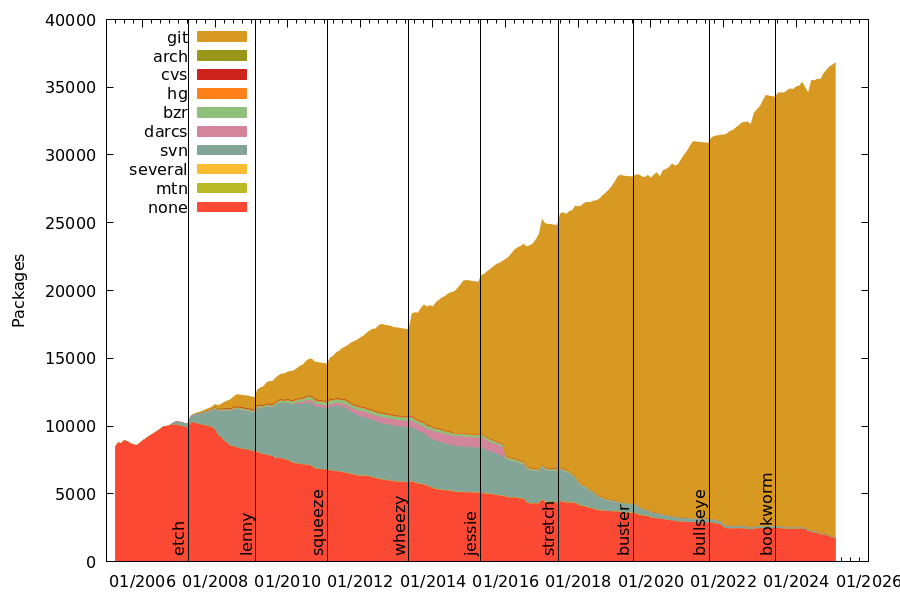
Vcs-Git headers The Vcs-Git headers in debian/control are the equivalent of the Repository field in debian/upstream/metadata, but for the packaging repositories (as opposed to the upstream ones). They ve been around for a while and are widely adopted, as can be seen from zack s stats: The vcswatch service that regularly polls packaging repositories to see whether they have changed makes it a lot easier to consume this information in usable way.
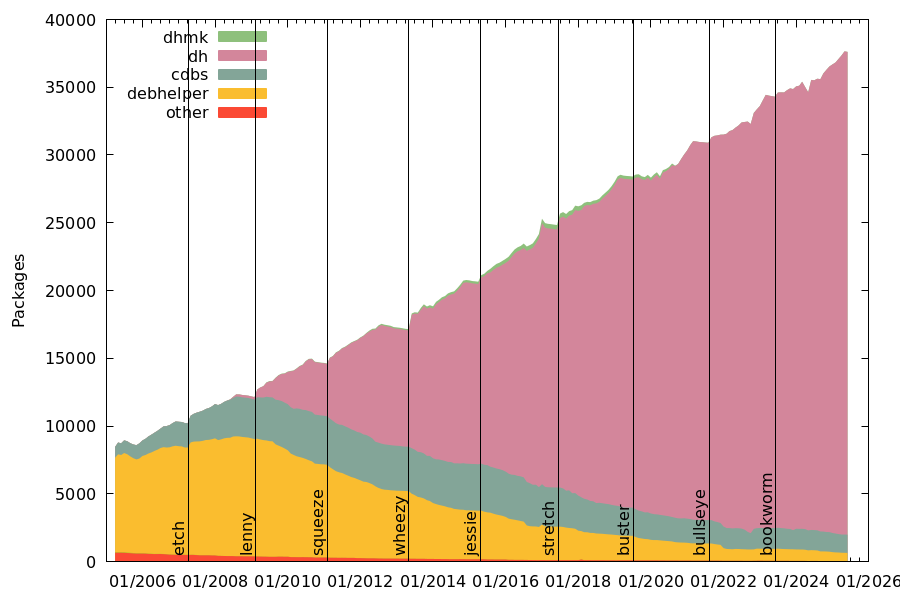
Debhelper adoption Over the last couple of years, Debian has slowly been converging on a single build tool - debhelper s dh interface. Being able to rely on a single build tool makes it easier to write code to update packaging when upstream changes require it.
Debhelper DWIM Debhelper (and its helpers) increasingly can figure out how to do the Right Thing in many cases without being explicitly configured. This makes packaging less effort, but also means that it s less likely that importing a new upstream version will require updates to the packaging. With all of these improvements in place, it actually becomes feasible in a lot of situations to update a Debian package to a new upstream version automatically. Of course, this requires that all of this information is available, so it won t work for all packages. In some cases, the packaging for the older upstream version might not apply to the newer upstream version. The Janitor has attempted to import a new upstream Git snapshot and a new upstream release for every package in the archive where a debian/watch file or debian/upstream/metadata file are present. These are the steps it uses:
  • Find new upstream version
    • If release, use debian/watch - or maybe tagged in upstream repository
    • If snapshot, use debian/upstream/metadata s Repository field
    • If neither is available, use guess-upstream-metadata from upstream-ontologist to guess the upstream Repository
  • Merge upstream version into packaging repository, possibly importing tarballs using pristine-tar
  • Update the changelog file to mention the new upstream version
  • Run some checks to ensure there are no unintentional changes, e.g.:
    • Scan diff between old and new for surprising license changes
      • Today, abort if there are any - in the future, maybe update debian/copyright
    • Check for obvious compatibility breaks - e.g. sonames changing
  • Attempt to update the packaging to reflect upstream changes
    • Refresh patches
  • Attempt to build the package with deb-fix-build, to deal with any missing dependencies
  • Run the autopkgtests with deb-fix-build to deal with missing dependencies, and abort if any tests fail
Results When run over all packages in unstable (sid), this process works for a surprising number of them.
Fresh Releases For fresh-releases (aka imports of upstream releases), processing all packages maintained in Git for which QA watch reports new releases (about 11,000): That means about 2300 packages updated, and about 4000 unchanged.
Fresh Snapshots For fresh-snapshots (aka imports of latest Git commit from upstream), processing all packages maintained in Git (about 26,000): Or 5100 packages updated and 2100 for which there was nothing to do, i.e. no upstream commits since the last Debian upload. As can be seen, this works for a surprising fraction of packages. It s possible to get the numbers up even higher, by both improving the tooling, the autopkgtests and the metadata that is provided by packages.
Using these packages All the packages that have been built can be accessed from the Janitor APT repository. More information can be found at https://janitor.debian.net/fresh, but in short - run:
1
2
3
4
5
6
echo deb "[arch=amd64 signed-by=/usr/share/keyrings/debian-janitor-archive-keyring.gpg]" \
    https://janitor.debian.net/ fresh-snapshots main   sudo tee /etc/apt/sources.list.d/fresh-snapshots.list
echo deb "[arch=amd64 signed-by=/usr/share/keyrings/debian-janitor-archive-keyring.gpg]" \
    https://janitor.debian.net/ fresh-releases main   sudo tee /etc/apt/sources.list.d/fresh-releases.list
sudo curl -o /usr/share/keyrings/debian-janitor-archive-keyring.gpg https://janitor.debian.net/pgp_keys
apt update
And then you can install packages from the fresh-snapshots (upstream git snapshots) or fresh-releases suites on a case-by-case basis by running something like:
1
apt install -t fresh-snapshots r-cran-roxygen2
Most packages are updated based on information provided by vcswatch and qa watch, but it s also possible for upstream repositories to call a web hook to trigger a refresh of a package. These packages were built against unstable, but should in almost all cases also work for testing.
Caveats Of course, since these packages are built automatically without human supervision it s likely that some of them will have bugs in them that would otherwise have been caught by the maintainer.
[1]I m not saying that a monoculture is great here, but it does help distributions.

Rapha&#235;l Hertzog: Freexian s report about Debian Long Term Support, July 2021

A Debian LTS logo
Like each month, have a look at the work funded by Freexian s Debian LTS offering. Debian project funding In July, we put aside 2400 EUR to fund Debian projects. We haven t received proposals of projects to fund in the last months, so we have scheduled a discussion during Debconf to try to to figure out why that is and how we can fix that. Join us on August 26th at 16:00 UTC on this link. We are pleased to announce that Jeremiah Foster will help out to make this initiative a success : he can help Debian members to come up with solid proposals, he can look for people willing to do the work once the project has been formalized and approved, and he will make sure that the project implementation keeps on track when the actual work has begun. We re looking forward to receive more projects from various Debian teams! Learn more about the rationale behind this initiative in this article. Debian LTS contributors In July, 12 contributors have been paid to work on Debian LTS, their reports are available: Evolution of the situation In July we released 30 DLAs. Also we were glad to welcome Neil Williams and Lee Garrett who became active contributors. The security tracker currently lists 63 packages with a known CVE and the dla-needed.txt file has 17 packages needing an update. We would like to thank Holger Levsen for the years of work where he managed/coordinated the paid LTS contributors. Jeremiah Foster will take over his duties. Thanks to our sponsors Sponsors that joined recently are in bold.

22 August 2021

Joachim Breitner: Sweet former employee appreciation

Two months ago was my last day of working as an employee for DFINITY, and as I mentioned in the previous blog post, one of my main contributions was the introduction and maintenance of the Interface Specification.
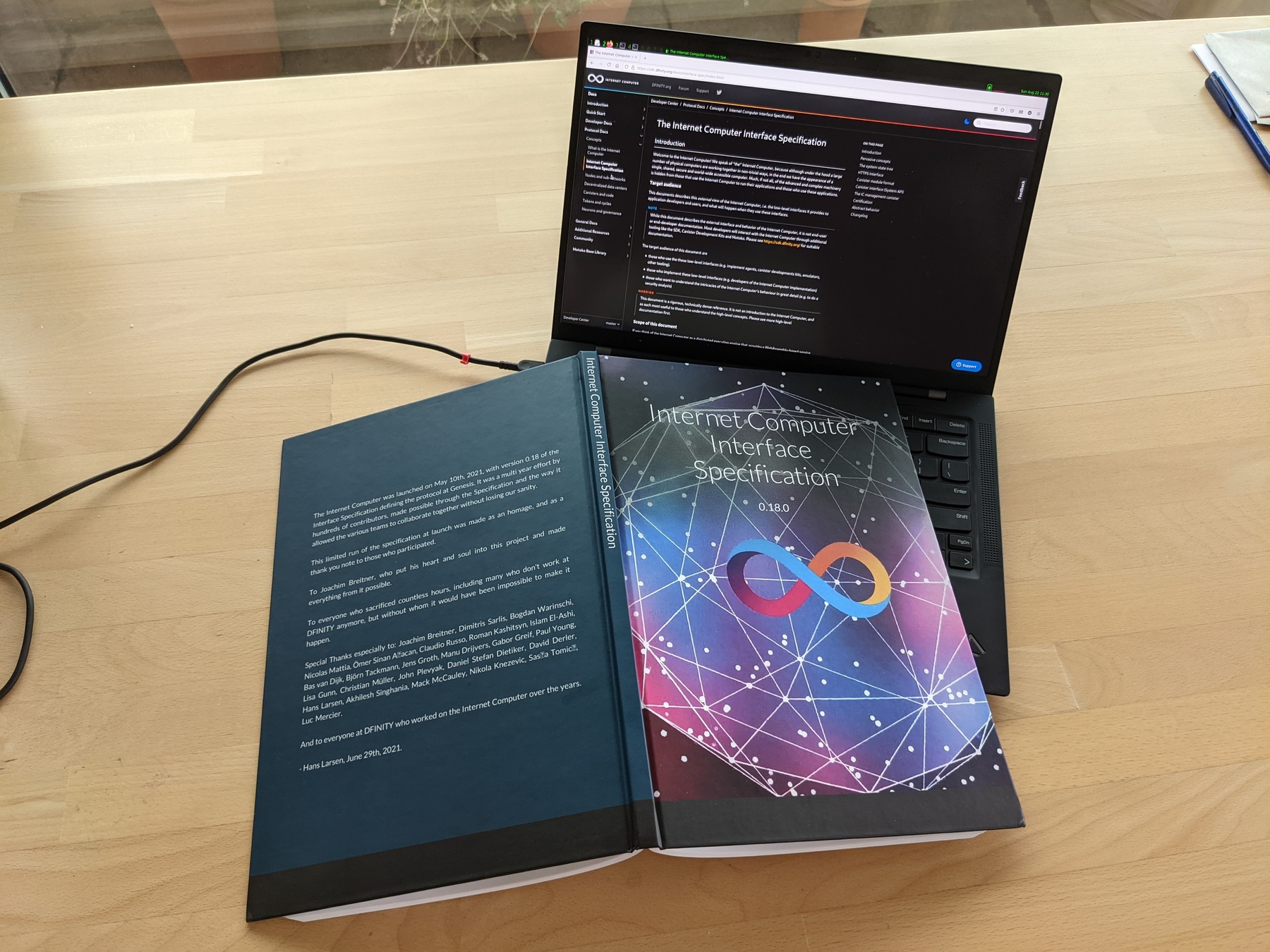
The Interface Specification as a bookThe Interface Specification as a book
Hence I was especially happy to find that my former colleague Hans Larsen has, as a farewell gift and token of appreciation, created a hard copy of the document, with 107 pages of dry technical content that, and a very sweet dedication on the back. This is especially valuable as it came from Lars personally (i.e. it s not just routine HR work to keep former employees happy, which I could imagine to be a thing in big and mature corporations), and despite the fact that he himself has left DFINITY since. I also take this as further confirmation that this specification-driven design process, despite the initial resistance and daily hurdles, is a good one. A rough list of guiding principles would be: The similarity to the concept of deep specifications from the DeepSpec project is indeed striking. One of my hopes at DFINITY was that these principles would catch on and that other components (e.g the NNS, the nodes or the ICP ledger canister) would follow suite. That did not happen, it seems. Or rather, it did not happen yet PS, in case you are wondering how: The rendering of the document that s shown at at https://sdk.dfinity.org/docs/interface-spec/index.html is not great; the internal website had a different style with made navigating this large document more possible, as it was a dedicated site with the document s nested table of content on the left.

19 August 2021

Jonathan Dowland: Budgeting tools

YNAB On the advice of many friends, I tried to use You Need A Budget. I gave it a seriously long, proper evaluation: over a year. But I just couldn't get it to work for me. I don't want to try and explain why. To be honest, those same friends who advocated for it fairly strongly, also gave me a pretty hard time for giving up on it! Despite it not clicking for me, there are a few concepts from YNAB that I quite like: GNUCash Jimmy Kaplowitz suggested back in 2012 that I should take a look at GNUCash. It took me a few more years before I did. The eventual trigger point for me was organising an event where I paid for a load of things on behalf of others and needed to track who had paid me back. It excelled for that. I've continued to use GNUCash to manage my personal money that is, my "play money" and anything I've accumulated but I haven't committed to it for my family finances. Practically speaking that would lock my wife out of them, which wouldn't be fair. But also because GNUCash's shortcomings (and despite its strengths, it certainly has some) mean that I don't expect I will be using it into the indefinite future, even for my personal stuff. The most significant drawback, in my opinion, is GNUCash's support for scripting. Sometimes, there's a laborious but easily-mechanisable (in theory) task I need to perform that would be ideal to script. GNUCash has built-in scripting support using Guile the GNU lisp/scheme dialect but this is limited to Reports only, I don't think it can be used for a task such as "match a series of transactions using one or more filters or regular expressions, and apply a transformation to them, such as change the account to which they are posted", etc. It also has a C library and auto-generated bindings for other languages. This has a horrible API, which is carried over into the language bindings. Documentation for the whole lot is basically non-existent too. Plain-text accounting For that reason I set out to find some better tools. There's a lot of interest and activity in plain-text accounting (PTA), including tools such as beancount, ledger or the Haskell re-implementation hledger. In a future post I'll write about PTA and hledger.

16 August 2021

Andrew Cater: Happy Birthday, Debian!

28 today. In a video call for Debian day earlier on, I was reminiscing about the earliest distributions: MCC Interim Linux gave instructions to turn it's final version into Debian. Debian is the second oldest Linux distribution, just behind Slackware.Debian 1.2 was my first Debian: my latest is, obviously, Debian Bullseye. Debian is like a family - often discordant, sometimes dysfunctional but always full of people that care and are cared for. I wish that some of my friends and colleagues no longer with us could be here to see just how well we're doing.This is something that's been with me for so long that I can't imagine life without it: software, obscure hardware but above all friends closer than family. The biggest software project anywhere, potentially, and it's all for free - and 95.7% independently reproducible. Thanks to all my colleagues and co-workers who've become friends over the years without whom none of this would be possible. Oh, and thanks to Ian Murdock - I never got to meet him but I did get to email him when he was in charge of Progeny. Without him, none of this would even have started.

Russ Allbery: Review: The Galaxy, and the Ground Within

Review: The Galaxy, and the Ground Within, by Becky Chambers
Series: Wayfarers #4
Publisher: Harper Voyager
Copyright: April 2021
ISBN: 0-06-293605-0
Format: Kindle
Pages: 325
The name of the planet Gora is the Hanto word for useless. It's a bone-dry, resource-poor planet with nothing to recommend it except that it happened to be conveniently located between five other busy systems and had well-established interspacial tunnels. Gora is therefore a transit hub: a place lots of people visit for about half a day while waiting for a departure time, but where very few people stay. It is the interstellar equivalent of an airport. Ouloo is a Laru, a species physically somewhat similar to a giant dog. She is the owner of the Five-Hop One-Stop in a habitat dome on Gora, where she lives with her child (who is not yet old enough to choose a gender). On the day when this novel begins, she's expecting three ships to dock: one Aeluon, one Quelin, and, to Ouloo's significant surprise and moderate discomfort, an Akarak. But apart from that, it's a normal day. A normal day, that is, until maintenance work on the solar satellite array leads to a Kessler syndrome collision cascade that destroys most of the communication satellites and makes it unsafe to leave the surface of the planet. Ouloo and her guests are stuck with each other for longer than they expected. In a typical SF novel, you would expect the characters to have to fix the satellite cascade, or for it to be a sign of something more nefarious. That is not the case here; the problem is handled by the Goran authorities, the characters have no special expertise, and there is no larger significance to the accident. Instead, the accident functions as storm in a very old story-telling frame: three travelers and their host and her child, trapped together by circumstance and forced to entertain each other until they can go on their way. Breaking from the formula, they do not do that primarily by telling stories to each other, although the close third-person narration that moves between the characters reveals their backgrounds over the course of the book. Instead, a lot of this book is conversation, sometimes prompted by Ouloo's kid Tupo (who I thought was a wonderfully-written tween, complete with swings between curiosity and shyness, random interests, occasionally poor impulse control, and intense but unpredictable learning interest). That leads to some conflict (and some emergencies), but, similar to Record of a Spaceborn Few, this is more of a character study book than a things-happen book. An interesting question, then, is why is this story science fiction? A similar story could be written (and has been, many times) with human travelers in a mundane inn or boarding house in a storm. None of the aliens are all that alien; despite having different body shapes and senses, you could get more variation from a group of university students. And even more than with Chambers's other books, the advanced technology is not the point and is described only enough to provide some background color and a bit of characterization. The answer, for me, is that the cognitive estrangement of non-human characters relieves my brain of the baggage that I bring to human characters and makes it easier for me to empathize with the characters as individuals rather than representatives of human archetypes. With human characters, I would be fitting them into my knowledge of history and politics, and my reaction to each decision the characters make would be influenced by the assumptions prompted by that background. I enjoy the distraction of invented worlds and invented histories in part because they're simplified compared to human histories and therefore feel more knowable and less subtle. I'm not trying to understand the political angle from which the author is writing or wondering if I'm missing a reference that's important to the story. In other words, the science fiction setting gives the narrator more power. The story tells me the important details of the background; there isn't some true history lurking beneath that I'm trying to ferret out. When that's combined with interesting physical differences, I find myself imagining what it would be like to be the various aliens, trying to insert myself into their worlds, rather than placing them in a historical or political context. That puts me in a curious and empathetic mindset, and that, in turn, is the best perspective from which to enjoy Chambers's stories. The characters in this story don't solve any large-scale problems. They do make life decisions, some quite significant, but only on a personal scale. They also don't resolve all of their suspicions and disagreements. This won't be to everyone's taste, but it's one of the things I most enjoyed about the book: it shows a small part of the lives of a collection of average individuals, none of whom are close to the levers of power and none of whom are responsible for fixing their species or galactic politics. They are responsible for their own choices, and for how their lives touch the lives of others. They can make the people they encounter happier or sadder, they can chose how to be true to their own principles, and they can make hard choices without right answers. When I describe a mainstream fiction book that way, I often find it depressing, but I came away from The Galaxy, and the Ground Within feeling better about the world and more open-hearted towards other people. I'm not sure what Chambers does to produce that reaction, so I'm not sure if it will have the same effect on other people. Perhaps part of it is that while there is some drama, her characters do not seek drama for its own sake, none of the characters are villains, and she has a way of writing sincerity that clicks with my brain. There is a scene, about two-thirds of the way through the book, where the characters get into a heated argument about politics, and for me this is the moment where you will either love this book or it will not work for you. The argument doesn't resolve anything, and yet it's one of the most perceptive, accurate, and satisfying portrayals of a political argument among normal people that I've seen in fiction. It's the sort of air-clearing conversation in which every character is blunt with both their opinion and their emotions rather than shading them for politeness. Those positions are not necessarily sophisticated or deeply philosophical, but they are deeply honest.
"And you know what? I truly don't care which of them is right so long as it fixes everything. I don't have an... an ideology. I don't know the right terms to discuss these things. I don't know the science behind any of it. I'm sure I sound silly right now. But I just want everyone to get along, and to be well taken care of. That's it. I want everybody to be happy and I do not care how we get there." She exhaled, her broad nostrils flaring. "That's how I feel about it."
I am not Ouloo, but I think she represents far more people than fiction normally realizes, and I found something deeply satisfying and revealing in seeing that position presented so clearly in the midst of a heated argument. If you like what Chambers does, I think you will like this book. If it's not for you, this is probably not the book that will change your mind, although there is a bit less hand-wavy technology to distract the people whom that distracts. The Galaxy, and the Ground Within didn't have the emotional resonance that Record of a Spaceborn Few had for me, or the emotional gut punch of A Closed and Common Orbit. But I loved every moment of reading it. This will apparently be the last novel in the Wayfarers universe, at least for the time being. Chambers will be moving on to other settings (starting with A Psalm for the Wild-Built). Rating: 8 out of 10

11 August 2021

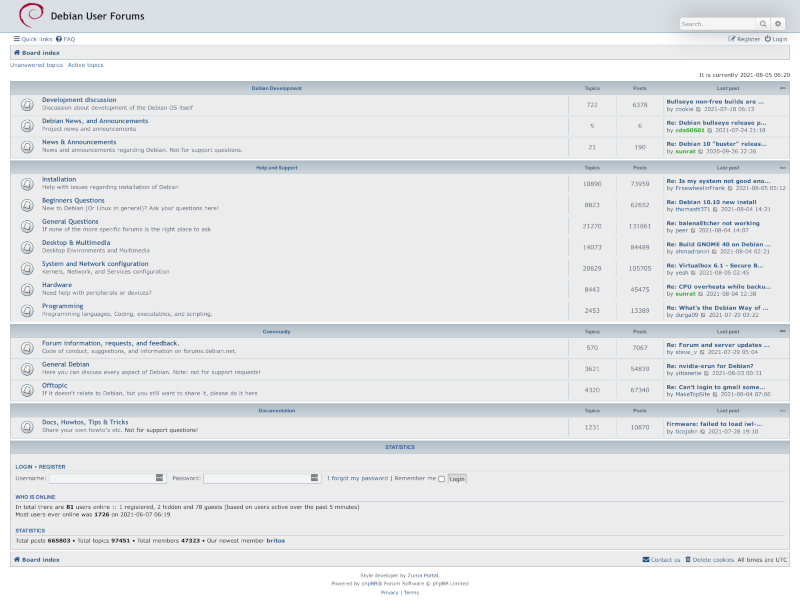
Bits from Debian: Debian User Forums changes and updates.

DebianUserForums Several issues were brought before the Debian Community team regarding responsiveness, tone, and needed software updates to forums.debian.net. The question was asked, who s in charge? Over the course of the discussion several Debian Developers volunteered to help by providing a presence on the forums from Debian and to assist with the necessary changes to keep the service up and running. We are happy to announce the following changes to the (NEW!) forums.debian.net, which have and should address most of the prior concerns with accountability, tone, use, and reliability: Debian Developers: Paulo Henrique de Lima Santana (phls), Felix Lechner (lechner), and Donald Norwood (donald) have been added to the forum's Server and Administration teams. The server instance is now running directly within Debian's infrastructure. The forum software and back-end have been updated to the most recent versions where applicable. DNS resolves for both IPv4 and IPv6. SSL/HTTPS are enabled. (It s 2021!) New Captcha and Anti-spam systems are in place to thwart spammers, bots, and to make it easier for humans to register. New Administrators and Moderation staff were added to provide additional coverage across the hours and to combine years of experience with forum operation and Debian usage. New viewing styles are available for users to choose from, some of which are ideal for mobile/tablet viewing. We inadvertently fixed the time issue that the prior forum had of running 11 minutes fast. :) We have clarified staff roles and staff visibility. Responsiveness to users on the forums has increased. Email addresses for mods/admins have been updated and checked for validity, it has seen direct use and response. The guidelines for forum use by users and staff have been updated. The Debian COC has been made into a Global Announcement as an accompanyist to the newly updated guidelines to give the moderators/administrators an additional rule-set for unruly or unbecoming behavior. Some of the discussion areas have been renamed and refocused, along with the movement of multiple threads to make indexing and searching of the forums easier. Many (New!) features and extensions have been added to the forum for ease of use and modernization, such as a user thanks system and thread hover previews. There are some server administrative tasks that were upgraded as well which don't belong on a public list, but we are backing up regularly and secure. :) We have a few minor details here and there to attend to and the work is ongoing. Many Thanks and Appreciation to the Debian System Administrators (DSA) and Ganneff who took the time to coordinate and assist with the instance, DNS, and network and server administration minutiae, our helpful DPL Jonathan Carter, many thanks to the current and prior forum moderators and administrators: Mez, sunrat, 4D696B65, arochester, and cds60601 for helping with the modifications and transition, and to the forum users who participated in lots of the tweaking. All in all this was a large community task and everyone did a significant part. Thank you!

9 August 2021

Russ Allbery: Review: The Last Battle

Review: The Last Battle, by C.S. Lewis
Illustrator: Pauline Baynes
Series: Chronicles of Narnia #7
Publisher: Collier Books
Copyright: 1956
Printing: 1978
ISBN: 0-02-044210-6
Format: Mass market
Pages: 184
The Last Battle is the seventh and final book of the Chronicles of Narnia in every reading order. It ties together (and spoils) every previous Narnia book, so you do indeed want to read it last (or skip it entirely, but I'll get into that). In the far west of Narnia, beyond the Lantern Waste and near the great waterfall that marks Narnia's western boundary, live a talking ape named Shift and a talking donkey named Puzzle. Shift is a narcissistic asshole who has been gaslighting and manipulating Puzzle for years, convincing the poor donkey that he's stupid and useless for anything other than being Shift's servant. At the start of the book, a lion skin washes over the waterfall and into the Cauldron Pool. Shift, seeing a great opportunity, convinces Puzzle to retrieve it. The king of Narnia at this time is Tirian. I would tell you more about Tirian except, despite being the protagonist, that's about all the characterization he gets. He's the king, he's broad-shouldered and strong, he behaves in a correct kingly fashion by preferring hunting lodges and simple camps to the capital at Cair Paravel, and his close companion is a unicorn named Jewel. Other than that, he's another character like Rilian from The Silver Chair who feels like he was taken from a medieval Arthurian story. (Thankfully, unlike Rilian, he doesn't talk like he's in a medieval Arthurian story.) Tirian finds out about Shift's scheme when a dryad appears at Tirian's camp, calling for justice for the trees of Lantern Waste who are being felled. Tirian rushes to investigate and stop this monstrous act, only to find the beasts of Narnia cutting down trees and hauling them away for Calormene overseers. When challenged on why they would do such a thing, they reply that it's at Aslan's orders. The Last Battle is largely the reason why I decided to do this re-read and review series. It is, let me be clear, a bad book. The plot is absurd, insulting to the characters, and in places actively offensive. It is also, unlike the rest of the Narnia series, dark and depressing for nearly all of the book. The theology suffers from problems faced by modern literature that tries to use the Book of Revelation and related Christian mythology as a basis. And it is, most famously, the site of one of the most notorious authorial betrayals of a character in fiction. And yet, The Last Battle, probably more than any other single book, taught me to be a better human being. It contains two very specific pieces of theology that I would now critique in multiple ways but which were exactly the pieces of theology that I needed to hear when I first understood them. This book steered me away from a closed, judgmental, and condemnatory mindset at exactly the age when I needed something to do that. For that, I will always have a warm spot in my heart for it. I'm going to start with the bad parts, though, because that's how the book starts. MAJOR SPOILERS BELOW. First, and most seriously, this is a second-order idiot plot. Shift shows up with a donkey wearing a lion skin (badly), only lets anyone see him via firelight, claims he's Aslan, and starts ordering the talking animals of Narnia to completely betray their laws and moral principles and reverse every long-standing political position of the country... and everyone just nods and goes along with this. This is the most blatant example of a long-standing problem in this series: Lewis does not respect his animal characters. They are the best feature of his world, and he treats them as barely more intelligent than their non-speaking equivalents and in need of humans to tell them what to do. Furthermore, despite the assertion of the narrator, Shift is not even close to clever. His deception has all the subtlety of a five-year-old who doesn't want to go to bed, and he offers the Narnians absolutely nothing in exchange for betraying their principles. I can forgive Puzzle for going along with the scheme since Puzzle has been so emotionally abused that he doesn't know what else to do, but no one else has any excuse, especially Shift's neighbors. Given his behavior in the book, everyone within a ten mile radius would be so sick of his whining, bullying, and lying within a month that they'd never believe anything he said again. Rishda and Ginger, a Calormene captain and a sociopathic cat who later take over Shift's scheme, do qualify as clever, but there's no realistic way Shift's plot would have gotten far enough for them to get involved. The things that Shift gets the Narnians to do are awful. This is by far the most depressing book in the series, even more than the worst parts of The Silver Chair. I'm sure I'm not the only one who struggled to read through the first part of this book, and raced through it on re-reads because everything is so hard to watch. The destruction is wanton and purposeless, and the frequent warnings from both characters and narration that these are the last days of Narnia add to the despair. Lewis takes all the beautiful things that he built over six books and smashes them before your eyes. It's a lot to take, given that previous books would have treated the felling of a single tree as an unspeakable catastrophe. I think some of these problems are due to the difficulty of using Christian eschatology in a modern novel. An antichrist is obligatory, but the animals of Narnia have no reason to follow an antichrist given their direct experience with Aslan, particularly not the aloof one that Shift tries to give them. Lewis forces the plot by making everyone act stupidly and out of character. Similarly, Christian eschatology says everything must become as awful as possible right before the return of Christ, hence the difficult-to-read sections of Narnia's destruction, but there's no in-book reason for the Narnians' complicity in that destruction. One can argue about whether this is good theology, but it's certainly bad storytelling. I can see the outlines of the moral points Lewis is trying to make about greed and rapacity, abuse of the natural world, dubious alliances, cynicism, and ill-chosen prophets, but because there is no explicable reason for Tirian's quiet kingdom to suddenly turn to murderous resource exploitation, none of those moral points land with any force. The best moral apocalypse shows the reader how, were they living through it, they would be complicit in the devastation as well. Lewis does none of that work, so the reader is just left angry and confused. The book also has several smaller poor authorial choices, such as the blackface incident. Tirian, Jill, and Eustace need to infiltrate Shift's camp, and use blackface to disguise themselves as Calormenes. That alone uncomfortably reveals how much skin tone determines nationality in this world, but Lewis makes it far worse by having Tirian comment that he "feel[s] a true man again" after removing the blackface and switching to Narnian clothes. All of this drags on and on, unlike Lewis's normally tighter pacing, to the point that I remembered this book being twice the length of any other Narnia book. It's not; it's about the same length as the rest, but it's such a grind that it feels interminable. The sum total of the bright points of the first two-thirds of the book are the arrival of Jill and Eustace, Jill's one moment of true heroism, and the loyalty of a single Dwarf. The rest is all horror and betrayal and doomed battles and abject stupidity. I do, though, have to describe Jill's moment of glory, since I complained about her and Eustace throughout The Silver Chair. Eustace is still useless, but Jill learned forestcraft during her previous adventures (not that we saw much sign of this previously) and slips through the forest like a ghost to steal Puzzle and his lion costume out from the under the nose of the villains. Even better, she finds Puzzle and the lion costume hilarious, which is the one moment in the book where one of the characters seems to understand how absurd and ridiculous this all is. I loved Jill so much in that moment that it makes up for all of the pointless bickering of The Silver Chair. She doesn't get to do much else in this book, but I wish the Jill who shows up in The Last Battle had gotten her own book. The end of this book, and the only reason why it's worth reading, happens once the heroes are forced into the stable that Shift and his co-conspirators have been using as the stage for their fake Aslan. Its door (for no well-explained reason) has become a door to Aslan's Country and leads to a reunion with all the protagonists of the series. It also becomes the frame of Aslan's final destruction of Narnia and judging of its inhabitants, which I suspect would be confusing if you didn't already know something about Christian eschatology. But before that, this happens, which is sufficiently and deservedly notorious that I think it needs to be quoted in full.
"Sir," said Tirian, when he had greeted all these. "If I have read the chronicle aright, there should be another. Has not your Majesty two sisters? Where is Queen Susan?" "My sister Susan," answered Peter shortly and gravely, "is no longer a friend of Narnia." "Yes," said Eustace, "and whenever you've tried to get her to come and talk about Narnia or do anything about Narnia, she says 'What wonderful memories you have! Fancy your still thinking about all those funny games we used to play when we were children.'" "Oh Susan!" said Jill. "She's interested in nothing nowadays except nylons and lipstick and invitations. She always was a jolly sight too keen on being grown-up." "Grown-up indeed," said the Lady Polly. "I wish she would grow up. She wasted all her school time wanting to be the age she is now, and she'll waste all the rest of her life trying to stay that age. Her whole idea is to race on to the silliest time of one's life as quick as she can and then stop there as long as she can."
There are so many obvious and dire problems with this passage, and so many others have written about it at length, that I will only add a few points. First, I find it interesting that neither Lucy nor Edmund says a thing. (I would like to think that Edmund knows better.) The real criticism comes from three characters who never interacted with Susan in the series: the two characters introduced after she was no longer allowed to return to Narnia, and a character from the story that predated hers. (And Eustace certainly has some gall to criticize someone else for treating Narnia as a childish game.) It also doesn't say anything good about Lewis that he puts his rather sexist attack on Susan into the mouths of two other female characters. Polly's criticism is a somewhat generic attack on puberty that could arguably apply to either sex (although "silliness" is usually reserved for women), but Jill makes the attack explicitly gendered. It's the attack of a girl who wants to be one of the boys on a girl who embraces things that are coded feminine, and there's a whole lot of politics around the construction of gender happening here that Lewis is blindly reinforcing and not grappling with at all. Plus, this is only barely supported by single sentences in The Voyage of the Dawn Treader and The Horse and His Boy and directly contradicts the earlier books. We're expected to believe that Susan the archer, the best swimmer, the most sensible and thoughtful of the four kids has abruptly changed her whole personality. Lewis could have made me believe Susan had soured on Narnia after the attempted kidnapping (and, although left unstated, presumably eventual attempted rape) in The Horse and His Boy, if one ignores the fact that incident supposedly happens before Prince Caspian where there is no sign of such a reaction. But not for those reasons, and not in that way. Thankfully, after this, the book gets better, starting with the Dwarfs, which is one of the two passages that had a profound influence on me. Except for one Dwarf who allied with Tirian, the Dwarfs reacted to the exposure of Shift's lies by disbelieving both Tirian and Shift, calling a pox on both their houses, and deciding to make their own side. During the last fight in front of the stable, they started killing whichever side looked like they were winning. (Although this is horrific in the story, I think this is accurate social commentary on a certain type of cynicism, even if I suspect Lewis may have been aiming it at atheists.) Eventually, they're thrown through the stable door by the Calormenes. However, rather than seeing the land of beauty and plenty that everyone else sees, they are firmly convinced they're in a dark, musty stable surrounded by refuse and dirty straw. This is, quite explicitly, not something imposed on them. Lucy rebukes Eustace for wishing Tash had killed them, and tries to make friends with them. Aslan tries to show them how wrong their perceptions are, to no avail. Their unwillingness to admit they were wrong is so strong that they make themselves believe that everything is worse than it actually is.
"You see," said Aslan. "They will not let us help them. They have chosen cunning instead of belief. Their prison is only in their own minds, yet they are in that prison; and so afraid of being taken in that they cannot be taken out."
I grew up with the US evangelical version of Hell as a place of eternal torment, which in turn was used to justify religious atrocities in the name of saving people from Hell. But there is no Hell of that type in this book. There is a shadow into which many evil characters simply disappear, and there's this passage. Reading this was the first time I understood the alternative idea of Hell as the absence of God instead of active divine punishment. Lewis doesn't use the word "Hell," but it's obvious from context that the Dwarfs are in Hell. But it's not something Aslan does to them and no one wants them there; they could leave any time they wanted, but they're too unwilling to be wrong. You may have to be raised in conservative Christianity to understand how profoundly this rethinking of Hell (which Lewis tackles at greater length in The Great Divorce) undermines the system of guilt and fear that's used as motivation and control. It took me several re-readings and a lot of thinking about this passage, but this is where I stopped believing in a vengeful God who will eternally torture nonbelievers, and thus stopped believing in all of the other theology that goes with it. The second passage that changed me is Emeth's story. Emeth is a devout Calormene, a follower of Tash, who volunteered to enter the stable when Shift and his co-conspirators were claiming Aslan/Tash was inside. Some time after going through, he encounters Aslan, and this is part of his telling of that story (and yes, Lewis still has Calormenes telling stories as if they were British translators of the Arabian Nights):
[...] Lord, is it then true, as the Ape said, that thou and Tash are one? The Lion growled so that the earth shook (but his wrath was not against me) and said, It is false. Not because he and I are one, but because we are opposites, I take to me the services which thou hast done to him. For I and he are of such different kinds that no service which is vile can be done to me, and none which is not vile can be done to him. Therefore if any man swear by Tash and keep his oath for the oath's sake, it is by me that he has truly sworn, though he know it not, and it is I who reward him. And if any man do a cruelty in my name, then, though he says the name Aslan, it is Tash whom he serves and by Tash his deed is accepted. Dost thou understand, Child? I said, Lord, thou knowest how much I understand. But I said also (for the truth constrained me), Yet I have been seeking Tash all my days. Beloved, said the Glorious One, unless thy desire had been for me, thou wouldst not have sought so long and so truly. For all find what they truly seek.
So, first, don't ever say this to anyone. It's horribly condescending and, since it's normally said by white Christians to other people, usually explicitly colonialist. Telling someone that their god is evil but since they seem to be a good person they're truly worshiping your god is only barely better than saying yours is the only true religion. But it is better, and as someone who, at the time, was wholly steeped in the belief that only Christians were saved and every follower of another religion was following Satan and was damned to Hell, this passage blew my mind. This was the first place I encountered the idea that someone who followed a different religion could be saved, or that God could transcend religion, and it came with exactly the context and justification that I needed given how close-minded I was at the time. Today, I would say that the Christian side of this analysis needs far more humility, and fobbing off all the evil done in the name of the Christian God by saying "oh, those people were really following Satan" is a total moral copout. But, nonetheless, Lewis opened a door for me that I was able to step through and move beyond to a less judgmental, dismissive, and hostile view of others. There's not much else in the book after this. It's mostly Lewis's charmingly Platonic view of the afterlife, in which the characters go inward and upward to truer and more complete versions of both Narnia and England and are reunited (very briefly) with every character of the series. Lewis knows not to try too hard to describe the indescribable, but it remains one of my favorite visions of an afterlife because it makes so explicit that this world is neither static or the last, but only the beginning of a new adventure. This final section of The Last Battle is deeply flawed, rather arrogant, a little bizarre, and involves more lectures on theology than precise description, but I still love it. By itself, it's not a bad ending for the series, although I don't think it has half the beauty or wonder of the end of The Voyage of the Dawn Treader. It's a shame about the rest of the book, and it's a worse shame that Lewis chose to sacrifice Susan on the altar of his prejudices. Those problems made it very hard to read this book again and make it impossible to recommend. Thankfully, you can read the series without it, and perhaps most readers would be better off imagining their own ending (or lack of ending) to Narnia than the one Lewis chose to give it. But the one redeeming quality The Last Battle will always have for me is that, despite all of its flaws, it was exactly the book that I needed to read when I read it. Rating: 4 out of 10

4 August 2021

Petter Reinholdtsen: Mechanic's words in five languages, English, Norwegian and Northern S mi editions

Almost thirty years ago, some forward looking teachers at Samisk videreg ende skole og reindriftsskole teaching metal work and Northern S mi, decided to create a list of words used in Northern S mi metal work. After almost ten years this resulted in a dictionary database, published as the book "Mekanihkk rs nit : Mekanikerord = Mekaanisen alan sanasto = Mechanic's words" in 1999. The story of this work is available from the pen of Svein Lund, one of the leading actors behind this effort. They even got the dictionary approved by the S mi Language Council as the recommended metal work words to use. Fast forward twenty years, I came across this work when I recently became interested in metal work, and started watching educational and funny videos on the topic, like the ones from mrpete222 and This Old Tony. But they all talk English, but I wanted to know what the tools and techniques they used were called in Norwegian. Trying to track down a good dictionary from English to Norwegian, after much searching, I came across the database of words created almost thirty years ago, with translations into English, Norwegian, Northern S mi, Swedish and Finnish. This gave me a lot of the Norwegian phrases I had been looking for. To make it easier for the next person trying to track down a good Norwegian dictionary for the metal worker, and because I knew the person behind the database from my Skolelinux / Debian Edu days, I decided to ask if the database could be released to the public without any usage limitations, in other words as a Creative Commons licensed data set. And happily, after consulting with the S mi Parliament of Norway, the database is now available with the Creative Commons Attribution 4.0 International license from my gitlab repository. The dictionary entries look slightly different, depending on the language in focus. This is the same entry in the different editions. English
lathe
dreiebenk (nb) v rve, v rvenbea ka, jorahanbea ka, v tnanbea ka (se) svarv (sv) sorvi (fi)
Norwegian
dreiebenk
lathe (en) v rve, v rvenbea ka, jorahanbea ka, v tnanbea ka (se) svarv (sv) sorvi (fi)
(nb): sponskj rande bearbeidingsmaskin der ein med skj reverkt y lausgj r spon fr eit roterande arbetsstykke
Northern S mi
v rve, v rvenbea ka, jorahanbea ka, v tnanbea ka
dreiebenk (nb) lathe (en) svarv (sv) sorvi (fi)
(se): ma iidna mainna uohpp vuolahasaid jorri bargo vdnasis
(nb): sponskj rande bearbeidingsmaskin der ein med skj reverkt y lausgj r spon fr eit roterande arbetsstykke
The database included term description in both Norwegian and Northern S mi, but not English. Because of this, the Northern S mi edition include both descriptions, the Norwegian edition include the Norwegian description and the English edition lack a descripiton. Once the database was available without any usage restrictions, and armed with my experience in publishing books, I decided to publish a Norwegian/English dictionary as a book using the database, to make the data set available also on paper and as an ebook. Further into the project, it occurred to me that I could just as easily make an English dictionary, and talking to Svein and concluding that it was within reach, I decided to make a Northern S mi dictionary too. Thus I suddenly find myself publishing a Northern S mi dictionary, even though I do not understand the language myself. I hope it will be well received, and can help revive the impressive work done almost thirty years ago to document the vocabulary of metal workers. If I get some help, I might even extend it with some of the words I find missing, like collet, rotary broach, carbide, knurler, arbor press and others. But the first edition build from a lightly edited version of the original database, with no new entries added. If you would like to check it out, visit my list of published books and consider buying a paper or ebook copy from lulu.com. The paper edition is only available in hardcover to increase its durability in the workshop. I am very happy to report that in the process, and thanks to help from both Svein Lund and B rre Gaup who understand the language, the docbook tools I use to create books, dblatex and docbook-xsl, now include support for Northern S mi. Before I started, these lacked the needed locale settings for this language, but now the patches are included upstream. As usual, if you use Bitcoin and want to show your support of my activities, please send Bitcoin donations to my address 15oWEoG9dUPovwmUL9KWAnYRtNJEkP1u1b.

2 August 2021

Colin Watson: Launchpad now runs on Python 3!

After a very long porting journey, Launchpad is finally running on Python 3 across all of our systems. I wanted to take a bit of time to reflect on why my emotional responses to this port differ so much from those of some others who ve done large ports, such as the Mercurial maintainers. It s hard to deny that we ve had to burn a lot of time on this, which I m sure has had an opportunity cost, and from one point of view it s essentially running to stand still: there is no single compelling feature that we get solely by porting to Python 3, although it s clearly a prerequisite for tidying up old compatibility code and being able to use modern language facilities in the future. And yet, on the whole, I found this a rewarding project and enjoyed doing it. Some of this may be because by inclination I m a maintenance programmer and actually enjoy this sort of thing. My default view tends to be that software version upgrades may be a pain but it s much better to get that pain over with as soon as you can rather than trying to hold back the tide; you can certainly get involved and try to shape where things end up, but rightly or wrongly I can t think of many cases when a righteously indignant user base managed to arrange for the old version to be maintained in perpetuity so that they never had to deal with the new thing (OK, maybe Perl 5 counts here). I think a more compelling difference between Launchpad and Mercurial, though, may be that very few other people really had a vested interest in what Python version Launchpad happened to be running, because it s all server-side code (aside from some client libraries such as launchpadlib, which were ported years ago). As such, we weren t trying to do this with the internet having Strong Opinions at us. We were doing this because it was obviously the only long-term-maintainable path forward, and in more recent times because some of our library dependencies were starting to drop support for Python 2 and so it was obviously going to become a practical problem for us sooner or later; but if we d just stayed on Python 2 forever then fundamentally hardly anyone else would really have cared directly, only maybe about some indirect consequences of that. I don t follow Mercurial development so I may be entirely off-base, but if other people were yelling at me about how late my project was to finish its port, that in itself would make me feel more negatively about the project even if I thought it was a good idea. Having most of the pressure come from ourselves rather than from outside meant that wasn t an issue for us. I m somewhat inclined to think of the process as an extreme version of paying down technical debt. Moving from Python 2.7 to 3.5, as we just did, means skipping over multiple language versions in one go, and if similar changes had been made more gradually it would probably have felt a lot more like the typical dependency update treadmill. I appreciate why not everyone might want to think of it this way: maybe this is just my own rationalization. Reflections on porting to Python 3 I m not going to defend the Python 3 migration process; it was pretty rough in a lot of ways. Nor am I going to spend much effort relitigating it here, as it s already been done to death elsewhere, and as I understand it the core Python developers have got the message loud and clear by now. At a bare minimum, a lot of valuable time was lost early in Python 3 s lifetime hanging on to flag-day-type porting strategies that were impractical for large projects, when it should have been providing for bilingual strategies (code that runs in both Python 2 and 3 for a transitional period) which is where most libraries and most large migrations ended up in practice. For instance, the early advice to library maintainers to maintain two parallel versions or perhaps translate dynamically with 2to3 was entirely impractical in most non-trivial cases and wasn t what most people ended up doing, and yet the idea that 2to3 is all you need still floats around Stack Overflow and the like as a result. (These days, I would probably point people towards something more like Eevee s porting FAQ as somewhere to start.) There are various fairly straightforward things that people often suggest could have been done to smooth the path, and I largely agree: not removing the u'' string prefix only to put it back in 3.3, fewer gratuitous compatibility breaks in the name of tidiness, and so on. But if I had a time machine, the number one thing I would ask to have been done differently would be introducing type annotations in Python 2 before Python 3 branched off. It s true that it s technically possible to do type annotations in Python 2, but the fact that it s a different syntax that would have to be fixed later is offputting, and in practice it wasn t widely used in Python 2 code. To make a significant difference to the ease of porting, annotations would need to have been introduced early enough that lots of Python 2 library code used them so that porting code didn t have to be quite so much of an exercise of manually figuring out the exact nature of string types from context. Launchpad is a complex piece of software that interacts with multiple domains: for example, it deals with a database, HTTP, web page rendering, Debian-format archive publishing, and multiple revision control systems, and there s often overlap between domains. Each of these tends to imply different kinds of string handling. Web page rendering is normally done mainly in Unicode, converting to bytes as late as possible; revision control systems normally want to spend most of their time working with bytes, although the exact details vary; HTTP is of course bytes on the wire, but Python s WSGI interface has some string type subtleties. In practice I found myself thinking about at least four string-like types (that is, things that in a language with a stricter type system I might well want to define as distinct types and restrict conversion between them): bytes, text, ordinary native strings (str in either language, encoded to UTF-8 in Python 2), and native strings with WSGI s encoding rules. Some of these are emergent properties of writing in the intersection of Python 2 and 3, which is effectively a specialized language of its own without coherent official documentation whose users must intuit its behaviour by comparing multiple sources of information, or by referring to unofficial porting guides: not a very satisfactory situation. Fortunately much of the complexity collapses once it becomes possible to write solely in Python 3. Some of the difficulties we ran into are not ones that are typically thought of as Python 2-to-3 porting issues, because they were changed later in Python 3 s development process. For instance, the email module was substantially improved in around the 3.2/3.3 timeframe to handle Python 3 s bytes/text model more correctly, and since Launchpad sends quite a few different kinds of email messages and has some quite picky tests for exactly what it emits, this entailed a lot of work in our email sending code and in our test suite to account for that. (It took me a while to work out whether we should be treating raw email messages as bytes or as text; bytes turned out to work best.) 3.4 made some tweaks to the implementation of quoted-printable encoding that broke a number of our tests in ways that took some effort to fix, because the tests needed to work on both 2.7 and 3.5. The list goes on. I got quite proficient at digging through Python s git history to figure out when and why some particular bit of behaviour had changed. One of the thorniest problems was parsing HTTP form data. We mainly rely on zope.publisher for this, which in turn relied on cgi.FieldStorage; but cgi.FieldStorage is badly broken in some situations on Python 3. Even if that bug were fixed in a more recent version of Python, we can t easily use anything newer than 3.5 for the first stage of our port due to the version of the base OS we re currently running, so it wouldn t help much. In the end I fixed some minor issues in the multipart module (and was kindly given co-maintenance of it) and converted zope.publisher to use it. Although this took a while to sort out, it seems to have gone very well. A couple of other interesting late-arriving issues were around pickle. For most things we normally prefer safer formats such as JSON, but there are a few cases where we use pickle, particularly for our session databases. One of my colleagues pointed out that I needed to remember to tell pickle to stick to protocol 2, so that we d be able to switch back and forward between Python 2 and 3 for a while; quite right, and we later ran into a similar problem with marshal too. A more surprising problem was that datetime.datetime objects pickled on Python 2 require special care when unpickling on Python 3; rather than the approach that ended up being implemented and documented for Python 3.6, though, I preferred a custom unpickler, both so that things would work on Python 3.5 and so that I wouldn t have to risk affecting the decoding of other pickled strings in the session database. General lessons Writing this over a year after Python 2 s end-of-life date, and certainly nowhere near the leading edge of Python 3 porting work, it s perhaps more useful to look at this in terms of the lessons it has for other large technical debt projects. I mentioned in my previous article that I used the approach of an enormous and frequently-rebased git branch as a working area for the port, committing often and sometimes combining and extracting commits for review once they seemed to be ready. A port of this scale would have been entirely intractable without a tool of similar power to git rebase, so I m very glad that we finished migrating to git in 2019. I relied on this right up to the end of the port, and it also allowed for quick assessments of how much more there was to land. git worktree was also helpful, in that I could easily maintain working trees built for each of Python 2 and 3 for comparison. As is usual for most multi-developer projects, all changes to Launchpad need to go through code review, although we sometimes make exceptions for very simple and obvious changes that can be self-reviewed. Since I knew from the outset that this was going to generate a lot of changes for review, I therefore structured my work from the outset to try to make it as easy as possible for my colleagues to review it. This generally involved keeping most changes to a somewhat manageable size of 800 lines or less (although this wasn t always possible), and arranging commits mainly according to the kind of change they made rather than their location. For example, when I needed to fix issues with / in Python 3 being true division rather than floor division, I did so in one commit across the various places where it mattered and took care not to mix it with other unrelated changes. This is good practice for nearly any kind of development, but it was especially important here since it allowed reviewers to consider a clear explanation of what I was doing in the commit message and then skim-read the rest of it much more quickly. It was vital to keep the codebase in a working state at all times, and deploy to production reasonably often: this way if something went wrong the amount of code we had to debug to figure out what had happened was always tractable. (Although I can t seem to find it now to link to it, I saw an account a while back of a company that had taken a flag-day approach instead with a large codebase. It seemed to work for them, but I m certain we couldn t have made it work for Launchpad.) I can t speak too highly of Launchpad s test suite, much of which originated before my time. Without a great deal of extensive coverage of all sorts of interesting edge cases at both the unit and functional level, and a corresponding culture of maintaining that test suite well when making new changes, it would have been impossible to be anything like as confident of the port as we were. As part of the porting work, we split out a couple of substantial chunks of the Launchpad codebase that could easily be decoupled from the core: its Mailman integration and its code import worker. Both of these had substantial dependencies with complex requirements for porting to Python 3, and arranging to be able to do these separately on their own schedule was absolutely worth it. Like disentangling balls of wool, any opportunity you can take to make things less tightly-coupled is probably going to make it easier to disentangle the rest. (I can see a tractable way forward to porting the code import worker, so we may well get that done soon. Our Mailman integration will need to be rewritten, though, since it currently depends on the Python-2-only Mailman 2, and Mailman 3 has a different architecture.) Python lessons Our database layer was already in pretty good shape for a port, since at least the modern bits of its table modelling interface were already strict about using Unicode for text columns. If you have any kind of pervasive low-level framework like this, then making it be pedantic at you in advance of a Python 3 port will probably incur much less swearing in the long run, as you won t be trying to deal with quite so many bytes/text issues at the same time as everything else. Early in our port, we established a standard set of __future__ imports and started incrementally converting files over to them, mainly because we weren t yet sure what else to do and it seemed likely to be helpful. absolute_import was definitely reasonable (and not often a problem in our code), and print_function was annoying but necessary. In hindsight I m not sure about unicode_literals, though. For files that only deal with bytes and text it was reasonable enough, but as I mentioned above there were also a number of cases where we needed literals of the language s native str type, i.e. bytes in Python 2 and text in Python 3: this was particularly noticeable in WSGI contexts, but also cropped up in some other surprising places. We generally either omitted unicode_literals or used six.ensure_str in such cases, but it was definitely a bit awkward and maybe I should have listened more to people telling me it might be a bad idea. A lot of Launchpad s early tests used doctest, mainly in the style where you have text files that interleave narrative commentary with examples. The development team later reached consensus that this was best avoided in most cases, but by then there were far too many doctests to conveniently rewrite in some other form. Porting doctests to Python 3 is really annoying. You run into all the little changes in how objects are represented as text (particularly u'...' versus '...', but plenty of other cases as well); you have next to no tools to do anything useful like skipping individual bits of a doctest that don t apply; using __future__ imports requires the rather obscure approach of adding the relevant names to the doctest s globals in the relevant DocFileSuite or DocTestSuite; dealing with many exception tracebacks requires something like zope.testing.renormalizing; and whatever code refactoring tools you re using probably don t work properly. Basically, don t have done that. It did all turn out to be tractable for us in the end, and I managed to avoid using much in the way of fragile doctest extensions aside from the aforementioned zope.testing.renormalizing, but it was not an enjoyable experience. Regressions I know of nine regressions that reached Launchpad s production systems as a result of this porting work; of course there were various other regressions caught by CI or in manual testing. (Considering the size of this project, I count it as a resounding success that there were only nine production issues, and that for the most part we were able to fix them quickly.) Equality testing of removed database objects One of the things we had to do while porting to Python 3 was to implement the __eq__, __ne__, and __hash__ special methods for all our database objects. This was quite conceptually fiddly, because doing this requires knowing each object s primary key, and that may not yet be available if we ve created an object in Python but not yet flushed the actual INSERT statement to the database (most of our primary keys are auto-incrementing sequences). We thus had to take care to flush pending SQL statements in such cases in order to ensure that we know the primary keys. However, it s possible to have a problem at the other end of the object lifecycle: that is, a Python object might still be reachable in memory even though the underlying row has been DELETEd from the database. In most cases we don t keep removed objects around for obvious reasons, but it can happen in caching code, and buildd-manager crashed as a result (in fact while it was still running on Python 2). We had to take extra care to avoid this problem. Debian imports crashed on non-UTF-8 filenames Python 2 has some unfortunate behaviour around passing bytes or Unicode strings (depending on the platform) to shutil.rmtree, and the combination of some porting work and a particular source package in Debian that contained a non-UTF-8 file name caused us to run into this. The fix was to ensure that the argument passed to shutil.rmtree is a str regardless of Python version. We d actually run into something similar before: it s a subtle porting gotcha, since it s quite easy to end up passing Unicode strings to shutil.rmtree if you re in the process of porting your code to Python 3, and you might easily not notice if the file names in your tests are all encoded using UTF-8. lazr.restful ETags We eventually got far enough along that we could switch one of our four appserver machines (we have quite a number of other machines too, but the appservers handle web and API requests) to Python 3 and see what happened. By this point our extensive test suite had shaken out the vast majority of the things that could go wrong, but there was always going to be room for some interesting edge cases. One of the Ubuntu kernel team reported that they were seeing an increase in 412 Precondition Failed errors in some of their scripts that use our webservice API. These can happen when you re trying to modify an existing resource: the underlying protocol involves sending an If-Match header with the ETag that the client thinks the resource has, and if this doesn t match the ETag that the server calculates for the resource then the client has to refresh its copy of the resource and try again. We initially thought that this might be legitimate since it can happen in normal operation if you collide with another client making changes to the same resource, but it soon became clear that something stranger was going on: we were getting inconsistent ETags for the same object even when it was unchanged. Since we d recently switched a quarter of our appservers to Python 3, that was a natural suspect. Our lazr.restful package provides the framework for our webservice API, and roughly speaking it generates ETags by serializing objects into some kind of canonical form and hashing the result. Unfortunately the serialization was dependent on the Python version in a few ways, and in particular it serialized lists of strings such as lists of bug tags differently: Python 2 used [u'foo', u'bar', u'baz'] where Python 3 used ['foo', 'bar', 'baz']. In lazr.restful 1.0.3 we switched to using JSON for this, removing the Python version dependency and ensuring consistent behaviour between appservers. Memory leaks This problem took the longest to solve. We noticed fairly quickly from our graphs that the appserver machine we d switched to Python 3 had a serious memory leak. Our appservers had always been a bit leaky, but now it wasn t so much a small hole that we can bail occasionally as the boat is sinking rapidly : A serious memory leak (Yes, this got in the way of working out what was going on with ETags for a while.) I spent ages messing around with various attempts to fix this. Since only a quarter of our appservers were affected, and we could get by on 75% capacity for a while, it wasn t urgent but it was definitely annoying. After spending some quality time with objgraph, for some time I thought traceback reference cycles might be at fault, and I sent a number of fixes to various upstream projects for those (e.g. zope.pagetemplate). Those didn t help the leaks much though, and after a while it became clear to me that this couldn t be the sole problem: Python has a cyclic garbage collector that will eventually collect reference cycles as long as there are no strong references to any objects in them, although it might not happen very quickly. Something else must be going on. Debugging reference leaks in any non-trivial and long-running Python program is extremely arduous, especially with ORMs that naturally tend to end up with lots of cycles and caches. After a while I formed a hypothesis that zope.server might be keeping a strong reference to something, although I never managed to nail it down more firmly than that. This was an attractive theory as we were already in the process of migrating to Gunicorn for other reasons anyway, and Gunicorn also has a convenient max_requests setting that s good at mitigating memory leaks. Getting this all in place took some time, but once we did we found that everything was much more stable: A rather flat memory graph This isn t completely satisfying as we never quite got to the bottom of the leak itself, and it s entirely possible that we ve only papered over it using max_requests: I expect we ll gradually back off on how frequently we restart workers over time to try to track this down. However, pragmatically, it s no longer an operational concern. Mirror prober HTTPS proxy handling After we switched our script servers to Python 3, we had several reports of mirror probing failures. (Launchpad keeps lists of Ubuntu archive and image mirrors, and probes them every so often to check that they re reasonably complete and up to date.) This only affected HTTPS mirrors when probed via a proxy server, support for which is a relatively recent feature in Launchpad and involved some code that we never managed to unit-test properly: of course this is exactly the code that went wrong. Sadly I wasn t able to sort out that gap, but at least the fix was simple. Non-MIME-encoded email headers As I mentioned above, there were substantial changes in the email package between Python 2 and 3, and indeed between minor versions of Python 3. Our test coverage here is pretty good, but it s an area where it s very easy to have gaps. We noticed that a script that processes incoming email was crashing on messages with headers that were non-ASCII but not MIME-encoded (and indeed then crashing again when it tried to send a notification of the crash!). The only examples of these I looked at were spam, but we still didn t want to crash on them. The fix involved being somewhat more careful about both the handling of headers returned by Python s email parser and the building of outgoing email notifications. This seems to be working well so far, although I wouldn t be surprised to find the odd other incorrect detail in this sort of area. Failure to handle non-ISO-8859-1 URL-encoded form input Remember how I said that parsing HTTP form data was thorny? After we finished upgrading all our appservers to Python 3, people started reporting that they couldn t post Unicode comments to bugs, which turned out to be only if the attempt was made using JavaScript, and was because I hadn t quite managed to get URL-encoded form data working properly with zope.publisher and multipart. The current standard describes the URL-encoded format for form data as in many ways an aberrant monstrosity , so this was no great surprise. Part of the problem was some very strange choices in zope.publisher dating back to 2004 or earlier, which I attempted to clean up and simplify. The rest was that Python 2 s urlparse.parse_qs unconditionally decodes percent-encoded sequences as ISO-8859-1 if they re passed in as part of a Unicode string, so multipart needs to work around this on Python 2. I m still not completely confident that this is correct in all situations, but at least now that we re on Python 3 everywhere the matrix of cases we need to care about is smaller. Inconsistent marshalling of Loggerhead s disk cache We use Loggerhead for providing web browsing of Bazaar branches. When we upgraded one of its two servers to Python 3, we immediately noticed that the one still on Python 2 was failing to read back its revision information cache, which it stores in a database on disk. (We noticed this because it caused a deployment to fail: when we tried to roll out new code to the instance still on Python 2, Nagios checks had already caused an incompatible cache to be written for one branch from the Python 3 instance.) This turned out to be a similar problem to the pickle issue mentioned above, except this one was with marshal, which I didn t think to look for because it s a relatively obscure module mostly used for internal purposes by Python itself; I m not sure that Loggerhead should really be using it in the first place. The fix was relatively straightforward, complicated mainly by now needing to cope with throwing away unreadable cache data. Ironically, if we d just gone ahead and taken the nominally riskier path of upgrading both servers at the same time, we might never have had a problem here. Intermittent bzr failures Finally, after we upgraded one of our two Bazaar codehosting servers to Python 3, we had a report of intermittent bzr branch hangs. After some digging I found this in our logs:
Traceback (most recent call last):
  ...
  File "/srv/bazaar.launchpad.net/production/codehosting1-rev-20124175fa98fcb4b43973265a1561174418f4bd/env/lib/python3.5/site-packages/twisted/conch/ssh/channel.py", line 136, in addWindowBytes
    self.startWriting()
  File "/srv/bazaar.launchpad.net/production/codehosting1-rev-20124175fa98fcb4b43973265a1561174418f4bd/env/lib/python3.5/site-packages/lazr/sshserver/session.py", line 88, in startWriting
    resumeProducing()
  File "/srv/bazaar.launchpad.net/production/codehosting1-rev-20124175fa98fcb4b43973265a1561174418f4bd/env/lib/python3.5/site-packages/twisted/internet/process.py", line 894, in resumeProducing
    for p in self.pipes.itervalues():
builtins.AttributeError: 'dict' object has no attribute 'itervalues'
I d seen this before in our git hosting service: it was a bug in Twisted s Python 3 port, fixed after 20.3.0 but unfortunately after the last release that supported Python 2, so we had to backport that patch. Using the same backport dealt with this. Onwards!

Russ Allbery: Review: Piranesi

Review: Piranesi, by Susanna Clarke
Publisher: Bloomsbury Publishing
Copyright: 2020
ISBN: 1-63557-564-8
Format: Kindle
Pages: 245
Piranesi is a story told in first-person journal entries by someone who lives in a three-floored world of endless halls full of statues. The writing style is one of the most distinctive things about this book (and something you'll have to get along with to enjoy it), so it's worth quoting a longer passage from the introductory description of the world:
I am determined to explore as much of the World as I can in my lifetime. To this end I have travelled as far as the Nine-Hundred-and-Sixtieth Hall to the West, the Eight-Hundred-and-Ninetieth Hall to to the North and the Seven-Hundred-and-Sixty-Eighth Hall to the South. I have climbed up to the Upper Halls where Clouds move in slow procession and Statues appear suddenly out of the Mists. I have explored the Drowned Halls where the Dark Waters are carpeted with white water lilies. I have seen the Derelict Halls of the East where Ceilings, Floors sometimes even Walls! have collapsed and the dimness is split by shafts of grey Light. In all these places I have stood in Doorways and looked ahead. I have never seen any indication that the World was coming to an End, but only the regular progression of Halls and Passageways into the Far Distance. No Hall, no Vestibule, no Staircase, no Passage is without its Statues. In most Halls they cover all the available space, though here and there you will find an Empty Plinth, Niche or Apse, or even a blank space on a Wall otherwise encrusted with Statues. These Absences are as mysterious in their way as the Statues themselves.
So far as the protagonist knows, the world contains only one other living person, the Other, and thirteen dead ones who exist only as bones. The Other is a scientist searching for Great and Secret Knowledge, and calls the protagonist Piranesi, which is odd because that is not the protagonist's name. Be warned that I'm skating around spoilers for the rest of this review. I don't think I'm giving away anything that would ruin the book, but the nature of the story takes some sharp turns. If knowing anything about that would spoil the book for you and you want to read this without that knowledge, you may want to stop reading here. I also want to disclose early in this review that I wanted this to be a different book than it is, and that had a significant impact on how much I enjoyed it. Someone who came to it with different expectations may have a different and more enjoyable experience. I was engrossed by the strange world, the atmosphere, and the mystery of the halls full of statues. The protagonist is also interested in the same things, and the early part of the book is full of discussion of exploration, scientific investigation, and attempts to understand the nature of the world. That led me to hope for the sort of fantasy novel in which the setting is a character and where understanding the setting is a significant part of the plot. Piranesi is not that book. The story that Clarke wants to tell is centered on psychology rather than setting. The setting does not become a character, nor do we learn much about it by the end of the book. While we do learn how the protagonist came to be in this world, my first thought when that revelation starts halfway through the book was "this is going to be disappointing." And, indeed, it was. I say all of this because I think Piranesi looks, from both its synopsis and from the first few chapters, like it's going to be a world building and exploration fantasy. I think it runs a high risk of disappointing readers in the way that it disappointed me, and that can lead to disliking a book one may have enjoyed if one had read it in a different mood and with a different set of expectations. Piranesi is, instead, about how the protagonist constructs the world, about the effect of trauma on that construction, and about the complexities hidden behind the idea of recovery. And there is a lot to like here: The ending is complex and subtle and does not arrive at easy answers (although I also found it very sad), and although Clarke, by the end of the book, is using the setting primarily as metaphor, the descriptions remain vivid and immersive. I still want the book that I thought I was reading, but I want that book in large part because the fragments of that book that are in this one are so compelling and engrossing. What did not work for me was every character in the book except for the protagonist and one supporting character. The relationship between the protagonist and the Other early in the book is a lovely bit of unsettling complexity. It's obvious that the Other has a far different outlook on the world than the protagonist, but the protagonist seems unaware of it. It's also obvious that the Other is a bit of a jerk, but I was hoping for a twist that showed additional complexity in his character. Sadly, when we get the twist, it's not in the direction of more complexity. Instead, it leads to a highly irritating plot that is unnecessarily prolonged through the protagonist being gullible and child-like in the face of blatantly obvious gaslighting. This is a pattern for the rest of the book: Once villains appear on stage, they're one-note narcissists with essentially no depth. There is one character in Piranesi that I liked as well or better than the protagonist, but they only show up late in the story and get very little character development. Clarke sketches the outline of a character I wanted to learn much more about, but never gives us the details on the page. That leads to what I thought was too much telling rather than showing in the protagonist's relationships at the end of the book, which is part of why I thought the ending was so sad. What the protagonist loses is obvious to me (and lines up with the loss I felt when the book didn't turn out to be what I was hoping it would be); what the protagonist gains is less obvious, is working more on the metaphorical level of the story than the literal level, and is more narrated than shown. In other words, this is psychological fantasy with literary sensibilities told in a frame that looks like exploration fantasy. Parts of it, particularly the descriptions and the sense of place, are quite skillful, but the plot, once revealed, is superficial, obvious, and disappointing. I think it's possible this shift in the reader's sense of what type of book they're reading is intentional on Clarke's part, since it works with the metaphorical topic of the book. But it's not the existence of a shift itself that is my primary objection. I like psychological fantasy as well as exploration fantasy. It's that I thought the book after the shift was shallower, less interesting, and more predictable than the book before the shift. The one thing that is excellent throughout Piranesi, though, is the mood. It takes a bit to get used to the protagonist's writing style (and I continue to dislike the Affectation of capitalizing Nouns when writing in English), but it's open-hearted, curious, thoughtful, observant, and capable in a way I found delightful. Some of the events in this book are quite dark, but it never felt horrifying or oppressive because the protagonist remains so determinedly optimistic and upbeat, even when yanked around by the world's most obvious and blatant gaslighting. That persistent hopefulness and lightness is a good feature in a book published in 2020 and is what carried me through the parts of the story I didn't care for. I wish this had been a different book than it was, or failing that, a book with more complex and interesting supporting characters and plot to fit its complex and interesting psychological arc. I also wish that Clarke had done something more interesting with gender in this novel; it felt like she was setting that up for much of the book, and then it never happened. Ah well. As is, I can't recommend Piranesi, but I can say the protagonist, atmosphere, and sense of place are very well done and I think it will work for some other readers better than it did for me. Rating: 6 out of 10

31 July 2021

Chris Lamb: Free software activities in July 2021

Here is my monthly update covering what I have been doing in the free software world during July 2021 (previous month): As part of my role of being the assistant Secretary of the Open Source Initiative and a board director of Software in the Public Interest I attended their respective monthly meetings. As outlined in last months posts, however, my term on the OSI board has been slightly extended due to the discovery of a vulnerability in OSI's recent election as a result, the 2021 election is currently being re-run. Reproducible Builds One of the original promises of open source software is that distributed peer review and transparency of process results in enhanced end-user security. However, whilst anyone may inspect the source code of free and open source software for malicious flaws, almost all software today is distributed as pre-compiled binaries. This allows nefarious third parties to compromise systems by injecting malicious code into ostensibly secure software during the various compilation and distribution processes. The motivation behind the Reproducible Builds effort is to ensure no flaws have been introduced during this compilation process by promising identical results are always generated from a given source, thus allowing multiple third-parties to come to a consensus on whether a build was compromised. This month, I: I also made the following changes to diffoscope, including preparing and uploading versions 178 and 179 to PyPI and Debian: Debian Bugs filed Uploads Debian LTS This month I have worked 18 hours on Debian Long Term Support (LTS) and 12 hours on its sister Extended LTS project. You can find out more about the project via the following video:

18 July 2021

Shirish Agarwal: BBI Kenyan Supreme Court, U.P. Population Bill, South Africa, Suli Deals , IT rules 2021, Sedition Law and Danish Siddiqui s death.

BBI Kenya and live Supreme Court streaming on YT The last few weeks have been unrelenting as all sorts of news have been coming in, mostly about the downturn in the Economy, Islamophobia in India on the rise, Covid, and electioneering. However, in the last few days, Kenya surpassed India in live-streaming proceeds in a Court of Appeals about BBI or Building Bridges Initiative. A background filler article on the topic can be found in BBC. The live-streaming was done via YT and if wants to they can start from

https://www.youtube.com/watch?v=JIQzpmVKvro One can also subscribe to K24TV which took the initiative of sharing the proceedings with people worldwide. If K24TV continues to share SC proceedings of Kenya, that would add to the soft power of Kenya. I will not go into the details of the case as Gautam Bhatia who has been following the goings-on in Kenya is a far better authority on the subject. In fact, just recently he shared about another Kenyan judgment from a trial which can be seen here. He has shared the proceedings and some hot takes on the Twitter thread started by him. Probably after a couple of weeks or more when he has processed what all has happened there, he may also share some nuances although many of his thoughts would probably go to his book on Comparative Constitutional Law which he hopes to publish maybe in 2021/2022 or whenever he can. Such televised proceedings are sure to alleviate the standing of Kenya internationally. There has been a proposal to do similar broadcasts by India but with surveillance built-in, so they know who is watching. The problems with the architecture and the surveillance built-in have been shared by Srinivas Kodali or DigitalDutta quite a few times, but that probably is a story for another day.

Uttar Pradesh Population Control Bill
Hindus comprise 83% of Indian couples with more than two child children
The U.P. Population Bill came and it came with lot of prejudices. One of the prejudices is the idea that Muslims create or procreate to have the most children. Even with data is presented as shared above from NFHS National Family Health Survey which is supposed to carry our surveys every few years did the last one around 4 years back. The analysis from it has been instrumental not only in preparing graphs as above but also sharing about what sort of death toll must have been in rural India. And as somebody who have had the opportunity in the past, can vouch that you need to be extremely lucky if something happens to you when you are in a rural area. Even in places like Bodh Gaya (have been there) where millions of tourists come as it is one of the places not to be missed on the Buddhism tourist circuit, the medical facilities are pretty underwhelming. I am not citing it simply because there are too many such newspaper reports from even before the pandemic, and both the State and the Central Govt. response has been dismal. Just a few months back, they were recalled. There were reports of votes being bought at INR 1000/- (around $14) and a bottle or two of liquor. There used to be a time when election monitoring whether national or state used to be a thing, and you had LTO s (Long-time Observers) and STO s (Short-Term Observers) to make sure that the election has been neutral. This has been on the decline in this regime, but that probably is for another time altogether. Although, have to point out the article which I had shared a few months ago on the private healthcare model is flawed especially for rural areas. Instead of going for cheap, telemedicine centers that run some version of a Linux distro. And can provide a variety of services, I know Kerala and Tamil Nadu from South India have experimented in past but such engagements need to be scaled up. This probably will come to know when the next time I visit those places (sadly due to the virus, not anytime soonish.:( ) . Going back to the original topic, though, I had shared Hans Rosling s famous Ted talk on population growth which shows that even countries which we would not normally associate with family planning for e.g. the middle-east and Africa have also been falling quite rapidly. Of course, when people have deeply held prejudices, then it is difficult. Even when sharing China as to how they had to let go of their old policy in 2016 as they had the thing for leftover men . I also shared the powerful movie So Long my Son. I even shared how in Haryana women were and are trafficked and have been an issue for centuries but as neither suits the RW propaganda, they simply refuse to engage. They are more repulsed by people who publish this news rather than those who are actually practicing it, as that is culture . There is also teenage pregnancy, female infanticide, sex-selective abortion, etc., etc. It is just all too horrible to contemplate. Personal anecdote I know a couple, or they used to be a couple, where the gentleman wanted to have a male child. It was only after they got an autistic child, they got their DNA tested and came to know that the gentleman had a genetic problem. He again forced and had another child, and that too turned out to be autistic. Finally, he left the wife and the children, divorced them and lived with another woman. Almost a decade of the wife s life was ruined. The wife before marriage was a gifted programmer employed at IBM. This was an arranged marriage. After this, if you are thinking of marrying, apart from doing astrology charts, also look up DNA compatibility charts. Far better than ruining yours or the women s life. Both the children whom I loved are now in heaven, god bless them  If one wants to, one can read a bit more about the Uttar Pradesh Population bill here. The sad part is that the systems which need fixing, nobody wants to fix. The reason being simple. If you get good health service by public sector, who will go to the private sector. In Europe, AFAIK they have the best medical bang for the money. Even the U.S. looks at Europe and hopes it had the systems that Europe has but that again is probably for another day.
South Africa and India long-lost brothers. As had shared before, after the 2016 South African Debconf convention, I had been following South Africa. I was happy when FeesMustFall worked and in 2017 the then ANC president Zuma declared it in late 2017. I am sure that people who have been regular visitors to this blog know how my position is on student loans. They also must be knowing that even in U.S. till the 1970s it had free education all the way to be a lawyer and getting a lawyer license. It is only when people like Thurgood Marshall, Martin Luther King Jr., and others from the civil rights movement came out as a major force that the capitalists started imposing fees. They wanted people who could be sold to corporate slavery, and they won. Just last week, Biden took some steps and canceled student loans and is working on steps towards broad debt forgiveness. Interestingly, NASA has an affirmative diversity program for people from diverse backgrounds, where a couple of UC (Upper Caste) women got the job. While they got the job, the RW (Right-Wing) was overjoyed as they got jobs on merit . Later, it was found that both the women were the third or fourth generation of immigrants in U.S.
NASA Federal Equal Opportunity Policy Directive NPD 3713 2H
Going back to the original question and topic, while there has been a concerning spate of violence, some calling it the worst sort of violence not witnessed since 1994. The problem, as ascertained in that article, is the same as here in India or elsewhere. Those, again, who have been on my blog know that merit 90% of the time is a function of privilege and there is a vast amount of academic literature which supports that. If, for a moment, you look at the data that is shared in the graph above which shows that 83% of Hindus and 13% of Muslims have more than 2 children, what does it show, it shows that 83+13 = 96% of the population is living in insecurity. The 5% are the ones who have actually consolidated more power during this regime rule in India. Similarly, from what I understood living in Cape Town for about a month, it is the Dutch Afrikaans as they like to call themselves and the immigrants who come from abroad who have enjoyed the fruits of tourism and money and power while the rest of the country is dying due to poverty. It is the same there, it is the same here. Corruption is also rampant in both countries, and the judiciary is virtually absent from both communities in India and SA. Interestingly, South Africa and India have been at loggerheads, but I suspect that is more due to the money and lobbying power by the Dutch. Usually, those who have money power, do get laws and even press on their side, and it is usually the ruling party in power. I cannot help but share about the Gupta brothers and their corruption as I came to know about it in 2016. And as have shared that I m related to Gupta s on my mother s side, not those specific ones but Gupta as a clan. The history of the Gupta dynasty does go back to the 3rd-4th century. Equally interesting have been Sonali Ranade s series of articles which she wrote in National Herald, the latest on exports which is actually the key to taking India out of poverty rather than anything else. While in other countries Exporters are given all sort of subsidies, here it is being worked as how to give them less. This was in Economic times hardly a week back
Export incentive schemes being reduced
I can t imagine the incredible stupidity done by the Finance Minister. And then in an attempt to prove that, they will attempt to present a rosy picture with numbers that have nothing to do with reality. Interestingly enough, India at one time was a major exporter of apples, especially from Kashmir. Now instead of exporting, we are importing them from Afghanistan as well as Belgium and now even from the UK. Those who might not want to use the Twitter link could use this article. Of course, what India got out of this trade deal is not known. One can see that the UK got the better deal from this. Instead of investing in our own capacity expansion, we are investing in increasing the capacity of others. This is at the time when due to fuel price hike (Central taxes 66%) demand is completely flat. And this is when our own CEA (Chief Economic Adviser) tells us that growth will be at the most 6-7% and that too in 2023-2024 while currently, the inflation rate is around 12%. Is it then any wonder that almost 70% are living on Govt. ration and people in the streets of Kolkata, Assam, and other places have to sell kidneys to make sure they have some money for their kids for tomorrow. Now I have nothing against the UK but trade negotiation is an art. Sadly, this has been going on for the last few years. The politicians in India fool the public by always telling of future trade deals. Sadly, as any businessman knows, once you have compromised, you always have to compromise. And the more you compromise, the more you weaken the hand for any future trade deals.
IIT pupil tries to sell kidney to repay loan, but no takers for Dalit organ.
The above was from yesterday s Times of India. Just goes to show how much people are suffering. There have been reports in vernacular papers of quite a few people from across regions and communities are doing this so they can live without pain a bit. Almost all the time, the politicians are saved as only few understand international trade, the diplomacy and the surrounding geopolitics around it. And this sadly, is as much to do with basic education as much as it is to any other factor

Suli Deals About a month back on the holy day of Ramzan or Ramadan as it is known in the west, which is beloved by Muslims, a couple of Muslim women were targeted and virtually auctioned. Soon, there was a flood and a GitHub repository was created where hundreds of Muslim women, especially those who have a voice and fearlessly talk about their understanding about issues and things, were being virtually auctioned. One week after the FIR was put up, to date none of the people mentioned in the FIR have been arrested. In fact, just yesterday, there was an open letter which was published by livelaw. I have saved a copy on WordPress just in case something does go wrong. Other than the disgust we feel, can t say much as no action being taken by GOI and police.

IT Rules 2021 and Big Media After almost a year of sleeping when most activists were screaming hoarsely about how the new IT rules are dangerous for one and all, big media finally woke up a few weeks back and listed a writ petition in Madras High Court of the same. Although to be frank, the real writ petition was filed In February 2021, classical singer, performer T.M. Krishna in Madras High Court. Again, a copy of the writ petition, I have hosted on WordPress. On 23rd June 2021, a group of 13 media outlets and a journalist have challenged the IT Rules, 2021. The Contention came from Digital News Publishers Association which is made up of the following news companies: ABP Network Private Limited, Amar Ujala Limited, DB Corp Limited, Express Network Pvt Ltd, HT Digital Streams Limited, IE Online Media Services Pvt Ltd, Jagran Prakashan Limited, Lokmat Media Private Limited, NDTV Convergence Limited, TV Today Network Limited, The Malayala Manorama Co (P) Ltd, Times Internet Limited, and Ushodaya Enterprises Private Limited. All the above are heavyweights in the markets where they operate. The reason being simple, when these media organizations came into being, the idea was to have self-regulation, which by and large has worked. Now, the present Govt. wants each news item to be okayed by them before publication. This is nothing but blatant misuse of power and an attempt at censorship. In fact, the Tamil Nadu BJP president himself made a promise of the same. And of course, what is true and what is a lie, only GOI knows and will decide for the rest of the country. If somebody remembers Joseph Goebbels at this stage, it is merely a coincidence. Anyways, 3 days ago Supreme Court on 14th July the Honorable Supreme Court asked the Madras High Court to transfer all the petitions to SC. This, the Madras High Court denied as cited/shared by Meera Emmanuel, a reporter who works with barandbench. The Court says nothing doing, let this happen and then the SC can entertain the motion of doing it that level. At the same time, they would have the benefit of Madras High Court opinion as well. It gave the center two weeks to file a reply. So, either of end-week of July or latest by August first week, we might be able to read the Center s reply on the same. The SC could do a forceful intervention, but it would lead to similar outrage as has been witnessed in the past when a judge commented that if the SC has to do it all, then why do we need the High Courts, district courts etc. let all the solutions come from SC itself. This was, admittedly, frustration on the part of the judge, but due in part to the needless intervention of SC time and time again. But the concerns had been felt around all the different courts in the country.

Sedition Law A couple of days ago, the Supreme Court under the guidance of Honorable CJI NV Ramanna, entertained the PIL filed by Maj Gen S G Vombatkere (Retd.) which asked simply that the sedition law which was used in the colonial times by the British to quell dissent by Mahatma Gandhi and Bal Gangadhar Tilak during the Indian freedom struggle. A good background filler article can be found on MSN which tells about some recent cases but more importantly how historically the sedition law was used to quell dissent during India s Independence. Another article on MSN actually elaborates on the PIL filed by Maj Gen S. G. Vombatkere. Another article on MSN tells how sedition law has been challenged and changed in 10 odd countries. I find it equally sad and equally hilarious that the Indian media whose job is to share news and opinion on this topic is being instead of being shared more by MSN. Although, I would be bereft of my duty if I did not share the editorial on the same topic by the Hindu and Deccan Chronicle. Also, an interesting question to ask is, are there only 10 countries in the world that have sedition laws? AFAIK, there are roughly 200 odd countries as recognized by WTO. If 190 odd countries do not have sedition laws, it also tells a lot about them and a lot about the remaining 10. Also, it came to light that police are still filing laws under sec66A which was declared null and void a few years ago. It was replaced with section 124A if memory serves right and it has more checks and balances.

Danish Siddiqui, Pulitzer award-winning and death in Afghanistan Before I start with Danish Siddiqui, let me share an anecdote that I think I have shared on the blog years ago about how photojournalists are. Again, those who know me and those who follow me know how much I am mad both about trains and planes (civil aviation). A few months back, I had shared a blog post about some of the biggest railway systems in the world which shows that privatization of Railways doesn t necessarily lead to up-gradation of services but definitely leads to an increase in tariff/fares. Just had a conversation couple of days ago on Twitter and realized that need to also put a blog post about civil aviation in India and the problems it faces, but I digress. This was about a gentleman who wanted to take a photo of a particular train coming out of a valley at a certain tunnel at two different heights, one from below and one from above the train. This was several years ago, and while I did share that award-winning photograph then, it probably would take me quite a bit of time and effort to again look it up on my blog and share. The logistics though were far more interesting and intricate than I had first even thought of. We came around a couple of days before the train was supposed to pass that tunnel and the valley. More than half a dozen or maybe more shots were taken throughout the day by the cameras. The idea was to see how much light was being captured by the cameras and how much exposure was to be given so that the picture isn t whitened out or is too black. Weather is the strangest of foes for a photojournalist or even photographers, and the more you are in nature, the more unpredictable it is and can be. We were also at a certain height, so care had to be taken in case light rainfall happens or dew falls, both not good for digital cameras. And dew is something which will happen regardless of what you want. So while the two days our gentleman cameraman fiddled with the settings to figure out correct exposure settings, we had one other gentleman who was supposed to take the train from an earlier station and apprise us if the train was late or not. The most ideal time would be at 0600 hrs. When the train would enter the tunnel and come out and the mixture of early morning sun rays, dew, the flowers in the valley, and the train would give a beautiful effect. We could stretch it to maybe 0700 hrs. Anything after that would just be useless, as it wouldn t have the same effect. And of all this depended on nature. If the skies were to remain too dark, nothing we could do about it, if the dewdrops didn t fall it would all be over. On the day of the shoot, we were told by our compatriot that the train was late by half an hour. We sank a little on hearing that news. Although Photoshop and others can do touch-ups, most professionals like to take as authentic a snap as possible. Everything had been set up to perfection. The wide-angle lenses on both the cameras with protections were set up. The tension you could cut with a knife. While we had a light breakfast, I took a bit more and went in the woods to shit and basically not be there. This was too tensed up for me. Returned an hour to find everybody in a good mood. Apparently, the shoot went well. One of the two captured it for good enough. Now, this is and was in a benign environment where the only foe was the environment. A bad shot would have meant another week in the valley, something which I was not looking forward to. Those who have lived with photographers and photojournalists know how self-involved they can be in their craft, while how grumpy they can be if they had a bad shoot. For those, who don t know, it is challenging to be friends with such people for a long time. I wish they would scream more at nature and let out the frustrations they have after a bad shoot. But again, this is in a very safe environment. Now let s cut to Danish Siddiqui and the kind of photojournalism he followed. He followed a much more riskier sort of photojournalism than the one described above. Krittivas Mukherjee in his Twitter thread shared how reporters in most advanced countries are trained in multiple areas, from risk assessment to how to behave in case you are kidnapped, are in riots, hostage situations, etc. They are also trained in all sorts of medical training from treating gunshot wounds, CPR, and other survival methods. They are supposed to carry medical equipment along with their photography equipment. Sadly, these concepts are unknown in India. And even then they get killed. Sadly, he attributes his death to the thrill of taking an exclusive photograph. And the gentleman s bio reads that he is a diplomat. Talk about tone-deafness  On another completely different level was Karen Hao who was full of empathy as she shared the humility, grace, warmth and kinship she describes in her interaction with the photojournalist. His body of work can be seen via his ted talk in 2020 where he shared a brief collage of his works. Latest, though in a turnaround, the Taliban have claimed no involvement in the death of photojournalist Danish Siddiqui. This could be in part to show the Taliban in a more favorable light as they do and would want to be showcased as progressive, even though they are forcing that all women within a certain age become concubines or marry the fighters and killing the minority Hazaras or doing vile deeds with them. Meanwhile, statements made by Hillary Clinton almost a decade, 12 years ago have come back into circulation which stated how the U.S. itself created the Taliban to thwart the Soviet Union and once that job was finished, forgot all about it. And then in 2001, it landed back in Afghanistan while the real terrorists were Saudi. To date, not all documents of 9/11 are in the public domain. One can find more information of the same here. This is gonna take probably another few years before Saudi Arabia s whole role in the September 11 attacks will be known. Last but not the least, came to know about the Pegasus spyware and how many prominent people in some nations were targeted, including in mine India. Will not talk more as it s already a big blog post and Pegasus revelations need an article on its own.

17 July 2021

Rapha&#235;l Hertzog: Freexian s report about Debian Long Term Support, June 2021

A Debian LTS logo
Like each month, have a look at the work funded by Freexian s Debian LTS offering. Debian project funding In June, we put aside 5775 EUR to fund Debian projects for which we re looking forward to receive more projects from various
Debian teams! Learn more about the rationale behind this initiative in this article. Debian LTS contributors In June, 12 contributors have been paid to work on Debian LTS, their reports are available: Evolution of the situation In June we released 30 DLAs. As already written last month we are looking for a Debian LTS project manager and team coordinator.
Finally, we would like to remark once again that we are constantly looking for new contributors. Please contact Holger if you are interested! The security tracker currently lists 41 packages with a known CVE and the dla-needed.txt file has 23 packages needing an update. Thanks to our sponsors Sponsors that joined recently are in bold.

16 July 2021

Junichi Uekawa: Bought BEHRINGER U-PHORIA 2-Channel UMC202HD.

Bought BEHRINGER U-PHORIA 2-Channel UMC202HD. My previous Q1002US mixer seemed to have unreliable right channel bus and was getting worried. MIDAS preamp, simple to use. Connect it to Linux box and it works as a USB audio device with two channel of input. It has two inputs and hence it will probably look like a stereo recording. If I connect my XM8500 it turns out to be on the left channel, for example. Looking at the waveforms, the noise floor is lower than Q1002US and I love it so far. Used my hack yesterday to confirm its behavior.

15 July 2021

Jonathan Dowland: Small tweaks to git branch behaviour

Despite my best efforts, I often end up with a lot of branches in my git repositories, many of which need cleaning up, but even so, may which don't. Two git configuration tweaks make the output of git branch much more useful for me. Motivational example, default git behaviour:
 git branch
  2021-apr-cpu-proposed
  OPENJDK-159-openj9-FROM
  OPENJDK-312-passwd
  OPENJDK-407-dnf-modules-fonts
  create_override_files_in_redhat_189
* develop
  inline-container-yaml
  local-modules
  mdrafiur-pr185-jolokia
  openjdk-containers-1.9
  openjdk-rm-jolokia
  osbs-openjdk
  release
  signing-intent-release
  ubi-1.3-mergedown
  ubi-11-singleton-jdk
  ubi8.2
  update-FROM-lines
  update-for-cct-module-changes-maven-etc
The default sort order is alphabetical, but that's never useful for the repositories I work in. The age of the branch is generally more useful. This particular example isn't that long, but often the number of branches can fill the screen. git can be configured to use columns for branch listings, which I think generally improves readability.
 git config --global branch.sort authordate
 git config --global column.branch auto
After:
 git branch
  update-for-cct-module-changes-maven-etc   signing-intent-release
  openjdk-rm-jolokia                        local-modules
  ubi8.2                                    mdrafiur-pr185-jolokia
  ubi-11-singleton-jdk                      OPENJDK-312-passwd
  ubi-1.3-mergedown                         create_override_files_in_redhat_189
  OPENJDK-159-openj9-FROM                   2021-apr-cpu-proposed
  openjdk-containers-1.9                    OPENJDK-407-dnf-modules-fonts
  inline-container-yaml                     release
  update-FROM-lines                       * develop
  osbs-openjdk

12 July 2021

Chris Lamb: Saint Alethia? On Bodies of Light by Sarah Moss

How are you meant to write about an unfinished emancipation? Bodies of Light is a 2014 book by Glasgow-born Sarah Moss on the stirrings of women's suffrage in an arty clique in nineteenth-century England. Set in the intellectually smoggy cities of Manchester and London, we follow the studious and intelligent Alethia 'Ally' Moberly, who is struggling to gain the acceptance of herself, her mother and the General Medical Council. 'Alethia' may be the Greek goddess of truth, but our Ally is really searching for wisdom. Her strengths are her patience and bookish learning, and she acquires Latin as soon as she learns male doctors will use it to keep women away from the operating theatre. In fact, Ally's acquisition of language becomes a recurring leitmotif: replaying a suggestive dream involving a love interest, for instance, Ally thinks of 'dark, tumbling dreams for which she has a perfectly adequate vocabulary'. There are very few moments of sensuality in the book, and pairing it with Ally's understated wit achieves a wonderful effect. The amount we learn about a character is adapted for effect as well. There are few psychological insights about Ally's sister, for example, and she thus becomes a fey, mysterious and almost Pre-Raphaelite figure below the surface of a lake to match the artistic movement being portrayed. By contrast, we get almost the complete origin story of Ally's mother, Elizabeth, who also constitutes of those rare birds in literature: an entirely plausible Christian religious zealot. Nothing Ally does is ever enough for her, but unlike most modern portrayals of this dynamic, neither of them are aware of what is going, and it is conveyed in a way that is chillingly... benevolent. This was brought home in the annual 'birthday letters' that Elizabeth writes to her daughter:
Last year's letter said that Ally was nervous, emotional and easily swayed, and that she should not allow her behaviour to be guided by feeling but remember always to assert her reason. Mamma would help her with early hours, plain food and plenty of exercise. Ally looks at the letter, plump in its cream envelope. She hopes Mamma wrote it before scolding her yesterday.
The book makes the implicit argument that it is a far more robust argument against pervasive oppression to portray a character in, say, 'a comfortable house, a kind husband and a healthy child', yet they are nonetheless still deeply miserable, for reasons they can't quite put their finger on. And when we see Elizabeth perpetuating some generational trauma with her own children, it is telling that is pattern is not short-circuited by an improvement in their material conditions. Rather, it is arrested only by a kind of political consciousness in Ally's case, the education in a school. In fact, if there is a real hero in Bodies of Light, it is the very concept of female education. There's genuine shading to the book's ideological villains, despite finding their apotheosis in the jibes about 'plump Tories'. These remarks first stuck out to me as cheap thrills by the author; easy and inexpensive potshots that are unbecoming of the pages around them. But they soon prove themselves to be moments of much-needed humour. Indeed, when passages like this are read in their proper context, the proclamations made by sundry Victorian worthies start to serve as deadpan satire:
We have much evidence that the great majority of your male colleagues regard you as an aberration against nature, a disgusting, unsexed creature and a danger to the public.
Funny as these remarks might be, however, these moments have a subtler and more profound purpose as well. Historical biography always has the risk of allowing readers to believe that the 'issue' has already been solved hence, perhaps, the enduring appeal of science fiction. But Moss providing these snippets from newspapers 150 years ago should make a clear connection to a near-identical moral panic today. On the other hand, setting your morality tale in the past has the advantage that you can show that progress is possible. And it can also demonstrate how that progress might come about as well. This book makes the argument for collective action and generally repudiates individualisation through ever-fallible martyrs. Ally always needs 'allies' not only does she rarely work alone, but she is helped in some way by almost everyone around her. This even includes her rather problematic mother, forestalling any simplistic proportioning of blame. (It might be ironic that Bodies of Light came out in 2014, the very same year that Sophia Amoruso popularised the term 'girl boss'.) Early on, Ally's schoolteacher is coded as the primary positive influence on her, but Ally's aunt later inherits this decisive role, continuing Ally's education on cultural issues and what appears to be the Victorian version of 'self-care'. Both the aunt and the schoolteacher are, of course, surrogate mother figures. After Ally arrives in the cut-throat capital, you often get the impression you are being shown discussions where each of the characters embodies a different school of thought within first-wave feminism. This can often be a fairly tedious device in fiction, the sort of thing you would find in a Sally Rooney novel, Pilgrim's Progress or some other ponderously polemical tract. Yet when Ally appears to 'win' an argument, it is only in the sense that the narrator continues to follow her, implicitly and lightly endorsing her point. Perhaps if I knew my history better, I might be able to associate names with the book's positions, but perhaps it is better (at least for the fiction-reading experience...) that I don't, as the baggage of real-world personalities can often get in the way. I'm reminded here of Regina King's One Night in Miami... (2020), where caricatures of Malcolm X, Muhammad Ali, Jim Brown and Sam Cooke awkwardly replay various arguments within an analogous emancipatory struggle. Yet none of the above will be the first thing a reader will notice. Each chapter begins with a description of an imaginary painting, providing a title and a date alongside a brief critical exegesis. The artworks serve a different purpose in each chapter: a puzzle to be unlocked, a fear to be confirmed, an unsolved enigma. The inclusion of (artificial) provenances is interesting as well, not simply because they add colour and detail to the chapter to come, but because their very inclusion feels reflective of how we see art today.
Orphelia (1852) by Sir John Everett Millais.
To continue the question this piece began, how should an author conclude a story about an as-yet-unfinished struggle for emancipation? How can they? Moss' approach dares you to believe the ending is saccharine or formulaic, but what else was she meant to turn in yet another tale of struggle and suffering? After all, Thomas Hardy has already written Tess of the d'Urbervilles. All the same, it still feels slightly unsatisfying to end merely with Ally's muted, uncelebrated success. Nevertheless, I suspect many readers will dislike the introduction of a husband in the final pages, taking it as a betrayal of the preceding chapters. Yet Moss denies us from seeing the resolution as a Disney-style happy ending. True, Ally's husband turns out to be a rather dashing lighthouse builder, but isn't it Ally herself who is lighting the way in their relationship, warning other women away from running aground on the rocks of mental illness? And Tom feels more of a reflection of Ally's newly acquired self-acceptance instead of that missing piece she needed all along. We learn at one point that Tom's 'importance to her is frightening' this is hardly something a Disney princess would say. In fact, it is easy to argue that a heroic ending for Ally might have been an even more egregious betrayal. The evil of saints is that you can never live up to them, for the concept of a 'saint' embodies an unreachable ideal that no human can begin to copy. By being taken as unimpeachable and uncorrectable as well, saints preclude novel political action, and are therefore undoubtedly agents of reaction. Appreciating historical figures as the (flawed) people that they really were is the first step if you wish to continue or adapt their political ideas. I had acquired Bodies of Light after enjoying Moss' Summerwater (2020), which had the dubious honour of being touted as the 'first lockdown novel', despite it being finished before Covid-19. There are countless ways one might contrast the two, so I will limit myself to the sole observation that the strengths of one are perhaps the weaknesses of the other. It's not that Bodies of Light ends with a whimper, of course, as it quietly succeeds in concert with Ally. But by contrast, the tighter arc of Summerwater (which is set during a single day, switches protagonist between chapters, features a closed-off community, etc.) can reach a higher high with its handful of narrative artifices. Summerwater is perhaps like Phil Collins' solo career: 'more satisfying, in a narrower way.'

7 July 2021

Dirk Eddelbuettel: Rcpp 1.0.7: More Updates

rcpp logo The Rcpp team is pleased to announce release 1.0.7 of Rcpp which arrived at CRAN earlier today, and will be uploaded to Debian shortly. Windows and macOS builds should appear at CRAN in the next few days. This release continues with the six-months cycle started with release 1.0.5 last July. As a reminder, interim dev or rc releases will alwasys be available in the Rcpp drat repo; this cycle there were seven (!!). These rolling release tend to work just as well, and are also fully tested against all reverse-dependencies. Rcpp has become the most popular way of enhancing R with C or C++ code. As of today, 2323 packages on CRAN depend on Rcpp for making analytical code go faster and further, along with 227 in BioConductor. This release contains a change which Luke Tierney urged us to make a good year ago in #1081) (and which we had looked at earlier in #382). Implementing the change in a regular update proved a little tricky, and my initial branch lay dormant until I aki revived it, and finished the transition (which we then did in two PRs). The change concerns how Rcpp grows internal objects, and the new approach (thanks to the hint by Luke) closer to what R does guaranteeing linear behaviour. It turns out that we overlooked one aspect (of coping with Modules built under earlier Rcpp releases) so the initial upload to CRAN on Saturday revealed that we needed a small adjustment that we made for the final release. This version should now be more performant, and rest on a stable API. Based on the reverse depends checks by both us and CRAN (using the updated version), we expect no issues with existing code. However, it something does act up a fresh compilation of the packages using Rcpp may help. We also made a few other minor changes in the API such as silencing a silly compiler warning, ensuring global Rcout and Rcerr objects, adding support for a new Rcpp::message() call, completing a switch to uint32_t instead of unsigned int and including the cfloat header (which relates to STRICT_R_HEADERS discussed below). Similarly, the Rcpp Attributes feature was enhanced by coping better with packages with a dot in their name and their for per-package include files, along with support for more quiet compilation if desired. As some Rcpp users may have seen, we plan to enable STRICT_R_HEADERS by the next release (expected in January 2022). A long issue tick #1158 is laying the ground work. Maintainers of 81 packages which are affected and need a small change (such as for example switching from PI to M_PI); of these 56 have already responded. We plan to be in touch in the fall. Adding the cfloat header is one help in this transition (as the corresponding C header was pulled in when STRICT_R_HEADERS is not defined) as it ensures DBL_EPSILON and alike are defined. Last but not least this is also the first relase in which we welcome I aki as a new member of the Rcpp Core team. Yay! The NEWS file entries follow summarizing the nine key PRs in this release.

Changes in Rcpp release version 1.0.7 (2021-07-06)
  • Changes in Rcpp API:
    • Refactored Rcpp_PreserveObject and Rcpp_ReleaseObject which are now O(1) (Dirk and I aki in #1133 and #1135 fixing #382 and #1081).
    • A spuriously assigned variable was removed (Dirk in #1138 fixing #1137).
    • Global Rcout and Rcerr objects are supported via a compiler directive (I aki in #1139 fixing #928)
    • Add support for Rcpp::message (Dirk in #1146 fixing #1145).
    • The uint32_t type is used throughout instead of unsigned int (Dirk in #1153 fixing #1152).
    • The cfloat header for floating point limits is now included (Dirk in #1162 fixing #1161).
  • Changes in Rcpp Attributes:
    • Packages with dots in their name can now have per-package include files (Dirk in #1132 fixing #1129).
    • New argument echo to quieten optional evaluation in sourceCpp (Dirk in #1138 fixing #1126).
  • Forthcoming Changes in Rcpp API:
    • Starting with Rcpp 1.0.8 anticipated in January 2022, STRICT_R_HEADERS will be enabled by default, see #1126.

Thanks to my CRANberries, you can also look at a diff to the previous release. Questions, comments etc should go to the rcpp-devel mailing list off the R-Forge page. Bugs reports are welcome at the GitHub issue tracker as well (where one can also search among open or closed issues); questions are also welcome under rcpp tag at StackOverflow which also allows searching among the (currently) 2616 previous questions. If you like this or other open-source work I do, you can sponsor me at GitHub.

This post by Dirk Eddelbuettel originated on his Thinking inside the box blog. Please report excessive re-aggregation in third-party for-profit settings.

Next.

Previous.