Search Results: "az"

7 April 2022

Gunnar Wolf: How is the free firmware for the Raspberry progressing?

Raspberry Pi computers require a piece of non-free software to boot the infamous raspi-firmware package. But for almost as long as there has been a Raspberry Pi to talk of (this year it turns 10 years old!), there have been efforts to get it to boot using only free software. How is it progressing? Michael Bishop (IRC user clever) explained today in the #debian-raspberrypi channel in OFTC that it advances far better than what I expected: It is even possible to boot a usable system under the RPi2 family! Just There is somewhat incomplete hardware support: For his testing, he has managed to use a xfce environment but over the composite (NTSC) video output, as HDMI initialization support is not there. However, he shared with me several interesting links and videos, and I told him I d share them there are still many issues; I do not believe it is currently worth it to make Debian images with this firmware. Before anything else: Go visit the librerpi/lk-overlay repository. Its README outlines hardware support for each of the RPi families; there is a binary build available with nixos if you want to try it out, and instructions to build it. But what clever showed me that made me write this post Is the amount of stuff you can do with the RPi s VPU (why Vision Vector Processing Unit and not the more familiar GPU, Graphical Processing Unit? I don t really know But I trust clever s definitions beyond how I trust my own ) before it loads an opearting system: There s not too much I can add to this. I was just Truly amazed. And I hope to see the remaining hurdles for regular Linux booting on this range of machines with purely free software quickly go away! Packaging this for Debian? Well, not yet not so fast I first told clever we could push this firmware to experimental instead of unstable, as it is not yet ready for most production systems. However, pabs made some spot-on further questions. And yes, it requires installing three(!) different cross-compilers, one of which vc4-toolchain, for the VPU is free software, but not yet upstreamed, and hence is not available for Debian. Anyway, the talk continued long after I had to go. I have gone a bit over the backlog, but I have to leave now so that will be it as for this blog post

6 April 2022

Jonathan Dowland: Stanley Kubrick's A Clockwork Orange (Music From The Soundtrack)

I was reminded of this record over the weekend, as Radio 4's Front Row was discussing the 50th anniversary of Kubrick's movie. To me, the soundtrack has a strange, whimsical, almost cynical element to it (especially with the selection of things like Pomp and Circumstance), but I was familiar with the movie before the soundtrack and it might just be the association that triggers those feelings.
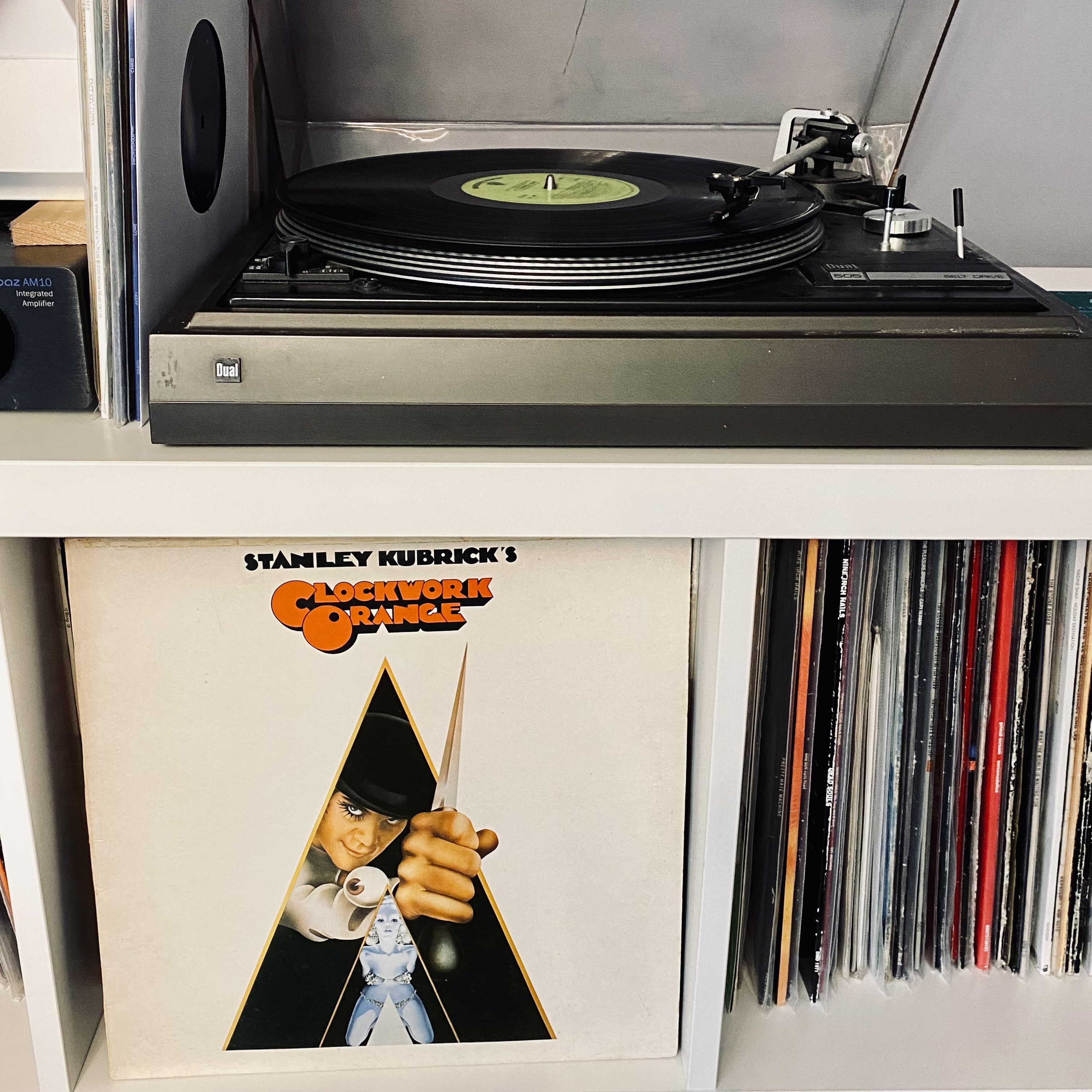
Picture of 'A Clockwork Orange' vinyl record playing on my turntable
I think I picked this up at Tynemouth Market when I lived close by, but I'm not sure. I am sure I didn't pay much for it. Mine is a UK re-pressing from 1971. The abridged (and sped-up) version of William Tell Overture is great for getting the kids to complete a task. Burgess's novel (now 60 years old) has been on my to-read pile for years. in 2018 Electronic Sound magazine featured a cover-mount CD "New Clockwork Music" of music inspired by this soundtrack: It's very good. I must dig that out

31 March 2022

Russell Coker: Links March 2022

Anarcat wrote a great blog post about switching from OpenNTP to Chrony which gives a good overview of how NTP works and how accurate the different versions are [1]. Bleeping Computer has an amusing article about criminals who copied a lot of data from NVidia servers including specs of their latest products [2], they are threatening to release all the data if NVidia doesn t stop crippling their GPUs to make them unsuitable for crypto currency mining. I don t support these criminals, but I think NVidia should allow people who buy hardware to use their property as they choose. If cryptocurrency miners buy all the NVidia products then NVidia still makes the sales, they could even auction them to make more money. NPR has a disturbing article about the way execution by lethal injection works in the US [3]. It seems that most people die in an extremely unpleasant way. It makes the North Korean execution by anti-aircraft gun seem civilised. The DirtyPipe vulnerability is the latest serious security issue in the Linux kernel [4]. The report of how it was discovered is very interesting and should be read by all sysadmins. SE Linux will not save you from this as the vulnerability allows writing to read-only files like /etc/passwd. Politico has an insightful analysis of Putin, it s not good news he wants to conquer all territory that had ever been part of a Russian empire at any time in history [5]. The Guardian has an informative article about the EU s attempts to debunk Russian propaganda about Covid19 [6]. Fortunately the sanctions are reducing Russia s ability to do such things now. The Guardian has in interesting article about a project to use literary analysis to predict wars [7]. Funded by the German military but funding was cut after it was proven to work. The Fact Act is a proposal by David Brin for political changes in the US to involve scientists and statisticians in an official advisory role in the legislative process [8], it s an idea with a lot of potential. Technology Review has an interesting interview with the leader of the NSA s Research Directorate [9]. In 2008 the EFF posted a long and informative article about the RIAA s war against music fans [10]. I had followed a lot of the news about this when it was happening, but I still learnt some things from this article that I hadn t known at the time. Also considering past legal battles in the context of the current situation is useful. As an aside all the music I want to listen to is now on YouTube and youtube-dl works really well for me. The 1952 edition of Psychiatry: Journal of Interpersonal Relations has an interesting article On Cooling the Mark Out [11] which starts about how criminal gangs engaged in fraud try to make their victims come to terms with the loss in a way that doesn t involve the police. But it goes on to cover ways of dealing with loss of status in general. The layout is hacky with words broken by hyphens in the middle of lines as it appears to have been scanned from paper, converted to MS-Word, and from there to PDF. But it s worth it. The Internet Heist by Cory Doctorow is an insightful series of 3 articles about the MPAA (MAFIAA) attempts to take over all TV distribution in the US [12]. Wired has an interesting exerpt from the book Spies, Lies, and Algorithms: The History and Future of American Intelligence , by Amy B. Zegart [13]. Interesting summary of the open source intelligence systems (which have nothing to do with open source as free software). But it would be interesting to have an open source intelligence organisation along similar lines to open source software. The guy who tracks billionaire s private jets is an example of this.

29 March 2022

Jacob Adams: A Lesson in Shortcuts

(The below was written by Rob Pike, copied here for posterity from The Wayback Machine) Long ago, as the design of the Unix file system was being worked out, the entries . and .. appeared, to make navigation easier. I m not sure but I believe .. went in during the Version 2 rewrite, when the file system became hierarchical (it had a very different structure early on). When one typed ls, however, these files appeared, so either Ken or Dennis added a simple test to the program. It was in assembler then, but the code in question was equivalent to something like this:
   if (name[0] == '.') continue;
This statement was a little shorter than what it should have been, which is
   if (strcmp(name, ".") == 0   strcmp(name, "..") == 0) continue;
but hey, it was easy. Two things resulted. First, a bad precedent was set. A lot of other lazy programmers introduced bugs by making the same simplification. Actual files beginning with periods are often skipped when they should be counted. Second, and much worse, the idea of a hidden or dot file was created. As a consequence, more lazy programmers started dropping files into everyone s home directory. I don t have all that much stuff installed on the machine I m using to type this, but my home directory has about a hundred dot files and I don t even know what most of them are or whether they re still needed. Every file name evaluation that goes through my home directory is slowed down by this accumulated sludge. I m pretty sure the concept of a hidden file was an unintended consequence. It was certainly a mistake. How many bugs and wasted CPU cycles and instances of human frustration (not to mention bad design) have resulted from that one small shortcut about 40 years ago? Keep that in mind next time you want to cut a corner in your code. (For those who object that dot files serve a purpose, I don t dispute that but counter that it s the files that serve the purpose, not the convention for their names. They could just as easily be in $HOME/cfg or $HOME/lib, which is what we did in Plan 9, which had no dot files. Lessons can be learned.)

27 March 2022

Russ Allbery: Review: A Song for a New Day

Review: A Song for a New Day, by Sarah Pinsker
Publisher: Berkley
Copyright: September 2019
ISBN: 1-9848-0259-3
Format: Kindle
Pages: 372
Luce Cannon was touring with a session band when the shutdown began. First came the hotel evacuation in the middle of the night due to bomb threats against every hotel in the state. Then came the stadium bombing just before they were ready to go on stage. Luce and most of the band performed anyway, with a volunteer crew and a shaken crowd. It was, people later decided, the last large stage show in the United States before the congregation laws shut down public gatherings. That was the end of Luce's expected career, and could have been the end of music, or at least public music. But Luce was stubborn and needed the music. Rosemary grew up in the aftermath: living at home with her parents well away from other people, attending school virtually, and then moving seamlessly into a virtual job for Superwally, the corporation that ran essentially everything. A good fix for some last-minute technical problems with StageHoloLive's ticketing system got her an upgraded VR hoodie and complimentary tickets to the first virtual concert she'd ever attended. She found the experience astonishing, prompting her to browse StageHoloLive job openings and then apply for a technical job and, on a whim, an artist recruiter role. That's how Rosemary found herself, quite nerve-wrackingly, traveling out into the unsafe world to look for underground musicians who could become StageHoloLive acts. A Song for a New Day was published in 2019 and had a moment of fame at the beginning of 2020, culminating in the Nebula Award for best novel, because it's about lockdowns, isolation, and the suppression of public performances. There's even a pandemic, although it's not a respiratory disease (it's some variety of smallpox or chicken pox) and is only a minor contributing factor to the lockdowns in this book. The primary impetus is random violence. Unfortunately, the subsequent two years have not been kind to this novel. Reading it in 2022, with the experience of the past two years fresh in my mind, was a frustrating and exasperating experience because the world setting is completely unbelievable. This is not entirely Pinsker's fault; this book was published in 2019, was not intended to be about our pandemic, and therefore could not reasonably predict its consequences. Still, it required significant effort to extract the premise of the book from the contradictory evidence of current affairs and salvage the pieces of it I still enjoyed. First, Pinsker's characters are the most astonishingly incurious and docile group of people I've seen in a recent political SF novel. This extends beyond the protagonists, where it could arguably be part of their characterization, to encompass the entire world (or at least the United States; the rest of the world does not appear in this book at all so far as I can recall). You may be wondering why someone bombs a stadium at the start of the book. If so, you are alone; this is not something anyone else sees any reason to be curious about. Why is random violence spiraling out of control? Is there some coordinated terrorist activity? Is there some social condition that has gotten markedly worse? Race riots? Climate crises? Wars? The only answer this book offers is a completely apathetic shrug. There is a hint at one point that the government may have theories that they're not communicating, but no one cares about that either. That leads to the second bizarre gap: for a book that hinges on political action, formal political structures are weirdly absent. Near the end of the book, one random person says that they have been inspired to run for office, which so far as I can tell is the first mention of elections in the entire book. The "government" passes congregation laws shutting down public gatherings and there are no protests, no arguments, no debate, but also no suppression, no laws against the press or free speech, no attempt to stop that debate. There's no attempt to build consensus for or against the laws, and no noticeable political campaigning. That's because there's no need. So far as one can tell from this story, literally everyone just shrugs and feels sad and vaguely compliant. Police officers exist and enforce laws, but changing those laws or defying them in other than tiny covert ways simply never occurs to anyone. This makes the book read a bit like a fatuous libertarian parody of a docile populace, but this is so obviously not the author's intent that it wouldn't be satisfying to read even as that. To be clear, this is not something that lasts only a few months in an emergency when everyone is still scared. This complete political docility and total incuriosity persists for enough years that Rosemary grows up within that mindset. The triggering event was a stadium bombing followed by an escalating series of random shootings and bombings. (The pandemic in the book only happens after everything is locked down and, apart from adding to Rosemary's agoraphobia and making people inconsistently obsessed with surface cleanliness, plays little role in the novel.) I lived through 9/11 and the Oklahoma City bombing in the US, other countries have been through more protracted and personally dangerous periods of violence (the Troubles come to mind), and never in human history has any country reacted to a shock of violence (or, for that matter, disease) like the US does in this book. At points it felt like one of those SF novels where the author is telling an apparently normal story and all the characters turn out to be aliens based on spiders or bats. I finally made sense of this by deciding that the author wasn't using sudden shocks like terrorism or pandemics as a model, even though that's what the book postulates. Instead, the model seems to be something implicitly tolerated and worked around: US school shootings, for instance, or the (incorrect but widespread) US belief in a rise of child kidnappings by strangers. The societal reaction here looks less like a public health or counter-terrorism response and more like suburban attitudes towards child-raising, where no child is ever left unattended for safety reasons but we routinely have school shootings no other country has at the same scale. We have been willing to radically (and ineffectually) alter the experience of childhood due to fears of external threat, and that's vaguely and superficially similar to the premise of this novel. What I think Pinsker still misses (and which the pandemic has made glaringly obvious) is the immense momentum of normality and the inability of adults to accept limitations on their own activities for very long. Even with school shootings, kids go to school in person. We now know that parts of society essentially collapse if they don't, and political pressure becomes intolerable. But by using school shootings as the model, I managed to view Pinsker's setup as an unrealistic but still potentially interesting SF extrapolation: a thought experiment that ignores countervailing pressures in order to exaggerate one aspect of society to an extreme. This is half of Pinsker's setup. The other half, which made less of a splash because it didn't have the same accident of timing, is the company Superwally: essentially "what if Amazon bought Walmart, Google, Facebook, Netflix, Disney, and Live Nation." This is a more typical SF extrapolation that left me with a few grumbles about realism, but that I'll accept as a plot device to talk about commercialization, monopolies, and surveillance capitalism. But here again, the complete absence of formal political structures in this book is not credible. Superwally achieves an all-pervasiveness that in other SF novels results in corporations taking over the role of national governments, but it still lobbies the government in much the same way and with about the same effectiveness as Amazon does in our world. I thought this directly undermined some parts of the end of the book. I simply did not believe that Superwally would be as benign and ineffectual as it is shown here. Those are a lot of complaints. I found reading the first half of this book to be an utterly miserable experience and only continued reading out of pure stubbornness and completionism. But the combination of the above-mentioned perspective shift and Pinsker's character focus did partly salvage the book for me. This is not a book about practical political change, even though it makes gestures in that direction. It's primarily a book about people, music, and personal connection, and Pinsker's portrayal of individual and community trust in all its complexity is the one thing the book gets right. Rosemary's character combines a sort of naive arrogance with self-justification in a way that I found very off-putting, but the pivot point of the book is the way in which Luce and her community extends trust to her anyway, as part of staying true to what they believe. The problem that I think Pinsker was trying to write about is atomization, which leads to social fragmentation into small trust networks with vast gulfs between them. Luce and Rosemary are both characters who are willing to bridge those gulfs in their own ways. Pinsker does an excellent job describing the benefits, the hurt, the misunderstandings, the risk, and the awkward process of building those bridges between communities that fundamentally do not understand each other. There's something deep here about the nature of solidarity, and how you need both people like Luce and people like Rosemary to build strong and effective communities. I've kept thinking about that part. It's also helpful for a community to have people who are curious about cause and effect, and who know how a bill becomes a law. It's hard to sum up this book, other than to say that I understand why it won a Nebula but it has deep world-building flaws that have become far more obvious over the past two years. Pinsker tries hard to capture the feeling of live music for both the listener and the performer and partly succeeded even for me, which probably means others will enjoy that part of the book immensely. The portrayal of the difficult dynamics of personal trust was the best part of the book for me, but you may have to build scaffolding and bracing for your world-building disbelief in order to get there. On the whole, I think A Song for a New Day is worth reading, but maybe not right now. If you do read it now, tell yourself at the start that this is absolutely not about the pandemic and that everything political in this book is a hugely simplified straw-man extrapolation, and hopefully you'll find the experience less frustrating than I found it. Rating: 6 out of 10

26 March 2022

Andrew Cater: Part way through testing Debian media images 20220326 1555UTC - Found a new useful utility

For various obscure reasons, I have a mirror of Debian in one room and the main laptop and so on I use in another. The mirror is connected to a fast Internet line - and has a 1Gb Ethernet cable into the back directly from the router, the laptop and everything else - not so much, everything is wired, but depends on a WiFi link across the property. One end is fast - one end runs like a snail.Steve suggested I use a different tool to make images directly on the mirror machine - jigit. Slightly less polished than jigdo but - if you're on the same machine - blazingly fast. I just used it to make the Blu-Ray sized .iso and was very pleasantly surprised. jigit-mkimage -j [jigdo file] -t [template file] -m Debian=[path to mirror of Debian] -o [output filename]
Another nice surprise for me - I have a horrible old Lenovo Ideapad. It's one of the Bay Trail Intel machines with a 32 bit UEFI and a 64 bit processor. I rescued it from the junk heap. Reinstalling it with an image today fixed an issue I had with slow boot and has turned it into an adequate machine for web browsing.All in all, I've done relatively few tests so far - but it's been a good day, as ever.More later.


21 March 2022

Antoine Beaupr : 20+ years of Emacs

I enjoyed reading this article named "22 years of Emacs" recently. It's kind of fascinating, because I realised I don't exactly know for how long I've been using Emacs. It's lost in the mists of history. If I would have to venture a guess, it was back in the "early days", which in that history is mapped around 1996-1997, when I installed my very own "PC" with FreeBSD 2.2.x and painstakingly managed to make XFree86 run on it. Modelines. Those were the days... But I digress.

I am old... The only formal timestamp I can put is that my rebuilt .emacs.d git repository has its first commit in 2002. Some people reading this may be born after that time. This means I'm at least significantly older than those people, to put things gently. Clever history nerds will notice that the commit is obviously fake: Git itself did not exist until 2005. But ah-ah! I was already managing my home directory with CVS in 2001! I converted that repository into git some time in 2009, and therefore you can see all my embarrassing history, including changes from two decades ago. That includes my first known .emacs file which is just bizarre to read right now: 200 lines, most of which are "customize" stuff. Compare with the current, 1000+ lines init.el which is also still kind of a mess, but actually shares very little with the original, thankfully. All this to say that in those years (decades, really) of using Emacs, I have had a very different experience than credmp who wrote packages, sent patches, and got name dropping from other developers. My experience is just struggling to keep up with everything, in general, but also in Emacs.

... and Emacs is too fast for me It might sound odd to say, but Emacs is actually moving pretty fast right now. A lot of new packages are coming out, and I can hardly keep up.
  • I am not using org mode, but did use it for time (and task) tracking for a while (and for invoicing too, funky stuff).
  • I am not using mu4e, but maybe I'm using something better (notmuch) and yes, I am reading my mail in Emacs, which I find questionable from a security perspective. (Sandboxing untrusted inputs? Anyone?)
  • I am using magit, but only when coding, so I do end up using git on the command line quite a bit anyways.
  • I do have which-key enabled, and reading about it reminded me I wanted to turn it off because it's kind of noisy and I never remember I can actually use it for anything. Or, in other words, I don't even remember the prefix key or, when I do, there's too many possible commands after for it to be useful.
  • I haven't setup lsp-mode, let alone Eglot, which I just learned about reading the article. I thought I would be super shiny and cool by setting up LSP instead of the (dying?) elpy package, but I never got around to it. And now it seems lsp-mode is uncool and I should really do eglot instead, and that doesn't help. UPDATE: I finally got tired and switched to lsp-mode. The main reason for choosing it over eglot is that it's in Debian (and eglot is not). (Apparently, eglot has more chance of being upstreamed, "when it's done", but I guess I'll cross that bridge when I get there.) lsp-mode feels slower than elpy but I haven't done any of the performance tuning and this will improve even more with native compilation (see below). I already had lsp-mode partially setup in Emacs so I only had to do this small tweak to switch and change the prefix key (because s-l or mod is used by my window manager). I also had to pin LSP packages to bookworm here and here.
  • I am not using projectile. It's on some of my numerous todo lists somewhere, surely. I suspect it's important to getting my projects organised, but I still live halfway between the terminal and Emacs, so it's not quite clear what I would gain.
  • I had to ask what native compilation was or why it mattered the first time I heard of it. And when I saw it again in the article, I had to click through to remember.
Overall, I feel there's a lot of cool stuff in Emacs out there. But I can't quite tell what's the best of which. I can barely remember which completion mechanism I use (company, maybe?) or what makes my mini-buffer completion work the way it does. Everything is lost in piles of customize and .emacs hacks that is constantly changing. Because a lot is in third-party packages, there are often many different options and it's hard to tell which one we should be using.

... or at least fast enough And really, Emacs feels fast enough for me. When I started, I was running Emacs on a Pentium I, 166MHz, with 8MB of RAM (eventually upgraded to 32MB, whoohoo!). Back in those days, the joke was that EMACS was an acronym for "Eight Megs, Always Scratching" and now that I write this down, I realize it's actually "Eight Megs, and Constantly Swapping", which doesn't sound as nice because you could actually hear Emacs running on those old hard drives back in the days. It would make a "scratching" noise as the hard drive heads would scramble maniacally to swap pages in and out of swap to make room for the memory-hungry editor. Now Emacs is pretty far down the list of processes in top(1) regardless of how you look at it. It's using 97MB of resident memory and close to 400MB of virtual memory, which does sound like an awful lot compared to my first computer... But it's absolutely nothing compared to things like Signal-desktop, which somehow manages to map a whopping 20.5GB virtual memory. (That's twenty Gigabytes of memory for old timers or time travelers from the past, and yes, that is now a thing.) I'm not exactly sure how much resident memory it uses (because it forks multiple processes), probably somewhere around 300MB of resident memory. Firefox also uses gigabytes of that good stuff, also spread around the multiple processes, per tab. Emacs "feels" super fast. Typing latency is noticeably better in Emacs than my web browser, and even beats most terminal emulators. It gets a little worse when font-locking is enabled, unfortunately, but it's still feels much better. And all my old stuff still works in Emacs, amazingly. (Good luck with your old Netscape or ICQ configuration from 2000.) I feel like an oldie, using Emacs, but I'm really happy to see younger people using it, and learning it, and especially improving it. If anything, one direction I would like to see it go is closer to what web browsers are doing (yes, I know how bad that sounds) and get better isolation between tasks. An attack on my email client shouldn't be able to edit my Puppet code, and/or all files on my system, for example. And I know, fundamentally, that's a really hard challenge in Emacs. But if you're going to treat your editor as your operating system (or vice versa, I lost track of where we are now that there's an Emacs Window Manager, which I do not use), at least we should get that kind of security. Otherwise I'll have to find a new mail client, and that's really something I try to limit to once a decade or so.

20 March 2022

Joerg Jaspert: Another shell script moved to rust

Shell? Rust! Not the first shell script I took and made a rust version of, but probably my largest yet. This time I took my little tm (tmux helper) tool which is (well, was) a bit more than 600 lines of shell, and converted it to Rust. I got most of the functionality done now, only one major part is missing.

What s tm? tm started as a tiny shell script to make handling tmux easier. The first commit in git was in July 2013, but I started writing and using it in 2011. It started out as a kind-of wrapper around ssh, opening tmux windows with an ssh session on some other hosts. It quickly gained support to open multiple ssh sessions in one window, telling tmux to synchronize input (send input to all targets at once), which is great when you have a set of machines that ought to get the same commands.

tm vs clusterssh / mussh In spirit it is similar to clusterssh or mussh, allowing to run the same command on many hosts at the same time. clusterssh sets out to open new terminals (xterm) per host and gives you an input line, that it sends everywhere. mussh appears to take your command and then send it to all the hosts. Both have disadvantages in my opinion: clusterssh opens lots of xterm windows, and you can not easily switch between multiple sessions, mussh just seems to send things over ssh and be done. tm instead just creates a tmux session, telling it to ssh to the targets, possibly setting the tmux option to send input to all panes. And leaves all the rest of the handling to tmux. So you can
  • detach a session and reattach later easily,
  • use tmux great builtin support for copy/paste,
  • see all output, modify things even for one machine only,
  • zoom in to one machine that needs just ONE bit different (cssh can do this too),
  • let colleagues also connect to your tmux session, when needed,
  • easily add more machines to the mix, if needed,
  • and all the other extra features tmux brings.

More tm tm also supports just attaching to existing sessions as well as killing sessions, mostly for lazyness (less to type than using tmux directly). At some point tm gained support for setting up sessions according to some session file . It knows two formats now, one is simple and mostly a list of hostnames to open synchronized sessions for. This may contain LIST commands, which let tm execute that command, expected output is list of hostnames (or more LIST commands) for the session. That, combined with the replacement part, lets us have one config file that opens a set of VMs based on tags our Ganeti runs, based on tags. It is simply a LIST command asking for VMs tagged with the replacement arg and up. Very handy. Or also all VMs on host X . The second format is basically free form tmux commands . Mostly commandline tmux call, just drop the tmux in front collection. Both of them supporting a crude variable replacement.

Conversion to Rust Some while ago I started playing with Rust and it somehow clicked , I do like it. My local git tells me, that I tried starting off with go in 2017, but that appearently did not work out. Fun, everywhere I can read says that Rust ought to be harder to learn. So by now I have most of the functionality implemented in the Rust version, even if I am sure that the code isn t a good Rust example. I m learning, after all, and already have adjusted big parts of it, multiple times, whenever I learn (and understand) something more - and am also sure that this will happen again

Compatibility with old tm It turns out that my goal of staying compatible with the behaviour of the old shell script does make some things rather complicated. For example, the LIST commands in session config files - in shell I just execute them commands, and shell deals with variable/parameter expansion, I just set IFS to newline only and read in what I get back. Simple. Because shell is doing a lot of things for me. Now, in Rust, it is a different thing at all:
  • Properly splitting the line into shell words, taking care of quoting (can t simply take whitespace) (there is shlex)
  • Expanding specials like ~ and $HOME (there is home_dir).
  • Supporting environment variables in general, tm has some that adjust behaviour of it. Which shell can use globally. Used lazy_static for a similar effect - they aren t going to change at runtime ever, anyways.
Properly supporting the commandline arguments also turned out to be a bit more work. Rust appearently has multiple crates supporting this, I settled on clap, but as tm supports getopts -style as well as free-form arguments (subcommands in clap), it takes a bit to get that interpreted right.

Speed Most of the time entirely unimportant in the tool that tm is (open a tmux with one to some ssh connections to some places is not exactly hard or time consuming), there are situations, where one can notice that it s calling out to tmux over and over again, for every single bit to do, and that just takes time: Configurations that open sessions to 20 and more hosts at the same time especially lag in setup time. (My largest setup goes to 443 panes in one window). The compiled Rust version is so much faster there, it s just great. Nice side effect, that is. And yes, in the end it is also only driving tmux, still, it takes less than half the time to do so.

Code, Fun parts As this is still me learning to write Rust, I am sure the code has lots to improve. Some of which I will sure find on my own, but if you have time, I love PRs (or just mails with hints).

Github Also the first time I used Github Actions to see how it goes. Letting it build, test, run clippy and also run a code coverage tool (Yay, more than 50% covered ) on it. Unsure my tests are good, I am not used to writing tests for code, but hey, coverage!

Up next I do have to implement the last missing feature, which is reading the other config file format. A little scared, as that means somehow translating those lines into correct calls within the tmux_interface I am using, not sure that is easy. I could be bad and just shell out to tmux on it all the time, but somehow I don t like the thought of doing that. Maybe (ab)using the control mode, but then, why would I use tmux_interface, so trying to handle it with that first. Afterwards I want to gain a new command, to save existing sessions and be able to recreate them easily. Shouldn t be too hard, tmux has a way to get at that info, somewhere.

7 March 2022

Ayoyimika Ajibade: Progress Report!! Modifying Expectations...

Wait! Just like yesterday when I was accepted as an Outreachy intern and the first half of the internship is finished . How time flies when you are having a good time As part of the requirements for the final application during the contribution period for the Outreachy internship, I needed to provide a timeline to achieve our goal on my outreachy task which is transitioning of dependencies in node16 and webpack5. Having consulted my mentors who implied that the packages depending on webpack and nodejs combined are so numerous that its impossible to finish all within a space of three months but we have steps to guide us through the entire process to achieve most of our goals which are As of this writing(though a little late ) we have successfully rebuilt all reverse dependencies of webpack5 and split them equally each for I and my co-intern for all Javascript modules as ruby packages also depend on webpack which is a total of 44 packages. Filed a bug report on Debian bug tracking system for failing packages, also the original maintainer or uploader of the package to the Debian archive mostly Debian developers also get a mail in references to the package bug report. Sometimes the uploader who also receives the bug report decides to help out to fix the package and forward the patch upstream if need be. We have also filed an issue to upstream repo mostly via github where some respond and create PR to solve those errors and others are plain aversive to the whole idea. PR from the upstream developer is cherry-picked and a patch is created by us to incorporate the code into our own working repository. some package upstream maintainer rejects such issues or doesn't respond, we take it upon ourselves to fix the package. The total number of packages that are successfully updated and ready to be merged is 10 packages while 12 packages remain on my own end to be updated. One of the most challenging packages to update so far was prop-type as its runs its large test suite using jest of a lower version 19.0.2 compared to that of Debian OS which is version 27.5.1 updating and migrating its API's and methods to use the Debian updated version is so challenging after several googling, testing out the solution from StackOverflow, trials, and errors, reading documentations we eventually made progress with the help of my mentor, co-intern and the whole community member. It's so crazy that when I got it working I said to myself. phew it's not rocket science why can I figure it out sooner than expected I initially proposed that I would be halfway done with the project by now, I guess the reason am not able to achieve some of our goals which are finishing up with the packages for webpack and moving to transition some of the nodejs packages at all is DEBUGGING. Yes DEBUGGING! where you never can predict what the solution is. is the problem coming from Debian? or dependencies of the package you are working on, upstream bug, or dependencies of dependencies of the package you are working on, so many questions to answer. You can't easily find a solution to a bug as it takes time to try out so many guesses more of an educated guess, or even try out all the solutions from stack overflow and still no viable progress. Obviously, you cannot really know about something to set up a plan for unless you get right into it. One way of doing this, if I have to start again is the truly understand how the javascript package work under the hood, how its handles different interaction between packages, some of its dos and don't of transpiling, bundling, testing, e.t.c I guess my unrealistic goals need to be modified because some drawback that was not envisaged popped up and I underestimated the complexity of the tasks, which will be reducing the number of packages to update in transitioning of nodejs from what I planned My major focus for the second half of the internship is to fix bugs and errors I discover, file bug reports for future bugs to seek help from co-maintainer or developers, file issues upstream and close those whose bugs are already resolved for the remaining 12 packages, and ultimately successfully uploading all reverse dependencies. Also diving into transitioning of nodejs16. Thanks for stopping by

4 March 2022

Abiola Ajadi: Outreachy-And it s a wrap!

Outreachy Wrap-up Project Improve Debian Continuous Integration UX
Project Link: https://www.outreachy.org/outreachy-december-2021-internship-round/communities/debian/#improve-debian-continuous-integration-ux
Code Repository: https://salsa.debian.org/ci-team/debci
Mentors: Antonio Terceiro, Paul Gevers and Pavit Kaur

About the project Debci exist to make sure packages work currently after an update, How it does this is by testing all of the packages that have tests written in them to make sure it works and nothing is broken This project entails making improvements to the platform to make it easier to use and maintain.

Deliverables of the project:
  • Package landing page displaying pending jobs
  • web frontend: centralize job listings in a single template
  • self-service: request test form forgets values when validation fails
  • Improvement to status

Work done

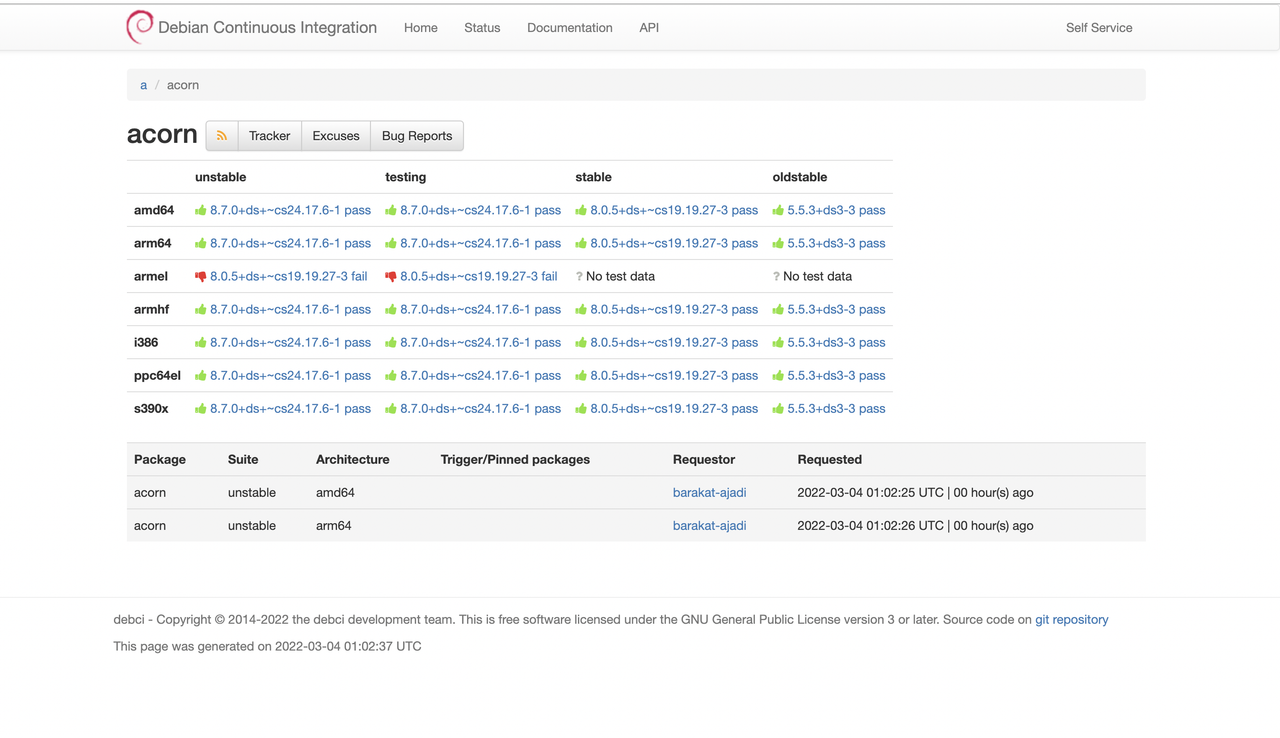
Package landing page displaying pending jobs Previously, Jobs that were pending were not displayed on the package page. Working on this added a feature to display pending jobs on package landing. Working on this task made it known that the same block of codes was repeated in different files which led to the next task Screenshot-2022-03-04-at-02-03-06.png Merge request
web frontend: centralize job listings in a single template Jobs are listed in various landings such as status packages, Status alerts, status failing, History, and so on. The same Code was repeated in these pages to list the jobs, I worked on refactoring it and created a single template for job listing so it can be used anywhere it s needed. I also wrote a test for the feature I added.
Merge request
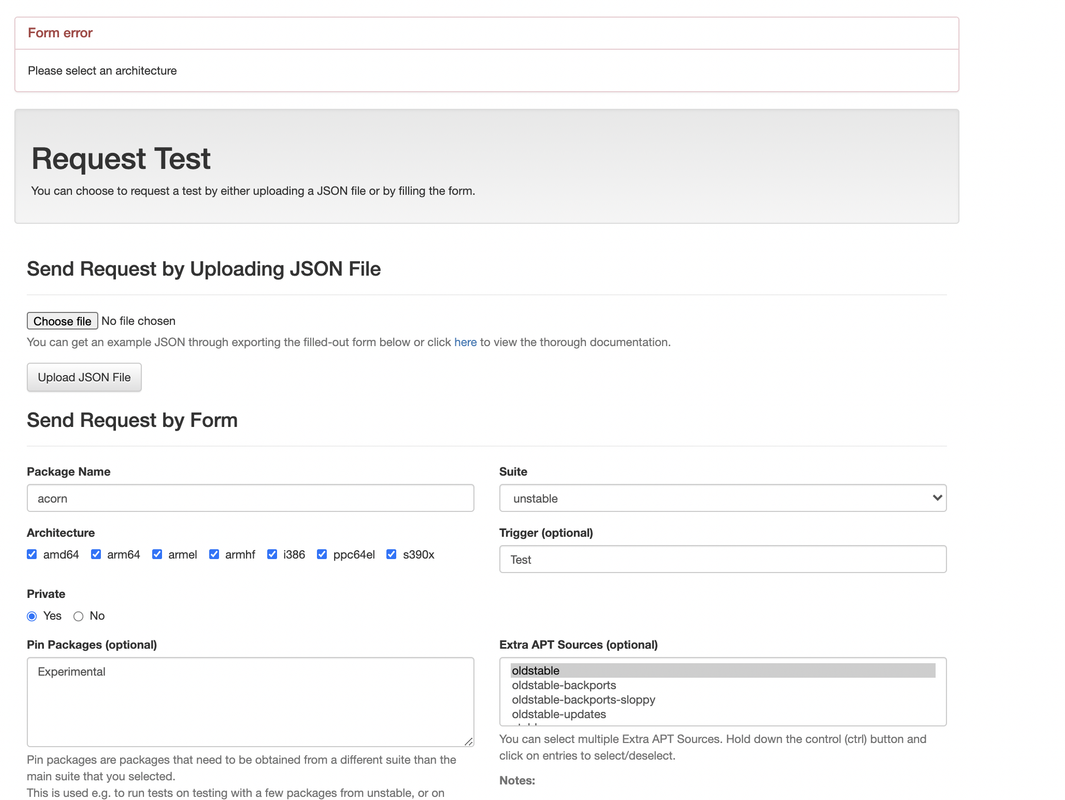
self service: request test form forgets values when validation fails When one tries to request for a test and it fails with an error, originally the form does not remember the values that were typed in the package name, suite field et. c. This fix ensures the form remembers the values inputted even when it throws an error. Image of request test page N/B: The form checks all architecture on the load of the page
merge request
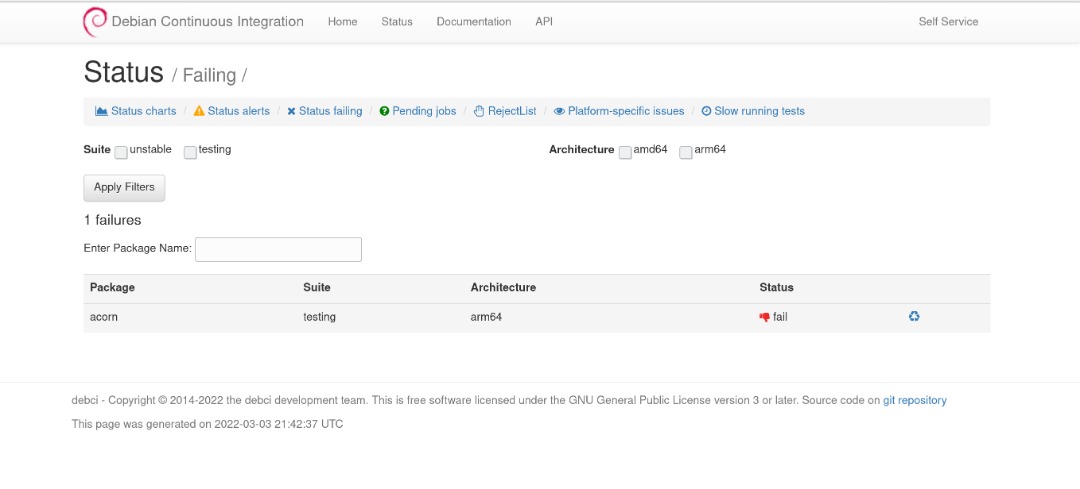
Improvement to status Originally the Status pages were rendered as static HTML pages but I converted these pages to be generated dynamically, I wrote endpoints for each page. Since most of the status pages have a list of jobs I modified it to use the template I created for job-listing. Previously, the status pages had a mechanism to filter such as All, Latest 50 et.c which wasn t paginated. I removed this mechanism added a filter by architecture and suites to these pages and also add pagination. Last but not the least, I wrote tests for these implementations carried out on the status page. Image of Status failing page merge request:
first task
second task

Major take-aways I learnt a lot during my internship but most importantly I learnt how to:
  • write Tests in Ruby and how writing tests is an important aspect of software development
  • maintain good coding practice, Paying attending to commit messages, Indentation et.c are good areas I developed in writing code.
  • make contributions in Ruby Programming Language.

Acknowledgement I can not end this without saying thank you to my mentors Antonio Terceiro, Paul Gevers, and Pavit Kaur for their constant support and guidance throughout the entire duration of this Internship. It has been a pleasure Interacting and learning from everyone.

Review Outreachy has helped me feel more confident about open-source, especially during the application phase. I had to reach out to the community I was interested in and ask questions on how to get started. The informal chats week was awesome I was able to build my network and have interesting conversations with amazing individuals in open-source. To round up, Always ask questions and do not be afraid of making a mistake, as one of the outreachy blog post topics says Everyone struggles!, but never give up!

1 March 2022

Utkarsh Gupta: FOSS Activites in February 2022

Here s my (twenty-ninth) monthly but brief update about the activities I ve done in the F/L/OSS world.

Debian
This was my 38th month of actively contributing to Debian. I became a DM in late March 2019 and a DD on Christmas 19! \o/ I had been sick this month, so most of the time I spent away from system, recovering, et al, and also went through the huge backlog that I had, which is starting to get smaller. :D Anyway, I did the following stuff in Debian:

Uploads and bug fixes:
  • at (3.4.4-1) - Adding a DEP8 test for the package, fixing bug #985421.

Other $things:
  • Mentoring for newcomers.
  • Moderation of -project mailing list.

Ubuntu
This was my 13th month of actively contributing to Ubuntu. Now that I joined Canonical to work on Ubuntu full-time, there s a bunch of things I do! \o/ I mostly worked on different things, I guess. I was too lazy to maintain a list of things I worked on so there s no concrete list atm. Maybe I ll get back to this section later or will start to list stuff from the fall, as I was doing before. :D

Debian (E)LTS
Debian Long Term Support (LTS) is a project to extend the lifetime of all Debian stable releases to (at least) 5 years. Debian LTS is not handled by the Debian security team, but by a separate group of volunteers and companies interested in making it a success. And Debian Extended LTS (ELTS) is its sister project, extending support to the Jessie release (+2 years after LTS support). This was my twenty-ninth month as a Debian LTS and eighteenth month as a Debian ELTS paid contributor.
Whilst I was assigned 42.75 hours for LTS and 45.25 hours for ELTS, I could only work a little due to being sick and so I spent 15.75 hours on LTS and 9.25 hours on ELTS and worked on the following things:

LTS CVE Fixes and Announcements:

ELTS CVE Fixes and Announcements:

Other (E)LTS Work:

Debian LTS Survey I ve spent 10 hours on the LTS survey on the following bits:
(and 5 hours of the last month that I m going to invoice this month)
  • Put most of the content in the instance according to the question type.
  • Been going back and forth updating the status of the survey on the issue.
  • Trying to find a way to send to DDs - discussing with DPL, Raphael, and other people on the issue itself.
  • Completing the last bits to start the survey for the paid contributors, at least. Talking to Jeremiah about this.

Until next time.
:wq for today.

Paul Wise: FLOSS Activities February 2022

Focus This month I didn't have any particular focus. I just worked on issues in my info bubble.

Changes

Issues

Review

Administration
  • Debian BTS: fix usertags for some users, unarchive/reopen/triage bugs for reintroduced packages: horae dh-haskell shutter logging-tree openstreetmap-carto gnome-commander
  • Debian servers: restore wiki data from backup, restarted bacula director for TLS cert update
  • Debian wiki: restore wiki account from backup, approve accounts

Communication
  • Respond to queries from Debian users and contributors on the mailing lists and IRC

Sponsors The purple-discord, gensim, DiskANN, SPTAG, wsproto work was sponsored by my employer. All other work was done on a volunteer basis.

26 February 2022

Daniel Silverstone: Subplot and FOSDEM 2022 talk

As many of you may be aware, I work with Lars Wirzenius on a project we call Subplot which is a tool for writing documentation which helps all stakeholders involved with a proejct to understand how the project meets its requirements. At the start of February we had FOSDEM which was once again online, and I decided to give a talk in the Safety and open source devroom to introduce the concepts of safety argumentation and to bring some attention to how I feel that Subplot could be used in that arena. You can view the talk on the FOSDEM website at some point in the future when they manage to finish transcoding all the amazing talks from the weekend, or if you are more impatient, on Youtube, whichever you prefer. If, after watching the talk, or indeed just reading about Subplot on our website, you are interested in learning more about Subplot, or talking with us about how it might fit into your development flow, then you can find Lars and myself in the Subplot Matrix Room or else on any number of IRC networks where I hang around as kinnison.

24 February 2022

Dirk Eddelbuettel: #36: pub/sub for live market monitoring with R and Redis

Welcome to the 36th post of the really randomly reverberating R, or R4 for short, write-ups. Today s post is about using Redis, and especially RcppRedis, for live or (near) real-time monitoring with R. market monitor There is an saying that you can take the boy out of the valley, but you cannot the valley out of the boy so for those of us who spent a decade or two in finance and on trading floors, having some market price information available becomes second nature. And/or sometimes it is just good fun to program this. A good while back Josh posted a gist on a simple-yet-robust while loop. It (very cleverly) uses his quantmod package to access the SP500 in real-time . (I use quotes here because at the end of retail broadband one is not at the same market action as someone co-located in a New Jersey data center. It is however not delayed: as an index, it is not immediately tradeable as a stock, etf, or derivative may be all of which are only disseminated as delayed price information, usually by ten minutes.) I quite enjoyed the gist and used it and started tinkering with it. For example, it collects data but only saves (i.e. persists ) it after market close. If for whatever reason one needs to restart recent history is gone. In any event, I used his code and generalized it a little and published this about a year ago as function intradayMarketMonitor() in my dang package. (See this blog post announcing it.) The chart of the left shows this in action, the chart is a snapshot from a couple of days ago when the vignettes (more on them below) were written. As lovely as intradayMarketMonitor() is, it also limits itself to market hours. And sometimes you want to see, say, how the market opens on Sunday (futures usually restart at 17h Chicago time), or how news dissipates during the night, or where markets are pre-open, or . So I both wanted to complement this with futures, and also cache it locally so that, say, one machine might collect data and one (or several others) can visualize. For such tasks, Redis is unparalleled. (Yet I also always felt Redis could do with another, simple, short and sweet introduction stressing the key features of i) being multi-lingual: write in one language, consume in another and ii) loose coupling: no linking as one talks to Redis via standard tcp/ip networking. So I wrote a new intro vignette that is now in RcppRedis. I hope this comes in handy. Comments welcome!) Our RcppRedis package had long been used for such tasks, and it was easy to set it up. Standard use is to loop, fetch some data, push it to Redis, sleep, and start over. Clients do the same: fetch most recent data, plot or report it, sleep, start over. That works, but it has a dual delay as the client sleeping may miss the data update! The standard answer to this is called publish/pubscribe, or pub/sub. Libraries such as 0mq or zeromq specialise in this. But it turns out Redis already has it. I had some initial difficulty adding it to RcppRedis so for a trial I tested the marvellous rredis package by Bryan and simply instantiated two Redis clients. Now the data getter simply publishes a new data point in a given channel, by convention named after the security it tracks. Clients register with the Redis server which does all the actual work of keeping track of who listens to what. The clients now simply listen (which is a blocking operation) and as soon as data comes in receive it. market monitor This is quite mesmerizing when you just run two command-line clients (in a byobu session, say). As sone as the data is written (as shown on console log) it is consumed. No measruable overhead. Just lovely. Bryan and I then talked a litte as he may or may not retire rredis. Having implemented the pub/sub logic for both sides once, he took a good hard look at RcppRedis and just like that added it there. With some really clever wrinkles for (optional) per-symbol callback as closure attached to the instance. Truly amazeballs And once we had it in there, generalizing from publishing or subscribing to just one symbol easily generalizes to having one listener collect and publish for multiple symbols, and having one or more clients subscribe and listen one, more or even all symbol. All with ease thanks tp Redis. The second chart, also from a few days ago, shows four symbols for four (front-contract) futures for Bitcoin, Crude Oil, SP500, and Gold. As all this can get a little technical, I wrote a second vignette for RcppRedis on just this: market monitoring. Give this a read, if interested, feedback on this one is most welcome too! But all the code you need is included in the package just run a local Redis instance. Before closing, one sour note. I uploaded all this in a new and much improved updated RcppRedis 0.2.0 to CRAN on March 13 ten days ago. Not only is it still not there , but CRAN in their most delightful way also refuses to answer any emails of mine. Just lovely. The package exhibited just one compiler warning: a C++ compiler objected to the (embedded) C library hiredis (included as a fallback) for using a C language construct. Yes. A C++ compiler complaining about C. It s a non-issue. Yet it s been ten days and we still have nothing. So irritating and demotivating. Anyway, you can get the package off its GitHub repo. If you like this or other open-source work I do, you can sponsor me at GitHub.

This post by Dirk Eddelbuettel originated on his Thinking inside the box blog. Please report excessive re-aggregation in third-party for-profit settings.

23 February 2022

Ian Jackson: Rooting an Eos Fairphone 4

Last week I received (finally) my Fairphone 4, supplied with a de-googled operating system, which I had ordered from the E Foundation s shop in December. (I m am very hard on hardware and my venerable Fairphone 2 is really on its last legs.) I expect to have full control over the software on any computing device I own which is as complicated, capable, and therefore, hazardous, as a mobile phone. Unfortunately the Eos image (they prefer to spell it /e/ os , srsly!) doesn t come with a way to get root without taking fairly serious measures including unlocking the bootloader. Unlocking the bootloader wouldn t be desirable for me but I can t live without root. So. I started with these helpful instructions: https://forum.xda-developers.com/t/fairphone-4-root.4376421/ I found the whole process a bit of a trial, and I thought I would write down what I did. But, it s not straightforward, at least for someone like me who only has a dim understanding of all this Android stuff. Unfortunately, due to the number of missteps and restarts, what I actually did is not really a sensible procedure. So here is a retcon of a process I think will work: Unlock the bootloader The E Foundation provide instructions for unlocking the bootloader on a stock FP4, here https://doc.e.foundation/devices/FP4/install and they seem applicable to the Murena phone supplied with Eos pre-installed, too. NB tht unlocking the bootloader wipes the phone. So we do it first. So:
  1. Power on the phone, with no SIM installed
  2. You get a welcome screen.
  3. Skip all things on startup including wifi
  4. Go to the very end of the settings, tap a gazillion times on the phone s version until you re a developer
  5. In the developer settings, allow usb debugging
  6. In the developer settings, allow oem bootloader unlocking
  7. Connect a computer via a USB cable, say yes on phone to USB debugging
  8. adb reboot bootloader
  9. The phone will reboot into a texty kind of screen, the bootloader
  10. fastboot flashing unlock
  11. The phone will reboot, back to the welcome screen
  12. Repeat steps 3-9 (maybe not all are necessary)
  13. fastboot flashing unlock_critical
  14. The phone will reboot, back to the welcome screen
Note that although you are running fastboot, you must run this command with the phone in bootloader mode, not fastboot (aka fastbootd ) mode. If you run fastboot flashing unlcok from fastboot you just get a don t know what you re talking about . I found conflicting instructions on what kind of Vulcan nerve pinches could be used to get into which boot modes, and had poor experiences with those. adb reboot bootloader always worked reliably for me. Some docs say to run fastboot oem unlock; I used flashing. Maybe this depends on the Android tools version. Initial privacy prep and OTA update We want to update the supplied phone OS. The build mine shipped with is too buggy to run Magisk, the application we are going to use to root the phone. (With the pre-installed phone OS, Magisk crashes at the patch boot image step.) But I didn t want to let the phone talk to Google, even for the push notifications registration.
  1. From the welcome screen, skip all things except location, date, time. Notably, do not set up wifi
  2. In settings, microg section
    1. turn off cloud messaging
    2. turn off google safetynet
    3. turn off google registration (NB you must do this after the other two, because their sliders become dysfunctional after you turn google registration off)
    4. turn off both location modules
  3. In settings, location section, turn off allowed location for browser and magic earth
  4. Now go into settings and enable wifi, giving it your wifi details
  5. Tell the phone to update its operating system. This is a big download.
Install Magisk, the root manager (As a starting point I used these instructions https://www.xda-developers.com/how-to-install-magisk/ and a lot of random forum posts.) You will need the official boot.img. Bizarrely there doesn t seem to be a way to obtain this from the phone. Instead, you must download it. You can find it by starting at https://doc.e.foundation/devices/FP4/install which links to https://images.ecloud.global/stable/FP4/. At the time of writing, the most recent version, whose version number seemed to correspond to the OS update I installed above, was IMG-e-0.21-r-20220123158735-stable-FP4.zip.
  1. Download the giant zipfile to your computer
  2. Unzip it to extract boot.img
  3. Copy the file to your phone s storage . Eg, via adb: with the phone booted into the main operating system, using USB debugging, adb push boot.img /storage/self/primary/Download.
  4. On the phone, open the browser, and enter https://f-droid.org. Click on the link to install f-droid. You will need to enable installing apps from the browser (follow the provided flow to the settings, change the setting, and then use Back, and you can do the install). If you wish, you can download the f-droid apk separately on a computer, and verify it with pgp.
  5. Using f-droid, install Magisk. You will need to enable installing apps from f-droid. (I installed Magisk from f-droid because 1. I was going to trust f-droid anyway 2. it has a shorter URL than Magisk s.)
  6. Open the Magisk app. Tell Magisk to install (Magisk, not the app). There will be only one option: patch boot file. Tell it to patch the boot.img file from before.
  7. Transfer the magisk_patched-THING.img back to your computer (eg via adb pull).
  8. adb reboot bootloader
  9. fastboot boot magisk_patched-THING.img (again, NB, from bootloader mode, not from fastboot mode)
  10. In Magisk you ll see it shows as installed. But it s not really; you ve just booted from an image with it. Ask to install Magisk with Direct install .
After you have done all this, I believe that each time you do an over-the-air OS update, you must, between installing the update and rebooting the phone, ask Magisk to Install to inactive slot (after OTA) . Presumably if you forget you must do the fastboot boot dance again. After all this, I was able to use tsu in Termux. There s a strange behaviour with the root prompt you get apropos Termux s request for root; I found that it definitely worked if Termux wasn t the foreground app You have to leave the bootloader unlocked. Howwever, as I understand it, the phone s encryption will still prevent an attacker from hoovering the data out of your phone. The bootloader lock is to prevent someone tricking you into entering the decryption passkey into a trojaned device. Other things to change There are probably other things to change. I have not yet transferred my Signal account from my old phone. It is possible that Signal will require me to re-enable the google push notifications, but I hope that having disabled them in microg it will be happy to use its own system, as it does on my old phone.

comment count unavailable comments

22 February 2022

Russ Allbery: Review: Children of Earth and Sky

Review: Children of Earth and Sky, by Guy Gavriel Kay
Publisher: New American Library
Copyright: 2016
ISBN: 0-698-18327-4
Format: Kindle
Pages: 572
Nine hundred years have passed since the events of Lord of Emperors. Twenty-five years ago, Sarantium, queen of cities, fell to the Osmanlis, who have renamed it Asharias in honor of their Asherite faith. The repercussions are still echoing through the western world, as the Osmanlis attempt each spring to push farther west and the forces of Rodolfo, Holy Emperor in Obravic and defender of the Jaddite faith, hold them back. Seressa and Dubrava are city-state republics built on the sea trade. Seressa is the larger and most renown, money-lenders to Rodolfo and notorious for their focus on business and profit, including willingness to trade with the Osmanlis. Dubrava has a more tenuous position: smaller, reliant on trade and other assistance from Seressa, but also holding a more-favored trading position with Asharias. Both are harassed by piracy from Senjan, a fiercely Jaddite raiding city north up the coast from Dubrava and renown for its bravery against the Asherites. The Senjani are bad for business. Seressa would love to wipe them out, but they have the favor of the Holy Emperor. They settled for attempting to starve the city with a blockade. As Children of Earth and Sky opens, Seressa is sending out new spies. One is a woman named Leonora Valeri, who will present herself as the wife of a doctor that Seressa is sending to Dubrava. She is neither his wife nor Seressani, but this assignment gets her out of the convent to which her noble father exiled her after an unapproved love affair. The other new spy is the young artist Pero Villani, a minor painter whose only notable work was destroyed by the woman who commissioned it for being too revealing. Pero's destination is farther east: Grand Khalif Gur u the Destroyer, the man whose forces took Sarantium, wants to be painted in the western style. Pero will do so, and observe all he can, and if the opportunity arises to do more than that, well, so much the better. Pero and Leonora are traveling on a ship owned by Marin Djivo, the younger son of a wealthy Dubravan merchant family, when their ship is captured by Senjani raiders. Among the raiders is Danica Gradek, the archer who broke the Seressani blockade of Senjan. This sort of piracy, while tense, should be an economic transaction: some theft, some bargaining, some ransom, and everyone goes on their way. That is not what happens. Moments later, two men lie dead, and Danica's life has become entangled with Dubravan merchants and Seressani spies. Children of Earth and Sky is in some sense a sequel to the Sarantine Mosaic, and knowing the events of that series adds some emotional depth and significant moments to this story, but you can easily read it as a stand-alone novel. (That said, I recommend the Sarantine Mosaic regardless.) As with nearly all of Kay's work, it's historical fiction with the names changed (less this time than in most of this books) and a bit of magic added. The setting is the middle of the 15th century. Seressa is, of course, Venice. The Osmanlis are the Ottoman Turks, and Asharias is Istanbul, the captured Constantinople. Rodolfo is a Habsburg Holy Roman Emperor, holding court in an amalgam of northern cities that (per the afterward) is primarily Prague. Dubrava, which is central to much of this book, is Dubrovnik in Croatia. As usual with Kay's novels, you don't need to know this to enjoy the story, but it may spark some fun secondary reading. The touch of magic is present in several places, but comes primarily from Danica, whose grandfather resides as a voice in her head. He is the last of her family that she is in contact with. Her father and older brother were killed by Osmanli raiders, and her younger brother taken as a slave to be raised as a djanni warrior in the khalif's infantry. (Djannis are akin to Mamluks in our world.) Damaz, as he is now known, is the remaining major viewpoint character I've not mentioned. There are a couple of key events in the book that have magic at the center, generally involving Danica or Damaz, but most of the story is straight historical fiction (albeit with significant divergences from our world). I'd talked myself out of starting this novel several times before I finally picked it up. Like most of Kay's, it's a long book, and I wasn't sure if I was in the mood for epic narration and a huge cast. And indeed, I found it slow at the start. Once the story got underway, though, I was as enthralled as always. There is a bit of sag in the middle of the book, in part because Kay didn't follow up on some relationships that I wish were more central to the plot and in part because he overdoes the narrative weight in one scene, but the ending is exceptional. Guy Gavriel Kay is the master of a specific type of omniscient tight third person narration, one in which the reader sees what a character is thinking but also gets narrative commentary, foreshadowing, and emotional emphasis apart from the character's thoughts. It can feel heavy-handed; if something is important, Kay tells you, explicitly and sometimes repetitively, and the foreshadowing frequently can be described as portentous. But in return, Kay gets fine control of pacing and emphasis. The narrative commentary functions like a soundtrack in a movie. It tells you when to pay close attention and when you can relax, what moments are important, where to slow down, when to brace yourself, and when you can speed up. That in turn requires trust; if you're not in the mood for the author to dictate your reading pace to the degree Kay is attempting, it can be irritating. If you are in the mood, though, it makes his novels easy to relax into. The narrator will ensure that you don't miss anything important, and it's an effective way to build tension. Kay also strikes just the right balance between showing multiple perspectives on a single moment and spending too much time retelling the same story. He will often switch viewpoint characters in the middle of a scene, but he avoids the trap of replaying the scene and thus losing the reader's interest. There is instead just a moment of doubled perspective or retrospective commentary, just enough information for the reader to extrapolate the other character's experience backwards, and then the story moves on. Kay has an excellent feel for when I badly wanted to see another character's perspective on something that just happened. Some of Kay's novels revolve around a specific event or person. Children of Earth and Sky is not one of those. It's a braided novel following five main characters, each with their own story. Some of those stories converge; some of them touch for a while and then diverge again. About three-quarters of the way through, I wasn't sure how Kay would manage a satisfying conclusion for the numerous separate threads that didn't feel rushed, but I need not have worried. The ending had very little of the shape that I had expected, focused more on the small than the large (although there are some world-changing events here), but it was an absolute delight, with some beautiful moments of happiness that took the rest of the novel to set up. This is not the sort of novel with a clear theme, but insofar as it has one, it's a story about how much of the future shape and events of the world are unknowable. All we can control is our own choices, and we may never know their impact. Each individual must decide who they want to be and attempt to live their life in accordance with that decision, hopefully with some grace towards others in the world. The novel does, alas, still have some of Kay's standard weaknesses. There is (at last!) an important female friendship, and I had great hopes for a second one, but sadly it lasted only a scant handful of pages. Men interact with each other and with women; women interact almost exclusively with men. Kay does slightly less awarding of women to male characters than in some previous books (although it still happens), but this world is still weirdly obsessed with handing women to men for sex as a hospitality gesture. None of this is too belabored or central to the story, or I would be complaining more, but as soon as one sees how regressive the gender roles typically are in a Kay novel, it's hard to unsee. And, as always for Kay, the sex in this book is weirdly off-putting to me. I think this goes hand in hand with Kay's ability to write some of the best conversations in fantasy. Kay's characters spar and thrust with every line and read nuance into small details of wording. Frequently, the turn of the story rests on the outcome of a careful conversation. This is great reading; it's the part of Kay's writing I enjoy the most. But I'm not sure he knows how to turn it off between characters who love and trust each other. The characters never fully relax; sex feels like another move in ongoing chess games, which in turn makes it feel weirdly transactional or manipulative instead of open-hearted and intimate. It doesn't help that Kay appears to believe that arousal is a far more irresistible force for men than I do. Those problems did get in the way of my enjoyment occasionally, but I didn't think they ruined the book. The rest of the story is too good. Danica in particular is a wonderful character: thoughtful, brave, determined, and deeply honest with herself in that way that is typical of the best of Kay's characters. I wanted to read the book where Danica's and Leonora's stories stayed more entwined; alas, that's not the story Kay was writing. But I am in awe at Kay's ability to write characters who feel thoughtful and insightful even when working at cross purposes, in a world that mostly avoids simple villains, with a plot that never hinges on someone doing something stupid. I love reading about these people. Their triumphs, when they finally come, are deeply satisfying. Children of Earth and Sky is probably not in the top echelon of Kay's works with the Sarantine Mosaic and Under Heaven, but it's close. If you like his other writing, you will like this as well. Highly recommended. Rating: 9 out of 10

19 February 2022

Shirish Agarwal: The King of Torts John Grisham

John Grisham The King of Torts Lots of things have been happening and I have been unable to be on top of things. There are so many things that happen and keep on happening and a lot of it is just not in control. For those who are watching Brexit, India is going through the same/similar phenomena just without Brexit. I would not like to delve much into Indian happenings as there is no sweet story to tell. Mum is in hospital (diabetic foot) so a lot of time to read books. So I have been making use of the time and at the same time learning or making connections from what I know of the history of the world which goes on enriching what I read all the time. For e.g. in this book, opens up with people who are on Crack. Now while the book is set in 2003, it is still relevant today for a lot of things. There have been rumors and whatnot that the President of the United States, Ronald Reagan supplied a lot of cocaine to black folks in the early 1980s. While that has never been proved, it has been proved somewhat that the CIA and even people in the state department were part of providing crack cocaine to African Americans (as they refer to blacks) in those days. Whether this was because of black power rising or non-profits like ACLU or other organizations is beyond me. I had also read that the GOP (Republicans/Grand Old Party) in the 1970s itself when computers became fast and could do a lot of processing, came to know if education would be as it is, then soon they would no voters. hence they decided to defund education in America, the end result being massive education loans to prospective students and perhaps partly the reason why China produces more than enough STEM graduates than the total number of Americans who become graduates. It is a shame nonetheless, that education in the U.S. is never top  . This is somewhat from a Republican perspective. That is also the reason they are much anti-science.

Tort Cases India doesn t have either class-action suits or tort cases. But before we go headlong, this is what tort means. The book however is not about general tort cases but medical tort cases. The idea is that medical companies often produce medicines claiming they solve x or y issues but more often than not they take short-cuts to get approval from FDA and other regulators. And sooner or later those medicines can and do have harmful effects on the body, sometimes resulting in death. One of the more interesting articles that I read and probably also shared is the work done by Mr. Rob Bilott. While it is a typical David and Goliath story once you read the book, you realize that there are and were many difficulties in Mr. Rob s path that are never fully appreciated or even worked out. The biggest issue is the 8 years that he paid out of his own pocket to get the hundreds and thousands of people tested. How many of us would do that? And this is before proving causation of any disease, illness or anything to a particular environment, pollution etc. is hard even then and even now. Whatever money the victims receive afterward and whatever went to Mr. Rob Bilott would never compensate for the stress faced by him. And lawyers have to be careful, if they ask too little, they are not hurting the company and there is no change in its behavior. If they ask too much, the company can declare Chapter 11, bankruptcy so they have to keep the balance. There is also a lot of greed shown by the tort lawyer and while at the end he does tell about a company s nefarious activities that he suspects he could share his opinion only after giving up his law career. There is and was talk of tort-reform in the book but as can be seen if you reform tort there is just no way to punish such companies but that is in the U.S. There is also some observations that I have shared over the years, for e.g. Europe bans far more drugs than the U.S. does. A major part of it is perhaps due to the fact that Europe has 26/27 independent medical regulators and one country bans medicine for one or the other reason, the rest of Europe also bans the same. In the U.S. it is only the FDA. I have read they have had both funding and staffing issues for years and this is from before the pandemic. The Indian regulators are much worse. One could follow Priyanka Pulla s articles in Mint and others where she has shared how the regulator is corrupt and lazy and a combo of both. And all of this is besides how doctors are corrupted in India by marketing executives of pharma companies. That would be a whole article in itself. In short, when you read this book, there are so many thoughts that come alive when you are reading the book. The sad part is the book doesn t offer any solutions at all. John Grisham s books are usually legal thrillers and courtroom exchanges, this one though is and was very different. This one sadly doesn t take one to any conclusion apart from the fact that we live in an imperfect world and there don t seem to be any solutions. This was even shared by Rep. Katie Porter in her pinned tweet. The Abbvie s of the world will continue to take common people like you and me for a ride.

18 February 2022

Colin Watson: Launchpad now supports SSH Ed25519 keys and RSA SHA-2 signatures

As of 2022-02-16, Launchpad supports a couple of features on its SSH endpoints (git.launchpad.net, bazaar.launchpad.net, ppa.launchpad.net, and upload.ubuntu.com) that it previously didn t: Ed25519 public keys (a well-regarded format, supported by OpenSSH since 6.5 in 2014) and signatures with existing RSA public keys using SHA-2 rather than SHA-1 (supported by OpenSSH since 7.2 in 2016). I m hesitant to call these features new , since they ve been around for a long time elsewhere, and people might quite reasonably ask why it s taken us so long. The problem has always been that Launchpad can t really use a normal SSH server such as OpenSSH because it needs features that aren t practical to implement that way, such as virtual filesystems and dynamic user key authorization against the Launchpad database. Instead, we use Twisted Conch, which is a very extensible Python SSH implementation that has generally served us well. The downside is that, because it s an independent implementation and one that occupies a relatively small niche, it often lags behind in terms of newer protocol features. Catching up to this point has been something we ve been working on for around five years, although it s taken a painfully long time for a variety of reasons which I thought some people might find interesting to go into, at least people who have the patience for details of the SSH protocol. Many of the delays were my own responsibility, although realistically we probably couldn t have added Ed25519 support before OpenSSL/cryptography work that landed in 2019. Phew! Thanks to everyone who works on Twisted, cryptography, and OpenSSL - it s been really useful to be able to build on solid lower-level cryptographic primitives - and to those who helped with code review.

16 February 2022

Joerg Jaspert: Funny CPU usage - rewrite it in rust

Munin plugin and it s CPU usage (and a rewrite in rust) With my last blog on the Munin plugins CPU usage I complained about Oracle Linux doing something really weird, driving up CPU usage when running a fairly simple Shell script with a loop in. Turns out, I was wrong. It is not OL7 that makes this problem show up. It appears to be something from the Oracle Enterprise Database installed on the system, that makes it go this crazy. I ve now had this show up on RedHat7 systems too, and the only thing that singles them out is that overpriced index card system on it. I still don t know what the actual reason for this is, and honestly, don t have enough time to dig deep into it. It is not something that a bit of debugging/tracing finds - especially as it does start out all nice, and accumulates more CPU usage over time. Which would suggest some kind of leak leading to more processing needed, or so - but then it is only CPU affected, not memory, and ONLY on systems with that database on. Meh. Well, I recently (December vacation) got me to look deeper into learning Rust. My first project with that was a multi-threaded milter to do some TLS checks on outgoing mails (kind of fun customer requirements there), and heck, Rust did make that a surprisingly easy task in the end. (Comparing the old, single-threaded C code with my multi-threaded Rust version, a third of the code length doing more, and being way easier to extend with wanted new features is nice). So my second project was Replace this shell script with a Rust binary doing the same . Hell yeah. Didn t take that long and looks good (well, the result. Not sure about the code. People knowing rust may possibly scratch out eyes when looking at it). Not yet running for that long, but even compared to the shell on systems that did not show the above mentioned bugs (read: Debian, without Oracle foo), uses WAY less CPU (again, mentioned by highly accurate outputs of the top command). So longer term I hope this version won t run into the same problems as the shell one. Time will tell. If you are interested in the code, go find it here, and if you happen to know rust and not run away screaming, I m happy for tips and code fixes, I m sure this can be improved lots. (At least cargo clippy is happy, so basics are done ) Update: According to munin, the rust version creates 14 forks/second less than the shell one. And the fork rate change is same on machines with/without the database. That 14 is more than I would have guessed. CPU usage as expected: only on the problem hosts with Oracle Database installed you can see a huge difference, otherwise it is not an easily noticable difference. That is, on an otherwise idle host (munin graph shows average use of low one-digit numbers), one can see a drop of around 1% in the CPU usage graph from munin. Ohwell, poor Shell.

Robert McQueen: Forward the Foundation

Earlier this week, Neil McGovern announced that he is due to be stepping down as the Executive Director as the GNOME Foundation later this year. As the President of the board and Neil s effective manager together with the Executive Committee, I wanted to take a moment to reflect on his achievements in the past 5 years and explain a little about what the next steps would be. Since joining in 2017, Neil has overseen a productive period of growth and maturity for the Foundation, increasing our influence both within the GNOME project and the wider Free and Open Source Software community. Here s a few highlights of what he s achieved together with the Foundation team and the community: Recognizing and appreciating the amazing progress that GNOME has made with Neil s support, the search for a new Executive Director provides the opportunity for the Foundation board to set the agenda and next high-level goals we d like to achieve together with our new Executive Director. In terms of the desktop, applications, technology, design and development processes, whilst there are always improvements to be made, the board s general feeling is that thanks to the work of our amazing community of contributors, GNOME is doing very well in terms of what we produce and publish. Recent desktop releases have looked great, highly polished and well-received, and the application ecosystem is growing and improving through new developers and applications bringing great energy at the moment. From here, our largest opportunity in terms of growing the community and our user base is being able to articulate the benefits of what we ve produced to a wider public audience, and deliver impact which allows us to secure and grow new and sustainable sources of funding. For individuals, we are able to offer an exceedingly high quality desktop experience and a broad range of powerful applications which are affordable to all, backed by a nonprofit which can be trusted to look after your data, digital security and your best interests as an individual. From the perspective of being a public charity in the US, we also have the opportunity to establish programs that draw upon our community, technology and products to deliver impact such as developing employable skills, incubating new Open Source contributors, learning to program and more. For our next Executive Director, we will be looking for an individual with existing experience in that nonprofit landscape, ideally with prior experience establishing and raising funds for programs that deliver impact through technology, and appreciation for the values that bring people to Free, Open Source and other Open Culture organizations. Working closely with the existing members, contributors, volunteers and whole GNOME community, and managing our relationships with the Advisory Board and other key partners, we hope to find a candidate that can build public awareness and help people learn about, use and benefit from what GNOME has built over the past two decades. Neil has agreed to stay in his position for a 6 month transition period, during which he will support the board in our search for a new Executive Director and support a smooth hand-over. Over the coming weeks we will publish the job description for the new ED, and establish a search committee who will be responsible for sourcing and interviewing candidates to make a recommendation to the board for Neil s successor a hard act to follow! I m confident the community will join me and the board in personally thanking Neil for his 5 years of dedicated service in support of GNOME and the Foundation. Should you have any queries regarding the process, or offers of assistance in the coming hiring process, please don t hesitate to join the discussion or reach out directly to the board.

Next.

Previous.