Search Results: "angel"

27 July 2015

Michael Stapelberg: dh-make-golang: creating Debian packages from Go packages

Recently, the pkg-go team has been quite busy, uploading dozens of Go library packages in order to be able to package gcsfuse (a user-space file system for interacting with Google Cloud Storage) and InfluxDB (an open-source distributed time series database). Packaging Go library packages (!) is a fairly repetitive process, so before starting my work on the dependencies for gcsfuse, I started writing a tool called dh-make-golang. Just like dh-make itself, the goal is to automatically create (almost) an entire Debian package. As I worked my way through the dependencies of gcsfuse, I refined how the tool works, and now I believe it s good enough for a first release. To demonstrate how the tool works, let s assume we want to package the Go library github.com/jacobsa/ratelimit:
midna /tmp $ dh-make-golang github.com/jacobsa/ratelimit
2015/07/25 18:25:39 Downloading "github.com/jacobsa/ratelimit/..."
2015/07/25 18:25:53 Determining upstream version number
2015/07/25 18:25:53 Package version is "0.0~git20150723.0.2ca5e0c"
2015/07/25 18:25:53 Determining dependencies
2015/07/25 18:25:55 
2015/07/25 18:25:55 Packaging successfully created in /tmp/golang-github-jacobsa-ratelimit
2015/07/25 18:25:55 
2015/07/25 18:25:55 Resolve all TODOs in itp-golang-github-jacobsa-ratelimit.txt, then email it out:
2015/07/25 18:25:55     sendmail -t -f < itp-golang-github-jacobsa-ratelimit.txt
2015/07/25 18:25:55 
2015/07/25 18:25:55 Resolve all the TODOs in debian/, find them using:
2015/07/25 18:25:55     grep -r TODO debian
2015/07/25 18:25:55 
2015/07/25 18:25:55 To build the package, commit the packaging and use gbp buildpackage:
2015/07/25 18:25:55     git add debian && git commit -a -m 'Initial packaging'
2015/07/25 18:25:55     gbp buildpackage --git-pbuilder
2015/07/25 18:25:55 
2015/07/25 18:25:55 To create the packaging git repository on alioth, use:
2015/07/25 18:25:55     ssh git.debian.org "/git/pkg-go/setup-repository golang-github-jacobsa-ratelimit 'Packaging for golang-github-jacobsa-ratelimit'"
2015/07/25 18:25:55 
2015/07/25 18:25:55 Once you are happy with your packaging, push it to alioth using:
2015/07/25 18:25:55     git push git+ssh://git.debian.org/git/pkg-go/packages/golang-github-jacobsa-ratelimit.git --tags master pristine-tar upstream
The ITP is often the most labor-intensive part of the packaging process, because any number of auto-detected values might be wrong: the repository owner might not be the Upstream Author , the repository might not have a short description, the long description might need some adjustments or the license might not be auto-detected.
midna /tmp $ cat itp-golang-github-jacobsa-ratelimit.txt
From: "Michael Stapelberg" <stapelberg AT debian.org>
To: submit@bugs.debian.org
Subject: ITP: golang-github-jacobsa-ratelimit -- Go package for rate limiting
Content-Type: text/plain; charset=utf-8
Content-Transfer-Encoding: 8bit
Package: wnpp
Severity: wishlist
Owner: Michael Stapelberg <stapelberg AT debian.org>
* Package name    : golang-github-jacobsa-ratelimit
  Version         : 0.0~git20150723.0.2ca5e0c-1
  Upstream Author : Aaron Jacobs
* URL             : https://github.com/jacobsa/ratelimit
* License         : Apache-2.0
  Programming Lang: Go
  Description     : Go package for rate limiting
 GoDoc (https://godoc.org/github.com/jacobsa/ratelimit)
 .
 This package contains code for dealing with rate limiting. See the
 reference (http://godoc.org/github.com/jacobsa/ratelimit) for more info.
TODO: perhaps reasoning
midna /tmp $
After filling in all the TODOs in the file, let s mail it out and get a sense of what else still needs to be done:
midna /tmp $ sendmail -t -f < itp-golang-github-jacobsa-ratelimit.txt
midna /tmp $ cd golang-github-jacobsa-ratelimit
midna /tmp/golang-github-jacobsa-ratelimit master $ grep -r TODO debian
debian/changelog:  * Initial release (Closes: TODO) 
midna /tmp/golang-github-jacobsa-ratelimit master $
After filling in these TODOs as well, let s have a final look at what we re about to build:
midna /tmp/golang-github-jacobsa-ratelimit master $ head -100 debian/**/*
==> debian/changelog <==                            
golang-github-jacobsa-ratelimit (0.0~git20150723.0.2ca5e0c-1) unstable; urgency=medium
  * Initial release (Closes: #793646)
 -- Michael Stapelberg <stapelberg@debian.org>  Sat, 25 Jul 2015 23:26:34 +0200
==> debian/compat <==
9
==> debian/control <==
Source: golang-github-jacobsa-ratelimit
Section: devel
Priority: extra
Maintainer: pkg-go <pkg-go-maintainers@lists.alioth.debian.org>
Uploaders: Michael Stapelberg <stapelberg@debian.org>
Build-Depends: debhelper (>= 9),
               dh-golang,
               golang-go,
               golang-github-jacobsa-gcloud-dev,
               golang-github-jacobsa-oglematchers-dev,
               golang-github-jacobsa-ogletest-dev,
               golang-github-jacobsa-syncutil-dev,
               golang-golang-x-net-dev
Standards-Version: 3.9.6
Homepage: https://github.com/jacobsa/ratelimit
Vcs-Browser: http://anonscm.debian.org/gitweb/?p=pkg-go/packages/golang-github-jacobsa-ratelimit.git;a=summary
Vcs-Git: git://anonscm.debian.org/pkg-go/packages/golang-github-jacobsa-ratelimit.git
Package: golang-github-jacobsa-ratelimit-dev
Architecture: all
Depends: $ shlibs:Depends ,
         $ misc:Depends ,
         golang-go,
         golang-github-jacobsa-gcloud-dev,
         golang-github-jacobsa-oglematchers-dev,
         golang-github-jacobsa-ogletest-dev,
         golang-github-jacobsa-syncutil-dev,
         golang-golang-x-net-dev
Built-Using: $ misc:Built-Using 
Description: Go package for rate limiting
 This package contains code for dealing with rate limiting. See the
 reference (http://godoc.org/github.com/jacobsa/ratelimit) for more info.
==> debian/copyright <==
Format: http://www.debian.org/doc/packaging-manuals/copyright-format/1.0/
Upstream-Name: ratelimit
Source: https://github.com/jacobsa/ratelimit
Files: *
Copyright: 2015 Aaron Jacobs
License: Apache-2.0
Files: debian/*
Copyright: 2015 Michael Stapelberg <stapelberg@debian.org>
License: Apache-2.0
Comment: Debian packaging is licensed under the same terms as upstream
License: Apache-2.0
 Licensed under the Apache License, Version 2.0 (the "License");
 you may not use this file except in compliance with the License.
 You may obtain a copy of the License at
 .
 http://www.apache.org/licenses/LICENSE-2.0
 .
 Unless required by applicable law or agreed to in writing, software
 distributed under the License is distributed on an "AS IS" BASIS,
 WITHOUT WARRANTIES OR CONDITIONS OF ANY KIND, either express or implied.
 See the License for the specific language governing permissions and
 limitations under the License.
 .
 On Debian systems, the complete text of the Apache version 2.0 license
 can be found in "/usr/share/common-licenses/Apache-2.0".
==> debian/gbp.conf <==
[DEFAULT]
pristine-tar = True
==> debian/rules <==
#!/usr/bin/make -f
export DH_GOPKG := github.com/jacobsa/ratelimit
%:
	dh $@ --buildsystem=golang --with=golang
==> debian/source <==
head: error reading  debian/source : Is a directory
==> debian/source/format <==
3.0 (quilt)
midna /tmp/golang-github-jacobsa-ratelimit master $
Okay, then. Let s give it a shot and see if it builds:
midna /tmp/golang-github-jacobsa-ratelimit master $ git add debian && git commit -a -m 'Initial packaging'
[master 48f4c25] Initial packaging                                                      
 7 files changed, 75 insertions(+)
 create mode 100644 debian/changelog
 create mode 100644 debian/compat
 create mode 100644 debian/control
 create mode 100644 debian/copyright
 create mode 100644 debian/gbp.conf
 create mode 100755 debian/rules
 create mode 100644 debian/source/format
midna /tmp/golang-github-jacobsa-ratelimit master $ gbp buildpackage --git-pbuilder
[ ]
midna /tmp/golang-github-jacobsa-ratelimit master $ lintian ../golang-github-jacobsa-ratelimit_0.0\~git20150723.0.2ca5e0c-1_amd64.changes
I: golang-github-jacobsa-ratelimit source: debian-watch-file-is-missing
P: golang-github-jacobsa-ratelimit-dev: no-upstream-changelog
I: golang-github-jacobsa-ratelimit-dev: extended-description-is-probably-too-short
midna /tmp/golang-github-jacobsa-ratelimit master $
This package just built (as it should!), but occasionally one might need to disable a test and file an upstream bug about it. So, let s push this package to pkg-go and upload it:
midna /tmp/golang-github-jacobsa-ratelimit master $ ssh git.debian.org "/git/pkg-go/setup-repository golang-github-jacobsa-ratelimit 'Packaging for golang-github-jacobsa-ratelimit'"
Initialized empty shared Git repository in /srv/git.debian.org/git/pkg-go/packages/golang-github-jacobsa-ratelimit.git/
HEAD is now at ea6b1c5 add mrconfig for dh-make-golang
[master c5be5a1] add mrconfig for golang-github-jacobsa-ratelimit
 1 file changed, 3 insertions(+)
To /git/pkg-go/meta.git
   ea6b1c5..c5be5a1  master -> master
midna /tmp/golang-github-jacobsa-ratelimit master $ git push git+ssh://git.debian.org/git/pkg-go/packages/golang-github-jacobsa-ratelimit.git --tags master pristine-tar upstream
Counting objects: 31, done.
Delta compression using up to 8 threads.
Compressing objects: 100% (25/25), done.
Writing objects: 100% (31/31), 18.38 KiB   0 bytes/s, done.
Total 31 (delta 2), reused 0 (delta 0)
To git+ssh://git.debian.org/git/pkg-go/packages/golang-github-jacobsa-ratelimit.git
 * [new branch]      master -> master
 * [new branch]      pristine-tar -> pristine-tar
 * [new branch]      upstream -> upstream
 * [new tag]         upstream/0.0_git20150723.0.2ca5e0c -> upstream/0.0_git20150723.0.2ca5e0c
midna /tmp/golang-github-jacobsa-ratelimit master $ cd ..
midna /tmp $ debsign golang-github-jacobsa-ratelimit_0.0\~git20150723.0.2ca5e0c-1_amd64.changes
[ ]
midna /tmp $ dput golang-github-jacobsa-ratelimit_0.0\~git20150723.0.2ca5e0c-1_amd64.changes   
Uploading golang-github-jacobsa-ratelimit using ftp to ftp-master (host: ftp.upload.debian.org; directory: /pub/UploadQueue/)
[ ]
Uploading golang-github-jacobsa-ratelimit_0.0~git20150723.0.2ca5e0c-1.dsc
Uploading golang-github-jacobsa-ratelimit_0.0~git20150723.0.2ca5e0c.orig.tar.bz2
Uploading golang-github-jacobsa-ratelimit_0.0~git20150723.0.2ca5e0c-1.debian.tar.xz
Uploading golang-github-jacobsa-ratelimit-dev_0.0~git20150723.0.2ca5e0c-1_all.deb
Uploading golang-github-jacobsa-ratelimit_0.0~git20150723.0.2ca5e0c-1_amd64.changes
midna /tmp $ cd golang-github-jacobsa-ratelimit 
midna /tmp/golang-github-jacobsa-ratelimit master $ git tag debian/0.0_git20150723.0.2ca5e0c-1
midna /tmp/golang-github-jacobsa-ratelimit master $ git push git+ssh://git.debian.org/git/pkg-go/packages/golang-github-jacobsa-ratelimit.git --tags master pristine-tar upstream
Total 0 (delta 0), reused 0 (delta 0)
To git+ssh://git.debian.org/git/pkg-go/packages/golang-github-jacobsa-ratelimit.git
 * [new tag]         debian/0.0_git20150723.0.2ca5e0c-1 -> debian/0.0_git20150723.0.2ca5e0c-1
midna /tmp/golang-github-jacobsa-ratelimit master $
Thanks for reading this far, and I hope dh-make-golang makes your life a tiny bit easier. As dh-make-golang just entered Debian unstable, you can install it using apt-get install dh-make-golang. If you have any feedback, I m eager to hear it.

26 July 2015

Lunar: Reproducible builds: week 13 in Stretch cycle

What happened in the reproducible builds effort this week: Toolchain fixes akira uploaded a new version of doxygen in the experimental reproducible repository incorporating upstream patch for SOURCE_DATE_EPOCH, and now producing timezone independent timestamps. Dhole updated Peter De Wachter's patch on ghostscript to use SOURCE_DATE_EPOCH and use UTC as a timezone. A modified package is now being experimented. Packages fixed The following 14 packages became reproducible due to changes in their build dependencies: bino, cfengine2, fwknop, gnome-software, jnr-constants, libextractor, libgtop2, maven-compiler-plugin, mk-configure, nanoc, octave-splines, octave-symbolic, riece, vdr-plugin-infosatepg. The following packages became reproducible after getting fixed: Some uploads fixed some reproducibility issues but not all of them: Patches submitted which have not made their way to the archive yet: reproducible.debian.net Packages identified as failing to build from source with no bugs filed and older than 10 days are scheduled more often now (except in experimental). (h01ger) Package reviews 178 obsolete reviews have been removed, 59 added and 122 updated this week. New issue identified this week: random_order_in_ruby_rdoc_indices. 18 new bugs for packages failing to build from sources have been reported by Chris West (Faux), and h01ger.

Lunar: Reproducible builds: week 12 in Stretch cycle

What happened in the reproducible builds effort this week: Toolchain fixes Eric Dorlan uploaded automake-1.15/1:1.15-2 which makes the output of mdate-sh deterministic. Original patch by Reiner Herrmann. Kenneth J. Pronovici uploaded epydoc/3.0.1+dfsg-8 which now honors SOURCE_DATE_EPOCH. Original patch by Reiner Herrmann. Chris Lamb submitted a patch to dh-python to make the order of the generated maintainer scripts deterministic. Chris also offered a fix for a source of non-determinism in dpkg-shlibdeps when packages have alternative dependencies. Dhole provided a patch to add support for SOURCE_DATE_EPOCH to gettext. Packages fixed The following 78 packages became reproducible in our setup due to changes in their build dependencies: chemical-mime-data, clojure-contrib, cobertura-maven-plugin, cpm, davical, debian-security-support, dfc, diction, dvdwizard, galternatives, gentlyweb-utils, gifticlib, gmtkbabel, gnuplot-mode, gplanarity, gpodder, gtg-trace, gyoto, highlight.js, htp, ibus-table, impressive, jags, jansi-native, jnr-constants, jthread, jwm, khronos-api, latex-coffee-stains, latex-make, latex2rtf, latexdiff, libcrcutil, libdc0, libdc1394-22, libidn2-0, libint, libjava-jdbc-clojure, libkryo-java, libphone-ui-shr, libpicocontainer-java, libraw1394, librostlab-blast, librostlab, libshevek, libstxxl, libtools-logging-clojure, libtools-macro-clojure, litl, londonlaw, ltsp, macsyfinder, mapnik, maven-compiler-plugin, mc, microdc2, miniupnpd, monajat, navit, pdmenu, pirl, plm, scikit-learn, snp-sites, sra-sdk, sunpinyin, tilda, vdr-plugin-dvd, vdr-plugin-epgsearch, vdr-plugin-remote, vdr-plugin-spider, vdr-plugin-streamdev, vdr-plugin-sudoku, vdr-plugin-xineliboutput, veromix, voxbo, xaos, xbae. The following packages became reproducible after getting fixed: Some uploads fixed some reproducibility issues but not all of them: Patches submitted which have not made their way to the archive yet: reproducible.debian.net The statistics on the main page of reproducible.debian.net are now updated every five minutes. A random unreviewed package is suggested in the look at a package form on every build. (h01ger) A new package set based new on the Core Internet Infrastructure census has been added. (h01ger) Testing of FreeBSD has started, though no results yet. More details have been posted to the freebsd-hackers mailing list. The build is run on a new virtual machine running FreeBSD 10.1 with 3 cores and 6 GB of RAM, also sponsored by Profitbricks. strip-nondeterminism development Andrew Ayer released version 0.009 of strip-nondeterminism. The new version will strip locales from Javadoc, include the name of files causing errors, and ignore unhandled (but rare) zip64 archives. debbindiff development Lunar continued its major refactoring to enhance code reuse and pave the way to fuzzy-matching and parallel processing. Most file comparators have now been converted to the new class hierarchy. In order to support for archive formats, work has started on packaging Python bindings for libarchive. While getting support for more archive formats with a common interface is very nice, libarchive is a stream oriented library and might have bad performance with how debbindiff currently works. Time will tell if better solutions need to be found. Documentation update Lunar started a Reproducible builds HOWTO intended to explain the different aspects of making software build reproducibly to the different audiences that might have to get involved like software authors, producers of binary packages, and distributors. Package reviews 17 obsolete reviews have been removed, 212 added and 46 updated this week. 15 new bugs for packages failing to build from sources have been reported by Chris West (Faux), and Mattia Rizzolo. Presentations Lunar presented Debian efforts and some recipes on making software build reproducibly at Libre Software Meeting 2015. Slides and a video recording are available. Misc. h01ger, dkg, and Lunar attended a Core Infrastructure Initiative meeting. The progress and tools mode for the Debian efforts were shown. Several discussions also helped getting a better understanding of the needs of other free software projects regarding reproducible builds. The idea of a global append only log, similar to the logs used for Certificate Transparency, came up on multiple occasions. Using such append only logs for keeping records of sources and build results has gotten the name Binary Transparency Logs . They would at least help identifying a compromised software signing key. Whether the benefits in using such logs justify the costs need more research.

25 July 2015

Dirk Eddelbuettel: Rcpp 0.12.0: Now with more Big Data!

big-data image A new release 0.12.0 of Rcpp arrived on the CRAN network for GNU R this morning, and I also pushed a Debian package upload. Rcpp has become the most popular way of enhancing GNU R with C++ code. As of today, 423 packages on CRAN depend on Rcpp for making analyses go faster and further. Note that this is 60 more packages since the last release in May! Also, BioConductor adds another 57 packages, and casual searches on GitHub suggests many more. And according to Andrie De Vries, Rcpp has now page rank of one on CRAN as well! And with this release, Rcpp also becomes ready for Big Data, or, as they call it in Texas, Data. Thanks to a lot of work and several pull requests by Qiang Kou, support for R_xlen_t has been added. That means we can now do stunts like
R> library(Rcpp)
R> big <- 2^31-1
R> bigM <- rep(NA, big)
R> bigM2 <- c(bigM, bigM)
R> cppFunction("double getSz(LogicalVector x)   return x.length();  ")
R> getSz(bigM)
[1] 2147483647
R> getSz(bigM2)
[1] 4294967294
R>
where prior versions of Rcpp would just have said
> getSz(bigM2)
Error in getSz(bigM2) :
  long vectors not supported yet: ../../src/include/Rinlinedfuns.h:137
>
which is clearly not Texas-style. Another wellcome change, also thanks to Qiang Kou, adds encoding support for strings. A lot of other things got polished. We are still improving exception handling as we still get the odd curveballs in a corner cases. Matt Dziubinski corrected the var() computation to use the proper two-pass method and added better support for lambda functions in Sugar expression using sapply(), Qiang Kou added more pull requests mostly for string initialization, and Romain added a pull request which made data frame creation a little more robust, and JJ was his usual self in tirelessly looking after all aspects of Rcpp Attributes. As always, you can follow the development via the GitHub repo and particularly the Issue tickets and Pull Requests. And any discussions, questions, ... regarding Rcpp are always welcome at the rcpp-devel mailing list. Last but not least, we are also extremely pleased to annouce that Qiang Kou has joined us in the Rcpp-Core team. We are looking forward to a lot more awesome! See below for a detailed list of changes extracted from the NEWS file.
Changes in Rcpp version 0.12.0 (2015-07-24)
  • Changes in Rcpp API:
    • Rcpp_eval() no longer uses R_ToplevelExec when evaluating R expressions; this should resolve errors where calling handlers (e.g. through suppressMessages()) were not properly respected.
    • All internal length variables have been changed from R_len_t to R_xlen_t to support vectors longer than 2^31-1 elements (via pull request 303 by Qiang Kou).
    • The sugar function sapply now supports lambda functions (addressing issue 213 thanks to Matt Dziubinski)
    • The var sugar function now uses a more robust two-pass method, supports complex numbers, with new unit tests added (via pull request 320 by Matt Dziubinski)
    • String constructors now allow encodings (via pull request 310 by Qiang Kou)
    • String objects are preserving the underlying SEXP objects better, and are more careful about initializations (via pull requests 322 and 329 by Qiang Kou)
    • DataFrame constructors are now a little more careful (via pull request 301 by Romain Francois)
    • For R 3.2.0 or newer, Rf_installChar() is used instead of Rf_install(CHAR()) (via pull request 332).
  • Changes in Rcpp Attributes:
    • Use more robust method of ensuring unique paths for generated shared libraries.
    • The evalCpp function now also supports the plugins argument.
    • Correctly handle signature termination characters (' ' or ';') contained in quotes.
  • Changes in Rcpp Documentation:
    • The Rcpp-FAQ vignette was once again updated with respect to OS X issues and Fortran libraries needed for e.g. RcppArmadillo.
    • The included Rcpp.bib bibtex file (which is also used by other Rcpp* packages) was updated with respect to its CRAN references.
Thanks to CRANberries, you can also look at a diff to the previous release As always, even fuller details are on the Rcpp Changelog page and the Rcpp page which also leads to the downloads page, the browseable doxygen docs and zip files of doxygen output for the standard formats. A local directory has source and documentation too. Questions, comments etc should go to the rcpp-devel mailing list off the R-Forge page.

This post by Dirk Eddelbuettel originated on his Thinking inside the box blog. Please report excessive re-aggregation in third-party for-profit settings.

21 July 2015

Dmitry Shachnev: GNOME Flashback 3.16 available in archive, needs your help

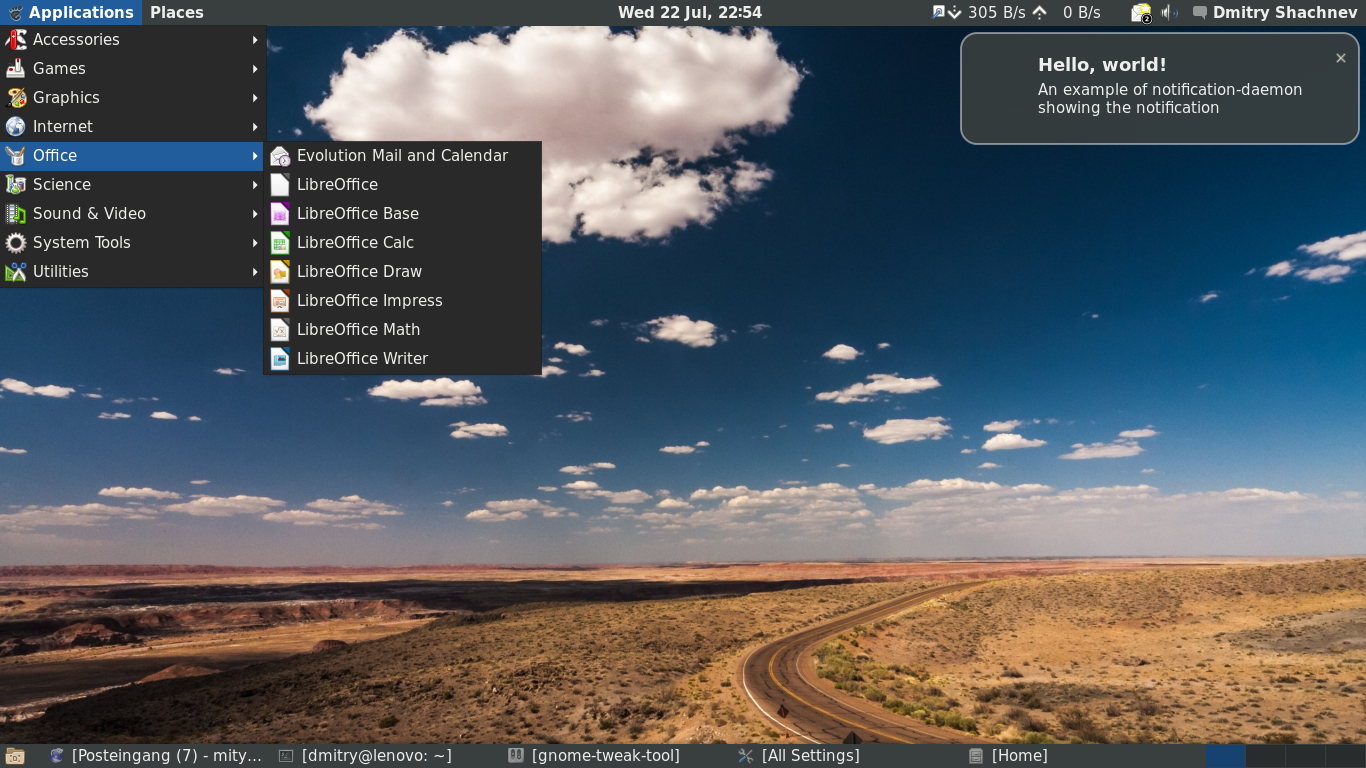
Some time ago GNOME Flashback 3.16/3.17 packages landed in Debian testing and Ubuntu wily. GNOME Flashback is the project which continues the development of components of classic GNOME session, including the GNOME Panel, the Metacity window manager, and so on. Screenshot The full changelog can be found in official announcement mail by Alberts and in changelog.gz files in each package, but I want to list the most imporant improvements in this release (compared to 3.14): Sounds interesting? Contribute! If you are interested in helping us, please write to our mailing list: gnome-flashback-list@gnome.org. The current TODO list is:
  1. Notification Daemon needs GTK notification support.
  2. GNOME Flashback needs screenshot, screencast, keyboard layout switching and bluetooth status icon.
  3. Fix/replace deprecated function usage in all modules.
  4. libstatus-notifier get it in usable state, create a new applet for gnome-panel.

18 July 2015

John Goerzen: True Things About Learning to Fly

I ve been pretty quiet for the last few months because I m learning to fly. I want to start with a few quotes about aviation. I have heard things like these from many people and can vouch for their accuracy:
Anyone can learn to fly. Learning to fly is one of the hardest things you ll ever do. It is totally worth it. Being a pilot will give you a new outlook on life. You ll be amazed at what radios do a 3000ft. Have you ever had an 3000-foot antenna tower? The world is glorious at 1000ft up. Share your enthusiasm with those around you. You have a perspective very few ever see, except for a few seconds on the way to 35,000ft.
Earlier this month, I flew solo for the first time the biggest milestone on the way to getting the pilot s license. Here s a photo my flight instructor took as I was coming in to land that day. landing Today I took my first flight to another airport. It wasn t far about 20 miles away but it was still a thrill. I flew about 1500ft above the ground, roughly above a freeway that happened to be my route. From that height, things still look three-dimensional. The grain elevator that marked out the one small town, the manufacturing plant at another, the college at the third. Bales of hay dotting the fields, the occasional tractor creeping along a road, churches sticking up above the trees. These are places I ve known for decades, and now, suddenly, they are all new. What a time to be alive! I am glad that our world is still so full of wonder and beauty.

17 July 2015

John Goerzen: First steps with smartcards under Linux and Android hard, but it works

Well this has been an interesting project. It all started with a need to get better password storage at work. We wound up looking heavily at a GPG-based solution. This prompted the question: how can we make it even more secure? Well, perhaps, smartcards. The theory is this: a smartcard holds your private keys in a highly-secure piece of hardware. The PC can never actually access the private keys. Signing and decrypting operations are done directly on the card to prevent the need to export the private key material to the PC. There are lots of standards to choose from (PKCS#11, PKCS#15, and OpenPGP card specs) that are relevant here. And there are ways to use SSH and OpenVPN with some of these keys too. Access to the card is protected by a passphrase (called a PIN in smartcard lingo, even though it need not be numeric). These smartcards might be USB sticks, or cards you pop into a reader. In any case, you can pop them out when not needed, pop them in to use them, and well, pretty nice, eh? So that s the theory. Let s talk a bit of reality. First of all, it is hard for a person like me to evaluate how secure my data is in hardware. There was a high-profile bug in the OpenPGP JavaCard applet used by Yubico that caused the potential to use keys without a PIN, for instance. And how well protected is the key in the physical hardware? Granted, in most of these cards you re talking serious hardware skill to compromise them, but still, this is unknown in absolute terms. Here s the bigger problem: compatibility. There are all sorts of card readers, but compatibility with pcsc-tools and pcscd on Linux seems pretty good. But the cards themselves oh my. PKCS#11 defines an interface API, but each vendor would provide their own .so or .dll file to interface. Some cards (for instance, the ACOS5-64 mentioned on the Debian wiki!) are made by vendors that charge $50 for the privilege of getting the drivers needed to make them work and they re closed-source proprietary drivers at that. Some attempts I ordered several cards to evaluate: the OpenPGP card, specifically designed to support GPG; the ACOS5-64 card, the JavaCOS A22, the Yubikey Neo, and a simple reader listed on the GPG smartcard howto. The OpenPGP card and ACOS5-64 are the only ones in the list that support 4096-bit RSA keys due to the computational demands of them. The others all support 2048-bit RSA keys. The JavaCOS requires the user to install a JavaCard applet to the card to make it useable. The Yubico OpenPGP applet works here, along with GlobalPlatform to install it. I am not sure just how solid it is. The Yubikey Neo has yet to arrive; it integrates some interesting OAUTH and TOTP capabilities as well. I found that Debian s wiki page for smartcards lists a bunch of them that are not really useable using the tools in main. The ACOS5-64 was such a dud. But I got the JavaCOS A22 working quite nicely. It s also NFC-enabled and works perfectly with OpenKeyChain on Android (looking like a Yubikey Neo to it, once the OpenPGP applet is installed). I m impressed! Here s a way to be secure with my smartphone without revealing everything all the time. Really the large amount of time is put into figuring out how all this stuff fits together. I m getting there, but I ve got a ways to go yet. Update: Corrected to read signing and decrypting rather than signing and encrypting operations are being done on the card. Thanks to Beno t Allard for catching this error.

12 July 2015

Lunar: Reproducible builds: week 11 in Stretch cycle

Debian is undertaking a huge effort to develop a reproducible builds system. I'd like to thank you for that. This could be Debian's most important project, with how badly computer security has been going.

PerniciousPunk in Reddit's Ask me anything! to Neil McGovern, DPL. What happened in the reproducible builds effort this week: Toolchain fixes More tools are getting patched to use the value of the SOURCE_DATE_EPOCH environment variable as the current time:

In the reproducible experimental toolchain which have been uploaded: Johannes Schauer followed up on making sbuild build path deterministic with several ideas. Packages fixed The following 311 packages became reproducible due to changes in their build dependencies : 4ti2, alot, angband, appstream-glib, argvalidate, armada-backlight, ascii, ask, astroquery, atheist, aubio, autorevision, awesome-extra, bibtool, boot-info-script, bpython, brian, btrfs-tools, bugs-everywhere, capnproto, cbm, ccfits, cddlib, cflow, cfourcc, cgit, chaussette, checkbox-ng, cinnamon-settings-daemon, clfswm, clipper, compton, cppcheck, crmsh, cupt, cutechess, d-itg, dahdi-tools, dapl, darnwdl, dbusada, debian-security-support, debomatic, dime, dipy, dnsruby, doctrine, drmips, dsc-statistics, dune-common, dune-istl, dune-localfunctions, easytag, ent, epr-api, esajpip, eyed3, fastjet, fatresize, fflas-ffpack, flann, flex, flint, fltk1.3, fonts-dustin, fonts-play, fonts-uralic, freecontact, freedoom, gap-guava, gap-scscp, genometools, geogebra, git-reintegrate, git-remote-bzr, git-remote-hg, gitmagic, givaro, gnash, gocr, gorm.app, gprbuild, grapefruit, greed, gtkspellmm, gummiboot, gyp, heat-cfntools, herold, htp, httpfs2, i3status, imagetooth, imapcopy, imaprowl, irker, jansson, jmapviewer, jsdoc-toolkit, jwm, katarakt, khronos-opencl-man, khronos-opengl-man4, lastpass-cli, lava-coordinator, lava-tool, lavapdu, letterize, lhapdf, libam7xxx, libburn, libccrtp, libclaw, libcommoncpp2, libdaemon, libdbusmenu-qt, libdc0, libevhtp, libexosip2, libfreenect, libgwenhywfar, libhmsbeagle, libitpp, libldm, libmodbus, libmtp, libmwaw, libnfo, libpam-abl, libphysfs, libplayer, libqb, libsecret, libserial, libsidplayfp, libtime-y2038-perl, libxr, lift, linbox, linthesia, livestreamer, lizardfs, lmdb, log4c, logbook, lrslib, lvtk, m-tx, mailman-api, matroxset, miniupnpd, mknbi, monkeysign, mpi4py, mpmath, mpqc, mpris-remote, musicbrainzngs, network-manager, nifticlib, obfsproxy, ogre-1.9, opal, openchange, opensc, packaging-tutorial, padevchooser, pajeng, paprefs, pavumeter, pcl, pdmenu, pepper, perroquet, pgrouting, pixz, pngcheck, po4a, powerline, probabel, profitbricks-client, prosody, pstreams, pyacidobasic, pyepr, pymilter, pytest, python-amqp, python-apt, python-carrot, python-django, python-ethtool, python-mock, python-odf, python-pathtools, python-pskc, python-psutil, python-pypump, python-repoze.tm2, python-repoze.what, qdjango, qpid-proton, qsapecng, radare2, reclass, repsnapper, resource-agents, rgain, rttool, ruby-aggregate, ruby-albino, ruby-archive-tar-minitar, ruby-bcat, ruby-blankslate, ruby-coffee-script, ruby-colored, ruby-dbd-mysql, ruby-dbd-odbc, ruby-dbd-pg, ruby-dbd-sqlite3, ruby-dbi, ruby-dirty-memoize, ruby-encryptor, ruby-erubis, ruby-fast-xs, ruby-fusefs, ruby-gd, ruby-git, ruby-globalhotkeys, ruby-god, ruby-hike, ruby-hmac, ruby-integration, ruby-jnunemaker-matchy, ruby-memoize, ruby-merb-core, ruby-merb-haml, ruby-merb-helpers, ruby-metaid, ruby-mina, ruby-net-irc, ruby-net-netrc, ruby-odbc, ruby-ole, ruby-packet, ruby-parseconfig, ruby-platform, ruby-plist, ruby-popen4, ruby-rchardet, ruby-romkan, ruby-ronn, ruby-rubyforge, ruby-rubytorrent, ruby-samuel, ruby-shoulda-matchers, ruby-sourcify, ruby-test-spec, ruby-validatable, ruby-wirble, ruby-xml-simple, ruby-zoom, rumor, rurple-ng, ryu, sam2p, scikit-learn, serd, shellex, shorewall-doc, shunit2, simbody, simplejson, smcroute, soqt, sord, spacezero, spamassassin-heatu, spamprobe, sphinxcontrib-youtube, splitpatch, sratom, stompserver, syncevolution, tgt, ticgit, tinyproxy, tor, tox, transmissionrpc, tweeper, udpcast, units-filter, viennacl, visp, vite, vmfs-tools, waffle, waitress, wavtool-pl, webkit2pdf, wfmath, wit, wreport, x11proto-input, xbae, xdg-utils, xdotool, xsystem35, yapsy, yaz. Please note that some packages in the above list are falsely reproducible. In the experimental toolchain, debhelper exported TZ=UTC and this made packages capturing the current date (without the time) reproducible in the current test environment. The following packages became reproducible after getting fixed: Ben Hutchings upstreamed several patches to fix Linux reproducibility issues which were quickly merged. Some uploads fixed some reproducibility issues but not all of them: Uploads that should fix packages not in main: Patches submitted which have not made their way to the archive yet: reproducible.debian.net A new package set has been added for lua maintainers. (h01ger) tracker.debian.org now only shows reproducibility issues for unstable. Holger and Mattia worked on several bugfixes and enhancements: finished initial test setup for NetBSD, rewriting more shell scripts in Python, saving UDD requests, and more debbindiff development Reiner Herrmann fixed text comparison of files with different encoding. Documentation update Juan Picca added to the commands needed for a local test chroot installation of the locales-all package. Package reviews 286 obsolete reviews have been removed, 278 added and 243 updated this week. 43 new bugs for packages failing to build from sources have been filled by Chris West (Faux), Mattia Rizzolo, and h01ger. The following new issues have been added: timestamps_in_manpages_generated_by_ronn, timestamps_in_documentation_generated_by_org_mode, and timestamps_in_pdf_generated_by_matplotlib. Misc. Reiner Herrmann has submitted patches for OpenWrt. Chris Lamb cleaned up some code and removed cruft in the misc.git repository. Mattia Rizzolo updated the prebuilder script to match what is currently done on reproducible.debian.net.

7 July 2015

Lunar: Reproducible builds: week 10 in Stretch cycle

What happened about the reproducible builds effort this week: Media coverage Daniel Stender published an English translation of the article which originally appeared in Linux Magazin in Admin Magazine. Toolchain fixes Fixes landed in the Debian archive: Lunar submitted to Debian the patch already sent upstream adding a --clamp-mtime option to tar. Patches have been submitted to add support for SOURCE_DATE_EPOCH to txt2man (Reiner Herrmann), epydoc (Reiner Herrmann), GCC (Dhole), and Doxygen (akira). Dhole uploaded a new experimental debhelper to the reproducible repository which exports SOURCE_DATE_EPOCH. As part of the experiment, the patch also sets TZ to UTC which should help with most timezone issues. It might still be problematic for some packages which would change their settings based on this. Mattia Rizzolo sent upstream a patch originally written by Lunar to make the generate-id() function be deterministic in libxslt. While that patch was quickly rejected by upstream, Andrew Ayer came up with a much better one which sadly could have some performance impact. Daniel Veillard replied with another patch that should be deterministic in most cases without needing extra data structures. It's impact is currently being investigated by retesting packages on reproducible.debian.net. akira added a new option to sbuild for configuring the path in which packages are built. This will be needed for the srebuild script. Niko Tyni asked Perl upstream about it using the __DATE__ and __TIME__ C processor macros. Packages fixed The following 143 packages became reproducible due to changes in their build dependencies: alot, argvalidate, astroquery, blender, bpython, brian, calibre, cfourcc, chaussette, checkbox-ng, cloc, configshell, daisy-player, dipy, dnsruby, dput-ng, dsc-statistics, eliom, emacspeak, freeipmi, geant321, gpick, grapefruit, heat-cfntools, imagetooth, jansson, jmapviewer, lava-tool, libhtml-lint-perl, libtime-y2038-perl, lift, lua-ldoc, luarocks, mailman-api, matroxset, maven-hpi-plugin, mknbi, mpi4py, mpmath, msnlib, munkres, musicbrainzngs, nova, pecomato, pgrouting, pngcheck, powerline, profitbricks-client, pyepr, pylibssh2, pylogsparser, pystemmer, pytest, python-amqp, python-apt, python-carrot, python-crypto, python-darts.lib.utils.lru, python-demgengeo, python-graph, python-mock, python-musicbrainz2, python-pathtools, python-pskc, python-psutil, python-pypump, python-repoze.sphinx.autointerface, python-repoze.tm2, python-repoze.what-plugins, python-repoze.what, python-repoze.who-plugins, python-xstatic-term.js, reclass, resource-agents, rgain, rttool, ruby-aggregate, ruby-archive-tar-minitar, ruby-bcat, ruby-blankslate, ruby-coffee-script, ruby-colored, ruby-dbd-mysql, ruby-dbd-odbc, ruby-dbd-pg, ruby-dbd-sqlite3, ruby-dbi, ruby-dirty-memoize, ruby-encryptor, ruby-erubis, ruby-fast-xs, ruby-fusefs, ruby-gd, ruby-git, ruby-globalhotkeys, ruby-god, ruby-hike, ruby-hmac, ruby-integration, ruby-ipaddress, ruby-jnunemaker-matchy, ruby-memoize, ruby-merb-core, ruby-merb-haml, ruby-merb-helpers, ruby-metaid, ruby-mina, ruby-net-irc, ruby-net-netrc, ruby-odbc, ruby-packet, ruby-parseconfig, ruby-platform, ruby-plist, ruby-popen4, ruby-rchardet, ruby-romkan, ruby-rubyforge, ruby-rubytorrent, ruby-samuel, ruby-shoulda-matchers, ruby-sourcify, ruby-test-spec, ruby-validatable, ruby-wirble, ruby-xml-simple, ruby-zoom, ryu, simplejson, spamassassin-heatu, speaklater, stompserver, syncevolution, syncmaildir, thin, ticgit, tox, transmissionrpc, vdr-plugin-xine, waitress, whereami, xlsx2csv, zathura. The following packages became reproducible after getting fixed: Some uploads fixed some reproducibility issues but not all of them: Patches submitted which have not made their way to the archive yet: reproducible.debian.net A new package set for the X Strike Force has been added. (h01ger) Bugs tagged with locale are now visible in the statistics. (h01ger) Some work has been done add tests for NetBSD. (h01ger) Many changes by Mattia Rizzolo have been merged on the whole infrastructure: debbindiff development Version 26 has been released on June 28th fixing the comparison of files of unknown format. (Lunar) A missing dependency identified in python-rpm affecting debbindiff installation without recommended packages was promptly fixed by Michal iha . Lunar also started a massive code rearchitecture to enhance code reuse and enable new features. Nothing visible yet, though. Documentation update josch and Mattia Rizzolo documented how to reschedule packages from Alioth. Package reviews 142 obsolete reviews have been removed, 344 added and 107 updated this week. Chris West (Faux) filled 13 new bugs for packages failing to build from sources. The following new issues have been added: snapshot_placeholder_replaced_with_timestamp_in_pom_properties, different_encoding, timestamps_in_documentation_generated_by_org_mode and timestamps_in_pdf_generated_by_matplotlib.

Russ Allbery: INN 2.6.0 release candidate

In more INN-related news (and catching up on my substantial backlog), a second release candidate for the INN 2.6.0 release is now available. (The first one was only circulated on the inn-workers mailing list.) INN 2.6.0 is the next major release of INN, with lots of improvements to the build system, protocol support, and the test suite, among many other things. Changes have been accumulating slowly for quite some time. There are a lot of changes, so I won't go into all the details here. If you're curious, take a look at the NEWS file. You can get the release candidate from ftp.isc.org. (Note that this link will be removed once INN 2.6.0 is released.) As always, thanks to Julien LIE for preparing this release and doing most of the maintenance work on INN! For more information about INN, see the official ISC download page or from my personal INN pages. The latter also has links to the full changelog and the other INN documentation.

6 July 2015

Russ Allbery: INN 2.5.5

(This release has actually been ready for a while, but there were a few technical difficulties with getting it copied up to the right places, and then I got very distracted by various life stuff.) This is the first new release of INN in about a year, and hopefully the last in the 2.5.x series. A beta release of INN 2.6.0 will be announced shortly (probably tomorrow). As is typical for bug-fix releases, this release rolls up a bunch of small bug fixes that have been made over the past year. The most notable changes include new inn.conf parameters to fine-tune the SSL/TLS configuration for nnrpd (generally to tighten it over the OpenSSL defaults), a few new flags to various utilities, multiple improvements to pullnews, and support for properly stopping cnfsstat and innwatch if INN is started and then quickly stopped. As always, thanks to Julien LIE for preparing this release and doing most of the maintenance work on INN! You can get the latest version from the official ISC download page or from my personal INN pages. The latter also has links to the full changelog and the other INN documentation.

5 July 2015

Robert Edmonds: Git packaging workflow for py-lmdb

Recently, I packaged the py-lmdb Python binding for the LMDB database library. This package is going to be team maintained by the pkg-db group, which is responsible for maintaining BerkeleyDB and LMDB packages. Below are my notes on (re-)Debianizing this package and how the Git repository for the source package is laid out. The upstream py-lmdb developer has a Git-centric workflow. Development is done on the master branch, with regular releases done as fast-forward merges to the release branch. Release tags of the form py-lmdb_X.YZ are provided. The only tarballs provided are the ones that GitHub automatically generates from tags. Since these tarballs are synthetic and the content of these tarballs matches the content on the corresponding tag, we will ignore them in favor of using the release tags directly. (The --git-pristine-tar-commit option to gbp-buildpackage will be used so that .orig.tar.gz files can be replicated so that the Debian archive will accept subsequent uploads, but tarballs are otherwise irrelevant to our workflow.) To make it clear that the release tags come from upstream's repository, they should be prefixed with upstream/, which would preferably result in a DEP-14 compliant scheme. (Unfortunately, since upstream's release tags begin with py-lmdb_, this doesn't quite match the pattern that DEP-14 recommends.) Here is how the local packaging repository is initialized. Note that git clone isn't used, so that we can customize how the tags are fetched. Instead, we create an empty Git repository and add the upstream repository as the upstream remote. The --no-tags option is used, so that git fetch does not import the remote's tags. However, we also add a custom fetch refspec refs/tags/*:refs/tags/upstream/* so that the remote's tags are explicitly fetched, but with the upstream/ prefix.
$ mkdir py-lmdb
$ cd py-lmdb
$ git init
Initialized empty Git repository in /home/edmonds/debian/py-lmdb/.git/
$ git remote add --no-tags upstream https://github.com/dw/py-lmdb
$ git config --add remote.upstream.fetch 'refs/tags/*:refs/tags/upstream/*'
$ git fetch upstream
remote: Counting objects: 3336, done.
remote: Total 3336 (delta 0), reused 0 (delta 0), pack-reused 3336
Receiving objects: 100% (3336/3336), 2.15 MiB   0 bytes/s, done.
Resolving deltas: 100% (1958/1958), done.
From https://github.com/dw/py-lmdb
 * [new branch]      master     -> upstream/master
 * [new branch]      release    -> upstream/release
 * [new branch]      win32-sparse-patch -> upstream/win32-sparse-patch
 * [new tag]         last-cython-version -> upstream/last-cython-version
 * [new tag]         py-lmdb_0.1 -> upstream/py-lmdb_0.1
 * [new tag]         py-lmdb_0.2 -> upstream/py-lmdb_0.2
 * [new tag]         py-lmdb_0.3 -> upstream/py-lmdb_0.3
 * [new tag]         py-lmdb_0.4 -> upstream/py-lmdb_0.4
 * [new tag]         py-lmdb_0.5 -> upstream/py-lmdb_0.5
 * [new tag]         py-lmdb_0.51 -> upstream/py-lmdb_0.51
 * [new tag]         py-lmdb_0.52 -> upstream/py-lmdb_0.52
 * [new tag]         py-lmdb_0.53 -> upstream/py-lmdb_0.53
 * [new tag]         py-lmdb_0.54 -> upstream/py-lmdb_0.54
 * [new tag]         py-lmdb_0.56 -> upstream/py-lmdb_0.56
 * [new tag]         py-lmdb_0.57 -> upstream/py-lmdb_0.57
 * [new tag]         py-lmdb_0.58 -> upstream/py-lmdb_0.58
 * [new tag]         py-lmdb_0.59 -> upstream/py-lmdb_0.59
 * [new tag]         py-lmdb_0.60 -> upstream/py-lmdb_0.60
 * [new tag]         py-lmdb_0.61 -> upstream/py-lmdb_0.61
 * [new tag]         py-lmdb_0.62 -> upstream/py-lmdb_0.62
 * [new tag]         py-lmdb_0.63 -> upstream/py-lmdb_0.63
 * [new tag]         py-lmdb_0.64 -> upstream/py-lmdb_0.64
 * [new tag]         py-lmdb_0.65 -> upstream/py-lmdb_0.65
 * [new tag]         py-lmdb_0.66 -> upstream/py-lmdb_0.66
 * [new tag]         py-lmdb_0.67 -> upstream/py-lmdb_0.67
 * [new tag]         py-lmdb_0.68 -> upstream/py-lmdb_0.68
 * [new tag]         py-lmdb_0.69 -> upstream/py-lmdb_0.69
 * [new tag]         py-lmdb_0.70 -> upstream/py-lmdb_0.70
 * [new tag]         py-lmdb_0.71 -> upstream/py-lmdb_0.71
 * [new tag]         py-lmdb_0.72 -> upstream/py-lmdb_0.72
 * [new tag]         py-lmdb_0.73 -> upstream/py-lmdb_0.73
 * [new tag]         py-lmdb_0.74 -> upstream/py-lmdb_0.74
 * [new tag]         py-lmdb_0.75 -> upstream/py-lmdb_0.75
 * [new tag]         py-lmdb_0.76 -> upstream/py-lmdb_0.76
 * [new tag]         py-lmdb_0.77 -> upstream/py-lmdb_0.77
 * [new tag]         py-lmdb_0.78 -> upstream/py-lmdb_0.78
 * [new tag]         py-lmdb_0.79 -> upstream/py-lmdb_0.79
 * [new tag]         py-lmdb_0.80 -> upstream/py-lmdb_0.80
 * [new tag]         py-lmdb_0.81 -> upstream/py-lmdb_0.81
 * [new tag]         py-lmdb_0.82 -> upstream/py-lmdb_0.82
 * [new tag]         py-lmdb_0.83 -> upstream/py-lmdb_0.83
 * [new tag]         py-lmdb_0.84 -> upstream/py-lmdb_0.84
 * [new tag]         py-lmdb_0.85 -> upstream/py-lmdb_0.85
 * [new tag]         py-lmdb_0.86 -> upstream/py-lmdb_0.86
$
Note that at this point we have content from the upstream remote in our local repository, but we don't have any local branches:
$ git status
On branch master
Initial commit
nothing to commit (create/copy files and use "git add" to track)
$ git branch -a
  remotes/upstream/master
  remotes/upstream/release
  remotes/upstream/win32-sparse-patch
$
We will use the DEP-14 naming scheme for the packaging branches, so the branch for packages targeted at unstable will be called debian/sid. Since I already made an initial 0.84-1 upload, we need to start the debian/sid branch from the upstream 0.84 tag and import the original packaging content from that upload. The --no-track flag is passed to git checkout initially so that Git doesn't consider the upstream release tag upstream/py-lmdb_0.84 to be the upstream branch for our packaging branch.
$ git checkout --no-track -b debian/sid upstream/py-lmdb_0.84
Switched to a new branch 'debian/sid'
$
At this point I imported the original packaging content for 0.84-1 with git am. Then, I signed the debian/0.84-1 tag:
$ git tag -s -m 'Debian release 0.84-1' debian/0.84-1
$ git verify-tag debian/0.84-1
gpg: Signature made Sat 04 Jul 2015 02:49:42 PM EDT using RSA key ID AAF6CDAE
gpg: Good signature from "Robert Edmonds <edmonds@mycre.ws>" [ultimate]
gpg:                 aka "Robert Edmonds <edmonds@fsi.io>" [ultimate]
gpg:                 aka "Robert Edmonds <edmonds@debian.org>" [ultimate]
$
New upstream releases are integrated by fetching new upstream tags and non-fast-forward merging into the packaging branch. The latest release is 0.86, so we merge from the upstream/py-lmdb_0.86 tag.
$ git fetch upstream --dry-run
[...]
$ git fetch upstream
[...]
$ git checkout debian/sid
Already on 'debian/sid'
$ git merge --no-ff --no-edit upstream/py-lmdb_0.86
Merge made by the 'recursive' strategy.
 ChangeLog                        46 ++++++++++++++
 docs/index.rst                   46 +++++++++++++-
 docs/themes/acid/layout.html      4 +-
 examples/dirtybench-gdbm.py       6 ++
 examples/dirtybench.py           19 ++++++
 examples/nastybench.py           18 ++++--
 examples/parabench.py             6 ++
 lib/lmdb.h                       37 ++++++-----
 lib/mdb.c                       281 ++++++++++++++++++++++++++++++++++++++++++++++++++++++++++++---------------------
 lib/midl.c                        2 +-
 lib/midl.h                        2 +-
 lib/py-lmdb/preload.h            48 ++++++++++++++
 lmdb/__init__.py                  2 +-
 lmdb/cffi.py                    120 ++++++++++++++++++++++++-----------
 lmdb/cpython.c                   86 +++++++++++++++++++------
 lmdb/tool.py                      5 +-
 misc/gdb.commands                21 ++++++
 misc/runtests-travisci.sh         3 +-
 misc/runtests-ubuntu-12-04.sh    28 ++++----
 setup.py                          2 +
 tests/crash_test.py              22 +++++++
 tests/cursor_test.py             37 +++++++++++
 tests/env_test.py                73 +++++++++++++++++++++
 tests/testlib.py                 14 +++-
 tests/txn_test.py                20 ++++++
 25 files changed, 773 insertions(+), 175 deletions(-)
 create mode 100644 lib/py-lmdb/preload.h
 create mode 100644 misc/gdb.commands
$
Here I did some additional development work like editing the debian/gbp.conf file and applying a fix for #790738 to make the package build reproducibly. The package is now ready for an 0.86-1 upload, so I ran the following gbp dch command:
$ gbp dch --release --auto --new-version=0.86-1 --commit
gbp:info: Found tag for topmost changelog version '6bdbb56c04571fe2d5d22aa0287ab0dc83959de5'
gbp:info: Continuing from commit '6bdbb56c04571fe2d5d22aa0287ab0dc83959de5'
gbp:info: Changelog has been committed for version 0.86-1
$
This automatically generates a changelog entry for 0.86-1, but it includes commit summaries for all of the upstream commits since the last release, which I had to edit out. Then, I used gbp buildpackage with BUILDER=pbuilder to build the package in a clean, up-to-date sid chroot. After checking the result, I signed the debian/0.86-1 tag:
$ git tag -s -m 'Debian release 0.86-1' debian/0.86-1
$
The package is now ready to be pushed to git.debian.org. First, a bare repository is initialized:
$ ssh git.debian.org
edmonds@moszumanska:~$ cd /srv/git.debian.org/git/pkg-db/
edmonds@moszumanska:/srv/git.debian.org/git/pkg-db$ umask 002
edmonds@moszumanska:/srv/git.debian.org/git/pkg-db$ mkdir py-lmdb.git
edmonds@moszumanska:/srv/git.debian.org/git/pkg-db$ cd py-lmdb.git/
edmonds@moszumanska:/srv/git.debian.org/git/pkg-db/py-lmdb.git$ git --bare init --shared
Initialized empty shared Git repository in /srv/git.debian.org/git/pkg-db/py-lmdb.git/
edmonds@moszumanska:/srv/git.debian.org/git/pkg-db/py-lmdb.git$ echo 'py-lmdb Debian packaging' > description
edmonds@moszumanska:/srv/git.debian.org/git/pkg-db/py-lmdb.git$ mv hooks/post-update.sample hooks/post-update
edmonds@moszumanska:/srv/git.debian.org/git/pkg-db/py-lmdb.git$ chmod a+x hooks/post-update
edmonds@moszumanska:/srv/git.debian.org/git/pkg-db/py-lmdb.git$ logout
Shared connection to git.debian.org closed.
Then, we add a new debian remote to our local packaging repository. Per our repository conventions, we need to ensure that only branch names matching debian/* and pristine-tar and tag names matching debian/* and upstream/* are pushed to the debian remote when we run git push debian, so we add a a set of remote.debian.push refspecs that correspond to these conventions. We also add an explicit remote.debian.fetch refspec to fetch tags.
$ git remote add debian ssh://git.debian.org/git/pkg-db/py-lmdb.git
$ git config --add remote.debian.push 'refs/tags/debian/*'
$ git config --add remote.debian.push 'refs/tags/upstream/*'
$ git config --add remote.debian.push 'refs/heads/debian/*'
$ git config --add remote.debian.push 'refs/heads/pristine-tar'
$ git config --add remote.debian.fetch 'refs/tags/*:refs/tags/*'
We now run the initial push to the remote Git repository. The --set-upstream option is used so that our local branches will be configured to track the corresponding remote branches. Also note that the debian/* and upstream/* tags are pushed as well.
$ git push debian --set-upstream
Counting objects: 3333, done.
Delta compression using up to 8 threads.
Compressing objects: 100% (1083/1083), done.
Writing objects: 100% (3333/3333), 1.37 MiB   0 bytes/s, done.
Total 3333 (delta 2231), reused 3314 (delta 2218)
To ssh://git.debian.org/git/pkg-db/py-lmdb.git
 * [new branch]      pristine-tar -> pristine-tar
 * [new branch]      debian/sid -> debian/sid
 * [new tag]         debian/0.84-1 -> debian/0.84-1
 * [new tag]         debian/0.86-1 -> debian/0.86-1
 * [new tag]         upstream/last-cython-version -> upstream/last-cython-version
 * [new tag]         upstream/py-lmdb_0.1 -> upstream/py-lmdb_0.1
 * [new tag]         upstream/py-lmdb_0.2 -> upstream/py-lmdb_0.2
 * [new tag]         upstream/py-lmdb_0.3 -> upstream/py-lmdb_0.3
 * [new tag]         upstream/py-lmdb_0.4 -> upstream/py-lmdb_0.4
 * [new tag]         upstream/py-lmdb_0.5 -> upstream/py-lmdb_0.5
 * [new tag]         upstream/py-lmdb_0.51 -> upstream/py-lmdb_0.51
 * [new tag]         upstream/py-lmdb_0.52 -> upstream/py-lmdb_0.52
 * [new tag]         upstream/py-lmdb_0.53 -> upstream/py-lmdb_0.53
 * [new tag]         upstream/py-lmdb_0.54 -> upstream/py-lmdb_0.54
 * [new tag]         upstream/py-lmdb_0.56 -> upstream/py-lmdb_0.56
 * [new tag]         upstream/py-lmdb_0.57 -> upstream/py-lmdb_0.57
 * [new tag]         upstream/py-lmdb_0.58 -> upstream/py-lmdb_0.58
 * [new tag]         upstream/py-lmdb_0.59 -> upstream/py-lmdb_0.59
 * [new tag]         upstream/py-lmdb_0.60 -> upstream/py-lmdb_0.60
 * [new tag]         upstream/py-lmdb_0.61 -> upstream/py-lmdb_0.61
 * [new tag]         upstream/py-lmdb_0.62 -> upstream/py-lmdb_0.62
 * [new tag]         upstream/py-lmdb_0.63 -> upstream/py-lmdb_0.63
 * [new tag]         upstream/py-lmdb_0.64 -> upstream/py-lmdb_0.64
 * [new tag]         upstream/py-lmdb_0.65 -> upstream/py-lmdb_0.65
 * [new tag]         upstream/py-lmdb_0.66 -> upstream/py-lmdb_0.66
 * [new tag]         upstream/py-lmdb_0.67 -> upstream/py-lmdb_0.67
 * [new tag]         upstream/py-lmdb_0.68 -> upstream/py-lmdb_0.68
 * [new tag]         upstream/py-lmdb_0.69 -> upstream/py-lmdb_0.69
 * [new tag]         upstream/py-lmdb_0.70 -> upstream/py-lmdb_0.70
 * [new tag]         upstream/py-lmdb_0.71 -> upstream/py-lmdb_0.71
 * [new tag]         upstream/py-lmdb_0.72 -> upstream/py-lmdb_0.72
 * [new tag]         upstream/py-lmdb_0.73 -> upstream/py-lmdb_0.73
 * [new tag]         upstream/py-lmdb_0.74 -> upstream/py-lmdb_0.74
 * [new tag]         upstream/py-lmdb_0.75 -> upstream/py-lmdb_0.75
 * [new tag]         upstream/py-lmdb_0.76 -> upstream/py-lmdb_0.76
 * [new tag]         upstream/py-lmdb_0.77 -> upstream/py-lmdb_0.77
 * [new tag]         upstream/py-lmdb_0.78 -> upstream/py-lmdb_0.78
 * [new tag]         upstream/py-lmdb_0.79 -> upstream/py-lmdb_0.79
 * [new tag]         upstream/py-lmdb_0.80 -> upstream/py-lmdb_0.80
 * [new tag]         upstream/py-lmdb_0.81 -> upstream/py-lmdb_0.81
 * [new tag]         upstream/py-lmdb_0.82 -> upstream/py-lmdb_0.82
 * [new tag]         upstream/py-lmdb_0.83 -> upstream/py-lmdb_0.83
 * [new tag]         upstream/py-lmdb_0.84 -> upstream/py-lmdb_0.84
 * [new tag]         upstream/py-lmdb_0.85 -> upstream/py-lmdb_0.85
 * [new tag]         upstream/py-lmdb_0.86 -> upstream/py-lmdb_0.86
Branch pristine-tar set up to track remote branch pristine-tar from debian.
Branch debian/sid set up to track remote branch debian/sid from debian.
$
After the initial push, we need to configure the remote repository so that clones will checkout the debian/sid branch by default:
$ ssh git.debian.org
edmonds@moszumanska:~$ cd /srv/git.debian.org/git/pkg-db/py-lmdb.git/
edmonds@moszumanska:/srv/git.debian.org/git/pkg-db/py-lmdb.git$ git symbolic-ref HEAD refs/heads/debian/sid
edmonds@moszumanska:/srv/git.debian.org/git/pkg-db/py-lmdb.git$ logout
Shared connection to git.debian.org closed.
We can check if there are any updates in upstream's Git repository with the following command:
$ git fetch upstream --dry-run -v
From https://github.com/dw/py-lmdb
 = [up to date]      master     -> upstream/master
 = [up to date]      release    -> upstream/release
 = [up to date]      win32-sparse-patch -> upstream/win32-sparse-patch
 = [up to date]      last-cython-version -> upstream/last-cython-version
 = [up to date]      py-lmdb_0.1 -> upstream/py-lmdb_0.1
 = [up to date]      py-lmdb_0.2 -> upstream/py-lmdb_0.2
 = [up to date]      py-lmdb_0.3 -> upstream/py-lmdb_0.3
 = [up to date]      py-lmdb_0.4 -> upstream/py-lmdb_0.4
 = [up to date]      py-lmdb_0.5 -> upstream/py-lmdb_0.5
 = [up to date]      py-lmdb_0.51 -> upstream/py-lmdb_0.51
 = [up to date]      py-lmdb_0.52 -> upstream/py-lmdb_0.52
 = [up to date]      py-lmdb_0.53 -> upstream/py-lmdb_0.53
 = [up to date]      py-lmdb_0.54 -> upstream/py-lmdb_0.54
 = [up to date]      py-lmdb_0.56 -> upstream/py-lmdb_0.56
 = [up to date]      py-lmdb_0.57 -> upstream/py-lmdb_0.57
 = [up to date]      py-lmdb_0.58 -> upstream/py-lmdb_0.58
 = [up to date]      py-lmdb_0.59 -> upstream/py-lmdb_0.59
 = [up to date]      py-lmdb_0.60 -> upstream/py-lmdb_0.60
 = [up to date]      py-lmdb_0.61 -> upstream/py-lmdb_0.61
 = [up to date]      py-lmdb_0.62 -> upstream/py-lmdb_0.62
 = [up to date]      py-lmdb_0.63 -> upstream/py-lmdb_0.63
 = [up to date]      py-lmdb_0.64 -> upstream/py-lmdb_0.64
 = [up to date]      py-lmdb_0.65 -> upstream/py-lmdb_0.65
 = [up to date]      py-lmdb_0.66 -> upstream/py-lmdb_0.66
 = [up to date]      py-lmdb_0.67 -> upstream/py-lmdb_0.67
 = [up to date]      py-lmdb_0.68 -> upstream/py-lmdb_0.68
 = [up to date]      py-lmdb_0.69 -> upstream/py-lmdb_0.69
 = [up to date]      py-lmdb_0.70 -> upstream/py-lmdb_0.70
 = [up to date]      py-lmdb_0.71 -> upstream/py-lmdb_0.71
 = [up to date]      py-lmdb_0.72 -> upstream/py-lmdb_0.72
 = [up to date]      py-lmdb_0.73 -> upstream/py-lmdb_0.73
 = [up to date]      py-lmdb_0.74 -> upstream/py-lmdb_0.74
 = [up to date]      py-lmdb_0.75 -> upstream/py-lmdb_0.75
 = [up to date]      py-lmdb_0.76 -> upstream/py-lmdb_0.76
 = [up to date]      py-lmdb_0.77 -> upstream/py-lmdb_0.77
 = [up to date]      py-lmdb_0.78 -> upstream/py-lmdb_0.78
 = [up to date]      py-lmdb_0.79 -> upstream/py-lmdb_0.79
 = [up to date]      py-lmdb_0.80 -> upstream/py-lmdb_0.80
 = [up to date]      py-lmdb_0.81 -> upstream/py-lmdb_0.81
 = [up to date]      py-lmdb_0.82 -> upstream/py-lmdb_0.82
 = [up to date]      py-lmdb_0.83 -> upstream/py-lmdb_0.83
 = [up to date]      py-lmdb_0.84 -> upstream/py-lmdb_0.84
 = [up to date]      py-lmdb_0.85 -> upstream/py-lmdb_0.85
 = [up to date]      py-lmdb_0.86 -> upstream/py-lmdb_0.86
We can check if any co-maintainers have pushed updates to the git.debian.org repository with the following command:
$ git fetch debian --dry-run -v
From ssh://git.debian.org/git/pkg-db/py-lmdb
 = [up to date]      debian/sid -> debian/debian/sid
 = [up to date]      pristine-tar -> debian/pristine-tar
 = [up to date]      debian/0.84-1 -> debian/0.84-1
 = [up to date]      debian/0.86-1 -> debian/0.86-1
 = [up to date]      upstream/last-cython-version -> upstream/last-cython-version
 = [up to date]      upstream/py-lmdb_0.1 -> upstream/py-lmdb_0.1
 = [up to date]      upstream/py-lmdb_0.2 -> upstream/py-lmdb_0.2
 = [up to date]      upstream/py-lmdb_0.3 -> upstream/py-lmdb_0.3
 = [up to date]      upstream/py-lmdb_0.4 -> upstream/py-lmdb_0.4
 = [up to date]      upstream/py-lmdb_0.5 -> upstream/py-lmdb_0.5
 = [up to date]      upstream/py-lmdb_0.51 -> upstream/py-lmdb_0.51
 = [up to date]      upstream/py-lmdb_0.52 -> upstream/py-lmdb_0.52
 = [up to date]      upstream/py-lmdb_0.53 -> upstream/py-lmdb_0.53
 = [up to date]      upstream/py-lmdb_0.54 -> upstream/py-lmdb_0.54
 = [up to date]      upstream/py-lmdb_0.56 -> upstream/py-lmdb_0.56
 = [up to date]      upstream/py-lmdb_0.57 -> upstream/py-lmdb_0.57
 = [up to date]      upstream/py-lmdb_0.58 -> upstream/py-lmdb_0.58
 = [up to date]      upstream/py-lmdb_0.59 -> upstream/py-lmdb_0.59
 = [up to date]      upstream/py-lmdb_0.60 -> upstream/py-lmdb_0.60
 = [up to date]      upstream/py-lmdb_0.61 -> upstream/py-lmdb_0.61
 = [up to date]      upstream/py-lmdb_0.62 -> upstream/py-lmdb_0.62
 = [up to date]      upstream/py-lmdb_0.63 -> upstream/py-lmdb_0.63
 = [up to date]      upstream/py-lmdb_0.64 -> upstream/py-lmdb_0.64
 = [up to date]      upstream/py-lmdb_0.65 -> upstream/py-lmdb_0.65
 = [up to date]      upstream/py-lmdb_0.66 -> upstream/py-lmdb_0.66
 = [up to date]      upstream/py-lmdb_0.67 -> upstream/py-lmdb_0.67
 = [up to date]      upstream/py-lmdb_0.68 -> upstream/py-lmdb_0.68
 = [up to date]      upstream/py-lmdb_0.69 -> upstream/py-lmdb_0.69
 = [up to date]      upstream/py-lmdb_0.70 -> upstream/py-lmdb_0.70
 = [up to date]      upstream/py-lmdb_0.71 -> upstream/py-lmdb_0.71
 = [up to date]      upstream/py-lmdb_0.72 -> upstream/py-lmdb_0.72
 = [up to date]      upstream/py-lmdb_0.73 -> upstream/py-lmdb_0.73
 = [up to date]      upstream/py-lmdb_0.74 -> upstream/py-lmdb_0.74
 = [up to date]      upstream/py-lmdb_0.75 -> upstream/py-lmdb_0.75
 = [up to date]      upstream/py-lmdb_0.76 -> upstream/py-lmdb_0.76
 = [up to date]      upstream/py-lmdb_0.77 -> upstream/py-lmdb_0.77
 = [up to date]      upstream/py-lmdb_0.78 -> upstream/py-lmdb_0.78
 = [up to date]      upstream/py-lmdb_0.79 -> upstream/py-lmdb_0.79
 = [up to date]      upstream/py-lmdb_0.80 -> upstream/py-lmdb_0.80
 = [up to date]      upstream/py-lmdb_0.81 -> upstream/py-lmdb_0.81
 = [up to date]      upstream/py-lmdb_0.82 -> upstream/py-lmdb_0.82
 = [up to date]      upstream/py-lmdb_0.83 -> upstream/py-lmdb_0.83
 = [up to date]      upstream/py-lmdb_0.84 -> upstream/py-lmdb_0.84
 = [up to date]      upstream/py-lmdb_0.85 -> upstream/py-lmdb_0.85
 = [up to date]      upstream/py-lmdb_0.86 -> upstream/py-lmdb_0.86
$
We can check if anything needs to be pushed from our local repository to the git.debian.org repository with the following command:
$ git push debian --dry-run -v
Pushing to ssh://git.debian.org/git/pkg-db/py-lmdb.git
To ssh://git.debian.org/git/pkg-db/py-lmdb.git
 = [up to date]      debian/sid -> debian/sid
 = [up to date]      pristine-tar -> pristine-tar
 = [up to date]      debian/0.84-1 -> debian/0.84-1
 = [up to date]      debian/0.86-1 -> debian/0.86-1
 = [up to date]      upstream/last-cython-version -> upstream/last-cython-version
 = [up to date]      upstream/py-lmdb_0.1 -> upstream/py-lmdb_0.1
 = [up to date]      upstream/py-lmdb_0.2 -> upstream/py-lmdb_0.2
 = [up to date]      upstream/py-lmdb_0.3 -> upstream/py-lmdb_0.3
 = [up to date]      upstream/py-lmdb_0.4 -> upstream/py-lmdb_0.4
 = [up to date]      upstream/py-lmdb_0.5 -> upstream/py-lmdb_0.5
 = [up to date]      upstream/py-lmdb_0.51 -> upstream/py-lmdb_0.51
 = [up to date]      upstream/py-lmdb_0.52 -> upstream/py-lmdb_0.52
 = [up to date]      upstream/py-lmdb_0.53 -> upstream/py-lmdb_0.53
 = [up to date]      upstream/py-lmdb_0.54 -> upstream/py-lmdb_0.54
 = [up to date]      upstream/py-lmdb_0.56 -> upstream/py-lmdb_0.56
 = [up to date]      upstream/py-lmdb_0.57 -> upstream/py-lmdb_0.57
 = [up to date]      upstream/py-lmdb_0.58 -> upstream/py-lmdb_0.58
 = [up to date]      upstream/py-lmdb_0.59 -> upstream/py-lmdb_0.59
 = [up to date]      upstream/py-lmdb_0.60 -> upstream/py-lmdb_0.60
 = [up to date]      upstream/py-lmdb_0.61 -> upstream/py-lmdb_0.61
 = [up to date]      upstream/py-lmdb_0.62 -> upstream/py-lmdb_0.62
 = [up to date]      upstream/py-lmdb_0.63 -> upstream/py-lmdb_0.63
 = [up to date]      upstream/py-lmdb_0.64 -> upstream/py-lmdb_0.64
 = [up to date]      upstream/py-lmdb_0.65 -> upstream/py-lmdb_0.65
 = [up to date]      upstream/py-lmdb_0.66 -> upstream/py-lmdb_0.66
 = [up to date]      upstream/py-lmdb_0.67 -> upstream/py-lmdb_0.67
 = [up to date]      upstream/py-lmdb_0.68 -> upstream/py-lmdb_0.68
 = [up to date]      upstream/py-lmdb_0.69 -> upstream/py-lmdb_0.69
 = [up to date]      upstream/py-lmdb_0.70 -> upstream/py-lmdb_0.70
 = [up to date]      upstream/py-lmdb_0.71 -> upstream/py-lmdb_0.71
 = [up to date]      upstream/py-lmdb_0.72 -> upstream/py-lmdb_0.72
 = [up to date]      upstream/py-lmdb_0.73 -> upstream/py-lmdb_0.73
 = [up to date]      upstream/py-lmdb_0.74 -> upstream/py-lmdb_0.74
 = [up to date]      upstream/py-lmdb_0.75 -> upstream/py-lmdb_0.75
 = [up to date]      upstream/py-lmdb_0.76 -> upstream/py-lmdb_0.76
 = [up to date]      upstream/py-lmdb_0.77 -> upstream/py-lmdb_0.77
 = [up to date]      upstream/py-lmdb_0.78 -> upstream/py-lmdb_0.78
 = [up to date]      upstream/py-lmdb_0.79 -> upstream/py-lmdb_0.79
 = [up to date]      upstream/py-lmdb_0.80 -> upstream/py-lmdb_0.80
 = [up to date]      upstream/py-lmdb_0.81 -> upstream/py-lmdb_0.81
 = [up to date]      upstream/py-lmdb_0.82 -> upstream/py-lmdb_0.82
 = [up to date]      upstream/py-lmdb_0.83 -> upstream/py-lmdb_0.83
 = [up to date]      upstream/py-lmdb_0.84 -> upstream/py-lmdb_0.84
 = [up to date]      upstream/py-lmdb_0.85 -> upstream/py-lmdb_0.85
 = [up to date]      upstream/py-lmdb_0.86 -> upstream/py-lmdb_0.86
Everything up-to-date
Finally, in order to set up a fresh local clone of the git.debian.org repository that's configured like the local repository created above, we have to do the following:
$ git clone --origin debian ssh://git.debian.org/git/pkg-db/py-lmdb.git
Cloning into 'py-lmdb'...
remote: Counting objects: 3333, done.
remote: Compressing objects: 100% (1070/1070), done.
remote: Total 3333 (delta 2231), reused 3333 (delta 2231)
Receiving objects: 100% (3333/3333), 1.37 MiB   1.11 MiB/s, done.
Resolving deltas: 100% (2231/2231), done.
Checking connectivity... done.
$ cd py-lmdb
$ git remote add --no-tags upstream https://github.com/dw/py-lmdb
$ git config --add remote.upstream.fetch 'refs/tags/*:refs/tags/upstream/*'
$ git fetch upstream
remote: Counting objects: 56, done.
remote: Total 56 (delta 25), reused 25 (delta 25), pack-reused 31
Unpacking objects: 100% (56/56), done.
From https://github.com/dw/py-lmdb
 * [new branch]      master     -> upstream/master
 * [new branch]      release    -> upstream/release
 * [new branch]      win32-sparse-patch -> upstream/win32-sparse-patch
$ git branch --track pristine-tar debian/pristine-tar 
Branch pristine-tar set up to track remote branch pristine-tar from debian.
$ git config --add remote.debian.push 'refs/tags/debian/*'
$ git config --add remote.debian.push 'refs/tags/upstream/*'
$ git config --add remote.debian.push 'refs/heads/debian/*'
$ git config --add remote.debian.push 'refs/heads/pristine-tar'
$ git config --add remote.debian.fetch 'refs/tags/*:refs/tags/*'
$
This is a fair amount of effort beyond a simple git clone, though, so I wonder if anything can be done to optimize this.

29 June 2015

Lunar: Reproducible builds: week 9 in Stretch cycle

What happened about the reproducible builds effort this week: Toolchain fixes Norbert Preining uploaded texinfo/6.0.0.dfsg.1-2 which makes texinfo indices reproducible. Original patch by Chris Lamb. Lunar submitted recently rebased patches to make the file order of files inside .deb stable. akira filled #789843 to make tex4ht stop printing timestamps in its HTML output by default. Dhole wrote a patch for xutils-dev to prevent timestamps when creating gzip compresed files. Reiner Herrmann sent a follow-up patch for wheel to use UTC as timezone when outputing timestamps. Mattia Rizzolo started a discussion regarding the failure to build from source of subversion when -Wdate-time is added to CPPFLAGS which happens when asking dpkg-buildflags to use the reproducible profile. SWIG errors out because it doesn't recognize the aforementioned flag. Trying to get the .buildinfo specification to more definitive state, Lunar started a discussion on storing the checksums of the binary package used in dpkg status database. akira discovered while proposing a fix for simgrid that CMake internal command to create tarballs would record a timestamp in the gzip header. A way to prevent it is to use the GZIP environment variable to ask gzip not to store timestamps, but this will soon become unsupported. It's up for discussion if the best place to fix the problem would be to fix it for all CMake users at once. Infrastructure-related work Andreas Henriksson did a delayed NMU upload of pbuilder which adds minimal support for build profiles and includes several fixes from Mattia Rizzolo affecting reproducibility tests. Neils Thykier uploaded lintian which both raises the severity of package-contains-timestamped-gzip and avoids false positives for this tag (thanks to Tomasz Buchert). Petter Reinholdtsen filled #789761 suggesting that how-can-i-help should prompt its users about fixing reproducibility issues. Packages fixed The following packages became reproducible due to changes in their build dependencies: autorun4linuxcd, libwildmagic, lifelines, plexus-i18n, texlive-base, texlive-extra, texlive-lang. The following packages became reproducible after getting fixed: Some uploads fixed some reproducibility issues but not all of them: Untested uploaded as they are not in main: Patches submitted which have not made their way to the archive yet: debbindiff development debbindiff/23 includes a few bugfixes by Helmut Grohne that result in a significant speedup (especially on larger files). It used to exhibit the quadratic time string concatenation antipattern. Version 24 was released on June 23rd in a hurry to fix an undefined variable introduced in the previous version. (Reiner Herrmann) debbindiff now has a test suite! It is written using the PyTest framework (thanks Isis Lovecruft for the suggestion). The current focus has been on the comparators, and we are now at 93% of code coverage for these modules. Several problems were identified and fixed in the process: paths appearing in output of javap, readelf, objdump, zipinfo, unsqusahfs; useless MD5 checksum and last modified date in javap output; bad handling of charsets in PO files; the destination path for gzip compressed files not ending in .gz; only metadata of cpio archives were actually compared. stat output was further trimmed to make directory comparison more useful. Having the test suite enabled a refactoring of how comparators were written, switching from a forest of differences to a single tree. This helped removing dust from the oldest parts of the code. Together with some other small changes, version 25 was released on June 27th. A follow up release was made the next day to fix a hole in the test suite and the resulting unidentified leftover from the comparator refactoring. (Lunar) Documentation update Ximin Luo improved code examples for some proposed environment variables for reference timestamps. Dhole added an example on how to fix timestamps C pre-processor macros by adding a way to set the build date externally. akira documented her fix for tex4ht timestamps. Package reviews 94 obsolete reviews have been removed, 330 added and 153 updated this week. Hats off for Chris West (Faux) who investigated many fail to build from source issues and reported the relevant bugs. Slight improvements were made to the scripts for editing the review database, edit-notes and clean-notes. (Mattia Rizzolo) Meetings A meeting was held on June 23rd. Minutes are available. The next meeting will happen on Tuesday 2015-07-07 at 17:00 UTC. Misc. The Linux Foundation announced that it was funding the work of Lunar and h01ger on reproducible builds in Debian and other distributions. This was further relayed in a Bits from Debian blog post.

22 June 2015

Lunar: Reproducible builds: week 8 in Stretch cycle

What happened about the reproducible builds effort this week: Toolchain fixes Andreas Henriksson has improved Johannes Schauer initial patch for pbuilder adding support for build profiles. Packages fixed The following 12 packages became reproducible due to changes in their build dependencies: collabtive, eric, file-rc, form-history-control, freehep-chartableconverter-plugin , jenkins-winstone, junit, librelaxng-datatype-java, libwildmagic, lightbeam, puppet-lint, tabble. The following packages became reproducible after getting fixed: Some uploads fixed some reproducibility issues but not all of them: Patches submitted which have not made their way to the archive yet: reproducible.debian.net Bugs with the ftbfs usertag are now visible on the bug graphs. This explain the recent spike. (h01ger) Andreas Beckmann suggested a way to test building packages using the funny paths that one can get when they contain the full Debian package version string. debbindiff development Lunar started an important refactoring introducing abstactions for containers and files in order to make file type identification more flexible, enabling fuzzy matching, and allowing parallel processing. Documentation update Ximin Luo detailed the proposal to standardize environment variables to pass a reference source date to tools that needs one (e.g. documentation generator). Package reviews 41 obsolete reviews have been removed, 168 added and 36 updated this week. Some more issues affecting packages failing to build from source have been identified. Meetings Minutes have been posted for Tuesday June 16th meeting. The next meeting is scheduled Tuesday June 23rd at 17:00 UTC. Presentations Lunar presented the project in French during Pas Sage en Seine in Paris. Video and slides are available.

20 June 2015

Lunar: Reproducible builds: week 4 in Stretch cycle

What happened about the reproducible builds effort for this week: Toolchain fixes Lunar rebased our custom dpkg on the new release, removing a now unneeded patch identified by Guillem Jover. An extra sort in the buildinfo generator prevented a stable order and was quickly fixed once identified. Mattia Rizzolo also rebased our custom debhelper on the latest release. Packages fixed The following 30 packages became reproducible due to changes in their build dependencies: animal-sniffer, asciidoctor, autodock-vina, camping, cookie-monster, downthemall, flashblock, gamera, httpcomponents-core, https-finder, icedove-l10n, istack-commons, jdeb, libmodule-build-perl, libur-perl, livehttpheaders, maven-dependency-plugin, maven-ejb-plugin, mozilla-noscript, nosquint, requestpolicy, ruby-benchmark-ips, ruby-benchmark-suite, ruby-expression-parser, ruby-github-markup, ruby-http-connection, ruby-settingslogic, ruby-uuidtools, webkit2gtk, wot. The following packages became reproducible after getting fixed: Some uploads fixed some reproducibility issues but not all of them: Patches submitted which did not make their way to the archive yet: Also, the following bugs have been reported: reproducible.debian.net Holger Levsen made several small bug fixes and a few more visible changes: strip-nondeterminism Version 0.007-1 of strip-nondeterminism the tool to post-process various file formats to normalize them has been uploaded by Holger Levsen. Version 0.006-1 was already in the reproducible repository, the new version mainly improve the detection of Maven's pom.properties files. debbindiff development At the request of Emmanuel Bourg, Reiner Herrmann added a comparator for Java .class files. Documentation update Christoph Berg created a new page for the timestamps in manpages created by Doxygen. Package reviews 93 obsolete reviews have been removed, 76 added and 43 updated this week. New identified issues: timestamps in manpages generated by Doxygen, modification time differences in files extracted by unzip, tstamp task used in Ant build.xml, timestamps in documentation generated by ASDocGen. The description for build id related issues has been clarified. Meetings Holger Levsen announced a first meeting on Wednesday, June 3rd, 2015, 19:00 UTC. The agenda is amendable on the wiki. Misc. Lunar worked on a proof-of-concept script to import the build environment found in .buildinfo files to UDD. Lucas Nussbaum has positively reviewed the proposed schema. Holger Levsen cleaned up various experimental toolchain repositories, marking merged brances as such.

Lunar: Reproducible builds: week 5 in Stretch cycle

What happened about the reproducible builds effort for this week: Toolchain fixes Uploads that should help other packages: Patch submitted for toolchain issues: Some discussions have been started in Debian and with upstream: Packages fixed The following 8 packages became reproducible due to changes in their build dependencies: access-modifier-checker, apache-log4j2, jenkins-xstream, libsdl-perl, maven-shared-incremental, ruby-pygments.rb, ruby-wikicloth, uimaj. The following packages became reproducible after getting fixed: Some uploads fixed some reproducibility issues but not all of them: Patches submitted which did not make their way to the archive yet: Discussions that have been started: reproducible.debian.net Holger Levsen added two new package sets: pkg-javascript-devel and pkg-php-pear. The list of packages with and without notes are now sorted by age of the latest build. Mattia Rizzolo added support for email notifications so that maintainers can be warned when a package becomes unreproducible. Please ask Mattia or Holger or in the #debian-reproducible IRC channel if you want to be notified for your packages! strip-nondeterminism development Andrew Ayer fixed the gzip handler so that it skip adding a predetermined timestamp when there was none. Documentation update Lunar added documentation about mtimes of file extracted using unzip being timezone dependent. He also wrote a short example on how to test reproducibility. Stephen Kitt updated the documentation about timestamps in PE binaries. Documentation and scripts to perform weekly reports were published by Lunar. Package reviews 50 obsolete reviews have been removed, 51 added and 29 updated this week. Thanks Chris West and Mathieu Bridon amongst others. New identified issues: Misc. Lunar will be talking (in French) about reproducible builds at Pas Sage en Seine on June 19th, at 15:00 in Paris. Meeting will happen this Wednesday, 19:00 UTC.

15 June 2015

Lunar: Reproducible builds: week 7 in Stretch cycle

What happened about the reproducible builds effort for this week: Presentations On June 7th, Reiner Herrmann presented the project at the Gulaschprogrammiernacht 15 in Karlsruhe, Germany. Video and audio recordings in German are available, and so are the slides in English. Toolchain fixes Daniel Kahn Gillmor's report on help2man started a discussion with Brendan O'Dea and Ximin Luo about standardizing a common environment variable that would provide a replacement for an embedded build date. After various proposals and research by Ximin about date handling in several programming languages, the best solution seems to define SOURCE_DATE_EPOCH with a value suitable for gmtime(3).
  1. Martin Borgert wondered if Sphinx could be changed in a way that would avoid having to tweak debian/rules in packages using it to produce HTML documentation.
Daniel Kahn Gillmor opened a new report about icont producing unreproducible binaries. Packages fixed The following 32 packages became reproducible due to changes in their build dependencies: agda, alex, c2hs, clutter-1.0, colorediffs-extension, cpphs, darcs-monitor, dispmua, haskell-curl, haskell-glfw, haskell-glib, haskell-gluraw, haskell-glut, haskell-gnutls, haskell-gsasl, haskell-hfuse, haskell-hledger-interest, haskell-hslua, haskell-hsqml, haskell-hssyck, haskell-libxml-sax, haskell-openglraw, haskell-readline, haskell-terminfo, haskell-x11, jarjar-maven-plugin, kxml2, libcgi-struct-xs-perl, libobject-id-perl, maven-docck-plugin, parboiled, pegdown. The following packages became reproducible after getting fixed: Some uploads fixed some reproducibility issues but not all of them: Patches submitted which did not make their way to the archive yet: reproducible.debian.net A new variation to better notice when a package captures the environment has been introduced. (h01ger) The test on Debian packages works by building the package twice in a short time frame. But sometimes, a mirror push can happen between the first and the second build, resulting in a package built in a different build environment. This situation is now properly detected and will run a third build automatically. (h01ger) OpenWrt, the distribution specialized in embedded devices like small routers, is now being tested for reproducibility. The situation looks very good for their packages which seems mostly affected by timestamps in the tarball. System images will require more work on debbindiff to be better understood. (h01ger) debbindiff development Reiner Herrmann added support for decompling Java .class file and .ipk package files (used by OpenWrt). This is now available in version 22 released on 2015-06-14. Documentation update Stephen Kitt documented the new --insert-timestamp available since binutils-mingw-w64 version 6.2 available to insert a ready-made date in PE binaries built with mingw-w64. Package reviews 195 obsolete reviews have been removed, 65 added and 126 updated this week. New identified issues: Misc. Holger Levsen reported an issue with the locales-all package that Provides: locales but is actually missing some of the files provided by locales. Coreboot upstream has been quick to react after the announcement of the tests set up the week before. Patrick Georgi has fixed all issues in a couple of days and all Coreboot images are now reproducible (without a payload). SeaBIOS is one of the most frequently used payload on PC hardware and can now be made reproducible too. Paul Kocialkowski wrote to the mailing list asking for help on getting U-Boot tested for reproducibility. Lunar had a chat with maintainers of Open Build Service to better understand the difference between their system and what we are doing for Debian.

11 June 2015

John Goerzen: Roundup of remote encrypted deduplicated backups in Linux

Since I wrote last about Linux backup tools, back in a 2008 article about BackupPC and similar toools and a 2011 article about dedpulicating filesystems, I ve revisited my personal backup strategy a bit. I still use ZFS, with my tool simplesnap that I wrote about in 2014 to perform local backups to USB drives, which get rotated offsite periodically. This has the advantage of being very fast and very secure, but I also wanted offsite backups over the Internet. I began compiling criteria, which ran like this: So, how did things stack up? Didn t meet criteria A lot of popular tools didn t meet the criteria. Here are some that I considered: Obnam and Attic/Borg Backup Obnam and Attic (and its fork Borg Backup) are both programs that have a similar concept at their heart, which is roughly this: the backup repository stores small chunks of data, indexed by a checksum. Directory trees are composed of files that are assembled out of lists of chunks, so if any given file matches another file already in the repository somewhere, the added cost is just a small amount of metadata. Obnam was eventually my tool of choice. It has built-in support for sftp, but its reliance on local filesystem semantics is very conservative and it works fine atop davfs2 (and, I d imagine, other S3-backed FUSE filesystems). Obnam s repository format is carefully documented and it is very conservatively designed through and through clearly optimized for integrity above all else, including speed. Just what a backup program should be. It has a lot of configurable options, including chunk size, caching information (dedup tables can be RAM-hungry), etc. These default to fairly conservative values, and the performance of Obnam can be significantly improved with a few simple config tweaks. Attic was also a leading contender. It has a few advantages over Obnam, actually. One is that it uses an rsync-like rolling checksum method. This means that if you add 1 byte at the beginning of a 100MB file, Attic will upload a 1-byte chunk and then reference the other chunks after that, while Obnam will have to re-upload the entire file, since its chunks start at the beginning of the file in fixed sizes. (The only time Obnam has chunks smaller than its configured chunk size is with very small files or the last chunk in a file.) Another nice feature of Attic is its use of packs , where it groups chunks together into larger pack files. This can have significant performance advantages when backing up small files, especially over high-latency protocols and links. On the downside, Attic has a hardcoded fairly small chunksize that gives it a heavy metadata load. It is not at all as configurable as Obnam, and unlike Obnam, there is nothing you can do about this. The biggest reason I avoided it though was that it uses a single monolithic index file that would have to be uploaded from scratch after each backup. I calculated that this would be many GB in size, if not even tens of GB, for my intended use, and this is just not practical over the Internet. Attic assumes that if you are going remote, you run Attic on the remote so that the rewrite of this file doesn t have to send all the data across the network. Although it does work atop davfs2, this support seemed like an afterthought and is clearly not very practical. Attic did perform much better than Obnam in some ways, largely thanks to its pack support, but the monolothic index file was going to make it simply impractical to use. There is a new fork of Attic called Borg that may, in the future, address some of these issues. Brief honorable mentions: bup, zbackup, syncany There are a few other backup tools that people are talking about which do dedup. bup is frequently mentioned, but one big problem with it is that it has no way to delete old data! In other words, it is more of an archive than a backup tool. zbackup is a really neat idea it dedups anything you feed at it, such as a tar stream or zfs send stream, and can encrypt, too. But it doesn t (yet) support removing old data either. syncany is fundamentally a syncing tool, but can also be used from the command line to do periodic syncs to a remote. It supports encryption, sftp, webdave, etc. natively, and runs on quite a number of platforms easily. However, it doesn t store a number of POSIX attributes, such as hard links, uid/gid owner, ACL, xattr, etc. This makes it impractical for use for even backing up my home directory; I make fairly frequent use of ln, both with and without -s. If there were some tool to create/restore archives of metadata, that might work out better.

8 June 2015

Lunar: Reproducible builds: week 6 in Stretch cycle

What happened about the reproducible builds effort for this week: Presentations On May 26th,Holger Levsen presented reproducible builds in Debian at CCC Berlin for the Datengarten 52. The presentation was in German and the slides in English. Audio and video recordings are available. Toolchain fixes Niels Thykier fixed the experimental support for the automatic creation of debug packages in debhelper that being tested as part of the reproducible toolchain. Lunar added to the reproducible build version of dpkg the normalization of permissions for files in control.tar. The patch has also been submitted based on the main branch. Daniel Kahn Gillmor proposed a patch to add support for externally-supplying build date to help2man. This sparkled a discussion about agreeing on a common name for an environment variable to hold the date that should be used. It seems opinions are converging on using SOURCE_DATE_UTC which would hold a ISO-8601 formatted date in UTC) (e.g. 2015-06-05T01:08:20Z). Kudos to Daniel, Brendan O'Dea, Ximin Luo for pushing this forward. Lunar proposed a patch to Tar upstream adding a --clamp-mtime option as a generic solution for timestamp variations in tarballs which might also be useful for dpkg. The option changes the behavior of --mtime to only use the time specified if the file mtime is newer than the given time. So far, upstream is not convinced that it would make a worthwhile addition to Tar, though. Daniel Kahn Gillmor reached out to the libburnia project to ask for help on how to make ISO created with xorriso reproducible. We should reward Thomas Schmitt with a model upstream trophy as he went through a thorough analysis of possible sources of variations and ways to improve the situation. Most of what is missing with the current version in Debian is available in the latest upstream version, but libisoburn in Debian needs help. Daniel backported the missing option for version 1.3.2-1.1. akira submitted a new issue to Doxygen upstream regarding the timestamps added to the generated manpages. Packages fixed The following 49 packages became reproducible due to changes in their build dependencies: activemq-protobuf, bnfc, bridge-method-injector, commons-exec, console-data, djinn, github-backup, haskell-authenticate-oauth, haskell-authenticate, haskell-blaze-builder, haskell-blaze-textual, haskell-bloomfilter, haskell-brainfuck, haskell-hspec-discover, haskell-pretty-show, haskell-unlambda, haskell-x509-util, haskelldb-hdbc-odbc, haskelldb-hdbc-postgresql, haskelldb-hdbc-sqlite3, hasktags, hedgewars, hscolour, https-everywhere, java-comment-preprocessor, jffi, jgit, jnr-ffi, jnr-netdb, jsoup, lhs2tex, libcolor-calc-perl, libfile-changenotify-perl, libpdl-io-hdf5-perl, libsvn-notify-mirror-perl, localizer, maven-enforcer, pyotherside, python-xlrd, python-xstatic-angular-bootstrap, rt-extension-calendar, ruby-builder, ruby-em-hiredis, ruby-redcloth, shellcheck, sisu-plexus, tomcat-maven-plugin, v4l2loopback, vim-latexsuite. The following packages became reproducible after getting fixed: Some uploads fixed some reproducibility issues but not all of them: Patches submitted which did not make their way to the archive yet: Daniel Kahn Gilmor also started discussions for emacs24 and the unsorted lists in generated .el files, the recording of a PID number in lush, and the reproducibility of ISO images in grub2. reproducible.debian.net Notifications are now sent when the build environment for a package has changed between two builds. This is a first step before automatically building the package once more. (Holger Levsen) jenkins.debian.net was upgraded to Debian Jessie. (Holger Levsen) A new variation is now being tested: $PATH. The second build will be done with a /i/capture/the/path added. (Holger Levsen) Holger Levsen with the help of Alexander Couzens wrote extra job to test the reproducibility of coreboot. Thanks James McCoy for helping with certificate issues. Mattia Rizollo made some more internal improvements. strip-nondeterminism development Andrew Ayer released strip-nondeterminism/0.008-1. This new version fixes the gzip handler so that it now skip adding a predetermined timestamp when there was none. Holger Levsen sponsored the upload. Documentation update The pages about timestamps in manpages generated by Doxygen, GHC .hi files, and Jar files have been updated to reflect their status in upstream. Markus Koschany documented an easy way to prevent Doxygen to write timestamps in HTML output. Package reviews 83 obsolete reviews have been removed, 71 added and 48 updated this week. Meetings A meeting was held on 2015-06-03. Minutes and full logs are available. It was agreed to hold such a meeting every two weeks for the time being. The time of the next meeting should be announced soon.

5 June 2015

Simon McVittie: Why polkit (or, how to mount a disk on modern Linux)

I've recently found myself explaining polkit (formerly PolicyKit) to one of Collabora's clients, and thought that blogging about the same topic might be useful for other people who are confused by it; so, here is why udisks2 and polkit are the way they are. As always, opinions in this blog are my own, not Collabora's. Privileged actions Broadly, there are two ways a process can do something: it can do it directly (i.e. ask the kernel directly), or it can use inter-process communication to ask a service to do that operation on its behalf. If it does it directly, the components that say whether it can succeed are the Linux kernel's normal permissions checks (DAC), and if configured, AppArmor, SELinux or a similar MAC layer. All very simple so far. Unfortunately, the kernel's relatively coarse-grained checks are not sufficient to express the sorts of policies that exist on a desktop/laptop/mobile system. My favourite example for this sort of thing is mounting filesystems. If I plug in a USB stick with a FAT filesystem, it's reasonable to expect my chosen user interface to either mount it automatically, or let me press a button to mount it. Similarly, to avoid data loss, I should be able to unmount it when I'm finished with it. However, mounting and unmounting a USB stick is fundamentally the same system call as mounting and unmounting any other filesystem - and if ordinary users can do arbitrary mount system calls, they can cause all sorts of chaos, for instance by mounting a filesystem that contains setuid executables (privilege escalation), or umounting a critical OS filesystem like /usr (denial of service). Something needs to arbitrate: you can mount filesystems, but only under certain conditions . The kernel developer motto for this sort of thing is mechanism, not policy : they are very keen to avoid encoding particular environments' policies (the sort of thing you could think of as business rules ) in the kernel, because that makes it non-generic and hard to maintain. As a result, direct mount/unmount actions are only allowed by privileged processes, and it's up to user-space processes to arrange for a privileged process to make the desired mount syscall. Here are some other privileged actions which laptop/desktop users can reasonably expect to just work , with or without requiring a sysadmin-like (root-equivalent) user: In environments that use a MAC framework like AppArmor, actions that would normally be allowed can become privileged: for instance, in a framework for sandboxed applications, most apps shouldn't be allowed to record audio. This prevents carrying out these actions directly, again resulting in the only way to achieve them being to ask a service to carry out the action. Ask a system service to do it On to the next design, then: I can submit a request to a privileged process, which does some checks to make sure I'm not trying to break the system (or alternatively, that I have enough sysadmin rights that I'm allowed to break the system if I want to), and then does the privileged action for me. You might think I'm about to start discussing D-Bus and daemons, but actually, a prominent earlier implementation of this was mount(8), which is normally setuid root:
% ls -l /bin/mount
-rwsr-xr-x 1 root root 40000 May 22 11:37 /bin/mount
If you look at it from an odd angle, this is inter-process communication across a privilege boundary: I run the setuid executable, creating a process. Because the executable has the setuid bit set, the kernel makes the process highly privileged: its effective uid is root, and it has all the necessary capabilities to mount filesystems. I submit the request by passing it in the command-line arguments. mount does some checks - specifically, it looks in /etc/fstab to see whether the filesystem I'm trying to mount has the user or users flag - then carries out the mount system call. There are a few obvious problems with this: Ask a system service to do it, via D-Bus or other IPC To avoid the issues of setuid, we could use inter-process communication in the traditional sense: run a privileged daemon (on boot or on-demand), make it listen for requests, and use the IPC channel as our privilege boundary. udisks2 is one such privileged daemon, which uses D-Bus as its IPC channel. D-Bus is a commonly-used inter-process system; one of its intended/designed uses is to let user processes and system services communicate, especially this sort of communication between a privileged daemon and its less-privileged clients. People sometimes criticize D-Bus as not doing anything you couldn't do yourself with some AF_UNIX sockets. Well, no, of course it doesn't - the important bit of the reference implementation and the various interoperable reimplementations consists of a daemon and some AF_UNIX sockets, and the rest is a simple matter of programming. However, it's sufficient for most uses in its problem space, and is usually better than inventing your own. The advantage of D-Bus over doing your own thing is precisely that you are not doing your own thing: good IPC design is hard, and D-Bus makes some structural decisions so that fewer application authors have to think about them. For instance, it has a central hub daemon (the dbus-daemon, or message bus ) so that n communicating applications don't need O(n ) sockets; it uses the dbus-daemon to provide a total message ordering so you don't have to think about message reordering; it has a distributed naming model (which can also be used as a distributed mutex) so you don't have to design that; it has a serialization format and a type system so you don't have to design one of those; it has a framework for activating" run-on-demand daemons so they don't have to use resources initially, implemented using a setuid helper and/or systemd; and so on. If you have religious objections to D-Bus, you can mentally replace D-Bus with AF_UNIX or something and most of this article will still be true. Is this OK? In either case - exec'ing a privileged helper, or submitting a request to a privileged daemon via IPC - the privileged process has two questions that it needs to answer before it does its work: It needs to make some sort of decision on the latter based on the information available to it. However, before we even get there, there is another layer: In the setuid model, there is a simple security check that you can apply: you can make /bin/mount only executable by a particular group, or only executable by certain AppArmor profiles, or similar. That works up to a point, but cannot distinguish between physically-present and not-physically-present users, or other facts that might be interesting to your local security policy. Similarly, in the IPC model, you can make certain communication channels impossible, for instance by using dbus-daemon's ability to decide which messages to deliver, or AF_UNIX sockets' filesystem permissions, or a MAC framework like AppArmor. Both of these are quite coarse-grained checks which don't really understand the finer details of what is going on. If the answer to "is this safe? is something of the form maybe, it depends on... , then they can't do the right thing: they must either let it through and let the domain-specific privileged process do the check, or deny it and lose potentially useful functionality. For instance, in an AppArmor environment, some applications have absolutely no legitimate reason to talk to udisks2, so the AppArmor policy can just block it altogether. However, once again, this is a coarse-grained check: the kernel has mechanism, not policy, and it doesn't know what the service does or why. If the application does need to be able to talk to the service at all, then finer-grained access control (obeying some, but not all, requests) has to be the service's job. dbus-daemon does have the ability to match messages in a relatively fine-grained way, based on the object path, interface and member in the message, as well as the routing information that it uses itself (i.e. the source and destination). However, it is not clear that this makes a great deal of sense conceptually: these are facts about the mechanics of the IPC, not facts about the domain-specific request (because the mechanics of the IPC are all that dbus-daemon understands). For instance, taking the udisks2 example again, dbus-daemon can't distinguish between an attempt to adjust mount options for a USB stick (probably fine) and an attempt to adjust mount options for /usr (not good). To have a domain-specific security policy, we need a domain-specific component, for instance udisks2, to get involved. Unlike dbus-daemon, udisks2 knows that not all disks are equal, knows which categories make sense to distinguish, and can identify which categories a particular disk is in. So udisks2 can make a more informed decision. So, a naive approach might be to write a function in udisks2 that looks something like this pseudocode:
may_i_mount_this_disk (user, disk, mount options)   boolean
 
    if (user is root   user is root-equivalent)
        return true;
    if (disk is not removable)
       return false;
    if (mount options are scary)
       return false;
    if (user is in  manipulate non-local disks  group)
        return true;
    if (user is not logged-in locally)
       return false;
    # https://en.wikipedia.org/wiki/Multiseat_configuration
    if (user is not logged-in on the same seat where the disk is
            plugged in)
       return false;
    return true;
 
Delegating the security policy to something central The pseudocode security policy outlined above is reasonably complicated already, and doesn't necessarily cover everything that you might want to consider. Meanwhile, not every system is the same. A general-purpose Linux distribution like Debian might run on server/mainframe systems with only remote users, personal laptops/desktops with one root-equivalent user, locked-down corporate laptops/desktops, mobile devices and so on; these systems should not necessarily all have the same security policy. Another interesting factor is that for some privileged operations, you might want to carry out interactive authorization: ask the requesting user to confirm that the action (which might have come from a background process) should take place (like Windows' UAC), or to prove that the person currently at the keyboard is the same as the person who logged in by giving their password (like sudo). We could in principle write code for all of this in udisks2, and in NetworkManager, and in systemd, ... - but that clearly doesn't scale, particularly if you want the security policy to be configurable. Enter polkit (formerly PolicyKit), a system service for applying security policies to actions. The way polkit works is that the application does its domain-specific analysis of the request - in the case of udisks2, whether the device to be mounted is removable, whether the mount options are reasonable, etc. - and converts it into an action. The action gives polkit a way to distinguish between things that are conceptually different, without needing to know the specifics. For instance, udisks2 currently divides up filesystem-mounting into org.freedesktop.udisks2.filesystem-mount, org.freedesktop.udisks2.filesystem-mount-fstab, org.freedesktop.udisks2.filesystem-mount-system and org.freedesktop.udisks2.filesystem-mount-other-seat. The application also finds the identity of the user making the request. Next, the application sends the action, the identity of the requesting user, and any other interesting facts to polkit. As currently implemented, polkit is a D-Bus service, so this is an IPC request via D-Bus. polkit consults its database of policies in order to choose one of several results: So how does polkit decide this? The first thing is that it reads the machine-readable description of the actions, in /usr/share/polkit-1/actions, which specifies a default policy. Next, it evaluates a local security policy to see what that says. In the current version of polkit, the local security policy is configured by writing JavaScript in /etc/polkit-1/rules.d (local policy) and /usr/share/polkit-1/rules.d (OS-vendor defaults). In older versions such as the one currently shipped in Debian unstable, there was a plugin architecture; but in practice nobody wrote plugins for it, and instead everyone used the example local authority shipped with polkit, which was configured via files in /etc/polkit-1/localauthority and /etc/polkit-1/localauthority.d. These policies can take into account useful facts like: For instance, gnome-control-center on Debian installs this snippet:
polkit.addRule(function(action, subject)  
        if ((action.id == "org.freedesktop.locale1.set-locale"  
             action.id == "org.freedesktop.locale1.set-keyboard"  
             action.id == "org.freedesktop.hostname1.set-static-hostname"  
             action.id == "org.freedesktop.hostname1.set-hostname"  
             action.id == "org.gnome.controlcenter.datetime.configure") &&
            subject.local &&
            subject.active &&
            subject.isInGroup ("sudo"))  
                    return polkit.Result.YES;
             
 );
which is reasonably close to being pseudocode for active local users in the sudo group may set the system locale, keyboard layout, hostname and time, without needing to authenticate . A system administrator could of course override that by dropping a higher-priority policy for some or all of these actions into /etc/polkit-1/rules.d. Summary

Next.

Previous.