Search Results: "anbe"

14 August 2016

Dirk Eddelbuettel: rfoaas 1.0.0

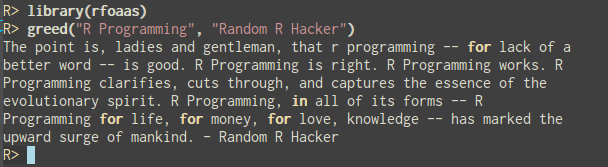
rfoaas greed example The big 1.0.0 is here! Following the unsurpassed lead of the FOAAS project, we have arrived at a milestone: Release 1.0.0 is now on CRAN. The rfoaas package provides an interface for R to the most excellent FOAAS service--which itself provides a modern, scalable and RESTful web service for the frequent need to tell someone to f$#@ off. Release 1.0.0 brings fourteen (!!) new access points: back(), bm(), gfy(), think(), keep(), single_(), look(), looking(), no(), give(), zero(), pulp(), sake(), and anyway(). All with documentation and testing. Even more neatly, thanks to a very pull request by Tyler Hunt, we can now issue random FOs via the getRandomFO() function! As usual, CRANberries provides a diff to the previous CRAN release. Questions, comments etc should go to the GitHub issue tracker. More background information is on the project page as well as on the github repo

This post by Dirk Eddelbuettel originated on his Thinking inside the box blog. Please report excessive re-aggregation in third-party for-profit settings.
7 August 2016

Dirk Eddelbuettel: drat 0.1.1: Updates schmupdates!

One year ago (tomorrow) drat 0.1.0 was released. It held up rather well, but a number of small fixes and enhancements piled up, along with somewhat-finished to still-raw additions to the examples/ sections. With that, we are happy to announce drat release 0.1.1 which arrived on CRAN earlier today. drat stands for drat R Archive Template, and helps with easy-to-create and easy-to-use repositories for R packages. Since its inception in early 2015 it has found reasonably widespread adoption among R users because repositories is what we use. In other words, friends don't let friends use install_github(). Just kidding. Maybe. Or not. This version 0.1.1 builds on the previous release from one year ago. Several users sent in nicely focused pull request, and I added a bit of spit and polish here and there. The NEWS file (added belatedly in this release) summarises the release as follows:
Changes in drat version 0.1.1 (2016-08-07)
  • Changes in drat functionality
    • Use dir.exists, leading to versioned Depends on R (>= 3.2.0)
    • Optionally pull remote before insert (Mark in PR #38)
    • Fix support for dots (Jan G. in PR #40)
    • Accept dots in package names (Antonio in PR #48)
    • Switch to htpps URLs at GitHub (Colin in PR #50)
    • Support additional fields in PACKAGE file (Jan G. in PR #54)
  • Changes in drat documentation
    • Further improvements and clarifications to vignettes
    • Travis script switched to run.sh from our fork
    • This NEWS file was (belatedly) added
Courtesy of CRANberries, there is a comparison to the previous release. More detailed information is on the drat page.

This post by Dirk Eddelbuettel originated on his Thinking inside the box blog. Please report excessive re-aggregation in third-party for-profit settings.

6 August 2016

Dirk Eddelbuettel: RcppStreams 0.1.1

Streamulus A maintenance release of RcppStreams is now on CRAN. RcppStreams brings the excellent Streamulus C++ template library for event stream processing to R. Streamulus, written by Irit Katriel, uses very clever template meta-programming (via Boost Fusion) to implement an embedded domain-specific event language created specifically for event stream processing. This release updates the compilation standard to C++11 per CRAN's request as this helps with both current and upcoming compiler variants. A few edits were made to DESCRIPTION and README.md, the Travis driver file was updated, but no new code was added. The NEWS file entries follows below:
Changes in version 0.1.1 (2016-08-05)
  • Compilation is now done using C++11 standards per request of CRAN to help with an array of newer (pre-release) and older compilers
  • The Travis CI script was updated to use run.sh from our fork; it now also installs all dependencies as binary .deb files.
  • The README.md was updated with additional badges.
  • The DESCRIPTION file now has URL and BugReports entries.
Courtesy of CRANberries, there is also a copy of the DESCRIPTION file for this initial release. More detailed information is on the RcppStreams page page and of course on the Streamulus page.

This post by Dirk Eddelbuettel originated on his Thinking inside the box blog. Please report excessive re-aggregation in third-party for-profit settings.

3 August 2016

Dirk Eddelbuettel: digest 0.6.10

A new release, now at version number 0.6.10, of the digest package is now on CRAN. I also just prepared the Debian upload. This release, just like the previous one, is once again the work mostly of external contributors. Michel Lang added length checks to sha1(); Thierry Onkelinx extended sha1() support and added more tests, Viliam Simko also extended sha1() to more types, and Henrik Bengtsson improved intervals and fixed a bug with file usage. CRANberries provides the usual summary of changes to the previous version.

This post by Dirk Eddelbuettel originated on his Thinking inside the box blog. Please report excessive re-aggregation in third-party for-profit settings.

2 August 2016

Dirk Eddelbuettel: RcppGetconf 0.0.2

A first update for the recent RcppGetconf package for reading system configuration --- not unlike getconf from the libc library --- is now out. Almost immediately after I tweeted / blogged asking for help with OS X builds, fellow Rcpp hacker Qiang Kou created a clever pull request allowing for exactly that. So now we cover two POSIX systems that matter most these days --- Linux and OS X --- but as there are more out there, please do try, test and send those pull requests. We also added a new function getConfig() retrieving a single (given) value complementing the earlier catch-all function getAll(). You can find out more about RcppGetconf from the local RcppGetconf page and the GitHub repo. Changes in this release are as follows:
Changes in inline version 0.0.2 (2016-08-01)
  • A new function getConfig for single values was added.
  • The struct vars is now defined more portable allowing compilation on OS X (PR #1 by Qiang Kou).
Courtesy of CRANberries, there is a diffstat report. More about the package is at the local RcppGetconf page and the GitHub repo.

This post by Dirk Eddelbuettel originated on his Thinking inside the box blog. Please report excessive re-aggregation in third-party for-profit settings.

24 July 2016

Dirk Eddelbuettel: RcppArmadillo 0.7.200.2.0

armadillo image The second Armadillo release of the 7.* series came out a few weeks ago: version 7.200.2. And RcppArmadillo version 0.7.200.2.0 is now on CRAN and uploaded to Debian. This followed the usual thorough reverse-dependecy checking of by now over 240 packages using it. For once, I let it simmer a little preparing only a package update via the GitHub repo without preparing a CRAN upload to lower the update frequency a little. Seeing that Conrad has started to release 7.300.0 tarballs, the time for a (final) 7.200.2 upload was now right. Just like the previous, it now requires a recent enough compiler. As g++ is so common, we explicitly test for version 4.6 or newer. So if you happen to be on an older RHEL or CentOS release, you may need to get yourself a more modern compiler. R on Windows is now at 4.9.3 which is decent (yet stable) choice; the 4.8 series of g++ will also do. For reference, the current LTS of Ubuntu is at 5.4.0, and we have g++ 6.1 available in Debian testing. This new upstream release adds new indexing helpers, additional return codes on some matrix transformations, increased speed for compound expressions via vectorise, corrects some LAPACK feature detections (affecting principally complex number use under OS X), and a rewritten sample() function thanks to James Balamuta. Armadillo is a powerful and expressive C++ template library for linear algebra aiming towards a good balance between speed and ease of use with a syntax deliberately close to a Matlab. Changes in this release (and the preceding GitHub-only release 0.7.200.1.0 are as follows:
Changes in RcppArmadillo version 0.7.200.2.0 (2016-07-22)
  • Upgraded to Armadillo release 7.200.2
  • The sampling extension was rewritten to use Armadillo vector types instead of Rcpp types (PR #101 by James Balamuta)
Changes in RcppArmadillo version 0.7.200.1.0 (2016-06-06)
  • Upgraded to Armadillo release 7.200.1
    • added .index_min() and .index_max()
    • expanded ind2sub() to handle vectors of indices
    • expanded sub2ind() to handle matrix of subscripts
    • expanded expmat(), logmat() and sqrtmat() to optionally return a bool indicating success
    • faster handling of compound expressions by vectorise()
  • The configure code now (once again) sets the values for the LAPACK feature #define correctly.
Courtesy of CRANberries, there is a diffstat report. More detailed information is on the RcppArmadillo page. Questions, comments etc should go to the rcpp-devel mailing list off the R-Forge page.

This post by Dirk Eddelbuettel originated on his Thinking inside the box blog. Please report excessive re-aggregation in third-party for-profit settings.

22 July 2016

Dirk Eddelbuettel: RcppCCTZ 0.0.5

Version 0.0.5 of RcppCCTZ arrived on CRAN a couple of days ago. It reflects an upstream fixed made a few weeks ago. CRAN tests revealed that g++-6 was tripping over one missing #define; this was added upstream and I subsequently synchronized with upstream. At the same time the set of examples was extended (see below). Somehow useR! 2016 got in the way and while working on the then-incomplete examples during the traveling I forgot to release this until CRAN reminded me that their tests still failed. I promptly prepared the 0.0.5 release but somehow failed to update NEWS files etc. They are correct in the repo but not in the shipped package. Oh well. CCTZ is a C++ library for translating between absolute and civil times using the rules of a time zone. In fact, it is two libraries. One for dealing with civil time: human-readable dates and times, and one for converting between between absolute and civil times via time zones. It requires only a proper C++11 compiler and the standard IANA time zone data base which standard Unix, Linux, OS X, ... computers tend to have in /usr/share/zoneinfo. RcppCCTZ connects this library to R by relying on Rcpp. Two good examples are now included, and shown here. The first one tabulates the time difference between New York and London (at a weekly level for compactness):
R> example(tzDiff)
tzDiffR> # simple call: difference now
tzDiffR> tzDiff("America/New_York", "Europe/London", Sys.time())
[1] 5
tzDiffR> # tabulate difference for every week of the year
tzDiffR> table(sapply(0:52, function(d) tzDiff("America/New_York", "Europe/London",
tzDiff+                                       as.POSIXct(as.Date("2016-01-01") + d*7))))
 4  5 
 3 50 
R> 
Because the two continents happen to spring forward and fall backwards between regular and daylight savings times, there are, respectively, two and one week periods where the difference is one hour less than usual. A second example shifts the time to a different time zone:
R> example(toTz)
toTzR> toTz(Sys.time(), "America/New_York", "Europe/London")
[1] "2016-07-14 10:28:39.91740 CDT"
R> 
Note that because we return a POSIXct object, it is printed by R with the default (local) TZ attribute (for "America/Chicago" in my case). A more direct example asks what time it is in my time zone when it is midnight in Tokyo:
R> toTz(ISOdatetime(2016,7,15,0,0,0), "Japan", "America/Chicago")
[1] "2016-07-14 15:00:00 CDT"
R>
More changes will come in 0.0.6 as soon as I find time to translate the nice time_tool (command-line) example into an R function. Changes in this version are summarized here:
Changes in version 0.0.5 (2016-07-09)
  • New utility example functions toTz() and tzDiff
  • Synchronized with small upstream change for additional #ifdef for compiler differentiation
We also have a diff to the previous version thanks to CRANberries. More details are at the RcppCCTZ page; code, issue tickets etc at the GitHub repository.

This post by Dirk Eddelbuettel originated on his Thinking inside the box blog. Please report excessive re-aggregation in third-party for-profit settings.

19 July 2016

Dirk Eddelbuettel: Rcpp 0.12.6: Rolling on

The sixth update in the 0.12.* series of Rcpp has arrived on the CRAN network for GNU R a few hours ago, and was just pushed to Debian. This 0.12.6 release follows the 0.12.0 release from late July, the 0.12.1 release in September, the 0.12.2 release in November, the 0.12.3 release in January, the 0.12.4 release in March, and the 0.12.5 release in May --- making it the tenth release at the steady bi-montly release frequency. Just like the previous release, this one is once again more of a refining maintenance release which addresses small bugs, nuisances or documentation issues without adding any major new features. That said, some nice features (such as caching support for sourceCpp() and friends) were added. Rcpp has become the most popular way of enhancing GNU R with C or C++ code. As of today, 703 packages on CRAN depend on Rcpp for making analytical code go faster and further. That is up by about fourty packages from the last release in May! Similar to the previous releases, we have contributions from first-time committers. Artem Klevtsov made na_omit run faster on vectors without NA values. Otherwise, we had many contributions from "regulars" like Kirill Mueller, James "coatless" Balamuta and Dan Dillon as well as from fellow Rcpp Core contributors. Some noteworthy highlights are encoding and string fixes, generally more robust builds, a new iterator-based approach for vectorized programming, the aforementioned caching for sourceCpp(), and several documentation enhancements. More details are below.
Changes in Rcpp version 0.12.6 (2016-07-18)
  • Changes in Rcpp API:
    • The long long data type is used only if it is available, to avoid compiler warnings (Kirill M ller in #488).
    • The compiler is made aware that stop() never returns, to improve code path analysis (Kirill M ller in #487 addressing issue #486).
    • String replacement was corrected (Qiang in #479 following mailing list bug report by Masaki Tsuda)
    • Allow for UTF-8 encoding in error messages via RCPP_USING_UTF8_ERROR_STRING macro (Qin Wenfeng in #493)
    • The R function Rf_warningcall is now provided as well (as usual without leading Rf_) (#497 fixing #495)
  • Changes in Rcpp Sugar:
    • Const-ness of min and max functions has been corrected. (Dan Dillon in PR #478 fixing issue #477).
    • Ambiguities for matrix/vector and scalar operations have been fixed (Dan Dillon in PR #476 fixing issue #475).
    • New algorithm header using iterator-based approach for vectorized functions (Dan in PR #481 revisiting PR #428 and addressing issue #426, with futher work by Kirill in PR #488 and Nathan in #503 fixing issue #502).
    • The na_omit() function is now faster for vectors without NA values (Artem Klevtsov in PR #492)
  • Changes in Rcpp Attributes:
    • Add cacheDir argument to sourceCpp() to enable caching of shared libraries across R sessions (JJ in #504).
    • Code generation now deals correctly which packages containing a dot in their name (Qiang in #501 fixing #500).
  • Changes in Rcpp Documentation:
    • A section on default parameters was added to the Rcpp FAQ vignette (James Balamuta in #505 fixing #418).
    • The Rcpp-attributes vignette is now mentioned more prominently in question one of the Rcpp FAQ vignette.
    • The Rcpp Quick Reference vignette received a facelift with new sections on Rcpp attributes and plugins begin added. (James Balamuta in #509 fixing #484).
    • The bib file was updated with respect to the recent JSS publication for RProtoBuf.
Thanks to CRANberries, you can also look at a diff to the previous release. As always, even fuller details are on the Rcpp Changelog page and the Rcpp page which also leads to the downloads page, the browseable doxygen docs and zip files of doxygen output for the standard formats. A local directory has source and documentation too. Questions, comments etc should go to the rcpp-devel mailing list off the R-Forge page.

This post by Dirk Eddelbuettel originated on his Thinking inside the box blog. Please report excessive re-aggregation in third-party for-profit settings.

12 July 2016

Dirk Eddelbuettel: RProtoBuf 0.4.4, and new JSS paper

A new release 0.4.4 of RProtoBuf is now on CRAN, and corresponds to the source archive for the Journal of Statistical Software paper about RProtoBuf as JSS vol71 issue 02. The paper is also included as a pre-print in the updated package. RProtoBuf provides R bindings for the Google Protocol Buffers ("Protobuf") data encoding library used and released by Google, and deployed as a language and operating-system agnostic protocol by numerous projects. This release brings small cleanups as well as build-system updates for the updated R 3.3.0 infrastructure based on g++ 4.9.*.
Changes in RProtoBuf version 0.4.4 (2016-07-10)
  • New vignette based on our brand-new JSS publication (v71 i02)
  • Some documentation enhancements were made, as well as other minor cleanups to file modes and operations
  • Unit-test vignette no longer writes to /tmp per CRAN request
  • The new Windows toolchain (based on g++ 4.9.*) is supported
CRANberries also provides a diff to the previous release. The RProtoBuf page has an older package vignette, a 'quick' overview vignette, a unit test summary vignette, and the pre-print for the JSS paper. Questions, comments etc should go to the GitHub issue tracker off the GitHub repo.

This post by Dirk Eddelbuettel originated on his Thinking inside the box blog. Please report excessive re-aggregation in third-party for-profit settings.

11 July 2016

Dirk Eddelbuettel: Rcpp now used by over 700 CRAN packages

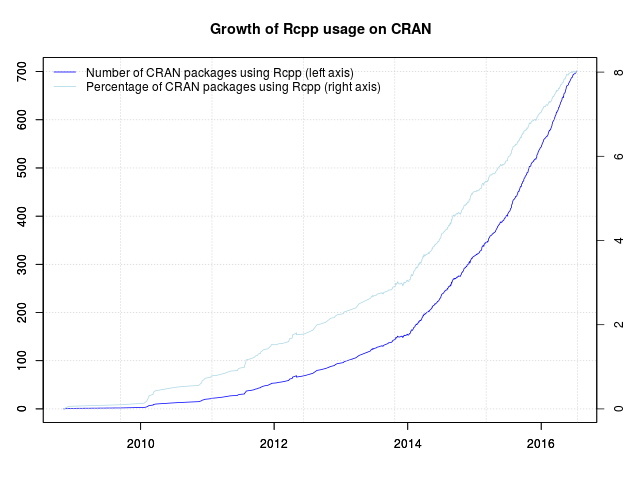
600 Rcpp packages Earlier this morning, Rcpp reached another milestone: 701 packages on CRAN now depend on it (as measured by Depends, Imports and LinkingTo declarations). The graph is on the left depicts the growth of Rcpp usage over time. Rcpp cleared 300 packages in November 2014. It passed 400 packages in June of last year (when I only tweeted about it), 500 packages in late October and 600 packages exactly four months ago in March. The chart extends to the very beginning via manually compiled data from CRANberries and checked with crandb. Then next part uses manually saved entries, and the final and largest part of the data set was generated semi-automatically via a short script appending updates to a small file-based backend. A list of packages using Rcpp is kept on this page. Also displayed in the graph is the relative proportion of CRAN packages using Rcpp. The four per-cent hurdle was cleared just before useR! 2014 where I showed a similar graph (as two distinct graphs) in my invited talk. We passed five percent in December of 2014, six percent last July, seven percent just before Christmas and now criss-crosses 8 eight percent, or a little less than one in twelve R packages. 700 user packages is a really large and humbling number. This places quite some responsibility on us in the Rcpp team as we continue to try our best try to keep Rcpp as performant and reliable as it has been. So with that a very big Thank You! to all users and contributors of Rcpp for help, suggestions, bug reports, documentation or, of course, code.

This post by Dirk Eddelbuettel originated on his Thinking inside the box blog. Please report excessive re-aggregation in third-party for-profit settings.

28 May 2016

Dirk Eddelbuettel: RcppArmadillo 0.7.100.3.0

armadillo image The first Armadillo release of the 7.* series is out: a new version 7.100.3. We uploaded RcppArmadillo 0.7.100.3.0 to CRAN and Debian. This followed the usual thorough reverse-dependecy checking of by now 230 packages using it. This release now requires a recent enough compiler. As g++ is so common, we explicitly test for version 4.6 or newer. So if you happen to be on an older RHEL or CentOS release, you may need to get yourself a more modern compiler. R on Windows is now at 4.9.3 which is decent (yet stable) choice; the 4.8 series of g++ will also do. For reference, the current LTS of Ubuntu is at 5.3.1, and we have g++ 6.1 available in Debian testing. This new upstream release adds a few new helper functions (which are particularly useful in statistics, but were of course already available to us via Rcpp), more slicing of Cube data structures and a brand new sparse matrix decomposition module courtesy of Yixuan Qiu -- whom R users know as the author of the RSpectra package (which replaces his older rArpack package) and of course all the most excellent work he provided to RcppEigen. Armadillo is a powerful and expressive C++ template library for linear algebra aiming towards a good balance between speed and ease of use with a syntax deliberately close to a Matlab. Changes in this release are as follows:
Changes in RcppArmadillo version 0.7.100.3.0 (2016-05-25)
  • Upgraded to Armadillo test release 7.100.3
    • added erf(), erfc(), lgamma()
    • added .head_slices() and .tail_slices() to subcube views
    • spsolve() now requires SuperLU 5.2
    • eigs_sym(), eigs_gen() and svds() now use a built-in reimplementation of ARPACK for real (non-complex) matrices (code contributed by Yixuan Qiu)
  • The configure code now checks against old g++ version which are no longer sufficient to build the package.
Courtesy of CRANberries, there is also a diffstat report for this release. As always, more detailed information is on the RcppArmadillo page. Questions, comments etc should go to the rcpp-devel mailing list off the R-Forge page.

This post by Dirk Eddelbuettel originated on his Thinking inside the box blog. Please report excessive re-aggregation in third-party for-profit settings.

27 May 2016

Dirk Eddelbuettel: rfoaas 0.1.9

rfoaas greed example Time for new release! We just updated rfoaas on CRAN, and it now corresponds to version 0.1.9 of the FOAAS API. The rfoaas package provides an interface for R to the most excellent FOAAS service--which provides a modern, scalable and RESTful web service for the frequent need to tell someone to f$#@ off. Release 0.1.9 brings three new access point functions: greed(), me() and morning(). It also adds an S3 print method for the returned object. A demo of first of these additions in shown in the image in this post. As usual, CRANberries provides a diff to the previous CRAN release. Questions, comments etc should go to the GitHub issue tracker.

This post by Dirk Eddelbuettel originated on his Thinking inside the box blog. Please report excessive re-aggregation in third-party for-profit settings.

15 May 2016

Dirk Eddelbuettel: Rcpp 0.12.5: Yet another one

The fifth update in the 0.12.* series of Rcpp has arrived on the CRAN network for GNU R a few hours ago, and was just pushed to Debian. This 0.12.5 release follows the 0.12.0 release from late July, the 0.12.1 release in September, the 0.12.2 release in November, the 0.12.3 release in January, and the 0.12.4 release in March --- making it the ninth release at the steady bi-montly release frequency. This release is one again more of a maintenance release addressing a number of small bugs, nuisances or documentation issues without adding any major new features. Rcpp has become the most popular way of enhancing GNU R with C or C++ code. As of today, 662 packages on CRAN depend on Rcpp for making analytical code go faster and further. That is up by almost fifty packages from the last release in late March! And as during the last few releases, we have first-time committers. we have new first-time contributors. Sergio Marques helped to enable compilation on Alpine Linux (with its smaller libc variant). Qin Wenfeng helped adapt for Windows builds under R 3.3.0 and the long-awaited new toolchain. Ben Goodrich fixed a (possibly ancient) Rcpp Modules bug he encountered when working with rstan. Other (recurrent) contributor Dan Dillon cleaned up an issue with Nullable and strings. Rcpp Core team members Kevin and JJ took care of small build nuisance on Windows, and I added in a new helper function, updated the skeleton generator and (finally) formally deprecated loadRcppModule() for which loadModule() has been preferred since around R 2.15 or so. More details and links are below.
Changes in Rcpp version 0.12.5 (2016-05-14)
  • Changes in Rcpp API:
    • The checks for different C library implementations now also check for Musl used by Alpine Linux (Sergio Marques in PR #449).
    • Rcpp::Nullable works better with Rcpp::String (Dan Dillon in PR #453).
  • Changes in Rcpp Attributes:
    • R 3.3.0 Windows with Rtools 3.3 is now supported (Qin Wenfeng in PR #451).
    • Correct handling of dependent file paths on Windows (use winslash = "/").
  • Changes in Rcpp Modules:
    • An apparent race condition in Module loading seen with R 3.3.0 was fixed (Ben Goodrich in #461 fixing #458).
    • The (older) loadRcppModules() is now deprecated in favour of loadModule() introduced around R 2.15.1 and Rcpp 0.9.11 (PR #470).
  • Changes in Rcpp support functions:
    • The Rcpp.package.skeleton() function was again updated in order to create a DESCRIPTION file which passes R CMD check without notes. warnings, or error under R-release and R-devel (PR #471).
    • A new function compilerCheck can test for minimal g++ versions (PR #474).
Thanks to CRANberries, you can also look at a diff to the previous release. As always, even fuller details are on the Rcpp Changelog page and the Rcpp page which also leads to the downloads page, the browseable doxygen docs and zip files of doxygen output for the standard formats. A local directory has source and documentation too. Questions, comments etc should go to the rcpp-devel mailing list off the R-Forge page.

This post by Dirk Eddelbuettel originated on his Thinking inside the box blog. Please report excessive re-aggregation in third-party for-profit settings.

8 May 2016

Dirk Eddelbuettel: Rblpapi 0.3.4

A new release of Rblpapi is now on CRAN. It provides a direct interface between R and the Bloomberg Terminal via the C++ API provided by Bloomberg Labs (but note that a valid Bloomberg license and installation is required). This marks the fifth release since the package first appeared on CRAN last year. Continued thanks to all contributors for code, suggestions or bug reports. This release contains a lot of internal fixes by Whit, John and myself and should prove to be more resilient to 'odd' representations of data coming back. The NEWS.Rd extract has more details:
Changes in Rblpapi version 0.3.4 (2016-05-08)
  • On startup, the API versions of both the headers and the runtime are displayed (PR #161 and #165).
  • Documentation about extended futures roll notation was added to the bdh manual page.
  • Additional examples for overrides where added to bdh (PR #158).
  • Internal code changes make retrieval of data in unusual variable types more robust (PRs #157 and #153)
  • General improvements and fixes to documentation (PR #156)
  • The bdp function now also supports an option verbose (PR #149).
  • The internal header Rblpapi_types.h was renamed from a lower-cased variant to conform with Rcpp Attributes best practices (PR #145).
Courtesy of CRANberries, there is also a diffstat report for the this release. As always, more detailed information is on the Rblpapi page. Questions, comments etc should go to the issue tickets system at the GitHub repo.

This post by Dirk Eddelbuettel originated on his Thinking inside the box blog. Please report excessive re-aggregation in third-party for-profit settings.

7 May 2016

Dirk Eddelbuettel: BH 1.60.0-2

A new minor release of BH is now on CRAN. BH provides a large part of the Boost C++ libraries as a set of template headers for use by R, possibly with Rcpp as well as other packages. This release uses the same Boost 1.60.0 version of Boost as the last release, but adds three more library: bimap, flyweight and icl. A brief summary of changes from the NEWS file is below.
Changes in version 1.60.0-2 (2016-05-06)
  • Added Boost bimap via GH pull request #24 by Jim Hester.
  • Added Boost icl via GH pull request #27 by Jay Hesselbert.
  • Added Boost flyweight as requested in GH ticket #26.
Courtesy of CRANberries, there is also a diffstat report for the most recent release. Comments and suggestions are welcome via the mailing list or the issue tracker at the GitHubGitHub repo.

This post by Dirk Eddelbuettel originated on his Thinking inside the box blog. Please report excessive re-aggregation in third-party for-profit settings.

6 May 2016

Dirk Eddelbuettel: RcppArmadillo 0.6.700.6.0

armadillo image A second Armadillo release 6.700.6 came out in the 6.700 series, and we uploaded RcppArmadillo 0.6.700.6.0 to CRAN and Debian. This followed the usual thorough reverse-dependecy checking of by now 220 packages using. This release is a little unusual in that it contains both upstream bugfixes in the same series (see below) but also two nice bug fixes from the RcppArmadillo side. Both were squashed by George G. Vega Yon via two focused pull request. The first ensures that we can now use ARMA_64BIT_WORD (provided C++11 is turned on too) allowing for much bigger Armadillo objects. And the second plugs a small leak in the sparse matrix converter I had added a while back. Nice work, all told! Armadillo is a powerful and expressive C++ template library for linear algebra aiming towards a good balance between speed and ease of use with a syntax deliberately close to a Matlab. Changes in this release are as follows:
Changes in RcppArmadillo version 0.6.700.6.0 (2016-05-05)
  • Upgraded to Armadillo 6.700.6 (Catabolic Amalgamator Deluxe)
    • fix for handling empty matrices by kron()
    • fix for clang warning in advanced matrix constructors
    • fix for false deprecated warning in trunc_log() and trunc_exp()
    • fix for gcc-6.1 warning about misleading indentation
    • corrected documentation for the solve() function
  • Added support for int64_t (ARMA_64BIT_WORD) when required during compilation time. (PR #90 by George G. Vega Yon, fixing #88)
  • Fixed bug in SpMat exporter (PR #91 by George G. Vega Yon, fixing #89 and #72)
Courtesy of CRANberries, there is also a diffstat report for this release. As always, more detailed information is on the RcppArmadillo page. Questions, comments etc should go to the rcpp-devel mailing list off the R-Forge page.

This post by Dirk Eddelbuettel originated on his Thinking inside the box blog. Please report excessive re-aggregation in third-party for-profit settings.

28 April 2016

Dirk Eddelbuettel: RcppRedis 0.1.7

A new release of RcppRedis arrived on CRAN today. And just like for the previous release, Russell Pierce contributed a lot of changes via several pull requests which make for more robust operations. In addition, we have started to add support for MessagePack by relying on our recently-announced RcppMsgPack package.
Changes in version 0.1.7 (2016-04-27)
  • Added support for timeout constructor argument (PR #14 by Russell Pierce)
  • Added new commands exists, ltrim, expire and pexpire along with unit tests (PR #16 by Russell Pierce)
  • Return NULL for empty keys in serialized get for consistency with lpop and rpop (also PR #16 by Russell Pierce)
  • Minor corrections to get code and hget and hset documentation (also PR #16 by Russell Pierce)
  • Error conditions are now properly forwarded as R errors (PR #22 by Russell Pierce)
  • Results from Redis commands are now checked for NULL (PR #23 by Russell Pierce)
  • MessagePack encoding can now be used which requires MessagePackage headers of version 1.0 or later; the (optional) RcppMsgPack package can be used.
Courtesy of CRANberries, there is also a diffstat report for the most recent release. More information is on the RcppRedis page.

This post by Dirk Eddelbuettel originated on his Thinking inside the box blog. Please report excessive re-aggregation in third-party for-profit settings.

24 April 2016

Bits from Debian: Debian welcomes its 2016 summer interns

GSoC 2016 logo Outreachy logo We're excited to announce that Debian has selected 29 interns to work with us this summer: 4 in Outreachy, and 25 in the Google Summer of Code. Here is the list of projects and the interns who will work on them: Android SDK tools in Debian: APT - dpkg communications rework: Continuous Integration for Debian-Med packages: Extending the Debian Developer Horizon: Improving and extending AppRecommender: Improving the debsources frontend: Improving voice, video and chat communication with Free Software: MIPS and MIPSEL ports improvements: Reproducible Builds for Debian and Free Software: Support for KLEE in Debile: The Google Summer of Code and Outreachy programs are possible in Debian thanks to the effort of Debian developers and contributors that dedicate part of their free time to mentor students and outreach tasks. Join us and help extend Debian! You can follow the students weekly reports on the debian-outreach mailing-list, chat with us on our IRC channel or on each project's team mailing lists. Congratulations to all of them!

18 April 2016

Dirk Eddelbuettel: RcppCCTZ 0.0.4

A few days ago a new upstream version "2.0" of CCTZ was released. See here for the corresponding post on the Google OpenSource Blog. CCTZ is a C++ library for translating between absolute and civil times using the rules of a time zone. It requires only a proper C++11 compiler and the standard IANA time zone data base which standard Unix, Linux, OS X, ... computers tend to have in /usr/share/zoneinfo. RcppCCTZ connects this library to R by relying on Rcpp. This new version adds more support to the notion of civil time representation -- i.e. independent of timezones -- which can then be mapped to different time zone representations. Changes in this version are summarized here:
Changes in version 0.0.4 (2016-04-17)
  • Synchronized with CCTZ v2 upstream.
  • Updated examples.cpp accordingly
A quick example is provided here where we look at the time when Neil Armstrong first stepped on the moon as an absolute ("civil") time and two local representations:
// from examples/hello.cc
// 
// [[Rcpp::export]]
int helloMoon()  
    cctz::time_zone syd;
    if (!cctz::load_time_zone("Australia/Sydney", &syd)) return -1;
    // Neil Armstrong first walks on the moon
    const auto tp1 = cctz::convert(cctz::civil_second(1969, 7, 21, 12, 56, 0), syd);
    const std::string s = cctz::format("%F %T %z", tp1, syd);
    Rcpp::Rcout << s << "\n";
    cctz::time_zone nyc;
    cctz::load_time_zone("America/New_York", &nyc);
    const auto tp2 = cctz::convert(cctz::civil_second(1969, 7, 20, 22, 56, 0), nyc);
    return tp2 == tp1 ? 0 : 1;
 
We can call this from R, and get the expected result (of equivalence between the dates):
R> library(RcppCCTZ)
R> helloMoon()
1969-07-21 12:56:00 +1000
[1] 0
R>
We also have a diff to the previous version thanks to CRANberries. More details, issue tickets etc at the GitHub repository.

This post by Dirk Eddelbuettel originated on his Thinking inside the box blog. Please report excessive re-aggregation in third-party for-profit settings.

7 April 2016

Dirk Eddelbuettel: RcppArmadillo 0.6.700.3.0

armadillo image A new Armadillo release 6.700.3 is out, and we uploaded RcppArmadillo 0.6.700.3.0 to CRAN and Debian. This followed the usual thorough reverse-dependecy checking of by now 216 packages using. Armadillo is a powerful and expressive C++ template library for linear algebra aiming towards a good balance between speed and ease of use with a syntax deliberately close to a Matlab. Changes in this release are as follows:
Changes in RcppArmadillo version 0.6.700.3.0 (2016-04-05)
  • Upgraded to Armadillo 6.700.3 (Catabolic Amalgamator Deluxe)
    • added logmat() for calcuating the matrix logarithm
    • added regspace() for generating vectors with regularly spaced elements
    • added logspace() for generating vectors with logarithmically spaced elements
    • added approx_equal() for determining approximate equality
    • added trapz() for numerical integration
    • expanded .save() and .load() with hdf5_binary_trans file type, to save/load data with columns transposed to rows
Courtesy of CRANberries, there is also a diffstat report for this release. As always, more detailed information is on the RcppArmadillo page. Questions, comments etc should go to the rcpp-devel mailing list off the R-Forge page.

This post by Dirk Eddelbuettel originated on his Thinking inside the box blog. Please report excessive re-aggregation in third-party for-profit settings.

Next.

Previous.