Reproducible Builds: Reproducible Builds in November 2024
 Welcome to the November 2024 report from the Reproducible Builds project!
Our monthly reports outline what we ve been up to over the past month and highlight items of news from elsewhere in the world of software supply-chain security where relevant. As ever, if you are interested in contributing to the Reproducible Builds project, please visit our Contribute page on our website.
Table of contents:
- Reproducible Builds mourns the passing of Lunar
- Introducing reproduce.debian.net
- New landing page design
- SBOMs for Python packages
- Debian updates
- Reproducible builds by default in Maven 4
- PyPI now supports digital attestations
- Dependency Challenges in OSS Package Registries
- Zig programming language demonstrated reproducible
- Website updates
- Upstream patches
- Misc development news
- Reproducibility testing framework
Reproducible Builds mourns the passing of Lunar
 The Reproducible Builds community sadly announced it has lost its founding member, Lunar. J r my Bobbio aka Lunar passed away on Friday November 8th in palliative care in Rennes, France.
Lunar was instrumental in starting the Reproducible Builds project in 2013 as a loose initiative within the Debian project. He was the author of our earliest status reports and many of our key tools in use today are based on his design. Lunar s creativity, insight and kindness were often noted.
You can view our full tribute elsewhere on our website. He will be greatly missed.
Introducing reproduce.debian.net
 In happier news, this month saw the introduction of reproduce.debian.net. Announced at the recent Debian MiniDebConf in Toulouse, reproduce.debian.net is an instance of rebuilderd operated by the Reproducible Builds project.
rebuilderd is our server designed monitor the official package repositories of Linux distributions and attempts to reproduce the observed results there.
In November, reproduce.debian.net began rebuilding Debian unstable on the
amd64 architecture, but throughout the MiniDebConf, it had attempted to rebuild 66% of the official archive. From this, it could be determined that it is currently possible to bit-for-bit reproduce and corroborate approximately 78% of the actual binaries distributed by Debian that is, using the .buildinfo files hosted by Debian itself.
reproduce.debian.net also contains instructions how to setup one s own rebuilderd instance, and we very much invite everyone with a machine to spare to setup their own version and to share the results. Whilst rebuilderd is still in development, it has been used to reproduce Arch Linux since 2019. We are especially looking for installations targeting Debian architectures other than i386 and amd64.
New landing page design
 As part of a very productive partnership with the Sovereign Tech Fund and Neighbourhoodie, we are pleased to unveil our new homepage/landing page.
We are very happy with our collaboration with both STF and Neighbourhoodie (including many changes not directly related to the website), and look forward to working with them in the future.
SBOMs for Python packages
The Python Software Foundation has announced a new cross-functional project for SBOMs and Python packages . Seth Michael Larson writes that the project is specifically looking to solve these issues :
- Enable Python users that require SBOM documents (likely due to regulations like CRA or SSDF) to self-serve using existing SBOM generation tools.
- Solve the phantom dependency problem, where non-Python software is bundled in Python packages but not recorded in any metadata. This makes the job of software composition analysis (SCA) tools difficult or impossible.
- Make the adoption work by relevant projects such as build backends, auditwheel-esque tools, as minimal as possible. Empower users who are interested in having better SBOM data for the Python projects they are using to be able to contribute engineering time towards that goal.
A GitHub repository for the initiative is available, and there are a number of queries, comments and remarks on Seth s Discourse forum post.
Debian updates
 There was significant development within Debian this month. Firstly, at the recent MiniDebConf in Toulouse, France, Holger Levsen gave a Debian-specific talk on rebuilding packages distributed from
ftp.debian.org that is to say, how to reproduce the results from the official Debian build servers:
 Holger described the talk as follows:
For more than ten years, the Reproducible Builds project has worked towards reproducible builds of many projects, and for ten years now we have build Debian packages twice with maximal variations applied to see if they can be build reproducible still.
Since about a month, we ve also been rebuilding trying to exactly match the builds being distributed via ftp.debian.org. This talk will describe the setup and the lessons learned so far, and why the results currently are what they are (spoiler: they are less than 30% reproducible), and what we can do to fix that.
The Debian Project Leader, Andreas Tille, was present at the talk and remarked later in his Bits from the DPL update that:
It might be unfair to single out a specific talk from Toulouse, but I d like
to highlight the one on reproducible builds. Beyond its technical focus, the
talk also addressed the recent loss of Lunar, whom we mourn deeply. It served
as a tribute to Lunar s contributions and legacy. Personally, I ve
encountered packages maintained by Lunar and bugs he had filed. I believe
that taking over his packages and addressing the bugs he reported is a
meaningful way to honor his memory and acknowledge the value of his work.
Holger s slides and video in .webm format are available.
Next, rebuilderd is the server to monitor package repositories of Linux distributions and attempt to reproduce the observed results. This month, version 0.21.0 released, most notably with improved support for binNMUs by Jochen Sprickerhof and updating the rebuilderd-debian.sh integration to the latest debrebuild version by Holger Levsen. There has also been significant work to get the rebuilderd package into the Debian archive, in particular, both rust-rebuilderd-common version 0.20.0-1 and rust-rust-lzma version 0.6.0-1 were packaged by kpcyrd and uploaded by Holger Levsen.
Related to this, Holger Levsen submitted three additional issues against rebuilderd as well:
rebuildctl should be more verbose when encountering issues. [ ]- Please add an option to used randomised queues. [ ]
- Scheduling and re-scheduling multiple packages at once. [ ]
and lastly, Jochen Sprickerhof submitted one an issue requested that rebuilderd downloads the source package in addition to the .buildinfo file [ ] and kpcyrd also submitted and fixed an issue surrounding dependencies and clarifying the license [ ]
Separate to this, back in 2018, Chris Lamb filed a bug report against the sphinx-gallery package as it generates unreproducible content in various ways. This month, however, Dmitry Shachnev finally closed the bug, listing the multiple sub-issues that were part of the problem and how they were resolved.
Elsewhere, Roland Clobus posted to our mailing list this month, asking for input on a bug in Debian s ca-certificates-java package. The issue is that the Java key management tools embed timestamps in its output, and this output ends up in the /etc/ssl/certs/java/cacerts file on the generated ISO images. A discussion resulted from Roland s post suggesting some short- and medium-term solutions to the problem.
Holger Levsen uploaded some packages with reproducibility-related changes:
-
devscripts versions 2.24.3, 2.24.4 and 2.24.5 were uploaded, including several fixes for the debrebuild and debootsnap and scripts.
-
cdbs version 0.4.167 uploaded in order to drop dh_buildinfo support, as dpkg has generated .buildinfo files since 2016 and the results of dh_buildinfo are typically unreproducible. Related to this a mass bug filing by Helmut Grohne intended to remove the obsolete and deprecated dh-buildinfo package from the archive. At the time of writing, this still affects 311 packages in Debian unstable.
Lastly, 12 reviews of Debian packages were added, 5 were updated and 21 were removed this month adding to our knowledge about identified issues in Debian.
Reproducible builds by default in Maven 4
 On our mailing list this month, Herv Boutemy reported the latest release of Maven (
4.0.0-beta-5) has reproducible builds enabled by default. In his mailing list post, Herv mentions that this story started during our Reproducible Builds summit in Hamburg , where he created the upstream issue that builds on a multi-year effort to have Maven builds configured for reproducibility.
PyPI now supports digital attestations
 Elsewhere in the Python ecosystem and as reported on LWN and elsewhere, the Python Package Index (PyPI) has announced that it has finalised support for PEP 740 ( Index support for digital attestations ).
Trail of Bits, who performed much of the development work, has an in-depth blog post about the work and its adoption, as well as what is left undone:
One thing is notably missing from all of this work: downstream verification. [ ]
This isn t an acceptable end state (cryptographic attestations have defensive properties only insofar as they re actually verified), so we re looking into ways to bring verification to individual installing clients. In particular, we re currently working on a plugin architecture for pip that will enable users to load verification logic directly into their pip install flows.
There was an in-depth discussion on LWN s announcement page, as well as on Hacker News.
Dependency Challenges in OSS Package Registries
 At BENEVOL, the Belgium-Netherlands Software Evolution workshop in Namur, Belgium, Tom Mens and Alexandre Decan presented their paper, An Overview and Catalogue of Dependency Challenges in Open Source Software Package Registries .
The abstract of their paper is as follows:
While open-source software has enabled significant levels of reuse to speed up software development, it has also given rise to the dreadful dependency hell that all software practitioners face on a regular basis. This article provides a catalogue of dependency-related challenges that come with relying on OSS packages or libraries. The catalogue is based on the scientific literature on empirical research that has been conducted to understand, quantify and overcome these challenges. [ ]
A PDF of the paper is available online.
Zig programming language demonstrated reproducible
 Motiejus Jak ty posted an interesting and practical blog post on his successful attempt to reproduce the Zig programming language without using the pre-compiled binaries checked into the repository, and despite the circular dependency inherent in its bootstrapping process.
As a summary, Motiejus concludes that:
I can now confidently say (and you can also check, you don t need to trust me) that there is nothing hiding in zig1.wasm [the checked-in binary] that hasn t been checked-in as a source file.
The full post is full of practical details, and includes a few open questions.
Website updates
 Notwithstanding the significant change to the landing page (screenshot above), there were an enormous number of changes made to our website this month. This included:
-
Alex Feyerke and Mariano Gim nez:
- Dramatically overhaul the website s landing page with new benefit cards tailored to the expected visitors to our website and a reworking of the visual hierarchy and design. [ ][ ][ ][ ][ ][ ][ ][ ][ ][ ]
-
Bernhard M. Wiedemann:
- Update the System images page to document the
e2fsprogs approach. [ ]
-
Chris Lamb:
- Cachebust every CSS file per-release. [ ]
- Replace some inline markdown with HTML. [ ]
- Use spaces on the Publications page. [ ]
- Add a news article about the passing of Lunar. [ ][ ][ ][ ]
- Add a black memorial band to the top of the page. [ ]
-
FC (Fay) Stegerman:
- Replace more inline markdown with HTML on the Success stories page. [ ]
- Add some links, fix some other links and correct some spelling errors on the Tools page. [ ]
-
Holger Levsen:
-
Julia Kr ger:
- Add a new Stripping of unreproducible information page to the documentation. [ ]
-
Ninette Adhikari & hulkoba:
- Add/rework the list of success stories into a new page that clearly shows milestones in Reproducible Builds. [ ][ ][ ][ ][ ][ ]
-
Philip Rinn:
-
hulkoba:
- Add
alt text to almost all images (!). [ ][ ]
- Fix a number of links on the Talks . [ ][ ]
- Avoid so-called ghost buttons by not using
<button> elements as links, as the affordance of a <button> implies an action with (potentially) a side effect. [ ][ ]
- Center the sponsor logos on the homepage. [ ]
-
Move publications and generate them instead from a
data.yml file with an improved layout. [ ][ ]
-
Make a large number of small but impactful stylisting changes. [ ][ ][ ][ ]
- Expand the Tools to include a number of missing tools, fix some styling issues and fix a number of stale/broken links. [ ][ ][ ][ ][ ][ ]
Upstream patches
The Reproducible Builds project detects, dissects and attempts to fix as many currently-unreproducible packages as possible. We endeavour to send all of our patches upstream where appropriate. This month, we wrote a large number of such patches, including:
-
Bernhard M. Wiedemann:
clisp (fix contributed by Bruno Haible)conky (date-related issue)emacs-auctex (date-related gzip issue)javadoc (filesystem ordering issue)jboss-websocket-1.0-api (embeds uname -r)lcms2 (CPU issue)LiE (ASLR-related issue)make_ext4fs (toolchain-related issue for for VM images)obs-build (issue when running builds with certain CPU types or core numbers)perl-Time-modules (fails to build far in the future)python-bson (fails to build far in the future)python-exiv2 (fails to build far in the future)python-moto (date-related gzip issue)python-pyhanko-certvalidator (fails to build far in the future)python-python-gvm (concurrency-related issue)python310 (fails to build far in the future)python313 (fails to build far in the future)reproducible-faketools (toolchain for emacs)shadowsocks-rust (date-related issue)swipl (fails to build far in the future)
-
Chris Lamb:
- #1087330 filed against
python-pydash.
- #1087485 filed against
fritzconnection.
- #1087486 filed against
tracy.
- #1088238 filed against
rust-broot.
- #1088353 filed against
python-aiovlc.
- #1088742 filed against
python-aiohomekit.
-
James Addison:
Misc development news

-
Bernhard M. Wiedemann published another report for the openSUSE distribution.
-
Martin Abente Lahaye updated diffoscope to fix a crash when
objdump is missing. [ ]
-
On our mailing list, Jan-Benedict Glaw announced the publication of the fifth NetBSD Reproducibility Report
Reproducibility testing framework
 The Reproducible Builds project operates a comprehensive testing framework running primarily at tests.reproducible-builds.org in order to check packages and other artifacts for reproducibility. In November, a number of changes were made by Holger Levsen, including:
-
reproduce.debian.net-related changes:
- Create and introduce a new reproduce.debian.net service and subdomain [ ]
- Make a large number of documentation changes relevant to
rebuilderd. [ ][ ][ ][ ][ ]
- Explain a temporary workaround for a specific issue in
rebuilderd. [ ]
- Setup another
rebuilderd instance on the o4 node and update installation documentation to match. [ ][ ]
- Make a number of helpful/cosmetic changes to the interface, such as clarifying terms and adding links. [ ][ ][ ][ ][ ]
- Deploy configuration to the
/opt and /var directories. [ ][ ]
- Add an infancy (or alpha ) disclaimer. [ ][ ]
- Add more notes to the temporary
rebuilderd documentation. [ ]
- Commit an nginx configuration file for reproduce.debian.net s Stats page. [ ]
- Commit a
rebuilder-worker.conf configuration for the o5 node. [ ]
-
Debian-related changes:
-
Misc changes:
- Adapt the
update_jdn.sh script for new Debian trixie systems. [ ]
- Stop installing the PostgreSQL database engine on the
o4 and o5 nodes. [ ]
- Prevent accidental reboots of the
o4 node because of a long-running job owned by josch. [ ][ ]
In addition, Mattia Rizzolo addressed a number of issues with reproduce.debian.net [ ][ ][ ][ ]. And lastly, both Holger Levsen [ ][ ][ ][ ] and Vagrant Cascadian [ ][ ][ ][ ] performed node maintenance.
If you are interested in contributing to the Reproducible Builds project, please visit our Contribute page on our website. However, you can get in touch with us via:
-
IRC:
#reproducible-builds on irc.oftc.net.
-
Mastodon: @reproducible_builds@fosstodon.org
-
Mailing list:
rb-general@lists.reproducible-builds.org
-
Twitter: @ReproBuilds
In happier news, this month saw the introduction of reproduce.debian.net. Announced at the recent Debian MiniDebConf in Toulouse, reproduce.debian.net is an instance of rebuilderd operated by the Reproducible Builds project.
rebuilderd is our server designed monitor the official package repositories of Linux distributions and attempts to reproduce the observed results there.
In November, reproduce.debian.net began rebuilding Debian unstable on the amd64 architecture, but throughout the MiniDebConf, it had attempted to rebuild 66% of the official archive. From this, it could be determined that it is currently possible to bit-for-bit reproduce and corroborate approximately 78% of the actual binaries distributed by Debian that is, using the .buildinfo files hosted by Debian itself.
reproduce.debian.net also contains instructions how to setup one s own rebuilderd instance, and we very much invite everyone with a machine to spare to setup their own version and to share the results. Whilst rebuilderd is still in development, it has been used to reproduce Arch Linux since 2019. We are especially looking for installations targeting Debian architectures other than i386 and amd64.
New landing page design
As part of a very productive partnership with the Sovereign Tech Fund and Neighbourhoodie, we are pleased to unveil our new homepage/landing page.
We are very happy with our collaboration with both STF and Neighbourhoodie (including many changes not directly related to the website), and look forward to working with them in the future.
SBOMs for Python packages
The Python Software Foundation has announced a new cross-functional project for SBOMs and Python packages . Seth Michael Larson writes that the project is specifically looking to solve these issues :
- Enable Python users that require SBOM documents (likely due to regulations like CRA or SSDF) to self-serve using existing SBOM generation tools.
- Solve the phantom dependency problem, where non-Python software is bundled in Python packages but not recorded in any metadata. This makes the job of software composition analysis (SCA) tools difficult or impossible.
- Make the adoption work by relevant projects such as build backends, auditwheel-esque tools, as minimal as possible. Empower users who are interested in having better SBOM data for the Python projects they are using to be able to contribute engineering time towards that goal.
A GitHub repository for the initiative is available, and there are a number of queries, comments and remarks on Seth s Discourse forum post.
Debian updates
There was significant development within Debian this month. Firstly, at the recent MiniDebConf in Toulouse, France, Holger Levsen gave a Debian-specific talk on rebuilding packages distributed from ftp.debian.org that is to say, how to reproduce the results from the official Debian build servers:
Holger described the talk as follows:
For more than ten years, the Reproducible Builds project has worked towards reproducible builds of many projects, and for ten years now we have build Debian packages twice with maximal variations applied to see if they can be build reproducible still.
Since about a month, we ve also been rebuilding trying to exactly match the builds being distributed via ftp.debian.org. This talk will describe the setup and the lessons learned so far, and why the results currently are what they are (spoiler: they are less than 30% reproducible), and what we can do to fix that.
The Debian Project Leader, Andreas Tille, was present at the talk and remarked later in his Bits from the DPL update that:
It might be unfair to single out a specific talk from Toulouse, but I d like
to highlight the one on reproducible builds. Beyond its technical focus, the
talk also addressed the recent loss of Lunar, whom we mourn deeply. It served
as a tribute to Lunar s contributions and legacy. Personally, I ve
encountered packages maintained by Lunar and bugs he had filed. I believe
that taking over his packages and addressing the bugs he reported is a
meaningful way to honor his memory and acknowledge the value of his work.
Holger s slides and video in .webm format are available.
Next, rebuilderd is the server to monitor package repositories of Linux distributions and attempt to reproduce the observed results. This month, version 0.21.0 released, most notably with improved support for binNMUs by Jochen Sprickerhof and updating the rebuilderd-debian.sh integration to the latest debrebuild version by Holger Levsen. There has also been significant work to get the rebuilderd package into the Debian archive, in particular, both rust-rebuilderd-common version 0.20.0-1 and rust-rust-lzma version 0.6.0-1 were packaged by kpcyrd and uploaded by Holger Levsen.
Related to this, Holger Levsen submitted three additional issues against rebuilderd as well:
rebuildctl should be more verbose when encountering issues. [ ]- Please add an option to used randomised queues. [ ]
- Scheduling and re-scheduling multiple packages at once. [ ]
and lastly, Jochen Sprickerhof submitted one an issue requested that rebuilderd downloads the source package in addition to the .buildinfo file [ ] and kpcyrd also submitted and fixed an issue surrounding dependencies and clarifying the license [ ]
Separate to this, back in 2018, Chris Lamb filed a bug report against the sphinx-gallery package as it generates unreproducible content in various ways. This month, however, Dmitry Shachnev finally closed the bug, listing the multiple sub-issues that were part of the problem and how they were resolved.
Elsewhere, Roland Clobus posted to our mailing list this month, asking for input on a bug in Debian s ca-certificates-java package. The issue is that the Java key management tools embed timestamps in its output, and this output ends up in the /etc/ssl/certs/java/cacerts file on the generated ISO images. A discussion resulted from Roland s post suggesting some short- and medium-term solutions to the problem.
Holger Levsen uploaded some packages with reproducibility-related changes:
-
devscripts versions 2.24.3, 2.24.4 and 2.24.5 were uploaded, including several fixes for the debrebuild and debootsnap and scripts.
-
cdbs version 0.4.167 uploaded in order to drop dh_buildinfo support, as dpkg has generated .buildinfo files since 2016 and the results of dh_buildinfo are typically unreproducible. Related to this a mass bug filing by Helmut Grohne intended to remove the obsolete and deprecated dh-buildinfo package from the archive. At the time of writing, this still affects 311 packages in Debian unstable.
Lastly, 12 reviews of Debian packages were added, 5 were updated and 21 were removed this month adding to our knowledge about identified issues in Debian.
Reproducible builds by default in Maven 4
On our mailing list this month, Herv Boutemy reported the latest release of Maven (4.0.0-beta-5) has reproducible builds enabled by default. In his mailing list post, Herv mentions that this story started during our Reproducible Builds summit in Hamburg , where he created the upstream issue that builds on a multi-year effort to have Maven builds configured for reproducibility.
PyPI now supports digital attestations
Elsewhere in the Python ecosystem and as reported on LWN and elsewhere, the Python Package Index (PyPI) has announced that it has finalised support for PEP 740 ( Index support for digital attestations ).
Trail of Bits, who performed much of the development work, has an in-depth blog post about the work and its adoption, as well as what is left undone:
One thing is notably missing from all of this work: downstream verification. [ ]
This isn t an acceptable end state (cryptographic attestations have defensive properties only insofar as they re actually verified), so we re looking into ways to bring verification to individual installing clients. In particular, we re currently working on a plugin architecture for pip that will enable users to load verification logic directly into their pip install flows.
There was an in-depth discussion on LWN s announcement page, as well as on Hacker News.
Dependency Challenges in OSS Package Registries
At BENEVOL, the Belgium-Netherlands Software Evolution workshop in Namur, Belgium, Tom Mens and Alexandre Decan presented their paper, An Overview and Catalogue of Dependency Challenges in Open Source Software Package Registries .
The abstract of their paper is as follows:
While open-source software has enabled significant levels of reuse to speed up software development, it has also given rise to the dreadful dependency hell that all software practitioners face on a regular basis. This article provides a catalogue of dependency-related challenges that come with relying on OSS packages or libraries. The catalogue is based on the scientific literature on empirical research that has been conducted to understand, quantify and overcome these challenges. [ ]
A PDF of the paper is available online.
Zig programming language demonstrated reproducible
Motiejus Jak ty posted an interesting and practical blog post on his successful attempt to reproduce the Zig programming language without using the pre-compiled binaries checked into the repository, and despite the circular dependency inherent in its bootstrapping process.
As a summary, Motiejus concludes that:
I can now confidently say (and you can also check, you don t need to trust me) that there is nothing hiding in zig1.wasm [the checked-in binary] that hasn t been checked-in as a source file.
The full post is full of practical details, and includes a few open questions.
Website updates
Notwithstanding the significant change to the landing page (screenshot above), there were an enormous number of changes made to our website this month. This included:
-
Alex Feyerke and Mariano Gim nez:
- Dramatically overhaul the website s landing page with new benefit cards tailored to the expected visitors to our website and a reworking of the visual hierarchy and design. [ ][ ][ ][ ][ ][ ][ ][ ][ ][ ]
-
Bernhard M. Wiedemann:
- Update the System images page to document the
e2fsprogs approach. [ ]
-
Chris Lamb:
- Cachebust every CSS file per-release. [ ]
- Replace some inline markdown with HTML. [ ]
- Use spaces on the Publications page. [ ]
- Add a news article about the passing of Lunar. [ ][ ][ ][ ]
- Add a black memorial band to the top of the page. [ ]
-
FC (Fay) Stegerman:
- Replace more inline markdown with HTML on the Success stories page. [ ]
- Add some links, fix some other links and correct some spelling errors on the Tools page. [ ]
-
Holger Levsen:
-
Julia Kr ger:
- Add a new Stripping of unreproducible information page to the documentation. [ ]
-
Ninette Adhikari & hulkoba:
- Add/rework the list of success stories into a new page that clearly shows milestones in Reproducible Builds. [ ][ ][ ][ ][ ][ ]
-
Philip Rinn:
-
hulkoba:
- Add
alt text to almost all images (!). [ ][ ]
- Fix a number of links on the Talks . [ ][ ]
- Avoid so-called ghost buttons by not using
<button> elements as links, as the affordance of a <button> implies an action with (potentially) a side effect. [ ][ ]
- Center the sponsor logos on the homepage. [ ]
-
Move publications and generate them instead from a
data.yml file with an improved layout. [ ][ ]
-
Make a large number of small but impactful stylisting changes. [ ][ ][ ][ ]
- Expand the Tools to include a number of missing tools, fix some styling issues and fix a number of stale/broken links. [ ][ ][ ][ ][ ][ ]
Upstream patches
The Reproducible Builds project detects, dissects and attempts to fix as many currently-unreproducible packages as possible. We endeavour to send all of our patches upstream where appropriate. This month, we wrote a large number of such patches, including:
-
Bernhard M. Wiedemann:
clisp (fix contributed by Bruno Haible)conky (date-related issue)emacs-auctex (date-related gzip issue)javadoc (filesystem ordering issue)jboss-websocket-1.0-api (embeds uname -r)lcms2 (CPU issue)LiE (ASLR-related issue)make_ext4fs (toolchain-related issue for for VM images)obs-build (issue when running builds with certain CPU types or core numbers)perl-Time-modules (fails to build far in the future)python-bson (fails to build far in the future)python-exiv2 (fails to build far in the future)python-moto (date-related gzip issue)python-pyhanko-certvalidator (fails to build far in the future)python-python-gvm (concurrency-related issue)python310 (fails to build far in the future)python313 (fails to build far in the future)reproducible-faketools (toolchain for emacs)shadowsocks-rust (date-related issue)swipl (fails to build far in the future)
-
Chris Lamb:
- #1087330 filed against
python-pydash.
- #1087485 filed against
fritzconnection.
- #1087486 filed against
tracy.
- #1088238 filed against
rust-broot.
- #1088353 filed against
python-aiovlc.
- #1088742 filed against
python-aiohomekit.
-
James Addison:
Misc development news
-
Bernhard M. Wiedemann published another report for the openSUSE distribution.
-
Martin Abente Lahaye updated diffoscope to fix a crash when
objdump is missing. [ ]
-
On our mailing list, Jan-Benedict Glaw announced the publication of the fifth NetBSD Reproducibility Report
Reproducibility testing framework
The Reproducible Builds project operates a comprehensive testing framework running primarily at tests.reproducible-builds.org in order to check packages and other artifacts for reproducibility. In November, a number of changes were made by Holger Levsen, including:
-
reproduce.debian.net-related changes:
- Create and introduce a new reproduce.debian.net service and subdomain [ ]
- Make a large number of documentation changes relevant to
rebuilderd. [ ][ ][ ][ ][ ]
- Explain a temporary workaround for a specific issue in
rebuilderd. [ ]
- Setup another
rebuilderd instance on the o4 node and update installation documentation to match. [ ][ ]
- Make a number of helpful/cosmetic changes to the interface, such as clarifying terms and adding links. [ ][ ][ ][ ][ ]
- Deploy configuration to the
/opt and /var directories. [ ][ ]
- Add an infancy (or alpha ) disclaimer. [ ][ ]
- Add more notes to the temporary
rebuilderd documentation. [ ]
- Commit an nginx configuration file for reproduce.debian.net s Stats page. [ ]
- Commit a
rebuilder-worker.conf configuration for the o5 node. [ ]
-
Debian-related changes:
-
Misc changes:
- Adapt the
update_jdn.sh script for new Debian trixie systems. [ ]
- Stop installing the PostgreSQL database engine on the
o4 and o5 nodes. [ ]
- Prevent accidental reboots of the
o4 node because of a long-running job owned by josch. [ ][ ]
In addition, Mattia Rizzolo addressed a number of issues with reproduce.debian.net [ ][ ][ ][ ]. And lastly, both Holger Levsen [ ][ ][ ][ ] and Vagrant Cascadian [ ][ ][ ][ ] performed node maintenance.
If you are interested in contributing to the Reproducible Builds project, please visit our Contribute page on our website. However, you can get in touch with us via:
-
IRC:
#reproducible-builds on irc.oftc.net.
-
Mastodon: @reproducible_builds@fosstodon.org
-
Mailing list:
rb-general@lists.reproducible-builds.org
-
Twitter: @ReproBuilds
A GitHub repository for the initiative is available, and there are a number of queries, comments and remarks on Seth s Discourse forum post.
- Enable Python users that require SBOM documents (likely due to regulations like CRA or SSDF) to self-serve using existing SBOM generation tools.
- Solve the phantom dependency problem, where non-Python software is bundled in Python packages but not recorded in any metadata. This makes the job of software composition analysis (SCA) tools difficult or impossible.
- Make the adoption work by relevant projects such as build backends, auditwheel-esque tools, as minimal as possible. Empower users who are interested in having better SBOM data for the Python projects they are using to be able to contribute engineering time towards that goal.
Debian updates
There was significant development within Debian this month. Firstly, at the recent MiniDebConf in Toulouse, France, Holger Levsen gave a Debian-specific talk on rebuilding packages distributed from ftp.debian.org that is to say, how to reproduce the results from the official Debian build servers:
Holger described the talk as follows:
For more than ten years, the Reproducible Builds project has worked towards reproducible builds of many projects, and for ten years now we have build Debian packages twice with maximal variations applied to see if they can be build reproducible still.
Since about a month, we ve also been rebuilding trying to exactly match the builds being distributed via ftp.debian.org. This talk will describe the setup and the lessons learned so far, and why the results currently are what they are (spoiler: they are less than 30% reproducible), and what we can do to fix that.
The Debian Project Leader, Andreas Tille, was present at the talk and remarked later in his Bits from the DPL update that:
It might be unfair to single out a specific talk from Toulouse, but I d like
to highlight the one on reproducible builds. Beyond its technical focus, the
talk also addressed the recent loss of Lunar, whom we mourn deeply. It served
as a tribute to Lunar s contributions and legacy. Personally, I ve
encountered packages maintained by Lunar and bugs he had filed. I believe
that taking over his packages and addressing the bugs he reported is a
meaningful way to honor his memory and acknowledge the value of his work.
Holger s slides and video in .webm format are available.
Next, rebuilderd is the server to monitor package repositories of Linux distributions and attempt to reproduce the observed results. This month, version 0.21.0 released, most notably with improved support for binNMUs by Jochen Sprickerhof and updating the rebuilderd-debian.sh integration to the latest debrebuild version by Holger Levsen. There has also been significant work to get the rebuilderd package into the Debian archive, in particular, both rust-rebuilderd-common version 0.20.0-1 and rust-rust-lzma version 0.6.0-1 were packaged by kpcyrd and uploaded by Holger Levsen.
Related to this, Holger Levsen submitted three additional issues against rebuilderd as well:
rebuildctl should be more verbose when encountering issues. [ ]- Please add an option to used randomised queues. [ ]
- Scheduling and re-scheduling multiple packages at once. [ ]
and lastly, Jochen Sprickerhof submitted one an issue requested that rebuilderd downloads the source package in addition to the .buildinfo file [ ] and kpcyrd also submitted and fixed an issue surrounding dependencies and clarifying the license [ ]
Separate to this, back in 2018, Chris Lamb filed a bug report against the sphinx-gallery package as it generates unreproducible content in various ways. This month, however, Dmitry Shachnev finally closed the bug, listing the multiple sub-issues that were part of the problem and how they were resolved.
Elsewhere, Roland Clobus posted to our mailing list this month, asking for input on a bug in Debian s ca-certificates-java package. The issue is that the Java key management tools embed timestamps in its output, and this output ends up in the /etc/ssl/certs/java/cacerts file on the generated ISO images. A discussion resulted from Roland s post suggesting some short- and medium-term solutions to the problem.
Holger Levsen uploaded some packages with reproducibility-related changes:
-
devscripts versions 2.24.3, 2.24.4 and 2.24.5 were uploaded, including several fixes for the debrebuild and debootsnap and scripts.
-
cdbs version 0.4.167 uploaded in order to drop dh_buildinfo support, as dpkg has generated .buildinfo files since 2016 and the results of dh_buildinfo are typically unreproducible. Related to this a mass bug filing by Helmut Grohne intended to remove the obsolete and deprecated dh-buildinfo package from the archive. At the time of writing, this still affects 311 packages in Debian unstable.
Lastly, 12 reviews of Debian packages were added, 5 were updated and 21 were removed this month adding to our knowledge about identified issues in Debian.
Reproducible builds by default in Maven 4
On our mailing list this month, Herv Boutemy reported the latest release of Maven (4.0.0-beta-5) has reproducible builds enabled by default. In his mailing list post, Herv mentions that this story started during our Reproducible Builds summit in Hamburg , where he created the upstream issue that builds on a multi-year effort to have Maven builds configured for reproducibility.
PyPI now supports digital attestations
Elsewhere in the Python ecosystem and as reported on LWN and elsewhere, the Python Package Index (PyPI) has announced that it has finalised support for PEP 740 ( Index support for digital attestations ).
Trail of Bits, who performed much of the development work, has an in-depth blog post about the work and its adoption, as well as what is left undone:
One thing is notably missing from all of this work: downstream verification. [ ]
This isn t an acceptable end state (cryptographic attestations have defensive properties only insofar as they re actually verified), so we re looking into ways to bring verification to individual installing clients. In particular, we re currently working on a plugin architecture for pip that will enable users to load verification logic directly into their pip install flows.
There was an in-depth discussion on LWN s announcement page, as well as on Hacker News.
Dependency Challenges in OSS Package Registries
At BENEVOL, the Belgium-Netherlands Software Evolution workshop in Namur, Belgium, Tom Mens and Alexandre Decan presented their paper, An Overview and Catalogue of Dependency Challenges in Open Source Software Package Registries .
The abstract of their paper is as follows:
While open-source software has enabled significant levels of reuse to speed up software development, it has also given rise to the dreadful dependency hell that all software practitioners face on a regular basis. This article provides a catalogue of dependency-related challenges that come with relying on OSS packages or libraries. The catalogue is based on the scientific literature on empirical research that has been conducted to understand, quantify and overcome these challenges. [ ]
A PDF of the paper is available online.
Zig programming language demonstrated reproducible
Motiejus Jak ty posted an interesting and practical blog post on his successful attempt to reproduce the Zig programming language without using the pre-compiled binaries checked into the repository, and despite the circular dependency inherent in its bootstrapping process.
As a summary, Motiejus concludes that:
I can now confidently say (and you can also check, you don t need to trust me) that there is nothing hiding in zig1.wasm [the checked-in binary] that hasn t been checked-in as a source file.
The full post is full of practical details, and includes a few open questions.
Website updates
Notwithstanding the significant change to the landing page (screenshot above), there were an enormous number of changes made to our website this month. This included:
-
Alex Feyerke and Mariano Gim nez:
- Dramatically overhaul the website s landing page with new benefit cards tailored to the expected visitors to our website and a reworking of the visual hierarchy and design. [ ][ ][ ][ ][ ][ ][ ][ ][ ][ ]
-
Bernhard M. Wiedemann:
- Update the System images page to document the
e2fsprogs approach. [ ]
-
Chris Lamb:
- Cachebust every CSS file per-release. [ ]
- Replace some inline markdown with HTML. [ ]
- Use spaces on the Publications page. [ ]
- Add a news article about the passing of Lunar. [ ][ ][ ][ ]
- Add a black memorial band to the top of the page. [ ]
-
FC (Fay) Stegerman:
- Replace more inline markdown with HTML on the Success stories page. [ ]
- Add some links, fix some other links and correct some spelling errors on the Tools page. [ ]
-
Holger Levsen:
-
Julia Kr ger:
- Add a new Stripping of unreproducible information page to the documentation. [ ]
-
Ninette Adhikari & hulkoba:
- Add/rework the list of success stories into a new page that clearly shows milestones in Reproducible Builds. [ ][ ][ ][ ][ ][ ]
-
Philip Rinn:
-
hulkoba:
- Add
alt text to almost all images (!). [ ][ ]
- Fix a number of links on the Talks . [ ][ ]
- Avoid so-called ghost buttons by not using
<button> elements as links, as the affordance of a <button> implies an action with (potentially) a side effect. [ ][ ]
- Center the sponsor logos on the homepage. [ ]
-
Move publications and generate them instead from a
data.yml file with an improved layout. [ ][ ]
-
Make a large number of small but impactful stylisting changes. [ ][ ][ ][ ]
- Expand the Tools to include a number of missing tools, fix some styling issues and fix a number of stale/broken links. [ ][ ][ ][ ][ ][ ]
Upstream patches
The Reproducible Builds project detects, dissects and attempts to fix as many currently-unreproducible packages as possible. We endeavour to send all of our patches upstream where appropriate. This month, we wrote a large number of such patches, including:
-
Bernhard M. Wiedemann:
clisp (fix contributed by Bruno Haible)conky (date-related issue)emacs-auctex (date-related gzip issue)javadoc (filesystem ordering issue)jboss-websocket-1.0-api (embeds uname -r)lcms2 (CPU issue)LiE (ASLR-related issue)make_ext4fs (toolchain-related issue for for VM images)obs-build (issue when running builds with certain CPU types or core numbers)perl-Time-modules (fails to build far in the future)python-bson (fails to build far in the future)python-exiv2 (fails to build far in the future)python-moto (date-related gzip issue)python-pyhanko-certvalidator (fails to build far in the future)python-python-gvm (concurrency-related issue)python310 (fails to build far in the future)python313 (fails to build far in the future)reproducible-faketools (toolchain for emacs)shadowsocks-rust (date-related issue)swipl (fails to build far in the future)
-
Chris Lamb:
- #1087330 filed against
python-pydash.
- #1087485 filed against
fritzconnection.
- #1087486 filed against
tracy.
- #1088238 filed against
rust-broot.
- #1088353 filed against
python-aiovlc.
- #1088742 filed against
python-aiohomekit.
-
James Addison:
Misc development news
-
Bernhard M. Wiedemann published another report for the openSUSE distribution.
-
Martin Abente Lahaye updated diffoscope to fix a crash when
objdump is missing. [ ]
-
On our mailing list, Jan-Benedict Glaw announced the publication of the fifth NetBSD Reproducibility Report
Reproducibility testing framework
The Reproducible Builds project operates a comprehensive testing framework running primarily at tests.reproducible-builds.org in order to check packages and other artifacts for reproducibility. In November, a number of changes were made by Holger Levsen, including:
-
reproduce.debian.net-related changes:
- Create and introduce a new reproduce.debian.net service and subdomain [ ]
- Make a large number of documentation changes relevant to
rebuilderd. [ ][ ][ ][ ][ ]
- Explain a temporary workaround for a specific issue in
rebuilderd. [ ]
- Setup another
rebuilderd instance on the o4 node and update installation documentation to match. [ ][ ]
- Make a number of helpful/cosmetic changes to the interface, such as clarifying terms and adding links. [ ][ ][ ][ ][ ]
- Deploy configuration to the
/opt and /var directories. [ ][ ]
- Add an infancy (or alpha ) disclaimer. [ ][ ]
- Add more notes to the temporary
rebuilderd documentation. [ ]
- Commit an nginx configuration file for reproduce.debian.net s Stats page. [ ]
- Commit a
rebuilder-worker.conf configuration for the o5 node. [ ]
-
Debian-related changes:
-
Misc changes:
- Adapt the
update_jdn.sh script for new Debian trixie systems. [ ]
- Stop installing the PostgreSQL database engine on the
o4 and o5 nodes. [ ]
- Prevent accidental reboots of the
o4 node because of a long-running job owned by josch. [ ][ ]
In addition, Mattia Rizzolo addressed a number of issues with reproduce.debian.net [ ][ ][ ][ ]. And lastly, both Holger Levsen [ ][ ][ ][ ] and Vagrant Cascadian [ ][ ][ ][ ] performed node maintenance.
If you are interested in contributing to the Reproducible Builds project, please visit our Contribute page on our website. However, you can get in touch with us via:
-
IRC:
#reproducible-builds on irc.oftc.net.
-
Mastodon: @reproducible_builds@fosstodon.org
-
Mailing list:
rb-general@lists.reproducible-builds.org
-
Twitter: @ReproBuilds
ftp.debian.org. This talk will describe the setup and the lessons learned so far, and why the results currently are what they are (spoiler: they are less than 30% reproducible), and what we can do to fix that.
rebuildctl should be more verbose when encountering issues. [ ]devscripts versions 2.24.3, 2.24.4 and 2.24.5 were uploaded, including several fixes for the debrebuild and debootsnap and scripts.
cdbs version 0.4.167 uploaded in order to drop dh_buildinfo support, as dpkg has generated .buildinfo files since 2016 and the results of dh_buildinfo are typically unreproducible. Related to this a mass bug filing by Helmut Grohne intended to remove the obsolete and deprecated dh-buildinfo package from the archive. At the time of writing, this still affects 311 packages in Debian unstable.
On our mailing list this month, Herv Boutemy reported the latest release of Maven (4.0.0-beta-5) has reproducible builds enabled by default. In his mailing list post, Herv mentions that this story started during our Reproducible Builds summit in Hamburg , where he created the upstream issue that builds on a multi-year effort to have Maven builds configured for reproducibility.
PyPI now supports digital attestations
Elsewhere in the Python ecosystem and as reported on LWN and elsewhere, the Python Package Index (PyPI) has announced that it has finalised support for PEP 740 ( Index support for digital attestations ).
Trail of Bits, who performed much of the development work, has an in-depth blog post about the work and its adoption, as well as what is left undone:
One thing is notably missing from all of this work: downstream verification. [ ]
This isn t an acceptable end state (cryptographic attestations have defensive properties only insofar as they re actually verified), so we re looking into ways to bring verification to individual installing clients. In particular, we re currently working on a plugin architecture for pip that will enable users to load verification logic directly into their pip install flows.
There was an in-depth discussion on LWN s announcement page, as well as on Hacker News.
Dependency Challenges in OSS Package Registries
At BENEVOL, the Belgium-Netherlands Software Evolution workshop in Namur, Belgium, Tom Mens and Alexandre Decan presented their paper, An Overview and Catalogue of Dependency Challenges in Open Source Software Package Registries .
The abstract of their paper is as follows:
While open-source software has enabled significant levels of reuse to speed up software development, it has also given rise to the dreadful dependency hell that all software practitioners face on a regular basis. This article provides a catalogue of dependency-related challenges that come with relying on OSS packages or libraries. The catalogue is based on the scientific literature on empirical research that has been conducted to understand, quantify and overcome these challenges. [ ]
A PDF of the paper is available online.
Zig programming language demonstrated reproducible
Motiejus Jak ty posted an interesting and practical blog post on his successful attempt to reproduce the Zig programming language without using the pre-compiled binaries checked into the repository, and despite the circular dependency inherent in its bootstrapping process.
As a summary, Motiejus concludes that:
I can now confidently say (and you can also check, you don t need to trust me) that there is nothing hiding in zig1.wasm [the checked-in binary] that hasn t been checked-in as a source file.
The full post is full of practical details, and includes a few open questions.
Website updates
Notwithstanding the significant change to the landing page (screenshot above), there were an enormous number of changes made to our website this month. This included:
-
Alex Feyerke and Mariano Gim nez:
- Dramatically overhaul the website s landing page with new benefit cards tailored to the expected visitors to our website and a reworking of the visual hierarchy and design. [ ][ ][ ][ ][ ][ ][ ][ ][ ][ ]
-
Bernhard M. Wiedemann:
- Update the System images page to document the
e2fsprogs approach. [ ]
-
Chris Lamb:
- Cachebust every CSS file per-release. [ ]
- Replace some inline markdown with HTML. [ ]
- Use spaces on the Publications page. [ ]
- Add a news article about the passing of Lunar. [ ][ ][ ][ ]
- Add a black memorial band to the top of the page. [ ]
-
FC (Fay) Stegerman:
- Replace more inline markdown with HTML on the Success stories page. [ ]
- Add some links, fix some other links and correct some spelling errors on the Tools page. [ ]
-
Holger Levsen:
-
Julia Kr ger:
- Add a new Stripping of unreproducible information page to the documentation. [ ]
-
Ninette Adhikari & hulkoba:
- Add/rework the list of success stories into a new page that clearly shows milestones in Reproducible Builds. [ ][ ][ ][ ][ ][ ]
-
Philip Rinn:
-
hulkoba:
- Add
alt text to almost all images (!). [ ][ ]
- Fix a number of links on the Talks . [ ][ ]
- Avoid so-called ghost buttons by not using
<button> elements as links, as the affordance of a <button> implies an action with (potentially) a side effect. [ ][ ]
- Center the sponsor logos on the homepage. [ ]
-
Move publications and generate them instead from a
data.yml file with an improved layout. [ ][ ]
-
Make a large number of small but impactful stylisting changes. [ ][ ][ ][ ]
- Expand the Tools to include a number of missing tools, fix some styling issues and fix a number of stale/broken links. [ ][ ][ ][ ][ ][ ]
Upstream patches
The Reproducible Builds project detects, dissects and attempts to fix as many currently-unreproducible packages as possible. We endeavour to send all of our patches upstream where appropriate. This month, we wrote a large number of such patches, including:
-
Bernhard M. Wiedemann:
clisp (fix contributed by Bruno Haible)conky (date-related issue)emacs-auctex (date-related gzip issue)javadoc (filesystem ordering issue)jboss-websocket-1.0-api (embeds uname -r)lcms2 (CPU issue)LiE (ASLR-related issue)make_ext4fs (toolchain-related issue for for VM images)obs-build (issue when running builds with certain CPU types or core numbers)perl-Time-modules (fails to build far in the future)python-bson (fails to build far in the future)python-exiv2 (fails to build far in the future)python-moto (date-related gzip issue)python-pyhanko-certvalidator (fails to build far in the future)python-python-gvm (concurrency-related issue)python310 (fails to build far in the future)python313 (fails to build far in the future)reproducible-faketools (toolchain for emacs)shadowsocks-rust (date-related issue)swipl (fails to build far in the future)
-
Chris Lamb:
- #1087330 filed against
python-pydash.
- #1087485 filed against
fritzconnection.
- #1087486 filed against
tracy.
- #1088238 filed against
rust-broot.
- #1088353 filed against
python-aiovlc.
- #1088742 filed against
python-aiohomekit.
-
James Addison:
Misc development news
-
Bernhard M. Wiedemann published another report for the openSUSE distribution.
-
Martin Abente Lahaye updated diffoscope to fix a crash when
objdump is missing. [ ]
-
On our mailing list, Jan-Benedict Glaw announced the publication of the fifth NetBSD Reproducibility Report
Reproducibility testing framework
The Reproducible Builds project operates a comprehensive testing framework running primarily at tests.reproducible-builds.org in order to check packages and other artifacts for reproducibility. In November, a number of changes were made by Holger Levsen, including:
-
reproduce.debian.net-related changes:
- Create and introduce a new reproduce.debian.net service and subdomain [ ]
- Make a large number of documentation changes relevant to
rebuilderd. [ ][ ][ ][ ][ ]
- Explain a temporary workaround for a specific issue in
rebuilderd. [ ]
- Setup another
rebuilderd instance on the o4 node and update installation documentation to match. [ ][ ]
- Make a number of helpful/cosmetic changes to the interface, such as clarifying terms and adding links. [ ][ ][ ][ ][ ]
- Deploy configuration to the
/opt and /var directories. [ ][ ]
- Add an infancy (or alpha ) disclaimer. [ ][ ]
- Add more notes to the temporary
rebuilderd documentation. [ ]
- Commit an nginx configuration file for reproduce.debian.net s Stats page. [ ]
- Commit a
rebuilder-worker.conf configuration for the o5 node. [ ]
-
Debian-related changes:
-
Misc changes:
- Adapt the
update_jdn.sh script for new Debian trixie systems. [ ]
- Stop installing the PostgreSQL database engine on the
o4 and o5 nodes. [ ]
- Prevent accidental reboots of the
o4 node because of a long-running job owned by josch. [ ][ ]
In addition, Mattia Rizzolo addressed a number of issues with reproduce.debian.net [ ][ ][ ][ ]. And lastly, both Holger Levsen [ ][ ][ ][ ] and Vagrant Cascadian [ ][ ][ ][ ] performed node maintenance.
If you are interested in contributing to the Reproducible Builds project, please visit our Contribute page on our website. However, you can get in touch with us via:
-
IRC:
#reproducible-builds on irc.oftc.net.
-
Mastodon: @reproducible_builds@fosstodon.org
-
Mailing list:
rb-general@lists.reproducible-builds.org
-
Twitter: @ReproBuilds
pip that will enable users to load verification logic directly into their pip install flows.
At BENEVOL, the Belgium-Netherlands Software Evolution workshop in Namur, Belgium, Tom Mens and Alexandre Decan presented their paper, An Overview and Catalogue of Dependency Challenges in Open Source Software Package Registries .
The abstract of their paper is as follows:
While open-source software has enabled significant levels of reuse to speed up software development, it has also given rise to the dreadful dependency hell that all software practitioners face on a regular basis. This article provides a catalogue of dependency-related challenges that come with relying on OSS packages or libraries. The catalogue is based on the scientific literature on empirical research that has been conducted to understand, quantify and overcome these challenges. [ ]A PDF of the paper is available online.
Zig programming language demonstrated reproducible
Motiejus Jak ty posted an interesting and practical blog post on his successful attempt to reproduce the Zig programming language without using the pre-compiled binaries checked into the repository, and despite the circular dependency inherent in its bootstrapping process.
As a summary, Motiejus concludes that:
I can now confidently say (and you can also check, you don t need to trust me) that there is nothing hiding in zig1.wasm [the checked-in binary] that hasn t been checked-in as a source file.
The full post is full of practical details, and includes a few open questions.
Website updates
Notwithstanding the significant change to the landing page (screenshot above), there were an enormous number of changes made to our website this month. This included:
-
Alex Feyerke and Mariano Gim nez:
- Dramatically overhaul the website s landing page with new benefit cards tailored to the expected visitors to our website and a reworking of the visual hierarchy and design. [ ][ ][ ][ ][ ][ ][ ][ ][ ][ ]
-
Bernhard M. Wiedemann:
- Update the System images page to document the
e2fsprogs approach. [ ]
-
Chris Lamb:
- Cachebust every CSS file per-release. [ ]
- Replace some inline markdown with HTML. [ ]
- Use spaces on the Publications page. [ ]
- Add a news article about the passing of Lunar. [ ][ ][ ][ ]
- Add a black memorial band to the top of the page. [ ]
-
FC (Fay) Stegerman:
- Replace more inline markdown with HTML on the Success stories page. [ ]
- Add some links, fix some other links and correct some spelling errors on the Tools page. [ ]
-
Holger Levsen:
-
Julia Kr ger:
- Add a new Stripping of unreproducible information page to the documentation. [ ]
-
Ninette Adhikari & hulkoba:
- Add/rework the list of success stories into a new page that clearly shows milestones in Reproducible Builds. [ ][ ][ ][ ][ ][ ]
-
Philip Rinn:
-
hulkoba:
- Add
alt text to almost all images (!). [ ][ ]
- Fix a number of links on the Talks . [ ][ ]
- Avoid so-called ghost buttons by not using
<button> elements as links, as the affordance of a <button> implies an action with (potentially) a side effect. [ ][ ]
- Center the sponsor logos on the homepage. [ ]
-
Move publications and generate them instead from a
data.yml file with an improved layout. [ ][ ]
-
Make a large number of small but impactful stylisting changes. [ ][ ][ ][ ]
- Expand the Tools to include a number of missing tools, fix some styling issues and fix a number of stale/broken links. [ ][ ][ ][ ][ ][ ]
Upstream patches
The Reproducible Builds project detects, dissects and attempts to fix as many currently-unreproducible packages as possible. We endeavour to send all of our patches upstream where appropriate. This month, we wrote a large number of such patches, including:
-
Bernhard M. Wiedemann:
clisp (fix contributed by Bruno Haible)conky (date-related issue)emacs-auctex (date-related gzip issue)javadoc (filesystem ordering issue)jboss-websocket-1.0-api (embeds uname -r)lcms2 (CPU issue)LiE (ASLR-related issue)make_ext4fs (toolchain-related issue for for VM images)obs-build (issue when running builds with certain CPU types or core numbers)perl-Time-modules (fails to build far in the future)python-bson (fails to build far in the future)python-exiv2 (fails to build far in the future)python-moto (date-related gzip issue)python-pyhanko-certvalidator (fails to build far in the future)python-python-gvm (concurrency-related issue)python310 (fails to build far in the future)python313 (fails to build far in the future)reproducible-faketools (toolchain for emacs)shadowsocks-rust (date-related issue)swipl (fails to build far in the future)
-
Chris Lamb:
- #1087330 filed against
python-pydash.
- #1087485 filed against
fritzconnection.
- #1087486 filed against
tracy.
- #1088238 filed against
rust-broot.
- #1088353 filed against
python-aiovlc.
- #1088742 filed against
python-aiohomekit.
-
James Addison:
Misc development news
-
Bernhard M. Wiedemann published another report for the openSUSE distribution.
-
Martin Abente Lahaye updated diffoscope to fix a crash when
objdump is missing. [ ]
-
On our mailing list, Jan-Benedict Glaw announced the publication of the fifth NetBSD Reproducibility Report
Reproducibility testing framework
The Reproducible Builds project operates a comprehensive testing framework running primarily at tests.reproducible-builds.org in order to check packages and other artifacts for reproducibility. In November, a number of changes were made by Holger Levsen, including:
-
reproduce.debian.net-related changes:
- Create and introduce a new reproduce.debian.net service and subdomain [ ]
- Make a large number of documentation changes relevant to
rebuilderd. [ ][ ][ ][ ][ ]
- Explain a temporary workaround for a specific issue in
rebuilderd. [ ]
- Setup another
rebuilderd instance on the o4 node and update installation documentation to match. [ ][ ]
- Make a number of helpful/cosmetic changes to the interface, such as clarifying terms and adding links. [ ][ ][ ][ ][ ]
- Deploy configuration to the
/opt and /var directories. [ ][ ]
- Add an infancy (or alpha ) disclaimer. [ ][ ]
- Add more notes to the temporary
rebuilderd documentation. [ ]
- Commit an nginx configuration file for reproduce.debian.net s Stats page. [ ]
- Commit a
rebuilder-worker.conf configuration for the o5 node. [ ]
-
Debian-related changes:
-
Misc changes:
- Adapt the
update_jdn.sh script for new Debian trixie systems. [ ]
- Stop installing the PostgreSQL database engine on the
o4 and o5 nodes. [ ]
- Prevent accidental reboots of the
o4 node because of a long-running job owned by josch. [ ][ ]
In addition, Mattia Rizzolo addressed a number of issues with reproduce.debian.net [ ][ ][ ][ ]. And lastly, both Holger Levsen [ ][ ][ ][ ] and Vagrant Cascadian [ ][ ][ ][ ] performed node maintenance.
If you are interested in contributing to the Reproducible Builds project, please visit our Contribute page on our website. However, you can get in touch with us via:
-
IRC:
#reproducible-builds on irc.oftc.net.
-
Mastodon: @reproducible_builds@fosstodon.org
-
Mailing list:
rb-general@lists.reproducible-builds.org
-
Twitter: @ReproBuilds
zig1.wasm [the checked-in binary] that hasn t been checked-in as a source file.
Notwithstanding the significant change to the landing page (screenshot above), there were an enormous number of changes made to our website this month. This included:
-
Alex Feyerke and Mariano Gim nez:
- Dramatically overhaul the website s landing page with new benefit cards tailored to the expected visitors to our website and a reworking of the visual hierarchy and design. [ ][ ][ ][ ][ ][ ][ ][ ][ ][ ]
-
Bernhard M. Wiedemann:
- Update the System images page to document the
e2fsprogsapproach. [ ]
- Update the System images page to document the
-
Chris Lamb:
- Cachebust every CSS file per-release. [ ]
- Replace some inline markdown with HTML. [ ]
- Use spaces on the Publications page. [ ]
- Add a news article about the passing of Lunar. [ ][ ][ ][ ]
- Add a black memorial band to the top of the page. [ ]
-
FC (Fay) Stegerman:
- Replace more inline markdown with HTML on the Success stories page. [ ]
- Add some links, fix some other links and correct some spelling errors on the Tools page. [ ]
- Holger Levsen:
-
Julia Kr ger:
- Add a new Stripping of unreproducible information page to the documentation. [ ]
-
Ninette Adhikari & hulkoba:
- Add/rework the list of success stories into a new page that clearly shows milestones in Reproducible Builds. [ ][ ][ ][ ][ ][ ]
- Philip Rinn:
-
hulkoba:
- Add
alttext to almost all images (!). [ ][ ] - Fix a number of links on the Talks . [ ][ ]
- Avoid so-called ghost buttons by not using
<button>elements as links, as the affordance of a<button>implies an action with (potentially) a side effect. [ ][ ] - Center the sponsor logos on the homepage. [ ]
-
Move publications and generate them instead from a
data.ymlfile with an improved layout. [ ][ ] - Make a large number of small but impactful stylisting changes. [ ][ ][ ][ ]
- Expand the Tools to include a number of missing tools, fix some styling issues and fix a number of stale/broken links. [ ][ ][ ][ ][ ][ ]
- Add
Upstream patches
The Reproducible Builds project detects, dissects and attempts to fix as many currently-unreproducible packages as possible. We endeavour to send all of our patches upstream where appropriate. This month, we wrote a large number of such patches, including:
-
Bernhard M. Wiedemann:
clisp (fix contributed by Bruno Haible)conky (date-related issue)emacs-auctex (date-related gzip issue)javadoc (filesystem ordering issue)jboss-websocket-1.0-api (embeds uname -r)lcms2 (CPU issue)LiE (ASLR-related issue)make_ext4fs (toolchain-related issue for for VM images)obs-build (issue when running builds with certain CPU types or core numbers)perl-Time-modules (fails to build far in the future)python-bson (fails to build far in the future)python-exiv2 (fails to build far in the future)python-moto (date-related gzip issue)python-pyhanko-certvalidator (fails to build far in the future)python-python-gvm (concurrency-related issue)python310 (fails to build far in the future)python313 (fails to build far in the future)reproducible-faketools (toolchain for emacs)shadowsocks-rust (date-related issue)swipl (fails to build far in the future)
-
Chris Lamb:
- #1087330 filed against
python-pydash.
- #1087485 filed against
fritzconnection.
- #1087486 filed against
tracy.
- #1088238 filed against
rust-broot.
- #1088353 filed against
python-aiovlc.
- #1088742 filed against
python-aiohomekit.
-
James Addison:
Misc development news
-
Bernhard M. Wiedemann published another report for the openSUSE distribution.
-
Martin Abente Lahaye updated diffoscope to fix a crash when
objdump is missing. [ ]
-
On our mailing list, Jan-Benedict Glaw announced the publication of the fifth NetBSD Reproducibility Report
Reproducibility testing framework
The Reproducible Builds project operates a comprehensive testing framework running primarily at tests.reproducible-builds.org in order to check packages and other artifacts for reproducibility. In November, a number of changes were made by Holger Levsen, including:
-
reproduce.debian.net-related changes:
- Create and introduce a new reproduce.debian.net service and subdomain [ ]
- Make a large number of documentation changes relevant to
rebuilderd. [ ][ ][ ][ ][ ]
- Explain a temporary workaround for a specific issue in
rebuilderd. [ ]
- Setup another
rebuilderd instance on the o4 node and update installation documentation to match. [ ][ ]
- Make a number of helpful/cosmetic changes to the interface, such as clarifying terms and adding links. [ ][ ][ ][ ][ ]
- Deploy configuration to the
/opt and /var directories. [ ][ ]
- Add an infancy (or alpha ) disclaimer. [ ][ ]
- Add more notes to the temporary
rebuilderd documentation. [ ]
- Commit an nginx configuration file for reproduce.debian.net s Stats page. [ ]
- Commit a
rebuilder-worker.conf configuration for the o5 node. [ ]
-
Debian-related changes:
-
Misc changes:
- Adapt the
update_jdn.sh script for new Debian trixie systems. [ ]
- Stop installing the PostgreSQL database engine on the
o4 and o5 nodes. [ ]
- Prevent accidental reboots of the
o4 node because of a long-running job owned by josch. [ ][ ]
In addition, Mattia Rizzolo addressed a number of issues with reproduce.debian.net [ ][ ][ ][ ]. And lastly, both Holger Levsen [ ][ ][ ][ ] and Vagrant Cascadian [ ][ ][ ][ ] performed node maintenance.
If you are interested in contributing to the Reproducible Builds project, please visit our Contribute page on our website. However, you can get in touch with us via:
-
IRC:
#reproducible-builds on irc.oftc.net.
-
Mastodon: @reproducible_builds@fosstodon.org
-
Mailing list:
rb-general@lists.reproducible-builds.org
-
Twitter: @ReproBuilds
clisp(fix contributed by Bruno Haible)conky(date-related issue)emacs-auctex(date-relatedgzipissue)javadoc(filesystem ordering issue)jboss-websocket-1.0-api(embedsuname -r)lcms2(CPU issue)LiE(ASLR-related issue)make_ext4fs(toolchain-related issue for for VM images)obs-build(issue when running builds with certain CPU types or core numbers)perl-Time-modules(fails to build far in the future)python-bson(fails to build far in the future)python-exiv2(fails to build far in the future)python-moto(date-relatedgzipissue)python-pyhanko-certvalidator(fails to build far in the future)python-python-gvm(concurrency-related issue)python310(fails to build far in the future)python313(fails to build far in the future)reproducible-faketools(toolchain for emacs)shadowsocks-rust(date-related issue)swipl(fails to build far in the future)
- #1087330 filed against
python-pydash. - #1087485 filed against
fritzconnection. - #1087486 filed against
tracy. - #1088238 filed against
rust-broot. - #1088353 filed against
python-aiovlc. - #1088742 filed against
python-aiohomekit.
- Bernhard M. Wiedemann published another report for the openSUSE distribution.
-
Martin Abente Lahaye updated diffoscope to fix a crash when
objdumpis missing. [ ] - On our mailing list, Jan-Benedict Glaw announced the publication of the fifth NetBSD Reproducibility Report
Reproducibility testing framework
The Reproducible Builds project operates a comprehensive testing framework running primarily at tests.reproducible-builds.org in order to check packages and other artifacts for reproducibility. In November, a number of changes were made by Holger Levsen, including:
-
reproduce.debian.net-related changes:
- Create and introduce a new reproduce.debian.net service and subdomain [ ]
- Make a large number of documentation changes relevant to
rebuilderd. [ ][ ][ ][ ][ ]
- Explain a temporary workaround for a specific issue in
rebuilderd. [ ]
- Setup another
rebuilderd instance on the o4 node and update installation documentation to match. [ ][ ]
- Make a number of helpful/cosmetic changes to the interface, such as clarifying terms and adding links. [ ][ ][ ][ ][ ]
- Deploy configuration to the
/opt and /var directories. [ ][ ]
- Add an infancy (or alpha ) disclaimer. [ ][ ]
- Add more notes to the temporary
rebuilderd documentation. [ ]
- Commit an nginx configuration file for reproduce.debian.net s Stats page. [ ]
- Commit a
rebuilder-worker.conf configuration for the o5 node. [ ]
-
Debian-related changes:
-
Misc changes:
- Adapt the
update_jdn.sh script for new Debian trixie systems. [ ]
- Stop installing the PostgreSQL database engine on the
o4 and o5 nodes. [ ]
- Prevent accidental reboots of the
o4 node because of a long-running job owned by josch. [ ][ ]
In addition, Mattia Rizzolo addressed a number of issues with reproduce.debian.net [ ][ ][ ][ ]. And lastly, both Holger Levsen [ ][ ][ ][ ] and Vagrant Cascadian [ ][ ][ ][ ] performed node maintenance.
If you are interested in contributing to the Reproducible Builds project, please visit our Contribute page on our website. However, you can get in touch with us via:
-
IRC:
#reproducible-builds on irc.oftc.net.
-
Mastodon: @reproducible_builds@fosstodon.org
-
Mailing list:
rb-general@lists.reproducible-builds.org
-
Twitter: @ReproBuilds
- Create and introduce a new reproduce.debian.net service and subdomain [ ]
- Make a large number of documentation changes relevant to
rebuilderd. [ ][ ][ ][ ][ ] - Explain a temporary workaround for a specific issue in
rebuilderd. [ ] - Setup another
rebuilderdinstance on theo4node and update installation documentation to match. [ ][ ] - Make a number of helpful/cosmetic changes to the interface, such as clarifying terms and adding links. [ ][ ][ ][ ][ ]
- Deploy configuration to the
/optand/vardirectories. [ ][ ] - Add an infancy (or alpha ) disclaimer. [ ][ ]
- Add more notes to the temporary
rebuilderddocumentation. [ ] - Commit an nginx configuration file for reproduce.debian.net s Stats page. [ ]
- Commit a
rebuilder-worker.confconfiguration for theo5node. [ ]
- Adapt the
update_jdn.shscript for new Debian trixie systems. [ ] - Stop installing the PostgreSQL database engine on the
o4ando5nodes. [ ] - Prevent accidental reboots of the
o4node because of a long-running job owned byjosch. [ ][ ]
#reproducible-builds on irc.oftc.net.
rb-general@lists.reproducible-builds.org
 The theme


 Most of my Debian contributions this month were
 Tracking library dependencies work in Debian to resolve from symbols usage to a library and add this to the list of dependencies.
That is working for years now.
The KDE community nowadays create more and more QML based applications.
Unfortunately QML is a interpreted language, this means missing QML dependencies will only be an issue at runtime.
To fix this I created

 My trek to Toulouse was seamless. I hopped on a bus from my home in Bristol to the airport, then took a short flight. I luxuriated in seat 1A, making me the first to disembark a mere ten minutes later, I was already on the bus heading to my hotel.


 Once settled, I wasted no time exploring the charms of Toulouse. Just a short stroll from my hotel, I found myself beside a tranquil canal, its waters mirroring the golden hues of the trees lining its banks. Autumn in Toulouse painted the city in warm oranges and reds, creating a picturesque backdrop that was a joy to wander through. Every corner of the street revealed more of the city's rich cultural tapestry and striking architecture. Known affectionately as 'La Ville Rose' (The Pink City) for its unique terracotta brickwork, Toulouse captivated me with its blend of historical allure and vibrant modern life.

 Prior to the main event, the MiniDebCamp provided two days of hacking at
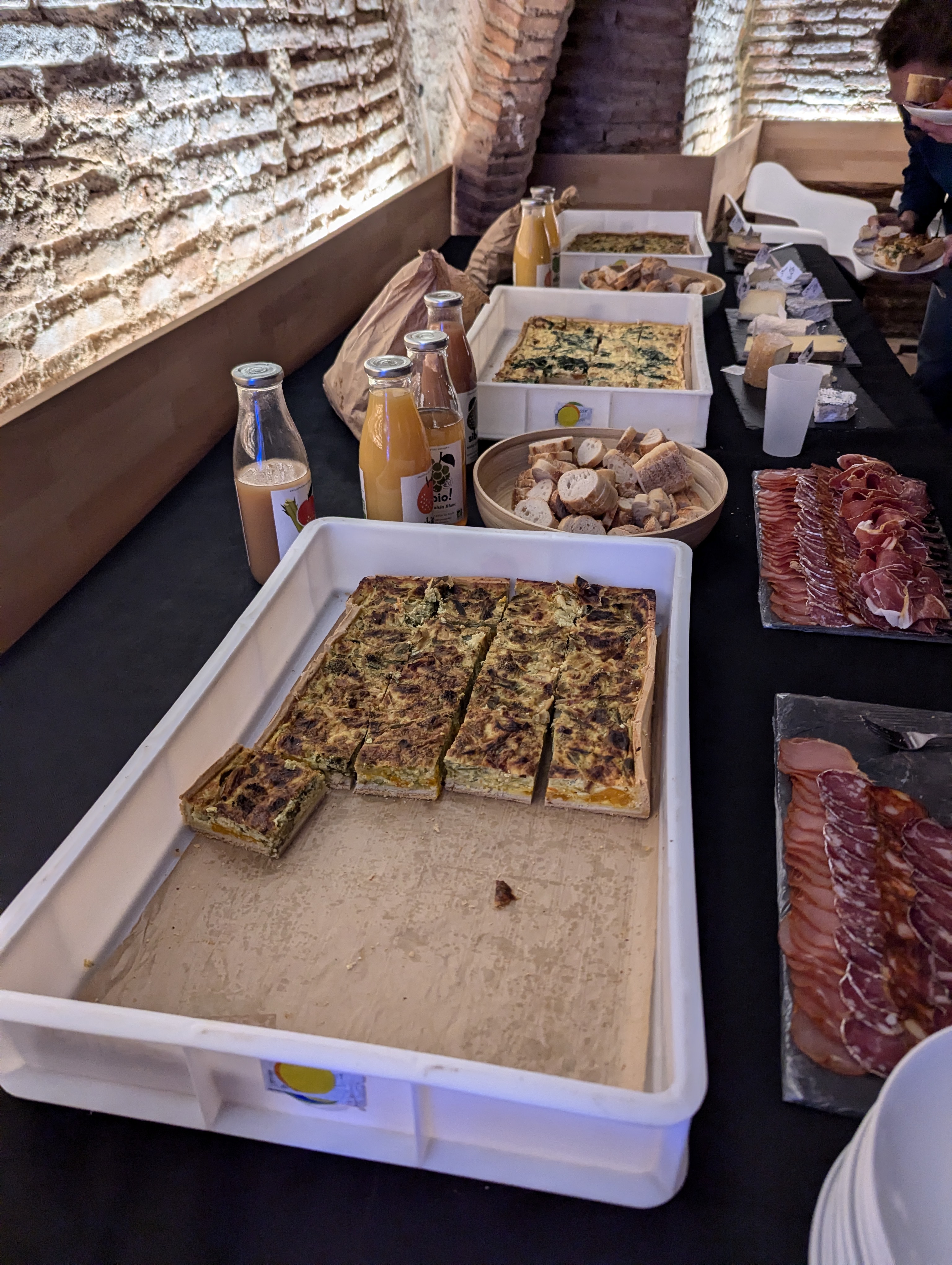


 The hospitality was exceptional. Our lunches boasted a delicious array of quiches, an enticing charcuterie board, and a superb selection of cheeses, all perfectly complemented by exquisite petite fours. Each item was not only a feast for the eyes but also a delight for the palate.
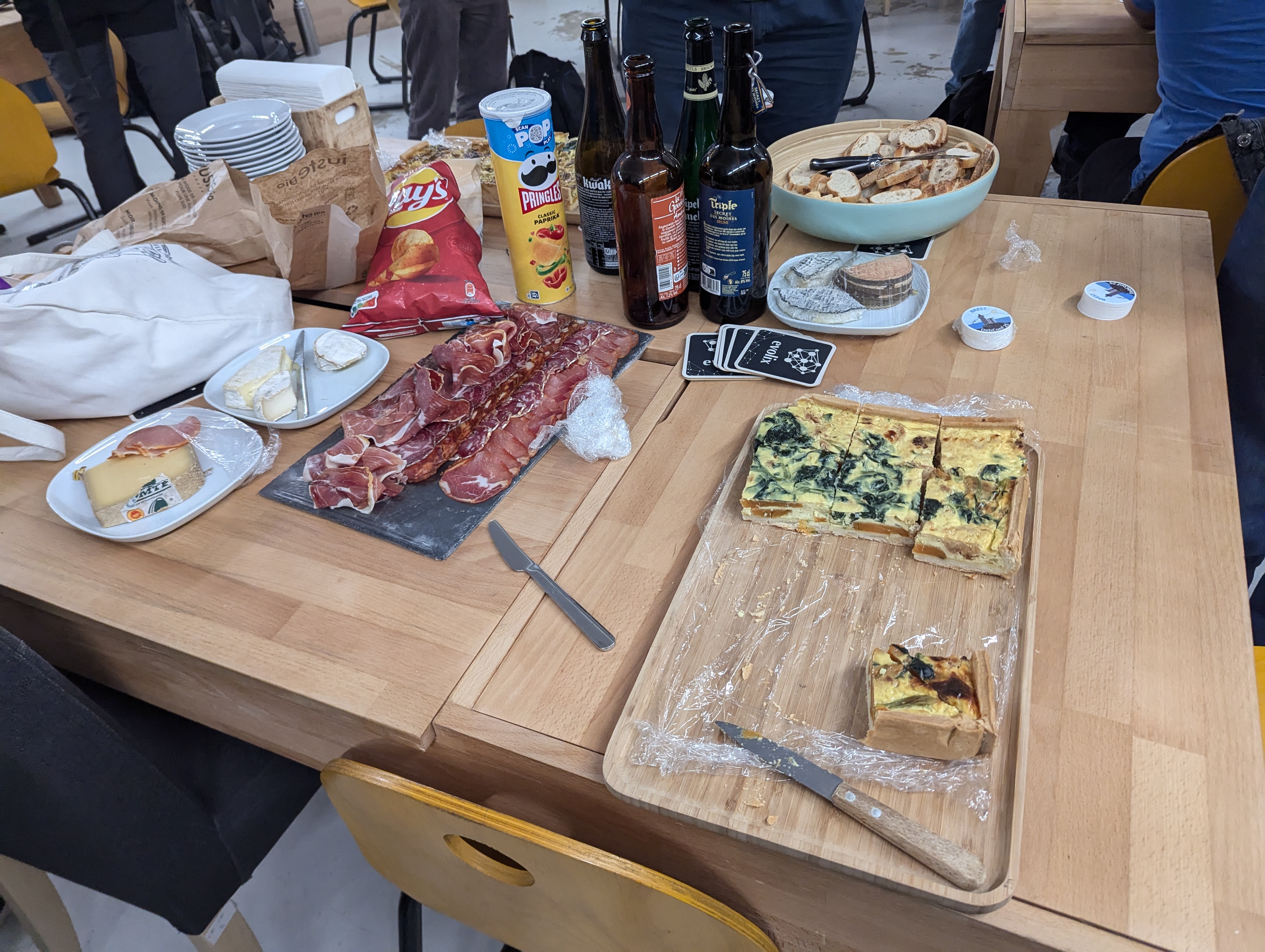
 Leftovers from these gourmet feasts fuelled our impromptu cheese and wine party on Thursday evening a highlight where informal chats blended seamlessly with serious software discussions.



 The enchantment of Toulouse doesn't dim with the setting sun; instead, it transforms. My evening strolls took me along the banks of the Garonne, under a sky just turning from twilight to velvet blue. The river, a dark mirror, perfectly reflected the illuminated grandeur of the city's architecture. Notably, the dome of the
 The MiniDebConf itself, part of the larger Capitole du Libre event, was a fantastic immersion into the world of free software. Unlike the ticket-free FOSDEM, this conference required QR codes for entry and even had bag searches, adding an unusual layer of security for a software conference.
Highlights included the crepe-making by the organisers, reminiscent of street food scenes from larger festivals. The availability of crepes for MiniDebConf attendees and the presence of food trucks added a festive air, albeit with the inevitable long queues familiar to any festival-goer.

 The city's

 Toulouse's markets were a delightful discovery. From a spontaneous visit to a market near my hotel upon arrival, to cycling past bustling marketplaces, each day presented new local flavours and crafts to explore.
The


 Our conference wrapped up with a spontaneous gathering at La Brasserie Les Arcades in Place du Capitole. Finding a caf that could accommodate 30 of us on a Sunday evening without a booking felt like striking gold. What began with coffee and ice cream smoothly transitioned into dinner, where I enjoyed a delicious braised duck leg with green peppercorn sauce. This meal rounded off the trip with lively conversations and shared experiences.


 Returning from Toulouse, I found myself once again in seat 1A, offering the advantage of being the first off the plane, both on departure and arrival. My flight touched down in Bristol ahead of schedule, and within ten minutes, I was on the A1 bus, making my way back into the heart of Bristol.
 For the past decade-plus, every piece of software I write has had one of two release processes.
Software that gets deployed directly onto servers (websites, mostly, but also the infrastructure that runs
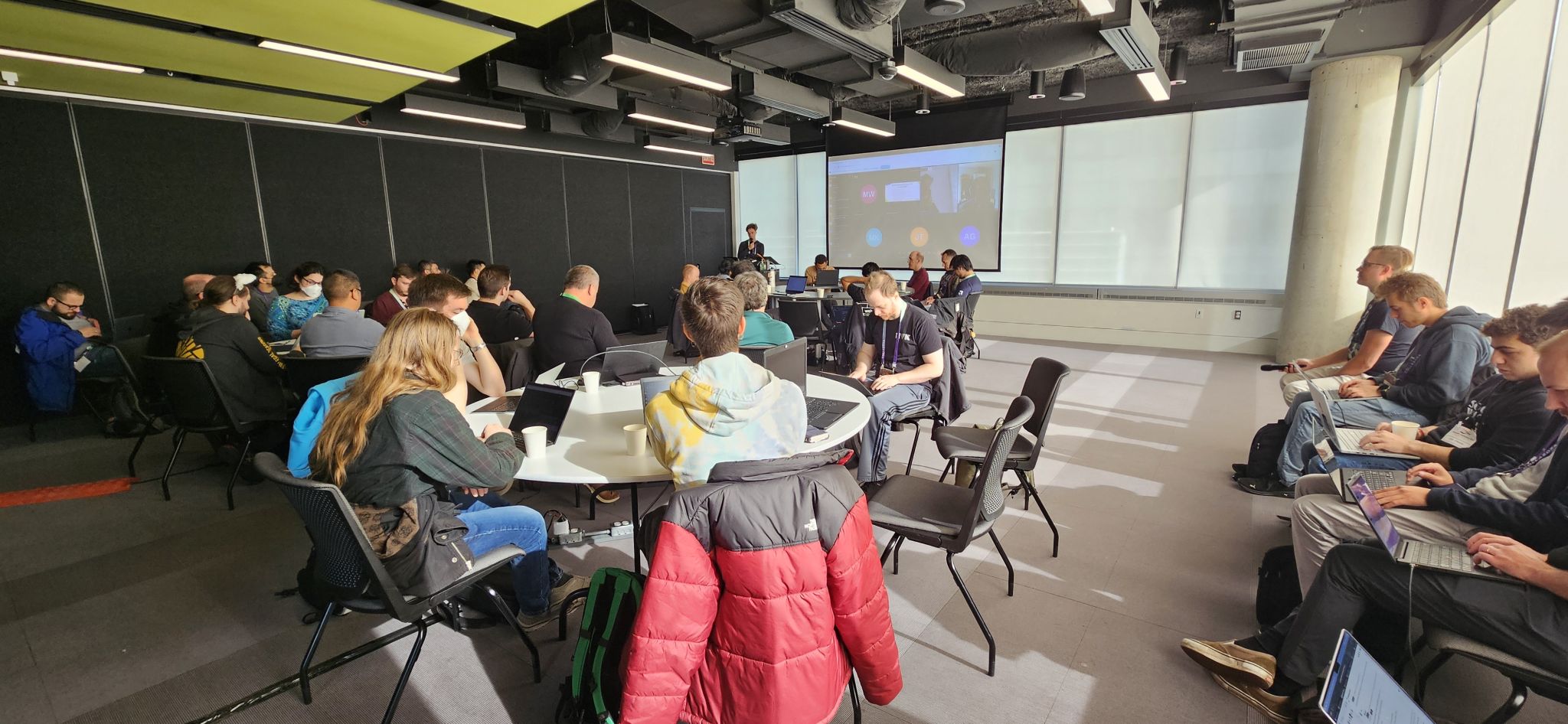
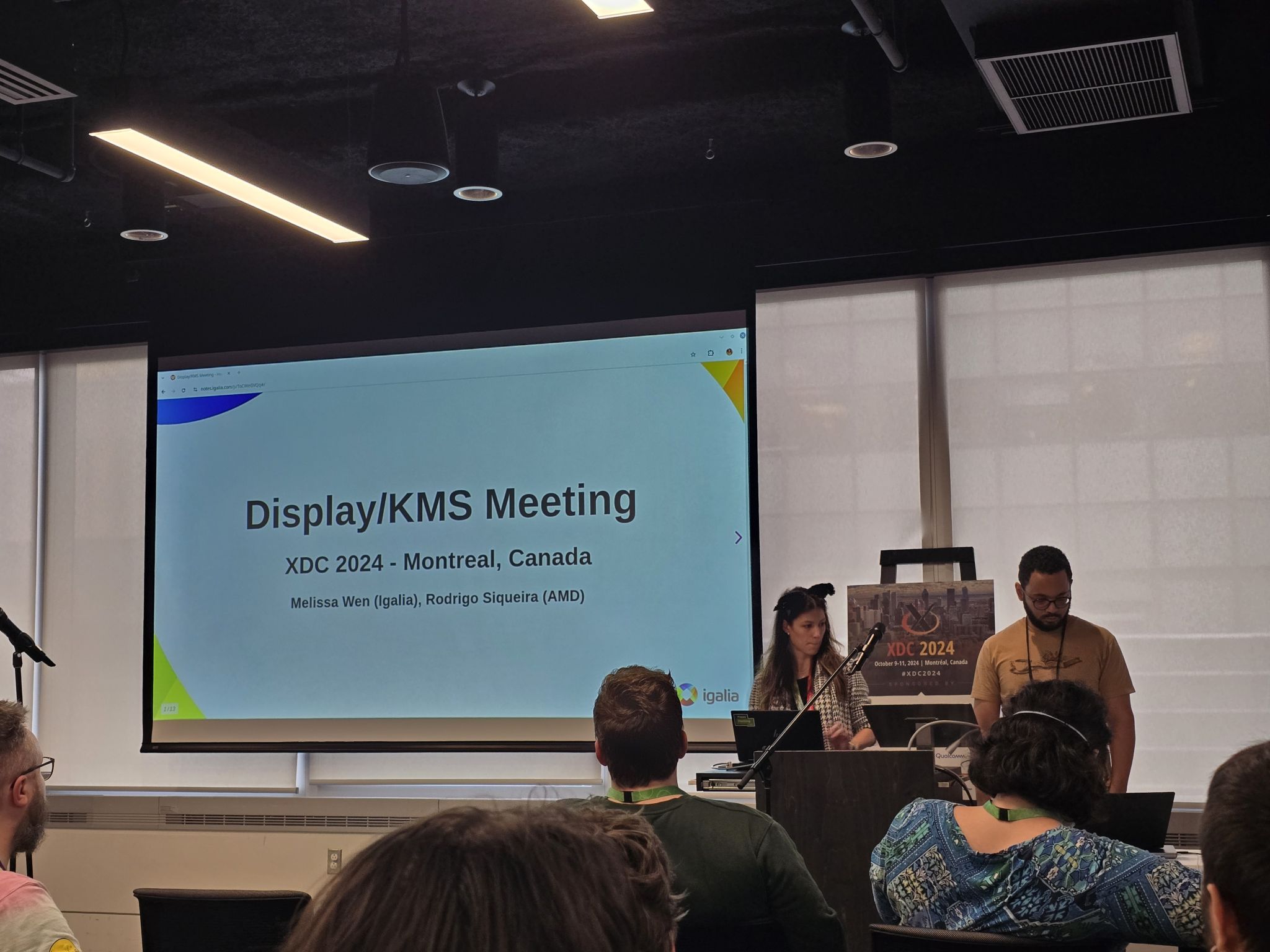
 Notes to self. And anyone else who might find them useful. Following are some ssacli commands which I use infrequently enough that they fall out of cache. This may repeat information in other blogs, but since I search my posts first when commands slip my mind, I thought I d include them here, too.