Search Results: "ah"

21 February 2022

Raphaël Hertzog: Freexian s report about Debian Long Term Support, January 2022

A Debian LTS logo
Every month we review the work funded by Freexian s Debian LTS offering. Please find the report for January below. Debian project funding We continue to looking forward to hearing about Debian project proposals from various Debian stakeholders. This month has seen work on a survey that will go out to Debian Developers to gather feedback on what they think should be the priorities for funding in the project. Learn more about the rationale behind this initiative in this article. Debian LTS contributors In January, 13 contributors were paid to work on Debian LTS, their reports are available below. If you re interested in participating in the LTS or ELTS teams, we welcome participation from the Debian community. Simply get in touch with Jeremiah or Rapha l. Evolution of the situation In January we released 34 DLAs. The security tracker currently lists 39 packages with a known CVE and the dla-needed.txt file has 20 packages still needing an update. Thanks to our sponsors Sponsors that joined recently are in bold.

16 February 2022

Joerg Jaspert: Funny CPU usage - rewrite it in rust

Munin plugin and it s CPU usage (and a rewrite in rust) With my last blog on the Munin plugins CPU usage I complained about Oracle Linux doing something really weird, driving up CPU usage when running a fairly simple Shell script with a loop in. Turns out, I was wrong. It is not OL7 that makes this problem show up. It appears to be something from the Oracle Enterprise Database installed on the system, that makes it go this crazy. I ve now had this show up on RedHat7 systems too, and the only thing that singles them out is that overpriced index card system on it. I still don t know what the actual reason for this is, and honestly, don t have enough time to dig deep into it. It is not something that a bit of debugging/tracing finds - especially as it does start out all nice, and accumulates more CPU usage over time. Which would suggest some kind of leak leading to more processing needed, or so - but then it is only CPU affected, not memory, and ONLY on systems with that database on. Meh. Well, I recently (December vacation) got me to look deeper into learning Rust. My first project with that was a multi-threaded milter to do some TLS checks on outgoing mails (kind of fun customer requirements there), and heck, Rust did make that a surprisingly easy task in the end. (Comparing the old, single-threaded C code with my multi-threaded Rust version, a third of the code length doing more, and being way easier to extend with wanted new features is nice). So my second project was Replace this shell script with a Rust binary doing the same . Hell yeah. Didn t take that long and looks good (well, the result. Not sure about the code. People knowing rust may possibly scratch out eyes when looking at it). Not yet running for that long, but even compared to the shell on systems that did not show the above mentioned bugs (read: Debian, without Oracle foo), uses WAY less CPU (again, mentioned by highly accurate outputs of the top command). So longer term I hope this version won t run into the same problems as the shell one. Time will tell. If you are interested in the code, go find it here, and if you happen to know rust and not run away screaming, I m happy for tips and code fixes, I m sure this can be improved lots. (At least cargo clippy is happy, so basics are done ) Update: According to munin, the rust version creates 14 forks/second less than the shell one. And the fork rate change is same on machines with/without the database. That 14 is more than I would have guessed. CPU usage as expected: only on the problem hosts with Oracle Database installed you can see a huge difference, otherwise it is not an easily noticable difference. That is, on an otherwise idle host (munin graph shows average use of low one-digit numbers), one can see a drop of around 1% in the CPU usage graph from munin. Ohwell, poor Shell.

13 February 2022

Gunnar Wolf: Got to boot a RPi Zero 2 W with Debian

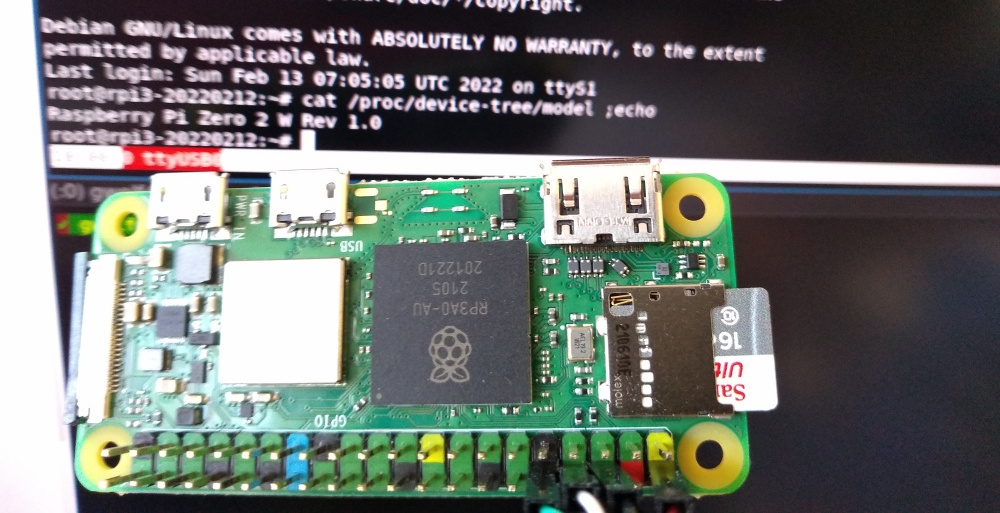
About a month ago, I got tired of waiting for the newest member of the Raspberry product lineup to be sold in Mexico, and I bought it from a Chinese reseller through a big online shopping platform. I paid quite a bit of premium (~US$85 instead of the advertised US$15), and got it delivered ten days later Anyway, it s known this machine does not yet boot mainline Linux. The vast majority of ARM systems require the bootloader to load a Device Tree file, presenting the hardware characteristics map. And while the RPi Zero 2 W (hey what an awful and confusing naming scheme they chose!) is mostly similar to a RPi3B+, it is not quite the same thing. A kernel with RPi3B+ s device tree will refuse to boot. Anyway, I started digging, and found that some days ago Stephan Wahren sent a patch to the linux-arm-kernel mailing list with a matching device tree. Read the patch! It s quite simple to read (what is harder is to know where each declaration should go, if you want to write your own, of course). It basically includes all basic details for the main chip in the RPi3 family (BCM2837), pulls in also the declarations from the BCM2836 present in the RPi2, and adds the necessary bits for the USB OTG connection and the WiFi and Bluetooth declarations. Registers the model name as Raspberry Pi Zero 2 W, which you can easily see in the following photo, informs the kernel it has 512MB RAM, and Well, really, it s an easy device tree to read, don t be shy! So, I booted my RPi 3B+ with a freshly downloaded Bookworm image, installed and unpacked linux-source-5.15, applied Stephan s patch, and added the following for the DTB to be generated in the arm64 tree as well:
--- /dev/null   2022-01-26 23:35:40.747999998 +0000
+++ arch/arm64/boot/dts/broadcom/bcm2837-rpi-zero-2-w.dts       2022-02-13 06:28:29.968429953 +0000
@@ -0,0 +1 @@
+#include "arm/bcm2837-rpi-zero-2-w.dts"
Then, ran a simple make dtbs, and Failed, because bcm283x-rpi-wifi-bt.dtsi is not yet in the kernel . OK, no worries: Getting wireless to work is a later step. I commented out the lines causing conflict (10, 33-35, 134-136), and:
root@rpi3-20220212:/usr/src/linux-source-5.15# make dtbs
  DTC     arch/arm64/boot/dts/broadcom/bcm2837-rpi-zero-2-w.dtb
Great! Just copied over that generated file to /boot/firmware/, moved the SD over to my RPiZ2W, and behold! It boots! When I bragged about it in #debian-raspberrypi, steev suggested me to pull in the WiFi patch, that has also been submitted (but not yet accepted) for kernel inclusion. I did so, uncommented the lines I modified, and built again. It builds correctly, and again copied the DTB over. It still does not find the WiFi; dmesg still complains about a missing bit of firmware (failed to load brcm/brcmfmac43430b0-sdio.raspberrypi,model-zero-2-w.bin). Steev pointed out it can be downloaded from RPi Distro s GitHub page, but I called it a night and didn t pursue it any further ;-) So I understand this post is still a far cry from saying our images properly boot under a RPi 0 2 W , but we will get there

5 February 2022

Reproducible Builds: Reproducible Builds in January 2022

Welcome to the January 2022 report from the Reproducible Builds project. In our reports, we try outline the most important things that have been happening in the past month. As ever, if you are interested in contributing to the project, please visit our Contribute page on our website.
An interesting blog post was published by Paragon Initiative Enterprises about Gossamer, a proposal for securing the PHP software supply-chain. Utilising code-signing and third-party attestations, Gossamer aims to mitigate the risks within the notorious PHP world via publishing attestations to a transparency log. Their post, titled Solving Open Source Supply Chain Security for the PHP Ecosystem goes into some detail regarding the design, scope and implementation of the system.
This month, the Linux Foundation announced SupplyChainSecurityCon, a conference focused on exploring the security threats affecting the software supply chain, sharing best practices and mitigation tactics. The conference is part of the Linux Foundation s Open Source Summit North America and will take place June 21st 24th 2022, both virtually and in Austin, Texas.

Debian There was a significant progress made in the Debian Linux distribution this month, including:

Other distributions kpcyrd reported on Twitter about the release of version 0.2.0 of pacman-bintrans, an experiment with binary transparency for the Arch Linux package manager, pacman. This new version is now able to query rebuilderd to check if a package was independently reproduced.
In the world of openSUSE, however, Bernhard M. Wiedemann posted his monthly reproducible builds status report.

diffoscope diffoscope is our in-depth and content-aware diff utility. Not only can it locate and diagnose reproducibility issues, it can provide human-readable diffs from many kinds of binary formats. This month, Chris Lamb prepared and uploaded versions 199, 200, 201 and 202 to Debian unstable (that were later backported to Debian bullseye-backports by Mattia Rizzolo), as well as made the following changes to the code itself:
  • New features:
    • First attempt at incremental output support with a timeout. Now passing, for example, --timeout=60 will mean that diffoscope will not recurse into any sub-archives after 60 seconds total execution time has elapsed. Note that this is not a fixed/strict timeout due to implementation issues. [ ][ ]
    • Support both variants of odt2txt, including the one provided by the unoconv package. [ ]
  • Bug fixes:
    • Do not return with a UNIX exit code of 0 if we encounter with a file whose human-readable metadata matches literal file contents. [ ]
    • Don t fail if comparing a nonexistent file with a .pyc file (and add test). [ ][ ]
    • If the debian.deb822 module raises any exception on import, re-raise it as an ImportError. This should fix diffoscope on some Fedora systems. [ ]
    • Even if a Sphinx .inv inventory file is labelled The remainder of this file is compressed using zlib, it might not actually be. In this case, don t traceback and simply return the original content. [ ]
  • Documentation:
    • Improve documentation for the new --timeout option due to a few misconceptions. [ ]
    • Drop reference in the manual page claiming the ability to compare non-existent files on the command-line. (This has not been possible since version 32 which was released in September 2015). [ ]
    • Update X has been modified after NT_GNU_BUILD_ID has been applied messages to, for example, not duplicating the full filename in the diffoscope output. [ ]
  • Codebase improvements:
    • Tidy some control flow. [ ]
    • Correct a recompile typo. [ ]
In addition, Alyssa Ross fixed the comparison of CBFS names that contain spaces [ ], Sergei Trofimovich fixed whitespace for compatibility with version 21.12 of the Black source code reformatter [ ] and Zbigniew J drzejewski-Szmek fixed JSON detection with a new version of file [ ].

Testing framework The Reproducible Builds project runs a significant testing framework at tests.reproducible-builds.org, to check packages and other artifacts for reproducibility. This month, the following changes were made:
  • Fr d ric Pierret (fepitre):
    • Add Debian bookworm to package set creation. [ ]
  • Holger Levsen:
    • Install the po4a package where appropriate, as it is needed for the Reproducible Builds website job [ ]. In addition, also run the i18n.sh and contributors.sh scripts [ ].
    • Correct some grammar in Debian live image build output. [ ]
    • Shell monitor improvements:
      • Only show the offline node section if there are offline nodes. [ ]
      • Colorise offline nodes. [ ]
      • Shrink screen usage. [ ][ ][ ]
    • Node health check improvements:
      • Detect if live package builds encounter incomplete snapshots. [ ][ ][ ]
      • Detect if a host is running with today s date (when it should be set artificially in the future). [ ]
    • Use the devscripts package from bullseye-backports on Debian nodes. [ ]
    • Use the Munin monitoring package bullseye-backports on Debian nodes too. [ ]
    • Update New Year handling, needed to be able to detect real and fake dates. [ ][ ]
    • Improve the error message of the script that powercycles the arm64 architecture nodes hosted by Codethink. [ ]
  • Mattia Rizzolo:
    • Use the new --timeout option added in diffoscope version 202. [ ]
  • Roland Clobus:
    • Update the build scripts now that the hooks for live builds are now maintained upstream in the live-build repository. [ ]
    • Show info lines in Jenkins when reproducible hooks have been active. [ ]
    • Use unique folders for the artifacts from each live Debian version. [ ]
  • Vagrant Cascadian:
    • Switch the Debian armhf architecture nodes to use new proxy. [ ]
    • Misc. node maintenance. [ ].

Upstream patches The Reproducible Builds project attempts to fix as many currently-unreproducible packages as possible. In January, we wrote a large number of such patches, including:

And finally If you are interested in contributing to the Reproducible Builds project, please visit our Contribute page on our website. However, you can get in touch with us via:

1 February 2022

Dirk Eddelbuettel: #35: apt install rstudio quarto

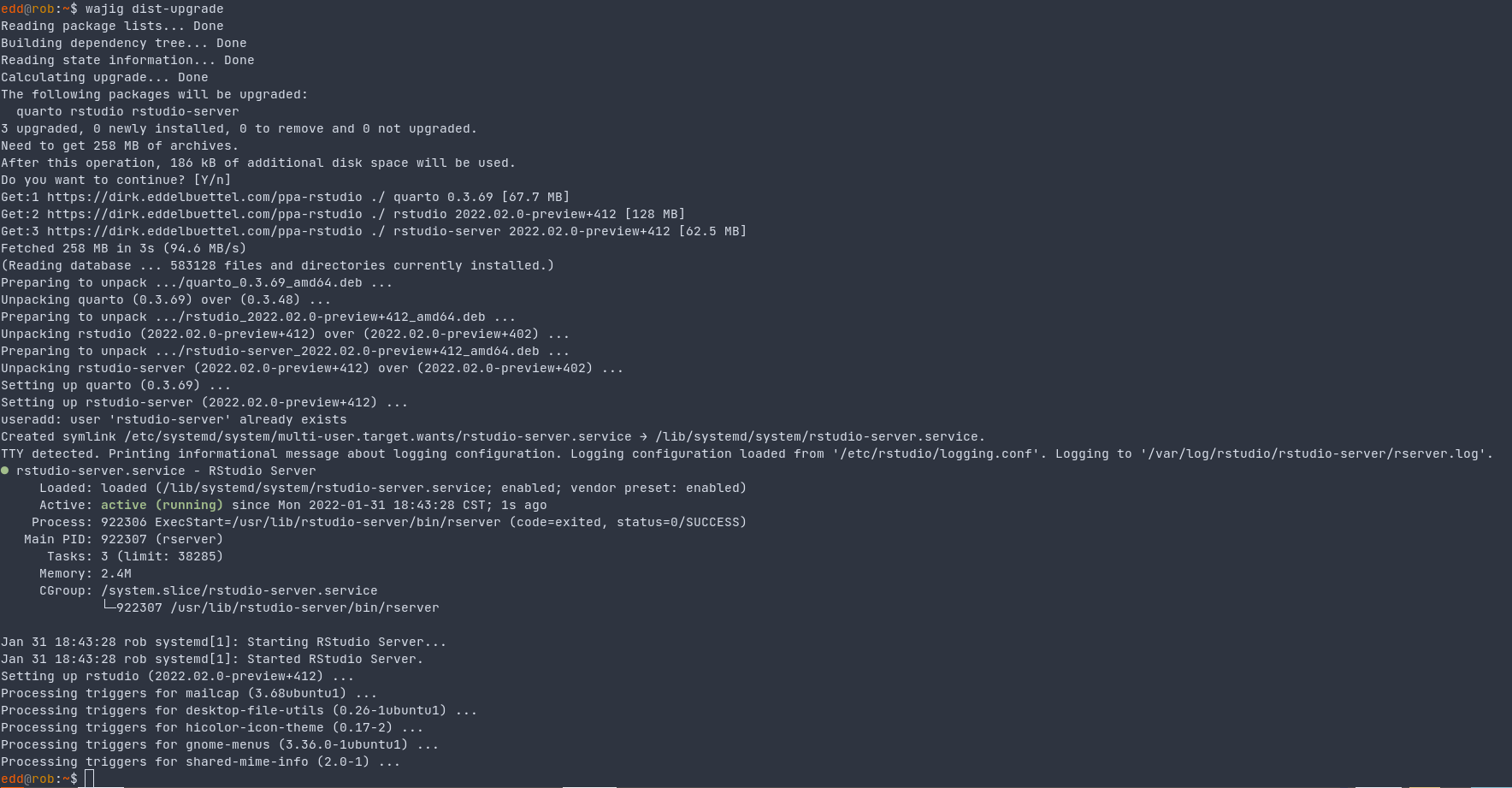
Welcome to the 35th post in the ravishingly rabiant R recommendations, or R4. Today s post is about apt and R tools. Many of us have been running RStudio off our local machines for as long as binaries have been provided. Which is by now probably a bit over a decade. Time flies. And as nice it is to have matching binaries, in my case in the .deb format used on Debian or Ubuntu, it is wee bit a painful to manually download a file and then install it. Twice the pain if you are lucky enough to be on a system where you can also run RStudio Server. And now three times as painful as you may need a matching quarto-cli binary for the nice quarto service. So wouldn t it be nice to have an apt-getable repo? And to autoMAGICall get updated versions when they are available? Oh yes. And I had been bugging JJ from day one. And JJ would almost listen intendly, nod briefly and firmly, and issue an assured we will look into it. Well, they are still looking Luckily, years ago, Carl wrote a helper script for our use in Rocker. I promptly adopted these and kept them in the littler examples directory as a pair of script getRStudioDesktop.r and getRStudioServer.r, later complemented by getQuartoCli.r. And I used these for years, somewhere between weekly and monthly. But it is still very manual: three script calls, one sudo dpkg -i call. And as our good friends at RStudio don t seem to be coming forward with a repo, I created one at GitHub thinking I could serve the files via GitHub Pages. Which of course I cannot as the .deb file for rstudio is well above the 100mb limit. So that seemed to be a bit of a setback. But after a bit of pondering, and recognizing that I am now in the fortunate position to have symmetric broadband access at home, I reckoned that until the bandwidth use gets excessive I will serve this as truly personal package archive (or tPPA) from here. Note that this is calibrated for my use so Ubuntu amd64 it is. Nothing else. And that it installs dailies . Which may cause issues for some people. You have warned. Reading tis paragraphs signifies agreement with the terms and limitations. Just kidding. A quick screenshot from an update earlier is here. Note that I use the fabulous wajig wrapper by Graham Williams here as my frontend to apt, dpkg and more as I have for even longer than I have use RStudio. Its use is tangential here; sudo apt upgrade would have done the same (and is essentially being called). And it demonstrates the main benefit: we are now automated as the cron scheduler launches an update of the PPA at which ever frequency you chose (currently twice a week for me) and after that it becomes part of the normal apt updates we do anyway (and which I do about daily). So that s main gist: automated apt upgrades of rstudio, rstudio-server, and quarto-cli. And you can find the underlying code in the GitHub repo ppa-rstudio which I put together a good week ago. I am currently updating the tPPA twice a week from crontab and have had two full upgrades already. And who knows, maybe with a bid of prodding RStudio may come around. One can always hope. If you like this or other open-source work I do, you can sponsor me at GitHub.

This post by Dirk Eddelbuettel originated on his Thinking inside the box blog. Please report excessive re-aggregation in third-party for-profit settings.

Paul Wise: FLOSS Activities January 2022

Focus This month I didn't have any particular focus. I just worked on issues in my info bubble.

Changes

Issues

Review

Administration
  • Debian BTS: unarchive/reopen/triage bugs for reintroduced packages
  • Debian servers: ping folks about mail forwarding issues
  • Debian wiki: unblock IP addresses, approve accounts

Communication
  • Respond to queries from Debian users and contributors on the mailing lists and IRC

Sponsors The oci-cli, oci-python-sdk, circuitbreaker, autoconf-archive, libpst, purple-discord, sptag work was sponsored. All other work was done on a volunteer basis.

20 January 2022

Caleb Adepitan: I'm Thinking About You Right Now!

Just in case you stumbled on this incidentally and you wonder Who in the seven fat worlds is this mysterious...? Ha! That was what I was thinking about you you were thinking about me. You gerrit!? I heard you listening to my thoughts; I listened to yours too. I wonder if you heard me too. I will like to talk, today, about what it is I do at Debian as an Outreachy Intern under the JavaScript team. I woke up this morning and decided to bore you with so much details. I must have woken up glorified!

A Broader View My sole role at Debian alongside my teammate, aided by our mentors, is to facilitate the Node.js 16 and Webpack 5 Transitioning. What exactly does that mean? Node.js 16, as of the time of this writing, is the active LTS release from the Node.js developers while Webpack 5 is also the current release from the Webpack developers. At Debian we have to work towards supporting these packages. Debian as an OS comes with a package manager coined Advanced Package Tool or simply APT on which command-line programs specific to Debian and it's many-flavored distributions, apt, apt-get, apt-cache are based. This means before the conception of yarn and npm, the typical JavaScript developer's package managers, apt has been. Debian unlike yarn and npm, ideally, only supports one version of a software at any point in time and on edge cases may have to support an extra one as noted in this chat between my mentor and a member. To provide support for Webpack 5 and Node.js 16 which as regards to Debian are currently in experimental and only can be migrated to unstable after our transitioning, we have to test, reverse build, report and fix bugs till a certain level of compatibility has been attained with dependent packages currently in unstable. Webpack and Node.js have their respective dependencies, but there are certain software and packages also dependent on Webpack and/or Node.js, these are termed as reverse-dependencies. We have to test and build these reverse-dependencies, report and fix bugs and incompatibilities with the new versions of Webpack and Node.js. For reverse-dependent packages not yet supporting Webpack 5 and/or Node.js 16, we'll open an issue in form of a feature-request in upstream repository asking for Webpack 5 and/or Node.js 16 support. Ideally, Debian manages a repository of all supported packages on a GitLab managed Git based VCS. For JavaScript packages maintained by the JS Team, the home of those packages sits at https://salsa.debian.org/js-team/. Supported packages are pulled from upstream repository, mostly GitHub, using some certian packaging tools provided by Debian. The pulled source cannot be directly modified else it will break build. So there exists a dedicated folder named debian where certain cofiguration files, scripts and rules to convey to the debian package builder live at. In some cases, source code needs to be modified; these are done via patching which means the modifications won't live in the source but in a dedicated patch file inside the debian/patches/ folder. The modifications are diffed line by line with the original source (just as with git) and the result is output in a file managed by debian utility tool, Quilt. The contents of the debian folder are instructions on how to build the source into binaries or an installable archive .deb (like Java's .jar or Android's .apk).

Understanding Debian Software Release Cycle There are quite some interesting things about the software release cycle at Debian to get familiar with. Listed here are some release repositories alongside their codenames as of Debian 11:
  1. Unstable (Sid)
  2. Testing (Bookworm)
  3. Stable (Bullseye)
  4. Old stable (Buster)
  5. Old old stable (Stretch)
Ha! Isn't it ironic that unstable is the only one with a stable codename? Some of these, if not all, have codenames subject to change after every new release and/or migration. Only unstable which is referred to as Sid never changes. The current stable release which is Debian 11 is codenamed Bullseye. The next stable release which will be Debian 12 will be codenamed Bookworm because the current testing repository will be migrated to stable and released as Debian 12. The previous stable release which was Debian 10, now old stable, was codenamed Buster. To better understand Debian releases you may take a look at this wiki that completely defines them. Basically, as explained by one of my mentors remixed in my own words, experimental software are migrated to unstable after (as I said earlier) they have attained a certain level of compatibility with dependent software. They remain in unstable for a long period of time undergoing testing, autopkgtest tests, regression tests, etc. At this point bugs are reported and fixed to a satisfactory level. The unstable repository is then migrated to testing where release-critical bugs are reported and fixed to a satisfactory level where one can comfortably say testing is almost stable , and voila (!), testing is released as a Debian stable version. This happens roughly every two years. Some months before a new stable release, a soft freeze is turned on such that no new versions or transitions should be uploaded to unstable. Only fixes will be uploaded at this point. In like 4-6 weeks before the release, a hard freeze is turned on that completely disallows uploading to unstable, not even fixes. In due time, testing becomes the new stable release and freeze is lifted.

References
  1. Packaging pre-requisites
  2. Working with chroots
  3. Sbuild (clean builds)
  4. Updating a Debian Package by Abraham Raji

16 January 2022

Chris Lamb: Favourite films of 2021

In my four most recent posts, I went over the memoirs and biographies, the non-fiction, the fiction and the 'classic' novels that I enjoyed reading the most in 2021. But in the very last of my 2021 roundup posts, I'll be going over some of my favourite movies. (Saying that, these are perhaps less of my 'favourite films' than the ones worth remarking on after all, nobody needs to hear that The Godfather is a good movie.) It's probably helpful to remark you that I took a self-directed course in film history in 2021, based around the first volume of Roger Ebert's The Great Movies. This collection of 100-odd movie essays aims to make a tour of the landmarks of the first century of cinema, and I watched all but a handul before the year was out. I am slowly making my way through volume two in 2022. This tome was tremendously useful, and not simply due to the background context that Ebert added to each film: it also brought me into contact with films I would have hardly come through some other means. Would I have ever discovered the sly comedy of Trouble in Paradise (1932) or the touching proto-realism of L'Atalante (1934) any other way? It also helped me to 'get around' to watching films I may have put off watching forever the influential Battleship Potemkin (1925), for instance, and the ur-epic Lawrence of Arabia (1962) spring to mind here. Choosing a 'worst' film is perhaps more difficult than choosing the best. There are first those that left me completely dry (Ready or Not, Written on the Wind, etc.), and those that were simply poorly executed. And there are those that failed to meet their own high opinions of themselves, such as the 'made for Reddit' Tenet (2020) or the inscrutable Vanilla Sky (2001) the latter being an almost perfect example of late-20th century cultural exhaustion. But I must save my most severe judgement for those films where I took a visceral dislike how their subjects were portrayed. The sexually problematic Sixteen Candles (1984) and the pseudo-Catholic vigilantism of The Boondock Saints (1999) both spring to mind here, the latter of which combines so many things I dislike into such a short running time I'd need an entire essay to adequately express how much I disliked it.

Dogtooth (2009) A father, a mother, a brother and two sisters live in a large and affluent house behind a very high wall and an always-locked gate. Only the father ever leaves the property, driving to the factory that he happens to own. Dogtooth goes far beyond any allusion to Josef Fritzl's cellar, though, as the children's education is a grotesque parody of home-schooling. Here, the parents deliberately teach their children the wrong meaning of words (e.g. a yellow flower is called a 'zombie'), all of which renders the outside world utterly meaningless and unreadable, and completely mystifying its very existence. It is this creepy strangeness within a 'regular' family unit in Dogtooth that is both socially and epistemically horrific, and I'll say nothing here of its sexual elements as well. Despite its cold, inscrutable and deadpan surreality, Dogtooth invites all manner of potential interpretations. Is this film about the artificiality of the nuclear family that the West insists is the benchmark of normality? Or is it, as I prefer to believe, something more visceral altogether: an allegory for the various forms of ontological violence wrought by fascism, as well a sobering nod towards some of fascism's inherent appeals? (Perhaps it is both. In 1972, French poststructuralists Gilles and F lix Guattari wrote Anti-Oedipus, which plays with the idea of the family unit as a metaphor for the authoritarian state.) The Greek-language Dogtooth, elegantly shot, thankfully provides no easy answers.

Holy Motors (2012) There is an infamous scene in Un Chien Andalou, the 1929 film collaboration between Luis Bu uel and famed artist Salvador Dal . A young woman is cornered in her own apartment by a threatening man, and she reaches for a tennis racquet in self-defence. But the man suddenly picks up two nearby ropes and drags into the frame two large grand pianos... each leaden with a dead donkey, a stone tablet, a pumpkin and a bewildered priest. This bizarre sketch serves as a better introduction to Leos Carax's Holy Motors than any elementary outline of its plot, which ostensibly follows 24 hours in the life of a man who must play a number of extremely diverse roles around Paris... all for no apparent reason. (And is he even a man?) Surrealism as an art movement gets a pretty bad wrap these days, and perhaps justifiably so. But Holy Motors and Un Chien Andalou serve as a good reminder that surrealism can be, well, 'good, actually'. And if not quite high art, Holy Motors at least demonstrates that surrealism can still unnerving and hilariously funny. Indeed, recalling the whimsy of the plot to a close friend, the tears of laughter came unbidden to my eyes once again. ("And then the limousines...!") Still, it is unclear how Holy Motors truly refreshes surrealism for the twenty-first century. Surrealism was, in part, a reaction to the mechanical and unfeeling brutality of World War I and ultimately sought to release the creative potential of the unconscious mind. Holy Motors cannot be responding to another continental conflagration, and so it appears to me to be some kind of commentary on the roles we exhibit in an era of 'post-postmodernity': a sketch on our age of performative authenticity, perhaps, or an idle doodle on the function and psychosocial function of work. Or perhaps not. After all, this film was produced in a time that offers the near-universal availability of mind-altering substances, and this certainly changes the context in which this film was both created. And, how can I put it, was intended to be watched.

Manchester by the Sea (2016) An absolutely devastating portrayal of a character who is unable to forgive himself and is hesitant to engage with anyone ever again. It features a near-ideal balance between portraying unrecoverable anguish and tender warmth, and is paradoxically grandiose in its subtle intimacy. The mechanics of life led me to watch this lying on a bed in a chain hotel by Heathrow Airport, and if this colourless circumstance blunted the film's emotional impact on me, I am probably thankful for it. Indeed, I find myself reduced in this review to fatuously recalling my favourite interactions instead of providing any real commentary. You could write a whole essay about one particular incident: its surfaces, subtexts and angles... all despite nothing of any substance ever being communicated. Truly stunning.

McCabe & Mrs. Miller (1971) Roger Ebert called this movie one of the saddest films I have ever seen, filled with a yearning for love and home that will not ever come. But whilst it is difficult to disagree with his sentiment, Ebert's choice of sad is somehow not quite the right word. Indeed, I've long regretted that our dictionaries don't have more nuanced blends of tragedy and sadness; perhaps the Ancient Greeks can loan us some. Nevertheless, the plot of this film is of a gambler and a prostitute who become business partners in a new and remote mining town called Presbyterian Church. However, as their town and enterprise booms, it comes to the attention of a large mining corporation who want to bully or buy their way into the action. What makes this film stand out is not the plot itself, however, but its mood and tone the town and its inhabitants seem to be thrown together out of raw lumber, covered alternatively in mud or frozen ice, and their days (and their personalities) are both short and dark in equal measure. As a brief aside, if you haven't seen a Roger Altman film before, this has all the trappings of being a good introduction. As Ebert went on to observe: This is not the kind of movie where the characters are introduced. They are all already here. Furthermore, we can see some of Altman's trademark conversations that overlap, a superb handling of ensemble casts, and a quietly subversive view of the tyranny of 'genre'... and the latter in a time when the appetite for revisionist portrays of the West was not very strong. All of these 'Altmanian' trademarks can be ordered in much stronger measures in his later films: in particular, his comedy-drama Nashville (1975) has 24 main characters, and my jejune interpretation of Gosford Park (2001) is that it is purposefully designed to poke fun those who take a reductionist view of 'genre', or at least on the audience's expectations. (In this case, an Edwardian-era English murder mystery in the style of Agatha Christie, but where no real murder or detection really takes place.) On the other hand, McCabe & Mrs. Miller is actually a poor introduction to Altman. The story is told in a suitable deliberate and slow tempo, and the two stars of the film are shown thoroughly defrocked of any 'star status', in both the visual and moral dimensions. All of these traits are, however, this film's strength, adding up to a credible, fascinating and riveting portrayal of the old West.

Detour (1945) Detour was filmed in less than a week, and it's difficult to decide out of the actors and the screenplay which is its weakest point.... Yet it still somehow seemed to drag me in. The plot revolves around luckless Al who is hitchhiking to California. Al gets a lift from a man called Haskell who quickly falls down dead from a heart attack. Al quickly buries the body and takes Haskell's money, car and identification, believing that the police will believe Al murdered him. An unstable element is soon introduced in the guise of Vera, who, through a set of coincidences that stretches credulity, knows that this 'new' Haskell (ie. Al pretending to be him) is not who he seems. Vera then attaches herself to Al in order to blackmail him, and the world starts to spin out of his control. It must be understood that none of this is executed very well. Rather, what makes Detour so interesting to watch is that its 'errors' lend a distinctively creepy and unnatural hue to the film. Indeed, in the early twentieth century, Sigmund Freud used the word unheimlich to describe the experience of something that is not simply mysterious, but something creepy in a strangely familiar way. This is almost the perfect description of watching Detour its eerie nature means that we are not only frequently second-guessed about where the film is going, but are often uncertain whether we are watching the usual objective perspective offered by cinema. In particular, are all the ham-fisted segues, stilted dialogue and inscrutable character motivations actually a product of Al inventing a story for the viewer? Did he murder Haskell after all, despite the film 'showing' us that Haskell died of natural causes? In other words, are we watching what Al wants us to believe? Regardless of the answers to these questions, the film succeeds precisely because of its accidental or inadvertent choices, so it is an implicit reminder that seeking the director's original intention in any piece of art is a complete mirage. Detour is certainly not a good film, but it just might be a great one. (It is a short film too, and, out of copyright, it is available online for free.)

Safe (1995) Safe is a subtly disturbing film about an upper-middle-class housewife who begins to complain about vague symptoms of illness. Initially claiming that she doesn't feel right, Carol starts to have unexplained headaches, a dry cough and nosebleeds, and eventually begins to have trouble breathing. Carol's family doctor treats her concerns with little care, and suggests to her husband that she sees a psychiatrist. Yet Carol's episodes soon escalate. For example, as a 'homemaker' and with nothing else to occupy her, Carol's orders a new couch for a party. But when the store delivers the wrong one (although it is not altogether clear that they did), Carol has a near breakdown. Unsure where to turn, an 'allergist' tells Carol she has "Environmental Illness," and so Carol eventually checks herself into a new-age commune filled with alternative therapies. On the surface, Safe is thus a film about the increasing about of pesticides and chemicals in our lives, something that was clearly felt far more viscerally in the 1990s. But it is also a film about how lack of genuine healthcare for women must be seen as a critical factor in the rise of crank medicine. (Indeed, it made for something of an uncomfortable watch during the coronavirus lockdown.) More interestingly, however, Safe gently-yet-critically examines the psychosocial causes that may be aggravating Carol's illnesses, including her vacant marriage, her hollow friends and the 'empty calorie' stimulus of suburbia. None of this should be especially new to anyone: the gendered Victorian term 'hysterical' is often all but spoken throughout this film, and perhaps from the very invention of modern medicine, women's symptoms have often regularly minimised or outright dismissed. (Hilary Mantel's 2003 memoir, Giving Up the Ghost is especially harrowing on this.) As I opened this review, the film is subtle in its messaging. Just to take one example from many, the sound of the cars is always just a fraction too loud: there's a scene where a group is eating dinner with a road in the background, and the total effect can be seen as representing the toxic fumes of modernity invading our social lives and health. I won't spoiler the conclusion of this quietly devasting film, but don't expect a happy ending.

The Driver (1978) Critics grossly misunderstood The Driver when it was first released. They interpreted the cold and unemotional affect of the characters with the lack of developmental depth, instead of representing their dissociation from the society around them. This reading was encouraged by the fact that the principal actors aren't given real names and are instead known simply by their archetypes instead: 'The Driver', 'The Detective', 'The Player' and so on. This sort of quasi-Jungian erudition is common in many crime films today (Reservoir Dogs, Kill Bill, Layer Cake, Fight Club), so the critics' misconceptions were entirely reasonable in 1978. The plot of The Driver involves the eponymous Driver, a noted getaway driver for robberies in Los Angeles. His exceptional talent has far prevented him from being captured thus far, so the Detective attempts to catch the Driver by pardoning another gang if they help convict the Driver via a set-up robbery. To give himself an edge, however, The Driver seeks help from the femme fatale 'Player' in order to mislead the Detective. If this all sounds eerily familiar, you would not be far wrong. The film was essentially remade by Nicolas Winding Refn as Drive (2011) and in Edgar Wright's 2017 Baby Driver. Yet The Driver offers something that these neon-noir variants do not. In particular, the car chases around Los Angeles are some of the most captivating I've seen: they aren't thrilling in the sense of tyre squeals, explosions and flying boxes, but rather the vehicles come across like wild animals hunting one another. This feels especially so when the police are hunting The Driver, which feels less like a low-stakes game of cat and mouse than a pack of feral animals working together a gang who will tear apart their prey if they find him. In contrast to the undercar neon glow of the Fast & Furious franchise, the urban realism backdrop of the The Driver's LA metropolis contributes to a sincere feeling of artistic fidelity as well. To be sure, most of this is present in the truly-excellent Drive, where the chase scenes do really communicate a credible sense of stakes. But the substitution of The Driver's grit with Drive's soft neon tilts it slightly towards that common affliction of crime movies: style over substance. Nevertheless, I can highly recommend watching The Driver and Drive together, as it can tell you a lot about the disconnected socioeconomic practices of the 1980s compared to the 2010s. More than that, however, the pseudo-1980s synthwave soundtrack of Drive captures something crucial to analysing the world of today. In particular, these 'sounds from the past filtered through the present' bring to mind the increasing role of nostalgia for lost futures in the culture of today, where temporality and pop culture references are almost-exclusively citational and commemorational.

The Souvenir (2019) The ostensible outline of this quietly understated film follows a shy but ambitious film student who falls into an emotionally fraught relationship with a charismatic but untrustworthy older man. But that doesn't quite cover the plot at all, for not only is The Souvenir a film about a young artist who is inspired, derailed and ultimately strengthened by a toxic relationship, it is also partly a coming-of-age drama, a subtle portrait of class and, finally, a film about the making of a film. Still, one of the geniuses of this truly heartbreaking movie is that none of these many elements crowds out the other. It never, ever feels rushed. Indeed, there are many scenes where the camera simply 'sits there' and quietly observes what is going on. Other films might smother themselves through references to 18th-century oil paintings, but The Souvenir somehow evades this too. And there's a certain ring of credibility to the story as well, no doubt in part due to the fact it is based on director Joanna Hogg's own experiences at film school. A beautifully observed and multi-layered film; I'll be happy if the sequel is one-half as good.

The Wrestler (2008) Randy 'The Ram' Robinson is long past his prime, but he is still rarin' to go in the local pro-wrestling circuit. Yet after a brutal beating that seriously threatens his health, Randy hangs up his tights and pursues a serious relationship... and even tries to reconnect with his estranged daughter. But Randy can't resist the lure of the ring, and readies himself for a comeback. The stage is thus set for Darren Aronofsky's The Wrestler, which is essentially about what drives Randy back to the ring. To be sure, Randy derives much of his money from wrestling as well as his 'fitness', self-image, self-esteem and self-worth. Oh, it's no use insisting that wrestling is fake, for the sport is, needless to say, Randy's identity; it's not for nothing that this film is called The Wrestler. In a number of ways, The Sound of Metal (2019) is both a reaction to (and a quiet remake of) The Wrestler, if only because both movies utilise 'cool' professions to explore such questions of identity. But perhaps simply when The Wrestler was produced makes it the superior film. Indeed, the role of time feels very important for the Wrestler. In the first instance, time is clearly taking its toll on Randy's body, but I felt it more strongly in the sense this was very much a pre-2008 film, released on the cliff-edge of the global financial crisis, and the concomitant precarity of the 2010s. Indeed, it is curious to consider that you couldn't make The Wrestler today, although not because the relationship to work has changed in any fundamentalway. (Indeed, isn't it somewhat depressing the realise that, since the start of the pandemic and the 'work from home' trend to one side, we now require even more people to wreck their bodies and mental health to cover their bills?) No, what I mean to say here is that, post-2016, you cannot portray wrestling on-screen without, how can I put it, unwelcome connotations. All of which then reminds me of Minari's notorious red hat... But I digress. The Wrestler is a grittily stark darkly humorous look into the life of a desperate man and a sorrowful world, all through one tragic profession.

Thief (1981) Frank is an expert professional safecracker and specialises in high-profile diamond heists. He plans to use his ill-gotten gains to retire from crime and build a life for himself with a wife and kids, so he signs on with a top gangster for one last big score. This, of course, could be the plot to any number of heist movies, but Thief does something different. Similar to The Wrestler and The Driver (see above) and a number of other films that I watched this year, Thief seems to be saying about our relationship to work and family in modernity and postmodernity. Indeed, the 'heist film', we are told, is an understudied genre, but part of the pleasure of watching these films is said to arise from how they portray our desired relationship to work. In particular, Frank's desire to pull off that last big job feels less about the money it would bring him, but a displacement from (or proxy for) fulfilling some deep-down desire to have a family or indeed any relationship at all. Because in theory, of course, Frank could enter into a fulfilling long-term relationship right away, without stealing millions of dollars in diamonds... but that's kinda the entire point: Frank needing just one more theft is an excuse to not pursue a relationship and put it off indefinitely in favour of 'work'. (And being Federal crimes, it also means Frank cannot put down meaningful roots in a community.) All this is communicated extremely subtly in the justly-lauded lowkey diner scene, by far the best scene in the movie. The visual aesthetic of Thief is as if you set The Warriors (1979) in a similarly-filthy Chicago, with the Xenophon-inspired plot of The Warriors replaced with an almost deliberate lack of plot development... and the allure of The Warriors' fantastical criminal gangs (with their alluringly well-defined social identities) substituted by a bunch of amoral individuals with no solidarity beyond the immediate moment. A tale of our time, perhaps. I should warn you that the ending of Thief is famously weak, but this is a gritty, intelligent and strangely credible heist movie before you get there.

Uncut Gems (2019) The most exhausting film I've seen in years; the cinematic equivalent of four cups of double espresso, I didn't even bother even trying to sleep after downing Uncut Gems late one night. Directed by the two Safdie Brothers, it often felt like I was watching two films that had been made at the same time. (Or do I mean two films at 2X speed?) No, whatever clumsy metaphor you choose to adopt, the unavoidable effect of this film's finely-tuned chaos is an uncompromising and anxiety-inducing piece of cinema. The plot follows Howard as a man lost to his countless vices mostly gambling with a significant side hustle in adultery, but you get the distinct impression he would be happy with anything that will give him another high. A true junkie's junkie, you might say. You know right from the beginning it's going to end in some kind of disaster, the only question remaining is precisely how and what. Portrayed by an (almost unrecognisable) Adam Sandler, there's an uncanny sense of distance in the emotional chasm between 'Sandler-as-junkie' and 'Sandler-as-regular-star-of-goofy-comedies'. Yet instead of being distracting and reducing the film's affect, this possibly-deliberate intertextuality somehow adds to the masterfully-controlled mayhem. My heart races just at the memory. Oof.

Woman in the Dunes (1964) I ended up watching three films that feature sand this year: Denis Villeneuve's Dune (2021), Lawrence of Arabia (1962) and Woman in the Dunes. But it is this last 1964 film by Hiroshi Teshigahara that will stick in my mind in the years to come. Sure, there is none of the Medician intrigue of Dune or the Super Panavision-70 of Lawrence of Arabia (or its quasi-orientalist score, itself likely stolen from Anton Bruckner's 6th Symphony), but Woman in the Dunes doesn't have to assert its confidence so boldly, and it reveals the enormity of its plot slowly and deliberately instead. Woman in the Dunes never rushes to get to the film's central dilemma, and it uncovers its terror in little hints and insights, all whilst establishing the daily rhythm of life. Woman in the Dunes has something of the uncanny horror as Dogtooth (see above), as well as its broad range of potential interpretations. Both films permit a wide array of readings, without resorting to being deliberately obscurantist or being just plain random it is perhaps this reason why I enjoyed them so much. It is true that asking 'So what does the sand mean?' sounds tediously sophomoric shorn of any context, but it somehow applies to this thoughtfully self-contained piece of cinema.

A Quiet Place (2018) Although A Quiet Place was not actually one of the best films I saw this year, I'm including it here as it is certainly one of the better 'mainstream' Hollywood franchises I came across. Not only is the film very ably constructed and engages on a visceral level, I should point out that it is rare that I can empathise with the peril of conventional horror movies (and perhaps prefer to focus on its cultural and political aesthetics), but I did here. The conceit of this particular post-apocalyptic world is that a family is forced to live in almost complete silence while hiding from creatures that hunt by sound alone. Still, A Quiet Place engages on an intellectual level too, and this probably works in tandem with the pure 'horrorific' elements and make it stick into your mind. In particular, and to my mind at least, A Quiet Place a deeply American conservative film below the surface: it exalts the family structure and a certain kind of sacrifice for your family. (The music often had a passacaglia-like strain too, forming a tombeau for America.) Moreover, you survive in this dystopia by staying quiet that is to say, by staying stoic suggesting that in the wake of any conflict that might beset the world, the best thing to do is to keep quiet. Even communicating with your loved ones can be deadly to both of you, so not emote, acquiesce quietly to your fate, and don't, whatever you do, speak up. (Or join a union.) I could go on, but The Quiet Place is more than this. It's taut and brief, and despite cinema being an increasingly visual medium, it encourages its audience to develop a new relationship with sound.


Russ Allbery: Review: The Brightest Fell

Review: The Brightest Fell, by Seanan McGuire
Series: October Daye #11
Publisher: DAW
Copyright: 2017
ISBN: 0-698-18352-5
Format: Kindle
Pages: 353
This is the eleventh book in the October Daye urban fantasy series, not counting various novellas and side stories. You really cannot start here, particularly given how many ties this book has to the rest of the series. I would like to claim there's some sort of plan or strategy in how I read long series, but there are just a lot of books to read and then I get distracted and three years have gone by. The advantage of those pauses, at least for writing reviews, is that I return to the series with fresh eyes and more points of comparison. My first thought this time around was "oh, these books aren't that well written, are they," followed shortly thereafter by staying up past midnight reading just one more chapter. Plot summaries are essentially impossible this deep into a series, when even the names of the involved characters can be a bit of a spoiler. What I can say is that we finally get the long-awaited confrontation between Toby and her mother, although it comes in an unexpected (and unsatisfying) form. This fills in a few of the gaps in Toby's childhood, although there's not much there we didn't already know. It fills in considerably more details about the rest of Toby's family, most notably her pure-blood sister. The writing is indeed not great. This series is showing some of the signs I've seen in other authors (Mercedes Lackey, for instance) who wrote too many books per year to do each of them justice. I have complained before about McGuire's tendency to reuse the same basic plot structure, and this instance seemed particularly egregious. The book opens with Toby enjoying herself and her found family, feeling like they can finally relax. Then something horrible happens to people she cares about, forcing her to go solve the problem. This in theory requires her to work out some sort of puzzle, but in practice is fairly linear and obvious because, although I love Toby as a character, she can't puzzle her way out of a wet sack. Everything is (mostly) fixed in the end, but there's a high cost to pay, and everyone ends the book with more trauma. The best books of this series are the ones where McGuire manages to break with this formula. This is not one of them. The plot is literally on magical rails, since The Brightest Fell skips even pretending that Toby is an actual detective (although it establishes that she's apparently still working as one in the human world, a detail that I find baffling) and gives her a plot compass that tells her where to go. I don't really mind this since I read this series for emotional catharsis rather than Toby's ingenuity, but alas that's mostly missing here as well. There is a resolution of sorts, but it's the partial and conditional kind that doesn't include awful people getting their just deserts. This is also not a good series entry for world-building. McGuire has apparently been dropping hints for this plot back at least as far as Ashes of Honor. I like that sort of long-term texture to series like this, but the unfortunate impact on this book is a lot of revisiting of previous settings and very little in the way of new world-building. The bit with the pixies was very good; I wanted more of that, not the trip to an Ashes of Honor setting to pick up a loose end, or yet another significant scene in Borderland Books. As an aside, I wish authors would not put real people into their books as characters, even when it's with permission as I'm sure it was here. It's understandable to write a prominent local business into a story as part of the local color (although even then I would rather it not be a significant setting in the story), but having the actual owner and staff show up, even in brief cameos, feels creepy and weird to me. It also comes with some serious risks because real people are not characters under the author's control. (All the content warnings for that link, which is a news story from three years after this book was published.) So, with all those complaints, why did I stay up late reading just one more chapter? Part of the answer is that McGuire writes very grabby books, at least for me. Toby is a full-speed-ahead character who is constantly making things happen, and although the writing in this book had more than the usual amount of throat-clearing and rehashing of the same internal monologue, the plot still moved along at a reasonable clip. Another part of the answer is that I am all-in on these characters: I like them, I want them to be happy, and I want to know what's going to happen next. It helps that McGuire has slowly added characters over the course of a long series and given most of them a chance to shine. It helps even more that I like all of them as people, and I like the style of banter that McGuire writes. Also, significant screen time for the Luidaeg is never a bad thing. I think this was the weakest entry in the series in a while. It wrapped up some loose ends that I wasn't that interested in wrapping up, introduced a new conflict that it doesn't resolve, spent a bunch of time with a highly unpleasant character I didn't enjoy reading about, didn't break much new world-building ground, and needed way more faerie court politics. But some of the banter was excellent, the pixies and the Luidaeg were great, and I still care a lot about these characters. I am definitely still reading. Followed by Nights and Silences. Continuing a pattern from Once Broken Faith, the ebook version of The Brightest Fell includes a bonus novella. (I'm not sure if it's also present in the print version.) "Of Things Unknown": As is usual for the short fiction in this series, this is a side story from the perspective of someone other than Toby. In this case, that's April O'Leary, first introduced all the way back in A Local Habitation, and the novella focuses on loose ends from that novel. Loose ends are apparently the theme of this book. This was... fine. I like April, I enjoyed reading a story from her perspective, and I'm always curious to see how Toby looks from the outside. I thought the plot was strained and the resolution a bit too easy and painless, and I was not entirely convinced by April's internal thought processes. It felt like McGuire left some potential for greater plot complications on the table here, and I found it hard to shake the impression that this story was patching an error that McGuire felt she'd made in the much earlier novel. But it was nice to have an unambiguously happy ending after the more conditional ending of the main story. (6) Rating: 6 out of 10

14 January 2022

Norbert Preining: Future of my packages in Debian

After having been (again) demoted (timed perfectly to my round birthday!) based on flimsy arguments, I have been forced to rethink the level of contribution I want to do for Debian. Considering in particular that I have switched my main desktop to dual-boot into Arch Linux (all on the same btrfs fs with subvolumes, great!) and have run Arch now for several days exclusively, I think it is time to review the packages I am somehow responsible for (full list of packages). After about 20 years in Debian, time to send off quite some stuff that has accumulated over time. KDE/Plasma, frameworks, Gears, and related packages All these packages are group maintained, so there is not much to worry about. Furthermore, a few new faces have joined the team and are actively working on the packages, although mostly on Qt6. I guess that with me not taking action, frameworks, gears, and plasma will fall back over time (frameworks: Debian 5.88 versus current 5.90, gears: Debian 21.08 versus current 21.12, plasma uptodate at the moment). With respect to my packages on OBS, they will probably also go stale over time. Using Arch nowadays I lack the development tools necessary to build Debian packages, and above all, the motivation. I am sorry for all those who have learned to rely on my OBS packages over the last years, bringing modern and uptodate KDE/Plasma to Debian/stable, please direct your complaints at the responsible entities in Debian. Cinnamon As I have written already here, I have reduced my involvement quite a lot, and nowadays Fabio and Joshua are doing the work. But both are not even DM (AFAIR) and I am the only one doing uploads (I got DM upload permissions for it). But I am not sure how long I will continue doing this. This also means that in the near future, Cinnamon will also go stale. TeX related packages Hilmar has DM upload permissions and is very actively caring for the packages, so I don t see any source of concern here. New packages will need to find a new uploader, though. With myself also being part of upstream, I can surely help out in the future with difficult problems. Calibre and related packages Yokota-san (another DM I have sponsored) has DM upload permissions and is very actively caring for the packages, so also here there is not much of concern. Onedrive This is already badly outdated, and I recommend using the OBS builds which are current and provide binaries for Ubuntu and Debian for various versions. ROCm Here fortunately a new generation of developers has taken over maintenance and everything is going smoothly, much better than I could have done, yeah to that! Qalculate related packages These are group maintained, but unfortunately nobody else but me has touched the repos for quite some time. I fear that the packages will go stale rather soon. isync/mbsync I have recently salvaged this package, and use it daily, but I guess it needs to be orphaned sooner or later. CafeOBJ While I am also part of upstream here, I guess it will be orphaned. Julia Julia is group maintained, but unfortunately nobody else but me has touched the repo for quite some time, and we are already far behind the normal releases (and julia got removed from testing). While go stale/orphaned. I recommend installing upstream binaries. python-mechanize Another package that is group maintained in the Python team, but with only me as uploader I guess it will go stale and effectively be orphaned soon. xxhash Has already by orphaned. qpdfview No upstream development, so not much to do, but will be orphaned, too.

12 January 2022

Michael Prokop: Revisiting 2021

* Uhm yeah, so this shirt didn t age well. :) Mainly to recall what happened, I m once again revisiting my previous year (previous edition: 2020). 2021 was quite challenging overall. It started with four weeks of distance learning at school. Luckily at least at school things got back to "some kind of normal" afterwards. The lockdowns turned out to be an excellent opportunity for practising Geocaching though, and that s what I started to do with my family. It s a great way to grab some fresh air, get to know new areas, and spend time with family and friends I plan to continue doing this. :) We bought a family season ticket for Freib der (open-air baths) in Graz; this turned out to be a great investment I enjoyed the open air swimming with family, as well as going for swimming laps on my own very much, and plan to do the same in 2022. Due to the lockdowns and the pandemics, the weekly Badminton sessions sadly didn t really take place, so I pushed towards the above-mentioned outdoor swimming and also some running; with my family we managed to do some cycling, inline skating and even practiced some boulder climbing. For obvious reasons plenty of concerts I was looking forward didn t take place. With my parents we at least managed to attend a concert performance of Puccinis Tosca with Jonas Kaufmann at Schlo bergb hne Kasematten/Graz, and with the kids we saw "Robin Hood" in Oper Graz and "Pippi Langstrumpf" at Studiob hne of Oper Graz. The lack of concerts and rehearsals once again and still severely impacts my playing the drums, including at HTU BigBand Graz. :-/ Grml-wise we managed to publish release 2021.07, codename JauKerl. Debian-wise we got version 11 AKA bullseye released as new stable release in August. For 2021 I planned to and also managed to minimize buying (new) physical stuff, except for books and other reading stuff. Speaking of reading, 2021 was nice I managed to finish more than 100 books (see Mein Lesejahr 2021 ), and I d like to keep the reading pace. Now let s hope for better times in 2022!

8 January 2022

Ayoyimika Ajibade: Nodejs 16 and Webpack 5 transition in Debian

What is Debian ? Debian is also known as Debian GNU/Linux is a free open-source operating system (OS) based currently on the Linux kernel or the FreeBSD kernel, developed by the community-supported Debian Project; although efforts are in place to provide Debian for other kernels, primarily for the Hurd.

Fun fact about Debian
  • Debian was the first Linux distribution to include a package management system for easy installation and removal of software. It was also the first Linux distribution that could be upgraded without requiring reinstallation.
  • To protect your system against Trojan horses and other malevolent software, Debian's servers verify that uploaded packages come from their registered Debian maintainers.
  • Debian comes with over 59000 packages; as of this writing (precompiled software that is bundled up in a nice format for easy installation on your machine), a package manager (APT), and other utilities that make it possible to manage thousands of packages on thousands of computers as easily as installing a single application. All of it is FREE!
  • Debian is also the basis for many other distributions, most notably Ubuntu

What is Webpack ? Webpack is a static module bundler for modern JavaScript applications. When webpack processes your application, it internally builds a dependency graph from one or more entry points and then combines every module your project needs into one or more bundles, which are static assets to serve your content from

What is nodejs ? Node.js is an open-source, cross-platform built on Chrome's JavaScript runtime for easily building fast and scalable network applications and also developing server-side applications, Here javascript code is no longer limited to the traditional method of running on the web browser

What does Transitioning mean in Debian? Transitioning is a concept in Debian about maintaining only one version of a library like webpack, nodejs. There is a bottleneck as other libraries and applications may not support the version we have in Debian. So we have to port that software which For example, node-mini-css-extract-plugin, node-mermaid and so many packages uses webpack. In buster we had webpack4 and in bullseye, we want to update it to webpack5. node-mini-css-extract-plugin already supports webpack5, but others like node-mermaid don't support it yet. So either we wait or we help those projects to update their webpack version. Check out this chat between my mentor and a community member on transitioning of rails6

Getting Started with Creating or Updating packages in Debian To be able to create or maintain packages suitable for uploading to Debian you must be in a sid/unstable environment or distribution. See recommended instructions on how to setup Debian Sid via this link See link on how to debianize a new package See link for brief steps on how to update a package to its new upstream version. For more detailed content on the whys and hows of updating a package to its new upstream version visit here Note In updating to the new upstream version we have to watch out for breaking changes caused by both minor updates or major updates. As per https://semver.org major updates(e.g If the current version is 2.3.4, then 3.0 is a major update) of libraries with versions greater than 1.0 and minor updates(e.g If the current version is 0.10 then 0.11 is a minor update) of libraries with versions less than 1.0 can have breaking changes

The overall flow of webpack5 and nodejs16 transitioning in Debian After grasping the fundamental process and flow on how to update a package, you are well on your way to transitioning . Transitioning in webpack or nodejs involves building and testing of dependencies or packages that depend on webpack or nodejs respectively called reverse-dependencies, these reverse dependencies are tested and built with the new updated version usually uploaded to the experimental distribution if reverse dependencies are built and tested successfully both reverse dependencies and dependency in this case nodejs or webpack are then uploaded to the unstable/sid distribution for further processing

The major guidelines to follow while transitioning are
  • Find a list of reverse dependencies to fix
  • See if new upstream versions of reverse dependencies are available that supports the transitioning version
  • See if new upstream of reverse dependencies are available that supports the transitioning version works
  • Report bugs found while rebuilding and testing reverse dependencies in Debian
  • Forward bugs found while rebuilding and testing reverse dependencies upstream
  • Fix or update packages and forward patches upstream
After a successful transitioning phase users of the Debian OS have access to the latest and also oldest installation of these packages via apt based on their preferences, which implies having the benefit of more features, bug fixes, updated security patches from those packages, all these are possible due to the community of amazing people

7 January 2022

Ayoyimika Ajibade: Everyone Struggles

Starting anything new always has in it an element of uncertainty, doubt, fears, and struggle to forge ahead, this has been my current situation as an outreachy intern working on the transition of nodejs16 and webpack5 which is about updating all packages that depend on nodejs14 and webpack4 to work well with the updated version of nodejs16 and webpack5 in the Debian operations system. Juicy right! As a software developer struggling to grasp both basic and advanced knowledge of a concept can seem daunting, much like learning anything new, you can be overwhelmed when you are surrounded and know there is a whole lot of other new concept, tools, process, languages you have to learn that are linked to what you are currently learning, as you are struggling to grasp the fundamental idea of what you are currently learning. imbued in any struggle to get a solution to the problem is where innovation and inventions lie in, and our learning becomes improved as we dive into fact-finding, getting your hypothesis after a series of tests and ultimately proffering a solution Some of my struggles as I intern with Debian has been lack of skill of the shell scripting language as that is one of the core languages to understand so as to navigate your way around maintaining packages for Debian, also funny enough having just an intermediate knowledge of the javascript programming language as arguably having a basic knowledge of javascript is necessary to building and testing javascript packages in Debian as I know only the basic of javascript since my core language is Python, that I struggle with. The good thing is that the more I keep at it the faster the chance of the struggles reducing Now to the fun part! having a community of developers who have been through the struggling phase is divine, as they make your learning experience much easier, my mentors and other community member have made learning to package modules for Debian much easier as all hands are on deck to always help out with our challenges. I remember it felt so wonderful when my first contribution got merged and I became more encouraged to update more packages. These helped me a lot in the contribution stage for Debian as I better familiar with how the system worked. I m super grateful to my mentors and co-intern as they are always there to assist me.

How I Navigate my way through my struggles I guess the first thing about any challenge is to be aware of it and admit your limitations of particular knowledge, then you move on to creatively seek solutions by asking for help from those who know the way. Voila! Now comes the part where you have to take up their solutions, ideas, opinions and make it work for your particular case scenario that is a skill set that all Software developers must-have. Going through documentation has immensely helped solve my problems much faster and build new knowledge, as I get the fundamental idea of why and how things work. I also try to break each concept down into steps, achieve my goals for each step, then build all solutions in each step together, surfing the internet to find solutions also has a huge benefit.

Vocabulary terms Used in Debian
  1. uscan => a tool to identify and download upstream source code from the repository, also compressing it into the required format.
  2. apt => a package manager to manage packages in Debian, similar to pip in python, npm in javascript.
  3. stretch/buster/bullseye/bookworm/sid => old old stable Debian9 - The codename for the release before the previous stable release (stretch). old stable Debian10 - The previous stable release (Buster). stable Debian11 - The current stable release (Bullseye). testing Debian12 - The next-generation stable release (Bookworm). unstable - The unstable development release (Sid) where new or updated packages are introduced. To understand more on debian release cycle
  4. reverse-rebuild => is building all modules that depend on a package in Debian while building the main package.
  5. lintian => A helper tool used to check for inconsistencies and errors in a Debian Package based on Debian standards.
  6. pkg-js-tools => A collection of tools to aid packaging Node modules in Debian.
  7. dpkg-buildpackage => A command to build upstream code in an unclean chroot or environment.
  8. quilt => A patch creation and management automation script. quilt helps manage a series of patches that a Debian package maintainer needs to be applied to upstream source when building the package.
  9. autopkgtest => a script used to test an installed binary package using the source package's tests
  10. RFS => (Request For Sponsorship) Working in the Debian ecosystem includes two roles either as a Debian Maintainer with restricted rights and privileges like uploading to the Debian archive or as a Debian Developer with all rights and privileges such as uploading to the Debian archive, as a new contributor or a Debian maintainer (with few rights and privileges) in Debian you can RFS so that your pull request (PR) can be merged to the Debian archive by a Debian Developer, much like your contribution has been accepted
There are so many terms and tools you have to get accustomed to, but they are easy to understand and use, as enough and frequently updated wiki documentation are available to guide you through, plus a whole lot of community members you can ask questions from. strength and growth come only through continuous effort and struggle. Napoleon Hill

5 January 2022

Reproducible Builds: Reproducible Builds in December 2021

Welcome to the December 2021 report from the Reproducible Builds project! In these reports, we try and summarise what we have been up to over the past month, as well as what else has been occurring in the world of software supply-chain security. As a quick recap of what reproducible builds is trying to address, whilst anyone may inspect the source code of free software for malicious flaws, almost all software is distributed to end users as pre-compiled binaries. The motivation behind the reproducible builds effort is to ensure no flaws have been introduced during this compilation process by promising identical results are always generated from a given source, thus allowing multiple third-parties to come to a consensus on whether a build was compromised. As always, if you would like to contribute to the project, please get in touch with us directly or visit the Contribute page on our website.
Early in December, Julien Voisin blogged about setting up a rebuilderd instance in order to reproduce Tails images. Working on previous work from 2018, Julien has now set up a public-facing instance which is providing build attestations. As Julien dryly notes in his post, Currently, this isn t really super-useful to anyone, except maybe some Tails developers who want to check that the release manager didn t backdoor the released image. Naturally, we would contend sincerely that this is indeed useful.
The secure/anonymous Tor browser now supports reproducible source releases. According to the project s changelog, version 0.4.7.3-alpha of Tor can now build reproducible tarballs via the make dist-reprod command. This issue was tracked via Tor issue #26299.
Fabian Keil posted a question to our mailing list this month asking how they might analyse differences in images produced with the FreeBSD and ElectroBSD s mkimg and makefs commands:
After rebasing ElectroBSD from FreeBSD stable/11 to stable/12
I recently noticed that the "memstick" images are unfortunately
still not 100% reproducible.
Fabian s original post generated a short back-and-forth with Chris Lamb regarding how diffoscope might be able to support the particular format of images generated by this command set.

diffoscope diffoscope is our in-depth and content-aware diff utility. Not only can it locate and diagnose reproducibility issues, it can provide human-readable diffs from many kinds of binary formats. This month, Chris Lamb prepared and uploading versions 195, 196, 197 and 198 to Debian, as well as made the following changes:
  • Support showing Ordering differences only within .dsc field values. [ ]
  • Add support for XMLb files. [ ]
  • Also add, for example, /usr/lib/x86_64-linux-gnu to our local binary search path. [ ]
  • Support OCaml versions 4.11, 4.12 and 4.13. [ ]
  • Drop some unnecessary has_same_content_as logging calls. [ ]
  • Replace token variable with an anonymously-named variable instead to remove extra lines. [ ]
  • Don t use the runtime platform s native endianness when unpacking .pyc files. This fixes test failures on big-endian machines. [ ]
Mattia Rizzolo also made a number of changes to diffoscope this month as well, such as:
  • Also recognize GnuCash files as XML. [ ]
  • Support the pgpdump PGP packet visualiser version 0.34. [ ]
  • Ignore the new Lintian tag binary-with-bad-dynamic-table. [ ]
  • Fix the Enhances field in debian/control. [ ]
Finally, Brent Spillner fixed the version detection for Black uncompromising code formatter [ ], Jelle van der Waa added an external tool reference for Arch Linux [ ] and Roland Clobus added support for reporting when the GNU_BUILD_ID field has been modified [ ]. Thank you for your contributions!

Distribution work In Debian this month, 70 reviews of packages were added, 27 were updated and 41 were removed, adding to our database of knowledge about specific issues. A number of issue types were created as well, including: strip-nondeterminism version 1.13.0-1 was uploaded to Debian unstable by Holger Levsen. It included contributions already covered in previous months as well as new ones from Mattia Rizzolo, particularly that the dh_strip_nondeterminism Debian integration interface uses the new get_non_binnmu_date_epoch() utility when available: this is important to ensure that strip-nondeterminism does not break some kinds of binNMUs.
In the world of openSUSE, however, Bernhard M. Wiedemann posted his monthly reproducible builds status report.
In NixOS, work towards the longer-term goal of making the graphical installation image reproducible is ongoing. For example, Artturin made the gnome-desktop package reproducible.

Upstream patches The Reproducible Builds project attempts to fix as many currently-unreproducible packages as possible. In December, we wrote a large number of such patches, including:

Testing framework The Reproducible Builds project runs a significant testing framework at tests.reproducible-builds.org, to check packages and other artifacts for reproducibility. This month, the following changes were made:
  • Holger Levsen:
    • Run the Debian scheduler less often. [ ]
    • Fix the name of the Debian testing suite name. [ ]
    • Detect builds that are rescheduling due to problems with the diffoscope container. [ ]
    • No longer special-case particular machines having a different /boot partition size. [ ]
    • Automatically fix failed apt-daily and apt-daily-upgrade services [ ], failed e2scrub_all.service & user@ systemd units [ ][ ] as well as generic build failures [ ].
    • Simplify a script to powercycle arm64 architecture nodes hosted at/by codethink.co.uk. [ ]
    • Detect if the udd-mirror.debian.net service is down. [ ]
    • Various miscellaneous node maintenance. [ ][ ]
  • Roland Clobus (Debian live image generation):
    • If the latest snapshot is not complete yet, try to use the previous snapshot instead. [ ]
    • Minor: whitespace correction + comment correction. [ ]
    • Use unique folders and reports for each Debian version. [ ]
    • Turn off debugging. [ ]
    • Add a better error description for incorrect/missing arguments. [ ]
    • Report non-reproducible issues in Debian sid images. [ ]
Lastly, Mattia Rizzolo updated the automatic logfile parsing rules in a number of ways (eg. to ignore a warning about the Python setuptools deprecation) [ ][ ] and Vagrant Cascadian adjusted the config for the Squid caching proxy on a node. [ ]

If you are interested in contributing to the Reproducible Builds project, please visit our Contribute page on our website. However, you can get in touch with us via:

4 January 2022

Jonathan McDowell: Upgrading from a CC2531 to a CC2538 Zigbee coordinator

Previously I setup a CC2531 as a Zigbee coordinator for my home automation. This has turned out to be a good move, with the 4 gang wireless switch being particularly useful. However the range of the CC2531 is fairly poor; it has a simple PCB antenna. It s also a very basic device. I set about trying to improve the range and scalability and settled upon a CC2538 + CC2592 device, which feature an MMCX antenna connector. This device also has the advantage that it s ARM based, which I m hopeful means I might be able to build some firmware myself using a standard GCC toolchain. For now I fetched the JetHome firmware from https://github.com/jethome-ru/zigbee-firmware/tree/master/ti/coordinator/cc2538_cc2592 (JH_2538_2592_ZNP_UART_20211222.hex) - while it s possible to do USB directly with the CC2538 my board doesn t have those bits so going the external USB UART route is easier. The device had some existing firmware on it, so I needed to erase this to force a drop into the boot loader. That means soldering up the JTAG pins and hooking it up to my Bus Pirate for OpenOCD goodness.
OpenOCD config
source [find interface/buspirate.cfg]
buspirate_port /dev/ttyUSB1
buspirate_mode normal
buspirate_vreg 1
buspirate_pullup 0
transport select jtag
source [find target/cc2538.cfg]
Steps to erase
$ telnet localhost 4444
Trying ::1...
Trying 127.0.0.1...
Connected to localhost.
Escape character is '^]'.
Open On-Chip Debugger
> mww 0x400D300C 0x7F800
> mww 0x400D3008 0x0205
> shutdown
shutdown command invoked
Connection closed by foreign host.
At that point I can switch to the UART connection (on PA0 + PA1) and flash using cc2538-bsl:
$ git clone https://github.com/JelmerT/cc2538-bsl.git
$ cc2538-bsl/cc2538-bsl.py -p /dev/ttyUSB1 -e -w -v ~/JH_2538_2592_ZNP_UART_20211222.hex
Opening port /dev/ttyUSB1, baud 500000
Reading data from /home/noodles/JH_2538_2592_ZNP_UART_20211222.hex
Firmware file: Intel Hex
Connecting to target...
CC2538 PG2.0: 512KB Flash, 32KB SRAM, CCFG at 0x0027FFD4
Primary IEEE Address: 00:12:4B:00:22:22:22:22
    Performing mass erase
Erasing 524288 bytes starting at address 0x00200000
    Erase done
Writing 524256 bytes starting at address 0x00200000
Write 232 bytes at 0x0027FEF88
    Write done
Verifying by comparing CRC32 calculations.
    Verified (match: 0x74f2b0a1)
I then wanted to migrate from the old device to the new without having to repair everything. So I shut down Home Assistant and backed up the CC2531 network information using zigpy-znp (which is already installed for Home Assistant):
python3 -m zigpy_znp.tools.network_backup /dev/zigbee > cc2531-network.json
I copied the backup to cc2538-network.json and modified the coordinator_ieee to be the new device s MAC address (rather than end up with 2 devices claiming the same MAC if/when I reuse the CC2531) and did:
python3 -m zigpy_znp.tools.network_restore --input cc2538-network.json /dev/ttyUSB1
The old CC2531 needed unplugged first, otherwise I got an RuntimeError: Network formation refused, RF environment is likely too noisy. Temporarily unscrew the antenna or shield the coordinator with metal until a network is formed. error. After that I updated my udev rules to map the CC2538 to /dev/zigbee and restarted Home Assistant. To my surprise it came up and detected the existing devices without any extra effort on my part. However that resulted in 2 coordinators being shown in the visualisation, with the old one turning up as unk_manufacturer. Fixing that involved editing /etc/homeassistant/.storage/core.device_registry and removing the entry which had the old MAC address, removing the device entry in /etc/homeassistant/.storage/zha.storage for the old MAC and then finally firing up sqlite to modify the Zigbee database:
$ sqlite3 /etc/homeassistant/zigbee.db
SQLite version 3.34.1 2021-01-20 14:10:07
Enter ".help" for usage hints.
sqlite> DELETE FROM devices_v6 WHERE ieee = '00:12:4b:00:11:11:11:11';
sqlite> DELETE FROM endpoints_v6 WHERE ieee = '00:12:4b:00:11:11:11:11';
sqlite> DELETE FROM in_clusters_v6 WHERE ieee = '00:12:4b:00:11:11:11:11';
sqlite> DELETE FROM neighbors_v6 WHERE ieee = '00:12:4b:00:11:11:11:11' OR device_ieee = '00:12:4b:00:11:11:11:11';
sqlite> DELETE FROM node_descriptors_v6 WHERE ieee = '00:12:4b:00:11:11:11:11';
sqlite> DELETE FROM out_clusters_v6 WHERE ieee = '00:12:4b:00:11:11:11:11';
sqlite> .quit
So far it all seems a bit happier than with the CC2531; I ve been able to pair a light bulb that was previously detected but would not integrate, which suggests the range is improved. (This post another in the set of things I should write down so I can just grep my own website when I forget what I did to do foo .)

1 January 2022

Russ Allbery: 2021 Book Reading in Review

In 2021, I finished and reviewed 43 books, yet another (tiny) increase over 2020 and once again the best year for reading since 2012 (which was the last time I averaged 5 books a month). The year got off to a good reading start and closed strong, but once again had sags in the spring and summer when I got behind on reviews and fell out of the habit of reading daily. This year, at least, the end-of-year catch-up was less dramatic; all but two of the books I reviewed in December were finished in December. The best books I read this year were Naomi Novik's magic boarding school fantasies A Deadly Education and The Last Graduate, which I rated a 9 and a 10 respectively. Memorable characters, some great world-building, truly exceptional characterization of a mother/daughter relationship, adroit avoidance of genre pitfalls, and two of my favorite fictional tropes: for me, this series has it all. The third and concluding book of that series is my most anticipated book of 2022. My large reviewing project of this year was a complete re-read of C.S. Lewis's The Chronicles of Narnia, starting with my 1000th published review. As you can see, I have a lot of opinions about those books; they were a huge part of my childhood, and I'd been talking about writing those reviews for years. They were the longest reviews I've published and, unusually for me, full-spoiler reviews, and they took up a lot of my reviewing energy for the year. Of the seven books in the series, I was pleased to see that The Voyage of the Dawn Treader and The Magician's Nephew held up and are still very much worth reading. The Voyage of the Dawn Treader, in particular, is an exceptional sense-of-wonder fantasy novel with a story structure that remains rare. The best non-fiction book I read in 2021 is a prosaic choice that's only of specialist interest, but JavaScript: The Definitive Guide is precisely the type of programming language manual that I look for when learning a new language. It taught me what I was hoping to learn when I picked it up. Honorable mentions are a crowded field this year; I read a lot of books that were good but not great. Worth calling out are Arkady Martine's A Desolation Called Peace (sequel to the excellent A Memory Called Empire), if for nothing else than Three Seagrass; Micaiah Johnson's impressive debut The Space Between Worlds; and Becky Chambers's last Wayfarer novel, The Galaxy, and the Ground Within. On the non-fiction side, Allie Brosh's Solutions and Other Problems is a much harder and sadder book than the exceptional Hyperbole and a Half, but it was still very much worth reading. This was another year spent reading mostly recently-published books, without much backfill of either award winners or my existing library. In 2022, I hope to balance keeping up with new books of interest with returning to series I left unfinished, award lists I left only partly explored, and books I snapped up in earlier years and then never got around to. The full analysis includes some additional personal reading statistics, probably only of interest to me.

Chris Lamb: Favourite books of 2021: Classics

In my three most recent posts, I went over the memoirs and biographies, the non-fiction and fiction I enjoyed in 2021. But in the last of my 2021 book-related posts, however, I'll be going over my favourite classics. Of course, the difference between regular fiction and a 'classic' is an ambiguous, arbitrary and often-meaningless distinction: after all, what does it matter if Hemingway's The Old Man and the Sea (from 1951) is a classic or not? The term also smuggles in some of the ethnocentric gatekeeping encapsulated in the term 'Western canon' too. Nevertheless, the label of 'classic' has some utility for me in that it splits up the vast amount of non-fiction I read in two... Books that just missed the cut here include: Oscar Wilde's The Picture of Dorian Gray (moody and hilarious, but I cannot bring myself to include it due to the egregious antisemitism); Tolstoy's The Kreutzer Sonata (so angry! so funny!); and finally Notes from Underground by Fyodor Dostoevsky. Of significant note, though, would be the ghostly The Turn of the Screw by Henry James.

Heart of Darkness (1899) Joseph Conrad Heart of Darkness tells the story of Charles Marlow, a sailor who accepts an assignment from a Belgian trading company as a ferry-boat captain in the African interior, and the novella is widely regarded as a critique of European colonial rule in Africa. Loosely remade by Francis Ford Coppola as Apocalypse Now (1979), I started this book with the distinct possibility that this superb film adaptation would, for a rare treat, be 'better than the book'. However, Conrad demolished this idea of mine within two chapters, yet also elevated the film to a new level as well. This was chiefly due to how observant Conrad was of the universals that make up human nature. Some of his insight pertains to the barbarism of the colonialists, of course, but Conrad applies his shrewd acuity to the at the smaller level as well. Some of these quotes are justly famous: Ah! but it was something to have at least a choice of nightmares, for example, as well as the reference to a fastidiously turned-out colonial administrator who, with unimaginable horrors occurring mere yards from his tent, we learn he was devoted to his books, which were in applepie order . (It seems to me to be deliberately unclear whether his devotion arises from gross inhumanity, utter denial or some combination of the two.) Oh, and there's a favourite moment of mine when a character remarks that It was very fine for a time, but after a bit I did get tired of resting. Tired of resting! Yes, it's difficult to now say something original about a many-layered classic such as this, especially one that has analysed from so many angles already; from a literary perspective at first, of course, but much later from a critical postcolonial perspective, such as in Chinua Achebe's noted 1975 lecture, An Image of Africa. Indeed, the history of criticism in the twentieth century of Heart of Darkness must surely parallel the social and political developments in the Western world. (On a highly related note, the much-cited non-fiction book King Leopold's Ghost is on my reading list for 2022.) I will therefore limit myself to saying that the boat physically falling apart as it journeys deeper into the Congo may be intended to represent that our idea of 'Western civilisation' ceases to function, both morally as well as physically, in this remote environment. And, whilst I'm probably not the first to notice the potential ambiguity, when Marlow lies to Kurtz's 'Intended [wife]' in the closing section in order to save her from being exposed to the truth about Kurtz (surely a metaphor about the ignorance of the West whilst also possibly incorporating some comment on gender?), the Intended replies: I knew it. For me, though, it is not beyond doubt that what the Intended 'knows' is that she knew that Marlow would lie to her: in other words, that the alleged ignorance of everyday folk in the colonial homeland is studied and deliberate. Compact and fairly easy-to-read, it is clear that Heart of Darkness rewards even the most rudimentary analysis.

Rebecca (1938) Daphne du Maurier Daphne du Maurier creates in Rebecca a credible and suffocating atmosphere in the shape of Manderley, a grand English mansion owned by aristocratic widower Maxim de Winter. Our unnamed narrator (a young woman seemingly na ve in the ways of the world) meets Max in Monte Carlo, and she soon becomes the second Mrs. de Winter. The tale takes a turn to the 'gothic', though, when it becomes apparent that the unemotional Max, as well as potentially Manderley itself, appears to be haunted by the memory of his late first wife, the titular Rebecca. Still, Rebecca is less of a story about supernatural ghosts than one about the things that can haunt our minds. For Max, this might be something around guilt; for our narrator, the class-centered fear that she will never fit in. Besides, Rebecca doesn't need an actual ghost when you have Manderley's overbearing housekeeper, Mrs Danvers, surely one of the creepiest characters in all of fiction. Either way, the conflict of a kind between the fears of the protagonists means that they never really connect with each other. The most obvious criticism of Rebecca is that the main character is unreasonably weak and cannot quite think or function on her own. (Isn't it curious that the trait of the male 'everyman' is a kind of physical clumsiness yet the female equivalent is shorthanded by being slightly slow?) But the na vete of Rebecca's narrator makes her easier to relate to in a way, and it also makes the reader far more capable of empathising with her embarrassment. This is demonstrated best whilst she, in one of the best evocations of this particular anxiety I have yet come across, is gingerly creeping around Manderlay and trying to avoid running into the butler. A surprise of sorts comes in the latter stages of the book, and this particular twist brings us into contact with a female character who is anything but 'credulous'. This revelation might even change your idea of who the main character of this book really is too. (Speaking of amateur literary criticism, I have many fan theories about Rebecca, including that Maxim de Winter's estate manager, Frank Crawley, is actually having an affair with Max, and also that Maxim may have a lot more involvement in Mrs Danvers final act that he lets on.) An easily accessible novel (with a great-but-not-perfect 1940 adaptation by Alfred Hitchcock, Rebecca is a real indulgence.

A Clockwork Orange (1962) Anthony Burgess One of Stanley Kubrick's most prominent tricks was to use different visual languages in order to prevent the audience from immediately grasping the underlying story. In his 1975 Barry Lyndon, for instance, the intentionally sluggish pacing and elusive characters require significant digestion to fathom and appreciate, and the luminous and quasi-Renaissance splendour of the cinematography does its part to constantly distract the viewer from the film's greater meaning. This is very much the case in Kubrick's A Clockwork Orange as well whilst it ostensibly appears to be about a Saturnalia of violence, the 'greater meaning' of A Clockwork Orange pertains to the Christian conception of free will; admittedly, a much drier idea to bother making a film around. This is all made much clearer when reading Anthony Burgess' 1962 original novel. Alex became a 'true Christian' through the experimental rehabilitation process, and even offers to literally turn the other cheek at one point. But as Alex had no choice to do so (and can no longer choose to commit violence), he is incapable of making a free moral choice. Thus, is he really a Man? Yet whilst the book's central concern is our conception of free will in modern societies, it also appears to be a repudiation of two conservative principles. Firstly, A Clockwork Orange demolishes the idea that 'high art' leads to morally virtuous citizens. After all, if you can do a bit of the old ultra-violence whilst listening to the glorious 9th by old Ludvig van, then so much for the oft-repeated claims that culture makes you better as a person. (This, at least, I already knew from personal experience.) The other repudiation in A Clockwork Orange is in regard to the pervasive idea that the countryside is a refuge from crime and sin. By contrast, we see the gang commit their most horrific violence in rural areas, and, later, Alex is taken to the countryside by his former droogs for a savage beating. Although this doesn't seem to quite fit the novel, this was actually an important point for Burgess to include: otherwise his book could easily be read as a commentary on the corrupting influence of urban spaces, rather than of modernity itself. The language of this book cannot escape comment here. Alex narrates most of the book in a language called Nadsat, a fractured slang constructed by Burgess based on Russian and Cockney rhyming slang. (The language is strange for only a few pages, I promise. And note that 'Alex' is a very common Russian name.) Using Nadsat has the effect of making the book feel distinctly alien, but it also prevents it from prematurely aging too. Indeed, it comes as bit of a shock to realise that A Clockwork Orange was published 1962, the same year as The Beatles' released their first single, Love Me Do. I could probably say a whole lot more about this thoroughly engrossing book and its movie adaptation (eg. the meta-textual line in Kubrick's version: It's funny how the colours of the real world only seem really real when you watch them on a screen... appears verbatim in the textual original), but I'll leave it there. The book of A Clockwork Orange is not only worth the investment in the language, but is, again, somehow better than the film.

The Great Gatsby (1925) F. Scott Fitzgerald I'm actually being a little deceitful by including this book here: I cannot really say that The Great Gatsby was a 'favourite' read of the year, but its literary merit is so undeniable (and my respect for Fitzgerald's achievement is deep enough) that the experience was one of those pleasures you feel at seeing anything done well. Here you have a book so rich in symbolic meaning that you could easily confuse the experience with drinking Coke syrup undiluted. And a text that has made the difficulty and complexity of reading character a prominent theme of the novel, as well as a technical concern of the book itself. Yet at all times you have in your mind that The Great Gatsby is first and foremost a book about a man writing a book, and, therefore, about the construction of stories and myths. What is the myth being constructed in Gatsby? The usual answer today is that the book is really about the moral virtues of America. Or, rather, the lack thereof. Indeed, as James Boice wrote in 2016:
Could Wilson have killed Gatsby any other way? Could he have ran him over, or poisoned him, or attacked him with a knife? Not at all this an American story, the quintessential one, so Gatsby could have only died the quintessential American death.
The quintessential American death is, of course, being killed with a gun. Whatever your own analysis, The Great Gatsby is not only magnificently written, but it is captivating to the point where references intrude many months later. For instance, when reading something about Disney's 'princess culture', I was reminded of when Daisy says of her daughter: I hope she'll be a fool that's the best thing of a girl can be in this world, a beautiful little fool . Or the billboard with the eyes of 'Doctor T. J. Eckleburg'. Or the fact that the books in Gatsby's library have never been read (so what is 'Owl Eyes' doing there during the party?!). And the only plain room in Gatsby's great house is his bedroom... Okay, fine, I must have been deluding myself: I love this novel.

31 December 2021

Chris Lamb: Favourite books of 2021: Fiction

In my two most recent posts, I listed the memoirs and biographies and followed this up with the non-fiction I enjoyed the most in 2021. I'll leave my roundup of 'classic' fiction until tomorrow, but today I'll be going over my favourite fiction. Books that just miss the cut here include Kingsley Amis' comic Lucky Jim, Cormac McCarthy's The Road (although see below for McCarthy's Blood Meridian) and the Complete Adventures of Tintin by Herg , the latter forming an inadvertently incisive portrait of the first half of the 20th century. Like ever, there were a handful of books that didn't live up to prior expectations. Despite all of the hype, Emily St. John Mandel's post-pandemic dystopia Station Eleven didn't match her superb The Glass Hotel (one of my favourite books of 2020). The same could be said of John le Carr 's The Spy Who Came in from the Cold, which felt significantly shallower compared to Tinker, Tailor, Soldier, Spy again, a favourite of last year. The strangest book (and most difficult to classify at all) was undoubtedly Patrick S skind's Perfume: The Story of a Murderer, and the non-fiction book I disliked the most was almost-certainly Beartown by Fredrik Bachman. Two other mild disappointments were actually film adaptions. Specifically, the original source for Vertigo by Pierre Boileau and Thomas Narcejac didn't match Alfred Hitchock's 1958 masterpiece, as did James Sallis' Drive which was made into a superb 2011 neon-noir directed by Nicolas Winding Refn. These two films thus defy the usual trend and are 'better than the book', but that's a post for another day.

A Wizard of Earthsea (1971) Ursula K. Le Guin How did it come to be that Harry Potter is the publishing sensation of the century, yet Ursula K. Le Guin's Earthsea is only a popular cult novel? Indeed, the comparisons and unintentional intertextuality with Harry Potter are entirely unavoidable when reading this book, and, in almost every respect, Ursula K. Le Guin's universe comes out the victor. In particular, the wizarding world that Le Guin portrays feels a lot more generous and humble than the class-ridden world of Hogwarts School of Witchcraft and Wizardry. Just to take one example from many, in Earthsea, magic turns out to be nurtured in a bottom-up manner within small village communities, in almost complete contrast to J. K. Rowling's concept of benevolent government departments and NGOs-like institutions, which now seems a far too New Labour for me. Indeed, imagine an entire world imbued with the kindly benevolence of Dumbledore, and you've got some of the moral palette of Earthsea. The gently moralising tone that runs through A Wizard of Earthsea may put some people off:
Vetch had been three years at the School and soon would be made Sorcerer; he thought no more of performing the lesser arts of magic than a bird thinks of flying. Yet a greater, unlearned skill he possessed, which was the art of kindness.
Still, these parables aimed directly at the reader are fairly rare, and, for me, remain on the right side of being mawkish or hectoring. I'm thus looking forward to reading the next two books in the series soon.

Blood Meridian (1985) Cormac McCarthy Blood Meridian follows a band of American bounty hunters who are roaming the Mexican-American borderlands in the late 1840s. Far from being remotely swashbuckling, though, the group are collecting scalps for money and killing anyone who crosses their path. It is the most unsparing treatment of American genocide and moral depravity I have ever come across, an anti-Western that flouts every convention of the genre. Blood Meridian thus has a family resemblance to that other great anti-Western, Once Upon a Time in the West: after making a number of gun-toting films that venerate the American West (ie. his Dollars Trilogy), Sergio Leone turned his cynical eye to the western. Yet my previous paragraph actually euphemises just how violent Blood Meridian is. Indeed, I would need to be a much better writer (indeed, perhaps McCarthy himself) to adequately 0utline the tone of this book. In a certain sense, it's less than you read this book in a conventional sense, but rather that you are forced to witness successive chapters of grotesque violence... all occurring for no obvious reason. It is often said that books 'subvert' a genre and, indeed, I implied as such above. But the term subvert implies a kind of Puck-like mischievousness, or brings to mind court jesters licensed to poke fun at the courtiers. By contrast, however, Blood Meridian isn't funny in the slightest. There isn't animal cruelty per se, but rather wanton negligence of another kind entirely. In fact, recalling a particular passage involving an injured horse makes me feel physically ill. McCarthy's prose is at once both baroque in its language and thrifty in its presentation. As Philip Connors wrote back in 2007, McCarthy has spent forty years writing as if he were trying to expand the Old Testament, and learning that McCarthy grew up around the Church therefore came as no real surprise. As an example of his textual frugality, I often looked for greater precision in the text, finding myself asking whether who a particular 'he' is, or to which side of a fight some two men belonged to. Yet we must always remember that there is no precision to found in a gunfight, so this infidelity is turned into a virtue. It's not that these are fair fights anyway, or even 'murder': Blood Meridian is just slaughter; pure butchery. Murder is a gross understatement for what this book is, and at many points we are grateful that McCarthy spares us precision. At others, however, we can be thankful for his exactitude. There is no ambiguity regarding the morality of the puppy-drowning Judge, for example: a Colonel Kurtz who has been given free license over the entire American south. There is, thank God, no danger of Hollywood mythologising him into a badass hero. Indeed, we must all be thankful that it is impossible to film this ultra-violent book... Indeed, the broader idea of 'adapting' anything to this world is, beyond sick. An absolutely brutal read; I cannot recommend it highly enough.

Bodies of Light (2014) Sarah Moss Bodies of Light is a 2014 book by Glasgow-born Sarah Moss on the stirrings of women's suffrage within an arty clique in nineteenth-century England. Set in the intellectually smoggy cities of Manchester and London, this poignant book follows the studiously intelligent Alethia 'Ally' Moberly who is struggling to gain the acceptance of herself, her mother and the General Medical Council. You can read my full review from July.

House of Leaves (2000) Mark Z. Danielewski House of Leaves is a remarkably difficult book to explain. Although the plot refers to a fictional documentary about a family whose house is somehow larger on the inside than the outside, this quotidian horror premise doesn't explain the complex meta-commentary that Danielewski adds on top. For instance, the book contains a large number of pseudo-academic footnotes (many of which contain footnotes themselves), with references to scholarly papers, books, films and other articles. Most of these references are obviously fictional, but it's the kind of book where the joke is that some of them are not. The format, structure and typography of the book is highly unconventional too, with extremely unusual page layouts and styles. It's the sort of book and idea that should be a tired gimmick but somehow isn't. This is particularly so when you realise it seems specifically designed to create a fandom around it and to manufacturer its own 'cult' status, something that should be extremely tedious. But not only does this not happen, House of Leaves seems to have survived through two exhausting decades of found footage: The Blair Witch Project and Paranormal Activity are, to an admittedly lesser degree, doing much of the same thing as House of Leaves. House of Leaves might have its origins in Nabokov's Pale Fire or even Derrida's Glas, but it seems to have more in common with the claustrophobic horror of Cube (1997). And like all of these works, House of Leaves book has an extremely strange effect on the reader or viewer, something quite unlike reading a conventional book. It wasn't so much what I got out of the book itself, but how it added a glow to everything else I read, watched or saw at the time. An experience.

Milkman (2018) Anna Burns This quietly dazzling novel from Irish author Anna Burns is full of intellectual whimsy and oddball incident. Incongruously set in 1970s Belfast during The Irish Troubles, Milkman's 18-year-old narrator (known only as middle sister ), is the kind of dreamer who walks down the street with a Victorian-era novel in her hand. It's usually an error for a book that specifically mention other books, if only because inviting comparisons to great novels is grossly ill-advised. But it is a credit to Burns' writing that the references here actually add to the text and don't feel like they are a kind of literary paint by numbers. Our humble narrator has a boyfriend of sorts, but the figure who looms the largest in her life is a creepy milkman an older, married man who's deeply integrated in the paramilitary tribalism. And when gossip about the narrator and the milkman surfaces, the milkman beings to invade her life to a suffocating degree. Yet this milkman is not even a milkman at all. Indeed, it's precisely this kind of oblique irony that runs through this daring but darkly compelling book.

The First Fifteen Lives of Harry August (2014) Claire North Harry August is born, lives a relatively unremarkable life and finally dies a relatively unremarkable death. Not worth writing a novel about, I suppose. But then Harry finds himself born again in the very same circumstances, and as he grows from infancy into childhood again, he starts to remember his previous lives. This loop naturally drives Harry insane at first, but after finding that suicide doesn't stop the quasi-reincarnation, he becomes somewhat acclimatised to his fate. He prospers much better at school the next time around and is ultimately able to make better decisions about his life, especially when he just happens to know how to stay out of trouble during the Second World War. Yet what caught my attention in this 'soft' sci-fi book was not necessarily the book's core idea but rather the way its connotations were so intelligently thought through. Just like in a musical theme and varations, the success of any concept-driven book is far more a product of how the implications of the key idea are played out than how clever the central idea was to begin with. Otherwise, you just have another neat Borges short story: satisfying, to be sure, but in a narrower way. From her relatively simple premise, for example, North has divined that if there was a community of people who could remember their past lives, this would actually allow messages and knowledge to be passed backwards and forwards in time. Ah, of course! Indeed, this very mechanism drives the plot: news comes back from the future that the progress of history is being interfered with, and, because of this, the end of the world is slowly coming. Through the lives that follow, Harry sets out to find out who is passing on technology before its time, and work out how to stop them. With its gently-moralising romp through the salient historical touchpoints of the twentieth century, I sometimes got a whiff of Forrest Gump. But it must be stressed that this book is far less certain of its 'right-on' liberal credentials than Robert Zemeckis' badly-aged film. And whilst we're on the topic of other media, if you liked the underlying conceit behind Stuart Turton's The Seven Deaths of Evelyn Hardcastle yet didn't enjoy the 'variations' of that particular tale, then I'd definitely give The First Fifteen Lives a try. At the very least, 15 is bigger than 7. More seriously, though, The First Fifteen Lives appears to reflect anxieties about technology, particularly around modern technological accelerationism. At no point does it seriously suggest that if we could somehow possess the technology from a decade in the future then our lives would be improved in any meaningful way. Indeed, precisely the opposite is invariably implied. To me, at least, homo sapiens often seems to be merely marking time until we can blow each other up and destroying the climate whilst sleepwalking into some crisis that might precipitate a thermonuclear genocide sometimes seems to be built into our DNA. In an era of cli-fi fiction and our non-fiction newspaper headlines, to label North's insight as 'prescience' might perhaps be overstating it, but perhaps that is the point: this destructive and negative streak is universal to all periods of our violent, insecure species.

The Goldfinch (2013) Donna Tartt After Breaking Bad, the second biggest runaway success of 2014 was probably Donna Tartt's doorstop of a novel, The Goldfinch. Yet upon its release and popular reception, it got a significant number of bad reviews in the literary press with, of course, an equal number of predictable think pieces claiming this was sour grapes on the part of the cognoscenti. Ah, to be in 2014 again, when our arguments were so much more trivial. For the uninitiated, The Goldfinch is a sprawling bildungsroman that centres on Theo Decker, a 13-year-old whose world is turned upside down when a terrorist bomb goes off whilst visiting the Metropolitan Museum of Art, killing his mother among other bystanders. Perhaps more importantly, he makes off with a painting in order to fulfil a promise to a dying old man: Carel Fabritius' 1654 masterpiece The Goldfinch. For the next 14 years (and almost 800 pages), the painting becomes the only connection to his lost mother as he's flung, almost entirely rudderless, around the Western world, encountering an array of eccentric characters. Whatever the critics claimed, Tartt's near-perfect evocation of scenes, from the everyday to the unimaginable, is difficult to summarise. I wouldn't label it 'cinematic' due to her evocation of the interiority of the characters. Take, for example: Even the suggestion that my father had close friends conveyed a misunderstanding of his personality that I didn't know how to respond it's precisely this kind of relatable inner subjectivity that cannot be easily conveyed by film, likely is one of the main reasons why the 2019 film adaptation was such a damp squib. Tartt's writing is definitely not 'impressionistic' either: there are many near-perfect evocations of scenes, even ones we hope we cannot recognise from real life. In particular, some of the drug-taking scenes feel so credibly authentic that I sometimes worried about the author herself. Almost eight months on from first reading this novel, what I remember most was what a joy this was to read. I do worry that it won't stand up to a more critical re-reading (the character named Xandra even sounds like the pharmaceuticals she is taking), but I think I'll always treasure the first days I spent with this often-beautiful novel.

Beyond Black (2005) Hilary Mantel Published about five years before the hyperfamous Wolf Hall (2004), Hilary Mantel's Beyond Black is a deeply disturbing book about spiritualism and the nature of Hell, somewhat incongruously set in modern-day England. Alison Harte is a middle-aged physic medium who works in the various towns of the London orbital motorway. She is accompanied by her stuffy assistant, Colette, and her spirit guide, Morris, who is invisible to everyone but Alison. However, this is no gentle and musk-smelling world of the clairvoyant and mystic, for Alison is plagued by spirits from her past who infiltrate her physical world, becoming stronger and nastier every day. Alison's smiling and rotund persona thus conceals a truly desperate woman: she knows beyond doubt the terrors of the next life, yet must studiously conceal them from her credulous clients. Beyond Black would be worth reading for its dark atmosphere alone, but it offers much more than a chilling and creepy tale. Indeed, it is extraordinarily observant as well as unsettlingly funny about a particular tranche of British middle-class life. Still, the book's unnerving nature that sticks in the mind, and reading it noticeably changed my mood for days afterwards, and not necessarily for the best.

The Wall (2019) John Lanchester The Wall tells the story of a young man called Kavanagh, one of the thousands of Defenders standing guard around a solid fortress that envelopes the British Isles. A national service of sorts, it is Kavanagh's job to stop the so-called Others getting in. Lanchester is frank about what his wall provides to those who stand guard: the Defenders of the Wall are conscripted for two years on the Wall, with no exceptions, giving everyone in society a life plan and a story. But whilst The Wall is ostensibly about a physical wall, it works even better as a story about the walls in our mind. In fact, the book blends together of some of the most important issues of our time: climate change, increasing isolation, Brexit and other widening societal divisions. If you liked P. D. James' The Children of Men you'll undoubtedly recognise much of the same intellectual atmosphere, although the sterility of John Lanchester's dystopia is definitely figurative and textual rather than literal. Despite the final chapters perhaps not living up to the world-building of the opening, The Wall features a taut and engrossing narrative, and it undoubtedly warrants even the most cursory glance at its symbolism. I've yet to read something by Lanchester I haven't enjoyed (even his short essay on cheating in sports, for example) and will be definitely reading more from him in 2022.

The Only Story (2018) Julian Barnes The Only Story is the story of Paul, a 19-year-old boy who falls in love with 42-year-old Susan, a married woman with two daughters who are about Paul's age. The book begins with how Paul meets Susan in happy (albeit complicated) circumstances, but as the story unfolds, the novel becomes significantly more tragic and moving. Whilst the story begins from the first-person perspective, midway through the book it shifts into the second person, and, later, into the third as well. Both of these narrative changes suggested to me an attempt on the part of Paul the narrator (if not Barnes himself), to distance himself emotionally from the events taking place. This effect is a lot more subtle than it sounds, however: far more prominent and devastating is the underlying and deeply moving story about the relationship ends up. Throughout this touching book, Barnes uses his mastery of language and observation to avoid the saccharine and the maudlin, and ends up with a heart-wrenching and emotive narrative. Without a doubt, this is the saddest book I read this year.

Russ Allbery: Review: The Space Between Worlds

Review: The Space Between Worlds, by Micaiah Johnson
Publisher: Del Rey
Copyright: 2020
ISBN: 0-593-13506-7
Format: Kindle
Pages: 327
Cara is valuable because, in most places, she's dead. In the world of Earth Zero, as the employees of the Eldridge Institute call it, a scientific genius named Adam Bosch developed the ability to travel between parallel worlds. This ability is not limitless, however. One restriction is that the parallel world has to be very close; large divergences of history render them unreachable. The other restriction is that anyone who attempts to travel to a world in which the local version of themselves is still alive is rejected: physically mangled in ways that result in a very short remaining lifespan. Earth Zero has not found a way to send information between worlds without sending people there physically to collect it. Those people are traversers, and their value lies in how many of their parallel selves have died. Each death in one of the 380 worlds Earth Zero can reach means another world that person can traverse to. They are the transportation system for a network of information-gathering nodes, whose collected contents are mined for stock tips, political cautions, and other information of value. Cara is dead on 372 worlds, and thus provides valuable savings on employee salaries. These related worlds are not so much post-apocalyptic as a continuation of current wealth disparity trends, although it's also clear that the climate has gotten worse. The Eldridge Institute, which controls traversing, is based in Wiley City, a walled, climate-controlled arcology of skyscrapers with a dome that filters out the dangerous sun. Its citizens are rich, with the best social support that money can buy. They are not interested in immigrants, unless they are extremely valuable. Cara is not from Wiley City. She is from Ashtown, the encampment in the desert outside of Wiley City's walls. That's part of the explanation for her death rate; in Ashtown, there are only a few ways to survive, particularly if one is not from the stiflingly religious Rurals, and most of them are dependent on being in the good graces of the local warlord and his Mad-Max-style enforcers. Being a traverser gets Cara out of Ashtown and into Wiley City, but not as a citizen, although that's dangled vaguely as a possible future prize. She's simply an employee, on a work permit, who enjoys the comforts of Wiley City for exactly as long as she's useful. Meanwhile, she juggles the demands of her job, her attraction to her watcher Dell, and her family in Ashtown. She is profoundly, aggressively cynical. Cara is also not precisely who people think she is. The Space Between Worlds pulls off a beautifully elegant combination of two science fiction subgenres: parallel universes and time travel. Both have been part of science fiction for decades, but normally parallel universes are substantially different from each other. Major historical events go differently, Nazis win World War II, Spock has a goatee, etc. Minor deviations are more often the subject of time travel stories, as travelers attempt to tweak the past and influence the future. Johnson instead provides the minor variations and small divergences of time travel stories in a parallel world framework, with no actual time travel involved or possible. The resulting story shows the same ripple effect of small differences, but the future remains unwritten and unconstrained, which avoids the stiflingly closed feeling of most time travel plots. Against that backdrop is set a story of corporate and personal intrigue, but one with a far deeper understanding of class and place than almost all of science fiction. Cara is not from Ashtown in the normal sense of science fiction novels written by comfortably middle-class white authors about protagonists from the wrong side of the tracks, who show their merit and then never look back. Cara is from Ashtown in a way that means she misses the taste of its dirt and understands its people and feels seen there. Wiley City knows very well that she's from Ashtown, and doesn't let her forget it. This type of ambiguous relationship with place and wealth, and deep connection to where one comes from, is so rare in science fiction, and it's beautifully written here. Cara wants to be in Wiley City over the alternative; the potential loss of her job is a real threat. But at the same time she is not at home there, because she is not visible there. Everything is slightly off, she has no one she can really talk to, and her reactions don't quite fit. No one understands her the way that her family in Ashtown does. And yet, by living in Wiley City, she is becoming less at home in Ashtown as well. She is becoming an outsider. It takes about 70 pages for the story in The Space Between Worlds to really get started. Those first 70 pages is very important background information that the rest of the story builds on, but they weren't that engrossing. Once the story kicks into gear, though, it's a tense, complicated story that I had a hard time predicting and an even harder time putting down. It's not perfect (more on that in a moment), but Johnson weaves together Cara's sense of place, her family connections, her sense of self, and her internal moral compass to create a memorable protagonist in a page-turning plot with a satisfying payoff. She uses our ability to look in on several versions of each character to give them additional satisfying heft and depth. Esther, Cara's highly religious sister, is the most delightful character in this book, and that's saying a lot coming from someone who usually doesn't like highly religious characters. I do have some world-building quibbles, and came up with more when I mulled over the book after finishing it, so you may need to strengthen your suspension of disbelief. The passive information gathering via traversing made a lot of sense; the bulk import of raw materials via the industrial hatch makes less sense given the constraints of the world. (Who is loading those materials into the other side? Or are they somehow traversing them directly out of the ground? Wouldn't someone notice?) The plot also partly hinges on a bit of lost technology that is extremely difficult to square with the rest of the setting, and felt like a transparent justification for introducing Mad Max elements into the setting. The quibble I noticed the most may be unavoidable given the setting: alternate worlds with slightly different versions of the same characters creates a potential explosion in cast size, which Johnson deals with by focusing on the cross-world variations of a small number of characters. I like all of those characters, but it does give the story a bit of an incestuous feel. The politics of every world revolve around the same ten people, and no one else seems to matter (or usually even has a name). That said, a small cast is a better problem to have than a confusing cast. Johnson does a great job helping the reader keep all the characters and relationships straight across their alternate world variations. I didn't realize until after I finished the book how difficult that probably was, which is the sign of a job well done. I do also have to complain about how completely dense Cara is when it comes to Dell, but I won't say any more than that to avoid spoilers. There are some things I figured out way before Cara did, though, and that made her behavior rather frustrating. This is an extremely impressive first novel that does some lovely things with genre and even more impressive things with social class and mobility. It's a little rough in places, you have to bear with the first 70 pages, and the ending, while a fitting conclusion to the emotional arc, seemed wildly unbelievable to me given the events of the plot. But it's very much worth reading despite those flaws. Johnson respects her characters and their culture and their world, and it shows. This was one of the best science fiction novels I read in 2021. (Content warning for physical and emotional partner abuse.) Rating: 8 out of 10

29 December 2021

Noah Meyerhans: When You Could Hear Security Scans

Have you ever wondered what a security probe of a computer sounded like? I d guess probably not, because on the face of it that doesn t make a whole lot of sense. But there was a time when I could very clearly discern the sound of a computer being scanned. It sounded like a small mechanical heart beat: Click-click click-click click-click Prior to 2010, I had a computer under my desk with what at the time were not unheard-of properties: Its storage was based on a stack of spinning metal platters (a now-antiquated device known as a hard drive ), and it had a publicly routable IPv4 address with an unfiltered connection to the Internet. Naturally it ran Linux and an ssh server. As was common in those days, service logging was handled by a syslog daemon. The syslog daemon would sort log messages based on various criteria and record them somewhere. In most simple environments, somewhere was simply a file on local storage. When writing to a local file, syslog daemons can be optionally configured to use the fsync() system call to ensure that writes are flushed to disk. Practically speaking, what this meant is that a page of disk-backed memory would be written to the disk as soon as an event occurred that triggered a log message. Because of potential performance implications, fsync() was not typically enabled for most log files. However, due to the more sensitive nature of authentication logs, it was often enabled for /var/log/auth.log. In the first decade of the 2000 s, there was a fairly unsophisticated worm loose on the Internet that would probe sshd with some common username/password combinations. The worm would pause for a second or so between login attempts, most likely in an effort to avoid automated security responses. The effect was that a system being probed by this worm would generate disk write every second, with a very distinct audible signature from the hard drive. I think this situation is a fun demonstration of a side-channel data leak. It s primitive and doesn t leak very much information, but it was certainly enough to make some inference about the state of the system in question. Of course, side-channel leakage issues have been a concern for ages, but I like this one for its simplicity. It was something that could be explained and demonstrated easily, even to somebody with relatively limited understanding of how computers work , unlike, for instance measuring electromagnetic emanations from CPU power management units. For a different take on the sounds of a computing infrastructure, Peep (The Network Auralizer) won an award at a USENIX conference long, long ago. I d love to see a modern deployment of such a system. I m sure you could build something for your cloud deployment using something like AWS EventBridge or Amazon SQS fairly easily. For more on research into actual real-world side-channel attacks, you can read A Survey of Microarchitectural Side-channel Vulnerabilities, Attacks and Defenses in Cryptography or A Survey of Electromagnetic Side-Channel Attacks and Discussion on their Case-Progressing Potential for Digital Forensics.

Next.

Previous.