
Following the
post about 10-bit Y'CbCr earlier this week, I
thought
I'd make an actual test of 10-bit H.264 compression for live streaming. The
basic question is;
sure, it's better-per-bit, but it's also slower, so it is better-per-MHz?
This is largely inspired by
Ronald Bultje's post about streaming
performance,
where he largely showed that HEVC is currently useless for live streaming
from software; unless you can encode at x264's veryslow preset (which, at
720p60, means basically rather simple content and 20 cores or so),
the best x265 presets you can afford will give you worse quality than
the best x264 presets you can afford. My results will maybe not be as
scientific, but hopefully still enlightening.
I used the same test clip as Ronald, namely a two-minute clip of
Tears of Steel. Note that this is an 8-bit input, so we're
not
testing the effects of 10-bit input; it's just testing the increased
internal precision in the codec. Since my
focus is practical streaming, I ran the last version of x264 at four threads
(a typical desktop machine), using one-pass encoding at 4000 kbit/sec.
Nageru's speed control has 26 presets to choose from, which gives pretty
smooth steps between neighboring ones, but I've been sticking to the ten
standard x264 presets (ultrafast, superfast, veryfast, faster,
fast, medium, slow, slower, veryslow, placebo). Here's the graph:
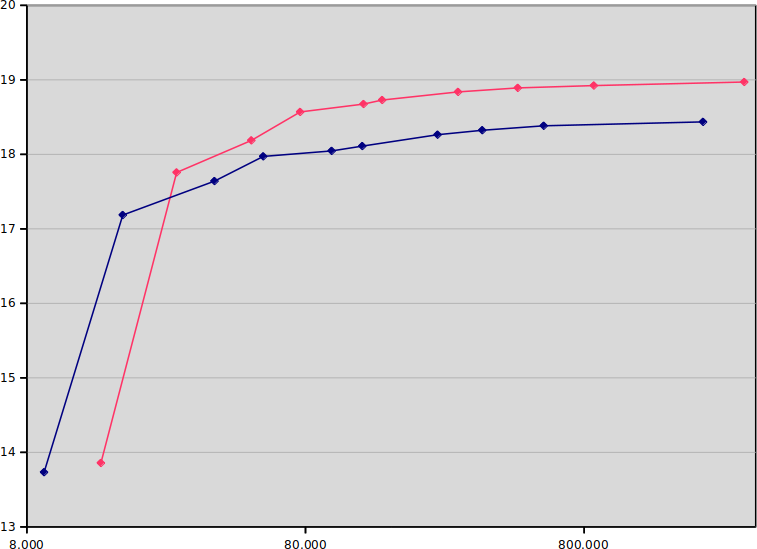
The x-axis is seconds used for the encode (note the logarithmic scale;
placebo takes 200 250 times as long as ultrafast).
The y-axis is SSIM dB, so up and to the left is better. The blue line is
8-bit, and the red line is 10-bit. (I ran most encodes five times and
averaged the results, but it doesn't really matter, due to the logarithmic
scale.)
The results are actually much stronger than I assumed; if you run on
(8-bit) ultrafast or superfast, you should stay with 8-bit, but from there
on, 10-bit is on the Pareto frontier. Actually, 10-bit veryfast (18.187 dB)
is better than 8-bit medium (18.111 dB), while being four times as fast!
But not all of us have a relation to dB quality, so I chose to also do a
test that maybe is a bit more intuitive, centered around bitrate needed for
constant quality. I locked quality to 18 dBm, ie., for each preset, I
adjusted the bitrate until the SSIM showed 18.000 dB plus/minus 0.001 dB.
(Note that this means faster presets get less of a speed advantage, because
they need higher bitrate, which means more time spent entropy coding.)
Then I measured the encoding time (again five times) and graphed the results:
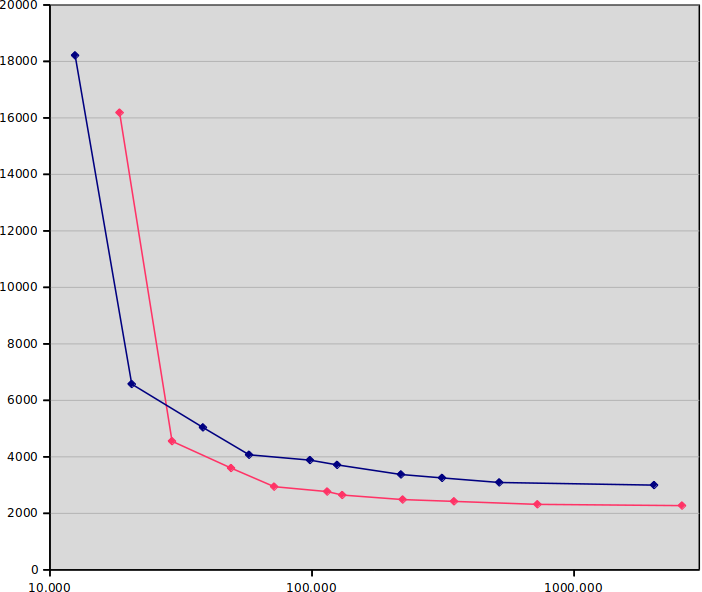
x-axis is again seconds, and y-axis is bitrate needed in kbit/sec, so lower
and to the left is better. Blue is again 8-bit and red is again 10-bit.
If the previous graph was enough to make me intrigued, this is enough to make
me excited. In general, 10-bit gives 20-30% lower bitrate for the same
quality and CPU usage! (Compare this with the supposed up to 50% benefits
of HEVC over H.264, given infinite CPU usage.) The most dramatic example
is when comparing the medium presets directly, where 10-bit runs at
2648 kbit/sec versus 3715 kbit/sec (29% lower bitrate!) and is only 5%
slower. As one progresses towards the slower presets, the gap is somewhat
narrowed (placebo is 27% slower and only 24% lower bitrate), but in the
realistic middle range, the difference is quite marked. If you run 3 Mbit/sec
at 10-bit, you get the quality of 4 Mbit/sec at 8-bit.
So is 10-bit H.264 a no-brainer? Unfortunately, no; the client hardware support
is nearly nil. Not even Skylake, which can do 10-bit HEVC
encoding in
hardware (and 10-bit VP9 decoding), can do 10-bit H.264 decoding in hardware.
Worse still, mobile chipsets generally don't support it. There are rumors
that iPhone 6s supports it, but these are unconfirmed; some Android chips
support it, but most don't.
I guess this explains a lot of the limited uptake; since it's in some ways
a new codec, implementers are more keen to get the full benefits of HEVC instead
(even though the licensing situation is really icky). The only ones I know
that have really picked it up as a distribution format is the anime scene,
and they're feeling quite specific pains due to unique content (large
gradients giving pronounced banding in undithered 8-bit).
So, 10-bit H.264: It's awesome, but you can't have it. Sorry :-)
 Once again, I'm making an announcement mainly for my local circle of friends and (gasp!) followers. For those of you over 100Km away from Mexico City, please disregard this message.
Back in July 2015, and after two years of hard work, my university finished the publishing step of my second book. This is a textbook for the subject I teach at Computer Engineering: Operating Systems Fundamentals.
The book is, from its inception, fully available online under a permissive (CC-BY) license. One of the books aimed contributions is to present a text natively written in Spanish. Besides, our goal (I coordinated a team of authors, working with two colleagues from Rosario, Argentina, and one from Cauca, Colombia) was to provide a book students can easily and legally share with no legal issues.
I have got many good reviews so far, and after teaching based on it for four years (while working on it and after its publication), I can attest the material is light enough to fit in a Bachelors level degree, while it's deep enough to make our students sweat healthily ;-)
Anyway: I have been scheduled to present the book at my university's main book show, 38 Feria Internacional del Libro del Palacio de Miner a this Saturday, 2017.03.04 16:00; Sal n Manuel Tols . What's even better: This time, I won't be preparing a speech! The book will be presented by my two very good friends, Jos Mar a Serralde and Rolando Cedillo. Both of them are clever, witty, fun, and a real honor to work with. Of course, having them present our book is more than a double honor.
So, everybody who can make it: FIL Miner a is always great and fun. Come share the love! Come have a book! Or, at least, have a good time and a nice chat with us!



 The
 systemd 233 is scheduled to be released next week, and there is only
 One of the products I have done some work on at Red Hat has recently been
released to customers and there have been a few things written about it:
 Like many people I use a password-manage to record logins to websites. I previously used a tool called pwsafe, but these days I switched to using
 France passed a law about right to disconnect (more info

 For those who haven t heard,
 I'm currently developing an nRF51822-based embedded device. Being one the Qt/Qt Creator maintainers in Debian I would of course try to use it for the development. Turns out it works pretty good... with some caveats.