Search Results: "spa"

19 November 2010

Debian News: Following Debian via microblogging

If you are user of identi.ca, twitter or both and you want to follow the Debian updates via this services, you can follow the: - official Debian identi.ca account
- official Debian twitter account

Also, Planet Debian is available at identi.ca with additional accounts for the Spanish and French planets.

If you are a Debian contributor using microblogging or part of a Debian team that uses microblogging to update
about your work, please include it in the list: http://wiki.debian.org/Teams/Publicity/Identica

Ondřej Čertík: Google Code vs GitHub for hosting opensource projects

Cython is now considering options where to move the main (mercurial) repository, and Robert Bradshaw (one of the main Cython developers) has asked me about my experience with regards to Google Code and GitHub, since we use both with SymPy.

Google Code is older, and it was the first service that provided free (virtually unlimited) number of projects that you could easily and immediately setup. At that time (4 years ago?) that was something unheard of. However, the GitHub guys in the meantime not only made this available too, but also implemented features, that (as far as I know) no one offers at all, in particular hosting your own pages at your own domain (but at GitHub's servers, some examples are sympy.org and docs.sympy.org), commenting on git branches and pull requests before the code gets merged in (I am 100% convinced that this is the right approach, as opposed to comment on the code after it gets in), allow to easily fork the repository and it has simply more social features, that the Google Code doesn't have.

I believe that managing an opensource project is mainly a social activity, and GitHub's social features really make so many things easier. From this point of view, GitHub is clearly the best choice today.

I think there is only one (but potentially big) problem with GitHub, that its issue tracker is very bad, compared to the Google Code one. For that reason (and also because we already use it), we keep our issues at Google Code with SymPy.

The above are the main things to consider. Now there are some little things to keep in mind, that I will briefly touch below: Google Code doesn't support git and blocks access from Cuba and other countries, when you want to change the front page, you need to be an admin, while at GitHub I simply add push access to all sympy developers, so anyone just pushes a patch to this repository: https://github.com/sympy/sympy.github.com, and it automatically appears on our front page (sympy.org), with Google Code we had to write long pages (in our docs) about how to send patches, with GitHub we just say, send us a pull request, and point to: http://help.github.com/pull-requests/. In other words, GitHub takes care of teaching people how to use git and figure out how to send patches, and we can concentrate on reviewing the patches and pushing them in.

Wikipages at github are maintained in git, and they provide the webfrontend to it as opensource, so there is no vendor lock-in. Anyone with github account can modify our wiki pages, while the Google Code pages can only be modified by people that I add to the Google Code project, which forced us to install mediawiki on my linode server (hosted at linode.com, which by the way is an excellent VPS hosting service, that I have been using for couple of years already and I can fully recommend it), and I had to manage it all the time, and now we are moving our pages to the github wiki, so that I have one less thing to worry about.

So as you can see, I, as admin, have less things to worry about, as github manages everything for me now, while with Google Code, I had to manage lots of things on my linodes.

One other thing to consider is that GitHub is only for git, but they also provide svn and hg access (both push and pull, they translate the repository automatically between git and svn/hg), I never really used it much, so I don't know how stable this is. As I wrote before, I think that git is the best tool now for maintaining a project, and I think that github is now the best choice to host it (except the issue tracker, where Google Code is better).

18 November 2010

Axel Beckert: Useful but Unknown Unix Tools: friends of du

You probably all know du from GNU Coreutils. But there s more than just du around in Debian. du xdu First there is xdu, which displays du output piped into it graphically, even if du is running on some other box with the output coming over an ssh connection:
$ du   xdu
$ ssh server-without-xlibs du some-directory   xdu
Clicking on any directory except the topmost zooms into that directory. Pressing n sorts by size and s toggles the display of sizes in numbers. xdiskusage xdiskusage seems to be a fork of xdu or at least shares some GUI code with it as it looks and behaves quite similar.
But the GUI looks nicer, more modern and you don t need to pipe the output of du into it. It collects the disk usage of a given directory itself. ncdu And then there is ncdu, the ncurses du . (It has nothing to do with the German party CDU . You can easily remember that as Not CDU . ;-) It shows you the disk usage of files and subdirectories in the given directory already sorted by size, optionally displaying also ascii art bars and/or percentage (by pressing g one or more times) for better comparision between file and directory sizes. And all easily and intuitively to navigate in an ncurses text-mode user interface.
ncdu 1.3 ~ Use the arrow keys to navigate, press ? for help
--- /home/abe/debian/webwml ------------------------------------
                             /..
   70.2MB [20.0% ##########] /english
   40.9MB [11.7% #####     ] /french
   35.0MB [10.0% ####      ] /german
   30.2MB [ 8.6% ####      ] /swedish
   26.6MB [ 7.6% ###       ] /japanese
   23.2MB [ 6.6% ###       ] /spanish
   21.5MB [ 6.1% ###       ] /portuguese
   19.8MB [ 5.6% ##        ] /danish
   15.2MB [ 4.3% ##        ] /italian
    9.8MB [ 2.8% #         ] /russian
    8.8MB [ 2.5% #         ] /polish
    6.5MB [ 1.8%           ] /finnish
    5.8MB [ 1.6%           ] /chinese
    4.4MB [ 1.3%           ] /catalan
    4.3MB [ 1.2%           ] /dutch
    3.7MB [ 1.0%           ] /korean
    3.4MB [ 1.0%           ] /ukrainian
    3.0MB [ 0.9%           ] /czech
    2.6MB [ 0.7%           ] /croatian
    2.6MB [ 0.7%           ] /bulgarian
    2.4MB [ 0.7%           ] /norwegian
    1.7MB [ 0.5%           ] /hungarian
    1.6MB [ 0.4%           ] /romanian
    1.2MB [ 0.3%           ] /greek
    1.2MB [ 0.3%           ] /turkish
    1.1MB [ 0.3%           ] /slovak
  576.0kB [ 0.2%           ] /Perl
  556.0kB [ 0.2%           ] /arabic
  428.0kB [ 0.1%           ] /lithuanian
 Total disk usage: 351.1MB  Apparent size: 351.1MB  Items: 70653                                                      
And yes, I uploaded the two screenshots shown above also to screenshots.debian.net as both tools had no screenshots available yet.

16 November 2010

Lior Kaplan: SpaceFun is really fun!

With today regular update from unstable an update to desktop-base package has brought the SpaceFun theme to Debian. This change made my feel like a child with a new shiny toy (: Take you Valessio Brito for this theme it looks great. p.s. As Rapha l mentioned, help is needed to integrated the rest of the theme to other packages.
Filed under: Debian GNU/Linux

Ingo Juergensmann: Frozen Squeeze, broken packages and bug reports

Squeeze is frozen for some time now and will be released when it's ready, of course. Currently, I have at least two packages that have reported bugs, but it seems that they are making no progress. The first package is BackupPC.One of the bugs is #600654 and the other is #601843. Where as the first is just a cosmetic bug displaying filesystem usage of the backup volume, the other seems to have a functional impact: the backup pool doesn't get cleaned up properly each night. Sadly the maintainer seems a little bit absent, so maybe someone else can do a NMU to get BackupPC into shape for release? Would be nice, though... ;-) The other package is spamassassin or more exactly libnetaddr-ip-perl and bug #601601. Whereas the BackupPC maintainer is rather quiet, there's lot of activity for the other bug but still I get these errors when running Spamassassin by cron:
netset: cannot include 0:0:0:0:0:0:0:1/128 as it has already been included
Although I'm confident that #601601 will be solved soon, I don't really know about the BackupPC bugs, except writing additional info mails to those bugs with "add me!" comment. UPDATE 17.11.2010:
libnetaddr-ip-perl (#601601) seems to be fixed now.

Debian News: Debian Women IRC Training Sessions begins

The Debian Women project is pleased to announce the -start of a series of training sessions to be held via IRC in the Debian Women IRC channel, #debian-women on irc.debian.org

The first session has been scheduled for Thursday, 18th November at 20:00 UTC. Lars Wirzenius, will give an introductory lesson titled Introduction to Debian Packaging .

The main goal of this initiative is to encourage more people, specifically women, to contribute to Debian while introducing them to different aspects of the Debian Project. Topics will span a wide range of subjects related to daily Debian maintenance efforts as well as advanced tasks and are open to everybody, regardless of gender or previous involvements in the community.

Future sessions will be held on a regular basis, and will cover collaborative maintenance with git, Python modules and applications packaging, and many more. Please visit the Training Sessions wiki page regularly to check the up-to-date agenda and follow our group on identi.ca. You may also refer to the wiki to suggest new topics or sign up yourself as a trainer: we are always looking for more people to share knowledge and complete the schedule, so don t be shy!

For further information about the Debian Women project, please visit the Debian-Women website or send mail to the Debian Women mailing list.

Steve McIntyre: Naming and shaming spammers

I'm going to be listing the more inept of the commercial spammers that I'm annoyed by, so I can hopefully help give them a more accurate reputation on Google searches. Spammer Number 1: CM Crossroads via Streamsend Guilty of: spamming lots of Debian mailing lists. I guess that "agile business" is a synonym for "being spamming bastards", based on this. I'll be careful to remember this in future.

15 November 2010

Neil Williams: Documenting Emdebian - intro

Developers are not usually the right people to write documentation, but in an effort to encourage more Debian folk to consider Emdebian, I'm starting an intermittent series of blog posts to describe how Emdebian works and how it fits with Debian. Emdebian has a variety of ideas and experiments but the principle distribution, to be released alongside Debian Squeeze, is Emdebian Grip. This post, I'll cover the basic stuff. Feel free to let me know if there are particular issues you'd like covered. In particular, if the documentation on the Emdebian Grip website needs improving, let us know.
What's Emdebian Grip all about?
Simply a smaller Debian. Smaller packages, smaller downloads, smaller sets of packages, smaller installation sizes and smaller update sizes; yet always and completely binary compatible with Debian. Every backtrace from an Emdebian Grip device will match the backtrace on a Debian machine of the same architecture, package version etc. Packages can be mixed trivially (with some allowances for strict dependencies like -dbg packages). The name is a derivative of Squeeze - to make Debian smaller, we take a hold of it; Grip it.
Is it cross-building?
NO. Emdebian Grip is not recompiled (natively or cross), it is processed. Packages natively built in Debian are unpacked, files removed and repacked on the server before being included into the Emdebian repositories. dpkg and perl do all the work, not gcc.
What gets taken out?
Translations move out of the source packages and into TDebs (organised by locale) and compiled .mo files are then removed from the binary packages. Manpages and other documentation is lost entirely, copyright is compressed and changelogs are removed. None of the binary files are touched. The SHA256 sum of your /usr/bin/foo executable in Debian will be precisely the same in Emdebian, the same applies to libraries.
How is it done?
The emdebian-grip-server package in Debian processes the package and treats every architecture in the same way. (This allows Emdebian to carry unofficial ports like SH4, armhf etc.)
Why not filter stuff with dpkg?
The straight answer is that there usually isn't room to download the large package first in order to strip it on device. Also, filtering on device is slow. Stripping the package on the server means that the work is only done once. Every Emdebian device is saved the effort of filtering the files one machine at a time. Grip effectively does what dpkg filtering does, just it does it on the server, repacking the results into a new .deb. Instead of every device doing the task again and again, the server does it once.
Why is my pet package not included?
Emdebian restricts the number of packages which are included in the repositories (less than 10% of Debian packages will be included in Emdebian Grip 2.0 which is based on Debian 6.0 "squeeze") but provides tools which can be used (on device or on the desktop) to prepare any other package for installation on an Emdebian Grip device. There is no need for the machine preparing the package to be of the same architecture as the intended device because all processing is architecture-neutral.
Who decides which packages get included?
Me, basically. The merits of adding particular packages is usually discussed on the debian-embedded mailing list. Typical criteria (in rough order) include:
  1. Subjectively suitable for an embedded device (so OpenOffice.org does not qualify)

  2. most, if not all, dependencies already included in Grip

  3. already available in Debian testing

  4. not in a state of churn in Debian (rapid upload cycles, frequent library transitions etc.)
  5. not particularly buggy in Debian

Can I convert Debian to Emdebian Grip
Yes - simply add Emdebian to your apt sources list and watch as your next upgrade releases tens of megabytes of space.
What are these em1 version suffixes?
Emdebian modifies Debian packages, albeit in an architecture-independent manner, by removing files. The resulting packages are therefore different to the originals, albeit containing compatible binaries. Hence, the Emdebian processing adds the em1 version suffix to show which version is installed. Adding the suffix also means that every Emdebian package is considered to be an upgrade compared to the equivalent Debian package, if both exist in your apt sources.
How is Emdebian Grip installed?
It is possible to use Debian Installer (we provide pre-seeding files to help this process) or create a simple tarball using multistrap if that is more suitable for your device.
What about Recommends: ?
Debian defaults to installing all packages listed as Recommends in the package metadata. Emdebian simply drops the entire Recommends field when processing the package. Suggests is also omitted. This dramatically shortens dependency chains and gives developers full control over which packages are installed. It is important here to consider the embedded device user interface. Recommends exists to support those users who need the extra parts of the package, the bells and whistles. Embedded devices strictly control which parts of the package is actually exposed to the user - there is no need for a menu or a desktop. Users can only access the functionality exposed by the device, so no bells and whistles - just the base system and whatever you choose to expose as part of the interface. Rather than require all Emdebian devices to turn off Recommends individually, Emdebian simply drops Recommends at the server and allows the developer to cherry-pick which packages to add.

More to follow . . .

Jaldhar Vyas: Oxford English Dictionary Word of the Year For 2010

Refudiate. [note: OUP blog may be unreachable due to heavy traffic and/or terminal embarrassment.] I'll just go ahead and delete that draft post I've been writing about the American educational system. Update: Oxford American Dictionary actually. Your precious literacy is safe...for now.

Raphaël Hertzog: Save disk space by excluding useless files with dpkg

Most packages contain files that you don t need: for example translations in languages that you don t understand, or documentation that you don t read. Wouldn t it be nice if you could get rid of them and save a few megabytes? Good news: since dpkg 1.15.8 you can! dpkg has two options --path-include=glob-pattern and --path-exclude=glob-pattern that control what files are installed or not. The pattern work the same than what you re used to on the shell (see the glob(7) manual page). Passing those options on the command-line would be impractical, so the best way to use them is to put them in a file in /etc/dpkg/dpkg.cfg.d/. Beware, the order of the options does matter: when a file matches several options, the last one makes the decision. A typical usage is to first exclude a directory and then to re-include parts of that directory that you want to keep. For example if you want to drop gettext translations and translated manual pages except French, you could put this in /etc/dpkg/dpkg.cfg.d/excludes:
# Drop locales except French
path-exclude=/usr/share/locale/*
path-include=/usr/share/locale/fr/*
path-include=/usr/share/locale/locale.alias
# Drop translated manual pages except French
path-exclude=/usr/share/man/*
path-include=/usr/share/man/man[1-9]/*
path-include=/usr/share/man/fr*/*
Note that the files will vanish progressively every time that a package is upgraded. If you want to save space immediately, you have to reinstall the packages present in your system. aptitude reinstall or apt-get --reinstall install might help. In theory with aptitude you can even do aptitude reinstall ~i but it tends to not work because one package is not available (either because it was installed manually or because the installed version has been superseded by a newer version on the mirror).
Found it useful? Click here to see how you can encourage me to provide more articles like this one.

8 comments Liked this article? Click here. My blog is Flattr-enabled.

Erich Schubert: Dear Lazyweb: tools for blog comments

Dear Lazyweb,
My blog currently does not have a comment function, since it is based on static HTML files (I just don't trust the average PHP blog software; I've seen to many issues and bad code there). So I'm considering ways to keep the comments separate from the actual blog; so that if they don't work, they'll still not affect my blog.
One option is to deploy a comment application e.g. on Google AppEngine. Another one would be to use SideWiki.
Have you used either of them? What are your experiences? Is there another simple option to add comments to my blog without going for one of those despised PHP applications - email me erich () debian org!
P.S. related to my previous post: planet.debian.org seems to use the "updated" timestamp where it should be using the "published" time AFAICT. Planet Gnome gets it right - do we need to upgrade the planet software on p.d.o?
Update: half a dozen people have pointed me to Disqus along with some other alternatives (Ikiwiki, building an own Django app, or using identi.ca). I guess I will give Disqus a try (although most just have "come across" it). Thank you, Lazyweb.

Alessio Treglia: Bits from the Debian Multimedia Maintainers

This brief announcement was published in the debian-devel-announce mailing list and I repeat it here for your information.
Hi! Since there has been a lot happening in the Debian Multimedia world during the Squeeze release, so we figured we should give you an update on that. Who are we? In the dark old ages, there were two teams involved in multimedia: the Debian Multimedia and Debian Multimedia Packages teams. Please note that neither of them is related to debian-multimedia.org (which is maintained by Christian Marillat, and is known to break current ffmpeg-based applications like mplayer and vlc in Debian Squeeze.). During late 2008, both teams were merged into one, the Debian Multimedia Maintainers team, to avoid effort fragmentation. Since then, there has been a lot of work done: Consumer Multimedia in Debian Consumer Multimedia is about playing and, well, consuming multimedia. Squeeze will feature: Squeeze will not feature: Producer Multimedia in Debian Producer multimedia is software for producing multimedia. Squeeze will
feature: End user applications: Platforms and technologies: Squeeze will not feature: Debian Multimedia Blend There is also an effort to start a Debian Multimedia Blend to give a better overview about what multimedia applications are available in Debian. There is a short list for a quick overview as well as a long package list separated in sections to give a more detailed overview (including translations, screenshots, popularity of package etc). You are invited to help improving the tasks either directly in SVN or by sending patches to Andreas Tille <tille@debian.org> or debian-multimedia@lists.debian.org (see below). Note that not all of the packages listed in the tasks pages are maintained by the Debian Multimedia team, since they are aimed at producing useful package sets instead of showing only our own packages. For those who want to squash some bugs in multimedia packages there is also the bugs page generated by the Blends tools, or our team bug page. Other activity The team has seen a lot of growth since the merger. Of the current 52 members of the Alioth team, 20 were added during 2009 and 18 in 2010, many of whom are involved in upstream development as well as the debian packaging. The number of packages has also grown, with 112 of the current 205 git repositories in our team area having its first commit during 2010. Where to reach us The Debian Multimedia Maintainers can be reached at pkg-multimedia-maintainers@lists.alioth.debian.org, should you have any questions. We have also decided to repurpose the old debian-multimedia@lists.debian.org address for user and more general discussion. We would like to invite everyone interested in multimedia to join us there. Interested developers/packagers can also join us at the first address. Some of the team members are also in the #debian-multimedia channel on OFTC.

Regards,

Alessio Treglia on behalf of the Debian Multimedia Maintainers

14 November 2010

Erich Schubert: Anybody using feedburner?

Dead Lazyweb*, Is anyone of you using FeedBurner for his blog? My new blog is Atom based, and FeedBurner would be a simple way of also offering RSS feeds. I don't think my blog is worth bothering with all the other 'features' of Feedburner, and I don't really want Google to track my subscribers ... And in fact, I'm not narcissistic enough to believe I have a single direct "subscriber", I belive that almost all my readers are using one or another planet ... that's why I also don't twitter - who'd read it? So: do you have experience here? If you use Feedburner, what benefits do you get? Drop me an email, erich () debian org. * Definition of Lazyweb

12 November 2010

Rog rio Brito: Packaging fonts for a Debian-based system

Seeing now that the situation regarding Free fonts is much better than in the past, I have started packaging some that are of high enough quality so that we can have it available on our systems (be it Debian or any of the good derivatives). In particular, I spent some time during the past few days packaging some that, I think, deserve to be mentioned: Well, that's it for now. Stay tuned for more to come.

Pietro Abate: dose3 distcheck

A while ago I wrote about the new distcheck tool upcoming in dose3. I've recently updated the proposal on the debian wiki to reflect recent changes in the yaml data structure. The idea was to remove redundant information, to make it easier to read and at the same time include enough details to make it easy to use from a script. I'll write down a small example to explain the format. A package can be broken because of a missing package or because of a conflict. For a missing package we'll have a stanza like this :
package: libgnuradio-dev
version: 3.2.2.dfsg-1
architecture: all
source: gnuradio (= 3.2.2.dfsg-1)
status: broken
reasons:
-
missing:
pkg:
package: libgruel0
version: 3.2.2.dfsg-1+b1
architecture: amd64
missingdep: libboost-thread1.40.0 (>= 1.40.0-1)
paths:
-
depchain:
-
package: libgnuradio-dev
version: 3.2.2.dfsg-1
architecture: all
depends: libgnuradio (= 3.2.2.dfsg-1)
-
package: libgnuradio
version: 3.2.2.dfsg-1
architecture: all
depends: libgnuradio-core0
-
package: libgnuradio-core0
version: 3.2.2.dfsg-1+b1
architecture: amd64
depends: libgruel0 (= 3.2.2.dfsg-1+b1)
The first part gives details about the package libgnuradio-dev, specifying its status, source and architecture. The second part is the reason of the problem. In this case it is a missing package that is essential to install libgnuradio-dev. missindep is the dependency that cannot be satisfied is the package libgruel0 , in this case: libboost-thread1.40.0 (>= 1.40.0-1). The paths component gives all possible depchains from the root package libgnuradio-dev to libgruel0 . Notice that we do not include the last node in the dependency chain to avoid a useless repetition. Of course there might be more then on path to reach libgruel0. Distcheck will unroll all of them. Because of the structure of debian dependencies usually there are not so many paths. The other possible cause of a problem is a conflict. Consider the following :
package: a
version: 1
status: broken
reasons:
-
conflict:
pkg1:
package: e
version: 1
pkg2:
package: f
version: 1
depchain1:
-
depchain:
-
package: a
version: 1
depends: b
-
package: b
version: 1
depends: e
depchain2:
-
depchain:
-
package: a
version: 1
depends: d
-
package: d
version: 1
depends: f
This is the general case of a deep conflict. I use an artificial example here instead of a concrete one since this case is not very common and I was not able to find one. To put everything in context, this is the example I've used (it's in cudf format, but I think you get the gist of it):
package: a
version: 1
depends: b, d

package: b
version: 1
depends: e

package: d
version: 1
depends: f

package: f
version: 1
conflicts: e

package: e
version: 1
conflicts: f
The first part of the distcheck report is as before with details about the broken package. Since this is a conflict, and all conflicts are binary, we give the two packages involved in the conflict first. Packages f and e are in conflict, but they are not direct dependency of package a . For this reason, we output the two paths that from a lead to f or e. All dependency chains for each conflict are together. Again, since there might be more than one way from a to reach the conflicting packages, we can have more then one depchain. Another important upcoming change is distcheck (to be implemented soon) it the ability to check if a package is in conflict with an Essential package. In the past edos-debcheck always check the installability of a package in the empty universe. This assumption is actually not true for debian as all essential packages should always be installed. For this reason, now distcheck will check the installability problem not in an empty universe, but in a universe with all essential packages installed. This check is not going to be fool proof though. Because of the semantic of essential packages, despite is not possible to remove a package toutcourt, an essential package can be replaced by a non essential package via the replace mechanism. For example, poking with this feature I noticed that the package upstart in sid replace sysinit and it is in conflict with it. This is perfectly fine as it gives a mechanism to upgrade and replace essential components of the system. At the same time this does not fit in the edos-debcheck philosophy of checking packages for installation problems in the empty universe (or in a universe with all essential packages installed). At the moment we are still thinking how to address this problem (the solution will be in the long term to add the replace semantic in distcheck), but for the moment we will just provide an option to check packages w.r.t essential packages conscious the this can lead to false positives. This work is of course done in collaboration with the mancoosi team in paris. Dose3 is still not ready for prime time. We are preparing debian packages and we plan to upload them in experimental in the near feature.

11 November 2010

Rapha&#235;l Hertzog: Debian Squeeze artwork selected by the desktop team

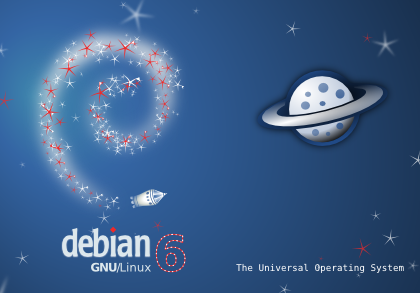
It looks like the desktop team has selected the artwork (including wallpaper and GDM theme) for the upcoming Debian 6.0 release. The winner of the small contest is SpaceFun by Valessio Brito. Included below is the splash screen, click here to see all the pictures. The other options in the poll were Nightly, Ciel and Lisp Machine. Thanks to the artists who participated in this contest! But the work is not over yet: while the artwork has been selected, it still needs to be integrated in the system. If you feel like helping by creating a theme for a display manager (GDM/KDM/SLIM) or for the Grub boot loader, please drop a mail to debian-desktop@lists.debian.org (subscribe here).
Be informed early by following me on Identi.ca, Twitter or Facebook.

16 comments Liked this article? Click here. My blog is Flattr-enabled.

Matt Zimmerman: Back to the future

In my professional role as Ubuntu CTO, I take on a number of different perspectives, which sometimes compete for my attention, including: My recent work, as Canonical has gone through a period of organizational growth and change, has prioritized the inward perspective. I took on a six-month project which was inwardly focused, temporarily handing off many of my day-to-day responsibilities (well done, Robbie!). I ve grappled with an assortment of growing pains as many new people joined Canonical over the past year. With that work behind me, it s time to rebalance myself and focus more outside of Canonical again. It s good to be back! In my outward facing capacity, I ll shortly be attending Web 2.0 Summit in San Francisco. I attend several free software conferences each year, but this is a different crowd. I hope to renew some old ties, form some new ones, and generally derive inspiration from the people and organizations represented there. Being in the San Francisco Bay area will also give me an opportunity to meet with some of Canonical s partners there, as well as friends and acquaintances from the free software community. With my head down, working hard to make things happen, it s easy to lose perspective on how that work fits into the outside world. Spending more time with people outside of Canonical and Ubuntu is an important way of balancing that effect. Looking forward, I ll be thinking about the longer term direction for the Ubuntu platform. The platform is the layer of Ubuntu which makes everything else possible: it s how we weave together products like Desktop Edition and Server Edition, and it s what developers target when they write applications. Behind the user interfaces and applications, there is a rich platform of tools and services which link it all together. It s in this aspect of Ubuntu that I ll be investing my time in research, experimentation and imagination. This includes considering how we package and distribute software, how we adapt to technological shifts, and highlighting opportunities to cooperate with other open source projects. My primary outside-in role is as chair of the Ubuntu Technical Board. In this capacity, I m accountable to the Ubuntu project, the interests of its members, and the people who use the software we provide. Originally, the TB was closely involved with a range of front-line technical decisions in Ubuntu, but today, there are strong, autonomous teams in place for the most active parts of the project, so we only get involved when there is a problem, or if a technical question comes up which doesn t fit the charter of an established team. It s something of a catch-all. I d like to re-establish the TB in a more central role in Ubuntu, looking after concerns which affect the project as a whole, such as transparency and development processes. I m also re-joining Debian as a non-uploading contributor, to work on stimulating and coordinating cooperation between Debian and Ubuntu. I m looking forward to working more with Zack on joint projects in this area. This change will help me to support Canonical and Ubuntu more effectively as they continue to grow and change. I look forward to exercising some mental muscles I haven t used very much lately, and facing some new challenges as well.

Evgeni Golov: OpenRheinRuhr 13/14 November 2010

openrheinruhr logoOn the 13/14 November 2010 there is a nice event in the so called Ruhrpott : OpenRheinRuhr. And I d like to invite YOU :)What should you expect from heading to the RIM in Oberhausen and paying 5 entry-fee? You get a nice program full of great talks (like mine about bley ;), mikas about OpenSource management, tokkees about Git and XTarans about cli-helpers and unknown tools), a bunch of nice people showing you their distro, software, etc (Debian is there too), a social event, a keysigning party and a lot of hacking and fun. So if you are somewhere nearby, join us and enjoy the event!


German version (sorry planet debian readers ;)):Am 13/14 November findet im Pott die OpenRheinRuhr statt, zu der ich euch alle herzlichst einladen moechte.Was kann man erwarten, wenn man den Weg ins RIM in Oberhausen gefunden hat und die 5 Eintritt bezahlt hat? Euch erwartet ein Programm voller Talks (zB meiner ueber bley ;), mikas ueber OpenSource Management, tokkees ueber Git und XTarans ueber Helfer auf der Kommandozeile and anderere unbekannte Tools), viele Aussteller, die die eigene Distro, Software oder was auch immer anpreisen (Debian ist natuerlich auch da), ein Social Event, eine Keysigning Party und natuerlich viel Rumgehacke und Spass. Also, jeder der grad irgendwie in der Naehe ist oder in die Naehe kommen kann: ab nach Oberhausen und geniesst ein freies Wochenende! :)

Steve Kemp: I miss the old Debian

I miss the days when Debian was about making software work well together. These days the user mailing lists are full of posts from users asking for help on Ubuntu [*1*], people suggesting that we copy what Ubuntu has done, and people asking for "howtos" because documentation is too scary or too absent for them to read. Yesterday the whole commercial spam on Planet debate started. Its yet another example of how in-fighting[*2*] seems to be the most fun part of Debian for too many. Me? I started and folded a company. I got Debian help and users. Some threw money at me. Joey Hess? Started making the nice-looking ikiwiki-powered branchable.com. Commercial? Yes. Spam? No. I guess there is little I can do. I could quit - as over time I've become less patient dealing with the project as a whole, but simultaneously more interested in dealing with a few specific people. But I suspect the net result would be no change. Either people would say "Ok , bye" or worse still offer my flttry: "Don't go - we lurve you". Meh. I shouldn't write when I'm annoyed, but living in a hotel will do that to you. Footy-Mc-Foot-notes. Cos HTML is hard. Lets go shopping Eat Cake.
1
The Ubuntu forums are largely full of the blind leading the blind. Or equally often the blind being ignored. I do believe that an Ubuntu stackoverflow site would be more useful than forums. But that's perhaps naive. People will still most often say "My computer doesn't work" missing all useful the details. The only obvious gain is you can avoid "me too!!!" comments, and "fix this now or I'm gonna go .. use gentoo?".
2
Back a few years when people were less civil some mailing lists and irc channesl were unpleasant places to be. These days we've solved half the problem: People mostly don't swear at each other. The distractions, the threads that don't die, even if you ignore them and don't join in the "hilarity" they still have a devisively negative effect.

8 November 2010

Cyril Brulebois: Debugging using netconsole

Now that we have KMS, it happens things go bad enough that when X goes down, one can no longer access any console to see what happened. Mainly, one can distinguish between two cases. I m going to discuss the second case. There s a nice tool in the kernel which makes it possible to send kernel logs over the network. It s called netconsole. As far as limitations are concerned, one shall note that it s UDP only, and over Ethernet (in other words: no wireless). The good news is that it can usually make the last crucial lines available. Let s call the crashy machine a patient and the logging machine a doctor. One should keep in mind that if something goes wrong while configuring the netconsole module, it can be unloaded at anytime through:
sudo modprobe -r netconsole
Easy case: on a local network Local network Here s an example: Patient s IP is 192.168.0.1, doctor's IP is 192.168.0.2. Doctor setup What one needs on the receiving side: only netcat. A tiny warning, there are several implementations. Here s the appropriate syntax:
# netcat-traditional:
nc -l -u -p 6666   tee ~/netconsole.log
# netcat-openbsd:
nc -l -u 6666   tee ~/netconsole.log
The nc command is handled through the alternatives system, one can use update-alternative --config nc to pick the appropriate one if several netcat-* packages are installed. To list the current one, an easy way is readlink -f $(which nc). Using tee means that incoming messages are going to be printed, both to the standard output and to the specified file. Running as non-privileged user is sufficient. Patient setup Now, to have the patient send stuff to the doctor, a simple modprobe is needed:
sudo modprobe netconsole netconsole=@/,6666@192.168.0.2/
What happens here? One requests the netconsole module to be loaded, and one specifies the parameters. Details can be read in the Linux kernel documentation (Documentation/networking/netconsole.txt), but concentrating on the points of interest here: That s all! On the doctor side, one should see something along those lines:
[2920549.188090] console [netcon0] enabled
[2920549.188102] netconsole: network logging started
Slightly harder case: over internet Over internet Because one might not have a second machine handy, it s also possible to go through a router and send stuff across the internet. Here s an example: Patient s IP is 192.168.0.1, connecting to internet through a router, which IP is 192.168.0.254. The doctor, available over the internet, is 192.0.32.10. Doctor setup Exactly the same as in the previous case. The main issue one can run into is firewalls at this point. That s why one may want to switch from the default 6666 port to another one which wouldn t be filtered. One can think of 53 (DNS), but that means running nc as root since it s a privileged port (below 1024). Patient setup Routing is also possible, but that requires an extra parameter: the MAC address of the router. To obtain it, one can use the arp command:
/usr/sbin/arp 192.168.0.254
Supposing it returned the 01:02:03:04:05:06 address, loading the module becomes:
sudo modprobe netconsole netconsole=@/,6666@192.0.32.10/01:02:03:04:05:06
Now, if you re running into firewall-related issues, you can change the source for the UDP packets. The default is 6665, but assuming you want to send from an unfiltered 1234 port, that becomes:
sudo modprobe netconsole netconsole=1234@/,6666@192.0.32.10/01:02:03:04:05:06


Next.

Previous.